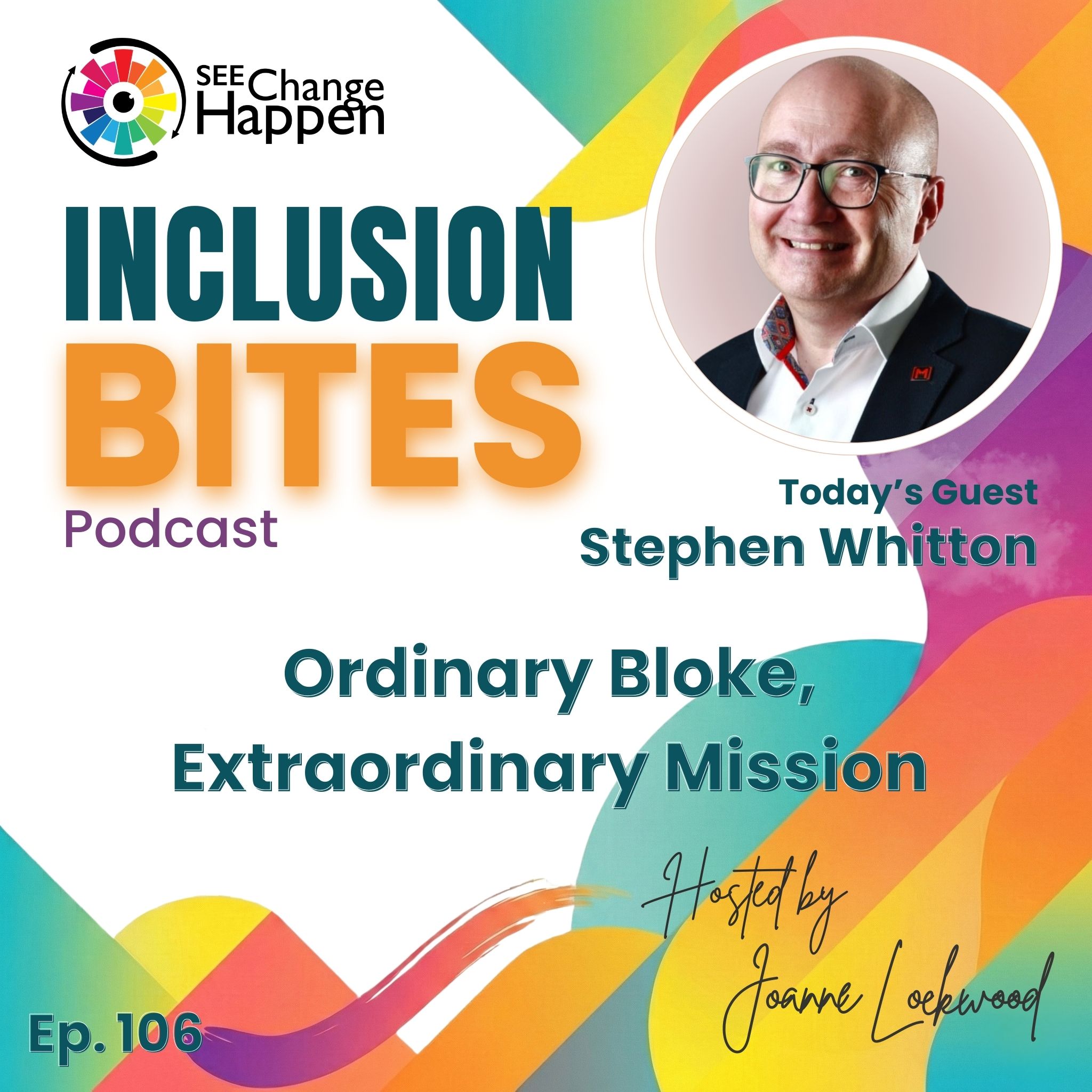
Stephen Whitton illuminates his journey of self-discovery and promoting inclusivity within the car industry by advocating for mental wealth and challenging the norms of traditional masculinity.
In this episode of Inclusion Bites, Joanne Lockwood speaks with Stephen Whitton about workplace culture systems.
“My marriage disintegrated. My family broke up, and I came out at the same time.”
Explore
Navigate this episode
Joanne Lockwoodhost
Welcome to Inclusion Bites, yoursanctuary for bold conversations that spark change. I'mJoanne Lockwood, your guide on this journey of exploration intothe heart of inclusion, belonging, and societaltransformation. Ever wondered what it truly takes to create aworld where everyone not only belongs Bites thrives?You're not alone. Join me as we uncover theunseen, challenge the status quo, and sharestories that resonate deep within. Ready to divein. Whether you're sipping your morning coffee or windingdown after a long day, let's connect, reflect,and inspire action together. Don't forget,you can be part of the conversation too. Reach out tojo.Lockwood@seechangehappen.co.ukto share your insights or to join me on the show.So adjust your earbuds and settle in. It's time toignite the spark of inclusion with Inclusion Bites.And today is episode 106 with thetitle, an ordinary bloke with an extraordinarymission. And I have the absolute honor and privilege to welcome Stephen Whitten.Stephen is the founder, MenebelMenebel, even, speaker and professional emcee. When Iasked Stephen to describe his superpower, he said it is spreading joyand saving the world see smile at a time. Hello, Stephen. Welcome tothe show. Joanne, hi. And I'm so keen to get
Stephen Whittonguest
stuck in. I interrupted you, so,apologies. Yes. It's absolutely I'm delighted to be here. The and that's myjoyful radio voice, or I could be an ordinarybloke and just go, yeah. Thanks for having me. It's been it's brilliant. It's gonna
Stephen Whittonguest
be great. Bites alright. It's alright, Steve. I mean, I I yeah. I had to
Joanne Lockwoodhost
have see eventually, I suppose. No.I'm really excited. I mean, we've known each other now a couple of years and,
Stephen Whittonguest
Yeah. Yeah. I I'm looking forward to this conversation to find out more about you
Joanne Lockwoodhost
and what makes you tick. Oooo Er and I suspect you're not just an ordinarybloke on an extraordinary mission. There's more to you than that. So tell me more.
Stephen Whittonguest
Yeah. Do you know what? The ordinary bloke thing actually came from a mutual friendof ours, Jackie Handy. And we were having a chat one day, and I wastalking about the challenges of life and where I'd come from andwhat had happened to me and all that stuff. And and she actuallysaid to me, she said, you know what? Your your real superpower is that you,you know, you're an ordinary bloke. You're as you look, sound, andact like a very typical,you know, Bites, middle aged, hopefully, middle class. Idon't know I don't know what that means anymore, but, you know, guyon the street, you're just ordinary. You could be working in a car dealership orin a supermarket or driving a busor working in an office or running a big business, you know, just anordinary, ordinary guy. But, yeah, you're right with what I hopeis an extraordinary mission, which, came to me throughsome really dark Bites, actually, which I'll get on to in in a bit. But,yeah. So that's that's what I'm what I'm all about. And most recently, the latestsort of incarnation of of that journey and my evolutionis exactly as you said in the intro, which is about nowproperly realizing that my my destiny, which I think is a step abovepurpose, but, you know, the ultimate one is the the destiny is aboutspreading joy and literally trying to do thatone one smile at a time, you know, saving the world by oneone person smiling at a time. So I love that. An
Joanne Lockwoodhost
ordinary blow. Yeah. Yeah. As I know you, I I can see that inyou that you you are unremarkable package. But asI say, I I know that that there's more to you than that. And, youknow, you're and I can see you driving abus, but I can really see you in a car dealership because isn'tthat your background? Yeah. It is totally. I started in a car dealership when I
Stephen Whittonguest
was 18. Absolutely loved it. It was an act of rebellion becauseI'd gone through school, and I'd done quite well academically given that Iwas a a school that wasn't renowned for its academicprowess, very ordinary secondary modern school in Aylesbury inBuckinghamshire where I grew up, having moved out of London when I was a kid.And I went into the car trade, and my my parents at the time wouldhave had me go into a factory or do something along their lineof work. So because I went into something that, to them, was a lot moreglamorous, that was was almost a sort of my first actof rebellion. Now interestingly, I I used to Irebelled at them because they said, oh, we'll get you a job at the factorywe work in. And I said, I don't wanna work anywhere that'scold, damp, greasy, smelly, and full ofblokes. So I ended up in a car dealership which was cold,damp, greasy, see full of blokes. Butthe act of rebellion was I got to drive flash cars and take the takethem home occasionally and sort of, you know, rub it in my parents' face thatthere there was me at a young age, you know, a flash young man inthe early eighties doing that stuff. I think I think you shared a photograph on
Joanne Lockwoodhost
social media not so long ago of you sort of leaning on the bonnetof, a car. Mhmm. I think you put the caption, me in myyounger days, the same smile, just more hair or something, wasn't it? Iwas yeah. It was I think it was 4 I think I think it said
Stephen Whittonguest
something like 4 stone ago and a lot more hair. And it was a FordCortina that we had for sale on the Foraker, which kinda gives my age awaya little bit as well. But yeah. And that's where it all started. And anddespite my protestations of wanting to get away from the carindustry, it still kinda drags you back in. Yeah. I I I
Joanne Lockwoodhost
it must give me a lot of life skills. You know? It it you're quitea a chatty, engaging, ordinary bloke.Yeah. And I guess the car dealership gives you that kind of backgroundin talking the hind legs of a donkey and just engaging and talking,having conversations. Well, it did, but I think I look back on it
Stephen Whittonguest
now, and I I think my main survival tactic as achild in what was a very vibrant, very opinionated,very working class family. And, I mean, in the early days, my parents seevery young when they had see. So we had to live with my grandparents,and they still had offspring that were living at home. So there was, like, thissort of big group of adults and one smallchild that learned very quickly probably that in order to getthe attention, I had to be as gobby as some of the adults. And soI think by the time I was 6 or 7, I was probably quite aquite an irritating, precocious little child.If I saw a walking radish shop, now I'd I'd walk away from. Butyeah. So I think that's where it started, and I think the car industry thenjust promoted that and gave me a platform to be evenworse. Was it mainly kind of dealerships for big
Joanne Lockwoodhost
manufacturers, or was it the, the cars the car showroom on thecorner pumping out the sort of the canardlies, if youlike? Yeah. Well, it was it was worse than that. It was a a, you
Stephen Whittonguest
know, not quite a back street used car dealership, but it was a it wasa used car dealer in a village that had probably15 to 20 used cars in stock, and we had a Skoda franchise as well,another part of the business, which was just down the road. And, of course, backthen, see Skoda well, that was back in the day where I had a terriblereputation. You know, it was one of those sort of eastern Lockwood countries that noone went anywhere near, except unless you wanted to buy a brand new car andyou had no money to buy buy it with. So we did quite well withthat. But then, yeah, I I moved out the motor trade for a couple ofyears and then went back into it working for VauxhallFinance, which owned by General Motors, so Vauxhall's own financecompany, doing collections and debt recovery and stuff likethat. And they they must have thought, well, this guy's got some good dealerbackground. We're making him an area manager. So I became the youngest area manager they'dever had and drove driving around in my Vauxhall Carlton, don't know if youremember those. I got that as a company car. So there was me, I think.I was like 22, 23, and I was driving around theVauxhall Carlton. I thought I was Billy Bigg Wattsit, and which, of course, thenit rubbed it on in my parents' face even more. Was that debt debt
Joanne Lockwoodhost
collection and repos and stuff, was it? That's what I started off doing with
Stephen Whittonguest
them. And then after a year, I got promoted into an area manager'sjob, and I totally I just did not have a clue what I wasdoing. I mean, it it was it was shockinglybad, really. You know, arse from elbow is is an understatement. I justdid not have a clue. How I blagged my waythrough that is anyone's guess. But, hey, I Lockwood good. I was driving a lovelycar. Eventually did the but the light bulb did go on eventually, and I didget to work out what I was doing. And then that then progressed meinto another, what, another another 10 or 11 yearsworking in that kind of environment before I stepped out and went self employedand started doing training and all that sort of stuff. And then, of course, asyou know training to the motor industry? Yeah. Predominantly.Yeah. Predominantly, which was, you know, again, despitemy stations, I always think at the time, I was like, well, Iwanna get out of the car industry, but the more you do, the more yourealize that your credibility is within that one sector in themain doing that type of work anyway. And,actually, when you go into other organizations, you think that,you know, it's the it's the same crap, different wallpaper,basically. Tell me a bit about Ben Abel, because that figures it
Joanne Lockwoodhost
in sort of towards the end of your story. Mhmm. That then we can figureout how you got from where you were to there and and talk about Bitesabout the jo. You know? How did you discover that you you neededto bring joy to the world because you didn't necessarily have it yourself? Is thatis that how it turned out? Well, yeah. I mean, this is this is the
Stephen Whittonguest
bit where it takes a bit of a dip, so brace yourselves.Effectively, what happened was I jo back a tiny bit. I knew asa teenager bear in mind, I was a teenager in the earlyeighties, sort of 81, 82, that II knew I was curious about my sexuality. Butback then, we didn't talk about Bites, andthose that did came out fully as as gayor hid it and didn't say or do anything. But Iknow that there were other boys of my age that were curious as well.And, you know, because of the sort of, dare I say,heteronormative part of that, managed to create a life that wasthat was normal in in the face of the the society, if youlike. So yeah. So project forward 30 oddyears working in the car industry. I'd been I'd gotmarried, married, and I met and married the prettiest girl in the village when Iwas working in the car dealership. We got married very young. We had 2 childrenfairly quickly. We had the mortgage. We had the house. We had all the bitsand pieces. And the car industry and everything I was doing in itfacilitated that. But working in that industry also meant that you
Stephen Whittonguest
were under pressure, stressed, anxious about where your nextpaycheck was coming from, how big it was gonna be, and all that stuff. And,with all that in mind, eventually, that that was a bubblethat ended up bursting and in the most unpleasant,horrible way that I can imagine. And, you know, to this day, I stilllive with the regret and the and the hate for what happened there and and,you know, the the, remorse for what my nowex wife and my one child in particular feel that Idid by coming out, by declaring the truth, and being authenticallyMy marriage disintegrated. My family broke up, and I cameout at the same time. So it was like, well, there's nothing else thatcan go what could possibly go wrong now? Or we'll just throwbankruptcy into that mix as well. Oh, hang on a minute. Here comes a solicitorwith some divorce papers. That'll do the trick. But yeah, sothat's where I went. And then during the course of 2020, I realized that Iwasn't the only person of a certain age in the car industry that had hadthose issues. So I reached out to some leaders and said, look, got this idea.I think we need to support our colleagues. What do you think? And immediatelypicked up some fantastic supporters and some greatpeople who became advocates and ambassadors for us. And sothat's how the the men able movement began. So so I'll answeryour question. Yeah. So you
Joanne Lockwoodhost
say you look back on it, and it was a dark time,and things didn't go as smoothly as you'd hoped. Yousaid you had some sort of regrets or certainly around youryour your family, if you like. So on reflection, where wherewhat could you have done differently, or where did it go wrong? Was it thestress you were under? Was it just? Yeah. I mean, well, I've I
Stephen Whittonguest
I mean, I suppose re yeah. Regret's a big word, isn't it?What I think I should have done was to havebeen brave enough and big enough to have owned it when I was 18, andbe honest with, you know, the people around me.But at that time, I was fearful, you know. And the fact that that itwas, you know, not not a completely sort of totally gay or totallystraight thing, that it was easy for me to sort of cover one part ofthat up and and just do and outside of that, you know, I'mnot gonna that sound you know, my ex wife will say that'smanipulative and all that. It it's not. It genuinely is the case that I'vemet her, fell in love with her, loved her, and adored her deeply.And so at that point, was like, no. This is you know, Bites let's putthat other bit in a in a box and leave it there. But, of course,it didn't stay there, did it? It simmered away and you know? And thenwhen the conversation happened, when it literally was timed with thepandemic and the business collapsing and having all of that as well. I Ididn't get the reaction from a few people, including my exwife, that I thought I would have done. I don't know why. I don't knowwhy I had believed or naively thought that she would be like, oh, okay. That'sfine. You know? Well, now I just know something more about you that I didn'tknow before. Let's go to Tesco's. I didn't I didn't expect that,but I didn't expect the reaction that I did get. Mhmm. What that diddo was see me down a very dark path of thinking Wellbeing.And I don't mean to trigger anyone who's listening here, but, you know, there werea couple of points where I thought fast moving train's got more appeal than dealingwith this rubbish. And it's only when you get there that you think,that's not me, you know. People often ask me, would I do think differently if
Joanne Lockwoodhost
I had my life again? Things like this. And I I always say that II love I love my family. My coming out storywas not a smooth ride, but it the result has been verypositive. But people often say, yeah, what would you do differently? I said, well, Iwouldn't change a thing because I've got 2 fantastic children thatwouldn't be alive, wouldn't be in my life now, wouldn't be amazing, had Idone something different at the age of 18, 17, or 15, or or 10, orwhatever years old. So Yeah. I I have to say, I would notchange a thing. Mhmm. Because otherwise, I I wish they'derase you if you like. And I think that's that always keeps me focusedthat, yeah, I I've had a whole life. I've had a big life. I'm sureyou've had a an amazing life doing what you Wellbeing,building that family. But it's it's difficult to regret your child'sbirth. Oh, yeah. No. And I don't I don't regret that at all. I mean,
Stephen Whittonguest
I think I still would Happen gone ahead and, you know, that would have happened.But what it would have done is given me the chance, you know, to makethe right choices way back then, and also give my my nowex wife, as I say, the the chance to make an informed decision as well.
Joanne Lockwoodhost
Mhmm. Bites not easy when everything comes together, you see the pandemic,the business failing, your awakening to your ownidentity, and something to do about that. Bites everything kind of carcrashes at once sometimes, doesn't it? And you just you wanna just startagain. Well, yeah. That was exactly it. That was exactly
Stephen Whittonguest
it. And, you know, to be my age, you know, at the time,what, 53, to then be facing,you know, financial ruin, which some would argue wasself imposed, but also, you know, that disintegrationof of a loving family environmentand, you know, losing the person that you would hope to have grown oldwith. You know, all of that together. And that's not a woe is me story.That's just a that's a accepting getting to a point of acceptingthat's the realistic situation that happened. You know, there's lotsof other stuff that, obviously, I wouldn't share that, obviously, she knows aboutthat. You know, she would argue, well, that was that was the crux of itall. Because, again, that's the other thing that the motor trade does is itthe divorce rates are very high because paint inthe bits in between the lines what you want. But suffice tosay, when you put a lot of people together in the same environment, andthey're stressed and anxious and under pressure,they can have a tendency to takesolace in each other. You know what I'm saying?
Stephen Whittonguest
And so, of course, you throw that into the mix as well, and and suddenly,Bites, yeah, it's it's a bit of a hotbed for, you know,all sorts of stuff to to happen. I'm sure that's not unique to the carindustry. I hear a lot about that in other industries as well. But, youknow, yeah, all of that and everything, as you say, collapsedat the beginning of 2020, and that was my year to go well. Ieither genuinely do go off and reinvent myself as a bus driver andgo and do something else or think seriously about what can I do? Andonce I'd started the ball rolling with the men able, and I could see that,actually, yeah, this is I've got something here. This is where it started to feelthat I was now fulfilling my purpose for the first time ever. Emanable,
Joanne Lockwoodhost
just tell us a bit about what sparked it. I mean, you've given us abit of hint, you know, what what was the kind of the big idea? What'sits purpose? And who do you does it have most success with atthe moment? So it was it was coming from the point
Stephen Whittonguest
of, I know I need to I want to do something that supports
Joanne Lockwoodhost
predominantly men in the industry, but then realizing very quickly that, actually, this isn't a
Stephen Whittonguest
seethen then the industry has a big problem with recruiting in its own likeness. Italso has a big problem with diversity and inclusion. There's lots of work going onin likeness. It also has a big problem with diversity and inclusion. There's lots ofwork going on in this area, but it's still a very male dominatedmasculine industry. And as a result, we'renot attracting the right people. We're not gate we're not keeping the rightpeople. So this point about mental health becamerapidly about diversity and inclusion and inclusivityand equity and everything else. And I then coined a
Stephen Whittonguest
phrase which was, if we want to achieve diversity and inclusionin the automotive industry, we have to address men's mentalhealth. Because what's going on there and the reason that we have homophily, whichis the, you know, recruiting in your own likeness, the reason thatwe have that is that there are an awful lot of men who have progressedinto senior positions, and out of fear orlack of confidence or low self esteem or whatever it is, what theydo because they don't wanna take a risk and they don't wanna put their ownsituation in jeopardy, what they end up doing is they continueto recruit people who look, sound, and act like them. Sosomeone comes along who's a bit different, a bit quirky,doesn't look like them, hasn't got the same background, doesn't dress like them,whatever it might be. So that person comes Belonging, and suddenly thatposes a, oh, that's gonna be a challenge. You know?Actually, what I want is somebody who can drop in the seat and get upto speed quickly. Now that doesn't work either because what we end up with inthe car industry is a revolving door and people that go from business tobusiness to business. And and I've said it a few Bites. We get, you know,a guy will go for a job and he's see, you know, he wears asa badge of honor the fact that he's done 18 months with that business and6 months with that one and 2 years there and 3 years there. Well,that's not a badge of honor. That's telling that's telling you something. That's a pattern.So MEN ABLE set out with that initial men's mental healththing, rapidly became about diversity and inclusion. Asrapidly now, we evolved that to become about mental wealth, notmental health, because that's about in everything around getting people to havethe right energy and the right approach to this. And like I said, in themost recent few days or weeks, we'restarting to talk more about, well, well, what brings you joy? You know, let'slet's not focus on the dark down stuff because no one wants to talkabout that. But let's focus on what you can do to be more positive andupbeat. All male or engineering or workshoppy type
Joanne Lockwoodhost
environments or dealership environments that you described tend to be, as yousay, a bit filled by a monoculture, a typicalordinary bloke type. And the environment can all Changeenvironments can be quite toxic. And survivor of the fittest, the alphamale, and everyone sort of falling in behind. You know, you see you see thestereotypes. It's it's quite a cruel environment if you're if you'redifferent. And I think, you know, maybe not maybe not today, but certainly nottoo distant past. Being queer, being gay, being biwas a was a weakness that people used to latch on. I've heard ofstories about people locking people in cupboards and things because they were gayor, you know, in the in the all in the aim of of banter andall good fun and a bit of a laugh. Oh, a 100%. I mean, I
Stephen Whittonguest
still hear the odd little story about it, but the the the key one isthe microaggressions. You know, it's the questions and it's thecomments that get aimed at at you, and I've neverhad any of that. And part of that is because I recognizedthat I was probably a part of that engine of of throwing outthat banter, in inverted commas. But also, thatordinary bloke thing is actually, I see that to to effect,because I'll start off a talk or a conversation with a group,and I'll, you know, I'll just act and look and sound as Iam. But I'll wear a pink shirt with matchingsocks and pink laces. And notice that 1 or 2people in the room have have clocked that and go, hang on a minute. Thisis this guy's a bit different. And then I'll flash my rainbow
Stephen Whittonguest
bracelet, and I'll, you know, act up being a bit camp and throw afew gay innuendos in there and suddenly just say to them,look, I'm in the most masculine environment you could be in, but I really don'tgive a shit. I don't care. You know, you can throw whatever you wantat me, but just do not throw that banter and that stuff ata 17 year old person, boy or girl, who's come to workin your business to to to do an apprenticeship because they wanna, youknow, work with cars. And suddenly, they find that they're in an environmentwhere, you know, that conversation over coffee. Have you got a girlfriendthen, Jamie? Come on, are you out are you out on you out on Saturdaynight? You're gonna pull a few birds? And so Jamie now can't say,well, no, actually, because, you know, I'm gay and I've got a boyfriend.Because the the environment is is tooif it's not toxic, it's certainly not safe to to do that.If you are like I was, a 17, 18 year old lad who, 1,is questioning it, and 2, thinks this isthis is dangerous for me to, you know, they not dangerous in aphysical harm way, although that could be the case, but dangerous certainlymentally. A really tough culture to kind of overcome
Joanne Lockwoodhost
because it's so ingrained and so part of theway it is, if you like. And it's not not surprised that, you know, youyou almost have to fix the problem before you can change the problem. It's thatchicken and egg, isn't it? How do you how do you dilute the culturewith difference when difference is driven out? Well, you asked me at the
Stephen Whittonguest
beginning of of that. I was conscious. I didn't quite answer the question previously, whichwas about how what successes are we having with that. The pointis that where we got to was that to go out there and be theand say, look, the culture needs to change. This is about culture. You know? AndI've got a real it it was a great phrase used by a politician afew weeks ago, which is jo one likes the guy that shouts iceberg. And forthe last 3 years, I've been that guy that's shouting iceberg,whilst parts of the car industry have been, well, let's just get ourdeck chairs back in the right place, you know, in an in asink on a sinking ship sort of thing. And as aresult, we're now talking about, oh, we're not recruiting the right enough people. We're notkeeping the right people. We're not doing this. We're not doing that. So one ofthe things that I did with Men Abel was created an accreditation programcalled Well-being Winners. And what we do with that is we go in and wedo an assessment, and we look at this from a perspective of well-being.Now one of my great supporters actually said that the problem you've got,Steve, is that you're going to a you're going to an industrywith a solution to a problem they don't perceive they have. And I was like,wow. Yeah. Bites and that stuck with me because the point is what theydo and there's a there's a charity that the industry relies onthat's they're great. They do a great job. But what we've got is bigcompanies that will happily pay big lumps of money to them everyyear and put posters on the wall saying, if, you know, if you've got aproblem, ring this number. Or they'll have a charitycake sale or whatever it might be. But what they're not getting to is thecrux of the issue that at a management level, you're still employingguys like me who were who areaggressive bullies, you know, have got take the wrongkind of approach, if that makes sense. Now I like to think that'schanging, but it's not changing quickly. Yeah. I well, I've
Joanne Lockwoodhost
I've done some work with big organizations, thedefense contractors and car manufacturers, and they have they have a verysimilar problem with the the shop floor, the hourly paid as opposed tosalary people that that culture is is so deep andso ingrained that even even now, and these big Joannethese are big organizations who have majorDNI programs, HR teams, big corporaty typeenvironments, and they still struggle to to to to evolve the culture. I'm notI said they haven't made any difference, but it's it is the iceberg yetor the ship. How do you turn around the supertanker and avoid theiceberg? It's you gotta stop first before you can go backwardsor before you can before you can maneuver. And it that's the that's the realChange is it's almost generational to make some of these changes. It it it isgenerational. And I and I've said as well that, you know, take the car industry.When you're geared
Stephen Whittonguest
And if you are the kind of person that's grownup in one industry, you probably only know of 1 or 2 ways to deliverthose objectives. And that's where we get the familiarity,the the the same old, same old. And, you know, veryfew people are prepared to take a bit of a risk and go, let's trysomething a bit different here. Let's try this a different way. Let's employ some differentpeople. You know, I saw I was went and had a a breakfast with somebodythe other day in a garden center, and the waitress, you know, one side ofher hair was blue, the other side was was pink. She was wearing dungarees,and she had what looked like a paper clip hanging out of her ear. Ido not and I thought to myself, she she'd be great in front of customersbecause she was wonderful with us. And I thought, I don't know anymanagers in the industry I've described that wouldgo, I'm gonna employ her as a car salesperson. Especially not in the
Joanne Lockwoodhost
premium tier, you know, the BMW, the Mercedes, the Audi, theBentley. It just wouldn't happen, would it? I hope. I hope.And, yeah, she'd be Yeah. You know, she'd be brilliant. She'd be brilliant. On theused car forecourt, maybe, but not on the, not in thepremium brands. And I I just worked with a a globalclothing brand. And I was at I wasat at the bar the night before the the main do, and people weretalking about their branch recruitment see. And they said, oh,yeah. I saw something the other way the other day. And they just weren't ourbrand. They had this and they had that. And I thought, wow. You've you've judgedthat personal appearance because that they didn't meet yourculture, your brand. I mean, you know, you argue about these brands andculture fit and all these kind of things. But somehow, you have to, in orderto to break the mold, you have to you have to break the mold. Andthat's that's sounds like an oxymoron. But you you have to be decisive thatJoanne looking for chain because you'd be surprised how manycustomers go, wow. Well done. Fantastic. Fabulous. Yeah.Yeah. She's just like my daughter. She's just like my son. Yeah. And Ido do you think we we we value and and I I use thephrase gifted jerk for one of a better way of describing it is that youget people who are maybe top salespeople, you know, the the the jet thathad the king of the hill. You know, the almost invincible Joanne firethem because they are they they are lifeblood. They keep the theship afloat. But they are then allowed to get away with everything they do. Youknow, we can't see anything to them because they're they're our top salesman. And, ofcourse, as long as you give permission for that person to continue and notchallenge them or risk them walking, then you're never gonna break that change, areyou? I do you know what? I see that a lot, and I've heard that
Stephen Whittonguest
a lot over the years. And even recently with one of the one of the,you know, really progressive businesses that we're working with, They took thewell-being winners. They're doing everything that we've asked them to do, but there'sstill an element of, see have I've got one Safety, and italways begins with the phrase, yes, but. Right? But, yes, but I've gotone sales exec, one salesman who sell you know, he's gotlots of floors, and he may not do this and do that, but he sells25 cars a month. You know. And then you go, well, yeah, but what what'sthe trail of destruction that he's leaving? Because hiscustomer service measurements are crap. His profitabilityis rubbish. His part exchange appraisalsare poorly done. And, yes, he might sell25 cars a month, but actually, how many potential customersis he pissing off in the meantime? Because he won't talk to themunless they're actually gonna buy a car that day. And so you're getting customers comingin who are not having a great experience, and they're going to shopsomewhere else or eventually shopping somewhere on shopping online,you know. So it's almost an interesting thing. You you as an industry
Joanne Lockwoodhost
have got to call that out and make an independent stand andsay, yeah, this this this this person isn't working, andthen give them a bad reference. Yeah. Yeah. But it
Stephen Whittonguest
it's an iceberg. I know. Yeah. I
Joanne Lockwoodhost
know. Do you know what I mean? It's it's that. And, you
Stephen Whittonguest
know, and I think the point about the, you know, the the lovely girl thatthat served me last week with the the blue and pink hair is thatwhat will happen in if she went for a job at one of these playplaces. And I gotta see, not all, because there are a lot of very progressiveones that, you know, they're they're not I'm tarring them all with the same brush.It's not all the same. But the vast majority would look at her, andthey would they wouldn't embrace the difference.They'd see the deficit, which is a phrase that I think Harvard used around thiswhole thing about DEI, and I love that. I just think that is so truethat we don't embrace what's different and unique andbeautiful about this person. All we see is there's a Decafdeficit. see, but I can't put her in front of customers because they theywill make a judgement. No, they won't. You know? The 90 year oldbloke who comes in and she doesn't look anything like he's usedto, well, they're gonna if they're gonna make a judgment, they're gonna make a judgmentabout anything. So they're gonna make a judgment about a girl with pinkor blue hair. Equally, they're gonna make a judgment about a 57 year oldguy guy with pink socks and pink laces, which is why I doit. When I when I I first came out,
Joanne Lockwoodhost
going back to 2007, so Bites 7 or 8 years ago,I well, I was scratching around Belonging for some some income asyou do. You first go out on your own. I was, one of mynetwork called out for Belonging for an associate who could help them withthis workplace ergonomics. You know, where you you measure the chairs and youget people to sit at their desk right, and you can lower things and raisethings, get the right Change. And she wanted to build up a littleteam of people who could do the the the ergonomicassessments for her. So she put a shout out on Facebook or our network, andI said, oh, I'd have to give that a go. I fancy a bit ofthat. And a few weeks later, she wrote back and said, Jo, could we havea coffee? I was, oh, great. So we had see evidence coffee and she said,Jo, it's it's not me. It's not me. I I I I think you're great,but I'm worried about my customers. What will they think of you if you turnup? I went, oh, what do you mean? She said, well, you're Joanne. And whatif they what if they they they won't they won't tell me that that thatthere's a problem. They'll just they'll just stop buying from me because ofyou. And I and I said, well, that's in yourhead, not in their head. And I I coined this phrase, Bites discriminationby proxy. It's not me. It's what it's what other people will think that itreflect on me. Actually, it's your own insecurity. And I said,well, how about I strip that around? What if they go, wow, you've got Jo.She's amazing. You've got trans people as well. We've got queer people. seeyou you're brilliant. You sent me into a university. You sent me into a publicsector. You see the great DI policy. So you you just frame meas a as a as a challenge, not as an asset, someone who could potentiallyturn customers on and not off. And see was so blockedby the what will people think of her, because it reflected on her.I think a lot of DNI hires, you can traceback to that. If I hire a queer bloke, well, they think I'm queertype thing, isn't it? Sort of, you know, what what yeah. What's wrong with youif you hire someone who's queer with big socks? Yeah. Yeah. Yeah. Yeah.
Stephen Whittonguest
And I'd you know, I still see elements of that,pockets of that. I mean, in the last year or so, as you know, becauseI've talked to you about some of this, I've done some bits and and someevents and some keynotes and emceeing some conferences, whereI've been I've been very open about Bites, you know. I talk openly aboutmy TikTok handle that I created was the bisexual granddad,you know. Well, some people will like that, some won't. You know that I use
Stephen Whittonguest
a bit of innuendo occasionally, and some of that's a bit close to JulianClary esque type of innuendo. And I have avery firm view that if I use an innuendo and someone takes that to meanhave a smutty or dirty meaning, well, that's in their mind, not mine,you know? And and so that's that's got me more and more toa place of thinking, well, at the end of the day, I kinda screwed upthe life that I had. That was on a trajectory to be lookingand feeling everything like a typically successful,you know, upper upper working class family kind oflife. Screwed that up, lost the people closest tome, went down that dark route of I could just throw it all inif I want to, and got to a place of like, well, what choice haveI got left now? You know, as I as I wrote on a post acouple of years ago, I've got no more f's to give whenI'd completely run out of money and everything else. I ran out ofthose f's to give. You know what I mean? Right? Soand that's where I'm I've built back up from and gone, well, now my missionis to spread joy one smile at a time. You know,if somebody said to me, oh, you're wearing pink socks and pink laces, I go,
Stephen Whittonguest
oh, yeah. No. They're great, aren't they? And then they go with the shirt. AndI won't show you the color of my pants, you know, and have a littlebit of Joanne, suddenly went all camp there when I did that, you know, Bites,and, and I'll make a thing of it. And and what it's done, actually, whatI'm getting is, is a great response from people. And, actually,particularly in the motor trade, and I'm I'm becoming quite known for it.And if that is what I have to do as an ordinarybloke to give other people permission to bethemselves, And that gradually, one smile at a time,gets joy back into the industry and back into what we're doing and gets themrecruiting the right people, keeping the right people, then, you know,I'm probably not gonna achieve it in my lifetime, but it's it's certainly nota bad place to be on the journey compared to where I was.
Joanne Lockwoodhost
It's extremely stressful living your life by other people's rules.First of all, there's so many rules out there that people different people will havedifferent rules. And when you're covering, masking, hiding,suppressing who you are, it's extremely exhausting. You know, we talked about yeah.You touched on psychological safety earlier. You talked on the you know, we talked aboutbringing your whole see to work, these kind of things. When you're when you're havingto be this other person for for other people's convenience,for their comfortability. Bites it's a dark place, and it's it's ano win. And I I I always love the quote that, Chris Evans, the,the the BBC broadcaster who he popped on to Top Gear for a while. Healways said, you know, he's you gotta be Marmite. Half the world will love youand half the world will hate you. The people who love you really, reallylove you. Mhmm. And I I always think this is a great wayof of only getting inquiries people who want to do business withyou. Yeah. True. If half the world don't like me or don'tknow what I stand for, who I am, that's great. I I don't have tolisten to them. I don't have to have that lecture. Yeah. Whereas peopleengage with me love me for who I am, and I so I I oftensay I'm very privileged that I go go through with the world as a asa trans woman. University meeting people who I get on reallywell with, who have a lot of time for me. Mhmm. So I think polarizingthe audience is is a good thing. I think being being unashamedlyyou with your pink socks, with your with whatever color underpants you're wearingthat day on the inside, maybe not on the outside. Youyou you get more work. And I I wouldn't you rather have workfor who you are rather than for who they want you to be? Oh, 100%.
Stephen Whittonguest
I mean, I I got invited to, an event about 18months ago, and it was at the Royal Air ForceClub in Piccadilly. Now I thought, right, this is gonna be like steppingback in time. Right? And I I did have at one point a hankering togo in the Royal Air Force and never did. Bites, anyway, along came the memo,you know, with the the requirements, you know, here's how you, you know,how you dress and all the rest of it. And it was very, very strict.It meant lounge, lounge suits, and thetie must be worn at all times in the building. So I looked at it,and I thought, do you know what? At one point in my life, in mycareer, I had probably 200 ties in mycollection. And I was known for wearing tiesthat were, you know, a bit out there and all the rest of it. AndI thought, I am not gonna go to this event in a gray suit witha gray pinstripe tie and just look and sound like everyoneelse. So I found the loudest, brightestblue and pink paisley tie that I could find,all of that. And I go, yeah. Look at see rainbow badge I'm wearing onthis on this jacket as well.And, funnily enough, I was it was accepted in the end, but it it wasalmost a bit of a statement on my part that, you know, if I haveto abide by your rules, I'm gonna do that in my own way. Mhmm. Yeah.
Joanne Lockwoodhost
I I look back, and do you think all these dress codes, you know,all the as you say, black tie, white tie, wingcollar, buff and down collars, all these kind of things, and patent shoes,oxford. Yeah. All this kind of yeah. You think about all this and youthink, so as a transfer, what's my dress code? You know? I'm I'm already I'malready turning up an address. I mean, that breaks half the mold and half therules that you you were imagining. So I didn't think,Wellbeing, you know, I'm gonna say the f word. Yeah. Fuck it. You know, whocares? You know? What's the point in trying to conform to a rule that Idon't fit into in the 1st place? So Yeah. Yeah. But yep. Bitesit takes I don't know. Takes certainmaturity or or certain stage of your life where you are able to justas you say, there are no more f's to give in this situation where you'veplateaued and found that you, and that you're prepared to justbe that you without without who cares who judges you now? II don't judge me what you like. I I don't have to listen to youropinion or even respect it. I just go find that that's it saysmore about you than it does about me. Yeah. But you get to that stagein life where where you can live that way, can't you? And it was takingyou a while to realize that. Yeah. And I think anyone who who, you know,
Stephen Whittonguest
we're I think I'm a bit older than you, aren't I, but we're similar agegroup, aren't we? And, you know, anyone who's grown up inthe areas that we did, you know, you grew up being compliant to that, youknow, looking, acting, sounding in a certain way based on the peoplearound you. And, you know, and and like you say, I've I've, you know, Imade a Belonging out of that. I made a lifetime out of doing exactly whatI thought was expected. And, you know, if I have to wear a suit andI have to wear a tie, then I'm gonna wear something that no one elseis wearing that looks a bit more flamboyant than anyone else's.And I always did that. And Bites you see, now I'm just at the nah.Just do you know what? All that time spent wondering what other people were thinkingand who was judging me. Well, how did that turn out? Well, it didn't. Ilost everything. So now I'm at the well, I amwhat I am. If you don't like that, jog on.
Joanne Lockwoodhost
You talked about bringing joy to the world and, howthat is kind of your new new passion. Yep. As you said, savingthe world once a while at a time. How do you define joy?What does joy mean to you then? Well, do you know what? I bounced this
Stephen Whittonguest
around a few friends over the weekend, and I had one one my best friendcame back and said, oh, see said, I'm not sure about the word joy orjoyful, he said. Because it come comes up with words ofconnotations of sort of I I guess see was getting that sort of a sexualnature and, you know, passion and all of that. And I was like, wow.That that works even more for me. I think joy isabout, you know, doing well, doing what makes you Happen, you know, doingwhat makes you happy. And it doesn't matter even if your circumstances aresuch that, you know, financially, you have to be in a certainplace or you have to be in a certain job. You know, you can stillfind ways of of having joy or giving joyor participating in joy with other people and, orwhatever it might be. So, you know, I see people leaving whatmight be a fairly mundane job and then going and, you know, coaching a achild's football team in the evening, you know, and they do that because it givesthem immense joy. You and I are involved in the Professional SpeakingAssociation and, you know, as as much as that may have its challenges attimes, it gives us immense joy. We're around peoplewho give freely and generously of of of the joy in theirlives. And, yeah, I mean, for me, I I made that commitment tomyself a year ago to only do what gives me joy.So if you're gonna ask me to turn up and, you know, to an event,and you're then gonna start telling me what I can wear, what I can say,what I can do, how I have to have to act, that is goingto suck the joy out of see, and I'mgonna get to a point where I'm like, I don't do I really wanna dothis? Yeah. Yeah. No. No. You no. You're
Joanne Lockwoodhost
right. I always think about joy as being words are popping into my headoff, freedom. And what do I mean by freedom? It's not unboundedfreedom, but it's it's it's freedom within broadparameters. And I when I was going through my mymy exploration and journey and coming out, I talked about theconcept of cage, Safety park, and Serengeti.Mhmm. So the Cage is where you're living under see of acid rules. You know,you're by permission, having to behave, having to live in that restrictedenvironment. Serengeti is where you're you're off piste. You're living in in the wild, youknow, trying to fight fight for your space in the water or not getting eatenby a lion or something or risk of poachers killing you orcutting your tusks off, whatever it may be. And the safari park is kind ofBites of half and half where you've got fences, but they're miles apart.There's no predators in your cage if you like. Someone chucks meat
Joanne Lockwoodhost
over and you can you can feast on that or whatever, whatever you eat. Andyou've got you've got mates, friends, and people to keep you happy.And so you but you've you're the as I say, the fence is so farapart, you don't bump into them. Or if you do, it does it theydon't seem that restrictive anymore because you've got plenty of other ground. So myjoy was finding my safari park, and that's the that's the analogy I used, wasto escape the cage. Live within societalrules broadly, because I don't wanna be anarchic and go and live in thewild, Mhmm. And finding this safari park where I could coexistwith others with huge great fences around, butno but no but no perceived barriers to the way I wanted to live. Andjo I completely understand your your concept of of of joy.And I also Happen discovered sufficiency as a term as well.I don't need everything. I don't need to acquirebigger, faster, thicker, whatever it may be, whatever analogy.I'm looking for sufficient sufficient resourcesfood, money, comfort, love, house, whatever it maysee, to enable that that joy of freedom in my safari park, ifyou like. So, yeah, it it's reevaluating what's important, I think.The earliest stage of my life was on this big up climb where you youwant stuff, don't you? You go on bigger. I want to be impressive people withall this stuff. And now I just joy is freedom and sufficiency forme. Yeah. I love that. I'm probably gonna nick that Safety Park analogy if I
Stephen Whittonguest
may, but, Published a blog. You're welcome to to read it.When when I I to see, I poked this word joyful out to a fewfriends, and loads of them came back as, oh my god. That is so you.Yes. It's very much what you're about. But my my best friend who I Itrust, you know, more than anyone came back and he went, yeah. I'm not sureabout the word joyful. It means bliss, pleasure, peace, and passion.So I wrote I just wrote back and went, exactly.
Stephen Whittonguest
So he wasn't sure about the word joyful, but he answered the question for me.He was like, well, it's exactly what I'm getting at. And, I mean, I've I'vemy exam an example I would use is that two and a half years ago,I moved out of a very nice, large, detached house ina very nice area, you know, post the divorce, andmoved into a a small rented flat, you know, that overlooks a carwash. And I remember when I was back in the houseand we were there 20 years in that house, every Christmas would bethe usual sort of let's go around and give the neighbors their Christmas cards.And, you know, if you happen to catch 1 in the street as they werecoming home and parking their car, you know, you'd go to stop and have abit of a conversation. Joannethis, or I'm going see, or I've gotta run here, or whatever. And I neverreally noticed that before until I came here to this block of flatswhere there are a fairly transient population of peoplecoming in and out renting. It's it's a lovely block of flats, beautiful flats, nicearea, but it's got a good proportion of renters. I movedin here and on in on the 1st October, and on the1st December, one of my neighbors knocked on the door and gave mea Christmas card and a bottle of wine, and she came in and we satand had a chat for 2 hours. And I thought, in 20 years living inthat really nice area where we were all competing over who's, youknow, who's got the cleanest curtains, who drives the nice nicest car,who went on the best holiday, didn't have any of that, moved to this placethat's a lot more grounded and a lot more people not competing for forattention, and and everyone's just looking out for each other. It was lovely.So hence, I'm I'm in on the safari park thing. I I
Joanne Lockwoodhost
wonder that I'm just curious. This is me just checkingmy bias about it. So the people you sent the the requestfor how does jo sound to you, were they mainlymale identifying? No. Actually, an well, no. Just one of them
Stephen Whittonguest
was. I just wonder, because is there a connotation where where men
Joanne Lockwoodhost
aren't allowed to use the word joy? Is is it is it a feminineconnotation? That's a good point. That's a really good point. Yeah, possibly.
Stephen Whittonguest
But it was my my business mentor on Saturday morning, actually, whosaid to me that he sees that the thread that runsbetween my three the three elements of my business, seemen, Abel, me as a speaker, me as an MC, the thread that runs throughthose are great experiences. Now he said, I'm notoverly keen on the word great. You have to think of another word for great,and it was me that came up with the word joyful. So for me, thatthat's the thread that joins all 3 of them together. So whether you'rean employer looking to up the ante on well-being in your business, that'sabout creating joyful experiences. Hiring me as a speakeris about inspiring people to have great experiences or asan emcee creating a great event. And when I put that into a summaryand sent that out to all my friends, interesting that most of my friends arewomen, isn't it? Which I it's fascinating. But anyway, I don't know if there's anythingthere. But when I sent that all out, yes, you're right. The only one whocame back and questioned joyful was my male best friend.
Joanne Lockwoodhost
Yeah. I I I quite relate to the word. And, essentially,you you you talk about joyful experiences. I mean, I I mymantra or the my kind of thing I I I promote ispositive people experiences. So, yeah, it's not great. I use I use the wordpositive, and it's around creating that positiveexperience of interacting with me, interacting with your customers,interacting with your potential candidates in the hiring process,your stakeholders, whatever it may be. So, yeah, it's making sure that everyinteraction you have from a people perspective is positive.Mhmm. You know, taking that analogy to you, then we'rejoyful. And I think that's that's a really positive well, that's ajoyful way of looking at the world. Yeah. Wellbeing one
Stephen Whittonguest
thing I did, I had to run a conference Joanne an awards night,actually, before Christmas. And, one of the little things I do with myintroduction is it involves a bit of confetti and glitter.And the event Happen, I met up with one of them for lunch lastweek, and and she said to me she said, you know, the hotelwere cursing you that and still are becauseeverywhere they look, they keep finding your glitter and yourconfetti. And I said, I know. Even on the diet, although I just threw ahandful of it up on stage, it went everywhere. It just seemed to find itsway into the gents, into the all over the stairs, and so on and soon. So I said, well, that's what happens when you spread a little sparkle ina little stardust. Right? Who knows where it's gonna end up?Doesn't mean I'm gonna stop doing it. Well, I've seen your MC
Joanne Lockwoodhost
gig, and I've seen you on stage, and you always sort of reach into yoursuit pocket or your trouser pocket, and you pull out some sparkles andand cast them. And do do you do you walk through life with glitter andsparkles in your pocket just in case? Well, I more more and more times,
Stephen Whittonguest
I think to myself I should do, but there's gonna be a place where I'mgonna do that, and it's, you know, it's gonna land in someone's coffee, orit's I'm gonna hack somebody off. But, yeah.It wouldn't be a bad thing, actually. It was what a great experiment to try.I mean, try it on the tube or on a train or Yeah. Maybe if
Joanne Lockwoodhost
you've got biodegradable sort of, you know, modern weddingconfetti sort of thing that doesn't stain and doesn't, Yeah.Doesn't damage the planet or something maybe. Yeah. No. No. All of this is. The
Stephen Whittonguest
only thing I would say is that my flat is also full of it because,obviously, where I've done exactly what you've said and put it in the pockets oftrousers and jeans and so on is that I've now see to have it everywhere.So it it it finds its way into the washing machine andunder furniture. It's bad enough if you leave a
Joanne Lockwoodhost
tissue in the pocket of a of a dress Oh, I know. And wash that.I mean, imagine, yeah, sort of having sparkles in the pocket of all your trousers.Yeah. That's gonna be a real colorful experience. Yeah. When
Stephen Whittonguest
you shake that out after taking out the see blow dryer or whatever, it's yeah.
Joanne Lockwoodhost
see, it's been absolutely fascinating. I mean, I'm I'm glad we're friends, and I'm I'mglad we get to see Dua on a regular basis. So it's been an honorto have you on the show today and hear about you bringing joy. And youmay say you're just an ordinary bird. I don't think you're an ordinary bird. Youyou you Happen done extraordinary things. You've overcome extraordinarychallenges in your life, and I'm sure you still will. And and you'vedone that with a smile and with a purpose to bring joy. Sothank you so much. How Joanne people get hold of you? Well well, thank you,
Stephen Whittonguest
Veer. It's very kind words as well, and the feeling's mutual, Joanne. You know, Ithink the world of yours, you know. So, thank you for giving me the opportunity.But, yeah, if anyone wants to get in touch, I'm all over LinkedIn,spreading stardust all over that platform at stephenjwitton.That's Stephen with a "ph", and Whitten is W-H-I-T-T-O-N. Mywebsite is https://menable.org. That's menable.org.Or my main website, which needs to change because it doesn't reflect thesparkly stuff we've just been talking about, is, stephenjwitton.co.uk.So, I'm very up for having chats and sprinkling a bit ofstardust on whoever needs it. Thank you. As we
Joanne Lockwoodhost
bring this conversation to a close, I want to express mydeepest gratitude to you, our listener, for lendingyour ear and heart to the cause of inclusion.Today's discussion struck a chord. Consider subscribing toInclusion Bites and become part of our ever growingcommunity, driving real change. Share this journey withfriends, family, and colleagues. Let's amplify the voicesthat matter. Got thoughts, stories, or avision to share? I'm all ears. Reach out to jo.Lockwood@seechangehappen.co.uk.
Joanne Lockwoodhost
And let's make your voice heard. Until next time. Thisis Joanne Lockwood signing off for the promise to returnwith more enriching narratives that challenge, inspire,and unite us all. Here's to fostering a more inclusive worldone episode at a time. Catch you on the next bite.
Addressing Microaggressions and their ImpactGenerational Resistance to Culture ChangePromoting Joy and Authentic Self-expression
Joanne Lockwood is joined by Stephen Whitton to explore why inclusion work in male-dominated industries can be so hard to shift, and what it takes to change a deep-rooted culture from the inside.
Stephen reflects on his decades in the motor trade, from early dealership roles to leadership positions, and how pressure, stress, and ‘banter’ can create environments where difference is treated as a risk rather than an asset. Together they unpack microaggressions, the impact on young people entering the industry, and how psychological safety is undermined when people don’t feel able to be open about who they are.
Stephen also shares the personal turning points that led him to build MEN ABLE and the Well-being Winners accreditation, connecting men’s mental health with the wider challenges of diversity, inclusion, and recruitment. The conversation moves from survival to resilience, and from coping to ‘mental wealth’, including Stephen’s commitment to spreading joy as a practical way to model authenticity and give others permission to do the same.
“Your real superpower is that you, you know, you're an ordinary bloke. You're as you look, sound, and act like a very typical, you know, guy on the street, you're just ordinary.”
“But working in that industry also meant that you were under pressure, stressed, anxious about where your next paycheck was coming from, how big it was gonna be, and all that stuff.”
“I'll flash my rainbow bracelet, and I'll, you know, act up being a bit camp and throw a few gay innuendos in there and suddenly just say to them, look, I'm in the most masculine environment you could be in, but I really don't give a shit. I don't care. You know, you can throw whatever you want at me, but just do not throw that banter and that stuff at a 17 year old person, boy or girl, who's come to work in your business to to to do an apprenticeship because they wanna, you know, work with cars.”
“And if that is what I have to do as an ordinary bloke to give other people permission to be themselves, And that gradually, one smile at a time, gets joy back into the industry and back into what we're doing and gets them recruiting the right people, keeping the right people, then, you know, I'm probably not gonna achieve it in my lifetime, but it's it's certainly not a bad place to be on the journey compared to where I was.”
“I think joy is about, you know, doing well, doing what makes you happy. And it doesn't matter even if your circumstances are such that, you know, financially, you have to be in a certain place or you have to be in a certain job. You know, you can still find ways of having joy or giving joy or participating in joy with other people.”
“I moved out of a very nice, large, detached house in a very nice area, you know, post the divorce, and moved into a a small rented flat, you know, that overlooks a car wash.”
The experience of microaggressions and their profound impact, especially on young individuals in conventional industries.
The challenge to deep-rooted organisational cultures and the complexities involved in ushering in change.
Development of an accreditation scheme to promote well-being that initially met resistance in the industry.
Organisation's struggles with reforming their culture in the face of diversity and inclusion programs.
Confronting and calling out detrimental employee behaviour, advocating for accountability in professional conduct.
The tension between the need for personal authenticity and the resistance faced in homogenised workplace settings.
Finding sufficiency and contentment in life's simple joys, and the significance of challenging societal norms for men and women.
One thing to remember
Point #1: Challenging Traditional Masculinity - Stephen Whitton shares his story of defying standard masculine expectations in the car industry, advocating for a more open and safe environment for LGBTQ individuals, and the need for long-standing organisational cultures to adapt and become more inclusive.
Questions this episode helps answer
How have you seen microaggressions affect young people within the car industry, and what steps can companies take to address and mitigate these negative impacts?
Stephen, can you elaborate on the ways you challenge the traditional notions of masculinity in the industry and how this advocacy for LGBT safety has been received?
Joanne, in your experience, what are some of the most significant barriers to changing the deep-rooted culture in organisations, especially when it comes to diversity and inclusion?
Can you discuss the inception and goals of the "Well-being Winners" accreditation program, and why do you think there's resistance within the industry to acknowledge such issues?
Could you both shed some light on the dangers or consequences of excusing top salespeople from poor behaviour, and what message does this send to the wider team?
How can industries effectively call out employees who are not meeting the expected standards, and should they always give a truthful bad reference if warranted?
Explore topics
Ideas from this episode
Addressing Microaggressions and their Impact
I had the pleasure of engaging with Stephen Whitton on the vital topic of microaggressions and the repercussions they have, particularly on our youth in the automotive sector. We mused on the persistent issue and the invisible barriers created by these seemingly minor acts of discrimination.
Generational Resistance to Culture Change
Throughout our conversation, Stephen and I tackled the thorny issue of generational divides and the resistance to culture change within organisations. We delved into the reluctance in accepting different approaches and the integration of diverse talent, which often hampers progression.
Promoting Joy and Authentic Self-expression
Another invigorating aspect of our discussion centred on the pursuit of joy and authentic self-expression in the professional sphere. We pondered over the liberating concept of being truly oneself, despite societal constraints and predefined roles.
Learn
Frequently asked questions
FAQ: "Ordinary Bloke, Extraordinary Mission" with Stephen Whitton
What is "Inclusion Bites" about?
"Inclusion Bites" is a podcast hosted by Joanne Lockwood that explores themes of inclusion, belonging, and societal transformation. The show engages in bold conversations with guests to uncover their personal experiences and insights on creating more inclusive environments.
Who is Stephen Whitton?
Stephen Whitton is a professional speaker and emcee known for his mission "to spread joy and save the world one smile at a time." With a background in the car dealership industry and as a member of the Professional Speaking Association, Stephen uses his experiences to advocate for diversity, inclusion, and mental wealth, especially in male-dominated industries.
Can Stephen Whitton's mission impact the car industry?
Yes, Stephen Whitton discusses the experiences of microaggressions and challenges in the car industry, particularly regarding young people. His work focuses on challenging traditional masculinity and expectations, creating a safer environment for LGBT individuals, and promoting well-being within the industry.
What is "Well-being Winners" and what resistance did it face?
"Well-being Winners" is an accreditation program created by Stephen Whitton that aims to recognize the importance of mental health and well-being in the workplace. He mentions resistance from the industry, highlighting a hesitance to recognize and act on existing problems within corporate cultures.
How does Joanne Lockwood perceive the culture change in organisations?
Joanne Lockwood comments on how deep-rooted cultures in organisations can be challenging to change, even with diversity and inclusion programs. She shares her experiences with big organisations that struggle to make significant cultural shifts.
What are the generational impacts and attitudes to diverse approaches in the business world?
Joanne and Stephen discuss the resistance to change within the industry, particularly when it comes to generational perspectives. They touch on the reluctance of some businesses to embrace different approaches and the fresh insights that diverse talent can bring.
What did the conversation delve into regarding traditional dress codes and identity in the workplace?
The conversation highlighted the importance of challenging traditional dress codes and the significance of individuals in being unashamedly themselves at work. Both Joanne and Stephen stress the value of authenticity and joy, and the freedom to express one's identity.
Is there an example discussed in the podcast about discrimination in the workplace?
Yes, the episode discusses discrimination by proxy and the difficulties faced by individuals who are perceived as different in the workplace. Stephen shares personal experiences of facing resistance when being open about his identity.
What is "MEN ABLE"?
"MEN ABLE" is a movement founded by Stephen Whitton, initially focused on men's mental health. It has since evolved to tackle broader issues of diversity, inclusion, and what Stephen refers to as "mental wealth" in industries known for their male dominance and sometimes toxic cultures.
How can listeners get in touch with Stephen Whitton or Joanne Lockwood?
Listeners can reach Stephen Whitton through his websites, menable.org and stephenjwitton.co.uk. To contact Joanne Lockwood, listeners can send an email to jo.Lockwood@seechangehappen.co.uk.
Remember to subscribe to the "Inclusion Bites Podcast" and engage further with these vital conversations on inclusion and belonging. Your feedback and stories are crucial to driving change and understanding.
Share this episode
Heard something worth passing on? Send this conversation to someone who needs to hear it.