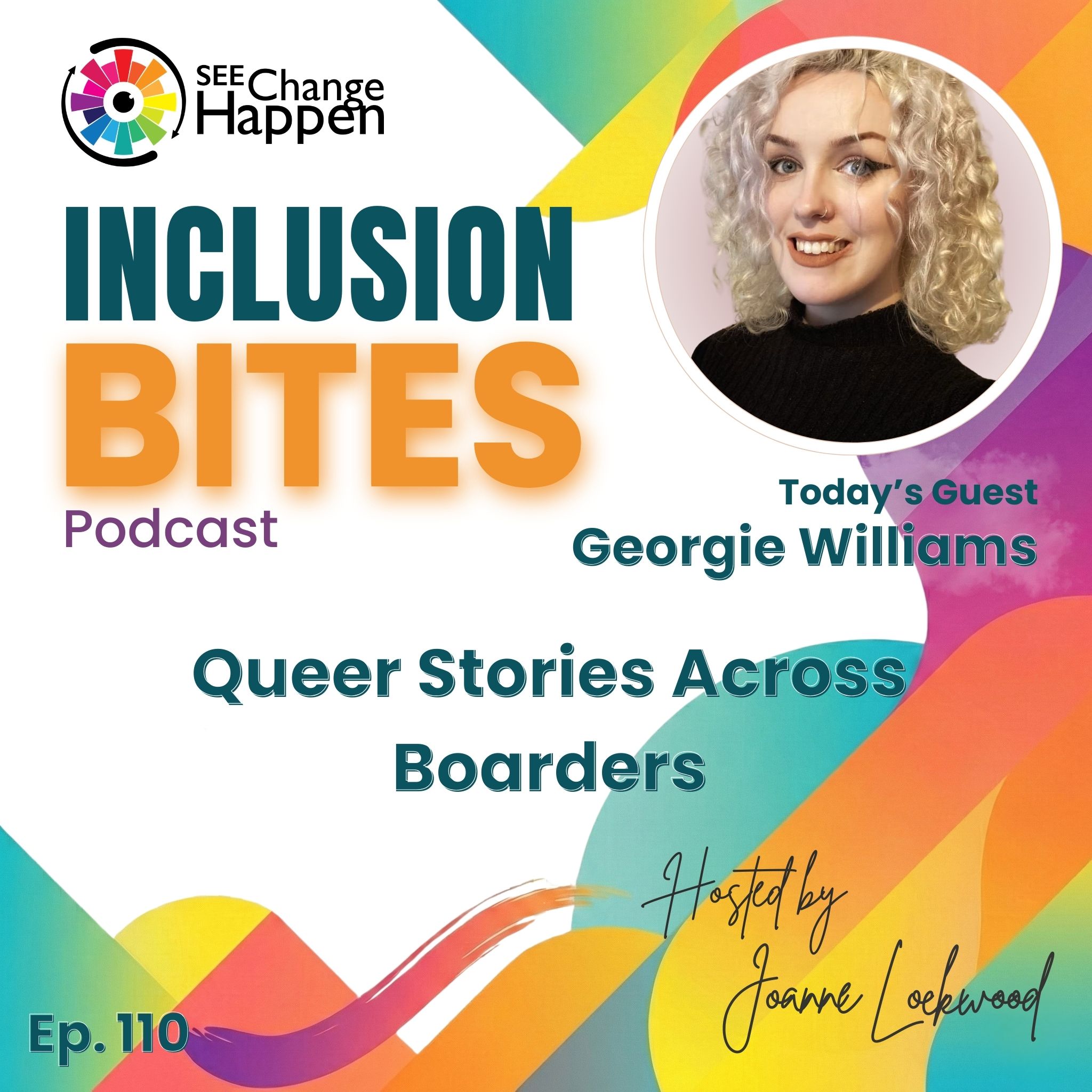
Georgie Williams uncovers the vibrant tapestry of queer relationships and identities, challenging conventional labels and exploring the impacts of societal norms across cultures.
Welcome to inclusion Bites, your sanctuaryfor bold conversations that spark change. I'm Joanne Lockwood,your guide on this journey of exploration into the heart ofinclusion, belonging and societaltransformation. Ever wondered what a true really takes to createa world where everyone not only belongs, butthrives? You're not alone. Join me as weuncover the unseen, challenge the status quoand share stories that resonate deep within.Ready to dive in? Whether you're sipping your morning coffeeor winding down after a long day, let's connect,reflect and inspire action together.Don't forget, you can be part of the conversation too. Reachout tojo.Lockwood@seechangehappen.co.ukto share your insights or to join me on the show.So adjust your earbuds and settle in. It's timeto ignite the spark of inclusion with inclusionbites.And today is episode 110 with the titleQueer stories across borders. And I have the absolutehonour and privilege to welcome Georgie Williams. Georgie isprofessionally queer and what that really means is that, is thatthey specialise in gender and sexuality diversity,field research, platforming, voices and stories incountries around the world. When I asked Georgie to describe their superpower, theysaid that they made the shocking personable. Hello,Georgie, welcome to the show. Hello, Joanne. Thank you so much for
Georgie Williamsguest
having me. Pleasure. I've been looking forward to this for ages. Very
Joanne Lockwoodhost
excited. So, Georgie, queer stories across borders.Tell us more about your project and what you're up to.
Georgie Williamsguest
So I started with Queer, which is mylittle organisation recording stories of gender andsexuality diversity around the globe back in2019. So originally I was supposed to startmy phd in social justice at University College Dublin.I already had a background in gender and sexuality. I had agender master's from Lund School of Economics, and I had an undergrad inpsychology. And so I was very much coming at this from aresearch perspective. And what I wanted to be doing with myphd and couldn't do was createan oral histories archive of gender and sexuality diversityaround the world that was very much steered by thepeople telling the stories. My concern was that people arevery curious about gender and sexuality diversity at thistime, but when we look at it from a global perspective,I often believe that people can be exploited by havingtheir stories told in a way that doesn't truly represent their culture andcommunity. And I wanted to be able to share these stories open sourceas well. I didn't want people to have to pay to learn about these thingsin the way that I'd learned about many of these communities in a lecturehall with a lot of student loans to show for it.So what I wanted to do was create this platform where I could share thesestories from my field research all around the world for free.So I started queer and I went out into the field five yearsago now, and I travelled in the first halfof this project through the USA, Japan,Indonesia, and then I conducted the lockdown episodesin the UK and Ireland during COVID And then the second half of thisproject I conducted in 2022 and 23that took us through Malta, Turkey,South Africa and Lesotho. So we'restill processing those episodes. The final episode of season twowill be coming out in about a month or so, which isour episode looking at sexuality diversity inLesotho culture amongst Sutu people. And I actuallyinterviewed a very senior member of the Lesotho governmentwho works in gender about that. So I disseminate it all opensource as a podcast and transcribe it as articles as well. Fascinating.
Joanne Lockwoodhost
I mean, I've spoken to you in the past around this project, and when yousay you're in the field, I mean, you have been in the field, haven't you?You have been around meeting people in their homes,in their communities, in a wide range,diverse set of backgrounds and experiences beyondjust the white middle class view ofUK gender politics and gender identity. So what have you kind of, ifyou had to distil it all down, what have you learned yourselfabout your own sense of identity and sexualityand gender from a global perspective, rather than just our blinkered UK
Joanne Lockwoodhost
view? If you. So I think the thing that's been so interesting about
Georgie Williamsguest
conducting this project and learning myself, as I travelled in thefields, I entered the field as a specialist, but I have nevertried to market myself as an expert, because you can't be an expert in thehuman experience. So when I was out there with thestories I got to hear and the people that I got to collaborate within the field on this project, I very much came to understandhow gender and sexuality diversityis part of what makes us human. That actually, no matterwhat culture, no matter what time period, the ideas thatwe had about gender and sexuality were actually quite broad,I think, where the ideas we have about a malefemale binary and about kind of heteronormativityhaving those propagated in the west, particularlyin countries like the US and the UK, we believe it'suniversal for several reasons. First and foremost,through those ideas being exported in western media aroundthe world, exposing other communities to that, but predatingthat as well. Colonialism had a huge influence onspreading these ideas about gender and sexuality. But it doesn't mean that theseideas emerged spontaneously in these environments.Quite the opposite. I've worked in communities all around theworld who, some of whom have five gender, threesex social systems, some of whom normalisedwomen having relationships with other women even when they were marriedto men. Our ideas aboutwhat kinship and what human connection and what personalidentity looks like, we've very much, many of us who have grown up in thewest, grown up with this very distilled, very reductiveidea that doesn't account for global humandiversity. And through that as well, it's given me a lens tobetter understand my own identity. And I've had feedback from listenersas well, who have used episodes to articulate their identitiesto people in their lives. And that's been really encouraging.
Joanne Lockwoodhost
There's a belief or a myth orthat we as a society have evolved tounderstand around sexuality and familyvalues and our structure, our social constructs,if you like, that we live in the rule set. We have. We consider ourselvesan evolved society where some of this queernotion is we've evolved out of, but I think it's theopposite way around. We kind of haven't evolved yet to trulyunderstand queer identities. So I think it's really interesting that you've brought in that
Georgie Williamsguest
idea of evolution, because I think thatthe arena of evolutionary psychology, the explorationof human behaviour through these evolutionarylenses, has often caused harm andcaused significant misunderstanding with regards to what is quoteunquote normal with regards to human behaviour andsocialisation. And the example I'll bring up, actually, issomething that I learned during my work in Japan was thatwith regards to sexuality, during the Edo period ofJapan, which is around the mid 16 hundreds to early 18hundreds, relationships between men, romantic andsexual relationships, were very much normalised. And this,I don't describe it as falling out of fashion, but wasdiscouraged by the japanese government from the point of theMeiji reformation at the end of that period, where,and this is unusual compared to some other countries I've looked at and workedin. What happened at that stage is that Japan looked to thewest for what was in vogue,I guess, culturally at the time. If they were going to be increasingtheir trade connections and they were going to be connecting more with the western world,then what were the cultural norms? And at thetime, one of the things rising in popularity was the pseudoscientificfield of sexology. This was popularin, I believe, Prussia and theUK, and I think France asmean. Interestingly know, anyone could call themselvesa sexologist at the time you could be working in a zoo, behavinganimal behaviour and call yourself a sexologist. And theconsensus amongst these sexologists was, well,animals engage in what was described as same sex behaviour atthe time. Humans don't because they're better developed than that, so we don'tdo that here. And Japan looked at that and went, okay, well, therelationships that we have going on right now between men that arepermissible, that is going to be unacceptable in a global arena.And that led to this discouragement andultimately rampant homophobia within japanesesociety. And obviously there's other contributing factors as well. Thesethings never happen in a vacuum of one specific cause.But yet you talk about the idea of the waywe've evolved and the way that humans conduct themselvesin relationships and in society, and actuallypseudoscientific ideas about that fed the propagationof homophobia in parts of the east. Yeah, because we are programmed from a very
Joanne Lockwoodhost
early age around rule sets of right and wrong andnormal expectations. I'm a great fan of thework defining the act like a man box, the gender box,the rule set that we're given as a man, as a woman.God knows where non binary people fit into those two boxes. There's no kind ofmiddle box offered in this rule set. And it's trying to figure outhow do we evolve people's thinking where these boxes don'tserve any real purpose other than to police people back into behaviours.
Georgie Williamsguest
It's a great question, and I like that you mentioned policing,because gender policing is something I talk about often, ways that we areencouraged to regulate one another's behaviour, because if we alignwith that, it creates this social currency. Right. We arefavoured by our peers, we are given advantages that other people aren't, aslong as we perform correctly within the box assigned tous. And it's funny, I mean, I don't want to get too technical with whatwe're talking about today, but there is a phrase I came across kindof, I don't want to say early on in my research, but around the timemy masters, that describes the gender binarybetween the concept of being male and the concept of being femaleas we know it in the contemporary west as aparasitic symbiosis. And if we break that down,what it's basically saying is that these two identitiessustain each other by feeding off each other.So in the sense that men are encouraged to recognise who theyare in the world by going, oh, well, I'm not feminine, I'm not like agirl, I don't do this I don't do that. Therefore I must be a man.And this is why non binary identities, if we use thatvery culturally west specific term,this is why they're considered so disruptive. Because ifsomeone's identity can be an amalgamation of feminine andmasculine behaviours, or male or femalecoded anatomy, how does a person look at an individuallike that and go, well, I must be a man or I must be awoman. But also that person has some of these attributes, and they're not aman or a woman either. And it's disruptive. It's incrediblydisruptive. So, yes, those boxes arestill incredibly limiting in the west, even whenthere's a lot that happened over the last hundred years in terms ofexpanding the idea of what womanhood can be. You know, we talk about thingslike fashion and haircuts and job roles, et cetera, etcetera. But there is still a ways to go in terms ofdismantling those incredibly rigid boxes. You find that in
Joanne Lockwoodhost
your experience, that a lot of misunderstandingscome from people's repression and self oppression oftheir own identity. Maybe they're scared to explore who they are. Maybethere's this fear of being finding out orallowing themselves to consider they may be bi, trans,nonbinary, and they're trying to hold it in, into thislittle box with these rule sets, otherwiseit'll explode. And they don't know how to handle that. Yeah. And actually, there was
Georgie Williamsguest
a really interesting documentary a few years ago on Netflix. I don't know if it'son there anymore, but it was called the mask you live in, and it talkedabout masculinity. And itopens with this conversation about what it means to doanything like a girl. They said, listen, if you want tohit like a girl, behave like a girl, cry like a girl, it's rockbottom, right? That means that you've ultimately failed at the thing you were supposed tobe doing. But to do something like a man is absolutetop of that bar, right? And it's also anunsustainable achievement. To do anything like a man means you have tocontinually prove it to yourself and others for the rest ofyour life. And if it slips for a moment, your wholeidentity as a man can be revoked externallyby judgmental outside forces. Andso, yeah, this idea that we have aboutgender, especially when it comes to things like masculinity, it'sall so fragile. And I think there is this fear thatcomes with asking those questions, becausewhat it means is that you can lose that currency, you canlose that potential. That privilege, especially forcisgender heterosexual white men, ifthey question their identity regarding their gender orsexuality, their social standing can absolutelyplummet. And it's incredibly daunting for manyindividuals to ask those questions, becausesocietally, we haven't facilitated a safe environment for people toask those questions of themselves without risking something. Other
Joanne Lockwoodhost
societies cope with these multiplegenders, a more fluid kind ofidentity, not just one spirit, two spirit, three spiritor five spirit, however you want to describe it. How do their societies copewith those multiple identities in people? Becausein the UK, we seem to have this big culture clash. How does thatmanifest in different societies around the world? So I'll add
Georgie Williamsguest
going on to that. So two spirits are a very specific culturalterm that has been used specifically within native american communities,particularly navajo communities. And when we thinkabout identities, they're always culture bound. Right?This is why sometimes I take umbrage with using the acronymLGBT for communities in the globalsouth, communities in Southeast Asia, for example, communities acrossthe continent of Africa, because very oftenpeople in these communities already had terms for this gender and sexualitydiversity that predate the term LGBT. And so,yeah, with some of these communities I've worked with, there is this.I don't want to say perfect harmony, but a sense of balance,that it comes from the fact that they don'tground one's worth and identityin innate biology, which can change. Anyways, biologydoes change over time, and there's so many people whose biology doesn'tfit into a binary anyways. The sex binary wasvery much an invention. It is something that was formulated bydoctors in order to determine what was thecorrect male or female body, which often led to theabuse of many individuals whose bodies divide thoseboxes. I'm sidetracking myself. But within many of thesecommunities, I'm thinking in particular of my interview I did with a memberof the Bugis community, which is a community thatrecognises a five gender, three sex social system in Indonesia.The Bugis are an ethnic group who arecomprised of, I believe, 6 million indonesian citizens. And, Imean, this is incredibly large country. I believe thatIndonesia is the largest muslim majority country inthe world. We're not talking about some tiny littlecorner of the world that observes this. And there it is verymuch held belief within the buddhist communitythat, yes, all five of these identities are supposed to exist becauseeverybody fills a different niche. And it's
Georgie Williamsguest
funny, when I think about this myself, I'm not even going to relate it togender and sexuality, but I spent the best part of lastyear when I wasn't in the field doing research, working on a shipas a crew. And it's funny because within the crew, every single one of ustook on different responsibilities. But if one of those people wasn't there,then mopping up those responsibilities was difficult because we all held our ownrole, we all contribute in different ways. And the Bukhascommunity, I would like to draw a very loosecomparison, that everybody has differentresponsibilities and contributions thatare not married to but aligned with their gender identity,and it creates this sense of balance. It's, asfar as I can tell, relatively non hierarchical, or at leastnot hierarchical in the way that a male female gender binary is. Yeah,
Joanne Lockwoodhost
I'm with you on the LGBTQ plus IIAP Alphabet system. I think all it's doing is it's creatingmore boxes and trying to stuff people into boxes. AndI'm a bigger fan of the word queer because I don't need to definemyself any more than just queer. I e,not straight, not Cis, not whatever. I can existin this space that is me without having toexplain it. Because I think once you start mixing genderidentity and sexuality, it's not a linear scale,it's a four dimensional model, and your little point withinthat model can change and evolve and floataround from day to day. Who I'm with, what I'mdoing, how I relate to tv programmes.I can sometimes relate in a more masculine way or more feminine way. Even thoughI perceive myself as a woman and feminine,I don't reject some of my traits and myupbringing. And to queer really allows me to exist withouta border. Yeah. And I mean, I will say, regarding
Georgie Williamsguest
the LGBTQ plus acronym, there are ways in which it can be useful. Irecognise the fact that having these specific terms allows usto, number one, articulate ourselves, but also, number two, findpeople of similar experience. Also, specific terminology isincredibly valuable from a legislative standpoint in terms of ensuringparticular protections. That said, I completely agree in the sensethat recognising it as a reclaimed term,I prefer to describe myself as queer becauseI don't believe that I owe anybody an explanation ofthe nuances of my identity every time I come out to someone.Queer, for me, has been a wonderful catch all, whereit says I exist outside of the bounds ofheteronormativity and cisnormativity, and that's incredibly freeing. I
Joanne Lockwoodhost
think I remember when we first met online, I think a couple of yearsago, maybe during COVID you were using bothmasculine feminine and gender neutral pronouns, almost likehe, they, she, they, her, him, and you kind ofweren't prescriptive about how the pronouns are used, because sometimes,again, that triggers people into trying to box you off again, doesn't it? It's like,oh, it's so difficult. Totally. And actually, I now use they
Georgie Williamsguest
them pronouns. And it's interesting, I have friends who will occasionally use he himpronouns with me, but I retired usingshe her entirely. Because the issue that I came acrossis that when I listed my pronouns, especially, we're talkingCovid era, most of my work I was doing was online, and so Iwould have my pronouns in my zoom tag. Overwhelmingly, people would lookat that, decide that because I was presenting in a feminine way, the thing thatmade them the most comfortable was to just use she for me.And I very clearly remember, and yes,I was angry in this moment, but I actually think it was a really justifiedanger. I remember in a meeting with some colleaguesmentioning that, yes, if you've noticed that my pronouns have changed from they shehe to they them, I want you to know that it's because I've revoked theother pronouns until you learn how to play nicely with them, thatactually, at the end ofthe day, my identity is a very. Idon't describe it as fluid, andI don't describe it as complex either, but anuanced, non prescriptive thing.And I want to know whenpeople are actually making an effort with my identity. Iam always incredibly touched when someone that I meetisn't familiar with my pronouns and puts in a real concerted effort. And thatdoesn't mean getting it right straight off the bat, but I cantell when people are trying, and I can tell when people arebarely navigating their own discomfort and trying to avoiddoing something that's ultimately a very low level of respect for aperson. So, yeah, I use they them nowbecause for me, anyone can be theymasculine or a feminine looking person can be they. And it's the same forthe pronouns she and know. There are many lesbians in the worldthat use he him pronouns. There are many gay men who refer toone another as she or her. But where we'reknow, especially in the UK, in terms of oursocietal development at this stage, we still have incredibly genderedideas about the pronouns she and he. So where I'mat now, they feels like the way to go. AndI wish that it wasn't informed by that external pressure. Butat the same time, our identities do respond to our environment.
Joanne Lockwoodhost
Yeah, we're kind of hooked up with how people look, aren'twe? Yes, you've got this in yourpants, you've got this in your head and you have to portraythose to make me comfortable. Asyou say, you identify with they, them pronouns, nonbinary or kind ofqueer as such. But you look, as everyone wouldprobably say, traditionally feminine. And it's not that you aren'tfeminine in some way, but your identity isqueer. And amongst that, and I remember you saying to me once that you reallylove to take a little bit of testosterone and grow a little bit of amoustache or a beard. And I thought that was fantastic when you saidthis and I thought, wow, that amazing blonde hairyou've got, and a little bit of a moustache would be fantastic. It looks sogood on you. I still want to get to the moustache, Joanne, I really do.
Georgie Williamsguest
I was on testosterone for about six months and then I think Isaid to you that I had to stop, mostly because travelling meantthat I couldn't access testosterone easily. And then when I came back to the UK,I didn't have the money for healthcare and trans healthcareis treated like a luxury instead of a. Right. So, yeah, Ididn't take testosterone long enough to get that wonderful little moustache thatI still dream about. But the thing is that I'm acutelyaware of how choices I have made with myappearance lead people to read me in particular ways.For a long time, I have had long blonde hair, very blondehair, and people always read that as an inherently feminine thing. And I'm always like,no, in terms of where my masculinity is at, I kind of want to belike a slightly more muscular version of like, Legolas from Lord of theRings, right? Who has that fascinatinglyblonde long hair, right? That's where my masculinitysits. But we don't read peoplelike that. And I recently did some trainingfor an organisation where I was actuallysaying, when we look at people, we are inclined toread things like, long blonde hair is feminine, right? Facial hair is alwaysmasculine. Ignoring the number of individuals whoidentify as cis women who havepolycystic ovarian syndrome and grow facial hair. We haveso many rigid ideas about the way a body has to look.And yeah, I think sometimes people think non binary. People lookcompletely know, like Tilda, Sweden inConstantine, just completely androgynous. Right?That's not how it works. I've previously joked that being non binary for me meansthat I'm actually gender greedy. I actually want to look really feminine and reallymasculine at the same time. And that makes it harder for people to read me.But I also think that our dependence on being able tomake gendered assumptions about people from the moment we see them across theroom is an unnecessary habit that many of us are encouraged to develop.
Joanne Lockwoodhost
I'm just imagining you as Legolas, as a king of the elves and beable to walk on snow or grass without leaving footprints. And that'd be areal good upgrade to your superpower. Wouldn't say? You didn't know that
Georgie Williamsguest
nonbinary people can do that. No, it's not in
Joanne Lockwoodhost
the book. I've got. Obviously, that's a secret thing, that nonbinary people.There's all these books, these imaginary books around trans people andcabals and how trans people all keep in touch with each other. We get thissuper connected power base all telekineticand you must know every other trans person in the country. You mustget this. Do you know so and so? No, I don't. Sorry. No.
Georgie Williamsguest
Worst is when that happens to me and then I'll be like, well, listen,we don't all know each other, but, yes, I do actually know that person. Itis always. I
Joanne Lockwoodhost
just. I can definitely see you as an elf. So that would work.Just maybe grow your ears slightly. Bit of a. But yeah. Legolas doesn't have abeard, though, does it? So we're a moustache. No, I'm like a pirate.
Georgie Williamsguest
Legolas. Yeah. I used to support a moustache for many years. I was in the
Joanne Lockwoodhost
RAF when I left school and it was a bit of rebellion becausein the RAF the only facial hair you're allowed is a moustache. Verystereotypical, kind of World War II pilot sort of twiddleit type thing. If I'd have been the navy, I could have grown a fullbeard, but I was able to grow a moustache and I had this from theage of probably, I don't know, 1718, which was a bit mousy and abit kind of nonexistent. And then I shaved it off for abet in the year 2000 and it was kind of part of who Iwas for a long while and my daughter really rejected me for a while afterI shaved it off because her whole entire visual image of mewas with a moustache and she had never seen me without it. But then whenI transitioned, I had the lot lasered off. If anyone'sever had laser on their legs, try having it on your face, it's incrediblypainful. 14 separate occasions of.So, yeah, I'm wholeheartedly hairless.Wherever I can be, because I want to playthat game of gender. I want to play that game of. I want people toclock me and read me without stubble. So, yeah, Irecognise that I am fitting into Cassidy constructs and it's hard not to. Tofit into that rule set when you want to be accepted for who you are.
Georgie Williamsguest
I also think it's safety when advocating fortrans healthcare. Before, I previously said that one ofthe ways in which it is as a life saving serviceis because if people can't tell that you're trans,you're less likely to get attacked on the street, like, you're lesslikely to face employment discrimination, you're lesslikely to be made to feel like asecond class citizen, that there are many people who I thinkcould comfortably live their lives as a trans person notpassing to a cisgender standard, because that's what it is, right?We're talking about a cisgender standard of gender identity, not just a universalone, but also people want to feel affirmed,they want to be treated withrespect and made to feel safe, but they also want to berecognised as belonging to a particular community as well.And when I think we use aesthetic details asan excuse to deny people the word I'm looking for, Iguess membership dignity to a particular group.Dignity, yeah, but also membership to a particular social group,like gender identity. It means people have to jumpthrough so many hoops in order to feel affirmed and securebeyond how they felt about themselves in the first place. A lot of
Joanne Lockwoodhost
people's safety and their fight, flight or fearmechanism where they freeze is all caught up in veryhistorical, prehistorical kind of brain development. Thebiases and the vagus nerve and our reaction to things. And in thesame way that trans people are trying to. We use the word pass,mask, cover, whatever word you want to use to be read,perceived as the gender they identify as, because it's avery strong reaction in people who will fear.Fear or discomfort around someone whois of the opposite gender, for want of a better way of describing it, whichis a lot of the critical movement is caught up infear of men in spaces. And the perception thata trans woman or someone who is identifying as queer isactually a man or wolf in sheep's clothing is kind of theargument. So how do we reconcile that fight, flightor freeze mechanism that is being invoked by people who are not reador pass in that chosen gender? Well, I mean, I think there's
Georgie Williamsguest
a huge overlap with this conversation andconversations around disability inclusion and racialinclusion. It's that idea of person has to look aparticular way in order for me to respect them. And there's ways that we canunpick those cognitive biases. I mean, this isunconscious bias that we're contending with is so many of uswere taught from a young age that this is what a respectable,normal person looks like. And if they deviatein x, y or z ways, then there's something innately wrong withthem. I think in particular, what the gender and sexuality kind ofdiversity community faces the most are accusations ofperversion, right? That actually there must be something inherentlycreepy or predatory about youif you flaunt these gender rules inhow you present yourself, and also in terms of whatrelationships you navigate in your personal life. And I think ifI had an answer for how we confront and dismantlethese issues, I'd be making so much more money. Butfundamentally, it is about taking a step back andquestioning on what grounds do we decidewho's a person and who's not. I think
Georgie Williamsguest
with disability, that's an easier conversation to have at thistime, instead of competitive with the trans community, becausedisability is something that can happen to us. Lots of people don't wantto talk about it and don't like that, but it's a thing that can happento us. And sometimes the conversation around disabilityinclusion, although it definitely isn't easy right now,is sometimes about, well, if this happened to you,how would it change how you felt about disability, and howwould it change how you wanted to be perceived? Andyou're still that person. Your sense of self can absolutelychange, but you're still absolutely a human being. But peopledon't like to think about trans identities in that way, because theybelieve that being trans is completely alien to them as a cis person,that they could never go through this process oflearning about themselves and discover that something they've been taught is an absolutetruth about themselves is not the case. So the touch point ofempathy can be difficult to get to, but it is aboutsaying, well, listen, what actually differentiates me from that personhugely? Is it as simple as aesthetics?Mostly, yes. The overwhelming majority of peoplejust want to be able to go about their lives without causingproblems for anyone else, without causing any extra stress for themselves.And when we create gender neutralspaces, we take a worry off of the minds of most transpeople. And listen, we could have a whole separate question about theunfounded concerns about predatory trans people,specifically trans women being demonised, notbeing allowed into gender specificspaces, and how so many of the accusations aroundconduct just have no evidence behind them. But that's a whole separateissue. And yeah, I think the conversation is getting better,but it's definitely vitriolic at this stage. Yeah, I've had
Joanne Lockwoodhost
conversations with people who are concerned about their ownpersonal dignity and their own personal respect for maybeintimate care or using a toilet, and therebeing a trans woman present, or the trans woman isproviding the service or the care to them. And they said, I wouldn't likethat if that person. Because in their head they're thinking this personisn't a woman, they're thinking this person is a man. They can't disassociatetheir assignment at birth with their identity and who they are today,regardless. And I said, I just asked them the question. So if you didn't realisethe person who was treating you was trans, it would be okay. Then theywent, well, yeah. So it's down to how good someone looks, howsomeone passes to gain acceptance. We would look at cyclistsI think someone's talking about in the news at the moment. We talk about peoplein prison. If you couldn't tell they were trans, it's okay, then it's only thefact you can tell they're trans because they look different or they're a bit taller,their fingers are a bit larger. So you're using beautybias or perception bias around how someone looks. Andthat's the challenge, isn't it? Which is why you talk about passing and living upto the rule set. Yeah. And actually that reminds me of some reading I was
Georgie Williamsguest
doing just last week. It wassome archival writing, I believe, mid 19 hundreds,about health care for transsexual, identifyingindividuals, but specifically with what we would now describe astrans women, where sometimes their healthcarephysicians were denying them treatment because they didn'tpass enough. There was even an excerpt from a trans womantalking about how I believe she had been permittedtreatment because the doctor said that as a heterosexualman, he felt an emotionalresponse to her and therefore that must make her awoman, that it was down to terms of this doctor's attraction toher, which is outrageous. Can you believethat that is still an issue that we face because it islike we still have issues with people being denied trans healthcarebecause it seemed that they're not putting in enough effort to pass asthe cis version of their gender identity? And can you imagine what itwould be like if cis individuals were beingdenied health care on the same grounds of, oh, well,I don't want to really treat you like a man, because as a femaledoctor, I don't find you attractive enough to believe you're truly a man. Can youimagine if that was happening? Yeah. Or are you sure you should have a baby?
Joanne Lockwoodhost
You don't really look like a mother. That sort of thingisn't there? And, you know, funnily enough, I've experienced the opposite with my own
Georgie Williamsguest
health care. As someone who I have no interest in having biologicalchildren, I am very much staunchly child free in thatregard. And I have had medical professionals makevery, very sweeping assumptions about what I want to do with my body.I once had a doctor tell me, well, if you wanted to get this proceduredone, there'd be so few complications that you won't even have to tell the midwifewhen you give birth. Emphasis on the when. And I just thought that that wasabsolutely shocking. So, yeah, the way thatwe police gender with people's bodies,it's a shame that there's still, especially in thiscountry, more so in this country than in the restof western Europe, a pushback fromso many women about fundamental rightsand protections for trans people, because they've also faced thesame struggles with bodily autonomy and recognition for that.And, yeah, we have more in common in ourbattles than we have. Different, in my opinion. So in your adventures
Joanne Lockwoodhost
around the world, talking to people and experience, at whatage do you think someone's old enough to know thatthey're trans or queer or bi or gay? At whatage does that formulate? I think that that is
Georgie Williamsguest
such a complex question, because for me,that's like saying, at what point in your adulthooddo you know that you want kids or that you'd be capable ofhaving a child and raising them properly? And by that, what I'msaying is not that young people don't know whenthey're young that they're trans or queer, but that it is subjective to theindividual, and that there are many young people that absolutelyknow who they are from a young age, and that putting ahard line on it and saying you'll definitely know by this age, or youcan't know until this age is incredibly reductive.I didn't come out about my sexualityuntil I was 15, which is by no means late,but I had been aware of it, in a sense, since I wasabout seven years old. I didn't have the language to articulate it at thetime. Maybe if I had, I would have been able to talk about it morefreely. I have a younger relativewho first. She first expressed interest inother girls the age of, like, six or seven. Andbecause it was a non issue, because this is a household thattalked very openly about gender and sexuality. There was nodiscomfort in her expressing that. And now that she's a lot older, shestill very much feels that way. I don't like theidea that gender and sexuality is something that you onlytruly understand at a certain age, because I thinkwhat that implies is that if you identify, especially ifwe're talking about sexuality, if you identify as gay orbisexual at a young age, it comes back to thatidea of perversion, that there is something sexual about thatchild. Sexuality encompasses romantic interest. It doesn'thave to have anything to do with sexual interest, and especially not as a child.You can have crushes on people in school in the waythat a heterosexual child would, and it doesn't have to meananything else. But we don't like talking aboutgay children and trans children because we see it as somethinginherently perverse. And it's not. There is nothingabnormal or strange or predatoryabout being a queer person or being a trans person. I think you picked up
Joanne Lockwoodhost
on it there. The parents are loving, they want their child tosucceed, and suddenly they discover there's somethingnot the same as them. They no longer fit intotheir dream and vision of how that child's going to evolve, grow,have a family. They could become grandparents. Suddenly, all theirlife's ambitions for this child have been shattered because they'requeer in some way. And that's kind of the parents almostagain trying to police their child back into the visionary box theyhad for them and see them as broken or having a condition.Some of that surely comes down to representation. If you're not seeingqueer people, trans people, nonbinary people, bi,gay, on television, in the media, working inshops, that reinforces the subversive,secretive, perversive type stuff we've talked about,because people aren't being in the mainstream. So we need to make sure we havemore mainstream representation of people with a disability, of people ofcolour, et cetera, and queer people to allow peopleto believe that they can succeed in society. Yeah,
Georgie Williamsguest
absolutely. And I think that representation, ouridea of representation, I still think, is very twodimensional as well, where it's like, am I seeinga gay couple in a McDonald's advertand that kind of thing, where it's like, okay, great. So do you actuallycare about these people and the nuances of their identity and theirwelfare, or do you want to virtue signal using our community?And, yeah, I think goodrepresentation involves showing how people don'tfit into clear boxes, ever. That your ideas aboutqueer people, trans people need to beloose and open to account for everyone. Becauseit's not about just creating more bites, like we said earlier. It's aboutsaying, well, the boxes don't actually exist. Iremember when I was growing up that whenever I sawpeople talking about bisexuality, it was about kind of dispelling thisnotion of, well, bisexual people aren't greedy, they're just capable of attractionto more than one gender. And I remember as ateenager being like, no, I am. I am greedy, but I'malso a human being and I don't need myidentity to be sanitised in order for me to berespected. There's many, many. Listen, if you think aboutcisgender, heterosexual men who can have many relationships allthe way throughout their lives, and people go, oh, good for him,right? Anyone else? Especially bisexual people, you have lots ofdifferent relationships, especially early on in your life,and it's seen as dysfunctional, it's seen as,once again, perverse and predatory. So, yeah, I thinkrepresentation is also about saying there's nuance to ouridentities and this is how we present them. Not morallyperfect queer people, not queer people as villains, but a littlebit of everything. Yeah. When I
Joanne Lockwoodhost
transitioned seven or eight years ago, hard to define a pointbecause it's an evolution rather than a point in time.I was married at the time for best part of 30 years,28, 29, 30 years. My wife, inorder to be able to get her head around it, had to open up herown thinking around her own sense of sexuality. And it'sactually, if you like, enabled her to be openabout her bisexuality, which allowed her to reconcile withme and accept me for who I am withoutrocking her sense of self either. So she's now openly bisexual. Itdoesn't mean to say we're going to go out there and have relationships with anybodyelse. It just means that we're quite comfortable in arelationship that isn't traditional, it isn'tnormal, whatever, however you want to describe it. I can be queer, Marie canbe bi, I can be pansexual. Not that I want to do anything withit, but it allows me to have a conversation withmy wife where we're compatible because we're not creatingany rule set that says we're incompatible. And allowingherself to explore that, created the ability for her to acceptme in a way that we embrace each other's identities nowrather than being a barrier between us. And I know many people struggle,if you're in a relationship, to be able to take that bisexuality or thatgay or that lesbian or a trans dynamicinto your relationship, because it's about you, isn't it? It'sabout your own identity and it impacts them. Yes, totally. Because I
Georgie Williamsguest
think when we have conversations about this, people always considertheir own identity. And when we have to ask those questions, sometimes it can makeus uncomfortable. And actually, I mean, speaking from a personal perspectiveas well, my partner has always identified asa cisgender, heterosexual white man. We actually met onthe ship that I was travelling on, which was a very queership. We had a female majority crew, we had many queerpeople. I was one of four trans people in the crew.And this was his kind of first experience of beingaround trans people. And it was
Georgie Williamsguest
never something that shook him up, ever. And I remember when wefirst kind of started our relationship and I remember saying, well, do youever question how this makes you feel about yourself?And I remember him being completely honest and being like, well, listen, Idon't care enough to ask those kinds of questions about myself. I am happy andI am in a relationship. It doesn't have to shake thefoundations of me feeling like me. And I loved thatbecause it wasn't him saying, oh, well, your identity is notrelevant to how I feel about myself. But he was more like, I know whoI am and I don't need to put labels on that.I can feel like the labels I've grown up with still identifyme, but still feel very firmed and assured about my ownidentity in this relationship and respect and acknowledge yours.And I think sometimes we expect queerrelationships to tick certain boxes in order to berespected. I think especially it's something that I see with.I've see it with trans women who previously identified with gay men,whose partners still identify as gay men. And yes, sometimes thatdoesn't work, sometimes it does. And both of those people can feel comfortable in theiridentities, but also say, this relationship works for us.
Joanne Lockwoodhost
So you're out with your partner who identifiesand presume he expresses as a white man or aman, a straight man who gets offered themenu. When you sit in a restaurant, does he offer the menu and asked toplace the order, or do you get a look in? I'll be entirely honest, he
Georgie Williamsguest
is a very sweet, softly spoken introvert andI am a human tornado, which means that largely,I take the lead on these things anyways. So I think, yeah,I haven't really paid a huge amount of attention to it, but usually I'mthe one that will ask for the bill and things like that. I think usuallyit comes to me because that's one of the joys of gender, is it doesn'tmatter what gender you are, if you are loud and annoying, people willdefer to you. In a restaurant, when my wife and I, we go
Joanne Lockwoodhost
out, we're in a restaurant, and we know that the waiter is going to comeover and look at both of us a couple of times and go,what do I do? We have a discussion before we go inand say, right, your turn to order, and I'll pay, sortof thing. So we predefined how we're going to respondand interact with the waiter because we know that it oftencauses confusion. I'll reach themenu, or we'll say to each other, so what do you think you're having?Or what do you think you're having? And we go, okay, you go first. No,you go first. All right, I'll go first. So we have that kind of. Butit's almost like a little game with us because we know the person isnot sure how to deal with us. Well, I mean, my partner and I kind
Georgie Williamsguest
of play with these things in similar ways as well, because I think heloves the novelty of it, that you get to see peoplebehaving in such unusual ways, because that social script isgone. And one of the things that I rememberhappening was actually on the ship that we still go and domaintenance on together. So the thing is that he and I referto each other. He refers to me as his husband. I refer to him asmy wife. And it became a joke that was like, oh, actually, we quite likethis. And it's quite sweet. And I remember oncehe was working on the other side of the ship, and the person down onthe deck, I was up in the rig was like, oh, do you need anything?And I was like, can you just tell my hot wife that I love himas a joke? And someone misheard that andturned to my partner and went, oh, your hot wife loves you. AndI was like, no, you heard that in the way that you wantedto hear it because you looked at me and went, that would be the personwho's described as the wife in this relationship. And I thought it was so interesting,that exposure of that kind of, like, unconscious bias.
Joanne Lockwoodhost
Yeah, it is. And it's fun.I often get people now helping me with my bagup the stairs or something. If I'm checking to a hotel, someone will rush overand go, I saw it, love. I'll take that. And I go, yes.Result micro validation. Yeah, I'll take that. Everyday. And Marie looks at me funny sometimes. He says, aren't you going tocarry my bag? I said, do I look like a husband?But obviously ingest. And we play with it, and it'sfun to sort of challenge these gendered rules and who does what?My wife and I do joint talks. She always says that I don't dothe dishwasher. And so the dishwasher is, for whatever reason,Marie's role. But I always point out that I do do therinse aid and put the salt in because that's not what Marie does. I dothe mechanical stuff. She does sort of like thehousewife. Yeah. I think it's no different toother queer relationships. Lesbian relationships, gay relationships, bi relationships,whatever. You just define your own protocols, don't you?
Georgie Williamsguest
You do. You really do. And it was something that I found veryaffirming at the start of my relationship with my partner was he saidthat one of the things he loved about being in his first ever queerrelationship is the freedom it gave him, that actuallythere weren't ways that he felt pressured to perform in order tobe the man in the relationship and have his partner be the woman in therelationship that actually, we've kind of thrown that script out the window,and we were figuring out what worked for us. And it feelsvery emancipating to be able to say, actually,whatever worked before felt restrictive. And we get todecide what this dynamic looks like. And sure, maybe it makes otherpeople uncomfortable, but that's nothing to do with us. It'sbeen. Yeah, so liberating. Thank you. That's amazing.
Joanne Lockwoodhost
And we could carry on all day. I know we could. And we'vespoke many times before. This is fascinating. And to Georgie, how can peopleget hold of you? I'm sure they'd love to tune into your podcast and findout more. So how do people get hold of you? So if you'd like to
Georgie Williamsguest
listen to the podcast, the podcast name is Queer, so that's a forward slashQ-U-E-E-R. If you search queer onSpotify or Apple Podcasts, you'll come across it. It'squeer in black text on a white background, so it's relatively easy tofind. You can also find it via my social media.So my Instagram handle is queer. That'sslash queer. It's the same handle onTwitter, which I barely use now because of Elon Musk. You can alsofind me on LinkedIn, my name being Georgie Williams.And you can also cheque out more of the project at the Slash queer website,which is slash queer.com slash queer. Thank you,
Joanne Lockwoodhost
Georgie. You've been amazing. Thank you for having me. As we
Joanne Lockwoodhost
bring this conversation to a close, I want to express mydeepest gratitude to you, our listener, for lendingyour ear and heart to the cause of inclusion.Today's discussion struck a chord. Consider subscribing toinclusion bites and become part of our ever growingcommunity, driving real change. Share this journey withfriends, family and colleagues. Let's amplify the voicesthat matter. Got thoughts, stories or avision to share? I'm all ears. Reach out tojo.Lockwood@seechangehappen.co.ukand let's make your voice heard. Until next time, thisis Joanne Lockwood signing off with a promise to returnwith more enriching narratives that challenge,inspire. And unite us all. Here's to fostering a moreinclusive world one episode at a time. Catch you on the nextbite.Close.
In this stirring installment of The Inclusion Bites Podcast, Joanne Lockwood is joined by Georgie Williams to share "Queer Stories Across Borders", an enlightening discussion on the tapestry of queer relationships and identities that transcend societal norms. Georgie opens up about how they and their partner eschew traditional labels within their relationship, fostering a dynamic where personal freedom reigns over adhering to gendered roles. They also touch upon the broader implications of gender boxes on personal identities, addressing the limitations these constructs place on our understanding of self and others. Joanne and Georgie conclude by reminding listeners that embracing all aspects of diversity is not only about kindness but a fundamental aspect of humanity, inviting the audience to engage further by subscribing to the podcast and continuing this crucial conversation about inclusion.
Georgie is an eloquent advocate for gender and sexuality diversity, with a diligent focus on research. Beginning their "SlashQueer" project in 2019, Georgie embarked on a journey to construct an oral histories archive, ensuring these personal narratives are documented with veracity and shared widely. Their fieldwork has taken them across multiple continents - exploring diverse cultural perceptions of gender and sexuality from the USA to South Africa. Through their work, Georgie has illuminated the breadth and complexity of human identity, providing resources that assist individuals in articulating their own stories. Their astute observations delve into the societal pressures that hinder the exploration of personal gender and sexuality, highlighting the need for representation and recognition within not just personal spheres, but also crucial services like healthcare.
The dialogue extends into a rich exploration of linguistic self-definition within the LGBTQ+ community, with Georgie expressing preference for the term 'queer' as it defies the confinement of stringent descriptions. They graciously share their insights on navigating pronoun usage, advocating for respect and effort in this sphere, while recounting personal transitions and their impacts upon relationships. Joanne and Georgie's discussion is enlivened with humour as they talk about nonbinary "superpowers", yet they don't shy away from the profound, addressing the policing of bodies and the intersectionality of trans issues with healthcare accessibility.
In conclusion, Joanne and Georgie's frank and heartfelt exchange challenges listeners to understand the importance of validating and affirming queer identities across borders. The episode underscores the value of such narratives in forging a world that is more accepting and inclusive for everyone.
The key takeaway from this episode lies in the profound notion that our humanity is inherently diverse, and that this diversity enriches our collective existence. For those looking to deepen their understanding of queer identities and embrace the spectrum of human experience, this episode of The Inclusion Bites Podcast is a compelling listen.
The views and opinions expressed by guests are their own and do not necessarily reflect those of Inclusion Bites, SEE Change Happen Ltd or Joanne Lockwood. This episode is shared for general interest and discussion; we accept no responsibility for the accuracy or completeness of any statements made.