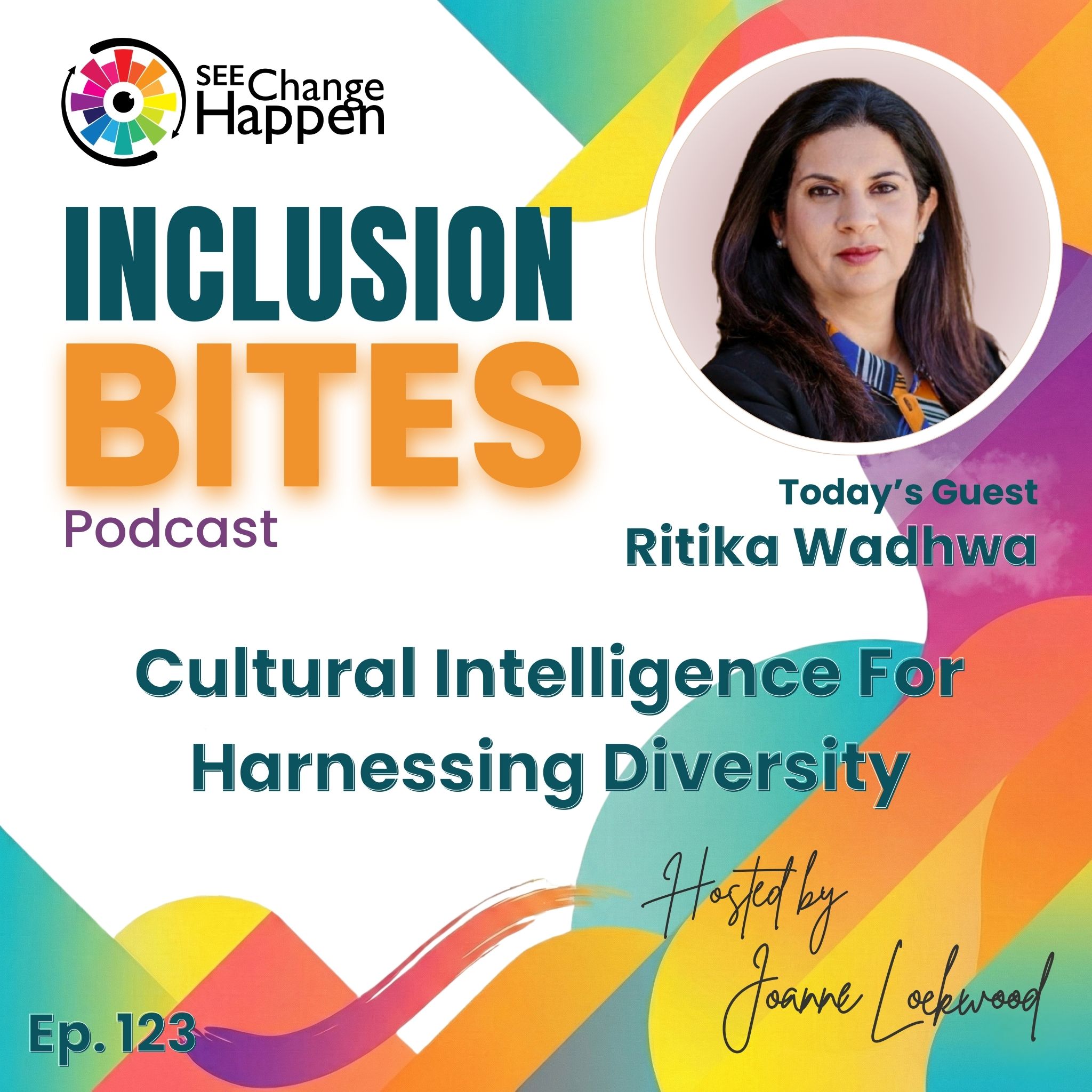
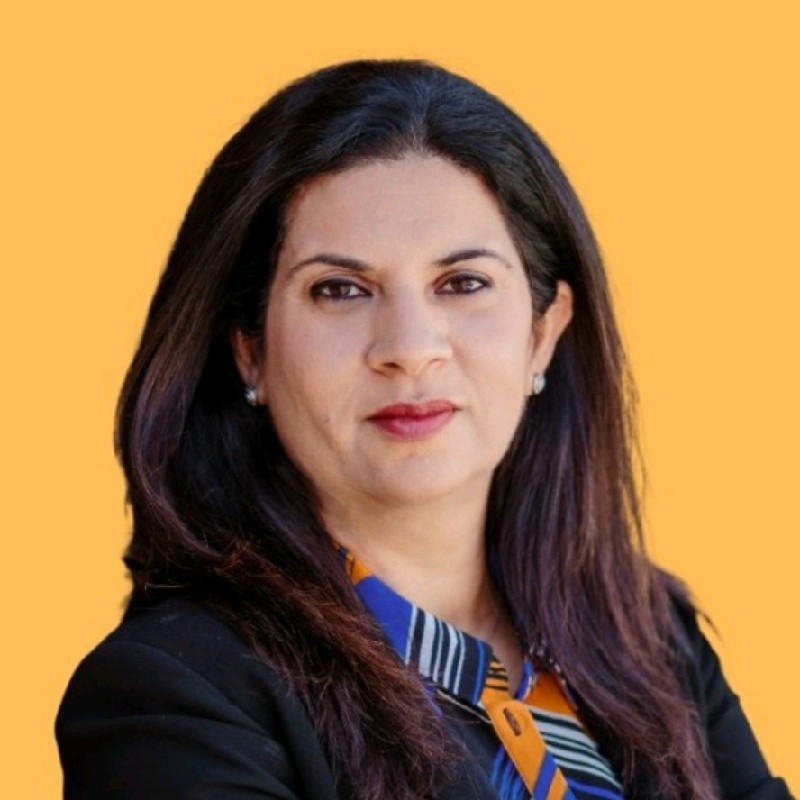
Ritika Wadhwa explores the critical role of cultural intelligence in harnessing diversity, addressing the complexities of identity, and driving impactful change through informed and empathetic leadership.
In this episode of Inclusion Bites, Joanne Lockwood speaks with Ritika Wadwha about inclusive leadership management.
“I've had to fight that system from the day I was born until today.”
Explore
Navigate this episode
Joanne Lockwoodhost
Welcome to Inclusion Bites, your sanctuaryfor bold conversations that spark change. I'm Joanne Lockwood,your guide on this journey of exploration into the heart ofinclusion, belonging, and societal transformation.Ever wondered what it truly takes to create a world whereeveryone not only belongs but thrives? You're notalone. Join me as we uncover theunseen, challenge the status quo, and sharestories that resonate deep within. Ready to divein. Whether you're sipping your morning coffee or winding downafter a long day, let's connect, reflect, andinspire action together. Don't forget, youcan be part of the conversation too. Reach out to jo.lockwood@seechangehappen.co.ukto share your insights or to join me on the show.So adjust your earbuds and settle in. It's time toignite the spark of inclusion with Inclusion Bites.And today is episode 123with the title Cultural Intelligence forHarnessing Diversity. And I have the absolute honor andprivilege to welcome Ritika Wadhwa. Ritikais an ethnic minority, immigrant, female founder,and CEO of Prabhaav Global that specialises in usingthe transformative power of cultural intelligencefor impactful leadership. When I asked Ritika to describesuperpower, she said resilience. Hello,Ritika. Welcome to the show. Oh, thank you, Joanne.
Ritika Wadwhaguest
The honor is absolutely, completely, and100% mine. You know what a big fangirl I am ofJoanne Lockwood. Oh, going bashful now and so.
Joanne Lockwoodhost
We met each other recently at a Professional Speaking Association meeting, butalso we caught up at the Culture Pioneer Awards, didn't we, with,HR's own Sift. That was a a great evening, wasn't it? It was.
Ritika Wadwhaguest
It was. I think I've well, I've I've been fangirling you from afar for awhile. And so it was I've actually seen you in a lotof forums, but obviously you only noticed me at thePSA first and then at the HR zone. So I think our paths have crossedseveral times before that. And so meeting you in person wasbrilliant, but also being asked to be featured as a guest on yourpodcast is an absolute honor. Thank you. Thank you.
Joanne Lockwoodhost
Pratika then, tell me, cultural intelligence,how do we harness it for diversity? Tell us more about CQ.
Ritika Wadwhaguest
Oh, right. So where do Istart? Tell us more about CQ. CQ CQ iscultural intelligence. Cultural intelligencetechnically is defined as the ability to work withpeople that are different from us. It is a capabilitythat we can all build and scale very muchlike emotional intelligence, and ithelps us to work in multicultural situations,to work with people that are different from us, to work and navigatesituations that might not be familiar to us. There'sIQ, there's EQ, and there's CQ. CQ is relativelythe new baby on the block as we call it because it's been around 20plus years, but only in the last 12 or so years hasthere been a practical application to cultural intelligence. Culturalintelligence, very much like emotional intelligence, is formed of 4capabilities. The first capability is the CQdrive, the why, there's CQknowledge, the what, CQ strategy,the how, and CQ action when you actually dosomething about all those capabilities. And sowhat cultural intelligence does is hold people accountable,hold leaders accountable for behavior change. Because I've seen a lot offrameworks, very, very interested in the field ofdiversity, equity, inclusion, personally and professionally.And what I was most interested in is to holdpeople, leaders more specifically, accountablefrom moving from intent to impact. And this is the framework that Ithought absolutely does that because a lot of training coursesout there and a lot of forms of intelligence, whether that's culturalcompetency, cultural awareness, whatever you wanna call it, sit inthe CQ knowledge box where you get the information, but you're not reallytold what to do with it. For example, unconsciousbias training increases discrimination, yeah, because we're not taught what todo with that unconscious bias. And this is why a cultural intelligenceframework means you've got the CQ knowledge, but you're beingtaught on how to use that knowledge to plan for those interactions thatare different, to be aware of how that interaction is going,and to self reflect on what about it worked or didn't. And weknow that the best learning comes from that self reflection, comes fromsitting with the discomfort and asking yourself what went right orwrong. And last but not the least, I was really, reallyinterested in exploring a body of thought, a framework,a theory, a research based topic onhow can people show up? How can leadersact in a way that is adaptable? Act in a way that is inclusive?Act in a way that they are able to work with thosedifferences in in how they show up as an ally, in how they show upas a leader, in how they show up as an inclusive leader.So really that in a nutshell is cultural intelligence.
Joanne Lockwoodhost
In a nutshell. In a nutshell. Yeah. I I I studiedCQ a fair bit, and I always think that, as yousay, knowledge you can be have knowledge. You can havethe have the desire to do well. But unless you've got that strategy,you're likely to be armed and dangerous. Little knowledgecan obviously take you to the wrong direction. When you talk about intent and impact,I was thinking if we're not careful, our positive intent can actuallybe problematic and cause negative impact. So that's where we gottareally focus on the strategizing how we contextualize whatwe've learned, isn't it? Exactly that. And this is why the organization's
Ritika Wadwhaguest
name is Prabhaav Global, and Prabhaav meansImpact in Hindi. So as much as it's a bitof a tongue twister, when I started when I started thinking aboutthe name for my organization, and I came up with the word Prabhaav,a lot of people with the right intention said, why don't you callit what it is on the tin? And I said, call it whatit is on the tin for who? For me, Prabhav impact is what speaks tome in my heart. And that's what I'm really, reallyinterested in. That impact. Whether the intent is positive ornegative, we can't see it. What we feel is the impact ofthose words and actions that turn the intent into impact. Andso that's what I'm interested in, how to use a theory,a framework that is foolproofto convert that intent into positive impact. When
Joanne Lockwoodhost
I talk to people, one of the biggest things, you know, the the barriersto inclusion is the fear of getting it wrong. People areso worried. We, you know, we live in this culture atthe moment, a blame culture. We live in a culture where ofwokeness and antiwokeness and political divideand people pushing back and people having their privilege challenged.And people get really scared about saying or doing the wrong thingfor fear of being called out on the internet or getting in the newspaperfor the wrong reasons. So how can CQ, culturalintelligence, help us navigate through that fear?
Ritika Wadwhaguest
I love that question. I want to answer that questionwith Martin Luther King's quote. People fail to getalong because they fear each other. They fear eachother because they don't know each other. They don'tknow each other because they have not communicated with eachother. So in a nutshell, it's all about the communication.And this is where CQ comes in. It sits at the heart. Cultural
Ritika Wadwhaguest
intelligence is about communicating, butcommunicating for impact. So what I mean by that ishow do we understand what outcomes we want todrive from any interaction? And getting to the core of that,what outcome do I want from my interaction with Joanne when I seeyou for the first time or when I'm in a meeting with you. Now whatknowledge do I have about Joanne? Okay. And how am I going to usethis knowledge to get the outcome that I want?And so with that, what we mean is people fear each other because they don'tknow each other, and this fear sits at that if if we canwe can level up and increase the knowledge about the communities,the groups, those parts of society that we're not familiar with,that we don't know much about. If we can find ways to gainknowledge, whether that's through books, listening to podcasts likeyours, being out there, watching movies, having those conversations,getting to know the human behind thosebiases and assumptions that we might have, will that take away thatfear to some extent Jo that not that we are completely confident,but at least we can come from a place of curiosity. And so culturalintelligence can really help us. And for this, toanswer your question a little more long winded way, I personally thinkthat the why is really important. When people say that we fear andthere's Joanne woke, there's this, there's that, what is it that we wantfrom our lives and from society and from our employees and thosearound us? When our why is clear, it's easier for us tonavigate that path and to be more confident in thoseinteractions than just come come from a place of fear. Yeah. I think I think
Joanne Lockwoodhost
you're Jo right. You talked aboutgetting to know people. I think what happens sometimes in thesedebates that become unproductive, toxic, whichever word you like touse, we start to dehumanize,and we can see a history of dehumanization languagethroughout the generations and centuries wherethe out group becomes labeled andstereotyped with a with with some sort of dehumanizedview. I'm good. I'm normal, butthey're not. They're bad. They're different. And then you youyou sort of associate this word. I mean, we see a lot ofthis with, using Donald Trump as an example, the way herefers to his, his challenges for the presidency. You know,the dehumanizing always puts a negative label in front of theirname, things like this to try and turn people's heads orminds against somebody with that repetitive. I think we yeah. So wewe've seen that in many wars. We're seeing it happen in the Middle East atthe moment where two sides dehumanize each other. Oncesomething is not human, it's far easier to discriminateor eradicate or exterminate. It re it really is,
Ritika Wadwhaguest
isn't it? It really is because if you don't have names, you don'thave faces, it's it's a certain set of society or certainreligion or certain way of doing things that I'm not familiarwith. That's got to be wrong because this is not this is not how Ido things. I mean religion goes a big way. One of the biggestcon biggest backlash I get is whenever I talk about religion.It is it it divides it feels to me that itdivides more than any other facet of humanity.And so how do we navigate that?How do we continuously work within thatsystem to ensure that individuals are treatedas humans, that groups are treated as humans. And I I personallythink that the more I work within this field, the moreI come across people that are culturally intelligent.I see them being able to do this effectively.But you've got to you've got to open up to the idea beforeyou, go down that road. So the the first step on this journey is is
Joanne Lockwoodhost
as you say, was CQ Drive. And II think you're quite right. You said before that even comesyour why, doesn't it? Because the why gives you the drive.So what gave you your why to to embarkon this, journey of of enlightenment, if youlike? Enlightenment. Wow. Epiphany more like.
Ritika Wadwhaguest
Yes. Absolutely. Only took me 25 years toget to where I am. Right? When I say 25 years, 25 years of workinglife, you know, a lot longer before that. Butwhat it really was is I want to I want to share that actuallyfrom the time that I was born, when I was born inIndia, up until now, even today, itvery much feels like systems were put in placefor someone like me to have a very different experience. Andso that right there is the why. Because from the time that I was bornas a woman, as a girl in a patriarchal India,40 something years ago to then moving to the UKand to Canada where it became that I'm a woman of color,that I'm an immigrant, that I have a funny accent, thatI'm fresh off the board. So many other facets of methat really was not something that was chosen. It wasn'tI didn't choose to be born as a woman. I didn't choose to be bornin the color of skin that I was born in. And I'm very proud ofthat. Don't get me wrong. But then systems were put in place for someone likeme to have a very different experience of life and what I wascapable of achieving. Right? And so I've
Ritika Wadwhaguest
had to fight that system, and this is why resilience is the superpower. I've hadto fight that system from the day I was born until today.As an entrepreneur, I'm still fighting that system.And so that's the why, because I want to leave a legacy.I want to leave a legacy for those that look like me, for those thatwere that have no choices in the way they were born, where they wereborn, how they were born, all of those facets to to where we don'thave a choice. I don't want someone like me to waste, and Isay waste, 20 something years of their life before theyget to the full circle moment of, I'm really proud of who I am andI can achieve whatever I want to achieve. It's taken me25 years of working in boardrooms whereI made myself small. I made myselffit in. I made myself try toplease powers that wouldn't be pleased no matter what I did tonow get to the point where it's like, no. You know what? Tryand take away any part of my identity now. Try and question any part ofmy identity now. No. So it's that part of that legacy for thosecoming behind me, including my own 2 daughters. But equally, howthat makes me feel, that why is very much I haven't felt betterabout myself and the skin I'm in thannow, which is when I've embraced that totality of my livingexperience and who I am. So the why really is that. And I'm driven intoboardrooms and into conversations with senior leaders andchallenge them to say, how are you makingyour organization, your team, the space you occupyinclusive for people like my like me, and that's why.
Joanne Lockwoodhost
This is very reasonable. I think that's a great motivation tochange the world one person at a time or one mind at a time orone Conversation at a time. One conversation. Yeah.Whatever. I think people often get frustrated that they can't fix theworld now. And it's that's that's the that's the problem. Sometimes you feel likeyou Jo you're taking one step forward and not just 2 backwards, but sometimes 5backwards. Because for every time you you make a difference,you see another example of somewhere you need to make a difference somewhere else, andit's just watching the TV and turning the news on, listeningto Question Time on the BBC, whatever it may be, and you seeexamples day in, day out where people shouldknow better and should to do better don't forwhatever reason. A political end, I guess, without getting too politicalhere. So how can we try and educateleaders in that way then? Because, you know, you gotta start you say you startwith the why, but the first bit is the the drive, and then we're gonnaget the knowledge. How do people acquire that knowledge? When I work with
Ritika Wadwhaguest
leaders, in fact, the workshop that I had even this morning, is very muchabout I know my why, but I'm gonna have to unpack their why. Becauseeveryone's why is different. And unless you're not unless you're clear about your why. Nowlet's be honest here. If your why if you're getting to work, and I'm talkingabout call lots of corporates that I've worked in, you're coming to work becauseROI is important to you, that profitability is important, cost savings isimportant. Sure. Innovation is important. Sure. That's all fine.Let's admit it. Let's admit to that, that that's your whyOr that you want to you you've had an experience of someone you you lovedearly that has been marginalized. Someone you know, your own experience ofbeing marginalized. Whatever the reason, and you want to make the world a better place.If you are not clear about your why, you're not gonna be able to persiston this journey that we call diversity and inclusion.So let's assume for the sake of thisconversation that a leaders, a CEO of abig multinational company, their why is ROI.Okay? Their why is financial stability, profitability. Nowyou've got to ask yourself, are you going to be able to getto that space without diversity and inclusion? And by that, wemean diversity because it brings the unique perspective that you need forinnovation, and inclusion Jo that those that arethere with unique perspectives are able to speak up and give those uniqueperspectives. Because if you're not gonna do it, your competition is gonnado it. So the business case for doing this, andI'm talking about leaders that are either heart led or head led.The business case for those head led leaders is a no brainer rightnow. CQ is a critical capability for navigatingtoday's increasingly global and diverse business environment.It's so important that we made it one of our core behaviorsat PwC. This is by the CEO ofPwC a while ago. Right?So that's the why. Now how do we go about gaining knowledge? That's the easierpart. You've understood your why. Which cultures do you interactwith the most? And by culture, I mean gender, I meannationality, I mean sexuality, I mean ability, I meanreligion. Everything that makes us who we are. Whichcultures do you interact with the most as a leader? That onus is now upto you to get the knowledge about how those cultures aresimilar or different from the way you are. There's books to read. There's podcasts tolisten to. There's conversations to be had. There's innumerable
Ritika Wadwhaguest
resources out there. There is no excuse for aleader now to say I don't know about this because we've got the we've gotthe Internet. You've got social media. Who are you followingon your social media feed that is vastly different from your livedexperience? So how are you constantly learning andgaining that knowledge? How are you understanding about the culturalvalues of the team members that you work with on aregular basis? I've had so many instances fromleaders that will say, but you know what? I've saidto my team, challenge me at any time. I love feedback.That's the only way I can get better. And look, I'm opening up myself vulnerablyto feedback at any point. I'm saying, have you understood who'sreporting into you? Maybe they come from cultures that are high power distance or lowpower low high power distance. Hierarchy means a lot to them,which means they are not okay to challenge their boss or someone that'ssenior to them in the organization. So by saying that youwant to be challenged, doesn't mean you're really opening the platformfor constructive dialogue. And so that CQ knowledgebox sits in really getting under the skin of what you thinkis acceptable and familiar to you, and it might not be for others, but itisn't wrong. So how are you navigating that?
Joanne Lockwoodhost
I think that's important what you say there. It's leaders whowho say that. It's the same to me as my door is alwaysopen. Mhmm. It's a very passive form ofcommunication saying, it's your problem to come and talk to me. Asa leader, it's our job to tolean in, to reach out, to be active anddeliberate about our allyship and our our learning.And you say, if you think about power dynamics, not everybody iscomfortable. Not everybody wants to say, I wanna knock on yourdoor and disturb you. It's only a little thing. I say, just thatlittle and often, how's it going today? Is everything working alright? Was was anyblockers? Anything I can help with? How was the weekend? And just thoseconversations become used to having conversation with people. I don't expect everyone to cometo you. And you might be listening to this saying, well, I've got 30, 40,50 people reporting to me. I can't do that with everybody. Well,you can. You can if you want to. Maybe not every day,but just gently cycle around, speak to people, talk topeople, get the lowdown. If you hear someone's having some struggles,make a special effort. But, yeah, just to sit back and say, my door's alwaysopen. Come find me. It's like I agree. I agree. I think, you know, even
Ritika Wadwhaguest
if you look I mean, that concept of leadership. I'm a big fan of servantleadership. So I I really believe that atitle doesn't make a leader. It is about what what theleader does with the title. So it's how do yougain not gain. How do you earn the respectof those that report into you? How do youearn their confidence? How do you earn their trust? And that tome is leadership because that's what will get the best out of people thatwork with you and for you. The other interesting element to this isthat old school thought of leadership and the oh, you know, the door isopen, speak up, give me feedback, give me challenge. It all comes from a greatplace of intention for sure. But what's the next generationlooking for? The next gen the the the the millennial,those coming behind us, their understanding of leadership and how they want to beled is vastly different from the way the world has been working sofar. So how are leaders adapting to that? And that's again where theheart of cultural intelligence sits. You've you spent as you say, you spent the
Joanne Lockwoodhost
early part of your life in India.I'm just curious, and this is this is curiosity. Howhow different was it for you to start againeffectively with with in a new culture, a differentmajority faith, a different majority language, even thefood. It's it's the television. Everything isdifferent. And how does that feel tobe someone embarking on this second part of their life or thenext part of their journey to is it exciting, oris it daunting? What a great question, Joanne. And, you
Ritika Wadwhaguest
know, I've thought about it in so many ways over so many yearsnow. And I'm able to recalibrate it so differently from ifyou'd asked me this question even 10 years ago. Okay? AndI say this because now that I've done this workand within I've spoken to so many people within this field of diversity, equity,inclusion. I have some amazing friends, you know, my tribe, andreally gone deep into what all of this means. When I first arrivedin the UK, as much as it was dauntingand it was actually not great, and that'sa polite word to to use, but I was grateful.At that point, even when people mocked my accentor the fact that when I arrived into this country, I hadsignificant work experience in the in in India. I had auniversity degree. I had a postgraduate degree, but I didn't get ajob in this country. I just didn't. They just they would refuse to even lookat my CV 25 something years ago. And I had tostart after months of looking at 100 of rejectionletters. I started from scratch as a sales executive, really.Anyone that could have me would have me. And I wasgrateful. That is the result of post colonization,that anything white. The fact that I am in London,
Ritika Wadwhaguest
the fact that I can actually visit Buckingham Palace anytime Iwanted, It was so ingrained in usthat everything white is so good that just to be part, just toget a job and work with white people, I felt grateful.It was those years were almost, wow. I've got whitefriends, and I can go spend time with them and,you know, send photographs to my family in India about these whitefriends I have. And I'm working at bosses who are white, and I'mgoing to university with white people, and my professor's white.And now I'm really, like, I'm in this culture where Christmas is celebrated.And Buckingham Palace on the you know, and Oxford is down the road and Cambridgeis down the road. All these words and notions that we grew upwith in India, Where we were taught to be grateful to a greatextent, because the British came and built the railways. Okay?And so when you unpack that part or what does that all of that mean,as hard as it was, I was terribly grateful. And it washard. It was hard. Absolutely everything that you've said. The language asmuch as it's English, it's still different. And, of course, Iwas asked more than anyone else, oh, your English is really good.The number of times that people said, wow. Do you have TVs inIndia? Wow. Your English is really good considering I was taught the Queen'sEnglish in a Catholic school by priests and nuns.It is a it is a dichotomy of sorts, really. And andso those initial years were really hard because the weather wasawful compared to India. Right? It gets dark at 3o'clock in the afternoon. What the hell is that? I thought they're a couple acouple a part what? Apoll acropolis?No. Go on. Help me here, Joanne. When the world is ending, what's the wordfor that? Apocalyp apocalypse. That's it. Thank you. Let's hope
Joanne Lockwoodhost
it's not let's hope it doesn't happen. The Rockets Europe. I was like, oh my
Ritika Wadwhaguest
god. No one ever told me. That's what happened here. And so and, obviously, youknow, having no friends, no family, it was really, really hard. But Iwas grateful, and so I got through it. And this is a different seasonnow. It so I I I'm just trying to
Joanne Lockwoodhost
fathom, but it feels I mean, it's bad not going on holidayto a country that you've not been to before, trying to drive on a differentside of the road, trying to and as Joanne Englishspeaker native there's an expectation that the whole world speaksEnglish and you go to a part of a country I rememberI think I was in somewhere in Spain whereoff off of the main track you go into a shop and horrified howdare you not speak English. So you kind of get it's that privilege you're bornwith though, isn't it? You're you're brought up in a world whereof the majority being white, being Englishspeaking, having a certain status and wealth,you you you do tend to breathe that oxygen where you thinkeverybody has the same. And that's where some of the CQ, I guess,comes in where we're have to recognize some of the lived experienceand the fact that they don't have the same experience as you as you asyou and that their their attitudessocial attitudes are different. Maybe there'san imposter syndrome. Maybe there's a limiting belief in there as well. Or as yousaid, there's a kind of aspiration to be white. Yeah.It's it's it's really interesting to hear that. Yeah. I never I never imaginedthat white people would be held in such high esteem in Indiaafter the colonial years of of what we did to thecountry as a as a as a British colony. You know? Yeah.
Ritika Wadwhaguest
It's such it's but what's it's the it's what you're fed, isn't it? It's whatyou're fed even after it's it's the it's the stories. I mean, obviously,I've gone into a much deeper dive into what all of thatmeant, the British to be in India. And we did learn. Now that I'm here,I I I realize and understand that actually we learned more about theBritish Raj in India than those living here everlearned. So we know what happened with the partition. Obviously, we knowwhat the Jallianwala Bagh massacre meant. That was part of ourhistory books. We learned about all that. Yes. They did build the railways,but what happened with the famine, what happened with the stolen jewelsand all the textiles and, you know, all of that? So welearned about that in school. And then it's been a journey as part of mywork, really, to dig deeper into what that really meant. Andhaving said that, so that was that was an interestingin between period in the 19 seventies, 19eighties, 19 nineties, those 30, 40 years,just under the shadow of post colonial India. Right? Now ifI look at India, if I go when I go back now and I talkabout you talk to those that are my age or youngerthan me, it's a very differentnarrative. Because India,economically, is doing better than the UK rightnow. So considering we've had75 years of independence, so it's really a75 year old country in a sense. And, and and, you know,it's doing better economically. And so a lot of my body of workthat I'm doing right now is focused on working with organizationsthat have a huge Indian employee baseor offices in India. And this isn't about trainingIndians to work with the western world.I'm taking the onus to actually train the western world on howto work with India. Because guess what? Youneed it now more than they need it. And I by you, I mean, thewestern world. Yeah. US, Canada,Australia, all of these countries need tounderstand the culture of countrieslike India, like China, like Brazil, those countries that areovertaking, that are not buying, you know, oilin dollars. India is not point buying oil in dollars right now. So whatdoes that really mean? Do you need them more or do they need you? Ithink history has turned its head. Things have turned aroundcompletely. And so a lot of my work sits aroundunderstanding those Indian cultural values and how can you make themost of your employees there rather than teaching them how to order foodin a British pub. Things have changed. Yeah. I mean, it it
Joanne Lockwoodhost
it's it's a real shift, isn't it, in in the power base? Because thewestern world wanted to use cheap labor, cheapresources, less controls, less health andsafety, more less this worry about the environment.Let's push all our problems out somewhere else. And the side effect of thatwas, yes, we probably didn't do great by the people, but we've actuallycreated industries and knowledge and expertisethat the Western world no longer has. We can't manufacture. We can'tdevelop. We we don't have the tech skills that you have inIndia and in China or the rapid resourcesyou have to be able to pull stuff together with people and thegrowth that you have over there is is phenomenal. And, you know, I think I'mnot sure exactly where where the rankings are, but China andIndia, the highest populations in the world, more people in those 2 countries inmost of the world. I mean, it's yeah. So India is the biggest democracy,
Ritika Wadwhaguest
the most populated with the average age being 23,and and just rapidly rapidly developing in everyway. Yeah. Yeah. You Joanne see where the where the where the
Joanne Lockwoodhost
power base is gonna be in 2021 and onwards, if not before. So, yeah,it's a as a as a Western worldperson, I guess I need to be thinking about where the future is. I mean,fortunately, I'm probably too old to worry about it, but ifyou're if you're coming out of school now, then sure isanything that in New York and China are gonna be instrumental in in the worldeconomics in the When coming out of the future? Organizations,
Ritika Wadwhaguest
big I'm working with a lot of multinational law firms,insurance firms, facilities management firm, nameit. All these international firms that are looking to expand andhave already expanded in places like Dubai and Bombay, youknow, Hong Kong, Singapore, China, all theseplaces. Literally, those are the organizations I'm working with because they arecoming to me and going, tell us. Tell us how we canimprove our knowledge. How can we use strategy? How can we.The drive is already there. It's a no brainer for them. They'll if you don'tJo I don't have to work on that, but I'm helping them to work anddevelop the rest of the capabilities. That isit's almost as if, literally, if you don't harness thatdiversity, if you don't harness that understanding and that knowledge,forget thriving, you won't even survive in 5years' time. I'm not saying 20 years. I'm saying 5years' time. If you're not harnessing that diversity, if you'renot understanding how to work better with the east, if you're notunderstanding what your competitive edge is, and this is one ofthem, then then really, that's what they're worried about. Andthat's why they come and either come to me and I and, you Joanne organizationslike myself to do this work. Is is English gonna be the dominant
Joanne Lockwoodhost
language? People from the Indian subcontinent, arethey gonna be happy communicating in English, or will we see ashift in western world peopleslearn to speak different languages? Joanne, I can only speak
Ritika Wadwhaguest
for India Joanne it breaks my heart. Really, it does. Becausethat colonialism has left such a deep impact. AndI say I speak only for India, but I've had this conversation with lots ofpeople from countries that were colonized.And those marks of anything English,when I go back to India now, a lot of my friends onlyspeak to their children in English. Allthe education system worth anything is in English becauseof that colonialism to go if you don't learn English, if youdon't understand English, if you're not ahead in English, we won't get ahead inlife. Whereas if I go to countries like Greece andSpain and Italy where they're not they're not shyabout their language. They're not embarrassed.All their education system is in the primary home country language.So it is, I mean, in Greece, it's Greek, and in Spain,it's Spanish. You know? So there's that aspect of that. But equally, the otheraspect about India, specifically, that I can speak with is thatit's so diverse even internally. We've got26 something states, and every state has its own language.But the only way to bind the country continues to remainto be English. So Hindi is the nationallanguage, but a lot of the north is Hindi, and alot of the south still speaks in English. They have 99%literacy late rate in some states, and it's all English education. Soreally, in that sense, literally, I don'tyou talk to the rickshaw drivers, you talk to the vegetable vendors onthe street, you talk to everybody speaks in English. Everybodyspeaks in English. And this is why I'm re you know, my my Itried to teach Hindi to my girls, and they learned it.They knew and they speak spoke Hindi fluently until the age of4, 5 until they started school. And then they go to India and they talkto Indians and everyone's speaking to them in English. So the effort is just gone.And Jo, yeah, long winded answer to the fact that it is sad,but I do think that English is there to stay as far as Indiagoes. It also means if you are trying to communicate with
Joanne Lockwoodhost
people in other countries, you mentioned Greece and Spain, otherplaces, that, isn't it? The secondthethe official second language or the official third language of Joanne countries, isn't it? Thesecond the the official second language or the official third language of manycountries. It's unusual not to find English spokenin many countries these days. But also that's also why India is
Ritika Wadwhaguest
on such a rise because unlike a lot ofother nations, India's ability tograsp in language Joanne English being itsprimary Joanne language, but also Indians will generally keep theirhead down, work hard, get on with it. It's a combination of all of thesefactors, which is also why if you look at Silicon Valley, mostof the CEOs are Indian origin. So so you mentioned
Joanne Lockwoodhost
that India is it do you say 26 states, you said? Is it26? Yeah. And each one of those, it has itsown culture. And asyou say, sometimes in in terms of different languages and different and it'srun sort of semi autonomously within the withinthe overall sort of state. That means thatI, as a person who wants to maybe do business in India,is not just doing business in India. It's doing business in a city or thiscity, and that's it. The culture is gonna be different. So theCQ knowledge I need is gonna is gonna be differentamongst different different parts. So I'm not just learning about India.Whereas in the UK, you tend to learn about the UK, and, yes, we havea north and a south and Scotland and Wales, but we're notvastly different. But what you're saying implies to methat there is a huge difference culturally. Correct. So,
Ritika Wadwhaguest
so just to correct, it's 28 states. Technically, now that we've gone back toso 28 states in India and absolutely every state has its own language,its food, its culture, etcetera. So interestingly, this is thethis is the conversation that I have with a lot of leaders as I aswe work through cultural intelligence. What it is is that it's impossible.Let, you know, let okay. Take India for an example, 28 states, whatever differentlanguages. But look at the world around us and how many languages are spoken andhow many cultures there are when you look at religion, ethnicity,nationality, all of that. It's impossible for us to know everything abouteverything. What cultural intelligence does isit helps us become flexible and adaptable to workwith any difference. So I'm I might know genericallythat, okay, India is a high power distance culture orthat this is the language spoken there. This is the food that's generally eaten. Iknow generally, and that onus is up to me to get thatgeneral knowledge. Plenty out there to get that. I've gotten thegeneral knowledge. When I actually go and work with people inthat country, what I'm doing is I'm using thestrategic part of the capability to Jo, okay. So I knowthat in India, generally, people are a hierarchical.That the culture works in a way that there's respect for titles, there's someformality there, etcetera. However, I'm sat in thismeeting with an Indian person in Mumbai, but they seem to below power distance. They don't really care about hierarchy. They don't really care abouttitles. I'm gonna flex and adapt the way I amconducting this meeting to get the outcome that I want, and that iscultural intelligence. So if you don't have the knowledge,you will go in through your own you will go in using your owncultural lens. So having the knowledge is really, really important. It's nota it's it's really important to gain as much knowledgeas we can about the cultures that we work with. However, that'swhere if knowledge is all we have, as you've pointed out in the start, ifknowledge is all we have, then that leads to stereotyping. Culturalintelligence holds you accountable to using that knowledge to flex andadapt in the here and now. So asmuch as I've got the knowledge, I'm sitting with someone that does notsubscribe to any of the knowledge that I have about this culture. So how amI gonna flex and adapt? And this is the beauty of the framework where, really,it is about how we work with any difference, and it'simpossible for us to know everything about everything. Yeah. You can't have
Joanne Lockwoodhost
a a check sheet or a manual for every individual person. You haveto as you said right at the beginning, we talked about emotion intelligence,EQ and CQ. You blend them together. Andwhen you're meeting people who are unknown forfor the first time, using a certain set of skills, a blendbetween those 2, you can start to build relationships. Butif you go in there with assumptions, go in there withoutwithout paving the way, if you like, for the that conversation.You're gonna get it wrong. So what what are the kind oftypical mistakes that western northernhemisphere, western world people tend to make in terms of the assumptionsor when working with people in maybe in the thesouthern hemisphere continent? Lots.
Ritika Wadwhaguest
Lots. But that's again down to the individual in in inwhat in the way they have been brought up, in what knowledgethey've been accruing, and through which sources. So it's very, again, very individual,really. So I'm not sure if I wouldpaint it with a wide brush of west western way. But generallygenerally, I would say, you know, an exampleof that general way is that somebody shared withme, a white Joanne, who shared with me recently that he's asenior trainer within an organization. And he wassent to Malaysia with the specific purpose of trainingMalaysian women to become more assertive. I mean, wheredo you start from that? Right? It's just what does assertivenessmean? In what context? How is it expressed? And why is whyis it that if it's expressed differently, that's not okay and that they you needtraining. Why is it that women generally get training and
Ritika Wadwhaguest
confidence? Why? I mean, what is the benchmark of howhow how confidence is expressed? Who decides?So any everything, every juncture, it's notjust east and west. What I'm thinking, everything that is the dominant way ofdoing things isn't necessarily the only way ofdoing thing. And I think, especially, those coming from thewest when they work with those in the east have to have to questionevery assumption that be do I think this person is not beingassertive because my version of assertiveness looksdifferent? Do I think that this person is not challenging me enough becausemy as as my view of what challenging means isdifferent? Do I feel like this person is being disrespectfulbecause my view of respect is different? Do I feellike somebody else has recently mentioned to me that I read that they gotreally irate with loud people, and they considered thatculture really loud and found it difficult to work? Loud bywho standards? So all of those assumptions, when youhave privilege, and I mean everybody has someprivilege, When you are privileged in certainfacets, those are the facets that you feel are thedominant features, and that's not really how the rest of the world operates. So you'vegot to question every facet of the privilege that makes it adominant feature. Does that make sense? Mhmm. So
Joanne Lockwoodhost
then what we're trying to do is assimilate peopleto behave as I behave. That's what we're saying. You know, youshouldn't meet my model of assertiveness. You don't meet my model ofthe way you speak your language, the way you interact withme. I want you to be make it easier for me to deal with youthat I'm pushing that back to you, then, aren't I? I'm training you to bea better me. Correct. Not training me to be morereceptive to your needs. And, again, that's that's what we talked about, theleadership being passive, not active. How can Ireach out in a way that's respectful to you, not expecting you tobe respectful to me? And we we I have to beresponsible for my change as well, don't I? Absolutely love
Ritika Wadwhaguest
that, Joanne. I don't know anyone who summarized if this whole thingthat I've just shared so wonderfully. That'sexactly that. And those that do come fromdominant groups are so used to the world molding aroundthem that it's hard to step out from that comfort and go,how do we change this? And and and it'shard, but equally you've got to ask yourself, why do I need tochange this now? The answers areoverwhelmingly that if you don't, then you won't survive, let alonethrive. Someone said, whatever it is that got me here isnot enough to keep mehere. And so there you go. Yeah. We we're constantly
Joanne Lockwoodhost
refining our why, aren't we? Our motivations, what makeshappy, what makes us sad. We need to be stretched,not not always. We need to relax occasionally, but we need to feelthat we're growing. Because if we're not growing, we are going backwards, andthat's that's the challenge, isn't it? And people are coming behind usand around us, organizations, leaders. Sowe have to keep pace. I think we we we can get complacent. You feellike you got to the top of the hill, but you don't realize there's stillanother hill that you haven't quite climbed yet. It's probably still in the cloud. Youdon't even know it's there until you've walked to the bottom of it. Yep.Yep. You mentioned I'm really curious as we're having thisconversation. You mentioned about the partition. Mhmm. I know very little aboutthat. As you as you quite rightly said, we very rarelylearn about the history of our colonialdependencies, for want of a better way of describing theplaces we invaded and took all their all their wealth and left themwith a with a religion and, and railroad.From my understanding, it's it was done on almost was itreligious, basically? Norms where mainly the Muslimpopulation of India wereforcibly ejected into Pakistan tobe a Muslim state, whereas India remained a Hindu,Sikh state. Was that was that kind of the rough and it was itwas a very, very tough time for everybody, forciblyrejected by the end. It's there's no kind of negotiation. It'soff you go. Yeah. I mean, one of the, we
Ritika Wadwhaguest
we learned about it a lot at school when I was growing up. But, youknow, when you when you're at school, you're, like, memorizing it once or the exampaper, and that's after that. And then you get to a certain point in yourlife where you look back at your roots and and your foundations andwhat all of that meant. So someone recommended a podcast calledEmpire. And I have studied that.Oh my god. That's one of the best versions of reallyneutrally explaining what happened with the British Raj, and what they did,and why they did, and all those massacres, and all the wars, and the reasonsbehind that, and what happened at the House of Lords here. Youknow, all of that goes into the history of it. And and in a nutshell,the way the British work across pretty much all the empiresand countries that they colonized was on the policy of divide andrule. So as soon as they saw groups ofrebels or groups getting together, getting along, fall formingsome sort of sort of a contingent to rebel againstthat that power. They would divide and then continue to rule.And so the so actually the Hindus and Muslims got alongswimmingly well, wonderfully well. They were neighbors.It was all one country. Religion was never an issue. Until,
Ritika Wadwhaguest
of course, then the the British were almostforced to leave because, you know, Gandhi did the nonviolent moment and all ofthat part. And as they were leaving, of course, they wanted to leave ahue of destruction behind them. So literally,one person took the map of that was all of India and drew a lineacross it going through farms and railwaytracks and people's properties and all of that and go, this isPakistan, this is India. And they they createdthat animosity in the Muslim leaders' mindsagainst the Hindu leaders and vice versa, which then ledto this awfulness that was partitioned. Where actually mygranddad was born on in in Lahore, the other side, which isPakistan now. And he was one of them that actually took hisbelongings or whatever it was, got on the train and got to Indiaand saved his skin and pretty much still got a village there where mygranddad and his brothers and all of them just just little bit dishyof Pakistan. You could you could walk across the border. That's how close they settlethemselves there. And, and millions dead.And even today even today, it goes onwith Kashmir being a big issue around whether that's part of India, whetherthat's part of Pakistan. You've got the line of control and Hindus andMuslims still don't get along, you know. And all of that stillhappening 75 years, you know, very much like what Iwouldn't compare it completely, but what's going on with Israel and Palestine.And that's part of exactly, we're really sorry what happened in Europe. Here yougo. So all of those are parts of that legacy whereit's really sad. Yeah. It is. And I and
Joanne Lockwoodhost
it's it's it's been quite privileged to ask you that question and hearfrom my own education because, you know, we I've got the drive, and I wantthe knowledge. It's it's making sure that we take opportunities when we're meetingpeople, not just to ask about you as an individual, but also someof your cultural heritage as well Jo I can be better understanding.And hopefully, next time I meet someone who has maybe come from the Indian continent,then maybe I'll have a bit more conversation. Next time I have meet someone fromPakistan, I'll have a bit more empathy with the history of the country,and it's we we gotta take opportunities to be curious,haven't we? And I think that's that's so important to,otherwise, be just living our bubble. It's easier to do that,
Ritika Wadwhaguest
though. You'll be surprised when I when I work with leaders on cultural intelligence,the number of people that are happy the way theyare. And that's fine as in what I meanby what I mean by happy the way they are is that they're not thatcurious. They're not that motivated to get on a train and go tosome distant land and eat in the localrestaurant there or travel by the local bus. And that's fine,because homogeneous, it's easier to work with people that are just like us.It's easier to be around. You don't have to do the guesswork around what doesthat mean when they were raising their hand like that or when they were youknow, what were the non all of that guess works taken away when you workwith people that are just like you. So that sense of curiosity isnot inherent in everybody. And the whole partof this work, which I find fascinating, is that you even if you'renot curious, you can become curious.So if your CQ drive scores are really low, there are veryspecific strategies and ways that you can increase that CQ driveand become curious and want to embark on those experiences.Because guess what again? If you don't do it, thatthat if you don't embark on that, if you don't stay curious, if you don'tfind out more, where are you gonna end up? Yeah. I suppose I
Joanne Lockwoodhost
in my life, I've had the I'm gonna say a privilege. I've had aprivilege of working all over the world. When Iworked for a bank, I maybe not for huge amountsof time, maybe 2 or 3 weeks at a time. I worked in Zurich,best part of about 18 months on and off.So 3 or 4 weeks here, 3 or 4 weeks there. So I was spendinga lot of time in Zurich. And also I've been members of organizationsthat, have a global reach, global footprint. And I'veI've stayed in people's houses, homoasting around the world, allacross Europe, all across North America. So I've had the opportunity.I'm now part of a a global association of speakers whereI'm not just meeting people who are living in theUK. I'm meeting people who are still living andworking and thriving in in their country. And so Iactually see people in their home environment, and it's a real privilege toso that that I suppose that's where my it's not even a drive. It's justa normality for me where peep tremendously curious.And I about 5 years ago, I was I spokeat a conference in Kyiv in Ukraine. It was almost 55 years ago this month. And I remember walking around
Joanne Lockwoodhost
the the square in the middle of Kyiv where there were sniperson the rooftops. I can't remember the year. I think it was something like 2014,2015 where they were shooting and they killed99 people or something like that, and if you go to I think it's RevolutionSquare or and there's a there's memorials to these peopleand and and something you said earlier was quite powerful, powerful, reminded me ofthis, was in order to humanize that loss. Everylittle memorial has a photograph, has a story. So when you'rewalking around there, you know who person a was, personb, because you've got their story in front of you. The the relatives stillbring things to that space. And I also remembervisiting Cyprus, and on the border between the thethe Greek side and the Turkish side, There's a border there,the no man's land, and on the on the Cypriot side that I was at,you could see the photographsof the children that that had been lostdisappeared wherever they may be, either killed or kidnappedor or just partitioned and separated. And,again, by having those faces and those stories, humanizes the conflictagain. I think, yeah, sometimes it's hard to watch thenews, and there's been stories around theMiddle East. We're seeing real stories about people who've lost their lives,the devastation of the of the people there. And to see thosefaces, to hear those stories is the powerful element that keeps us humanand means that we've got to do something. So I guess that's kind of mywhy is to humanize. Yeah. Is to don't allow us to fall intothat way where we we can demonize, dehumanize,and and and treat people as as sub or something. And II guess that's my why. It's It's interesting though
Ritika Wadwhaguest
because, you know, again, if you're if you're completely privilegedand you haven't ever felt what it's like to be marginalized,discriminated, bullied, harassed, hurt, or thatpeople you love have been hurt because of just who they are,then it's so hard to to stay curiousor want to do something about it. I personally do thinkvery strongly and right or wrong that this workof dehumanizing or this work ofactivism, you might call it that, or this work of justwanting to make the world a better place Joanne come only whenit sits deep in the gut, when it's really, really, really personal toyou. And as much as, you know, for example, my girls come across as,you know, they're presumed white. They're 100% presumedwhite. So the way the doors open up for them, very different for the frommy own lived experience. But I make sure that they know that thattheir mother has not had the same experience that they are having.Of course, the fact that they are in England compared to I was being broughtup in India. Patriarchal India at that. Post colonial India atthat. That's different. But, you know, even whenwe are traveling together at the airport, if they, you know,if I'm treated differently, they need to know that. Andthat's that's what will keep them wanting to fight towards anequitable world because their mother had to fight the system. And unless itbecomes personal, I don't think people will have the fire in the belly tobe persistent to continue when the going gets tough. Yeah. That that
Joanne Lockwoodhost
must be I mean, I was Iwas gonna say interesting. I mean, interesting is not the right word. I'llexplain what I mean. So you have a a, like, a a live realexample of being a compare and contrastyour lived experience with those of your daughtersbased on perceived ethnicity?I'd say interesting is a word. I can't think of the word I'm trying tofind here, but it must be you're able to observe that firsthandabout those differences. And you're obviously happy for yourdaughters. Mhmm. But all but sad that it came atthe expense of their culture, faith, and history. They'vealways had to have that part of them erased. I'm nowacceptable because I'm white kind of thing. Right. And I don't
Ritika Wadwhaguest
allow them to erase that. I don't allow it. I let them know.My my now 6 year old knew from the time that she started school at4 that she is presumed white. She knows the word.She knows what that means. So we can just do our bit, but the veryfact that I'm out and about speaking to to to to humansthat are 16 year old and those that are 66 year olds about thisexact same topic in the simplest terms to go, mommy, what do you do?And I'm like, I just try to get people to be kind to each other.That's what I do. I just get out there in the world to do thatBecause and why? Because, you know, they weren't kind to me because the way Ilook. Would you how do you feel about that? How do you feel about yourbest friend being treated differently just because they have a darker color skin compared toyou? Or look out for the person that is alone in the playground. I mean,that's all we can do. Right? And so that's the part of the legacy, whichis which is a live thing that we are constantlyworking with. You had to give our
Joanne Lockwoodhost
listener here a a way to find their why intheir drive, how would you suggest that theyinwardly reflect to find that why where they don't have it?
Ritika Wadwhaguest
Interesting. So 2 things. On the fly, I'mgoing to answer that. 2 things. 1 is, think about the timethat someone you love was treated unfairly. How doesthat feel? Really, how did that feel? Andnow project that to the world around you.How does every person who's marginalized, how do they feelwhen they've constantly got a glass ceiling in front of them that they're told they'renot capable of doing something because they're differently abled orbecause they are they have a different sexual orientation or because they lookdifferent. Whatever it is, you've got to that feeling, youknow, deep in your gut. That's the thing that I urge leaders
Ritika Wadwhaguest
to find. Secondly,whatever it is that gets you up in the morningand doing whatever it is that you do, What is that? What isthat? We're all living because not because we're a robot, butbecause we want to achieve something, you know, when we're all at our deathbed. Whatdid we achieve? We all want to, whether that's providing for our family, whetherthat's leaving a mark because we made the world a better place, whether that'sbecoming really rich, like, whatever it is.If you unpack that part, then that's that that will lead toyour why and how you can play your part in making the worlda better place because ultimately, it all boils down to that.
Joanne Lockwoodhost
Yeah. What a fascinating conversation. How can people get a hold ofyou and find out more? I'm everywhere. Trust
Ritika Wadwhaguest
me. It's hard not to get hold of me. Yeah. Iknow on LinkedIn, Instagram, my website,Ritika Wadwha on LinkedIn, Prabhaav Global, thewebsite, Prabhaav Global on all socials. Yeah.It's it's hard not to find someone these days. So hopefully,lots of people come looking for me. But I've thoroughly enjoyed thisconversation, Joanne. It's been absolutely fascinating and I andvery unique. I've loved it. Thank you so much. As we bring this
Joanne Lockwoodhost
conversation to a close, I want to express my deepestgratitude to you, our listener, for lending yourear and heart to the cause of inclusion.If today's discussion struck a chord, consider subscribing toInclusion Bites and become part of our ever growingcommunity, driving real change. Share this journey withfriends, family, and colleagues. Let's amplify the voicesthat matter. Got thoughts, stories, or avision to share? I'm all ears. Reach out tojo.Lockwood@seechangehappen.co.uk,and let's make your voice heard. Until next time. Thisis Joanne Lockwood signing off for the promise to returnwith more enriching narratives that challenge, inspire,and unite us all. Here's to fostering a more inclusive worldone episode at a time. Catch you on the next bite.
Understanding Cultural IntelligenceThe Impact of Colonial History on Cultural RelationsEducational Diversity and Language Influence
Joanne Lockwood is joined by Ritika Wadhwa, founder and CEO of Prabhaav Global, for a wide-ranging discussion on Cultural Intelligence (CQ) and why it has become a practical capability for modern leadership.
Ritika breaks CQ down into four capabilities—drive, knowledge, strategy, and action—and explains how the framework moves organisations beyond awareness into accountable behaviour change. Together they explore common inclusion barriers in workplaces, including fear of getting it wrong, passive leadership habits, and the way “one-size-fits-all” expectations can lead to stereotyping rather than better collaboration.
The conversation also draws on Ritika’s lived experience as an immigrant from India, reflecting on the impact of systems, power distance, and post-colonial narratives on how people are treated and how they learn to “fit in”. They discuss what culturally intelligent leadership looks like in practice: being deliberate about communication, understanding different norms around hierarchy and feedback, and adapting without asking others to assimilate.
Listeners leave with clearer language for understanding cultural differences at work, plus practical prompts for developing CQ—starting with clarifying your “why”, expanding your knowledge sources, and using self-reflection to turn intentions into inclusive impact.
“People fear each other because they don't know each other, and this fear sits at that if we can level up and increase the knowledge about the communities, the groups, those parts of society that we're not familiar with, that we don't know much about.”
“And he was sent to Malaysia with the specific purpose of training Malaysian women to become more assertive. I mean, where do you start from that? Right? It's just what does assertiveness mean? In what context? How is it expressed? And why is why is it that if it's expressed differently, that's not okay and that they you need training.”
“So literally, one person took the map of that was all of India and drew a line across it going through farms and railway tracks and people's properties and all of that and go, this is Pakistan, this is India.”
“It's interesting though because, you know, again, if you're if you're completely privileged and you haven't ever felt what it's like to be marginalized, discriminated, bullied, harassed, hurt, or that people you love have been hurt because of just who they are, then it's so hard to to stay curious or want to do something about it.”
The critical importance of acknowledging and preserving cultural identities to prevent racial and cultural erasure.
Initiating vital conversations with children about racial presumptions from a young age to foster early awareness and sensitivity.
Reflective practices that help individuals identify their personal motivations and past experiences of discrimination to drive meaningful change.
Strategies for leveraging cultural intelligence to communicate effectively and achieve desired outcomes in multicultural interactions.
The detrimental effects of dehumanization and labelling in public discourses and how cultural understanding can bridge divides.
The role of historical colonial impacts on current cultural dynamics and languages, with a focus on India's adaptation in global contexts.
Practical steps for leaders to incorporate cultural intelligence actively into their leadership styles to nurture inclusive environments.
One thing to remember
Cultural Intelligence (CQ) is critical for harnessing diversity effectively within organizations and across societies, moving beyond stereotypes to a deeper understanding and adaptation to multicultural nuances. This enhances cooperative interactions and potentially leads to more robust and innovative environments. Ritika Wadhwa, with her expansive experience across multiple countries, underscores the need for leaders and individuals alike to develop a purpose-driven approach to cultural diversity, aiming to convert positive intent into impactful actions that promote inclusivity.
Questions this episode helps answer
How can cultural intelligence (CQ) help in bridging the gap between diverse groups within multinational organizations, as Ritika has experienced in her work across Dubai, Hong Kong, and Singapore?
Ritika mentions the importance of teaching children about racial presumption from a young age. Can you elaborate on practical ways parents and schools can integrate this into their educational approaches?
What specific challenges did Ritika face when adjusting to British culture and weather, and how did these experiences shape her views on cultural adaptability?
Could you discuss the impact of colonial history, particularly the British policy of divide and rule, on current cultural dynamics and tensions in regions like India and Pakistan?
Ritika stressed the need for continual growth and understanding of historical contexts. How does a deeper knowledge of history contribute to more effective cultural intelligence and inclusivity in professional settings?
In the podcast, there was a focus on leaders adapting their behaviour to be more inclusive. What are some of the common missteps leaders make when attempting to foster inclusivity, and how can they avoid these pitfalls?
Explore topics
Ideas from this episode
Understanding Cultural Intelligence
Our deliberations kicked off with a robust discussion on Cultural Intelligence (CQ), which is pivotal in today's globalised business environment. We stressed the importance of recognising and respecting diverse cultures, beliefs, and behaviours, and how these factors integrate into successful business strategies across borders.
The Impact of Colonial History on Cultural Relations
Moving deeper into our conversation, we tackled the enduring effects of colonial history on today's cultural relations and business practices. This included a poignant look at how historical legacies influence present-day economic and social interactions between nations.
Educational Diversity and Language Influence
Our discussion also embraced the vast subject of educational diversity and language's influence in multicultural settings. We spoke about the strategic advantages of language skills in international business, emphasising specific instances from emerging economies like India.
Learn
Frequently asked questions
What is Cultural Intelligence (CQ)?
Cultural Intelligence, or CQ, is an individual’s capability to function effectively in situations characterized by cultural diversity. It includes four key components: CQ Drive (motivational), CQ Knowledge (cognitive), CQ Strategy (meta-cognitive), and CQ Action (behavioral).
Why is understanding different cultures important in business?
In today’s global economy, understanding various cultures is crucial for effective communication, negotiation, and leadership across borders. It helps in navigating multicultural environments, prevents misunderstandings, and enhances team cohesion and productivity.
How does cultural education impact economic growth?
Cultural education broadens understanding and fosters an inclusive workforce capable of innovative thinking and problem-solving. For countries like India, where there's a diverse cultural tapestry, it contributes to its rising influence in the global market, particularly in industries like technology.
How can leaders develop Cultural Intelligence?
Leaders can develop CQ by actively seeking knowledge about different cultures, participating in cross-cultural training programs, and being open to feedback from individuals from diverse backgrounds. This also involves challenging their own cultural assumptions and adapting their leadership styles to be more inclusive.
How are personal experiences of discrimination relevant to activism in diversity?
Personal experiences with discrimination often serve as a powerful incentive for individuals to drive change. These experiences make the issues more tangible and urgent, fuelling activism aimed at creating environments where equity and inclusion are priorities.
What is the significance of challenging leaders on inclusivity?
Leaders hold influential positions that shape organisational culture and policies. By challenging them to be more inclusive, it ensures that diversity and inclusion are not just tick-box exercises but are integrated into the core operational and strategic frameworks of the organisation.
Share this episode
Heard something worth passing on? Send this conversation to someone who needs to hear it.