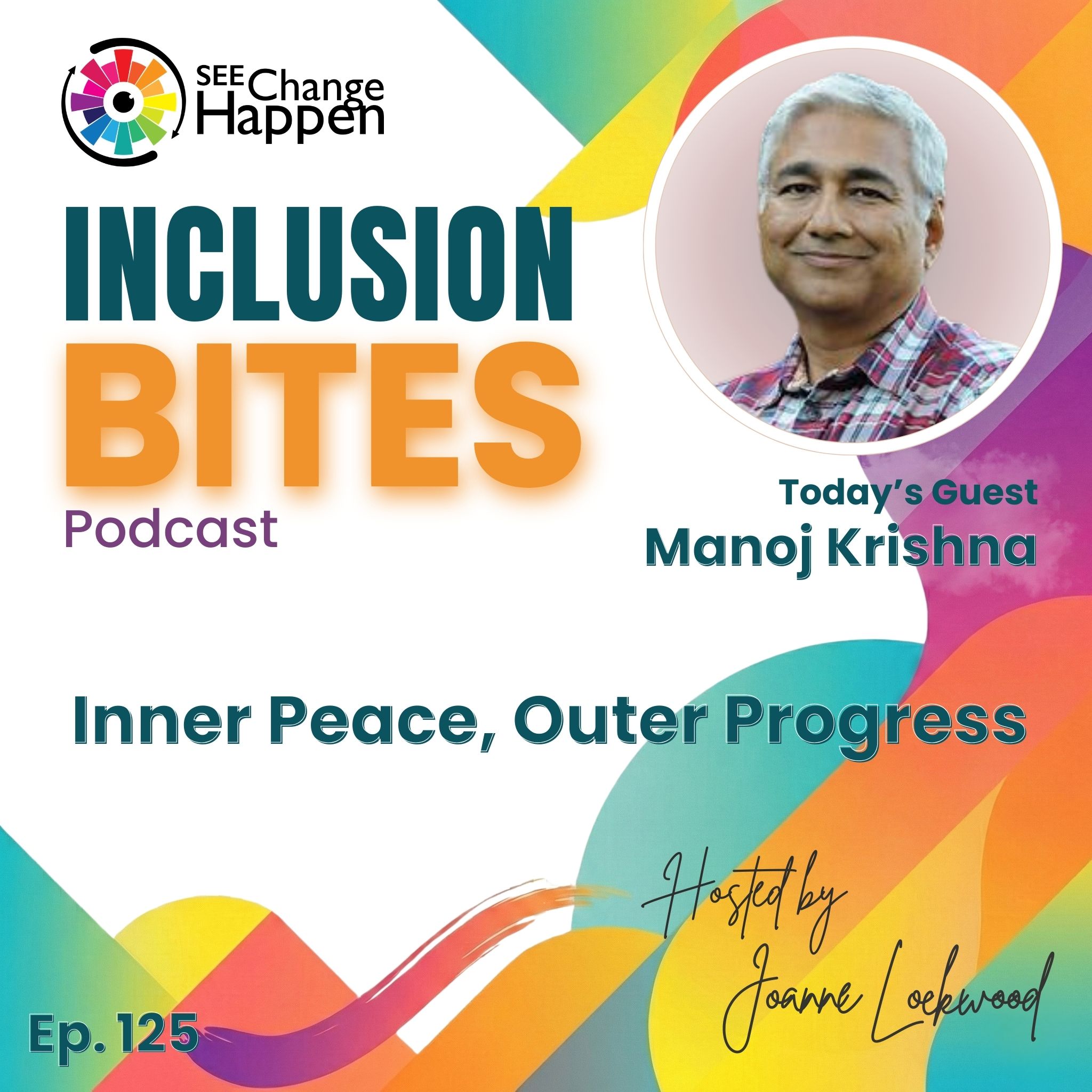
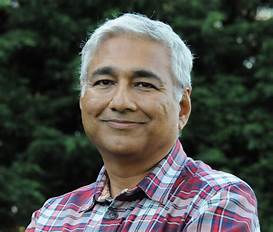
Manoj Krishna explores the profound connection between self-understanding and societal peace, emphasising how deep introspection can lead to harmonious interactions and diminish global conflicts.
In this episode of Inclusion Bites, Joanne Lockwood speaks with Manoj Krishna about mental health wellbeing trauma.
“The root word of education, adusory, is to draw out.”
Explore
Navigate this episode
Joanne Lockwoodhost
Welcome to Inclusion Bites, yoursanctuary for bold conversations that spark change. I'mJoanne Lockwood, your guide on this journey of exploration intothe heart of inclusion, belonging, and societaltransformation. Ever wondered what it truly takes to createa world where everyone not only belongs but thrives?You're not alone. Join me as we uncover theunseen, challenge the status quo, and sharestories that resonate deep within. We're justdiving. Whether you're sipping your morning coffee or windingdown after a long day, let's connect, reflect,and inspire action together. Don't forget,you can be part of the conversation too. Reach out to jo.lockwood@seechangehappen.co.ukto share your insights or to join me on the show.So adjust your earbuds and settle in. It's time toignite the spark of inclusion with Inclusion Bites.And today is episode 125with the title Inner Peace, Outer Progress.And I have the absolute honor and privilege to welcome doctorManoj Krishna. Manoj started the human wisdomproject and created the HappierME personal developmentapp to help reduce suffering,help each person lead a happier and more successful life.And when I asked Manoj to describe his superpower, he said, he used to bea spine surgeon, but less surgery to start thisproject to create a better future for humanity.Wow. What an ambition. Hello, Manoj. Welcome to the show.
Manoj Krishnaguest
Hi, Jo. Thank you so much for having me.
Joanne Lockwoodhost
Absolute pleasure. Absolute pleasure. So Manoj,inner peace, outer progress, I'd love to hear more about someof your your life, your history, and your passion. So, you
Manoj Krishnaguest
know, I was driving home from work one day aftersurgery, 10 hour surgery, you know, allday, and a hospital in the Middle East got bombed,but it was a children's hospital. It was about 10 years ago,and the kids were screaming on the radio, and I felt wehumans I was really moved by that and I felt we humans need todo better. We can do better,and we have the wisdom in the world to do better.It's just not spread enough. Do you know what I mean? It'sjust not it's not part of education. It's not part of ourlives. And the understanding that could endconflict and war is so simple that children as young as10 get it straight away. But why don't adults havecarry this with them? And so I transitioned out of medicine. Ifelt called, you know, to do something about it. Youknow, you keep thinking some politician or some clever person is going to stepup and do all this, and then you realize they're theyaren't, and it's up to you. And you think, who am I? And thenyou realize you have the ultimate power because you'rean ordinary human being. And the biggestchange in the world, Margaret Mead said,that never doubt paraphrasing, of course, that asmall group of committed individuals can change the world.In fact, it's the only thing that ever has.And so I just started and I'vealways been one to start walking andwith not knowing what's going to happen next. So I leftmedicine, I started working in schools talking to teachers aboutstress and anxiety, And one day the head teacher said, hey, come andtalk to these kids. I said, but I don't know how to talk to children.I know what to say to them. He said, no. No. Come along with, youknow so I sat down with them and I said, will you look after me?It's my first time talking to kids. I'm a little bit nervous. They said, oh,yes. Yes. Of course. There are only 7 or 8, you know. But I discoveredsomething amazing, which is we're missinga trick in education because we thinkeducation is about stuffing their heads with what we know,and we think we're doing them a favor by doing that. But the rootword of education, adusory, is to draw out.You see? And what we really need to do in education isdraw out their innate intelligence orwisdom, whatever word you want to call it. Andevery child, in fact, every adult has thisinnate intelligence or wisdom inside them, which can becompletely life changing. So when you sit down with kidsas an equal and say, I might have gray hair, but we'rethe same human being, you and I. Can we explore this subjecttogether, whatever it might be? And they say, oh, yeah. And they're fearless as youknow, and they're open and beautiful. And Ithought, oh my god. If we can bottle up theirwisdom and share it with the world, wereally could not only help each childflourish, but change the future of humanity. They have an answer towar, to climate change, to all the conflictsin the world, to relationship conflict, to stress and anxiety.They have solutions which are so simple, but adults have forgottenthat. So that's been my passion. So I started out on that journeyand then came COVID, had spoken in 50 schools andcolleges and universities by then.And you see it's the question that has the powerto open the door to wisdom. AndI then discovered that my goodness, if we could take this to theworld that's why I created the human wisdom project,and then I built this app called happier me. And
Manoj Krishnaguest
all it does is ask you questions and helpsyou unlock your own inner intelligence.So I said recently it's like walking intoa room and putting the light on, except the light goes on in yourown mind. So you can see clearly, you can make betterdecisions, you can live withoutconflict and with meaningful deep relationships.You can manage your own emotions, manage your own mentalhealth, live in peace with yourself and others, and youcan contribute to making the world a more peaceful andmore beautiful place. See our time on earth is solimited, it goes by a flash. But if youlive with this deeper understanding of yourself, which doesn'tcome from a book by the way or some religion, but it justcomes from looking and learning about your own mind. And if you can dothat and it's so simple, you can make the most ofyour limited time on it. Wow. That is
Joanne Lockwoodhost
so powerful. So powerful to sit here and listen to you speak there.I know my mind is is absorbing it. I I feelkind of drawn into the word you're using andthat Margaret Mead paraphrase quote around the small group ofcommitted individuals can change the world,it made me reflect on again, I'll paraphrasethis. I don't know who the original quote was. If you we always worry abouttime travel, being able to go back in time. And if we if we makea little change, we could ruin the future, and we could changeirrevocably what happened.But we can make that change ourselves in the present tense Yes.And have a a a a a lasting effect on thefuture that will occur, yet to occur. But we're we're scared totime travel back and make a little change, and we're scared to make the changetoday. That's a little change. And I I always reflect ona a video, I think it's Accenture produced one, called Inclusion StartsWith the I, and I was the punchline for me is always be theone. I can't change the world. I can't changeeverything, but I can change me. I could change how I show up.I could change how I take responsibility. And if Ican exemplify that to others, maybe theywill take inspiration from that change as well. So I think that reallythat Margaret Mead was very insightful, and I think it's the root cause thatwe can always push it off to somebody else, but we have to take personalresponsibility. And you know you talk to anyone about war,
Manoj Krishnaguest
climate change, and say, oh, somebody else is gonna fix have to fix that. It'sbeyond my pay grade. But what I hope to bring upand show in this conversation isthat each of us can be this light. Find our ownlight, and then we can be beacons to shine in the world.And this process is simple. And each personcan do it and it can transformour life and the world. You see, the other thingpeople get frightened of is change. If I do this, then howwill my life change? And the beauty of this approach is all you're doing islooking and learning about your your your own mind and your own so you're justwatching and learning. And the change happens effortlessly,
Manoj Krishnaguest
You see, without conflict, without anykind of resistance, it just flows. Your relationships becomehappier, you become happier. And the scale ofthe problems, Jo, that we can address with this.I mean, just imagine if there was just one answer or one solutionthat could help prevent the 80% of peoplewho are stressed, for example, avoid stress, or the 40 to60% who are anxious, or the80% of relationships that are in conflict and 50%breakdown, you know, or the 1 in 6 people who goand fall into addiction, substance abuse of some kind.Oh, listen to this one, 17% ofyoung people are self harming, Look at the amount of distress behindthat. And then I came across one yesterdaybecause we've got an event coming up on preventing suicide on the 29thMay, and it's a free event. But1,700,000 Americans in 2021tried to take their own. So the extent of suffering in theworld is off the scale. And thisdeeper understanding of ourselves and how our minds workcan help us take charge of our thinking,how we feel, how we behave, and it's an answerto our own self. That's the beauty of it. As a as a species, we've
Joanne Lockwoodhost
been around, not not obviously since the beginning of time, but, you know,a 100000 years, I guess, in, you know, in some shape or form.Why haven't we solved this problem here? You know, you whatever you're sayingsounds so fundamentally straightforward. What what really iswhy why is change such a barrier to people? What's the psychologicalbarrier to change that we're we're fighting back against? Well, everything
Manoj Krishnaguest
begins with the human mind, which is very capable,but not wired to be intelligent. There's a difference. And weare never taught from day 1 how to understandour own mind. We're always taught about the world around us but not ourselves.For example, we're all conditioned by our pastexperiences and it shapes our opinions,our beliefs, our habits, everything. What we wear, dress,eat, what we think about other people. So I waslike talking at Newcastle University once and I asked a lecturer, Isaid, where do your opinions come from and why are youso attached to them? And he said, Manuj, I've been ineducation 30 years, nobody's ever asked me that question.So we are not asking the right questions.You see? So shall I share a little story about how we couldend war? Okay. And then I'll bring you little kids I'd love to hear it.
Joanne Lockwoodhost
Alright. I'd love to hear it. Yeah. I'd love to hear it. It's so simple,
Manoj Krishnaguest
but and of course, if you ask kids they get it in 1.I'll tell you 2 stories, and they're both true.So if say you're a Russian and I'm Ukrainian, we'reabout to kill each other. We're on a war zone or could be Palestinian,Israeli, or Indian and Pakistan, doesn't matter where we are.Shia, Sunni, and we just stop and askone question. Why? Why are you and I about tokill each other? I've not done anything to you, Jo, and you've donenothing to me, but yet you and I are about to kill eachother. Why is that? And we know that if we killeach other, we go back home and we'll get a medal. But if we wereon the same side of the line and we killed each other, we'd go tojail. It's just you see what I mean? How human beings are capable but notintelligent. Right? And the more people I kill on that side of theline, the bigger my medal. But on this side of the line, I'll be calleda mass murderer, go to jail, people will remember me,or, you know, and so on. The sea, it's the same thing but you're takinga human life anyway. So we stop and ask why?Why are we killing each other? And then we realize, because you're Russian andI'm Ukrainian. Okay. Why are you Russian?Why am I Ukrainian? Oh, because we grew up in Russia and Ukraine.Okay. Is that enough to make us kill each other?Oh, no. No. You see, the same unconsciousprocess of conditioning, which is our influence,have shaped your identity and have shapedwithout our own awareness. See? And yet we've becomeattached to that identity, you know. And then as soon as you becomeattached to an identity, somebody else canmanipulate your thinking. Whether it's a religious identity, a political one,doesn't matter what it is. Nationalistic one, but you know, likeyou're democrat, republican, whatever, doesn't matter. The moment you and Isee the deep down where the same human being, your heart works inthe same way as mine, we'll say this is doesn't make any sense. Whywould we do that? And we would just put our guns down. Well, whatever, ifwe have some differences we'll talk about. So when I put this question to kids,10 year old, and I've got this recorded on video, I said, how are wegonna end war? And they said, we need to realize we have the same icecream, just different flavors. Chocolate ice cream wouldnever go to war with vanilla ice cream just because it was different. See? Butwe humans do because we don't see that we're the samehuman being deep down. And if we saw that really clearly, we wouldn'tkill each other. You know, in the last century, wehumans killed 200,000,000 of our own. Noother species on the world does that. And we think we're intelligent.See? So real intelligence comes fromunderstanding our own mind and how it's functioning without ourown awareness. And this is just one example. Does does something come down
Joanne Lockwoodhost
to the cognitive dissonance or detachmentof actions, consequences, impact? IfI if I'm killing you, I don't kill youas a human being. I kill you as aa stereotype, as a as a a demon or a beastor because the motivation we have is toprotect what I have and to defend it against somebody who wantsto take what I have. You know, you talked about identity. Sothe motivation is the key is the is the understanding whatmotivates me to want to do that. What am I trying to protectthat I feel a value that I think you want to take from me?That's the kind of fundamental, isn't it? Is that is that is that what you'retrying to say? Yes. But it also comes down to understanding
Manoj Krishnaguest
identity. Because if you and I are brothers forexample, we might fight over the spoils, but we probably wouldn'tkill each other, you know, over that. But if you and I have adifferent identity which we're attached to, then we losecontrol of our own thinking. See? Imean, take Yugoslavia when it broke up, you know, theSerbs and Croats and Muslims and Christians live next door to eachother for decades and then suddenlythey turned and started killing each other. Same happened in the partition of Indiain 1947, Hindus and Muslims slaughtered each other. Soidentity can provide comfort,security. I'll give you an example. So again, 10 year
Manoj Krishnaguest
old chap, I said you walk into a classand they're it's got black children and white children and you're awhite boy. Where are you gonna sit? He said, I'm gonna sit with thewhite boys, white children. I said, why? He said, I feel safer.And I said, what else? I said he said, I think they'll understand me better,and I think they'll listen to me, you know, and so on. And I said,will you talk to the kids on the other side of the class who area different skin color to you? He said, no. No. I won't talk to thembecause I'll think they're a bit strange. I said, what happens in 3 months? Hesaid, oh, well, we'll start having arguments because we're nottalking to each other, we won't understand. I said, what happens if you're a country?He said, we'll go to war. 10 year olds. And I said, what's the answer?He said, we have to mix with people who are different. And howoften do we do that you see? You know we all want to be withpeople like us, But if we want peace in the world,we have to reach out and connectwith others who are different. And it's just common sense. See?
Joanne Lockwoodhost
It's that sounds fundamentally lazy.It because affinity bias and people like us, peoplelike me, it's easier, as you say, to have a conversation, torelate to each other. If we're trying to interact with peoplewho have a different lived experience, a different perspective, a differentidentity, it takes more cognitive processingto have conversations and to understand the other person's viewpoint.Yes. So it it does it come down to laziness andand our innate sense of justkeeping the status quo. That's that's the challenge here. I I don't I don't wantto invest time in finding out about you because I also don't think you wantto invest time finding about me. Therefore, I just talk to my my my likeminded people. Is that is that what's going on? Well, we're not curious
Manoj Krishnaguest
anymore, you see, Jo. We are as children,but our education system does 2 things. It killsour love for learning, and it kills our curiosity.So when you're a child, you're really curious about everything. You'recurious about other people you meet and you want to know.But as adults, that suddenly been gradually taken out of us. Sowhen I meet someone who's different, I meet that personwith fear, lack of interest. But actually, if youthink about it, if I'm curious, there's so much I can learn fromyou, you know, your everything that you'redifferent about is an opportunity for me to learn to enrich my life with that.You know, the books you read, the poetry, the food you eat, or whatever itis you're thinking, we've lost that curiosity.So our mind is wired in aparticular way and this the way it's wired rightnow is creating all these problems. So every problemwe humans face for which there's no easy answer beginsin our thinking and all the problems we talked about earlier. Sosimply logical that if we had a better understanding of this mind ofours, we could avoid those problemsand overcome them much more easily. Andbecause there's so many of them, I mean for example, we could talk aboutaddiction if you like. You know, addiction is a problem of thinking.It's not a problem linked to alcohol or drugs. Obesity is aproblem of thinking. It's not linked to foodbecause we know what we need to do, but we find difficult to selfregulate our emotions and therefore ourhabits around food, drink, all that stuff. Sothis if you begin this journey of just looking andlearning about your own, it awakens your own innerintelligence. And you don't need to be educated for that, by the way.In fact, the more educated you are, the the moreclever arguments you have why, you know, you're okay as you are andyou're not interested in learning. But I believe if we could bring this toevery child and adult in the world, we could help themflourish and live in peace. After all,happiness is peace, you see. If you ask anybody, what do you want from yourlife? They say I wanna be happy. And happiness isreally at the core of it is living with peace. Because all ourpleasures as you know fade, you know, you have a new car, next week it'san old car. You go on holiday as soon as you come back it's finishedand so on. But peace is the thing that each human beingwants, and no matter how much wealth and power and fame youaccumulate, peace is the one thing that's missing inmost human hearts. And this understanding ofourselves can bring us that elusive peacethat we chase all our lives. And if I live in peacewith myself, then I can live in peace with you. And then we can havepeace in the world. You used the word elusive there, in search
Joanne Lockwoodhost
of peace. It's it's the it's the challengewe have. It's we don't we're not ableto set a bound ora definition of what happiness and peace means to us.So I found more joy bythinking about sufficiency, whereas in my life whereI was looking for acquisition, for growth, formore, for bigger, for faster, and newer,that was like like a drug that I chased, and andyou could never be satisfied because it's always one more. And it's likedreaming about winning the lottery. You think, well, if I won £10,000,000,is that really enough? I really need 20,000,000 to haveevery the life I want. So we we always tend to want thisplus 1, plus a 100, plus a1000000. And he'strying to rein that back to to move thatelusiveness of happiness to one of sufficiencyand satisfaction with what we have nowor realistically can achieve without wanting more. And Ithink yeah. Listen to what you're talking about there. It's the conflicts.It's often about acquisition of more. I want your territory. Iwant you to do what I want. And if if if Iwas sufficient in my mind thinking, I'm happy for you to beyou and be who you are. I don't need you to be meor I to be you. Yeah. And I think is that that that that's thething we're chasing is gluttony for one of a better way of describingit. But you see the way our mind is wired is automatically
Manoj Krishnaguest
driving us in that direction. So without understanding thishidden driver in our mind that's pushing us in that direction.You can try and stop it. You somebody might listen to me or you andsay, no. No. Tomorrow, I'm going to try and be contentwith what I have. It doesn't work because the innerdriver is so powerful, it's gonna keep on pushing you.So let's take a moment to explore that. What is it inus that drives us to accumulate more andmore and more and never be satisfied.See? And maybe it's inus all is this deeper emptiness. Call itinner boredom, call it the void. And the more we get stimulatedfrom the outside, the more we can cover it up, you know, call itloneliness. So but the nature of pleasure issuch that I get a new car, it's an old car, new shirt, it's anold shirt, so I need a new one, you see. So I'm constantly
Manoj Krishnaguest
chasing something on the outside to make me feelgood on the inside. But if we pause and ask,why don't I feel good on the inside? What's going on? Becauseif I could answer that question and find the peacewithin me, right, then I don't need tochase all this stuff on the outside. Then I'll get what I need, youknow, I don't whatever it is I need andthe answer to that is first to wake up andrealize this inner emptiness that we all have as human beings.We cover it up very cleverly, you know, through all ouracquisitions and relationships and power and all of that. But theemptiness does never goes away. So the answeris to lean into it, is to stay with it and then ittransforms to peace. But we are scared of doingso shall I tell you a story with children?Again, I love children and they're intelligent. So I'm talking tothese kids and I said, okay. What do you what makes you happy?And they said, Christmas presents, holidays,ice cream. So I said, how long does a pleasure last? I said, notlong. Soon as you open the Christmas present. And I said, how do youfeel after the pleasure ends? And then a little bit of apause, and then they say, I feel bored,empty, and restless. I said, what do you need to donext? Oh, I need something more. So another present, you know,more ice cream. But I said, how is it gonna be different thistime or it's gotta be bigger and better?So I said, what impact is this having on your lives? And this is inthe northeast, a very deprived area and the kids say well there's no foodto eat sometimes because we've spent all the moneyon things, you know, presents and whatever,pub and all that. I said, okay. What else is can I do?He says it can cause pollution and 10 year olds have heard globalwarming, so they kind of say, okay. It can lead to global warming because allthis pollution and consumption. So I said, what's the answer toglobal warming? And this little girl said, well, we have to find sources ofpleasure that don't involve buying things. Right? I said,like, what? She said, like, going for a walk with your friends,playing with your friends, going for a walk in the woods. I said, what elsecan we do? So then there's a long silence, and this girl at theback said, if we could find an answer to our inner boredom,then we wouldn't need to consume so much. We wouldn't need to buyso much. Right? Because that's what's pushing us to buy all this stuff. So Isaid, what's the answer to the to your boredom? And she told me this. Well,
Manoj Krishnaguest
I said to you right at the beginning, if I stay with it,it goes away. It's just so moving and profound, the intelligenceof children. And when you talk to adults about climate change,they think it's going to be solved by electric cars or whatever, but it's not.It's going to be solved by us connectingwith our own inner intelligence, waking up to realize there'senough in the world for everyone and this more and more thatwe're chasing as you as you said right at the beginning,isn't making us any happier. It's not serving us. Do you know what Imean? Absolutely not serving us.I mean, I know people who go on 8 holidays a year. It's becausethey're just not at peace with themselves, you see. Or they comeback from one cruise and 2 days later they're off on another one,and so on. So the purpose of life becomes to accumulate moreand more money so you can buy more and more pleasure. And inthe process, we wear ourselves out and become miserable. And ofcourse, all the mental health statistics are there to show what'shappening, you know, in our lives. It's the boom and bust. It is
Joanne Lockwoodhost
as you say, we're we're working, working, working toaccumulate. Then we we we offload ouraccumulation onto holiday, so we end up with this peak and troughof the brain chemicals. So we're rushing with stress, then we're de stressing,having a holiday, get back. We think, oh, we need to rush, rush, rush andrestress to follow the next holiday. And so, yeah, we're doing this cycle.And it's a bit like taking sugar in your tea, I guess,where you don't necessarily want the the drink for the fluid.You want the drink for the sugar. So you're you're craving the sweetness.And you you stop taking sugar in tea and coffee, youdrink it for the drink, not not for the sugar rush. And I and Iand I I've stopped drinking alcohol now. I haven't drunk alcohol for 80060 something days, and I've I find that has changed my whole outlookon what I do for for for pleasure. I don'tI'm not trying to feed the alcohol monster anymore. I'm not trying to look forthat for the alcohol to fuel my goodtime. I go and have a good time in in doing other things. You yousaid that let's go for a walk around the lake. Let's go and sit inthe sun. Let's do let's do something that I don't need to spend moneyon. I bought a 7 I bought a 17 year oldcar because I got off of the the wagon of saying I had tohave the newest model on 3 year loans and then turn itover and get another 3 year car, another 3 year car. I bought a 17year old car that's now 22 years old, and I don't think I ever needto replace it until I do. It'll be fine. And then one day, I'll buyanother 17 year old car that I'll keep for another 5 years, wanted itit doesn't work anymore. If you're not, that's a different thing. In your own
Manoj Krishnaguest
mind, Jo, and you're easily conditioned by the worldaround you, then before you know it, you would have bought the newcar on a 3 year lease. By the way, we're not sayingholidays buying things is wrong. We're just saying at themoment, it's happening without your own intelligence operate.And all we're saying is when you wake up and yourintelligence is operating, then you will make the right choices foryou that serve you. We're not trying todictate what people should and shouldn't do. We're just saying wake up andconnect with your own inner light intelligence, whatever word you wannause. But that's play play into the scarcity mindset, isn't it?
Joanne Lockwoodhost
Where if you believe a resource is scared, you'll try and holdit, because you wanna make sure you've got that resource if itever becomes, you know, unavailable. And other people you know, we saw inCOVID toilet rolls, rice, bread, flour. Peoplewere holding stuff for this scarcity mindset. They had to have it, thennobody else could have it. And I guess that's the basis of war, isn't it?You know, we can we just had to speak about shooting and killing each otherbecause people are worried that they're gonna take something of theirs. Peoplethose those very primeval instincts were coming out inCOVID around, I want, I want, I have to accumulate. Idon't need 10,000 toilet rolls, but I've got them just in case. Yes. And
Manoj Krishnaguest
you're driven to do that without even being able to stop yourself, yousee. And the reason is that we don't understand thenature of fear. See, there are 2 drivers for human beings. Pleasure,we've talked about, but the other big one is fear becauseand fear is really interesting to understand.And when I talk to the kids, the explanation I offer them which theyreally love is like you're sitting in a cinema theater and you're watching amovie and on the screen are all these scary images and you believethem to be true and you get frightened and that fear thenchanges your thinking and your behavior. You don't seethe projector is your own mind. See,it's projecting all these images onto the screen which youbelieve to be true. So in a scary movie, if you wake up and realize,this is just a scary it's a movie. It's fine. Your fear goes away.But we don't have that illusion continues in our inour own life. So once you understand that your mind exaggeratesthe fears of the future and it catastrophizes. In a way to tryand protect you, but quite often it doesn't serve you. Andthen of course fear turns to anxiety and we did a survey recently,60% of people said I've got moderate to severe anxiety,and you can imagine how crippling that is. So once youwake up and realize your anxiety is not caused by your lack ofmoney or your worry about your health or your kids orwhatever, It's caused by your own mind creatingyour own suffering. So the work you need to do is on the inside. And
Manoj Krishnaguest
as soon as you wake up and realize that, then youbegin your own journey of learning and you're free. You know, or it's a bitlike you wake up from a scary dream,And in the dream you're really frightened, you're in a sweat, but assoon as you wake up and realize, oh, that's just a dream, your fear vanishes.Similarly, when you wake up and realize your fear andanxiety has been created by your thinking and it maynot be real, but it's shaping your life in ways that doesn't serveyou. See? Then you're free. So Igave this talk once and I said, okay, fromtomorrow we're all going to stop eating because this halfof the room is frightened of being attacked by that half of theroom. So we're gonna use that money and buy guns instead.They all started laughing. But I said that's what countries are doing. That's whatwe human beings are doing, you know. We spend, I don't know, $1,600,000,000,000on arms every year and a 1000000000 people go hungry every day andseveral in this country, and the richest countries in the world. So and it's allbeen And we have a major a major country in the world
Joanne Lockwoodhost
advocating more guns makes you safer.Yeah. If I if I if I have a gun, I'm more at risk. Andwhat I need to do is buy a bigger gun so I'm less at risk.And I need to buy more guns, so I'm less at risk. And that that'san inherent societal belief Yes. Incertain countries that we we can all think about. Yeah. Yeah. But it's all
Manoj Krishnaguest
based on fear and conditioning. Yeah. What I mean isthat there's a hidden mind operating in the background without ourown awareness. We think we're in charge of our life, but actually we'renot. This hidden mind of ours is running our life forus. And when we wake up and can see clearlywhat it's doing, putting the light on, shining a light inside,we can then be in charge of our own life andmake more intelligent choices forourselves. So we can live in peace withourselves, with others, be happier, have relationshipswith meaning depth without conflict. Do you know60% of people in the world feel alone, 30% ofthem are in relationships. And this is becausewe haven't learned the art of relationship, Or wethink love is what you are making going to help me make mefeel. Do you know what I mean? So ifyou make me feel good, I'll say I love you, but I'll do things foryou. But the moment you stop making me feel good,Jo, I stopped loving you. I said I don't love you anymore.And I genuinely convinced my brain convinces me I'm loving youbut actually I don't see. I'm just it's I'm just loving me.Do you see what I mean? So It's a codependency
Joanne Lockwoodhost
thing, isn't it? Where we're trying to secure ourselves by bythe word love, creates a commitment and anownership maybe. AndI need you to make me feel good, sort of thing. So, therefore, I Iuse those words back. I see what you're saying there. It's it's creating that codependencyand commitment. If people are doing that, I'm looking to you to
Manoj Krishnaguest
get my needs met, you're looking to me. And if for by anychance we do do that, then of course we have a happy relationship.But if we're not aware of this process in the background,then you can easily see how conflict happened.And our loneliness comes not because we don't have people in ourlives, but because we don't have depth of connection with them.So I spoke at this I was talking to these, kids in auniversity, I was talking about loneliness and this boysaid, I don't know how to have a deeperrelationship with anyone. I've never been taught. Nobody's ever evertold me how to do that. So this is what my passion is to bringthis understanding of understanding our own mind intoeducation. So we can have relationships with meaning, depth, you know,so our lives can be richer overall. Right? Because afterall, our our relationships are the foundationof our own long term happiness. Right? You're talking away.
Joanne Lockwoodhost
I'm I'm I'm thinking about, you know, going back to the happiness side, the relationshipside, the human mind, the psyche. And I was I was justmy wife was wondering thinking around behaviors. AndI and I was thinking about flying aircraft,scheduled flights as an indicator of human behaviorthat that I'm simplifying this data to 2 types ofpeople. One type of person wants to get on theaircraft as quick as possible to be first toto fight the rest of the front of the queue. And there's the other sortof person, which I put myself into the category of, I wanna belast on that plane. I I I don't wanna inconvenienceeverybody, but I wanna just literally walk up, walk on the plane, sitdown, strap myself in, and then we go. I wanna makemaximize that. And I also I'm one of the people that wants to be lastoff the plane. I wanna if you wanna fight for it, you wanna stand upand queue, you wanna get all upset around this and and be alluncomfortable. That's fine. I'll just sit down, fold myarms, go back to sleep, and wait for the plane to be empty and go,right, unbuckle, stand up, grab case, walk off. Thekeypad passport's gone. The the bags have already arrived at the on the carousel,and I walked straight out. But you see some people get really,really, I don't know, anxious,aggressive, demanding, tense,whatever it may be. And despite focusingon the plane doesn't get there any quicker, whether you're at the front or theback. It's it's a it's a I always probably book a seatas far to the back as possible because I don't care. I don'tneed to be past the melee of of people fightingwith each other. And it's it's just again, it's thatthinking about the mindset and what you're trying to achieve,but people don't. They're so busier and you take your practiceconflict and killing each other. We're so busy, worried that someone's gonnatake something that's ours. And we don't we have to defendourselves all the time. So you see the
Manoj Krishnaguest
door to intelligence opens with a simple question. Why amI thinking this way? Why am I feelingthis? Why am I behaving in this way? For example, jumpingon, you know, all the plain story you said, Russian. Doesit matter? So asking ourselves thequestion is what helps us pauseand then our intelligence can kick in. But if wehave never been taught, Jo, to question our own thinkingand our own behavior and what we feel.Because you see right now, our mind is wired to convince us thatwhat we think is true, what we feel is true,what we see is true, you know. And we neverwe justify everything. If I'm smoking, I'll justifyit. If I'm about to kill somebody, I'll just it doesn't matter what I'm doing.Even Hitler, you know, justified the killing of all the people hedid and so on. So everybody justifies theirown actions. That's how our mind is wired. Intelligence comeswhen you can pause and ask why. What am Idoing? See? And then that opens the door to adeeper experience of life. And, you know, it'sa really enriching experience. So right now,our minds are wired to look on the outside forthings to make us feel good on the inside. But if you live with thisinner intelligence or wisdom or whatever you want to call it, you'renourished from the inside. And as you say, then you can relax, sit on theback of the plane and wait for everyone to take off because you know it'sa smart thing to do. Or you mightlearn you're both chasing money all the time, where you've gottaactually pause and enjoy your life because we spend every day working fortomorrow. Right? Or so many people do, youknow. So we're we're we're enlightened. We're we're we're living in the
Joanne Lockwoodhost
echo chamber of of kinda getting some of this stuff that you'retalking about. I I'm I'm not I'm you've got no resistance for me here atall. I'm I'm with you on everything you're you're saying.But we recognize that the facts don't change people. You know, wewe we can tell people to a blue in the face that doing this,cause and effect, do this, that will happen. And people will ignorethat. They'll they'll they'll they'll risk take. They'll they'll drive toofast. They'll drink too much. They'll stand on the edge of theplatform. Don't fall where they should be standing back. They'll rush to the front ofthe the baggage carousel. When standing back and waiting for yourbag to appear is obviously the best solution, but now we have to be atthe front. So what how can someone who'slistening to this podcast maybe reflect on what we've been talkingabout? And what's that first step they can taketo enlightenment, to change, or that nuggetthat's gonna nudge them into a slightly different orbit of thinking? What canthey do? Yeah. I think the first thing is to want it.
Manoj Krishnaguest
See. Say, the other day I was doing a event and alady gave this beautiful example. She said,it's like learning a new language. First, you have to want to learnthe language. So what is it that's going to make you want to,you know, understand your own mind? You might want to be lessstressed or less anxious or less lonely or have ahappier relationship or deal with an addictionproblem or you might want to be happier. You mightwant actually to be emotionally intelligent, which will helpyou be successful in the world. You know, if you can manage your emotions, you'reemotionally intelligent. And they say our success comes from emotionalintelligence more than whatever skills we may have picked up.So you have to decide what's important foryou. And once you decide, then as you're saying, thenthere's a knowledge part. Okay. The, you know, the learning thelanguage has some grammar and basics. And we've got we'vedeveloped an app we'll talk about which helps with all of that calledHappier Me. And then you have to practice. Right?Then you have to actually, it's gotta be a living thing in your life. Youpractice the language and unless you practice it, it won't stayalive. So similarly, you've got to then notice what'shappening in your thinking. Ask yourself, why am Ithinking that way? What's going on? And then yougo deeper and explore. And you see, it's like again, if you havethat curiosity, then you think, oh,well, I didn't know that about myself. So it becomes aprocess of self discovery. And that self discovery bringsjoy, brings change, and enriches yourlife in a 100 ways. Yeah. Anyone can do this. Everyonecan do this. There's no stereotype for this. It's
Joanne Lockwoodhost
it's as you say, it's the the fundamental is thethe epiphany, the wake up, the the thing that'sgonna nudge you, the the drive to change.But the the reality is most people will never ever findthat drive. And the ones who doare halfway on the on the road to enlightenment anyway. Soit's what yeah. There'd be people listening to this podcast going, what are theyon about? What are they on about? Why do I need to do this? I'mperfectly fine. I'm perfectly happy. It'swhat's what's the trigger? How do we say we wanna try and findsomething within us that are gonna go, Now I get it. What's thatwhat's that thing that's gonna trigger me? I've just been writing a blog, Jo, on
Manoj Krishnaguest
the 5 barriers to overcoming stress.The number 1 is, I may not even know I'm stressed. By theway, when I use the word stress, it could easily be anxiety or conflict. Itdoesn't matter what it is. So firstly, I may not be awarethat this is what this is what's happening to me. Secondly,I may think, oh, this I'm bigger than that.I'm a man or whatever. I I'm I don't I never get stressed, you know.I'm I have a perfect relationship, so you're indenial basically. You're just not aware. Or it couldbe that you just don't think it's possibleto be anything other than how you are. You don't think it's possible tonot be stressed, or you don't think it's possible tonot be anxious, or have a happier relationship. See?Because you've just grown up thinking that's the norm. Orthen you might think, well, it's somebody else's bloody fault, you
Manoj Krishnaguest
know. Why should I have to change? Somebody else needs to change,or my job needs to change, or I I I need to havemore money to be less anxious or whatever. So the change has got to comefrom the arts, so therefore it's got nothing to do with me. And evenif they listen to us and said, okay, I agreeI need to change, they don't know how to, or they're frightened of looking atthemselves. So there are a few barriers, but each ofthem can be overcome quite simply, I think, andwe've created a toolkit to help people do that if they're really interested.
Joanne Lockwoodhost
Okay. Yeah. That's interesting. That's as I thinkwhat I'm kind of hearing is that there's an externalfactor that's gonna cause that trigger. Yeah.So you say a burnout, an illness,being made redundant, car crash, something that something that's gonna hityou in your life that that's gonna jolt you involuntarilyout of your orbit for it long enough foryou to see a different path. If it's a minor bump, you probablywon't, but if it's a significant bump. And that's that's thechallenge we face is we need something really, really fundamentallyknocking on our door to make us wake up and go andreevaluate. I mean, I've been through this. I've been through something that knockedmy life several lanes to the left. And Iknow people who have had a very similar wake up call for variousreasons, which is provoked life changingthinking and activity. But most of us who would benefit fromthis will wait until that point in their lifewhere they just keep heading they they arrive at60 miles an hour towards a brick wall, and and it's only the brick wallthat's gonna make them stop, not not their power on the brake pedal.
Manoj Krishnaguest
So interesting, Jo. Let me ask you a question. Knowing what you knownow, do you think it would have been smarter for youto have avoided all those challenges in your life? Right? Sosomeone listening to this conversation, I'll ask them, I do you thinkyou're intelligent? Do you think you're smart? Everyone says yes.If you are, you're a thinking person.You've got a beautiful brain, the most capable in the universe. Useit to reflect on your own life. Why waitfor disaster, trauma, self harm, youknow, all of that stuff. You can change your lifetoday. Just take the first simple step of
Manoj Krishnaguest
looking and learning, asking why. What's going on? Just be curious.See? You don't want to be in acar crash in your life, metaphorically or literally. You wantto avoid car crashes in your life. Right? So manypeople end up with burnout, depression, and if I said70% of the people in the world are gonna burn out and you're in the30%, if you're really smart, you won't wait tillthat happens. You'll say, right, I'm gonna make sure I don't burn out.I'm gonna find out what's going on. If I learn I'm gettingmarried and I learn 50% of marriages end indivorce. I'm not gonna sleep walk into that. I'm gonna wake upand do something about it. So I'm not that statistic.And of course, the wisdom is there if you want. Or if I wake upand realize 60% of people are anxious in the world, and then someonecomes along and says you don't have to be, something can be done about. Sowe have that capacity for intelligence. It'sjust we need to, a, wake up, b, realize it'spossible to change, and, c, it's not that difficult.Children as young as 10 get it like that. See?
Joanne Lockwoodhost
Yeah. Even though I know what I know, I'm still not convincedthat I will take preemptive enough actionwithout something becoming a problem next time. So II've I've I've gone through a period of change. I've gone through a period ofreflection. I've got I've gone through a period where I completely relate to what you'resaying is, but I can foresee myself being in anotherplateau. Mhmm. Well, again, I'm blissfully unaware untilsomething else happens to cause me to reset again. Soit's almost like a step to its waveform. I'm I'm flattering,staying steady, plateauing, staying steady, and going from this, like,sequence of of epiphanies. Yes. Hopefully, in
Manoj Krishnaguest
time, maybe I'm more. Problems will be repeated until thelessons are learned. You know? Yeah.So yeah. But it's, of course, it's I'm probably more open.Yes. I'm I'm more open to be aware sooner. So
Joanne Lockwoodhost
the resistance to change will it likely beless than it ever was. And every time that I'mrealizing the change is necessary, I'm more willing toembrace it. But there's still a lag on that curve, isn't it? There's still gonnabe a a slight delay while I reevaluate,reincorporate, and then adapt. And I guess what we're trying to do hereis we're trying to minimize that curve of acknowledgmentYes. To take action. Think about why people learn another language.
Manoj Krishnaguest
It's not there's no pain point they're trying to solve. They're doing something for thelove of it because they want to get something out of it. Sosimilarly, learn about the most importantperson in your life. You learn abouthow to be at peace and happy, which isthe number one thing you're chasing in your life. Learnnot to waste your life so that you don't want to be,you know, on your deathbed and think, oh my god, I just wasted my lifesoft with suffering when I could have lived with joy,you know. I could have had really happier relationships.So why didn't I? What happened? So here isthe jewel of understanding. It doesn't come from a book orreligion, don't worry. Nobody's telling you what to do. But here isa jewel that can completely transform your life and make itricher, more beautiful. Why would you not look at thatand just be curious? You don't have to believe anything anyone's saying,least of all me, but you could just becurious. Maybe there's something there. Let me let me have alook. There's no harm done looking. See what I mean that way? Yeah.
Joanne Lockwoodhost
And I think going second right back to something you said right at the beginning,education or educate derives from was it theGreek or the Latin? It's Greek. Yeah. To draw out. Yeah. To drawout. And I think that's the key here is tryingto draw out what we think and feelourselves, expose that draw out of others of what they're thinkingand feeling, and then be able to make better decisionsthat don't involve conflict or gluttony, I guess. Yes. All of
Manoj Krishnaguest
that. And and and my passion is thatthis subject of learning about yourself, call it what you like, selfunderstanding, should become part of education. Soas much a part of the curriculum as maths andscience because it could save us from allthat conflict and suffering, number 1. It could helpeveryone live in peace no matter what you're doing in society. Youknow, you're the barista in the coffee shop, you're cleaning the streets, you're the theprime minister, doesn't matter. You live a rich fulfilledlife on the inside. Your inner life is rich, andwe could create together a better future for our children andfor humanity as a whole. And it's not that far off, you see.We have all this wisdom in our hands to make this areality today. Manoj, thank you. This has been fascinating. I've really
Joanne Lockwoodhost
enjoyed diving into this with you. How can our listeners get hold of you? Howcan how can you, start more conversations? So people can find me on
Manoj Krishnaguest
LinkedIn, Manoj Krishna. You can visit ourwebsite. It's happier me, one word, dot app. You candownload the happier me app from all theall the stores and begin aconversation. Reach out. It's manuj@happierme.appis my email. If this resonates and you'd like to bepart of our mission to helpreduce suffering, to help people lead happierand more successful and to create a better futurefor our children and for humanity, then get in touch. I think we have it
Joanne Lockwoodhost
Just on the edge. To do something really beautiful in the world
Manoj Krishnaguest
and leave a legacy for our children who look backat our generation and think, okay. They messed it up, butthen, okay, they try to do something about it. Or at least equipthe next generation with the wisdom to be able to addressthese challenges we face. Yeah. As I've just found the the app
Joanne Lockwoodhost
on Apple. And, yeah, I'll go and take a look at that. It's Please try
Manoj Krishnaguest
out. It's no obligation to buy anything. Yeah. Yeah. Go ahead and havea look. Yeah. Well,
Joanne Lockwoodhost
thank you so much. It's been a fabulous conversation. I've really enjoyed it, andgood luck with the app and good luck with, spreadingHappier Me to everybody in the world. Jo, it's been my pleasure.
Manoj Krishnaguest
Thank you so much. As we bring this
Joanne Lockwoodhost
conversation to a close, I want to express my deepestgratitude to you, our listener, for lending yourear and heart to the cause of inclusion.If today's discussion struck a chord, Consider subscribing toInclusion Bites and become part of our ever growingcommunity, driving real change. Share this journey withfriends, family, and colleagues. Let's amplify the voicesthat matter. Got thoughts, stories, or avision to share? I'm all ears. Reach out to jo.Lockwood@seechangehappen.co.uk.And let's make your voice heard. Until next time. This
Joanne Lockwoodhost
is Joanne Lockwood signing off for the promise to returnwith more enriching narratives that challenge, inspire,and unite us all. Here's to fostering a more inclusive world,one episode at a time. Catch you on the next bite.
Education's Impact on Curiosity and LearningUnderstanding Ourselves for Inner PeaceThe Role of Fear in Human Behaviour
Joanne Lockwood is joined by Dr Manoj Krishna, a former spine surgeon who left medicine to focus on reducing human suffering through the Human Wisdom Project and his HappierMe app.
Together they explore how greater self-understanding can shift how we think, feel, and behave, with ripple effects for relationships, conflict, and society. Manoj argues that many of our biggest challenges—stress, anxiety, loneliness, addiction, and persistent conflict—are fuelled by unseen patterns of conditioning and fear, and that learning to question our thinking can open the door to calmer, more intelligent choices.
The conversation also critiques how education can suppress curiosity, and makes the case for teaching self-awareness and emotional understanding as core life skills. Using stories from work with children, they discuss identity, difference, and the importance of mixing with people unlike ourselves to build connection and reduce division. The episode closes with practical encouragement to start with curiosity and simple questions, and pointers to Manoj’s resources for those who want to go further.
“But the root word of education, adusory, is to draw out. You see? And what we really need to do in education is draw out their innate intelligence or wisdom, whatever word you want to call it.”
“And all it does is ask you questions and helps you unlock your own inner intelligence. So I said recently it's like walking into a room and putting the light on, except the light goes on in your own mind.”
“And the change happens effortlessly, You see, without conflict, without any kind of resistance, it just flows. Your relationships become happier, you become happier.”
“After all, happiness is peace, you see. If you ask anybody, what do you want from your life? They say I wanna be happy. And happiness is really at the core of it is living with peace.”
“So I'm constantly chasing something on the outside to make me feel good on the inside. But if we pause and ask, why don't I feel good on the inside? What's going on? Because if I could answer that question and find the peace within me, right, then I don't need to chase all this stuff on the outside.”
“if we could find an answer to our inner boredom, then we wouldn't need to consume so much. We wouldn't need to buy so much. Right? Because that's what's pushing us to buy all this stuff.”
The impact of traditional education in diminishing adults' curiosity and innate love for learning.
Exploring the deep-seated human drive for accumulation and how confronting this can lead to inner peace.
The role of cognitive dissonance and personal identity in shaping social conflicts and interpersonal relationships.
Practical reflections on how understanding the human mind significantly improves interaction with diverse people and enhances problem-solving abilities.
The influence of a scarcity mindset on behaviors, particularly highlighted during crises such as the COVID-19 pandemic.
Strategies for breaking the cycle of material accumulation and fostering satisfaction through non-materialistic sources of pleasure.
Actionable insights into personal development, emphasizing the need for regular self-examination and understanding to drive societal change and reduce global suffering.
One thing to remember
To foster true inclusion and societal progress, one must start with inner peace, which stems from a deep understanding of oneself and a commitment to transcending beyond superficial societal norms and materialistic pursuits.
Questions this episode helps answer
Manoj Krishna discussed the impact of education diminishing curiosity and love for learning in adults. How can educational systems be reformed to foster lifelong curiosity and passion for learning?
Considering Manoj’s belief that understanding oneself leads to inner peace, what practical steps can individuals take to begin this journey of self-understanding?
Joanne reflected on the pursuit of acquisition and the elusiveness of happiness. What societal changes are necessary to shift the focus from materialism to sufficiency and contentment?
Manoj highlighted the temporary nature of pleasure through children's interaction in a deprived area. How does recognising the fleeting nature of pleasure influence our daily choices and interactions?
The discussion touched on the importance of understanding the human mind for improving relationships and problem-solving. Can you share an example where this knowledge has personally helped you resolve a conflict or enhance a relationship?
Joanne and Manoj discussed the barriers to change in people. In your opinion, what are the biggest challenges individuals face when trying to change their mindset, and how can they overcome these challenges?
Explore topics
Ideas from this episode
Education's Impact on Curiosity and Learning
In our fascinating exchange, we dived into how the traditional educational systems perhaps inadvertently dampen the natural curiosity and fervour for learning that many of us start with as children. This conversation was actually quite an eye-opener!
Understanding Ourselves for Inner Peace
The intrinsic connection between self-awareness and inner peace. Understanding our own minds, emotions, and motives can lead us not only to personal tranquillity but also to improved relationships with others.
The Role of Fear in Human Behaviour
Lastly, we tackled the ever-persistent role of fear in driving human behaviour. This part of our discussion shed light on how fear originates from the mind and the ways in which it can dictate our actions and decisions, often to our detriment.
Learn
Frequently asked questions
What is the main focus of the episode "Inner Peace, Outer Progress"?
The episode delves into how understanding oneself can lead to inner peace, which consequently fosters better interactions and progress in a diverse world. Manoj Krishna discusses the role of self-awareness in overcoming barriers in communication and fostering a more inclusive environment.
How does Manoj Krishna explain the impact of education on adults' curiosity and learning?
Manoj criticises the traditional educational systems for stifling curiosity and genuine love for learning by prioritising rote learning and exam-oriented teaching methods. He suggests that education often hinders our natural curiosity and lifelong learning which is essential for understanding ourselves and others.
What does Joanne Lockwood say about the pursuit of material acquisition?
Joanne reflects on her personal experiences, noting that constant acquisition rarely leads to true happiness. She advocates for finding sufficiency and satisfaction in what we already have as a pathway to genuine contentment.
How does Manoj Krishna describe the nature of pleasure and its implications for personal peace?
Manoj highlights that many pleasures are temporary and lead to a cycle of endless desire and emptiness. He suggests that true inner peace comes from addressing and transforming this inner emptiness into contentment and understanding rather than seeking external fulfilments.
What practical advice does Manoj Krishna offer for moving towards enlightenment or changing one’s mindset?
Manoj suggests that the first step is the genuine desire to change, likening it to the dedication needed when learning a new language. He emphasizes that understanding one’s own mind is crucial for this transformation, aiding in managing emotions like stress and anxiety, and improving overall life satisfaction.
What are some non-materialistic ways to find pleasure according to the discussion?
The episode suggests engaging in simple activities such as walking, sitting in the sun, or spending quality time with friends as ways to derive pleasure outside of materialistic pursuits.
Share this episode
Heard something worth passing on? Send this conversation to someone who needs to hear it.