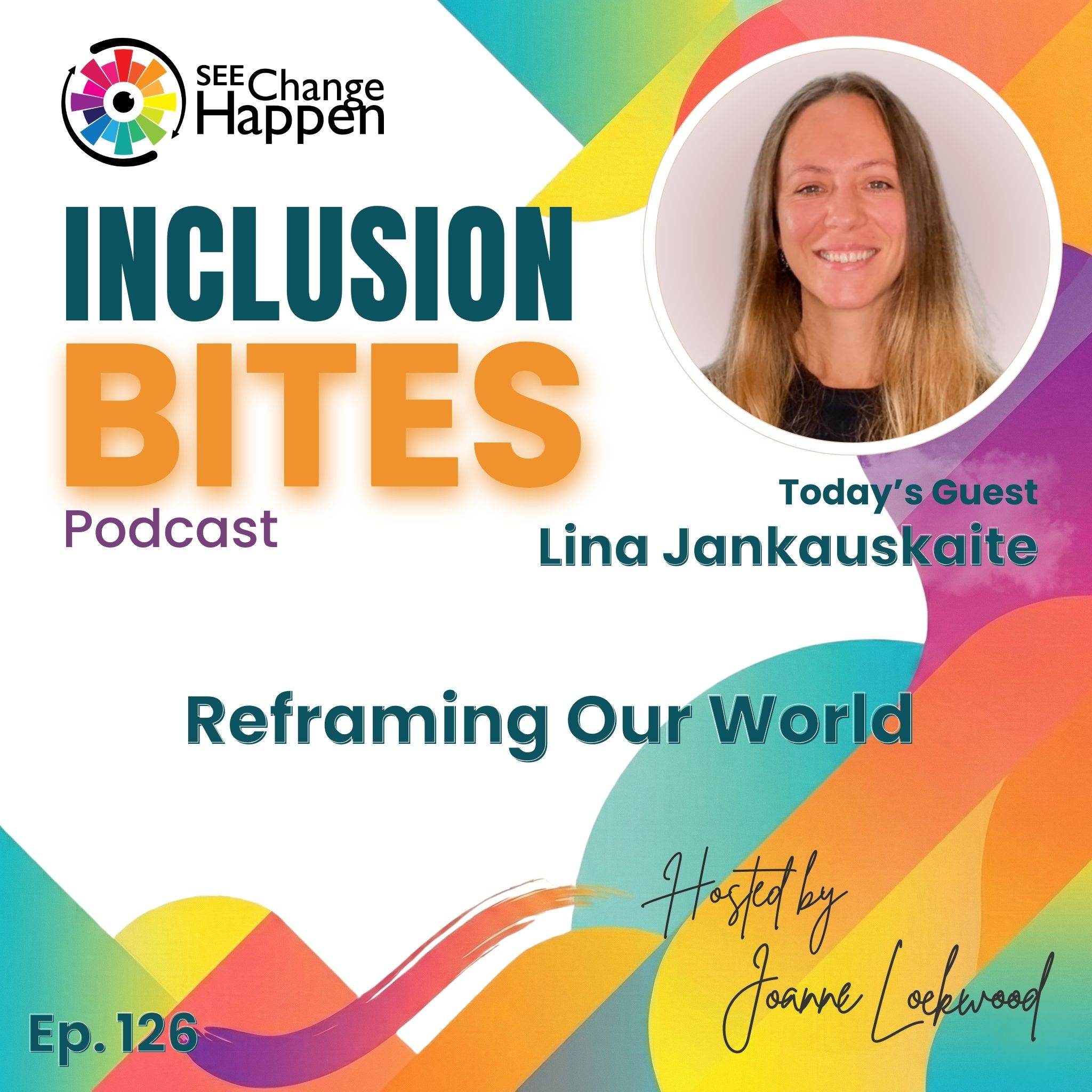
Lina Jankauskeite explores the transformative power of reframing difficult situations, nurturing self-leadership, and embracing humility to foster genuine connection and drive systemic change in personal and professional realms.
In this episode of Inclusion Bites, Joanne Lockwood speaks with Lina Jankauskaite about inclusive leadership management.
“The UK is really what made me up to this point what I am.”
Explore
Navigate this episode
Joanne Lockwoodhost
Welcome to Inclusion Bites, yoursanctuary for bold conversations that spark change. I'mJoanne Lockwood, your guide on this journey of exploration into theheart of inclusion, belonging, and societaltransformation. Ever wondered what it truly takes to createa world where everyone not only belongs butthrives? You're not alone. Join me as weuncover the unseen, challenge the status quo,and share stories that resonate deep within.Ready to dive in? Whether you're sipping your morning coffeeor winding down after a long day, let's connect, reflect,and inspire action together. Don't forget,you can be part of the conversation too. Reach out tojo.Lockwood@seechangehappen.co.ukto share your insights or to join me on the show.So adjust your earbuds and settle in. It's time toignite the spark of inclusion with Inclusion Bites.And today is episode 126 with thetitle, reframing our world. AndI have the absolute honor and privilege to welcome LinaJankauskeite. Lina is a trained psychologist, acertified holistic life coach, psychoeducator,trainer, a speaker, and a dreamer.When I asked Lina to describe her superpower, she said, it is herundefeatable belief that in humans, both individuallyand collectively, that at their core are good,giving, willing, and caring. Hello,Lena. Welcome to the show. Hi, Joanne. Well, thank you for
Lina Jankauskaiteguest
having me. Absolute pleasure. We we did practice your
Joanne Lockwoodhost
surname a couple of times in the in the green room before we came on.
Joanne Lockwoodhost
I was determined to get it right. So reframing our world,you've obviously got a a rich heritage and past.Tell us about yourself and what you believe in.
Lina Jankauskaiteguest
In terms of, I was gonna say in terms on who I am.I suppose there's those sort of demographic or biographicalthings, which is, I originate from Lithuania. I came to the UKnearly 20 years ago. And II suppose I matured in the UK. I was 20 when I came, and Imatured here in the UK. And II can hardly remember myself for what I was before becauseI think I changed quite a bit seeing the world aroundme, been exposed to a lot more in theUK than I have been in Lithuania because I grew up in a small, smalltown. Provincial, very small town. So Ialways say that whilst Lithuania is always going to be my home, theUK is really what made me up to this point what I am.And, yes, as you said, I am a dreamer,and I dream about exactly that. Like, the tar title of the episodereally speaks to it really well. I I want, ascliche as it sounds, I want to change the worldto leave that little bit better place than I found it.So however little I can contribute to it, it all adds up.Again, loads of cliches, but, I just truly believe in that. And,I'll I'll try to do my best in in that changing of theworld by helping people to really, to to see theopportunities on on how they can contributeto changing the world. And I know it sounds really abstract, butthat's just because it's a big it's it's it's a big game to change theworld. So, yeah, at the minute, it sounds a bitabstract, but there's many things I'm doing. As you said, I'm a coach. Ifancy myself, a self leadership coach becauseI think that's where it all starts, from self leadership because that'swhere how you relate to the rest of the world, your environment,to to the fellow human, to to the tree out, youknow, outside. It all comes down to that. How you relateto the rest of the world starts with self leadership. So I think that's mystarting point in in changing the world. Interesting.
Joanne Lockwoodhost
My knowledge of Lithuania is is tiny. I thinkI was I went for a, I think, a 3 day conference.This is probably bestpart, 20 years ago, so probably by the time you're still there.It's so the capital is, Vilnius. Is that right, Vilnius? Right. Yeah.Yeah. Vilnius. And it's a very old traditionalkind of Baltic y sort of state and, yeah, largesquares, cobbles, ancient architecture, beautifulconstruction churches, and things. I remember it being very iconicwhen I was there, but I'd say it was mainly a quick tour of thecenter and a tour of the nightlife and a tour of,had some a couple of boring meetings to attend as well. So, yeah, it wasa a quick in and out. I'd love to go back. I spent I spenta bit of time in Estonia, mainly in Tallinn and and the surroundingarea, and I did pop to, Viga once aswell in, in Latvia. So, yeah, it's,yeah. I I I've always got a fun place in my heart forthose regions because of the people. I've I've found the people really warm,easy to connect to, and not at all how Iimagined. It's very forward thinking certainly in the last10, 15 years. A lot of tech startupsand developing economy there. Yeah. That is a it's it's phenomenal. Andyou're right. You you must have had this, complete transformationabout how you saw the world, as you say, coming from rural Lithuaniato to entering sort of like the UK and the hustle and bustleof of of of the hell on life, if you like?
Lina Jankauskaiteguest
It it was. It was very much so because,the town I grew up in is considered the 8th or the 9th biggest townin Lithuania, but because Lithuania is tiny. I think thepopulation when I was still there, it was about 35,000, which now hasdropped to below 30,000. And like I said, it'sconsidered 8th or 9th biggest town in Lithuania, sojust for people get the idea of scale. Andand it was very I mean, I I I had a greattime growing up, and, and I'mstill very fond of my hometown even though there's no one and nothingthere now for me when I go back. But, yeah, whenI first because when I first arrived in the UK, I found myself inLondon as most of us do. So thecontrast was was wow. However,what's the the what I didn't expect was because I knewBritain through watching because I was an hard diehard fan of Sherlock Holmes series. So Iexpected it to arrive on the 4th September. Actually, I can't rememberthe year, but I remember the date. It was the 4th September. And I wasexpecting it to be, you know, this narrowstreets, cobble streets as well that's sort ofgrayish, darkish with this mistyou know, everything covered in mist. And they arrived, and it was, like,30 yard degrees. I think it's one of the hottest summers or hottest endsof summers that's, you know, on record at the time. And I was like,woah. What the hell? That's not what I expected.
Joanne Lockwoodhost
Yeah. I mean, there are parts of London that are sort of narrow streets andcobbles, especially in the kind of the square mile rush in the city. There's areal kind of intricate little cobbled areas. Youknow, a lot of London got rebuilt after the fire, Londonafter the war, and things like this. But, yeah, you can still find thoseold streets, but, yeah, we're not, eveneven the mythical, 2 was it 221or whatever is, Baker Street? I think it's the 221 B. Is it BakerStreet or whatever the address is? That's in a quite a wideroad. It's in a row. I mean, yeah, the row it's in is isvery old traditional Victorian type of architecture. I don't know if you'vedone the Sherlock Holmes Museum. I did the Sherlock Holmes Museum or the thatvisit that place, probably 10, 15 years ago. It's it's a it's agood little good opportunity to sort of see Victorian life ifyou'll help people for the Victorian era lived because it's still kitted out in thatway. But yeah. No. No. I don't think we're we're we're we'reprobably not at all like our our stereotypes you see in the movies or onthe telly. The yes. In my experience,
Lina Jankauskaiteguest
not I mean, the obviously, they are it's hard to tellbecause when I first came, like I said, I was 20. So I knewvery little. It was it was going to be a 6 months break, and thenI was going to go back and reenroll uni, which Iquit because I didn't like what I chose. Sobeing 20 years old, I didn't really careabout many things, you know, that that that I donow. And so I don't think I had any I don't thinkI arrived with any stereotype in my head in terms ofthe lifestyle. I think it was just that picture that I held in myhead, you know, this darkish, gloomish, mistish kindof, you know, from Sherlock Holmes. But in terms of everythingelse, I I don't think I had any preconceptions.But like I said, I'm struggling to remember myself, what I was like backthen. But it was yes. Because I found myself on OxfordStreet. So Jo, yes, thatwas, but but it was what I found.I because I didn't I didn't have any preconceptionsor not that I remember of. The onlyemotion that I feel I don't know emotion, feeling,not entirely sure how to describe that, wasawe. I was in awe of of how manypeople, of of, yeah, of theof the hustle and bustle. I I I've never seen anything like it inmy life. But for me, it was justamazement and, like, wow. Oh my god. Icannot believe this. I cannot believe I'm here. And,yeah, and just everyone Joanne there's masses of people going aroundtheir business, and it's just yeah. The pace, II think, yeah, I was just in awe. I I would imagine, and this
Joanne Lockwoodhost
is just me having a guess here, that there must be 30or 1000 people in that Oxford Street area atany one time, which is bigger than the population of of theyour hometown, and it's so kind of incredible. You know? And Iguess coming from a town where there were so few people,you kinda know everybody or you or you're you're connected with people in someway. It's, you know, most of the streets, you know, most of the locationsand suddenly coming to I don't understand, by any stretch, thatmeans that, UK is a huge country. It's not. London London does feel quitehuge when you're in the middle of it sometimes. But coming to a a acity that is, yeah, massively bigger than what youexpected, did you find it unfriendly? Did you find it unwelcomingor or just, as you say, in awe? I
Lina Jankauskaiteguest
didn't, actually. Not at all becauseI no. I didn't, actually. I just, yeah, I didn'tget that feeling. Yes. I was just in awe. So I was moreI think I I was more at the time, I found myself inthe position of observer rather than aparticipant in that. So I would literally I was aheavy smoker at the time. Not anymore. But I was a heavy smoker at thetime, so I really enjoyed for the first few days in Londonto just sit either on the small park bench. You know, thesmall parks that, are off the major streets,which you can still people watch when sitting there. You can see them. So, obviously,if you go to Hyde Park, you see a lot of people in Hyde Park,but you don't see these busy hustle and bustle streets so clearly.So I would really enjoy just sit on the park bench and justjust to watch the people who I by having a cigarette and a Red Bullat the time. And so and I thinkbecause I I just found myself I I can't say Iput myself in that position. I just found myself in that position that I wasan observer of the world around me. I
Lina Jankauskaiteguest
didn't I didn't encounter or I didn'tperceive any unfriendliness or or unapproachability.And as far as I remember, you know, the you know, whenyou ask for directions or you ask for whichbus you need to take to get there in there, people were verywilling to to share the information with you, and andand they wouldn't even in that hustle and bustle, they would reallyactually stop rather than just say, you're right. Sostraight and then fifth right and walk away. It wasn't like that.People would actually still take that extra 10 seconds, extra 15seconds to say, right. So, yeah, if you carry on straight, you know,don't you're gonna need to take a 5th ride. You know, just you're gonna seethis in the shop and go around there. So they've really put theeffort into, you know, even because at the time I mean, obviously, I willalways have the accident. In that time, my accident was very heavy. And Ididn't for one moment, I didn't perceive anyanything. I was I was an observer to begin with,but when I was a participant in terms of interacting with people and withthe environment, I I didn't yeah.It was it was fine. It was good. It was it was lovely. Jo
Joanne Lockwoodhost
as you say, you you you're an observer before you participatedin, I guess, if you're there for a break, youknow, 6 months, you you weren't looking to necessarily come here andreside. How did you because you must havestarted to develop that sense of belongingness to where you were living,to what you were doing. Because if you if you just stayed an observer, youwould have felt the connection in order to stay here. Is that is that true?
Lina Jankauskaiteguest
You know what? The way you said it, it makes a lot of sense. Iwould have never I I would have never Inever thought about it in that way, but that is absolutely true. Yeah. Becauseso I came I came because I quit uni. So I finished school.I quit uni because I didn't like what I chose. And I thought, right, Ihave to wait until the next academic year starts. And English is the only languagethat I know. I know I want to see the world a little bit. SoI'll come to the UK for about 6 months then go back and reenroll.So that was the intentional sort of intention of or theplan. But I reallyI enjoyed myself in that diverse very because I workedmy first job was, working in a in a restaurant atStansted Airport. And out of 99members of staff, there was1 British person and 1 Irish person, andthe rest were probably from, like, 30 differentcountries. And so I can't say I learned much Englishthere because, obviously, we all, you know, we all communicated inour broken English at the time. I probably built a vocabulary, but, youknow, just the vocabulary. But, it was itwas a wonderful experience because I was I had never beenexposed to different cultures. I had never been exposed to differentviews of life, and I'venever been exposed to different, well, metaphysical positions, if youwill. And it was a veryit was a very beautiful experience. I think maybe partlymaybe I found myself belonging. And I I don'tknow. I I don't know. I'm just sort of analyzing in my head now asI on the spot. Maybe the reason why I've startedfeeling, like, right, I I wanna stick around for a bit longer and see whereit takes me. Because partly it was a veryenriching experience. And Isuppose maybe my first job in the UK, we probably connected because wewere all immigrants, and wewere all some were trying to make it. Some of us were like myselfjust here for possibly a brief break and seeing the world. SoI don't know. But, yes, as as you said it, now I'm thinkingthat's I must have found that belonging because 20 yearson, nearly, I'm still here. No.
Joanne Lockwoodhost
For sure. So you you mentioned earlier about self leadershipbeing one of the the sort of key fundamentals for,well, taking personal responsibility in in your youryour passion for changing the world. Because you have to start withyourself, don't you, to change the world? Absolutely. And
Lina Jankauskaiteguest
you absolutely have to start with yourself. AndI, we just recently, we hadyou know, this is gonna be where I'm gonna go off on tangent so much,so feel free to just yeah. You have to it's verycliche as well. A lot of people, oh, yeah. We heard that before. Start withyourself. What you know, whatever. What does that actually mean? Anda lot of people are really, reallydisempowered. And they, I meanand this is obviously this is not either or. It's aspectrum of the level of disempowerment.And a lot of people, they they won'tperceive themselves as that. We won't perceive them ourselves as that.But I I found myselfI found myself often feeling like I have no control ofthings. And this is where when you have nocontrol of things, you can feel disempowered.You wouldn't necessarily put that particular name of it, like, Ifeel disempowered. We we use all sorts of language to describe that.Like, oh, this can't be done, or, well, it doesn't work likethat, or, well, it's always been that way. Why would you change?Oh, nobody cares. Nothing's gonna change. So it's it'sreflected in our language that thatliving in a somewhat disempowered state, if youwill. And I catchmyself now. I mean, I catch myself more and more now because this isthat's my job, and I've been focusing it for quite a fewyears now on yet self development, onobserving how I relate to the world. Andeven though I find myself knowing better, I still get caught out. Istill get into that. I don't particularly likethat term, what but people use it victimmentality. It's not a nice term, but I haven't thought ofanything better yet other than just in that disempoweredmode. And but when I catch myself, because I've beenreally self developing for years years now, I I am able tocatch myself using the language thatkeeps me stuck in that disempowered mode. So I'mable to catch it sooner, and I'm able torationalize in my head to think, right. Hang on asecond. Get a grip of yourself. So I thinkthat's kind of the the core of that self leadership,just striving to because there's always gonna be thingsthat's out of our control. And, and we canonly act in whatever circumstanceswe are at the time, but we can act eitherfrom the disempowered mode where we just just go withwhat things are and and just live an unhappy andmiserable life, or wecan be in the same place wherewe have no control of certain things, but we can decideto do whatever we can to changeour own reality around us in the hope that itwill ripple. So You talked about victim mentality.
Joanne Lockwoodhost
I I can relate to the the concept here. Is this internalizationyou feel sometimes or you you you feel otherpeople's language being used against you sometimes, and that can causeyou to sometimes fight back, to be angry, to be frustrated.It takes a real strength of character to be able to step back,reflect, and then refocus whatyou're what what you're who you are, what you're trying to say withoutfeeling that pressure of others to who judge you. And And I think that's whatyou're trying to say there. It's this the victim mentality is where you're you'reliving in a world of oppression or marginalization. And how do you stepinto that and with the strength? Because it it can be exhausting, can't it,to try and keep overcoming that adversity.
Lina Jankauskaiteguest
It can be very exhausting.Or if you keep overcoming, it can be exhausting. But if you know whereyou're going at, you kind of you know, you youcan can be fueled by by your endgoal. However, it is for example, toaddress what you what you were saying, in one of my talks,I speak one of my talks is exactly that, you know, disempowereddisempowering language and how to take our control back.And in that talk, I give examples. So for example and this is now adaily language, which, you know, we we use it flippantlya lot of times. We don't really think, and it's easily done. We all fallfor it. But the brain work. That's how thebrain works, like brain plasticity, the way thepathways form from young ages,the language constructs the way we relate to the world.So for example, if someonepulled in in front of me in in traffic as I'm driving, I'm I'ma lot better now. I was a lot worse than before before.But I could really I couldreally get into this rage, I suppose, because a lot oftimes, the expression of the expression of thesense of lack of power in a situation, a lotof times is expressed as anger. Andso I would get into that rage. I mean, I wouldn't act on it. Iwouldn't start, you know, beeping my my horn or throwingcoffee cups at a car. I wouldn't act on it, but it would simmerinside me. And and and I I hadto find the ways. Ultimately, at some point, going throughlife, probably studying and just generally maturing,it dawned on me that, right, the only person that is sufferingthis situation now is you. That person theypulled in and moved on. And the way it is, for example, reflectedin the language. So we could say, oh, he pissed me off,or she does my head in, or they always dothat to me. And this is a very flippant use of language, whichwe do because it's a very it's an everyday language, and we all dothat. And I say it myself, but ifwe stop for a second to reframe the way wesay it. So if you think, oh, she
Lina Jankauskaiteguest
pissed me off, for example. Well well, that's it.So you are that that passive agent in thesituation because she actedupon you. And if you reframe, for example justtake that one second to reframe that exactly thesame situation and just saying, I feel pissed off becauseof what you said or what she did. The The situation is still the same,and the trouble is a lot of in this situation, when I try and suggestthat people could reframe it like that, some people canfeel very defensive and say, so are you saying that it's it's myfault that I feel that way? And that's not at all what I'm saying. I'mnot saying it's anybody's fault that someone feels the way thatthey do. I'm saying that is if you thinkthat I feel how I feel because of what'sbeen done to me, the situation is the same. There's an objectivetruth that something was done that, you know, you werewronged in in the same situation here for you as the same as someone pulledin in front of you, to use a simple example. So, yes, you werepotentially wronged, and the feelingsare justified, but do they serve you? Andif they don't serve you, you can either stay in that self righteous place, whichis which is justified, absolutely justified, but where is that going totake you? All you're doing, you're killing your own nerve cells by feeling like youdo. You're not able to drop your bestself in in your following interactionsfor the rest of the day, possibly, let's say. Whereas if only youjust say I feel pissed off because of what she did.So the situation is the same. You're justified. You feel like you do, butit doesn't serve you. So when you say that I feel pissedoff, the way the brain works, it just opensmore possibilities of right right. I don't want to feel thatway. What can I do about it? Whereas if you say at,oh, she pissed me off, well, there's nothing you can do about the fact thatshe pissed you off. There's nothing you can do. So you stay in that passiverole, whereas you're the passiveparticipant in a situation where something or someone acted uponyou. Whereas if you just own the feelings, recognize that thisis how I feel. I'm justified to feel that way, but I don't want tofeel that way. And if you just reframe the language, itis really it sounds so simplistic. Butif people use it consciously over,say, I don't know, a period of 30 days when just trying to catchyourself, you will notice thatit's it will become easier and easier to catch yourself because you will literally berewiring your brain. I mean, there's a lot of that same buzzword,rewiring your brain. But it is absolutely true. The waythat neuroplasticity works, the way you break the cycles and the way you build thenew connections, you will literally rewire your brainwhere it will become much easier tocatch yourself using that disempowered and disempoweringlanguage, whether it's out loud or whether it's your internal dialogue dependingon the situation. And then you see a lot moreopportunities when you say, right. This is what I'm doing. Whatcan I do to change that? Yeah. I think I well, right at the beginning,
Joanne Lockwoodhost
I I mentioned your superpower and yourundefeatable belief that, we, as a humanspecies, are, at our core, good, giving, willing, and caringis what I said in what you wrote. Most people who as asas you you use the phrase, piss you off,generally, they don't set out with that intent.And I appreciate there's a huge difference between intent and impact. We have to beunpack that as well. But inherently, people don't do something. Like,some someone when someone cuts you up in the road or or pulls in frontof you, they're not doing it to disadvantage you. They're doing it to think,oh, I'm in the wrong place. I need to get in. I need to pullin. And it's almost like if you beat your horn, they go, oops.Sorry. Whereas if you if you just take it as kind of they're trying tolive their best life, you're trying to live your best life. There's a bit ofa conflict of how you would treat that. And, Jo, I think what you'resaying here is we want to police people back into a box. This ismy rule set. You've broken my rule set. I want to tell you what you'vedone to my rule set, and I need to let, you know, crusade against this.Whereas if you just go, yeah. But they they they didn't do itdeliberately to to piss me off. They did it because they thought they wereyeah. And you otherwise, you start inventing things in yourhead about how they're feeling or what's going on in their life or whatever. Andand, again, we we don't know what that is what that person's going through. Theymight have gone I'm gonna deliberately park in front of you or cut you up.But they they probably didn't even think that. They just sort of a gap andand took an advantage. And some people like that, some people aren't. Asyou say, it's but I like the analogy of road rage because what we wewanna try stop people doing it again. Jo. It's notright. And it's that's the ability to step back, have thatanger. I always think of it screwing up a bit of paper to pop itin the bin. I've I've I've been angry. I've I've now thrown it in thebin. Pop. It's gone. Move on. That
Lina Jankauskaiteguest
is absolute I I could you probably saw me nodding my head. Myneck's hurting now as my I couldn't I couldn'tagree more. And that's where, yes, that's whereanother thing that I really like to talk about, which is about perception,comes in. Because exactly as you said,99 times out of 100, peoplego about their own business. And they absolutely, as yousaid, they don't intentionally wrong anyone.And the way the way I deal with it, I have my own strategy. Soyou have your, you know, piece of paper that you just throw inthe bin. The way I deal with it again, for example, if it's going backto that traffic example where someone cuts you off or someone's going40 in a 60 mile zone, And, obviously, you'rein the rush. You need to be somewhere, and then it it at first, youstart thinking, oh, for god's sake, why are you even on the road if youdon't have to be anywhere? But the way I,the way that I then reframe the situation andthat works for me, so everyone needs to find their own. Mine is,right, I bet you they are carrying an injured animal tothe vets. And, obviously, they can't go fast because theyconjure the the the poor pet around or or whatever animalthat is not necessarily a pet. And the moment I reframe thatsituation, I couldn't care less that it'spossibly not true. But it works for me, and I justuse that. So this is this is what they're doing, and this is why they'regoing slow. This is why they're going slow around the corners even slower because,you know, they have an injured pet in the car. Sowe can all find ways that works for us, but that'sexactly I couldn't agree more with what you said. It is I like
Lina Jankauskaiteguest
the way you put it, actually. Yeah. But there's someone infringed on our set ofrules about, you know, transpersonal interactions orand and, yeah, that's that's so perception is one very big thing, but I thinkalso we can use in the I mean, obviously, that's just oneof tools, one of the tools,not not the only tool. Far from it. But with usingthe language, we can help ourselves reframe our habitualperceptions in these, you know, repeatedsocial situations where, yeah, someonewasn't in front of you in the traffic or pushes in in thequeue at the supermarket or justanything. Or even if, for example, your technology not working. AndI remember I was visiting my mom a few months back, and sheshe fired up Zoom because she had to she wanted to remind herself how toput people in the breakout rooms, and she something didn't work or something.And she was, oh, all of this is nonsense, and she sort ofjust stood up and went off in the straw.And now I'm quite petty with the use of language,and and I just went, no. Hang on a second.This this isn't nonsense. It's just we don't know how to useit, me and you. And when you reframeit and she came back a few minutes laterand feeling quite concerned and worried probably because it was, like, 9o'clock in the evening. And then at 8 o'clock in the morning, she had tocarry out the lesson, or I think it was somedemonstration that she had to carry out where, you know, potentially get,this project. And, so it's important that she sheknows. And, obviously, she walked away really discouraged and really, selfimage is is suffering. And and, this,you know, catastrophizing happening in your head when when you word itlike that. But like I said, me being petty, Iinsisted that we reword the situation. And she came backjust 2, 3 minutes later saying Jo, okay, so what dowe do? And just because we I'm not saying just becausewe reframed it, but I'm saying potentially that was the reason orpotentially that helped because we reframed it, that she came back.Haven't found that enough power within her tothink right. So there is something that I can do. So now I need tolook what it is that I can do to change the situationas opposed to leave it, oh, you know what? This is not working. This isall just nonsense and just walk away feelinglike the, you know, the the the weight of the world upon you.
Joanne Lockwoodhost
Yeah. I I I did Joanne entrepreneurialstartup course with, NatWest, I don't know, 10 yearsago. And one of the things I learned from that is it's about taking personalresponsibility. If I'm late,I had the choice to leave earlier.I had the choice to think about the things that could have gone wrong.I could have planned ahead for the traffic jam. I could have planned ahead fora puncture in my car. I could have planned ahead for running out of fuel.I could have planned ahead for that petrol station not having any fuel,and I had to go to the next one. I could have planned for allthose things by leaving earlier, making sure I had a full tank ofpetrol, making sure that I wasn't in a rush, making sure I knew where Iwas going. I could I could do all of that myself. Whereas what happensis something goes wrong, and I've got I haven'tgot enough time. I haven't got enough resources. I haven't got enough of whateverexpertise, learning, whatever it may be. So now I'm under pressure to deliversomething that I can't because something's got in the way. So if I if Ithink back with far enough, how do I make sure that I never put myselfin a situation where something else is is gonna causeme embarrassment or failure or whatever it is? I don't getit right all the time. But when it happens, I I I reframe it instantly.I said, yep. I could've left earlier. Yep. I could'veforeseen that. Yep. I could've done that. So I don't start blaming other people. II I teach it as an exercise in my own head to say,yeah, it's a lesson. I've learned it. Yeah. I Iand I chose to risk Joanne, and the risk overtook me thattime. Yeah. So it's like if I'm going to do somedelivery of a of a talk or a a keynote or some training, Ican leave the night before. I can get there earlier,or I Joanne I could I could not say yes to doing 2 thingsthat were too tight. Yeah. I I chose to accept 2 things,and the gap between them was minimal and my risk was high. Ichose that. Jo, therefore, I shouldn't be stressing somebody elseout because of my decision. So I think that that's what you're kindasaying here. It's making sure that you're taken to personal responsibilitybecause you have the power, you have the control to say yes, to say no,to think about something. That is absolutely what I'm saying. Yes.
Lina Jankauskaiteguest
And it's it's a practice. So I imagine evenyourself so for example, do you I don't know if you because like I said,I can't remember myself 20 years ago. Not very well anyway.And but do you remember when it happenedwhen you went? Because as as children and thenteenagers, we we grow up with a lot of that.You know, the world doesn't understand us. The world is the world isagainst us and and things like that. And then, obviously, aswe mature in, we probably step out of that to a certaindegree, all of us, out of that victimhood mentality,for want of a better term. But then, obviously, again, there's aspectrum. There's a never ending progress of howfar out of it you can step out andcontinue going. So when you were describing how you approachthe situations where, yeah, you werelate, for example, to me, that sounds like a practicethat got you to the place where you are now able, withoutany bad bad feelings, to just recognize,you know, I could've I could've done things differently, and I wouldn't be in thatsituation now. Just recognizing that.Because it's a practice that takes you there. Because we don't startoff with that. And we're not exactly taught that either because,as children, everything's decided for us. As teenagers,
Lina Jankauskaiteguest
everything's decided. And, you know,all these schools, for example, the thethey've really just encourage encourage, not just encourage. Theyencourage and enforce conformity tothe rules that I imposed on you, which kind of takesaway to a degree and everything. I mean and these are just littleexamples, but a lot of we are taught that, right, there's alwaysan outside factor that has a say ina certain situation. So if we have a headache,more often than not, we will go to the painkillersthen stop to think, right, what could be the reasons why I havea headache? And which is fair enough. Sometimes it's overpowering theheadache. You need the panculus to even be able to thinkstraight. But, yeah, to reflect back, to think Johow you know, try and try and notice when didit happen, what could have triggered it, or, you know,have there been things accumulating over time? Is it body in my 10tension in my body that's you know, how long has that been building up?Why was it building up? What so we are taughtthat the source all these every you know, everything'soutside of us. That's what we were taught in a form of,you know, rules and regulations that we have to conform toI mean, don't get me wrong. Obviously, there needs to be rules and regulations tolive in a society. But, we were nevertaught that within that containersocietal norms, we also havepower. So we were never taught that, and that's why I'm saying it's apractice. So when you described the way you the wayyou now perceive situations, thatsounds to me like you've been practicing for quite a while to get to thepoint where you're now where your defaultnow is the recognition that, right, well, I am where I am. I couldhave done things differently. I think I think it was the to be honest, it
Joanne Lockwoodhost
was probably on that, entrepreneur courseI was on that that it really that that was kinda you know, you youtalk about your the work you do about coaching leaders and people totake this personal responsibility and to empower themselves. Itwas it was that training that I didn't think I had that epiphany before thatmoment. You know? That's 7 or 8 years ago, andthat that was I I went through most of my life notunderstanding that. And I think from that, when we talk about one ofthe, you know, one of the keys of effective leadership is humility.And you're allowed to be wrong. You're allowed to you're allowed to say sorry. You'reyou know, I hear so many people say, don't apologize. You know, be like thequeen, be like the king. You know, the royal family never apologized, neverexplains himself. I think, well, yeah, that that's that's not the wayI wanna live my life. I wanna say if I if I've made a mistake,I'm sorry. I could've done that better. Yeah. You're right. I didn't I didn't approachthat in the right way. I reflect on that, and I've taken on board allyour comments. Yeah. If I feel I am right, I will stand up for whatI think. But I'm also very reflective where yep.Yep. Oops. I did carve you up there on the on the road. I didI did party. Yeah. You're right. I should have been more thoughtful. Yes.Thank you for pointing that out. You're right. I'm not I'm not gonna stand hereand defend it. Some people want to defend their positionregardless whether they're right. They think you know, some people defend their position even theyknow they're not in the right or they just believe so strongly that they're rightor the other person is so wrong that they want to defend it. And Ithink humility, saying sorry, admittingit is because we I think we wehave this fear of being judged, fear fear of being wrong, andsomeone's thinking badly of us. And I think you can apologize ina way that doesn't make people feel badly about you. They feel more trustingof you because they they recognize that you you are somebody that will tellthe truth and Jo matter how painful it is. And Ithink we're taught as kids, aren't we? I think we're taught as kids not tosay sorry or not to admit things or hide things or sneak around behindour parents' back or we do say naughty and we won't tell anybody. Because there'salways punishment for for telling the truth. Ithink you can reframe it. Yeah. If you talk about reframing things, buttelling the truth is actually a strength, and being sorry isactually a strength. Having humility is actually being a strength. Not having all theanswers could also be a strength. I think that's what we need to thinkabout in our leadership and, you know, self leadership or leadership of others.It's I don't have to be perfect. I have to be the best human Ican be and build relationships and collaborate, not Idon't have to have all the answers. I've really
Lina Jankauskaiteguest
I couldn't agree more with, honestly, I couldn't agree more, but 2 thingsstand out for me. 1 is thatjust thinking which way around or okay.Jo that's defending your position, and Ithink that is where that self leadership is really selfsometimes people ask, what would you mean self leadership? What is it? So for me,that contains several things. It contains, first ofall, self awareness. Anotherthing it contains would be resilience because youbuild the strategies to todeal with situations. So, hence, it makes you more resilient goingforward. But yeah. So that defensivenessis exactly that, and I think and I think that isthe going back to wanting to change the world,I think that's where it beginsbecause there's of course, there's systemic there'sthe the the systemic things arewe we don't we need a lifetime to discuss that, so I'm not gonna gointo into systemic things. But even though
Lina Jankauskaiteguest
sometimes it seems that systems take up a life on their own,I, at least, personally, still strongly believe that the systems arerun by people. The systems have come and gone, andthey will continue exactly as they were up to this point coming andgoing. And because systems are run by people, systems are created,systems are reframed and redefined bypeople, it will always, for me, startwith people, with individuals. And it isextremely hard because when you grow up in an environment, and I'mnot even going to talk about some you know, I'm talking justyour general everyday growing up. I'm not talking about some people thatexperience a lot of trauma because that's, again, another topic.But we grow up in thatkind of environment, so where especiallynow a western world, there's very it's very competition orientated.Everything's a competition. The way you're marked at school, theyou know, it's there's a lot more competition. And, I mean, thisis systemic, a lot more competition orientated than it iscollaboration orientated when it comes down to it. Wehear that word a lot these days, collaboration.But when it comes down to it at the core, from when we werelittle, it was instilled into us that you mustyou have to be better than someone else. And on the one hand,that's needing to defend yourself. It's an evolutionaryneed because, you know, if you if you suddenlyrecognize that actually I was wrong or if you don't defendyourself and apologize, it comes it can shatter your selfimage depending on how long you werewrong in your life, in a particular, let's say, in thein a particular area of the wayyou conducted your life. And thatcomes, but the reason why it threatens your self imageis because of that lack of self assurance.And self assurance, it has some bad rep because it'sit's associated with arrogance, you know, on in the veryon the very sort of superficial,plane. But if you don't if you're not securewithin yourself, if your self image is dependenton others' perceptions, youyou will find it very hard to admitfault even to yourself, never mind to somebody else,because that literally threatens yourself your identity. Because tosay, you know what? I conducted myself wrong for the last 20years. What are you left with then? So it's a very hard place to beat. You can, if you're not careful, paint yourself
Joanne Lockwoodhost
into a corner, can't you? You kind of you back yourself in, and you feelthe only only way out is to fight. A bit like a cornered animal.Whereas if you can reflect I mean, I've I'vereflected I've had some significant life changes over the last 10, 15years, various things. And I can look back andsay, yeah, I've I've I wokeup 5, 10 years ago, and I have a different outlook on life. I lookback at my past life. I look back at my past history and how Ibehaved, and I recognize that I could have done better. AndI I look back and think I'm not necessarily saying I'm ashamed of who Iwas or who how I acted, but I've reflected on some of thosetimes being not the person I would how I'd react today.And I've, yeah, I I've I've realized that maybe I put people in situationsthat weren't fair or I wasn't treating them with enoughrespect. I think I could look back and and not necessarily say feelshame about it. I I I would I'd be happy to apologize. I'd be happyto reflect and say, you're right. I should've done better. I could've donebetter. I now know better. I think we shouldn't be shouldn't be afraid todo that. I think if you're not careful, we we keep we keep enforcing ourrules here. You know, I'm in the corner. I have to fight it out ofit. I have to keep defending this hill. And sometimes it's just a case ofsaying, no. No. You're right. I I look back and,yeah, I've learned. And, you know, that brings me to the second point
Lina Jankauskaiteguest
of what you previously addressed, which is vulnerability.And in my experience, innot not only in experience I observed, but also inmy own experience time and time and time and time again,vulnerability is what connects me to otherpeople because that defendingyour corner, it's a very lonely place to be,just defending your corner no matter what.And it will because it isit is threatening your self image to you know, if ifsomeone says you're wrong, that's when we become defensive because it'ssomebody else imposing their worldview, and you need to defend it,and you're gonna think about it later. Andit's when we are able to recognize upon reflection that,yeah, we could have done better, that is such a such a strengthon the one hand to to be able to say that. It's a it's avery strong thing to do as opposed to weak.I can't even put into words how important that is for me as well tobe to be able to say, you know what? I would and I'm not goingto lie. There are situations where I sometimes find it hard still,but it's a practice. It's something that you that I thinkthat I I have to do that. I have to do the right thing bythat other person by admitting that I was wrong,by putting them first. And I find that in thatprocess, which is a very, very youit can take to build up, but that's the thing exactly as you said, younow know better. At the time when you did something or did not dosomething that maybe you could have done, you did not know better. You didthe best you knew you can at the time. So it'snot admitting that you'd what you did wasn'toptimal or back, you know, in thepast. It's not it's it'snot that you're saying, oh, yeah. You know, I I I wasit's admit you you knew you did the best you could. You did the bestyou knew you could, and that's okay. That's all the only thing we canexpect of ourselves, to always do the best we know that wecan until we know better. Is it Joanne Angelo thatsaid it's a very famous goat, isn't it? But, really,that keeps you in the place in isolation until you find that courageto first look at yourself. Just first look at yourself. Because likeyou said, sometimes you have to stand in the corner because you feel you'reright. But if you suddenly reflect back and you recognize that maybeyou could have done things differently, it's very, very it'sa very lonely place to be to keep that to yourself. And to say itout loud, it both reconnects to you to other people, andthat vulnerability reconnects you to other people. And suddenly,you're not alone because you're sharing their humanity with thosearound you. And that's where the empowerment actually comesfrom, where that self leadership, that's how itmanifests. But it's a practice. It's not it's notjust skills you learn that you're told this ishow you speak. This is what, you know, what you do. It's a practice.
Joanne Lockwoodhost
Yeah. You you talk about the loneliness. Yeah. The loneliness of being rightis you either you either have to agree with meor you're in a position where you have to be wrong. It's a very lonelyplace to to make sure that everybody either agrees with you or is wrong.And I think if I often say this to people. I haven't been married forthese 37 years by having to be right. I think marriage,relationships, leadership it's not about having to be right because it becomes avery lonely place. And what you soon find is thatyou don't have people's support. They you don't have people's respect. You don't havepeople looking up to you. They're they'reconstantly feeling yeah. They're feeling, I don't know, threatenedwhen they're in your presence. So I think the need to be right is somethingwe need to overcome. You know, vulnerability, humility.Yeah. I mean, as a as a leader, have strategy, have direction,have inspiration, paint the big picture. It doesn't mean tosay you have to defend that to to the hilt. You couldthe best project management managers I know questionand revisit the plan all the time. Is this still the right plan? Are westill on the right track? Have facts changed? You know, you say,this is how I was back then. The facts have changed. My ageI've moved on. I've changed who I am. I can now revisit that and doit differently. The project has changed. We we have different objectives. The teamhas changed. The the the world has changed. Yeah. COVID popped up.We had to change. So I think having a fixedview of being right or having a fixedplan can be problematic. I think what you're saying here is that byreflecting, be more introspect, self aware,We don't have to hold on to all this stuff ourselves. I think that that'sthat's really keen to you know, part of this changing ourselves first. And you sayit's corny and cliche. It's it's not really.It it it is fundamental as far as I can see. I
Lina Jankauskaiteguest
yeah. I I think it's fundamental. It's only conian cliched just becauseit's used so much and sometimes very flippantly. That's why it comesacross as that. But what's behind thoseconcepts or constructs is for me, itis absolutely, yeah, it's the core things. It'sit's the it's the essentials. And I really like,as you were saying about leadership, I heard thisa few months ago, I was listening to some or justwatched a little clip on YouTube, and there was some a coach aswell talking to someone, some interview,and he was talking about impostor syndrome. But I thinkI apply it more wider you know, a lot wider than than in whatcontext he was saying that. So this coach was talking about the imposter syndrome that
Lina Jankauskaiteguest
he constantly had to battle at the beginning of his career.And so the interviewer asks, so, you know, how did you deal withthat? What what helped you? And sothe interviewee described how he was working with a coach himself,which was, I think, of sort of a bit of Buddhistphilosophy inclination. And,the coach apparently had asked him. He said,why do you feel that you have to be the master ofthings? You know, you you only need to be a guide.And he said that that was what really helped himto, with time, overcome that imposter syndrome. And for me,that really stuck with me, and I think it's very much applicableboth in leadership positions because, obviously, they are inpositions that create culture, so, youknow, your your workplace culture or your institutional culture.So it's very important that they see themselvesas guides, which are a step or 2 aheadof other people that they are leading, and that is where they are leading. Theyare a step or 2 ahead rather than master. Because whenyou when you fancy yourself a total master,it it's a very slippery slope where you can slip into thatI know better, and I'm not listening to anybodyelse. Whereas you just if you andthat goes back to what you said, humility. If you perceive yourself as aguide, right, you know so, you know, I have moreknowledge, more experience than those people I'm leading in thisparticular field, and this is why I'm leading, but I don't know atall. So when you're not a guidementality or mindset, you you will continueprogressing in your self development, in your professional development becauseyou, you know, that when you become a masteror self ascribed master, you you that's it.That's kind of sealing a limit. That's it. I achievedwhatever whatever I had to achieve, and there'snothing else to be achieved in this area. So I know everything, andI'm an absolute authority. And it just doesn'twork that way because the world, as you say, is changing.So I really like that guide versus master metaphor. Like I said, itwas in different context by apply and it's everywhere, not just in leadershippositions in in your personal relationships,in your, yeah, in your social relationships?
Joanne Lockwoodhost
I don't know who who said it, but I'm I'm gonna say Richard Branson springsto mind. His His philosophy, or the person who has quotedthis philosophy, was surround yourself by people who are better than you.Because one thing I've I've learned in my in my pastlife in in computing and IT is I I was always wantingto be the best. And, generally, I I have more expertise.But that becomes exhausting as well because not only you're trying to lead, you're tryingto lead with your views, your opinions, and try and bring people with you. Ifyou have a perception that nobody else is good enough or not as good asyou, you'll never trust them. So I I've learned that I I wouldrather surround myself with people who are farmore astute and and and skillful at what they do and letthem do it well and and be the guide. You know, talk about being theguide, being the coach, being the mentor, create strategythrough their expertise, andthat bring also allows people to buy into the strategy, buy into the direction.But if, you know, again, if as a leader, if if you're the one thatdoes all the talking and never the listening, how do you get people tobuy in? You know, we talked about belonging right at the beginning. Belonging happens whenyou feel part of something, when you start to be listened to and contribute.If I just tell you what you're doing all the time, you're never gonna feelbelonging. You're never gonna feel bad. That sense of engagementor buy into whatever I'm doing. So, yeah, it's I've I've learned thatas a as a leader that it's it's it can't all be aboutme. It's not about me. It's not about the leader. Theleader yeah. Whether you use the servant model where the leader's at the bottom holdingeverybody up or the visionary transformational model whereyou're painting a picture and get people to follow. I work in aworld where it's empowering people's important. Okay. If Iwas working on a production line, I was working in a very tightquality control environment. Maybe that I need to take a different gripof the the leadership enforcement maybe. But,yeah, I I mean, I'm there to serve. I'm there to create strategy anddirection, not not micromanage or or tell people what tothink. Yes. And for me, it is also a challenge because I'm a
Lina Jankauskaiteguest
bit of a control freak. But, I'm acontrol freak in terms of I make my own cups of tea because no onecan make me a a good cup of tea because that's just that's just me.That's my problem. That's nobody else's problem. But I think that's anotherthing to recognizethat I shouldn't make something somebody else'sproblem. That is my problem. Andthat's just one of examples where where I am a bit of a controlfreak. And, I mean, I'm serious. It's literallyI'm very specific about my cup of tea. I know exactly how many times todip the tea bag because I, you know, I like it weak and yeah.So I'll just if someone asks you, want a cup of tea? I'll say, justput enough water in the kettle and I'll do it myself. And I alwaysthink, oh, man, you know, the carers are gonna hate me when I get old.So I hope that by that point, I somehow, you know, acquire different tastebuds. But, really, it is that ifyou if you have that streak of thingsto be done a certain particular way,you also have to really wait up to towhat degree you you can or you justify toexpect other people to do them in the same way as youdo them. Because, of course, there can be timeswhen when when the situation requires it, and that's when youbecome a leader when the situation requires it. Because otherwise, for me, the way Isee leadership is being supportive, being anapproachable support to people around you so they can really,really stop shrinking inside of themselves andto really open up and notjust share the wildest of ideas, the wildest of ideas, themost audacious, the most ridiculous ideas. That's what thethat's what real leadership does. It's quietsitting there and observing unless the situationrequires that you absolutely step in and people are now lookingup to you to lead them out of the stormy waters into the calmerwaters when they, again, can develop and andand just be what they are. Jothat, yeah, without having a certain, you know,me talking from someone, like I said, from a control freak point of view,I recognize that, and I recognize that my need for controlfor certain things should not become other people's problem. I
Joanne Lockwoodhost
I've also, picking up on that, I've also learned when itmatters to somebody else more than it matters to me. So Ican coexist with somebody who has strong opinions and is a control freak andwhatever because it clearly I can respect the fact that that reallymatters. It's like, if I'm playingand occasionally, I play darts. I play pool very,very occasionally. I don't have to win. I like a bit ofa game. I like to chat. I like to play. If the other person really,really wants to win, is really, really competitive, I'm not gonna let them win, butI'm not gonna take it as seriously as I will. And I I can coexistin that environment where I don't have to be competitive.And I recognize that someone else is, and I'm I don't feel threatened by someoneelse's competitive nature. And the other thing I was gonna we we were speakingearly. I was thinking, I know when to walk away. Iknow when I know when something doesn't matter that much to me. I'm eitherhappy to acquiesce, capitulate, give in,or say, you've got the passion. Go for it. I'll follow you. I'm I'mmore than happy you taking the lead. It's also known when to walkaway from situations where it's toxic. Youcan never you can never bring any change. It may probably beme, and I'm this doesn't work for me. It's notyou. It's actually no. Yeah. I'm not here to change you. And it comes toa point where you have to accept that somebody else isn't gonna change foryou, at which point you you decide you have the you have the choice eitherto keep playing or step back.Often, I know where my limitations are, and this environment is notfor me. And I'm sorry. I'm I'm out. It doesn't work. And it's recognizing thatas well. You don't have to you don't have to win in every game oreven compete in every game you play. That's very relate
Lina Jankauskaiteguest
relatable of things you said, and I think it's it's probably relatable toeveryone as well. And it is, yeah, I had to walk awayfrom toxic relationships as well because it hadto run its its course. I had to I thinkI achieved closure before I couldstep away from that relationship. Andsome probably would have said I should have done it earlier, but Ididn't because I haven't got to the point where where I achievedclosure. And I didn't wanna be left with, oh, what ifsif you do it too early. But at the same time, like you said, youhave to you have to be open to stepping awaybecause it just consumes your energyand and really brings out the worst in you as well if you stay toolong in those situations. AndI don't I don't regret those situations where I foundmyself from which I needed to reallyurgently walk away eventually. And I don't regret them because they reallyalso showed me my shadows with whichI can work then. Because before then, I wouldn't have known them.You know, they weren't exposed. They weren't illuminated because I've I've never foundmyself in the situations where they would rise to the surface.But, and I I have been provoked following thaton numerous times, provokedinto interacting in that same kind of defensiveway. You know, someone will tell you that, alright. So we'vegot nothing else to say. That's why you're walking away. Or, oh, yeah. Soyou just, you know, just giving up or orjust things like that. You know, the provocative kind of language.But it's exactly what you say. You have to you and you have to besecuring yourself sufficiently to notfall for that kind of provocation. And that for me is,again, practice something thatyou have to constantly practice. It starts with awareness,continues with conscious,intentional, effortful practiceuntil it then becomes easier to actually you know, it justeventually washes off like a water off a dog's back. Is that the saying, Ithink? But it is what weall I think it is what we all striving for, but we don'talways recognize to that sense of, yeah, selfleadership, self efficacy, self sufficiency,and sufficient self sufficientlysafe self image, but there's a lot of things that are packed into this. Imean, obviously, there are decades decades decades of researchinto all these different tiny little threads of what self leadershipentails. And still not everyone agrees onthe on the subject, but youhave to start somewhere. Lina, thank you. What an amazing
Joanne Lockwoodhost
conversation. How do people get a hold of you if they wanna find out more?
Lina Jankauskaiteguest
Right. I'm on LinkedIn, mostly. Mainly, that's where I am active onLinkedIn. You can find my contact details there as well if you're moreinterested, and you can if you browse, you'll you'll see whatI believe in, what I fight for. It's infragments, but, it should give you a taste.And if you don't want to go on LinkedIn and look for immediatedetails, the easiest way to contact me is the email address, whichis queries at redefineandrewire.co.uk.
Joanne Lockwoodhost
Fabulous. I'll put those in the show notes. Lina, thank you somuch. It was an absolute wonderful conversation.
Joanne Lockwoodhost
As we bring this conversation to a close, I want toexpress my deepest gratitude to you, our listener, forlending your ear and heart to the cause of inclusion.Today's discussion struck a chord. Consider subscribing toInclusion Bites and become part of our ever growingcommunity, driving real change. Share this journey withfriends, family, and colleagues. Let's amplify the voicesthat matter. Got thoughts, stories, or avision to share? I'm all ears. Reach out to jo.Lockwood@seechangehappen.co.uk,and let's make your voice heard. Until next time. Thisis Joanne Lockwood signing off with a promise to returnwith more enriching narratives that challenge, inspire,and unite us all. Here's to fostering a more inclusive worldone episode at a time. Catch you on the next bite.
Reframing Difficult SituationsThe Role of Humility and Vulnerability in LeadershipRecognising and Stepping Away from Toxic Situations
Joanne Lockwood is joined by psychologist and holistic life coach Lina Jankauskaite to explore how reframing our interpretations of people and events can reduce frustration and create more empowered choices. Using everyday examples like road rage, conflict, and technology stress, they unpack how language shapes thought patternsand how small shifts in wording can move us from a passive, disempowered stance into taking ownership of our reactions.
Lina shares her journey from rural Lithuania to the UK and reflects on how diversity, community, and belonging shaped her outlook. Together, they discuss self-leadership as a practice built on self-awareness, resilience, and the willingness to notice defensiveness before it takes over.
The conversation moves into leadership and accountability: why humility and vulnerability build trust, how admitting mistakes can strengthen relationships, and why leaders are better viewed as guides rather than all-knowing masters. Joanne connects these ideas to lessons from her entrepreneurial training and the importance of personal responsibility, planning, and learning rather than blame.
They also touch on recognising when to step away from toxic dynamics, finding closure, and using difficult experiences to reveal patterns that can be worked on. The episode leaves listeners with practical, repeatable strategies for reframing, taking responsibility, and creating healthier interactions that support more inclusive environments.
“And if you reframe, for example just take that one second to reframe that exactly the same situation and just saying, I feel pissed off because of what you said or what she did.”
“The moment I reframe that situation, I couldn't care less that it's possibly not true. But it works for me, and I just use that. So this is this is what they're doing, and this is why they're going slow.”
“I remember I was visiting my mum a few months back, and she she fired up Zoom because she had to she wanted to remind herself how to put people in the breakout rooms, and she something didn't work or something. And she was, oh, all of this is nonsense, and she sort of just stood up and went off in the straw.”
“But even though sometimes it seems that systems take up a life on their own, I, at least, personally, still strongly believe that the systems are run by people.”
“Vulnerability is what connects me to other people because that defending your corner, it's a very lonely place to be, just defending your corner no matter what.”
“You have to be open to stepping away because it just consumes your energy and really brings out the worst in you as well if you stay too long in those situations.”
The concept of perceiving people's actions through a positive lens and strategies for reframing difficult situations to reduce frustration.
The significance of personal responsibility in planning and avoiding potential issues, and viewing mistakes as learning opportunities.
The practice of self-awareness and resilience in changing the victimhood mentality and promoting self-leadership.
Overcoming defensiveness as a barrier to self-leadership and the importance of systemic change beginning with the individual.
The impact of admitting mistakes and embracing humility to connect more deeply with others and foster effective leadership.
Techniques for using empowering language to rewire the brain and alter thought patterns, thereby transforming disempowering behaviours.
Recognising and stepping away from toxic situations and relationships, and achieving closure for personal peace and growth.
One thing to remember
The essential takeaway from the episode is the transformative power of reframing situations with a positive lens. By taking personal responsibility, practising humility, and exercising self-awareness, individuals can navigate challenges more effectively, enhance their leadership qualities, and foster a more inclusive environment.
Questions this episode helps answer
Lina, you mention the importance of viewing people's actions through a positive lens. Can you share a specific instance where this mindset helped you navigate a difficult situation?
Joanne, you talk about personal responsibility in decision-making and planning. Can you elaborate on how this approach has shaped your leadership style?
Lina, you discuss the importance of self-awareness in changing the victimhood mentality. What practices or exercises do you recommend for building greater self-awareness and resilience?
You both touched on the issue of defensiveness in leadership. Lina, could you provide some strategies for overcoming defensiveness and fostering better self-leadership?
Humility and admitting mistakes were highlighted as vital traits in leadership. Joanne, how do you balance humility with maintaining authority and respect in a leadership role?
Joanne, you mentioned the benefits of surrounding yourself with people who are better than you. How do you create an environment that empowers and maximizes the potentials of those around you?
Explore topics
Ideas from this episode
Reframing Difficult Situations
Lina Jankauskeite and I had an enlightening, deep dive into the art of perceiving people's actions through a positive lens and reframing challenging situations. This discussion illuminated how adopting a mindset that people generally don't intentionally harm others can greatly reduce frustration and promote a more peaceful existence.
The Role of Humility and Vulnerability in Leadership
The significance of humility, vulnerability, and the ability to admit mistakes in both personal and professional realms. Lina discussed how these qualities are vital in dispelling defensiveness, a common barrier to effective self-leadership and systemic change.
Recognising and Stepping Away from Toxic Situations
Lastly, we ventured into the often ignored territory of recognising and stepping away from toxic situations and relationships. Lina shared her personal narrative of achieving closure before exiting toxic relationships, highlighting the importance of self-leadership and personal responsibility in creating positive change.
Learn
Frequently asked questions
What is the main focus of this episode?
The episode focuses on perceiving people's actions through a positive lens and reframing difficult situations to reduce frustration. It emphasises personal responsibility, leadership, and the importance of humility and self-awareness in personal growth and relationships.
Who is the guest in this episode, and what is her background?
The guest is Lina Jankauskeite, a psychologist, holistic life coach, and speaker originally from Lithuania. She moved to the UK at 20 and has since found a sense of belonging, particularly through her diverse work environment at the airport.
What are some strategies for reframing difficult situations discussed in the episode?
The episode suggests assuming people generally do not intentionally wrong others. Strategies include planning ahead, taking personal accountability, viewing mistakes as learning opportunities, and using empowering language to change thought patterns.
How does the episode address the concept of personal responsibility?
Joanne emphasises the importance of taking control over decision-making and being accountable for one’s choices. She shares how an entrepreneur course taught her the value of personal responsibility in becoming an effective leader.
What barriers to self-leadership are highlighted?
Lina discusses defensiveness as a primary barrier to self-leadership, explaining that it comes from the fear of admitting mistakes and feeling judged. She advocates for humility and constant reflection to break this barrier.
How can listeners contact Lina Jankauskeite?
Listeners can contact Lina via LinkedIn or email her at redefineandrewire.co.uk.
Share this episode
Heard something worth passing on? Send this conversation to someone who needs to hear it.