Sharita Marshall delves into the intricate financial implications of employee turnover, the relentless push for true equity over meritocracy, and the necessity of strategic Employee Resource Groups to foster a deeply inclusive workplace culture.
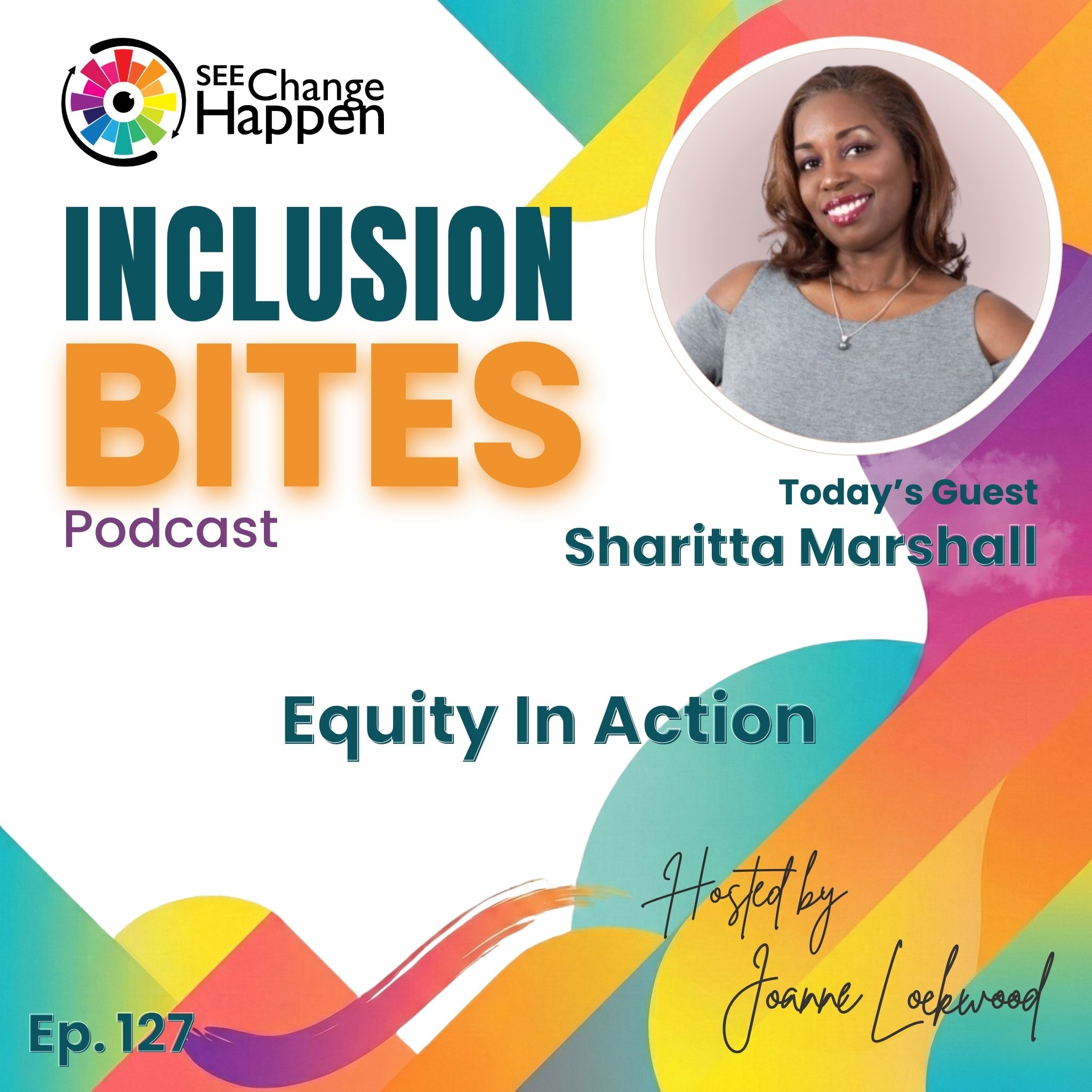
In this episode of Inclusion Bites, Joanne Lockwood speaks with Sharitta Marshall about workplace culture systems.
“You don't have to traumatize people in order to make money.”
Explore
Navigate this episode
Joanne Lockwoodhost
Welcome to Inclusion Bites, your sanctuaryfor bold conversations that spark change. I'm Joanne Lockwood,your guide on this journey of exploration into the heart ofinclusion, belonging, and societal transformation.Ever wondered what it truly takes to create a world whereeveryone not only belongs but thrives? You're notalone. Join me as we uncover theunseen, challenge the status quo, and sharestories that resonate deep within. Ready to divein? Whether you're sipping your morning coffee or winding downafter a long day, let's connect, reflect, andinspire action together. Don't forget,you can be part of the conversation too. Reach out tojo.lockwood@seechangehappen.co.ukto share your insights or to join me on the show.So adjust your earbuds and settle in. It's time toignite the spark of inclusion with Inclusion Bites.And today is episode 127with the title Equity in Action. And I have theabsolute honor and privilege to welcome Sharitta Marshall.Sharitta is the founder of Visionary DevelopmentConsulting. She's dedicated to ensuring that everyone feels seen,heard, and valued within their organization. When I askedSharitta to describe her superpower, she said, mysuperpower is my ability to connect diverse perspectivesand translate them into actionable strategies thatalign with organizational goal. Hello, Sharitta. Welcome to the show.
Sharitta Marshallguest
Hi, Joanne. Thank you so much for having me. Oh, what a pleasure. What a
Joanne Lockwoodhost
pleasure. So, Sharitta, tell me. Equity in action, what does that mean
Joanne Lockwoodhost
to you? Well, let me first by saying equity is making sure
Sharitta Marshallguest
that everyone has the appropriate resources that they needto thrive and be successful in any givensituation or experience. So equity in action forme, from the perspective of the work that I do, means thatthere is an acknowledgment of systemic inequities, and thereis an intentional and impactful planto address those systemic inequities. So everyonehas not only the correct tools thatthey need to thrive, but also the opportunity thatthey need to be the best possible versions of themselves.
Joanne Lockwoodhost
Yeah. I I completely get that and resonate with that. But a lot ofpeople, I find, don't truly buy into the concept ofof equity. You know, they they look around and they think, well, hang on aminute. This is it's all about meritocracy, isn't it? Everyone should succeedon their own merits. And that's a common myththat exists in in recruitment, in in the workplace, around thisbelief in the meritocracy. Yeah. And it comes
Sharitta Marshallguest
from the misguided belief thatequality is available for everyone. And thesimple fact is is that if you say, well, we've giveneveryone running shoes, so everyone should be able to run,but you have an individual who does nothave ability to use their legs, who isblind, who never learned how torun. But the standpoint of, well, if we gave everybody shoes,then they should be able to do it. And that's why I come from thelens of equity because we need to be able to provide resourcesfor everyone given what they need in orderto thrive and not just have the assumptionfrom 1 perspective that if everyone is given this 1 thing, then thatmeans everyone has the same starting point, thesame ability, as well as the same informationto be successful. Yeah. III see people talk about this all the
Joanne Lockwoodhost
time, and and a lot of people will tell me, well, they've had a toughlife as well. You know, it's not been easy for them. No 1 givesthem any help. That's the challenge, trying to allow people whohold privilege to recognize howthat privilege has benefited for them all of their livesand to have and to be able to connect, as you say, with that senseof equity where people need those tools, that that support to succeed.
Sharitta Marshallguest
Yeah. And I think people misunderstand thatprivilege is not the erasure ofhardship. That's not what privilege means. Privilege just meansthat there are not systemic inequities or issuesthat you have to deal with on a daily basis.So for me, I am privileged tohave Internet and be in a place where Ican, you know, afford to have a home and takecare of my bills. Like, that's a privilege. And I don'tnegate the fact that, yeah, are there times that I struggle into take care of my bills? Absolutely. But that doesn't mean that I don't havethe privilege to go out and, you know, figure something outor not have the, you know, the hindrance thatif I was chronically dealing with housinginsecurity and food insecurity, I don't, you know, I don't have todeal with that. So there are things that are not putin my my way in order for me to not besuccessful and being able just, you know, to live. Yeah.
Joanne Lockwoodhost
I mean, I guess, from your perspective, you have a Social Security number. You canget a job. You can get employment. You have a bank account. Whereas manypeople who are maybe escaping terror, fleeingpersecution arrive in the country without evenspeaking 1 of the major languages, you know, Spanish orEnglish in the US. So and and peopleoften think about speaking English as a privilege,and it is. Yeah. For most of the vast majority of the world,speaking English is is still the dominant language and therefore is a privilege, isn'tit? It very much so is. And I think people don't understand,
Sharitta Marshallguest
like, how how difficult that is. Everyone noteveryone, but there are people that like to throw around, well, you know, just learnthe language. I don't believe that people understand English is 1 of thehardest languages to learn in the world. It is there's so manycaveats, so many if then then that.And as a parent of a child that has dyslexia,that makes it even more difficult. So the assumptionthat, you know, just because it's the norm for you, thatthat should be the standard for everyone is a misnomer andvery much steeped in, you know, a privileged eyesight.
Joanne Lockwoodhost
Well, as someone who's spoken English all of my life,I I I've I've got the privilege of never having to try tolearn it. And and when I hear the the complexities that other peopletalk about, I think I never think about it because I don't think oflanguage and English certainly in the same way that when I try to learn Frenchor or German, other language. I don't think of English in those ways. I don'tunderstand the construct of sentences and how it's built up. I I just know itinherently. And that's the challenge is is you say English is iscomplex. It changes the nuances thathelp people talk and help what people say, and they make words upas well. And it it could be very complex. It's a very dynamic language.And, but it has some very, very strange rules as well, isn't it? Yes.
Sharitta Marshallguest
And I like to tell people, like, if you don't believe that English is hard,then teach a preschooler English.Sit down with a preschooler and teach them English. Like, tell them words, and thentell them the words that are that sound the same that are spelled different. Andthen tell them about the silent letters and why they're gonna ask why well,why is that there? And it's it's a very interesting thingthat I really didn't think about until I had achild, and I was teaching my child to read words and understandwords. And then adding on the fact that she has dyslexia,it compounded her ability to be able tounderstand how to read and comprehend English. There are also a whole
Joanne Lockwoodhost
host of words that look the same, sound the same, but have a different thatalmost have the opposite meaning Yeah. Depending on how you use them and how yousay them. And it's like, yeah. And people say this to me, like, okay. Yeah.I get it. And but that's just 1 example of expectingother people to just do something because I did,therefore, you can. It's almost like that. It's that rule, isn't it? Yes. And
Sharitta Marshallguest
that where that's where equity comes in is the assumption that just becauseI did it with this, then if you have access to it, then you shouldbe able to do the same thing. It's not coming from a place of,1, understanding diverse perspective and diverselived experiences, but also having absolutely no empathy for someonehaving a different life experience and what that lookslike. And there are so many assumptions that are madeby individuals of other individualsthat really do lend itself to peoplenot wanting to contribute and push equityin the world. Yeah. I I just seen that in some of the show notes,
Joanne Lockwoodhost
there's some of the stuff you sent through. You talk about the work that you'redoing or helping organizations to do with their staff networks, the employee resourcegroups. Mhmm. I'm a great I'm a great believer thatERG staff networks give employeesa a collective voice of support, alsoadvocacy within the organization. I'm also a great believer that organizations canleverage the power of those perspectives and voices. So howhow do you work with organizations to to empowerERGs and, you know, develop equity, I guess?
Sharitta Marshallguest
Well, I start from the the lens ofthem looking at the employee resource group as a strategic businessunit. Not an Infinity Group, not a community group, not aclub, or just a checkbox, butprogram of individuals that areunderrepresented typically within the organization and settingthem up to create equity throughout theorganization. That is 1 of the cornerstonesthat organizations can use to create equity and create it in away that people actually understand and get what it is. Alot of times, especially now, the push for DEI isgetting so much pushback on, 1, is itnecessary? Does it discriminate against other people that arenot considered protected groups? And, you know, why should peoplegive up what they have for other people. Andwhen I come in and talk about how ERGs createequity, they create equity in several ways. 1, they give avoice to diverse lived experiences that a lotof people don't have insights into and don'tunderstand. They allow for understanding through language andterminology. There are different, terminologies that are usedin the they've added another letter, so I don't wanna mess thisup. 2 s LGBTQI pluscommunity where people don't understand is like, well, what's the 2 s, and what's theplus, and what is all that? Being able to give them language andterminology so that they understand that. Sharing whatsystemic inequities where theyare able to expresstheir lived experience, where they areable to express their lived experiences andshow how those systemic inequities impact them on a daily basis,including their experience with the organization. And when they're able todo that, not only are they able to understand how they contributeto systemic inequities as an organization, but also howthat contribution affects their community as atlarge, including their consumers. We live in a globaleconomic global world, and so consumers are more diversethan ever. And ignoring the impactof systemic inequities in a capitalist societyis going to pretty much create the ruin ofcapitalism. I tell people that equity is the antithesisof capitalism. And where wherever equitythrives, capitalism dies a little bit. So from thestandpoint of organizations in ERGs, Iam introducing the, I guess, the partnership, ifyou will, between equity and capitalism. I understand we live in a
Sharitta Marshallguest
capitalist society. I understand I'm dealing with capitalistorganizations. And for all of their, yes, we would like to, you know,have diverse teams, and we wanna, you know, create equality andequity. They have a bottom line that they have toadhere to. And my point is that you can impact yourbottom line in a positive way, but you don't have to continuouslytraumatize people to pay bills. And when you have an ERGprogram that is truly set up to create equity, not justfrom the fact of having creating those psychological safespaces, but having the ability for your leaders to upscalethemselves so that they can have a career that truly reflectstheir education experience and know how. Havingexecutive sponsors that are truly sponsors and sponsors those leadersthose leaders in spaces and places where they are not Jo thatthey have an opportunity to have that sponsorship and say, youknow what? Joanne has been a great ERG leader, and I think she willbe a phenomenal director in this position. And I've been working withher and blah blah blah blah blah blah. That sponsorship, that isgiving people access to spaces, places, and people that theynormally wouldn't have access to, and that creates equity. Andthen understanding your diverse clientele and community.We are moving into the Gen z workforce,and soon thereafter, the Gen Alpha. They have a very differentperspective on, 1, how they wanna work in organizationsthey wanna work for as well as organizations that they wanna actuallysupport and spend money with. And it would be to organization'sdetriment to ignore what they're looking for and how they cancultivate a culture not just for talent to comein and stay, but also to bring in thosenew consumer bases that are coming up.
Joanne Lockwoodhost
Right. I I love what you said in there. Acts to spaces,places, and people. And you often, ifyou hold privilege, you don't realize howempowered you are compared with people who aremarginalized, voiceless, however you want to describe Joanne who who has less privilege,is that access to spacespaces and people, thenetworks, the unwritten rules, the the things that in the back ofsociety that you you don't see advertised. They're just you know becauseyou know. So it's just it's just like you say,ERGs with the exec with the right exec sponsors, the rightmentorship programs, the right acceleration programs,provide that access to the to what youdon't know. You didn't even know it exists, let alone you don't know. So that'squite that's quite it's a very powerful way of saying it. And, because a partof the problem is definitely not having access to that. Sowhat other ways are you working with that?
Sharitta Marshallguest
Well, through my management my program management services,I make sure that, 1, they are strategicin their build out of their ERG program, meaning thattheir goals for the overarching program, which is overallof the individual ERGs, are directly tied to the organization'sbusiness priorities or outcomes either for that year or aspan of a couple years. In order for ERGs,1, to be supported, funded, and haveaccountability from leadership, there has to be a direct connectionto the organization's business priorities. There has to be impactshown. There has to be metrics. There has to be data collected.And that can't be done if there is not a directconnection to what is impacting the organization.So I make sure that, 1, the program is connected tothose business priorities, but also that they're connected in a way thatdoes not burden the program. It is not theERG's responsibility to handle all of the DEI objectives. It is
Sharitta Marshallguest
not the ERG's responsibility to handle all of the talent acquisitionobjectives, But it is part of their responsibility todirectly impact those business priorities that they can have avery powerful impact for, and what does that look like.And being able to lay out a project plan,including time timeline resources needed, making surethat leadership not only understands what theprogram is, the goals that they're tied to, but alsoholding them accountable for success. When I say leadership, I just don't mean,like, c suite. I mean, middle managers. They need to understandthat they're directly tied to the ERG success because they need to make sure thatleaders have the support and ability to get those objectivesdone. And then creating a strategicimplementation plan that is flexible enough to adjust with the business. Becauseas we all know, business happens. Sometimes priorities shiftand change, and things happen with the business where sometimes they're like, hey. We're noteven doing this anymore. So being able to have that flexibility topivot whenever those things come up are also important aswell. Because, again, when you treat the ERGs as yourbusiness unit, it is just like any other unit, like marketing,products, sales. They have their objectives. They have their resourcesneeded, but they also know that sometimes the plan has to pivot.So by making sure the plan is flexible enough topivot, you are still aiming for those goals and for thatsuccess, but also giving grace to the program incase things need to change that are completely out of the program's goalI mean, control. Yeah. I mean, you talked earlier about yep. You
Joanne Lockwoodhost
just been saying there about the ERG has to be seen like a businessunit with exec or senior sponsorship to give them thatvoice. It's too often the case, though,and I'm afraid I didn't come across this too often, where the ERGdoesn't have strategic access. It doesn't have strategic importance.It becomes a talking shop, an echo chamber of of thesame voices, but change never occurs. The frustrationoften often is is around trying to find this exec sponsor whohas the ability to make make change. How do you work withorganizations to find and empower an exec sponsor to takeover ownership of the their particular ERG, if you like? Becauseit's that's the hard business. Actually, that's not the hard bit.
Sharitta Marshallguest
The hard bit is getting them to actually do things.So I always start with roles and responsibilities for the leaders, including theExecutive Sponsors. A lot of times, Executive Sponsors within organizationsare either volunteer or are voluntold to do something withinthe ERG space, but they don't know what that means. They're like, well, do Ijust go to meetings? Do I just say, hey. You know, I'm the executive sponsor,and that's it. I think it's very important to have the roles andresponsibilities laid out. Jo, 1, the executive sponsor knows whatis expected of them, but then if there is a point where they'renot willing to commit or cannot, that someone else isselected. Because the worst thing to do is assign somebody orhave someone volunteer and they do absolutely nothing. And there there'sno support. There's no sponsorship. There's no advocacy.And that role is super important,especially from a program standpoint. Because if the ERGprogram, including the individual ERGs, are having impediments to theirgoals, it is the executive sponsor's role to step in and deal with thoseimpediments. If I am the executive sponsor for, let's say, theblack ERG, and 1 of their goals is to get to morediverse conferences. And we've agreed and said yes. And thennow they're like, okay. Here are the 2 conferences. This is the budget,and they don't get approval. And they're getting the runaround. They're like, hey. Wethis was agreed to. What's happening? And then my job as executive sponsoris like, hey. You know, what happened to the budget budget for this? This wasagreed to. They need to do this in order to do x, y, and z.So that is something that is part of the executive sponsor's role,or at least it should be. But if they don't know what is expected ofthem, then they either don't do anything or do what they feelis important, but that might not Jo
Joanne Lockwoodhost
your programs, have and do your programs have so that you youtalk about making sure that they're performing and you use to add the role specsand the roles on to it. Do do we actually train them? I mean, II would guess that Well, there should be training to most yeah. Yeah.
Sharitta Marshallguest
There should be at least an onboarding so that they know, like, hey. Here's howthis works. This is what you'll have access to. This is how youcommunicate with your leadership. These are, like, the, you know,quarterly meetings of the executive sponsors and the ERG program managerto talk about the goals, where you are to go, how,you know, you can support the program, whatever it is thatis your onboarding plan. That should be in place forthe executive sponsors as well as the ERG leaders. There should bea laid out onboarding process, including the succession Joanne. Because, youknow, people leave, change positions, stuff happens, so youdon't wanna leave your program and your leadership just kind of, like,vacant and out there where they're like, well, we don't know what to do now.That, you know, causes chaos, but then also doesn't lendpeople to want to participate because they're like, well, what's thepoint? You know, you guys aren't really doing anything, or we do stuffand then nothing happens. So you want to make sure there's transparency,but also there are laid out plans so everyone knows what to do, how todo it, and when to do it. But how do we stop the ERGs becoming
Joanne Lockwoodhost
AA1 person crusade for their particulartheir focal point? Now they they get have a passion around, they've been wronged, orthey have something they wanna try and solve. The the the danger is you endup spending all your time dealing with single issues. It's trying to how how doyou keep the ERG focused on more strategic, bigger goals?
Sharitta Marshallguest
It comes from the program itself. When the program has the strategic goals that arealigned with the business outcomes, it is the individual ERGsto have those projects and initiatives that directly connect tothose program goals. So if the program goal isto increase diverse leadership throughout the organization by 2%,1 of the projects that each of the ERGs hasis leadership development. What does that look like? Is that upskilling theleaders? Is that offering management courses to the teammembers? Whatever those agreed upon projectsare. So the connection to the programis what ties them together, but alsounderstanding that that upskilling of these membersand leaders are important to that group becausethey haven't had access to leadership development because they areindividual contributors. They haven't been able to beseen by directors in higher level managementbecause they're individual contributors, but now they're doing presentationsaround the program goals to to date.They're presenting that. They, you know, they have that ability to do that so thatthey have that visibility. That lends itself to thatupscaling and leveraging for career success. Sowhen I say that the program goals and individual ERGsshould be tied to the organization's business priorities, I don't meanthat to be the detriment to the individual ERGs and what they're trying to do.I mean that to create a holistic, everyone is going in the samedirection type of strategy. We're we're
Joanne Lockwoodhost
mid 2024, so June 2024 at the moment when we're recordingthis. The US is in its political cycleof going to having a an election not in not toodistant future, a change of well, potentially a change of of,leader, maybe not. The UK is just going through its cycleof general elections at the moment. We've got ours in about 2 or 3 weeks'time. There's a a lot of pushbackand a lot of political divide on the valueof EDI initiatives both atgovernment level, central government, also devolved government, statelevel in the US. We're seeing a lot of pushback in the UK aroundgovernment department having their DEI budget slashslash being almost forced and told not to invest in DEI. So DEI is isstarting to become a kind of a toxic word. How howdo you find that organizations are responding? I mean, you youdo do you find the people you work with are in governmentorganizations of having their budgets cut, or do you find you in in thepublic and private sector who have more access to funds? What's the what's thepolitical climate around DEI these days? Well, I do find that
Sharitta Marshallguest
there is definitely cuts within DEI,not just funding, but is existing in publicthe public and the private sector. So that's absolutelyreal. And the pushback around DEI,to be quite honest with you, is coming from whitesupremacists and Joanne black sentiment. What they're going afterlegally is using a lot ofthe legislator that legislation that was put into placeto give equity to formerly enslaved blackAmericans against current black Americans. Andthe standpoint of that is directlyconnected to, you know, individuals through highereducation, them halting scholarshipsthat are for black students, from a haltingof funds that are available to black womenfunders. There's a lot of antiblackness thatdrives the continued push to eraseDEI. And, again, what I saidearlier is that equity is the antithesisof capitalism. So the push for equity to giveeveryone the correct resources they need tothrive chips away at the foundation of capitalism.And the people that are late stage, true die hardcapitalists do not want equity to exist because that takesaway their control of the majority,be it the small percentage of the individuals and organizations that theyare. So from my standpoint, I comeat it understanding that and not ignoring that and notstanding on it. Well, this is the right thing to do because it's the rightthing to do. I'm standing on this isthe right thing to do, and this is how you can still make money doingit. You don't have to traumatize peoplein order to make money. You don't have to be a person that'scontinually traumatized in order to pay your bills. There isa way to exist happily in the meaning.But, yeah, my standpoint is always taking it from theethereal DEI. We have so much data, somany reports, so many Harvard Business Review, somuch, but people don't equate it totheir individual impact. So showing organizations,hey. Here's what is costing you to continuously havepeople leave. Here is your loss of knowledge cost. Here is yourtalent acquisition cost, and here is your inability to hireGen z and Gen Alpha because they do not trust you. This is what it'sgonna cost you. And when they're able to see that bottom line, they're actuallyable to make that very tangible connection towhy DEI matters. And that's where Icome from, and that's where I've been coming from for the past year. I thinkpeople are just now paying attention to it. But I come from itfrom a very, here is the cost. Here is either the costyou're gonna pay. Here is the cost savings you can have, or and here ishow you can make money. Yeah. I mean, you live in a a very
Joanne Lockwoodhost
politically polarized country.We I live in a a very politically polarized country where there's2 main parties or 2 main schools are thinking.And the sad thing is what you're saying makes perfect sense. Youknow, as you say, McKinsey, HBR, all these type ofreviews are out there. We've we've seen it. We we can quantify it.We and there's evidence. But, yeah, a large percentage of thepopulation, both in the US and in the UK,somehow don't get it. And it's it's not like it's a minor part. It's it'salmost it's almost a majority view. That's the scary thing, isn'tit? It is. And I do believe
Sharitta Marshallguest
that it comes from the lens of a lack of empathy,But then also, it comes from thepropagandist capitalist view that,you know, if you let anyone have anything, thenthey're taking away from you. And they're not working as hard asyou, and they're gonna take away everything that you worked for. And howdare they get something and didn't work as hard as you? That doesn'twork. But, again, it does not address thesystemic inequities that exist. It acts like those systemicinequities don't exist, have no impact,and should be thought as some type of mythical fairy tale thatpeople are using to, quote, unquote, push DEI down their throats.
Joanne Lockwoodhost
Yeah. It's this it's this belief in the the bullshit, if I'ma better phrase, of meritocracy. It's it's calling that out and saying, hangon. Yeah. It's meritocracy only works inthis cloud of mist and and mysteriousness. You know? When you when youshine a light on it, you bring equity, you bring sexuality into it.Meritocracy very rarely is what happens.Privilege, biases, stereotypes, beliefs,perspectives, everything clouds the meritocracy. And it'sit's it's hard to I was gonna say argue.I didn't mean argue. Dissuade is probably a better way better word. I don't wannaI don't like arguing with people. It's it's hard to share a perspective wherepeople could buy into the vision of of true equitybecause they always feel and I think you said this. The the thesense has been taken away from them. If I give you something, Ilose. Mhmm. And it's trying to get away from that 0sum game where actually we just create biggertables. We create more and not not take things away from you. Wewe amplify people. It's hard to get people to see that, isn't it? It is.
Sharitta Marshallguest
It is very hard to get them to see that. So it's alwaysfor me, it's me constantly showing everyone what'swhat's in it for them. What do they get out of it? Because that's theonly way they'll pay attention to the conversation, to be honest with you. If theydon't hear what's in it for them, they are not interested in the conversation.Now there are some people that no matter what you say, it doesn't matter. They'rejust not. They don't care. It's it it is what it is.
Sharitta Marshallguest
But definitely being able to show what's in itfor them is very key to shifting thebalance, so that it's not so many people on 1side versus the other. I would like nobody to be on the sideof anti DEI, anti blackness, but, you know,that's not gonna be the case. But however, we can shift the balancefor people to understand that we are all connected Jomatter what people wanna say or think. Everything is adomino effect that happens in the world because we are a globalcollective society. We are notsiloed the way people think that we are. People havethe disillusion that geography silosus from what's happening in different parts of theworld. And, yes, we would not necessarily feel the physicalimpacts per se directly, but a lot of it is,again, a domino effect. The things that happen in othercountries affect us. They affect us financially. They affect us emotionally.They affect, you know, our ability to, you know,do business in a global economic society.They affect how, you know, we are dealing withclimate change. Everything is connected. And once wecan understand that as a collective global community,what impacts 1 will eventually impact another. Ithink that is 1 of the ways that we'll finally get it. But until weget to that point, just showing and connecting the dots so thatpeople understand and get that is liberation for all orliberation for none? Yeah. I mean, you you say that a lot of this is
Joanne Lockwoodhost
is a race discrimination, racebias, and and understanding the the challenges of of race.It's very intersectional, don't we? You look at I look at what what I'm seeing,and there's a lot of oppressing of womenin in terms of their abortion rights, in terms ofbeing able to succeed in the world. So a lot of it's impacting women, anda lot of it is around LGBTQIA plus people and 2 spirit people aswell. It's there's a it's an intersectional lens here, and it it's it's almostlike multiple attack vectors on marginalized minoritygroups to appease majoritypeople with privilege. And I think it's it's it's multifaceted some someof this attack, isn't it? Oh, it's always multifaceted because we
Sharitta Marshallguest
are not monoliths as human beings. When I focuson race, I'm focused on race from a legislation alegislative point here in the US. But it is notjust, you know, about race. It's aboutgender. It's about class. It's about disability.It's it's about all of it. It's about the caste system thatexists globally. Everyone isa individual, but they are multifacetedindividuals. You have so many different components that make up youas Joanne, just like I have different components that make me up asSharitta. So 1 attack on 1 component ofme may not seem that detrimental, but that1 impact or that 1 attack attacks me as awhole because it never stops with 1 thing. And I think that'swhat people don't get. It's never just 1 thing. It's never just gender. It'snever just race. It's all of it because it'sabout the global minorityholding, keeping, and controlling whatthey control and not allowing anyone tosee that. That is what we're fighting against. We should notbe fighting 1 another. We should be fighting the cap the late stagecapitalist control that is killing our planet,that is taking away our liberties as human beings to existin whatever way, shape, form, or fashion we choose to show up in ourlives. And that is the most dangerous thing that we cancontinue to ignore. How do we make sure
Joanne Lockwoodhost
our ERGs or staff networks think intersectionally?Because there's the danger that we we divideour focus. We focus on race. We focus on gender. We focus onsexuality, whatever it may be. If we're not careful, what happens is we we endup having to have a foot in multiple camps because the ERGsare polarized. How do we create intersectional approaches in our organizationsand leverage this ERG power intersectionally?How do we how do we do that? Well, 1 of the things that I
Sharitta Marshallguest
always do is let people know that,you know, as a because I was a global ERG leader, but Iwas the leader of 1 particular ERG, but I was a memberof 5 others. So understanding thatjust because I'm a leader in 1, I'm a member of5. So what the other 5 are doing, I'm still a part of. I'mjust not leading it because I'm leading this 1 over here. It's just like ifI was the director of marketing, I'm still working with product, I'm still working withsales, but I'm just leading this over here. It's the samething. So again, going back to when I said it'sa strategic business unit, it is a part of it should beholistically a part of the whole organization because, again, it's makingup people that should be in existence in every part of theorganization. And if you have an ERG program and you seethat you don't have any executives, you don't have anydirectors, you don't have anybody that is in any of theseERGs, then maybe you need to look at that because they should represent theentire organization. So there should be no silo because yourmembers and your leaders should represent all of your organization.That's the community. That's the holistic making sure thatit is organically a part of the organization.And then also having that program where everyone is driving inthe same direction. How they get to their goal may be different, but thewhole point is that we're all going in the same direction. Event, we'resupporting it. We want to makesure if an ERG is isevent. We're supporting it. We want to make sure if an ERG isis struggling with membership or they have any impediments, ifwe're able to help them with that, we support that because we know because we'rehaving meetings and talking to each other. So, again,the ERGs are a holistic part of the organization. Sothere should be transparency, communication, again,going in the same direction for the goals even if we areon different lanes. So that's how you reduce the silo, andthat's how you truly make it not just astrategic business unit, but a community for thebetterment of every team member, regardless ofif I am a member as an ally or if I'm a member identifyingas a member of the group or or if I'm a leader. Yeah. I've worked
Joanne Lockwoodhost
with a number of organizations, and you can tell when they're they havestrategic importance because ERG start to pull theirresources. They they share their budget. They do jointmarketing. They put on joint events, and then but I've seen other organizationswhere there's a a competitive nature, where they don't talk. Theythey're not crossing over, and then you have to decide whichcamp you have your foot in, or sometimes you have to sort of swap betweenthem. So, yeah, I think you're right. It's it's completely beenwith the ERGs being strategic, having seen level sponsorship coordinated,and was was I I was described by having a as a as a networkof networks. Mhmm. It's almost like I have a an overarchingall the ERG leaders meet together, and so they canthey can strategize and and coordinate with their their theirtheir activities amongst each other. I think that's really, really important Jo you don't youdon't create these sort of little silos. But the the problem II always face is is about getting allies into the room.And it's it's the chance of of the echo chamber is not specifically aroundthe ERGs. It's any initiative where we're talking about I don'tknow. I don't know if you've experienced this from a from a Joanne racism perspective,but I've seen it from a gender perspective and Joanne LGBTQ plus perspective whereyou you you were in the echo chamber of the people who hold thatcharacteristic. And the people you actually want in the room listening and takingaction are the people who are the allies, the people with privilege, the peoplewho are enablers of change. And that's areal challenge of of getting people to be interested insomething they're not. How do how do you tackle that? There are a couple of
Sharitta Marshallguest
different ways I do that. 1 of which is making surethat the mission, vision, and goal of thenot just the ERG program, but the individual ERGs are available to theentire organization, Making sure that theroad map to the goals of the program are available to theorganization, and this can be done through,having the program manager or ERG leader talking in all hands andsharing that information or doing a road showthroughout the organization to say, hey. This is what we're doing. This is what we'replanning. This is how you can support. Having individualERGs share their language and terminologies so that everybody inorganization has access to that. And then havingcommunity events where information about theERGs members, their lived experience is shared. So peopleget to have access to understand thatThere is power in storytelling, andthere's power in having the ability toshare your lived experience from your lived experienceJo that people can have an insight and maybe createempathy around that. But, again, the transparencyand the communication is the only way that theallies can really be allies. There can't be,okay, the ERGs exist over here. They're doing stuff. It has to be,hey. You know, here this ERG event coming up with x, y, and z.Here's the ERG celebration calendar that celebratesall things related to, you know, DEI,and that includes accessibility, Hispanic heritage,so on and so forth. So people are aware of what these things are,giving a brief history that can be shared throughout the community, so thatpeople understand what things are. And I believe in doing it from aglobal perspective because everyone has different lived experience.There is not 1 Black experience foreveryone. There is not 1 Black American experience for everyone.So being able to share those different experiences,celebrations is so very important forallies to really understand diverse livedexperiences, and then telling them how they can support.I think that is just the easiest and most overlooked thing. Beingdirect with your allies and say, this is how you can support us.When people don't have to try to figure it out, because a lot oftimes they won't because they'll be too scared to, when you tell them, hey. Thisis exactly what we need as this ERG. Notdon't go out here and do this for everybody because we're not speaking for everyone.We're just speaking for us. This is what we need from you to support us.It makes it a lot easier for allies to show up andthen show up in a way that's best supportive of who they're trying tosupport. I completely concur that that that should be the
Joanne Lockwoodhost
way. But the reality is, you know, we're no matter howmuch we push and and and talk about this, needle isn't moving that far, isit? It's frustratingly, glacially slow.
Sharitta Marshallguest
It is. That's why I I push to dowhat I do with so many global organizations because Iwant that to be the best practice. I want that to be thenorm Jo that the needle isn't slowlypushed. The needle starts to just flow downstream. Yeah. I
Joanne Lockwoodhost
mean, I'm with you. I'm with you completely. And, yeah, it'sit's frustrating, though, isn't it? As a as a DEI practitioner, as someone who hasworked in the organization because no matter how much we want it to be abusiness priority, somehow it's never quite on the list. Youknow? They'll invest organization often invest inleadership development training, but they often forget to mentionaround the inclusive leadership development training. They talk about others otherskills, or they'll they'll be more focused on sales or businessdevelopment or growth or or organizational development, notaround those well-being and DEI initiatives. And it's it'sfrustrating sometimes to see whether the budget is being spent.But does do do you think that DEI has a tangibleROI that the business understands? If if they understood the ROIor or it's it's all badly implemented. Well, they can if we
Sharitta Marshallguest
show them. If we come from the perspective of,okay. According to Gallup poll, you are going to spendbetween 1.5 to 2 times yoursalary each year for every overhead turn.So how much how many overhead turns have you had in this pastquarter? Okay. It's been, you know, let's say,200. Okay. So it's cost you $2, 000, 000 thispast quarter in your overturn. What has been yourexit interview information? Oh, you haven't done that. So you don't even know why peopleare leaving. So you're just so you're okay with spending this this $2,000, 000. Let's just say you're spending this $2, 000, 000 every quarter.So at the end of the quarter, you know, you have thisyou have this 8, 000, 000 in in overturn. Is thisto the percent of churn your employee churn? Is isthis this acceptable amount? Okay. So this is acceptable amount.Were you looking to save costs at any point in time this year? Yes.How are you gonna do that? You're gonna lay off. Okay.So you have a cost of $2, 000, 000 for people leaving, but youthink laying off people is gonna save you the money. How much money is thelayoff gonna save you? It's gonna save you 6, 000, 000. Okay. This layoff isgonna save you 6, 000, 000, but it's costing you 8, 000, 000 in inyour employee turn. How about you switch the focus from lays offlaying off to seeing why people leave or how youcan keep people? Are employees engaged? Have you done an employee?It's it's really coming down to the quantifiables because when youcan have those conversations, people take it a lot more seriouslyversus if we continue to say, you know, hey.This should be done, and diversity is important because it doeslead to innovation and growth. Yeah. It does. We again, to yourpoint, McKinsey, Harvard, they have all this documentation. Theybut people don't really care when it's not directly tiedto them. It's not directly tied to their budget at the end of theyear or the sales growth they're supposed to have or theirARR. You have to make it very tangible for theseorganizations, and then that's when they are more than likely, notall the time, but more than likely to take it a lot more seriously andbe willing to redirect funding resourcesand support. Yeah. I think you're right. I think it it
Joanne Lockwoodhost
it's we have Jo I think what we need to do is we need tostart driving home the ROI, driving home the the business benefit. As you say, the,the MTC cost, the the onboarding cost, the the hiring cost,all these things are tangible cost to a business whereyou start to understand the impact of poor poor employee experience,high turnover, low discretionary effort, lowcyclical safety in organizations. So, yeah, it it'sa lot of this is is is sort of seen as the soft stuff, whicha lot of people aren't managing and and focusing on. I think if we startto drive the costs, the true cost of these in our business, then we startto understand them. And then we're gonna move on to something about it. But atthe moment, they're kind of they're they're they're sort of hidden costsas such. Mhmm. Yeah. Businesses have a have a a prediction ofchurn. They have a prediction of rehiring. They have a prediction of ononboarding. And they don't actually think, well, actually, if we could reduce that by 5%,that that huge impact it would have. So, yeah, I think it's aroundgetting the accountants more focused. Maybe we need to startand I and I'm I hate saying is it has you know, the businesscase has to be in there somewhere, and I'm I'm a I'm a bigI'm reluctant to talk about a business case because I think you should your peoplestrategy should be around just around a business case. But I think sometimesin order to make it sustainable and sticky and embedded, we have to startmeasuring the benefit of it beyond just justpeople's experience. And I think that's where we're starting to seetrue benefit as as you say, as per the Harvard Business Review, as perForbes, publishing articles all the time, as per McKinsey,other, etcetera, organization. So, yeah, it that's the challenge wehave is to try and leverage hard dollars, ifyou like Yeah. To drive the case. Yeah. So I I hear so many
Sharitta Marshallguest
people. I see so many people that say that same sentiment. Like, there shouldn't bea business case and we shouldn't, you know, have to, you know, makethe human experience a business case. Butwe're dealing with capitalism. Like, capitalism is gonnacapitalize capital c and capital m all the time. It does notcare about the human experience. It does not care if people are traumatizedin order for it to exist. It doesn't care. What it cares aboutis, is it making the money it wants to make? Is it holding the powerit wants to hold? And we have tounderstand that realistically and deal with it inthe best way possible. Otherwise, we're still gonna be in thesame position. Because if a business case thatwasn't focused around the economics ofDEI was powerful and was impactful, we would notbe in the situation we're in. Yeah. I'm I'm pretty sure if,
Joanne Lockwoodhost
people at Hold Privilege suddenly found that they were making moremoney by doing this. They they sure they sure as heck would, I'm sure.I'm sure. So what's your vision, you know, of the future? Where where's where's theworld going? You know, we're living in a a world of change, andpeople say, how far have you come? I said, well, if you look over yourshoulder, we've come a long way in the last 40, 50, 60,100 years. But the journey's stillinfinite in front of us and that's what do you think what's your vision? What'swhat's gonna happen? Are we are we gonna finally get people togo, oh, yeah. It is a good idea, or are we gonna still be fightingthis for years to come? I do believe we're gonna be fighting this
Sharitta Marshallguest
for years to come. I think it's gonna get to the point wherewhen late stage capitalism is no longer in the position tosustain itself, when it has completelyworn out the the working classand it can't continue to propagate and expandupon itself, that that's when verywidespread impactful change will happen. Untilthen, we have to keep up the fight and keeppushing for, you know, what's right in a way thataligns and can be heard from an organizationalstandpoint, even higher education. We just have to keepfighting the fight for those thatare having the lived experiences that they're having. I knowfor me, I'm gonna fight this until I can't fightit anymore because it's it's the long game.I wish it was a short 1, but it is the long game. It's notlike we haven't been fighting this for 100 ofyears, so I don't foresee it changing in the next5. But I just think that how we fight it, how weapproach it definitely does need to change. Our mindsetaround it, our commitment to it, andour ability to, 1, understand thatthere are gonna be consequences, good or bad, for the decisions we maketo push DEI and change. Some of thoseconsequences are going to be us being able to makesome change. Some of those consequences are wemight be impacted negatively financially because of our stance.But for me, it's, you know, it's either you go all in or youdon't. And there's no right or wrong about it. Ifit's something that, you know, is going to be mentally,emotionally, physically detrimental to you, then don't. But,you know, if you can stay the course for however long you can stay thecourse, there are too many people with us andbehind us for us to just give up. But Tuesday, 5th November
Joanne Lockwoodhost
2024 is, US election date. The next 5 yearscould be hard or harder, I guess. Does it impact the workyou're doing? Who sat in the big chair? It definitely will impact
Sharitta Marshallguest
what I do. And whoeverends up in that chair, it might require me topivot even further than what I'm doing anddo something else entirely, but the basis of whatI do is still gonna fight for the liberation of all. That'sjust my purpose in life. It's liberation for all, liberation for none.So regardless if I'm doing it in the particular business structurethat I'm doing it right now, that will be something I will continue to dono matter who's in the chair. Sharitta, I wish you
Joanne Lockwoodhost
well, most sincerely, to keep fighting the goodfight, to keep doing what you do, to keep that strength, andto and to be on the right side of history, to keepknowing that. I think that's the important thing. So how Joanne,people get a hold of you if they wanna find out more? People can get
Sharitta Marshallguest
a hold of me on LinkedIn, Sharitta Marshall.You can follow me there or connect with me there. Please feel free to DMme if you would like to connect via meeting, and then youcan also email me atinfo@VisionaryDevelopmentIn.com, andvisit my website https://visionarydevelopmentinc.com. I lookforward to supporting everyone in their endeavors tomake sure that everyone feels seen, heard, and valued. Thank you so
Joanne Lockwoodhost
much. Thank you. As we bringthis conversation to a close, I want to express mydeepest gratitude to you, our listener, for lendingyour ear and heart to the cause of inclusion.Today's discussion struck a chord. Consider subscribing toInclusion Bites and become part of our ever growingcommunity, driving real change. Share this journey withfriends, family, and colleagues. Let's amplify the voicesthat matter. Got thoughts, stories, or avision to share? I'm all ears. Reach out to jo.lockwood@seechangehappen.co.uk,and let's make your voice heard. Until next time. Thisis Joanne Lockwood signing off with a promise to returnwith more enriching narratives that challenge, inspire,and unite us all. Here's to fostering a more inclusive world1 episode at a time. Catch you on the next bite.
The High Cost of Employee TurnoverChallenging the Meritocracy MythThe Role of Employee Resource Groups (ERGs)
Joanne Lockwood is joined by Sharitta Marshall, founder of Visionary Development Consulting, for a wide-ranging conversation about what “equity in action” really looks like inside organisations.
Sharitta challenges the myth of meritocracy and unpacks how privilege and systemic inequities shape who gets access to opportunity, resources, and decision-makers. Together they explore why equality-based approaches often fail in practice, and why equity requires intentional plans, appropriate support, and a clearer understanding of diverse lived experiences.
A central focus is the role Employee Resource Groups can play when they are treated as strategic business units rather than social clubs. Sharitta outlines what effective ERG programmes need: alignment to business priorities, clear goals and metrics, proper funding, defined roles and responsibilities, onboarding and succession planning, and executive sponsorship that actively removes barriers and opens doors to spaces, places, and people.
They also discuss the broader political and economic context influencing DEI pushback, including the impact of anti-Blackness and policy trends, and why organisations often only respond when the costs are made tangible. The episode closes with a practical call to quantify the real financial impact of turnover and poor employee experience, and to use that data to sustain meaningful culture change.
“Well, I start from the the lens of them looking at the employee resource group as a strategic business unit. Not an Infinity Group, not a community group, not a club, or just a checkbox, but program of individuals that are underrepresented typically within the organization and setting them up to create equity throughout the organization.”
“When I say leadership, I just don't mean, like, c suite. I mean, middle managers. They need to understand that they're directly tied to the ERG success because they need to make sure that leaders have the support and ability to get those objectives done.”
“They haven't been able to be seen by directors in higher level management because they're individual contributors, but now they're doing presentations around the program goals to to date.”
“And if you have an ERG program and you see that you don't have any executives, you don't have any directors, you don't have anybody that is in any of these ERGs, then maybe you need to look at that because they should represent the entire organization.”
“There is power in storytelling, and there's power in having the ability to share your lived experience from your lived experience Jo that people can have an insight and maybe create empathy around that.”
“I do believe we're gonna be fighting this for years to come. I think it's gonna get to the point where when late stage capitalism is no longer in the position to sustain itself, when it has completely worn out the the working class and it can't continue to propagate and expand upon itself, that that's when very widespread impactful change will happen.”
The critical costs associated with employee turnover and the need to focus on employee engagement.
The tangible financial impacts of poor employee experience, emphasising the importance of involving accountants.
The necessity of framing a strong business case for prioritising human experience amid capitalist pressures.
The challenge of driving DEI initiatives in politically polarised environments and the potential difficulties over the next five years.
The disconnect between DEI data and individual impact, and the importance of addressing systemic inequalities.
The role of Employee Resource Groups (ERGs) in giving a voice to diverse lived experiences and tying them to strategic business goals.
Strategies for building and supporting ERG programmes and the importance of executive sponsorship for driving meaningful change.
One thing to remember
The episode "Equity in Action" underscores the critical need for businesses to truly understand and engage with the high costs associated with employee turnover and the broader financial implications of neglecting diversity, equity, and inclusion (DEI). It emphasises the necessity of making a compelling business case for human experience and stresses the importance of addressing systemic inequalities through strategic and empathetic approaches, such as empowering Employee Resource Groups (ERGs) and ensuring executive sponsorship.
Questions this episode helps answer
Sharita Marshall highlights the high cost of employee turnover and the importance of understanding why employees leave. How can organisations better identify and address the root causes of employee dissatisfaction?
Joanne Lockwood discusses the tangible costs of poor employee experience. How can organisations present the financial implications of high turnover to their accountants or financial teams effectively?
Sharita mentions the need to make a business case for human experience within a capitalist system. What strategies can organisations employ to balance profitability with employee well-being?
The conversation touches on potential difficulties in the next five years, including political impacts. How can organisations proactively prepare for these challenges in their DEI initiatives?
Sharita discusses resistance to equity by those who fear loss of control. What are some effective methods to address and mitigate this resistance within organisations?
Sharita highlights the gap between DEI data and personal impact. How can organisations ensure that their DEI data translates into tangible, positive changes for all employees?
Explore topics
Ideas from this episode
The High Cost of Employee Turnover
In my recent conversation with Sharita Marshall, we tackled the often-overlooked, yet tremendously significant, issue of employee turnover and its financial implications. We examined why businesses seldom focus on the root causes of employee departure and engaged in a thought-provoking discussion about the need to reframe this narrative.
Challenging the Meritocracy Myth
Our dialogue naturally flowed into the realm of systemic inequities, questioning the deeply entrenched belief in meritocracy. We reflected on how this ideology often overlooks underlying issues of privilege and access, leading to pervasive inequities in the workplace.
The Role of Employee Resource Groups (ERGs)
Finally, our conversation delved deeply into the strategic importance of Employee Resource Groups (ERGs) in promoting diversity and inclusion within organisations. Sharita shared her insights on empowering these groups, treating them as strategic business units rather than mere community accolades.
Learn
Frequently asked questions
What is the cost of high employee turnover, and why should organisations be concerned about it?
High employee turnover can incur significant financial costs, including recruitment, training, and lost productivity. Sharita Marshall and Joanne Lockwood discussed the importance of understanding why employees leave and focusing on keeping them engaged rather than constantly replacing them. The tangible costs of poor employee experience should be made clear to accountants to highlight the financial implications.
What is the importance of making a business case for human experience in the corporate world?
Considering the influence of capitalism, Sharita Marshall emphasises the necessity to link DEI initiatives to business priorities. It helps in getting buy-in from stakeholders who control funding and resources by demonstrating the long-term benefits of prioritising human experience and equity in workplaces.
What are some challenges in driving change in DEI efforts within organisations?
Challenges include resistance to equity from individuals who fear a loss of control, the political climate's impact on DEI funding, and the slow progress in implementing effective DEI measures. Both speakers stressed the importance of persistence and strategic alignment of DEI goals with business outcomes.
How do systemic inequalities and the myth of meritocracy impact workplaces?
Systemic inequalities and the belief in meritocracy often hinder true equity in organisations. Sharita and Joanne discussed the necessity of addressing privilege and recognising the complex layers of discrimination related to race, gender, class, and disability. This understanding is crucial for creating equitable workplaces.
What role do Employee Resource Groups (ERGs) play in organisations?
ERGs are pivotal in providing a collective voice for underrepresented employees and advocating for systemic changes. Sharita Marshall argues that ERGs should be treated as strategic business units, aligned with the organisation's goals, and adequately supported through executive sponsorship and clear roles and responsibilities.
How can organisations successfully integrate ERGs with their strategic business goals?
To prevent ERGs from becoming single-issue focused, it’s important to align their projects with broader business objectives. This includes onboarding and training executive sponsors, ensuring transparency and communication of ERG goals across the organisation, and holding leadership accountable for supporting ERGs effectively.
Share this episode
Heard something worth passing on? Send this conversation to someone who needs to hear it.