How to Simplify Inclusion by Focusing on Behaviours
It was an interesting conversation with Jackie where we talked about how we can focus on the language used in our organisations over and above focusing on Unconscious Bias training as our only tool.
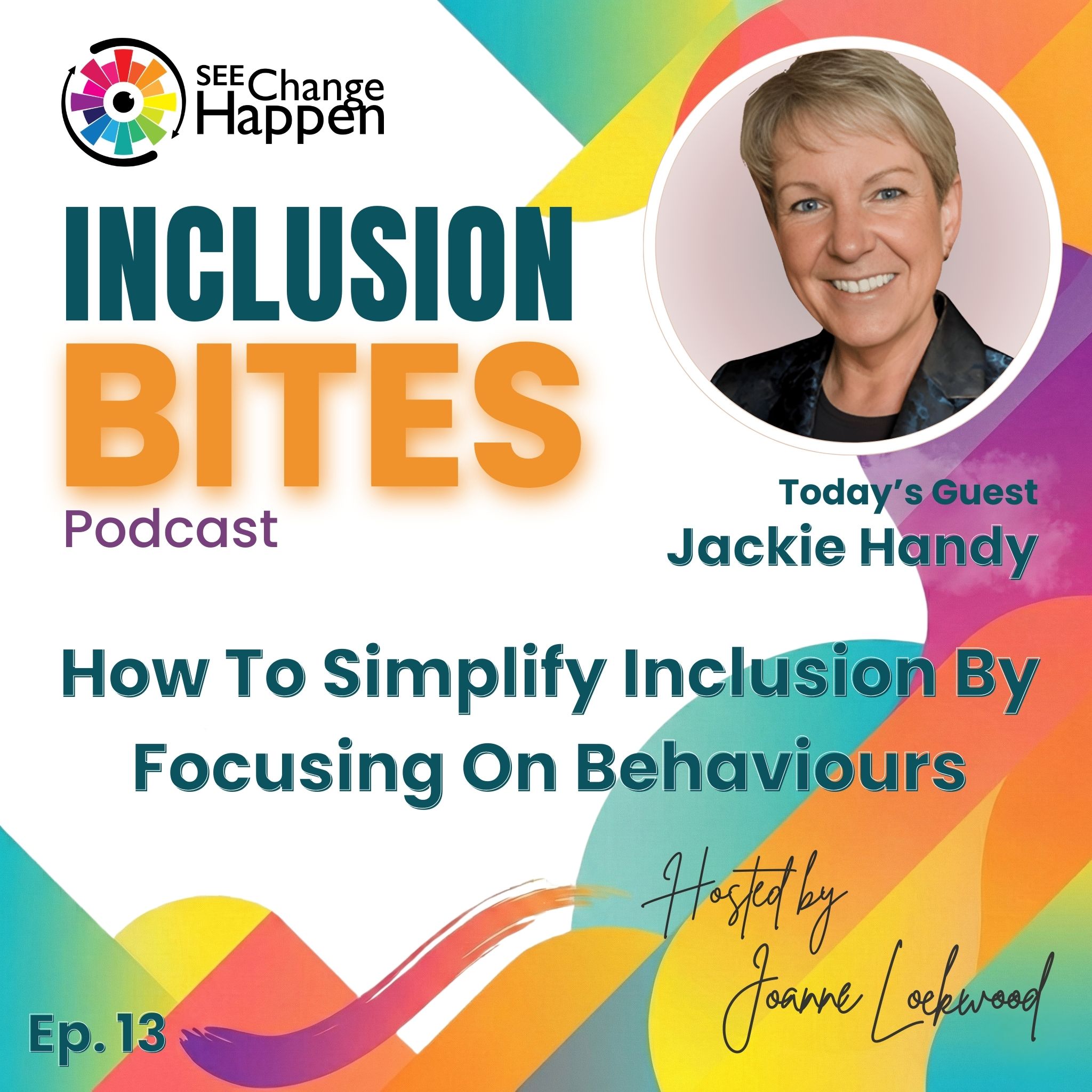
In this episode of Inclusion Bites, Joanne Lockwood speaks with Jackie Handy about workplace culture systems.
“I really believe that there's good in everybody.”
Explore
Navigate this episode
Joanne Lockwoodhost
Hello, everyone. My name is Joanne Lockwood and I am your hostfor the Inclusion Bites podcast. In this series, I will be interviewing anumber of amazing people and simply having a conversation around the subject ofinclusion, belonging and generally making the world a better place for everyoneto thrive. If you'd like to join me in the future, then please do dropme a line tojo.Lockwood@seechangehappen.co.uk.That's seechangehappen.co.uk. Of course,you better catch up with all of these shows on iTunes, Spotify and theusual places. So plug in your headphones, grab adecaf and let's get going. Todayis episode 13 with a title, how to Simplifyinclusion by focusing on behaviours. And I have the absolutehonour and privilege to be joined by Jackie Handy. I first metJackie at an annual convention of the Professional Speaking Association a fewyears back, and of course, many times since, Jackie describesherself as a speaker who trains global businesses on the topics ofdiversity, inclusion, belonging and leadership.I asked Jackie to describe her superpower and she said tobe able to speak people's languages in such a way to create simple,clear understanding around a topic. So,hello, Jackie, welcome to the show.
Jackie Handyguest
Hi, Jo. Thank you so much for having me. It's great to be here.
Joanne Lockwoodhost
Yes, and we've had some technical difficulties this morning, but I thinkwe've persevered, we've made it.Tell me, then, how do you simplify inclusion by focusing onbehaviours? Well, yeah, I mean,
Jackie Handyguest
it's something that, I think it sort of does what it says on the tin,but I think we all know that in order to become moreinclusive, we need to focus on the language that weuse and the behaviours that we demonstrate each and every day witheverybody in our networks. And what I found is,when I'm speaking to organisations about their diversity andinclusion strategies, so many of them are reallyfocusing on getting people through unconscious biastraining and potentially discrimination awareness training.And whereas those things are incredibly usefuland a fundamental part of the diversity and inclusionjourney, I actually feel that sometimes peoplefind that that puts a bit of a sort of negative spin on howthey feel about the topic because of this discomfort itcreates. And so the way I see it, if we'reable to focus on predominantly theproactive behavioural steps we can taketo be more inclusive in the actionsand behaviours and the language that we use every day,then that creates a much more positive framework aroundthe topic of inclusion generally. I completely
Joanne Lockwoodhost
agree. We all know that there's millions and millions ofpounds, euros and shekels spent around the world onUB training. And you're right, evidence saysthat it's not moving the needle at all. What do you think is actually goingwrong with the training? Is it because we're just teaching people aboutbiases and we're not actually giving them anyoutcomes or real sort of practical steps? What's your thoughts? Well, my
Jackie Handyguest
thoughts are really that somebodywalks into a room, just sort of imagine this. I mean, you and I,we're familiar with the space, we understand the space, we understand all the benefitsassociated with it. But for somebody that's justbeing introduced to diversity and inclusion andtheir first experience of that is to walk intoa room and be told that they're actually bias, Ithink that can feel very uncomfortable. And indeed I'veexperienced that when I've been asked to deliver unconscious biastraining by organisations where I've had people say, well, I justdon't agree because I'm not bias. And so then you'vegot that defensive mechanism and that fragility coming through, butalso you'll perhaps have people that were actually quite excited aboutthe whole topic and suddenly they feel really ashamedthat they've got a bias, when actually they thought theywere quite an inclusive individual. So, as Isay, I don't think that there's a problem having unconsciousbias training as part of an ongoing journeytowards diversity and inclusion in our society and in ourorganisations. But I'm not sure it works well as anopening gambit, whenactually, I think we all know that, as SimonSinek famously said, start with why. And we all know thatwhen we understand more about thewhy to something and how that benefits not only ourselves but ourorganisations and our society in general, then we're probably much morelikely to then start that journey from a positive standpointand then a little later down that journey are able tounderstand more about our biases, but importantly why those biaseshappen. And then, as you say, give them something to take awayand do differently on the back of that.
Joanne Lockwoodhost
So I imagine right now there's probably people screaming at the podcastgoing, well, I do unconscious bias training and I get great results, I'm reallypositive. Or there's maybe some organisations out there listening insaying, well, we've just invested unconscious bias training for all our staff and it's gonereally, really well. So I think we probably appreciate that not all unconscious bias trainingis created equal. And there are some very good trainers out there, somevery good programmes do work. And I think what we do is we call themunconscious bias training. But really they're more than that, aren't they? Well, absolutely.
Jackie Handyguest
And this isn't astandpoint to say, oh, all trainers doing it arerubbish. I've also delivered unconscious bias training fororganisations and had some good results and I'm sure you have too. Ithink the point that I'm really making is that ifpeople really want to move the dial on inclusion, I mean,unconscious bias training has been around for a long time nowand yet the dial is slow to move on inclusion.So why is that if unconscious bias training is so good?And I think one of the things I've saidis that it could cause a lack ofengagement, a disappointment in fact from delegates or somedelegates doing it. This is not a sweeping statement for everybody, but forsome. And the second thingto say is that, as we know, in isolation, in fact any trainingin isolation is not particularly effective and unconsciousbias training is no exception. So it has to be part ofa holistic approach toembedding inclusion and inclusive actions andbehaviours within organisations as a whole.
Joanne Lockwoodhost
I completely agree. I think we've seen over the last,since lockdown, we've seen a lot of things going on the newsabout how people are readjusting to working remotely, workingfrom home, working in different situations, people's mental health. We've alsoseen the Black Lives Matter movement come to theforefront on everyone's television screens. All of thesethings are highlighting that it's not really biasthat is really the problem we're trying to fix. It's about systemicoppression, systemic discrimination. It's about howcultures are built for the privileged andthe less privileged. Intersectional individuals haveless privilege and less power. And that isn't really beingaddressed by unconscious bias training, from what I understand. Exactly,
Jackie Handyguest
and I'm glad you raised it because it was a point I wanted to mentiontoo, is that as we know so often, unconscious bias trainingdoesn't refer to intersectionality. So it's verymuch referring to underrepresented orminority groups as a singleelement, if you like. And we know thatidentity isn't a single element for anybody really, isit? So I think that can cause andcreate issues and I guessdisengagement. Also, I think youraised the good point about privilege and the systemic natureof our society. And I think youand I know that privilege isn't just about white privilege, butprivilege takes many, many forms. And again,I think it's almost a more effectiveexercise actually to highlight our privileges, or lackthereof, in order to demonstrate how theyin turn our experiences, our culturalbackgrounds, ourprivileged or less privileged condition insociety, basicallybrings us to a place where we are going to havemore or less bias towards other people. Andit all forms part of that completeapproach, if you like. And I think therefore, one thing inisolation is less effective than a whole combinationof interventions. I hate the term interventions when it comesto diversity and inclusion, by the way, because I think it's anongoing journey, but for want of a better term,I think there has to be a collaborative journeyapproach to really committingto inclusion. And as we know,it's not enough tosay I'm not racist or I'm nothomophobic, or I'm not against women or whatever.It's not enough anymore. It never has been enough justto say those things. But actually we have to be proactivein our allyship to be true allies.And I think the George Floydkilling has really, certainly from the Black LivesMatter movement, has really brought that to the forefront of people'sattention that it is just not enough to say I'm not racistor I don't believe I'm racist.It needs another step whereby peopleare stepping out and saying, and this is what I'm doing proactively aboutthat, to be antiracist.And yeah, I think that's just highlighting what needs tohappen. One of the things we were chatting about before we went on
Joanne Lockwoodhost
air was around this concept of beingdeliberate and proactive in your inclusion. Andyou're right in what you say there. By beingpassively not racist is not the sameas being antiracist in an active way, is it?
Jackie Handyguest
Absolutely. And one of the things I talk about from myown experience, of course, different experience,but my own experience is the fact that all I really wantedat certain points was somebody to stand up for me,somebody to take my side, to fight my corner, to challenge thepeople who were bullying me. And we'rereminded of the passive natureof inclusion. I use that in inverted commasagain in the Black Lives movement, Mattermovement, because I've been reading a book,a great book, and I was talking to you about this prior, but it's calledme and White Supremacy, and it's by Leila Saad. And it's agreat book that it's very reflective. It'squite a hard read at times because it reallychallenges your white privileges,but it also explains the terminology in greatdetail. But it gets you reflecting on so manyfacets of the way in which you deal with racism and understandracism in society. Andit goes deep enough to say, well, how do youengage in conversations around racism with your family and with yourfriends? And there are details in there aboutperhaps somebody of an older generation in your familyhas been somebody thathas made racist remarks or racist commentsor racist jokes in the past. And how have you challengedthat? And it really got me thinking, because as somebodythat is very, very passionate about inclusion in all itsforms, you don't really want to admit that you've everjust let that go. Andoften, with our nearest and dearest, we do.We're more tolerant and accepting of their biases,overt or otherwise. And yet,as I was saying to you earlier, it's those people thatreally we need to be having those deep and meaningful conversations with,to challenge those belief systems. Because just because itmight have been acceptable 20, 30, 40 yearsago certainly doesn't mean it's acceptable now. And really, deepin their hearts, those people realise that. So I thinkthey're ongoing conversations to really get us thecourage, not in a. And I use thisin the racism battle, if you like, for antiracismin our society. I don't think in a sort of whitesaviorist term, andto make out that I'm the only white person and I'm here toact on behalf of all white people to save the day, because it justdoesn't work that way. But to acknowledge thateven when we work in the field, there is always so much more wecan learn. And by honouring thatvulnerability, I think is a really good firststep to saying we want to walk thatwalk. And we acknowledge there is more to do. Andpersonally, I'm taking ownership to do that. And I'd like to bring otherson the journey with me. Yeah, obviously
Joanne Lockwoodhost
we're seasoned DNI professionals, somemight say, and we struggle sometimes,being able to have conversations with people, being able to challengepeople, because it can take some personal bravery aswell, to be able to stand up to hearing something. Youmay, at certain times, put yourself in a situation of dangerwhere you stand up, maybe in public, or you may findyourself being victimised by calling it out and someone sort ofchallenging you back. So for people who aremaybe not in the DNI space, not used to having these conversations,what can they do to become comfortable doing this? I
Jackie Handyguest
mean, gosh, great question. And funnily enough,a couple of the behaviours that I work with people to focuson are vulnerability andcourageousness. Because, as we know, thanksto Brene Brown and many other authors and speakers in thatfield, but vulnerability and courage do go hand in handand in hand with that, you'll see how all thesebehaviours that I talk about really intertwine with one another. Therehas to be that creation of safety in thatenvironment. Soit almost needs a commitment of everyone to take smallsteps. And I'm a big believer in small steps. Let's not try and run beforewe can walk. Let's not try and be the expert ineverything immediately, or even ever, becausehumanity evolves. Right. But let's thinkabout how we can start thoseconversations from a placeof. I don't know, but I want to know.And I think that when we do that from a placeof vulnerability, but with positive intention,especially in our workplaces, we are morelikely to find that there is abuy into at least starting those conversations. But I thinkwe have to have charters, if you want to callit that, a code of ethics, whatever people want to callit in their organisation, but agreements really, thatwe're going to have conversations that may challenge us,that we may not always agree with. Because I say to people, youdon't have to always agree with somebody's viewpoint torespect it. And that is the key.To be able to be open and vulnerablewould be the first step. Then link that in
Jackie Handyguest
with the courage to ask the questions and for the information thatyou don't know as well as the courage to be asked, andtherefore respond to questions that might be asked of you and your ownidentity starts to thenmove that dial forward just for that couple of peopleor that team or that division, very, verygently and kindly, butwith positive intention. And weknow how important communication is in any area of business,and this really is no exception. Thesecommunications, they can't just be had in aclassroom, a facilitated space, but actually thinkabout ways that an organisation can incorporatesomething to do with, excuse me, diversity and inclusioninto their team meetings, into a one to one witha manager and a team member, but always with it framed atthe outset, always with permission and always with respect andkindness and without judgement. That sounds like quite abig catalogue of things, but actually we can makeit simple when all those parameters are put in placeand there is buying an agreement from everybody to commit.
Joanne Lockwoodhost
Sure. I love the way you talked aboutvulnerability. I'm a great believer in throughvulnerability you can build empathy. When you gotempathy, you can start building conversations and the space becomes nonthreatening. It becomes an open conversation, doesn't it? Absolutely.
Jackie Handyguest
And this is whyI'm so big on saying, let's not have ouropening gambit as an unconscious bias training session,because what often happens is we're forcingpeople to show theirvulnerabilities. You put them through an IAT, the implicit association test,for example, and there it is, their vulnerability laid bare. And they may notbe ready for that just at that moment. And whereas, Ithink, I don't know if you've used them yourself, Jo,probably. But when you have questions that youask gentle but impactful questionsaround privilege, various types of privilege,and then the individual can reflect themselveson the privilege that they have or don't have,then what you're able to do is from a place of. You're notsaying, oh, you have biases. What you're saying is thesociety in which we live has, without yourequesting it, either worked to serve you and youridentity, or worked against you and youridentity. Let's have that from aplace of a springboard, if you like, to moveforward from. And I think that somehow, although the termprivilege sounds like a horrid term, when we really look under the surface of whatthat means, privilege is havingsomething that goes in your favour that you've never askedfor. That's what privilege means.Unlike the biases where we suggest that,oh, actually, you should be working to overcome those biases, and we know thatcan happen. But instead to say, well, let's look at whatsociety has or hasn't offered you. And now let's use thatfrom a place of springboard. Because whenwe're starting then, and I guess I'm trying to make ita bit more comfortable for people, and others may argue with me andsay, well, no, if people are to be inclusive, they have to feeluncomfortable. But again, I just don't think it's a great place toalways open from. By being able to look atsystemic, the systemic nature of what's in oursociety, first we can then look at, okay, andhow have I misunderstood the lackof privilege that somebody, the person to the left or the person to the rightof me may have experienced? And that iswithout saying, this person who'sLGBT, identifying as, or this personwho's female, or this person who uses a wheelchair or whatever, but instead of thosekind of cohorts, just simply as the person to the left of meand the person to the right of me, what does theirexperience look like from society? And then we can start takingsteps to look at individually what we can do. Does that makesense? It does. I picked up a couple of words there. I was writing them
Joanne Lockwoodhost
down. Relatability is quite a keything, and I know myself, Idon't consider myself privileged, but I am privileged. Does that makesense? You don't self identify because weall swim in the same air and the air we breathe isour privilege and we don't see it often. And there's anincident this week actually where my privilege was challengedand it really knocked me, it really caused me to reflect. I mean,I was in a group, we're having a conversation about something andsomeone spoke about their perspective.I felt myself triggered by it and I thought, wow, my privilege justkicked in there and I felt really uncomfortableand I had to self heal myself to think, right,okay, let's work through this. That feeling I've just hadis my privilege being triggered. I fullyunderstand what it can feel like for a CEO, someone who's running a company, asenior manager, to have someone challenge their privilege because they're going to feel thisuncomfortability that I felt certainly this week. AndI think we as educators, we've got to make sure we don't put people inthat position without some support to help them through that.
Jackie Handyguest
Absolutely. And what you're describing isabsolutely natural. And likeyou, I have privilege in certain areasof my identity and my lifestyle and myculture, and I also fall foul. SoI'm considered, I suppose, inferior on a privilege perspectivein other areas. So this is that whole intersectionality coming inagain, and the fact that we are not just athing, a label, but we're so much more than that, somuch more complex. So you're right. I thinka couple of the behaviours that I focus on, one would be understanding, andthat's really understanding one another at a deeper level,and there's more to it than that. But that's sort of in simpleterms. And then another of the behaviours is education.And I mean that in terms of educating ourselveson what does it mean tohave or not have privilege. And the factthat, as you mentioned yourself, and I've done it too, Jo,I've responded in a defensive way toalmost protect myselfbecause I don't want to appear like a bad person in some way.That actually is also a thing. It is known asa fragility response and it's quitenormal and it's quite natural. But to understandwhy we do it is really moreof a lack of understanding of whatprivilege actually means. Because privilege doesn't necessarily mean thatyou were brought up inaffluence. It doesn't necessarily mean that at all. It could
Jackie Handyguest
be part of the privilege spectrum, if you like, but it certainlydoesn't just mean that, and I've seen some really,to be honest, slightly cringeworthyposts and so on that have come out just in the wake ofthe George Floyd killing and the Black Lives Matter movementstarting being dominant again onsocial, where people have said, yeah,I don't have privilege either because I was brought upin a poor family and so on, and I'mrealising that the intention is positive, but the education islacking as to what that really is. And so I thinkthat as educators, we notonly should be talking more around this stuff andexplaining in very respectful terms, so no one has topatronise in this, we're all in this together, as it were,but to explain clearly what it means and what it doesn'tmean, but then also empower those peopleto self educate. I've just mentioned the bookI've read, and you and I, and Iknow many others like us, invest in our own developmentconstantly. We're constantlylearning. And I've always said this in any aspect of my work, isthat the day you think you know everything is just like the saddest dayever. There is so much always to learn.I think that inclusion is anothertopic, like many others, that it needs somesort of gentle buy in persuasion and somesimplification on some of the things that we can do. But alsoit needs enough to be able to be giftedso that those people that we're working with can now feelempowered to take responsibility to learnmore and also act on that and makesmall changes. Again, I say those small steps that can reallymake a difference, not only to their own lives, but to those around them.
Joanne Lockwoodhost
Absolutely, for sure. As you're talking now, I think about. We're talking about tryingto practise relatability, trying to understand different people, checking ourown privilege and being able to walk into the shoes of others. And I knowmany organisations, they bring in subject matterexperts, they host lunch and nerds and things,and they bring in peoplewho maybe storytell, maybe some personal experience, or talkabout their own characteristic. And I'm a great believer in storytellingas being a great source of education. But what I also sometimeschallenge organisations is, if they're not careful, they can be a bit tokenistic,they can also be a bit. Idescribe it as the greatest showman experience, where you've got P. T. Barnum gettingall the misfits into a room for the benefit andentertainment of the privileged. Roll up, roll up. Come and see thebearded lady, come and see the midget, come and see the person with three arms.And sometimes we've got to be careful that corporatebest intentions don't end up feeling like this sortof showcase of difference.
Jackie Handyguest
It's a great point and I'm in two mindsabout this actually, because I think, first of all, I totally agree withyour storytelling. What I think is interestingis when we look at organisationsand C suite roles and whatever, and especially now asyou're getting more diversity and inclusion directorsknow, global heads of DNI and so on and soforth, it's interesting that,and I say this rarely, notnever, rarely is this a white, straight, ablebodied man.What am I trying to say here? I think there is an element oftokenism in that very nature to say, well, it'sDNI, so we need someone who's considereddiverse, as you say, in the kind of roll up, rollup. And whenI think organisations get DNI people in or getspeakers in to talk about inclusion, it isdifficult because I think, all right, so if, let's justsay a white, straight, able bodied mangot up on stage to talk about the importance of diversity andinclusion, now would there be anything wrong withthat? Absolutely not. I'm sure that that individual couldgive just as much value because of course we don't know what's goneon in their life and their life experiences, so they could give just as muchvalue. However, I think there are also going to bepeople in the audience who would judge that and would say, oh,okay, well look at that then. The privileged whiteman, straight man, able bodied man dictatingto us about people who are very, very different.So I guess you're kind of damned if you do and damned if you don't,really. I think whatis important is whomever is on your stage. And by the way,I'm quite happy to have organisations bring somebody in that'sgot difference because it kind of helps me as much as it helps a lotof us. But what I think is the most importantthing is that it just doesn't end there. And in the same waythat if you have somebody of an underrepresentedgroup as your head of DNI, that that really isn't just yourtoken approach. And actually there's something muchmore proactive going on under the surfaceto make sure that your rainbowlogo one month every year has really got somesubstance underneath it. And I would say that about any othercampaign and so on, that is the importantthing. It's more than what just happens on a stage or whathappens in a classroom. And it's everything as we know about whathappens beyond that. That's what I would say aboutthat. It's a tough one. And I hear youin terms of the sort of tokenistic feeling it can sometimeshave. I think it'strue. There are occasions where I think, oh, here we are, thefemale lesbian, talking about diversity and inclusion. Howapt. But then,on the other hand, I do have an experiencein that field. And we use our anecdotes in ourstories, don't we? We use our personal experience. It's part of who we are.And I'm a white woman,so I have privilege of colour, as itwere, in the society that we live in. I am a woman, so Iidentify as a woman, so thereforeI potentially have an inferiority in someparts of society. But we are just all a combination ofour experiences, our culture, our upbringing and so on.
Joanne Lockwoodhost
This is the paradox of DNI, isn't it?We're all there going, right, I don't want to be judged on the colourof my skin, what's between my legs, myability or lack of physical, my disabilities,my neurodiversity. I want to be accepted for who I am, the capabilityI can do. Then in walks a white guy and standson stage, and then everybody's judging him on the colour of hisskin, his gender, and what does he know? Sothis is this paradox, isn't it? We want to havethis right, not to be judged ourselves, yetwe're the first to maybe jump out and say, what do they know?It is tricky. And I know sometimes it's moreabout being seen to be doing the right thing, almost like thispolitical statement rather than necessity statement.And I was on a call this week and someonebanded out this tired, sad trope, whitemale, pale and stale, which I find personally offensive. I'm sure youdo, too. But again, what this person was then doingwas effectively demonising white menin the DNI space for not knowing what they're talking about.And I called it out and I said, look, I'm not prepared to be ona call with that language that can be used. It's not my kind of thing.But what we've got to be careful of here is we don't end upcreating our little echo chambers where we believe we use ourown bias to say, my opinion must be the only opinion. Nobody else can knowas much as I do, which is a bias. Absolutely. And I think you're
Jackie Handyguest
right. In the whole white malearea, discrimination is still discrimination.Bias is still bias. And I think we do haveto be careful. I've been saying this for a while, we've got to be reallycareful that we don't discriminateagainst another group to give opportunitiesto a different group.Everybody has value and everybody's value should beappreciated. And hence, again, whyI really promote the behaviour side of things,because this is basically saying regardless of who weare in terms of our physical or any,any other sort of expression of our identity,we all understand what it means todemonstrate certain behaviours and thatactually it crosses borders and it crossesboundaries of identity as well. And so that's why it
Jackie Handyguest
can be so effective, because we are thefirst to say we don't like labels and yet constantlywe're labelling, labelling, labelling, this just removesthat once again. And all I would say isfellow human being. And for a fellow humanbeing I'm going to take steps to learn about them, bevulnerable with them, be courageous with them andso on and so on. To really digdeeper into that relationship and theinfluence of that individual's and my ownidentity in our relationship. And as weunderstand one another better, just as individual human beings,then we have a mutual platformto work from. And that doesn't needany label, does it? That's what I see asthat is just pure relationship building communication.And to be honest with you, love between onehuman being and another, that's really what I thinkinclusion boils down to is just a loveof our fellow human beings.
Joanne Lockwoodhost
Nicely said. Well put. I agree. I thinkwhat you're saying there is we all can take personal responsibilityand accountability for being the one who can make a difference.And by making a difference through love, through empathy, by havingour own vulnerability, being slow to judge,quick to empathise for sure. I
Jackie Handyguest
think inclusion can be hard for people becauseit does take an element of self reflection,self evaluationand sometimes a bit like the bias conversation.It's not always comfortable what wesee when we look in the mirror, as it were. ButI think that once we acknowledge that,regardless of how we identify, we will all havethat kind of balanced reflection, if you like.So there's good in everybody. I really believe thatthere's good in everybody, but there'll also be something that feels uncomfortableto look at and we will all have that. You don't haveto only be a certain type of person to see that.And once we recognise that, then we can take stepsto understand it. And that's where the bias piececan be helpful. Sort of going full circle to where westarted. It can be helpful. But as I say, I think we haveto kind of frame thingsfrom a kinder, morepositive place to begin with on that journey, toprepare people for the potential discomfort that willfollow, but knowing that when they put themselves through that,they'll come out stronger and more educated and more compassionateat the other end. Awesome,
Joanne Lockwoodhost
right? Just as a final note, what do you want to leave the listenerswith? What's your thought for the future that you want to leave everyone with?
Jackie Handyguest
I just. I long for the day when I'm out ofwork, Jo. I long for the day that D I isnot a.I mean, you've heard me talk about belonging as well.We all have an innate need to feelas though we belong and that our contribution to theworld matters and that we're valued for who we are.And I almost can visualise how that wouldbe in the world. WhereasI was speaking to someone the other day and I said, I'd love tohave a superhero power of loveglasses, where we literally all saw that. Firstthing we saw when we looked at another human being was love. Andwe start from a place of loveand then diversity and inclusion training isn'trequired. It's more about developing anddeepening that understanding and bonds with our fellow human beings ratherthan actually having to label it as something.And maybe that does link to a sort of final word forbusinesses. And that would be. Don'tnecessarily think you have to call any kind ofdib. Diversity, inclusion,belonging, intervention, diversity andinclusion. You may find that actually bycalling it something different,some form of journey that embeds within your cultureas an organisation will. Will helpkeep. Keep people focused on the positives as opposedto necessarily worrying about our.
Joanne Lockwoodhost
That's. That's kind of what I would leave with.Fantastic. So the vision is D&I specialistswill be out of a job because it's embedded into the business and we justdo it because it's the way we are. Whata vision for the future. Well, thank you, Jackie. That'sbeen amazing. I've loved your insights and I'm sure everyone who'slistening will have much to ponder and take inspiration from. So how canour listeners get in touch with you? Thank you, Jo. And it's been a pleasure
Jackie Handyguest
talking with you as well. So my website isww, jackiehandy.com. Niceand simple. I'm also on LinkedIn. You'll find me asJackie Handy, FIRP on there.Those are probably the best channels to find meon. And if I'm allowed to say just one morething, I've literally, just literally justput together a little book, which is called the Little Book of Belongingand it's a kind of weekly guide toinclusive behaviours and reflections for people. Andthat can be found on my website as well. So that's the Little Bookof Belonging. I've seen you advertise that and promote it on
Joanne Lockwoodhost
Facebook and LinkedIn. It looks really good, the Spiral Ring Bander and everything, isn'tit? Yeah. Literally just sits on your desk. So it's a desktop book.Yeah. And just so that listeners. I've got it.Jackie is J-A-C-K-I-E isn't it? That's right, yeah. And
Jackie Handyguest
handy, as in youthful as I've been saying my whole life.Yeah. Grown,but yeah, that's correct. Well, thank you so much. Well, a
Joanne Lockwoodhost
huge thank you both, Jackie and you, the listener, for tuningin and sticking it out to the end. Please do subscribeto keep updated on all the future episodes of the Inclusion Bytes podcast.That's bites. Please tell your friends, please tell yourcolleagues. I have a number of exciting guests lined up that will beinspired by over the next few weeks and months. Remember, if you'd like to bea guest, then do let me know. I'd also welcome any feedback andsuggestions you might have to jo.Lockwood@seechangehappen.co.ukhow I can improve future shows so my name isJoanne and it has been an absolute pleasure to host this podcast.
Simplifying Inclusion through Behavioural ChangesThe Importance of Allyship and Active Anti-RacismUnderstanding and Leveraging Privilege for Inclusion
Joanne Lockwood is joined by Jackie Handy to explore how organisations can make inclusion feel more practical and achievable by focusing on everyday behaviours and language, rather than relying on unconscious bias training as a standalone solution.
They discuss why bias training can sometimes trigger defensiveness or shame, and why inclusion efforts work best when they are part of a broader, ongoing approach that builds understanding, reflection, and action. The conversation looks at privilege, systemic barriers, and the importance of creating safe conditions for people to have honest discussions that may feel challenging.
Jackie and Joanne also examine what proactive allyship looks like in practice, including the courage to challenge harmful comments and the vulnerability to admit what we do not yet know. They reflect on how storytelling can educate while also risking tokenism if organisations treat difference as performance rather than embedding change into culture.
The episode closes with a vision of inclusion and belonging becoming so embedded in organisations that it no longer needs to be labelled as a separate initiative, supported by small, consistent behavioural steps taken by everyone.
“If we're able to focus on predominantly the proactive behavioural steps we can take to be more inclusive in the actions and behaviours and the language that we use every day, then that creates a much more positive framework around the topic of inclusion generally.”
“I don't think that there's a problem having unconscious bias training as part of an ongoing journey towards diversity and inclusion in our society and in our organisations. But I'm not sure it works well as an opening gambit.”
“If people really want to move the dial on inclusion, I mean, unconscious bias training has been around for a long time now and yet the dial is slow to move on inclusion.”
“Unconscious bias training doesn't refer to intersectionality. So it's very much referring to underrepresented or minority groups as a single element, if you like. And we know that identity isn't a single element for anybody really, is it?”
“All I really wanted at certain points was somebody to stand up for me, somebody to take my side, to fight my corner, to challenge the people who were bullying me.”
“Let's not have our opening gambit as an unconscious bias training session, because what often happens is we're forcing people to show their vulnerabilities.”
“When we look at organisations and C suite roles and whatever, and especially now as you're getting more diversity and inclusion directors know, global heads of DNI and so on and so forth, it's interesting that, and I say this rarely, not never, rarely is this a white, straight, able bodied man.”
The importance of understanding the "why" behind inclusion and focusing on positive behavioural changes.
Limitations of unconscious bias training and the need for a holistic approach to embedding inclusion.
The role of privilege in shaping biases and experiences, and how to address it responsibly.
Differences between being passively non-racist and actively anti-racist, along with strategies for having difficult conversations.
The necessity of proactive allyship and the significance of events like the George Floyd killing in informing inclusion efforts.
Building empathy and trust through vulnerability and cautious approaches to discussing biases and privilege.
The imperative of valuing everyone and fostering positive relationships without resorting to token gestures or labels.
One thing to remember
This episode of the Inclusion Bites Podcast, hosted by Joanne Lockwood, features an enlightening discussion with Jackie Handy, a renowned speaker and trainer on diversity, inclusion, belonging, and leadership. Jackie effectively argues that the key to simplifying inclusion lies in focusing on positive behavioural changes rather than relying solely on unconscious bias training. By understanding the "why" behind inclusion and fostering empathetic, respectful, and kind conversations, organisations can create genuinely inclusive cultures.
Questions this episode helps answer
Why does Jackie Handy suggest focusing on behaviours rather than unconscious bias training to simplify inclusion?
How can understanding the “why” behind inclusion efforts make a difference in promoting behavioural change?
What are some practical steps organisations can take to shift from traditional unconscious bias training to a more behaviour-focused approach?
Why might unconscious bias training create discomfort and defensive reactions among participants, and how can this impact the effectiveness of such training?
In the discussion of systemic discrimination and intersectionality, why do Joanne and Jackie believe unconscious bias training is insufficient to address these issues comprehensively?
Jackie Handy speaks about the concept of privilege in shaping biases and experiences. What are some effective ways to use this understanding to foster greater inclusivity in the workplace?
Explore topics
Ideas from this episode
Simplifying Inclusion through Behavioural Changes
I recently had an enriching conversation with Jackie Handy, a remarkable speaker and trainer focused on diversity, inclusion, and leadership. We explored how to simplify inclusion by honing in on specific behaviours rather than solely relying on unconscious bias training, which often leaves participants feeling uncomfortable or defensive.
The Importance of Allyship and Active Anti-Racism
Our dialogue took a compelling turn when we delved into the vital role of allyship and the distinction between being passively non-racist and actively anti-racist. In response to events such as the tragic killing of George Floyd, Jackie emphasised that genuine support goes beyond mere words—it's about daily action and courage.
Understanding and Leveraging Privilege for Inclusion
An intriguing facet of our conversation was the topic of privilege and its profound impact on shaping biases and experiences. Jackie highlighted how privilege often operates unnoticed, favouring some while marginalising others, and discussed how we could use it as a springboard for fostering inclusivity.
Learn
Frequently asked questions
What is the main focus of this episode of The Inclusion Bites Podcast?
In this episode, Joanne Lockwood is joined by Jackie Handy to discuss how focusing on behaviours can simplify inclusion, rather than relying solely on unconscious bias training.
Why is unconscious bias training not sufficient on its own for fostering real inclusion?
Unconscious bias training often leads to discomfort and defensive reactions among participants. It also fails to address systemic discrimination and intersectionality effectively. Behavioural change offers a more holistic and practical approach to embedding inclusion.
What practical steps do Joanne and Jackie recommend for promoting inclusive behaviours?
Jackie suggests starting with the positive aspects of inclusion, understanding the underlying 'why', and providing clear, practical steps for changing behaviours. This can be more effective than focusing solely on identifying biases.
How should one approach conversations about diversity and inclusion in the workplace?
Both Joanne and Jackie stress that these conversations should be initiated with vulnerability, courage, positive intention, respect, and kindness. It's important to create an environment where employees feel safe to discuss difficult topics.
Why is it important to consider privilege when discussing biases and inclusion?
Privilege shapes our biases and experiences whether we are aware of it or not. By acknowledging and understanding privilege, we can better understand different perspectives and work towards genuine inclusivity.
What does being an ally entail, according to Jackie Handy?
Being an ally means being proactive in supporting inclusion. This involves moving beyond passive non-racist behaviours to actively being anti-racist and supporting marginalised groups, particularly in response to significant events like the George Floyd killing.
Share this episode
Heard something worth passing on? Send this conversation to someone who needs to hear it.