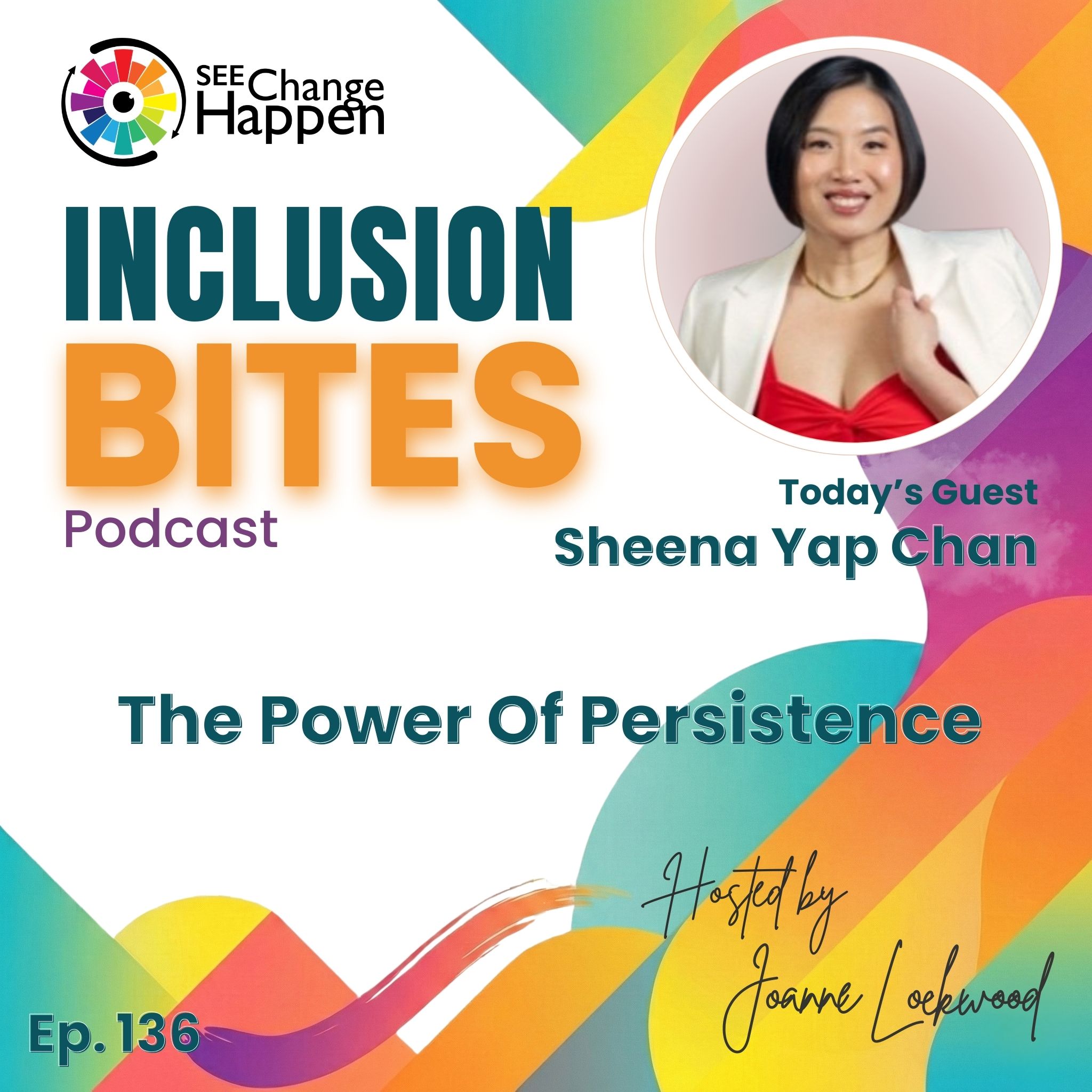
Sheena Yap Chan explores the essential role of persistence in achieving success, delves into the impact of social media on self-perception, and highlights the necessity of embracing authenticity and addressing personal and ancestral traumas.
In this episode of Inclusion Bites, Joanne Lockwood speaks with Sheena Yap Chan about careers growth confidence.
“If I wanted representation, it had to start with me.”
Explore
Navigate this episode
Joanne Lockwoodhost
Welcome to Inclusion Bites, yoursanctuary for bold conversations that spark change. I'm JoanneLockwood, your guide on this journey of exploration into theheart of inclusion, belonging, and societaltransformation. Ever wondered what it truly takes to create aworld where everyone not only belongs, but thrives,you're not alone. Join me as we uncover theunseen, challenge the status quo, and sharestories that resonate deep within. Ready to divein? Whether you're sipping your morning coffee or winding downafter a long day, let's connect, reflect, andinspire action together. Don't forget, youcan be part of the conversation too. Reach out to jo.lockwoodatcchangehappen.co.uk to share yourinsights or to join me on the show. Soadjust your earbuds and settle in. It's time toignite the spark of inclusion with Inclusion Bites.
Sheena Yap Changuest
And today is episode 136 withthe title, The Power of Persistence. AndI have the absolute honor and privilege to welcome Sheena YapChan. Sheena is a keynote speaker and WallStreet Journal best selling author on leadership and confidence.When I asked Sheena to describe her superpower, she said, her superpoweris being persistent in her mission. That hashelped her push through so many challenges in her life. Hello,Sheena. Welcome to the show. Hello, Joan. Thank you so much for havingme here. Hope you're having a fantastic day. I am.And, from what we're saying just now, you're inon the East Coast of Canada, just north of, of New York.Lovely part of the world. Dusheana, tell me more. The power of
Sheena Yap Changuest
persistence. Yeah. I mean, I think a lot ofpeople don't realize, you know, in order to make things happen, you know,nothing happens overnight. Even though we see people who haveso called overnight success, They don't realize behind the storythey've been putting in the work day in and day out. You know, sometimes itcould take years before they can see, you know, the light at the end ofthe tunnel. And when it comes to forging your own path, you know, we're gonnago through obstacles. We're gonna go through challenges and roadblocks, but it's howwe move forward that matters the most. Right? Imean, I think the pandemic has been a great example ofus persevering through one of the wildest timesin in history, you know, being stuck at home, not knowing what was gonnahappen, not knowing if we're gonna see the light ofday, but we persisted. Right? We made it we made things work. We learned howto pivot, you know, at every given moment during thepandemic, and so it's just always moving forward.Right? And I think that power of persistence really came from my greatgrandfather when he started his business, and one of hisvalues is persistence. Right? You don't give up. We get better.We learn from our mistakes because we're always gonna make mistakes in ourjourney, and it's not a bad thing becausesometimes our mistakes can be our greatest opportunities. I knowit's weird to say that because when you go to school, when you makea mistake, you get punished for it. Right? Not realizing in thereal world, sometimes those mistakes is how we can solve problems,create new businesses, create new opportunities for other peoplearound the world. So for me, yeah, I just realizedit's like sometimes life is tough, andit's okay to feel our feelings. But we also have to learn to pick
Sheena Yap Changuest
ourselves back up and keep moving forward if what we're doing is something thatwe're super passionate about, if it's in alignment with ourvalues. Right? Of course, it's I think it's okay to quit things that doesn'talign with you because we grow. We evolve ashuman beings. And so that's why we always have to look back andask the right questions and say, is this the the path I'm supposed tobe in, or is this the the purpose I'm supposed to be? If not, whatis it? And so and we we will know because as humanbeings, you know, intuition is huge. And so,you know, it'll lead us to that moment even if it doesn't looklike it. So, yeah, to me, persistence is just, you know, movingforward, always moving forward. Like, if you see people in the media, people ofinfluence, celebrities, you know, they've all had topersist their way through to get to where they are. Right? Iremember Lizzo talking about how she got started. Imean, she she performed at so many places,sometimes with for no money, sometimes for just beer, but she realizedshe had to put in the work day in and day out to get towhere she is today. And I think it's really refreshing to hear that, especially inthe world of social media where everything seems to be perfectly curated,not knowing the struggles people had to go through. And so ifpeople just, I guess, are more transparent and vulnerableabout the things that they do, it just makes it real more relatable and realizewe're all not alone. We're in this together. We go through similar things, and it'sjust part of the journey. So that's a little bit about thepower of persistence. Yeah. I think you touched on a few things there which whichreally resonated with me. The, that we talked about influencers,social media, and social media,most of it, I'm not saying it's a lie, but it's overinflating someone's sense of self and andtheir ego, whatever it may be, because you, when you're trying to create a personalbrand, you're trying to sell the best of you on you or the or theyour potential to get people to be attracted to you, whatever it may be.As you say, if you're just starting out or you you lack a bit ofconfidence, seeing everybody with their stuff together,it can be quite daunting, can't it? Oh, yeah. And II and, you know, it's it's so easy to compare ourselves to other people withperfectly curated photos, but I've also seen a lot of peopleon on social media who've learned to be vulnerable, who've learned to sharetheir mess to the world. And it's actuallyrefreshing to see that because more people are inclined to listening to them versus thepeople with the perfectly curated photos because to them, it doesn'tmakes it's not real life to them. Right? They can't relate to that. Butif they see somebody sharing, you know, I got rejected 20 times today,it's like, oh, okay. So she's not the only one who gets rejected?This is great knowing that even though she's successful, she still goes through these things.She goes through imposter syndrome, self doubt, anxiety,you know, mom guilt, mom shame. Being able to sharethose, it's just it's just really refreshing versus, like,here's my perfect vacation in this perfect island with my perfectyou know, it's it's just unattainable. And, you know, when wekeep showing up in those, like, surface level photos,you know, that's when we start having, you know, mental health issues, feeling we'renot good enough, feeling like we need to keep up with everybody, keep upwith the Joneses. I mean, there's so many stories where you hear,like, people of influence or influencers who've, youknow, spent way beyond their means and then are really bankrupt even thoughthey're still showcasing that they're living this so called life versusjust learning to live within or beyond their means.Right? Because not everyone can do that. Like, it doesn'tit's it's not realistic, unfortunately. And we've I've seenit time and time again. You know, I I've seen so many stories and hearso many stories. In fact, I was on Facebook,and I saw a post about Keke Palmer, and shementions that she lives beyond her means, like, low way below her means, Imean. Like, she only she still drives a Toyota. Right? And she's she's aphenomenal actress, very, very successful. She started her careerat 8. But because she started her career at 8 and wentbankrupt at 18, she realized that she had to dothings differently. Right? So instead of, you know,trying to live lavishly, she lives beyond below her means. She focuses on hermany businesses and her careers. And, of course, now that she has a child, shealso focuses on her child. So it's really nice to see thatversus, like, seeing everybody in private jets and andfancy cars, not realizing that might not even be theirs. It could be rentedor, you know, it could be taken away becausepeople are just trying to showcase this, like, perfect lifeor trying to keep up with the Joneses, and it gets exhausting. So Yeah. I'm
Sheena Yap Changuest
just as you're talking now, I'm thinking, you know, we're we're recording this at theend of October in 2024, and, there wasa, well, famous singer in the UK, Liam Payne, former OneDirection member, who jumped off a balcony or what, I'mnot sure the exact circumstances are known, but he obviously liveda very troubled life despite the appearance of having everything,super connected, influential people, you look at all the people paying tributes whocome out and say there is is a great friend, clearly a battle withalcoholism and drugs and other and other things that was going on in hislife. And then we look at people like Robin Williams, you know, youthink that that he had his stuff together, Gregarious,outgoing actor, had had it all there, under the covers mentalhealth, Heath Ledger. So we we look at these people andtheir on screen persona or their stage persona, and that oftenmasks the true pain that people have, but we're aspiring to theon screen persona, not understanding, you know, thosethat frantic paddling under the water that's going on, trying to hold their life togetherthat people go through. Yeah. I mean, it we never know,right, until, unfortunately, things like these happen and, you know,mental health can look different for everybody. Just because someone's smiling on a photo doesn'tmean they're they're happy. And then I'm I'm not saying everyone's like that. Of course,there's people out there who are genuinely happy, but we alsohave to realize there's people out there who may seem like they're happy, but, really,they're dying on the inside, and they have no outlet to turn to.Right? And, you know, trauma is huge. Right? Trauma is somethingthat we never talk about, but it's needed to talk about. You know? Everytime someone asks me, well, how do I build confidence? And I'm like,well, before we ask that question, what is really stopping you frombuilding confidence? Like, is there a moment in your life where you weretraumatized that really stopped you from moving forward? You know, it's really important toget to the root cause of why you're feeling the way you'refeeling. It could be childhood trauma. It could be PTSD.It could not even just be your own trauma. It could be the trauma ofyour parents, grandparents because intergenerational trauma is very prevalent. Andthen we also have culture and gender. So, you know, there's so many differentfactors that we have to learn to to work through that root cause firstbefore we can even think of, well, how can I build confidence? Because Ican show you a million ways to build confidence, but, you know, if you're notthere, if you're still working through a lot of trauma,it's not it's not gonna be beneficial. You know, I'd rather youfigure out what that root cause is. And if you're not aware, start asking theright questions, start talking to the right people, you know, startresearching. Because, of course, as humans, we can alwayssense something is wrong. Right? We can feeldifferent things or see different signs from the universe, andthen then we start to question things. Right? And then when we start to questionthings, we get curious and start trying to find the answers. Andso, you know, mental health is really important. You know, it'staboo in most cultures, especially in my culture. It's something thatwe never talk about because it's considered not real. If we talkabout it, you know, we're deemed as crazy. Right? Eventhough it's just part of maintaining your mental well-being.
Sheena Yap Changuest
If we don't talk about it, it it it's seen as we've neverit never existed. But, of course, it existed. It happened. And for solong, like, we've done the same thing over and over again, just transferring thetrauma to the next generation, to the next generation, to the next generationwithout someone breaking that cycle, without someone saying, wait a second.You know? Why is it we're constantly feeling the same feelingsor similar feelings in every generation? Maybe we need to dig alittle bit deeper and find a, you know, a way to heal from it sothat we don't pass it on to the next generation. Andit's it's unfortunate that we'd had to go through all this, but at thesame time, you know, we're aware of it now so that we can tell others,like, listen. You're not the only one who's going through mental health issues. You're notthe only one who's going through pain and trauma. A lot of people areand aren't too sure what to do with it or not too surewhat they can do to heal from it. Right? And everyonehas different stories, different differentexperiences. So everyone's gonna find different ways to heal from it,of course. Right? Like, what may work for me might not work for you andvice versa because we're 2 totally different people. And so it'simportant to learn to find ways that would help youversus trying to follow everybody else. Especiallyin Asian color culture, we've always been toldto live one way of life, never rock the boat because that's alwaysbeen the formula for success for centuries. And so justimagine how much trauma has been transferredand how much we have to unlearn to create a new normal tomake, you know, our lives better and our next generation better.So it's a whole cycle, unfortunately. So youmentioned specifically around your culture. Do you wannajust explain a bit background about how you thinkmaybe define what your culture is and how how that has the impact onon people's well-being and mental health? Yeah. I grew up inin Asian in a very conservative Asian culture. You know, I wasChinese and Filipino culture and, you know, especially as women, we've beentold different things, you know, especially, like, you have to go to school,get a job, never get married, never I mean, go to school, get a job,get married, never rock the boat, you know, never put yourself out there,you know, just keep yourself in the background, never make any noise. Andbecause of that, we have so much repressed feelings. We feel like we're not allowedto share what we feel. We're not allowed to share anyissues that we're going through. We're just told to just keep it toourselves, and that really hurts us because that's when we start having confidenceissues, mental health issues. And if we don't have an outlet to letit out, it's gonna it's gonna kill, like, kill us on theinside, unfortunately. And I've seen that time and time again with, youknow, people who are older than me, the oldergeneration. You know, you see this, like, Iguess, this look of, like, you know, they're they're something'stroubling them, but they're they'll never share anything because this they'vebeen taught to just never share anything, to just leteverything just take everything in, don't let anything out.And then in Asian culture, especially for women, we've been told to be theperfect daughter, the wife, the mother, the sister, etcetera. Like,we always had to be perfect. And for me, perfection doesn'texist because we're all human. We're gonna make mistakes. There's no such thing.But, yeah, we're always trying to chase thisunattainable thing that doesn't make sense, and then we go throughso much to be this perfect person when there'swhen when it's not even real. So just alot of, like, cultural traditions andways of living that really stops us from moving forward. And becauseof that, we go through so many issues. I mean, one of the things wego through too is the negative stereotypes. You know? Asian women are alwaysseen as quiet, submissive, and obedient, and, youknow, most people think that's a good thing. It's not. Right?Because then, you know, we're prone to so many things. We're getting takenadvantage of, and there's sexual violence and child marriages andhuman trafficking. And this is hard stuff that peopledon't talk about but still exist today, unfortunately. And soit's important for me to show up to be to be able tospeak up, to put myself out there, and I don't I it's not like Ilike doing it. You know, of course, it's uncomfortable still, but I realize it'snot just about me. It's so many other women who feel like theyhave no voice, they've been silenced, they feel invisible. And so ifI wanted representation, it had to start with me. And all thisreally stemmed from growing up in Toronto in the midnight inthe in the in the early nineties, not seeing anybody in the media that lookedlike me because that really hurt my own confidence. I feltlike I needed to look a certain way. I need to have a certain skincolor, certain hair color, certain eye color just to feelbeautiful. I was embarrassed of my own culture, and it wasn'tuntil my twenties when I finally embraced it. And so
Sheena Yap Changuest
growing up in Toronto, Canada in the early nineties, you know, I neversaw anybody in the media that looked like me. And I think my the workthat I did really started from there because I was so always ashamed of myown culture. I wanted to look a certain way to feelaccepted, to feel beautiful, and it wasn't until my twenties when Ifinally embraced being Asian, being beingproud of who I was, my culture. But it wasn't until 2015when I realized that I really wanted to create a platform to highlight more Asianwomen to dismantle the negative stereotypes. Because time and time again,that's all I've seen. And you think in 2015, there'd be morerepresentation, but there wasn't. And so in order for me to create it,I had to be the one to do it. Even if I had no cluewhat I was doing or where to even start, I said, I'llfind a way. So in September 2015, that's when I actuallystarted my own podcast called The Tao of Self Confidence, where I'veinterviewed over 800 women on the topic of confidence, mostly Asian women.And, you know, I I didn't even know what a podcast was when I firststarted. Like, I had no idea. I just saw it on Itunes at the time,but back then it was on Itunes. There was hardly anyAsian people podcasting at the time either, so I was like, I don't even knowif this was the right thing. Right? But sometimes if you're one of thefirst people to do it, it's it's a good thing. Right? Because then you're theone starting it, starting this, like, wave of other peopledoing it. So, you know, I still have the the the podcasttill this day being able to interview so many amazing women. And because I'vebeen able to interview so many women, it'shelped me with my own confidence issues, realize that, you know, learning tolove myself, fully love myself, good, bad, and the ugly. And that's wherepersistence comes in because, you know, it's almost 10 years, and, like, noteverybody has that that that drive tokeep going, especially sometimes when even when I first started, I didn't even know whereI was going. I just knew I needed to have a platform. I just keptgoing, and it's led me to so many other things. You know? I've written abook on on trauma and and how that affects us andhow we can move beyond that. You know, I I speak formany different companies, be able to, you know,be seen as a leader even though sometimes I don't feel likeit. But, I mean, if I stopped atthe 1st year or even the 5th year, I wouldn't even be heretoday. And so I realized persistencewas my power because without it, I wouldn't be here today. Youknow, I wouldn't be here talking to you, being able towrite a book, not just for not just any book, but a book forWiley, which is one of the top five publishers in the world. Never thoughtthat could ever happen to me. Not because I didn't believe in myself. It's justbecause, you know, how many Asian authors are out there, right, that are getting signedunder big publisher names? Now there's been more, which is which Ilove, and it had to start somewhere. So, youknow, if people think there's, like, this secret sauce tosuccess, but, really, the the only thing that I think is reallyimportant is you just have to be persistent in what you want.Right? Even if you can't explain how you're gonna get there, you'll find away. Because most people who are successful have noclue what they're doing, and I think it's okay to say that. Like,even some of the biggest names you see are just figuring it outas they go. And I think if we're more honest on that, it'll
Sheena Yap Changuest
be a little bit more helpful because, especially as women, we're alwaystold to, like, prepare everything before we start, but then we keeppreparing to the point that we forget to start, and we're just preparing and preparing,delaying our own success, not realizing you can go out there and makemistakes, course correct, and you'll get a result. Andso I I had to go through many mistakes,figure things out, but I always knew that no matter what happens, nomatter how bad the situation can be or no matter ifI'm going through my own dark moments, I can pushthrough. I can keep moving forward and and rise to thetop. So that's why for me persistence is so important becauseanything I ever did or anything I ever got, it was through my persistencythat led me through here. You know, you don't you know, people think you haveto be the smartest. You have to know everything. Actually, you don'tbecause I don't know everything. Like, I I never thought I'd write a book. Ihad to take English classes coming to Canada because I couldn't put sentences together.You know, I wrote my book, the the the child of self confidence at theage of 40, and that's when most people thinkas women being 40 is, like, being expired, but it's not.Right? It's never too late to go out there and do what you want. Youcan start at any given given moment if you believe in yourself. And I knowthat sounds cheesy, but it really does take that belief in yourself to go outthere and make things happen and knowing that you are capable no matter whatthe circumstances is because there's gonna be crazy moments in ourlife. And if we learn to practice orhave the tools and resources to keep moving forward to build that persistence, webecome invincible. So I know I went a little bit on a tangent there,but I think it's really important to just share those things.So when you're working with people, you mentioned a bit earlier about some ofthis is down to limiting beliefs or imposter syndromeor cultural stereotypes being reinforced within your own community.And sometimes you said it takes a lot to stop and change. So howhow do you encourage people to to stop and to create thechange? I mean, I think it's also like learning to ask the rightquestions. Right? I remember talking to a ladywho was afraid of going to parties. Like, she wasalways afraid to be in a group setting. AndI asked her why, and at first, she was blocking me. Like, she did notwanna tell me. And I'm like, I can't help you if you can't helpyourself. Right? Like, I can't help you if you're not gonna tell mewhy this is happening. So, you know,I let her have her space a little bit, and shefinally opened up. She said the reason why she feels this
Sheena Yap Changuest
way and and the reason why we had this was because she was invited toa party, and she was having a panic attack because she didn't wanna get ignoredat the party. And so she said about10 years ago, she went to a concert with a group of people.And for some reason, the that group of people left her alone. So she wasalone at that concert, and she had to, I guess, find her way home byherself. And because of that, that's really traumatized her tobe in group settings because she was always afraid if she went to a groupsetting, someone's gonna leave her, and then she's gonna be all aloneagain. And so I had to tell her, like, you have to look at thingsfrom a different perspective. Right? What happened 10 years ago is not gonna happen now.Plus the person who is throwing the party invited you,and it's not the same group of people. It's a different group of people. Right?A lot of us, we tend to hold on to the past. I'm the sameway. You know, I'm human. You know, sometimes we think what happened 10 years agois gonna happen now, but we have to see things from a different perspective.Right? And, also, our brain is protecting us in the process. Becausewe go through so many bad things, our brain is unconsciouslyprotecting us from that bad thing happening again. So sometimes we also haveto talk to ourselves and realize, you know, again, what happened 10 years ago isnot gonna happen now. And so because she was able to seethat, you know, it helped her realize, like, okay. You're right. This is a newsetting. She invited me. I didn't invite myself, andthese are a new set of people. They're not the same people who's gonna leaveher or abandon her. So those are some ofthe things. One of the things I also talk about is learningto have confidence strengthening. Right? Because we're all bornwith confidence. You know, when you're a baby, you can walk, you cantalk. Even if you fall down, you put yourself back up.As kids, we just have no fear in anything. Right? We'll we're bouncing off thecouches. We fall off. We get up. We cry a little bit. Wewe move forward. Right? But as we grow up, we havesociety, cultural differences that tellsus no or tells us you can't do this. You can't dothat. And so then we start to get a little bit more cautiousand then to the point where we're too afraid to do anything. And so sometimeswe just need to build that muscle back to be more confidentto go out there and do those things. So, you know, that's somethingthat I realized actually recently. Right? Because, Imean, you were born with confidence. I was born with confidence, but then it justgot lost in the way as we grow up, and we just need to getit back. It's kinda like working out. Right? I mean, you know,we may gain a couple pounds. If we wanna lose it, we go back tothe gym. We eat properly to lose that weight, and then we feel goodagain. So yeah.Yeah. I mean, as as as for growing out, you mentioned that we welearn by making mistakes. Yeah. And I I guess it's howthat mistake is treated. If you have positiveencouragement and nurturing as a result of that to to grow anddevelop, you'll grow in confidence. If that mistake isalways negative, it's treated badly or you're you're criticized for it, you're gonnabe fearful of making mistakes. And if you're fearful of making mistakes, you'refearful of growing, you're fearful of changing, you will stay in your comfort zone allthe time. So it it really does come from earlychildhood trauma effectively, that that fear of making a mistake, isn't it?
Sheena Yap Changuest
Oh, yeah. I mean, I failed kindergarten in the Philippinesfor coloring outside the lines of a photo. So,I mean, that traumatized me until my adult life. Right?I thought everything I would touch would be an instant failurebecause I that was my first major failure at the tender age of5, and I had to, like, redo kindergarten and move to another school allover again because I couldn't color within the lines of one photo.And if I had the personal development work that I I havenow, I can interpret that as I wasn't afailure. I was just meant to color outside the lines. I wasjust meant to live life a different way versus whateveryone is supposed to live, especially in my culture. Soand I guess everything had to happen the way it happened so we can sharethese moments and share these these these learnings sothat other people can maybe start seeing in their own childhood or their ownlife what's stopping them from moving forward. Right? What do they see that'snegative that's actually a positive? So, Imean, it and you don't have to do this alone. Right? That's anotherthing. Like, when it comes to your mental health, yourconfidence journey, like, it's okay to ask forhelp, to ask for a second opinion, to have a second pair of eyes becausewe also have a lot of blind spots. So trying to figure it out ourselvesis actually gonna delay us, and being able to seek help or receivehelp can help us. Right? Like, maybe being taught be like,when it comes to mental health health, like, it's there's no shame in seekinga mental health professional, right, if that's gonna helpyou. Everyone's different. Maybe reading books will help. Maybe joining acommunity, a women's group, listening to podcasts like these. You know,there's so many different ways to do it. I think it's just important to pickand choose what would work for you because, like I said, we're all different. We'renot all gonna learn the same way. We're gonna we're we'll have similarsimilar ways, but, of course, each and every one of us will have somethingdifferent. Even though there's, like, over, what, 8,000,000,000 people in this world, we'reall different and unique. Yeah. We
Sheena Yap Changuest
are for sure. And would it be such a boring place if we were thesame or even similar? It's So we need that, thatuniqueness that each of us bring to the party, I guess. II I suffered, I suppose, in my childhood, that thefear of making mistakes or being over correctedor not allowed to express myself or, and then the same way you talked aboutcolouring outside the lines. I was alwaystold by my father actually that if I was writing a letteror writing, you know back in those days we used to use pens and paperdidn't we? And, I was never allowed to write something in ink to startwith. I had to write it in pencil, but then when I got it right,I was then allowed to ink over the pencil then rub out the pencil afterwards.So if I was writing a a thank you letter at Christmas or a aletter to a friend or something like that, I always had to write it outand my father would read it first and correct it, and I'd weended up in crying in tears, and I'd finally be able to ink it in.And I still remember that trauma now of of of never been good enough.Whatever I was doing had to be inspected andpassing someone else's test before I was allowed to expressmyself. So I think I did a couple of creative exercises, which theteacher apparently loved. She told me that it was she loved it. I brought ithome to just do a bit of tidying up, and my dad got hold ofit and said, you can't write that. That doesn't make any sense. It's a littlerubbish. And I had to rewrite it all very clinically, andI ended up not submitting in the end. And the teacher said, what happened tothat? I said, oh, I lost it. And, because it, I've been so reinforcedinto this behaviour that wasn't me.And I could, I could see where all my limiting beliefs and, myperfectionism, if you like, and and the recrastinations come from,because of these sort of ways that I was always bought out by my father.And, yeah, he's taught me procrastination and perfectionism,which has has been a a hindrance sometimes. Yeah. I think I think we've allgone through that. Right? You know, showing up a certain way,being being only acting one way, or elsewe're not accepted. And it and because of that, we feel like we always needpermission from somebody to make moves, take action.And so that's why, for me, I'm always like, Ineed to put myself out there so that other women can see, like, you don'tneed permission. You can just go ahead and do it, especially when it comes toself promotion. I mean, a lot of people think it's tacky.It's no good. But for me, it's empowering because it helps you build yourconfidence. You know, if you have products and services that can help somebody,why why wouldn't you be your biggest advocate? Right? And and itbuilds also being becoming a leader. Right? Becauseit shows you many different skills. And it's not easy. It'suncomfortable. It's still very uncomfortable for me, but I realize, again,it's not just about me. There's so many other women out there who feel likethey don't have a voice. There's no one that looks like them making moves,and so I have to show up to show others what's possible. And then itgoes beyond my culture. Right? It goes to other other cultures, othergroups, and and because even though wemay come from different cultures, we still go through similar things. And,you know, we just I I I just feel like we need more good inthis world. It's just such a chaotic time right now. Butone of the one of the problems I've I've I've found recently is that aswomen, we're not very good at amplifying other women. Wewe've almost reinforced the limiting beliefs or we'retrying to put other women down. And we'd we're our worst enemysometimes, not promoting ourselves or each other or beating each other up. We canbe very critical, hypercritical, more than more men often than men aresometimes. Yeah. I I you know, I've witnessed that. Youknow, sometimes part of the reason why women don't move forward is becausewe're the problem. Right? And, you know, instead of tearing eachother down, we should be lifting each other up. And I I get it. Youknow, it's years of, like, programming thinking that there's onlyone spot at the top, not relying there's not realizing there's so manyspots, or we can create our own table or our own platforms,and it takes a huge mind shift to to gets get awayfrom. You know, there's a lot of work to do, of course, but it hasto start with us putting ourselves out there, showing others wecan make a change. Because if, collectively, we work together,that's how we can overcome so many big problems that we encounter still.So we know this. Everything you're saying, we know. It's it's in your book. It'sin other people's book. It's, we talk about it at conferences. We havewomen in parent sessions. We we have leadership coachesaiming at women. We everything you're talk we're talking about here now, we know.So so why aren't we making a huge difference in a huge changeor the change we want to make? I think there's still a lotof, I guess this is just what Ithink, so it's not the absolute truth.I think there's still a lot of mindset shifts we haveto work on. You know, everything starts with how we perceive things.And when we can learn to shift how we think, that's whenwe can start creating the change. You know, like I mentioned, there's still a lotof people in the scarcity mindset, andwe have to unlearn a lot of things too at the process. Right? When you'vebeen taught the same thing for generations, for years,it might take some time to to fix that.Right? Fix the way we see things, fix the way we think. I mean,when it you know, when you look at reports, they say, like, girls starthaving confidence issues as young as 6 years old. Right?Versus boys, they they don't, you know, they start buildingconfidence at 8. So it's a big difference. And sothat's that's why we have to keep showing up, keep showing others what's possible,be able to encourage others even when times are tough.There's no easy fix, of course. But if we just takeit one step at a time, just imagine what we can achieve. Are men doingenough to help? There are men
Sheena Yap Changuest
out there who are great allies, and at the same time, there are men whoaren't doing great things. Right? I mean, there's gaps for areason. Right? Leadership gaps, gaps in different industries.I mean, you look at the VC the VC world, like,only 2% of women get funding. And when they do get funding, it's only,like, $1,000,000 versus, like, you look at the guywho owned WeWork. He got he made it bankrupt, openeda new company, and got, like, $300,000,000 funding just becauseyou know, even though his track record isn't great, meanwhile, womenover you know, are very smart or very capable, have prepared such anamazing presentation, and yetthey'd be lucky if they get 7 figure funding. Right? And it'stough. And sometimes I don't even know what the answer isto break through that unless we just keep moving forward andjust be persistent to show them, like, you need to pay us. Right?Pay us for what we're worth. And it's always a constant battle.Right? Because it's like, you know, if if we goout there and ask for more, now we're seen as aggressive or too much. Meanwhile,guys ask, and it's like they're confident. But if we don'task, then it's also our fault. There's always, like, this double standard that we haveto live by, and it's exhausting. That's why it's important todismantle these these notions, you know, especially for women. We need to havemore positive positive, I guess, wordsor labels, you know, instead of being aggressive. Like, why aren't we confident?
Sheena Yap Changuest
We're doing the same thing. Why are we still labeled as aggressive versus being confident?I mean, we can definitely go through a whole conversation on this because there'sjust so many layers and and and things that westill go through, and it's tough. I mean, I'm rightI I wrote all about that in my next book that's coming next yearbecause I think it's important to be aware of all these things that we're stillgoing through and then finding a way to solve it. Like Imentioned, it's not gonna happen overnight, but if we don't doanything, you know, the World Economic Forum mentioned it's gonna takea 130 years for gender parity to be achieved, at least.But I feel like at the rate we're going, it's gonna take longer. You know,when you hear women in Afghanistan not being able to havea voice, not being be being able to speak in public, show their facesin public, not not being able to sing in theirown home. Like, I think that is ridiculous,and some people might think, well, that doesn't affect me. But for me, itdoes. As a woman, like, it does affect you because if one country can doit, imagine how many more countries can do it in the year of2024 when we think women's rights have, you know,moved way forward when it feels like we took one step forward and 5 stepsback. So I guess this is why I'm so passionate,and I keep persisting even when at times I question myself, youknow, especially when you're doing something for the greater good. I thinksometimes in our journeys, we question, like, is this the right path? Am I doingthe right thing? Is this making sense? And whenwe get a sign from the universe or, you know, whensomeone comes up to us and tells us how much has helped them, then Irealize, yeah, I know where I'm going. So we definitely have a lot ofwork to do. It it always frustrates me when we you youmentioned the World Economic Forum Statistics under the34 years, gender parity, gender equity, and the and the that'sgenerally in the western world. If you look at the the whole world, it ittouches near 200 years, and that's clearly not a great place to be.This, women succeed when they'remore like men, is the frustration, isn't it? There's this myththat you can't, you have to sacrifice something in your life, you know, youhave to either sacrifice some of your maternal instinct, yournurturing instinct to you. You have to be the one that's going to work late,travel the world, stand up in meetings, beloud, be boisterous, be one of the lads in order to succeed.It's really hard to be a woman being a woman, isn't it?It definitely is. I mean, it's definitely not easy. There'sstill so many double standards. You know, if we don't speakup, then it's our fault. If we speak up, we're too much.You know, like, the backlash women get just forspeaking up is horrendous. I mean, I've been through it, and it's notfun, and I had to learn to work through that too. I mean, yes, it'seasy to say just ignore it, but, like, as a human being, youknow, it's gonna get to you sometimes. Right? Andwe have to learn to work through it or find outlets to let it outor talk to somebody who's been through something similar so that werealize, like, once that happens again, we can learn to move forwardand be like, okay. That's just someone's opinion. Right? That's just probablysomebody who's just brave behind a computer,but, you know, in the like, if they were in that same position, they probablywouldn't be able to go through it. And sometimes the people attackingyou might be projecting what they're feeling. And it'sit sucks that it happens to us, but at the same time,things happen for a reason. It could be a blessing or a lesson.And those lessons, we can also share with the audience. Right?Knowing that I've been through it. You're not the only one going throughit. Yeah. It sucks. And, you know, what I get isnothing compared to some of the other women that I've seen, just thebacklash they get. It's it's it's terrible. Andsometimes I'm just I just pray that they're okayand that they can get through it because sometimes it's all we needwe can do at that point. Right? So We see
Sheena Yap Changuest
many women in their forties and fiftiesfinally finding their voice. So they they've had their theirfamily. They've had their time to be them, if you like,their maternal instincts. And then when they come back in their 40s50s, they're finding that new empowerment.And we see a lot of rising, there's certainly female entrepreneurs in their50s now, where they, they've, they've had what they needed to do, butthey're still 10 years behind their male counterparts at that point now, becausebecause they have had a career break, because that's what that's what mattered to themat the time. They they didn't wanna sacrifice what mattered to them,whereas men can still a man with a good boy a womannext to him can always get away with, if you like, outsourcing thefamily responsibility to the mother and or the theother parent, if you like, however you wanna describe the relationship. Soit's it's how are we ever gonna solve that problem? Oh my gosh.I don't even know, to be honest. Like, I you know,I mean, I don't always have all the answers. Right? Especially, like, I'm I don'thave kids. I'm not a mother. It's it's it'sI mean, it I guess it's something that we have to figure out one stepat a time, whatever that may look like. And I know it's noteasy because if it was easy, everyone would be working on this.Right? I mean, it's and I think it's okay sometimes to sayyou don't even know what that answer might be even though I talk aboutconfidence all the time. I think we're also afraid ofhaving the wrong answer. We're also afraid of saying I don't know. But at thesame time, I think it's refreshing to say that because sometimes I don't know. Idon't really know what to say at times. Right? And Iremember not being afraid to say I don't know. I would have, like, major anxietyattacks thinking I had to know everything before putting this before, like,showing people that, you know, I'm capable. Like, I may not know the answernow, but as we keep focusing on this issue, we can find ananswer later. So I hope that kinda helps.
Sheena Yap Changuest
Yeah. I mean, I I look at when I was starting a familyback in the mid nineties. We were early nineties, we started our family,and it's a different world, you know. Now we look at propertyprices, rental prices, economic climate.Most families now need 2 incomes in order to pay therent, pay the mortgage. It's a real pressure nowfor, for women, because they're the ones that are looking topause their career to have children, or choose, we're not going to havechildren because we can't afford it, so women are being asked to compromise their, theirsense of self, you know I said earlier about you've got to focus on what'simportant to you and not be led by societal'sexpectations. So if you have an expectation, you want to have a career,fine. But many women still want to have a family, and many men want afamily as well, and it's, it's unfair that we have to choose,and it's it's unfair that women are the ones that have to do the sacrifice,because the structures aren't in place with shared paternity leave,there's still stigma about men becoming primary carers forchildren, they're seen as weak. Again, these stereotypes reinforcethere, so almost like we've got to give permission for men to befull time parents first, to allow that, that roleto be valued in society. Yeah. Yeah.Right. We know the answer. We're gonna solve that one first. Yeah. You're right. It'sa it's a it's a it's there's so many chicken andeggs here, isn't there? There's so many, gotta fix that, gotta fix that, gotta fixthe other. Yeah. But, so all of this playsinto the the lack of confidence, the, the lack of persistence, the lackof resilience, the the people you work with are finding that,some of it's cultural around your, your own personal culturebut also it's the culture of being a woman and societal constructsand the expectations of being a woman. And that's doubly reinforcing, notjust for Asian women, also other women, yeah. Yeah.You play into the self perpetuating cycleof of of of oppression, for one of the better way of describing it.Yeah. Yeah. I mean, I realized, you know, justafter realizing, like, talking to so many other women, you know, we go throughsimilar things. We may look different. We may come from different cultures, but we stillgo through so many similar things. Like, mental health is still a taboo.Right? Not feeling good enough. Feeling like we have to be a certain skin colorto be beautiful. Like, if you look at skin whitening creams, it's like amultibillion dollar industry. So that's a worldwide thing,not realizing everyone's beautiful in the skin they're in no matter what shade that is.And so it's unfortunate that they're profitingoff of women's insecurities because, I guess,I think everyone's beautiful in their own skin, and we have to learn tojust show up that way even if it's scary. Right? Even ifwe wake up with a pimple on our nose, you know, it's still us.So it's, yeah, it's it'sit's yeah. There's a lot of stuff, I guess, we have to work on.It is. That expectation, as you say, for for beauty, and, I'm very consciousabout the fact that when I walk out the front door, I want to lookat myself in the mirror and go, yeah, I've made an effort today. If I,if I go out without make up, wearing just jeans and thetop, I sometimes think, I look at myself and think, I'm just feeling reallylazy today, I just want to go, I just want to sneak out and thenyou come back and you think, wish I put a bit of color on orwish I put a bit of this on or and it it's there is thatpressure you feel. In my past life, I never used to have that experience. Iwould just show up as I as I showed up and not even give ita thought. But there is an expectation to show up as the best you allthe time. Yeah. I mean, I think it's that need for perfection. Right? Being thatperfect person and then, you know, you look at fashion magazines,like, all you see is perfectly curated edited photos ofmodels, not realizing, like, they do so much editing that you can'tdo that in real life. Like, you can't just shave off part of your waist,part of your leg to make it look beautiful. You know, a lot ofwomen and even men go through body dysmorphia because ofthat. And even in the pandemic, people are going through Zoomdysmorphia, right, because they didn't like how they look on Zoom, and so they wentto get surgery so that they could look better on Zoom. And that andit might sound ridiculous, but it it did like, that was a thing.Right? And so this is why I think it's important sometimes to just show upas your imperfect self. Be okay that, yes, you may haveblemishes on your face. You may have scars on your bodyfrom falling down when you were biking or whatever that may be becausethat's who you are. And, you know, that tells you the story of whatyou went through, how much resilience you had, persistence to be where youare today. Yeah. You're too short. Your bum's too big. Your bum's toosmall. You've got no waste. You've got too much waste. Whatever it may be,That those are all messages, as you say, we're reinforcing the beauty industry.I have my nails painted yesterday, and that's once youget on that conveyor belt, you have to go back every 3 or 4 weeksbecause they grow, you have to take it off, put it back on again, yourhair, you get into this cycle of suit, you leave the salon, they book youin your next appointment. So the on cost of being a woman, just justto show up in the world is, but just face cream, makeup,beauty, hair, nails, 15 differentpairs of shoes depending on what the weather is, different outfits depending on what theweather is. You can't wear the same thing twice or everyone says, hang on, youwore that yesterday, didn't you? So you've got all this pressure, whereas menjust turn up in the same suit, they just maybe change their shirt every dayand put a different tie on, But, fundamentally, there's there's less expectations.People aren't judging men in the same way. Yeah. Totally. I mean,especially when it comes to parties. Right? Like, you can't wear the same dress twice.People will notice. You know? Men can wear the same suit over and overand over again and never get judged. Like, these just little simple things likethis. If you go to a posh night owl, you wear a
Sheena Yap Changuest
tux as a man, don't you? And, and it's a ablack black dinner jacket with a a a whitewing collar and a bow tie. Yeah. That that you can wearthat every single time you go out. That's what's expected of you for as yousay, as a woman, we have to go shop for the new dress, have ourhair done, have our nails done, probably a pedicure, probably a massage, afacial as well just to make sure we glow and we're radiant. But since wewalk into the room, we're then we're then comparing ourselves to every other woman inthe room, aren't we? We're then judging, you know, going back to what you're sayingearlier about being our own worst critic. We're now puttingourselves down and competing with every other woman in the room tobe the most attractive or the most, yeah, the most standoutperson, and again, we're doing it to ourselves. Yeah, forsure. So your books about overcoming thiscrisis of confidence, this persistence, What are the toptips for someone listening to this, this episode today? What what's thetop tips? You know, where do we where do we start? I think the most
Sheena Yap Changuest
important is really getting to the root cause as to why we we're feeling thisway. Right? I mean, I wrote the book the child self confidence, a guide tomoving beyond trauma and awakening leader within becausewe need to work through our traumas. We have a lot of unresolved traumas thatwe're afraid to work through, and it's really important to get to the rootcause. Because if we don't heal from that, it's just gonna keeptaking over our our our life. Right? We just feel likewe're not good enough. We're not gonna go out there and make things happen becauseof the traumas we've been through. And not just only our own traumas, but thetraumas of our parents, our grandparents, and so on. And so,really, I think that's the most important thing. Get to that rootcause as to why you're feeling that way. And then once you're able to healfrom it, you know, the how will appear. Right? Like, being able to find waysto build confidence. I mean, I can share so many different ways to buildconfidence, but the most important thing is to really work through thatunresolved trauma. Or maybe just maybe you're not even aware that you'rethere's trauma in you. Right? Maybe trying to figure out, is there trauma? Like,how can you how can you find that? Maybe talk to family members or,you know, like, your body will give you signals if something is wrongand just learning to be curious and asking the right questions so that theright answers will appear. How do peoplechallenge power, if you want? Because that's the problem sometimes, isn't it? Thewhen you talk about marginalization, you talk about less privilege, whateverhowever you would describe it. How do people push back against the powersystems that exist? And without sometimes, as you say at theyou said right at the beginning that you don't see role models, so you're gonnabe doing this fit in a very isolated way. You're gonna feel very exposed,very vulnerable. How how do we find our inner strength?Well, for me, the purpose is really important. Right? For me, representation was reallyimportant. I didn't want current future generations to go through what I wentthrough growing up in Toronto. And so when times are tough, that's what Ithat's what I always go back to. It's like, why am I doing this? It'sbecause I realize we need representation.We need better role models. We need someone that looks like us so thatothers can feel seen and realize what's possible forthemselves. So, I I mean, having a big purpose is reallyimportant, or else you're not gonna go out there and do half the things you'regonna do. It's not gonna help you build the confidence to keep moving forward. Ialways go through that every time I'm feeling down or not feeling like I'ma 100 percent a 110% confident. That's that'sreally helped me. I've always led with my purpose, evento people who have never met me or know me, but they can theyknow what I stand for. And so when people know what you stand for,it's just a lot easier for you to go outthere and take action or have the right people come to you. But as you'reas you're speaking now, I'm thinking it's it's about personal brand,being authentic, and and those you mentioned by the beginning about values,you know, understanding what you stand for, who you are, what's important to you,things you need to shed, things you need to focus on, and be reallydisciplined about your core values, I guess, and what you, and whoyou are. Yeah. And how do we find those? Because, again,that's that's the other challenge, isn't it? You know, I not everybody is used tobe able to crystallize that as a thought, and that's maybe that's part of thecoaching you do. I think that's why you don't have to do things a
Sheena Yap Changuest
lot. Right? Everyone always thinks that they have tofigure the these things out on their own, not realizingthere's someone out there who can help you find those values.Right? Base like, there's personality tests. There'sarchetypes that can give you a set of valuesthat may align with you, and then you can pick and choose if that worksfor you. If not, you can pick something else. Right? And at the same time,you have to know what you feel is good for you. Right? Just because someonetells you these are your values, and you're like, I don't know about the thirdone. Maybe it's this one. And if you feel better on the on what you'vechose, then that's great. But being able to give you alist that may work that may be those values, and thenyou can come then then you can start thinking, well, is itreally, you know, just really going through that work, taking through that taking makemaybe 2 hours out of your time to really work through thatand really figure it out, it can help you a lot. So sometimes youjust need someone to start it for you to figureit out and finish it. So persistence, confidence,support, mentoring, owning who you are, andsaying to yourself, if I don't change,it won't change. Yeah. So taking that personal responsibility is is part of it aswell. Yeah. Brilliant. Absolutely fantastic. Sheena, I've lovedchatting away for the last hour and a bit. How do people get hold ofyou? Tell us more about your book, your LinkedIn, your website. Yeah. For sure. Socheck out my website, sheanyapchan.com, or you can if you wanna check outall my social media profiles and links, just go to sheenyapchan.comforward/links.All my books are there. You can order. It's available on Amazon and all majorbook retailers. On my website, sheenyapchan.com, there's also a freequiz that you can take to know your self confidence personality. Soit's a couple questions. You get the results right away. And I'm onLinkedIn, Facebook, Instagram, Twitter,or x, TikTok. But if you forget anything,I said, if you just Google my name, Sheena Yap Chan. I'm the only SheenaYap Chan, so it makes it easier. So Sheena is sh, double e, n a, y a p, and thenChan, c h a n. Yeah. Yep. Fantastic. Well, asI say, it's been an absolute pleasure chatting to you today, and,I'm gonna go check your book out on Amazon in a minute and, and andtake a look at that and also your website. So I'm really interested to findout more. So thank you so much, and it's been a pleasure talkingto you. Same here. Thanks again for having me.
Joanne Lockwoodhost
As we bring this conversation to a close, I want toexpress my deepest gratitude to you, our listener, forlending your ear and heart to the cause ofinclusion. Today's discussion struck a chord.Consider subscribing to Inclusion Bites, and become partof our ever growing community, driving real change.Share this journey with friends, family, and colleagues. Let's amplifythe voices that matter. Got thoughts,stories, or a vision to share? I'm all ears.Reach out to jo.lockwood@cchangehappen.co.uk,and let's make your voice heard. Until next time. This
Joanne Lockwoodhost
is Joanne Lockwood signing off with a promise to returnwith more enriching narratives that challenge, inspire,and unite us all. Here's to fostering a more inclusive worldone episode at a time. Catch you on the next bite.
The Power of Persistence and SuccessAuthenticity in the Age of Social MediaAddressing Gender Confidence and Double Standards
Joanne Lockwood is joined by Sheena Yap Chan to explore what persistence really looks like behind the scenes—moving past the myth of overnight success and continuing to take action through rejection, setbacks, and self-doubt.
Sheena shares how confidence can be rebuilt by understanding the root causes of fear and limiting beliefs, including childhood experiences, trauma, and cultural expectations. The conversation examines how social media comparison and perfectionism can damage self-worth, why vulnerability and authenticity matter, and how support—through communities, mentoring, and professional help—can accelerate growth.
They also discuss broader systemic pressures, including gender double standards at work, barriers to funding and leadership, and the importance of allies in shifting norms. Throughout, the focus stays on practical mindset shifts, staying connected to purpose, and persisting long enough for personal growth to translate into professional impact.
“But we also have to learn to pick ourselves back up and keep moving forward if what we're doing is something that we're super passionate about, if it's in alignment with our values.”
“I've also seen a lot of people on on social media who've learned to be vulnerable, who've learned to share their mess to the world. And it's actually refreshing to see that because more people are inclined to listening to them versus the people with the perfectly curated photos because to them, it doesn't makes it's not real life to them.”
“I mean, you look at the VC the VC world, like, only 2% of women get funding. And when they do get funding, it's only, like, $1,000,000 versus, like, you look at the guy who owned WeWork. He got he made it bankrupt, opened a new company, and got, like, $300,000,000 funding just because you know, even though his track record isn't great, meanwhile, women over you know, are very smart or very capable, have prepared such an amazing presentation, and yet they'd be lucky if they get 7 figure funding.”
“The World Economic Forum mentioned it's gonna take a 130 years for gender parity to be achieved, at least. But I feel like at the rate we're going, it's gonna take longer.”
The myth of overnight success and the reality of the hard work behind true achievement.
How aligning your goals with personal values can create fulfilment and resilience.
The influence of social media on self-perception and the importance of authenticity online.
Learning from mistakes as a pivotal part of the journey to success, rather than fearing them.
Addressing the global gender confidence gap and the societal challenges women face in professional settings.
The crucial role of male allies and the need for equal representation in leadership and business funding.
Enhancing personal growth through support networks, persistence, and understanding one's core values.
One thing to remember
The essence of persistence is a crucial ingredient in overcoming professional and personal barriers, where authenticity, support networks, and addressing internal and societal challenges can lead to meaningful change and confidence building.
Questions this episode helps answer
Sheena Yap Chan highlights the importance of persistence in achieving success. Can you share a personal experience where persistence played a crucial role in your own achievements?
The podcast discusses the misleading nature of perfectly curated images on social media. How do you think social media affects your self-perception and confidence, and how can we mitigate these negative effects?
Both Joanne and Sheena advocate for authenticity and vulnerability. How do you balance being authentic with the pressures of societal expectations, particularly in professional settings?
Sheena touches on learning from mistakes as part of personal growth. Can you recall a significant mistake that led to a valuable learning experience or opportunity in your life?
The podcast addresses how comparing oneself to others can negatively impact self-esteem. What strategies do you use to overcome the habit of comparison and maintain a healthy self-worth?
Sheena discusses the discrepancy in confidence development between girls and boys. What can educational institutions and families do to foster confidence equally among all children?
Explore topics
Ideas from this episode
The Power of Persistence and Success
Recently, I had the pleasure of sitting down with Sheena Yap Chan, whose perspectives on persistence and success truly opened my eyes to what lies beneath the surface of so-called 'overnight success'. We talked about the immense value of persistence, how it is often misunderstood, and the true essence of success.
Authenticity in the Age of Social Media
The realm of authenticity and social media. Sheena and I reflected on the dual-edged sword that social media represents, influencing how we perceive others and ourselves.
Addressing Gender Confidence and Double Standards
One of the more pressing issues we tackled was the gender confidence gap and the double standards women face in professional settings. Sheena provided a perspective that was both insightful and indispensable for anyone navigating these challenges.
Learn
Frequently asked questions
Who hosts the Inclusion Bites podcast?
The Inclusion Bites podcast is hosted by Joanne Lockwood, who delves into transformative conversations about inclusive cultures and nurturing belonging.
Can you tell me more about the guest of this episode?
This episode features Sheena Yap Chan, a keynote speaker and author renowned for her work on leadership and confidence, particularly focusing on the power of persistence.
What is the main theme discussed in this episode?
The central theme is the power of persistence in achieving success, underscoring that what may appear as 'overnight success' is often the result of relentless hard work and overcoming numerous challenges.
How does Sheena Yap Chan relate to the theme of persistence?
Sheena shares personal stories, such as drawing inspiration from her great grandfather’s persistence, and underscores that mistakes and setbacks are valuable for learning and long-term success.
What does the podcast say about social media impacts?
The discussion covers the misleading nature of curated social media images, emphasising the importance of authenticity and vulnerability in sharing real, relatable experiences.
Are there any notable examples of persistence mentioned in this episode?
Yes, the journey of singer Lizzo and the life choices of actress Keke Palmer are highlighted as powerful examples of how persistence and living authentically can lead to success.
Share this episode
Heard something worth passing on? Send this conversation to someone who needs to hear it.