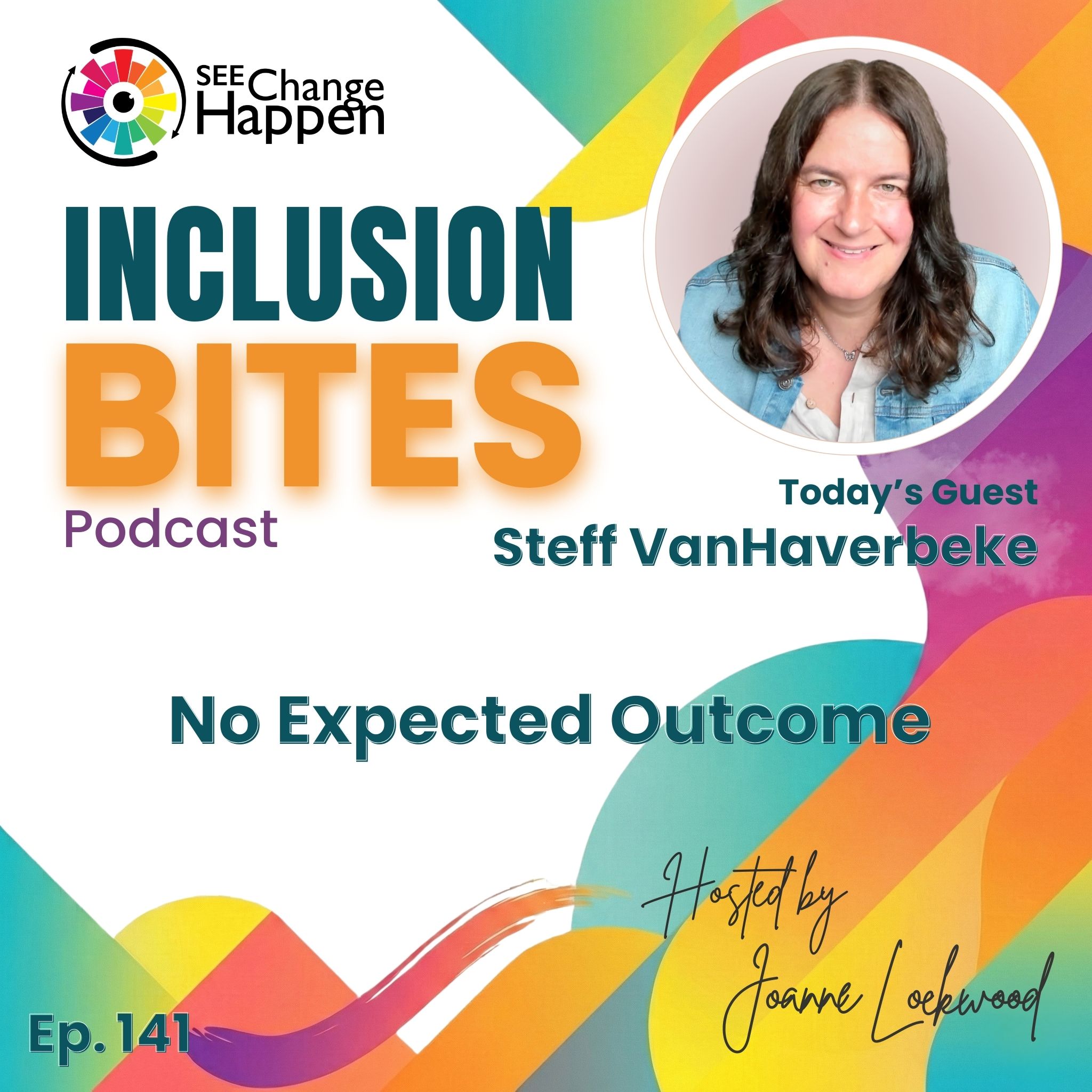
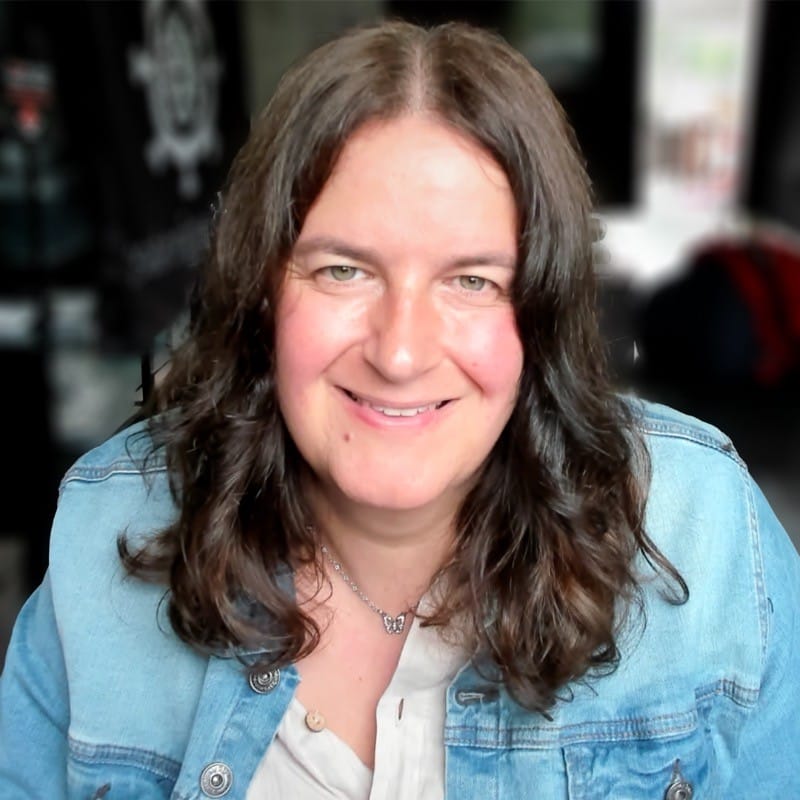
Steph VanHaverbeke explores personal transformation, the liberation in letting go of perfection, and navigating gender identity, while championing empathy and critical thinking to foster inclusion and growth.
In this episode of Inclusion Bites, Joanne Lockwood speaks with Steph VanHaverbeke about lived experience identity.
Welcome to Inclusion Bites, your sanctuaryfor bold conversations that spark change. I'm Joanne Lockwood,your guide on this journey of exploration into the heart ofinclusion, belonging, and societal transformation.Ever wondered what it truly takes to create a world whereeveryone not only belongs but thrives? You'renot alone. Join me as we uncover theunseen, challenge the status quo, and sharestories that resonate deep within. Ready to divein. Whether you're sipping your morning coffee or winding downafter a long day, let's connect, reflect, andinspire action together. Don't forget, youcan be part of the conversation too. Reach out tojo.lockwood@seechangehappen.co.ukto share your insights or to join me on the show.So adjust your earbuds and settle in. It's time toignite the spark of inclusion with InclusionBites. Today is episode 141with the title, no expected outcome.And I have the absolute honor and privilege to welcome SteffVanHaverbeker. And that's not easy to say a flourished nameas an English person. Steff is the cofounder ofthe House of Coaching. She empowers professionals withcognitive agility and inclusion driven strategiesto thrive in a rapidly changing world. And when I askedSteff to describe her superbash, she said that it is her empathyand self confidence enabling her to deeplyunderstand unique challenges and empower individualsto uncover their strengths. Hello, Steff. Welcome
Joanne Lockwoodhost
to the show. Hey, Jo. It's great to be here.Absolutely fabulous. And how did I do on your name? Did I did I getit close? It sounded perfect. Thankyou. And I know it's hard. It is.It's, the Dutch language is a law unto itself,isn't it? With lots of, guttural Yeah. Sort of throat noises, isn't it?It's a It comes from deep within. Deepwithin. Yeah. I've had many Dutch friends, and I've been to that partof the world many times. And, yeah, we sit in bars and laughabout pronunciations and things. And Yeah. I
Steph VanHaverbekeguest
know. So you you Steff. You were doing great. Yes. Thank you. Thank
Joanne Lockwoodhost
you. So Steff, tell me more. No expectedoutcomes. What's all the heard about? Yeah. Well, it's,
Steph VanHaverbekeguest
it's something that I I realized a few months ago.Beginning of this year, we're we're now December of2024. And, and past year, so in2023, post COVID, my main business, my mainactivity suffered from the COVID pandemic and wentbankrupt. So that meant thatI had to reinvent myself, reinventmy business. In Dutch we have this beautiful word it's calledDorstaat. So it's starting true. That's not starting here,but you're making a true push something through throughthrough the troubles, through and at the same time, I wasgoing through my gender transition as well. So this
Steph VanHaverbekeguest
meant there was a whole lot of stuff going on at thesame time. And and,and at one Friday morning, beginning this year, I had thislong, long, long, long list of things that I needed to do. AndI sat in front of my computer, like I'm sitting here now,and watching its screen and just a wholelist of emails and all you know you know,that feeling. Too much to, you knowand and you you want to get through it. And then my eye felton this, synthesizer that I got for mybirthday. And I was still wrapped. It's, it wasone of my old passions to make music. And I said,come on. What? Hell, let's let's unwrap this thing.And I hooked it up, and I played music the whole day.And what I noticed is that by doing this,by shifting my focus away from, you know,the result oriented tasks that I needed to do,I felt energized. I felt inspired.I got back into flow. And I was able to dothat list of tasks, in justmaybe an hour or so afterwards. Just becauseI I, yeah, resourced. I refined myenergy by having bymaking a small decision, actually. And that's that's that's whatthis neo or no expected outcome. That's what thisthat's what this is about. So that's quite a challenging journey
Joanne Lockwoodhost
you've had there. So a complete reboot.Yeah. But so he had no expected outcome fromthat, but you knew you knew whatwasn't working. You just weren't surewhat would work. Is it is that kind of fair? Yeah. Yeah.
Steph VanHaverbekeguest
No. It's it is it is. No. I reflecteda lot afterwards. After that particular Friday, I wentFriday evening, I went walking with mydog in the park here and, justright in front of my house. And, as I waswalking, I reflected on what what happened. And it doesn't seem likea lot happened, but it was for me, it was very profoundbecause I was, you know, I'm a person who was always, you know,out there putting the foot on the pedal and putthe foot on the pedal and plow through. Andjust by making a small decision to take a stepback, to do something that I'm passionate about,being creative a whole day andhaving no expectation about this, not having not having thissense of guilt. I need to do this or or this will get me introuble. So this there was no no guilt involved.So it freed me. It set me free, actually. Andthen as I was walking my dog, this this this word came tome, no expected outcome. I hadno outcome that I was expecting from that day. I let itgo, and that meant that I was able toreenergize myself. And yeah. And that's that'ssomething that I that I discussed with a lot of people sinceand I found that But presumably. Yeah. Presumably. But when you when you were going
Joanne Lockwoodhost
up to this period, you must have had a a lot ofapprehension, fear Mhmm. Nervousness, all these kind ofwords of limiting beliefs, things holding you back.Yeah. Was there a a particularly defining moment thatyou remember that was the key to the lock that allowedyou to move forward? It was a conversation with a friend. And,
Steph VanHaverbekeguest
I was talking about this my experience. And we were sitting in this,coffee shop drinking a cup of coffee and and having a sandwich. And,and then I was discussing you know, just talking about my experience.And then he said, you know, this is this is so recognizable because, youknow, I'm also somebody who, he said, who who's really, youknow, focused on, you know, results, results,results. I have to do this. I have to do that. I need to dothis, and it needs to be perfect, and this and that.
Steph VanHaverbekeguest
And, and as he as he wasdescribing this, he burst into tears. He said, this is, thisis, you know, he said, this your story is also my storybecause I have the same experience, but I'm notnot able myself to do this, to do what you did.And it's such a simple thing. It's making a decision. Butthey said, I know from myself I won't be able to do this because Ihave this sense of, you know, if I would do this, first ofall, I don't know if it would work for me. And second of all, yeah,would I be able to allow myself to do to make such a decision? AndI had thought, you know, WTF, what is going on here? Howhow are we programmed that we have toperform every day? We we are robots and we haveto be economically, you know, a piece of themachinery. I mean, that we don't allow ourselves thisthis small freedom to to be creative when we want.
Joanne Lockwoodhost
Would you looking back on it, would you saythat COVID created the the thechallenge with your business, which created the bankruptcy, whichthen empowered you to gender transition, or do youthink it was kind of a bit of everything? It was a bit of everything.
Steph VanHaverbekeguest
It's not I did not transition because of COVID. No. That thatthat that has been part of me for a way longer time. But it isit is it gave me the that that wassomething maybe that was an element, that it gave me the time to reflecton things. That's true. Yeah. Yeah. Yeah.
Joanne Lockwoodhost
I I I reflect on some of my my own history and my own experience.The once, momentum is in in progress, you know,you've got some movement on change. I'd almost felt that the need to justchange everything rather than change a bit because you think you come back to itand you just pick at the edges. You got to cut deep and cut reallyefficiently into your life and say, hang on a minute. This isn't working in allthese different aspects. And if you're going to change something, you must have justgive it a go. Yeah. There's something there, of course.
Steph VanHaverbekeguest
This this kind of this this is a kind of change that isprofound because it's about your identity, and your identitydetermines so much. You know, it's andit's it's a very, very, very small things. It's not only the big things.It's not only about how you present yourself or how you youknow, what what are you going to wear today. It's it's it's part of it,but it is it is not that. It is it goes so muchdeeper. And and, of course, COVID COVID played. It gave me theopportunity, to do thisin kind of my own, my own tempo. Youknow? My own pace. That's that's true. So inthat sense, yeah. So we'll talk a bit more
Joanne Lockwoodhost
about your coaching and what you're doing now. But can I just ask you acouple of kind of questions around you're living inBelgium, you mentioned to me before we kicked off?What's the, let's say, the climate foryou as a a transgender woman? You know, we see what's going on in theUS. We see what's going on in you probably see what's going on in theUK. I have very little knowledge around what it's like tobe a transgender person in mainlandEurope. How does it feel to you? Well, I feel very
Steph VanHaverbekeguest
lucky because in Belgium, we have one of the most progressivelegislation around gender and gender equality andgender. You know, that you can simply, as a Belgiancitizen, you can simply go to the how does it call it? The city hall,to the administration, and just state, this is now my gender. Andthat's it. And they have to change everything legally just because you aremaking that statement. So it's very easy.There's Belgium, they decided that there shouldn't be anyhurdles because that would be discriminatoryhow to say that? Discriminatory. Yeah. That's adifficult word for me as a Flemish.Yeah. So, and in that sense, we are very lucky.And in terms of society,when I made public that I was transitioning, I gotnothing else than encouragement and peoplewho appreciated what I was doing and found it very courageousand things like that. So that's, that's even in my, it starts in my ownfamily, of course. My wife, my daughter.Okay. My wife is a little bit different story, of course, becausewe were not married as a woman with a woman. We were marriedas a man with a woman. So and that's some still something,
Steph VanHaverbekeguest
of course, we we have to work on every day,you know, because it's it's rocks the core verycore of your foundation of your relationship. Butin a broader sense, you know, within my family, with mycoworkers, my, you know, my clients. Yeah.It was very, they welcomed it almost.And yeah, that's, that's I don't say that this is the experiencefor everyone in Belgium, but I built my lifealready in such a way that I surroundedmyself with people and also whatI do as a profession in a way that people would just, you know,that there wouldn't be any resistance to the to the to thatchange, to my transition. What was the biggest thing that surprised
Joanne Lockwoodhost
you around your transition? Yeah, that's a good question. Well,
Steph VanHaverbekeguest
the person who had the most trouble with all this in my lifeis me. Yeah. It took a longtime before I made before I decided,you know, I have to do something about this. That took a longtime. Of course, you know, I'm 55 years oldnow. Meaning 50 you know, about 50 yearsago, there wasn't much about gender.You know, that wasn't something people thought about.You know, it's just you're born in a certain way. You are,therefore, a girl or a boy. You know?And there was no awareness around it or on that topic.At least not in my family. Yeah.So, I could I can imagine when I if I would have been bornnow, things my wife would be a whole lot different. But in
Joanne Lockwoodhost
your coaching, you donow with working with individuals and organizations,what insights do you think that your your gendertransition has had in your, yourinsights you help people with? It allows me
Steph VanHaverbekeguest
to be more empathic. As I said, you know, the first person I had todeal with with how my whole transition was myself. I was the firstperson who needed to accept this, that this was a reality. And sonow I'm I'm very more aware whenpeople come with whatever issues that they have.I'm I'm much more able to put myself in the othershoes. And, I have areal sense of, you know, what what is going on. And, of course,I'm not only able to be more empathic, but alsomore authentic. And I can can truly speak from my heartnow. Whereas before the I I always had thiskind of a shield, you know, you project you project apersona to the outside, which is inauthentic, and it it's itfelt also always felt wrong. So I'm
Joanne Lockwoodhost
it may be expected outcome strategy or mantra, if youlike. We, as humans, we kind of we haveour biases, we have our preconceived ideas, and we bring all this baggagewith us, don't we, with these outcomes? How do you work withpeople to get into, if you like, let go of the baggageand and start to see possibilities. Yeah. There's there's difference
Steph VanHaverbekeguest
between baggage and luggage. So I like to have some luggage with me,but not the baggage. And this is how I also you know,this is my frame when when people come with me with with whateverbaggage they have and it's it's like, what is in therethat could be transformed into somethingelse that would be useful for you? But what I foundis that the greatest hurdles that people deal with inthose experiences liesthe the root of the solution. Like like we justsaid, because of COVID, I had all these troubles. But also because ofCOVID, it created this opportunity for me toto look at the world in a different way and to experience somethingthat maybe otherwise I would have never experienced. Sothere's always, you know, there's there's this coin that has two sides. Sowhat I what I do is when I have a coachingclient, and not only asking questions,you know, what are your goals and what are your resources and blah blahblah, but it's like a journey. I look atit as a journey and an exploration where peoplecan discover parts within them thatmaybe they would have rejected somehow in the past,but now are able to give it aplace and see it as a resource.And maybe I I'll give an example. Someone justsaid, you know, I'm, I'm having trouble relaxing.I'm I'm always, in my mind, busy, busy, busy, busy.And I find it very hard to create the mentalspace that I need to feel at ease, to, yeah,be myself, actually. And so what I what wedid, we we did a little exercise, and it's kind ofan it's kind of aimaginary journey that you make in your own landscape.It's called mindscaping. And during thatexercise, which is a guided meditation slashhypnosis. It's a bit of both, and it's verymetaphorical. It's kind of a guided dreamalmost. Andand then there was this girl that came to herand, she says, she's perfection.This girl is perfection. And sheoffers me a flower. And the moment she got thatflower, she burst into tears and she said, okay, I see the beautyof it, but I also see that the flower is cut.So even though the flower is perfect, it is notperfect. So this is whole duality there. And thatchanged the way she looks at the world now.And now she's able to see thatperfection. You know, itis elusive. It is something that you canappreciate and you can strive for. But at thesame time, you know, perfection is also somethingyou can let go. And it is yeah. They often
Joanne Lockwoodhost
say that perfection is the enemy of progress, because we're so busytrying to get everything completely right, completelyokay. And sometimes good enough is good enough, isn't it? It
Steph VanHaverbekeguest
is. It is. And, justlast weekend, I, facilitated aconference for visual practitioners, whichare people who are helping organizations to, youknow, solve problems, be more creative, brainstorm,teach, and all these kind of things. So I was facilitatingthis and, people had to draw on big, big, big sheets ofpaper, you know, what their intention was for the day,for themselves, for each other, and so on.And so as we were as a group with about 40people, drawing on a big sheet of paper about10 meters wide with all kinds of colors and makingdrawings and putting on some slogans and whatever.And and one of the one of the participants came up to me and shesaid, you know, this is so amazing and so beautiful. Itit is something to, wow, to to really hold onto. And she said, you know, what else? What is going to happen with thispiece of this big sheet of paper after the conference?And I said, you know, I I look at it as a as amandala. It only exists here and nowin this moment. And it exists for you, andit will still exist afterwards in your hearts becauseyou have experienced it. But after this, the paper will begone. You know, we will tear it up and put it in abin. And she said, that's, you know,she had some struggles with that idea, but it is beautiful. Itis beautiful. Yeah. Because You said just now
Joanne Lockwoodhost
that you've it's different between luggage andbaggage. I I thought that was a really good analogy there, where weoften fill up with carrying around baggage. So what we need to dois we need to unpack all of our baggageand extract the valuable parts, the luggage.Yeah. And jettison those baggage elements.So we're traveling lighter with stuff we need,not bogged down with everything we don't need.
Steph VanHaverbekeguest
Indeed. Indeed. And just to reflect for the listener also, justjust ask yourself this question, what is holding me back? What,what do I keep dragging behind me? Likeevery day that I maybe don't need? Or maybethere's something in there that is of real value. Just when I look atit in a different way and it becomes lighter and it becomes something that isuseful for you. And it's not holding you back. Most of the change we
Joanne Lockwoodhost
actually need within ourselves, isn't it? It's, you said earlier, whatwas the biggest surprise? What was the biggest barrier? Yourself holding yourself back. And whatwe find is we become our own limiting belief, our own perfectionist,or we could become constrained by our ownbeliefs, don't we? And that's what we need to unlock sometimes. Because if wedon't take a step forward, we'll always stand still. And it's a ton of workout to find that bravery or that or realize that we're moreuncomfortable by being where we are than we would be by moving forward.
Steph VanHaverbekeguest
Indeed. For instance, for me, I've always felt that,when I was, when I was before my transition, I had toprove myself. I always had the sense, you know, I haveto prove myself that I am aman. I found that very hard, by the way.It took a lot of energy from me because it was it didn'tfeel natural for obvious reasons.And, and once I let go ofthat, it transformed me. And I now Ifeel free. I feel a lot lighter. I feel a lot more
Steph VanHaverbekeguest
comfortable. And I couldn't really be myself infront of a whole group. Whereas before, Ialways felt like I had to put on an act. And that is, you know,that, that what that part of me was, was the baggage.But, but it also had the roots. Because, becauseit's brought me on this journey to really exploreand investigate and find out what was goingon and to learn a whole lot about how the brain works,about psychology, even though I'm not a psychologist.But, you know, and I pushed myself, you know,learning and teaching about this, you know, in front ofgroups of people as a trainer and as a coach. And thisreally enabled me to to let go of a lot of things, butalso to transform and reintegrate some parts of,you know, not only the science and the knowledge that we haveabout, you know, what it means to be human and, you know,and about gender and all these things. But it also helped me toto integrate on a on a deep, deep, deeplevel the experience that Ihad. I wouldn't be the person that I am today without thatexperience. It is the foundation of my confidence today. So I
Joanne Lockwoodhost
mean, I think it's fair to say that many peopledon't understand about being trans, gender,non binary, or having a gender identity that is notas aligned that you were given at birth. So you saidjust now that you spent many, many years of your life trying toprove to the world you were a man, and you found that exhausting,tiring, and something that was making you feel uncomfortable.Do you now find the challenge is having to explain whatbeing trans for transgender means and having to maybejustify yourself as a woman to certain people? You definitely
Steph VanHaverbekeguest
don't have the sense that I have to justify anything. No, no,no. That's that's not the case. I had tojustify before my transition. I don't have to justifyanything now. So no. No. The it's it'sit's it set me free. And now I I amable to really let me tell you with a concrete example. Afew days ago with with with somebody, he was, you know,a good friend of mine. We were walking in the city. We had to pickup some things. He had to go to the printer to pick up some, youknow, yeah, some orders that he made. And whenhe was in the print shop, the owner of the print shop came in andsaid, hi Karl, how are you doing? And blah, blah, blah. And then, you know,they're making jokes and, you know, going in this typicalmale bonding things that I neverunderstood. You know, I cannot grasp what that is.But now that I that I've transitioned and I am trulywho I am, I can connect with people in such a betterway. It goes way easier. It goesdirectly. There are no walls anymore. Sothere's no need to justify anything. Whereas,yeah, that's See, you just
Joanne Lockwoodhost
are. There's no there's no kind ofdiscussion here. In the same way, I'm just a woman. You're just a woman. Wejust are. We don't feel the need to prove that. To make it
Steph VanHaverbekeguest
very blunt, if somebody would come up to me and challengeme on this, I would challenge the other person also ontheir identity. You know, it's the samething. You don't challenge anybody on their youknow, on parts of their identity. You cannot have any judgmentabout that. You mentioned some you're not a psychologist,
Joanne Lockwoodhost
but you did some working on understanding the brainand the, itsperception of the world. Do you wanna give me a little bit more background ofof what you uncovered when you were going through that? Well, what I found
Steph VanHaverbekeguest
particularly interesting is, of course, you know, what are thedifferences between male female brains? Is there anyscience to really back this up? And, yeah,what I found is basically there isn't really.Meaning that the brain changes as we growolder. Of course, there'sdifferent processes, you know, the brain only becomes adultwhen we are about 25 and the brain doesn'tdeteriorate, like, in a sense thatan older person could have a brain ashealthy as 25 year old.If you do particular activities that keep your brain healthy.But in a natural flow of things, of course, the brainchanges over time. Things become harder toremember and all these things. So the difference betweena brain of a 4 year old and a 94year old are far greater than, of course, thebrain between a man and a woman. And, you know,and even saying that, of course, there are some differences that will be aboutthe size and about, you know, the but youcannot generalize. I was during the conference, I'm fromBelgium and there were people there from Norway,Sweden and Holland. I don't know if you everlooked at those people, but they are my neck stillhurts because I had to look up the whole time. But they areeven the women are, you know, they are they have a lot more stature thanI have. So it's not about size. It's not about,you know, particular parts of the brain. It is more howwe use our brain that makes the difference.Yeah. And so there's there'salso some culture involved, nature and nurture.
Steph VanHaverbekeguest
But what I found was that the way I used,I've used my brain my whole life is typical fora woman. The things that I was interested in, the things that Ithat caught my attention, the things that I you know, even though Ido like Star Wars. But I've also found that a lot of women likeStar Wars. So I'm not the exception here. So we have allthese preconceptions about, you know, male female,about male female bodies, how they should look, how they shouldbe, about our brains, how they should work, how they shouldn't work, and soon and so on. But basically, thetemplate is human and gender is a spectrum. You canbelieve it or not, but it's science. And,yeah, just, you know, where are you on thegender spectrum? And for me, I found that being in the malepart of the gender spectrum didn't work for me. Yeah.
Joanne Lockwoodhost
Yeah. The whole concept of genderand roles and what you should like, what you shouldn't like is it's all asocial construct. We've we've made this stuff up. We made it up.We've decided we've decided we we givelabels to things like that's a that's a man's thing, that's a woman's thing, that'sa men should like this, women should like that. That's a man's toilet, that's awoman's toilet. We invented this stuff in the20th 21st century. Most of the stuff before that was role based, based onwhat you were trying to do. And society has kind of enforced these ruleswithout any, well, as a blanket approach, without any realunderstanding about what, how people see themselves in theworld? Yeah, that's true. Actually, a lot
Steph VanHaverbekeguest
of the constructs thatwe hold as self evident arevery recent. Victorian age wasan age where a lot of the social norms thatwe adhere to today, you know, theynot originated, but they became like the norm.And, you know, that's that's also something, you know, being atransgender woman and having walked that journey,I'm much actually, I consider myself in aprivileged place because I can seecertain frames that are just nonexistent, that a lot of people believe about theworld that are simply not true. So, yeah,I like to think outside the box. Yeah. No, I
Joanne Lockwoodhost
agree. And I think, again, going back to your experience of doinga diversion halfway through yourlife or 3 quarters away through your life, wherever you want to look at it,that you are able to put down the baggage, as you say, and and andpick the path that works best for you. Going forward, whatdo you believe is is kind of the future for you andthe world and the people you help? I
Steph VanHaverbekeguest
think we'll we'll we'll come into a time ofof particular challenges. We have the rise of AI.I mean, if you're just, you know, seeing the first the first,first emergence of that, even though AI is is much older than whatthan many people realize. But it will change the way wework profoundly. And it will put intoquestion what makes us human and what makesus intelligent. You know, there will be a whole lot ofphilosophical ideas floating around about thatone. But also for many people, they will also haveto transition, ina certain way and and society aswell. So we we we face particular challenges. It's
Steph VanHaverbekeguest
not I who's saying that. It's everybody who's who's working inthat area sees that. And I think thatmy contribution being here on this planet today isto share some of my experiences and to also to teach people someof the principles and techniques, how toreally leverage human intelligence and remindthat, you know, we are not robots. We aredifferent from the AI and the bots. Andif you have a tedious task to do today, go tochatgptorclod and make use of AI and use it ina smart way. But also when you arewith people together, the stupidest thing youcan do is to listen to one person and say,okay, he should be he's right probably or she's right probablyor whatever, and not challenge that. We are heretoday alive because we areable to communicate, to invent,to create, and also to think critically.And that is something that is a skillthat should be taught from kindergarten upwards.Think critically. When you hear a politician in Belgium, they hadelections together with European elections. So before the summer or thatbeginning of the summer, we still don't have agovernment. And what these people show is profound lackof leadership. They arebickering, they are discussing about topicsthat really don't matter and they are not able to come to anagreement. That is, that is, that is not leadership. That is stupidity.And that's plain and simple. So we need to bevery careful about what we believeabout the world, what we do with our, you know, with ourlives and how we spend our days. And I'mhere as the advocate. Spend your days wisely anddo things that, you know, give you energy,that set you free, make you look to the to theworld in a different way. But that's that helps you andthe people around you.It's plain and simple. Should we be scared about AI? I mean, it's
Joanne Lockwoodhost
we talk about masculine, feminine, non binary, and AI truly isan is an it. It has no gender identity orconcept of self. It is it's making stuff up based on patterns of otherof old information. Yeah. Yeah. It has no identity.
Steph VanHaverbekeguest
We we give it identity, but it has no identity. It still isa machine. Maybe someday, I don't know, butdefinitely not for the foreseeable future. Butit it has all the it resembles someonewho has identity and personality and all thesethings, but it's not. So will it change theway we work? Most definitely. Will it take away jobs? Yes,of course. Will it create new jobs? Definitely.So the question is not, will I be without a job because ofAI? No. No. The question is, how can you use that newtool to make your job better or to make your life better?So start using it. That's but in a smartway. And and don't forget, you you are not a robot. You are you arenot a machine. You're a human being. So be smart.
Joanne Lockwoodhost
Yeah. I mean, that that's my view of AI. I'm a great believer in usingit as a an assistant, a tool, automation,light for heavy lift. Fundamentally, at this current time, aswe say, December 2024, it doesn't have a soul. It doesn'thave a conscience. It doesn't have feelings orempathy or love. Any parameters and patterns.And you can often tell the difference between an AI generatedpicture or content, unless it's been heavilycrafted by someone who gives it and injects it, a personality andsoul, it can appear very empty and heart withoutwithout a center, without a heart. Yeah. So
Steph VanHaverbekeguest
but for so we face this, thishuge change as a society. It will be veryprofound and we will start to feel the the thing is, a fewweeks ago, I, I was giving thispresentation about the impact of AI. Somebody from the audience asked, youknow, in our company, there's a discussion. Should we implementstart to implement AI? What is your take on that? Andand I said, well, you're asking the wrong the wrongquestion. Oh, it's not about should we.It's not even about about, you know,how or when. Itis, you know, what can AI do for ustoday? And when you look at AI, what itcan do? The answer is obvious. It can help you. It can
Steph VanHaverbekeguest
serve you in in in in amazing waysto boost your productivity, to really set your peoplefree. And I will give you a small example. Andand one of the organizations that I that I, thatI'm working with, they started to implement AI to they haveoffers coming in and documents in various formats,PDF, you know, and they have to OCR it and and all that thesethings. And it's still a quite amanual job because because of the different formats. They started touse AI for that and create a workflow. And now it goeson automatically. And and the role of the people fromthe from the department changed from processingdata to building clients' relationships,which AI cannot do. Yeah.So it's obvious. Will it change? In a sense, it will make itmore human. It's only if we choose to.So If we look back at human history, you know, we we we go out,
Joanne Lockwoodhost
I don't know, 30, 4000 years, about the timewhere Homo sapiens became the dominant human speciesbeyond the the the andetholes and the other variants of humanevolution. We were living of the moment. Wedidn't we we were we were hungry. We'd catch something. We'd eat it.And then we mechanised. We created agriculture. We startedkeeping animals as livestock, asfood for the future. We started plantingplants and cultivating. We took control over ourdestiny by not having to live at the moment. And, of course, weindustrial revolution, mechanising boats, ships, airplanes,tools, engines, petrol, etcetera. We'vewe've we've created all these things over time. AI is just anotherevolution of a tool along with computing and other other devices,mobile phones, Internet, satellites, GPS, isanother tool that will displace existingmethods and technology and work and replace it withdifferent paradigms. It? Of course. You know, like, let's
Steph VanHaverbekeguest
make an analogy. Before we had washing machines,women had to spend hours, you know, rubbing clothesin fresh water with soap with their hands in order to cleanthe clothes. Because of the washing machine,women were set free. And it seems likewhat? Yeah. But my mother, when she wasyoung,roads parts. You know? I still see people in many parts of the
Joanne Lockwoodhost
world who have to walk for half a day to collect water and walk halfa day back again with the water. Yeah. Irrigation, sanitation.
Steph VanHaverbekeguest
So, yeah. So technology service, of course. Cantechnology used to be used against us? Most definitely.Yeah. Like everything. You know, a tool forchopping wood can be used to kill somebody. So we have to be verysmart about this tool and really think about, you know,how we will use it to benefit us and to reflectalso on, you know, what does that mean for us ashumans? The way we work, the way we earn money, it willbe it will be different. You can see thatalready happening. So it's
Joanne Lockwoodhost
exciting. I'm excited by it. It's one of the few things I think,if only I was 20 again. The the technologicalleaps and bounds that are occurring right now in the world, I wanna Iwanna another 50 years of this. I mean, I'm I'm a bit older than you,not much. I'm thinking, hang on a bit. By the time this gets really exciting,I'll be in my seventies. I wanna I wanna another go. I wanna go aroundagain. Yeah. Yeah. Well, it's
Steph VanHaverbekeguest
life is a mandala. We as a species,
Joanne Lockwoodhost
as a society, as a family, we're we're growing and evolving all the time. AndI guess, you know, if I if I had my life again, I'd be wantingthe next thing and the next thing and the next thing. Like, you're you're a
Steph VanHaverbekeguest
podcaster. Could you have could you haveimagined, like, 5 years ago or maybe 10 years ago, it didn'texist? No. And the the ease, you know, I I we're using a
Joanne Lockwoodhost
platform now called Riverside, which has AI technology. It helpsproduce show notes. It will clean the audio up, take the clicks and knocks outof it. And when I first started this, I was going into tools and Ihave to clean up the audio myself. I'd have to hire someone to readthrough or listen listen to the episode,transcribe it for me semi manually. And, yeah, I canturn a show around now in 20 minutes, half an hour, whereas it would takeme half a day before. So huge leaps about.Yeah. It's making the podcasting accessible. I can also generateassets for YouTube and bouncing audiograms and other things.When this episode goes out, you'll be able to access this on YouTube with abouncing audiogram as well. So, yeah, lots and lots of tools out there. Yeah. Yeah.Yeah. I'm excited for the for that part of the future. I mean,I'm less less excited about some of the other trouble we've got inthe world, you know, the the rise of the conflicts that are developingbetween certain parts of east asversus certain parts of the west. And there's some north south issues.There's poverty, there's eco climate change,extremist views dominating the world, fueled by socialmedia, by media bias. And you think, well, hang on a minute, we'recreating a more enlightened society, but with all theseflashpoints, all these triggers that are there. Yeah. Yeah.
Steph VanHaverbekeguest
Well, I like I like to see myself as someone who has apositive impact on people. Andthat's why that's why I teach, I coach, I talk.And people you know, for me, it's all about a human connection. Youknow? In essence, it's about, you know,us and, you know, what you what we are doing here on thisplanet. And my small contribution to that is every time Isee somebody struggling with something, to maybe open adoor in in their metaphorically in their minds where theycan see a new path, something else that they hadn'tseen before. And 1 by 1, person by person,if I can see that's happening, that thatgives me a sense of purpose. For me, I'm 55 years old. I'm hereto prepare the next generation. So the people usually who come tomy training courses are late 20 untilearly 40, usually. So thesepeople have to do it for the moment. They have to they have to pickup those tools. They have to pick up those skills as well. Theyhave to be they do things differentlythan their predecessors. And they have also to be able tochallenge their predecessors, even if they are their bosses.And it's a bold statement, but it is necessary. We're
Joanne Lockwoodhost
going to give our listenersome advice. What is the one top tip you'd like to leave them withas a result of our conversation today? The top tip based on
Steph VanHaverbekeguest
what we discussed is thinkagain. When you hear something, when yousee something, really do the research, make surethat you make wise decisions. Beknowledgeable. You know, you hear sometimes people say, you know,things are not what they seem to be. And then, you know, this is awhole conspiracy. Well, there is a conspiracy,and this conspiracy only lives inside your head. Youknow, the conspiracy is we are the system, and we canchange it. And so you can change it. So theso think again, be smart, be knowledgeable. Believe
Joanne Lockwoodhost
everything you hear and see, because it's a deep fakewith media bias, with people's bias. Yeah. You're right. We'vegot a challenge why people are trying to say something or what they'rereally trying to tell us. Yeah. Excellent. News news is a product.Yes. Or if it or you're the product, so I'm trying to sell to you.
Steph VanHaverbekeguest
Sometimes you are the product. Yes. Completely. Yeah. Sobe How do people get a hold of you, Steff? If you want to track
Joanne Lockwoodhost
you down, what's the best way to get a hold of you? Well, I've had
Steph VanHaverbekeguest
I have this very, very, very tiny, tiny, tiny website with onlyone page on it, and it's coachsteff.life, and that'sSteff with double f. So coachsteff.life.And there you find all the all the inroads to what Ido and where where you can see me or find me or reach me. I
Joanne Lockwoodhost
just clicked on that link now. Let's have a quick look. Yep. It'scoachsteff.live. Blue background. There's a picture of you in themiddle. And, you got you got someaudio books on there. Is that, you got a free book of you? Yeah?
Steph VanHaverbekeguest
Yeah. Yeah. So I got some books there. And and also I wouldlike to offer, based on our discussion, I will create,a small guided meditation like wediscussed. Yeah. Kind of aa guided dream that will help your listeners, so youas a listener, to open your minds and to,to get smarter. So I I'll put that together, and, I will put it onthe link. So coachsteff.life/inclusionbites.
Joanne Lockwoodhost
I'll put that in the show notes as well so that, we can signpostit easily for people who have not quite got to the end of thepodcast. Maybe they've nipped off for coffee halfway through and forgot toforgot to press play again. Who could do that? Yeah. Or
Steph VanHaverbekeguest
whatever. Or it's side tracked. It's been an
Joanne Lockwoodhost
absolutely fascinating conversation, Steff. I've really enjoyed meeting you, getting to know you, andhearing some of your thoughts about the world. And it's, a lot ofwhat you're saying resonates deeply with some of the things that I went throughwhen I gender transition coming up for 10 years ago, andthe the challenges I have with my wife, my children, and my work, andmy colleagues and things. Yeah. The world'schanged in the last 10 years. Some of it for the better. Some ofit, I'm not going to say for the worst. It's just different. Justdifferent. It's a different colour. That's what I'm going to say toNear the brown, but it's the the sunny. But, yeah.But, yeah, it's different. Thank you. That's that's it's been absolutely fascinating. So,thank you for listening in this far.
Joanne Lockwoodhost
As we bring this conversation to a close, I want toexpress my deepest gratitude to you, our listener, forlending your ear and heart to the cause ofinclusion. Today's discussion struck a chord.Consider subscribing to Inclusion Bites, and become part ofour ever growing community, driving real change.Share this journey with friends, family, and colleagues. Let's amplifythe voices that matter. Got thoughts,stories, or a vision to share? I'm all ears.Reach out to jo.lockwood@seechangehappen.co.uk,and let's make your voice heard. Until next time. Thisis Joanne Lockwood signing off with a promise to returnwith more enriching narratives that challenge, inspire,and unite us all. Here's to fostering a more inclusive world,one episode at a time. Catch you on the next bite.
The Notion of Perfection and Letting GoThe Transformative Journey of TransitionThe Role of AI and Technology in Modern Workplaces
Joanne Lockwood speaks with Steph VanHaverbeke, co-founder of the House of Coaching, about what happens when you stop chasing a fixed result and allow space for creativity and renewal. Steph shares a pivotal moment after a business bankruptcy where choosing a day of music
They explore how perfectionism and constant performance can become self-imposed constraints, and how reframing ‘baggage’ into useful ‘luggage’ can support growth. Steph describes coaching approaches that help people uncover resources inside what they usually experience as obstacles, including a mindscaping exercise that reframes perfection as both beautiful and inherently imperfect.
The conversation also touches on Steph’s gender transition and how it shaped her empathy and authenticity, alongside reflections on gender as a social construct and the impact of progressive gender legislation in Belgium. They end by discussing the disruptive rise of AI, the need for critical thinking, and how technology can free people to focus more on human connection and relationship-building.
“How are we programmed that we have to perform every day? We we are robots and we have to be economically, you know, a piece of the machinery. I mean, that we don't allow ourselves this small freedom to to be creative when we want.”
“Because of COVID, I had all these troubles. But also because of COVID, it created this opportunity for me to to look at the world in a different way and to experience something that maybe otherwise I would have never experienced.”
“Someone just said, you know, I'm, I'm having trouble relaxing. I'm I'm always, in my mind, busy, busy, busy, busy. And I find it very hard to create the mental space that I need to feel at ease, to, yeah, be myself, actually. And so what I what we did, we we did a little exercise, and it's kind of an it's kind of a imaginary journey that you make in your own landscape. It's called mindscaping.”
“It's brought me on this journey to really explore and investigate and find out what was going on and to learn a whole lot about how the brain works, about psychology, even though I'm not a psychologist.”
“We are here today alive because we are able to communicate, to invent, to create, and also to think critically. And that is something that is a skill that should be taught from kindergarten upwards.”
“And now it goes on automatically. And and the role of the people from the from the department changed from processing data to building clients' relationships, which AI cannot do.”
“Every time I see somebody struggling with something, to maybe open a door in in their metaphorically in their minds where they can see a new path, something else that they hadn't seen before. And 1 by 1, person by person, if I can see that's happening, that that gives me a sense of purpose.”
The importance of letting go of perfection and accepting "good enough" to foster progress.
Creating a temporary collaborative artwork as a metaphor for the beauty of impermanence.
The concept of unloading unnecessary baggage to focus on essential aspects of life.
How transitioning can provide a profound sense of freedom and authenticity.
Insights into balancing dualities and fostering personal change through imaginative exercises like mindscaping.
The role of critical thinking in evaluating information and navigating societal norms.
The impact of AI on work dynamics and the essentiality of using technology wisely.
One thing to remember
In this episode of The Inclusion Bites Podcast, titled "No Expected Outcome," the discussion between Joanne Lockwood and Steph VanHaverbeke underscores the liberating power of embracing imperfection and the profound journey of transitioning. Both speakers illuminate the significant theme of letting go of societal expectations and unnecessary baggage to foster authentic personal growth and inclusivity. Steph’s transformation and her insight into critical thinking, especially regarding AI and societal constructs, offer listeners a deep understanding of balancing professional and personal evolution.
Questions this episode helps answer
How do you interpret the concept of "no expected outcome," and how might this philosophy benefit both personal and professional growth?
In what ways can striving for "good enough" rather than perfection contribute to progress and productivity in everyday work environments?
Steph VanHaverbeke facilitated a collaborative, temporary artwork to symbolise impermanence. How can similar activities be integrated into workplace culture to foster creativity and teamwork?
The analogy between luggage and baggage encourages individuals to let go of unnecessary burdens. What are some common examples of "baggage" individuals might carry, and how can they begin to unload it?
How did transitioning affect Steph VanHaverbeke’s approach to coaching and her ability to connect with clients?
What are some ways that societal norms and cultural contexts influence perceptions of gender, and how can individuals challenge these preconceptions?
Explore topics
Ideas from this episode
The Notion of Perfection and Letting Go
The intricate terrain of perfection, exploring the delicate balance between striving for perfection and the freedom found in accepting "good enough." Steph VanHaverbeke and I deliberated on the aphorism "perfection is the enemy of progress," highlighting its significance in personal and professional realms.
The Transformative Journey of Transition
Our dialogue took a poignant turn as we delved into the profound journey of gender transition, examining its many-layered impacts on personal identity and societal interactions. Steph VanHaverbeke generously shared her experiences of living as a transgender woman in Belgium, highlighting both her struggles and triumphs.
The Role of AI and Technology in Modern Workplaces
The future, examining the role of AI and technology in shaping modern workplaces. Steph and I discussed how AI can enhance productivity and create new opportunities while cautioning about its potential downsides.
Learn
Frequently asked questions
What is the main theme of this podcast episode titled "No Expected Outcome"?
The main theme revolves around letting go of perfection and embracing the concept of "good enough" as discussed by Steph VanHaverbeke and Joanne Lockwood. This episode dives into the beauty of impermanence, shedding unnecessary baggage, and transitioning towards authenticity and self-acceptance.
How does the episode address the idea of perfection?
Steph VanHaverbeke suggests that while perfection is something worth striving for, it is also something we should be willing to let go of. Joanne Lockwood adds that "perfection is the enemy of progress," underscoring the importance of accepting what is "good enough."
What significance does the collaborative artwork at the conference hold?
The collaborative artwork created by visual practitioners at the conference symbolises the beauty of impermanence. It was designed to be temporary, highlighting the value in ephemeral experiences and allowing participants to embrace the moment without attachment to a permanent outcome.
What is the analogy discussed about luggage and baggage?
The analogy likens unnecessary emotional or mental baggage to physical luggage. Steph proposes that individuals should unload this baggage to focus on essentials that provide value and benefit in their lives, paralleling a journey towards personal improvement.
How has transitioning impacted Steph VanHaverbeke's sense of self?
Transitioning allowed Steph to feel liberated and more comfortable in her own skin. It provided her with an integrated understanding of gender and psychology, which has been essential for her personal growth and authenticity.
What is Steph's coaching approach?
Steph employs a transformative journey approach in coaching, guiding clients to identify and embrace previously rejected parts of themselves. She uses imaginative exercises like mindscaping to help clients find balance and acknowledge the duality within perfection.
Share this episode
Heard something worth passing on? Send this conversation to someone who needs to hear it.