Georges Córdoba shares his compelling journey through battling stage 4 melanoma, embracing holistic health, and balancing physical and emotional well-being, all while navigating personal challenges and catalysing change through resilience and purpose
In this episode of Inclusion Bites, Joanne Lockwood speaks with Georges Córdoba about mental health wellbeing trauma.
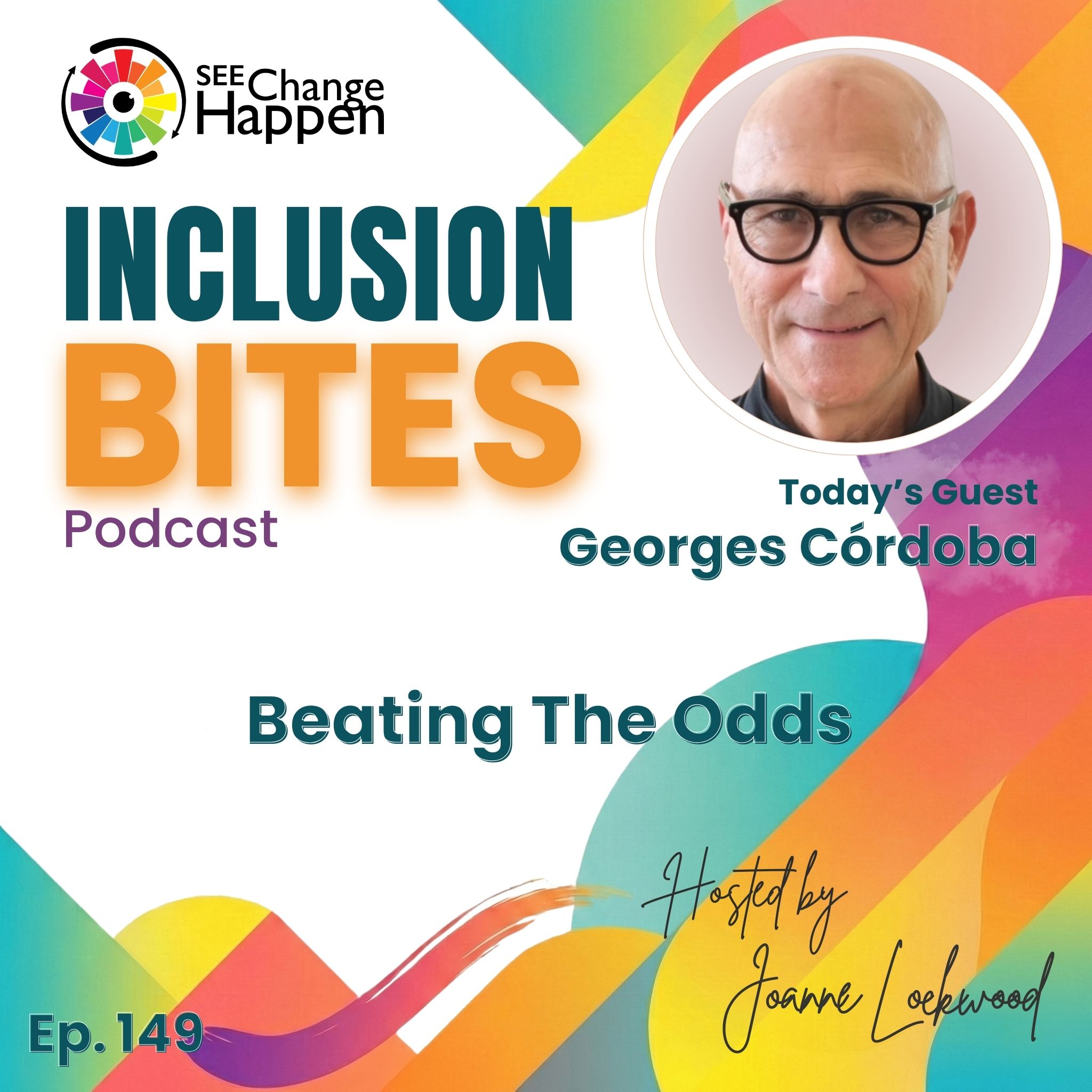
Foreignwelcome to Inclusion Bites, yoursanctuary for bold conversations that spark change. I'mJoanne Lockwood, your guide on this journey of exploration into theheart of inclusion, belonging and societaltransformation. Ever wondered what it truly takes to createa world without where everyone not only belongs butthrives? You're not alone. Join me as weuncover the unseen, challenge the status quoand share stories that resonate deep within.Ready to dive in? Whether you're sipping your morning coffeeor winding down after a long day, let's connect,reflect and inspire action together.Don't forget, you can be part of the conversation too. Reach outtojo.lockwood@seechangehappen.co.ukto share your insights or to join me on the show.So adjust your earbuds and settle in. It's time toignite the spark of inclusion with Inclusion Bites.And today is episode149 with the title Beatingthe Odds. And I have the absolute honour and privilege towelcome Georges Cordoba. Georges is astage 4 cancer survivor, holistic health coachand best selling author who empowers individuals totransform their health vitality throughholistic even practises. When I asked Georgesis describe his superpower, he said it is turning adversity intoa mission of hope, healing and purpose.Hello Georges, welcome to the show. How you doing
Georges Córdobaguest
Joanne? Thank you for inviting me and I'm honoured toshare some minutes with you.
Joanne Lockwoodhost
Absolute pleasure. So we were chatting in the green room just now andyou're New Mexico in the, in the, in the U.S.yes. And you were telling me a bit about how you have family
Joanne Lockwoodhost
and relatives in the California area with the wildfires. Doyou want to tell me about how worrying that is? Yes,
Georges Córdobaguest
very worrying. Because on top ofeverything the fires are very toughto contain because they have 85, 90mile an hour winds on top of everything. So like a perfectstorm. Now they have like, and that's unusual,a tropical storm turning hurricane over there. Sothey, they're getting better but it's been,it's been crazy. When you see pictures it seems like it also lookslike, like in the, an atomicbomb the way they burned all those homes. And there are someunexplicable situations where you see an entirestreets of mansions burned out and then on the sideyou still see some trees that were not here. So it waslike it's nature, it's, it's tough to, to understandsometimes when you see the, the end result but it's,it's worrying, not so much also, I mean the burning is amazingbut the smoke they're evacuating folks in terms of,you know, for, for smoke inhalation. So my, my son lives
Georges Córdobaguest
in Venice beach which is well basicallyright at the coast. He's not being evacuated yet and Ihave some Greek family in San Fernando Valley andit hasn't been affected but again a valley gettingall this smoke. They were talking about yesterday that alsohaving these folks evacuate because of the smokingin late in fishing. Yeah. So it's,it's quite for us, you know, anywhere. I have my, myoldest son there and some of my mother'scousins like I said in Sherman Oaks.But hopefully by, by the end of the week, hopefullywith right now is Monday, but we're hoping that very soon,sooner than later they can contain this stuff. Destructionis amazing. LA is not the same my sonis saying and affects obviously the, the work,the folks are professionals. You have the elite there, theHollywood stars losing their homes and youknow, it's a little bit crazy right now. Yeah, yeah.
Joanne Lockwoodhost
People are given minutes to evacuate. They're leavingeverything behind. Literally what they're wearing.
Georges Córdobaguest
Exactly. They can do anything. It's like,you know, like hurricanes. I lived in Miami,Florida for 30 years andwe've, we've gone through a few of them. Particularly one in1993 was very, very strong with200 mile winds, 225mile gust winds. Andrew, HurricaneAndrew and same thing. If you're in the evacuationzone, you leave everything behind and hope that is there when youcome back. Yeah, I mean being in the uk we often play
Joanne Lockwoodhost
about our weather being too hot, too cold, too wet, too windy, whatever.But our weather really is not in extremes. It's kind of likemiddling. Whereas in the us I mean my family and I, we spent sometime in Orlando doing the Disney sort ofexperience and we'd never experienced thunderstorms and torrentialrain that lasted like 10 minutes. Thunderstorm, rainstorm, 10 minutes,then suddenly, poof, it's blue sky again. Never experiencedanything like that. And also I spent some time working in California andla. Minor earthquakes, but I spenttime in the Beverly Hills area, Santa Monica,Venice Beach, Long beach, those places down SanDiego. So yeah, you see these environments, you just think they're almostinvincible. But this fire has been a great leveller, isn't it?
Georges Córdobaguest
Yes, it's levelling. Yes, absolutely.Yeah. So George's, your
Joanne Lockwoodhost
journey from battling advanced cancer tobecoming a holistic health coach is quite remarkable. And so how did thisshape your purpose and to quote you, give you a chance to singthe song you were Born to sing. Yeah. It's
Georges Córdobaguest
interesting because many people, Joanne,don't find their purpose. They go through their life and in away existing. Just like Oscar Wilde saidthat we were the most interesting folks because allwe do is exist. And I believe in that. And in mycase since I was a youngster, I alwayslike to help people. Somehow I was born with that,some talent, if you will. I just. Iwas always aware of seeing the less fortunate aroundme, especially growing up in South America andVenezuela. My parents being immigrants, you know,they worked so much to get back to on theirfeet because they lost everything in World War II. My familyfrom Greece and then the other part of my family fromSpain, they went to Venezuela. They were, they were doinggreat in Europe with the war. They, they werevictims of losing pretty much everything. And so,but, so, but they managed to go to clubs. Mydad ended up playing Davis cup tennis. I learned tennis andthat's how I end up in the United States. But I alwayswanted to help people. For example, they would give us allowance atthe club, you know, for the day we would be working out,learning tennis and practising them. I became part of thejunior national junior team and we had ball boys.These ball boys were. They were poor kidsthat they would, you know, bring in and they would give themuniforms and they would be our ball boys, even forkids to kids. And I, I had a lot ofcompassion for them and I would convince my,my friends to give them the change. After we willgo and have snacks, we'll give them the change. So we would go towhere they were gathering. They had them in a place in the club and
Georges Córdobaguest
we will just give them the change that we got from, fromeating so they could go eat. So that was something that I grew upwith. I learned. I went to school with the Jesuitsand, and they had a ministry todo some, some help to the areas of lessfortunate favelas and stuff like that. I went toa place to help the. It was a tribein the border between Venezuela and Colombiaand we spent two weeks helping thembuilding, getting electricity and stuff and justliving, you know, being in hammocks with this amazingthings to protect ourselves with this hugemosquitoes and. But at the end we will leaveand you know, when you serve others, and I have this inmy book, service is healing as well. We, we have acomponent in ourselves, Joanne, that is tohelp people to, to be, you know, kind oflike some of the avatars, not only Jesus, but you know, in, inthe, in, in the East Indians, you know, Babaji.And later on more modernParamahanta Yogananda. I read these folks andit's all about love and service. And I have to tell you this, whenI was ill, I, I still had this compassion. I wasgoing through regular conventional treatments,radiotherapy, chemotherapy, but I still joineda volunteer programme from the American Cancer Society whichwas about taking folks that wereill taken to their, their treatments. And, and the way theydid this is, you know, I was working, I, I, I, folksin my area that were going through cancer like me.But you know, I just decided to join. I was in oneof my remissions. I'll tell you in a second about that. Butso I would drive, we would drive patients to theirtreatments, we would drop them off and then another volunteer will comeand pick him up. Sometimes those treatments will take longerso somebody else will pick him up and take him back home.You know, it's interesting, every time you help somebody from yourheart, at the end of it you think who helped who?You go home and you say, man, I feel I'm the one. You, you feelso, such a, you feel fulfilled. And in my book Isay service to others is healing is one of thethings that I experienced. And so that, that wasit. So basically because of things in life, ourparents though, they had a hard time in Europe, so when they get to, toAmerica, South America, they wanted the best for you. We hadto be either doctors, lawyers or engineers ofsome type. Of some type because in that case you wouldnot suffer if you, there was a, another war or whatever. They hadthat trauma. So for me it was easy logic andmathematics, you know, natural. So I said, well, I'm going to studyengineering. And then I, I had a, you know, I was veryattracted to technology and it was starting, you know, Iwas born in 1960 but you know, in1975 start, you started to see some things and1980 started my, to study computer science. And I,I'm blessed because I've seen the transformation oftechnology. It took in the beginning, it was 50 years for achange. Now in our days is like five months. But getting back to
Georges Córdobaguest
the answer there, it's interesting because when I look back on my,I'm not sure if I mentioned this to you, but on year eight, Ifought cancer, advanced cancer, melanoma for 10years and I had 10 surgeries, including fourcraniotomies because I have metastasis in my brainand two gamma knives and two of my eighttumours. When I had my first Craniotomy, they told me.And again, and here's something very interesting. There's13 rules of the mind, Joanne, and one of themis that for us in the west, and whenI say the west is Europe, us, the mind goes to what isfamiliar. This is for everyone, but it goes to what is familiar. And in thewest, what is familiar is to go running, almost runningto an oncologist. There's no other option. You just go toan oncologist, you, you ask for friends and say, hey, do you have, youknow anybody that is good? Because cancer hits everybody indirectlyor directly here in the U.S. by the way, one ortwo men, if we don't change our ways, will have cancer intheir lifetime and one of three women will have cancer in theirlifetime. So we're not a healthy nation. Nation.48% of the nation, it has one or two chronic diseases.But so anyway, we, we. I'm going throughthis stuff and I'm still acto. I was, I became a, an executive intechnology, chief technology officer when I gotsick. And so I battled the disease for 10 years. I had 10surgeries, four craniotomies. But on yeareight, on year eight, and this is why, when you're gonna seenow why I say it gave me the chance to sing the song I wasgoing to sing. On year eight, after my firstcraniotomy, they finally, they saythe FDA found a pharma and researchfound a type of chemo that would penetrate thebrain. And so they gave me that in the form of, it wasoral, it, it was capsules which by the way,$1,000 for each capsule. It's crazy.By year eight, we had to tap intoretirement accounts, we had to tap in into our kidscollege funds that we were basically saving for. We weredoing good. I was a cto. My wife was in the medicalindustry as a, as an ultrasound techfor, for cardiovascular andobstetrics. So we were doing well. Butboy, when, when this stuff hit us. But on year eight, Istarted taking this pills. It was Monday throughFriday and then take a break on the weekend and then Monday to Fridayagain. On my second Monday, my sixthcapsule, I thought I was going to get a heart attack. I just couldnot. Like I said in my book in the introduction,pharmas almost killed me. I mean, killed me.And so I just hadthis very fast palpitations. I got dizzy, I startedsweating and I was alone. The kids were in school, my wife wasworking. I had to stop working after 18months. It was tough and so at that moment, Joanne andI decided, you know what? This is, this is not working for me. This, it'sjust really not working for me. I need to go on a different route.And by that time I was looking, looking into things, you know, that werenatural, not chemicals. And becauseI'm a person of faith as well, I, you know,when my wife got home, I said, look, I'm stopping this. Are you sure? What,what are you doing? Well, no, no, say, look, I know myself. Thisis not, this is killing me. So I'm not doing any more chemoand radio already. I'm going to go natural. I'm going to go on theholistic journey and holistic health journey to,to, to survive. And thispast July 24, it was my 12th yearfree of cancer. So. But it's, and you know,
Georges Córdobaguest
a lot of many things happened there and, and as I wasgoing through my, my process, I, Istopped, you know, blaming the world of the universe.I mean, it was my fault, you know, you know, we need to understand we,if we handle humble ourselves, it was us, it's usthat get us ourselves sick. Our lifestyle, maybe we'retoo stressful, doing too many things, whatever, whateverit is, but it, it is us. I'm,I'm a nutritionist as well. And you know, I have,you know, basically have to tell you that25% of nutrition and digestion is what youeat. 75% is who you are when youeating, are you eating in a hurry? Do you chew very few timesbefore you swallow? I mean, there are so many things that we do to getus ourselves sick. Then comes another thing. When you,when you study holistic health, and this is prettymuch a fact, these are facts. All chronic diseases,Joanne, all of them, without exception, cancer included,start in an acidic body and inflamed bodies.We have inflamed tissue because we have too much acid in ourcells. Dieting, maybe we stress so we producecortisol. And also, and this is, was found out nottoo long ago after epigenetics. All diseaseby the way, is emotional as well. Andthat's why many people get recurrences because doctorsare not nutritionists, they're not psychologists,they're not acupuncturists, they're not Reikior massage therapists. They just know what they, they change.Go ahead. Yeah, so listen to that. It's
Joanne Lockwoodhost
just contextualising. So you had multiplecranial surgery. So that's basically peeling back your skin, takingall bits of your skull off. They Actually saw. I
Georges Córdobaguest
don't know if you can see because I have. It's a night. I havescars. Obviously I was lucky because I didn't get manycavities. You know, sometimes when they remove the tumour, then, thenyou get like a cavity there. My first one was from ear to ear.Here is two, three and in this sidefour. And the two gamma knives. Two of the eighttumours that I got in my brain were not operable.So that I'm gonna let. Let you guys if.If you have a chance to. To get the book. It. Itis very interesting be. You know, I have not promotedmy books and it's. I'm writing two more.When I say my books is because I first launched it in English,but then I launched it in Spanish three months later and on St.George's Day in April, this is 2021Spanish in. They both made bestseller in my gender and thefirst day. And that. That was remarkable. I'mthinking how can this happen? And you, you find out that,you know, there's many people going through this disease.
Georges Córdobaguest
It's becoming really. To give you a perspective duringCOVID which actually I think took about 5million lives in a year and ahalf to two years on 20, 21, 10million people pass of cancer. So thereal pandemic is this. You know, it's just why. Whydoes it happen and why does it stillrecurring, you know, and, and, and the reason isbecause the doctors are not into findingthe root cause. They're just going there to throw the kitchen sink on youlike it's. We say in America and try everything they cannew new formalities and see how they can help Georgesor you know, the different patients. Are you saying
Joanne Lockwoodhost
this. This all stemmed from melanoma, which is skin cancer? That's. It's
Georges Córdobaguest
skin cancer. Yes. And travel from that. Yeah. Yes.By the way, great, great question there. Great point. Becausemelanoma still is hard to. To reallycontain. It's very unpredictable and is veryaggressive. It's probably.It's right neck to neck with pancreatic cancer.If you know, to give you an example, my last two tumours and Iwas already on year eight after those capsules, I decidedto go natural and I was lucky because basicallythe moment I surrendered, I went to this chapel and I cried.I cried for. I just. I mean I was releasingso much. You know. Crying is healing, by the way. Cleans your soul and.But I surrender. I say, look, these guys, they're trying, but youknow, this is not Working for me. Give me some discernment to look foralternatives. I'm really very close to make this decision.And obviously, I have a surgeon in my family. His wife.They're both my. My daughters got parents. They were.And my wife. No, no, you crazy. Keep going. Likethere's no other alternative. But I. Because of mytennis, too, I saw cancer. It got to a point. Point forme that said. I said, you know what? There's a reasonwhy I'm the only one from all my cohorts that startedwith me, the treatments, that I'm the only one that has survived. Ihad some survival, like guilt, survival guilt.I'm the only one that survived. There's got to be a reason. Andat that moment, I. When I decided to go natural, I said, you know what?This is going to work. And I have to share something with you,Joanne. From my Greek side of the family,I saw cancer taking the life of my grandparents,his brother, and that was four or five years old. Then mygrandmother's two sisters of three. She had threesisters. Two of them passed from cancer. Then mygodfather, also part of the Greek family that went toVenezuela, passed with cancer. Then my uncle, my mother'sbrother. And three weeks before I was diagnosed, mymother passed of cancer. So for me,as a kid, I remember this. The secret, the
Georges Córdobaguest
power of the. You know, not like hearing something and you mightactually end up getting it. I was not surprised when I wasdiagnosed, I couldn't even mould my mother. But I said, becauseI always thought, man, I'm doomed. And I never sawanyone. And here's part of the title of the talk of whatwe're doing today. I said at one point, when I went through all theemotional roller coaster, I said, you know what? I'm going to beatthe odds. I'm going to be the first person from my Greek familythat survives this thing. And I went on my journey,and I. It came to a point that I said, man, this isnot happening to me. It's happening for me. There'ssomething going on here. I loved. I love technology,but my inner self, without knowing this,I mean that I always felt it. If I could help somebody open adoor, an elderly person opening the door in the. In thegas station or at a supermarket or a store, Iwould do it. So. So I made that decision,and I went to my oncologist again.I thought he was going to, you know, give me hard time. And he goes,are you sure, Georges, that you want to stop? And I said, doctor, lookit's been almost eight years and I'm, I'mhere, you know, surgery, treatment, remission,recurrence. Surgery, treatment, remission, recurrence, eightyears and the last one now in the brain. So I'mgoing natural. And so he asked me again, I said, yes doctor,but I would appreciate if you could continue to do follow ups onme. And he agreed. He said, okay, Georges, and ifwhat you're doing is not working, something else came up approvedby the fda and then maybe that would help youbecause all they're doing is applying the stuff thatthey find. You must have felt a lot of back pressure from the
Joanne Lockwoodhost
medical professionals because medical sciencesays holistic non medical interventionis just a myth, is mumbo jumbo.You're signing your own death warrant. Medical science is proved towork. Everything you're doing, you're just effectivelypraying and hoping and miracles don'toccur. So you must have felt a lot of pressure from your family, from yourfriends. Yes, absolutely. Almost like you're giving up. Yes, a
Georges Córdobaguest
few friends, a real good ones. And even one ofmy best friends, my brother, he played doubles with me since we werelittle and we, you know, we went to different countries and played tournaments.But his wife was into holistic stuff since she was18. She was, you know, they say whatever you do, George,we, you know, we support you. And mykids were little so they, they had no, no say there.Poor things. Say, they actually grew up fearing that that will go liketheir grandma, you know, and they just, they had to live.I, you know, I, I feel so bad. I went, I
Georges Córdobaguest
already, you know, had a, that go.But for a while I was feeling guilty that I couldn't do many ofthe things that I was doing, you know, when, when I wasn'tsick. But yeah, it was, it was tough. I had to do itagainst the mindset of many folks that,you know, believe that the only option is treatments,conventional treatments. Now I'm not against the medical world.If it wasn't for these 10 surgeries and four of them beingcraniotomies, I would not be talking to you, Joanne. SoI mean, my son, we have twinbro sons and those twins are the ones that made usgrandparents. One of them, I had to fly anemergency flight to Miami in July. He hadthat, an infection in his blood, mrsa. Andhe, he almost, we almost lost him. He has three littlekids, three toddlers and four,four, six, eight, six, six and five.This, you know, the one that's turning five now. Butyeah, and now when you see the, the, thecredits in my book. One of the doctors says that, youknow, which, which he, he really, reallyadvocated for me to not stop. He says,you know, George has proved us wrong, you know, thatthere are other alternatives. And now I've been doing this forseven and a half years, Joanne, and I'vemet some, what they call themselves now holisticMDs. They're doctors that got sick with cancerand realised and year three or four, this is notworking for me, let me see what, what's out there. And they endup, you know, going parallel and then little by littlejust moving into more of a, of the alternative, whichis a combination of things. You know, it's notjust what you eat and your lifestyle. Holistic healthis really a combination of your physical body, youremotional body, your mental body and your spiritualbody, which is not really has to be religion, like aformalised religion. It's your connection. You're embracingthe universe, I call it God through nature. You and I areconnected, Joanne. I mean soul wise and learning to dothat. One of the things I, I, I use a metaphor. It's called thefour legs of the table. One of the legs is your physical self,the other one is your emotional self, your mental self and your spiritualself. If one of those or two of them are missing, the table can'tstand. And that's really the holistic approach. And youknow, once I surrender because this is something that all theavatars say, not only the service and love, butit's really being humble. Humble yourself. He whohumble himself gets in a way stronger. He who isalways up here one day will really drop down. Andso when I humble myself and surrender and I say God is up toyou, I like to see my, we're, we're Catholics and so Ilike to see my daughter first communion, my kids finishing highschool, you know, and being a better husband, a betterChristian, you know, better friend and, and things started tohappen when it, you know, when you put your faith, whichby the way, faith is nothing more than the certainty ofwhat you want because you know there's something bigger than you that ifyou take action it would help you. It's not amagic one or like some folks say now is aperfect example. Everybody has a New Year's resolution andstuff and that's the intention. But an intention without actionbecomes an illusion. So I took action. It sounds
Joanne Lockwoodhost
that what you're saying here is it's mindset,you have to believe in yourself, believe in what you're talkingabout. And what you're doing, but also it's also radicallychanging your relationship with your environment, your food, yourthings around you. Because as a human species we obviously wedidn't evolve to live in society we are in today to eat the food, tobreathe the air, interact the way we do. We werevillage dwellers in forests and caves and by thewaterside, living a very holistic, very cleanlife. And we've polluted ourselves with sugars and additives and everything else.So we're trying to get back, what you're saying is, trying to get back tothat simplified intake purity if youlike, not, not today's sludge fat andsugars and all these other chemicals. So that's, that'squite difficult to achieve in society today. Everywhere youlook, right, fast food and bad food and bad,bad air, bad. Water everywhere isn't there and going
Georges Córdobaguest
that's amazing. Yes, that's one aspect and, and then theother thing is that it's a fast paced world,we don't take time for ourselves and that is a keysituation we could have another episode about.I like to usually explain the human cycle. Thesun is 365 days or 66 depending on theyear. The moon is 28 days. We have 24 hourcycle and some things need to happen there. And guesswhat? 99% of us don't honour thisparticular cycle. We do need to eight hours, six toeight hours of those 24 hours to detoxand restore, which is when we sleep. But manypeople don't eat well during the day and then anhour or so before they go to bed they eat this hugemeal. So what happens? I'm just giving an example ofhow we actually cause these diseases upon us. We bringthem, we are the ones that get ourselves sick. But thegood news is that we also are the ones that can get us ourselvesback to healing. And that's where the mind comes in.The power of the mind and subconscious mind.However, you know what you weresaying, like I said, 25% is what you eat,75% is who you are when you're eating. If you're stressed out,you're producing cortisol and you're oneof the branches of your, of yournervous system, the sympatheticbranch of the nervous system. Fight or flight. It says,oh you know what, Joanne is stressed. We're not going to have a gooddigestion and so whathappens because of the cortisol and the stress, the vagus nervetells the gut, hey, you know, Joanne is stressed out.So we'll See what you're going to do. Stomach, the stomach, insteadof going through the process, the beautiful process of digestionstores everything to fat because it's not,it's. It already received a nervous systemmessage that says, you know what? This digestion cango. This is the example that I got from anaturopath. That's the first person I went to visit becausean angel, I started calling this angels in human formcoming to me when I made a decision to go natural and she toldme, go see this naturopath. He helped my sister
Georges Córdobaguest
basically rid of hepatitis. So Iwent and he explained me a lot of stuff, which by the way,later on I'm going to tell you that I have a giveaway for your audienceand for you, which is very powerful there, there's some good stuffin there that if you use it'll get you on the way forhealth. You don't have to be ill. If you are ill,you can manage your way back to hell. And the reasonfor that, that I found out, and here's two thingsthat are very important. Healing, Joanne, happensfrom the inside out, not from the outside in. This isif you go to the east and, and, and, and in many othercultures, they understand this. We have such wisdomin our subconscious mind. That's why it interested me and I becamea hypnotherapist. It is amazing howemotional emotions have a big role inus getting sick. So in my book, I, I,you know, you gotta get recurrences, my friends.You're gonna get recurrences unless until you find the rootcause of what made you sick. And usuallymost of the time, I would say almost bluntly, a hundred percentof the time is emotional. So I was readingabout this and I, one of my employees gave me a bookon emotional intelligence. And in there they weretalking about the whole topic of forgiveness. So I started tolook for avatars past, you know, and,and you know, even the llama, things like thaton forgiveness. So I, because I was
Georges Córdobaguest
humble, I looked for people that hurt me. When I was youngerand one passed away, I had to do surrogate work. But I, theother ones, I basically went and said, you know, hey,you know, I forgive you. Guess what, Joanne? None of themremember that they hurt me.I kept holding all this poison in inme for decades. But I was, when I didthat though, I felt like a piano went off myshoulders. And then I worked on being forgiven,approached some people that I hurt, particularly some girlsin high school, not hurt, but it's just Like I did, I was. Iwas, you know, immature, you know, but I went tosay I'm sorry. And only one, one ladyI remember, the other ones didn't either. But still, that helped merelease some of this stuff that I had in me. Andthen the toughest one was forgiving myself. ButI worked on that. If you humble yourself and understand that we're.Like you said earlier, we're humans, we makemistakes, which is part of us, but ifwe deal with those, because, you know, those memories andthose beliefs also produce cortisol.So there's two ways that we get all this acidity in ourbodies. The cortisol from emotional clutter that wehave and the cortisol that we produce even when weeating, because we're in a hurry, we need to do someerrands. So fast food here and then we chew verylittle. We chew six to 10 times, especiallyhere in America, in the US, the average Americanchew six times before they swallow. When inreality, I can tell you as a, as a nutritionist, I specialisein the digestive tract. We should be chewing between20 and 32 times, depending on what we put in our mouth,because digestion starts in the mouth. Thesaliva enzymes process the food. Yeah,
Joanne Lockwoodhost
I'm really being enlightened by what you're saying. Can Ijust take you back to that period seven or eight years ago, when you werein the middle of this? So you were, you were CTO company, so you'reinvolved in tech, advising them, and you've also got afamily and you've been diagnosed,as you'll say, in the US healthcare system. It wasn't that youhad to invest in your treatment, you know, these thousand dollars a daypills or whatever that cost. How did your familycope at that time withyour condition? How, how do. How
Georges Córdobaguest
was work? Were you. Were you accommodated with. By your
Joanne Lockwoodhost
employer? Was it quite tricky to try and keep everything going?
Georges Córdobaguest
Yes. Great question, by the way, Joanne. Yes, it was. Itwas not fun. It was. It was. First of all, a lot of peopleforget about the caregiver. Everybody is, oh, how.
Georges Córdobaguest
How's George's? Naomi, How's George's house? George's. And they wouldnot ask her. You know, like, we had five kids and that was asix kid after 18 months, you know, I couldn't really take allthose treatments and I was, you know, working. Imanaged to do some work from home, but being a cto, andI remember perfectly, I was at the pool and I was scratching,I had long hair. I used to Be in the sun all my life inthe Caribbean. Surfing,snorkelling, water skiing, playing tennis,soccer. I love soccer. So I got, you know,I thought it was just a lot of accumulationof UV through the years, but it really didnot, you know, come up. And I had noidea until I saw my mother suffering her last sixmonths of life. So I was veryemotional, very close to my mother. I was living in Miami. Iwould fly to Caracas, Venezuela, every weekend to seeher. And then when, when it got to a point that mykids could go, we went. And, you know, they stayed there threeweeks at the house with my mother. My wife went,took some time off, so. But I wasat the office, I was at the pool. I was scratching. I thought itwas a pinball. And I got some blood. So I calledmy wife. I was at the pool at the house with the kids.And she came and saw it and she didn't like it. She goes, your chestdoesn't look good. It was a Sunday. I'm going to call the kidsdermatologist tomorrow to see if you can go. He can see you.So that's how the whole thing started. Andso she called on Monday. They said, look, we have no, no,no place until a month from now. And she goes, look,this is probably melanoma. She said, I know it. I mean, I'm.I'm a. I'm in the medical world. I work with BaptistHospital. So Lise, he asked the, The. Theassistant there if some. If somebody cancels,let me know. Well, that afternoon, Joanne,she got a call from. From this lady and said, look, we havea. We have an opening Wednesday morning. Wegoing. So we went on Thursday morning. Well, when, WhenI was there, she had some resident students, and when she saw mylesion, she. I mean, what I had on my sculpt right here,you may see across. Because there was a. Then they had to do a littlecraniotomy there, too, because he reoccurred there. Butso she. She started talking to them about, look, you see how it'sirregular and this and that? And it's ulcerated. That's whyit's. You know, so that could mean that, you know, it kind of goneinto his lymphatic system. So I thought, oh,boy, this just doesn't sound right. But on Thursday morning, I'm up in myoffice and my secretary said, Mr.Cordoba, Dr. Trousers is on the phone and she says,it's, you know, urgent. And I go, oh, myGod. If you. Nobody, nobody wants tohear the Word that you know, you're diagnosed with cancer. All Icould think is about my five kids and that this doesn'tmake sense, man. You blessed maybe five beautiful kids and nowI'm getting this stuff. My mother just passed three weeksago from cancer. And I thought the Greek, thegreat landscape, you know, of cancer. Andso it was really. I was frozen when shetold me, Mr. Cordova, you have malignant melanoma. It'sulcerated. You need to go get a biopsy right away.Oh my gosh. Everything changed.I was going, if we in the average think60,000 thoughts a day. Well, that morning I wasprobably close to 300,000. It was just like allover. And so, you
Georges Córdobaguest
know, so I started thinking first my kids, my wife,obviously. But I'm thinking, what am I going to do here? Ihad no idea how much it was going to influence mycareer as a, as a leader. We were servingsome big brick and mortar companies. Royal CaribbeanCruises, Celebrity Cruises, Ryder System, DelMonte. And they were my accounts. And so I'mthinking my account in terms of technology, obviouslythe companies. But it came to a pointI really tried. I tried almost like I said, 18 months goingthrough already a couple surgeries. But it was already hurtingme. Not only me, but my team.My team started seeing that I would. I could not come becauseI had a surgery or then recruit recuperating oranother biopsy or doctor visits. You have anew routine in your life that. So all of a sudden it was thrown toyou. So it was tough. I could not coach my kidsin soccer. I was a soccer coach. I. I taught him how to playtennis. We would go camping, to the beach, vacation. Allthis stuff had to stop because it was very aggressive.For me, when it was, when the time happened here I was already. Itwas stage three. So. But you know,if you look at me, the first surgery was up here.And then later on it became also one of thecraniotomies because in a way it wasn't because they didn't haveto like saw my skull. ButI did have some biopsy because I was having this likea heart limb doted my left, my right ear. It camepositive. So they decided to do to extract23 lymph nodes from my right side.But they couldn't get to three of them on those 23. So theysacrifice a muscle.We are amazing our human body. The other muscle for ittook a few years, but it kind of compensates. But if you see me without,without. The listeners, basically it's in your neck, going down.
Joanne Lockwoodhost
So from your ear down through to. Your shoulder, down through my
Georges Córdobaguest
shoulder, 23 litres. But those three, ifthey didn't sacrifice the muscle, they couldn't get. And Those were,those three were positive. The other 20 were negative.Four months later I was already in treatment. I hadthe same situation on my left ear and itwas positive. So they took 22 lymph nodes from there.That was one, two, that was my fourth surgery.
Georges Córdobaguest
And then the whole loop again. Surgery,treatment, remission, recurrence. So I havenothing against surgery, especially the new things that they're doingwith robots and stuff. I didn't get that. But my,especially for me, all of them, because my surgeononcologist worked on anything that was my head and theneurologist worked, you know, my fourcraniotomies and two gamma knives, which are those, are theyconsider surgeries as well. I don't count them. If I, that was, thatit was 12 surgeries but,but I stopped doing treatments on, onthe eighth year pretty much. And when Istart get still some recurrences, like I said, I fought itfor 10 years. You know, I, I, I could hearor feel the energy of my family and riskand relatives kind of like, hey man, go back to,go back to this stuff. But I did and I stayed strong. I knewthat the other stuff was killing me. So, so here Iam, 12 years later, I'm cancer free. I mean, listen to that.
Joanne Lockwoodhost
The amount of surgery you had, how invasive those surgerieswere, are you aware of. Because doingoperations on the brain that can affect motorfunctions, cognitive ability, speech, hearing, everything like this. Areyou aware that you've become impaired or lostfunction due to the surgery or have you pretty much escaped that? That's
Georges Córdobaguest
why you're asking some great questions, Joanne. Yes. For each of thecraniotomists, particularly the other ones, that would tell mewhat could go wrong. It's part of their protocol. They have to tell you,but with the craniotomists, every single one, they say thatI could end up with a cavity. I could have somecognitive issues. My speech, which by the way, myfirst craniotomy I had right here in the front lobe, itcame like this. I went to do a scan and it wasn'tthere. Three months later, I had almost like a small like keyline. I had a tumour right here that was affectingmy vision and my speech. I was prefrontal cortex, isn't it that that's
Joanne Lockwoodhost
where your creative thinking is, that's where lobotomies happen. So that'sreally a part of your core you, isn't it? That's how my wife
Georges Córdobaguest
realises something was wrong on the kids as a daddy.Stuttering. And not only that, I had a clientthat did not know in Miami. A lot of peoplespeak Spanish too, but because it's my. I guess it'smy native language, my first language. Not only was Istuttering, but I was stuttering in Spanish. My wife realised thatI was coming in to the house and I was talking withthis client that she knew. Sometimes we would eat somecocktails and stuff at the office. And his name was Don, DonSmith. And I was talking to him in Spanish. Okay, Don. And my wife issaying, what is this Smith? And he's talking in Spanish andstuttering a little bit. So that's what kind of like brought everything up.And then one day at the office, going up the elevator, weclimb with two clients of the same company, two guysfrom the same company, we went to lunch and going up the elevator,I lost my vision momentarilyand I just, you know, I held to one of them. I freaked out.I. I really thought, oh, my God, what's going on?So that at that point I said, look, I call mywife. We went upstairs, they set me down, I called mywife and then she called over there to the clients andsaid, take his keys out, don't let them dry. I'm going to takethe Metro rail. And so I'm going to pick themup from there. She took me to the hospital and that wasit. They. They did an MRI and they show the tumour. Soyou staying home here? We're going to have to do some surgery.And so. Yeah, butit was. It was a trauma. When I first heardof this, I was thinking of the kids, what was going to happen to them.And financially, I mean, it got to a point that I had to give.I first asked for a leave of options, but in this type ofenvironment where you have to really, you know, comeup and finish your projects, usually onbudget, you know, we were putting all the Internet cafes for theseships and I was managing that, you know, doing some proxysatellite stuff. And then. So. So at the end of the day, Ihad to say, look, I'm going to find a replacement. They gaveme six months and. And it was tough even then because,you know, I like what I was doing, but I had to work on, youknow, focus on my. Even with the kids, taking them to sports,I. I just had to worry about surviving, you know, Imean, taking care of myself. Yeah. Seven, eight years
Joanne Lockwoodhost
on from your, Your all pair, for one of a better way ofdescribing it, you're still playing tennis, you're still doing your 10k runs,your fitness, athletics. Yeah. Living your bestlife. Living my best life. And like I said, you
Georges Córdobaguest
know, I look back and I. I see my survival experience as ablessing because God gave me the chance to sing thesong I was born to sing. And one thing I have to share with you,Joanne, is I asked my clients, which, by theway, only three in almost 88 years that I'mdoing this, I. I transition from being a cto. That's another thing.Everybody, you're crazy. You're comfortable. I wasn't, you
Georges Córdobaguest
know, really a CTO anymore because I had givenmy position, but I could. I knew that I could get back intothat. But it was interesting becausewhen I was making that transition, everybody also, again, no,you're crazy. You're going to start again at 57. You're goingto start again at 57 people, retire, 65,retiring at 65. What do I do at the resume? ButI made that decision and I went and I gotall my acolytes to provide the best value to my clients. ButI want to share this. In this eight years, only threepeople, one from London, by the way, decided togo completely natural right off the bat. The other
Georges Córdobaguest
ones, they have that strong rule of the mind that theythink, you know, hey, I got to continue to be in this route.I say, okay, I'm not gonna advocate for you to do it, but you're gonnanotice that by going through my protocol, through theholistic journey, you're gonna feel better, you're gonna haveless side effects, and you're gonna heal. You're gonnastart. Your process of healing is gonna accelerate. And whenthey realise that a couple towards the 90 days,you know, my protocol is nine, three monthspure, working on the four legs of the table, physical, emotional,mental and spiritual. And. But in many cases, they wantto continue because they found somebody that has themethod and that holds them accountable with thesupport. And now that they're seeing the difference,they're going, can we go? Can we keep going? And we usually go.Then instead of weekly, we go once every two weeksand then ultimately once a month until they feel okay. Ittakes almost like a year. And. And they say, man, I'm. I'm freeof cancer. What? This is great. So it'sinteresting because when you're doing something that youlove and I imagine you're part of You're. You're an example.It's not. It's not a job, man. You're doing. You're doing something.You have a powerful tool right there. What, what you do withpodcasting and you. And you understand. Soreally, I ask my clients sometimes, are you going to be the same personwhen. When you back healthy? And theysay, no, no way. I don't know. I don't. I say, look,usually it goes around, you know, it's. It'saligned with your talents. But, you know, when you goto hospice, which we do sometimes as. As wedid for a while as volunteers, my wife and I, the commondenominator there of everybody tell. Tells you, man, if Ihad time, I would do the really love todo. And why we don't do it when we're okay. We arenot good stewards of our time. We are the ones that gotus sick. You know, our lifestyle, like you said earlier, it's.It's all in a hurry. And, you know, hurry here, hurry there. You havea discussion or some sort of an argument with somebody on thestreet, or you're in traffic and you stressed out, and then you go, eatfast, boy, you're Ukraine. And you dothat day after day. Two meals a day.Sooner or later the body says, here's a medicalbill, whatever disease, you know, because we. Producingacidity. So I have a massive stuff thatI have for you guys. I have a link that hasso many things for. For you, Joanne, for you and your audience.One of them is to me is themo. Well, there's very important things in there. We talk about ouremotions. I give you a little bit of each leg of the table.Okay. But I have to share this if we have a fewminutes. When I went to see this naturopath,he had this scan that he got either from Germany or Sweden.It was not approved by the fda. He had it. This is in Palm Beach,Florida. Gabby, my. Mybest friend's wife told me, go to him. And I went. Iopened myself, which is important to learning how toreceive. It's very hard for us to receive. It's easier to give. Wecould talk about it in a different moment, but thisguy says, let's do this scan. And which was.He put some wires in my. In my. In my head, inmy hands, in my feet and in my heart.And then he started the scan andhe had the screen and you could see yourself inside.And Joanne, my body was like the Fourth of Julyfireworks. There was so much acidity, obviously, fromthe Chemotherapy, that's, you know. And he says,boy, you line up all over the place. Andthat's because of the chemo. So he talked to me about
Georges Córdobaguest
the PH balance and take note because this is,this is key. He says, look, diseasecannot grow on a balanced PH body. And if youhave it, what you're doing by balancing yourPH and not being acidic is that you're destroying the environmentfor of the disease, for the disease to grow.So it is key to have a PH balance. Andhe said, look, imagine you have a pool. You said, yeah, yeah.If you put too much chlorine in the pool, it becomes too acidic.It's, it's just dangerous to jump in there for your skin, your eyes,if you swallow some of it, your hair, on the other hand, ifyou don't put enough chlorine in your pool, it turns, the water turns green,which is also not healthy. There's bacteriathere that if you swallow some of that water, it couldactually damage your red blood cells. Sohe's telling me this and I'm thinking why I'm making theright decision to go natural. So the first thing he did washe took me on a 25, 21 day detox.He called it bad body reset, which wasall about reducing the acidity in my body. Soafter 21 days we did another scanand it was like nine a day. There were afew, a few areas, but very little compared to the23 weeks before. So we did another 21 daysand when I come back from that, first of all,people would see me and say, man, you look great.George, what's going on? I said, look,I feel great. How are you feeling? So theycould not understand a guy with so many surgeries and all this,this stuff being so positive, which, which is alsoan amazing part of the mental leg of the table. It's,it's own mindset. It's, it's amazing. Yeah, it's
Joanne Lockwoodhost
been absolutely insightful. Fascinating to hearyour story, to hear about your mindset, your ethos aroundyour own journey and how you're helping others. How can people get hold of you?So if you've got a website, LinkedIn, tell us about your bit about your book.
Georges Córdobaguest
Yes, the website, I'm changing the name, butstill is Qualivita, which in Latin is.It means quality of life. And I'll give you all thelinks and you know, I do have obviously asocial following in LinkedIn, Instagram, Facebookand quite a bit in YouTube as well. Youknow, you'll have the link to my YouTube channel. I have some greatstuff. It's in the show notes for the listeners to, to click on and follow
Joanne Lockwoodhost
you. Yeah, absolutely. And the most important one Joanne, is, is
Georges Córdobaguest
the, the giveaway. It has a lot of value inthere. It has the, the ebook I wrote on the balanced ph and yourhealth has some recipes. It also, also sharing a, atable there, I call it the alkaline table thatdescribes which foods are acidic and which foods arealkaline. And I don't believe in extremes likeokay veganism or paleo or keto asa. You have to just have some good proteins,good fats and good carbs andlearn how to create balanced ph plates.So if you're having red meat instead of eating it with other stuff thatis acidic, have it with salad, have it with greens, withveggies which are alkaline and then there you go, you'renot, you're not really you, you, you having an alkalineplate, that's one thing. Then I have tworecorded meditations on forgiveness. One for men, one forwomen. There's. They're there. I have someinformation about how to water tips. You know, weneed to drink water, we need to hydrate, how to sleep as well.And like I tell you before we started, there is aninteresting conversation about us honouring our24 hour cycle. Human cycle, but that's inthere. Fantastic. Yeah, brilliant. I'll put links to all of that. The rules ofthe mind, you'll see. Yeah, I'll put links to all of that on the
Joanne Lockwoodhost
show notes so that everybody who's no doubtfascinated by your, your story, your journey and your ethos then they can,they can take inspiration from your, your content, your YouTubeand I'll certainly be checking out your YouTube straight after we hang up andsubscribing to your channel. So Georges, thank you so muchfor your time today. Thank you so much Joanne for having me on your show.
Georges Córdobaguest
I appreciate it. Awesome. As we
Joanne Lockwoodhost
bring this conversation to a close, I want to express mydeepest gratitude to you, our listener, for lendingyour ear and heart to the cause of inclusion.Today's discussion struck a chord. Consider subscribing toinclusion by and become part of our ever growingcommunity driving real change. Share this journey withfriends, family and colleagues. Let's amplify the voicesthat matter. Got thoughts, stories or avision to share? I'm all ears. Reach out tojo.lockwood@seechangehappen.co.ukand let's make your voice heard. Until next time, thisis Joanne awkward, signing off with a promise to returnwith more enriching narratives that challenge, inspireand unite us all. Here's to fostering a more inclusive world
Joanne Lockwoodhost
one episode at a time. Catch you on the next bite.
Holistic Approaches in Chronic Disease ManagementImpact of Emotional Health on Physical Well-beingThe Role of Nutrition in Disease Prevention
Joanne Lockwood speaks with Georges Córdoba about his decade-long experience of living with and recovering from stage IV melanoma, including multiple surgeries and the realities of enduring treatment while trying to protect family life and work.
Georges describes the turning point that led him to step away from chemotherapy and pursue a holistic health pathway, and how that shift reshaped his understanding of healing as something that involves lifestyle, mindset, stress, sleep, nutrition and emotional processing. He explains his “four legs of the table” model (physical, emotional, mental, spiritual) and the role that forgiveness, faith and daily habits played in his recovery.
The conversation also explores the pressures people can face from family and clinicians when choosing different approaches, the importance of support for caregivers, and Georges’ later transition into coaching others using his framework to build sustainable wellbeing.
“Yes, very worrying. Because on top of everything the fires are very tough to contain because they have 85, 90 mile an hour winds on top of everything. So like a perfect storm.”
“You know, it's interesting, every time you help somebody from your heart, at the end of it you think who helped who? You go home and you say, man, I feel I'm the one.”
“And again, and here's something very interesting. There's 13 rules of the mind, Joanne, and one of them is that for us in the west, and when I say the west is Europe, us, the mind goes to what is familiar.”
“It says, oh you know what, Joanne is stressed. We're not going to have a good digestion and so what happens because of the cortisol and the stress, the vagus nerve tells the gut, hey, you know, Joanne is stressed out.”
“You're gonna notice that by going through my protocol, through the holistic journey, you're gonna feel better, you're gonna have less side effects, and you're gonna heal.”
The aggressive nature of melanoma and the emotional toll of being a survivor within a family affected by cancer.
Transitioning from conventional cancer treatments to exploring natural alternatives, despite external pressures.
Integrating holistic practices that address physical, emotional, mental, and spiritual health as part of a comprehensive healing journey.
The metaphor of the "four legs of the table" to explain the balance required in achieving overall well-being.
Practical advice on maintaining a balanced pH through dietary choices, reducing stress, and following proper sleep cycles.
Understanding the significance of emotional health, including the practice of forgiveness, in holistic healing.
The role of volunteer work and philanthropy in finding personal fulfilment and aiding recovery from serious illnesses.
One thing to remember
The primary takeaway from Episode 149, "Beating the Odds," is the importance of a holistic approach to health, as epitomised by Georges Cordova's journey from cancer survivor to holistic health coach. His experience underscores the significance of integrating physical, emotional, mental, and spiritual health into the healing process. Through his personal anecdotes and professional insights, Georges highlights how considering the whole person, rather than just treating symptoms, can lead to profound recovery and well-being.
Questions this episode helps answer
How did Georges' initial diagnosis and subsequent ten-year struggle with skin cancer affect both his personal and professional life?
What are the key differences between the conventional medical treatments Georges underwent and the holistic approach he later embraced?
In what ways did familial and societal expectations influence Georges' treatment choices, and how did he navigate the pressure to conform to conventional medical practices?
How did Georges' personal experiences of losing family members to cancer and surviving his own battle shape his perspective on survivor’s guilt and his holistic healing journey?
Can you discuss Georges’ metaphor of the “four legs of the table” in the context of holistic health?
How did the support from those interested in holistic therapies influence Georges' journey?
Explore topics
Ideas from this episode
Holistic Approaches in Chronic Disease Management
Georges Cordova and I embarked on an engrossing conversation about the multifaceted nature of chronic disease management, specifically focusing on his transition from conventional treatments to holistic health practices. Georges' journey is a compelling testament to the potential of integrating physical, emotional, mental, and spiritual health.
Impact of Emotional Health on Physical Well-being
Our discussion then meandered into the sphere of emotional health and its profound impact on physical wellness. Georges illustrated how unresolved emotions and stress can exacerbate physical ailments, underscoring the need for a holistic approach that addresses emotional health.
The Role of Nutrition in Disease Prevention
Encompass the critical role of nutrition in preventing chronic illnesses. Georges emphasised the importance of a balanced diet, debunking extreme dietary trends and focusing on alkaline and acidic food balance.
Learn
Frequently asked questions
Who is Georges Cordova and why is he featured on this episode?
Georges Cordova is a stage 4 cancer survivor, holistic health coach, and bestselling author. He is featured on this episode to discuss his journey from battling advanced melanoma to embracing holistic health practices, and the transformative power of this approach in his life.
What is the main focus of Georges Cordova's story in this episode?
The main focus of Georges' story is his battle with melanoma, his transition from conventional to holistic treatments, and how he has managed to stay cancer-free for 12 years. He emphasises the importance of balancing physical, emotional, mental, and spiritual health.
What prompted Georges to switch from conventional treatments to holistic health practices?
After eight years of undergoing multiple surgeries and experiencing severe side effects from treatments like oral chemotherapy, Georges decided to explore holistic alternatives. His decision was influenced by the need to address the root causes of his illness rather than just treating symptoms.
How does Georges Cordova define holistic health?
Georges defines holistic health as a balanced approach that considers all facets of health: physical, emotional, mental, and spiritual. He uses the metaphor of "four legs of the table" to describe the necessity of maintaining balance across these areas.
What personal challenges did Georges face during his cancer treatment and recovery?
Georges endured numerous surgeries, including craniotomies and gamma knife procedures. He faced cognitive and physical challenges, such as speech difficulties and vision loss, which deeply affected his personal and professional life. He struggled to maintain his career while managing his health and supporting his family.
Does Georges Cordova advocate against conventional medical treatments?
No, Georges does not oppose conventional medical treatments. He acknowledges the life-saving role of surgeries in his journey while advocating for a holistic approach that includes medical knowledge combined with alternative practices.
Share this episode
Heard something worth passing on? Send this conversation to someone who needs to hear it.