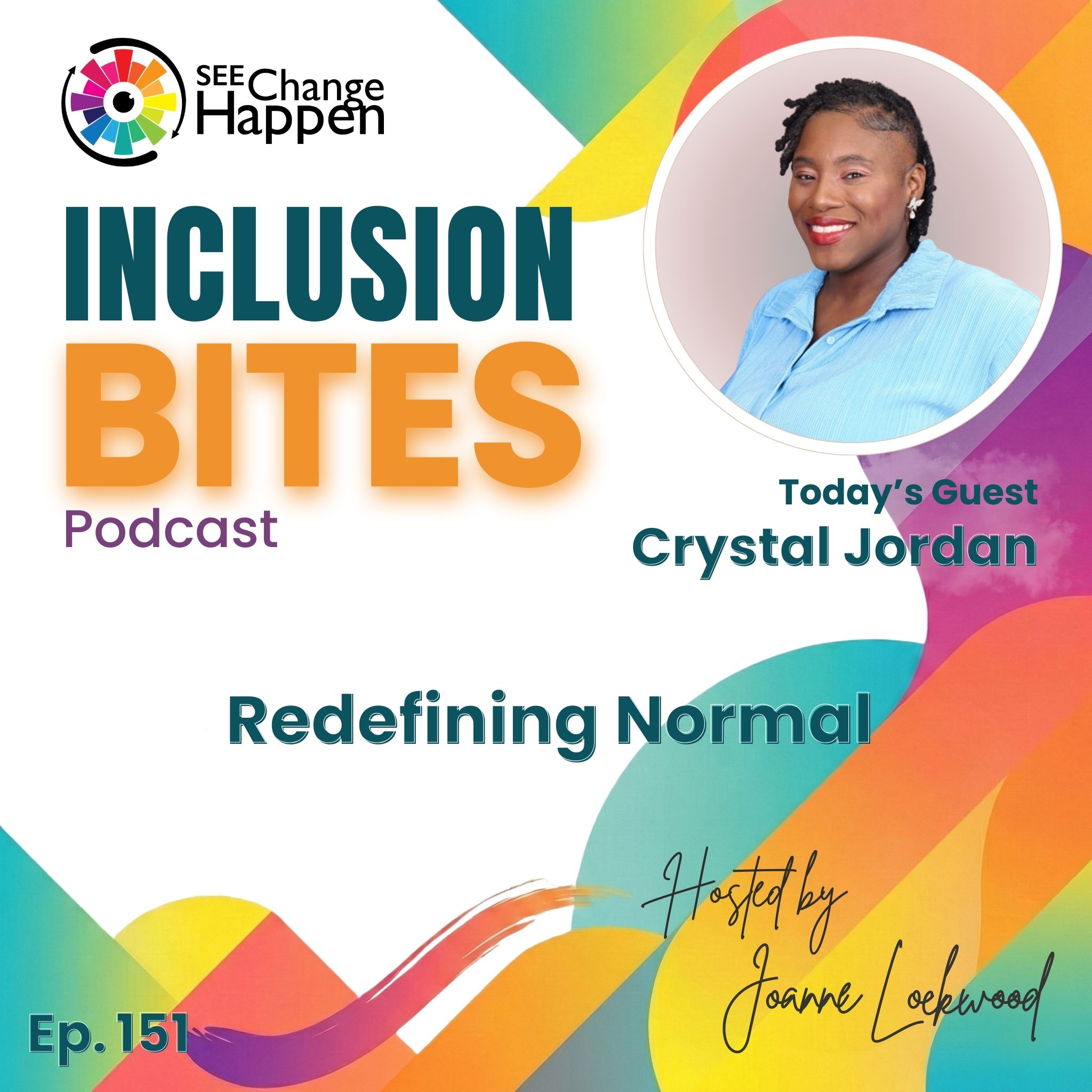
Crystal Jordan navigates the intricate landscape of autism advocacy, highlighting the importance of redefining normal, fostering independence, and the critical role of personalised education in empowering neurodiverse individuals.
In this episode of Inclusion Bites, Joanne Lockwood speaks with Crystal Jordan about lived experience identity.
Welcome to Inclusion Bites, your sanctuaryfor bold conversations that spark change. I'm Joanne Lockwood,your guide on this journey of exploration into the heart of inclusion,belonging, and societal transformation. Everwondered what it truly takes to create a world where everyone notonly belongs but thrives? You're notalone. Join me as we uncover the unseen,challenge the status quo, and share stories that resonatedeep within. Ready to dive in? Whether you're sippingyour morning coffee or winding down after a long day, let'sconnect, reflect, and inspire actiontogether. Don't forget, you can be part of the conversationtoo. Reach out to jo.lockwood@seechangehappen.co.ukto share your insights or to join me on the show.So adjust your earbuds and settle in. It's time toignite the spark of inclusion with InclusionBites. Todayis episode 151 with the title,which redefining normal. And I have the absolute honor andprivilege to welcome Crystal Jordan. Crystal is an autismadvocate, author, philanthropist, dedicated to raisingawareness and empowering families to embrace neurodiversity.When I asked Crystal to describe her superpower, she said, itis her ability to amplify unheard voices andfoster inclusion through advocacy, storytelling, andresilience. Hello, Crystal. Welcome to the show.
Crystal Jordanguest
First off, I'm so happy to be here
Joanne Lockwoodhost
We were chatting just now before we went live, and I understand you'rebased in Atlanta, Georgia in the US? Yes. I
Crystal Jordanguest
am based in Atlanta, Georgia, and itis cold here. It's too cold here. Yeah.
Joanne Lockwoodhost
I always thought Atlanta, that part of America was kind oflike hot, humid, and sticky all year round, but you've hada snow warning, haven't you? Yes. And, actually, most of our kids
Crystal Jordanguest
are out of school today. Because it's so cold, we're outthey're out of school. We all do cold in the south. No.
Joanne Lockwoodhost
So this is really unusual temperature for January, is it? Yes. It
Crystal Jordanguest
is. Wow. Hey. Who said
Joanne Lockwoodhost
climate change is not happening? It's our climate. We've definitely got some climate change there,haven't we? Oh my god. I hate it. It's so cold. That's why I have
Crystal Jordanguest
all this winter dress because I'm freezing. Yeah. Well
Joanne Lockwoodhost
well, we'll get talking, and we'll warm ourselves up in the conversation. How about that?That's that deal? I love that. So, Crystal,your journey as an autism advocate, and you also founded ZachariasWorld, which you could tell us more about, is really really inspiring from our conversations.How would you turn your personal experiences into a mission for inclusion andempowerment? What inspired you for that? So what inspired me behind any
Crystal Jordanguest
brand I'm doing dealing with autism is my son. He was diagnosed withautism when he was 2 years old. And since he's been 3,that's when I started writing books and doing so much. But I didn't callmyself a advocate until people kept calling me aadvocate. And I said, well, I guess I'm a advocate. So he's the reasonbehind everything that I'm doing because I want to create aworld where he can get jobs when he's older. He cango to college. He can have family, and people understand, yes,he's autistic, but he's more to his disability. I don't want peopleto look at autistic people and be like, oh my god. They're autistic.No. Embrace them for who they are. Treat them like a human being,and let's hire them and make sure our companies have training.
Joanne Lockwoodhost
I I titled this episode, redefining normal. Whodecides what is normal? Zacharias, he's got his own normal,hasn't he? He's got his own personality years over years. But as asociety, we wanna put a label on someone. Yeah. The autism label. Yes. Ithelps provide support for them. But what whywhy do we need to divide people up in this way?
Crystal Jordanguest
So for me, I actually do not use the wordnormal. I feel like for me, it's aphysicist. Not the not the name that you put you you titled for thepodcast. I love the name you titled for the podcast because we can dive deeperinto the conversation. What is normal? Somy son is atypical, and I look at normal likethis. You cook your chicken one way. I cookmy chicken one way. Now that's normal to you, but that's notnormal to me. We have to look at people in the same way. Wecan be we go for example, I can be from the UK, and you canbe from the UK. But we still have 2 different ways of thinkingand looking, and that's to me, that is normal. So yes.
Joanne Lockwoodhost
Yeah. So we're all normal in our own head, aren't we? We all we allthink in the same eye. I often talk to people and I've talked to peopleabout neurodiversity in the past. You see the world through your own lens, through yourown sense of self. And if if your IQ islow or you're high, the world is referenced by you.So presumably, Zachariah just sees the world around him as the world around him. Hedoesn't have any different definition of who he is than he is, who he's alwaysbeen, isn't he? Right. And I I feel like sometimes us
Crystal Jordanguest
as people, we we overlook what normal is like. SoI feel like when you see people with disabilities, people just treatthem differently, and it shouldn't even be a thing. So
Joanne Lockwoodhost
how did, you you first become aware ofZach's superpower, if you like, his autism? How did you become aware of that? Whatled you to believe that he was, atypical,to use your words? So Is that Zach in thebackground? He is back in the background. To answer your question, I did
Crystal Jordanguest
not know my son was autistic. Looking back, it was science there, but Ididn't know what autism was. I didn't know what he was doing, of course.So I started to learn, but hisdoctor at 8 months told me that, hey, I think I think Zachary isautistic. His doctor is a pediatrician and his doctorhas an autistic son. She's asked, he saw us. So thenafter that, my best friend, she said it too. And then myson's dad mom said it as well. And I still didn't believe himat that this point. And I'm like, I don't think my son is autistic.But when he turned because he was hitting all his milestones, but when he turned1, that's when I thought to pay attention. Like,he's not he wasn't walking at 1 yet. So I said, okay. That'sa delay. Not put it back. And I said, that'snot the delay. Sock for y'all. Then I also,when he turned 2, he wasn't talking. He, he, he didn't have certain words inhis vocabulary. He wasn't out 200 words in your vocabulary at the age of 2years old, but he didn't have that. So for me, thatwas concerning, and that was like, okay. I think mychild may be autistic. So I need to make surethat I figured it out. Oh, you're having a sing song in the background there,
Joanne Lockwoodhost
isn't he? He he is having the time of his life. He right now, with
Crystal Jordanguest
the audience, what you guys are hearing, you're hearing my son stem,and he's vocally stemming. There's something he cannot help. Well, he'stelling to be quiet, and he'll go back right back to it. So that's whatyou're hearing now. But he was diagnosed. I remember he wasactive. I remember going to the doctor, his doctor, and then a walk in.
Crystal Jordanguest
And the crazy thing about it, she normally is too busy to take walk ins,but she knew that I was ready at this point torealize that, hey. My son may be autistic. Sheriddled my referrals to Market Center in Atlanta, Georgia,and it was the best decision ever because Market Center is amazing.He was diagnosed on a Friday, andI took him to the fair. Never forget. I cried at the fair. I grievedwhat I thought she was gonna be. And that Monday, I wascalling speech, a b a l t, and I remembera provider saying your son was just diagnosed. Your son was justdiagnosed. And here you are calling to get himservices. That's amazing. And I know a lot of PRs are not likeme, but I knew in my head, my auntie was aspecial need teacher. I knew I had to be his advocate. I knew I hadto get for him to get where I want him to be in life. Ihave to push that and I have to be that voice because my son isnonverbal. He does not have he's not vocal like you andI. So is it anyone's listening. Zach just came on on the video here,
Joanne Lockwoodhost
and he he gave you a big hug and a kiss, didn't he? And thennipped off again. So he's such a cutie. Buthe has all these terms banned around autism, autistic,neurodiverse, ADHD. Can you explain those differentterms just for people who are listening? So I so I can understand them aswell. So all of those terms you just stated is neurodiversity.
Crystal Jordanguest
So pretty much the best way I can describe it is they just allthink differently. Look at, look at the world differently. And it, but for me, it'snothing wrong with them because they are awesome just the way theyare. We just have to learn to adapt to them and understand their wayof learning. But it's just one big umbrella of neurodiversity,and autism falls right under there. I get I get it. And
Joanne Lockwoodhost
Zach's particular variety, if you want, of of autism is beingnonverbal. He has autism and ADM. So he has attention deficitdisorder as well. So he's hyper and, intense.
Crystal Jordanguest
Super super hyper. Like, it is intense.So right now, he's quiet in a sense, but he ishyper. So what what challenges does that bring
Joanne Lockwoodhost
you as a parent? You know, you you obviously when you'repregnant, you're planning your family, you're thinking about having a child, andthen you have to learn how,as a parent, you you can adapt to an autistic child. What werethe challenges that you find in that adaptation? You know what's
Crystal Jordanguest
crazy? I love to be super transparent in interviews.When I was pregnant, I was depressed. I was not looking forward to my pregnancy.When I was pregnant, my Zachariah was a threatening miscarriage.So I was high risk. A threatening miscarriage is before you have a miscarriage.So that's before you lose the baby. But God wasfortunate enough to spare him because he's here today.So I did not really plan anything he was bornbecause I wasn't sure if he was gonna go live because they wasn't sure washe gonna come out as stillborn or come out with a disability. They evenasked I would terminate my pregnancy. Zack's joining in again if you're listening in.
Joanne Lockwoodhost
Yeah. He wants some attention. He he's like, no. I wanna be here.
Crystal Jordanguest
I'm looking at him like he's he's like this with the tablet. But, he
Joanne Lockwoodhost
Hi, Zach. He he's so funny.
Crystal Jordanguest
But that was part of my pregnancy. I didn't getattached to my child until he came out on my womb, and I put himon me. So just to be super transparent,I did I was not attached to my child while I was pregnant, so Idid not plan anything for him because mymidwife was telling me that, Hey, he may come out stillborn. He may come outwith disability. So we don't, you know, I, I just wasn't sure if I wasgonna have a healthy baby, so I didn't plan. To answer that question.And I know you like, wow, that is, that is very true.How I navigate having an autistic child. I'm not going to lie.I have, I have challenges. Oops. Sometimes I hate itbecause I remember it was a point when he had ABA, he hasspeech, he had OT and he had feeding therapy and then he hadtennis. So that's 5 different things I had to navigateto take him to. Plus I'm a single mom, me and his dad are nottogether. So doing all of this just will just by crystaland crystal alone is a lot. Like, yes, my parentsare my village. My parents help me, help me with my child, but they arenot taking him to these services because that's me. Helike, it's a lot. And I navigate it now. It's like easybreezy, but I used to be overwhelmed and stressed. Wow. Like,it's too much, but I came up with a decision that works. I honestlystopped some services to work on my mental health because it wasjust too much. He really I mean, he he sounds so adorable just listening to
Joanne Lockwoodhost
him. I I I presume he's quite amfool sometimes as well. Hisautism with ADHD must make mean that you have to havepatience for Saint. We've he he's not gonnaconform to societal's expectations around beingquiet, sitting still. I mean, it's actually apleasure to have Zac joining into the call. You know, we're why why should weexclude him here? His voice is there, so let's bring him in. Oh, there heis. I can see him again. Yeah. Sowhat what was the hardest thing you had to get to learn and adapt to?
Crystal Jordanguest
That is an amazing question. So you just taught me. What was thehardest thing I had to adapt to?Okay. The hardest thing I had to adapt to is my, theway I navigate. No. I treat my son like he's my client.So when, when I go into the school, I'm his advocate first. I'mnot his mom. When I give him services, I tell peopleout of service providers. I'm his I'm his advocate.Yes. I'm his mom on paper, but I'm telling you right now, I'm anadvocate, and I'm not I don't play with him. So the hardest partis we cutting off the mom and me being an advocate.But it had actually, it's been so easy because with me beingthe advocate first, I've gotten him so much, especiallyin the school system. I got him so much. It's amazinghow much I got him. So let me just clarify what what's
Joanne Lockwoodhost
going through my head here. So a mom, you're emotionally connected. You'rekind of involved with it. Advocate. You're logical. You're demanding.You're ensuring you're getting the best. And that that's kindof the difference is that as a mom, you may think I won't push toohard or all these kind of things. So by going advocate first, you're you'rechallenging and making sure people are listening to you to deliver the rightthings. Do I interpret that right? You are a 100%
Crystal Jordanguest
right. That's exactly how I am in in anysettings. When when I'm an advocate, it's no feelings. Thisis I'm gonna give you the loan. I'm gonna break down theethic codes. We're going to to discuss his goals. We're gonnadiscuss for ABA. We're gonna discuss his programs. Are they appropriate for him?Are they appropriate for what I want for him as a adult? That is theside you'll give me. The mom is like, oh, okay.No. No. That's that's so thisyear well, where is this 125? Last year,they, people didn't get the mom's side of me. They got the advocate side ofme. And like when my son's teacher, I love her.She gets both. Cause I, I turn it on and off on fieldtrips. I'm a or I come in todiscuss my son. He's advocate. So she sees both.I turn it on and off. It's it's it's it's, you know, or it's it'seasy. I turn it on and off all the time. Yeah. I I I
Joanne Lockwoodhost
think I haven't kept I'm not nice. I'm not nice. I know that.
Crystal Jordanguest
And when I say I'm not nice, I'm very firm. Soif I know what I'm talking about, which most of the time I do, I'mgoing to address it. I'm gonna be, I'm gonna be very, very, veryaffirming and firm. And like right now, we deal with asituation. Well, not anymore because I already addressed it. We was working with this
Crystal Jordanguest
company and this company was terrible and they did not get thenice advocate. They got the advocate thatknew everything, and that was they ended upgetting to see like, the regional director involved because itit was so bad. So it's two sides to my advocate side whenhe's calling my son. And after when I started treatment, I know I do thesame thing for a client. I'm very serious about peopletreating them how they should be treated, and they're getting the services they shouldget. Yeah. I I I hear what you're saying there. And I've just turned 60.
Joanne Lockwoodhost
My parents are are quite old now. My wife's parents are quite old. And we'vewe've learned that we need to go to advocate mode to engage withhealth care professionals, care professionals, whatever it may be. Because if you go inas as a daughter, you go in as a as a family member, and youknow they gotta push back or ignore you or not talk to you. So youhave to be brutally firm with people in orderto get not not rude, but just really, really firm. You have to know whatyou're gonna get. Because we've been through so many situations where we come awaygoing, they didn't listen or we didn't get something or we need to add weneed to get more out of this. And you learn very quickly that unless youadvocate and you're firm with it and keep on it, people will not give youthe respect or the service you need. And I think that's
Crystal Jordanguest
unfortunate when we really like dive into the word advocate.So I have a best friend who's and I'm going to advocate for her, whois my godson. What is funny is when you use the wordadvocate, it's like things change. It's like, oh, they got toadvocate. Let me get my stuff together. And I think that's unfortunate. Why not?When it comes to our special needs kids, our ADHD kids,our near diverse kids, why not? Whenwhen that kid get enrolled, why not have a welcome pamphlet talkingabout the law, talking about what you need as a parent, talking aboutresources, talking about things that will help younavigate in the school system to better your kid's life inlongevity outside of school, inside of even in the educationalrealm. What you know, why not? In high school, it should be a pathway.Hey. Your kid is neurodiverse and your kid's autistic. You got a list of collegesin United States that your kid can go to. Why not why notput these programs in place? Why does we need someonelike me who is passionate about what I'm talking about toget these things in place. Like for me, myson, I know when he get to high school, it'll mean himgonna go a different route. And I'm figuring that out, what we're gonna do. Ifhe wanna go to college, I gotta set up his IEP a different way,and you transition him to something else. Because I when I say I'm thinkingahead, I'm thinking ahead. So it's not perfect today. And we we
Joanne Lockwoodhost
are 2025, and the world ismoving on a lot. Yeah. We're doing a lot of thinking about a lot ofstuff, and services are getting more and more experience. But if you wind theclock back, I don't know, 10, 20, 30 years, Zach'slife would have been so much different. You you would not have had the supportthat you get now. Even though even though it's imperfect today, it's evolvedquite a bit. So what are the key things that they are getting right? I
Crystal Jordanguest
would say the key thing that Oxy is getting right, people get it rightI hear this a lot. It's a spike in autism. Right? I think andI and this is this is just my personal opinion, so do not let listeners,please don't get mad at me. I'm happy to see thatparents are now aware and they're getting their kids tested.And I'm happy to see that as more kids like my son getting tested andagain, their diagnosis and parents are doing what they need to do to make surethat they raise their child to be an awesome little human that they're going tobe. So a lot of people, it's a myth. I mean, a lot of peopleare like, oh, they're going to outgrow it. You don't outgrow autism.
Crystal Jordanguest
Now, one thing I wish that the world got right, United States,UK, I wish we have more resources that was,quicker. Instead of waiting having wait list, I wish that itwasn't an age out period, that when our kids turn 18or 21, they're aged out of the program. I wish it wasmore programs and more nonprofits geared towards autisticadults or neurotypical adults because they needhelp. Because, unfortunately, the reality is theirparents, me, I'm not gonna be here forever. Sowhen I leave, what is gonna be here to to push him to be thebest Zachariah or the best Mariah or the bestSarah or the best kid they could be? And those arejust random names I'm saying. But besides that, those are random names,because these are conversations that we need to have at the governmentoffice. These are bills that we need to pass.There's so many things that we have to do as a societyto make sure our, other adults are adults whohave special needs or taken care of and not takenadvantage of. There's not a drain on resources there,
Joanne Lockwoodhost
whether it's the legislature legislators, the,the healthcare professionals, society, whatever. You know, we've got obesitycrisis. We've got we just come out of a pandemic, a globalpandemic. As you as you mentioned, we're seeing a spike in autism and neurodiversity,diagnosis. It's a health care profession struggling to keepup. Are are we are we too demanding? I do think it's a
Crystal Jordanguest
struggle to keep up, but I I also think it's not really a spike. It'sreally so when you look at the data, years ago, it's 1 out ofa 100 and 60 6 kids that were diagnosed with autism. When I wrotemy book, just like you, it was 1 out of 54kids diagnosed with autism. As of 2024,according to the CDC, is 1 out of 36 kids diagnosed withautism. Right? I think now is more awareness, andmy focus is acceptance and inclusion of that. Butwhen it comes to the resources, the speech, o o t,it's too many diagnosis and not enough providers. Toomany diagnosis, not enough services. My son has been on hiswait list for speech for almost a year. Nope. It'd be yeah. It'dbe almost a year, like 2 months. That is ridiculous.That is not acceptable. And that iscrazy to see my son is waiting on a service that he needsand deserve, and I can't even get it from him because it's notenough providers in the field who are taking clients.And that's heartbreaking. So are you saying we the world needs more community
Joanne Lockwoodhost
advocates like yourself, independence, small charities, smalladvocacy groups? Maybe More resources. People within the autisticcommunity come together and become an advocacy powerhousebetween them. Is is that kind of the way things are gonna develop, you think?
Crystal Jordanguest
Still, as as as we get more parents like me to keep pushingthis topic, we're going to grow as a community. Nowit's certain things in the community. Some people in the community don't agree with likepuzzle pieces. I'm talking about an autistic or a person with anor perfect person with autism. We have bigger things to talkabout. We have bigger things to worry about, like, nonsecurity for for autistic individuals, funding for them tolive independent. Like, I feel like sometime in a community,we focus on things that are so small thatthat is that is not as important as you having a jobto pay your bills and not lose your home. I have aautistic friend, andshe's in a process that was her law. She she's nonverbal, she's anadult and she cannot pay her bills. These are conversationsthat need to be at because she needs a job where she'sable to work and not speak. Cause she cause she cause she's nonverbal.She's not speaking. If everyone be technical, she has an aid device andshe needs a, and she has seizures. So she need a work from home jobthat can be able to pay her so she won't lose her home. These areconversations that need to be had versus puzzle piecesversus, oh, you used the wrong term or that's notimportant. What is important is inclusion, jobs,hiring autistic individuals, especially nonverbalautistic individuals, jobs, having training forautistic individuals. Those are the things that are superimportant that are overlooked and overshadowed because we're talkingabout puzzle pieces. So we're talking about, oh, you used the wrong term.You should say personal autism or autistic individual. Let's talkabout something that is more important. My son isnonverbal. Would he be able to have a job? I mean, the reason why I'mpassionate about that, I lost my voicelast year, no 2023 andI didn't have a voice. I would never forgetto not talk at work. So my manager at the time sent mehome and he told me, and I quote, I will never forget this.He said, your voice is a part of your uniform. I cried.I was so mad because Iknow a little bit of ASL, a customized ASL.And I also wrote, how dare you? But I talked to my HRs over herethat, that, that important, but he gave me a glimpse.I feel like God took my voice as a dope, but I can see howit would be for my son. And that was the most powerful thing. And it'sso funny. I lost my voice at work a couple of days ago. I couldn't
Crystal Jordanguest
talk, but my management was accommodating, guestsunderstood what I wanted. I was writing, I was communicating, I was signingand it went good. Now, one man said, you sure you want to be here?And I, and I just think about whenever I lose my voice,it's the most humbling thing and experience for me.Cause I, when I lost my voice, I had to go grocery shopping. I hadto go through a drive through. Do you know how hard that was to notbe able to talk? So that's why I'm super passionate aboutjob security because my son is going to be older and I need him tohave a job. Even though 9 out of 10,I'm I'm going my company's gonna be successful. He gonna work there, and I'mgonna hire nonspeaking individuals. Buttill then, I'm not there yet. It's companies like Walmart.It's companies like Target, Apple, Google, Teslawho need to think about hiring these type of individualstoday. Not tomorrow, today. I've got a a friend,
Joanne Lockwoodhost
married couple friend, who had a a child with Down syndrome,32 years ago. So their their son is now 32,and they are older than me. They're in their mid sixties. They'revery aware of the fact they won't be able to go onproviding care and advocacy for their son for the rest of their lives.And that there was a law passed in the UK a couple of years agowhere there was a well, this has all been passed. There's anexpectation that people with down syndrome wouldn't survive past theirthirties. So most people with downs would have their parents around. They'd have
Joanne Lockwoodhost
advocacy. They'd have a combination of housing, and someone talks after them. What's happeningnow is because of the health care advances, people with, downs are now livinglonger and potentially most of them are now outliving their parents. So we'vegot a crisis with the with people with downs where they will not be ableto see that they haven't got independent living or they're not independently capableof living. The state will need to provide support and advocacy for them. I thinkwhat you're saying here is, you know, when you have your your son Zack, he'snonverbal at the age of 3 or 4 years old, however he is now.When he gets into his teens, when he gets into his twenties and thirties, youwill not be able to advocate for him for the rest of his life. Heneed as you say, he needs independent living. He needs to have his own hisown property, his own house, his own life, his own training, his education,and job. He has passion and purpose, doesn't he? So I think you'reright. I mean, I see a lot of people talk about young autistic childrenand what how we can help them. I see a lot of people who areadults, who have autism, who have ADHD, who have neurodiversity,advocating for themselves. What I don't see is adultpeople autistic people being advocated for ontelevision nationally. I don't see the awareness of nonverbalautistic people in their twenties, thirties, and forties and how wesupport them. So what you've done here is you've highlighted to me this big gulfbetween self advocating functioning people who with autism andnonverbal people who are young at the moment. What do we do? How do wehow do we how do we how do we bang our fists on the tablein in a in the right way to get people to think about the future,not just about today. If people can, if I can give Jess a
Crystal Jordanguest
glimpse, imagine if yourgranddaughter was autistic, where were you wanting to be when you passed?I feel like people had to personally place their self inpeople's shoes. And then I feel like we'll get closerto answering the problem or or coming with a bettersolution. So that's that's the challenge, isn't it? We we we haven't created,
Joanne Lockwoodhost
I would call it, an empathy bridge. We haven't got people to connect in anempathetic way to the the problems so that they become boughtinto providing the solution. I think that's that's the challenge we've got, isn't it?People just kick you off into touch because you're there advocating thesack. They can abdicate responsibility for the time being. Butyou're gonna have to keep keep keep the pressure on for the next20, 30, 40 years. That relies on you having good health, physicaland mental health, having a support network, having a career yourself. Otherwise, he willbe dependent on you for a long time. So
Crystal Jordanguest
my son is becoming independent every day fromhe just started trying to brush his teeth. He gets his self dresseddown, put his own shoes and socks on. So, eventually, as he getolder, I'm gonna teach him how to cook because I need him to be independent.That that is my biggest focus is him being independent.
Joanne Lockwoodhost
Do you see other people who have autistic childrenhaving same impetus as you? Are you I presume you'renot unique in this. These are proven techniques. Andhow do we help the wider understanding of of how to do this?
Crystal Jordanguest
I believe that autism is one word. It's a million different stories. Icame up with a came up with a quote, but that's what it is.But most all of the parents I know who have autistic kids,they wish for the same thing I wish for, which is their kidsbeing independent, their kids thriving and living an independent life.And we watching them grow into the also individual that they are. Yeah. And that
Joanne Lockwoodhost
that's no different to any child. You know? I have2 children, and I was there's nothing prouder than tosee our 2 children go to university, growup, get married, have a have their own house, property. Andyou feel like you you as a parent have then pushed them into the world,and your your job's never done, but at least you feel that you've achieved amilestone of independent children. They've they're now functioningadults in their own right. So that's quite a challenge asa parent regardless of whether they're autistic or not. I love that.
Crystal Jordanguest
So I feel like as parents, we are like we are managers to littlekids, little people. And then as they get older, we're still theirmanager, and then we kinda get demoted as they getolder because they're not listen to their managers no more. Like, whatever. I'm a girl.I can do what I want. So I look at it as me being hislittle manager right now. And then once he get older, he's gonna managehis own life, and I'm gonna become the assistant manager. Then I know that analogyof, like, crystal. Yeah. I like that. So you're his
Joanne Lockwoodhost
manager. You know? I'm thinking about boxing promoter and manager that Isuppose a boxing promoter, you're the advocate in that role. As a manager, you're therekeeping you on track, and then you're gonna get you're gonna get fired. Feel likethe apprentice. You get fired. Oh, yeah. And I'm gonna become assistant manager.Yeah. He don't need you no more sort of thing. Yeah. Right. And once
Crystal Jordanguest
you're done here yeah. I'm gonna become a shift leader. Soit's like Yeah. I love that. I love that. So
Joanne Lockwoodhost
your role is to become obsolete, and that's that that will give you no morepleasure than being having Zach going out there and and notneeding you as much. Okay. You're still always gonna be his mom. He's always gonnaalways have a sweet spot. You always gonna wanna hug him, whenever you can.So yeah. But he he has his own life and passion,purpose. Yeah. We all want that. Fantastic.So so you set up Zachariah's World, which is, howwould you describe it? Is it a charity? Is it just a a a mission,a brand, or No. Zachariah World is not a charity. It's a for
Crystal Jordanguest
profit business. It is warehouse all my books because Ihave wrote almost 20 books or if not more. And they're allabout, either autism or inclusion or, I alsowrite for moms, a coloring book for moms and a safehaven for moms as well, a planner for moms. So that brand ismy autism friendly brand that you can buy apparel,and you can buy books for your organizations, your classrooms, yourschools. So which gives a bit of depth into what sort of so you
Joanne Lockwoodhost
mentioned a lot of different books there. So there are some specific for workplaces, somespecific for parents, schools. SoYou have a whole bunch of books. So my books are, one of my
Crystal Jordanguest
first books that I promote the most is called Just Like You. That book isa great introduction to what autism is. And I recommend buying that book for yourschools, your organizations, or giftsbecause it's a good tool. Other books are just fun. Like Iam also. It's talk about positive affirmation for autistic kidsbecause I want autistic kids to understand that they are awesome. They areenough and they are gifted and they are loved.So the older other books I've created, I've created coloring books.And then for the moms, I have created coloring books for us becauseit's therapeutic for us to color. For me personally, like when I'm going Inever forget I was going through something. And when I, worked in mycoloring book and I started to color and it just I feel bad when Icolor, even though my hands are cramp up now. But I like to color,so I made a coloring book for moms. And that brand is justis that. It's meant to to educate, havefun, and that's it. Is it is it
Joanne Lockwoodhost
lonely being the parent of an autistic child?Do you feel that there's not enough knowledge? It's a difference betweenbeing lonely and being alone. Okay. You're not alone. You have people around you. Butyou can be lonely where people don't understand you. You don't understand the challenge. You'vegot no one to offload. You've got no one to to share your burden. Isit can it be lonely? I wanna say I was in a place
Crystal Jordanguest
one time where it was lonely because I I didn't I didn't I don't likeI don't vent to people like that when it comes to my son, butI'm not there. I wasn't there long because I ended up findingcommunities on Facebook and finding other women who haveautistic kids that I can call and talk to them. They're like, Hey, I'm goingthrough this. And we talk about it, but I'm, I'm more solution and strategybased. So for me, I'm notalong or lonely. Dating is interesting because I'm veryparticular who I date because I do have an autistic kid and he isnonverbal. So I'm like, okay. That that's in my lifeis where I feel a lot. Okay. So, yeah, it's you feel that you have
Joanne Lockwoodhost
to declare Zach as part of a relationship. Is you're you'renot dating you, you're dating both of you. Dating both of us,
Crystal Jordanguest
but not originally. Like, I have a boundary. Like,don't I don't want you talking about my kids too quick because forme, that gave me weird vibes. So it's hard to navigate andbe single and, haveautistic kid. But I'm not actively looking, so itis what it is. I suppose at the moment where you are with this
Joanne Lockwoodhost
is Zach has to come first in any relationship.
Crystal Jordanguest
Any relationship, he has to always be first. And he
Joanne Lockwoodhost
has, I don't mean this unkindly, but complex needs. He has complex emotions. Hehas complex so somebody has to join you in the advocacy battle. They can'tcome on as a as a bystander. Right. They have to understand some days
Crystal Jordanguest
I'm I'm gonna have to go to something. Like, we may have a datetoday, but something may happen. I have something to do. Then I'm alsobig at being a part of his being a part of my son's life.So I'm not saying that the person I would talk to wanna wanna comefirst, but I can't will always be first. Even when theybecome my dope, he will always be first. Some of that's a
Joanne Lockwoodhost
mother's instinct anyway, isn't it, to protect your child? Andmoms and their sons are even more tightly bonded. So, yeah, I II get that completely. We obviously, you just said you're you're onthe market for what I've got to hope. So you you have you have friendsand with autistic children, presumably,who are married or or living as a couple, and they're navigatingthis as a couple. What what about if they have other children?How how how sometimes is it if you've got a,an a a typical and an atypical child, it mustbe must be hard to ensure that your typical childdoesn't feel pushed out or marginalized from their atypical child withautism, where you're putting all your all your time into that one child. Okay.
Crystal Jordanguest
So all of my main autistic moms, friends,we're all single. Oh, I only know one who ismarried. She don't live in Schlippen, Virginia.And she navigates fine with her. She has oneatypical kid, and her other kids are neurotypical. Neurotypical issociety standard and normal. I don't because I don't use the word normal. I useneurotypical, and she navigatesthrough having it. And she's and she's a advocate, and she's amazing. Now myother friends who are single as myself and they haveautistic kids, one, she only has one. She I think she navigatesvery fine. The other one, she she has2.1 is autistic, 1 is not. And I feel like she separates itpretty well even though she she used she used to be married,but now she's divorced. So I think she's navigatingbeing a divorced woman and raising a autistickid by herself. They're all in differentit's funny saying that out loud. We're all in different differentspots in our life, but we love on our our kid. You used
Joanne Lockwoodhost
a an acronym in passing a bit earlier. I think I think you saidIEP. Can you explain what an IEP is andwhy it's important for that? So IEP is a
Crystal Jordanguest
individualized educational plan. That is something that you have in place inyour school or a 504 plan. So those are similar,but they're different. And, 504 have more accommodations.I am actually an IEP advocate as well. So when it comes to myson and why it's so important and the reason why, cause hehe's categorized in 1 to 13 categories, which is autism.So with him being categorized and he has certain delays, I sayweaknesses sometimes, sometimes I say delays that we have to work on andnavigate. So for me,so as of right now, my son, he cannot write his name. So one ofthe goals is him learning how to write his name, but also havingOT services at school that he deserves. And Iknew that the data would show that, which he is OT at schoolnow, but I always knew that data was going to show that.So we have an IEP, you know, your laws, youknow, you need to go in with an open mind. Andif you can afford an advocate or if you know, an advocate who's free,had them come a part of the IEP meeting and add themto your team because you're one big team. But IEPs are very importantwhen you have a special kid. Yeah. No. I I get that. And too often
Joanne Lockwoodhost
what we do is we we try and apply generic solutions.But we need to recognize that we need individualistic. And you say here, theindividualized education program allows us tocreate something just for Zach or just for another autistic child, not treatthem like everybody else because age you know, typicalchildren tend to be grouped under a big banner of they all get treatedthe same. But neurodiversity autism areare so individual. Zach's flavor of autismis different to another child's flavor of autism. They may have similar attributes, but it'svery individualized. And you have to what you're saying here is recognize whatZach needs, not what stereotype of an autisticchild needs. Right. And that's the point of a IEP.
Crystal Jordanguest
Come on, man. I told you it's cold. That's the point. Putting a blanket on
Joanne Lockwoodhost
to leave herself warm. She's not used to the the cold in the south.
Crystal Jordanguest
I'm not. It's so cold here. I can't wait till thesummer. But, to answer your question, the IEP,every person IEP should be, it's, it should bededicated to that child is not to make accommodations for theschool or the teacher is to make accommodations forthe child. And those plans should be smart goals. So when you have yourIEP meeting, if your goals are not a smart goal, which is a strategywith making sure the goals are very small. S is forand I have a okay. So before I say the word, y'all, I have aspeech impediment and I may be also snick, not sure yet, but S isfor specific. I have a problem saying that. M is for measurable, Ais for the attributes, R is for the, is beingrelatable and T is for taught. So you're planning your kidIAP meeting, it should not be, the goals should not be opinionbased. It should be a smart goal. And yeah, and then lookup some books like right wall. They are attorneys who, who havebooks and trainings for parents to learn moreabout IEP, rights and laws. There's so many lawsinvolved in IEP. The IEP is legal buying a contractand most parents don't even realize it's a contractbetween you and the school. So yeah. So with myson and just in general, I made sure that his goals made senseand I make sure they match who he is. And are they are they arethey are attainable? Can he attain this goal?Can he reach it? Or are we are we putting the expectation for himthat's too high? And I I presume that the contract is both ways. So you
Joanne Lockwoodhost
as a you as a mom, you as a parent have to upholdyour side of the education and me. If he needs work at home, you're partof that. It's not just just the school. The contract is both ways, isn't it?
Crystal Jordanguest
So one thing I like about me, I always ask for a whole schoolcommunication guy. I'm a whole school communication. I'm sorry. Because since heis nonverbal, I need to be, I want to know how they went to school,what he did today, what was going on at school. So these are thingsthat I personally ask for as accommodation that he's put in hisIV. I'm curious. What makes Zach laugh and and
Joanne Lockwoodhost
giggle and and and have fun? What what does he do?
Crystal Jordanguest
Oh, God. I got a story for y'all. So last week, theteacher called me. I'm at work. The teacher was like,we can't find Zach's shoe. See, he's takehis shoes off and they said, every time we look for it, he laughs.So the school had to get him some brand new shoes. They said, send ithome with some new shoes. Guess what a shoe was? And his school
Joanne Lockwoodhost
bag? No, the shoe was up under all of the
Crystal Jordanguest
coats in a closet. He put it in thecloset up under all those coats that like the school alwaysgive the kids who can afford it. Like shoes, clothes,coats. Yeah. So he hit the shoe under there andthey say every time he looked, he looked for the shoe, they looked in thetrash. They said Zach would just laugh and like he was thefunniest thing. That boy is funny. He thinks hethinks everything's funny. I favor. So the stereotype
Joanne Lockwoodhost
would be that because he's nonverbal because he's has autismthat you wouldn't have humor. You wouldn't have that level of intelligence. So justbecause he's nonverbal, just because he's autistic doesn't mean to say he hasn't aperson with a personality, a cheekiness, a mischievousside as well. Also, most people what what people think
Crystal Jordanguest
is because he's not verbal, he don't understand. Andthat's not true. So he's able to he can interpret. He can he he
Joanne Lockwoodhost
understands language. Right. Can he can he read atall? That is to be determined. I don't
Crystal Jordanguest
know if he can read or not. Part of me thinks so, but I don'tknow. He may not gonna recognize words, but not not read. Does that make so
Joanne Lockwoodhost
he could he can tell what that means. Maybe biscuits or cakeor something. I don't know because I that's something I'm trying to
Crystal Jordanguest
figure out as we speak. So I I don't know if he can read ornot. This one, I don't know. How old is he now? 7. He'd be8.7? He'd be 8 or 20. Oh, blimey.
Joanne Lockwoodhost
Uh-huh. So yeah. That I'm just trying to think back to when ourchildren were 8. Both our children had, developmental differenceswhere it turned out our son had dyslexia andour daughter had a different sort of dyslexia. We struggled to get oureducation system to recognize that. And also we struggled asparents to identify with it. We we were getting very frustrated when ourson couldn't do his alphabet, or we're holdingflashcards up with a for apple and b for bear or something. And
Joanne Lockwoodhost
he he he just couldn't get a for apple. And we just didn't understand it.We were getting very frustrated with him. And when we finally had this diagnosisfor, dyslexia, we suddenly understood why he's not able torecognize letters and shapes and things. But it took us many years to that.So when he got to about 8, I think we started realizing more. We evensent him to an optician to have his eyes tested and they gave him glasses,but he never would wear his glasses. Then we realized what was happening was theeye test is all about picking letters off a chart because he couldn'trecognize the shapes in the letters. His dyslexia was stopping him past the eye test.So they assumed he was stroking with eyes. In reality, it was hisdyslexia. So, yeah, there's a lot of lessons that we had to learn about witha child who wasn't developing in the way that you expect themto. And you have to overcome this the knowledge gap in your own selfand and educate the people around you. It's a challenge, isn't it? Yes. It
Crystal Jordanguest
is. So what what surprised you in the last year with Zach? You
Joanne Lockwoodhost
know, he he's getting older. He's learning stuff. Obviously, this cheekiness andhiding his shoe is quite quite an adventure. But what what other things has hehas he surprised you with? This goes down so simple to somebody
Crystal Jordanguest
else. What surprised me this year well, so farwith Zachariah is him getting dressed, him putting hisshoes on, him knowing when I was in the bathroom to get dressed, he knowI'm leaving. So he would go downstairs and get dressed and pull out hisclothes. He'd be matching, for his shoeson. He'd be ready. Like, I'm ready. And for me,I'm like, that's that's independent. And that's what I want for you. So that
Joanne Lockwoodhost
that beginning of independence where he does stuff on hisown, that's that's what's really inspiring you. Yep. That is that makes my
Crystal Jordanguest
day. I can see that. Yeah. I can see that too. It's, all of your
Joanne Lockwoodhost
advocacy, your hardware, the IEP, all of these sort of things are startingto show this progress. And Right. It gives youthe faith that things are working, doesn't it? Yes, it
Crystal Jordanguest
does. They show that that's my crazy strategies. They're notreally crazy, but my strategies are really working. So what what else did you are
Joanne Lockwoodhost
you planning for this year and beyond? You know, you've got yourZachariah's World. You've got your books, your 20 odd books, and some of the advocacywork you're doing and building the communities. What other things are you working on?
Crystal Jordanguest
So I'm dropping the autism awareness in NeurodiverseMagazine. Is dropping April 2,25. I'm super excited about this because I'm focusingon not just autism, but all disabilities. So this is about tobe a powerful magazine. This is about to be amagazine that shapes how we look at other individuals who don't looklike us or act like us or think like us. And I'm also workingon writing my book on how to be an advocateand I'm breaking down my strategies because it was highly requested.And then last but not least, no, not last, not least. I havea couple of days. I'm working on a community for moms. And now lastbut not least, I'm working on a mocktail recipe book. Cause I don't drinkalcohol. Not really. It may be like super rare,but I don't drink alcohol. So I'm coming out with a, mocktail recipebook. I don't drink either. I gave up 3 years ago. I've been sober now
Joanne Lockwoodhost
for 3 and a bit years. So, yeah, it's a good good thing for me.But, that sounds amazing. There are people gonna be listening to this who either knowsomeone with an autistic child. How can they,a, sorry, help and and help the parents, the, you know, theperson they're talking to, the father, the mother, whoever maybe you're talking to. How canpeople support them most effectively? I'd say
Crystal Jordanguest
be understanding, be patient, and offer, hey. Do you need do youneed time off? Do you want me to come babysit your kid while you justrun to the store for an hour or go running or dosomething? Sometimes we just need a break. So
Joanne Lockwoodhost
How how can we help if if I was living next door to youand I I came to you and said, Crystal, you need a break. I needto help. I'm kinda nervous. I'm worried abouttaking on that responsibility for for Zachariah for an hour, 2hours because I don't have any experience of autistic children myself. Howcan I overcome that anxiety that I might have in being able to reach outto you? I would recommend come sit with
Crystal Jordanguest
me for a couple days out of the month or out of the week orwhatever, whatever your ability is. And you can see how henavigates or how she navigates and we can learn,Hey, this work for him. This doesn't work for him. My son is all abouta blanket and a tablet. As long he got a blanket overhim and a tablet, he'll be fine in his snacks.He's really easy to watch. So it's his happy place? His happy place isout of her blanket and with his, tablet and somesnacks. Does he again, I I'd be worried that you give him the
Joanne Lockwoodhost
instruction. Give him his blanket. Give him his tablet. He'd be fine. But what ifhe isn't? What what what can go wrong? And Just call me, and I'll
Crystal Jordanguest
come back. Go ahead. Yeah. Obviously. Obviously. Yeah. Good plan.
Joanne Lockwoodhost
Because I I'd be nervous, and I I I was really nervoustaking our 2 children home for the first time. We take them out of hospital.We take them home. We put them on the bed. What do I do now?Will I break this child? And so, yeah, we we could do get nervous aboutstepping out of our comfort zone sometimes, don't we? Yeah. We
Crystal Jordanguest
do. Because people you know, you said me
Joanne Lockwoodhost
people get confused about the language. As you said, if we're worried about the littletiny thing, are you an autistic child or child with autism, all these kind ofthings we talk about. But there's a there's a lack of knowledge.We all we all live in our own little echo chamber. We all blinkers on.We hear what we know. Anything outside of that, we we tend to beblissfully unaware of. And I think, hopefully, things we talked about todaywill give people some more confidence to find out more, to, to investigate,to read some of your books. But, yeah, there's, there's definitely a nervousness. SoI was, I was nervous around our friend downsyndrome child for a while. Because he was unpredictable.He was hard to read, hard to plan for. There was noway of having a conversation in the same way. So you have to learn.Try not to be patronizing. You don't talk to them as if they're a smallchild. You have to sort of treat him as a as an adult because he'snow an adult. You have to treat him as a teenager when he's a teenager.And if you don't care for without that exposure, without that learning, withoutthat advocacy, you could become very nervous and hold back. And I think that's whatpeople are worried about getting it wrong. Right.
Crystal Jordanguest
But give yourself grace and patience. Grace andpatience is all you need. Grace and patience. I like that. Yeah. Be kind to
Joanne Lockwoodhost
yourself and reach out and learnand grow. You don't no one's gonna criticize you for trying, arethey? And if they do criticize you, then just don't
Crystal Jordanguest
help them no more. Yeah. Because so we've been chatting around
Joanne Lockwoodhost
chatting away for, well, over an hour now in the green room and before wewent live. And we had Zac joining the conversation as well, which isincredible. How do people get ahold of you? What's the best platform? And do weGoogle you? My the best way you can get in contact with
Crystal Jordanguest
me is I am Crystal Jordan on all platforms. And no matter whatplatform it is, you can just type in I am Crystal Jordan. My name isso easy. It's I m, and it's c r y s t al, Jordan, j o r d a n. I'm sure, and I'll put all the
Joanne Lockwoodhost
details in the show notes. I think you've given me some links, which I'll,in the, in the forms of zachariahsworld.com so wecan we can signpost all that for you. And, no, it's been aabsolute pleasure talking to you. I'm finding out more about Zach,finding more about you. And I'm certainly more educated aroundautistic children than I was before. Oh, thank you. And hopefully, I'll be lessnervous about being around people, parents who have haveautistic children and be able to offer some support. Thank you. But
Crystal Jordanguest
yeah. Yeah. Yes. Become an ally and just keep doing what you're doing. Telling the
Joanne Lockwoodhost
stories, normalizing the conversations without using the word normal. Yeah.It's, creating the awareness out there. We all I think we can all takepersonal responsibility for raising awareness Yes. And doing our owneducation. I agree. And thank you so much for just having me on
Crystal Jordanguest
your platform and having this amazing conversation. Crystal, thank
Joanne Lockwoodhost
you very much. As we bring this conversation
Joanne Lockwoodhost
to a close, I want to express my deepest gratitude toyou, our listener, for lending your ear andheart to the cause of inclusion. Today'sdiscussion strike a chord. Consider subscribing to InclusionBites and become part of our ever growing community,driving real change. Share this journey with friends, family, andcolleagues. Let's amplify the voices that matter.Got thoughts, stories, or a vision to share? I'm allears. Reach out to jo.lockwood@seechangehappen.co.uk,and let's make your voice heard. Until next time. Thisis Joanne Lockwood signing off with a promise to return withmore enriching narratives that challenge, inspire, andunite us all. Here's to fostering a more inclusive world oneepisode at a time. Catch you on the next bite.
The Power of Advocacy in AutismChallenges of Raising an Autistic ChildInclusion and Independence
Joanne Lockwood is joined by autism advocate and author Crystal Jordan for a conversation about what it really means to “redefine normal” through the lens of autism and neurodiversity. Crystal shares how her son Zachariah’s diagnosis shaped her mission to amplify unheard voices, educate others, and push for environments where autistic people are treated with dignity and supported to thrive.
They discuss the practical realities of raising a nonverbal autistic child, including navigating multiple therapies, dealing with long waits for services, and the emotional load of parenting while advocating. Crystal explains why she often enters schools and service settings in “advocate mode,” and why families shouldn’t have to fight so hard to access what their children are entitled to.
The episode also explores long-term inclusion: preparing children for independence, the gaps in support once autistic young people become adults, and the need for employers and institutions to make work and life accessible to non-speaking and higher-support-needs individuals. Along the way, Crystal shares everyday moments that reveal Zachariah’s personality and progress, and offers concrete advice on how friends and communities can support parents with understanding, patience, and practical help.
“What's happening now is because of the health care advances, people with, downs are now living longer and potentially most of them are now outliving their parents. So we've got a crisis with the with people with downs where they will not be able to see that they haven't got independent living or they're not independently capable of living.”
“What I don't see is adult autistic people being advocated for on television nationally. I don't see the awareness of nonverbal autistic people in their twenties, thirties, and forties and how we support them.”
“We haven't created, I would call it, an empathy bridge. We haven't got people to connect in an empathetic way to the the problems so that they become bought into providing the solution.”
“It must be must be hard to ensure that your typical child doesn't feel pushed out or marginalised from their atypical child with autism, where you're putting all your all your time into that one child.”
“The individualized education programme allows us to create something just for Zach or just for another autistic child, not treat them like everybody else because... neurodiversity... are so individual.”
The transformation from being a mother to becoming a staunch advocate for an autistic child.
Understanding the concept of "normal" from a neurodiverse perspective.
The importance and impact of an Individualized Education Program (IEP) for children with special needs.
Overcoming challenges and the importance of patience and persistence in securing appropriate services and support.
The significance of building a supportive community for parents of autistic children.
The crucial role of job security and independence for neurodiverse individuals in adulthood.
Practical ways for friends and neighbours to provide support and understanding for families with autistic members.
One thing to remember
The essential takeaway from Episode 151 titled "Redefining Normal" is the importance of redefining societal norms around neurodiversity and the critical role of advocacy in ensuring that individuals with autism, like Zachariah, receive the support and inclusion they deserve. The conversation reveals the necessity of creating a world where neurodiverse individuals are embraced for who they are and highlights the need for sufficient resources, personalised education plans, and community support to help them thrive independently.
Questions this episode helps answer
Crystal Jordan spoke about initially not identifying as an advocate until others labelled her as one. How can the distinction between personal experience and formal advocacy impact the effectiveness of one's efforts in promoting autism awareness and inclusion?
Crystal Jordan mentioned her preference for the word "atypical" over "normal." How does our choice of language influence societal attitudes towards neurodiversity and inclusion?
Reflecting on Crystal's journey with her son, Zachariah, what were some of the signs that led to his diagnosis of autism?
Discuss the significance of Individualized Education Programs (IEPs) as highlighted by Crystal. How can schools better support children with autism through personalised educational strategies?
Crystal mentioned building communities among parents of autistic children. What are the benefits of these support networks, and how can they alleviate some of the challenges faced by parents?
Examine Crystal's concerns about the future independence of autistic individuals, particularly nonverbal adults. What measures can society implement to ensure continued support and opportunities for these individuals as they age?
Explore topics
Ideas from this episode
The Power of Advocacy in Autism
In my recent conversation with Crystal Jordan, we delved into the transformative power of advocacy, particularly as it pertains to autism. Crystal's journey as an autism advocate and founder of Zachariah's World is truly inspiring, rooted deeply in her personal experiences with her non-verbal autistic son, Zachariah.
Challenges of Raising an Autistic Child
The myriad challenges faced by parents raising autistic children. Crystal's candid reflections highlighted the emotional and practical hurdles she navigates daily, from securing necessary services to balancing personal well-being with her advocacy efforts.
Inclusion and Independence
Crystal and I delved into the importance of creating pathways for independence for autistic individuals. Crystal shared her hopes and efforts in ensuring her son, Zachariah, achieves independence and is afforded opportunities for a fulfilling life.
Learn
Frequently asked questions
What inspired Crystal Jordan to become an autism advocate?
Crystal Jordan became an autism advocate because of her son, Zachariah, who was diagnosed with autism at a young age. She wanted to create a world where he could grow up experiencing inclusion and acceptance, have job opportunities, and live a fulfilling life. Her advocacy efforts are driven by her goal to amplify unheard voices and foster acceptance for people with neurodiversity through storytelling and resilience (Transcript: [00:03:13]).
What is the main purpose of Zachariah’s World?
Zachariah's World is a for-profit business founded by Crystal Jordan. It serves as a hub for her books and educational materials about autism and inclusion. The brand offers apparel, books, and other resources aimed at educating and supporting the autistic community and their families. It focuses on raising awareness and promoting neurodiversity (Transcript: [00:33:27]).
How does Crystal Jordan differentiate between being a mom and an advocate?
Crystal Jordan separates her role as a mother from being an advocate to effectively support her son's needs. As an advocate, she is firm and logical, focusing on securing the best possible services and accommodations for Zachariah. This approach ensures she can challenge and demand appropriate support without the emotional involvement that often accompanies parenting (Transcript: [00:14:45]).
What are some of the key challenges Crystal faces as a parent of an autistic child?
Crystal faces numerous challenges, including managing multiple therapies and services for Zachariah, such as ABA, speech therapy, and occupational therapy. As a single parent, coordinating these services on her own can be overwhelming. She also highlights the importance of mental health, noting that sometimes prioritizing her well-being involves reducing the number of services to avoid burnout (Transcript: [00:12:30]).
Why does Crystal Jordan push for individualized education plans (IEPs)?
Crystal advocates for IEPs because they provide tailored educational strategies and accommodations specific to each child's unique needs. An IEP is a legal contract that outlines the goals and services necessary to support a child's educational development. For Zachariah, it includes goals like learning to write his name and receiving necessary therapies at school (Transcript: [00:43:32]).
How does Zachariah demonstrate his independence according to Crystal?
Crystal is proud of the small yet significant steps Zachariah has taken towards independence. For example, he has started dressing himself, putting on his shoes, and preparing to leave the house without prompts. These actions, though simple, are milestones demonstrating his growing ability to perform daily tasks independently (Transcript: [00:48:25]).
Share this episode
Heard something worth passing on? Send this conversation to someone who needs to hear it.