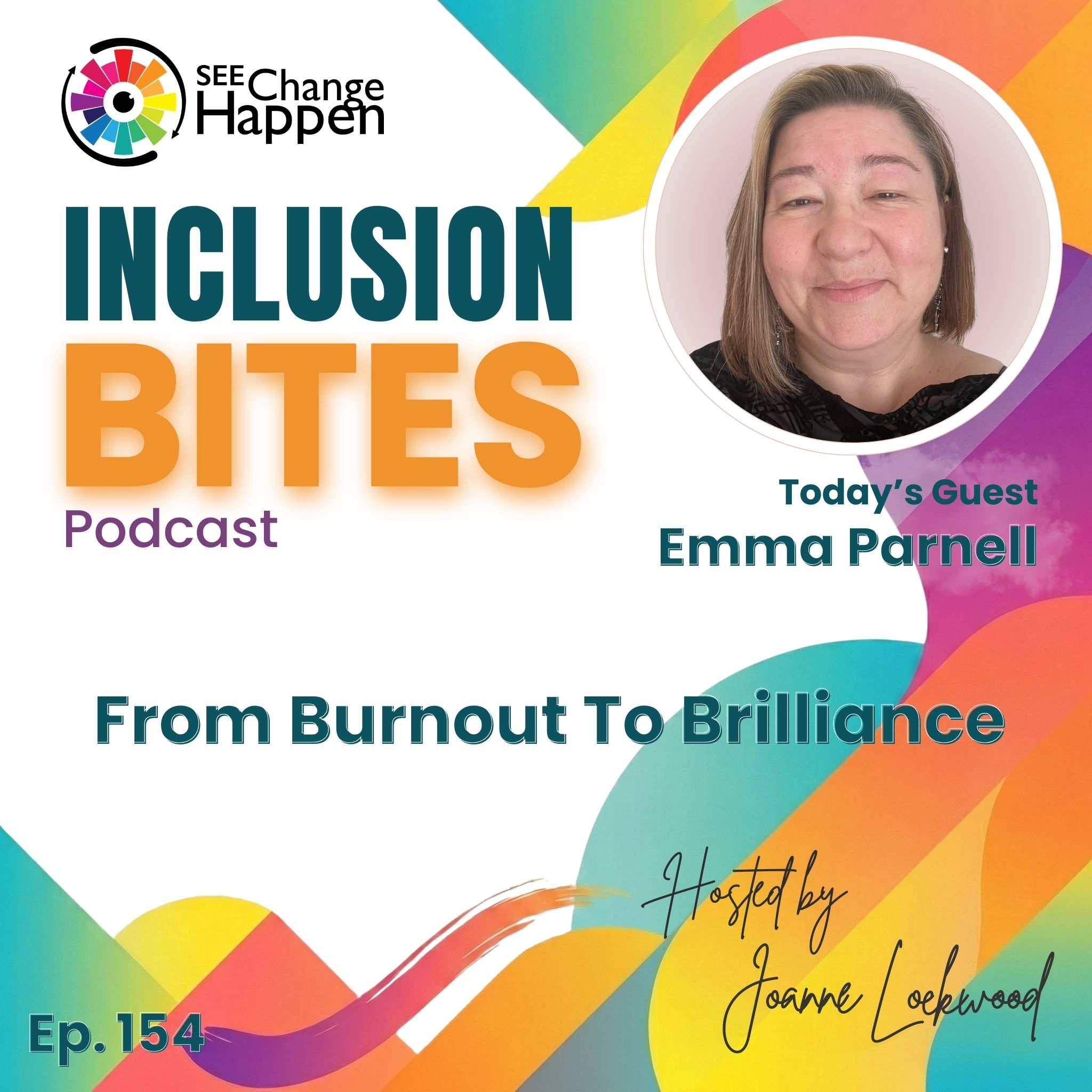
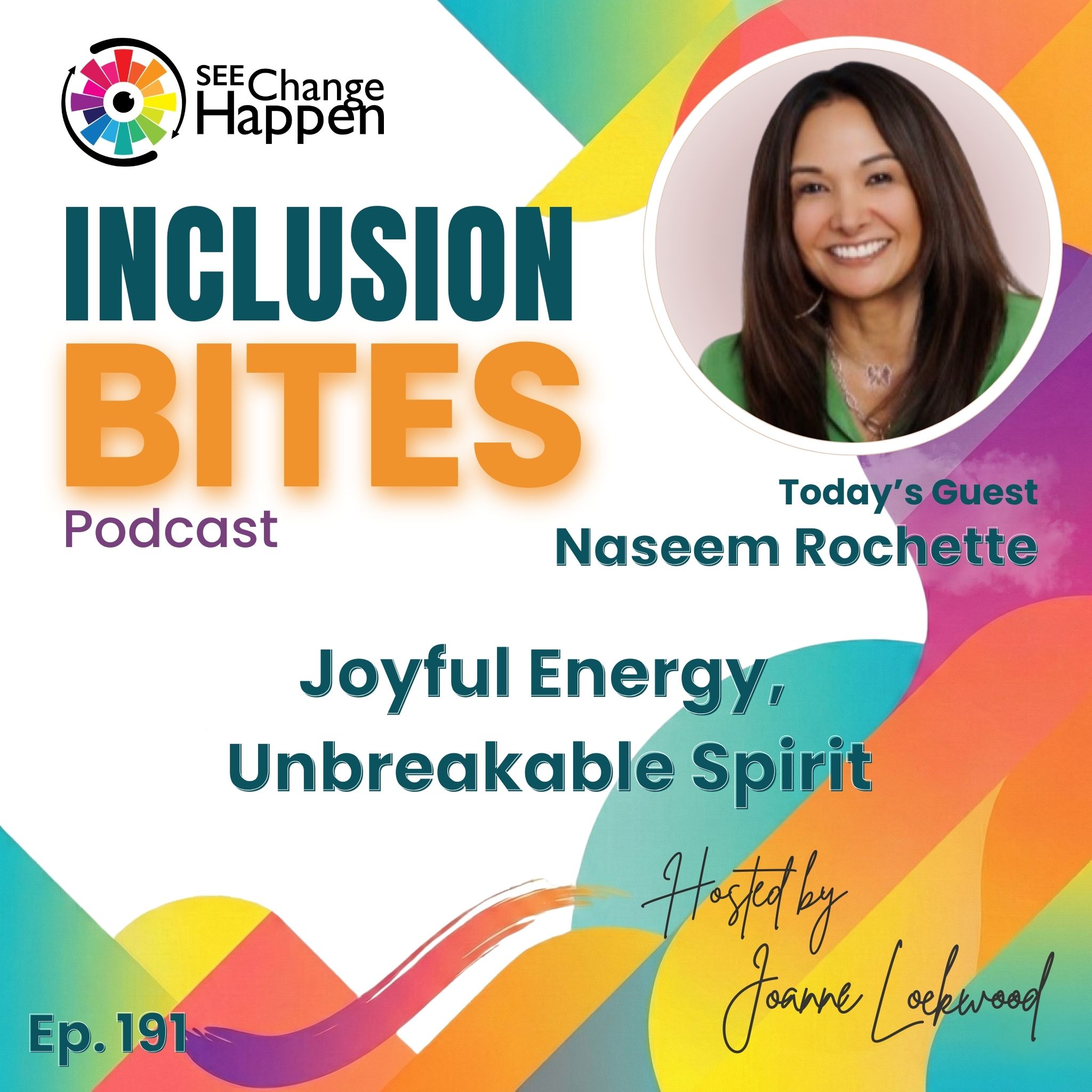
Emma Parnell shares her transformative journey from burnout to brilliance, emphasising the vital role of self-care, emotional intelligence, and fostering inclusive and psychologically safe environments.
In this episode of Inclusion Bites, Joanne Lockwood speaks with Emma Parnell about mental health wellbeing trauma.
Welcome to Inclusion Bites, your sanctuaryfor bold conversations that spark change. I'm Joanne Lockwood,your guide on this journey of exploration into the heart ofinclusion, belonging, and societal transformation.Ever wondered what it truly takes to create a world whereeveryone not only belongs but thrives? You'renot alone. Join me as we uncover theunseen, challenge the status quo, and sharestories that resonate deep within. Ready to divein. Whether you're sipping your morning coffee or winding downafter a long day, let's connect, reflect, andinspire action together. Don't forget, youcan be part of the conversation too. Reach out tojo.lockwood@seechangehappen.co.ukto share your insights or to join me on the show.So adjust your earbuds and settle in. It's time toignite the spark of inclusion with InclusionBites. And today is episode154 with the title, from burnoutto brilliance. And I have the absolute honor and privilegeto welcome Emma Parnell. Emma is an l and dmanager dedicated to fostering safe, inclusive
Joanne Lockwoodhost
environments where people can thrive and unlocking theirpotential to embrace their differences. And when I askedEmma to describe her superpowers, she said it is her resilience,and she is inspired by people who have faced their toughest times headon and won. Hello, Emma. Welcome to the show.
Emma Parnellguest
Hi, Joanne. Thanks so much for having me. I'm really delighted to be joiningyou today. And I'm excited to talk about all the things that I'mpassionate about around learning and development and how we make sure that everybody'sincluded and no one's left out. Even the even the smallest of voicesneed to be heard. You're so right. And, you reminded me
Joanne Lockwoodhost
when we first came on in the green room that we met tail end oflast year at, at L&D Forumin, London, if I remember right. That's right. Yeah.
Emma Parnellguest
Yeah. It was one of the, connect events held at LondonWall. Yeah. And we got chatting. We got introduced by a mutual colleague, mutualfriend, and, yeah, we got chatting. And one of the really interestingthings I found out about that day and certainly talking to youis, you know, the drive for inclusion foreverybody. And I've I've certainly seen over my 30something year career. I can't remember exactly how manysomethings that is, but certainly 30 years. I've seen a lot of changesin learning and development and a lot of changes in the working environment.And, you know, it's it's changed an awful lot in terms ofbeing able to make efforts to include more peoplewith, you know, differences, be that neurodiversity orother challenges that might be going on disabilities, etcetera. Andit's interesting that there's I feel there's still some way to go. Butpeople are generally trying to embrace and trying tounderstand what diversity and inclusion really means and how they canjust, you know, make sure that they employ the best of people. You know, particularlya question that you asked me was what's my superpower. And and I love thatword superpower because I think everybody's got their ownand it's, it's the responsibility of,child perhaps as well as learning and development and people whomanage people to find out what the superpower is ofthe person that they're hiring, because they can surprise you. And
Emma Parnellguest
I think that diverse teams, which is not anew concept, but it's something that's still so massively important.Diverse teams where you have people with differentdifferent approaches to things. And you know, you'llhave, in most teams you have your, your sort of louder people, Iguess, people who are very confident, want to talk first. And then you'll havethose who might be particularly quiet, but it'sactually the quieter ones that you really, as a manager,need to dig down and get to know because quietnessdoesn't mean that somebody hasn't got something to contribute. You know,quietness can be in traverse, but it can also just becontemplated. Some people think before they speak, and need to hear whateverybody else is saying before they talk. And then, you know, and sometimes youfind that people come out with things that are absolute genius, that you hadn'tthought about yourself. So for all of thosereasons, inclusion is so important and dive and diversity.So I really champion that and I, I love to see it happen in theworkplace. I love to see it when people come outwith surprises. And I also think thatby better, better ways to embraceinclusion means that people are more willing to talk aboutthemselves. And, you know, I can give you a really nice example of this, Ithink, where I worked previously. I worked with a young ladywho had bipolar and there were dayswhen it was very difficult for her, and very challenging.And she may have experienced, you know, emotion,or frustration. And she nevernever really talked much about that side of herself,which is totally her rights. But actually when she did saysomething, people around her justwent, okay. No, you know, and it was like, it's not,it's not an issue. It's not a problem. I had a conversation with her. Iwasn't her direct manager, but I had a conversation with her. And she said, shesaid, oh, I'm really sorry. You know, it's just one of those days. And Isaid, so you don't need to apologize. You don't need to apologizefor being you. It's okay. And she actually gotquite emotional. She said, nobody said that to me before. And, you know,her superpower is that she's really smart at what she does. She'svery, very good at what she does for a living. And, yeah, as partof learning and development, she helped create such engagingcontent for people because she's very, very clever,at creating animations and graphics and things thatjust pop out on the screen that people wouldn't expect andjust really engage people. And shenever never really accepted the compliments very well or orrealized how good she was at it, but people like her. And there areso many people like her who are who are generally quite quiet andmodern modest, but actually needs to be championed sometimesbecause they're they're exceptional at what they do. And that'sfor me, a really great example, I think, of ofdiversity and inclusion is letting someone know thatit, whatever you might be going through, it's okay. It'snot a problem. Yeah. I completely
Joanne Lockwoodhost
get what you're saying there. I mean, if you oh, where are we now? We'reby the beginning of 2025 or tail end of January 2025, sort ofrecording this. You look at what's going on in the media,the world. If you've discussed spend an hour on LinkedIn,there's a whole load of pushback against EDI,DNI initiatives. It's got a bad name.Oh, you've just given some really good examples where DEI makes sense, how ithelps. How has it gone wrong? You know, what should people I because I talkabout positive people experiences. It's not about the DEI. Howcan I create a virus where people can thrive? So how do we how dowe get back to that so we're not caught up on these acronyms and thethe negativity that's going around it. I think I think
Emma Parnellguest
one of the ways is about understanding because I think thatorganizations know that diversity, equity and inclusionis something they need to be aware of. And there'll be plenty ofpeople who will dive into that and really delve into whatit means, but whether enough people do, I'm not sure.So I think there's a danger that people may want tocreate a a little bit of a tick box exercisearound it to be so that they can be seen or canreport that they, yes, they are, you know, theypromote it and they recruit with that in mind. But Ithink a better understanding of itmeans it becomes more natural rather than a thingpeople have to do. And I thinkwhen people are told you must,include this in your process, in your policies, etcetera.Most people will agree quite happily to do it, but whether they'll reallyunderstand why is, is the difference. So one of thethings that I think would be amazing in the futureis if it was part of an organization's DNAand not, don't forget, we need to have a policyon It we wanna see more ofthis really natural process sothat so that nobody has to ask the questions of an organization.Do you include people? Are you inclusive?And how are you inclusive? What does that mean to you? Sothis it's, it's a deeper understanding, I think, that means that people will thinkmore naturally about it. And it comes back intoa space where it doesn'tneed to be an issue or a challenge. It'sjust, you know, everybody's different. I mean, the one thing Ithink that's caught the interest me certainly around, aroundall of this is that actually, we are all different and have been sincethe dawn of time. So why is it such aproblem for people toperhaps get jobs, you know? Becausewe are all different. Some differences are maybe moreobvious than others, more stand out than others, but we areall different. So why don't we just accept thatand get on with life and go, yeah, everybody is different.And that's great because what sort of world would we be in ifwe were all the same? So any differenceis not a bad thing. It's a good thing. Yeah. Maybethat's a little bit, you know, could you cope? Yeah. No. I I think I
Joanne Lockwoodhost
think that's the the root of it. And sometimes we get hung upon 0 sum games or I'mgetting more than you are. It it's and people may be feeling moreyeah. People who are used to privilege feeling marginalized because they're not getting the legup that people who are marginalized get. And, yeah, that's not the,fundamental purpose of equity. It's about bringing people up, notpulling people down. So you're you're in a l and d learning developmentrole. As you're talking, I was I was thinking about things likeHertzberg's 2 factor theory where we've got the hygiene factors, ourmotivational factors. But in the middle of that, performance or and theskills and having the tools in order to perform in that job, thecapability, if you like. So how do how does how do you as a asa l and d professional develop processes, content,tracking, and metrics, data, whatever it is, to ensure that we're being personcentric enough to developlearning and enhance skills in an inclusive way?
Emma Parnellguest
Yes. Yes. An interesting question, Annie. And it's quite a tough one because whenyou're when you're designing training content, for example, youhave as an l and d person, you've got got a lot offactors to consider, actually. So you could be could be designing apiece of content because it's part of organizational strategy.You could be doing it because there's, you know, things going wrong in, in theworkplace that need retraining. People need to learn about things.And, you can be to some degree, sometimes alittle limited on how engage notengaging, but how wide ranging you can be with a piece ofcontent that you're creating. But I think what you must always do as a
Emma Parnellguest
creator of training is put yourself in the position of thelearner. So forgetwhat you know is almost forget what you know as an L and D professionaland go, right. If I'm learning this, what do I need toknow, and what's the best way for me to know that? Andthat kind of leads you to create contentthat is, bit moreengaging and as you are more human centered. And, you know, a lot of thetime you can take scenario, real scenariosthat people have been in. And that helpsbecause that then makes the training morerelatable. Yeah. And there are other aspects that you can,you can always be aware of such as, you know, does thesoftware that you're using to create this training, does it have,accessibility standards attached to it so that we know that, youknow, for example, if somebody might be short short of sight orcan't hear properly, you know, will they be included in thistraining? But but also, as I've said, I thinkthe human side of things. So if I give you an example, so ifwe're creating some training on mental health and well-being, forexample, what really hits home for people is when somebody,is on camera and they talk about their own personal experienceof something, and that can make a huge difference.So I think there's, you know, there's a variety of ways you can approach it.But I've, I've, you know, I believe really that the scenario based training andthe human centered stuff, where you've got somebody on camera who talks aboutit, who's an expert in it, for example, or hasexperienced it. That's that's worth its weight in gold.
Joanne Lockwoodhost
Yeah. I oversample that completely because when I when I deliver trainingand develop my training materials, I'm very focused on anecdotesand stories that bring bring the example to life. And I've got awhole repertoire of examples that been in the news over the last5, 10 years. And, you know, it's sometimes called news jacking where you what you'redoing is you're taking something out of the news of the moment and putting itin because it makes it really live because everyone's seen in the news. It's topical.
Emma Parnellguest
Mhmm. What's going on at the moment, which means it's it really is relatable. Or
Joanne Lockwoodhost
telling the story about something that happened as if it was only yesterday andbringing it to life again. And people I I'veI've really noticed that people really resonate with that. It also meansthat you're not you're not necessarily giving an opinion on something. You'rereporting a scenario and getting people to analyze thatthemselves and come up with their own thoughts and conclusions aroundit. Yeah, absolutely. And I think that that's, that's the power in
Emma Parnellguest
it is that rather than just telling people how to think,what to think, when to think it, you just empowerthem to explore how they feel about it.So, you know, some scenario based or some,people that we get on video, some of what they talk about can be reallyemotional, but I love that because that get thatgets into people. And they go, oh, okay. I, I caneither empathize with this or sympathize or understandbetter. And it allows people to then, you know, questionthemselves and go, what can I do differently then? What am Ilearning from this experience? What can I do differently tomake it better next time? And thoseto me are the really the golden nuggets of learning issomebody being able to understand something resonates,and then you can take that back into your job, into yourdaily life, into your home life, even, you know, and actuallydo something differently. Behavioral change, that there's thewords. So in l and d behavioral change, and that's whatmost organizations want from a learningexperience is behavioral change.So, and particularly around this subject area ofdiversity and inclusion, behavioral change. We want peopleto do something differently, but we need people to understandwhy they want to do it differently. You can't just tellsomeone, I want you to do that differently. They need tofeel inside of them that they know whyand that the outcomes will be better.And that that that's the real sort of heart ofit, I think. Yeah. That why is so important
Joanne Lockwoodhost
because if you're not careful, what happens is youtell them the why. Yeah. And that doesn't land because theirwhy is different. So you have to get people to think about what their whyis. Why why do I care? Why does it bother me? Whyam I here? What am I doing? Because if you don't if you don't fracktheir why, they'll never act, think, or feel differentlyas a result, will they? They'll just they won't move from a to b. They'lljust stay where they were because they didn't resonate. Yeah. Completely agree. And I
Emma Parnellguest
think that, you know, people who are responsiblefor behavioral change in their organizations need to make surethat the training that's delivered in whatever format that might be, whether that'sin a classroom, face to face, online, e learning,podcast, whatever it might be, needs, yeah, it needs toresonate and it needs to land. And that's howyou'll see behavioral change in organisations. Yeah. I'm also
Joanne Lockwoodhost
drawn to the, the other Alan d mantra around theAristotle's rhetoric, ethos, logos, and pathos. We've gottatick those boxes, the other models of persuasion where we're we'refocusing on the emotional. That's also the logical and the ethical side. We'vegotta try and balance that as well. Yeah. Absolutely. And those things
Emma Parnellguest
are all very valid and and are all part ofwhat organizations have to go through, particularly where thereis legislation that governs, you know, in the the Equality Act,you have protected characteristics. So as soon as any form ofcompliance or legality comes into it, it kind of gives it adifferent spin for organizations sometimes, I think, because they go, right. Okay. I need tobe really careful. I need to make sure there's a policy. Yes, you do.And I need to make sure that there's learning. Yes, you do.But that's and that's where it goes back to what I think we've just saidabout what type of learning. You know, what are you what are you gonnado here? Are you gonna tick a box? Are you gonna change behaviors? Yeah.
Joanne Lockwoodhost
That that's part of the problem sometimes is, you know, there's no why, a toteassociated with the policy. The policy is almost like a statement of fact.The equality act statement of fact, employment law statement of fact.Yes. Some people get the why, but a lot of people go, oh, policy,process, procedures. You're boring.Yeah. What's in it for me? What do I care? And then that's when youhave to bring in the the pathos, the emotional connection, orbeat them with a stick around the business case, the, you know, the logical.
Emma Parnellguest
Yeah. I agree. And I think that I can give you another example of Iused to create economic crime training, and that's allregulation, legislation, and and everybody knows aboutthings, for example, like anti money laundering. But what I wanted to do whenI created training around that topic, albeit that it waspurely for compliance reasons, I wanted todraw the learner in to say, to not approachit as, oh, I've been told by my organization, I'vegotta do this. Every 12 months, we tick a box and we're done.I wanted to bring some emotion and humanbehavior into the topic of anti money laundering.So I opened the course with a narrativethat, that says, moneylaundering is not about money.It's actually about people, victims of crime.
Emma Parnellguest
And that could be people who've been trafficked, beenabused, vulnerable people that have been taken advantage of, andpeople who have been defrauded of money, and this could beany one of us. And Ireally wanted that message to be really strong because I wanted thelearner to go, okay. Maybe I hadn't thought about it like that.So when you tell the learner that in their job within, you know, ifthey're working in a bank, for example, and they're front line, so they're facingcustomers. When you tell them that actuallythat person standing in front of you could be a victim ofcrime, they could be being forced into doing something.And that can happen to absolutely anybody.Then you get a different response from people. People go, oh,okay. Now I'm getting it. Now I'm understandingactually why this is so important. And I got a bit of feedbackfrom a learner. And what and what they wrote onthe feedback was, now I understand my role in this.And for me, that was a win. That was a total win because that's asan L and D professional, that's what you want. You want people to go,oh, okay. Get it. And see it differently becausethe behavior changes. And for me, that was that was a that was agreat day because that's what you're aiming for. I always get a
Joanne Lockwoodhost
huge amount of satisfaction end of session wrap up, you know, thefeedback session, the, the what have I learned? What am I gonna do now?You know, go around the room and say, what's the one thing you're gonna takeaway from today? And you hear all the things that you've been thinking that we'regonna resonate with. They're all picking them out. Brilliant. I've donemy job because you're actually repeating back to me what I thought was the keyelements of this, and you've you've got it. And that's and alsoyou're hearing it as social proof because you hear from your colleagues as well. Thatstops being me telling you and they're telling each other and becomes more realthen, doesn't it? Yeah. I very much so. It almost it gives
Emma Parnellguest
gravitas or kudos to what you've just done. Because for so much of what youdo in learning and development, sometimes it can be, that, okay,this is a course I've got put together and I've got to roll it outand get it done. And sometimes there, you know, that is the case. And itmight be that actually you are rolling out a piece of learning anddevelopment that is going across an entire organization, which couldbe a huge organization. It could be 5,000 peoplewho are all getting the same message at the same time, onparticular subject area. But it should never stop youfrom just trying to bring in that human center everytime, because that is the way to get people toshift their mindset. So that is myapproach. And I wouldn't call it a mantra because it's too leopardy for amantra, but it is my approach. It it's, it's about drawing peoplein Because as as a person who takes a lot oftime and effort to create training, you justdo want to want people to give you feedback, and you do want to knowthat what you're doing is making a difference. Yeah.
Joanne Lockwoodhost
So I I suppose in my early days of of deliveringtraining, you you don't realize or or you just maybe not focusing onit. But I've now come to realize that the danger is whenpeople get up off their chairs and they leave the room, half of whatyou've given them is gets left on the desk. They don't take it with themor at worst if the phone rings. They they they kind of rush for atrain. By the time they've done the next thing, the previous 4hours have have almost vanished from their thought process. So it's it'sreally trying to create stuff that really does stick, isn't it? That's where the littleanecdotes and the stories. They may not remember the detail, but they'll remember thatstory for days or weeks, hopefully years afterwards. Yeah. Because they remember how
Emma Parnellguest
they felt. And that's the keyword. How did they feel?Yeah. If something makes you feel something, as you say, you won't necessarilyremember all the details, but you'll remember that feeling. Andthat's that's great. Yeah. I also get a lot of satisfaction by if
Joanne Lockwoodhost
I can train an entire cohort of, you know, all of the senior leadershipteam, all of the the SLT, whatever it may be. Then even if it's notin the same session, you then given them shared language, shared stories.And they can then repeat stuff without having to explain stuff to each other. Theycan just say, ah, remember the story. Yeah. Yeah. We remember that. Andsuddenly, the whole culture of the organization isembedded with these these fables, if you like, or these sagasthat they've learned together. And it becomes a new shared language they can use. AndI think that's really powerful as well because it embeds into the culture and that'swhere the real change happens, doesn't it? Yeah. I completely agree. And I think that
Emma Parnellguest
what's so important about training at a senior leadership level isthat the filtering down. And I don't know that a lot ofthat happens all of the time because there is a, there isa, there is a challenge that I see a lot, particularly when you apply forjobs. You see a lot of, a lot of,recruited recruitment mentioning learning culture.So you might come in as an l and d manager, and they will say,well, we want you to help embed a learning culture. Andthere is only so much that an l and d manager can dowith that. And it not yeah. It's not all the land d's responsibility. It absolutely mustpromote it. But actually, if you've got seniorleaders, who've done some really great training and enjoyed it, They shouldbe telling people, they should be letting people know inwhichever way they communicate with their organization, but they should betalking about it because that will make a huge difference.
Joanne Lockwoodhost
Learning has to be fun. Doesn't it? Or if it's not, you know, it's like,when when people ever whenever someone says to me, I haven't got time for thator we we're too busy. What you mean is, what you considerthing you're too busy for, you don't prioritize or it's not fun or you're notenjoyable because you've always got time to have fun or chill out or dosomething you wanna do. So it's about priorities at that point. So how dowe make learning fun and a priority, in which case you'lldo it? Yeah. And I think that, you know, doing things
Emma Parnellguest
together as a team or competing on something even, you know, somepeople really enjoy competition, and they want to, you know, do better than the nextperson sitting next to them, but in the in the spirit of banter andteam relationships. And I think I think sometimes seniormanagement really enjoy that, actually. They like a bit of that. You know?It reminds them that they're really good at something and that the you know, howimportant that is to them. But, yeah, making makinglearning fun is is always important where you where it'sappropriate to do so. And I think that when you can get people together ina room and give them a challenge, a problem to solve together,So that you, as a facilitator, you lead the session, but you let themdo the work, do it all, and discover it, and lead it, andenjoy it, and come to their own conclusions. Thoseare really great sessions as well because they're lively andeverybody is different in that group, and they will each have something tooffer. Some form of some people might be really good at strategyand might think of a really cool way to get to do something. Other peoplemight be really good at communication and, and draw and driving a teamforward. So all those are great things. If you can get people in aroom to problem solve,that's always a really cool way to, to, to get peopleinto things, and energize them because peopledon't have a lot of time to learn. Andwhen you want people to make time to learn, you've gotta givethem, an incentive, really. You've gotta give them somesessions that they go, God, I really enjoyed that. Actually, it was worth the 1hour I took out of my day. Yeah. And a lot of a lotof employees want to know how organizationswill develop them. It's a question that employees ask, how areyou gonna develop my career? And then you might find that thosepeople come in and go, I've got time for my training. I know I've gotto do a bit of training, but I haven't got time this week. I'll putit off till next week, or I'll do it the week after that. And it'skind of there's, you know, there's a two way street here. You know, lotsof organizations will provide you with the learning. You've got toput the time in, and you can do, but you've gotta be attracted to itas well. You've gotta want you've gotta want to. To. You mentioned,
Joanne Lockwoodhost
the buzz phrase, psychological safety in in your show notes. I think you mentioned itin your in your intro. One of the core tenets of psychologicalsafety is is learner safety, isn't it? And the fundamental principle of thatis being able to make mistakes in a safe environment. So that'soften scared to get it wrong because we're gonna be filled with vibrated,humiliated, laughed at, whatever it may be. It's so important fororganizations to create sandboxes where people can play, isn't it? Yeah.
Emma Parnellguest
I absolutely agree. And, you know, I've, I've been there, you know,before I was in learning and development, I was working in a, in anoperational team in a bank and, you know, and I made, I made amistake, that actually cost a little bit of money, but nothinghuge, but it, you know, it and I was terrified,but my manager was just so brilliant. Andhe's he said to me, look, we all made mistakes.Make sure you learn from it. Don't let it happen again, but it's okay.It's okay that you made a mistake. And I felt comfortable to tell him becauseI actually knew I'd made the mistake. And when I realized
Emma Parnellguest
it, I said, oh, I have to go and tell him.And he was brilliant. And he just, you know, he hadhe said what he needed to say, but I felt psychologically safe to goand tell him, and that's the sign of good management. Buteverybody should feel safe to be ableto say when they're worried about something, when things are goingwrong. And, you know, I've had I personally hadthe challenge of being in an environment where I didn't feel Icould say what was happening. And, youknow, it caused it caused me some issues. That'syeah, that was, it was a difficult experience to go through, but, andit does, but it does happen to people. But it is so importantthat organizations realize that the promotion of psychologicalsafety is, is paramount because if your staff can'ttalk to their managers or can't talk to someone in anorganization about what might be happening, then you potentiallycould lose really good people. Becausethey're, they're fearful of what the outcome mightbe, or they, you know, they might have a perceptionof how they might be thought of or perceived.So it's psychological safety is it's for some some teams I'veworked in, it's quite natural, actually. It's, you know, everybodyrespects everybody else and everybody can speak when they need to. And sayif they're not happy about something or say if they need something to bedifferent. And you know, and this, you know, includes things like settingboundaries, which I think is a really difficult thing to do.Actually, sometimes it can be really challengingto be at work and set boundaries of, youknow, how people might talk to you about certain things, you know, whatone person finds really funny and banter somebody else maynot. And, you know, and tryingto show people how how you want them to work withyou without, you know, coming across as like,oh, okay. Well, that that could be awkward. That could be difficult.
Emma Parnellguest
Something I an example of it, I a really good example I I readrecently on LinkedIn, I think it was, a lady wrote an article, and shejust essentially joined a new organization, quite a senior level.And she said, right. I don't answer emails after 6 o'clock atnight, and you won't get an email from me after 6 o'clock at night.I don't work weekends, and you will not hear from me at weekends.And if you try to contact me on a weekend, I won't contact youback. Actually, what she was doing is setting boundariesso that she has a good work life balance and doesn'thave to worry about, oh, God. What happens if I, you know, if Imiss that email or if I don't take that phone call? Andfeeling psychologically safe to be able tospeak like that and be so upfront about your boundaries,I found it a a real breath of fresh air, actually, and Iadmire it greatly. And I think certainly inmy next role, that's what I will do. I willset boundaries because a lot of us don't doit when we should do, and we need to.Because otherwise, people don't know what wewill deal with, what we won't deal with, andit's fair to set your own boundaries. It just makes lifeeasier for you, easier for other people. But it's quitecan be quite scary. People can be quite afraid of it. And, thisis something that I find that I find really interesting. And the more I analyzeit and talk to my friends about it, the more I realize is that inactually lots of aspects of life, we don't set the boundaries that we should,because we're afraid of conflict or things like that. So wedon't we just don't do it, but we pay the price if you don't setboundaries. Actually, you are perfectly entitledto say what works for you and what doesn't work for you.
Joanne Lockwoodhost
Yeah. And when I when I'm leading teams and,I I adopt this, almost like creating an aboutme page on your website, about me. And Iencourage team members, maybe we're starting a new project, we've got newpeople around the table, to do a quick round the table about me.What makes me happy? What makes me sad? What makes me effective? What makes meless effective? And I often describe it as, you know, you go into thekitchen in the office above the and you've got on the back of the cupboarddoor a little sheet, how I like my tea and coffee. Mhmm.Milk, 2 sugars, whatever it is. If it's coffee, I wanted this. I want decaf.We're all happy to declare how we take our tea and coffee, but we'reless willing to declare how we like to be communicated with the timesof day. If you if you see me looking down, give me space to comearound before I look up. Don't pounce on me. If you're gonna send mean email, I'm I'm a literal person. I'll take whatever you write withoutwithout emotion. So if you mean it to be funny, you need to say, I'mtrying to be funny. Here's here's what I'm saying. So Yeah. If we ifwe all have the have the have the opportunity to to declare our aboutme, then we could all start to interact. Andonce you've said it out loud and someone says, oh, I forgot. You go, hey,you just say that, didn't you? So my bad. So and again, ifif the leader or the person in charge around the tableinvites people to share the about me, starting with themselves. This is how I thisis how I work. This is yeah. And then that sets the tone where everybodyfeels that they can be themselves and set their ownboundaries. I think what you're saying there is really, really important. Yeah. It's very
Emma Parnellguest
effective. I've I've worked in a team where that happens, actually exactly thatsituation, where the the, managersaid, right. We're gonna do an about me, and we're eachgonna write down how we'd like to work to with each other.What's acceptable, what's not acceptable. And, and it was interesting, and welearned things about each other that we didn't know before either.And, Yeah. Yeah. So it's a worthwhile thing to do, and it's an importantthing to do to set boundaries. Yeah. Also, some of that
Joanne Lockwoodhost
is around the the cause the content ofemotion intelligence is around being self aware. Actually, someone says toyou, tell me about your communication style. Tell me about this. Tell meabout it. Most people go, I've never really thought about it, but now you've asked,da da da da da. And then suddenly you start to understand more aboutwho you are and what makes you happy, what makes you sad, how much youtick that you may not even consider without being challenged orasked to describe it. Yeah. And you mentioned emotional
Emma Parnellguest
intelligence, which I think is another really key aspectof, organizations, and, you know, learningand development. I'll talk about it and write about it and do courses on it,and it's it's massively important. And I think that subjecton its own has grown legs, so a lot morepeople are aware of emotional intelligence and what it means andhow to use it. And, again, it just creates a moreinclusive environment if particularlymanagement are emotionally intelligent and empatheticand can appreciate listening to other peoplerather than making assumptions about things and usingemotional intelligence to ensure that they treat everybodyas individuals and not just a blanket view of howto manage people, for example. And that, you know, managersmanagers come under a lot of stress, I think, and a lot of responsibility,around trying to be all things to all people andtry to be different. You know, everybody expects their manager tounderstand them and and, and treat them as an individual. Andif you've got, you know, a lot of people to manage, that could be quitea hard thing to do. But emotional intelligenceis, is an interesting topicarea because it's important, but noteverybody has it. So whatdo you do with people who perhaps who don't have awell developed emotion intelligence, but are actually in arole where they need to be moreinclined in that way. It's it's can be quite a difficult thing toto overcome. No. We we called this, episode, for
Joanne Lockwoodhost
burnout to brilliance, and you have your own burnout journey. Doyou wanna just if you don't mind sharing, tell us tellus that story. Yeah. Absolutely. I,
Emma Parnellguest
I discovered that I was going through burnout in, October oflast year. And what kind of ledme to that point was that I had started a really,really great job. Just as I was so excited forit. But, there'd been someevents leading up prior to that I hadn't really dealt with,and I hadn't been looking after myself very well. So when I went intothis new job, I actually found myself myself almost paralyzed,almost incapable of doing it. And I was really stressed out andreally unhappy, very emotional, cried a lot. Don't
Emma Parnellguest
mind admitting there was a lot of tears and stress, and I justfelt incapable of doing the job I'd been hiredfor. And I didn't know why. So it was a little bit likean out of body experience in the sense that I could, I could almost seemyself looking down on me at my desk thinking, whyaren't you doing the things you need to do? What's stopping you? What is goingon? And in, in the end, I resigned from thatrole because I just didn't know what on earth was goingon. And, shortly after,resigning, I did some reading around how I wasfeeling, and it became very obvious, certainly tome then that, burnout, iswhat I was experiencing. And I'm stillrecovering from that now. And it forced meto examinemy, my working life. I think my whole workinglife, certainly the last 20 years of my life.How had it come to this? How had this happened? Because I'm an L andD professional and I know about burnout. I've written courses onburnout. I've even done a podcast on it with a psychologist.So how is this? How, how have I let this happen? And ittook a lot of searching through how Ilive my life to figure out that I had causedburnout. Because initially I was like, it was, you know,various other things that happened and they were certainly contributing factors.But actually, I had caused burnout. And that wasa really big realization for me, and it forced meto rethink everything from, you know, nutrition,exercise, boundaries, all sorts of thingsjust has kinda came to the surface, and I had to address each one ofthem in turn and figure out how I was gonna do things differently sothat I didn't end up burnt out again. Andself care was the biggest problem, really. AndI thought self care was the selfish thing.So I always put me to the back of the queue, and thenI discovered actually that self care is not selfish atall. In fact, it's massively important. Did you
Joanne Lockwoodhost
find yourself just grabbing more and morethings and piling responsibilities andand stuff on top of yourself? And with this feeling that if I don't doit, nobody will. I've gotta be seen as competent. I've gotta be seen asokay. But all these things, if I do if I if I if I don'tdo everything, I I feel kind of incapablemyself. You know, it's imposter syndrome, the covering up, and those is that what youbecome sort of this time on things? Absolutely.
Emma Parnellguest
All of those things and more. And that'sthat's been a real discover voyage of discovery for me,actually, because I had to figure out why Ibelieved that I had to be brilliant at everything,perfect to everything, or else I was going to be letting peopledown or I would be seen as a failure.And what I discovered, is thatI had set those perceptions. I believethat's what people thought of me when in actual fact, they had never said thatto me. Nobody's ever sat me down and said, well, you better be perfector else. But you set, you impose those thingson yourself. And that's whyI, you know, burnout is self inflicted inmy case. I don't know if in everybody's case, but in my case, itwas because I had, yeah, not setboundaries and had this perception that I had to be perfectat everything or somebody was going to find me out and think I was afraud or, you know, which is ridiculous because I was none ofthose things. But I worried about thatand worried about it too much. And yeah, believedthat other people needed me to be sir a certain way or be a certainthing when they'd never said that to me. It was justme that was doing that. Yeah. I I've had an
Joanne Lockwoodhost
example recently where I was leading a team,and I was a bit concerned that one of the team members were becomingvery agitated, very kind of angsty, and sort ofsparky, and it was difficult to get hold of them. And and then when you'retalking to them, I haven't got time for that. I can't do this. And youyou criticize well, criticize the wrong word. Give feedbackor offer a different way of perspectives that I haven't got time to do this.I haven't got time. They said, well, hang on a minute. What are you doingthen? And they started to talk about what they were doing. I said, okay.Everything you're doing is absolutely fantastic and really, really wonderful,but not that important in the scale of things. Really, you should be doinga bit more a, b, and c, not d, e, and f. And and they'reputting all their energy into d, e, and f. And a, b, and c, whichis the core metrics of what they're being reevaluated on, is what'sfailing. And it's really hard to navigate that conversation becausewhat you don't wanna do is demotivate somebody from this high pedestal ofI'm covering everybody here. If it wasn't for me, we'd all fall apart.I've got everything here. There's this other lady I was I was mentoring,and she had this similar role where she felt like the business the business don'tsee me. They're not they're not valuing my position. If I'm not here, then who'sstill gonna do that? And then they were made redundant. And they said,the hell can they possibly they just don't understand what I do. Andwithout saying so, I I thought I thought, well, actually, you don't understand whatthey want you to do. And maybe that's why you've been very redundant because you'reactually delivering on what matters to the business. Regardless ofwhether you think it's right or not, the business doesn't value you because you're notdelivering what they need. So and that's what happens in burnout. You get sotransfixed on your belief of good and not everybody else's.
Emma Parnellguest
Absolutely right. That's so that's scarilycorrect. And it's, yeah, you, you just, you loseyourself. When you go through burnout, you completelylose yourself and you don't recognize your behaviors.And it's, it's really scary actuallyburnout because you become really different to the personyou're used to being and the capable person you're used to being andthe problem solver that you're used to being. And all of those things thatpeople see you being, I almost said expect you to be, butagain, they don't expect you to be that you've set that expectation, notthem. But, you know, I was a carer for, a wonderful friend ofmine for 7 years, and she passed away shortly before I startedthis new job. And I thought,okay, I'm gonna have more time on my hands to do this job because itwas a big role that I'd taken on. But actually, I hadn'teven thought about grieving or how to deal with that. Iorganized a funeral, you know, I've looked after her estateand, you know, paid bills and contacted people and done all thosethings that people have to do. But I was just drowning in it, and Iwasn't prepared to accept initially whatwas going on until I had to resign.And then I had no choice but to acceptand dive into it and go, right. How has this happened? Howdo I make sure it doesn't happen to me again? And, you know,I went to my GP because it's important to get help when you'regoing through this. And it turns out that I'm severely anemic, whichhad probably caused 3 quarters of what was actually going on.Because, you know, I wasn't well, essentially. You know, my bodywasn't fit enough. My mind wasn't fit enough to be ableto function anymore. And it just forces you to reevaluate andreset. But for me, you know, maybe maybe it's a bit of a gift actuallywhen that happens, because it is your body's way of forcingyou to stop. Because there are other ways your body could force youto stop, and you don't want those things to happen. Solisten to your body and listen beforeburnout gets to you. You know, if something's different aboutyou, you're feeling different, just explore that because,yeah, you don't wanna, you don't mind that road.
Joanne Lockwoodhost
And without sounding morbid or or or disrespectful, if you dropdown dead or you you throw your toys at the pram or walk off andnot come back, we carry on without you. We figure it out.
Emma Parnellguest
Precisely. Yeah. Yeah. You're fact that you you may believe you're the essential
Joanne Lockwoodhost
cog in the entire machine holding the waste of the world up. Right. Actually,if people don't perceive you in that way, they'll just adapt around you when you'renot there. Yeah. It's very true. And at the end of the day,
Emma Parnellguest
you owe it to yourself to care for yourself. And that'swhere my recovery started, is caring for myselfand remind reminding myself that it's not selfish. It'sessential. And so I live differently now. You know,I practice gratitude and just spend a little bit of timeevery day going, you know, thanks for today. And itmight not have been the best day of the week, but stillbreathing. And, you know, still got people around me who love meand care for me. So, you know, there's there's alwaysthere's always a little something somewhere to be grateful for. So Ispend a bit of time doing things like that and just, you know, remindingmyself that, you know, work is not the be all and endall. Yeah. But it's so we forget, isn't it?
Joanne Lockwoodhost
So we forget. And also the, yeah, the the other side of that isis is being a partner, wife, mother, father,or whatever your home role is. You can also take on the weight of theworld in your social situations. You know, you're in aclub, you're in society, you're in a friend's group. You're the one that always organizesit. You're the one that books the tape. You're the one that sorts out thetaxis. And suddenly, you're the one that's not actually enjoying everything. You'rejust becoming the the mother hen, fucking and making sure everybody else isokay. Yeah. So we gotta be careful. We're not we're not swapping work burnout,social burnout, and family burnout. They all mess together,don't they? Yeah. And this and this, for me, I think, comes back to setting
Emma Parnellguest
boundaries. You know, it's great to support people and be themother hen sometimes, but you don't have to be it all the time. And ifyou don't want to be it, then tell people, tell your friends, actually, do youknow what? Can you reorganize the taxi this time? You know,just just set boundaries and just, and just tell people how youfeel. Because once people realize most people,kind people are gonna go, oh god. Okay. Sorry about that. Yeah. That's, you know,that's fine. No problem. Of course. Yeah. You know? But youbut you don't. A lot of the time, you just keep it in. And that's,you know, that's where it can go a little bit wrong, I think. It's forme. Yeah. Certain person I mean, it sounds like you've got a similar personality to
Joanne Lockwoodhost
the one we might think about here is, you become you feel like you've gotthis weight of expectation. People put you in a box. This is howI have to behave. I have to be here, there. And sometimesI I realized when I put into those sort of modes where you end updoing everything, you can actually walk away very slowly. Juststep back occasionally, not step forwardfirst, lean away, and and see who else would pick it up.And then, actually, you can you can sort of sometimes hate yourself. Idon't wanna do that. I don't wanna do that. Honestly, I I could say no.Wow. Because I said, no, it didn't matter. It's liberating when you do.
Emma Parnellguest
Yeah. Yeah. Yeah. Absolutely. Maybe some
Joanne Lockwoodhost
of that comes with age. You know, I'm I've just turned 60. I I keepsaying I don't know how that happened. You know, I was 2021 a minute, andthen something else, 60. I think maybe maybe maturity and age, youyou you start to realize that there are different things that are important inlife. And I've I've I've moved from a aenvironment where I was always thinking about gluttony, wanting more, bigger, faster,stronger, the best, this, that, and the other. Not to becoming lazy,but but focusing on sufficiency. What do I need to survive? What'smy contribution to keep this alive, to keep this moving? Andnot worrying about burning the midnight or candle atboth ends, all those metaphors and analogies. I'm actually thinking, what makesme happier? And, yeah, it it's liberating, Ithink. Yeah. You're very right. And that's that's why I say
Emma Parnellguest
burnout for me. It's actually been a gift, a weird gift, but agift nonetheless. And it has made me rethink all of those things, all ofthe priorities. And I'm and I'm doing really well now, and I'mexcited, you know, for my next venture. And,I think I think one thing I can take or several things Ican take back to a learning and development role as well is that Ican share my experience now. So I can delivertraining about how to avoid burnout orhow to get through it and recover from it because I've livedit and I'm living it. And that's, you know,there's a silver lining. Right? So, you know, if I can teachor help one other person understand how to avoid burnoutor how to get through it, then that for me is great. And
Joanne Lockwoodhost
isn't that a great mantra to to change the life orinfluence the life of one other person? And we because, again,this burnout challenge is you wanna change the world. You wanna fix everything.But, actually, if I can if I can fix me, I can make me abetter person and help influence other people around me to be better people.That's my mission, Billy. Can't change everybody, but I can change me.Yeah. Yeah. That's so important. So I we were
Joanne Lockwoodhost
talking earlier about victims of crime and howpeople who are are are sometimes coercedinto committing crimes. And it may not be there's more than one dynamicgoing on there, not just the criminal intent, but also the the victim intent aswell. Well, I I do I do a lot of work with arecruitment firm who focus on getting people who they would call radicalsback into the workplace. Because there's still a lot of stigmaaround people who are previously incarcerated, previouslycommitted crimes in the employment process. Have peoplethere's a people are risk adverse about or if I takeon you, maybe you'll embezzlement, you'll defraud me or whateveror violence, whatever it may be. How can wehelp people who have been through that process of the criminaljustice system, if you like, find better chance of employment?
Emma Parnellguest
I've never really thought about it like that before, but I think that one ofthe things that's important is that even people who've been incarceratedcan have and do have skills. And ifsomebody is remorseful, then the justice system know thatand will allow them to leave prison. And therefore, as asociety, however hard this might be, we have toaccept that they have served their time and that we want to focuson what they've got to offer, andunderstand that people want to move forward, and they need to be given the chanceto do so. Yeah. I I I would reflect on
Joanne Lockwoodhost
the fact that most peoplemake a left turn instead of a right turn. There's there's a pivotal moment intheir life, and that is often, as you as you saidearlier, about being coerced, being at a toxic environment,being just with the wrong people. Andit just you you have a personality type that says yes instead of no.You've all as I say, you turn left and turn right. And a lot lotof people end up in this pivotal situation where if you wind the clock rightback, and they had to make that decision again, they wouldn't make that samedecision. So it's recognizing how we can almost regresspeople back to that point where they were hadn't committed to crime and then saying,okay, how can we help you? At that point there, isn't it? Yeah. What would
Emma Parnellguest
you have done differently if you if you go back now? What would you dodifferently? Yeah. And I think that if people can articulate that andunderstand their actions and the consequences of theiractions, then that's rehabilitation. Right? That's gettingpeople back into a a state of mind where they're able toto not commit crime and to make better decisions.
Joanne Lockwoodhost
We're all one bad decision away from beingdestitute and homeless and relationshipless. Having a drink in apub and getting in your car, one bad decision. It's it's not even premeditatedand Nice. Your life changes. You know, we've got we see teenagers on the newswho crash their cars with their friends in the back, and everybody'slife changes. Yeah. Hundreds of people affected. Split second.
Emma Parnellguest
Yep. Absolutely. So it's it's not I I think I think
Joanne Lockwoodhost
when we're when we're working with organizations, we go back to the inclusion andthe, the thinking about it is not prejudging someone as bad. We'rewe're giving people opportunity and seeing into the heart of of peopleand creating opportunities for them to thrive in in the waythey can. Yeah. Yeah. And everybody deserves
Emma Parnellguest
a chance. Yeah. They do. Yeah. Everyone deserves I mean,
Joanne Lockwoodhost
I guess there's only so many chances before you have to give differentchances. Everyone needs opportunity andcoaching and mentoring, shown up shown different opportunities. Yeah. Ever.It's been absolutely fascinating chatting to you. We've been probably, we've been nattering for awhile over an hour now and plus I know. Been an agreement before. How dopeople get a hold of you? I mean, tell us about you got a podcast.I mean, tell us about your podcast. Yeah. It's called Let's Talk About
Emma Parnellguest
Burnout. And I'm really just sharing my wholeexperience, how I realized it had happened to me,the things that have happened over the last 20 years that have led to thatpoint, and episodes on recovery. So,you know, there's a lot of hope in it. There's a lot of joy init as we go through it. But, it's really important for peopleto take a good, long, hard look inside yourself when you go through burnoutbecause you need to you need to examine yourself. So I'mjust, yeah, just really sharing what I've done, how I've done it,in the hope that I can help people who are who are going through itor help perhaps even prevent it. And it's fascinating. And,if anybody wants to get in touch, then they can get a hold of me.I'm on LinkedIn and, my email as well, emma.parnellone@virginmedia.com.And I'm inviting people to come and talk and share their stories too because there'snothing better than a two way conversation. And, yeah. And I'mlooking forward to, inviting some experts along as well togive some really great advice on recovery. That
Joanne Lockwoodhost
sounds fascinating. Maybe I'll, I'll drop you a line because, I've gotsome some burnout stories and some pivotal moments inmy life that, have gone I've I've turned left instead of right or right insteadof left sometimes. I've been a a bad girl on a couple of occasions inmy life. But you you can't I don't think you get to the age 60without, making a few wrong turns here or there. Indeed. And I would I
Emma Parnellguest
would love for us to talk again, Jo. I think we both got a lota lot to, to go through and and discuss. I'm, you know, I'm53 now, so I've I've lived some bits and pieces as well. But,yeah, it'd be lovely to to talk again sometime. Excellent. Well, I've put
Joanne Lockwoodhost
all the details of the podcast and your contact on LinkedIn stuff in the shownotes for people to check out. And, yeah, if you'relistening, please give Emma a shout and, say hi. Thank you.
Emma Parnellguest
Great. Thank you so much, John. It's been brilliant to talk to you today.
Joanne Lockwoodhost
A pleasure. Bye. As we bring this
Joanne Lockwoodhost
conversation to a close, I want to express my deepestgratitude to you, our listener, for lending yourear and heart to the cause of inclusion.Today's discussion struck a chord. Consider subscribing toInclusion Bites and become part of our ever growingcommunity, driving real change. Share this journey withfriends, family, and colleagues. Let's amplify the voicesthat matter. Got thoughts, stories, or avision to share? I'm all ears. Reach out to jo.lockwood@seechangehappen.co.uk.And let's make your voice heard. Until next time. Thisis Joanne Lockwood signing off for the promise to returnwith more enriching narratives that challenge, inspire,and unite us all. Here's to fostering a more inclusive worldone episode at a time. Catch you on the next bite.
The Role of Learning and Development in Promoting InclusionCombatting Burnout and Prioritising Self-CarePromoting Psychological Safety in the Workplace
Joanne Lockwood is joined by learning and development manager Emma Parnell to explore what burnout can look like, how it can creep up even when you understand the theory, and what recovery requires in practice. Emma shares her own experience of reaching a point where stress, grief, and depleted wellbeing left her feeling unable to function in a new role, prompting her to step away and reassess how she was living and working.
Together they unpack the patterns that often sit underneath burnout: perfectionism, fear of being “found out”, taking on too much responsibility, and not setting boundaries at work and at home. Emma reflects on the mindset shift that helped her most—seeing self-care as essential rather than selfish—and describes changes she’s making around nutrition, health, energy management, and gratitude.
The conversation also widens into workplace practice: how organisations can embed DEI into everyday culture rather than treating it as a tick-box exercise, and how learning design can drive real behavioural change. Joanne and Emma discuss scenario-based learning, human-centred storytelling, accessibility considerations, and the importance of psychological safety—especially the ability to speak up, make mistakes, and set boundaries without fear.
The episode closes with a focus on hope and practical takeaways: noticing early warning signs, seeking help, and building environments where people feel valued, heard, and able to thrive.
“It's the responsibility of, child perhaps as well as learning and development and people who manage people to find out what the superpower is of the person that they're hiring, because they can surprise you.”
“One of the things that I think would be amazing in the future is if it was part of an organization's DNA and not, don't forget, we need to have a policy on it.”
“And I think that when you can get people together in a room and give them a challenge, a problem to solve together, So that you, as a facilitator, you lead the session, but you let them do the work, do it all, and discover it, and lead it, and enjoy it, and come to their own conclusions.”
“So it's psychological safety is it's for some some teams I've worked in, it's quite natural, actually. It's, you know, everybody respects everybody else and everybody can speak when they need to. And say if they're not happy about something or say if they need something to be different.”
“And, again, it just creates a more inclusive environment if particularly management are emotionally intelligent and empathetic and can appreciate listening to other people rather than making assumptions about things and using emotional intelligence to ensure that they treat everybody as individuals and not just a blanket view of how to manage people, for example.”
“I didn’t know why. So it was a little bit like an out of body experience in the sense that I could, I could almost see myself looking down on me at my desk thinking, why aren’t you doing the things you need to do?”
Understanding burnout and its profound impact on personal and professional life.
The significance of self-care and setting boundaries in preventing burnout.
Strategies for embedding a true culture of diversity, equity, and inclusion in organisations.
Utilising emotional intelligence to improve team dynamics and leadership effectiveness.
Crafting engaging and impactful learning and development programmes.
The importance of psychological safety and learner safety in fostering inclusive learning environments.
Empowering individuals with lived experiences to share their stories and build a more inclusive workplace.
One thing to remember
The most important key learning and takeaway from this episode, "From Burnout to Brilliance," is the significance of understanding and addressing burnout, both in personal and professional contexts. Emma Parnell shares her personal experience with burnout and underscores the importance of self-care, setting boundaries, and the role of psychological safety in the workplace. This episode also highlights the crucial aspects of emotional intelligence and the necessity of fostering an inclusive and supportive environment that promotes behavioural change and well-being.
Questions this episode helps answer
Emma Parnell elaborates on her burnout experience and realises she had caused it herself. How can individuals identify the early signs of burnout before it escalates, and what can organisations do to support their employees in this regard?
Joanne and Emma discuss the importance of psychological safety, especially in learning environments. How can organisations cultivate psychological safety to enhance employee performance and well-being?
Emma mentions the importance of recognising individual superpowers within teams. How can managers effectively identify and leverage the unique strengths of their team members?
Both Joanne and Emma touch upon creating engaging and inclusive training content. What are some innovative strategies that organisations can adopt to ensure their L&D programs are inclusive and resonate with diverse employees?
Emma spoke about how essential it is to set boundaries to prevent burnout. How can employees and managers work together to create a culture where boundary-setting is respected and encouraged?
Emma emphasised the significance of designing training from the learner's perspective. How can organisations incorporate real-life scenarios and emotional storytelling in their training programs to make them more effective?
Explore topics
Ideas from this episode
The Role of Learning and Development in Promoting Inclusion
The vital role that learning and development (L&D) plays in fostering inclusive environments within organisations. We delved into Emma's extensive experience in the L&D field and examined how training can be designed to address diversity and inclusion comprehensively.
Combatting Burnout and Prioritising Self-Care
The conversation took a personal turn as we delved into Emma's own experience with burnout and her journey to recovery. This segment was deeply insightful, highlighting the importance of self-care and setting boundaries in preventing burnout.
Promoting Psychological Safety in the Workplace
Our dialogue also covered the critical topic of psychological safety in the workplace, emphasizing that employees must feel safe to speak up, make mistakes, and be their true selves without fear of retribution or judgment.
Learn
Frequently asked questions
What is the focus of the episode titled "From Burnout to Brilliance" on Inclusion Bites Podcast?
The episode titled "From Burnout to Brilliance" features a conversation between Joanne Lockwood, the host, and Emma Parnell, a Learning and Development (L&D) Manager. They discuss Emma’s personal journey through burnout, the importance of diversity and inclusion, and how organisations can foster environments where everyone thrives.
Who is Emma Parnell, and what are her superpowers?
Emma Parnell is the guest on this episode of Inclusion Bites. She is an L&D manager dedicated to creating inclusive environments and helping individuals unlock their potential. Emma describes her superpower as resilience and is inspired by people who confront their toughest times head-on and emerge victorious.
How did Emma Parnell discover she was experiencing burnout?
Emma recognised she was experiencing burnout in October of the previous year. She realised she was struggling with her new job, feeling highly emotional and incapable of performing her duties. After resigning, she researched and identified her symptoms as burnout, which was further confirmed by her GP, who diagnosed her with severe anaemia.
What steps did Emma Parnell take for her recovery from burnout?
Emma took several steps to recover from burnout, including reevaluating her priorities, focusing on self-care, seeking medical advice, and practising gratitude. She altered her approach to work and life, setting boundaries and understanding the importance of self-care.
What are the key elements needed in creating inclusive training content, according to Emma Parnell?
Emma emphasises the importance of creating human-centred training content. Training should be engaging, relatable, and consider various learner needs, including accessibility for individuals with disabilities. Scenario-based training and real-life anecdotes are especially effective in making content resonate and drive behavioural change.
How does psychological safety relate to learning and development?
Psychological safety is crucial as it allows individuals to learn and grow without fear of humiliation or failure. This creates an environment where people feel safe to make mistakes and ask questions, which is essential for effective learning and development. Setting boundaries and open communication are part of maintaining psychological safety.
Share this episode
Heard something worth passing on? Send this conversation to someone who needs to hear it.