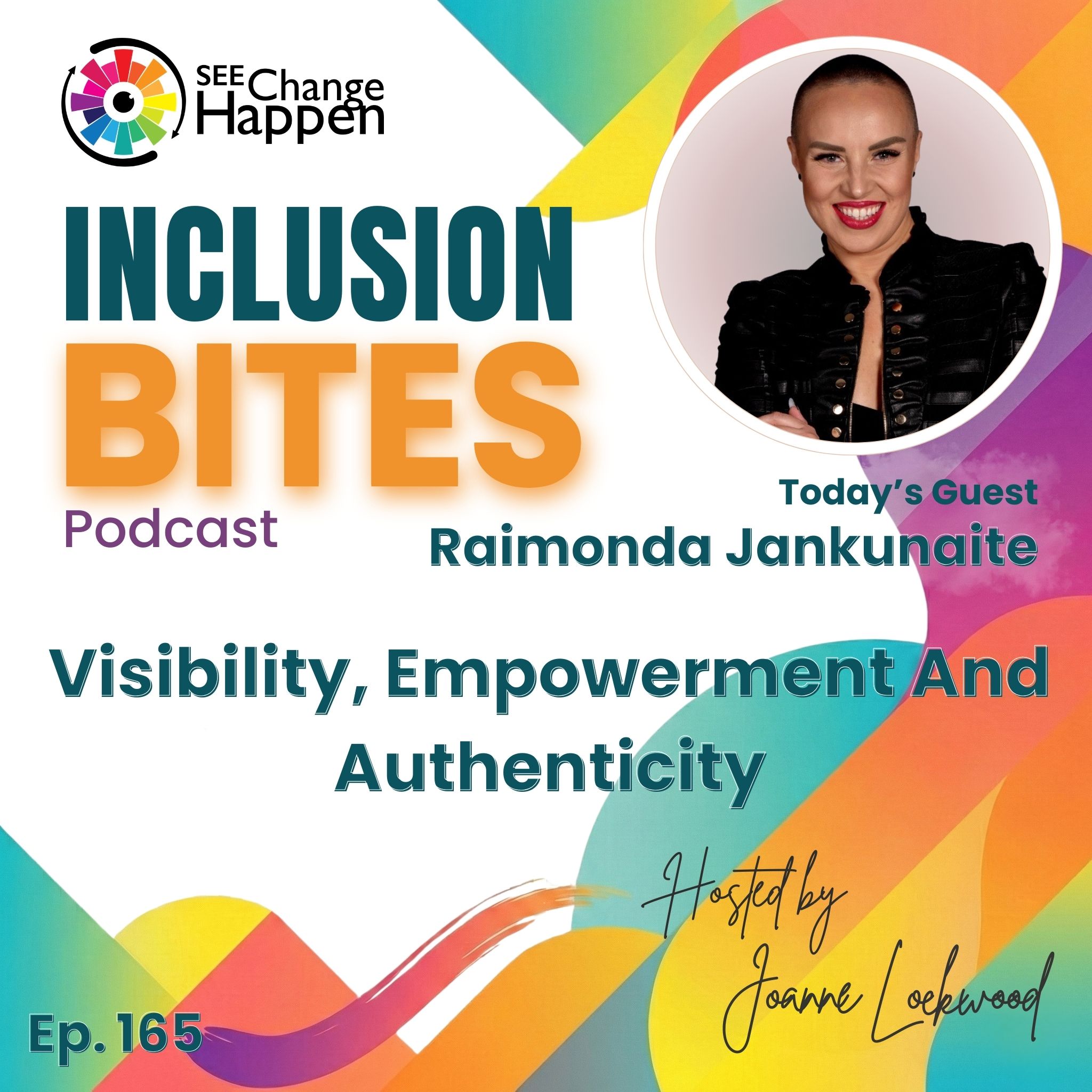
Raimonda Jankunaite explores the journey to authentic empowerment, challenging societal norms by boldly reclaiming voice, visibility, and agency for women against a backdrop of cultural expectation and global shifts.
In this episode of Inclusion Bites, Joanne Lockwood speaks with Raimonda Jankunaite about lived experience identity.
Welcome to Inclusion Bites, your sanctuaryfor bold conversations that spark change. I'm Joanne Lockwood,your guide on this journey of exploration into the heart ofinclusion, belonging and societal transformation.Ever wondered what it truly takes to create a world? Remember, everyonenot only belongs, but thrives. You're not alone.Join me as we uncover the unseen, challengethe status quo and share stories that resonatedeep within. Ready to dive in? Whether you'resipping your morning coffee or winding down after a long day, let'sconnect, reflect and inspire action together.Don't forget, you can be part of the conversation too. Reach outto jo.lockwood@seechangehappen.co.ukto share your insights or to join me on the show.So adjust your earbuds and settle in. It's time toignite the spark of inclusion with Inclusion Bites.Today is episode 165 with the titleVisibility, Empowerment and Authenticity.And I have the absolute honour and privilege to welcome RaimondaJankunaite. Raimonda is a visibility and
Joanne Lockwoodhost
empowerment mentor, international speaker, author andfounder of Women Thrive Media, dedicated to amplifying women's voiceson a global stage. When I asked Raymonda to describe hersuperpower, she said it is seeing the potential in othersbefore they see it in themselves and empowering them to step intotheir true, authentic and apologetic,unapologetic selves. Hello, Raimondo, welcome to the show.
Raimonda Jankunaiteguest
Hi. So good to be here. I'm excited to finally be doing thispodcast with you, Joanne. Yes, likewise. I mean, we, we
Joanne Lockwoodhost
met online. It's gotta befour, five, maybe even pre Covid when you're just setting up youronline presence and what you do. I think I came on your show and youinterviewed me and we talked about some various things and it's been dyingto get you back on mine and it's great you connect. Thank youfor bearing with me with your name. Yeah, I had to. I practised that, asyou know, in the green room. I practised that several times because you're notfrom Western Europe, you're from the Eastern side of Europe. So where do you comefrom originally? Yeah, well, originally I am from
Raimonda Jankunaiteguest
Lithuania and I grew up, was born there and grew up there andI've actually spent. Spent 22 years living in theUK and now I live in Spain. So I've kind of travelledaround, but originally from Lithuania. Ah,
Joanne Lockwoodhost
I've been to Lithuania once and that was in thenoughties 2007, eight, something like that. I went toVilnius and had a. A stagweekend. Yeah, they are quite in the old
Raimonda Jankunaiteguest
Days. Back in the old days. Yeah, it was a.
Joanne Lockwoodhost
I spent a bit of time in the old town in the cobbled area andthe sort of the. The very typical Balkanold, old style town. You know, I've been to Latvia and,and Estonia as well, so very similar cultures and architecture, isn't it?
Raimonda Jankunaiteguest
Yeah, it. It is really a stunning place and it has really grown a lotand changed over the last few years. I love goingback. I have not been able to be back since COVID butit's a really lovely place, to be honest. Now I kind of traveleverywhere else and love my life in Spain. I've moved here four yearsago and it's just absolutely fantastic being here. Weather's a bit warmer, I
Joanne Lockwoodhost
guess, on the Baltics, that a bit of coast there. It canbe a bit brutal, can't it? Yeah, absolutely. I wake up every day and I
Raimonda Jankunaiteguest
thank myself for making this decision to be here.
Joanne Lockwoodhost
So your, your work centres around empowering women,amplifying voices, andthat authenticity sits in the heart of you becauseyou're empowering yourself, ensuring you have a voice.So what was the trigger point? Where did that come from? You obviously haven't donethis all your life, so where did, where. Where did that momentum come from? Yeah,
Raimonda Jankunaiteguest
for sure. You know, I. I do think that authenticitycomes from truly finding yourself some reason. It's the hardest thing forpeople to do, just to be themselves. And I had very much of the samestruggles where I was hiding, hiding of who I am ormy true potential of who I can become. AndI started work in entrepreneurship when I was 21, so ithas been quite a few years I've been doing this. And I started firstwith a community called Women In Business Club, whichwas really amazing and it was gaining a lot of traction. And I was alwaysspotlighting women, I was always putting them on stages, putting themon podcasts, interviewing them, running summits and doingall this amazing work. Never really asking myself whythis was part of what I do, part of, like, why am I sopassionate? Until my mentor, Les Brown, asked me,why do you want to speak? I joined his speaking programme in2021 and in one of our first calls, he said, right,why do you want to speak? Why is this important to you? And in thatmoment, in that split second, I realised somethingand I said it. Mr. Les, I want to speak because I know whatit's like not to have a voice. And thepenny dropped for me where I realised, wow, thatis truly part of my mission of why I do what I do.
Joanne Lockwoodhost
That's so true. Because if. If you're not speakingand being heard, then others are speaking for youand over the top of you or you have no place in that conversation. Soas a speaker, wherever, however, you just identify that havingthat voice is so important, isn't it? Yeah. Well, for me, it was
Raimonda Jankunaiteguest
more than just, I guess, not having a voice. I lostmy voice physically and mentallywhen I faced trauma through a relationship that was a toxicrelationship and events that unfolded during the breakup ofthat relationship. And I felt violated. I feltviolated emotionally, spiritually,physically. And that brought onshame, guilt, fear. I started to lose my identity,I started to lose my confidence. And seeing myself in themirror, I couldn't see who I was anymore. So the only way
Raimonda Jankunaiteguest
I could still function is almost putting on a mask and continueto function, pretend that I was okay. And I literallycouldn't speak. For two years I couldn't speak. And I reallystruggled. I challenged myself to try and get better,but I didn't know that. I was struggling with depression and I wasstruggling with the symptoms from what happenedthat really tore me, tore my true selfsense of self away and my identity. Andthat struggle was really what gave me the passion notonly to build my own voice back up, but then to help others,especially women who may have gone through these kind of challenges and traumasin their own lives. Yeah, I think I saw some of the echoes of
Joanne Lockwoodhost
that part of your life on Facebook and you were quite publicaround owning that part of your life. Did you also have a child at thattime as well? No, it was some time later. This
Raimonda Jankunaiteguest
was in my mid-20s, so this was about 10 years ago.It was. It was hard times. It was really hard times. And it took mequite a while to find my voice again andrealise who I was. Because seeing yourself in a mirrorand you don't know who you are anymore. And I think that's what trauma does.And I wrote about this when in 2021,Mr. Les Brown asked me this question of why you want tospeak. Like I said, the penny dropped or why I've been doing all this work.And then I started to own my truth. And this is where the unapologeticcomes from, starting to own your truth and speak yourtruth. Because we are so often disempowered tobe our true, authentic self and speak our truth. And therefore, because we areafraid of judgement, we have fear, shame of who we are.And that rips our true, authentic selves and our voice awayfrom being able to speak and advocate for Ourselves. I think that's so true formany people around the world.
Joanne Lockwoodhost
Certainly when you have, we describe it as a marginalised characteristic or aminority characteristic, being voiceless is one of theside effects of that marginalisation not being heard. Does it, do youthink it disproportionately affects women intersectionally than the men, if youlike? I think women historically have been told
Raimonda Jankunaiteguest
to fit in, to stay quiet, to not speak up, thattheir voice don't matter. So I think there has been a lot of conditioning. Nowsomething like trauma can affect or say sexual abusecan affect anyone. And certainly men have been affected by someof the same things and I think they have been torn their voices away aswell. But certainly I think historically women have been tornmore so than the men. To some of it come down to
Joanne Lockwoodhost
social conditioning. You said there that women traditionallyhave been, let's use the word oppressed or marginalisedin their upbringing and generally a lowerexpectation set on girls than boys. If it's lower
Raimonda Jankunaiteguest
expectations, but certainly a different social conditioningin the way we are expected to behave, in the way we were expectedto show up. Right. There's certain characteristics of boys, when theyshow up, it shows leadership. If women show up in the same way,they seem bossy. Right. So the labels and theperception and biases that are built aroundhow unequally women and men are treated fromplaygrounds to schools to their workplacesand societies, it's undeniable and therefore we haveto break those biases and start a differentnarrative. Do you think you were influenced by.
Joanne Lockwoodhost
Undoubtedly you were influenced, but how much were you influenced by the cultureof where you were born in Lithuaniaat that time? And I don't want to give your age away.It was a different world in those parts of the world andmaybe still living in the echoes of the previous SovietUnion and the countries are still emerging and finding their own identity themselves.How did that influence being a young woman inLithuania at the time? I think my growing
Raimonda Jankunaiteguest
up was just at the cusp of that turn of acentury of Lithuania becoming independent country. I wasbrought up in a very women led family, if you like, andvery strong women. So from the very beginning Iobserved women being strong and to some extent fearless,yet at the same time suppressed. Suppressed bydomestic violence, by expectation that menhave the authority, they are in control, theymanage the funds of the house. So women, even though,let's say in my own household, this was not always the truth because mymom had contributed a lot to the businessof our family, yet my dad was Always in control of the money.Right. So some of these things, of course, starts to shape yourperception from an early childhood. Buttravelling to the UK and when I came to the UK, I was 13 yearsold, I didn't speak English, I couldn't start education there because at first I wasan immigrant. But what I got thrown into is this melting potof diverse people, people from all around the world, differentcolours, different cultures, different religions that I've never seen before.And also feeling like I was marginalised because Iwas now an immigrant. Right. Like the minority.And so most of my friends were from minority groups. When I startedmy school, my college, I would always make friends with thosewho were not, perhaps from the UK themselves, because I couldunderstand their struggles and challenges. And I started tobuild that rebelliousness inside of me to say, look, we haveto fight for ourselves, we have to stand up for ourselves. And that socialconditioning still played a part where you should stay quiet, you should be agood girl, you're a woman, all of those things, it still plays in your mind,but now you're starting to see that there is something worth fightingfor. And it's not just for yourself, but for others as well. Andthat's where I said, I have toempower myself if I'm going to make a difference. AndI had no choice because I burnt my bridges with ever going downthe route of conventional career path.So I had no choice. Yeah, I think
Joanne Lockwoodhost
we're often put on this conveyor belt of life, aren't we, to this very earlyage, you will do this, you will do this, you will do this. As ayoung woman, there's a high expectation of gettingmarried, falling in love, having children, being ahomemaker. Um, the last 20, 30, 40,even 50 years, women have now understood that theirrole is what they want it to be. Yes, they may well wish tohave children, but it's not an automatic thingthat they have to want. And I've seen many women who embracethe not having children, not being a mother,not being a parent, and they've consciously abstained from that. And.And that's a choice people make. Whereas previously there was thishigh expectation you weren't good enough, you were failing as a woman andowning that and empowering yourself to make the decision for your own self and yourown body is something that we're starting to embrace now, or even moreso. Yeah, yeah, of course. And there were lots
Raimonda Jankunaiteguest
of experiences in my life where there was certain expectationsand even my own family and, you know, and my love choices.I Remember when I was relatively young, I was dating a guywho's a man of colour, right? And my mom said to me,why can't you just go for a Lithuanian guy? And my conditioning froma young age was, well, Lithuanian guys actually beat women. Theydon't treat them right. That was, that's what I've seen growing up. Sonaturally I was too afraid to date a Lithuanian guy. And I said to mymom, really bluntly, I said, mom, he can be blue, green,black, yellow, I don't care, as long as he treats me right andloves me. I will date whoever as long as he's goodto me. So you can't tell me that a colour ofhis skin is going to make a difference to anyone and tomake different choice because of it. So I was very, very clear from very youngage that I was just not going to conform.
Joanne Lockwoodhost
You came up with that observation about Lithuanian guys? I hada bit of a surprise. I was in kyivback in 2019 and I was with a group of people, wewere speaking at a conference and we were there and I remember walking aroundKyiv town centre or city centre, restaurants and bars and justaround the central part and I noticed that there was a.Seemed to be common that men,Ukrainian men just walked straight through women. There was this kind of like. AndI felt I had to get out of a man's way. There wasno accommodation. Maybe in the UK a man would have been more polite and sortof stepped out the way or ladies first. I just got the impression thata Ukrainian man's were just very muchmore, I own the pavement, you have to get out of my way. And ithappened in a supermarket as well. They just literally walked through me and I thought,wow, in one respect it was so gender affirming, but in the othereffect it was like a real difference in culture is that have I.Have I represented that feeling accurately, do you think?
Raimonda Jankunaiteguest
It's interesting. I've never been to Ukraine, but I think that EasternEuropean men are more, in theirown self view, macho men whotry to uphold that masculinity and anyweakness seems just not really notmasculine enough. And therefore they try to exerciseviolence or overpowerment of womento assert their masculinity and theirpower. Yeah, I mean, part of it is a lot of the social conditioning andculture normalising it. You know, in the Western world it's notso normal and a lot of times, well, it has been illegal for a longtime. Yeah, it was kind of socially accepted back in my country forwomen to beat men, for men to beat women. And I, I could,haven't seen that growing up. I just couldn't, couldn't dealwith it. And I, I decided I will never accept that in my ownrelationship or I will never accept in my surroundings for that to be the case.
Joanne Lockwoodhost
So you shouldn't. Society puts a burden on womento present look, incertain ways there's a certain socialvalue to a young, beautiful, attractive womanand as you get older, wrinkles, grey hair, child tummy, whatever,there's a certain pressure that you become less valuable. Andso women are striving. And again, part of this struggle withempowerment is trying to fit in with these societal expectations which aregenerally designed by the patriarchy, designed by men who wantto value and own women in a certain way. How can women be authentic andstart to create their own value for who they are without havingto subscribe to all these beauty standards?
Raimonda Jankunaiteguest
It's hard. I think I've seen many, many people havingto live up to it and subscribe to it, as you say. However, Ithink the first step to it is a real selfacceptance and knowing that those external layersdoes not define us. And I've done the same for many years, tryingto look good and trying to, you know, you know, have the perfect bodyand the beautiful hair and then at one point justrealising that's not what it's about. And actually whenI was young, I went down the modelling route and at somepoint I decided that's not what I want to be known for.I. I want to be known for my impact and myknowledge and the way I see the world, not the way I look,because I felt that was so shallow. Oh, you, you can. To
Joanne Lockwoodhost
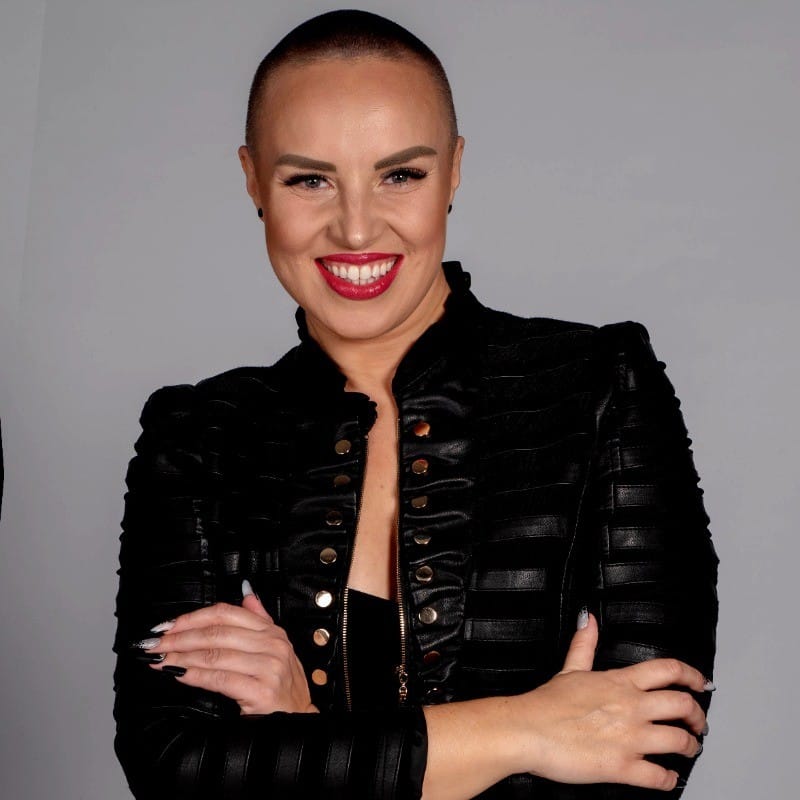
my attention. I mean, I do follow you on Facebook, I think I'm part ofsome of your groups and see some of the updates. What struckme, I think it was about three or four months ago, two or three monthsago, suddenly you went for beinglong by most standards, beautiful, longhair, blondish, aged on one side.I think you hit it cut and then suddenly yousaid, it's all coming off. And then next shot, thereyou are with a grade zero, effectively you shaved it alloff. And you were just so striking in thatcontrast between the old you and the new you. And I couldsee in your eyes and the smile when you shaved your headoff, there's this certain ownership of self, wasn't there? You really ownedthat look. It's making me laugh. My whole life I was
Raimonda Jankunaiteguest
living up to the long blonde hair look. Never Changed ituntil a few years ago when I shaved one side and it was another actof rebellion and self ownership. And one day I just made a decision.I'm no longer subscribing to this. I'm just. Thathair does not define me anymore. It has taken me so many yearsand so many layers of shedding shame, sheddingfear, shedding societal expectations,living up to those things. And even before I shaved, I had fear.Don't get me wrong, I was afraid, what am I going to look like? Whatare people? What's next? What's after you shave? Your hair is gone.You can't just grow back overnight. I had a lot of fears.But the minute when I took it all off and I saw myselfin the mirror, I held my head and Icried and I was like, wow, this ishow it feels to liberate yourself of allthose things you've been carrying your entire life. Having to live up to thoseexpectations and finally seeing yourself in a mirror, finallyseeing yourself without a mask.Because we put on a mask, we wear these masks ofclothing brands, hair, makeup,whatever, other things to distract people from seeing our trueauthentic selves. And it was the mostamazing experience and so empowering. Itchanged so many things for me when I'd done that. The level of selfacceptance, it's just amazing. And I recommend itto so many people in whatever shape or formto empower yourself to that degree where you actually justdon't care what other people think and you just live your true authenticself. Just be you. If you love yourself,people have no choice but to accept you. Do you find that you get different
Joanne Lockwoodhost
reactions from people now? I mean, I'm gonna say different,I guess, specifically around how men treat youthan before. Do you getthe impression men feel more threatened by you with the shorter hair,more nervous about you, more apprehensive about you, take you more seriously?
Raimonda Jankunaiteguest
Don't know exactly. But I recallwalking in a supermarket in London a couple months agoand I'm noticing guys don't pay attention tome the way they used to. I realised that so much attentionused to come to me because of beingthat. Having that perception of a kind of woman that you are,right? The long blonde hair, the curves or whatever, youknow, I used to get a lot of attention and now I realise,okay, I'm not getting that attention and I don't mind either way becauseI have a partner, I have family. So for me it's neither here or there,but it's just an interesting observation. And those who Know me, but perhapsdon't know me personally that much, afraid toask, why the change? Because they think maybe I. I'm sick,maybe I have cancer. And sometimes when I see them for the first time andI realise that they kind of looking but trying not to ask anything, I say,don't worry, this is just a style change. You can ask me and make alittle joke. And those who are in my community, especiallymy peers, have reallysupported this change, like, really supported this change. They love thechange and they said, this is. This really, really suits you. I think it's very
Joanne Lockwoodhost
iconic. I think it suits you. And obviously different styles suit different people,but you kind of own it. You can see the empowerment there. I think fromyour authenticity point of view, it really is authentic with who you are andredefining your place in the world. I think it's very iconic. Thank
Raimonda Jankunaiteguest
you. I appreciate it. Because I've got
Joanne Lockwoodhost
other female friends who have felt the pressureto shorten their hair because in the workplace orin leadership positions, they felt they weren't being taken seriously havinglong hair and they had to get a bob because this is almost this perceptionthat long hair equals young, short hair equals older and moremature. So this desire to be perceivedas more mature, more capableand I think your style, if you don't mind me saying, confuses menbecause what they're seeing is an empowered woman who's prepared tobuck their needs and treat it as yourselves.I guess men are more apprehensive around youand, yeah, scared. Maybe. You're scared. Yeah. Well, you know, I want
Raimonda Jankunaiteguest
to just mention that my own partner. So thisthought has come to my mind about two years ago and I said it tomy partner, I said, I just want to shave it off. Honestly, dealing with somany challenges around my hair that I'm just tired. And at thetime, I didn't go through with it. But he said to me, do it. Let'sdo it. Go for it. You're going to look amazing. And so when thisnext time I came around to him, I said, I think I'm really ready todo this now. I'm just so fed up. The hairdressers here inSpain causing me so much just, just. It was more headachethan it was worth. And his wavering support andconfidence and real love showed me that,you know, it doesn't matter what I look like, he loves me for who Iam. And as that was enough of confirmation forme to say, I don't mind shaming it off,he's gonna still love Me. Regardless. Just for anyone who's listening, who hasn't got the
Joanne Lockwoodhost
video of this podcast, I should explain that you arerocking a kind of a grade one, grade two at the moment withgrade one, grade zero sides. So you've maintained the short haireven after several months now? Yeah, Yeah, I love
Raimonda Jankunaiteguest
it. It's so easy to maintain. Sometimes I look at my olderpictures, you know, the blonde hair, different looks and the curlyhair. I mean, it looked nice and sometimes I miss it,but it's a different chapter and I have to just embrace this newchapter, new look. At first it was really strange because I didn'tknow what to wear. I didn't know what suited me. The colours no longer suitme, the dresses no longer suit me. So I was like, okay,we're gonna have to uplevel the entire wardrobe now.
Joanne Lockwoodhost
What a hardship, Abe. What a hardship. I've gotta go shopping. It sounds like areal nightmare. I mean, if I was a prolific shopper, that would be
Raimonda Jankunaiteguest
absolute pleasure, but I'm not quite. Well, you can always
Joanne Lockwoodhost
embrace that. That new side of you. Yeah. Style queen.
Raimonda Jankunaiteguest
Yeah. Yeah. But I am enjoying exploringwho I am. In this new chapter. I. I was consciously aware of
Joanne Lockwoodhost
my own hair. So for much of my life, pre transition, in my lateryears, I was, for the sake of ease and convenience, I wasrocking a grade one, grade two. You just get so used to just jumping inthe shower, quick, quick wash, quick rub with the towel, it's all dry and offyou go. After my transition, hair meant something to me. So Istarted with wigs. Had a hair weave at one point,and then toppers. And then eventually I went for a hair transplant. I remembergoing into the hair transplant clinic and with thedoctor, the surgeon, and he said, we're going to have to shave your head.And I was like, completely unprepared for this because I thought they would just workaround what I had. So I'd grown my hair to roughly the length it isnow to down to my shoulders. And so I was just imaginingto pick bits out and just. And make it fine. Hesaid, no, I've to shave it off. And I said, okay. And I needed 10minutes to compose myself. I was crying my eyes out. I was kind of going,all of this because I'd known it had taken me two or three years toget to the length it was and it was going to go. I thought, wow.So I cried. They shaved it off. And then I thought, okay, you're not allowedto wear a wig or a hat or cover your Head for at leasta fortnight and you shouldn't wear a wig for at least, I think it wasa month or two months. I thought, wow, what am I going to do? Ican't live. I've got to go out, I gotta, gotta do something. So I thought,okay, let me just open this. I. I rocked the scabbybald head look and I got some stuff, some big hoopearrings, some big bright lipstick. I just went for the soul singer. I was doingZoom calls. I remember going to London and running a training course on site forsomebody and I was still post surgery. Traumaticscabbed all over my head. I just walked in and just got on with mylife. I think once I realised that all of those
Joanne Lockwoodhost
stories you tell yourself are just stories and you canovercome them. I thought, I remember thinking, because after the second,I had a second hair transplant, it was about 18 months after that, so Ishaved it all off again, everything. I grew and I had to carry on again.But then the next time I was more empowered and I. I've got friends whohad air transplants as well and they got back to the wig as soon asthey could. And I thought, well, at some point when they're happy withthemselves, they've got to transition again to takethe wig off and declare, this is the real me. And I thought,with me, every day is a better day. Every millimetreit grows is a better day than it was yesterday. So I was able togrow into my style rather than have another step change anotherpoint. So, yeah, I was quite pleased with that, owning it. Butyeah, it's so key to your identity and how you see yourself and how othersperceive you. Such a massive. It plays a big part on your
Raimonda Jankunaiteguest
confidence, on your subconscious. Look, when I shaved, at firstI was elevated. I was absolutely amazed by the support.I was so confident, rocking it. And then fewweeks passed and I started to feel the effects of it,started to judge myself, started to see myself differently. Oh, this doesn't fit meanymore. Do I look beautiful still? I started toquestion it and started to feel like I'm showing up less,not posting as confidently as I was not doing camera.And then I had to remind myself a little bit that, hey,this is not going to define you. And you made this choice. And beforeone of our major events recently, I called my boyfriend and said, I, I don'tknow what to wear. Nothing fits me no more. He said, why are you tryingto still fit in your old clothes? You changed, youelevated. So everything needs to elevate Embrace it and go forit. So this advice was like, yeah, why am I still trying to fitinto my old self? Just move on. And what you're wearing now is
Joanne Lockwoodhost
it's like a limey yellowy colour blouse. Verystriking, very contrasting. Yes. It's a beautiful dress and a beautifulnecklace around your neck as well. So, yeah, kind of owning that look. Whereas ifwith the long hair, you would have covered half of that up, wouldn'tyou? You'd have covered your V neck up, your necklace up. It will all bearound you. You say hiding behind the hair as a comfort blanket. Yeah,
Raimonda Jankunaiteguest
that's a huge mask and that's what I realised. It was a big mask.And so many people hide behind those various things.
Joanne Lockwoodhost
So you work with women all around the world. You're a global business.There's a lot of changes going on in the lastmonth, I guess. Six weeks from over America, attitudesin the uk, rise of the far right inFrance, Germany, other countries as well. Unsettlement in the east ofEurope around the worry about Russian threats. Howare women experiencing this on a global basis? Is there. Isthere worry out there? Certainly there's a lot of worry and
Raimonda Jankunaiteguest
I think women feel things more globalcompassionately. Personally, it affects me personally,it seems like, well, it's all going on in the States and it shouldn't reallybother us. I feel that is a personal threat on women,on minority groups, on LGBTQ communities,on minorities, on different continents of the worldwhere the war is happening on children, the injustice andthe far. The few people who are in power,the perception that they can do just about anythingright and they own us. It's really heartbreaking. Andat first it was very concerning and it isstill very concerning because I think we're going through massive shift andchange in the world and I don't know where this is leading us to yet,but something I realised that up until now, theenemy was hiding in the plain sight.It wasn't as obvious who our enemy was. Now theycome out of the woodworks and we know exactly what we're up against.And we wouldn't be sodriven to stand up and advocate and fightfor our rights than we are more now. Because when yourback is against the wall, you will do something to fightback. And up until now, our backs were never down, backto the wall, as hard as it is now. So now we knowwhere we need to take action. Now we clearly there is no in between forpeople. Now. You either that way or the other way, you either supportthis New far right movement or you completely against. There's no middle, there is nogrey zone. And for me it's really simple to say these are the peopleI'm with and these are the people I am not. It makes it a littlebit clearer in the world, very concerning what's going on, butit's certainly time for all of us to start having a voiceand start fighting for it. Right? I think you're right. I think before
Joanne Lockwoodhost
the way hard right far right politicsworked was they were picking people off in small subgroups and sort oftalking to you, talking to you, talking to you. It didn't matter if the peopletalk to each other, as long as you were resonating with what caused me pain,I could ignore everything else. And now I think, as you say, because it's nothiding in plain sight, all those different areas ofattack are coming out onto the table and they're all lookingunpalatable to many. Even people that have been previouslyempowered to vote in favour of these views are nowrealising the impact of it's not justwhat gives me pain, there's the things that give me pleasure that are being curtailed.Women's reproductive rights, needing more masculine energyin business, removing women from positions of power because they seem tobe less capable or weaker of the dei higher. Allthese kind of things. We're rolling back good business practise, not justdei, this is sound business practise and marginalisingwomen still further. Just women. I mean, the whole. The decades of
Raimonda Jankunaiteguest
work that has gone in intodiversity and inclusion, into policies, into the workthat has been done to build bridges, to buildinclusivity, to give rights to minoritiesovernight being eradicated. How it's affectingus not just now, but how it's going to affect ingenerations to come, decades. So we are rollingway back and I look at, let's say thewomen in Afghanistan whose rights in thelast few years have been taken away to the point where they haveto cover the entire faces with burkers.They can't speak, they can't use public transport, they can't use.They can't walk out the house easily, they can't go to education, they can't goto hospitals without men's assistance.I mean, that was not the case just few years ago. Whatmakes us think that we're safe in the rest of the world ifthese kind of things are being rolled back? Soif we don't do something now, be very afraidthat in a few years our society is going to look very different and theNext generations observing all of this will say this is normal. Sowe're rolling back decades, not just few years of work that'sgone into it. Yes, it's almost like the dystopian Margaret Atwood
Joanne Lockwoodhost
handmaid's tale come into fruition in plainsight. I think that's the shock. You know, I think during the lastterm of the current president we sawsigns of this dystopian future. I think what's happened this timeis it's been kind of where we picked where we finished offlast time. It's now been accelerating and you know, LGBTrights, Q rights, rolling back the DEI programmes,replacing people in the federal government in positionsof power in the executive branches. There's nobody left to sayno. And every time you do say no, then you're being strong, armedout. And there's an immense amount of pressure on business leaders,the billionaires, the Zuckerbergs, the Bezosand the people who run these big companies to start winding it back. I sawthe other day that Zuckerberg and his wife, Ican't remember her name, Chan. So they have the Czi A foundationand they've removed all of the dei. They've evendefunded some of the causes they were supporting that are pro dei.Facebook have even taken wheelchairs out ofthe avatar. They'll build your own avatar. Any prideoutfits have all been taken out so you can't even express yourselfusing a Facebook avatar anymore to match your full identity. So these thingsare. Took years to build and now people are caving in forfear of. Fear of their own marginization, I guess.Survival. Yeah. If there was nothing to fear,
Raimonda Jankunaiteguest
this would not be happening. Okay. Theyare too afraid of the power of these so calledminorities because we are far from minorities. Theexercise of their attempt of their power,honestly, I see it as a small man syndrome.I've seen it in my own country with men trying to exercisetheir power when they just simply don't feel empowered. Andwhat's a biggest shame really is about that we'relosing the ability. This huge divideis creating such a chaos that we're losing our ability.
Joanne Lockwoodhost
To. See and appreciate each other's differences and how
Raimonda Jankunaiteguest
much it is needed. You can't take away the factthat we have so many continents around the world that in eachcontinent, each country there are different cultures, different colours, different.They're not minorities. I'm sorry? They are not minorities. Look atAfrica, look at China, look at other parts of the world. These are notminorities. This is the rest of the world. So if you are living inthis cave and you think you're the best and you're themost powerful, you may be acting like that, but I'm sorry, there is a lotmore billion people in the world that see things differently. Andas a leader myself and I have a community of more than600,000 people embracediversity, inclusion, that I embracedifferent voices because if we are only going to hear onetype of voice, one type of perception, we're going to start believing it'strue. And you can't be a right leaderif you are going to be the only smartest person in the room. Youcan't. And you're only going to see things one waybecause like I said, there are so many people in the world. Andif you think you, you're, you're the bee'sknees and you're everything in this world, unfortunately you areliving in a very delusional world.
Joanne Lockwoodhost
So it's that part of the problem where. And again we're trying to create toomany stereotypes. The the able bodied white manwas perceiving that they were marginalised themselves. You know, we see the rise offigures like Andrew Tate with toxic masculinity and the incelmovement gaining traction against with young men in the beliefthat they're the ones that are getting no advantages now. You know,it's all for people of colour, for queer people. If you're straight and white,then there's nothing for you anymore. Yeah, just feeling
Raimonda Jankunaiteguest
threatened. They're feeling threatened, yeah, because they don't have a club
Joanne Lockwoodhost
to stand up for them. And maybe that's sdei being tooexclusionary on and exclusion the majority. You know, we need men in the conversationto create change and we all know, we all know that men often don't wantto join into those conversations because they, they don't understandor they don't have the tools or capability to be greatallies or to challenge their own behaviour. Sometimes
Raimonda Jankunaiteguest
their behaviour not being challenged as well.This is where the open conversation leads to change.Inclusion of different voices, perspectives,experiences. If you don't understand what one is experiencing, you'renot willing to listen how you're going to know. So you're livingin your silo of your own experience and you're expecting or you thinking everythingis great until you start to experience.Even Elon Musk, his daughter, his son,sorry, came out as trans. Like she wanted a changeand he was not accepting it. That's on his own doorstep. Sonot only you're not willing to accept that Society ischanging and there are people with different experiences,but you're always also disowning your own daughter.Fear of a lack of understanding and fear. It's more
Joanne Lockwoodhost
than just disowning his daughter. He's now anactive part of a regime that is trying toexterminate and eradicate anybodywho's not straight and cis. And you know, wemay be talking about trans, non binary people, queer people today,but there's certainly no exceptions for people of any part ofthe sexual spectrum or gender spectrum. And we'll see, I'm surewe'll see further eradication of gay rights, lesbian rights,bi rights in the future. And this is just the first step. And that's certainlywhat we see the far right in the UK and other places.It's us today, you tomorrow, that's the worrying thing. It justescalate the purging of. I'm not goingto say it's going to be euthanasia or ethnic cleansing or anything like this, butthere is a purging of people who aren't fittinginto the stereotype. Truth is you're not going to
Raimonda Jankunaiteguest
eradicate them. You will disempower them and you'llthink they non existent, but you will noteradicate people. And there is still power in the masses. Andour choices are, we still have, we hold a lot of financialpower in our choices and our voices andas long as we don't buy into the messaging ofdisempowerment. Because yes, you may not be able tochange anything, but that does not need to change your life completely.Your choices, what you stand for in, in how you treat others andhow you respect others in the way you advocate for others, likein your workplace. Don't allow that narrative to be happening, don'tallow the behaviour be the one that caused outin your society, in your community. Because changestarts at macro level, not just at the massive level whenthe leaders fail us. We need to start looking at the difference that wecan make at a macro level. That's where we need to start puttingour efforts in. How are you seeing the impact
Joanne Lockwoodhost
of what's going on in America right now,on Europe? I think I always perceive thatthe UK is very much more culturally tiedto America, economically, politically and kind ofemotionally. That doesn't necessarily translate intoa French, a Spanish, a German, a Swiss or otherNordic views. Does it translate the same? I'm agreat believer as a UK person, we should be looking right, not looking leftall the time. We should be looking to our closest Partners, obviously Brexit messed alot of that up, but we should be looking to our European partners where we'remore culturally similar. I believe in many respects,I think. They just need to have more backbone, simply. Yeah. You know,
Raimonda Jankunaiteguest
have the strength to stand up for something, not.Listen, the reason why I never went down the corporate route,because I'm not going to come to anyone andtherefore I believe that hold your own, have your ownculture, have your own beliefs, have, you know, like, like France, look howstrong they are. You try something with French people, they'll come and put theirtractors in front of your government and pour crapall over the floor. Yes. Yeah, they're nothaving it, but slowly, slowly. I think people in the UK havebeen conditioned and just, you know, when you're tryingto fry, boil a frog, English people have beenunfortunately boiled slowly to now accept whatever thegovernment is giving them. And it's a shame because the government isnot really as strong backbone as I think they could be right now.
Joanne Lockwoodhost
Yeah. I think if you go back to the 1970s, there was the,the miners strike, there was the Thatcher government and the, the politicalwill at that time was to break the back and the morale of the,of the worker. And I think they quite effectively did that. So the same way,as you mentioned, France, as you say, they'll barricade, they'll. They'll put sheep everywhere andmake a mess everything, close everything down. And that's kind of culturally the way theydo things in this country. They're more like to send the riot police in andarrest people, change the laws, ban it, whichwe've seen. Some of the anti protest laws that have come out have been toprevent that kind of. The French behaviour for whatever way of describing it.Yeah. Culturally, we don't want to make a fuss, do we? We want to havea cup of tea and sit down and be very nice about things and playcricket, which I think we're evolving away fromthat. And I think the more we see the echoes of what happensif we don't speak up around the world, then we're going, hang on aminute, we don't want to go back. And I'm not seeing, apart from the media,which is. Right, right. Biassed. I'm not saying much,much momentum to go back to the right again. Well, you never know.You never know. Yeah, the uproar is not as strong and
Raimonda Jankunaiteguest
I think until something is completely on your doorstep andaffecting you so much that it's causing you pain, people will not take action.And because it's not happening on their doorstep, they just simply ignore it.They can get on with their daily lives and that's fine.Personally, it doesn't sit right with me. And every single day I wakeup and think, how can I make a difference in a story world? Might notbe able to change everything that's happening, but it starts withus. It starts with us having a voice, putting our voice, advocating forourselves, advocating for others, knowing you're not the only one in thisworld and you need to have a voice and be an ally for those whoperhaps don't have a voice. Yeah, no,
Joanne Lockwoodhost
for sure. I completely. That's the song I'm singing as well. Yeah. And I,I like many, get frustrated. We can't change the world. But we're both speakers,we're both able to speak up. And part of our reason to speak is tohave that voice to speak out andchange as many people as we can around us.And hopefully those people will change people around them as well. I think we canstart by changing ourselves, influencing others and creating amomentum richer. If we abdicate responsibility, then who's going todo it? We can't. Unfortunately,
Raimonda Jankunaiteguest
the last few years has showed us that we can't trust leadershipto have our backs and therefore we have to have our own backs.
Joanne Lockwoodhost
Yeah, yeah, yeah. I mean I've gone into reflective mode nowthinking about what you're saying. Yeah. Because it is. And you took, you gave, yougave some thoughts there. But you speak to your large community of globalmenu women. How can each one of them step up andget in, get involved in it? How can people empower themselvesfor social justice, for social change, or even pure resistanceand saying no, what are things that people can do? I think
Raimonda Jankunaiteguest
being part of communities that are like minded is this first stepbecause a lot of spaces are no longer safespaces and finding spaces where wecan have those conversations, where we can create movements.Taking your own responsibility for your part in this world andknowing that you doing nothing or just coming offsocial media isn't going to solve the problem. So many people see I'm justcoming off social media. That's not solving the problem. It might be giving you peaceof mind, but that action is going to come and bite youin the ass in a few years time when you're starting to see all yourrights being rolled back. So it's not a time to stay quiet and justdo nothing. See what you can do within your community.Events, host podcasts, start those conversations,become more vocal, be more empowered to speakup. We're still very, very disempowered to speak our truth.Too afraid of judgement, too afraid to stick out,let's stick out. Let's be that sore thumb, right,that is going to keep pointing the finger at what is wrongin this society right now. So maybe those who don't actually see itcan start to realise that we are those frogs that are being boiledin the water right now, slowly and not realising it. It's time to take action.It's time to get angry. It's time to get vocal.We can't sit here and continue accepting this as our newreality. So the futuregenerations will look back on us and say, what didyou do when you had the choice to do something? If youranswer will be, I sat back and watched it all unfold, it's not going tobe good enough. Yeah, that's well said. I completely resonate with that.
Joanne Lockwoodhost
I mean, I. I started saying recently that my existence isresistance. And by my very existence, Ichallenge people's definition of what should or shouldn't be. So ifI. If I remove myself from the spaces that they're making uncomfortablefor me, I make it more comfortable for them.So by being that grain of salt in themollusk, let's make some pearls. Let's be annoying, let's. Let'srive up the people the wrong way. Because if I shut down and go away,they've won and I'm more empowered. And I've never used the word. I don'tidentify as a word activist. I don't want to be an activist. But maybeactivism is not settling for the status quo. Maybe it's speakingup, maybe it's being that resistance. Because if I don't, then who will? If notme, then who? By having a voice. If I. My voice, if myvoice isn't in the conversation, whose will be? Because the conversation will still happen. Ifwe're not there, people will just make up their own stories.So you need to have the voice of opposition, the voiceof difference, the voice of another perspective. And no matter howchallenging that is sometimes, and I do a lot of media interviews and it's.They're very toxic. They're designed to attack. But ifI'm. If I'm not doing it, who will? Yeah, yeah,
Raimonda Jankunaiteguest
we. We publish a lot of books and stories of womenand you not sharing your storyis you not empowering or being a voice for somebody else rightnow. And we have to, because as you said, our voice isgoing to be silenced. So many books are being pulled from theLibraries because it's the attempt to silence and eradicate us.So if you leave social media, you stop speaking, you stop showing up.Yeah. You become non existent. Yeah. And you know, you just look back through
Joanne Lockwoodhost
time, how women have been repressed, you know, with gaslighting,domestic violence, abuse. And the story is the same.Don't speak up, it'll be shameful. Don't tell yourfriends because they'd be shame. When women finally have the courage to leave atoxic relationship, people say, well, why didn't you do it sooner? Well, Icouldn't. I was tied up. There was financial, there was emotional pressure,no one would believe me. And that's because people are beingsilenced. And if you don't speak up and have a voice,then no one will hear you. So we need to createspaces where people can speak up, can be heard and we canamplify, which is, I think, a lot of what your community does as well, isn't
Joanne Lockwoodhost
it? Yeah, absolutely. We host events globally,
Raimonda Jankunaiteguest
virtually. I publish a magazine. So my whole entiremission is to create a platform, global platform for women to have a voice,to be advocates to. We have Women Thrive Media, which is a publishingcompany, so we publish books, solo authors, co authoredbooks, magazines, host events and do a lot of productionon podcasts, doing social media lives anyway, shape or form. I can help women amplify their voices andmake them heard because I have been blessed to have been built, to havebuilt such a big community and audience globally. I have thatresponsibility to do that. And luckily my mission is,I guess, the right mission with the right intention tospotlight women and give them the voice. And theempowerment piece runs deep through everything that I do,from the way I handle our clients, ourpartners, our team to the way Irun everything is all about empowerment. And it'sa byproduct if, if anybody comes into our community,into connection with us, you experience the same thing. Andby the end you can't help but feel empoweredand supported to share your voice, to share your message, tohave collaborations and step out there knowing that you have the supportand backing of a bigger organisation. It's bigger than me.It's a movement and that's what we're doing. It's been a quite a
Joanne Lockwoodhost
monumental rise. I mean, when I first, I think when we first met, it wasn'tnecessarily the right at the beginning, but it was in the earlier days and thegrowth has been phenomenal over the last four or five years. Yeah, it has.
Raimonda Jankunaiteguest
It was the right time for, for the right thing in the first year, whenI started using Instagram, we grew to a hundred thousand followers and I wasjust like, wow, that is just insane. And then we triplethat on Facebook. It's just been a huge growth. Butconsistency in everything, in my brand, in my messaging, inshowing up, in my commitment, in the things that we do. You know,publishing and the magazine and the summits that I do every,every March to celebrate Women's History Monthcreates momentum. I started small. I started at nothing.I started in 2017 with zero followers. And somy success or the rise of our community is notsome kind of magic and overnight shot. It happenedbecause of the dedication and the mission behind it. No, I
Joanne Lockwoodhost
completely applaud your passion, focus and mission. Soit's been phenomenal to just keep in contact with you and see and seewhat you do. I'm sure you have inspired the personat the end of this set of headphones that's listening to this right now,and they want to find out more. How can they get in contact with you?Do you want to give some URL to your website? Well, put them in theshow notes, but just tell people how, then get hold of you. Yeah, I mean,
Raimonda Jankunaiteguest
anywhere you search. Women Thrive, Women Thrive Media, Women ThriveMagazine, Women Thrive Summit is where you will find us. Like I said,we host an annual summit that happens every March, third week of March,we have our books that we publish, which is called WomenThrive, that are published on Amazon and we have fourth editionnow out. And Women Thrive magazine goes, goes out andships globally. So you can go to womenthrimagazine.com and any otherwebsites. As long as you Google Women Thrive Media, you will find us.
Joanne Lockwoodhost
And so if you say you're on Facebook, you're on Instagram, people can findyou on LinkedIn. But yeah, women Thrive is the key search term.
Raimonda Jankunaiteguest
Yeah, absolutely. You'll find a lot. Andthe best part, you'll find not only a voice of mine, but voice ofother women who have risen together tothis common mission to empower, inspire others.Their stories. It's not about me. It's about our collectivevoices coming together. You've ignited a movement, I
Joanne Lockwoodhost
think is probably the phrase, isn't it? You'vegiven people a collective power of voice. And I think that's,that's what you've achieved. And I think, as you said,now is a time when it's needed more than ever.From Afghanistan, Ukraine, acrossEurope, UK and now in the US across the world. Andthere's still areas of the world where women need to be heard. You know, theWorld Economic Forum is still talking about 200 years forgender equity across the globe, 80 to 100 yearsin Western Europe. So there's a long way to go and a long waythat women need to have their voices heard. So,Amanda, thank you so much. Thank you so much for coming on. I've loved ourconversation. It's been amazing. Thank you for the opportunity.
Raimonda Jankunaiteguest
It's been so much fun to just catch up and hopefullyinspire other people to use the power of their voice andbe part of communities and create safe spaces forothers to flourish and appreciate each other's differences.I always say there's so much more that unites us than separates us,and I hope that is a message that we can continue to carry andrespect and love each other. Thank you. As
Joanne Lockwoodhost
we bring this conversation to a close, I want to express mydeepest gratitude to you, our listener, for lending yourear and heart to the cause of inclusion.Today's discussion struck a chord. Consider subscribing toInclusion Bites and become part of our ever growing communitydriving real change. Share this journey with friends, family andcolleagues. Let's amplify the voices that matter.Got thoughts, stories or a vision to share? I'm allears. Reach out tojo.lockwood@seechangehappen.co.ukand let's make your voice heard. Until next time, thisis Joanne Lockwood signing off with a promise to return withmore enriching narratives that challenge, inspire andunite us all. Here's to fostering a more inclusive world oneepisode at a time. Catch you on the next bite.
Visibility, Empowerment, and Authenticity for WomenThe Impact of Societal Conditioning and Cultural NormsGlobal Shifts, Social Justice, and the Power of Collective Voice
Joanne Lockwood is joined by visibility and empowerment mentor Raimonda Jankunaite to explore what it means to be seen, heard and unapologetically yourself.
Raimonda shares her personal journey, from growing up in Lithuania and later navigating life in the UK as an immigrant, to rebuilding her sense of identity after a traumatic and toxic relationship left her feeling voiceless and disconnected from who she was. Together, they talk about how fear, shame and social conditioning can lead people—especially women—to mask, stay quiet and shrink to fit.
The conversation moves from personal liberation to wider social realities: beauty standards, workplace perceptions of women’s leadership, and the importance of finding communities where it feels safer to speak up. Raimonda describes her decision to shave her head as a symbolic act of self-acceptance and a practical rejection of expectations placed on women’s appearance.
They also reflect on global political shifts, the rollback of inclusion efforts, and why visibility and collective voice matter when rights and representation are being challenged. The episode closes with a call to action: build supportive networks, use your platform—however small—and be an ally for those whose voices are being silenced.
“I observed women being strong and to some extent fearless, yet at the same time suppressed. Suppressed by domestic violence, by expectation that men have the authority, they are in control, they manage the funds of the house.”
“But the minute when I took it all off and I saw myself in the mirror, I held my head and I cried and I was like, wow, this is how it feels to liberate yourself of all those things you've been carrying your entire life.”
“I realised that so much attention used to come to me because of being that. Having that perception of a kind of woman that you are, right? The long blonde hair, the curves or whatever, you know, I used to get a lot of attention and now I realise, okay, I'm not getting that attention and I don't mind either way because I have a partner, I have family.”
“Something I realised that up until now, the enemy was hiding in the plain sight. It wasn't as obvious who our enemy was. Now they come out of the woodworks and we know exactly what we're up against.”
“The decades of work that has gone in into diversity and inclusion, into policies, into the work that has been done to build bridges, to build inclusivity, to give rights to minorities overnight being eradicated.”
“And our choices are, we still have, we hold a lot of financial power in our choices and our voices and as long as we don't buy into the messaging of disempowerment.”
“It's not a time to stay quiet and just do nothing. See what you can do within your community. Events, host podcasts, start those conversations, become more vocal, be more empowered to speak up.”
The process of reclaiming identity and voice after experiencing trauma and societal silencing.
How cultural conditioning and patriarchal expectations shape self-perception and limit women’s opportunities.
The importance of dismantling beauty standards and embracing self-authenticity in professional and personal realms.
The transformative power of community in amplifying marginalised voices and creating social movements.
Strategies for resisting the rollback of rights and maintaining advocacy amidst far-right political shifts.
Practical actions individuals can take to empower themselves and elevate social justice within their circles.
The role of visible leadership and storytelling in inspiring others and safeguarding hard-won progress for future generations.
One thing to remember
The essential takeaway from "Visibility Empowerment and Authenticity" is that reclaiming and owning one's authentic voice is both an act of personal liberation and a catalyst for broader societal change. Through the conversation, Raymonda Jankunaite’s journey illustrates how overcoming societal conditioning and personal trauma can empower individuals—particularly women—to shed imposed expectations, find true self-acceptance, and inspire others to embrace their own visibility and agency. In an era of growing global instability and regression of rights, collective empowerment and vocal advocacy become even more crucial to safeguard and progress inclusion.
Explore topics
Ideas from this episode
Visibility, Empowerment, and Authenticity for Women
In my recent conversation with Raymonda Jankunaite, we delved into the journey of visibility and empowerment, especially for women striving to find—and amplify—their authentic voices in a world often determined to marginalise them. Raymonda shared her personal history, growing up in Lithuania before moving to the UK and finding herself at the intersection of multiple cultures, identities, and social expectations.
The Impact of Societal Conditioning and Cultural Norms
We peeled back the layers on how social conditioning and cultural expectations shape perceptions of gender, speaking about Raymonda’s experiences in Eastern Europe versus her life in the UK and now Spain. Our exchange highlighted how traditional expectations—around appearance, relationships, and even workplace behaviour—are still carried by many women, sometimes long after leaving the environments that reinforced them.
Global Shifts, Social Justice, and the Power of Collective Voice
As our conversation progressed, attention turned to global events and the urgent need for collective resistance in the face of growing far-right politics, rollback of rights, and threats to inclusion. Raymonda articulated the shared anxiety that many women and marginalised groups are experiencing as rights are eroded from the US to Afghanistan—emphasising the importance of community, activism, and finding agency even in the most uncertain times.
Learn
Frequently asked questions
What are the central themes discussed in this episode?
The episode centres on visibility, empowerment, and authenticity, particularly as they relate to women’s voices and presence in society. Joanne Lockwood and Raymonda Jankunaite explore the barriers women face, the journey to reclaiming one’s voice, and the power of embracing one’s true, unapologetic self.
Who is Raymonda Jankunaite and what is her expertise?
Raymonda Jankunaite is a visibility and empowerment mentor, international speaker, author, and founder of Women Thrive Media. Her work revolves around amplifying women's voices globally and empowering others to recognise and actualise their potential.
How does culture and upbringing influence women’s visibility and empowerment?
Raymonda shares how her Eastern European upbringing, particularly in Lithuania, influenced her perceptions of gender roles and societal expectations. She highlights how social conditioning and cultural norms in both Lithuania and the UK shaped her advocacy for women’s visibility and rights.
What role does trauma play in shaping visibility and authenticity?
Raymonda discusses personal experiences of trauma, particularly the loss of her voice both physically and emotionally. This sense of violation and identity loss was pivotal in her journey to empower both herself and others, as she realised the importance of regaining and owning one’s narrative.
Why has shaving her head become symbolic for Raymonda?
Shaving her head represents Raymonda’s rejection of societal beauty standards imposed on women. It was an act of liberation, a shedding of masks and expectations, demonstrating the shift from external validation to genuine self-acceptance and empowerment.
How do social expectations and biases impact women’s leadership and self-perception?
The episode underscores how labels such as “bossy” are disproportionately ascribed to women in leadership, whereas men exhibiting the same behaviour are often deemed assertive. These biases, which begin in childhood and permeate workplaces, contribute to internalised barriers for women.
Share this episode
Heard something worth passing on? Send this conversation to someone who needs to hear it.