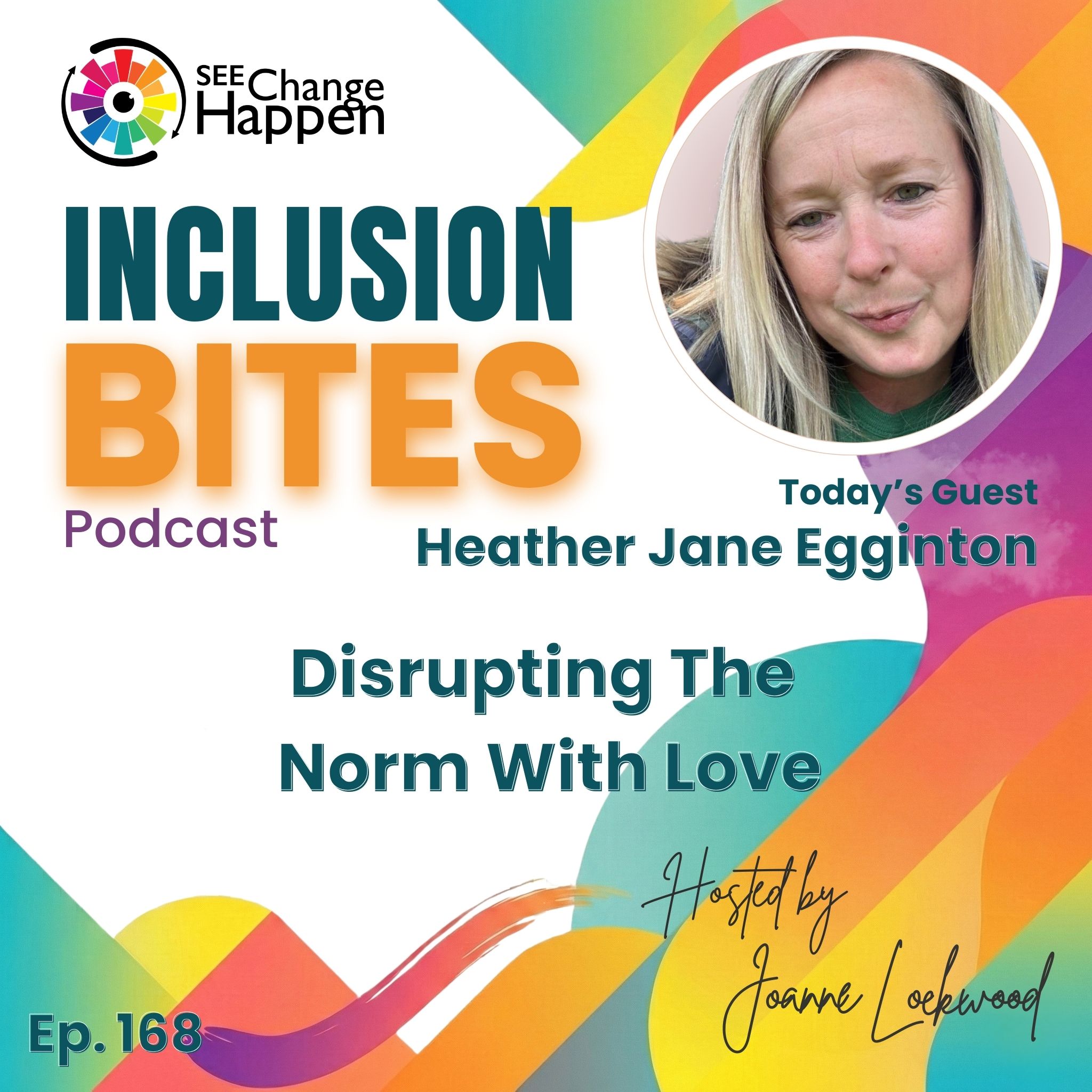
Heather Egginton explores the transformative impact of radical honesty, self-compassion, and disrupting societal norms to foster genuine human connection, authenticity, and inclusion in both personal and professional spheres.
In this episode of Inclusion Bites, Joanne Lockwood speaks with Heather Egginton about lived experience identity.
“I'd rather have the whole world against me than live a lie.”
Explore
Navigate this episode
Heather Eggintonguest
Foreign.
Joanne Lockwoodhost
Welcome to Inclusion Bites, your sanctuaryfor bold conversations that spark change. I'm Joanne Lockwood,your guide on this journey of exploration into the heart ofinclusion, belonging and societal transformation.Ever wondered what it truly takes to create a world? Remember, everyonenot only belongs, but thrives. You're not alone.Join me as we uncover the unseen, challengethe status quo and share stories that resonatedeep within. Ready to dive in? Whether you'resipping your morning coffee or winding down after a long day, let'sconnect, reflect and inspire action together.Don't forget, you can be part of the conversation too. Reach outto jo.lockwood@seechangehappen.co.ukto share your insights or to join me on the show.So adjust your earbuds and settle in. It's time toignite the spark of inclusion with Inclusion Bites.And today is episode 168 with the titleCorrupting the Norm With Love. And I have the absolutehonour and privilege to welcome Heather Egginton. Heather is adisruptor of the Norm and a truth, trust and love
Joanne Lockwoodhost
activator, passionate about creating deeper human connectionsin an often disconnected world. When I asked Heatherto describe her superpower, she said it is the ability to bringstrangers together and leaving them feel trulyconnected. Wow. Hello, Heather, welcome to the show. Hello,
Heather Eggintonguest
Joanne. Thank you so much for having me.
Joanne Lockwoodhost
Absolute pleasure. This is a return visit. I. Marie, actually my wifeMarie and I came on your show back in January, I think it was.
Heather Eggintonguest
Yes, you came on. It was such an amazing conversation.It was the wealth of you two and you were theone first couple that I went live with. It wasamazing. We talked about my gender
Joanne Lockwoodhost
transition, we talked about how Marie coped with that. So, yeah,that's online and I'll signpost that in the show notes if you want to listento that as well, that'd be fantastic. So, Heather,you describe yourself as the Truth, Trust and love activator.Can you describe what that means to you and how it shapes the way youconnect with people? Firstly, Joanne, thank you. I know I'm
Heather Eggintonguest
giggling a lot. We've had such fun before weeven got on to actually recording, so I'm just trying to rein in my.My giggles and so my. I guess whatbeing a truth, Trust and love activator is all about isreally, in my company, that isautomatically what happens. There are people aroundme that cannot lie. They seem to find themselvestrusting themselves more to be honest. Right selfhonest and be honest with what's going on with themand. And through that they just love themselves more. Because theycan see how much beauty there is inside them. Isjust one of my superpowers. We all havethem. It's just not always easy to really recognise,without us doing anything, what our actual powerful presence reallycreates for other people just by being ourselves. It's
Joanne Lockwoodhost
interesting what you say there about the truth. The truth, and it startsas you. I think you're right. It starts with ourselves. Because if we're not careful,what we find ourselves doing is creating our ownlie, which then becomes our. Which then becomes a version ofour truth, doesn't it? If we're not careful, it's that inauthenticity, it'sthat pretence with the world that get either scared to come outor you're not prepared to face up to something. So you create this new normalfor yourself and that becomes your story if you're not careful. Yeah.
Heather Eggintonguest
It's like an illusion really, Joanne, Sometimes. Andlook, it's not even something maybe we consciously do. It might beunconsciously something that we kind of lead and live our lifewith and through and view the world through that's actually noteven ours. Not most of the time. The lies we tell ourselves orinherited from past generations,significant adults in our life that have also gone through the same experiencekind of had to try and make themselves be something they're not just in orderto fit in or belong or all of those things. So it'sactually something that we've inherited and it's not even ours.However, it does mean that takingradical responsibility, I guess, for what we're not willing tocontinue lying to ourselves about or lying to other people about. Right.You know, a good example of this, and this is some of thework I do, is the wealth of Women programme that I run. A goodexample of this is we've been led to believe that you're not a womanunless you or you're not don't feel. Shouldn't feel complete as awoman unless you've had children. Right. And that's a lie. However,consciously or unconsciously we tell ourselves, I have no children,hands up, have fur babies, have two rescue doggies.And. And I was led to believe that I was incomplete. And alsowomen said to me, I'm really sorry to hear that you can't have children.And it's just like, nobody said I couldn't have children. They just weren't in mypath. Right. So just a good example ofwhere really we maybe aredelusioned into thinking that there's something wrong with us if we haven'tgone the same way as other people have and it's not true.It's just not true. So it's just a good example. Yeah. I don't think
Joanne Lockwoodhost
having children has to define you. Okay, yes, it's asignificant life event that occupies yourprimary brain for at least 20 odd years and then it's still in the backof your brain even now. So our children are in their 30s,so we've been through that ultimate responsibility phaseand that hanger on phase and all those kind of phases. But nowwe're not post children, we're post worrying about children.And so having children no longer defines who we are.They're a fantastic part of our lives and people welove and treasure, but they're not what they were 20 yearsago. So it's a transient phase. And when you talk about having children
Joanne Lockwoodhost
defines you, it's a transient phase. You becomean active parent to being a kind of a long lost parent or they don'tneed you anymore. So yeah, I think it's. But I also see what,how I'm now able to support my own mum who's in herlate 80s now and she's. Our father passed away. Myfather passed away a couple of months ago and so helping her through thistransition from being married, although my father was in the nursing home,to being a now a widower,single again and trying to reclaim our own independence and ownidentity around that is a really interesting journey andI hope I teach our children abouthow I've had to help my mum adjust to thisso that they'll be there for either me or Marie at that point whenwe become a widow. So I think, yeah,it's important to learn that transition, I think. Butyeah, as you say, it doesn't define me. I just know that I've gothopefully two children who will look after me later.I've banked up that old age pension supportcredit. I love it. Sparky's just
Heather Eggintonguest
woken up. I'm not sure that tin dogs would be able to support mewhen I get into my elderly years. However, theyfully support me now Right. In bringing out the best ofme now. And I would say, you know, speaking to thatJoanne, firstly, sorry to hear about you losing your father a few monthsago and please send my love to your mother.This is a really harsh statement to make, soforgive me if this is a bit triggery, but. But ultimately we don'tnecessarily mourn the person that we've lost. We actuallymourn the identity that person gave us. Yeah, I can
Joanne Lockwoodhost
Relate to that. I mean, my relationship with my father wasn't great. Andit surprised me how much I was emotionallyconnected to his passing, given that I had very little timefor him when he was alive. And it was, you say, I think as youwrite, it's clinging onto that identity of him being a fatherand me being a child and just that, that breakof the. That bond, if you like, in the living. Andyeah, I think you summed up really well there. It hit me more than Ithought. Yeah. And it is. People
Heather Eggintonguest
find it really surprising they could have no realcontact with a particular relative or friend and then they findout they've passed and it really hits them. And it is generallyon a. I would say, depending on the person. Right. BecauseI believe currently that we are all thesame, yet we're just living on different timelines. Right. So dependingon the person, on average, I would sayme personally, I probably go throughthe loss, let's say, of an identity every two or three,three weeks. And what happens with that is the, what I callit, and this is a lot of my work with individuals, privatework with individuals, is about getting them to, I guess,navigate and lead themselves through the griefrelief, disbelief and belief cycle. So.And that's what we experience when we lose somebody that we lovevery, very much, whether we're really connected to. To them or not. And even whenwe don't really love them that much. But it was what they gave us. Youknow, the identity is, is, you know, we go through the, thekind of the disbelief that someone's actually not here anymore. Right. And then we kindof feel that grief of. And we grieve what was.Right, what was before, that's no longer the same.And then we go through that kind of phase of relief. It'slike, oh, now there's this thing that's leaving us thesefeelings that have probably given us a bit of dark days. And then we comeout the other side in belief when we see that thisperson's not gone, they actually live on through us. And thatis really powerful when we kind of get to that place. Andit's not always in the space that I've done it. Right. So it cantake people a couple of three years if it's someone they've lived with on adaily basis. But it's just once, silly. Once somebodyknows that's the kind of thing they're going to go through, thatthere's almost a little bit of peace that's found there. Really.
Joanne Lockwoodhost
Yeah. I just think about how My mum describes itthat if my father was in the nursing home for over two years, so shewas very used to living alone, getting on with life.She used to visit him sometimes two or three times a week for an hourat a time, and she'd always save up things that she wanted totell him on the next visit, so she always had something to talk about, becauseobviously his life was four walls and a window in the distanceand he could probably see the same tree, the same building, and that's all hecould see. So his life had no depth to it. It wasvery transactional. Eat, get changed, cleanedup, sleep, get up, not even get up, sit up,have dinner and then food, sleep, repeat sort of thing.So she used to save all these things up. And she said that the strangething is that she keeps thinking, oh, I must tell dad that, or I musttell dad that. And that's the biggest thing she finds, is thathabit of interaction, I suppose. I was heavily involved lastyear with sorting out some issues around his medication,his wellbeing. He had some reactions to medication andinfection, which meant his personality change really, reallybadly for the worse. And so I was dealing with care home issues,being hidden issues type thing withold people's mental health, those kind of events. So it's a real.I got really, really engaged in this for about two months, really trying to sortthis out. And we got him onto this really nice level playing field where itwas really fine. And then, then he started to decline. So it's
Joanne Lockwoodhost
almost like could have done with another six months of himbeing really a really nice person again, having had all that trauma in thesummer. So, yeah, it is strange. It's strange youbecome very invested in that relationship, even though,as I say, even though it's strange for me and my mum still sees itas well. So, yeah,grief is strange. You were talking earlier aboutthese layers of truth and as you were talking, I was thinking aboutBreaking Bad at the series, for example, whereWalter, his truth got away from him, didn'tit? He kept laying and laying and laying all these different eventsand then he found he couldn't go backwards. The only way he could dig himselfout was to dig deeper. And sometimes when you'reinventing these truths or the language you're telling yourselfwho you are, you can become so engrossed in that. It's hardto find your way back to the truth again, isn't it? I've not never watched
Heather Eggintonguest
Breaking Bad. I don't know what you were referring to,but I think what you were referring to is the layers that we place onour. The layers that we have to kind of work through orkeep up with and remember. Oh no, but Isaid I'm that type of person and now I'm with this person and I can'tremember what person I am with this person person. And so we add all theseextra layers. I think that's what you're describing. Yeah. If you've
Joanne Lockwoodhost
seen EastEnders, I don't know if you're an EastEnders fan, but you hada recent character called Rhys and he became a serialkiller and one problem at a timegot away from him and he kept rationalising whathe had to do based on the disaster of a situation he wasin, rather than going back and going back 10 paces and going,if I don't take the left hand fork here and go right, things willbe okay, even though they're tricky. But that's what we do. We make this poordecision and we can't go back, can we? We find it very difficult toreverse out of that one way street. Yeah, it can be
Heather Eggintonguest
like that. I think also a lot of. Joanne, youknow, as much as I don't watch telly, you know, that's why a lot ofpeople are, let's say AKA and maybe addicted to like theoriesand soaps and, and characters identities withinthese dramas, right? Because what they do is they so much seethemselves that it could be there, right? That theycould get to that place where they do something that's a bit criminaland they're like, how did I even get to this place? And it's just like,well, one lie after another just led to this, right?So ultimately for us to understandwithin ourselves that, that there are thesegreater forces just as there are thepowers that be, the universe, God, whatever kind ofterminology, there's also these other greater forces thatcome and try and take you out when you are really livingand leading in your truth, right? And it's being able todiscern between is that my truth or is that somethingelse? And it's really powerful. The questionssometimes that I find myself asking, personalone to one clients, is that like, is this really true foryou, right, or is this another realitythat you have maybe been witnessing orthat you have been led to believe is yours in truth,like is it yours? Right? And it is quitea grounding question for the reason that you've just described with thecharacters in the TV shows. Because it does forcesomebody, the energy disruption there, like the norm disruptor,right? From my perspective, it does force Somebody to ask themselvesand question themselves a lot deeper than themaybe others have before. Right. Ilike to play the why game. And I've done it withall amount different level of clients. So they're millionaires,CEOs, entrepreneurs. Right.And it's five whys. Yeah. So someone would comewith something that they want to create, let's say, and birthinto the world. And then we play the why game with it. We're like, well,why? Is that really important to you? Why? Right. And it. I mean, it isa little bit intrusive, I'm not gonna lie.And it is annoying as well, because I play it with myself. Right. And itgets frustrating. But. But once we get to the root of why someone wantsto create something, it's really powerful because they can see what it'srooted in. And if it's rooted in truth, brilliant. If it's rooted inlove and trust, brilliant. But if it's not, it's like, well, thatis not yours. You know, you're trying to create,let's say, in a false reality that's not actually yours.So it is really. I love that you've gone down this path. Have no idea.Can we say, whoever's tuning in, we did not know where this wasgoing to go. Right. So I appreciate your inquiries so much.
Joanne Lockwoodhost
Yeah. And it happens, you know, it's almost like that wewere too afraid to tell the truth. That, you know, we'retalking about that path left and right. Whatever reason it is, there'seither shame, guilt, fear, whatever it is, causes usto want to take the path of easy. The easiest path, the one with lessstigma attached to it. Less fear, less truth. How will Ibe judged? Whether we're having an affair, whether we've messed upat work, pushed the wrong button by mistake. You know, when you connect thefirst time earlier, I cut you off because I pressed the redX instead of the green tick. And you said, oh, it didn't work. I couldhave just said to you, oh, that's strange. I don't know why that happened. Iwent. I thought I might have pressed the X button instead of the tick buttonbecause it's. I've learned over the years thatit's much easier to just tell the truth at that junctionbecause once you stop, once you start on that lie, you then escalateit all the way through and it becomes that relationship. It's built on that onemistruth or that easy excuse. If I'mlate for a meeting, I just say to people, I'm Sorry, I was completelydaydreaming and I had no idea what the time was and I suddenly looked atmy watch and did omg, and I hope you forgive me. So I'drather say that than, oh, no, my computer was playing up. Oh, no. I hadto dash to the doctors because I had a headache this morning.It's just to tell the truth and be honest because people go, oh,I've done that myself. You end up having this big conversationabout how we're all just human, we all get stuff wrong, don't we?
Heather Eggintonguest
Yeah, I mean, that's the loving and compassionate andempathetic way of seeing truth. Because ifwe're really honest, the. What I say is the truth,it kind of whisks up your insides and other people'sas well. Say, for example, my example of notbeing complete as a woman without having children. You know, that is goingto be polarising for a lot of people,right? And so therefore the truthwhisks people up, whereas lies, they twist youup. And when I say twist you up, Joanne, I mean, physically,your body contorts itself, contracts itself.I mean, this is going really out there, right? Andmy belief is it does cause and create cancerin human beings the more we livea lie, right, My foundation,like now in life is I'd rather have the whole world againstme than live a lie, you know, and. And I. Andthat also is very polarising. But it's just like,why would I ever want to treat myselfas something that's not valuable, that valuable enoughto. To really honour its true powerultimately? And unfortunately, as I. Onmy website, it tells people, like, the five kind ofstages to working with me from a transformational perspective.And the first one is like, we get rid ofthe lies we tell ourselves, right? So. And we get to the root ofwhat created that, which is amazing becauseit's all working in our favour. It's just thatnormally we kind of lead with lies, orlet's say, act a different way when we're a little bit triggered about something,because it just means we're not fully living in our true kindof path, you know, we're not living and leadingin our true value as a person, which is all, like,easily kind of put back together. People can come backhome to themselves, all easily remembered. But it's just like you say,the layers of lies, once they come back, it's like,oh, of course I understand. Now I see why this washappening to me, or now I see why I have thiship problem. Or now I see why mydigestive system's messed up, for example. And it'slike, so once you notice and go back to the root of everythingand, and see that it's all just becauseI started a lie here and then it just escalatedand it's like, how powerful is that though? Thatis simply following that energetic trail back to the rootcauses. It's amazing.
Joanne Lockwoodhost
Because we look at the escalation. The first lieis, is, is 10 centimetres. The nextlie is another 10 centimetres. Another 10. Everything is built on that, on that first10 centimetres. And to climb down from 10metres after a year or whatever it may bethen, then people start unpacking all the lies going, well, hang on a minute, youlied to me about that and you lied to me about that and you liedto me about that and, or, or I lied to myself about that or Ilied to myself about that, whatever it may be. And youthen become so invested in that new version of you,you look at bigger mists and other people, criminals, whatever it may be,become completely invested in this double identity,there's no way of backpedalling because then your truth is so far removed from whoyou are now that you'll never be forgiven. And then you're tryingto hold onto that and thinking, hang on a minute, I'm protecting the person I'mlying to, that becomes your new truth as well.You're doing it for them, not for you. Yeah. I mean the biggest thing I
Heather Eggintonguest
picked up on there was there's almost like one,there's almost like a divide within ourselves.Yeah. And I know that you talk and you make a stand for equity,diversity and inclusion. Right. So there's almosta place where we become a divided person. Andwork is a really good example of this. As someone whoworked in the corporate world for 25 years, previouslyleaving as a projects director for ITprofessionals and management consultancies.Who I was at work was, not who I was at home.Yeah. And this like divide within usbecomes almost the biggest point that you madeabout the 10 centimetres is, is so true, Joanne, because it,we separate ourselves from, and specifically ourbody from. Right. So we can always push through and make itinto work. Yet when it comes to the weekendand have fun, we want to curl up on the sofa andjust wallow in self pity or, oreat loads of crap food or like and just immerse ourselves insomething so that we can forget about everything else.Right. And it's like when you, when I mean that, when you seethat if that is Something you're experiencing, like I wasexperiencing. Thenthere's almost a. Something that turns up to wake youup. Right. I'll put it that way. Right. Like a big joltin something that's happened in your life that goes really like. And I'm reallyliving my life this way. Way, because this clearly is notworking for me. And for me, that was losing my cat. Ihad Lester. Yeah. Such. I mean, I'm saying simple, but weall know, you know, living beings, whatever form they come in, right.Are really valuable. And. And I was like, hold on a minute, I haven't gotanything to be responsible for. Why am I slogging my heart out of workbehind the scenes? I was already building a property portfoliofor myself anyway. So it was like, why,why, why am I putting myself through this hell every daywhen I can just go and do this? You know, it was like,oh, I haven't got to have a fixed abode. You know, I can travel aroundnow. So, you know, I so grateful for mycat harshly passingand where it took me in the end.And that was, what am I now? Seven.Yeah, seven years ago. Seven and a half years agothat I retired from having to work, as I call it.So it does. There is like a thing that comes along because peopledon't necessarily always just automatically choose, I think, is what I'm going to say,Joanne, don't automatically wake up one day and go, I'm going to live myfull truth to today, you know, and then, ta da,Right. Like it is something like turns upthat sort of says, it keeps happening, doesn't it? It becomes this
Joanne Lockwoodhost
kind of. Yeah. You could feel something stalking you from behind, going,
Joanne Lockwoodhost
I've been. And then you feel this pressure to keep on the status quo, don'tyou? And I often describe this as when I discovered this myself in my late40s. The analogy I use is you get to Gatwick Airport and you get offthe. Out the taxi and as you walk into the terminal, there's these really, reallylong travelators. It's almost like a mile of travelators. You get on, then you getoff, then you get on and you get off and it takes you all theway into the departure lounge. And I describe it as, you know, Ifound myself on this travelator of life just getting on thereand, you know, the ticket says you're going to Malaga,and you think, actually, I don't want to go to Malaga, I want to gosomewhere else. So it's having the courage to hit the stop button. The
Joanne Lockwoodhost
metaphorical stop button of life on that travelator, take allyour luggage off and just park up and go, so where do Ireally want to go now? Otherwise you just carry onon that escalator or travelator of life doing what everybody else hastold you you wanna do. The expectations you started probably when you were 12 yearsold. I wanna be this, I wanna be that. This is who I am. Thisis my identity that gets shaped as you get older andsuddenly you go, hang on a minute, I should be over there somewhere. How didI end up over here? And it's really difficult. As you say, we builtthat truth of who we are. How do you go backwards tofind that path again? And it took me to gender transition and sell myIT company to do it. Not for everybody. But yeah, it's tryingto have that bravery. I mean, you said you've got out of yourcorporate life and you now havea functioning new career as somebody who invests inproperty and does other things. So yeah, it's a different way of being, isn't it?
Heather Eggintonguest
Yeah. And it isn't. It isn't the norm.Right. So let's just what you, your decisions, you know,to walk your truth. Like, that's not the norm, Joanne.Right. And the same for me, you know,who does that? Who retires at 39 and declares that andsays, right, I'm never going back to the nine till five,even though mine was six till nine at night kind of job again. Right. Like,who does that? Who buys their first house at 21when everyone else has gone to university? Like, who goes against thegrain? Right, Exactly. Itis. They are out there. But,and I will speak this, those outer for greaterforces, the ones that push against us living likethis, will do everything in their power for us notto stand tall and be loud and proud about thedecisions we've made that aren't the norm. Becausethat's societal conditioning. That's the systems and theprocesses. We're easily controllable if we're all nodding and goingin the same direction. And it's just like, I'm not willing to dothat and, and there is like a recourse, you know,when we come home to ourselves, like, and who we havealways been truly at heart. There's. There's no fight.You just be that. Like you said about theoptions. Now, my, the way my business works, the world viewis an extension of my being. So why would I saymy superpower is deep, truthful connection andbe on a podcast with somebody and, and it not Feel like it's. We aredeeply, truthfully connected and we've mettwice online. That's correct, isn't it,Joanne? Right. Yeah, yeah, at least. At least twice. Yeah. Yeah. And how do youfeel in conversation with me? Like you're an old friend, you know, like I've known
Joanne Lockwoodhost
you for five years. See what I mean? So it's like a model
Heather Eggintonguest
completely what actually is possible. And look,it's. That's my value. I'm living and needing in my valueand totally embodied in that. That's not going to be the samefor everyone, however. It's being inthe position where we're willing to really take a good long look at ourselvesand see how freaking incredible we actually are withoutthe societal programming, without those greater forceslike you've described. Fear, regret, shame, allof those greater forces that suggest we should be thissmall thing that doesn't really matter. And it's just like wereally matter, but we have to decide that,you know, we. We make that decision. We have to make that decision withinourselves. The saying, that'squite trickery for some. I know that I am thechosen one and so are youand so is everyone. But do you choose you as the chosen one?Do you see what I mean? I think. I'm not sure of the exact
Joanne Lockwoodhost
phrase, but it's something like you are a product of your six closest friends orsomething like that. So either either your six closest friendsinfluence who you are, or you influence who you pick as yoursix chosen friends, whichever way you want to look at it. And if you hangaround in corporate life with corporate people, that becomes yourtruth. And if you step out of that, everyone who's theregoing, oh, you're brave to go out into the cold and be shunned andgo off and do your own thing, and they carry on doing their old. Theircorporate slavery. But I hang out now. I'm sure you do. You hang outwith other, probably other property investors. You probably hang out in entrepreneur space.You hang out in small business space. And many of the people I meetnow, professional speakers, trainers, consultants, have exitedcorporate life because the same reason I did it was just like it wasbs. I wasn't getting anywhere. Most of my networknow, most of my close friends are sole trader, independententrepreneurs, trainers, speakers, consultants.Therefore, you don't feel out of kilter with the right way of doingthings. You get this sort of solace in knowing that you are doing the rightthing because it's working for everybody else. So I don't feel alone anymore. WhereasMaybe in the early stages of exiting corporate life, I felt,yeah, like out on a limb, lonely.
Heather Eggintonguest
Oh, I can totally relate to that, Joanne, totally. And let'sstar. Star this. Look, there are people that thrivein the corporate world and are really good at that, right?So it's not about us saying this is wrong and this is right and thisis how right, but it's just recognising where do we fit,right? Why. Why we were put on this earthand. And it might be that somebody was put on this earth to disruptand change, shift the paradigm within the corporate world, and that'sbrilliant. And I know that you're working really hard to already do that inyour see change happen from a speaking and trainingperspective, but it's just knowing, rightwhat. Where we lead ourselves. And also,
Heather Eggintonguest
I believe it's not necessarily you become the sum of the people you arearound, what you become is the sum of the energy that you sit around,right? So if you're in a room full of people that aredisrupting the norm, for example, like me, then it's likethere you calibrate to more bravery, being morebold, right. Being more truthful, like, and open inthe world, sharing it out loud. Yeah. If you're inthe room with people that don't necessarily have that desireor burning drive, I guess, thenyou won't. So it's recognising, well, what is it that I actually standfor? What is it that I actually value? And am I in the room orwhat of people? Am I surrounded by people that are actuallyon the same path or similar path to me? Or am Iin the room with people hoping that they will see mefor what I value and what I'm trying to create and aredriven towards. So it's being able to understand what tabledo I want to sit at? Because that table isenergetically in the right kind of similar field to me, butit's being able to recognise that, Joanne, because speaking frommy own experience, I tried my hardest to convincepeople and prove to people that the best place to be was fully,deeply, truthfully connected. And like, why don't you wantthis? Because I've got it and it's amazing. And you know what that did?It just knocked me out of being deep, truthfully connected tomyself. It was literally a vicious circle definition ofinsanity, Right. I was trying to convince everyone else this is the way togo, trying to get everyone to value the same as me, and then it's justlike, no, Heather, I'd left a communitybecause of it because of the way they kind of changed thecommunity without coordinating or communicating with me.And I saw it right there. Hold on a minute. These people here don't valuedeep, truthful connection. And I consider in thisroom for two years, like I had been hoping, willingand with all my life wanting them to value the same asme. And it's just like. But they don't.And that's okay. And then you can leave, you know, and youcan find or be, or even start your own freakingtable, which is what I did anyway. Right. SoI love that you brought that up around the, you know, you arewho you are surrounding yourself with. Really powerful.
Joanne Lockwoodhost
Yeah. And I, I love to quote Chris Evans, thecelebrity broadcaster, Top GearYear 1 Radio 2 presenter and bring your own toothbrush.I appreciate you don't watch. I remember TV much. Remember that. Yeah.So I, I remember him saying that, you know, you have to be Marmite,half the world have to love you and half the world have to hate you.And there's another quote that I can't remember who said it was, I don't haveto like everybody because I don't expect everyone to like me or whichever wayaround that is. So sometimes by polarising people, knowing who you
Joanne Lockwoodhost
are, what you stand for, is a very powerful place to be, rather than tryingto be a people pleaser, you've tried to please everybody, please the peoplethat you want to please, because they won't ever try and please you. And Ithink sometimes we get so invested in our friend relationships wherewe often find there's a disconnect between how you view that relationship andhow they view that relationship. And we have people who are. They never phoneus, we always have to phone them. There are people who are pleased to seeus and people think, do you want to see me or don't you? And youend up having this relationship where one of you doesn't care more than the otherperson. So you've got to try and find relationships where you both have an equalpartnership in the success of that relationship. But we toooften invest. I want to be your friend. I'll keep phoning you. They never callme, they never text, they never write. Well, stop writing to them, stoptexting them, stop calling them. And if they don't notice, thenit. Wasn'T meant to be, all values thing, Joanne, you know,
Heather Eggintonguest
you'd think that you would attract friends that value the same as you. Andyou know why? Most of the time you do. We are all magnetic. It'sjust what we are we attracting. Do you know what Imean? This is being able to be observant about, oh, I've attractedanother friend who expects me to organise and sort everythingout. What's that telling me? Right? It's telling me thatI'm amazing at organising, but actually that'snot what I want to do for my friends. And I love that you've spokento this, because I'm just about to bring out my Frequencyof values challenge on LinkedInand I do a different, slight, different version. I do my Frequency of Lovechallenge, right? And I do that on Facebook and it's ultimatelyhelping those that want to be in communitywith the people that they want to be in community with. Right. That goingto have a reciprocal like you've described, you know, they'll phone youand you'll find them and it's not like feeling like you have to, you know,it's just a nice, easy community relationship. And that'swhat it's about this month. And it's aboutgoing from the lonely couch, right? To fully connected.That's what it's about because I was the one that was sat on the couch,lonely, never had any friends, didn't know anyone, Always thought there's somethingwrong with me. Just wished that I could be normal. I was one of thosepeople. And it took a lot, I'm not gonnalie, for me then, to come to a place where I am today tosay that that had I not experienced that, Iwould not be in the position I am today. To say, ifyou're wanting to create community and connect effortlesslywith your people, can never say that word. If youwanted to connect effortlessly, nailed itwith your people, then that's the challenge tojoin, right? Because I managed to do it where I moved heretwo years ago into Shropshire. Never lived here in my life.Was living in Worcestershire for like 25 years and now moved toShropshire. And I've literally created acommunity of women around me that are incredible, thatall value the same thing as me and all into the same things asme. One of those cup of quizzes. We won three last month. Havea look. Yay. No, no, it's brilliant.But it's just a good example of, like, what's possible. And.And I. I got to experience thatdark and light, like you say, you know, the, the Marmite let safeconnection. No coincidence that had Marmite on toast breakfastthis morning. It's funny, I. I'm. I'm not really a Marmite on toast. I'm
Joanne Lockwoodhost
not. I've got this Thing in my head that says, I don't like Marmite, yetat Christmas I will pig out on Twiglets, which are basically Marmitesticks, aren't they? So it's a really strange thing. I could do Twiglets, but Ijust don't do Marmite. Raw Marmite, if you like. Maybe it has to be. What
Heather Eggintonguest
you would love is Marmite with cheese spreadon toast. Probably because it's.
Joanne Lockwoodhost
I'm sure I've just got to try it. I've just got this story in mymind. You know, we talk about stories we make up and my own truth. Myown. My own. The truth I've told myself for many, many years is I don'tlike Marmite. Yeah. I like. To Eiglets. It's like. It's crazy, isn't it? It
Heather Eggintonguest
is crazy and amazing at the same time. I can't wait to hearwhen you first try Marmont House. It's been years. I
Joanne Lockwoodhost
mean, Marie has it all the time. She had some this morning as well. Ithink she loved a bit of Marmite and toast. Maybe I should get her todo some. Next time she does something, do something for me and just give itto me and I'll go, okay. After I chat with Heather, I need to goback and revisit Marmite. It's like, for years, I couldn't eat celery. You know, asa child, I didn't like cheese, I didn't like celery. And thenI went through a phase where I didn't like garlic. And then suddenlyI broke those myths in my head. There was even aphase where I went through where I didn't like gin or I didn't like SouthernComfort. I didn't like vodka, probably because of a bad night out thatmy brain was going, oh, that's naughty for you. It took me a while, butI managed to break through that dislike of Perno. And, yeah, if you try anythingenough, you'll start liking it. Sorry. Well, for those of you who are listening, whodon't know, I stopped drinking three years ago, so I don't drink anything now. It'salcohol. Yeah. I link our taste
Heather Eggintonguest
buds to identity because I would not go any. You wouldnot catch me anywhere nearfeta cheese. Yeah, I thought it was heinous.I mean, I'm not fan of. Can be a bit dry, can't it? It can
Joanne Lockwoodhost
be a bit dry, yeah. Not careful. Yeah. And then what it took is for
Heather Eggintonguest
me actually to travel with someone who was quite energetically,very high frequency for them. To order feta cheese and honeyin Greece and I tried it and I was like, yeah,hello. That's really nice. So yeah, I do like. Andtaste buds to, to identity to like how highyou are in vibration as a person depending on what your taste waslike. Because the, the, the way I used to makefood before wasn't necessarily with tender loving care.My partner will joke with you about this and take the mick outof my. My throwing it all together skills. Right. This throwing it alltogether skills has got me in a lot of places and a lot of complimentsfrom people because I do make stuff up to go along and then they askme what the recipe is and I'm like, no idea. However.Yeah, exactly. Yeah. However, overlike the last three or four years, what I've really noticed is myattention to detail, my presence while I'm cooking hasthen now more started to perfect the tastesand what goes together really well. And I've been makingthe most exquisite tartar tan. Which if someonesaid you'd be baking a tartar tan, Heather, I'd be like, what?Because I didn't do baking cake stuff. Right. Fancy French
Joanne Lockwoodhost
dish that you see on MasterChef. Yeah, yeah, but. And it's
Heather Eggintonguest
so simple and yetunlike now at the place where. Yeah.And it is just down to like who I'm being in the moment while I'mcooking. Like how pleasant I am to it and just really noticing.And it's not even an effort thing. It's like the mostsatisfying thing in the world is to have made something and want toeat it at the end and find it delicious. Whereas I would make someit and just eat it because it was food. Someone taught me how to make
Joanne Lockwoodhost
a roux. I don't know, about 10, 15 years ago,how you melt the butter really, really slowly and gradually introducethe flour and bake it into this. You gotta get itautomatically like marzipan, haven't you, before you. And then you make this, then you canthen use that as a base for any sauce. And it was like once youdiscover that magic about making a roux and suddenly it's parsley saucefor your fish and then suddenly it's gravy or whatever you want to do withit. And I just thought it was magic. This secretsauce. The roux is the basis of everything.Yeah. I did a masterclass about four years ago on
Heather Eggintonguest
secrets people's secret sauce. What's your secret sauce? I'm more ofa white wine cream and onion garlic based saucemaker. Yes. Yeah. With Muscles. Yeah.Oh, yeah. I love it how we'velike immersed ourselves into food. Well,
Joanne Lockwoodhost
it says in your show notes here that you're a food junkie. So it wasfood loving junkie. Is that so? It's not surprising we've got there. I mean, Ilove my food. I love, I love good food. But I'm with you on this.Chuck it in, see what happens. I don't. I look at the recipe and go,
Joanne Lockwoodhost
okay, I've got half of those things. I can substitute the other halfI haven't got with something else or it'll be a kind offacsimile of what said it was. And yeah, I love just playingaround. I made an amazing garlic chicken with kalemash once out of a. I think it was a hairy biker's dishand it was just. It was like four cloves of garlic. You chuck it insidethis chicken, you spread it all around and put it in the oven and it'slike, you come out, you go, it's amazing with the garlic. So the mashed potato,kale and mash on the side of it, it was just this absolutely gorgeous dishand the whole family loved it. I just never did it again. But yeah, itwas one of those one offs, one off creations that was. If you love garlic,you like chicken, you like mash, you like a bit of kale in it. Googleit. Hairy bikers, garlic and garlic chicken andkale mash. Yeah, it's brilliant. Absolutely fantastic dish. Very easy aswell. Just need a chicken, a couple of cloves, a couple of bulbs of garlic.Not. Not cloves. This is like a full, A full garden of garlic. You justchuck it all in there and you end up. The garlic goes really soft andmushy and it's like, yeah. Oh, you might get hungry.I know I'm gonna have to dig out the recipe because it's. I can't. Ineed it again. Amazing that you've remembered it, though.I'll try and remember. Put it in the show notes. So I'll find. I'll digout the recipe and put it the show notes. If anyone's listening and they wantto. Want to have a go with it. Heather. Heather.I would describe you as someone who's extrovert,gregarious, outgoing, even though maybe on the inside, maybeyou're not, but on the outside you are. I meet a lot of people whogo, oh, I couldn't be outgoing. I couldn't. I couldn't go networking. I couldn't dothat. I'm too reserved, I'm too shy, Fear of beingjudged again. This is a story we make up, isn't it, that I'm an introvert,therefore I can't do anything, whereas I would, by thedefinition of introvert. Introverts get power from self, extrovertsget power from the room, energy from the room. I describe myself as an introvert,but I perform in a very outgoing, gregarious way when I want to,but when I don't want to, I turn the light off, lock the cubicle doorand hide in the toilet for 10 minutes, recharge and then come back out again.How do we overcome that lie with dental cells that only extroverts cando this? Well, I mean, firstly we look at
Heather Eggintonguest
where that programming has come from, because I don't class myselfas introvert or extrovert. I'm just a person who loves tobe on my own in my own company, and I also love tobe in the company of others. Right. So we have to look at wherethat condition or that programme came from. And when we go backto, even when we were growing up, what happened when wewere extrovert around certain people and when we weren'taround others. Yeah. Because when you're really quietand not saying anything because a kid, people would think there was something wrong withyou. Right. So what does that programme in?
Heather Eggintonguest
Well, I shouldn't be quiet because people think there's something wrong with me.Yeah. So we have to go back and back and this is the layers thatI'm talking about. Right. And we go back to the truth of that is weare everything. We are both extrovert, introvertand all the things in between. However,it's recognising that if there's a particular way thatwe sway. If there's somebody, for example,who seeks more solitude than being in a room full of people,then it's been in a position to ask yourself, is thisreally true of me or am I really afraid of people saying,seeing the truth of who I am? And I think that's a big question.If. If there was smaller steps, I would love for anyone experiencingthat to come and join the Frequency of Values challenge. BecauseI value being on my own, in deep,truthful connection with myself and I also value that with other people.I'll give you an example of a client I was workingwith a few months ago who were led to believe that they were shy.Yeah. So I asked them to. To. We worked on clearingthat point of view because it was something which they were labelled with as achild, but it wasn't actually true. Yeah. And I.So I think some of the introvertness can come from the labels wewere given as well. So there's quite a few different angles to go at thatquestion with Joanne. Not sure whether I've answered itfully, but. No, no, we've done good there. We've done good. It's basically, I think
Joanne Lockwoodhost
what I was trying to get at really, is that it's another truth we're tellingourselves. It's another label we're owning withoutquestioning. We haven't done that five whys on it, have we? Why does it botherme? Why am I upset? In fact, why does it affect me? And I guessit comes with age. I turned 60 the other month and you spend50 is the new 40. 60 is the new 50, or whatever you want tosay. And it gets to that point where you thinkyou become more reflective about yourself, what you want, what you're looking at from theworld. I don't care if people see me sitting in thecorner of the room on my own playing my phone or just staring out thewindow for an hour, say, are you okay? Just checking your right.You look like you're lost or you look like you're upset. I just want someme time. I don't want to go and sit in the toilet with the doorshut for 10 minutes. I'd rather sit out here and just watch the world goby. I'm cool but relaxed. Just let me daydream. I. Good.That's. That's strange. It's fine. Also, you're speaking about
Heather Eggintonguest
what that might also suggest coming up for the other person, how it's makingthem feel as well. So, like I say, there's quite a few differentangles to go with that because, yeah,I remember I was at a bite My tongue. I was
Joanne Lockwoodhost
at a. I was speaking at a panel event, I think it was with ebay,a couple of years ago, before COVID Anyway, five, six years ago,and we were just talking away and we're talking about imposter syndrome andbeing introvert and this whole thing. And I just sort of said, look, when I'mfeeling stressed out, when I'm feeling like I need a recharge, I just grabmy phone, go sit in the end cubicle, shut the door andplay Candy Crush for half an hour and recharge. And then I come back out,I'm good again. And the whole audience, you can see people in the audience go,yeah, me too, me too. That's what I want to do. I want to goand recharge. I want to take some time. Okay, just do it. Don't beapologetic. If that's what makes you happy, if that's what topsyour energy back up again and allows you to come back out and go, yeah,I'm ready. Do it. If you don't need to, don't.I used to drink through it, you know, have another glass of wine, have anotherbeer, have something else that used to mask that. And you start.You take that out of your life and suddenly, actually, I'm exhausted. Now I justwant to go home. It's half nine. I'm tired. I've had enough. In the past,I'd have had another couple of hours. Large wines and I'd be life itself witha party for another couple of hours. And then suddenly it's five o' clock inthe morning, isn't it? And you're absolutely wrecked. All your friends have now passed outand gone home and you're going, come on, then, who's up for it? I'm stillready to. You're bouncing around like Tigger. Yeah. I mean, what you're
Heather Eggintonguest
speaking to is kind of there's an energetic ceilingwithin us. The way we've had enough when we have to retreat and kind ofrecharge. My. My way of seeing that now,before it was my way of recharging was hiding away for a whole weekendand not see one. Right. And being on my own.That was before my way of recharging. Now I just clearanything that's not mine. So if you're in a room full of powerfulpeople, there are a lot of greater forces that are coming to take you out.Right. Without you knowing that. And if you're also in that room,fully embodied, living your living and leading with your trueself, that also drains your energy. So you have like twoprong approaches now. For example, on this conversation, had Idone this about three years ago, what would happen is I would beamazing at the beginning and then become a little bit shrttowards the second half because I was trying to keep up aPersona and identity with that things that we've talked about.Trying to keep up a way of being right that wasn't truly me.
Heather Eggintonguest
So that drains my energy. Take on the fact that there's all these other thingsgoing on around me that are also trying to take on some poweraway from me as well. Right. And consume it from me.That is what we would term energeticwarfare. So I get why someone would want to go and hide in the toiletcubicle because they want to be away from that, and they also want to beaway from trying to be something that potentially isn't them. Andif you speak to when you did it before, Joanne, obviously at that point, youhaven't transitioned either. I had transitioned. You alreadytransitioned. Right. Okay. So it's definitely outside forces foryou, right? Definitely. It's.
Joanne Lockwoodhost
I just recognise in me now that I. If I've had enough, I've hadenough. I don't need to keep pushing myself into spaceswhere I don't. I don't feel comfortable. I don't want to be there if I'mnot in it. I'm just. I. I said I'd rather say to people, look, I'mnot feeling it. I don't want to stay here. You're obviously having a great time.I'm not feeling it. It's me. I'm off. Bye. And that's fine.
Heather Eggintonguest
Yeah. Whereas when I was younger, I just forced myself to stay in those spaces.
Joanne Lockwoodhost
And I think it's, again, going back to what we started with. Is that tellingyourself the truth, being honest with yourself, do I want to behere? Do I want to go out tonight? Do I want to go and spendtime with these people? And if it. If it's. It's trying to. It's afine line between can't be asked. Cba, FOMO andJomo. You know, joy of missing out, fear of missing out, or can't be askedif it's just being lazy. You know that if you go in, goout, go and do it. You'll come back and go, I'm really glad I didthat. So you can. You can do that destination planning, you can start thinking abouthow you'll feel when you get there. But sometimes you just think, I really don'twant to. If you don't want to. What I say is, is it a
Heather Eggintonguest
full body? Yes. If it's a full body, yes. Go do it.Do the thing, whatever that is. It's not a full body. Yes.Don't. Because it's not gonna. It's not gonnaexpand your energy. Right. It's only gonna contract it.So that's my wave. Makingdecisions about where I spend my time and effort intowhatever. Yeah. On that note, Heather, we've. We've been
Joanne Lockwoodhost
yakking away now for best part of an hour and a half,an hour before we. We pushed the live button. So, yeah, it. It's been anabsolutely fascinating conversation. I think we're both fully charged at themoment. And Neither of us are hiding in the toilet with our phone playing CandyCrush. So it's been absolutely fantastic having a chat with you. How can peopleget hold of you and talk about your website, your podcastand other things? So tell us what you do. Sure. Best
Heather Eggintonguest
way to I guess connect with me initially is eitherLinkedIn, which is Heather Egginton wealth of you orFacebook. I'm also on there quiteprovocatively sometimes, so you can connect with me there. Orif you want to find out more about the kind of work I do froma mentor or coaching perspective, then you can look at my website which isalso Heather Egginton orwww.henrygington.com.normally I had too many W's when I do that. So you can read. Iknow you can read more about the work I do withothers there. It's been fascinating. If you
Joanne Lockwoodhost
just remind if anyone is listening that we did a Marie, my wife and I,we recorded an episode with you I say back in January. So do, dolook that up as well and that that was a. You've got a great podcastchannel with loads of video video podcasts on YouTube with loads of gueststhat are really inspiring as well. So do look those up. Heather, it's been amazing.
Heather Eggintonguest
Thank you Joanne. Likewise. Thank you for having me andfor all those listening. Appreciate you.
Joanne Lockwoodhost
As we bring this conversation to a close, I want to expressmy deepest gratitude to you, our listener, for lendingyour ear and heart to the cause of inclusion.Today's discussion struck a chord. Consider subscribing toInclusion Bites and become part of our ever growing communitydriving real change. Share this journey with friends, family andcolleagues. Lets amplify the voices that matter.Got thoughts, stories or a vision to share? I'm allears. Reach out tojo.lockwood@seechangehappen.co.ukand let's make your voice heard. Until next time, thisis Joanne Lockwood signing off with a promise to return withmore enriching narratives that challenge, inspire andunite us all. Here's to fostering a more inclusive world oneepisode at a time. Catch you on the next bite.
Living Authentically: Truth, Trust, and the Masks We WearRedefining Life Stages and Challenging Societal NormsBuilding Deeper, More Inclusive Human Connections
Joanne Lockwood is joined by Heather Egginton, who describes her work as activating truth, trust, and love to help people connect more deeply with themselves and others. Together they explore how everyday “truths” can be inherited illusions—beliefs and expectations passed down through family, society, and culture—and how those stories quietly shape identity, choices, and relationships.
The conversation moves through examples of the narratives people absorb, including assumptions about womanhood and parenthood, and the ways labels like “introvert” or “shy” can become self-limiting identities. Heather shares how she helps clients examine what’s really true for them, including using reflective questioning to get to the root of why people want what they want, and how telling small untruths can snowball into a life that feels divided.
Joanne brings in personal reflections on grief, identity, and life transitions, including supporting his mother after bereavement and the ways loss can reshape how we see ourselves. Both discuss the cost of inauthenticity—emotionally and physically—alongside the relief and freedom that can come from radical honesty and self-acceptance.
Across stories about career changes, community-building, and everyday habits, the episode returns to a central idea: meaningful inclusion and belonging start when people come home to themselves, choose authenticity over conformity, and build relationships and communities grounded in truth and mutual value.
“The lies we tell ourselves or inherited from past generations, significant adults in our life that have also gone through the same experience kind of had to try and make themselves be something they're not just in order to fit in or belong or all of those things.”
“I probably go through the loss, let's say, of an identity every two or three, three weeks. And what happens with that is the, what I call it, and this is a lot of my work with individuals, private work with individuals, is about getting them to, I guess, navigate and lead themselves through the grief relief, disbelief and belief cycle.”
“Is this really true for you, right, or is this another reality that you have maybe been witnessing or that you have been led to believe is yours in truth, like is it yours?”
“And also, I believe it's not necessarily you become the sum of the people you are around, what you become is the sum of the energy that you sit around, right?”
“It's about going from the lonely couch, right? To fully connected. That's what it's about because I was the one that was sat on the couch, lonely, never had any friends, didn't know anyone, Always thought there's something wrong with me. Just wished that I could be normal. I was one of those people.”
The power of self-honesty and how adopting authentic truths can reframe personal and collective narratives.
The way inherited beliefs and societal conditioning inform self-perception and shape choices, particularly around identity and belonging.
The impact of grief and loss on personal identity, challenging notions of completeness and familial roles.
How living authentically can disrupt entrenched systems, reframe relationships, and foster deeper human connections.
Practical approaches for confronting the lies we tell ourselves and recognising when we are leading from inherited stories rather than personal truth.
The role of community and conscious relationship-building in finding belonging—highlighting the importance of shared values and energy over labels or roles.
The interplay between vulnerability, bravery, and the ongoing work of questioning assumptions, embracing change, and supporting true inclusivity in everyday life.
One thing to remember
The core message of this episode, “Disrupting the Norm with Love,” is the transformative power of radical truthfulness and authentic self-acceptance in cultivating deeper human connection. Joanne Lockwood and Heather Eggington explore how challenging inherited or societal ‘truths’ and shedding the lies we often tell ourselves are vital steps towards inclusion, belonging, and genuine well-being. The discussion advocates for the courage to disrupt the status quo—whether in personal identity, relationships, or workplace culture—by embracing vulnerability and love as tools for personal and collective growth.
Questions this episode helps answer
How do inherited societal expectations (such as beliefs about motherhood or career paths) impact our sense of personal identity and truth?
In what ways can “radical responsibility” for one’s own truth contribute to building more authentic workplace cultures?
The episode mentions the idea of grief not just for people, but for the identity we held with them. How does this perspective reshape our understanding of loss and change?
What are some practical strategies for recognising and dismantling self-imposed or inherited “lies” that no longer serve us?
Heather Eggington speaks about being a “Truth, Trust, and Love Activator.” How might organisations cultivate similar qualities in their leaders and teams?
The discussion explores polarisation and the value of being “Marmite”—loved by some, disliked by others. How can embracing polarisation support authentic inclusion, rather than hinder it?
Explore topics
Ideas from this episode
Living Authentically: Truth, Trust, and the Masks We Wear
As I reflected on my recent conversation with Heather, I found myself repeatedly coming back to the concepts of truth, trust, and the myriad ways we all construct our identities. Heather described herself as a “truth, trust, and love activator”, and what struck me is how easily we, whether consciously or not, layer on stories and illusions about ourselves in order to fit in, belong, or simply survive the day-to-day.
Redefining Life Stages and Challenging Societal Norms
Heather and I could not have had a better discussion about societal expectations—especially regarding what it means to be complete or successful. We delved into the narrative surrounding parenthood, exploring the discomfort (and indeed, the grief) often experienced when individuals’ lives diverge from a supposed norm.
Building Deeper, More Inclusive Human Connections
Throughout our time together, the essence of community and meaningful human connection underpinned everything. Heather shared how one of her greatest joys is bringing strangers together and helping people feel “fully connected”.
Learn
Frequently asked questions
What does it mean to be a "Truth, Trust and Love Activator"?
A Truth, Trust and Love Activator embraces the power of honesty, self-acceptance, and authentic human connection. This approach encourages not only being truthful with oneself but also extending that honesty to others, cultivating trust and deeper love in relationships. As Heather Eggington describes, it’s about living in alignment with who you are, dissolving inherited or self-imposed falsehoods, and empowering others to do the same.
---
Why do we construct alternative truths or 'lies' about our own identities?
Alternative truths or self-deceptions often develop unconsciously, typically formed by societal expectations, family conditioning, or inherited beliefs. As highlighted in the episode, such narratives help individuals fit in, avoid discomfort, or cope with shame and fear. Over time, these constructs can become so ingrained that they replace one’s authentic self, making it challenging to return to the underlying truth.
---
How can grief be linked to changes in personal identity?
The discussion explored how mourning is often tied less to the individual lost, and more to the identity that relationship conferred—such as "daughter" or "partner." When a loved one is gone, individuals often find themselves grieving the role or connection that no longer exists, requiring a recalibration of self-identity.
---
Is having children essential to a person's sense of completeness or identity?
No. Both speakers emphasised that the belief that parenthood is required for completeness is a societal myth rather than a universal truth. Identity and worth are not determined by whether one has children; each path is equally valid and transient phases, such as parenthood, should not define one’s core self.
---
Why do people find it difficult to break away from false narratives or 'lies' in their lives?
Falsities may begin as small "white lies" or tiny divergences from the truth, but as they accumulate, returning becomes incrementally more challenging. Layers of deception can become defensive mechanisms, protecting individuals from perceived judgement or fear. The longer these persist, the more invested and isolated people become in sustaining their false identity.
---
How does societal conditioning influence our life choices and sense of inclusion?
Societal norms, inherited values, and systems of expectation can make it daunting to step outside the 'status quo.' The episode illustrates that questioning, disrupting, or rejecting these norms invites resistance, yet it is crucial for authentic self-leadership and inclusion. True belonging happens when individuals align themselves with communities and values that resonate with their authentic self.
---
Share this episode
Heard something worth passing on? Send this conversation to someone who needs to hear it.