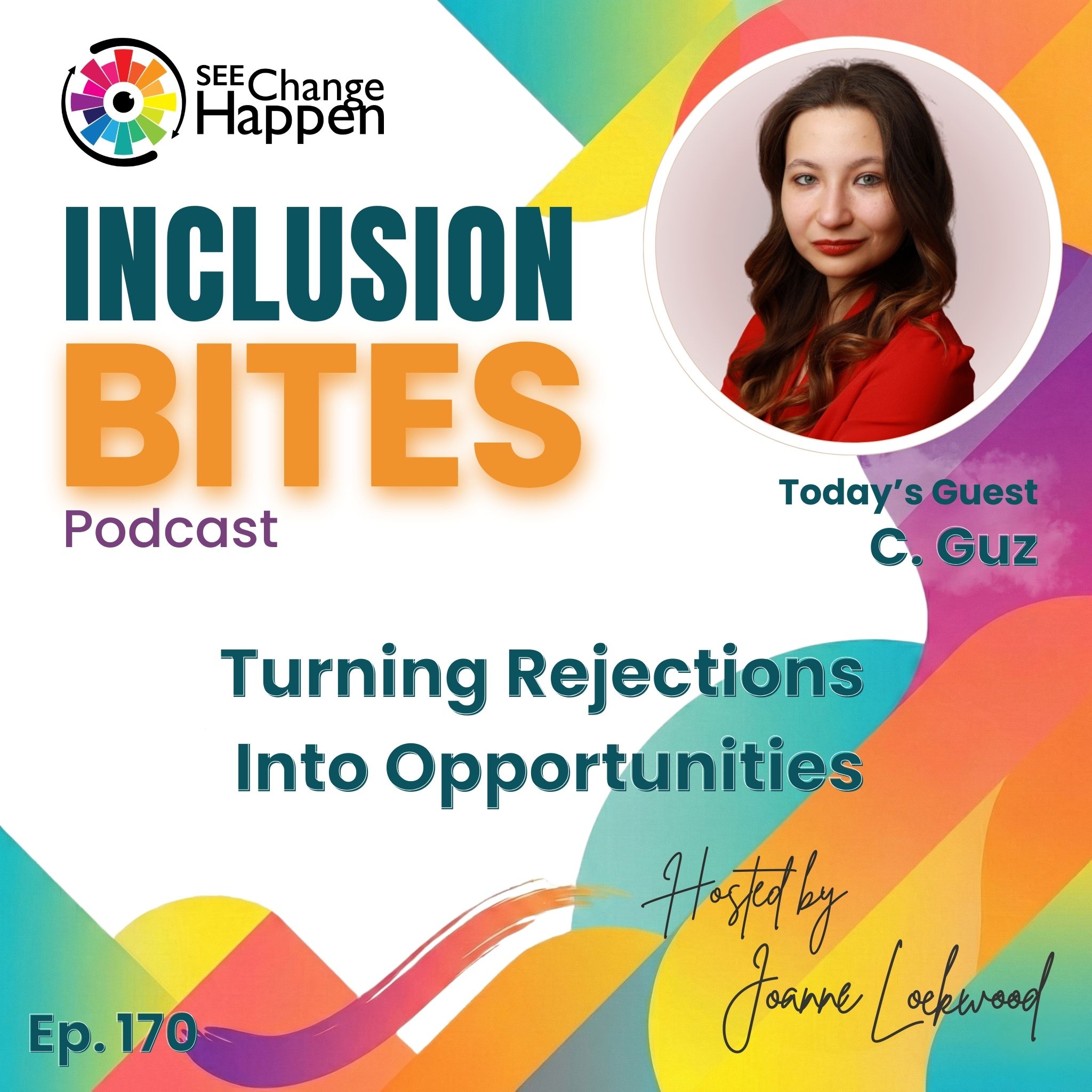
C. Guz explores the journey from relentless job rejections to entrepreneurial empowerment, challenging the impersonal recruitment status quo and advocating for inclusive, candidate-centric hiring practices that rebuild trust and human connection.
In this episode of Inclusion Bites, Joanne Lockwood speaks with C. Guz about workplace culture systems.
Welcome to Inclusion Bites, your sanctuaryfor bold conversations that spark change. I'm Joanne Lockwood,your guide on this journey of exploration into the heart ofinclusion, belonging and societal transformation.Ever wondered what it truly takes to create a world? Remember, everyonenot only belongs, but thrives. You're not alone.Join me as we uncover the unseen, challengethe status quo and share stories that resonatedeep within. Ready to dive in? Whether you'resipping your morning coffee or winding down after a long day, let'sconnect, reflect and inspire action together.Don't forget, you can be part of the conversation too. Reach outto jo.lockwood@seechangehappen.co.ukto share your insights or to join me on the show.So adjust your earbuds and settle in. It's time toignite the spark of inclusion with Inclusion Bites.Today is episode 170 with thetitle Turning Rejections Into Opportunities,and I have the absolute honour and privilege to welcome C Guz.C is a female entrepreneur and job seeker who has turned her
Joanne Lockwoodhost
own experiences with rejection into a mission to humaniserecruitment and make the hiring process more inclusivefor all. And when I asked C to describe her superpower, she saidit is transforming setbacks into empowerment byadvocating for inclusive recruitment practises that allow everyoneto thrive. Hello, Si. Welcome to the show. Hello,
C. Guzguest
Joanne. It's so nice to be here and so, so nice to be doing thiswith you. I'm. I'm glad I actually pushed record
Joanne Lockwoodhost
on this episode because we were chatting away, we were wasting all this fabulousmaterial, so. Brilliant. So, yeah, we've got loads of stuff for our guests to listento today, so, you see, you said when we were chattingaway, you're in Turkey, is that right? Whereabouts in Turkey?Whereabouts in. I don't know it that well. I know Bodrumprobably is probably about it. Currently in Istanbul, commonly known as, you
C. Guzguest
know, the Constantinople, the city with two coasts. So that's where I was bornand raised then. Wow. Because Turkey is a
Joanne Lockwoodhost
interesting country because it's a bit Mediterranean, it's almost a bit African,it's almost a bit Asian, almost a bit European. It's kind of on thatreally sort of strange gateway zone, isn't it? I'd
C. Guzguest
say so, but I personally never found my belonging here. Andthat's also, you know, what eventually led me to, you know, seeking these globaldoors and opportunities. So, you know, like
Joanne Lockwoodhost
me, actually, you know, you faced rejections in your jobsearch and so how did you turn those kind of rejectionsand channel those into kind of a An entrepreneurial spirit.How do you humanise recruitment? Absolutely. That's a great question. Thank you
C. Guzguest
so much. Accidentally, I think I've been studying the whole space forthe last eight years and I initially didn't really mean to. I wasa very young person, young professional, looking to getopportunities, get the right mentorship. And then the last fiveyears for me has been really difficult because I got more than 13,000rejections. And that meant like slap on thewrist, a kick on the face. But that eventuallymade me navigate a 10 month of unemployment period wherethe financial insecurity was at an all time low, at an all timehigh. And essentially I looked at everything thatI was navigating and how degraded, you know,unqualified I felt. And it felt like as if I amtotally useless, as if I cannot achieve nothing. Um,and the job market was really like, you know, transforming whenI was an undergraduate. And then when I graduated, it just becamea whole chaos with the layoffs and, and the economy, inflations andeverything. So in that 10 months, what Irealised is, you know what? See, I said to myself, millions of peopleare going through the same thing today and you see a solution.If you do not act on this solution, then you're not responsible,you're not fulfilling your responsibility and you're, you know, youare not doing what it needs to be done. And if you don'tdo it, then no one will do it. And can you really live with yourself?You know, after five, 10 years, the solution does not exist and these peopleare going through the same chaos just because you were ignorant.And then that was a spark that basically fueled everything. And I said,you know what? This is not going to work. And event. Initially it was morethe candid experience. My problem was because the inhumanity really, reallybothered. But then when I had to recruit for my own startup, Ihad 2,000 resumes in front of me. And I remember looking at thoseresumes and being like, how do I understand whoI should interview Those tell me nothing about who a person is.It was in 2019, I had to create my first resume and Iremember looking at that one pager when it was done and I hated it.It was almost like, I'm going to destroy you. You're tellingnothing about me to that employer. You're not telling the value that I canbring, how much of an asset can be. You're reducingme to these data points that don't actually translate to business outcomes,to actionable data, and you also don't know the contextualinformation about how I was able to like achieve those goals in theorganisations that I've supported in. So I've always had a problem withresume ever since I created one. And I also had theseexperiences where I was constantly rejected and ghosting isalso like a must. So I found myself just holisticallypicturing what is actually going on in each of those steps andthen actually living them and then seeing what would be a betterway so that we can actually build the bridge that should have existed,all of them. And that's really my motivation.And I was lucky to meet my co founder who's a technical end of thingsand I'm so lucky because he has been the co founder that I alwaysdreamed of that I would have. Yeah, great. What
Joanne Lockwoodhost
you're saying that candidate experience sucks, doesn't it? I've never had a greatcandid experience yet. I'm not saying never, but yet not theone that jumps out to me. But as you, as you pointedout there that you know, in your own startup you had a thousand, two thousandapplicants. It's hard to be specific andgive great feedback to 2000 people or whatever it is. And we think about largeorganisations who are hiring at scale, big, well known brands, they just,they just get inundated. So the first sift that, that first gatekeeping is almostlike a instant rejection. You're lucky if you get that within an houror you never get it at all. So how can we start thinking in amore candidate centric way? Because studies haveshown that often candidates are also clients andcustomers. So if we don't treat our candidates right, that can damageour brand, can't it? Absolutely. I love how you put
C. Guzguest
it. And there was a quote by a Forbes HR council member who says thatwe have built our current recruitment tools to reject candidates and not toselect them. And having been a recruiter, recruiter, like today for example,when I talk to recruiters and employers and asking if they're currentlyposting their jobs, they're telling me no and particularly they're not postingon LinkedIn. LinkedIn used to be an asset for those people, but now it'snot because they're telling me, you know, if I do well, I'm just going toget spam applications and people who haven't read my job descriptionsdon't meet the qualification and I'm just going to be wasting my time there. Whenyou're a recruiter, when you see an applicant tracking system, it's really true, likeyou're trying to get rid of the unqualifiedpipeline as fast as possible. And that means alot of people are falling through the cracks. And again, like, theget rid doesn't mean that you're trying to sort of, you know, beinhumane in that process. But you're a recruiter. Like, imagine thatyou're going after or have two roles that you're hiring for. Let's say you're hiringfor a software engineer and a product manager. And if you're getting 500applications for each of them, what you're going to do, you're going to use filtering,keyword search, boolean. That's what we were taught to do,that's how the systems work. But if I don't know howto format my resume, like I have experienced this and I'vealso seen this happening. Hiring managers look at a resume format of resumeand they tell me, no, there is no way that I'm gonna allow thatcandidate to be moved forward in the process. Resumes are not standardised.
C. Guzguest
You know, like, without the standardisation, how do you compare, like apples to,you know, pears or apples to cherries? And essentially that's, that's what we're trying todo. The only thing that we have been focusing on is actually theactionable data part, which resumes were supposed to focus on,but again, missing a lot of contextual information, behavioural informationand hundreds of more data points that I can hear count. So coming back tothe employer brand, I mean, you go to a Glassdoorpage and now candidates are talking about their interview experiencesopenly. If you've interviewed in a company, candidate has now becomea YouTuber and they're going to be publicly speaking about the experience, experiences thatthey just had. Your employers, first, sorry, employersare advocates for you, but then the second advocates for your brandidentity. Your employer brand is candidates. And if you don't valuethose people, then they're going to talk about it. Let's say, youknow, you're a McKinsey and you had this horrible experience with McKinseyas a candidate, that candidate is going to be talking to their closestcircle and now they are going to think twice when they'reapplying to McKinsey, no matter how good the brand is, because it reallyis based on trust. And if you don't build that trust effectively rightin the beginning, if you don't value those candidates, then those candidates are not goingto be applying to you. So you're going to be starting to miss out onthe top talent in the market and your competitors would get them just becausethey Care just because they're creating those right. Candid experiences.And let me give you another data here. So the researchers looked atwhat really predicts retention and growth after those candidates arehired. And candidate experience is the core and you know, it's predictedby 90% of HR people that actually sayscandidate experience is a core predictor of retention and growth. And if youdon't nail that, then how can you expect to retainthose, you know, candidates that you hire as employees? Like it's a wayto build trust. It's to build a way to build that commitment, to showthis is how it's like when you become an employee with us, when you'rean employee with us. And if you're saying that this is how it lookslike and we won't care about you when you're an employee, then how as apotential employee, I can build a trust that you will train me with theright resources, that you will create the right environment for me to work in,that you will create growth opportunities for me, that I will be compensatedfairly. You're shaking all of these foundationsbefore they are even built if you don't have the right candidate experience.So that's essentially how it translates to, you know, the dignity influenceson your employer brand. You mentioned something in there,
Joanne Lockwoodhost
trust. And I'm, I'm a great advocate for trust hasto be inherent in the process. We talk about psychological safety. There has to bepsychological safety in the hiring process, in the candidate experience as well.The problem is you said this when you were talking about your own applicationjourney. All Those thousands of CVs, thousands of applications you made,you got to the end in that process and you had zero faith ortrust in the system. That almost like why should Ibother submitting another application? Because you had beenso bruised and damaged by the past experience, you think, well,this is just pointless doing it. So your trust was at an all time low,that you were going to be given a fair hearing, treated fairly, whatever it was.So as recruiters, whether you're agency, RPO or in house,how could you reach out and bring that trust in back intothe process? So it really starts
C. Guzguest
with the first experience, like in your career space probablyis the first place that the candidate is going to look at like a dayin life, how the culture looks like. And you shouldn't use likebuzzwords. It's not about for example, like leadership, but what that leadershipmeans to you. For example, maybe you believe leadership should be sharedor how, you know, how do you empower those people in your Organisationsand real time testimonials of them, like people hire people.That's something that we've forgotten in the process and we have to bring this back.And starting from that careers page, everything on the website has to beoptimised. You have to position yourself as, you know, answeringwhy I should work for you, why I should work with you, whatexciting mission are you working on that I should get excited about?And then when I scroll through the caregivers page, I should be able to seethe growth opportunities that are waiting for me. And not only that, this isonly done by so many, few employers. For example, I think
C. Guzguest
Johnson and Partners in the uk, I'm notsure if I'm pronouncing their name correctly, but they're a retail brand andthey have been the most transparent organisation thatbasically said, these are the stages that are waiting for you, these are the kindof questions that you will be asked and in each step, this is the personyou will be speaking to. And to succeed, these are the things that we willbe looking out for. Now you're prepared, but many of the interviewsdon't prepare organisations and candidates for this. Socandidates don't have the data. Like you get an interview request. Whydo you want to talk to me? Is this a first hiring manager interview? Isa recruiter going to be talking to me like, what am I asked to, like,answer? Am I asked to just, you know, participate in a live casestudy that I don't know nothing about and then I find out on the spotand then I'm asked to say submit something in an hour and I know that'sjust impossible. So candidates are set to fail, almostlike you're setting your candidates to fail, which is so ironic.And then the job description, like, the job description is not only somethingthat shows what the day to day looks like and what youexpect from that candidate, from that potential employee to achieve, butalso a way to position how it is like to work foryou. Like the mission that you're passionate about, the impact that you'vecreated. How many organisations have you helped? You know, for example,for us it's candidate experiences, it's the brands that we're able to helpthem humanise recruitment. Our change makers, our partners,show how that narrative looks like, like give them an insiderperspective. You know something that's really ironic, when I got those2,000 resumes as a startup, as a recruiter for the first time, in my firststartup, we had an employer brandbefore the product itself, before an mvp, we were working from Five differenttime zones. It was, it was a mess. But the way that wepositioned our vision resonated so deeply with peoplethat they went on and apply and that was not it. After theyapplied, I actually had a 20% like of the people filling outan eight section form that I have prepared to be able to assesscandidates. And that process look entirely different from any of theinterview processes that I've been to because I couldn't find any of thoseanswers in the resumes. Then more, you know, around200 people actually went on and completed that. And one person gave methis feedback that it actually took them four hours to complete that form.And the reason is it's not because it was that long, but it's becausepeople were not used to being given that space, thatopportunity. The eight section forum looked like, okay, likeI see that you're a current student or a mid level, like professional, but whatdo you want to do? Like it was more reflective. How canI support you? What are the areas that you want to grow in? Whatare your skill sets like? You know, having people break downthemselves as a spot and it was a reflective opportunity for them thatmany of those, you know, people who worked with me were able to understand whatkind of a career that they wanted to pursue. And I'm going to tell thisas a recruiter. Majority of the people, especially juniorsand even middles, they don't know what they want. Andit's your opportunity to help them reflect to, you know, havea more coaching style of interview where they're able to understandthis because then you hire them and then they realise that job is not rightfor them. So help them understand. We treated thoseinterview processes as transactional and as an interrogation, you know,sort of, you know, model where the hierarchy is always,I as a recruiter have, you know, the upper hand until thecandidate gets to the point of salary and then things change. Butit is a partnership. I, as a recruiter am assessinga potential employee that I should be excited for the hiringmanager that I'm supporting to, you know, to be working with. I amassessing that fit. And as a recruiter, focusing on a strategy, themore you work with that hiring manager, if you're for example, not the more thatyou understand their expectations, the more you understand what kind of aleader, a mentor that person would be. So now you're hiring their report.Everything really is based on that human connection. And then we're tryingto remove those human loops from the process and then automatethem so humans are not able to make the right hiring decisions. Howcan AI make the right hiring decisions if you remove human from theprocess? So, long story short, it's really about creating thatinsider perspective. How is it like working for youremployer, working for your organisation? And as a recruiter,how has your experience been like? All these things are very,very simple and easy to do. It takes a minute toadd that something in, but it makes all the difference. And candidates really feel likethere is a human behind the keyboard who will be assessing theirapplication. Going back to what you're saying
Joanne Lockwoodhost
there about you get the resume, the CV in and you're trying to extractthis data and you're saying it's not geared up to actuallygive you the soul or the personality or the heart of that individual, which iswhat we really ideally want to be. Hiring people, not paper,not numbers. I always think about the CV is very historical.It's a Wikipedia. It's not saying anything about you.We've kind of evolved the CV to be this master document of my life. Thisis what I've done. I'm a great believer in not howdid you questions or what have you done questions. It's what would
Joanne Lockwoodhost
you do? How would you approach this? Or what's yourthinking behind this scenario? Which the CV doesn't show you?Which is why a lot more modern recruitment practisesanonymizing. They're using workplace samples, they're using five or six howwould you questions which actually require more effort from the candidatebecause they can't just bombard you with their CV onauto, they have to actually look at these questions now.And that can actually filter candidates out because. Oh, that's too difficult. That's too difficult.But if you actually put the effort into crafting that greatworkplace sample, how would you tackle this challenging situation? How wouldyou tackle the data centre just gone down and you'vegot customers screaming at you. How would you handle that situation? What would you dofirst? That's for getting into the mindset of thecandidate and then we can see what a valuable resource they would be in acrisis, in a. In a team environment, what their personalityis, isn't it? That's what we want to find out. I love that. And that
C. Guzguest
made me. That brings me to this. Like psychometric assessments that enterprisesleverage really heavily and then cannot feelinsecure at that point because they're thinking there is abehavioural example that they're asking to answer. For example, you know, yourcolleague just stole something from the office, what would you do? And then there Arelike four different like, answers to that. Like, do you protectyour, you know, colleague because they're your colleague and youstand with them? Do you report that to the hr?Do you, like, ask them to, you know, return that?All of these things say something about your behavioural characteristics, yourpersonality. But these tests are not,you know, leveraged in a way that creates psychological safety fora candidate. Because you're standing in front of that screen and you're thinking toyourself, what is the right answer? Like, because there aredifferent right answers in that particular situation. Maybe the employer is trying toassess your loyalty there, maybe they're looking for your, like, workethics. If you're assessing loyalty, then you should ideally supportyour colleague who stole something from the organisation. But from the businessperspective you shouldn't do that, but you don't know what they're assessing.So the psychological safety, I think is, is really making things difficultfor the candidate. Like, I understand that I'm being assessed right now, but whatare you really looking to get from me? Like, what is itthat you're really assessing? And I understand all these like,cheating measures and sort of really trying to create an unbiasedenvironment from a psychological experimenting perspective. And that's where we took theselike, studies from. Essentially all these psychometric assessmentsoftwares that you see now, they were one psychological experiments andessentially we learned from that data and now we basically productizethem. But I think that candidates are not feeling safe with that and it's,it's, it's not happening. I think it's a bit like
Joanne Lockwoodhost
when you use ChatGPT or an AI system.What you do at the beginning is you say you are anexpert this and your role is to design that.When you do the psychometric test is you think, well, what am I applying for?I'm applying to be a programmer, acoder, therefore I'm going to put my head in thatmode. If you're hiring me to be head of security or HR or audit,then I'll have a different answer because, you know, you want me to grass upyour teammate. You want to be ultimately security focused, company focused, butif you're in a small team, you want this person to maybe talk to theperson that's committed the wrongdoing and say, look, you really shouldn't have done that. Idon't want to be the one that grasses you up. Why don't you go andhand it back or be honest yourself and coach them into thatwithout colluding. So you want a different approach, so you just Got to put yourhead in the mind of, of the job you're applying for. Andyou could. People say you can't cheat these systems, but I think if you've, ifyou've got enough intelligence, you can move your brain into a spacewhere you're thinking and acting in the model. You have to act. Soyeah, and I think what we're doing is we're almost forcing people to act andwe talk about bring your whole self to work. You don't actually want my wholeself. You want this narrow bit that fits into your definition.
C. Guzguest
Yeah, fully agree. And like recruiters areessentially like prone to look for red flags rather than,you know, the things that they like about the candidate thathelps them move to, to the next stage.
Joanne Lockwoodhost
It's down to risk though, isn't it, the recruiter, if it can. If therecruiter's got two good candidates, it will come down to whichone am I most comfortable, which one is least risk. And that isoften a bias. It's that gut feel, it's that spider sense.Oh, I just feel it. You rub the paper, you go,this candidate just feels better to me. For whatever reason, all thosebiases come out, don't they? So we have to recognise thatthat personal bias has a huge influence on two identicalcandidates or even two candidates that are very close. You makea, I can't take the risk. If I hire this person, it goes wrong,people are gonna blame me. People are selfprotectionist as well. It's human nature. Yeah, yeah. But I think
C. Guzguest
that again, like it comes back to what we evolverecruitment into. And that has become today, unfortunately,rejecting candidates because like if 500 people areapplying, you have one opening. It's really,really, really difficult to get to that top 10 when you'reable to like say, okay, now it's the top five and top two.And then you also have to like have candidates, you have to, you know, keepthem waiting on the sign because maybe someone will reject the offer. And now youhave to be like thinking about your next move as a recruiter. But I thinklike recruitment has been evolved in a waythat something that this candidate does is right and wrong. But I think thatit should be focusing on the differences, like how would thiscandidate think about the situation? And maybe their way of thinkingis particularly right for a company that is in a, in a different stagethan ours. And that's completely okay. If you think that is, then, then you know,you have to give them the feedback and that would be really helpful tothem so that they can go out and seek the right jobs for them. Butgoing back to iOS, you need data. There isnothing in the process that is removing those biases. Likewe have software today that removes forexample, like the names of the candidates and like the contact information.We had the DEI software that focused on reporting measures.So it was more like do you want more females in your organisation now ordo you want more diversity? And diversity was diversity in a way that it washealthy, but it was more like, hey, this, you know, Mr. Government,this is the type of employees I hire now, you know,like give me more funds. And I don't think that that's, that's the right wayto go about diversity. Inclusion has to be, youknow, for all the candidates that you're putting in the process for.And if, for example, I'm a neurodiverse candidate, I don't always do well inthe interview. My brain works differently and recruiter can saythat my thoughts are unstructured, I don't know what I'm talking about.And for example, it is on you to like set those candidates forsuccess, like send them the questions that you want to ask in advance andthen the candidate could then have the risk basically to, you know,read things from ChatGPT. And we have things that are happening, but the candidates aredoing this because their trust is entirely gone in recruiters. Like we'retalking to people today and they're rather wanting to be assessed by anAI than a recruiter because those recruiters are making them go through likehorrible candid experiences. And I think that's a pledge that we all haveto take. Like, you know what, I understand that things havebeen really hard, but to rebuild this trust we have to worktogether. And I think that that's, that's reallyhow things can move forward. Because I cannot be like these peopleare adults. When you look at it like theanti cheating measures and tracking softwares to me feelsjust utterly dystopian. And I personally don'twant them in my hiring process because I, if I don't trust my candidateand they know that I don't trust them, how can youempower them as employees to do what's right when push comes down theshow, when they need to take an incentive, macromanagementdoesn't lead to success. We all know this. And then the question allcomes to like remote work and on site and everything else, butI don't think that's the way to go. So we have to focus on rebuildingthat trust. I think to overcome Those biases.
Joanne Lockwoodhost
I used to do a lot of work with smart recruiters. I went to alot of their conferences, spoke at a lot of their conferences. Pre Covid I gotto know their founder and CEO Jerome quite well and he talks about thesethree dimensions of hiring success as he would put it. Soyou've got the cost per hire, the hiring velocity and the candidate experienceand they can't all be high. Sorry, you can't have. You've got to balancethose. If you want great candidate experience, you can't do it cheaply.If you want higher velocity at a pace, you can't do it cheaplywithout sacrificing candidate experience. So you've got that three legged stool. If you'renot careful, what you end up doing is trading off for speed and velocity becauseyou've got empty seat costs, you've got need to fill that vacancy. Thereforeyou're not going to think about diverse hiring best practisebecause you've got to get somebody in that chair. You know, you know you've gota three month lead time once you've made the offer and you want.So basically this is a six month hiring hiring cycleand you want someone now. So you can't do it cheap, you can't, you know,you can't do it quick, you can't do it take your time, do it properly.You can do experiences going to be rubbish because you're just firing people in, fillingthem up and you just kind of pick what you've got. Sohow do you balance those things and actually which is the most important candidateexperience, cost per hire or velocity? Which one do you sacrificeor should you? I think that it's not the question of a
C. Guzguest
sacrifice, but I think these things are interconnected. Like this is a systemthat you're talking about and I think that if you nail candidate experiencethen essentially you're reducing your cost for all thingsinvolved. And the reason is because you're attracting the right candidates for youbecause those candidates are essentially pre qualifying themselves and they nowknow what kind of an organisation that they will be working in. So you're reallygetting engaged candidates which essentially makes you not repeatthe hiring process over again and basically double your hiring costs. Sowhen investing your in your candidate experience, you're actually fixing all of themin terms of the velocity. I think that really depends on what kind ofa role that you're hiring for. But every role like should look different. What kindof a case study will you be like leveraging for example, because you also needto, to focus on how to understand how to candidate things but without,you know, basically making them do unpaid labour, which is, which isa massive like concern in candidates today. So maybe youcompensate those case studies that might be, you know, costly but then youbasically say, you know what, I'm gonna send only to like the 10 candidatesthat I know who might be qualified for the position. I think that investing incandidate experience makes you attract the right candidates and those right candidates arenow engaged. So now you are able to move much fasterbecause you're in attracting them to your inbound. So this means thatyou don't have to go out and seek those candidates on LinkedIn, message them andoutreach. It really takes so much time and even recruiters getghosted here. Like ghosting is not just for candidates at this point.Candidates also as a response can try to like ghostrecruiters because of what is going on in the current job market. So Ithink that candidate experience ultimately reduces your costs. Butif you like treat it right, if you don't understand how candid experience ispositioned within your greater hiring strategy and how the hiringexperience will look like and how different stages willbasically need different stakeholders to engage. For example, maybe ahiring manager did like sends to send the feedback, needs to send the feedback ora recruiter needs to collaborate with another recruiter. Maybe there is a decision making.So if you structure those and essentially you will be able to move much faster,much faster in this process. But again I think that candidexperience is not costly as people think.Writing that one line of this is what our culturelooks like in a day to day. You know, we forexample, like describe someone's day to day. Like I wake up,I get my coffee, I start my day in xyz, where are they workingfrom? Maybe you are like giving like remote work opportunities. So sharetheir real life experiences of a successful employeeprofile so that the candidate can see, well I'm represented thereor not represented there. So the people who actually read your jobdescriptions will be resonating with that and essentially they will bethe ones who apply and you will be reducing on all costsincluded. Like you don't need to invest in a software to do this.So I really think that it's really about focusing onmaintaining that human connection and it is not as costlyas you think and you really don't need to invest in a specialist software, especiallyif you're a small organisation. What we talk about here is it's the early stage
Joanne Lockwoodhost
of the sift, it's the talent attraction Element, the employer brand, making surethat people resonate with you. Do the datagathering and then we're doing the long list, down to the short list of10 candidates. We haven't actually met these people yet, have we really, in most ofthese cases. And I'm a great believer when I'm a candidate, I just want tomeet you. Get me off of the paper, get me off of the, off ofthe, the ats, into your face. Because I could, I know I can sellmyself, I can smile, I can engage, I can adapt, I can bea chameleon around what you need face to face. But if I'm, if I'm tryingto argue on a bit of paper, that's not me, I can't, I'm not interested.I want the human connection. So how do we givecandidates more face to face time without it beingburdensome? Because as you say, you see horrorstories of organisations that get people in for 10 interviews. They wantyou to do this presentation, they want you to do this work summary, theywant you to write an application or design something for them.Blimey, I'm doing all this work. And then you get this feeling that they're actuallyusing you as a prototype.If you're marketing, they want to see who's got the best marketing idea. And eventhough they don't hire, they still pinch your idea. So people are worried about theirown intellectual property at this stage as well, aren't they? I think
C. Guzguest
the best thing that you can do is actually find out who you will beworking with and then reach out to that person directly. But then like, forexample, as a recruiter, you will get a lot ofmessages and I don't think that going to the recruiter will still likeget you on, on the top of the pile. A recruiter won't remembereach of the few thousand candidates who applied. But message the recruiter,yes, they will go out and check with you, but they mightnot be able to assess your competency because you have to remember that arecruiter is not a specialist. So if I'm helping the,let's say, lead product manager hire an associate product manager.I have not been a product manager myself and as much as I cantalk to the like hiring manager, I still don't have thenuances of what they're seeking. So go directlyto the hiring manager saying, hey, I've applied, I'm really excitedbecause your mission really resonates with me or the product that you'reworking really relates to my experiences or the areas that I Want to grow.Here are some of the things that I've achieved and I would bereally grateful for a response or basically directly going to thatperson who you will be meeting with. If you're involved, then ifthey like it, then you basically will get an interview and hiring manager will bethe one to prompt it. In the current process, unfortunately,this is the shortest cut, the shortest pathway. Thisis not ideal, absolutely not ideal. Especially if a loadof thousand candidates in the pipeline end up doing this. So youreally have to like, mindful about the message that you'rewriting and you should give them actionable data. Likeas a candidate, you have to remember that the employer islooking for actionable data. What makes you the right fit for thatposition? And you know, how do you becomethat successful employee profile? I think that's really important.And don't be like forceful in your messages, like that's, that'snot going to leave a good impression. Or don't tell the recruiter, hey, youhaven't like checked my response in like two weeks. The recruiter is probablydrowning in applications. No recruiter wants to leave themessages unanswered or leave the applications unanswered. But sometimesthey're stuck because the hiring manager says, you know what, I need a week becauseI have X, Y, Z to finish in my current operations. So the hiringprocess extends for another week and then another week. The recruiter is really thefrontline person here who doesn't have much control in,you know, the internal operations, but she is the one, or he is the onethat is representing whatever that is going on and maintainingthose communication processes with you. But we know that in big
Joanne Lockwoodhost
organisations, suddenly that role goes on hold, the project getscancelled, or there's another thing going on in the organisation, a mergeror a diversification. So the recruiter sat there inthe middle of this project, recruitment project, and suddenly he's got Austria. He's got noidea what's going on around them. So, yeah, as a candidate you're obviously thinking,well, they must be ready to hire. But that's not always the case. And someof them, sometimes they're speculative. Go to market, just see who's out there as well,aren't they? So they're not, they're not all. I know it's a bit unethical todo speculative job seekers and just to get people in,but it does happen. People are testing the market. They want to know, if wewere to open an office in this new city, what's ourlikely response rate? So you Might want to put stuff out there, you know,fly a kite, as they say, just to see what the interest is. Absolutely.
C. Guzguest
I think that one unethical practise that I really hope wecan like put to an end. Put an end to. And LinkedIn has been takingsome action against this, but it's really, really hard to know, especially when you're avalidated employer. Ghost posting. Like the jobs thatare not actually real and the main intention of that isactually increasing the amount of LinkedIn followers because if you do notopt out, then essentially as a candidate you followthe employer and then that basically increases their follower count. So themarketing team seems this as a shortcut. I'm really sorry,but this is, this is what's going on. So you have to understand whether thatjob is real. And it's really hard to, to do.
Joanne Lockwoodhost
Now. Everyone's. We've got to remember that recruitment issales and marketing. It's. It's like buying or selling a house. It's likeanything you're. You're just trying to matchneeds and, and resources and yeah, it's.Some people are ethical, some people aren't ethical, or some people bend the ethicsto suit their own definition. So people will use any, any salestechnique. And you gotta remember that you're. Whilst you're the most important person toyou, you're not the most important person to the recruiter. Therecruiter's bosses, who they're trying to hire for is.That is their client. Really, you are just theplate of chips in McDonald's. You're just the food at the end of the day.And the recruiter decides whether you want chips or whether you want jacketpotato. It's trying to get into that mindsetthat you're not special, you're just one of a wholepile of people. I think that's where it is, but I think that's
C. Guzguest
where we went wrong. Like, again, the transactionalism, itmust come to an end if you're being hired bya recruitment agency. If you're a candidate and a recruitment agency recruiter has seekedyou out, the process will look like entirely different and the candidateexperience will be relatively better because you. I don't knowhow to put it like this way. You said the food, so I'm just goingto use that. But essentially you are valuable because if you gethired, then they get a bounty of that or a commission of that, sothey need you to get hired. But again, like, if you, if theythink that you're the right fit, then you're going to be seeing the top candidateexperience possible from that recruiter. But I really think thatagain, like, we have to reestablish recruitment as apartnership. Like, it's not just me who isgetting hired, but I'm also hiring you as an employer. Like I'm basicallysaying I have all of these great skills, great qualifications, and ifyou work with me, these are the things your organisation is going to be achievingand these are the areas that I can grow myself in. And it's reallyabout meeting in the middle. Like it'snot. One gets the upper hand and the other fights against it. AndI think that mentality led us here, really. Wehave to focus on rebuilding the bridge and we have to understandand re establish recruitment as a partnership.
Joanne Lockwoodhost
So you touched on AI earlier. I'mreading these posts on LinkedIn and other forums aroundrecruitment and what we're ending up in isan AI bot talking to an AI bot. We look at all theseno code platforms, Zapier, Pabli,mate.com, all these sort of things. You can build all this stuff that will scrapejob listings, take the, the requirements, take yourPersona and merge it and produce that and then email the recruiteroff. Then the recruiter's got this ATS that sucks of that inAI pre processes, it matches against the job spec and then if you're good enough,you do. So are we going to be in a market where in the olddays it was? If I pay $150, Ican get someone to write my CV for me. That will be ATS FriendlyKeyword Boolean. They'll redo my LinkedIn profile so I'll send more chance.Now you're going to have AI, no code, people writing automationscripts to say, right, you pay me a thousand bucksand I'll get you in there and I'll target you and I'll guaranteeyou'll be submitted to, I don't know, 50 a dayand it'll be individually tailored and then we're just ending up in a world whereit's like super catfishing, isn't it? On dating sites where youjust, when you finally meet each other, you go, oh, who are you?That's what we're going to end up, isn't it? I love how you put it.
C. Guzguest
One recruiter said to us, like, it's almost like in amongthose 500 candidates, I'm looking for a simple human being because, likeChatGPT, like it's almost a new form oflanguage where everyone just like Knows it as they see it, likethey call it out. As a recruiter, I know likeinstantly when a cover letter is generated by GPT.Like, and I'm not against GPT being used like in that process.Of course, like, use that, of course paraphrase it. But if you're notputting any additional effort, then, then like, how do I know as apotential employee you will be putting that effort? So like, if I'm notlooking to hire someone like average, I'm looking for someone exceptional in that process.And you're essentially telling me that you're not the exceptional person that I'm looking tohire. So you're essentially wasting your own time and going backto your question. So there is a data just before, like eventhese automation tools came in for, for candidates.70% of candidates today already like lied orexaggerated facts in their resumes. We know this. So who youend up hiring or the sort of, you know, moving in the processes. But. Sorry
Joanne Lockwoodhost
to interrupt, but. But 70% of organisations and companies lie about thejob as well. So it's, it's two people bullshitting each other, isn't it? We'reboth selling. That's what we're doing. We're both selling an opportunity. Yeah,
C. Guzguest
that's, that's absolutely true. And you know, going back to it, it's, it'sreally now hard because we know that AI hallucinates. Like, I'vetried these tools myself as well. Like it tells the,you know, the AI tool that I'm able to speak like Dutch,French and German and applies to all these positions that I'm notqualified for. And then I see the LLM as written,you know, the paragraphs. And then, you know, it justdoesn't make any sense. And the recruiters are, you know, seeing them and beinglike, no, absolutely not. AI is not necessarily processing theapplications today, which is really the hardest part because like, governmentshave serious consequences know against it. They're basically tellingyou AI cannot make employment decisions. Like, there iscritical, you know, laws around this where you, youhave to see each of the resumes that are, that are being passed onand filtering out is one way. And AI is able to currently likesummarise or pull like information of those resumes and score them.But it cannot and should not make hiring decisions because youstill require that human judgement in the process. But again, like theemployers, again, that's why we have to focus onbuilding that bridge. Like, how do we meet in the middle and stopBSing each other in this game? So if you Start talking right at the very
Joanne Lockwoodhost
beginning about trying to see me as a human being in this process.And one thing I've always wanted to happen is you apply foran organisation and they say, actually now we've met you,we think you might be better for this role or this role or this role.Can we talk to you about other things we do in our organisation? So hiringinto a talent pool if you like, or fishing people into this talent pool wherethey start to evaluate you, where they have a wholesmorgasbord, to use a Finnish or Swedish word, ofopportunities here we want to see where you fit in the organisation becauseactually we want to hire you because you're a greatasset to our company. And then once you're here, we'll figure out what to dowith you. And I say, look, give me a job and then figure out whatto do with me because I'll, I'll evolve into it as well. And if youthink about quite the best organisations, there's jobshare opportunities, there's career pivoting, there's moving into different areas of the business.Why can't I do that on the way in rather than have to wait tillI'm there to do that? It's a great question. Personally, my opinion is
C. Guzguest
that those talent pools do not work. Like the initial reason that,you know, those recruiters or employers in general are building those pipelinesis because rather talent pools is because, so that they can haveaccess and essentially reduce the candidate acquisition cost becausethen they have to do recruitment marketing and then that means anotherinvestment to their recruitment budget. But most of those candidates nevereven get contacted and then, you know, it just becomes areporting metric again. I think that what you're saying makesa lot of sense. There is one person, Constanti, who has been workingon this for the last 20 years and he says that youessentially, you know, hire someone and they become the perfectemployee. Like you cannot expect for a candidate to, youknow, fill all the boxes before you hire them because you train them and theyevolve into the job as you mentioned, but we don't have anytools today that focus on that evolution, that growthpotential. And that's exactly one of the gaps that we want to fill in withOctopus. And essentially like youdon't have the data as a recruiter to show, hey, you know,like Joanne is going to be growing to, to these areas orthis person is inclined, inclined to grow in XYZ directions andthey can therefore like create value for, for your business. It's,it's really Hard to assess that, especially when you have solimited data that is, that is not actionable. But
Joanne Lockwoodhost
what a lot of progressive companies, I'd arguethey're progressive, is they're building their own academies. So they're.Whether you want to call it later life apprenticeships, whether you want to. Whatever youwant to call it, recognising that you don'talways make the right decision when you go to college, when you go to university,when you're 25, you think, I don't want to be a chef, I want tobe an engineer. And all of those early careeropportunities suddenly disappear, whereas some of the smarter companies are looking and saying,okay, if you're a returning parent in your 40s,whether you've been very redundant in your 50s, whether you're.Wherever you are in your life, we're looking for fantastic people in ourorganisation. And in the same way, if you wanted to train to be a doctor,you go into a hospital and you do rotation around all the different departments. Actually,I want to be a brain surgeon or no, I want to be in geriatrics,I want to be in this, I want to be in that. So you specialiseonce you've done your baseline qualifications. So if organisations were looking atbuilding talent academies, which is more active thana passive talent pool, I'm not talking about a marketing database, I'm talking about activeopportunities to get people in who are seen asgreat assets to the organisation, and then we'll build you and nurtureyou into positions and we maybe discover in the firstthree months, actually, you can go this way instead.That gives people an opportunity to get back into the job market for thedepression that you felt into working with an organisation. You're going to be loyal. Imean, just think about the investment they're giving you and the investment you wantto give back, that loyalty you're going to give. Because there's trust there, isn't there?
C. Guzguest
That's true, but that also takes a lot of investment. Like, youknow, a number of enterprises today would be able toinvest in such a large. Because when you look at the LNDpower behind it and all those people who have to, like, if they'reable to build those, you know, specific targeted academies,it means that they have figured out their own kind oflike the, the role structures, like their L1s to L5, howdoes L5 look like for me versus how does it look like for you?But then your seeds say startup and you're like, okay, you haveto wear so many hats and you cannot necessarily focuson, on that transition. So I think that if anexpectation from the candidate is towards more structure andtowards that flexibility, you know, you mightenjoy wearing the hats, but maybe you will realise that you want to dosomething more specific so you have the more freedom and also safetyin enterprises, I would say. And that's why it's really important tolike, assess the behavioural characteristics of a person.One thing that I really focus on in my interviews, for example, do you feelmore comfortable in structured environments, structured tasks wherelike, you don't have to deal with abstract instructions and youessentially are doing something with, you know,like assigned training manual. And now there is not muchuncertainty there. But there are also some people who love thatuncertainty. For example, me, like, give me the biggest, most
C. Guzguest
complex problem and I'd rather solve that on my own than, you know, gofrom point A to B repetitively. But for some people, they wantto specialise from like going on A to B, for example, let's saycreating marketing campaigns in that specific area, maybe theywant to specialise on Google Ads. So it's really, asyou know, we are very different as individual differences. And I think that in termsof that flexibility, not every organisation will be able toprovide that. And it's important for candidates to alsorecognise that as they're applying, because if that's an expectationand you're applying to a startup who recently got funded and they're in a seatand even like series A round, they won't be able to provide the sameflexibility. But if you, for example, go to a more mature environment, let's saystartup who's raised their like series C, series D, series E, thenyou're really talking about that enterprise structure where you're able to seehow those roles and expectations have evolved, howother people perform. Because like all that, academies arebuilt on the previous experiences. What did I learn internallythat I can translate to, you know, external resources to attract the righttalent for me, but if I lack that learning, then Iessentially can't build the right funnels that I will be able to attract theright icp, the ideal candidate Persona, who will then transforminto my successful employee Persona.
Joanne Lockwoodhost
Yeah, it's not easy, is it? It's not easy. And you say, doI want structure? I love living in a world with chaos.It allows me to create, lets me to ideate, allows me to spitballblue sky, think whatever it is, but that's all well and gooduntil you actually want me to deliver something for you, becausemy chaos is going to be different to your chaos. My expectations. Your expectations aregoing to be different. So the moment I have to deliver something,my first question is, let's nail it down. I don't want chaos at this point,I want certainty. Because if I'm going to have to work something and deliver yousomething, I want certainty. And I think it depends on the role,doesn't it? If you're looking for an R and D with unlimited budget,what we could do is sit there and drink coffee andideate. Or whether you actually want a project team that's going to come up withsomething. You have your agile phase, you have your bit of ideations. I think thecandidates you're going to. Get. You want them to be able toswap between those contexts, don't you? As well? So you can't always find that outfrom a bit of paper in the interview. Do you like structure or do youlike chaos, as you say? My answer would be, I like both. But it dependson what you want at the time you want it. The recruitment process wehave, it's just. It's not fit for purposes. It was still reliant on the cv.I often train organisations around moderncontemporary recruitment practises, which is. It's not just anonymizing the cv,it's just don't have one. And using workplace samples, using the fivequestions, 400 words each, then grading them against predefinedmetrics and follow that process all the way through to interview and each leveland having a diversity of thought on those questions and answers as well.But I still come back when I'm in boardrooms talking to people and they say,well, how do I know who they are without their cv? Well,you don't. You have to trust. You have to trust the process. What ifwe hire someone and I find out something later because Ihaven't got this cv? You have to trust the process. But people are so weddedto this document that we created in the 80swhen, with fax machines before then, we used to fill them in by hand, didn'twe? We used to fill application forms in and then the fax machine arrived andwe started printing stuff out and faxing it to each other. Yeah, the first
C. Guzguest
ever example like that is considered. The first resume was actuallycreated by Da Vinci. So that old we were speaking aboutand he was wanting to work in an architectural project, sohe had to like summarise what he has done and that'sthe first experience and it comes from like, resume, resume to. Tosummarise. So essentially, like, you resum raising the things that you've done ina more digestible manner. So that, that was the earliest example.And I think that like resumes worked until somepoint because I think that we were still focusing on that, you know, thehuman element of it. But then with tech wecouldn't figure out how to marry that technologywith our emotional intelligence. And I think that's the challenge that we're facingtoday. Like we have to be efficient. Yes. But at thecost of that, you know, human touch, we became efficient. So lookingat the history of resume, when from, from your point, you used to mailthose resumes into organisations and then you would never hear back if you wererejected because how can I send 500replies? And like mail was expensive, how can I, you know,like send that back to your address? So I only reach out to people whoI'm interested in and would like to speak to. You've naturalise thatprocess down but then come, you know, digitization like theHTML job application portals, the first applicant tracking system,digitising that entire process. The hiring decisions today are still notmade on those applicant tracking systems. Which is the most like biggestirony to me because you know, applicant tracking systemscost thousands and thousands of dollars, up to 100,000 or moreeven like for, for enterprise level organisations and the biggestsoftware providers. And they're saying that they streamline yourrecruitment. But if you're not making hiring decisions or if you'renot enabled to make those hiring decisions, then what do you streamline?Exactly. Like if that software is not giving that actionable data toyou, what do they streamline? Exactly. And what Isee is then, you know, because they don't have that actionable data, thesetools have empowered us to even build more layers on top of it. So it'snow not three processes, not three steps of interviews, but like sevenstages where there are case studies involved, system design,interviews, all these different interview processes that I am assessing you and thenyou're asking, being asked to like resubmit a case study reinterview just because they cannot collect theactionable data. And that's where we have to focus on. And again
Joanne Lockwoodhost
like, or the recruiters risk averse andthey just want to be really, really sure, really, really, really sure. They'realmost scared to make a decision sometimes, which is why they want to see youagain. It's like oh, I can't sign, let's get them back in for another chance.And yeah, I think some of it is just lack of decision makingor. Structured process, I would say structured process, yes. But
C. Guzguest
without that actionable data you're not able to like move anyone forward. Youshould be able to say I'm moving John Doe becausehe was able to demonstrate their XYZ qualifications and meets myqualifications because you know like they want to grow in XYZ areas.Like you should be able to, you know, picturethat and position that completely if you're moving that candidate in the process.But I wouldn't say it's a risk aversion and you would do this asa recruiter as well because it costs up to more, more thanthe annual salary of an employee if they miss hire.So then it even might cost them their job depending on the policy ofthe organisation. Or it just, you know, leads to drastic. That's risk
Joanne Lockwoodhost
aversion, isn't it? That's risk aversion. You know we know that the average30k salary is cost 130k in oncosts of getting it wrong. So there is a risk aversion there. And that peopleare driven by. I can't mess this up, you know, if this personA is not right for us or we're not right for them. Because that happensas well. You know, you get the rejection on offer, you get the, you getthe first 14 days. We think oh this is for me, I'm outthat walk out. So yeah, it's, it is arisk. I think what we're trying to do is we're trying to minimise those riskson both sides. Protect ourselves, protect my own job. And I think some ofit is just down to lack of, lack of vigour and datain the application process. We should be able to saythat person was good enough. That will do. Stop. Don't need to look any further.Rather than say oh no, we need to see the next 200 people. I sayno, if you've seen the right person after three, stop. Nothing wrong with that.Sorry. We've hired. I think that like
C. Guzguest
the recruiter has to be constantly moving alongand constantly making sure that there's like a backup of that candidateand then expectations are not being communicated well and I thinkthat that's really creating a disconnect. But one more thing about the actionable data sidegoing back to like establishing recruitment as a partnership.I don't know why you're inviting me to a first interview.So what we're doing with OCTOPUS is hey recruiter, thisis a real time data that we collected because you've sent thistargeted smart pre interview. You have those answers beforeeven meeting that candidate. If they're not the right fit, you won't invest20 hours for that candidate because they're not qualified for your role. Heythere, candidate. If you're not the right fit and looking at this, you're not feelinghappy, we're saving you 20 hours because that's on averagethe roles expect you to like, invest in and per role. In today's jobmarket, if you were to pursue five jobs at the same time, that makes100 hours. And that leads you to burnout. If you're, you know, pursuing all ofthem at the same week, it's more than double full time job expectations.But that's how long it really takes to pay. So it's really a process thatburns, burns out both of the sites. So looking atthe partnership again. Hey recruiter, this is the data that we collected.Hey candidate, this is how you were able to demonstrate your skills andqualifications. Here's how you meet like the expectations.When you're going to that interview, you should know what you've donewell, what you have not done well. And now you know how to positionyourself. And because you completed that pre interview, you now know whatkind of questions that the recruiter is going to ask you. So now you're setto succeed, not set to fail. And that's basically what we want todo. Like then we can really talk about an actionable, structuredinterview where you're not starting from point zero. Hey, who are you andwhere do you see yourself in five years? Like those kinds of unstructured interviews thatdon't lead us to anywhere. Like if you're assessing the creativity of the calendars, go
C. Guzguest
ahead. But maybe in five years we're going to be dealing with another pandemic andthat just doesn't tell me what I can achieve in your organisation in the longand short term. So focus on the competency inside the job performance.Many of the interviews today are structured to assess interview performance andexpect that to be translated to job performance, which is again a massive problem.But going back to, you know, that partnership, if bothsides have the same data now, then we can really finally talking aboutthem being on the same page and Octopus having built that bridge. Andthat's why I care about that work so much. Because in every feedbackthe candidate will get better in every interview. And every feedback thatthey got from Octopus, who is being the bridge in between them and therecruiters also will figure out how to better collect thatactionable data. So we're not replacing recruitersand AI cannot and should not and will not like It's a humanhiring human being. So I would say that's really the core thing that wehave to focus on as we focus on building that bridge andbuilding that intersection between the human touch, the emotionalintelligence and technology, I think. So say it's been absolutely
Joanne Lockwoodhost
fascinating. We could chat all day, I'm sure. So you've mentioned Octopusseveral times. So you're the founder and CEO of Octopus. Do you want to justgive us, in a nutshell, your elevator pitch? What is Octopus?
C. Guzguest
Absolutely. I've just been talking about that. I should havefor that question. But to give you in a nutshell,Octopus, if you're an organisation, helps you move forward only thecandidates that are aligned with your qualifications into your pipeline.So you don't have to go through the 500 resumes that don't meet yourqualifications and instead send a smart pre interview thatis created based on your job description. And from there you will beable to assess the qualifications you're looking for. Automatically.Candidates are going to be submitting their answers to that. So it's like a
C. Guzguest
text based interview. So and on that they will be positioning themselvesand you will have given the space for them to really show whatthey can do for your organisation and the additional information that they'd like tomention. And then you will be able to access that data real timeand all those qualifications will be scored based on yourrequirements. So everything that you've given us, it's about you.You take that ownership, that flexibility and it's differentfor every job, every role, every company. And that's why wecreated Octopus, you know as to be your extra tentacle in this process,because as we say that the problem is so big and massive right now thatarms are not solving it. So we develop tentacles. That's our motto.So we're here to be your extra tentacle and help you make that right, thehiring decision, and essentially build the bridge between the right candidate andyou and the. Every candidate who submits that pre interview with yougets a feedback from Octopus saying that this is how they were able toalign with your requirements and demonstrate themselves effectively. Soin every pre interview that you're sending, you're actually nurturingyour talent pool. And those candidates will remember becauseyou've given them feedback. No recruiter today gives candidatesautomatically the actionable feedback that they're looking for. 90% of themgo, so if you're looking to become a top employer,then we'd love to be your extra tentacle. Fabulous.
Joanne Lockwoodhost
What a punchline. Let us be your extra tentacle. And we know thatoctopuses or octopi, they're seriously intelligentcreatures, aren't they? That they're. They're smart beyond their means. They're almost likea alien life form because they're so intelligent. Yeah, I think so, theextra tentacle. And with intelligence as well, no doubt. So lovely. So,see, it's been fascinating. And if people get hold of you, how can they gethold of an Octopus demo or find out more?
C. Guzguest
Absolutely. You can reach out to us on our website, which isjoinocto.co. So that would be J O I N O C T O . CO. Or you can find me on my LinkedIn, which is C. Guz. So,in any case, I'd love to hear from you. And if you're like,you know, being challenged from, with your current hiring process and overwhelmed by somany tools today, I'd also love to help you, you know, find theright direction. Our goal with Octopus is to, you know, help you andgive you ownership that you must and should have as wenavigate the age of AI human humanship.
Joanne Lockwoodhost
Fabulous. And just if you're listening, C Guz. That'sC. You've abbreviated your name because it's Turkish and it's easier for people to sayC. So C full stop. And Guz is G U Z. So if you'relooking for you on LinkedIn, C Guz. Easy to find you. Thank you.Absolutely fantastic. Thank you so much. Thank you.As we bring this conversation to a close, I want to expressmy deepest gratitude to you, our listener, for lending yourear and heart to the cause of inclusion.Today's discussion struck a chord. Consider subscribing toInclusion Bites and become part of our ever growing communitydriving real change. Share this journey with friends, family andcolleagues. Let's amplify the voices that matter.Got thoughts, stories, stories or a vision to share? I'm allears. Reach out tojo.lockwood@seechangehappen.co.ukand let's make your voice heard. Until next time, thisis Joanne Lockwood signing off with a promise to return withmore enriching narratives that challenge, inspire andunite us all. Here's to fostering a more inclusive world oneepisode at a time. Catch you on the next bite.
Transforming Rejection into Opportunity and EmpowermentRedefining Candidate Experience and Trust in RecruitmentThe Future of Inclusive Hiring: Technology, Biases, and Human Touch
Joanne Lockwood is joined by entrepreneur and job seeker C. Guz to unpack what happens when recruitment becomes a system designed to reject rather than to select. Drawing on C’s experience of receiving over 13,000 rejections and navigating a long period of unemployment, they explore how repeated knockbacks can erode trust and confidence—and how those experiences can be channelled into changing the way hiring works.
Together, they examine the mechanics that shape candidate experience at scale: CVs that strip out context, applicant tracking systems and filtering that drop people through the cracks, ghosting and poor communication, and the risk-averse behaviours that lead to longer, more burdensome hiring processes. They discuss why employer brand is inseparable from candidate experience, and how transparency—about stages, expectations and feedback—can increase psychological safety and reduce wasted time for everyone.
The conversation also addresses the ethics and limitations of AI in hiring, including automation on both sides, hallucinations and exaggeration, and why human judgement and dignity still matter. C shares the thinking behind her platform Octopus, which uses a role-specific pre-interview to gather more useful data than a CV and provide candidates with actionable feedback. The episode leaves listeners with practical reflections on rebuilding trust, human connection and inclusion in modern recruitment.
“we had an employer brand before the product itself, before an mvp, we were working from Five different time zones. It was, it was a mess. But the way that we positioned our vision resonated so deeply with people that they went on and apply and that was not it. After they applied, I actually had a 20% like of the people filling out an eight section form that I have prepared to be able to assess candidates. And that process look entirely different from any of the interview processes that I've been to because I couldn't find any of those answers in the resumes.”
“And I'm going to tell this as a recruiter. Majority of the people, especially juniors and even middles, they don't know what they want. And it's your opportunity to help them reflect to, you know, have a more coaching style of interview where they're able to understand this because then you hire them and then they realise that job is not right for them.”
“if you nail candidate experience then essentially you're reducing your cost for all things involved. And the reason is because you're attracting the right candidates for you because those candidates are essentially pre qualifying themselves and they now know what kind of an organisation that they will be working in.”
“One thing that I really focus on in my interviews, for example, do you feel more comfortable in structured environments, structured tasks where like, you don't have to deal with abstract instructions and you essentially are doing something with, you know, like assigned training manual. And now there is not much uncertainty there. But there are also some people who love that uncertainty.”
“And I think that in terms of that flexibility, not every organisation will be able to provide that. And it's important for candidates to also recognise that as they're applying, because if that's an expectation and you're applying to a startup who recently got funded and they're in a seat and even like series A round, they won't be able to provide the same flexibility.”
What it means to turn personal and systemic rejection into a catalyst for entrepreneurial action and advocacy in recruitment.
The hidden costs to employer brand and retention when candidate experiences are overlooked or mishandled.
How technology, automation, and AI are shaping the future of recruitment—both the promise and perils.
Why actionable data and structured feedback are essential for reducing bias and fostering a truly inclusive selection process.
The shortcomings of the traditional CV and why behavioural and contextual insights are far more predictive of potential.
Strategies for embedding transparency, psychological safety, and trust throughout each stage of hiring.
The value of reimagining recruitment as a true partnership—one that respects and empowers both candidates and employers.
One thing to remember
The central takeaway from this episode of Inclusion Bites is that the current recruitment landscape is systemically flawed, often reducing candidates and employers to transactional participants and perpetuating distrust, inefficiency, and bias. Both candidate and employer suffer: candidates face impersonal rejections, lack of transparency, and dehumanised processes, whilst recruiters contend with overwhelming volumes, inadequate actionable data, and the pressure to mitigate risk. The solution lies in humanising recruitment by building genuine trust, focusing on candidate experience, implementing transparent and structured processes, and leveraging technology as a supportive tool—never a replacement for human judgment.
Explore topics
Ideas from this episode
Transforming Rejection into Opportunity and Empowerment
One of the most resonant themes in my conversation with C. Guz was the idea of turning rejection into an opportunity for growth and empowerment.
Redefining Candidate Experience and Trust in Recruitment
The complexities of the candidate experience in modern recruitment landscapes, examining both the challenges faced by job seekers and the resource constraints of employers. C.
The Future of Inclusive Hiring: Technology, Biases, and Human Touch
A third and particularly dynamic subject was the evolving role of technology in recruitment, specifically the use (and mis-use) of AI, automation, and data-driven tools. C.
Learn
Frequently asked questions
What is the central theme of this episode?
The episode explores how rejections in the job search process can be reframed as opportunities for personal growth and systemic improvement. It particularly focuses on humanising recruitment, building trust between candidates and employers, and creating more inclusive hiring practices.
Who are the guest and host featured in this episode?
Joanne Lockwood (she/her), Host of Inclusion Bites, interviews C. Guz (she/her), a female entrepreneur and job seeker who is passionate about transforming setbacks into empowerment through advocating for inclusive recruitment practices.
Why does C. Guz believe the recruitment process feels inhumane for many candidates?
C. Guz cites her own experience with over 13,000 rejections and an extended period of unemployment, highlighting the widespread feelings of degradation, invisibility, and lack of feedback. She points out that traditional processes often reduce candidates to data points, missing their unique value, context, and potential.
What are the key problems with traditional CV/resume-based recruitment?
Both Joanne and C. Guz argue that CVs are overly historic and do not convey a candidate’s true personality, potential, or how they might approach future workplace challenges. The conversation critiques the subjectivity, lack of standardisation, and over-reliance on paper-based or keyword-driven sifting methods that favour superficial filtering over genuine connection and capability assessment.
How does candidate experience impact employer brand and long-term business outcomes?
Negative candidate experiences, especially lack of feedback and impersonal rejection, can erode trust and damage an employer’s reputation. The episode references research indicating candidate experience is a strong predictor of retention and growth. Candidates who feel valued, prepared, and respected are more likely to become loyal employees and brand advocates.
What practical steps can organisations take to create a more candidate-centric process?
Cultivate transparency around hiring stages, interview structure, and criteria.
Offer real testimonials and clear, mission-driven information on careers pages.
Prepare candidates by sharing interview formats and expectations in advance.
Use structured interview questions oriented towards actual workplace scenarios and potential.
Provide feedback to all candidates, not only those who succeed.
Recognise the diversity of approaches and learning needs in the candidate pool, particularly for neurodivergent individuals.
Share this episode
Heard something worth passing on? Send this conversation to someone who needs to hear it.