Pippa O’Brien explores the impact of immersive storytelling in empowering everyday learners, dismantling workplace bias, and nurturing bold, inclusive leadership through trust, allyship, and authentic conversation.
In this episode of Inclusion Bites, Joanne Lockwood speaks with Pippa O'Brien about inclusive leadership management.
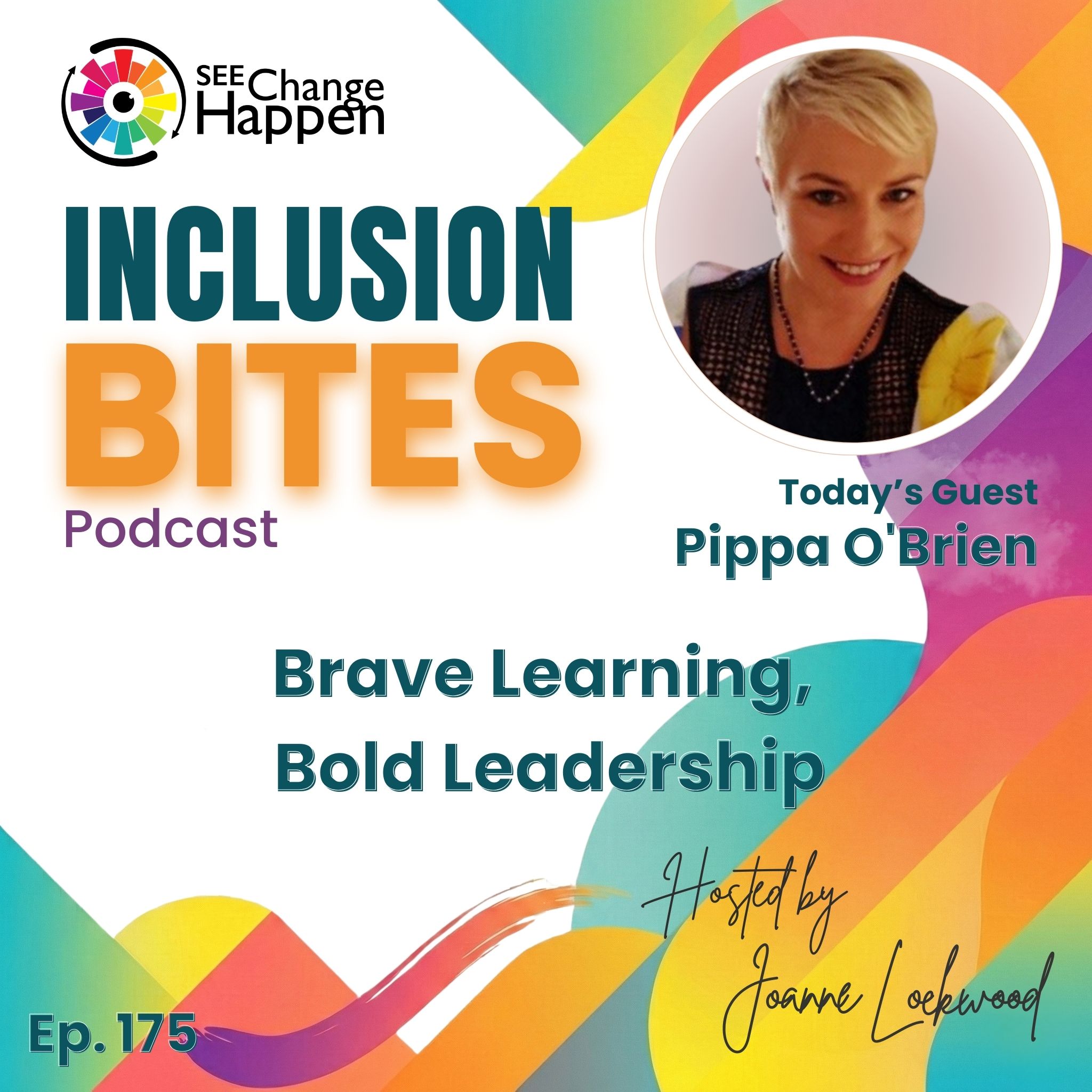
Welcome to Inclusion Bites, your sanctuaryfor bold conversations that spark change. I'm Joanne Lockwood,your guide on this journey of exploration into the heart ofinclusion, belonging and societal transformation.Ever wondered what it truly takes to create a world? Remember, everyonenot only belongs, but thrives. You're not alone.Join me as we uncover the unseen, challengethe status quo and share stories that resonatedeep within. Ready to dive in? Whether you'resipping your morning coffee or winding down after a long day, let'sconnect, reflect and inspire action together.Don't forget, you can be part of the conversation too. Reach outto jo.lockwood@seechangehappen.co.ukto share your insights or to join me on the show.So adjust your earbuds and settle in. It's time toignite the spark of inclusion with Inclusion Bites.And today is episode 175with the title Brave Learning, Bold Leadership.
Joanne Lockwoodhost
And I have the absolute honour and privilege to welcome Pippa O'Brien.Pippa is a learning innovator and founder of Proda,transforming how frontline teams experience inclusion through immersivedrama and authentic conversations. And when I asked Pippato describe her superpower, she said, it is turning everyday peopleinto empowered learners to through real world storytelling.Hello, Pippa. Welcome to the show. Thank you so much for
Pippa O'Brienguest
inviting me. I feel really privileged and honoured to be theguest on episode 175. I'm in very safehands, clearly. And looking at your nails, I thinkbeautifully manicured. Safe hands as well. Mine are under the tablefor a reason. Not so manicured. Right? Beautiful.
Joanne Lockwoodhost
Oh, thank you. We met probably 18 monthsago. Must be to work with Tallis, wasn't it? We did astorytelling. I was one of your protagonists in astory, wasn't I? Yes, definitely. And then we took that input
Pippa O'Brienguest
and we used it for some drama where weshowcased what allyship should and could look like andinvolved the learners in feeding lines to theactors so they could be really fully immersed and involved inthe story as well. Well, yeah, and it was all around transgender
Joanne Lockwoodhost
inclusion, if I remember rightly, with. And my wife Marie was involved and we. Wedid a kind of a dual perspective on workplace and how shefelt and how I felt, which is quite powerful, wasn't it? It was really powerful.
Pippa O'Brienguest
And I think one of the lessons that that organisation took from thatsession was, yes, it could be transgender, it could beany other situation that somebody is facing in their lifeand that there's no playbook out there that covers every possiblescenario that could be going on. In somebody's life. And actually theusing your and Marie's story, if you like, to set thescene was so powerful and really thought provoking.And then in the drama we flipped it and we hadthe actor from memory. The scenario that I'd written was agay couple where one of the members ofthe one partner in that partnership was wanted to transition.That was the way that we flipped it. And actuallyyou never know what's going on for people. People show up for work,they do the best that they can in the moment and what's underthe surface is like this massive iceberg that you just don't see. But itcomes out through people's behaviour. It's what they say and what they do thatgives clues to what's going on to the surface. And quite often that's thetime when somebody needs to reach out and say, when what's happening? Tell me.And doing so from a position ofwhere there's trust between the two people and the leadershipbehaviour then is really around not just trust, but theintegrity piece as well. Like, I need you totrust me and I'm going to trust you, but actually I needyou to treat that information with integrity andbe there to support me as a person. Really, that's. That's kind of themessage that I wanted to come out from that session. Because we hear
Joanne Lockwoodhost
that lived experience talking and stories arereally, really powerful. And they are, yeah. But in my experience,the learning doesn't always occur. I. I don't goand watch a Netflix or go to the cinema and hear these powerfulstories, whether they're real drama orinterpreted, and always take learning away from them. Sowhat we're going to try and do is take a two dimensional storyand create rumination, creatingfiring points in our brains. And that's where the experiential,the storytelling with interaction kicks in, isn't it? Totally.
Pippa O'Brienguest
And that's really what we've done with a programme that we've been runningquite recently. And this is, this issomething that was really a little bit of a. Well, I'm going tosuggest this, this is a bit out there, if you know what I mean. AndI was really expecting the client to come back and go, oh, no, that's. Well,we couldn't do that. And actually they didn't. They went, okay, let's do it. AndI was okay. So a bit surprised, but also really honouredthat they had trusted me to do a great job for them. Andnot just me, but my whole team, the whole team here at Poda andthough their population and workforce,although there's a number of them who are really highlyqualified professionals, the bulk of their workforce ispeople who are really skilled but they're manual workers. So they domanual work outside in all weathers. That's prettyunpleasant at times. I'll be honest. The average reading agefor a lot of these operatives is 11.Age 11. So when I was designing something
Pippa O'Brienguest
I had to be really mindful thatfor whatever reason they had this lower literacylevel but that could be caused by a number of different reasons. Butwhatever for, but for whatever reason school had failed themin some way or another or education had failed them. Soputting them in a classroom environment with. And here's slide199 which just describes theEquality act of 2010 probably wasn't going to bethe real way forward for this audience. So what wedesigned was a programme where from themoment they arrived they were immersed into a real lifedrama, if you want to call it that. We had the characters in the dramawelcoming them. Oh dear, my words got a little bit mumbled up there,mumbled up, inviting them and welcoming themand I still can't say it, welcoming them to the session andthen allowing them to observe a meeting wherethere was some extremes of opinion being expressed.
Pippa O'Brienguest
Okay. And what we asked them to do was just listen and then talk aboutit afterwards. Okay, so what did they notice? What behavioursdid they notice, what words did they hear and what did that mean for them?So how did that resonate with them and their own personal experiences.So the lived experiences then came from within the roomas much as anything. And we, we really wanted peoplewho were maybe of a generation,I think Gen Z, I think is a, is a, is one way to describethem, to talk about how people have made assumptions about them and what they werecapable of based on their age. We wanted people to talk about gender. Wewanted to talk about people who had and really explore awhole range of labels really which that people give otherpeople that are really, that are really about bias, aren't they? You know,there's, there's nothing else to describe it. Oh, there are this, there are that, that'sa label and actually the label is the bias and it can be positive ornot so positive. But equally there's something here aroundchallenging those biases and really reminding people thatactually as individuals and as human beings we're always lookingto confirm biases unless we actively are challenged on them.So the data that sticks is the data that confirms thebiases that we already hold and the opinions that we already hold. So. Andthat's kind of linked to also. And then with these people we were talking about,well why is that then? And they were talking about, well, it's social media init. You know, we had some great discussions around social media,the role of the press and then moving into allyship and howto challenge and how to challenge up. And we used our drama teamto role play like a more senior member of staff and then how they couldchallenge that in a way that was going to be non threatening forthem individually. And we had some great outcomes from that. Really great,some really great conversations. You've got some people that go, no, he's right,he's wrong and that was it. But everybody else in the room was saying, youdon't think that, do you? Well, yes, I do. And that's great because you're bringingit all out into the open in one go. The only way we could dothat was to create a really safe environment where people felt they couldgenuinely say what they believeand to be prepared to be challenged by other people in a way that wasappropriate. Okay, yeah, we're really pleased with that one. Itlanded well. And you can see from my face that we actually reallyenjoy doing it as well. And I'm doing it this week for a company downin Winchester. So I'm quite excited about that. It's one that I love doing.
Joanne Lockwoodhost
Yeah, I found, you know, I've run a lot of training sessions on inclusive recruitment.Inclusive best practise, whatever it may be. And sometimes you walk into the room andyou can see people with their arms folded. You know, I don't want to behere. This is all a bunch of woke nonsense. And they havethat face on, don't they? And then you do the introductions in a room. Yeah.And I said, what are you hoping to get out today? And this person's alwayskind of making some sort of remark about whatever because I have to bewhatever and. But I find that those people do twothings. One is they enlighten the rest of the room as to the importanceof why we're here today. Because they're doing my job there. They're saying, well, Ihaven't got to say the anti pushback on this. There's already that person's in theroom. But the second thing that happens is this person becomesenlightened. Their change in them is fargreater than the change in people who actually get it. So I alwayscome at the end of it. I've had these people come out to me orat the end of the day, so what have we got out of it? Oh,I've seen a new perspective and I never really thought about this. And it's like,you think, wow, I've made aimmeasurable difference in this one person. My job is done.Everybody else got it already. All I've done is nudge them a bit. This personhere went from being uninformed to being embracing it. You think,wow, how powerful is that? And I think that's what frustrates me.Sometimes when we have these conversations, we always end up with the echochamber in the room, not the people who should be in the room, but whoaren't. Do you find it's easier to get people in the roomwhen you're doing the storytelling and this is role playing, than it would be throughtraditional training? 100%. And that's regardless
Pippa O'Brienguest
of the organisational level, if youlike, it's just as powerful at exec level.For example, if we were looking at a DEI programme,then we would start at the top, obviously, and really explore,well, why is this so important?But with that team, and then obviously bring insome data at that point. But also, more importantly, do something aroundallyship, because that's their role, that's what they should be doing every single day,is being the ally for people in their organisationand making sure that their organisations reflect the communitiesand the organisations that they serve as well. And when I see somany people who. I'm going to use example here of back to theoffice, you know, going back to the office and you hear so many peopleat exec level that are saying, everybody should work from the office. Thisis, you know, the people. And actually, when you look at them, there's a certaindemographic that says that, and typically they would bemale, white, probably over 50now. Yes. For them, I'm sure that going to the office isstructure, it's routine. And then when they get home, there'ssomebody who's made sure that their shirts are ready for the next day, that they'vegot everything that they need to be for them to be successful, ifyou see what I mean, on the. Table, the kids are looked after. Yeah.
Joanne Lockwoodhost
The cat has been fed everything else. Yeah, yeah, you're right. And
Pippa O'Brienguest
when you. When you look at people who, duringlockdown, who were loving it, were the people who had that flexibilityof being able to. To do a bit of work, look aftertheir children, be the best person that they could be for their families, do thingslike the school pickup and the things that they just didn't have a chance todo. And I did a bit of research for a company at the back endof lockdown around whether going back to work was,was really the way to go, or whether they could actually considerclosing down some of their sites and going to a fully remote model, butwith some hubs where go for meetings, you know, face to face meetingsif needed. I ran some focus groups for them anduniversally there was a demographic that was like,this is brilliant, I love this. I can get up, I can do two hourswork, I get the kids packed, lunches in the bags, I get them to school,I come back, I do more. And it's. For them, it was just what they've
Pippa O'Brienguest
always needed and just what they've always needed to be ableto be the best person that they can be at work and alsothe best person that they can be for their family as well.Surely that's what organisations need toensure is available, is people to havethe flexibility of what works for them, but also make sure thatthey are. They know how to manage people ina completely different environment. Because I think a lot of people tried to manage peopleas they always had done from home and it didn'twork. So they've all got to come back to the office. Not what we doneeds to change, but. Or the way that we do this needs to change, butlet's just take away all the bits that work for a goodpercentage of the workforce and impose bits that don't work, you know,so it's like, for me, it's a real fundamental offlexibility, is that you trust people to do a great job, youexplain the why and you're the leader thatthey need in order to be the best that they can be. It's quitesimple in my opinion. Yeah. When
Joanne Lockwoodhost
I was doing some events, some roundtable type discussions aroundthe time where we were just about to take our face masks off ontrains, you know, sort of that early stage, remember back in that time, back inthat history, and I remember that lots of big companies were trying tosell their culture. We need to get you back in the office because we've gotour culture, we've got our way of talking, we've got our way of being,we've got a fantastic culture, we want to. Itook a step back and said, well, hang on a minute, what you're trying todo me is exchange culture for commute is what you're saying.You give me, I commute for you and then you give me a culture. AndI said, now, hang on a minute. I want my culture, like my pension.It's a personal pension, I could take it anywhere. So when I leave you, Itake it with me and go somewhere else. So my personal culture, my familyculture, my community culture should be first. Andyour culture is this something I borrow while I'm here. I haveto like it, I have to fit in with it. But I would rather youencourage me to build community links, to co work in my localcommunity to have more family time so that myculture is now my own. And wemeet because your culture and my culture meet. But don't tellme that I have to have your culture because, yeah, you mayhave this belief that your culture is amazing, but actually my family isamazing, my friends are amazing, my hobbiesand I want that time back. I don't want to give you two and ahalf hours of commute each direction because that's my time thatI'm giving you for free. 100%. I completely agree with that. And I
Pippa O'Brienguest
think that's where having values and actually within anorganisation can bridge that gap. Because if youmake values meaningful in people's daily behaviourin an organisation, that's one way of bridging the gap betweenthe culture and like personal cultureand organisational culture, if you want to call it that, because it's makingsure that, for example, if you've got ainnovation as a value, which a lot of organisationsdo, then if somebody asks a great idea, oh, I've got an idea, thehand goes out and then you get, no, that's not going to work. Or really.Or no, then it's. I wouldliken that to that whack a mole game. You know, that you get in thefun fair with the hammer and you get the little mole and you stick yourchin up like that, that's my mole impression for the morning. And then the
Pippa O'Brienguest
manager's there with a hammer, whacking it down. After a while, that mole's going togo, I'm nice and warm and cosy in my hole. I'm not going to getup because if I stick my head up, I'm going to get whacked on thehead with a hammer. So that whack a mole culture,where people say, oh, we believe in innovation. No,they don't. You've got. If somebody comes up with an idea, then you need togive it the airtime, explore it. It might not work in thatcircumstance, but you've got to be really clear with the person, why not? Ratherthan just that dismissal piece because the oneidea that that little mole may have in the future, that could be thesalvation of whatever, that you're never going to hear it because they're never going totell you. And that's what I mean about living values andbringing values to life. Yeah, it's not always a bad idea. Because
Joanne Lockwoodhost
if you were to enlighten the person who came up with that thought thatdidn't work for whatever reason as to the reasons why rightnow it doesn't work, then they go, I get that now let me havesmall thinking. Correct. Because one person's thought isn't always oneperson's thought. A lot of people are often thinking the same thing. I mean,I look at what the government do and think that's crazy. Why are they doingthat? I look at what's going on across the water in the States, I thinkthat's crazy why they're doing that. Maybe there's information, I don'tknow, the media, the military,there's data, there's awareness, there's briefings that politicianshave, there's big think tanks going on. And mybias says I know better because I'm more intelligent, I'm cleverer. That'snot a bias I have. We all have that. So we're almost saying, well, thatthey don't know what they're doing. They must be less intelligent than me.But we've got to accept that they have some good ideas as well. That Idon't know is why they think that. And that's what I need to know ifthey tell me. Actually, Joe, the reason we're doing this, the reason we'reinvading that country and it looks to be a little bit one sided here, isbecause there's some threat intelligence that we see that youdon't. Okay, now I get it. Soif we listen to people's ideas and dismissing them, we need to give them thewhy. Because if you tell me the why, I can challenge your why with,huh, how about this? And maybe that's what people don't want. They don't want thedebate, do they? They don't want the debate. And I think also there's this
Pippa O'Brienguest
I know better than you syndrome as well, which goes back to trust.And I think, I think I know nothing about government, please,but accept what I see and hear and read like everybody else.But equally what I do know is I struggle to trustpeople that don't do what they say they're going to do. And if,if you want people to, to accept what yousay because you know facts and information that can't be revealed, whetherthat's within an organisation or. Or nationally orinternationally. Globally. You have to prove that you are trustworthybecause why would you trust somebody that says one thing and then does something else?Okay, so it's around building a culture that's basedon trust. And then people might notlike what you do. They may not fully understand the reasons,but if they trust that you are a leader with integrity,then they will go with it and they'll buy into it.
Joanne Lockwoodhost
Because I think worse than being told there's a reason, I can't tell you.It's like, oh, so I'm not worthy ofthat. I'm aloof here. I've got stuff you don'tknow. So I guess sometimes you can't be told that you don't know somethingyou don't know. It's trying to sell that, as you say in a trust.I look at the government in opposition or thepotential government, all the politicians sit there going, making thesereally wacky statements about, oh, yeah, we cut this, we do this and we dothat. When they get into power, they go, actually, now, now we've got the booksopen, we see the data. Actually, we know we can't now, but we can't saywe didn't. Yeah, yeah, we can't tell. That's really difficult as well. And I
Pippa O'Brienguest
think often when you look at. When you observe, think,particularly the UK Parliament, Ifind it's not about debate, it's just about mudslingingand almost playground behaviours as well, which I think devaluesthe whole process. There's no. There's no structured debate. It'sjust who can slag the other party off with the greatestpanache in the moment. You know, it's like, it's point scoring butnot real points, if. If you see what I mean, it's not about the topic,it's about. It's about visibility.That's my perception. Public school debate society of the past, isn't it?Yeah, yeah, it is. And it's. And
Joanne Lockwoodhost
I think our media don't help either. The media, the mainstream media, socialmedia, they like this polarisation because polarisation creates tribes.Tribes create revenue and advertising and clicks anddiscussions and people get fired up because unless we have emotionattached to a thought, it doesn't happen, does it? You know, we have to.Negative or positive emotions, they mean. He knows that negative emotionsare stronger than positive emotions. So it drives. It drivesengagement. This is it. And if you look at a technique, say, like transactional
Pippa O'Brienguest
analysis where you've got, you know, people that are behaving adult to adult, which isrational, listening, giving and giving. It doesn't make forgreat tv. Let's be fair. It's when you've got people who are actingas like the critical parent with the finger out or where you've gotpeople who have been in child. I don't like this. That under foot stampingthat's what makes for good watching. Anything in the middle ground is just.Is sensible, rational and maybe not soappealing. Yeah, there's a couple of. An
Joanne Lockwoodhost
author I quite enjoy reading is Ricker Bregman. He'sdone two books that I really found inspiring. One is Utopia for Realists which isa great read if you've not read it. Humankind.Humankind is. It's about analysing the human beingand the human psyche. It really summed up the whole ideaof reality TV and what happens is in these scenarios, you know, whowants to be. I'm sorry to get me out of here. Big Brother or LoveIsland. What they found was these would be verybenign, very controlled. If you just put agroup of people in the room, they'll get on largely they'll get on, they'll havea good time. They'll start forming little communes and Kumbaya and sitting around thecampfire. You say not great telly. So what they have to do is they haveto starve them. They have to put a. A grenade in there like a. A.A rogue personality who's going to disrupt. They're gonna have to create a love interest,a power base, create a. Create a leader who has power thatothers don't like. Suddenly you've got. You've got this disrupted humanenvironment that creates great telly and then so they have to prod the bearand the beast to make it. To make it interesting. Otherwisepeople will just go so what we assume that people areantagonistic and aggressive towards each other, but that's manufactured by the media.
Pippa O'Brienguest
Agree. And I think in most cases I think yes andI think I would say that manufactured by the media. But I thinkin face to face, 100% I agree. I think the challengecomes now with social media where people say. Feel that they cansay all sorts of chisel, which is a technical term,all sorts of chisel with. Under the COVID of. Of. Of being akeyboard warrior and they don't have to actually sit in front of somebodyand say well I think this, that and the other because in the real lifethey wouldn't actually Risk thatantagonistic behaviour because it could be risky for them.It's the old who's the bigger dog in the pack type scenario. You know,they might get bitten back, but on a keyboard they can be as unpleasant as
Pippa O'Brienguest
they wish. Yeah, I mean, we're recording this on 31 March 2025, which
Joanne Lockwoodhost
is trans day of visibility. And as a,As a trans woman myself, I'm well aware that people haveopinions against trans people in the whole. Notnecessarily against me specifically, but against people like me.But there's no accountability to those views and often it's born outof tropes around, oh, we're protecting women and girls, or it's justunnatural. It's like there's only two sexes. It says so inmy biology book or the Bible or something. Andpeople can go unrestrained, as you say,keyboard warriors, because there's no human at the end of theirkeyboard, it's electrons. And whenpeople meet you face to face, they hear your story, they listen to you, itbecomes powerful. But again, as I said earlier, hearing a two dimensionalstory doesn't necessarily create change. You've actually got to have that engagement, thewhy? Fill my soul, fill my heart, feel mypain, feel my family for my wife's pain. And that's where whatyou're doing with stories and acting brings it out, doesn't it?
Pippa O'Brienguest
Sometimes I'm really humbled by little old me, and Imean that sincerely. Little. Well, not that little, but older me. It'speople that can. I've written that and I've thought, oh, it might work, who knows?And then when we've done it, it's had such a powerful reactionand response and how people have. Teams have gone on tocome up with safe words that they can use around the banter. I think whenI'm working with some teams, they're terrified that they won't be able to,to, to have any banter at all. You know, that it's all got to beterribly polite from now on. And of course, who doesn't like a bitof banter? We all like a bit of bance. And the line is flexible,the line's fluid. It depends who's there. It depends on howpeople are feeling that day. That's the big thing as well. And what else they'vegot going on in the background and how well you know each other, what youknow about what's inside that iceberg for that person as well.And all of those factors influence people'sbanter tolerance, shall we say. I think that one of some of thework that we've done with those teams is around encouraging them to come up witha safe word that they can. Anybody can use where on that day.I'm not feeling it. And it stops. Please. Okay. And that'sit. That's full. Stop the band. That's. No. No explanationneeded. Not having a bad day, are we? Or anything like that.Okay. Oh, somebody's grumpy. None of that. It's just. Itjust stops. And that's. That's it. Whichis quite a healthy way to manage it, I think. It's where teams manage theirown. Their own behaviour, if you like. They're accountable for their own behaviour in thatway. Wasn't it Roma S Ranganathan, the
Joanne Lockwoodhost
British comedian that tried to come up with the safe word of mate?You know, mate with a elongated 8 in the middle? Yeah. So when youhear your. Your mate say something inappropriate, you just go, mate.And that's a code word for, yeah, it's too far. Yeah, you've gone too far.
Pippa O'Brienguest
Yeah, yeah, yeah, yeah. Well, this. This one particular organisationI've been working with, they've gone with not cool. Oh, mate, that's not cool. Andthen it just stops. Okay, so you could have. Mate, that's not cool. Butyou could even just say, not cool. And then that's it. Stop, stop, stops.So that's worked for them. Yeah. Because none of us want to be the
Joanne Lockwoodhost
inclusion police. None of us. People have stopped talking. I'm 60 years old. I've.I've lived a pretty colourful life, both genders. And I'm not trying tosay I'm perfect. I've got some high ground here of righteousness. I'm a human.I. I laugh. I laugh at comedy. I call myself out sometimes,thinking, actually, no, that's not right. No, stop.Yeah, still funny. But no, it's not really funny.
Pippa O'Brienguest
And I think it's just there's so. I think the more we callourselves out, and also I'm going to sayappropriate or gently challenge other peopleas well, the more. The more human we can be aboutnot being the police in this way. You know, the banter police orthe inappropriateness. Please. And my husband Joey, who have beenmarried to Jerry for six years now, I know he.I know he's Scottish and when he first came to London, he would often havepeople say, come on, Scotsman, get your hand in your pocket and buy us adrink. And that he found that really annoying because he's probably the most generous personyou'd ever Meet. Except when I think when you met him, Joanne, he came toyour house and he ate all of your biscuits. So he does owe you atleast a couple of the last biscuits. He had the last biscuit on the plate.I know. Which I couldn't believe. I was like, if I could have said, mate,I would have done then, right. But this happened Even recently,in 2024, probably just before Christmas.He was in our local pub and somebody who we'd never met before,who came in as a guest, you know, with somebody else that he did know,said, oh, let the Scotsman get the drink, get his hand in his pocket. Andit's like Jerry came home and he went. I said, well, what did you sayto him? And he said, well, I didn't say anything. I said, you. If you
Pippa O'Brienguest
don't challenge that, people will continue to do it. So it's around how you challengeand it's kind of like, oh, that's a bit of a, you know, casual racismgoing on there, isn't it, or something like that. Or, oh, I can hear astereotype, can't I? So how you do it is the thing. And not getting onyour. I think. Not getting on your high horse. I think in the moment,people may not go, oh, you're so right, I'm sosorry, you know, or, oh, my bad. But theymight think about it afterwards. That's. And it goes. They may. Mayreflect on it afterwards and go, yeah, maybe. Maybe that's notappropriate, really. But if we don't say anything, then nothing's going to change.
Joanne Lockwoodhost
Yeah. And I think also, as someone on the receiving end, I have toput a little bit of a buffer between myhearing and reaction, because I was. Happened to meyesterday, I think. Well, no, I was in Asda's. Asda's shopping. There are othersupermarkets available, obviously. And a man came around the cornerand he kind of bumped into me a little bit and said, sorry, mate.And I just thought. I was about to react because I really detest the wordmate being used to me. Yeah. You wouldn't callmy wife mate if you do with me. I thought. I didn't say anything becauseI thought, hang on a minute. There are some people who call everybody mate. It'sjust their default. My husband does, I'm afraid. Yeah. And so I justthought, whatever. I'm not going to take it as some personal offence. And some peopledo it. You could tell. Some people do it deliberately. Yeah. But I've had icecream salesman give me an ice cream. I said, there you go, mate. Really?Will, you said that to my. I sent my wife to the ice cream once,Marie, who you've met, and he called her love. And I said, yeah, that'sright, yeah, he calls you love, he calls me mate. So next time I said,I prefer you called me love next time, if that's okay. And he went, oh,sorry, love. And I go back and, youknow, we have a good chat and a good bit of banter. So sometimes thatfriendly calling it in rather than aggressivelycalling it out, you win hearts and minds over, don't you? Because nobody wants tobe told they're a bad person or imply they're a bad person because they'renot. They're just misguided, misunderstood, notreacting. Their bias has kicked in and suddenly they say something and I thinknobody wants to be shot down in flames for. Yeah, obviously, if they'rerepeatedly in the context or they're maliciousweaponizing it. Yeah, I think, I think most
Pippa O'Brienguest
people, if they understandit's accepting and they are accepting, I think being,having empathy for them in that moment that they. You don't want them to feelreally bad, but equally you don't want them to carry on with thatbehaviour is the way to go. So it's around as you, as you sort ofbeautifully described it, it's being quite gentle about it as well, likenow. Yeah, but I will remember the negatives, you know, we talked about negatives,
Joanne Lockwoodhost
emotions being stronger. But the number of times I get people bump into me, I'llsay, oh, sorry, love, are you okay? And. Or love, can I help youwith your case? Up those stairs I go, yeah, sure, please go. Go for it.Go. Yeah, yeah, yeah. No one does that for me, Joe, or telling you. So
Pippa O'Brienguest
you've obviously got something going on then. Yeah, well, I look
Joanne Lockwoodhost
quite helpless sometimes on the underground with laptop bags andcases and things. And sometimes people go, they take pity on me. I go, comeon, then. And there are good people around
Pippa O'Brienguest
still. You know, I think, I think you're right about.It's that confirmation bias place piece. You know what I was. I always use theanalogy of the labels when we're talkingabout how we have bias aboutothers. And one of the examples that I use quite often is aboutdrivers and cars and it was always, it's the car, notthe driver. It's interesting when you talk about it because it's, oh, it's Audis that,that cut me up. It's not the person driving the Audior it's up flipping BMWs. Right. And then of course, now it'sTesla's, but there's all sorts of reasons for that as well. But there you are.But it's got nothing. But I completely miss all the times when an Audi mightflash me out a junction or an Audi driver might flash me out at ajunction that goes. Because it doesn't fit the buys that I alreadyhold about that particular group of people. So it doesn'tfit. But sometimes you play
Joanne Lockwoodhost
to the stereotype. I mean, I've. I've got Mercedes at the moment. I've had BMWsin the past and Audis in the past. I remember, I think that's when Ihad my 4 Series BMW. I parked it and I wasn't quite in the space.Marie said to me, don't you. Yeah, you're not quite in the middle space. Isaid, that's why it's a BMW. People don't expect me to park correctly anyway. SoI left it there. It's like. So I played that stereotypeand maybe other BMW drivers cut people up and go, it's all right,it's a BMW. The indicators don't work. They don't have indicators on a
Pippa O'Brienguest
BMW. Yeah, I've just. Yeah, just found that out. Yeah.
Joanne Lockwoodhost
So you started life as a chef? I did. So. Sowhat was the ambition to be a chef? Was it a. Okay. I thinkthat. Well, in those. Let's rewind a little bit because actually I
Pippa O'Brienguest
had. I was. As a young person, Ididn't have the best start. I'm going to say that I think one of myreal challenges today even is a massiveimposter syndrome that sits around me because as a youngsterI was repeatedly told, you're rubbish, you're useless,you'll never be any good at that. So that was kind of the bad side.On a good day, nothing was said. Okay. So there was no positive
Pippa O'Brienguest
affirmation. I didn't really feel comfortable atschool at all. And that resulted in me not reallyapplying myself and having been told that you're useless then if you don't do well,it kind of reaffirms the belief system that you have. Well,what do I expect? You know, of course I'm going to leave with a handfulof nothing because everybody told me that I wasn't going to amount to anything.So, you know, that's kind of what I expected. I lovedcooking, I still love cooking. So I started as a chef and inthose days it was really rare for women to be in the kitchen. It wasvery male dominated and I do Remember once we had a new headchef come into the kitchen and I was standing facing the stove to havemy back to the pass and he came in, he went, youget your flipping haircut. All right, lad, get. You know, and it's.So there was an assumption that everyone in the. Oi, you lad, get yourflipping haircut. And that was it. So there was an assumption that everyone in therewas male. I had to be tougher, harder, stronger, worklonger hours, be generally deal with a lot ofreally difficult banter as well in that environment. Ithink I loved it. I love the challenge of it. I love theFriton that you get from. You've got so many. You've got to get this out,you've got to get that done. And you're juggling a lot of thingsat the same time in a hugely pressurised environment. And it's gotto be really well done. And I don't mean that steak had to be reallywell done. I mean, you know, it's gotta be professionally produced.
Pippa O'Brienguest
It's incredibly. It takes an incredible toll on your sociallife. And I think as a youngster I was then workingfive and a half day week and then I had Sunday afternoons and Mondays offand Monday was my college day. So that meant thatactually you don't have any time off at all, which is quite hard work,quite hard for a youngster. I made a sort of transition intoworking more in hotel management, but I couldn't really get that farbecause I didn't really have great qualifications.I then worked for when after I met Geri, whobecame my husband, working shifts wasn't really workingfor me. And so I had the opportunity towork for quite a big, well known company in the UK as afacilities manager. If you can run a hotel, you can run acouple of buildings with one hand tied behind your back because it's not a 24hour operation. Catering is much simpler andalthough you've got still got to deliver a high level of customer service and facilities,it's way easier. And all the mechanical engineering stuff and allof that, it's way easier than actuallyrunning a hotel. Much, much easier. A you know how many people you're going tohave through the door every day, you know how to staff yourself. For example,that organisation then moved to a centralisedsite and I was going to be made redundant and they said, well, how abouta role in our training team, learning and development. And I was like, yeah,okay. Then off I go. And that's when everythinghappened for me. It Was like, I hadthe best ever leader and he was somebodywho. I find it quite hard to talk about him because I get emotional ina really positive way because for the first time, he wassomebody who really trusted me. Herecognised that I had something a bit more than just get the coffees in, Pippa,or do this or do that. He recognised that I had potential and he sochallenged me every single time that he gave me insight. We'd go right here,you are going to drop the bomb on you here. Fine. How do you thinkyou're going to start this one, Pip? And he'd start by. What I didn't realisewas he was coaching me. And what that coaching did was ittotally unlocked my potential. It got me critically thinking formyself and it enabled me to actuallyrealise that I could actually be successful. There was a bit of a blip. Ican tell this story now because it's a lot of years down the line, therewas a bit of a blip because he. On my application for thatorganisation, I slightly exaggerated some of my schoolqualifications, shall we say, my leaving qualifications. Andthat year, that particular year, the company that I was working for,this person, my manager, recommended meto do a degree, fully sponsored degree course,which for me was terrifying because having always been a failure and youwon't amount to anything, all of a sudden I've got to do this. But moreurgently for me was this. I haven't actually got the Alevels that I said that I had at the time. So a bit of blagginghad gone on, may I say, and I had to talk myway into a course which actually was not as hard as you think as a.As a mature student, you can, you can get in on an interview if you.If you can prove that you're, you know, livedexperience. Yeah. Yes. And I actually did really well. I blew myselfout of the water, literally, because I applied all the skills that I'd learnedon the job to how to manage the project, which isactually delivering your coursework and getting all that done. And Iwas quite surprised at myself. That was probablya massive stepping stone in my confidence andbecoming me. That would never have happened if it hadn't been for that one leaderwho saw something in me, trusted me, gave memassive exposure, but was there as a safety net andquestioned me, got me to critically question how I was going to do everything.He was somebody that I would. I really wanted to be like. Andthat's really why I ended up. I ended upin, I think it was 1999. 2000,2000, being head of L and Dfor another big household name company in the uk. And then I thought, you knowwhat, I'm just a desk jockey now and I'm, I'm budgeting,I'm trying to work out how I can create efficiencies. And that's notabout supporting people to learn and be the best that they can be.So I jacked it, walked away, started PODA inDecember 2000, which is a bit scary, buthuge. At that point I had some huge belief that it would work out. Andhere we are 25 years later. Not global domination,but I'm really happy with where we are. 2000. I mean,
Joanne Lockwoodhost
the world was significantly different. You know, Tony Blair wasPrime Minister doing Auld Lang Syne at the Millennium Dome. Things will only get better
Pippa O'Brienguest
and all of that. Yeah, yeah. But computing,
Joanne Lockwoodhost
you just think about the world, the way we're connected. I mean, I was runningmy IT business back in 2001. It was pre 9 11,it was pre iPhone, pre social media.Most people had dial up Internet still. There was no, just thewhole computing revolution. There was no phone in your pocket, Google, thethings we see is couldn't get Deliveroo or an Uber in those days. Sothe world was different. It was very much more hands onin people's offices, wasn't it? So how have youadapted what you do, I guess to technology and expectations?
Pippa O'Brienguest
Yes, I think, I think expectationsare a movable feast because ifpeople trust you, and I've used theword trust a lot in this, I know, but that's because it's super important tome, then you can manage those expectationsjointly so that everybody is comfortable with what's happening. I think in termsof how we changed, lockdownwas an enormous catalystfor change for us. And at the beginning, I think onthe day one when it all kicked off and it, right, everything's shut down,we're only a small company and on that one day we hadcancellations and most people took the trouble to phone us to say we're going tohave to cancel everything. We had £250,000 worth ofcancellations in a day and we were, we were just like,okay, no, we understand, thanks very much and blah, blah, blah, looking forwardto working with you when we can and all that good stuff. And I thinkwe had to learn on a vertical learning curve.So what I started to do is reach out to all of our existing clientsand say, right, how can we support you to manage peopleremotely? Because this is the new normal for the, for the foreseeable.And I used that to run loads of free sessions and using thatas an opportunity to get my head around using some of thetechnology that was available. And it was, some of it was pretty sketchy right backthen. You know, there was. And then there was almost like the VHSBeta max was for anybody that's old enough to remember that around whichplatforms were going to be the ones that were adopted. AndI think that was, that was one element of change. I think peoplewent from big multi day programmes, ifyou like, to wanting to see greater embedded resultsin the organisation. So what we started to do was really more aroundtakeaways, if you like. So people do a little learning module, they go awayand apply it and then they come back and chat about the results. And thatactually has the impact of really being motivational for the rest of thecohort as well. Somebody thinks, oh well, they've done it so I could do it,you know, so it's really powerful stuff. I think the other thing that I did
Pippa O'Brienguest
during lockdown was to support my own learning was I dida course within sead, the Global Business School, oninnovation, managing innovation during disruption. So I mean, how muchmore disruption were we going through at the time? It couldn't have been a betterexample. And off the back of that we came up with some virtualreality AI modules that we partnered with another organisationto develop and then market, which it's interesting becauseI thought they would go really crazy and really take off and people havegone. We prefer the actors actually. So it'sinteresting where you offer people this great solution where theycan access any time and it was ideal for shift workersor people who have got downtime in their day job and thenthey can just do a little. I'll just do that module. So they wantreal people, whether that's real people through a screen or realpeople face to face in the room. So that was areally interesting piece of learning as well. But yes, sokeeping it current, seeing what other people are doing is important. Thekey thing I think is listening and listening to whatour clients need, what their aspirations are, whatthey want to achieve. And then it goes in, it goes in hereand then I go away and mulch it down. It sort ofcomposts away in here for a bit and then I then think about a solution.It does take a while to think about, well, how can I take this andmake it into something that's. That's really going to getpeople's attention and it might be attention toChallenge. It might be attention to go, aha, but how can I do that? Andthat does take a little bit of pain. I think, oh God, how am Igoing to do that? And then it always comes. I have to trust the process,the composting process. So when I'm too busy, I find I don'tget composting time. So that's a little bit frustrating. Yeah,
Joanne Lockwoodhost
I think you're right. I'm not sure I call it compost and time, butI find that I need to have those stare in spacemoments to sit on the sofa. Maria will come up to me and said, whatare you thinking about? I said nothing really because I'm not really thinking about anything.I know that somewhere in my head myneurons are firing off, reprocessing everything, reindexing my brain. And then things become clear. And you're right,I can go on a car journey, drive for three hours. I get to theend of it, I think at all what happened. I come out andgo, right, ping, ping, ping, ping, ping. All these ideas are firing off where mybrain has sort of used that opportunity to do that. Andyou can't do that while you're interacting with people or you're stressed or you're busyor you're focusing on. No, you can't, you need that space. Jerry,
Pippa O'Brienguest
who now, who's my husband, who now works with our business, he's reallya great implementer, transactional person and hegets everything done. He finds it hard to understand that I need that timeto just be a bit vague for a while. And that's an important part ofthe process as well. It's almost like in a, in a project based world world,he would want a time code for that, you know, want a thinking timecode so that he can make sure that we're making the best use of everythingthat we've got available. Yeah, yeah, it's. I mean
Joanne Lockwoodhost
people sometimes will equate that to procrastination, I guess, whereyou want to just keep playing with it. And I, I don't know about you,but I find that if I've got a three week deadline, everything happens the daybefore because I'm thinking about things, I'm remodelling itand tweaking it in my mind and when I actually got to put it onpaper, it comes straight out. I don't think as I write, I've kind ofgot the ideation down there and I need that, that evaluation timein my brain to get to that point where suddenly now I can do. It
Pippa O'Brienguest
that's real, what we call reflective behaviour. Andwhereas I'm much more of a. Get something, think about it, get somethingdown and then leave it and then come back and tinker with it.So I maybe do the tinkering in a different. You're doing the tinkeringup here and I'm doing the tinkering in a different way.And sometimes in organisations there's challenges where if you'vegot a real activist leader and a reflector team member,Jo, that task to do 10 days ago and she hasn't even started it yet,you know, and actually have. It's all going on up here. It's all clickingaway up here. So it can cause all sorts of conflicts aswell. Yeah, I think it serves me well
Joanne Lockwoodhost
sometimes where I don't have to. I don't have to have the worldmapped out. Some people need to have their togetherfor want of a better expression. I'm quite happy to go into.I can exist in chaos because I trust my brain to be able toassemble what I need in a moment. Themoment is now. Make it happen. I know I can trust my brain to dothat. Where some people go, well, I can't start until I can start. I've gotto have this. All my ducks in a row. I've got to have this plannedout. And when I get there, I've got certainty. I can turnup at an event and the organiser can say, well, do you mind if wechange everything? I go, okay, I'm not wedded toit. What are you thinking? I go, okay, I can do a bit of thatand a bit of this and a bit of that. That's born from your confidence
Pippa O'Brienguest
in yourself. Yeah, yeah, I guess
Joanne Lockwoodhost
that's. My brain works. But I've been throughphases where I needed certainty, but I spread my IT background.You never knew the result or the answer because people say to me,why did it take you four days to fix that server? You go, well, becauseit was a problem. Well, I said, if it hadn't been a problem, I'd havefixed it immediately. But the problem needs investigating. You need to try differentscenarios, different thought processes in order to get to the point where Isaid, well, I still don't understand. But, you know, a problem's a problem because it'sa problem. You know, it just is. How many things do we do every daythat aren't actually problems? They just solve first time.And it's easy to say, well, if I'd done the last thing first, but thenthere were Times I'd probably do the last thing first. You just don't realise itor I don't realise it. And that's experience as well, going be on a cutshort circuit. And I guess I've been used to having thatanalytical mind where you try differentscenarios and some of those are happening in your head and you go no,have I tried that before? Yeah, I've done that. The probability of that. Yeah. Almostlike my own GPT in my head. If you like all these scenarios, kick out.So yeah, I guess we all think differently but yeah, that works for me. Yeah,
Pippa O'Brienguest
I think that's another piece around supporting people tounderstand that actually we all approach tasks in different way and that'sequally valuable in teams that we all approach tasks in different way, weall think in different ways, our brains work in different ways and whatcollectively we bring is what makes the team successful. And Isee and it goes back to a little bit about what I was saying earlieron about people who are, have got very fixed views abouthow people should work is quite often that they're a very fixed anddefined group of people. So they're not looking for that richness of diversitywithin their teams. They want everybody to think like them, be like them, look likethem, because that's the right way to be. Yeah. And also when we're
Joanne Lockwoodhost
delivering training we have to recognise that as well, don't we? We have to firethe neurons in different ways for different people. Yeah, totally. 100%.
Pippa O'Brienguest
I love it. I'm still loving it now I'm 64 next month.Well in fact this coming month, very soon, 31st of March,April. I can't keep going forever obviously. But what I say is aslong as I'm still relevant, I'll. I'll be continuing. I don't, I couldn'timagine retiring really. So it's. I saw a
Joanne Lockwoodhost
keynote From Lindsay at 55 redefined the other day and she's talkingabout the ageism is the next barrier. I've
Pippa O'Brienguest
read that as well. Yeah. And when we look at the
Joanne Lockwoodhost
workforce, millennials will turn 50in six years time, I think. Yeah. So the bulk of our
Joanne Lockwoodhost
workforce will suddenly become over 50 because ourpopulation is shrinking now we may have to have two point somethingchildren to create a sustainable population and women aregiving birth at a rate of 1.2 or something. I can't remember the exact figureshe said. So basically our population and theglobal population is now shrinking. So Gen Alphas and Gen Zs will be thesmallest cohort in formany, many Many generations. So we have to start Investing in our50s, our Gen X's, even our boomers still,and our millennials. So we have to find a careerthat lasts us into our 80s because we can't afford to retire. Retirement was meantto be five years and then you die. It's now seenas a 40 year birthright. You know, you retire in your 60s, liveto your hundred and unless we got a mega pension, which mygeneration just don't have mega pensions anymore, I. Think that's
Pippa O'Brienguest
another reason for keeping going is the financial one. But equally,I don't feel, I don't feel ready, I don't feelready to stop yet. I still reading things and get excited about thingsand as long as I'm still getting excited, then it's got to happen, hasn'tit? Yeah, I'm excited too. I think I see
Joanne Lockwoodhost
innovation every day. I mean, see AI coming on board, we see Internetand technology and computing getting faster and phones and theattitudes of people. You think, well, there's so much more to do. I thinkgoing back to what we talked about earlier, about working from home, working from theoffice, I don't feel that I have to exhaust myselfcommuting, travelling, being a slave to someone else'sculture and environment. I create my own culture. I feel very empoweredto have this gig economy, thismulti career, multi idea, entrepreneurial, make money indifferent directions so I can keep my brain firing on differentthings and not feel I'm in this trudge. When people say, oh, I'm looking forwardto retiring next year, I think, to do what? I
Pippa O'Brienguest
completely agree with you and you know what? Nothing, nothing disappointsme more is when I meet people and theyare moaning about their job, the organisations thatthey work in and everything about it, any change that'sgoing on, colleagues, how they're being managed, I said, well, whydon't you do something else? Why don't you leave? Oh no, I can't do that.Well, why not? Pension in seven years. It's like, soyou're going to completely burn the next seven years ofyour finite resources of life doing somethingthat for a third of your week you clearly hateand if you clearly hate it, you're not going to be doing the best job.May I say that as well? Because you might be doing an adequate jobor they might be doing an adequate job, but they're not gonna be doing thebest work. So how can people waste their life? That's what Idon't understand. It's like it's like the old adage, you know, if someone says
Joanne Lockwoodhost
they're too busy, it means it's not a priority.
Pippa O'Brienguest
Yeah, absolutely, yeah. You've always got time to do something you
Joanne Lockwoodhost
want and you enjoy and you're interested in. Yeah.So maybe if you're thinking I need to retire. Retire from what?Which part of what you're doing do you want to retire from? Do you wantto retire from being engaged and passionate and creative? No, youdon't. You want to be retired from being told what to do, to commuting, tobeing a slave, to getting up at five in the morning to jump on it.Yeah, great, we'll retire from that bit. But find yourself a passion andpurpose, otherwise you'll just be floating around, havingarguments at home, kicking the cat, getting bored. I've gottime to go on holiday. I've got time to wake up at 8o' clock in the morning, have a lay in, do what I want to do,work with clients, not work on Friday afternoons. I've got time to do what Ineed to do. Yeah. I've also got time to really bepassionate about what I do as well. So, yeah, you can reprioritize.
Pippa O'Brienguest
That's exactly what I believe as well. There we are. Fullalignment. Love it. And that's the future. Future of work is that. That's the
Joanne Lockwoodhost
future of work. Agree. Pippa, We've beenyakking on now. We have. Thank you for. And thank you to you who arelistening to this. We've been yakking on there for nearly an hour and a halfbecause we had a good old chat and catch up before we went. Press therecord button, as I always do. So how can peopleget hold of you? Well, poda.co.uk is a good
Pippa O'Brienguest
start. Is our website orpippa@poda.co.uk. you can look me up onLinkedIn. Pippa O' Brien and. Or just kind ofshout, I'll. I'll hear you somewhere. Right. Don't worry at all.If you are listening and you think we could help you in any way, doget in touch. But more importantly, Jo, thank you for listening, really,and thanks to everybody else for listening. It's been a really interesting experience.
Joanne Lockwoodhost
Thank you. Thank you. Take care. That was great. Thank you.
Pippa O'Brienguest
That was interesting. Refresh the page. As the problem persists,
Joanne Lockwoodhost
as we bring. This conversation to a close, I want to express
Joanne Lockwoodhost
my deep, deepest gratitude to you, our listener, forlending your ear and heart to the cause of inclusion.Today's discussion struck a chord. Consider subscribing toinclusion bites and become part of our ever growing communitydriving real change. Share this journey with friends, family andcolleagues. Let's amplify the voices that matter.Got thoughts, stories or a vision to share? I'm all
Pippa O'Brienguest
ears. Reach out tojo.lockwood@seechangehappen.co.ukand let's make your voice heard. Until next time, this isJoanne Lockwood signing off with a promise to return withmore enriching narratives that challenge, inspire andunite us all. Here's to fostering a more inclusive world oneepisode at a time. Catch you on the next bite.
Immersive Storytelling and Brave LearningAllyship, Bias, and Psychological SafetyFlexible Work, Belonging, and Reframing Organisational Culture
Joanne Lockwood is joined by learning innovator Pippa O’Brien, founder of Poda, to explore what “brave learning” looks like in practice and how it enables bolder, more inclusive leadership. Together they unpack why traditional, slide-led training often fails to land, and how immersive drama and facilitated conversation can create the conditions for deeper reflection, behaviour change, and practical allyship.
Pippa shares how she designs learning for frontline and manual-worker audiences, including teams with lower literacy levels, by meeting people where they are and building sessions around observation, discussion, and participation. They discuss how psychologically safe environments allow people to voice honest opinions, be challenged appropriately, and learn without fear of humiliation. The conversation also looks at “banter” in workplace culture, including practical approaches like agreed safe words to stop conversations that have crossed a line.
Alongside the learning design, the episode widens into leadership and culture: trust, integrity, and values being lived rather than stated; the impact of dismissing ideas on innovation; and what flexible work requires from managers. Pippa also shares her own career journey from a male-dominated kitchen into learning and development, how imposter feelings shaped her confidence, and the pivotal role of a leader who coached and backed her potential.
The episode leaves listeners with a clear message: inclusive innovation depends on leaders and teams creating safe spaces for honest dialogue, listening for what’s under the surface, and turning good intentions into everyday behaviours.
“So what we designed was a programme where from the moment they arrived they were immersed into a real life drama, if you want to call it that. We had the characters in the drama welcoming them.”
“for me, it's a real fundamental of flexibility, is that you trust people to do a great job, you explain the why and you're the leader that they need in order to be the best that they can be. It's quite simple in my opinion.”
“It takes an incredible toll on your social life. And I think as a youngster I was then working five and a half day week and then I had Sunday afternoons and Mondays off and Monday was my college day. So that meant that actually you don't have any time off at all, which is quite hard work, quite hard for a youngster.”
“We had £250,000 worth of cancellations in a day and we were, we were just like, okay, no, we understand, thanks very much and blah, blah, blah, looking forward to working with you when we can and all that good stuff.”
“It's interesting where you offer people this great solution where they can access any time and it was ideal for shift workers or people who have got downtime in their day job and then they can just do a little. I'll just do that module. So they want real people, whether that's real people through a screen or real people face to face in the room. So that was a really interesting piece of learning as well.”
“so you're going to completely burn the next seven years of your finite resources of life doing something that for a third of your week you clearly hate and if you clearly hate it, you're not going to be doing the best job.”
The importance of using real-life storytelling and immersive drama to shift inclusion from theory to lived experience in the workplace.
Why trust and integrity are foundational to effective leadership and creating psychological safety for authentic conversations.
The impact of moving away from classroom-based, literacy-heavy training approaches towards experiential learning, especially for employees with diverse backgrounds and educational needs.
How interactive scenarios and lived experiences can challenge entrenched biases and foster reflection, debate, and meaningful behaviour change.
Strategies for addressing resistance and echo chambers, ensuring inclusion initiatives engage sceptics as well as allies.
The evolving role of organisational culture, values, and the need for flexibility in work arrangements to respect individual and community needs post-pandemic.
Techniques for calling in inappropriate behaviour and managing workplace banter in ways that build collective accountability, not fear or division.
One thing to remember
The episode "Brave Learning, Bold Leadership" underscores the transformative power of authentic storytelling and immersive, experiential learning in fostering genuine inclusion within organisations. Most crucially, it emphasises that bold leadership is not about having all the answers or rigidly applying a rulebook; true inclusion is created when leaders foster trust, act with integrity, and empower individuals—especially those on the frontline—to become active participants in their own learning journey. Creating safe spaces for honest dialogue, enabling challenges to bias, and making room for diverse voices to shape organisational culture are central to sustainable, impactful inclusion.
Explore topics
Ideas from this episode
Immersive Storytelling and Brave Learning
In my recent conversation with Pippa O'Brien, we delved into the transformative power of immersive storytelling and how it sparks brave learning within organisations. Pippa highlighted her innovative approach—using drama and authentic scenarios to bridge the gap between lived experience and practical application.
Allyship, Bias, and Psychological Safety
Our talk also focused intently on the foundations of allyship and the realities of navigating bias in everyday work environments. Together, we explored the delicate balance required to confront and challenge bias—especially when it emerges as casual banter or unspoken assumptions—and the organisational responsibility to cultivate psychological safety.
Flexible Work, Belonging, and Reframing Organisational Culture
Our discussion also ventured into the ongoing debate around flexible working and workplace belonging. Pippa articulated a compelling vision for reframing organisational culture: that it should complement, not subsume, personal and community cultures.
Learn
Frequently asked questions
What is experiential learning and why is it effective for inclusion training?
Experiential learning immerses participants in live scenarios or interactive dramas rather than relying solely on lectures or slide presentations. In the episode, Pippa O’Brien highlights how this approach enables frontline teams—especially those with varying literacy levels—to engage authentically. When people participate in realistic situations, they’re more likely to reflect deeply, connect the experience with their lives, and internalise inclusive behaviours.
How does storytelling enhance inclusion and learning in the workplace?
Storytelling transforms abstract diversity concepts into personal and relatable experiences. As discussed by Joanne Lockwood and Pippa O’Brien, lived experiences, when shared openly, foster empathy and challenge ingrained biases. Stories provide the emotional engagement needed to provoke meaningful self-reflection and cultural change.
Why is there an emphasis on creating safe learning environments?
A psychologically safe environment encourages honesty and vulnerability. The episode stresses that people must feel safe to voice opinions—even contentious ones—without fear of reprisal. In such settings, biases and assumptions can be surfaced and sensitively challenged, unlocking powerful dialogue and growth.
What challenges do trainers face with participants resistant to inclusion topics?
Some individuals might initially resist sessions perceived as “woke” or unnecessary. However, the podcast notes that these participants often experience the most transformation when they are respectfully engaged. Their objections can spark vital discussions and, more often than not, such individuals leave with broadened perspectives.
How does roleplay or drama facilitate learning about allyship and challenging inappropriate behaviour?
Roleplay, as described by Pippa, allows participants to practise challenging discriminatory statements safely, especially when dealing upwards with authority figures. This rehearsal of real-life scenarios provides scripts, techniques, and confidence for speaking up, promoting practical allyship in everyday settings.
What is the role of leadership in fostering inclusion?
Leaders set the tone, model key behaviours, and are pivotal in building trust and integrity within teams. Authentic leadership means more than espousing values; it involves transparent communication, genuinely trusting teams to do their best, and living the inclusion agenda actively.
Share this episode
Heard something worth passing on? Send this conversation to someone who needs to hear it.