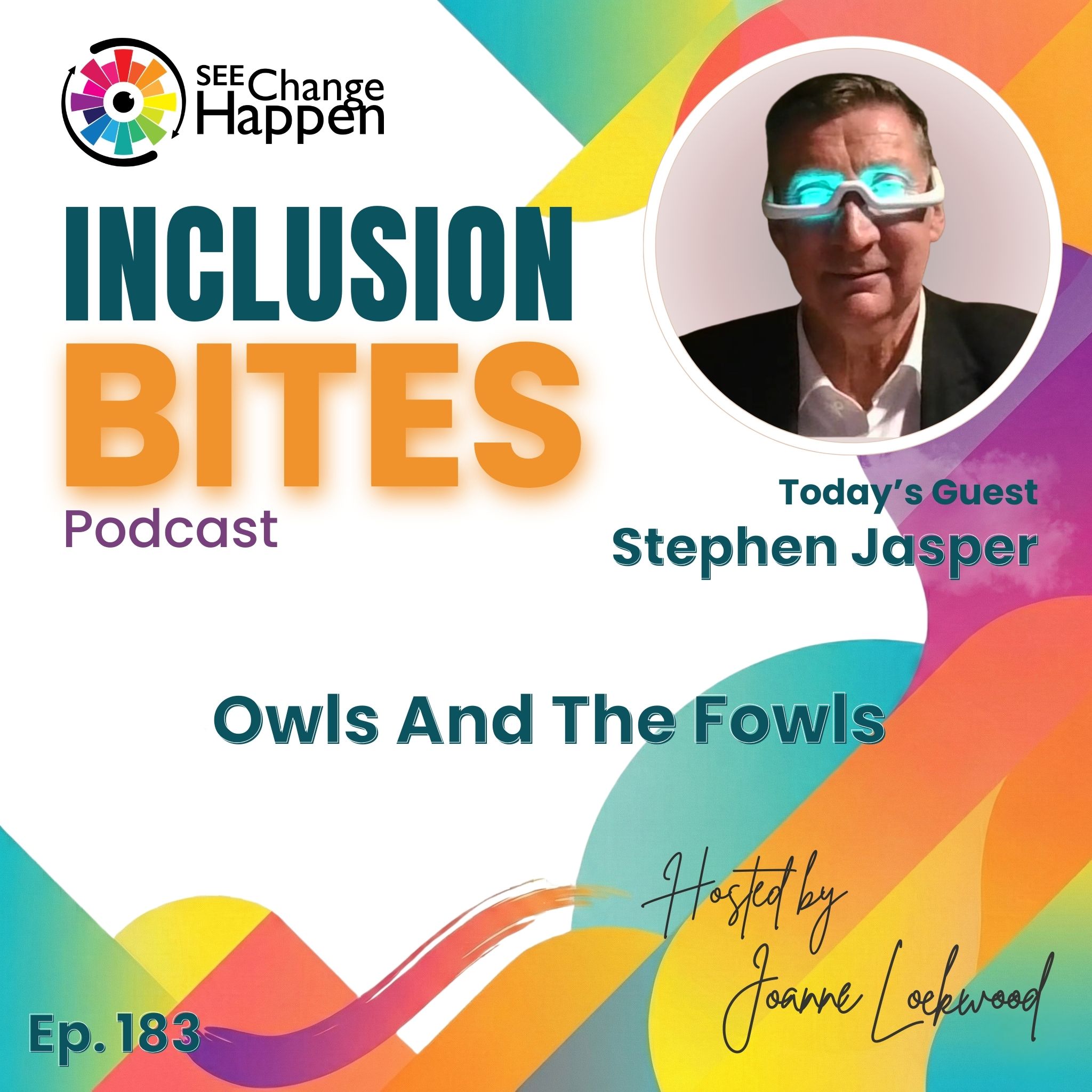
Stephen Jasper unpacks the science of jet lag, chronodiversity, and the societal stigma around night owls, offering practical insights into how understanding our biological rhythms can foster productivity, wellbeing, and authentic workplace inclusion
In this episode of Inclusion Bites, Joanne Lockwood speaks with Stephen Jasper about workplace culture systems.
Foreign.Welcome to Inclusion Bites, your sanctuaryfor bold conversations that spark change. I'm Joanne Lockwood,your guide on this journey of exploration into the heart ofinclusion, belonging and societal transformation.Ever wondered what it truly takes to create a world? Remember, everyonenot only belongs, but thrives. You're not alone.Join me as we uncover the unseen, challengethe status quo and share stories that resonatedeep within. Ready to dive in? Whether you'resipping your morning coffee or winding down after a long day, let'sconnect, reflect and inspire action together.Don't forget, you can be part of the conversation too. Reach outto jo.lockwood@seechangehappen.co.ukto share your insights or to join me on the show.So adjust your earbuds and settle in. It's time toignite the spark of inclusion with Inclusion Bites.Today is episode 183 with thetitle Owls and the Fouls. And I have the absolute honour andprivilege to welcome Stephen Jasper Stephenis a jet lagconsultant and chrono diversity advocate who reshapes how
Joanne Lockwoodhost
we review time, productivity and work basedinclusion. When I asked Stephen to describe his superpower, he saidit is providing simple interventions that help people managenot only their jet lag, but their working lives andproductivity. Hello, Stephen, welcome to the show. Hello,
Stephen Jasperguest
Joanne. Thanks for the lovely welcome. Absolute pleasure.
Joanne Lockwoodhost
I could tell by your accent you're not from around these parts.
Stephen Jasperguest
I'm about as far away from those parts as you can get. Really?Yes, I am. I'll confess up front, I am an Australian and that'swhy it's pitch black here. It's just gone midnight when you'reinterviewing me and I'm a bit of a night owl. Come back to that. Andit's a public holiday here, so that's what I'm doing on my publicholiday at midnight. So which public holiday is it?It's a public holiday called Anzac Day and theclosest equivalent I know, the Americans have Veterans Day. What'sthe UK equivalent? Armistice. Yeah.
Joanne Lockwoodhost
Remembrance Sunday. Armistice. Yeah, that kind of thing. Or Victory in Europe.VE Day. Those sort of things. Yeah, those sort of. It's. But
Stephen Jasperguest
it's a commemoration of a loss. So Anzac stands for Australia,New Zealand Army Corps. So of course it's celebrated in both Australia and NewZealand and it's a loss in a place called Gallipoliin Turkey. So10 years ago they had their hundredth anniversary and it was a very big andemotional deal. So we will have a dawn serviceand halfway between me and the city, I'm about eight kilometres out of thecity, we have the shine of remembrance and there'll be a. A dawnservice there for the fallen and fallen, thosewho. In war. And so there's going to be early morning trams, like 4o' clock in the morning transport to get people to the shrine of remembrance orother places of commemoration. So very. A very
Joanne Lockwoodhost
deep, meaningful. And I say sombre. Sombre.
Stephen Jasperguest
Sombre is a good word for sombre. Yeah, yeah. Reflection of the
Joanne Lockwoodhost
nation's loss. Yeah. And remembrance. And also gratitude to
Stephen Jasperguest
those who fought for our nation. Yeah, it's. I don't know if you have the
Joanne Lockwoodhost
same expression. In Australia we would say lest we forget.
Stephen Jasperguest
It's a very much. Yeah, very much. That phrasehere. And we have the torch that gets lit and.Okay, is that a thing that you do there? Is that an Australianthing? Like in a. An RSL or a legacy club with a member? They'llsay lest we forget. And there's a torch that gets lit. It'san electric light inside a torch. I don't know
Joanne Lockwoodhost
that particular tradition. We will probably have a lonebugler trumpeting out thelast post. Yes, we have that, but you. Okay, we had the torch as
Stephen Jasperguest
well. So I'm not aware of the torch. So it's possible we
Joanne Lockwoodhost
would lay holly wreaths at the cenotaph or. Yeah, we wouldlay wreath to Hollywood. That's more of a First World War remembrance as well,right? Yes. And also rosemary sprigs. Is that a thing for you?I don't think we're big on rosemary sprigs in the. In the uk. But
Stephen Jasperguest
it's for remembrance. It's not to, you know, garnish your lamb roast.
Joanne Lockwoodhost
We have rosemary, but now we would use poppies. Poppypoppies are kind of our remembrance symbol.
Stephen Jasperguest
We use poppies as well, but they tend to befake because I don't know that there's a lot of. They certainly don't grow wildhere. I have seen gardens nearme, but, yeah, they don't. They're biodegradable these days. They used to be
Joanne Lockwoodhost
paper and plastic. Hopefully they're better now. Wow.We just had a quick cultural lesson, so thank you for that, Stephen. It wasfascinating. I don't know if it's linked at all, but, you know, you are ajet lag expert. And cranodiversity. You could talk a bit aboutcranodiversity. Is the fact you're in Australiacontributing factor to the fact you're an expert in jet lag?
Stephen Jasperguest
Absolutely, absolutely. Australia is the bestplace in the world to research jet lag. And if you've everflown here, you'll understand why.And I'll explain how I got into it, because how did this guy becomea jet lag expert? So I started off life as a pharmacist and I washappy as a compounding pharmacist working in the hospital system. SoI'm one of those people that actually knows how to work in water and pestle.I can drive those things. And after about10 years in the hospital system and you get burnout. I hear storiesabout, you know, the nurses, especially during the pandemic, how
Stephen Jasperguest
exhausting it was. And I felt for them because I'd been, you know, inthat and not in the pandemic. And I moved into the pharmaceutical industry, whichis a fairly logical progression. And I had a number of rolesand I fell into a role where I did a lot of travel andthere was no expectation that I travelled when I went for the job, eitherfrom the people hiring me or me myself, there was no expectation of travel.And I had a boss and he said, I'm sick of travel, you do it.So I did it. And so I became one of the small number of Australiansthat does crazy travel. You know, could I fly to America througha week and stopped by London for a couple of days on my way home?That was normal. And I think my craziest travel, the one thatreally changed my life was a three day trip to BuenosAires. And if you know anything, it's 11 time zones. Thejet lag between here and South America is insane. It's about as badas you can possibly get. And it was four flights goingthere from Melbourne to Sydney to Auckland to Santiago toBuenos Aires. Worked, you know, worked for two days, had a day off at theend of it and did it all in reverse. So that was, yeah, thatwas my craziest escapade. And so I had an interestbecause I get shocking jet lag, you know, if I don't treat it. My jetlag is absolutely shocking, as I discovered on my firstoverseas trip. And the thing that saved
Stephen Jasperguest
me, and I didn't know it at the time, but I know nowon the first day, the people I was training said, hey, we're goingto lunch, we could drive you, but it's only a kilometre away. Do youwant to go for a walk? I'd love to go for a walk and have,you know, see the streets of Buenos Aires. That's not something you see every day.And it was sunny, you know, it was Winter, but it was sunnyand that sunlight absolutely saved me. Sosunlight is a key thing. And so I did an MBAafter that job and I wanted to do project management.Looked around, nothing interesting came up. I was being offered pretty much thesame sort of roles that I'd done. So I thought, stop it, I'll do aPhD as you do. I was hunting around for thingsand my supervisor and research manager were all saying, no, that's rubbish,don't do that. And then I mentioned the whole jet lag, explain the story.And they said, yes, absolutely, this is what you should do, research. AndI did it. And that's how I became the jet lag guy.So, yes, I have a PhD in jet lag, sowow. International management. So it was aseries of so many left turns. That's a spiral. I'm just
Joanne Lockwoodhost
thinking there must be a, a whole collective of jet lagPhD, experts of one. Yeah.
Stephen Jasperguest
And also, I mean, there's lots of scientists that do circadian rhythmstuff. And that's great. We need more of that. And I cite them.But in terms of international management, now, bearing inmind I was doing it through what was then the College of Business and Law,so people were writing about finance, economics, they're, you know,big on blockchain and of course all the various types of law. And I cameacross fairly late in my PhD, a study where they injectedhamsters with Viagra for jet lag. AndI had worked with Viagra in the clinical trials back in 97. Iactually, you know, was up close and personal, you know,with 2,000 bottles of Viagra, and it was still being researched.And so I dedicated a paragraph for my PhD to thatstatement, you know, and it's all done academically. Ithink I lay claim to being the only person in that college toever have written a paragraph about Viagra being injected intohamsters for jet lag. So, yeah, that, that's, I thinkthat's unique. Blowing here, thinking, what other side effects did the hamster
Joanne Lockwoodhost
exhibit with Viagra? Well, that's the funny
Stephen Jasperguest
thing. I mean, going back to, like I said, I've worked with Viagra. It startedoff as a heart drug. It opens blood vessels, surprise, surprise, itopens some other blood vessels. And one of the nurses in the veryearly stage, like first time in humans trials,asked the patient, did you notice anything? Well, actually, nurse, Inoticed. And da, da, da, da, da. And interestingly,that same drug. I'm digressing here, that'sfascinating. Fascinating. Is used in aserious cardiovascular condition called pulmonary arterialhypertension. And it's fatal. It strokesmostly young women. It's a horrible disease. Butthe active drug sildenafil is used in that application to open up bloodvessels and alleviate that. So it is still used as acardiovascular drug, but it gets a lot more use with other uses.
Joanne Lockwoodhost
Yes, yes. And it's also now useful for jet lag,
Stephen Jasperguest
but only in the eastbound direction. That's the other.
Joanne Lockwoodhost
That was my next question. In myearlier career I used to work for a private bank and they had officesin Hong Kong, Singapore and la, SanDiego, New York, Miami, east and west and Uruguay andBahamas and Cayman, other other lovely places. So I used tofly regularly east, west, up, down across Europe andfurther afield. And I was aware that there was a differentexperience of east west travel to west east travel.
Stephen Jasperguest
So what's, what's the, what's the okayfor most people? And I'm going to put a, you know, red underline,yellow highlight. This is the kind of diversity kicking in for mostpeople. East is a beast and west is bestfor most people. Flying east is a beast. And
Stephen Jasperguest
here's the thing. And for morning people it's the other way around. So let, letme unpack that because that just sounds random. So when youfly west, say if you're, you're in London, if you fly to Los Angeles,the day seems to stretch out whether it's a long night or a long day,but your day seems to stretch out. It seems to last longer than24 hours. So what you do is you stay up late and youhave a sleep in. But if you're a night owl,lovely, that's fine. Ifyou're a morning person, that's hard. And then going theother way, flying east, the day seems to shrink. Soyour sun rises and sets less than 12 hours because you're flying against thesun. So you have to go to bed early when you're notreally tired and wake up early when you still are tired.For night owl, that's hard going. But fora morning person or a foul, that's easier for them.Yep, they'll go to bed early and wake up early. So there's thatintersection between direction of flight and chronodiversity. And that's where Istumbled into onto that. And I'll give you anexample from my own life. During my PhD,I got a scholarship to go to an international managementconference in Paris. You haven't had cateringuntil you've been to an international management conference in Paris. But that's anotherstory. But I noticedI flew there and it was my birthday. It'sthe only time in my life I've ever had a warm birthday because my birthday'sin winter here. Landed and I was goodto go. And I just said to the conferenceorganisers, every break we get, I'll be going outside just to getsome sunlight. And then I knew coming back,I had to throw everything I could at it because I'm a night owl. Thisis why I'm talking to you. Just after midnight,I did. I managed my jet lag. Day two, day three, I wentto bed a little bit early, like 8:30, 9 o', clock, which is early forme, but I didn't lose any productivity. And that's when I. Yeah,I'm onto something. I'm definitely onto something. And I did everythingI needed to do. So coming back.So that directional component's absolutely vital. Yeah. I was
Joanne Lockwoodhost
thinking the last time I went long haul was Australia,Melbourne, where you're. Where you are. That was pre Covidand I'd never travelled. Sayagain from. I'm in Melbourne. I'm not from Melbourne, I'm from the other cities.Sorry. Oops, Sorry. The mostI'd ever flown before, I think in terms of time wasSingapore, Thailand, those sort of Hong Kong and they tendto be about 13 hours. From the UK was about eight,
Stephen Jasperguest
I think. Singapore. Eight, was it? Yeah, maybe. Maybe
Joanne Lockwoodhost
it was Thailand. It was Thailand. Thailand, I think, is
Stephen Jasperguest
about. I think it might only about seven. No, it's definitely
Joanne Lockwoodhost
more than that. I've. Yeah, I've done it.
Stephen Jasperguest
Singapore and Hong Kong are both +8 and Thailand's a little bit westtime zone. I'm talking about flight time. Sorry, I'm talking about flight time.No, no, you're right. You're really right. Sorry. And I,
Joanne Lockwoodhost
I. Because when we went to Melbourne, we went via Singapore.Yeah, no, sorry, via. We went via Hong Kong. We stopped over in Hong Kong.I remember the journey. We got. We weren't rich, we. We went. We went coach.We were at the back of the plane, knees on our chest like you do.And the flight to Hong Kong was absolutelypainful. And then you have to get off and you have to do itagain. So you do 13 hours, have a couple of hours breakand then you got to do another eight. It was that second eight. It's veryheady. Yeah. It's not quite as far
Stephen Jasperguest
from here to Hong Kong as it is from London, but it's still a longway. It's a long way, yeah. And so the jet lag was One thing, because,
Joanne Lockwoodhost
you know, you talked about the fact that you're flying into the sun or flyingaway from the sun when you're flying 18 hours total, the wholecircadian rhythm gets messed up. You've gone past that. Is the day getting longer orshorter? It's wrapping itself, isn't it? Well, there's a couple
Stephen Jasperguest
of things to pull apart there. And the first is jetlag versus travel fatigue.And an example I would give to you. Say youwant to fly to Cape Town in South Africa, but you can't get a directflight. So you've got to do a couple of, you know, you've gotthe long flight to Johannesburg, then you're going to hang around Johannesburg airport, then youget another flight to Cape Town and then you, you get in ataxi and you get to your hotel, right? And of course there's the getting tothe airport in London at your end. That's an exhaustingjourney. And you'll be tired, but you won't be jet laggedbecause you're very similar time zone. There's notravel fatigue. I mean, sorry, there's no real jet lag. There's travelfatigue. Lots of travel fatigue. The example I use in Australia is if we flewto Vladivostok, same thing, lots of travelfatigue. If on the other hand, they rebuilt the Concorde,you know, or you know, some super duper. One article wastalking about London to Australia in three hours and you've got this super,supersonic jet, right? Let's say you boarded the supersonic jet andfor that three hours there's soft pillows and, you know,little meals and cups of tea and anything you could want, right?And you land in Melbourne three hours later,you won't have travel fatigue because you've had three hours just sitting verycomfortably. It's like going to the movies. But the jet lag will bebrutal. So I want to pull those two things apart. The otherthing is when you fly so far east, what can happen is yourbrain doesn't shrink the day. It's like it's flyingwest. And I've had that happen to me. You get sodisoriented because there's two mechanisms to adjust toflying east. You have phase advance. So you, you know, yougo to bed and wake up early. That's called phase advance. Viagrahelps with that mechanism. When you fly west, you have phase delay. You goto bed late and you wake up late and that's phase delay. And that's easierfor most people. So what can happen if you Fly, sayLondon to Australia and you're just so not coping.What your body might do instead of doing phase advance, it might go into phasedelay and take you longer to overcome your jet lag. So.Yeah, absolutely. And that first flight from London to Hong Kong isthe one that, that's the terrible one in terms of time jet lag.That's an eight hour time difference. Hong Kong toheat too, not a problem. So if you could stop at HongKong, you know, rest up, that will help. Yeah,that's exactly what I did on my first round the world trip. I stopped atHong Kong for a few days cause I knew my jet lag would be terribleand it was. And I was fine. And I used the old Hong Kong airport.That was scary. I've landed in there when you're
Joanne Lockwoodhost
flying in. That was in the 90s. Yeah. Yes.
Stephen Jasperguest
You fall through the mountains and you land on a cricket pitch.
Joanne Lockwoodhost
Yeah. I remember distinctly about that was you couldsmell the sewers in the plane when you were on the tarmac and youcould smell Hong Kong coming through. I remember seeing
Stephen Jasperguest
the slums. But what I also remember,at the end of the Runway there was a cafeand you could watch the planes landing or taking off.It just looked terrifying. You know, all that had to happen was forone plane not to break properly and it would plough straight into that cafe and.And everyone seems perfectly oblivious to that. No, no, absolutelynot. Get me out of here. If I fly to the
Joanne Lockwoodhost
us they tend to structure the flight so that you get on mid eveningand then you're effectively landing and waking up at six in the morning and thenyou just get off the plane and get on with your day. And then inreverse you structure the flights and then morning. So getting off and then going home,going to bed and then try and kick your routine back in, is that kindof a good thing to do? It can be. I think going
Stephen Jasperguest
from the US to London is, will be harder for most people to having aday flight, I think I've done night flights, all myflights and they're brutal. The transatlantic eastbound crossings andI've done trans Pacific crossings a lot as well. But thetransatlantics are the ones that get me because I don't get a chanceto nap. I don't the overnight ones. So yeah, a dayflight I think would be better. You know, the overnight ones.I be lucky to sleep for two hours on atransatlantic flight. And if you do it in this height of summer,you've got sunlight most of the way anyway. There's not Much night.You're flying that far north. When I was flying a lot, let's say
Joanne Lockwoodhost
back in the 90s, I used to do a lot of short haul. Let's sayit was to. From London to Zurich. I guess that short haul, two and ahalf, three hours or whatever it was. We had domestic flights, given
Stephen Jasperguest
that here. Yeah. I got so used to it
Joanne Lockwoodhost
that I could literally fall asleep beforetakeoff. And I would land as we landed.I would chop and wake up as we hit the tarmac at the other end.And I'd probably let out an expletive out of my mouth, go, that justhappened something. Because I was mid deep sleep. Everyone around megoing, what the hell is this going on? But now I found itvery easy to fall asleep on those short hauls.And my technique for long haul is get on there and pick about fourmovies. And the movie that I'm not that fussed about is alwaysthe third or fourth one. Because I know by the time I've watched the firsttwo that my brain is now getting to the tiresome stage.Then I found myself forcing myself to stay awake for the third. And generally Imiss most of it. It's a bit like go for an operation. They inject youand say, count back from 10. You know, you never get past two. I neverget past the third movie sort of thing. So it's a. It's a good techniquethat I've learned over the years. Now I'm
Stephen Jasperguest
one of those strange people. They call it raw dogging, which soundspositively obscene. It's not. I just like to watch the flight map.I don't really want to watch movies. I don't want to have headphones in.I just. I just want to see my flight map.And I'm. I think we are relatively rare inthe population in that we fall asleep on planes. I know, you know, I getthe white noise and there's light vibration and bang, I'm out. But I know mostpeople can't sleep on planes and they complain they can't sleep on planes. And Ican't stay awake on the things, you know. So, yeah,
Joanne Lockwoodhost
I put a lot of weight on over. Over Covid and other things, and Iflew to San Francisco. I found that really, reallydifficult to fly to San Francisco a couple of years ago after Covid, because Iwas a lot bigger. I was a lot more cramped. I was justuncomfortable. And it's. It really, as you say, that,that travel fatigue combined with the jet lag and justthat frustration of the whole cramped in space,it's just, it's painful, isn't it? And the airlines know that that'sthe, the problem. And they, they charge you premium to book a biggerseat or to have pick your aisle. And it's like you trap me inthe middle up middle aisle or you trap me by the window with a familynext to me. It's hell, isn't it? Well, I,
Stephen Jasperguest
I hate the middle seats. I really don't like the big planes. I'm happieron not the tiny ones, but you know, medium sized planes where I likebeing next to the window.But yeah, I think the flight from Raleigh Durham to London,I was near a whole lot of families with small children. So that was anovernight flight from Raleigh Durham international to London. So what's the
Joanne Lockwoodhost
recovery time? You know, I get you have the jet lag and I appreciateeveryone's different, but how the body's naturalrecovery, what is the kind of process it goes through?
Stephen Jasperguest
The rule of thumb is about a day per hourcrossed. That's the rule of thumb. Bearing in minda few things. First of all, that it's easy torecover from west than east for most people.So like I said, when I went to Paris, I just got off the plane,I'm good to go. Off we go. Andwhen I went back, I managed to telescope it.I interviewed someone for my podcast.So it's wonderful doing a podcast. I don't have to press any buttons here.You can do that. And he investigated Canadian in speedskaters. He's based in Montreal and theylooked at speed skaters and they recovered much more quickly than they anticipated.So I think the state of health is important. Of course these speed skatersare in peak condition. They have to be speedskaters.But the rule of thumb is a day for every hour cross. So ifyou're crossing 10 time zones, which you do from to London, giveyourself 10 days. But I think it could be less. And I thinkthere's lots of things you can do to manage that. If I'm, if
Joanne Lockwoodhost
I'm spending 10 days in Melbourne, it's going to take me10 days when I'm in Melbourne to recover from the 10 days I'm in Melbourne.And then I ping back again. Is that 10 days plus 10 days,that's 20 days of recovery or does the reverse offset it?No. Yep. Well, there are some. An
Stephen Jasperguest
airline crew typically do this and this is why they don't want you to openthe windows, by the way, the blinds. Obviously not
Joanne Lockwoodhost
open the windows, but open the blinds. No, they don't want you to open The
Stephen Jasperguest
Sorry, no, not open the window. Yeah,don't open the blinds. They don't want you to open the blinds. It's not foryour convenience, it's for theirs. Because let's say you've got BritishAirways and they've got a crew based in London, they want to stay on Londontime because let's say they do a flight to Bangkok, they'lltouch down, they'll have a nice set and then they'll be back on the planethe next day to come back to London. They want to stay on London time.They don't want to be adjusting and they don't want the sunlight in Bangkokwhen it's still nighttime in London to interfere with their circadian rhythm.But if you're a traveller, you want that blind open so you can get thatBangkok sunlight so your body adjusts. Yes, it's daytime. Yeah. I
Joanne Lockwoodhost
never thought about the cabin crew, the wanting to keep theirtime clock because if they're completely isolated from the externalworld and they stay on London time in their mind and in their job,the shift pattern, then they're not affected at all, are they? They justcarry on living London time. That's it. And that's what
Stephen Jasperguest
people do. There was one case where someone flew aroundthe world, I think it was for Qantas and you know, he just stayed onplanes and flew around the world but he stayed on Sydney time.And so he didn't get jet lagged because he stayed on Sydney time. He justignored what was happening outside. Again, going back to the night when I used to
Joanne Lockwoodhost
fly. This was way before Internet and smartphones Ithink I did have an old Nokia 2110 phone that hadglobal roaming or something so I could roam. But I tried to leavemy watch. The old days we had a watch that you had to adjustmanually. I tried to leave that on home time andthen in my mind just translate what time I am. So I was always thinkingabout what time I was at home and then add five, add six, take away10, whatever it was and then eventually I could give up after about four daysand just set it, set it to the local time. But I guess that's meadjusting in a, in a slow slide bykeeping the reference point back home. Well, it depends. Do you want to
Stephen Jasperguest
adjust or do you want to stay on home time? That's the decision you're makingnow if you want to stay on home time. If it was a really shorttrip, stay on home time. You know, like the cabin crew typicallystay on home time. Don't Adjust your watch, leave it to London timeor whatever, stay on home time. Ifit's a longer trip and you really want to adjust to the local time oryou need to perform within the working hours of local time, get onto local timeright away. Get on, you know, adjust your watch right away.There's a decision. But, yeah, go one way or the otheris what I would say. Rather than stay on 1. Don't sit on the fence.
Joanne Lockwoodhost
Yeah, sit on the fence. It's just painful. Make a decision one way
Stephen Jasperguest
or the other and then stick to it. Are there ways to sort of fool
Joanne Lockwoodhost
your body? I mean, you mentioned sunlight is a good way ofgetting your brain chemicals flowing. Eating foodat re. Changing your eating habits is that or your pattern. Eating food is
Stephen Jasperguest
secondary. Sunlight is the big one. And I've got a little gizmo I'llshow you in a moment. But there's five different types of light receptors in theeye. You've got SO3 for colour vision. So think of red, green, blue,kind of sort of red, green, blue. You've got one for low levellighting and that's why you don't see colour very clearly in low level lighting.It's not geared for colour. And then you've gotreceptors that have nothing to do with vision and everything to do withregulating your circadian rhythm. And they're most sensitiveto light in the blue, green, that sort of cyan colour,that sort of wavelength. And that's very primitive. If you think oflike blue green algae in the water when they're sort of sinkingor rising depending on the time of day, that's the colour of light thatpenetrates that blue green colour. So that's why it penetrateswater better than any other wavelength. And I met a young mana few years ago and he went blind. Suddenly at the age of 16,his optic nerve just stopped working, which is a really awfulthing. And so he was legally blind, but he still had acircadian rhythm. And a lot of blind people still have a circadianrhythm. A lot don't and they have to, you know, and thisis where melatonin supplementation for those people can beuseful. But yeah, it's independent of vision and a littlegizmo. So this is an Australian invention because we love our jet laghere. And I was speaking with the inventor the other week and they. These areelectronic sunlight glasses. So it's that cyanshowing up for. Anybody who's listening to this and can't see it. So
Joanne Lockwoodhost
Stephen's got what looked like half Glass half, halfglasses, white frames. And then they're beaminga blue light into his eyes. Yeah, blue green light.Blue green light. Yeah. So they're beaming light. And what
Stephen Jasperguest
this does. And I better take them off because I want to get to sleeptonight. True, trueis they wake you up and I go to networkingevents and I hand them around and get people to try them on. And forsome people, they say it's like having a shot of coffee,and for other people, they're fine with it. And I think part ofit is because I'm doing this about seven or eight o'clock at night. The morningpeople, their melatonin starting to kick in. And what this does, itsends a message to the eye saying, hey, it's sunlight, wake up.And that sends a message to the brain saying, hey, stop producingmelatonin. Little part of the brain called the suprachiasmatic nucleusstop producing melatonin. Wake up. And the evening people, their melatoninhasn't kicked in yet, so they're fine. They just put them on, don't feel athing. So there's, there'slabs that are similar. They have that blue, green colour. And this is, this is
Joanne Lockwoodhost
the logic behind things like mobile phones having dark mode.
Stephen Jasperguest
Exactly. Adjusting the tone, night mode,
Joanne Lockwoodhost
you adjust the. The balance of light as well, so you make them moreyellow at night. Things like this, it gets a reddish kind of tinge,
Stephen Jasperguest
Like a reddish yellowy, tawny sort of tinge. That's. That's cuttingout the blues and the greens. That's what it's doing, cutting out the bluesand the greens. You get this sort of sandy,bluish, reddish kind of colour. And so that's whatnight mode is. And it's doing that with yourcell phones and your monitors, that sort of thing. Yes. You're trying not to
Joanne Lockwoodhost
feed your brain chemicals with daylight light.
Stephen Jasperguest
That's it. And that's why, you know, they tellpeople, don't doom scroll late at night.You know, you're giving. You're not only keeping yourself awake with all the horrors ofwhat's happening in the world, but, youknow, and there's some horrors, but you're feeding the blue lightthat's keeping you awake, you've got bad news that's keeping you awake andblue light keeping you awake. And then, no surprise, you get insomnia. Yeah,
Joanne Lockwoodhost
I'm guilty of that. Guilty of that, definitely. Yeah. But I flipmy phone, goes into automatic night mode or dark Mode at about 8o' clock in the evening, so. Oh, that's good. I'm not saying, I'm not sayingit's brilliant, but yeah, yeah, yeah.
Stephen Jasperguest
So. And in my research in jet lag, like I said, it intersected withChronodiversity. And this is something.I'm a night owl and I've been that all my life. And it does changewith age. So if you've ever been the parent of small children, there's no suchthing as a sleep in because they're up, ready to play, it's6:00am Come on, let's go. And then when you're the parent of teenagers, like,you know, they're up at the crack of noon, you know, that's,that's what happened. Yeah, teenagers. Yeah, teenagers were laying. They'll
Joanne Lockwoodhost
sleep anyway, weren't they? Teenagers? Yeah, I remember, yeah. But that's
Stephen Jasperguest
actually really useful for us as a species. So that theyresearched a tribe in Africa and theyfound they had morning people and late people. This was natural. And there was onlya total of about 80 minutes, 18 when everyone wasasleep. Otherwise someone was awake. Really handy in Africa,you know, there's lions and jaguars and stuff.You want someone to protect the tribe from prey. So this iswhy chronodiversity is a feature, not a bug. And ifyou, you know, if you're under attack from predators or enemies or someone,you know, late at night trying to take advantage, who do you wantawake? Crazy teenagers is who you want to wake. Youknow, they'll, they're at, they're physically fit and they'll,they'll just go for it. So that's why, you know,chronodiversity is a feature and we treat it like abug. And over in Australia we havean election coming up and the opposition initially had apolicy against working from home. They said, right, we're going to abolish working from homein the public service. There was an outcry. There was anabsolute outcry. And they pointed out it's going to mostly affect women. Doyou really want to lose women's votes? And they said, actually no. Theyreversed on the working from home, which is good because it was bad policy.And I don't think it was clearly thought through. But one of thebenefits with working from home is you can choose your hours.For most people, you can choose your hours. And I had a positiveexperience some years ago because I always struggled to be in the officeat 9. That's just, I've got to get, you know, gettingon crowded commuter transit, you know, it's just awful.And I Was working with a team based in Paris and I.
Stephen Jasperguest
I was in Sydney initially, then Melbourne and I didn't need to be atthe office at 9, I'd start at lunchtime.They weren't going to be in the office until at least 4:30 in the afternoonmy time. I could work on things and then if I had any questions, wecould video conference early evening for meand it was just liberating As anight owl it was. I got to be who I was and people valuedwho I was and I want that for everyone.And it's not a one size fits all, but being able to work with yourown body's natural rhythm. So that's. I'm passionate about that. Andnow, you know, I've been working in academia.I've had one class at 8am that was unusualbut my morning classes start at 11:30,so technically morning classes,yeah. It's interesting what you say there about how over the course of our
Joanne Lockwoodhost
life our internalcranodiversity mortifies. I remember being,I suppose in my early 20s. I was, I was very much.Everyone accused me of burning the candle at both ends. I was getting up earlyand working late. I was in it. So I end up working on systems allnight, getting locked into something and then Ihad a job where I had to travel for two hours. I got in thecar, I woke up every day at 5 o' clock in the morning, I wasin the car, I got into my office at 10 to 8or something like this, beat all the traffic and then I got a clear run.
Joanne Lockwoodhost
Then in the evening I hung on until the traffic had passed. I got homeat 8:30, 9 o' clock in the evening, have my tea and I'd probably stilldo something and then I go to bed about midnight, I'd be up again atfive and I behaved and performed like that for five,six, seven years. And all of a sudden I stopped doing that very earlymorning, I didn't need to. And I found my abilityto start early, disappear completely. Andthen my job changed again and I wasn't working all night,I wasn't staying up all night and I found my ability to keep going,disappear completely. So now I'm a kind of an 8 o' clock in themorning person till 8 o' clock at night. Outside of thatI'm just not functional in a professional sense anymore. Right. What
Stephen Jasperguest
time is it there now, by the way? 50. So 10 to 4 in the
Joanne Lockwoodhost
afternoon. Right. That's quite civilised. Good, good, good. Yesit is, yeah. I've got good lighting, so I've probably got somedaylight lighting here as well. No, the only lighting I
Stephen Jasperguest
would get is the aurora australis at this time of night. We do haveaurora sightings down here, by the way, so that's not made up downamongst the penguins. But that evolution of our own
Joanne Lockwoodhost
self, was it because it was a habit or is it because ofmy ageing and changing hormones and changing life changing? I tick all
Stephen Jasperguest
of the above for that. I mean, look, when you're in your 20s, you're bulletproofor you feel bulletproof. And I know in my 20s I wasworking in the hospital systems, I. I'd do late nightshifts and on calls and, you know, I'd be called into makeupand infusion at 3 o' clock in the morning and doing, you know, mathsand, you know, crazy stuff like that. And I was doing that,I think, into my 30s. I couldn't imagine doing that now.I couldn't imagine showing up in a Hospital at 9am andcompounding. And I worked really hard.In hospitals, you work hard, there's no two ways aboutit. And that's why all thenurses during the pandemic and the doctors, like, yeah, I feel you. I havesympathy for you. I've been up against it, doing that hard work and havingto have additional protection, you know, you had to have themasks and what have you Absolutely had to. That wasabsolutely. Yeah, I'm glad I wasn't working the healthcaresystem at that time. But again, I think ageing is partof it and your chronotype changes. You become less ofa night owl, you sort of peak for men,males, I think we're about 17 and for females about15. I think somewhere around that. Andthen you drift towards being a more of a morning person or some ofus drift. I seem to have stayed. I have adolescentchronic. That's just how it is. Yeah, I definitely struggle now beyond
Joanne Lockwoodhost
10 o' clock at night. Yeah. And I'm not particularly earlyriser. My alarm goes off at quarter to seven in the morning. So, yeah,past 10 o'. Clock. That's it. Yeah. And also you missed out on
Stephen Jasperguest
a lot of sleep. There will be some catch up. You know,there's unfortunately been a link to lackof sleep and dementia, so Itake my sleep as absolutely sacred. And I think therewas an example, the late Margaret Thatcher, who famouslylived on four hours of sleep, but. Yes, but she ended her life with dementia.So, you know, that sort of thing. Exact surprise. Maybe it'slinked. Maybe it's Not. But, you know, that's. Sleep is just one of the pillarsof health. And again with Chronodiversity,letting people sleep when it suits them. We have sucha stigma in society. My father used to say to me all the time, earlyto bed and early to rise makes men healthy, wealthy and wise. And, you know,we have all these sayings. You know, the early bird catches the worm,different languages will have different sayings, all saying the samething. And there's a real stigma about it. And people say, oh, I've donehalf a day's work before breakfast. No, I did mine the night before.I did mine the night before, I'm done, so I could sleep in. I. I've
Joanne Lockwoodhost
seen that, that kind of bias exhibit itself in the workplace myself, where, because Iwas. I was an early and a later, I'd be in there sort of 8o' clock and I'd see people coming in. Some people would drift in half nineor whatever it is, and they would be sort of saying to people, oh, you'releaving already? It's only five o', clock, the night shift's already here sort of thing.There's this perception that you don't see the habit of the otherpeople. You think they're slacking because you only see what you see. Thatoverlapping period is probably a third of your working day.So you think you've done a third more than they have because they've come inlater, but really they're staying on. So, yeah, there is a bias there.
Stephen Jasperguest
There absolutely is. And it's a real stigma. And they do researchon evening types of the owls. So you should talk about the owlsand the fowls, which is different to the birds and the bees. Butif you're a morning person, you're said to be a foul, and if you're anevening person, you're said to be an owl. That. That's the explanation.But there's a real stigma against owls. Real stigmaagainst night. Night owls is like, as a night owl, I know I'm everybit as productive. As a morning person, Ijust do it later, or in my case, to do it the night before. So.And this push against work from home,I don't know why people need to be micromanaged. If they. If they can dotheir job at home and be as productive, let them, Let people select theirhours. You might need to have a zoomtime that suits everyone. See if you can have it in the middle of theday. And if people have to meet in the office, do that occasionally.But See if you could do that in the middle of the day. Butthis nonsense, you know, everyone rushingto work to be in the office at 9 o' clock isbonkers. I came to the conclusion after
Joanne Lockwoodhost
some self reflection I realised no matter what time Icame in I'd always end up leaving at the same time,late, whatever it was and I'd always end up getting the same thing done, youknow, I'd always achieve the same amount. So I soon realised that there wasno benefit to me to coming in at early o'clock because I'd still be there at 8 o' clock and I still get thesame thing done in the day. So I thought well hang on a minute, whydo I put my pressure on myself to come in really early and do thisboth end stuff? I might as well just start at 10, finish at 8in the evening and say that's the way I work. Yeah
Stephen Jasperguest
and that's what I do. I try not to do much before 10unless I'm dealing with Americans and that's because of the time zone difference.So you know, but my American, anycolleagues, my Americans I know, I'll just be there with a cupof tea and don't talk. I mean I've set my online diary,
Joanne Lockwoodhost
my calendar up so that the first appointment is never before half nine in themorning and my last appointment is half five to halfsix in the evening. That's quite so, yeah. SometimesI'll end up having to accommodate someone from a different time zone or I haveto get a meeting in and I said it's a nine or something like thisand I'll wake up in the morning, I'd just be chilling out, doing my morningroutine, listen to the radio and listen to the quiz on the radio, listen tothe favourite song of the day and then I go and have my shower andI come back to it and look at my phone go my God, I've gota beating in two seconds. It's like how did that. My brain'stuned itself that the day starts at 9:30 and yeah, I've got tosometimes check that. So when I go to bed I go what? I programme mybrain say right, I've got to get up early and my brain goes okay, I'lldo that. Well I have my alarm set, so I have my
Stephen Jasperguest
daily list in my phone of what times things are on andokay, what alarms do I need to set? So I set an alarm for 10minutes to midnight. Normally I'd set it for five minutes. I wantedthis. I don't haven't used this platform much, so I thought, I'll get in niceand early. And I have a friend who rings me about 10 past,quarter past 11 when she worked. So, um,she, she works until 11:00 o' clock and she was in a near miss, ina car accident. Near miss. So she was, you know, survived,but she was rattled. And I said, well, why don't you ring me when you'redriving home from work? Because that was when she'd get nervous. I'll be awake.And so we, we chat typically three or four times a weekat 11 o' clock at night. And that works for both of us.
Joanne Lockwoodhost
So sleep deprivation, you know, you mentioned Margaret Thatcher, potential dementialinks. Sleep deprivation is a really bad thing, isn'tit? It affects our whole wellbeing. Absolutely. Look,
Stephen Jasperguest
sleep is one of the fundamental pillars of health, along with, you know, dietand exercise and, you know, connection or community, thosesorts of things. Sleep is absolutely one of them. You cannot,you can go without a night of sleep. You can probably go fortwo nights at a pinch, but you will. Crunch. And we doneed, you know, in the wild we needed to do that if, you know, sabretoothed tigers running around or something. Not a good time to have a nap.
Stephen Jasperguest
So we needed to have sleep like that. Andit's interesting, horses need a lot less sleep than humans do.Horses sleep for less than three hours a night and they're very skittish,they wake up very quickly, but that's because they'reprey. You know, for a lion, that's a meal,that's several meals. So that's why horses are so skittishin that they don't sleep much. And we have a big race here inMelbourne called the Melbourne cup every first Tuesday in Novemberand horses are flown in from around the world.And there's. And this jet lag device isalso a similar one, is used for horses. Their own blinkers they
Joanne Lockwoodhost
put on and. They'Ve got these blue light blinkers that
Stephen Jasperguest
they, you know, it's a different shape because it's a horse face and there's acompany that researches it and there's an academic,Barbara Murphy, who's dedicated her life to horse jet lag. She'sat Kentucky, Kentucky, which is near the Kentucky Derby.So, no, that makes sense. But yeah, horse jetlag was her thing. So we've got probably the only PhD
Joanne Lockwoodhost
jet lag expert on the call right now. We're talking to you. Andthen we've got a unique person who's a horse jet lag expert somewhere inKentucky and states another. Another pool of one person that's likea. It's fractal. You know, we're going sort of
Stephen Jasperguest
jet lag in horses. So. Yeah. And somewhere out there there's probably jet
Joanne Lockwoodhost
lagging dolphins, jet lagging in sheep or something.Deprivation. Certainly, you know, they do look at
Stephen Jasperguest
jet lag in animals because it's. But jet lag goesright down even to plants. You know, there are. Because plants have acircadian rhythm. That's when it was discovered. It was a mimosa plant that wasput in a cupboard and it opened and closed its petals at the same timeas it would have normally out the fields. Yeah, I'm certainly aware.
Joanne Lockwoodhost
I suppose I've pulled 36 hour onthe, on the bounce. Sometimes, you know, in my IT days, get up at normaltime, all the systems crash, you're there and all nightand then you get to about 4 o' clock in the morning. There's no pointin stopping now, we might as well just carry on. And you're there, everyonewalks in, you're the heroes that got the system back up. And everyone gives youa round of applause. Your boss looks at you, wags his finger and says, youshould go home to bed now. You go, hang on a minute. If we goto bed now, we've got to make sure everything's tested. And eventually they force youout about just after lunch, get home and then you'resort of like, you're wired, aren't you? You're kind of wired, all the adrenaline's kickedin. There's no way you can just drop to sleep all of a sudden crash,you say the adrenaline goes and you're out. And that's that
Stephen Jasperguest
same response, you know, staying awake in case there's a Sabre tooth target.It's that, it's that biology kicking in. You're wired, you. Andit's really funny. When I was doing my PhD and I was in theinterview phase, so I interviewed 28 people who were workingin biotechnology sector about their jet lag. That was the first phase. And thenI did a survey and they kept coming up with the phrase running onadrenaline. Now I had a checklist of questions.
Stephen Jasperguest
Adrenaline wasn't in there. But multiple people keptusing the phrase running on adrenaline. Oh,I've got to look into that. And this is something I found isthat because, you know, east is worse than west for mostpeople, but more people said that jet lag on returnwas worse than jet lag going out. Because when they goout that, you know, they'll fly to America or the uk. They are running onadrenaline. They've got to do this and do this and go here and go thereand go to conference and speak and da, da, da, da, da. Right? Then theyget back, they're in their routine, they're safe and all thatexhaustion, bang hits them. And it takes a realtoll on relationships because their partner,and especially if they've got kids, their partner who's been away isnow absolutely useless. Can't drop the kids off at school,can't cook a meal, grumpy as, you know, bear with a sore head.That's a strain on relationships. And a lot of people getburnout and say, you know what, I'm just not going to do this anymore, I'mdone. So, yeah, you raise agood point with running on adrenaline or caffeine and. Or
Joanne Lockwoodhost
caffeine. Yeah, caffeine and energy drinks. Caffeine and
Stephen Jasperguest
sugar. No, but my big bugbear isalcohol. People are, oh, well, I'll just have a few drinks and go to sleep.
Joanne Lockwoodhost
If you have a lot of drink, it'll make you pass out. But a fewdrinks doesn't as wise. You know, when I travel,
Stephen Jasperguest
I channel my Methodist preacher grandfather. Aboutthe only time lips that, lips that touch liquor will never touch mine.I do tomato juice and I remember being, I think it was Qatar and Iordered tomato juice. Oh, would you like some vodka in that? No, absolutely not.So alcohol is the worst thing you canpartake of when you're travelling, you know, cross time zones and ofcourse the airport lounge, it's free. And then on the plane it's free.You know, the temptation's there, but no,resist that. Yeah. The other problem I have is that if I've
Joanne Lockwoodhost
got something on my mind, I mean, okay, I have to get up earlyin the morning, you know, I can't sleep through. I can't sleep through. I can'tsleep through. Some reason my brain either wakes meup at the right time or I just can't. I'm looking at the clock every20 minutes, every 20 minutes. I just time slice in the entire night and eventuallyI have to wake up and I haven't slept at all. And it's. The brainjust will not sleep on it. Yeah, no, I'm a big believer
Stephen Jasperguest
in alarms. That seems to be the thing that works best for me.But speaking of alcohol, the effect of jet lag is similarto the effect of alcohol. So I ask people,would you go to work drunk if you don't Then why wouldn't yougo? Why would you go to work? Jet lag, it'sthe same thing. Adding alcohol to that is like being twice as drunk. So
Joanne Lockwoodhost
that's a combination of time zone change and also sleep deprivation as well. Soboth those combinations. Yeah, it's impairing your
Stephen Jasperguest
cognitive performance. Right. Jet lag has an effect oncognitive performance. We saw Joe Biden in the debateabsolutely crash and burn and he attributed to that jetlag, and I believe that. And then after the election, hevisited Angola and fell asleep in a meeting. Again,jet lag. And he flew. He'd flown east and, you know,in a dark room, bang, you fall asleep. And he's not ayoung man, let's be honest there. So is that why Trump
Joanne Lockwoodhost
actively says he doesn't like flying and travelling anywhere? He likes to stay in theus, that's why he says sends JD Vance everywhere.You know, can't trust himself to stay awake. Not a young man
Stephen Jasperguest
either. And yes, the jet lag messes with you. He might go, you know what,just send JD out. And interestingly,JD's wife Usha travelled to Italy recently andcancelled a number of events there because of her jetlag. And again, that's flying east. And as we know,east is a beast, so we don't think ofjet lag and the top echelons of politics. But yes, absolutely,Steve, it's been absolutely. Fascinating to learn about owls and fowls
Joanne Lockwoodhost
and east is the beast and west is best. Some brilliant, brillianttakeaways there. And fascinating to see your flashyglasses. If you're listening to this and you haven't got the video, track down thevideo somewhere and you can see the crazy glasses that Stephen was wearing there toshine that. So everyone, our viewers know what we're
Stephen Jasperguest
talking about. There we go. Let me just screen hold them there, let me do
Joanne Lockwoodhost
a screen grab and they can. I can maybe put that inthe thumbnail on the image. So there we are. I think so. I think this,
Stephen Jasperguest
this is the thumbnail. I'll put that as your thumbnail
Joanne Lockwoodhost
for the please do show. So. Yeah, well, it's very
Stephen Jasperguest
flattering. Yeah, I use that as the COVID.Glasses will be most appreciative. Yeah. So could people buy those on
Joanne Lockwoodhost
Amazon or are they specialist? They can buy them at my website.Just say that again.
Stephen Jasperguest
Www.jetlagguy.comau.au Australia.Of course, I couldn't get the dot com on its own, so I've got theau. So there is another jet lag. Guys, have I Then,
Joanne Lockwoodhost
yeah. So that's, that's the website that's all about me
Stephen Jasperguest
working on. Are you on LinkedIn and other platforms as well? Absolutely. OnLinkedIn. Hit me up. I welcome pretty much everyone on LinkedIn. I'mreceptive. So look for Dr. Stephen Jasper or the jet lagguy. You'll see me. I post quite a bit on LinkedIn. I've also gota Blue sky account because I don't use TwitterX. I just. No. And I have a YouTube channel and I've gottwo podcasts about jet lag because one isn't enough. You got a East one
Joanne Lockwoodhost
and a West one, have you? Well, we've got the.
Stephen Jasperguest
As a chatty one. It's like this. It's a chat with me and another guy,Arthur Chan, and we just chance called Whatever Happened to Baby Jet Lag.That was the weirdest title I thought. Yeah, it's a memorable title.The other is a series where I interview thoughtleaders in this field. So I've got one coming up where I interviewthe inventor of these. So he talked about and he hadfalse starts in this because they needed light and he thought, oh, let's try amberlight. Amber did absolutely nothing though.So it's called ending Jet Lag. So I've got one withwho's written a cookbook for the Circadian rhythm, so all that sort of thing. So.And I've also got some merch. I've got several books. So I've gota book called Jet Lag and it's written inuser friendly language so you know, but there's a glossaryfor any technical terms. And I've got a children's book called Ben Fliesto London. It's about little boy Ben living in Sydney who flies to London.And there's a companion colouring in book. So give somekids some pencils or crayon on a long flight, they're amused.It's a travel survival pack. Excellent, Stephen. Thank you.Thank you very much, Joanne. As we bring
Joanne Lockwoodhost
this conversation to a close, I want to express my deepestgratitude to you, our listener, for lending your earand heart to the cause of inclusion.Today's discussion struck a chord. Consider subscribing toInclusion Bites and become part of our ever growing communitydriving real change. Share this journey with friends, family andcolleagues. Let's amplify the voices that matter.Got thoughts, stories or a vision to share? I'm allears. Reach out tojo.lockwood@seechangehappen.co.ukand let's make your voice heard. Until next time, this isJoanne Lockwood signing off with a promise to return withmore enriching narratives that choose challenge, inspire andunite us all. Here's to fostering a more inclusive world oneepisode at a time. Catch you on the next bite.
Chronodiversity and Inclusion in the WorkspaceJet Lag, Productivity, and Health Across Time ZonesStigma, Bias, and the Narrative of Productivity
Joanne Lockwood is joined by jet lag consultant and chrono-diversity advocate Stephen Jasper for a wide-ranging conversation about how our biological rhythms shape work, wellbeing, and inclusion. Stephen shares how extensive international travel led him from pharmacy and the pharmaceutical industry to a PhD focused on jet lag, and why sunlight and timing are central to managing it.
Together they unpack the practical realities of travelling across time zones, including the difference between jet lag and travel fatigue, why “east is a beast and west is best” for many people, and how sleep disruption can affect cognitive performance, relationships, and day-to-day functioning. Stephen explains how light influences circadian rhythms, why late-night screen use can keep people awake, and why alcohol is a particularly poor choice when travelling.
The discussion then turns to workplace inclusion through the lens of chrono-diversity. Joanne and Stephen explore the stigma and bias often directed at “night owls”, the limitations of rigid nine-to-five expectations, and how flexible working and remote collaboration can allow people to work in ways that better match their natural rhythms. The episode closes with a call to treat chrono-diversity as a genuine inclusion issue, creating cultures where different sleep and productivity patterns are recognised and valued.
“And after about 10 years in the hospital system and you get burnout. I hear stories about, you know, the nurses, especially during the pandemic, how exhausting it was.”
“Let's say you boarded the supersonic jet and for that three hours there's soft pillows and, you know, little meals and cups of tea and anything you could want, right? And you land in Melbourne three hours later, you won't have travel fatigue because you've had three hours just sitting very comfortably. It's like going to the movies. But the jet lag will be brutal.”
“They don't want you to open the blinds. It's not for your convenience, it's for theirs. Because let's say you've got British Airways and they've got a crew based in London, they want to stay on London time because let's say they do a flight to Bangkok, they'll touch down, they'll have a nice set and then they'll be back on the plane the next day to come back to London. They want to stay on London time. They don't want to be adjusting and they don't want the sunlight in Bangkok when it's still nighttime in London to interfere with their circadian rhythm.”
“And I met a young man a few years ago and he went blind. Suddenly at the age of 16, his optic nerve just stopped working, which is a really awful thing. And so he was legally blind, but he still had a circadian rhythm.”
“So that's why, you know, chronodiversity is a feature and we treat it like a bug. And over in Australia we have an election coming up and the opposition initially had a policy against working from home. They said, right, we're going to abolish working from home in the public service. There was an outcry. There was an absolute outcry. And they pointed out it's going to mostly affect women.”
“I got to be who I was and people valued who I was and I want that for everyone. And it's not a one size fits all, but being able to work with your own body's natural rhythm.”
“More people said that jet lag on return was worse than jet lag going out. Because when they go out that, you know, they'll fly to America or the uk. They are running on adrenaline. They've got to do this and do this and go here and go there and go to conference and speak and da, da, da, da, da. Right? Then they get back, they're in their routine, they're safe and all that exhaustion, bang hits them.”
The difference between jet lag and travel fatigue, and why it matters for health and performance.
The profound impact of chronodiversity, highlighting how morning “fowls” and night “owls” experience travel, work, and sleep.
How direction of travel (east vs west) influences jet lag severity, and practical strategies to manage recovery.
The biological role of sunlight and light exposure in regulating circadian rhythm, plus technological innovations like electronic sunlight glasses.
Stigma and bias attached to different sleep chronotypes in workplaces and society, and ways to foster greater inclusion.
The benefits of flexible working arrangements for harnessing peak productivity, wellbeing, and belonging.
The cognitive risks linked with sleep deprivation, and actionable habits for safeguarding long-term mental health and family relationships.
One thing to remember
The most significant takeaway from "Owls and the Fowls" is the profound impact of chronodiversity—our individual biological timing preferences—on productivity, wellbeing, and inclusion. By understanding and accommodating chronotypes (whether 'owl' or 'fowl'), particularly in the context of jet lag and workplace routines, we can create more inclusive environments that promote both performance and health. Recognising differences in how people experience time and fatigue is not just a matter of comfort, but a gateway to systemic change in how we approach work-life balance, wellbeing, and equity.
Questions this episode helps answer
How do personal experiences with jet lag, such as those shared by Stephen Jasper, influence our understanding of chrono-diversity and productivity at work?
In what ways can organisations better accommodate both "owls" (night people) and "fowls" (morning people) to foster more inclusive workplaces?
Reflecting on Joanne Lockwood and Stephen Jasper's cultural exchange about remembrance traditions, how do national customs and rituals shape our perceptions of loss and gratitude?
What is the physiological impact of flying east versus west, and how does this interact with an individual's natural chronotype?
How might the stigma surrounding night owls in the workplace undermine both inclusion and productivity?
What practical interventions—such as light therapy or flexible working hours—could organisations adopt to ease the effects of jet lag and harness the benefits of chrono-diversity?
Explore topics
Ideas from this episode
Chronodiversity and Inclusion in the Workspace
Reflecting on my recent conversation with Stephen Jasper, I was struck by how intricately our natural sleep-wake cycles—what Stephen termed ‘chronodiversity’—dovetail with the challenge of workplace inclusion. He illuminated the biological and social reasons why some of us flourish as morning ‘fowls’ while others soar into productivity as night ‘owls’.
Jet Lag, Productivity, and Health Across Time Zones
Stephen’s expertise as a jet lag consultant brought fascinating insights into the science and lived experience of jet lag—much more than the stereotype of groggy business travellers. He distinguished sharply between jet lag and simple travel fatigue; the former stems from crossing time zones, while the latter from the exhausting logistics of long journeys.
Stigma, Bias, and the Narrative of Productivity
The enduring bias underpinning society’s narrative about productivity and ‘the right way’ to work. Stephen and I noted how sayings like “the early bird catches the worm” serve not only as motivational mantras, but also as tools for exclusion, reinforcing the idea that only those who operate by the morning clock are virtuous and dependable.
Learn
Frequently asked questions
What is “chronodiversity” and why does it matter in the workplace?
Chronodiversity refers to the natural variation in people’s circadian rhythms—essentially, whether you’re a ‘morning lark’ or a ‘night owl’. As Stephen Jasper explains, these tendencies are shaped both by genetics and age. Recognising chronodiversity is vital for inclusive work cultures, as forcing standard 9-to-5 hours on everyone can undermine productivity and wellbeing, particularly for those whose natural rhythms don’t align with traditional work schedules.
---
Is there scientific backing for the idea that some people are more productive at different times of day?
Yes. As outlined by Stephen Jasper, extensive research shows that people’s peak alertness and productivity are not universal. Teenagers, for example, typically have later chronotypes, while young children and many older adults may naturally wake and sleep earlier. Societies and teams that recognise and accommodate these differences are better positioned to enhance both diversity and performance.
---
What is the difference between jet lag and travel fatigue?
Jet lag is a specific consequence of rapidly crossing multiple time zones, leading to a misalignment between your internal body clock and local time. Travel fatigue, as Stephen Jasper points out, is physical tiredness from the process of travelling (e.g., long flights, layovers), regardless of time zone changes. You can be exhausted after a long journey without being jet lagged if your circadian rhythm isn’t disrupted.
---
Why is travelling east typically harder than travelling west?
Stephen Jasper succinctly summarises with, “East is a beast, west is best.” Most people find eastbound travel more challenging because it requires advancing the body clock—going to bed earlier than usual—whereas westbound travel extends the waking day, which feels more natural for most chronotypes. However, the effect can flip for extreme morning types (‘fowls’), who may struggle more with westbound travel.
---
How long does it take to recover from jet lag?
The rough rule is one day per time zone crossed, as shared by Stephen Jasper. For example, travelling across ten time zones might take up to ten days for full adjustment. Factors such as age, chronotype, health status, and use of mitigation strategies (like light exposure) influence this duration.
---
Why do cabin crews want passengers to keep the window blinds down during some flights?
Cabin crew often try to keep their own body clocks anchored to their ‘home’ time zone, especially if they’re regularly flying back within a short time frame. Blocking out new daylight cues by keeping window blinds closed helps prevent their circadian rhythms from adjusting to the local destination, making return adjustment easier. Passengers wanting to acclimatise to the new time zone, however, should seek out local sunlight after arrival.
---
Share this episode
Heard something worth passing on? Send this conversation to someone who needs to hear it.