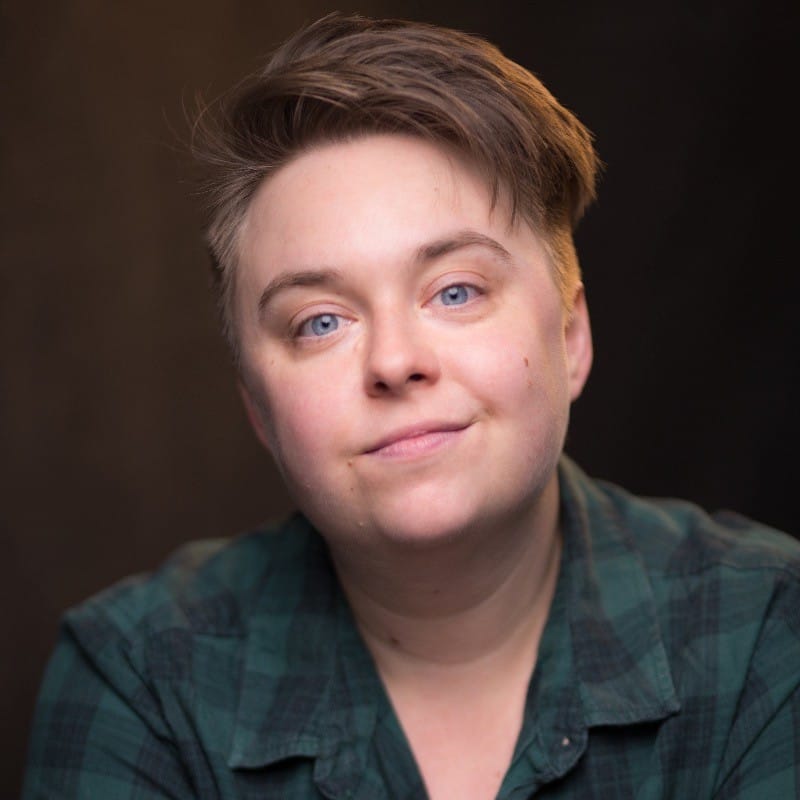
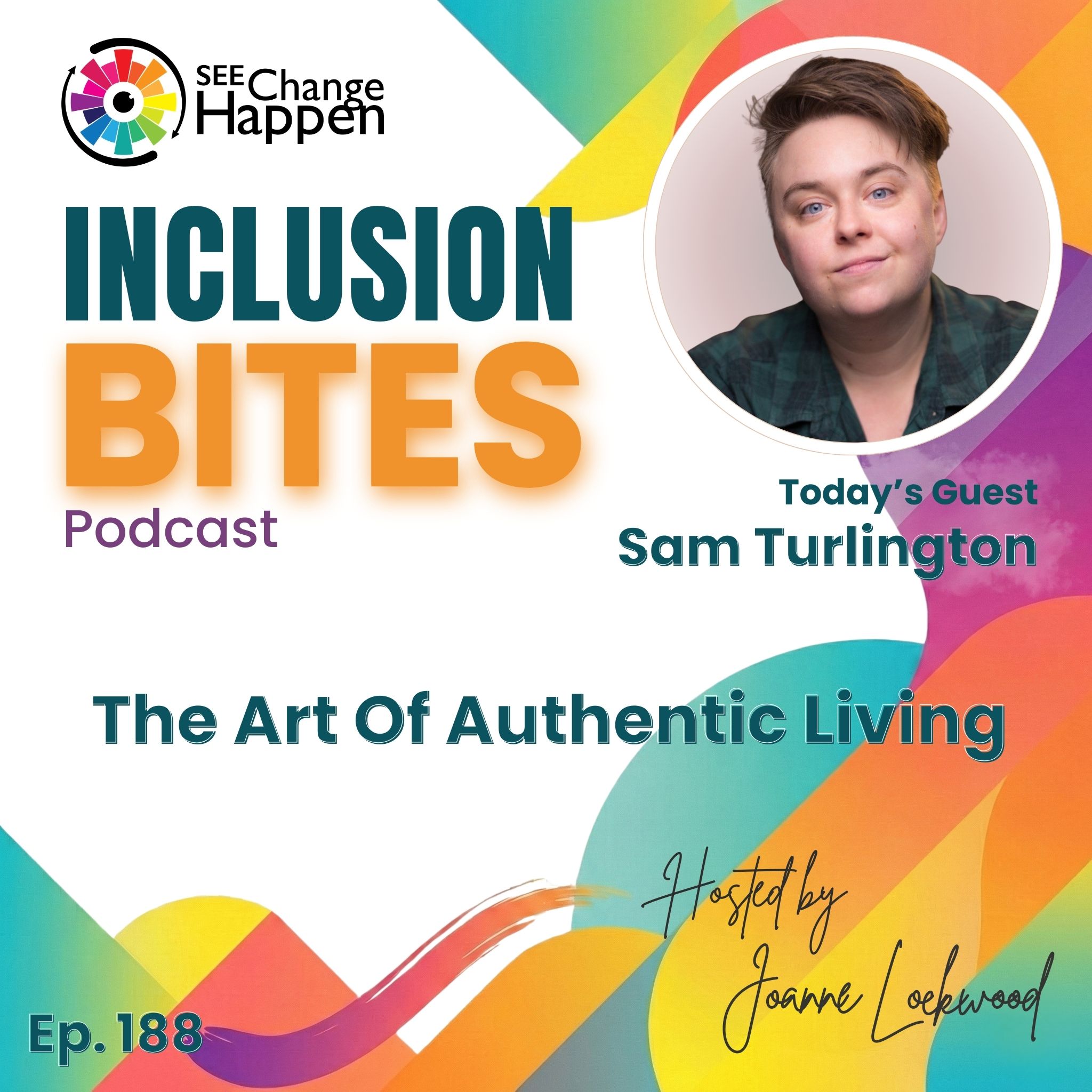
Sam explores the nuances of authentic living, sharing how a multi-hyphenated creative identity and queer joy foster greater empathy, resilience, and the courage to step beyond binaries—ultimately inviting us to open the doors to our true selves
In this episode of Inclusion Bites, Joanne Lockwood speaks with Sam Turlington about lived experience identity.
“If I find myself on a binary, I jump off of it immediately.”
Explore
Navigate this episode
Sam Turlingtonguest
Foreign.
Joanne Lockwoodhost
Welcome to Inclusion Bites, your sanctuaryfor bold conversations that spark change. I'm Joanne Lockwood,your guide on this journey of exploration into the heart ofinclusion, belonging and societal transformation.Ever wondered what it truly takes to create a world everyonenot only belongs, but thrives? You're not alone.Join me as we uncover the unseen, challengethe status quo and share storeys that resonatedeep within. Ready to dive in? Whether you'resipping your morning coffee or winding down after a long day, let'sconnect, reflect and inspire action together.Don't forget, you can be part of the conversation too. Reach outto jo.lockwood@seechangehappen.co.ukto share your insights or to join me on the show.So adjust your earbuds and settle in. It's time toignite the spark of inclusion with Inclusion Bites.And today is episode 188 with thetitle the Art of Authentic Living. And I havethe absolute honour and privilege to welcome Sam Turlington.Sam is a non binary, award winning actor and multi
Joanne Lockwoodhost
hyphenated creative whose work champions queer joyand the complexity of authentic storytelling. And when I askedSam to describe their superpower, they said that it is seeing people soulfullyhonouring the truth of. Of their experience. Sam,welcome to the show. Hello. It's lovely to be here. So, judgingby the accent, you're not based in the uk, where I live. So wherein the world are you? So I. I'm American, I live in New York
Sam Turlingtonguest
City, but I have really strong ties to the uk. Igot my master's degree in Glasgow. I think you're saying before we went on air
Joanne Lockwoodhost
that you spent a lot of time working up in Glasgow and you've just comeback to the us? Yes, I do. I. I'm actually working on a
Sam Turlingtonguest
film in Glasgow at the moment and a lot of my colleagues are in Londonas well. So I pop over and we create things togetherand yeah, I'm all over the place.
Joanne Lockwoodhost
I'm fascinated by the term multi hyphenated. So what is, whatis. What is a multi hyphenate creative then? So
Sam Turlingtonguest
essentially, you know, when I first trained, I got my BFAmany, many years ago. You could just kind of be one thing like you, youfocus and that for me, at the time, that was justan actor. And as my career has developed and shiftedand changed, and as I have developed and shifted and changed, I've takenon other positions. You know, I've producedfilms, I have directed plays. I don't knowthat just one title suits me. So, but saying 12 of them wouldbe a mouthful. So just I'm a creative arts multi hyphenate.Boom, there it is. But always an actor first.
Joanne Lockwoodhost
So it's kind of the identity equivalent of being non binary, I guess. So you'renot nailing yourself to any particular identity there? Absolutely. I think my
Sam Turlingtonguest
entire life could be summed up as if I find myself on a binary,I jump off of it immediately. So what makes you tick?
Joanne Lockwoodhost
What was your kind of inspiration as a young person to plotyour course in this direction? So I have a fundamental
Sam Turlingtonguest
curiosity at the core of my person to just connect andwonder. And I grew up in a.Not a small town, but in a small southern spacewhere I didn't really have a lot of access to the wider world around me.And I found myself just gravitating towardsanything that was different from what my upbringing had introducedme to. And that's how I fell into acting. Because as an artist, as anactor, you get to take on other people, otherpersonalities, you get to walk in another person's shoes, you get to researchtheir experiences and put yourself in scenarios that you yourselfwould never find yourself in. So Ithink in a strange way, my corenature of curiosity and wanting connection with theoutside world led me to acting. And then I'm pretty sure it's that thatled me even deeper in myself to discover that I'm nonbinary and that my experience of the world is much more varied than Ioriginally thought. When I was a kid, just being an actor playing,
Joanne Lockwoodhost
playing a part through someone else's words. I guess most of the time when you'reacting, someone else has scripted you. You're someone else'sPersona. Did that give you an opportunity to maybestep outside of yourself and try on new things? Is that kind of whathappened there? Absolutely. I would say, you
Sam Turlingtonguest
know, as a young actor, you get a script and your first instinctis to say, well, how would I do this? And then you learn very quickly,oh, that doesn't actually serve, you know, the play or the film or whatever itis you're doing. So I felt a freedom to be like, oh, great.I don't have to think about what Sam would do. I get touse the tools I have to figure out what this person would do. Andthen the freedom that comes from that to be like, great. I don't haveto worry about how I feel about a thing. I know how they feel abouta thing. And then the inevitable conclusion of that is, okay,well, I, Sam, do not understand why this kind of person would make thiskind of decision because it's so vastly different from whatI would do. So then you have to, you know,whatever kind of research you do, talking to people. I sought a psychologyminor when I went into my time in university. I was like, I have tounderstand why people do the things that they do do. And reallyall that was doing was fostering greater empathy forpeople in the world around me. So it's amazing how all that kind of playsin together. Yeah. When I used to run IT companies and when I
Joanne Lockwoodhost
tend to transition about 10 years ago, give or take,I bulked from this new part of my career, both career andidentity and I was looking for what I was going to do in the middleof the night and I thought I would try and get into acting because Ihad a few friends who were, who did bit parts, youknow, the sort of, you know, they were. The person walking behind somebody orthey were serving them at a table. There's sort of minor rolesand I wrote with a lot of agencies and I never, I never got anywhereas it happened, but I did, I did have a couple of auditions doing afew things and it kind of got me into that. It made me realise thatI didn't want to do it, to be honest. But it was, it was fascinatingbecause I actually changed my bio to being aspiring actor atone point. You know, I love it, you have. To manifest it for it tobecome real. So I tried to manifest it on my bioand I just decided it was. It didn't pay very well. You know, itdoesn't, you know, when you're in that early stage, £100 for a dayor something. And I thought that's a lot of work to go all the wayto London and back and stand around and maybe get to.I decided I wanted to focus on higher worthopportunities. I absolutely understand the amount of
Sam Turlingtonguest
work that you have to put in as an actorcompared to the benefit andcompensation that you get, especially early career is nearimpossible. Sometimes I'm inspired by. I don't know how younger medid it, I really don't. And I applaud them. Andany young actor who's starting out right now, particularly,goodness gracious, they're my heroes. I don't. The leap of faith youhave to take and the amount of work you have to put in and theamount of rejection you have to deal with in an alreadytumultuous world that's rejecting you and your identity potentiallyis overwhelming.
Joanne Lockwoodhost
But I soon figured out that my stage was different. It didn't need tobe an acting stage. So I'm now a keynote speaker, a professional speaker on stage.So you still bring that larger than life Persona.So you. Absolutely. It's authentic, but it's a bigger version of you.It's not the quiet you, it's the stage you. So yeah,I enjoy performing because I think being a professional keynote speakeris a performance as well. It has to have Act 1, Act 2,Act 3 and thank you at theend. So yeah, it is like being a solo performer.Solo act for sure. The overlap between public speakers
Sam Turlingtonguest
and keynote speakers and actors is. I mean the Venn diagramis a circle. Basically it's the same thing. Except for I think youusually control what you're going to say and we sometimes aresaying other people's words. Sometimes I don't know what I'm going to say next. It
Joanne Lockwoodhost
is like ad lib. Sometimes it is. Yeah, lots of. Andimprov. And improv. Yeah. Yes. And
Sam Turlingtonguest
yeah. So yeah. But I mean obviously I know what the topic is when I
Joanne Lockwoodhost
stand on stage. I know what I'm gonna talk about roughly. But in all seriousness.And if you're looking to book and pay me to do anything, don't worry, Ialways get it right. But I often don't know what I'm gonna say next untilit actually comes out my mouth. Cause it is conversational often. Yes.
Sam Turlingtonguest
I actually think that's a really wonderful skilland it's something that all actors have to be in someway shape or form good at improv. And ifnot improv, when you're in a play, you haveto be so comfortable with the script that it's as if you are saying itoff the cuff. It's as if it's not pre planned. SoI think knowing the shape of a conversation,knowing the shape of what you want to say, knowing, okay, we're going to gohere, we're going to move here, we're going to end here eventually.That's the most important thing. You don't always need to know exactly what words andexactly what order are coming out of your mouth. But knowing what the journey's goingto be is incredibly important and areally good skill to have when you're working on a very wordy playbecause your errors are going to happen, you're going to make mistakesand recovering from that is really the mark ofa true professional. How you recover and for simply, it's not just you that makes
Joanne Lockwoodhost
messes up, it's the person you're acting against or with andthey've gone off on one and you're thinking, well, that's not in my script, butI'll just have to rock with this and see what happens, see when you comeback. And I'll pick it up from wherever you leave it. Yeah, you just gotta
Sam Turlingtonguest
roll with the punches sometimes. And if it goes off the rails, it goes offthe rails. And if you're in a play, it's goingoff the rails live in front of a bunch of people. And eitherthey're gonna be on board or they're not gonna be on board. And it's yourjob to get them on board with whatever madness is happening.
Joanne Lockwoodhost
I guess you've got to have faith in the writer because everything you're saying shouldbe optimised to be part of the storey or a necessary plot.You're often not just saying words for the sake of it. They're part ofevolving the character, aren't they? They should be. They certainly
Sam Turlingtonguest
should be. I think I didn't know this when I was a young artist,but I have more experience now thatyou can hear the difference between a good script andjust a script by howimportant is every word that the characters are saying?Is all the details coming out in an organic way? Is it a show me,don't tell me kind of thing? You can really hear if there's filler,if there's just fluff, language. Like, the writer was like, oh, this might sound abit clever if I say it like this, but it doesn't serve the purpose ofthe storey. And they're out there. You're gonna. Yeah, yeah, yeah. I've auditioned withsome doozy scripts, but, you know, that's my job, to makeit better and make it real and solve the problem as we say. Youalways want to solve the problem. Do you find yourself having
Joanne Lockwoodhost
your own version of predictive text in your head where you're listening along tosomething and you know exactly what the next character's gonna say? I mean, I watchTV and films all the time thinking, and I'm reading out the next timeMarie's looking at me going, how'd you know they were gonna say that? It justgonna happen. It is. All the time. Yeah. The
Sam Turlingtonguest
same. Em and I will be on the couch and they'll be like, especiallyin high dramas, there's always those long pauses waiting for the next characterto speak. And nine times out of 10, I'm like, I know exactly what they'regonna say. And it's not even the gist of what they're gonna Say
Joanne Lockwoodhost
it's actually the word. Cause there's obviously there's lots of superlatives they could havepicked. And I go, I just say, da, da, da, da. There it is.Exactly what they just said. Almost in time with them as well. Yeah,maybe I became invested in the character and I became with them. Honestly,
Sam Turlingtonguest
that might be you syncing up with the character and their narrative. That's a formof acting as well, is being able to empathetically getinto the headspace of someone else so much that their wordsare coming out of your mouth. Absolutely. So you obviously hang out
Joanne Lockwoodhost
in creative space a lot as athespian. If you identify as a thespian, a producer or yourhyphenates out there, I would imagine as someone who isn't in that space,that it's a very open, queer friendly type environment. Is thata truism? Say yes with an asterisk.
Sam Turlingtonguest
It's. The majority of creative spaces are going to be open toqueer people and multiple identities and things like that.It shocked me to discover that somecreative places are not. I didn't. I never really considered that. Ikind of took for granted that everyone who works in thisindustry has the level of empathy required tojust be cool with everybody and bespecifically inclusive of everybody. Because being cool with someone and being inclusive of themare very different things. And a few years ago,
Sam Turlingtonguest
I went to a playthat I didn't know anything about, but someone was like, hey, I have a ticket,let's go. It was a small off off Broadway play andI was not in the audience very long before I realised this is aconservative propaganda piece. And I am surroundedin a theatre with actors, withdirectors, all of the normal people, but they're putting onthis play that's saying some really not okay things. Andit was my first interaction with how could this happenin our community? I didn't know these spaces existed. And so of course, Igo out into the lobby afterwards and there's some prominent conservative mediafigures there. And I'm like, this is odd. And I talk to,like the house manager and stuff and I'm like, how in the worlddo spaces like this happen? And she goes, well, we all have toeat and we have jobs to do and we get hired to do these jobs.And sometimes the people that we're working for are notgreat, but we don't control who rents thetheatre. Some people are dicks and you can't legislate. It was soshocking because the house manager was like, well, you know, I don't knowwhen the theatre gets rented, we don't know what show's going in there, sowe're just as surprised as you. And I said, well, what about the actors? Doyou know what's going on with that? And she was like, you know,it's an acting job and some actors can just be like, well, you know, I'mnot gonna worry about it. I'm just gonna do my job and then get onwith it and take the paycheck. I was shaken by that news.
Joanne Lockwoodhost
Can't bring your friends to the opening night, can you? Oh,
Sam Turlingtonguest
I don't know, sort of have. This shame I'm in this play or you can't
Joanne Lockwoodhost
come and see it. It's awful. Here's the thing. I've been in some bad plays,
Sam Turlingtonguest
but I've never been in bad plays because they were written by bad peoplelike, or had something bad to say. I will happily invite my friendsto a bad play that's not very good and the writing or the storytelling isgreen. But my goodness, I don't know if Icould ever agree to be in a play that was actively trying tocause harm to somebody or is going to say something that could cause harm tosomebody. So other than that very specificgroup of people that does exist, maybe 5%of the industry as I know it, most every creative space I'm inis wonderfully queer friendly. Thank goodness. You said earlier
Joanne Lockwoodhost
about it's not you playing the role, you're having to step into the character andthe character plays the role, if you like. Where do you stand onyour own identity? Do you play CIS male, CIS femalecharacters as a non binary person or do you have to bring your identity intothat role as well? My first and foremost approach is to always bring
Sam Turlingtonguest
my identity to a role. But I play CIS women allthe time. I've had the very A highlight for me has beenplaying CIS men recently, which is really great. I usuallywhen I get cast as whatever gender identity, thefirst conversation I have with the director is, okay, you have chosen someonelike me to play this role. Let's deal withthe narrative dramaturgical ramifications of that orthe gift that that is. I was in a play last year by awonderful playwright who's actually in the uk and the role I was cast aswas just called the son S o n and it was a family dynamic where,you know, parents and then a son and a daughter andthey cast me as the son and the director said, actually,how would you feel if we explore what this role's genderidentity actually is. Does it actually need to be a CISman? It doesn't have to be. Let's see what happens. And we endedup coming to the conclusion that this character was nonbinary and it actually served the storey betterfor them to be so. So that was a moment of mebringing who I am to the role and it actually made the playbetter. And I think now the writer has actually rewrittenthe script so that that character just is non binary. Now I
Joanne Lockwoodhost
suppose at that point there, you're then having to give an authenticityconsultation top to bottom on that script so thatall the characters who interact with that characterknow that person's identity, how they're going to refer to them, how thoserelationships, work, family, whatever, and all those littlewords that you forget agenda, suddenly you have to bereorientated, don't they? Absolutely. One very specific example
Sam Turlingtonguest
of that. I was in a production of as yous like it, and Iwas playing Touchstone, who's the clown in that playand originally written for a CIS man.But we decided that in the context of the play, thischaracter would start out in stealth mode, hidingas if they were a CIS man, but then transitioning to nonbinary as the play went on. And we got curious of like,okay, how are we going to support that with Shakespeare's language in a verywell known play? And we ended up getting curious aboutneopronouns and maybe Touchstone refersto themselves with zee zem zir and how does that fit withShakespeare's language? And as we got curious, as wedived dove into the text and explored,we just decided, you know, what Shakespeare was doing allkinds of weird gender stuff a long time ago. I don't think he would mind.We changed all of Touchstone's pronouns in the script so that even when othercharacters referred to them, they used theseneo pronouns. And then there was an evolution of like when they werein the first act in the very strict horrible Court, theyreferred to Touchstone as him. And then they slowlystarted going to they them. And then by the end of the play, Z zem'sear, which was so cool, to figure out how thatfunctions and to not put any limits on what it could be. And it's actually
Joanne Lockwoodhost
quite like real life as well, because you don't go from hereto there overnight. You don't wake up one morning and go, well, maybe you do,but you have to bring the world with you, don't you? Yes. I
Sam Turlingtonguest
say, there's a joke that everyone makes.It's the he, him to he, they to they, sheto they, them to she her pipeline, it juststarts to go and. Cause it's an exploration.
Joanne Lockwoodhost
It's a soft launch, isn't it? Coming out as non binary. It can be asoft launch, but that validates your, that, that also invalidates non binaryidentities as seeing it as a. Oh, you're just trying it out.That's actually my destination. So you've got to be careful. You're not propagating that myth,isn't you? Yes, of course. Because like, and some people
Sam Turlingtonguest
can use non binary, the non binary identity as like astopping ground to kind of sit and reorient before they move on to somethingelse. Because they might think that being non binary is my destination. But then theyget here where I am and they go, oh, I thought this was theconclusion, but it's actually not. And they can keep going. And then some people likemyself get here and we go, sweet, we've made it home. Thisis the correct thing. And I have explored the otherdirection and been like, oh, nope, that wasn't right. So thefreedom to move from one to the other and to validateeveryone as they're passing through or making campas twere, I think is really important. Yeah, no, I get that
Joanne Lockwoodhost
completely. Yeah, I skipped the middle bit. I just went straight to the other end.I just, I knew I was going at the book, had the map,honestly. Yeah, respect. To know exactly where you're going,
Sam Turlingtonguest
exactly what you want. All of my trans siblings who know exactlylike, this is me, I have such respect for that and I have suchadmiration for it because I've just never been able to make up my mind.
Joanne Lockwoodhost
But to be fair, my evolution was back in the 1970s andyou know, think about how long ago that was. Andshe her was bad enough in those days. You know, there's no, there's no kindof. There's no, There was no queer option or gender queer orgender expansive options at the time. You had to be here or I had tobe here. And that bit in the middle was a destination rather than,as you say, a stopping ground. Absolutely. What's going on here then? Let'shave a look around. So true. I mean, as
Sam Turlingtonguest
tumultuous as things are right now for our community,I can't fathom the experience that it was inthe 80s, in the 70s, in the 60s and beyond.Unbelievable. Well, there was just, there was no language.
Joanne Lockwoodhost
There was nothing to envy or be worried about. It was when you've gotno options, you don't worry about having no options because you don't know no options.So you don't know what you don't know. Absolutely. That was
Sam Turlingtonguest
a big thing in conversations around my coming out, because I, asfar as the current generation believes I came outlater in life because so many of our community members get to come out whenthey're like children because they know exactly who they are and they havethe access to the language. But non binary did not existwhen I was in high school. When I was in middle school, I didn't. Idon't think I met an out trans person until I was incollege. So I had no access to that identityor that life or how it might apply to me. Which,hilariously, I figured that out throughtheatre. I got cast not long out of school,I got cast in a play playinga trans woman. And in that time,the conversation around casting CIS actors as trans people wasnot existent really, or was not loud like it isnow. But I ended up playing a trans character.And it was the first time my brain went, is this me?This is the way I feel. And it was adoorway. I tell that I haven't ever told that director who cast mein that play, but I need to write her a letter and say thank you,because if it wasn't for that play, I don't know that I would have gottenthe unlock as early as I did in my adulthood.It would have been many, many more years later before figuring out who I was.Maybe she knew something that I didn't. I don't know.
Joanne Lockwoodhost
Now you say that I can relate to that experience wherethere's a life trigger that allows you to unlock thatdoor, whatever that may be. So when I say I knewfrom a very early age in my life there were certaintriggers that if that hadn't have happened at that time,it may have happened later. But I can say that, well, that was a keyto that door that went, now let's explore that. And thenonce you've got the key, you want to keep trying the doors, don't you? Youwant. Yeah, I've got the key now. I want to keep opening stuff. So, yeah,I see what you mean. You were in a situation where your brainwent, okay, let's play with this and see what happens. You go, actually, it fits.It works. Yeah, yeah, I remember. So.
Sam Turlingtonguest
So clearly I was cast in this role and the director said, okay,so we've cast you as a trans person and the writer ofthis play was a trans woman, and shehas asked that you go to lunch with herso that she can help you understand the mindset, so that youcan. Doing my actor job, I am researching andgetting information. So Carla and I went to lunchand as she is orienting me to what it feels like,I just kept sitting there going, I know this, I knowthis feeling. This is also me too. Yes, well, of course.And then I start realising and I started asking her, wait a minute, do CISpeople not feel this way? Apparently not. Apparently not.
Sam Turlingtonguest
Apparently not. I just remember at one pointshe kind of got quiet and she was looking at me and she goes, haveyou ever explored within yourself what youactually are, what you are? Like, what kind of exploration have you done in yourlife? And I said, well, I know, I'm. I'm. I said, at the time, Ithink I called myself bisexual, but pansexual was more accurate. And I waslike, I've never really felt at homein the space that I wasraised. I never felt at home in the genderassigned to this body by the space that I was raisedin. But I've also never felt like the othercalled to me in a way. And she goes, all right, well, through this project,I just encourage you to keep asking questions. You're so curiousabout the world around you. I'd like you to be curious about yourself becausethat's going to bring you home to this role. And she had no idea thatwhat it was actually going to do is bring me home to me andmyself and my authentic being. So, honestly, ifit wasn't for what I do for a living, I have no idea when Iwould have discovered my transness, when I would have discovered my nonbinary nature. I don't know when that would have happened. As you were talking, I
Joanne Lockwoodhost
was thinking about, this is how my brain works, blood types and thefact that O negative is the universal donor and AB positive is theuniversal receiver. So do you feel that as a non binaryperson, you're able to donate yourself into otherblood types more readily than someone who ismaybe rigid? And now I just.
Sam Turlingtonguest
Absolutely, I feel. So now that I amfully my authentic self, I feel so connected toevery experience. I don't feel like,like obviously I have my lived experience and other people have their lived experiences andthat will colour what I'm able to relate to. But on a fundamental level,being able to identify with every person that I come into contact withand every storey that I hear and being able to relate to it, especially whenit comes to gender and sexuality and the internal strugglesthat we all experience, it's not like CIS people don't experiencestruggle or don't experience, you know, the cognitive dissonance on the insideor these are all universal feelings, just some of us express them outwardly ina very different way. So I would say yes, I do.
Joanne Lockwoodhost
Do you come across many cishetactors who attempt to play a queercharacter and either they, they don't get it or they'reconflicted? I'm just thinking of Eddie Redmayne playing inthe Danish Girl. Yeah, Danish girl. Yeah. Now here in
Sam Turlingtonguest
New York City, I can't think of any. I can think of CIShet actors who have played CIS gayor lesbian roles and sometimes you see them in plays and you go,that's not how we talk or that's not how we hold ourselves.So you can kind of see the scenes. Stereotype kicks in.
Sam Turlingtonguest
Yeah, because I mean as an actor stereotype isa little important because it gives you a quick flash look atsomething but then you have to get curious and go past the stereotype andable to actually be. Because you know, every stereotype isgrounded in some kind of reality because that's how we categorise humans. Sobut we need to unpack that and find out, you know, okay, is this aharmful stereotype? Is this a joyful stereotype? You know, whatkind of stereotype is this and how can we actually get to the reality? Anda lot of, in my observation, a lot ofcishet actors, particularly CIS men who takeon gay male roles, they go to astereotype that is common for their viewpoint but notours. Our community knows how CIS gay men are. The straight communitydoesn't always know that. So, but I thinkit's a little more. People are a little more mindful of that now. And there'sso many actors who are out and proud just cast people for the roles thatthey need to be playing. You know, it's the same thing with, I'm a fatbodied actor. Don't cast thin people to play fat people. Just don't do it.We know us, let us play us. Yeah. Unless you've had boob sweat or
Joanne Lockwoodhost
got out of breath walking up down the stairs, if you're too fit, you're nevergoing to appreciate the nuances and the giveme five at the top of. The stairs or something as something as simple
Sam Turlingtonguest
as sitting in a chair. Because I'm larger bodied, I have theknowledge that most chairs are not structuredfor my weight. And so I'm gonna tell you what, every time I sit I'mjust like, I'm just Gonna go down really slow to make sure this is gonnabe okay. And I am in the fat community,I'm considered a small fat. Okay. So if I'm worried about this,my other bodied friends, my fatter bodied friends are.It's a nightmare. It's a nightmare that the world is literally notbuilt with them in mind. So you know what, we understand this,we understand what it is to struggle to find clothes in your size and haveto shop online because they never have your size in store. Right. Or have tobe perfectly put together all the time because of the stereotypespeople associate with being fat. So, you know, it's just let people playtheir identities is what I. Yeah. I
Joanne Lockwoodhost
mean I can identify as a, as a past largebody person. I was probably 300 pound plus at my max,20, 22, 23 stone and I've lost 140 pound,120 recently. So yeah, I've been to that thing wherewe go to a pub garden in the UK and they've got that white plasticfurniture and it used to be a party trick. People would look at me andgo, you really can sit on there. Go, oh yeah. And I go, I'll becareful. And all of a sudden hear this cracking noise and suddenly you're on thefloor and this thing has just gone like a baby giraffe. I'm from underneath, right.
Sam Turlingtonguest
It's just ridiculous. Literally those, those plastic, those plasticchairs, if I see those, I'm like, mm, mm, no, no, no, I'll be standing,thank you very much. And how uncomfortable is it? Everyone
Joanne Lockwoodhost
sits on the grass. You think I don't, how do I get down there then?How do I get back up? And it's bloody uncomfortable as a large body personjust laying on the grass or sitting on the ground. Yeah, it's, it can be
Sam Turlingtonguest
so ridiculous. And you know, I'm, I'm really grateful that I, I'm a reallyactive person and like my body because you know, of what I do andI, I love, I've always been bigger bodied and I lovethe way my body moves and I love what my body can handle and theamount of stuff that it can do. But the fact that Ihave to make accommodation in my just likeday to day life to fit into the world around me. Like here in NewYork City, in every restaurant, tables are like yay far apart, like acouple inches apart and they expect you to walk past those tablesto be sat. And I'm like, first of all, allof this lusciousness is not making it through that narrow little alleyway that you'vemade. But I don't think anybody should be forced into those narrow ofspaces. It's just wrong. It's not. Okay, well, the
Joanne Lockwoodhost
diners on one side are gonna get your butt in their face or wipingacross their food. And the other side, it's probably your boobs, isn't it? And
Sam Turlingtonguest
then to my ultimate fear is that one day I'm gonna try tosqueeze through a space of tables like that and they're gonna have like a bottleof wine sitting on the table and I'm just gonna knock it, I'm gonna knockthat with my booty and then be like, I'm so sorry, now I have tobuy your dinner and I'm just gonna like throw myself in the Hudson. It's shameful.I can't so, so bad. But if people wouldjust be mindful and like move the tables a little farther apart,it's all you gotta do. And then it would be fine. See,
Joanne Lockwoodhost
as a reformed large body person, I've got these storeys. I live withbeing larger than life. For 30, 40 years of my life,I've had the problem with the tray table. You know, you're on the plane, youend up having to force it in and you end up with a bit aboveand a bit below the tray table. And they put the dinner down there andsort of like wedge door, you want the extra long seat belt, you know, thebooster on a train.
Sam Turlingtonguest
Well, air travel these days is just offensive to everybody.Aeroplanes are getting so uncomfortable because they're not thinking ofanybody's comfort at all. And so I feel like a lot of the thingsthat large bodied folk have been saying, hey, maybe consider X,Y and Z about how to fix this. Now more straightsized people are going, you know, yeah, itis uncomfortable. We really should have better things. Andto that I say, you're welcome, you're welcome, straight sized people.
Joanne Lockwoodhost
But the airline industry is solving that problem by charging youto pick your seat or to get the aisle to get the extra legroom, aren'tthey? So they're cashing in on people's sizeas a sales process, aren't they? That's what it is. Yeah. I
Sam Turlingtonguest
get offered upsells to first class all the time becausethey're roomier seats, they have more distance to the tray tables andstuff. They're like, oh, well, if you want to be more comfortable, go first class.I'm like, who in the world can afford this all the time?Like, it's ridiculous. No, absolutely not. I don't want to have to pay more justbecause my body exists the way it does. Yeah, I
Joanne Lockwoodhost
remember I used to do a lot of short haul in Europe back in the90s and I was quite a big person. I remember, morethan not. I'd have a window and you're praying for no one to sit inthe middle. And then you take off and the person on the other end andyou look at each other go, dodged a bullet there. But sometimesI end up packed plane. I'd end up in the middle seat myself sometimes. AndI remember walking up to the. Walking up to my aisle, seeing the person bythe window, seeing the person by the. And I look at them and go,big person, that's it. Yep, my seat. And they look at me andgo, oh, you could just see. Oh, my God. And then youend up. You end up sitting there eating a meal with your arms crossed andtrying to sort of keep your elbows in it. And it's such an uncomfortable thing.
Sam Turlingtonguest
It's, you know, where I have had that experience recently herein New York. Some of the Broadway houses are sosmall, their seats. I don't know how anybody is comfortable inthem. Like, I'm about. I'm about a size 18,20American. I think that's what, like a 22 in the UK.I sat. I was at the NederlanderTheatre recently and I sat in the seat and I was with my mateBryce, and I was like, hey, buddy, I'm just gonna have to snuggle up nextto you because this poor woman next to me, I was like crossing my armsover, like pulling in as tight as possible. And Bryce, who'slike a real fit guy, was like. He's like, yeah, my biceps are just. It'sgot. We're all sitting here tight together and I really loved this perspectiveof like, you know, really swole dudes are like, like talking to fatpeople, being like, oh, yeah, us too. We're all having a hard time squeezing inhere. It was hilarious. But too small. Like,I don't know why in the world they would want people to watch a playsqueezed into seats like that. I barely remember anything about the first 10 minutesbecause I was so uncomfortable. I also realised that you don't realise
Joanne Lockwoodhost
when you're a large body person that there's quite a lot of youon your butt and your back. So it actually pushes you further forward in theseat as well. You actually talk. You know, the length of your, yourknees is quite long. So when you lose weight, you realise that actually Yourbum goes further back in the seat and you've got a gap at the frontof the seat now. But for years I was thinking, how can anyone. I can'teven get my knees in here. And I remember sitting in the aisle, put myfeet out and. Yeah, it's so uncomfortable that it's not designed.
Sam Turlingtonguest
Yeah, no, it's so wild. And theycram. And tall people as well. I have a couple friends who are very talland when we go to see shows, it's like they're constantly tucking their knees inand stuff. They're not made. Most places are not made for dimensionsoutside of, I don't know, the standard body for thethieves, you know, like from the 90s or something. It's ridiculous.
Joanne Lockwoodhost
We're eating too much steak and red meat now. We're growing too big, aren't we?
Sam Turlingtonguest
It must be. I'll tell you, I haven't had red meat in a verylong time. I'm a flexitarian. I mostly eat fish and chicken andI didn't realise just how much red meat is in all of.Like, especially as an American and how much red meatis like the centrepiece of all of our diet inAmerica. Like it's all we eat. And sometimes finding meals,especially when I go to benefits and stuff, finding meals that arenot beef or pork is really, really difficult.
Joanne Lockwoodhost
My perception is that the meat, beef and pork, ischeap, cheap in the States compared with other parts. It is. And I don't wantto get into debate about your food hygiene and GM and all thatkind of. But you've got a lot more cattle and it's a lot more.There's a bigger market. So beef steaks in the US arelarge and cheap, aren't they? Generally, yeah. And
Sam Turlingtonguest
varying in quality. Of course, a big reason why I stopped eatingparticularly beef but red meat was because I just can'twith how we treat our food here in the States.Growing up in a southern home, Ithink we ate beef steak three, four nights a week.It's just a normal thing to do. Like a meatloaf with ground beef in itor, you know, spaghetti and meatballs like chicken fried steak, youknow, just constant meat. So when I wasvegetarian it was a big deal. I remember when I went to
Joanne Lockwoodhost
Florida with the family back in 2004, 21 years ago,it was either steak or it was lobster and spider crabeverywhere. We just chowder. We love our spider,
Sam Turlingtonguest
we love our spider crabs, we love our crab legs buffet.
Joanne Lockwoodhost
Yeah, it was, it was an all we can eat red lobster or something, Whereverthe brand is. Yeah, I'm gonna tell you, I don't. Red
Sam Turlingtonguest
Lobster's not an establishment that I visit anymore. But they're cheddar biscuits.Come on now. They're pretty good. That's the class. Maybe next time I go,
Joanne Lockwoodhost
next time I feel safe to come to the States, I will. And that. Thatkind of segues us onto a part of the conversation really is, how are youand your buddies, for want of a better way of describing it,how is it? What's the world like from your perspective? I
Sam Turlingtonguest
mean, it's difficult to know the temperature of thewater when you're sitting in it. That's. That can be astruggle. I am incredibly grateful that I have spent yearsoutside of the States because my time in Scotlandallowed me to take a minute andreorient myself and look at my country from afarand really take stock of how things are. So, you know, of course, being aperformer, you know, anytime someone's like, how are things? My gut reaction is to alwaysbe like, oh, yeah, it's great, we're getting on, everything's fine. Butin all honesty, trans and non binary folk, all queer folkin America are in crisis right now.You know, we are dealing with, muchlike our siblings in the uk, ourgovernment constantly putting laws on ourbodies and trying to limit our movement. And even if thelegalities and the logistics are not permanent fixtures,the conversations around them, the constant checking in, theconstant hearing, our identities weaponized, isexhausting and, you know, draining. And itmakes our joy and it makes our celebrations evenmore vital and rebellious. And I have never sofervently embraced joy as an act of resistance as I haveright now. I didn't really know what that term meant until standing inthis current cultural moment. Now I get what joyas resistance means because I have to live it every day.
Joanne Lockwoodhost
Yeah, I often say to people that I'm a protest justby existing. It's kind of. I make people uncomfortable justby the fact I'm here.If you've never been in that position, you don't knowwhat that means. Just by standing somewhere and being present,you are polarising people, aren't you? Me being
Sam Turlingtonguest
visible is me saying something. Walking aroundas myself during the day, I am making a statement. I am awalking protest all on my own, without meaning to be. Isaw a TikTok recently that has just been echoing in my mind.You know how sometimes people go, oh, I don't get into politics, I don't liketo get into politics. I don't follow politics. A woman on TikTok goes, well,politics followed you all the way to your house. Politics is veryinterested in you and is with you all the time.And that is the core of how I feel at the moment.
Joanne Lockwoodhost
Quite stressful, isn't it? Yep. Thank goodness I have a good therapist. You
Sam Turlingtonguest
know, it's exhausting. I will saythere is something magical that happens when your entire communityis stressed out and exhausted and you all come together and you go,okay, we're gonna be stressed out and exhausted together. And thatcreates tighter bonds. And I've never feltcloser to my community than I feel now.But it is such a heavy weight and I'm readyfor it to lift. Something's gotta give.I don't know what that is. And without sounding overdramatic,
Joanne Lockwoodhost
you're right, it does bond the community. I mean, you think about what's going onin Ukraine and how that's bonded the Ukrainian people together. What's going on in otherwar torn territories, what's going on in Gaza. Probably, yes.People are finding that solace in human contact in themselves.And I think the key thing from a human perspective is it's not havinghope and not being alone, isn't it? And lonely. It's tryingto find that kindred spirit. We need. We need a tribe, don't we? We needa tribe. And bonding together in times of need is whatwe do as humans. I think that's what's happening. Yeah. A
Sam Turlingtonguest
core tenement of our humanity isbeing together and getting through things together.No great achievement was ever actually achievedsolo alone. There is noworld changing thing that has happened with oneperson. There's always if and if one person isput to the forefront of all this stuff happened because of this one person, therewere hundreds probably of people around them, supporting themin some way, encouraging them in some way.So I think the power of community and the power of people is what's goingto get us through all of this. I think it is the particularly thequeer community. The magic thing about all of us is thatour resilience does something to the people around us. Seeing queer peoplebe resilient inspires community and relationand empathy in other people. I have seen familieswho, you know, did not agree politicallybut who had queer members in them. I have seen the more conservative of thesefamily members pivot and go, you know what? I'm watching you rally with your people.I'm watching you rally with your community and standing on what you knowto be true and your identities. And while we might not agree with you. You'reright to do it and you're right to fight the good fight. And it's inspiring.And they have joined up and still not understood fully, but.But known it was right to do anyway. And I think that's an amazing thingabout our community. Is New York a relatively safe place? I mean,
Joanne Lockwoodhost
east coast, west coast, is it. It's a bit in the middle. That's the worst.
Sam Turlingtonguest
I find it to be a really safe place. I've lived here for over 10years, and currently right now, we're in a time where a bunch of influencers onlineare like, oh, my God, New York is so scary. New York is what it'salways been. I feel very protected here. That's not to say that harmdoesn't happen here and that there aren't people who. It's a verytouristy place. People come from all over the world, so, youknow, things happen here. But all in all, I feel safer here than Ido pretty much anywhere else in the United States. I feel. I can tellwhen I leave New York City, there's a different feeling.But here, yeah, we're fine.
Joanne Lockwoodhost
New York has zones anyway, doesn't it? It has the Bronx and place like thatwhere you. You have to know where your. Where yourcommunity is and where your community isn't. I know better than to go to Staten
Sam Turlingtonguest
Island. I know better. I don't go there. Yeah,yeah, yeah, there's. There. Most of the communities keep to their own. Like, you know,no shade to Staten Island. I'm sure there's some really lovely people who live there,but, you know, that's. Not a. I went there.
Joanne Lockwoodhost
I went to Staten island once when I was in New York. We heard thatthe Staten island ferry was free, so we thought, oh, if it'sfree, we'll go for a boat ride and go to Staten Island. So we wentover there, boat ride, loads of people got off the other end,got on the next boat, came back again. It was like we had a littlefree tour across the bay. It's great. That's a wonderful way to
Sam Turlingtonguest
see Staten island and then immediately go back to Manhattan and we do it. See
Joanne Lockwoodhost
it from the boat and wave at it. Yeah, yeah, yeah. You know,
Sam Turlingtonguest
I feel very privileged to live. I'm in Brooklynspecifically, and I feel very privileged to live where I do and to feel assafe as I do. I know there are people who come to New York orpeople who are here who don't have that same experience, and I definitely holdspace for that. But compared to like where I grew up and what my experiencewould be if I was living where I grew up or, you know, some otherplace like my. All of our siblings in Texas or Tennessee.Those places which are like actively dangerousfor queer people. So in comparison, it's hard to ever saythat I have a hard time here. I was in Oakland last year in
Joanne Lockwoodhost
California and hanging around the Bay Area, San Francisco as well,on my own, largely apart from being at a conference. And I felt verysafe. In fact, in Oakland I felt less safe as a whiteperson than it had nothing to do with my gender or what.
Sam Turlingtonguest
Interesting. Yeah. In fact, I was trans. I just felt nervous being
Joanne Lockwoodhost
around. They call them panhandlers, people begging on the street and on the.On the tube and subways. I felt more wary aboutthe potential drug culture on the street and that kindof thing. That I felt more under threat by the random strangersomewhere than I ever felt around who I was, ifyou like. It's. Isn't that interesting that depending
Sam Turlingtonguest
on where you go changes whatotherness you have that is being called attention to.I'm in some spaces where, you know, myotherness of size calls attention to me. I'm in spaces where myotherness of gender calls attention to me. And you know, sometimes I'm inspaces where, you know, my race is an otherness because I'min a minority there. And it's just. Oh, it always fast isfascinating what you expect to be the thing that goes, I'm the onlyinsert thing here in this space. And what makes you wary how thatshifts and changes as you move through the world. Picking up on that, what you
Joanne Lockwoodhost
just said there. You're the only one in that space.It's quite a lonely place sometimes, isn't it? Because you have all thisresponsibility to be the best one you can be, to not let yourkind down. For a better way of putting it. But also hyper aware ofthat difference that other people perceive you and they clock you and suddenly you're onshow, aren't you? Yeah, I. Circling it, connecting
Sam Turlingtonguest
it back to as an artist. I can't tell you how many times I walkinto an audition room and I am the largest body in that space. I amalso the queerest looking person in that space. Visibly, visibly,clockably queer. And every time, you know, especially in film andtelevision, all eyes will just turnand look at me. And I am very hyper aware of. Of all theattention that is on me. And I'm like, all right, everything I do has tobe perfect. Otherwise people might make Assumptionsabout other people who look like me. And it's a largeresponsibility to bear. So you've got the. Your queer
Joanne Lockwoodhost
responsibility, you've got your large body responsibility, you've got yournon binary everything, everything's going on and your pansexuality's gottakick in there as well. And just by the way, multi hyphenate.Hyphenated. Yeah, my multi hyphenate identity
Sam Turlingtonguest
constantly on display and constantly. I'm trying so hard to be a goodadvocate for my communities because, you know, as an extrovert, Ifeel like we have extra, you know, because we're the ones whowill talk and engage with and have the capacity for it. I feel like Idefinitely have to take on that role as much as possible.
Joanne Lockwoodhost
I just need a rest. I can't have a rest. I'm an extrovert. I've gotto entertain everybody else. I'm on all the time, constantly
Sam Turlingtonguest
on. Although the older I get, the more important I'm realising.Taking the time to turn off and just rest and be awayfrom things. Really important bit
Joanne Lockwoodhost
neurodiversity kicks in. You get distracted on something and then you get grosson something else. All the time. All the time. Sounds normal tome. Yeah, that's just. It's just my life, you know, that's just.
Sam Turlingtonguest
I'm, you know, neurodiverse. And so the way my brain works, I've learned tojust roll with the punches and let my personality likeembody that and follow that and sit and wonder, wow, how do people whodon't have this experience just do.That's amazing. And be in awe of other people's experiences.
Joanne Lockwoodhost
Yeah. For the people who've never opened that door, whatever that door is. Yeah,yeah. You have the opportunity before you die to open the doorand figure out. Yes, it's never too late to open the door, it's
Sam Turlingtonguest
never too late to crack the egg, as they say. And Iencourage all people to shut it again. If it's scary, just shut the door. Doesn't
Joanne Lockwoodhost
matter. Lock it, throw the key away. Yeah, yeah. But only do it afteryou've tried it. Yeah. Life is too short not to open the door and
Sam Turlingtonguest
at least see what's going on back there, you know? Hmm. It's a lot of
Joanne Lockwoodhost
fun, actually. Most doors are crazy. Truly.
Sam Turlingtonguest
I had no idea that my life. Yeah, I had no idea that my lifewould be this joyful and this wonderful on the other side of the door. Ithought it was gonna be scary and constant turmoil.But as bad as things are for our community.I've never felt so at home in myself and so joyful in the waythat I live. I had no idea. So I will takethe bad with the good easily. What a conversation we've had. So we've
Joanne Lockwoodhost
been gnashering away now for an hour and a half.Half an hour in, I said to be better press record, otherwise I'm going towaste all this. For anyone listening right now,we've been doing this half an hour before you started. We carried on andwe could carry on for another half an hour, I'm sure, but it's been absolutelyfascinating to meet you, Sam. We both opened the doorand we both bumped into each other and gone. Wow, what a place. How canpeople get hold of you? How can you help people? So anyone who wants to
Sam Turlingtonguest
get a hold of me, I'm on Instagram @seturli and you cancheck out my website seturlington.com andshoot me a message. My contact information is all on my website, so I'dbe happy to connect with anybody. So anybody who wants to
Joanne Lockwoodhost
talk about what open doors I guess is absolutely. You want to know
Sam Turlingtonguest
about opening doors, holler at me. I'll talk to you about, you know, picking thelocks, how to relock the door. If you need to, I'll. I'll help you overacross the threshold. Absolutely. I'll just blatantly open
Joanne Lockwoodhost
it without any shame at all and in joyfully walk. In
Sam Turlingtonguest
to kick the door down. I'm here, I'm queer. My back pain ismoderate to severe. It's been a blast. Thank you so
Joanne Lockwoodhost
much. Thank you so much. As webring this conversation to a close, I want to express mydeepest gratitude to you, our listener, for lending yourear and heart to the cause of inclusion.Today's discussion struck a chord. Consider subscribing toInclusion Bites and become part of our ever growing communitydriving real change. Share this journey with friends, family andcolleagues. Lets amplify the voices that matter.Got thoughts, storeys or a vision to share? I'm all
Joanne Lockwoodhost
ears. Reach out tojo.lockwood@seechangehappen.co.ukand let's make your voice heard. Until next time, thisis Joanne Lockwood signing off with a promise to return withmore enriching narratives that challenge, inspire andunite us all. Here's to fostering a more inclusive world oneepisode at a time. Catch you on the next bite.
The Art of Authentic Living: Identity, Representation, and Self-DiscoveryQueer Representation in the Arts and Everyday SpacesCommunity, Resilience, and Joy as Resistance
Joanne Lockwood is joined by New York-based actor and multi-hyphenate creative Sam Turlington for a wide-ranging conversation about what it means to live authentically. Sam reflects on how curiosity and empathy shaped their path into performance, and how acting created unexpected routes into self-understanding, identity exploration, and more truthful storytelling.
Together they talk about representation in creative spaces, including when the arts feel welcoming and when they don’t. Sam shares experiences of bringing their identity to roles across genders, collaborating with directors and writers on the narrative implications of casting, and even adapting scripts and pronouns to make nonbinary identity visible and coherent within a production.
The discussion also touches on the lived realities of being visibly different—through gender expression and body size—and how everyday environments can be built without some bodies in mind. Against a backdrop of political pressure on queer communities in the US and UK, Sam describes “joy as resistance” and the importance of community connection, resilience, and finding places where people can both challenge and celebrate together.
“So I think in a strange way, my core nature of curiosity and wanting connection with the outside world led me to acting. And then I'm pretty sure it's that that led me even deeper in myself to discover that I'm non binary and that my experience of the world is much more varied than I originally thought.”
“You don't always need to know exactly what words and exactly what order are coming out of your mouth. But knowing what the journey's going to be is incredibly important and a really good skill to have when you're working on a very wordy play because your errors are going to happen, you're going to make mistakes and recovering from that is really the mark of a true professional.”
“Well, we all have to eat and we have jobs to do and we get hired to do these jobs. And sometimes the people that we're working for are not great, but we don't control who rents the theatre.”
“Actually, how would you feel if we explore what this role's gender identity actually is. Does it actually need to be a CIS man? It doesn't have to be. Let's see what happens.”
“I've never really felt at home in the space that I was raised. I never felt at home in the gender assigned to this body by the space that I was raised in.”
“it's not like CIS people don't experience struggle or don't experience, you know, the cognitive dissonance on the inside or these are all universal feelings, just some of us express them outwardly in a very different way.”
“as an actor stereotype is a little important because it gives you a quick flash look at something but then you have to get curious and go past the stereotype and able to actually be.”
“But in all honesty, trans and non binary folk, all queer folk in America are in crisis right now. You know, we are dealing with, much like our siblings in the uk, our government constantly putting laws on our bodies and trying to limit our movement. And even if the legalities and the logistics are not permanent fixtures, the conversations around them, the constant checking in, the constant hearing, our identities weaponized, is exhausting and, you know, draining.”
The multifaceted reality of creative careers and the power of embracing multiple identities beyond the binary.
How authentic storytelling and lived experience enrich character portrayal and foster audience empathy.
Navigating the challenges of underrepresentation, stereotyping, and the balancing act of bringing one’s whole self into creative professions.
The significance of inclusive and queer-friendly spaces in the arts, and recognising that not all creative environments are welcoming by default.
The process and importance of re-examining traditional roles and scripts through a lens of authentic gender identity.
Managing the emotional and societal weight of visibility, and how community bonds develop amidst political and structural adversity.
The importance of opening doors, self-exploration, and finding joy and connection as lasting acts of resistance and personal growth.
One thing to remember
The cornerstone of this episode, "The Art of Authentic Living," is the power of embracing one’s multifaceted identity as a route to deep belonging and resilience, particularly within queer and creative spaces. Authenticity not only supports personal fulfilment but also strengthens communities, challenges societal binaries, and drives positive change—making self-expression not merely an individual act, but a collective force for inclusion and empathy.
Questions this episode helps answer
How did Sam Turlington’s journey as a “multi-hyphenate creative” influence their understanding of authentic identity, and what parallels can be drawn with non-binary self-discovery?
The episode touched on the distinction between spaces that are “queer-friendly” and those that are truly inclusive. What do you think are the key differences, and why does it matter?
Joanne Lockwood described her stage as a keynote speaker as “a performance” and drew parallels with acting. In what ways can authenticity and performance coexist, particularly for marginalised identities?
What are the psychological and emotional implications of being the “only one” (whether in terms of gender, body size, or other identity markers) in a professional or social space, as discussed in this episode?
Reflecting on Sam’s theatre experiences, especially when playing characters who are cisgender or of a different gender identity, how can the arts challenge or reinforce stereotypes?
What impact does language, or the lack of it, have on personal identity development—as illustrated by both Sam and Joanne Lockwood reflecting on the “missing language” of the past and new labels emerging today?
Explore topics
Ideas from this episode
The Art of Authentic Living: Identity, Representation, and Self-Discovery
Reflecting on my recent conversation with Sam Turlington, I found myself deeply immersed in themes of authenticity, identity, and the transformative power of self-exploration. Sam, an award-winning non binary actor and creative, shared their journey from a Southern upbringing to the stages of New York and Glasgow.
Queer Representation in the Arts and Everyday Spaces
Our exchange naturally shifted towards the politics and realities of queer inclusion in the arts. As Sam recounted their experiences navigating creative environments, the discourse unveiled tensions between perceived openness and actual inclusivity.
Community, Resilience, and Joy as Resistance
One of the most profound threads running through our conversation was the notion of joy as an act of resistance, particularly for queer, trans, and non binary communities in turbulent times. Sam spoke candidly about the political climate in the United States—where legislative and social pressures weigh heavily on LGBTQ+ lives.
Learn
Frequently asked questions
What does it mean to be a “multi-hyphenate creative” and how does this relate to identity?
A multi-hyphenate creative is someone who actively pursues and embodies multiple roles and creative identities—such as actor, producer, director, and writer—rather than fitting rigidly into a single professional label. As Sam Turlington explained, it’s a pragmatic way to acknowledge broad creative interests without the need to list every job title. This concept echoes the rejection of binaries and resonates with non-binary identities: both in career and personal identity, freedom comes from moving beyond one prescribed categorisation.
How does acting contribute to self-discovery and authentic living?
Acting offers the opportunity to explore diverse human experiences and step into other people's shoes. Sam Turlington described how performing in scripted roles created space for personal growth, empathy, and curiosity, ultimately fostering a deeper understanding of their own identity, including their journey to being non-binary. This process allows actors not just to portray others, but to reflect and discover truths about themselves.
Is the creative arts sector typically inclusive of queer and non-binary people?
Most creative spaces tend to be open and inclusive towards queer and non-binary individuals, promoting empathy and varied representation. Nonetheless, as Sam Turlington noted, there are exceptions—some artistic environments still lack genuine inclusivity, sometimes even promoting harmful narratives. True inclusion goes beyond mere tolerance; it requires active acceptance and integration of diverse identities.
Can actors bring their authentic selves to roles that traditionally have a fixed gender or identity?
Absolutely. Sam Turlington emphasised that they seek to infuse every character with aspects of their own identity. Casting non-binary or queer individuals in roles originally written for cisgender characters can enrich the narrative, provoke necessary dramaturgical conversations, and improve the authenticity and depth of a storey. This approach sometimes leads to scripts being revised to reflect inclusive realities.
How does gender exploration manifest in both personal life and artistic performance?
Gender exploration is often a journey, sometimes involving gradual shifts in identity expression (“soft launches”) or periods of questioning. In performance, this can echo real life, with characters evolving in gender identity throughout a play, as was the case with Sam Turlington in a Shakespeare production. Authentic representation requires thoughtful adjustment of interactions, language, and relationships within the narrative.
What barriers and challenges do queer and trans people currently face in the US and UK arts?
Both countries are witnessing heightened scrutiny and legislative challenges around queer and trans rights. There is continual political and societal pressure, with identities too often weaponised in public discourse. As Sam Turlington shared, this leads to exhaustion but also galvanises communities to resist through celebration and joy—joy itself becomes an act of rebellion.
Share this episode
Heard something worth passing on? Send this conversation to someone who needs to hear it.