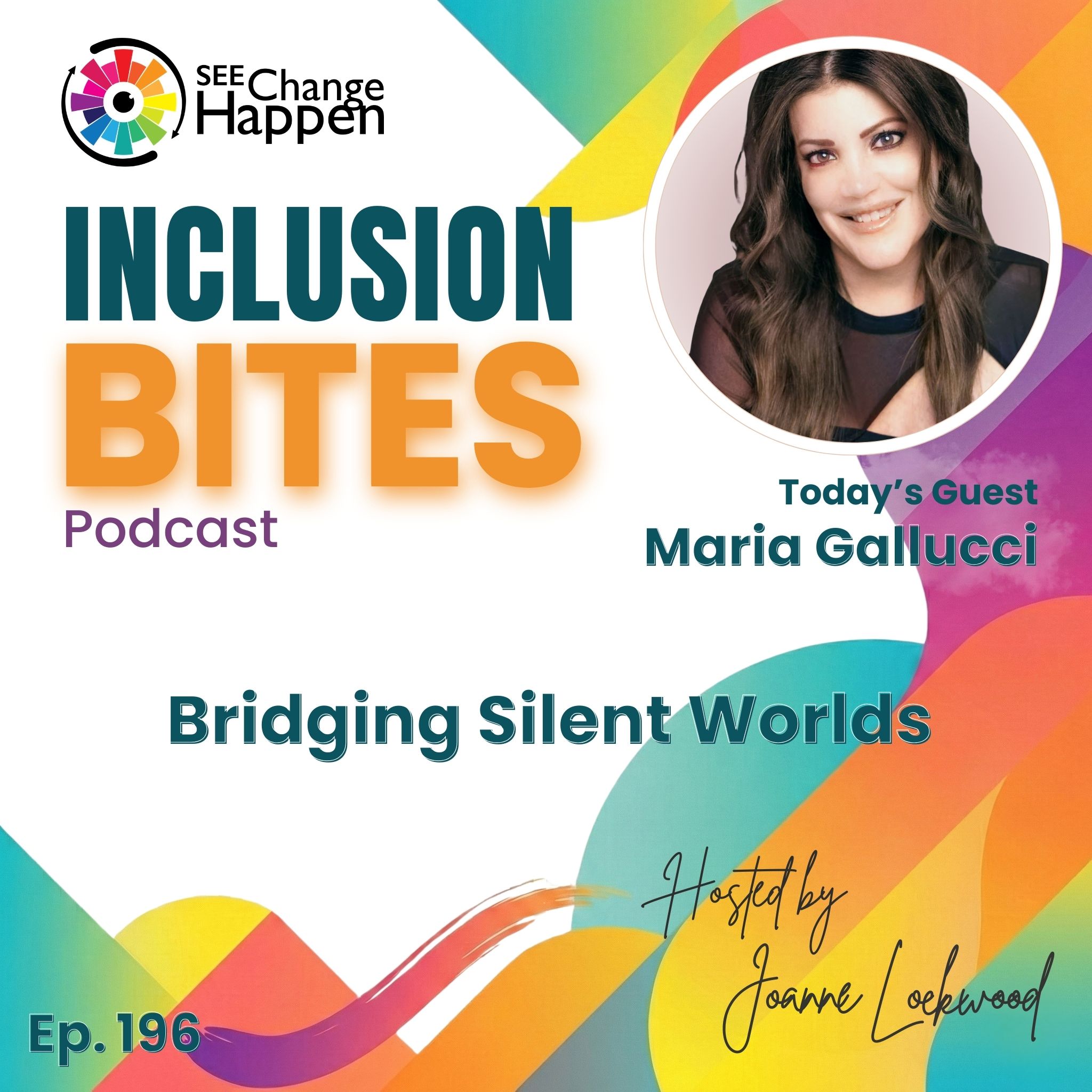
Maria Gallucci explores the transformative role of radical empathy as she navigates life as a child of deaf adults, illuminating the nuanced realities of bridging deaf and hearing communities and championing true inclusion and belonging.
In this episode of Inclusion Bites, Joanne Lockwood speaks with Maria Gallucci about lived experience identity.
Foreign.Welcome to Inclusion Bites, your sanctuaryfor bold conversations that spark change. I'm Joanne Lockwood,your guide on this journey of exploration into the heart ofinclusion, belonging and societal transformation.Ever wondered what it truly takes to create a world without? Remember, everyonenot only belongs, but thrives. You're not alone.Join me as we uncover the unseen, challengethe status quo and share storeys that resonatedeep within. Ready to dive in. Whether you'resipping your morning coffee or winding down after a long day, let'sconnect, reflect and inspire action together.Don't forget, you can be part of the conversation too. Reach outto jo.lockwood@seechangehappen.co.ukto share your insights or to join me on the show.So adjust your earbuds and settle in. It's time toignite the spark of inclusion with Inclusion Bites.And today is episode 195 with thetitle Bridging Silent Worlds. And I have theabsolute honour and privilege to welcome Maria Gallucci.Maria is a multi award winning Realtor,Altcoder stands for Child of Deaf Adults,and author of Raised in Silence. She alsobuilds accessible home buying experiences and championing,I can never say championing, championing empathy between deafand hearing communities. And when I asked Maria to describeherself, she said that it is radical empathy thatbridges deaf and hearing worlds. Hello,Maria, welcome to the show. Absolute pleasure. Absolute pleasure. And we werechatting in the green room before we went live about your ancestry,where are you from and where do you descend from in the past?
Maria Gallucciguest
So I'm Italian and we live in Denver, Colorado now,but we're second generation Italians in the UnitedStates. And I was born in New Hampshire but basically raised in Coloradobecause we. Were talking about how the pronunciation of your name
Joanne Lockwoodhost
is. People see the Cs and they pronounce it kind of anAmerican way, but not in the Italian way. So Gallucci. So CH isthe C. Yeah, exactly. And everyone always just did Galu sea, which it's actually.
Maria Gallucciguest
Gallucci. Yeah, that's really. Yeah. And I was, I was wondering
Joanne Lockwoodhost
the other day, you know, historical character Julius Caesar, should he bereally Julius Cheeser? Yeah, that's true.I always wondered that. Rewrite history books the world over.
Maria Gallucciguest
Yeah. To redo all the class stuff that we learned. Yeah. Hail
Joanne Lockwoodhost
Cheeser and all that kind of stuff. Yeah, so it's. Yeah, I always wonderedthat. But. So Maria, you, as I said in theintro, you're the child of deaf adults and you grew upin a. In a world where silence was the norm for them. Butobviously You're a hearing child. That must have beena challenge because you must have also had to be theirsign interpreter or their interpreter from the hearing to the nothearing world. Yeah, we were always the gap
Maria Gallucciguest
between the hearing and the non hearing world and so we always had to interpretfor their medical appointments or any financial things.And there's six of us kids and we're all hearing and both of our parentswere deaf. So ASL was our first language. And then my mom alwayssaid we learned how to speak through the TV and obviously schooland things like that. So ASL is all we've known since we werekids. Asl, that's American Sign Language.Yes, American Sign Lang language. Every country has their ownsigns. Like, because it's not a universal language,
Joanne Lockwoodhost
you don't translate, do you? It's a completely independent language.
Maria Gallucciguest
Yes, Yep. And we always say things, we reverse things like Spanish,how they do the reversal, that's how we sign as well. WhereEnglish is the different. So ASL and bsl different syntax
Joanne Lockwoodhost
and context. Is it? Yes. Yeah, it's all, it's. It's different. Like in,
Maria Gallucciguest
I think my mom always said in the Philippines, I think it was, they wouldactually like use their hands to do signs. Like their bodies todo. Do the signs. Where in AASL we do. We do it with ourhands. Wow. So there's no universal
Joanne Lockwoodhost
sign language. No, no. But every, every has, everyone
Maria Gallucciguest
has their own. It's like having accents too. Yeah. Wow.
Joanne Lockwoodhost
So different parts of the country have different signs for differentwords, do they? Yes. Yep. Yep, they do. It's completely different.That must be tricky to learn, Iguess as a non native or a nonchild growing up with signings. So you have to learn it, but if you're travellingaround the country you have to learn that there's different dialects as well. Were yourparents ever hearing or were they born without hearing? So
Maria Gallucciguest
my dad was born deaf and then my mom became deaf at ninemonths because she had, I think it was the measles and the mumps at thesame time when she was nine months. So she was raised deaf, butshe, she was actually not born deaf. And all, all of us six, sixkids are hearing, so none of us were deaf. Okay.
Joanne Lockwoodhost
So I've got a friend who has cochlear implants and she, she losther hearing probably in the childhood, I think five orsix years old. So she had a few years off hearing, which makes the cochlearimplants easier to process because she knows what hearing is. But itmust be extremely Difficult for maybe both your parentsbecause they've never heard. It's such anintegral part of my experience that how can Idescribe something without ever having heard something? Yes,
Maria Gallucciguest
I agree. I agree with that because. Well, back then, they had.It wasn't the implants, but it was something else that they had that they puton their ear. Like, they've come advanced on that stuff. And my mom,they never wore hearing aids. It gave her migraines, so she always, like, tookoff the hearing aids. So I think that when you're born deaf, it isdifferent because you've never heard. And so a lot of people struggle with, like,headaches and things like that when they put the implants in oreven use the hearing aids. Is your. Are your parents proud of their deafness?
Joanne Lockwoodhost
It's part of their identity. It's not just a. They don't see it as adisability. It's more that they're proud to be deaf.
Maria Gallucciguest
Yes, exactly. And I'm proud to be a coda. It gives you adifferent perspective on people and being inclusive andthings like that. Yeah, I've heard that before. But it's like other
Joanne Lockwoodhost
disabilities or conditions where people don't feel they need to be fixed.They're perfectly okay as they are, and they're not broken. They don't needsomeone to come fix them. They just are. Yeah. They're
Maria Gallucciguest
being their authentic self. They don't feel like they're.They're anything different than who they are. So what challenges did you face
Joanne Lockwoodhost
as a child growing up in this world?Were you the oldest of your siblings or in the middle of their siblings? I'm
Maria Gallucciguest
in the middle. Yeah. So I'm the third to the oldest. Yeah. And so Ithink it was just having people making them feel different than theyare, not accepted, and seeing my parents belike. Or we all of us being made fun of because we signedor because our parents didn't, you know, talk. So I thinkthat it gave us more empathy towards peopleand communities. And I think that beingraised with deaf parents gives you a different perspectiveon how you treat others.
Joanne Lockwoodhost
So if you were in the middle of your siblings, you had theadvantage of having older brothers or sisters tointerface before you, if you like. So your oldest siblingmust have had the biggest challenge of being the interface.
Maria Gallucciguest
Yeah. And what's strange is I was. I was always the mainperson with my parents when we. When I went to. Yeah. So. And Idon't know how that ended up coming about, but, yeah, I. I was the mainone that always helped to interpret when I. When I was little andhelp them get through. Through things with, like the. The Met medicalappointments and the. And things. Things like that, where you have to actually be therefor them, to help them, guide them. So that, that must mean quite a weight
Joanne Lockwoodhost
of responsibility to be being a young person and being theprimary, I suppose, carer in certain situations.
Maria Gallucciguest
Yeah. And I think that that's why seeing my parents get taken advantageof a lot. And I always promised myself, even when I was younger,that I will never, ever let anybody feel left out or notincluded or feel not seen. And so that was always my mission eversince I was little. One thing I've heard other deaf people tell me is that
Joanne Lockwoodhost
when you have an interpreter, it's really important to speak to theperson, not to the interpreter. Because sometimes people will talk to theperson doing the interpreting, not to the person you're trying to. That's quite an insult,really, isn't it? You're almost cutting them out. Yeah, exactly. And that is so
Maria Gallucciguest
true, because when we do our closings, a lot of the times thecloser will actually talk to the interpreter. And then my client will belike, no, you need to talk to me directly. And then. Cause youjust. You make it seem like the interpreter's not there. And then. Sowhen. When we do the video phones, like the, the relay, we also are talkingto them as if we're talking to the person. So you, You. You always talkto them and face them instead of the interpreter. Andeven with, like, sign language and ASL is very expressive.And that's how. Because, you know, with our voices, we can do emotion. Andso with sign language, we do it with our expressions and everything.And so even with. Yeah, exactly. And I still do that. I always move myhands, you know, when I'm talking, well, Italian. So maybe that has something to do
Joanne Lockwoodhost
with Italian. Yeah, exactly.
Maria Gallucciguest
But we can't. It's hard for me to talk to people if they have sunglasseson. And so. Because I have to see them and I have to, like,see their expressions on their faces. So, yeah, I think looking at someone isvery important. And even not in just asl, I think just communication in general,you should always just look at the person so they can feel, like,seen and heard. I found that I used to go to networking meetings quite often
Joanne Lockwoodhost
in business, and the number of times you'd shake someone's handand they'd look away from you or they start talking over here. AndI developed a technique where you don't let go of their hand until they lookat you, they're sort of trying to shake your hand and they're moving on. Youjust hold their hand and they go, oh, thankyou. Now we're talking. Yeah, yeah, justdon't let go. And it really confuses them. I'm start doing that from now on.
Joanne Lockwoodhost
I was wanting, I was waiting for you to look at me. Then they realisedhow rude they've been by doing this and they walk off. That's why I'm forthe wrong video here. So if you're watching, what I'm doing is, I'm actually, I'mdoing this simulated shaking towards handle. What happens is sometimes people walk into a roomand they don't look at you while they're shaking their hands. I just visually justwas playing that out on camera. But if you're listening to this on the, onthe audio, you won't be able to, you won't be able to see me. SoI thought we better make that inclusive if we're not careful. Talk about, talk abouthearing. But also there's, there's a sight issue here as well, if you're anylistening anyway. Yeah. So, yeah, I. Peoplecan. I'm going to start doing that. But people aren't doing it deliberately. They're just,they're just not, they're just not focused, are they? Yeah,
Maria Gallucciguest
they're just, I don't want to say self absorbed but they're not like,they're not making. That's how a lot of people feel, like excluded andnot feel seen. I don't know if it sounds strange or not, but I
Joanne Lockwoodhost
learned about this need to look at the person, not theinterpreter. And I think it was an episode of Star Trek NextGeneration where one of the species or thecharacters couldn't hear and they always had an interpreter with them. AndI think Jean Luc Picard or Reich or something kept looking at the interpreterand they said, no, no, look at, look at the king, look at, look atthe emperor or something. It's like it stuck with me. And that was, I don'tknow, 20, 30, 40 years ago when I was watching that. Yeah, that's crazy. Yeah.
Maria Gallucciguest
And that happens a lot actually. A lot, a lot. So I have to likejudge up and say, make sure you're, you're talking to the client. Like just pretendlike the interpreter's not there. All she's doing is just interpreting.
Joanne Lockwoodhost
Yeah, I've been in situations where there's been some deaf people and theinterpreters in, around and becauseyou consciously don't focus on the Interpreter. It almost feels rudethat you almost want to say, I see you as well. Butthere's often such in the background. And the protocol is talk to the person,not to the interpreter. But I just feel that the interpreter sometimes feels like aspare part in the whole thing. Yeah, I was feeling embarrassed for nottalking to them. Sometimes I go after and say, just want to sayI see you as well. Yeah, exactly. Just say hi. And just say hi.
Maria Gallucciguest
I see. Thank you so much for interpreting.
Joanne Lockwoodhost
Yeah. And then go, yeah, Otherwise. Otherwise they're almost like autility piece in the background. I don't know if you find that sometimesyou're just in the background and no one ever acknowledges you.
Maria Gallucciguest
Yeah, exactly. And that's how I feel. Like a lot of us growing up wasfor my parents. And so because they do get excluded because people don't want totry, like just try to communicate with them or if they think thatthey can't communicate, they just won't. They'll just shuck themaside instead of just trying with them. Did you ever have
Joanne Lockwoodhost
to deal with people askingsilly questions like, can't they have hearing aids? Or why don't they have cochlearimplants? Or can they have a surgery or can they be fixed? Do they haveto have to fend off questions like that often? Oh, yes, a lot when we
Maria Gallucciguest
were kids, like, why can't they talk normal? Or.And then like asking about the hearing aids. And then the other one is, doesit feel? Or how was it like growing up with deaf parents? And then I'mlike, well, how was it like growing up with hearing parents? Like, it's our normal,so it's the same thing. But yeah, now we got. We got stared at alot. And I still am, like, self conscious even now, like gettingstared at. And so I think that. And sign language isbeautiful too. Like, if you just. I mean, to be able to speak with yourhands is, I think, absolutely amazing. And to be ableto be able to do stuff in words. And I think a lot of peoplemaybe take that not for granted, but like, not reallyknowing that or what it is and always look at it as somethingdifferent, but it's not. It's. We're just communicating just in a different language.
Joanne Lockwoodhost
Well, you. One of your superpowers, I guess, is you can communicate across a roomin silence, can't you? Yes. You can have a conversation20ft apart. Yeah. So if. Yeah, exactly.
Maria Gallucciguest
If my sisters or my brothers are like, down, like the room, I cansign if I needed them to go Grab me something. Or if we're like along line at the restaurant, I can tell them can you get me a drink?And we can communicate way across the room. Do either of your parents
Joanne Lockwoodhost
actually verbalise at all? Or they could or they, they're non verbal or they,they try and speak. So my dad was nonverbal, he barely ever
Maria Gallucciguest
spoke. I probably heard him say maybe two things his entire life but mymom did speak. So she and I, and I don't know if it's becauseshe was born deaf that made, I mean born, not deaf,born hearing that made the difference. I'vealways wondered that. But yeah, my mom did speak so we would know if wewere in. Trouble I guess if she had as you said, I think you said
Joanne Lockwoodhost
nine months or so before she lost her hearing. So she would have heardher father, her mother, her, her environment as words.So she would have learned some words, I guess. Yeah, yeah, she would
Maria Gallucciguest
learn some. But they, they. Well my mom didn't like, she would likemy name's Maria but she would say Biwika as my name. And sothey don't know the, or my mom didn't know like the, what wordssounded like. So it'd be like yes, their words.But we understood it and I, I can even understandaccents, even heavy accents. And I think it's because I grew upwith that because you're, you have to listen and, and try to figure out what,what they're, they're saying. So for me it's very easy to have different accents andthings like that. I can understand it. So it must have been a real challenge
Joanne Lockwoodhost
and I, I don't want to sound like I'm being patronising here but it mustbe a challenge for your parents to learn to get onIn a world where hearing is taken for for granted. Hearingalso enables you speech. You learned how to read, readand write by through audible language aswell. How did your parents learn to read and write? I mean itmust be a lot harder. Maybe reading might be easier but they obviously hear differentwords in their head as they read. They must recognise the word but they don'tknow. They have a different way of processing that when we read a book wealmost say it to ourselves, say the words out loud in our head sometimes.
Maria Gallucciguest
I asked, it's funny that you said that because I asked my mom one timeI had to do a, a high school like thesis andwhen I was graduating and it was about dreams and I hadasked my mom and dad if they can hear in their, in their Dreams. Andthey said yes. And so I'm like, oh, that's like. And I thought that wasso interesting. And then. And then supposedly blindpeople can actually see in their dreams as well. So they did go to adeaf boarding school growing up. So then I think it's just teaching themhow to read and write because they. But. And then also when youlose your hearing, you all your other senses heighten up too,so you like, you watch better. You. And the
Joanne Lockwoodhost
gesticulations. And the Italian. And the Italian,yeah. Sowhat's the biggest challenge in the world today for them? I mean, we've talked abouta few things around acceptance, but I'd liketo think the world is getting a better place than it was 10, 20, 30years ago. Yeah, it's so advanced now. Like before we didn't have
Maria Gallucciguest
like the. We have the video relay services now where you cansee somebody on the video and it's an interpreter on the other line, whichwe didn't have that back then. We had. It's called a tty.So you just. It was like a little machine and you typed and then itwould go to the other machine on the other end. And. But now there's. There'sa lot of apps that you can do now that willinterpret. Like you could just show. Show it to them and thentexting. So I think that it's just awareness now andletting people know that they're just likeus. Like in the deaf and hard of hearing community is just likethe, the hearing world. They. They just communicate in a different language. So you used
Joanne Lockwoodhost
to use a phrase there. Deaf and hard of hearing. What's thedifference for those who are listening? When is someone deaf? When is someone hard ofhearing? What's the difference? So when you're
Maria Gallucciguest
deaf, you're like 100% deaf, so you can't really hear.And then hard of hearing is when you've just lostsome or most of your hearing. So the deaf culture isusually always deaf and hard of hearing because they all go in one. And
Joanne Lockwoodhost
so profoundly deaf means completely deaf, doesn't it? Yes.At the. Hard of hearing is a level of deafness. It's notcomplete, but it's enough more than.Yeah, it puts you into a different bracket. And then you've got. Hearing impaired orhard of hearing is a different category. Is it?
Maria Gallucciguest
Yeah. So they're hearing impaired and deaf and hard of hearing. They all.It just shows. Or the difference I would say would bethe percentage of what your deaf or. Because mydad was 100% deaf in both ears. And then my momwas like. I think she was like 95 in one and 90 in the other.So she was profoundly deaf. And so I think it just depends onthe percentage. But the deaf and hard ofhearing community is all lumped into the deaf culture.
Joanne Lockwoodhost
Yeah. I've heard in the UK that someone who is profoundly deafor completely, completely deaf uses a capital Dfor their deafness, whereas people who arenot profound or completely deaf use alowercase D. Is that similar to the culture in America?
Maria Gallucciguest
No, out here we do. So the deaf and hard of hearing. So theD is capitalised and then the H is capitalised, and theother H for deaf and hard of hearing. That's if you'respeaking about them, like the deaf and hard of hearing community, those would becapitalised, capitalised. But then if you. Yeah, and then if you do justthe deaf culture, like, that would be in lower clique. Yeah.
Joanne Lockwoodhost
So it's a bit like capital B for black, for someone's identity.It's reinforcing that. There's so many different nuances, isn't there,that an outsider of the community,if they're not aware of the culture of deafness,you're. Well, you are unaware of these littlenuances that you've got to be careful of. Yeah,
Maria Gallucciguest
exactly. Because you can say or do something that'sactually very insulting to the community.And so I think that's where awareness comes in and justtrying to learn about the culture. Or even if you see someonewho's not hearing and they're trying to find something, go ahead and, like, tapon their shoulder and see if you can help them. Or. Because you could evenput on your phone, like text it in your notes and just show. Show itto them, like, do you need any help? Yeah. In modern technology, as you say,
Joanne Lockwoodhost
you've got these devices, apps now, where it'll convertspeech to text and even translate it into a different language aswell. Yeah. It must have radicalised and changed the wholeexperience. Oh, yeah, it's changed. Between my mom and her
Maria Gallucciguest
medical appointments when she had cancer, to my dad24 years later was completely different.So, yeah, it's definitely advanced and still moving.
Joanne Lockwoodhost
As a hearing person myself, my go to entertainment is cinema,it's tv. Your parents probably didn't grow up in thatkind of world. So do they. Are they bigtv, watches, subtitles, or is that something that they just do somethingdifferent instead? Yeah, the closed captioning now. So we
Maria Gallucciguest
have, I think back, like, when I was little, I don't know if wehad it when I was little, but we did. It did, like, develop into closedcaptions. So now that's, like, everywhere. And then now they have, like, before, they didn'thave interpreters at speaking events or the news orconcerts, and now they do, which is amazing because it used tonot have, like, any of that stuff back then. Yeah. I
Joanne Lockwoodhost
see on the tv, America seems better at it than we are in the uk.The uk, we are getting better. But things like the superbowl, those sort of things, always have a signed interpreter in the corner, don't they?And the closed captioning is more rigorously enforced than I think it ishere. Yeah, yeah, it's definitely. And you can even now,
Maria Gallucciguest
like on YouTube or even Instagram and things like that, there's a buttonthat you can press that'll actually translate what they're saying. Yeah.Into close captioning. Yeah. So it'sdefinitely more obvious now than it was. Yeah. And in conference and things like that,
Joanne Lockwoodhost
you could scan QR codes and it will link you through to the thing andyou can get the transcription on your phone so you can be sitting in theaudience and not. They don't have to put it on all the boards. You canjust sit in the phone and have your own private caption you. Can just see
Maria Gallucciguest
on the phone. Yeah, exactly. So it's definitely a lot better now than itwas back then. So you wrote this book called Raised in
Joanne Lockwoodhost
Silence, and that's the storey of your journey for you. I mean,we talked a bit. A lot about your parents now. So let's talk a bitabout you and your experience growing up andwhat prompted you to write the book. I think
Maria Gallucciguest
when I was building. Well, I've always wanted to make people feelincluded and not isolated, and I feel like I wanted towrite about it to make people just aware of, like, the community.There's funny storeys in there, there's tips in there for. Onwhat. What to do and what not not to do. And then I feel likethere was a moment in my life when I realised I was building a. Asuccessful career and watching people I cared about get, like, left outin the process. So I was doing very well in industrystandards and everything, but I wasn't. I didn't feel like I was serving the community.And it's a very underserved community community. So I think that's what shaped me.I think it. It made me seeing that at the end, that my client,like, before feeling invisible before, like, the asl, and then just seeingThem feel very included and happy,you know, buying their first home and because that's a big lifeinvestment and so not being able to understand what they're signingor what. What they're. They're doing. I think. I think that. That that's why I.I wrote the book is just for awareness and just make people feel includedin all, like, all. Not just the deaf and hard ofhearing community. So which other communities do you work with?
Joanne Lockwoodhost
So, accessibility. So someone who has a disability orsomeone who's blind or so you're working with to makethe whole buying process accessible for all. For all. Yeah. And
Maria Gallucciguest
then I work with the LGBTQ community. My son is gay, and so when hecame out, that was just very easy for us because we werevery inclusive and that's how we were raised. So that. That was theeasiest. So I. And I see, like, my son strugglessometimes with being, like, excluded out of that thing. So for me, I think it'sall about communication and about empathy and justbeing in, like, inclusiveness for me, and that's what, like,drives me. So where you live now is. It's
Joanne Lockwoodhost
Denver, Colorado. Is that a. That seemsto me like it's a red state. Is that. Is that red state? We're blue.You're blue? Ah, yeah. In Ireland. Yeah. So we're.Yes. Yeah. So he's very lucky to be
Maria Gallucciguest
in Colorado because it's a very, veryLGBTQ friendly state. It's interesting. I'm actually doing
Joanne Lockwoodhost
a talk to a Rotary Club of Texas tonight.I was a bit concerned when I first got the call to do the talk,and I thought, oh, Texas, are they really gonna be up for me? You know,you never think. But I had a really great chat with this Rotarian, andit's a really interesting conversation. And it's so easy to judge peopleand assume that somebody's gonna be anti you or against you or whatever it is.I think the media sometimes create this impression that it's not true. Yeah, I
Maria Gallucciguest
agree. And that's what I mean. I just saw my parents get judged all thetime, and us, too, as that, like the kids, and even with my son andeverything. And I just think that it's so easy to be. It's. I think it'seasy. It's so easy to. To have people, I think hate. And I. I justwant people just to love. I think love is love, no matter who you are.And I think that that's how. I think that if we all just come togetherand just know that all of us are the Same. And we're justliving our lives through the process and all we want is tofeel it accepted. Amen. Amen to that. Yeah,
Joanne Lockwoodhost
completely. So going back tosupporting and championing, if you like,people who are deaf, hard of hearing, hearing impaired,what are the sort of basic tips that we can give to ourlistener out there who wants to find out more, who wants tomaybe learn more about people who are deaf?Where's a good starting point? What's the key things that we should beleaving them with? I think just trying and
Maria Gallucciguest
then knowing. There's a lot of places where you can learn the basic science,like thank you or you're welcome, and it makes them feel so good. And I'veseen this before where I'm at, like a restaurant or whatever and thewaiter says thank you, like, in sign language. And that means a lotto them. So just like the basic signs. Yeah. Yep. That's thank you. Yep. Yeah.Just the basic. The basic signs, I think makes such a big difference. Just forthem. Just to feel like somebody is trying with them and someone is,like, making them. Trying to make them feel included. I think that'shuge for everyone. Yeah.
Joanne Lockwoodhost
Is it polite, for example, to tap someone gentlyon the shoulder or the elbow, Just indicate you're trying to have a conversation?Is that rude or is that acceptable? I do it all the time.
Maria Gallucciguest
I think it's. I think it's. I mean, obviously, I think lightly just tapping themso they know that you're there because otherwise they're not going to know or justturn or turn and walk in front of them. Yeah.
Joanne Lockwoodhost
So they see you getting their attention is perfectly valid.You know it's not. Yeah, yeah. So either. Either, as you say, manoeuvreyourself, or gentle touch on the shoulder or theelbow in a polite way to say, I'm here or. Yeah,
Maria Gallucciguest
exactly. That's what I do. Just manoeuvres just so that they can see orwave, so they know that you're trying to get their attention.
Joanne Lockwoodhost
Do people forget thatthe people you work with, your father, your mother can't hear? Do they forgetsometimes and they start having a conversation, they speak too quickly, or they just makean assumption that. Yeah, exactly. Yeah, a lot of
Maria Gallucciguest
times. And then I would have to tell them, oh, my mom can't hear ormy dad can't hear. And then. Yeah, because. And then they'll either starttalking, like, louder, which does not help. And then I think thatthere's an assumption that all deaf and hard of hearing people can lip readand not all of them can. I can, because I was taught that. But alot of people, I think, assume that they, they could. Yeah, I've seen it. You
Joanne Lockwoodhost
know, it's like, it's when you talk to somebody who has a different first language,you shout or you speak as if the other person isless intelligent sometimes, don't you. You assume that they're, they can't be understood. So,yeah, it's, I've seen people do this and it's, it's. It's very embarrassing to watch.
Maria Gallucciguest
I know. And I, I've seen people, People do. Do that too, because it's likethey, and I, I agree with you. They think that they're less intel. Intelligent andthey aren't like. They're just like everybody else. And I don't thinkanybody's smarter than another one. It's just a different way of learning in adifferent skill. Yeah. Different skills, different ways. In fact, if
Joanne Lockwoodhost
anything, they've had to overcome more barriers in a hearing world tocope and adapt. Exactly. More cognitive ability in that way.
Maria Gallucciguest
Yeah. And. Yeah, because what I was saying earlier was like, all of theirsenses, like, get heightened, so they're more aware ofthings and they're more, I think, like not,not really not knowledgeable, but like they. All this stuff, like,takes over. So I think that they assume things like that, butit's not, it's not the case. What's, what's
Joanne Lockwoodhost
something you wouldn't appreciate? You know, just without knowing somebody who'sdeaf. What's something that, a joy of life that they have that maybewe, we hearing people don't have? Thatthat's part of their identity, part of their community that we could be. We wouldbe surprised about. I would say they
Maria Gallucciguest
love music usually because they can feel the beat oflike, so, like every. Yeah, yep, exactly. And so every timeI have like my. I call it my, my uptown party, they.They always, like, dance. They always dance. They like most of them love to. Todance because they, they can feel the beat. They can. I think they appreciate the,the music more and the actual, like, music partbecause they, they're going off of feeling instead of hearing.
Joanne Lockwoodhost
In our TV series, we call it Strictly Come Dancing. You call it Dancingwith the Stars. I think in the US we hada deaf actress who took part inthat show. I think it was last year or the year before. She won thewhole competition in the end. And it was reallyfascinating to watch her dance theset knowing she was deaf, yet she was in perfecttiming and she was able to. But she, she could feel, as you say, shecould feel the rhythm. And her and herpartner developed cues, either tapping each other orgrabbing or squeezing, whatever it may be, to get. To get thatrhythm. And yeah, you're right. I've been to rock concerts. I've seenmeatloaf and other people have been down the front. And you can feel your chestvibrate and your whole body vibrate with music, can't you? Yeah,
Maria Gallucciguest
I think. And then I think that we sometimes may take that for granted, thatwe can hear the music. But them feeling the music I think gives them likeit's just a different century, I think. And soI can see that she won that. That's awesome because I mean, she can feeleverything. And that's when you know the beats because you're actually feeling the beats insteadof like hearing it. I love that feeling, the music. That's a real superpower
Joanne Lockwoodhost
that be able to become really at one with that vibe,with that feeling. Yeah, it's like going to aclub raised. Yeah, you really give it. You reallypumping those vibes. And your whole body is at one with thatmusical experience. Exactly. It's like a meditation
Maria Gallucciguest
almost, because they're feeling it and it's different. Yeah. Oh,
Joanne Lockwoodhost
yeah. That's really, really give me a glow there. That's fascinating.What else have you found in your lifeagain as a child growing up thatwas either easier for you or harder for you? Beingthe primary interpreter must have been tricky, but there must have beena lot of joy there as well. Yeah, I think
Maria Gallucciguest
because I'm multi language too, so I speak like two differentlanguages. And I think it gave me better communication skills becauseI know that I need to listen and have them feel seen andhave like, take my time to listen to them, know what they. They want.So I think that it gave me a better, like, understandingof people be feeling le left out, which is not what Iever want to do with anybody. So I've always been more.I've always had a bigger heart because I've always thought that I don't wantanybody hurting and I don't want anybody feeling left out or made fun of becauseI was growing up, growing up as a kid. So I would never want anybodyto feel bad about their own selves. So for me, I think it gave memore of like a bigger heart, I think.
Joanne Lockwoodhost
Is your son taking it upon himself tolearn ASL as well? Is it kind of a family duty?
Maria Gallucciguest
So. Well, it's kind of funny because I had him takeASL in high school. As one of his languages, thinking that I wouldhelp him and he can ace the tests and all that stuff. So I helpedhim and he actually, he. He got straight A's throughout school and he got.Flunked that test. He got one F. He was so mad at me because Iwas signing the way I learned and I'm a coda, so I'm fluentin sign language. But I didn't even realise that when you're actually taught andthe years later too, everything was so different. Beingtaught, like sign language, you're going through the. Like proper sign language.Going through that. The classes was completely different, different than how I wasraised. And so he was like, thanks, Mom. So there's. The way you learn it
Joanne Lockwoodhost
today is not the way that the deaf community, if youlike have grown up with it, it's more conversational, morechatty, whereas when you're learning it, it's more structured. Is it? Yes.
Maria Gallucciguest
Yeah. Different, like. And there's different signs for different words. Because, like, favourite.I was like, this is favourite. And I was taught favourite. Andso. And like birthday was birthday, but now it's like birthday. So there'sdifferent signs for different things. It's kind of like sling.And so the way we were taught was just growing up, like, it wasn'tproper, like asl. So it was completely different when I was doing itwith. With him than it was when I learned. So it's. So it's become more
Joanne Lockwoodhost
formalised over the generations and it's. It'sbecome a standard throughout the country where, as you said before, there was moredialects and local regional variations. It's nowtrying to. Got a core structure. Yeah, exactly. It's like. And there's different types of
Maria Gallucciguest
sign too, like asl, which. What I do. Andthere's like. I think there's eel or E or C S,E too. So there's different types of sign,like slang words. And so there. There's different types of. Yeah,yeah, like dialect and things like that. There's actually different types of thatwithin sign language. So it's a bit like driving
Joanne Lockwoodhost
test. You have the. You part. You learn to drive and pass your test withthe instructor. And then when you pass your test, you drive completely differently.
Maria Gallucciguest
Yeah, exactly. Yeah, yeah. You bypassedeverything you learned. Yeah. You almost stop at the stop sign.Yeah, exactly, yeah. And you turn right sometimes, even when
Joanne Lockwoodhost
you're not supposed to on the red. It's. Yeah,you get in the habit. And you Never drive at 55 miles an hour. Doyou always. You always go at The. Yeah, never. No. Unless there'sa. Unless there's someone with a speed gun down the road pointing it at you.
Maria Gallucciguest
Yeah, exactly. I never. I never thought. I
Joanne Lockwoodhost
never thought of it that way. As you said, you didn't think of it either.You just assumed that he. Yeah, I just assumed. Yeah.
Maria Gallucciguest
And then I. And I thought I did so well. Like, I literally thought hewas gonna come home and have an A. And he.
Joanne Lockwoodhost
But you can sign fluently to your parents. I guess he cannot
Maria Gallucciguest
now. Jordan. Jordan was learning. My oldest was learningsign language. And then my mom passed away when Jordan wasnine and so she forgot a lot of the sign. Andthen with him, I never really taught him how to sign, andI should have, but we're teaching the grandbaby how to sign, so we'll see.She'll learn. So you'll pass it on to the next generation. Yeah,exactly. But it's kind of so cute to see, like,because she's only a year and a half old, but it's so cute to seebaby sign. And it's. It's easier for them, too, to learn the signs than itis to like, to use her voice at that age,too. So she was signing, like, milk and more and all that stuff beforeshe was even talking. I'm thinking of. Now I'm thinking about that. That
Joanne Lockwoodhost
movie, was it Meet the Fockers, where they're signing formilk and all those things. Yeah, yeah,yeah. It's creating these signs for things. Yeah, that's funny. Yeah.Poop and milk and. Yeah, that's funny. But, yeah, no, it's a lot
Maria Gallucciguest
easier to teach babies to sign. It's a lot. Idon't know if I would. I'm so glad that I'm a coda and learned thatASL was my first language, but I couldn't even imagine beingan adult or older learning how to sign. And,like, it's because, for me, it's my normal. Because I was raisedlike that. But I know a lot. A lot of people who went and takeand took classes and they're like, ASL is, like, really hard to learn. And thenseeing him go. Go through. Through that, I was like, oh, that actuallyis completely different. That'd be hard. I guess it's like any language, if you're
Joanne Lockwoodhost
with people who are using that language all the time, you pickup one word here and one word there, and it becomes. You learn to structureyour sentences as you do it, whereas if you're trying to learn it as atextbook without the context, it's always harder, isn't it?
Maria Gallucciguest
Yeah, yeah, it is. And I have a lot of good friends who are deafand hard of hearing and in that world. And I feel it always ismore comfortable for me to be in an environment with the deaf culture becausethat's what I was raised in. And I always feel more comfortable in that environment.And I've always stuttered as a kid so I had to go to count orlike speech therapy and all that stuff for stuttering. But I don't stutter when Isign, like at all. It's just when I speak. So it's kind ofironic. Yeah. My own experience of losing hearing is.
Joanne Lockwoodhost
Well, for myself, about 10, 15years or thereabouts. I had a viralinfection in my inner ear and all of a sudden I woke upone day, I just. I couldn't hear much. I could hear alittle bit, but I'd. It was like a real cloudy, muffled, sortof really strange sort of echoey noise in my head andeverything was like I was underwater all the time. AndI went to the doctor and the doctor said, it's a virus,one day it will clear up maybe. And I was like,how long? He went, dunno, 612 weeksmaybe. See, just. So it was overChristmas one year and I remember our children camearound and we were watching TV and was. I had to have the subtitles on.I did the telly loud and they were talking to me and I go, Ican't hear you. And it, it was a really, a real wake up call towhat it's like to not hear you. Just, you're in a little bubble. Theworld seems very isolated. And then one day I woke up and it, itwas back, it was like, whoa. As fast as it went, itreappeared and it was a really strange feeling, but it gave me an appreciation.And my father who passed away this year, hewas pretty deaf, you know, he could wear hearingaids but he was very hard, very hard ofhearing. He worked on ships in the navyand he used to work on the guns. We thinkthat the constant firing the guns damages hearing. Yeah.And my father in law, he's alsopretty deaf and has hearing aids. And even with a hearing aid,it's hard sometimes to communicate with him. So I now live
Joanne Lockwoodhost
in a world with two elderly parents who are pretty deaf. Mymum has hearing aids, she's pretty good at hearing, butshe's still got some impairment. And I've got some friends nowI'm in my 60s, I've got friends who are about my age and we gofor a couple of drinks in the evening and they say, oh, could you siton my left hand side? Because I can only hear in that ear, I can'thear in the other ear. And you start becoming appreciative. AndI think I read a stat once that one in six of us willlose our hearing to an extent where I think when you lose 80%or something, we become deaf by classification. So one insix of us will happen to by our mid-50s, early 60s. You think,wow, that's a lot of population. Yeah, it's a lot. And that's
Maria Gallucciguest
what I think that we take or we take a lot of thingsfor granted and hearing I think is one of them for sure. We don'trealise like what we canhave even with like the blind too. Like we take our vision andour hearing for, for granted. So I think that,I think just like including people and knowing thatlater on in life they may not have their hearing. And so Ithink that that's where, it's where you want to make people feel like,be inclusive and not isolated because it is anisolating feeling that you can't hear. Like all of a sudden you can hear andthen you can't. Then it, like,I think it makes them feel like overlooked or misunderstood. So I thinkthat just findings where they,they fit in I think is what just makingpeople in general fit in I think is just really big. And I think that'swhy I also wrote the book because ithas other stuff in there, not just for the deaf and hard of hearing community,it's just all about inclusion and being inclusive andawareness because we, we are like, like you're saying one onein six, that's huge. Like we're going to be losing our hair or even ifwe lose our sight too, because that goes down. I'm, I'm going to start needingglasses soon. Yeah. I've been wearing
Joanne Lockwoodhost
varifocals for 30, 40 years, you know, and Inoticed my, my distance vision, it's almost getting worseevery year now and I've got, I think, is it glaucoma orcataracts or something? I've got something developing that isaccelerating the degeneration of my left eye slightly. Soevery year it's getting worse. I think eventually I'll probably needlaser or something on it. But yeah, youget to get past 50 and things start breakingor shutting down orwe forget easy. You know, when you're 20 years old, you'reinvincible. And if you've never had a childhoodproblem. Then you get to your 20s, you just think the world is easy,and then all of a sudden you break your legskiing, or you do you injure your knee playing football,or you do this, whatever your sport you're playing,and suddenly you realise, hang on a minute, my body is starting to fall aparthere and it aches. And when you get to your 50s and it creaks whenyou stand in, get up for a chair and you can't quite walk as faras you used to. Yeah. SoI think we need to be more aware when we're youngerabout creating accessible and inclusive spaces, becausethat'll be us in not too distant future. Yeah, exactly. Veryrealistic. In 10 years time, I'm going to be less able than I am today.No matter how much exercise I do and try and keep fit andactive, something's gonna stop working. Yeah, exactly.
Maria Gallucciguest
And I think that when we're young, we definitely take our youth for granted, forsure. Because we don't realise, like, I think that we always see. Cause we sawour parents grow up and that, well, my mom passed away in her 40s, butwe saw them, like, get older and older and we always thought, like, they wereolder, but now we're their age and we're like. But we. But when we're kids.So I think that even as kids and as youths, we take, like, yourageing for granted, like, you don't realise, like, I'm gonna be theresomeday. Your dad must have taken it pretty hard when your mum passed away, because
Joanne Lockwoodhost
I'm guessing they were soulmates as beingso tightly linked together, being both deaf. Yeah,
Maria Gallucciguest
the. They. They were married for 32 years, or they were together for32 years before my mom passed away. And then.And my dad was so. My dad was probably. So mymom was like, 49, and then my dad was like,52. And then he got married six months laterto Dixie. And she was. She was in my life
Maria Gallucciguest
more obviously than my mom, because my mom had passed away. Because whenwe're kids, we don't really remember them. And so Dixie.I think my dad got a second chance. I always thought that my mom broughtDixie to my dad because I think my dad would have been.He wouldn't have known to be alone because he was with my mom since theywere like 18 or 17 years old.And so I think that. And then my dad ended up passing away justtwo years ago of the same cancer, too, which isunusual. So 24 years. They had melanoma, both ofthem. And so 24 years later, my dad got it.
Joanne Lockwoodhost
Oh, that's sad. Yeah. But we took the genetic death as well.Is Dixie deaf as well? Yeah, she is. Yeah, she is. Yeah.And so he def. Had a second soulmate who was also deaf as well, whichis. Yeah, I guess that's a beautiful storey as well. Yeah.
Maria Gallucciguest
Yeah. And I still talk to Dixie tothis day. She's always been really sweet. I think thatmy dad would have been, I think, verylonely and lost, like you were saying, without my mom. So I've alwaysbeen thankful that he found Dixie.
Joanne Lockwoodhost
So melanoma, it's a skin cancer, is that right? Yeah,
Maria Gallucciguest
it's the skin cancer. Yeah. So my mom had it internallybehind her eye from not wearing sunglasses, which I never knew that happens.Yeah. And then my dad had it on the back of his head. Yeah. I
Joanne Lockwoodhost
think my dad had a. Because my dad lost a lot of his hair andhe had, we think, a sort of developer ontop of his head and also a lump on the back of his neck. Buthe was so old. He passed away when he was 92.So there was no point. There was no point doing. There was no point doinganything about it. It was just. Yeah. That he had some radiography to sort itout. But, yeah, my dad was in his early 70s. He was still young.
Maria Gallucciguest
My old. My mom was obviously younger, but my dad was still in his early70s. Wow. He had a good life.Yeah, exactly. And he had a second chance at life too,which is good. And he did. Yeah. That's the important thing.
Joanne Lockwoodhost
It's not about forgetting your firstlove. It's about continuing your life aswell. You know, Alfred said this to my wife, and my wife's just around thecorner. You know, I wouldn't expect her to mourn for mefor the rest of her life. She's entitled to find a second love andI would wish her well if she wanted to. You know, you don't wantto hold somebody to. In your legacy for the rest of their lives.
Maria Gallucciguest
Exactly. No, I agree. It goes through a period of
Joanne Lockwoodhost
reflection and mourning. But life is for living.
Maria Gallucciguest
Yeah, exactly. And I think everybody goes through stages of life as well.
Joanne Lockwoodhost
So how can people get a hold of you? What's the best way of trackingyou down these days? So I have an Instagram and it's
Maria Gallucciguest
Galuchy Homes. And then my website is galluccihomes.comand then the book is raisedinsilence.com and Gallucci. Is
Joanne Lockwoodhost
G, A, double L, U, double C, I. For those ofyou who are not Italian in your pronunciation and spelling. Sogive me something profound to finish on. I think the main
Maria Gallucciguest
thing is to just have connection, like try tocommunicate and have connection with people and then always just trywith people. Try. Yeah. Because the fear of getting it
Joanne Lockwoodhost
wrong is quite powerful sometimes, isn't it? We. We worry about saying something incase we get it wrong or mess up or. Yeah. And
Maria Gallucciguest
no one's perfect. But as long as you. You try, you. You've made aneffort. Yeah. Because by not trying, you're
Joanne Lockwoodhost
excluding. So giving it a go. Trying.Being brave. Maria, thank you. It's been an absolute pleasure andI've loved our conversation. As we bring this
Joanne Lockwoodhost
conversation to a close, I want to express my deepestgratitude to you, our listener, for lending your earand heart to the cause of inclusion.Today's discussion struck a chord. Consider subscribing toInclusion Bites and become part of our ever growing communitydriving real change. Share this journey with friends, family andcolleagues. Lets amplify the voices that matter.Got thoughts, storeys or a vision to share? I'm allears. Reach out tojo.lockwood@seechangehappen.co.ukand let's make your voice heard. Until next time, thisis Joanne Lockwood signing off with a promise to return withmore enriching narratives that challenge, inspire andunite us all. Here's to fostering a more inclusive world oneepisode at a time. Catch you on the next bite.
Bridging Deaf and Hearing Worlds with Radical EmpathyEvolution of Accessibility: Technology and Inclusive CommunicationIdentity, Language, and the Nuances of Deaf Culture
Joanne Lockwood is joined by Maria Gallucci, a multi-award-winning realtor and author of Raised in Silence, to explore the realities of growing up as a hearing child of Deaf adults. Maria shares how American Sign Language shaped her family life, how she often became the bridge between Deaf and hearing worlds, and what it taught her about being seen, understood, and included.
Together they unpack common misconceptions and everyday moments that can exclude Deaf and hard of hearing people—from speaking to an interpreter instead of the person, to assuming lip reading or “fixing” through devices is the default. They also reflect on Deaf identity and pride, the emotional weight of child interpreting, and the ways technology such as video relay and captioning has improved access while not eliminating stigma.
The conversation closes with practical guidance for listeners: make the effort, learn a few basic signs, use respectful ways to get attention, and focus on genuine connection. The central message is simple but powerful—trying matters, and small acts of communication can create real belonging.
“And I think it's because I grew up with that because you're, you have to listen and, and try to figure out what, what they're, they're saying. So for me it's very easy to have different accents and things like that.”
“I feel like there was a moment in my life when I realised I was building a. A successful career and watching people I cared about get, like, left out in the process. So I was doing very well in industry standards and everything, but I wasn't.”
“seeing Them feel very included and happy, you know, buying their first home and because that's a big life investment and so not being able to understand what they're signing or what. What they're. They're doing.”
“So I've always had a bigger heart because I've always thought that I don't want anybody hurting and I don't want anybody feeling left out or made fun of because I was growing up, growing up as a kid. So I would never want anybody to feel bad about their own selves. So for me, I think it gave me more of like a bigger heart, I think.”
“I think just like including people and knowing that later on in life they may not have their hearing. And so I think that that's where, it's where you want to make people feel like, be inclusive and not isolated because it is an isolating feeling that you can't hear.”
“It's just all about inclusion and being inclusive and awareness because we, we are like, like you're saying one one in six, that's huge. Like we're going to be losing our hair or even if we lose our sight too, because that goes down. I'm, I'm going to start needing glasses soon.”
The everyday responsibilities and identity formation for children raised in deaf households.
Understanding the diversity of sign languages and the importance of cultural nuance in communication.
Navigating and challenging stereotypes around deafness, identity, and the notion of “fixing” others.
Practical communication strategies when interacting with deaf or hard of hearing individuals, including etiquette and inclusive behaviours.
The impact of modern technology—such as apps, video relay services, and closed captioning—on accessibility and community participation.
Approaches for fostering inclusion within property and financial services, particularly for marginalised or underserved groups.
The importance of beginning with small, genuine efforts—like learning basic sign language—as everyday acts of empathy and inclusion.
One thing to remember
The central takeaway from "Bridging Silent Worlds" is the transformative power of radical empathy and genuine inclusion in connecting deaf and hearing communities. True inclusion requires not merely awareness but a conscious effort to bridge communication gaps, respect identity, and recognise the value in diverse lived experiences. By fostering direct connection, learning basic sign language, and appreciating the nuances of deaf culture, everyone can help create a world where no one feels left out or overlooked.
Questions this episode helps answer
How did being “raised in silence” by deaf parents shape Maria Gallucci’s understanding of empathy and inclusion within wider society?
In what ways does the deaf community resist the narrative of needing to be “fixed,” and how does this connect with wider disability pride conversations?
How can the difference between American Sign Language (ASL), British Sign Language (BSL), and other national sign languages act as both a bridge and a barrier within deaf culture?
Why is it important to address the person, not the interpreter, during conversations involving sign language, and what impact does this have on inclusion?
Reflecting on Maria Gallucci’s experiences, what are effective ways to help individuals who feel “left out or not seen” in daily life?
How has technology—such as video relay services, closed captions, and translation apps—changed the experience of deaf and hard of hearing individuals in recent years?
Explore topics
Ideas from this episode
Bridging Deaf and Hearing Worlds with Radical Empathy
Reflecting on my conversation with Maria Gallucci, the idea of radical empathy in bridging deaf and hearing communities truly struck a chord. Navigating the boundary between these two worlds is not simply a matter of language, but a practice of genuine understanding, patience, and connection.
Evolution of Accessibility: Technology and Inclusive Communication
Our discussion naturally gravitated towards the rapid advancements in technology and their profound impact on accessibility. Maria painted vivid contrasts between her parents’ early experiences—when telecommunication for the deaf meant cumbersome machines called TTYs—and the present landscape with instant video relay apps, closed captions, and real-time transcription codes at conferences.
Identity, Language, and the Nuances of Deaf Culture
Much of our chat revolved around the nuances and richness of Deaf culture and the identity it fosters, not just for those born deaf, but for their families too. Maria’s reflections on language were illuminating—ASL as a first language gave her a unique lens on communication, empathy, and even challenges like stuttering in English but not in sign.
Learn
Frequently asked questions
What is a CODA and why is it significant in this episode?
A CODA stands for "Child of Deaf Adults." Maria Gallucci, the guest on this episode, is a multi-award-winning Realtor and a CODA, which has hugely influenced her perspective on empathy, inclusion, and accessibility between Deaf and hearing communities.
Is sign language universal?
What is the difference between ASL and other sign languages?
No, sign language is not universal. As Maria Gallucci explains, American Sign Language (ASL) is distinct from British Sign Language (BSL) and other national sign languages. Each has unique syntax, grammar, and even regional dialects, much like spoken languages.
How did growing up with Deaf parents shape Maria Gallucci’s identity and empathy?
Being raised in a Deaf household, Maria Gallucci and her siblings learnt ASL as their first language and often served as interpreters for their parents in essential settings like hospitals and banks. This experience heightened her sense of empathy, inclusivity, and the importance of making people feel seen and heard.
Is Deafness always seen as a disability by those who are Deaf?
Not at all. Maria Gallucci underscores that her parents and the wider Deaf community often regard Deafness as an identity, not a disability. They embrace deafness as part of their authentic selves and, rather than seeking to be "fixed," value connection and understanding.
What are some basic etiquette tips when interacting with Deaf or hard of hearing individuals?
Always address and look at the Deaf individual rather than the interpreter. This fosters respect and direct communication. It’s also polite to gently tap someone on the shoulder or arm to gain their attention if they do not see you approaching. Learning a few common signs such as “thank you” or “hello” can make a meaningful difference.
How do modern technologies support the Deaf and hard of hearing community today?
Technology has evolved substantially, with video relay services, texting, speech-to-text apps, closed captioning on media, and QR code transcriptions at events. These advances offer far greater independence and accessibility compared to the older devices like TTY machines.
Share this episode
Heard something worth passing on? Send this conversation to someone who needs to hear it.