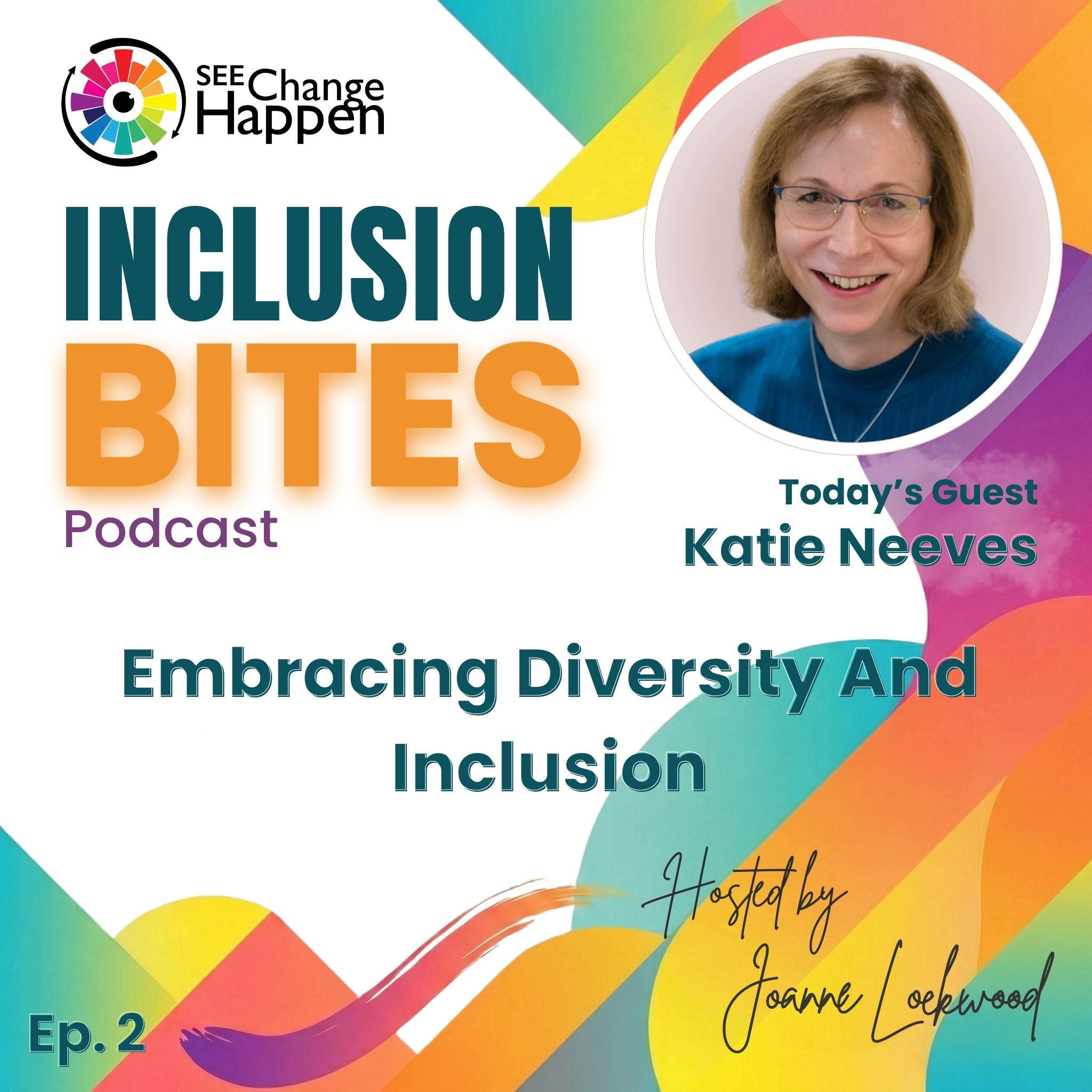
Hello, everyone. My name is Joanne Lockwood and I am the host of theInclusion Bites podcast. In this series, I will be interviewing a numberof amazing people and simply having a conversation around thesubject of inclusion, belonging and generally making theworld a better place for everyone to thrive in. If you want to join mein the future and be a guest, then please do drop me a line tojo.Lockwood@seechangehappen.co.uk.You'll also be able to catch up with all of the shows on itunes, Spotifyand all of the users. Plug in your headphones, grab adecaf and let's get going. Today's episodeis episode two with a title EmbracingDiversity and Inclusion. As a small business owner andI have the absolute honour and privilege to be joinedby my friend Katie Neves. I first metKatie at a true inclusion event last summer in London, but we've beenonline business associates for much longer. Katieis a photographer and she also runs a speaking business and advocacy called Call tobe Trans. So earlier, I asked Katie to describe hersuperpower and she said being able to connectwith people, be very honest and to be able to get herpassion across, isn't that amazing? So, hello, Katie, howare you? Hello, Joe. Thanks very much for inviting me on
Katie Neevesguest
podcast number two.
Joanne Lockwoodhost
Exciting. So, tell us a bit about yourself.What is your business? What do you do? Right, well,
Katie Neevesguest
basically, I've been a photographer and filmmaker for33 years, but two years ago I came outvery publicly as being transgender after living for 48 yearsas a man. So I now have a new business as atrans ambassador, which runs alongside my photography business. So I helpcompanies with their diversity and inclusion by doing transawareness training, public speaking and media appearances. But I'm still doing thephotography as well, so I've got those two things on the go,but they fulfil both of my passions. SoI'm passionate about photography and video and I'm passionate about helpingpeople with their diversity and inclusion,particularly, I think, with trans. I think what Ifind is that a lot of trans people don't know that it'sokay to be trans, andit really is. I don't think so manytrans people don't know that. And so I want to try and fuckinglead by example and just show people thatI'm so much happier as I am now. Andlife's good. Yeah. So you must have had a
Joanne Lockwoodhost
dilemma those two or three years ago about your business,how people would accept you and the world was readyfor a Katie like you, or whetheryou'd find your business falling apart. I mean, how have you found the world tobe in the last couple of years? It's been an interesting couple of
Katie Neevesguest
years, I say. Good, though. It's good on the whole, good.I've had some challenges along the way. The first challenge wasthe name of my photography business was, and still is namedafter my old male name, which is Martin. So it's called Martin Nevesphotography and film. Now, I think when Iwas about to come out, it had been an established brandfor 22 years then, and I felt that I didn't want tochange the name of the business because I could have changed it to Katie NevesPhotography and Film. But then I thought, well, nobody would knowwho I was, so I thought Ihad to keep the name of the business the same, otherwise it'd be like startingfrom scratch. So I thought the only way I could do it was to comeout very openly and very honestly as being transgenderand continue to do that to this day, which I am.So I thought the only thing to do is just to be very open andhonest and be big, bold and out there.What I did, I made a coming out videoand I sent that to all my clients and I put it on allmy social media and then sat backand worried. I didn't know what the reactionwould be. I was absolutely bricking it, joe I'll. Say.Technical term absolutely. I really didn't know becauseeverything was riding on my whole livelihood, my reputation,everything was resting on the reaction to that video. I wasso worried. But whatit the first social media I put it out on was Facebook. And Iremember my finger hovering over the mouse, very nervously, thinking, as soon asI make that click, my life will never be the same again.Anyway, I made the click and then I waited. But then Ihad a job that I had to go out on and I went out onthis job very clearly. Now my mind wasn't on the job atall. I just wanted to get it done as quickly as possible. The client was
Katie Neevesguest
very happy with the pictures and everything, but I couldn't wait to get back justto see what's happening on Facebook. And I tell you, I needn't have worried becausewhen I got back, I was inundated with literally hundreds ofmessages of support. It was amazing. Ifelt so loved, I really did. And it went from beingsomething that was something that I wasabsolutely dreading, to being one of the most upliftingexperiences of my life. It was absolutely incredible.As well as being inundated with messages of supportfrom friends and from clients,I also had a lot of messages from other trans people saying that they'd beenstruggling with it. But what I'd said had really helped and they thanked me forit, so that really spurred me on. It'sbeen incredible. But say you're askingabout the reaction from clients.I have lost some clients through it and I expected that Iwould, because the problem is that as a photographer, Ihaven't got any long termcontracts. It's all short term stuff. So people phone up on freelance,people phone up, they want a job, doing a quote for it. Ifthey find it acceptable, I do it and that's it, and then it's on tothe next one. And so if they've got a problem withit, then they just don't ring me, the phone stopsringing. So I felt very vulnerable, tobe honest. I had no laws of discrimination.If you work for a company, you can't bediscriminated. Well, you can be, but you get taken to a tribunal, if you do,you're protected. I had no protection at all. So runninga small business and coming out as trans, verychallenging. Very. So, yeah, I have lost someclients, but in the main, most of them have been very good andsupportive, and I've had some that have been really good, and I think some ofthem actually I might have actually had a little bit of positivediscrimination because I think I might have ticked a few boxes for them. And Ithink, well, actually, I'll take that, because I've lost a few,and I have had a few issuesin. So I did quite a bit of business networking and stuff as well. Ihave run into a few issues with some people there as well. I think thatsome people just didn't want to hear about my trans stuff, they just wanted tohear about my photography stuff. So, yeah,I have had a few problems like that and you get some people whojust they don't want to know about anything, about diversity and they just say, oh,I'm old school. Well, I'm sorry, they need to oldschool, they do. I've had that said to me, I'm old school.And they say that after they've just misgendered me and I think, oh, comeon, get real.
Katie Neevesguest
But in the main, I think because I've approached it how I have, andI've approached it very head on and been very open.And I said to people, I've cut people quite a lot of slack. The peoplewho have known me as Martin for years, I know that they'regoing to slip up from time to time and they're going to call me Martinsometimes, or they're going to say he and him. BecauseI know the people who are supportive and the people who are not. SoI know if it's somebody who is supportive and they normally get itright and they just slip up, it's not a big deal at all, I'm notoffended in the slightest. And they beat themselves up about I don't beat them up,I just sort of say, no, don't worry about it, they just apologiseand move on. But I know they're beating themselves up about it. ButI also know the people who aren't supportive and the people that deliberately misgenderme and then that's abuse and I won't stand for that. But youknow, don't you? You know the people, yeah, I have a very similar outlook on
Joanne Lockwoodhost
life that I kind of categorise people into several boxes. One boxbeing, you've known me for 30, 40 years, it's difficultand I know it's difficult and youcan't bully people. You have to work with them and educate themand give them time, as you say, cut them some slack. And then there's otherpeople who have only known me as Joe, and that's where I get morefrustrated, where people have only known me as me andthey're lazy or they don't make the effort or randomly, they just get itwrong. And that's a bit more frustrating, I find. Exactly
Katie Neevesguest
the same, yeah. Because generally, the people, the new friends, the people who haveonly known me as Katie, tend not to get it wrong. Thenwhen they do, it does hurt, doesn't it? It's confusing. It's
Joanne Lockwoodhost
like, Where did that come from? Andthey go, I don't know, it just came out. Sorry.The previous podcast, episode one, I talked to Dr Linda Shaw about this, about howthe brain and heuristics and the biases kick in andreptilian fast brain stuff kicks in and you can't always controlit. So, yeah, it's strange. I suppose I get mostly frustratedby service providers. So someone who's working in a shop, arestaurant, airport Cheque in Trains,where people are paid and their role is customer service, that's where I get mostfrustrated because I would like to thinkI find often people not eithereducated or they're just a bit lazy beyond what they should be. So those arethe people I tend to get most frustrated with, ordering coffee in Starbucksor Costa or one of the concessions on Waterloo Station. And you get, whatdo you want, mate? Or you ask her and you think, Come on, really?I've had a long day. Can I just go home without you adding to myburden? Yeah, exactly.
Katie Neevesguest
I did a job recently for a photography job and it was on abuilding site and the clientwas actually there. He's a developer and he was there. And it's funny,when he phoned me, he found my website. Of course, it's got Martin NevesPhotography all over it, but it's got a bit about me. It's got a pictureof me and it says, I'm Katie, and explains all about mytransition and things. I'm very open about it. And so he phonedme to get me to, quote, for this job and he subsequently booked me forthe job. And then when he was on the phone, he so hehadn't read it all properly. So who's Martin, then? So I said, oh,I used to be called Martin, but I'm in transition. And he said, oh, right,okay. And I assumed just he acceptedit fine. I then got the job and I went out on the buildingsite to do this joband all the builders that spoke to him, they were fine. Theyclearly saw me as the real meand calling me my dear andeverything and fine. But then at onepoint when we were talking as a group and there's some buildersthere, and then him and me, and then he referred to me as heand him. Where did that come from?So I just corrected him so she. And then after that,he couldn't actually bring himself to say she or her.He was just saying Katie the whole time, sohe couldn't get the pronoun. I thought, well, okay, well, that's a win. So Idon't know whether that was him just not accepting me asfemale, but I don't know. But it just seemed a bit odd that he couldn'tactually bring himself to say her or she.Yeah. I find some people it's easier to use your name, and I
Joanne Lockwoodhost
say this to people when I'm training, that if you're not sure you're notcomfortable, just use someone's name all the time because they say that's their name. Youcan't get it wrong. That is often the best wayout. If you're worried about making a slip up, just stick to thename. Yeah. Or even just go for they them.
Katie Neevesguest
Because that covers everyone. You can't get itwrong that way, can you? No, not at all. Well, there's some people do
Joanne Lockwoodhost
question the use of a singular. They them. But we all know the challengewith that as well. But yeah,as you said just now, you had this big dilemma. You'd obviously planned it, youwere going to do what you had to do, and you picked a date.So how many times, maybe in the last year before that, had youhad that go no go situation? Or was this kind of this was the firstattempt at doing it, or. Had you backed off before it was
Katie Neevesguest
actually the first attempt at doing it? Yeah,I did it all pretty much to plan. Yeah. It'sfunny, actually, because I did it, I only admitted tomyself that I've had gender dysphoria all my lifeand previously considered myself as a crossdresser. So that was right up untilwhat was it? October November2017, when my gender dysphoria just went through the roof? Iwasn't expecting it to do it at all, but it just went through theroof. And then I just didn't know what gender I was at all. And thenafter a whole journey of discovery, then went upto it was January the 11th,2018. That's when I admitted to myself that I was trans.And then it was then, like, full steamahead, right. I've missed myself. I need to do something about it.And then I just started planning for it. And because of some of thework that I had in some of the weddings that I was photographing, particularly, thatwas the main concern. I wanted to start living fulltime as female from early September. And that's exactlywhat happened. It was September the second 2018 that Istarted living full time as female. But what I did do, I came out toeveryone earlier. I came out on the 26 April
Katie Neevesguest
2018, so I had quite a few months in between and that wasreally, really awkward. If I had the time again, I wouldn't come outas early. But what I did, I did a straw poll of quite a lotof my trans friends to say, well, look, I'm planning oncoming out in September. Sorry, going full time inSeptember. Should I come out earlier because should I come outnow or should I wait till a few weeks before? Because the originalplan was to come out just a few weeks before and then just go straightinto it. And pretty much unanimously they said,no, come out earlier, come out now, sooner rather than later.Give people time to get their heads around it. Ithought, okay, so I did so say 26 April. That's when I cameout. But people actually got their heads around it a lotquicker than I gave them credit for. And then I found that they startedgetting impatient with me because what was happening is I was living that double lifewhere people knew that I was trans, I'd come out as trans. Theyknew my female name was Katie, butbusiness networking and on jobs, I was still presenting asmale. So it was a very confusing time, allgetting a lot of people some people were calling meMartin, some people were calling me Katie, some people were calling meMatey, and I had a lotof hello you.They didn't know what to call me. It was a very confusing time for them,bless them. I love matey. I think Matey's fantastic, isn't
Joanne Lockwoodhost
it?
Katie Neevesguest
I never expected at all I had. A similar experience
Joanne Lockwoodhost
because I called it transitioning inchunks. So I basically picked things off that I was doing and sortof transitioned in those roles. And it became the point whereI got to a tipping point where most of me was Joe and the restof me was sort of like just the dreg. Well, actually the dregs was mymajor employment. Yeah. And I foundthat personally quite tricky. And also for thepeople who knew both sides of me, that was also tricky for them. AndI kind of had to explain to them, if you can't see me and youcan't tell, call me my old name. If you can see me and it lookslike if I look like Joe and dress like Joe, then call meJoe. If you can't tell, call me the old name. And that's kind of theway I worked it. But.I think with hindsight, ripping the plaster off and jumpingall in as quick as you can for me, withhindsight would have been a better way of doing it. I would have definitely delayed.
Katie Neevesguest
I wouldn't have come out if I did it again, I wouldn't come out asearly as April. I think going full time inearly September, I would have maybe come out in August.I think that would have been the right time frame. What was the difference in
Joanne Lockwoodhost
your life between April and September then? What was thatlag? What was the hold off? What that was, was that it was
Katie Neevesguest
the wedding side of my business that I was worried about. The weddingswas where I felt most vulnerable, to be honest.Because at weddings you get all sorts ofpeople there, from very young to very old, and in my experience,it tends to be the older people who have trouble getting their heads aroundthis and understanding it,whereas I think younger people generally accept it a lot more readilythan older people. So I was reallyworried about that, and I was worried also at weddings.So as well as you could have bigoted old auntsand uncles as well as that,there's lots of booze, isn't there, at weddings? And not just that it's free booze,so free booze and bigots is not a greatrecipe. So I just thought, well, that's where I felt my mostvulnerable. So I thought, well, I had a load of weddings that were booked upto then and I'd already made a decision, becauseI don't just do weddings, I do a lot of commercial photography. It was mainlycorporate photography and videography and that sort of thing,but the weddings were about a third of my income. I'dalready decided I used to do lots of wedding fairs, so nearly everySunday I was off doing a wedding fair. But wedding fairsare very competitive, there are just so many photographers around andthey can book loads of photographers in at these wedding fairs. Soeven the smallest wedding fair, you'd have four photographers there, and larger ones, you'd havelike ten or something, and they're so competitive. And where I am,I'm sort of aimed more at the mid to top end of the market anyway,so already a lot of my market isn't there because a lot of people thatgo to wedding fairs, they're looking for a bargain, they just want somethingcheap. They're not in my marketanyway, so already I'm limitingmyself. But then I just felt reallyuneasy, particularly mainly because of my voice,because what I didn't want often, you can grab hold of it or you cancall people over just to get their attention, because you have to be super confidentwhen you're doing these wedding fairs. And I wasn't confident particularly with myvoice. Now my voice hasn't it's lightened a bit from what it was, but ithasn't lightened that much. I know I still sound like a bloke.Now, when people see me in person, that's not too bad. On the phone, Ijust get misgendered all the time. But I just findthat at a wedding fair, I wasn'tconfident enough to be able to stand there. Because I think if I called someoneover, if I grabbed someone, they might hear my voice, but then not see mestraight away. And then they'd see me standing there in front of the banner saying,martin needs photography and film. And I just thought, I'm justloading the dice against me, because I thought, well, even though young couplesmight be okay with me being trans, theyprobably would be. Most, I think, would beapart from some that may be very religious, they mightnot, because a lot of those aren't. I just thoughtthey just might think, well, what about our guests? And what guestsare we inviting? And we've got a load of elderly ones. If they know thatsome of them are a bit outspoken or a bit bigoted, they might just feela bit awkward about booking a trans photographer because they might think, well,is it a problem that we just needn't have? And itjust might be easier to book a non transphotographer?
Joanne Lockwoodhost
You say that I've experienced thatin my life, where the person you're talking to is kind of,I'm okay with you, I haven't got a problem with you, whoever you are,you're fine. But I'm worried about what other people will think. And what they're sayingis, I'm worried what other people will think of me if I introduce you. AndI'm worried that they're going to be dangerous, and so therefore, I'd rather not takea risk, so I'll go somewhere else. And that's kindof this bias by proxy. You're almost imprinting your biasesonto somebody else and assuming the worst. Absolutely,
Katie Neevesguest
yeah. And I think I've had that with my commercial work as well.I've definitely lost some work because of that, definitely.But with the weddings, I just decided to preempt it. And so I just thought,well, I'm just going to take the hit. And so I stopped doing thewedding fest, and consequently, the income from the wedding sideof my business has dropped massively. I don't do that manynow, so I just do the ones where people are recommended andthey know that I can do a good job and I get recommended and they'refine and I just do it. But I did have an interesting one,actually, over the time of my transition, where Iphotographed the wedding ceremony as Martin andthe reception as Katie. I probablyought to expand on that. They weren't on thesame day. They were months apart. It was acouple that they actually got married insecret and there were only four people there,including the couple. Well, it was four people plus me and avideographer. So they just got married at a registry office and then Ihad the two witnesses and then went off just for photo shoot.So that was in April 2018. Sothat was just a few weeks just before I came out. Butthen their reception wasin late August. It was the late August bank holiday in2018. So it was those few monthsI photographed the wedding ceremony and then I came out and the couple werebrilliant, they were so supportive of me. They're brilliant, they were sort of following meall the way through, it was great. And although theirwedding reception was just beforeI was going to be living full time as female, because originally I was planningto do that as Martin. Because a whole load that I had lined up thatwas going to be as Martin. And I was just going to do that andjust do that and put it to bed. That's it. But they were so supportive,
Katie Neevesguest
they really encouraged me and they said, oh, we'd really like you to do itas Katie. And I didn't know whetherI'd be able to, and I was I don't know, I was really nervousand I said, I'm going to have to leave it to the last minute todecide whether I can do it or not. But I did it and I'm soglad I did, because they were brilliant and I didn't have any problems at all.And the majority of the sort of style of photography that I doweddings is repertoire, so it's very natural documentary photography, a lot of candidphotography, because I think it's so much nicer and it brings out thecharacters of people. Also, it's less intrusive on thewedding. So that was the majority of it. So the majority of thetime, most people didn't hearme speaking loudly anyway, so thatwasn't a problem. But the only problem was that they did want a few groupshots, which most couples do. Of course, with those, I had to. Project
Joanne Lockwoodhost
my voice, of course, put row them in. Yes. There's one
Katie Neevesguest
thing talking in a more feminine voice anyway. There's another thingactually projecting your voice, doing it. It's really hard,you know that? It's hard, isn't it? So I wasjust so conscious of it, I was so worried. But I'll tell you what,I didn't have a single problem. It was just brilliant and it was a lovelywedding and I'm so glad I did it. And it was a real confidence booster.
Joanne Lockwoodhost
So this was two years ago and all theseanxieties, all these apprehensions, so the voice was a bigdeal, we were going to say. So looking backto two year old self, whatadvice would you give yourself? I mean, what have you learned over those two years?
Katie Neevesguest
I think I'd tell myself to not worry somuch because actually, I remember firsttime apart from that wedding, but the first time I went out on a commercialjob and started living full time as Katie and just goingout on a job in a dress, I was what? What people going tosay?Well, without exception, people have just treated me with the utmostrespect and as the professional that I am and that I'mthere as a photographer and I know I can do a good job. I'm confidentwith what I do. I think the more I've done it, the more confident I'vegot. And I just go in there and I don't even think about it now,this is me. This is the real me. I just go in and domy stuff. And I think a lot of it is what youportray, what you project comes back at you. If you go in there allnervous with your head down or looking over your shoulder, I've got any funny looksand what people saying, then you make yourself avictim and you attract that sort of thing.But because now I'm just really confidentand don't even think about it, that comes back to me. It'sgreat. Yeah, I completely agree. And that's
Joanne Lockwoodhost
kind of what I learned over the last few years as well, that if yougo into the world with a smile, the world smiles back. If you go intofrown, the world frowns back. So, yeah, treat peopleas you want to be treated, sort of thing. And in a way whereopen your heart, open your arms to people and they embrace you. And Ithink that's not just trans people, but all people.If you go in with a person,not less of a dick because they're trans, if you like being trans doesn'tmake you less of a dick. If you're a dick, you're a dick. And Ithink if you approach the world with anger and aggression, then youget it back. So I'm with you on that. So you've kindof not bothered so much about your voice. I mean, you couldtell I decided not to bother because it's kind of my voice. I kind oflike it, so why worry about it? Yeah, I have
Katie Neevesguest
done some work with it, but I haven't done as much as perhaps Ishould do. And I think it's the same sort of thing. Like youyou've got a business, public speaking. When you'redoing a lot of speaking, you're thinking about what you're saying ratherthan and that is more important. And Ithink I've got to the point where thinking, well, actually, thiswhole journey is about authenticity and this is my authenticvoice. I'm not putting on an act for anybody. But having saidthat, I know that if I do put more of an effort in, then it'lljust make my life easier in certain circumstances. So Ido want to still do a bit more work with.And if I just take my voice back to how it used to be,I'll try and do it. Hang on. Okay, it's down there.That was how I used to speak. So that was my normal voice asMartin. So I was talking very much from my chest just down there,whereas I'm talking much more now from my head. So it's subtle, but. It'sgone up a bit. Still got some more work to do with it. I know,but that's where I am at the moment. But I think it's better to doit as a gradual thing. I think I tried. I had a bit of voicecoaching to begin with and then didn't doas much work with it as perhaps I should do. And I sort ofsettled at this for the time being, but I think if I can gradually justeke it up a little bit, then I think that'll help.And I think the gradual thing is. I struggle with is coughing
Joanne Lockwoodhost
or sneezing. It's hard to disguise a cough or a sneeze, isn'tit? Laughing as well because laughing is just a natural
Katie Neevesguest
thing it's really hard, isn't it? Yeah,
Joanne Lockwoodhost
I've stopped worrying about the phone. If someone misgenders me on the phone,I pick my moment. Sometimes I'll say I'll correct them. Sometimes I thinkif I'm friending a garage to have my MOT booked in, they call me geeseor mate or something. I think I can't be bothered with this. It doesn'tmatter, it's not important, just whatever. I'll see you tomorrow. You can pick the carup, then I arrive, give them the keys and pick it up.So certain battles that are just not worth playing with.Whatever. And it's funny, the
Katie Neevesguest
times that I try more when I'm just picking the phoneup and I don't know who's calling. Sothat's when I'll try, I'll start off with a Hi, Katie. Knees. Hello. AndI'm up there a bit more. And then when I hearwho it is, if it's somebody who knows me, then I relax a bit more,a couple of octaves. Hello. Right down
Joanne Lockwoodhost
there resonance going in the chest.
Katie Neevesguest
So I try more that if I'm in a shop or somewherewhere I'm not going to be coming out to them and telling them that I'mtrans and I've got no intention of doing that, it's a shortconversation, then I'll try more then, actually. Whereasmost of the time, say like if I'm out networking orwhatever, or if I'm doing presentation, most of thetime people know that I'm trans because I'm there talking about it. I'm doinga trans awareness training workshop or whatever, so I know that I'm doing that. Orif I'm promoting cool to be trans,I have to come out in the process of telling them about the business.
Joanne Lockwoodhost
Kind of secret about it doesn't work, does it? It's part of theauthenticity of what you're doing, isn't it? It is and I find that
Katie Neevesguest
once I've told them that takes the pressure off me with my voiceand it's a bit of a cop out it's a bit of a cop outreally, isn't it? But it works. Yeah, similar.
Joanne Lockwoodhost
I do a lot of big stage speaking around trans inclusion anddiversity. So I remember being in I was inBerlin on a stage there. There's six or 700 people in the audience and Ideliberately hold back for a few seconds before I start talking,just so that the audience look at me. They get a visual identity of whoI am and then I speak. And I actually had people come in, anyone's comeup to me afterwards going, wow, that completely blew my mind.Where did that voice come from? Sort of thing. But it's agreat attention grabber. It's a great way of bringing people into theroom, get their focus, so I suppose I tend to useit to my advantage and not be ashamed of it.
Katie Neevesguest
Yeah. Oh, I'm certainly not ashamed of it at all.I get where you're coming from. The funniest time I remember was
Joanne Lockwoodhost
I was on a train coming back from Waterloo to Portsmouth andthe old buffet trolley. They push the trolleys down the corridor, don't they? And normallythey go 100 miles. Now you have to almost, like, shout at the buffet guy,Come back here. I wanted one, but this guy was kind oflooking either side and I said, yeah, black coffee, please,in a very resonating voice. And thewhole carriage sort of like, went, Wolf, where did you come from? It's likethis big reveal, because I just sat there minding my own business,everyone's mind their own business with their phones and thenkind of this big sort of like and what.
Katie Neevesguest
And then you start singing I Am What I Am, and there'sthis chap. Sat next to me. If you sat there for like, 20 minutes, half
Joanne Lockwoodhost
an hour, he sat next to me and as soon as I spoke, he lookedat me with horror. And then as soon as the trolley went past, he literallygrabbed on his bag and ran down the corridor. Looking over hisshoulder, I could see him at the end of the seat, lookingover, staring at me. It's like, oh, I obviously had a bigger effect onhim. You've been known to clear
Katie Neevesguest
railway carriages. Fantastic.
Joanne Lockwoodhost
I don't play with it, I don't do it. But, yeah, I've lost myanxiety about saying, Excuse me, can I have a coffee, please?
Katie Neevesguest
I still do have a bit of anxiety over that, because I find thatespecially when you want to project yourself like that, I do find youwant to grab people's attention. By doing that, you're outingpeople. So, for instance, I did a wedding a little while agoand just before doing the group shots,I was finding once, organising people, but actually gettingthe attention of the room. At Martin, I always used to sort of say, Ladiesand gentlemen and in a big, deep voice, and itwould cut through. But I just didn't want to do it this time because Ithought, if I do that, that's just going to out me to everyonethere and then.What I didn't want was to hear a great intakeof breath from all the guestsI'd be mortified by that. So I really didn't want that. SoI just got the best man just to get their attention and then just todirect people to where I was.But once then once I was there, then I was talking to them and directingthem. But then that didn't seem too badthen, because I was just telling people and thenthey just realised in their own time that I was trans.But that wasn't so bad. But what I didn't want was for me just tomake that big announcement. So I do still have a bit of that worrythere. Is it getting less? Is it an
Joanne Lockwoodhost
anxiety you can manage? Or we talk about bring our wholeself to work, so you're still not quite being able to bring yourwhole self? Or are you bringing the bit of yourself you want tobring and leaving the bit you don't want to bring. At home is that I
Katie Neevesguest
am bringing my whole stuff there. I think it's purely over, that bit,just getting people's attention initially that Ididn't in that situation, it's okay.It wouldn't be a problem if people were there and they knew they were thereto be photographed, but just in that situation, I just didn't wantto be making that big announcement. That wasthe only thing that I didn't want to do. Because it'sdifferent if it's a trans awareness training thing, because they all know that I'm transanyway. But it was just in that particular situation, I didn'twant to get their attention, but once theirattention had begot, then I talked to them. No problem atall. A takeaway for some of the people listening to this podcast
Joanne Lockwoodhost
is that if they have trans people in their workplace or they have no peoplewho are going to transition, they need to be kind of conscious of theanxieties that may be gone in that person's head and some of the barriers theyface on a daily basis and how you as an organisation canmaybe make that life easierthrough those. Absolutely. Absolutely. And there
Katie Neevesguest
are so many, aren't there?Just going to work in a dress forthe first time. It's hard.
Joanne Lockwoodhost
I was consulting with a big global multinational based inParis and they called me in to helpadvise them on a person at work who wanted totransition. And this person had some major anxieties and theybuilt it up into a point where they believed the world was going to discriminateagainst them regardless of any evidence. But the companywas absolutely super supportive. But this person was convinced thesecurity guards were laughing at them behind their back. The people in the canteen werelaughing at them. And I wouldn't quite say it's paranoia, but there was a levelof projecting what they were expecting onto people.But one of their big anxieties was the toilets.I don't think any trans person exists that hasn't had atoilet conversation with somebody, or at least been part of the debate. But one ofthe big challenges they had was they'd never been into this.
Katie Neevesguest
Particular lady's toilet, right? So their major anxiety
Joanne Lockwoodhost
was walking through that door for the first time,and you don't know what's on the other side of the door. You don't knowwhat maybe the protocols are, what it looks like, where the hand soap is, wherethe towels are, how the cubicles lock. So if you're trying to just getin, get out, get with your business, that initial bit ofanxiety about the protocol and just what's in there can be a bit of ashock. I just said to the HR manager there,well, why don't you allow or invite this person to maybe afterhours, use the toilets, feel comfortable, and then you wait outsideand just say, just experience that environment in your own time. Andthen when they come to use them the next day, the anxiety is gone, andmaybe again, out of hours, allow them to walk into the building, allow themto walk into the lift. Allow them to feel that relaxation. So when they do,it live with people around, it's not brand new experience.And these are a couple of things I often say to companies, is by goingthat extra little bit of mile, which you don't even think about as anissue, can really change someone's lives, but just by giving them that space to bethemselves. So I remember, I don't know if you've had
Joanne Lockwoodhost
this experience, but motorway service stations, the first time I thinkI went to a motorway service station, you walk in there, everyone's just kindof milling around, aren't they? You're either doing something or you're satthere waiting for someone who's doing something, and there's a whole load of people justmilling around in the sort of area between Costa andKFC and all that bit. And then the toilets are right dead opposite you, aren'tthey? And you walk into the toilets. It's like a chicane. Yougo in and you turn right, and then you're into this unknown space,and you've got absolutely no idea what's going to be around the corner.It's like so voyager discovery. You get in there, and there's thisqueue of women, and you think, blow. What's the protocol? Do I get on theend of the queue? Do I nip around the corner so I could find anempty cubicle? How do I playthis game? It's like you're standing there trying to think, reallynervous, and it's your turn. Okay. Where do I go? Do I run a quickcubicle lock? Made it safe? Right, now I got to comeout again, right? Okay. Someone says something as I'm coming out. Wash your hands.
Katie Neevesguest
Don't look in the mirror. Destroy your hand.
Joanne Lockwoodhost
Survived. I always described the motorway servicesession toilets as my worst anxiety nightmare, really,because it was just such an unknown, unpredictable,you've no idea what's behind that door. Experience.And I just had it in my head that this was going to be aflashpoint, because you're standing around waiting for the toilet with a wholeload of people, women who end up chatting to each other or looking at eachother. We say, Hurry up. The kind of conversation you havein the toilets. Yeah. And then my voice, I think, I don't have a conversationin here with my voice.My other nightmare is walking to the toilets with a femalecolleague and she just wants to keep on talking.Since men walk into a toilet, no one says a word. Are they actually silent?So we just get in there, do our biz, we didn't wash ourhands, we just walk straight out. Done. Absolutely. You'rechatting in and out, you have adjacent cubicles, you're talking through the door.I just find it really uncomfortable with my voice having aconversation in a women's toilet behind a locked door. I
Katie Neevesguest
do. I find it exactly the same. And it's a real eye opener, that. Yeah,because they say men don't talk to each other in the loose, but womendo all the time.Because it's one thing when they can see you, it's not a problem, but whenthey can't see you, it's just like being on the phone, isn't it?My daughter still calls me Daddy because I'm proud tobe her dad and I always will be her dad. Butthe only time I ban her from calling me dad or Daddy is in theladies lose. And we had an incident one timewhen I was in a cubicle and she was just standing outside thedoor and she said,I was doing business and I heard this. There's a couple of women incubicles either side of me. And I heard this little voice from outside thedoor saying, Daddy. Then there was a pause. Oh,Katie. I thought, oh, God, it's too late now, isn't it? Butthen it got worse. Then she, umso I said, yes, darling. She said, So, Daddy,so are you going to start having your periods now,then?Don't do this to me. So I justsaid in my highest voice I could, no, darling. And then therewas a pause and then it's so why is that, then?I'll talk to you about it later, darling. Just don't dothis to me. Oh, God. The ground toopen up and just swallow me up. But I couldn't get out of those loosequick enough. I can imagine that's.
Joanne Lockwoodhost
Yeah.One of the problems I faced recently is mywife's office Christmas party. Okay. I've
Joanne Lockwoodhost
been out and about transition for three and a bit yearsnow. The world's known for nearly three and a half years.And I've never made my wife's Christmas party before, because in the earlystages, she didn't know how to approach the subject. She didn't know how to tellher colleagues that oh, by the way, my husband's trans. Andin case it reflected badly on her, she's got her own anxieties about how she'sgoing to be. So the first year she took my daughter, the second yearshe took a friend, and this past Christmas she took me.And only a few of her colleagues knew the fullstory that she didn't know that well from different offices, there werefield service companies, there are people coming from all over the country there. Andshe started introducing me as her other half.And I sort of like, nudged her and joked with her and said, well,going back 20 years, if I'd have introduced you as my other half, how wouldyou have felt? And she went, So you're
Katie Neevesguest
not proud. That I'm your husband? She said, Well,
Joanne Lockwoodhost
I don't really think it's easy to introduce you as my husband when you're wearinga dress. I said, that's a fair point. Just such a gendered
Katie Neevesguest
term, isn't it? We kind of agreed that other
Joanne Lockwoodhost
half was better than partner, because partner impliedsome other relationship, so we decided to stick with otherhalf. But it's very interesting just to watch hercoming out, if you like, to peopleand me having conversations with their work colleagues. And I remember chatting with onelady around the table. You sit around the table eating your turkeyand stuff, and three quarters of the way through theconversation, I said something about what Ido, trans awareness workshops and all this sort of thing. She went, Are
Katie Neevesguest
you trans? I went, oh, yeah,
Joanne Lockwoodhost
thank you for not noticing. Yeah, it's great when that happens, isn't
Katie Neevesguest
it?
Joanne Lockwoodhost
I suppose I have quite a limiting belief aboutmy voice, so I kind of just assume that people suss it with myvoice. I assume
Katie Neevesguest
exactly the same, Joe. Yeah, I had that the other day. I was at anetworking thing and I was talking to this woman, talking for about ten minutes tobegin with, and mainly talking about the stuff that she was doing to beginwith. And then she said, Also, what do you do?So then I just said two things I'm a photographer andfilmmaker, and I'm also a trans ambassador because I'm transgender.And then she had to look on her face, she looked so shocked. And thenshe just said, oh, I've got to give you a hug. And she gave methis big hug and then spilt all her coffee everywhere.It's nice when that happens, isn't it? Let's
Joanne Lockwoodhost
give our listeners something to more stuff to take away here.So earlier you mentioned about you're meeting members of the publicweddings you've got there may be less educated or the lessopen minded people in a party. You've got people maybe from differentgenerations who have different lived experience that maybe don't understand.Most often, people aren't being deliberately nasty,they just lack awareness. What are yoursuperpowers is to approach the world and give people yourpassion and smile and educate? How do youtackle those situations where you perceive that there's aconfusion? So what advice would you give people? How to approach you or how wouldyou approach people? I think smiling
Katie Neevesguest
is a huge thing. I think it goes such a long waybecause it just breaks down barriers and it shows peoplethat you're confident and you're happy in yourself. And I think it's such a bigthing. There's a lot of trans activists about that,a lot of them very angry andthey're fighting a good cause, but I think a lot of the time they endup damaging the cause because they turn people off it. Whereas I thinkif you can actually just bring them along and acknowledgethat they're struggling to get their heads around it, but then help them withit and actually just show, well, I'm notsomebody to be afraid of, I'm not somebody to be pitted.Be happy for me, because I'm happy. I'm happy in my own skin.I'm happier now than I've ever been. There'slots of struggles going on and, yeah, we know that it's not aneasy journey, being trans by any means, but in myself,because I'm living my truth, it feels amazing, absolutelyamazing. I've lost count of the number of people who've toldme, I look so much happier now than I did before.And I'm not surprised because I feel happy. I think that'sthe main thing, because if you can just smile and be happy,that just breaks down those barriers and I think you canbring people with you. Definitely, yeah. But I recognise that
Joanne Lockwoodhost
it's quite a privilege. I am privileged. The fact that I cansmile, I can be happy. My lived experience is very positive.But we all know that not everybody has the samereason to be happy for no better way. Maybethey're really struggling with their income, really struggling with their work. Maybe they're gettingbullied, maybe they've been put into a point where they nolonger have faith in society. So we've had a very positiveexperience and we shouldn't undermine or minimalize theexperience had by others, which is sometimes where absolutelytheir frustration overflows because of the microaggressions,the drip, drip, drip every time they go out andthe environment they're in. And I think that is a struggle that a lot ofpeople have and we're lucky not to have that, I guess. Yeah, absolutely.
Katie Neevesguest
And I think because of the sort of work that we're both doing andthat we're both very much out, I mean, neither of us could be more outif we tried, let's face it, could. We reallyputting it on a massive great big billboard. SoI think we're very lucky in the fact, because we've approached it like that,I think it's come back at us. So it sort ofsolved any problem. I think a lot of people aremuch more shy and they do have atough time with it. And I think a lot of it is that they putso much pressure on themselves with it, whereasthey needn't do. But I think it's just getting across to themthat it really is okay to be trans andthat the world will accept them as being trans. Not everybody.Some people won't. I've lost friends,some friends through it, and I've lost some family through it as well. Quite alot of family through it, butstill, the majority of people are absolutely fine with it. And Ithink that's one of the things that was the one big worry, is I justdidn't know whether people would be okay with it. But certainly in themain, I found most people are, and it's just a case of just trying tosort of get that into your head, that, yeah, most peopleare going to be okay with it, or the ones thataren't. They just disappear from your life. Often you don't see them. Yeah, well,I think that's it situations like this, when youlearn who your true friends are, it's a very effectiveway of finding it's quite an extreme way of finding out who your friends are,but it's very effective. Certainly somepeople who I previously thought were friends turned out not tobe, but then others who I didn't realisethey were such good friends and actually been really supportive, they've been fantasticand think, wow. And they've actually become better friends. So aswell as those, I've also gained a whole load of new friends who Iwouldn't have met had I not been transitioned. Myworld has just opened up so much,it's been incredible, actually. You'reone of them. I've got thousands of new friends
Joanne Lockwoodhost
I never had three years ago, and I travel around the world,I meet new people every time. Every time I go and speak at a conference,I'm generally meeting 200, 300 new people for the first time. Every time.I'm constantly outing myself, if you like, or being open about who I am.One thing you said thereabout my mind's gone blank. Whatwas I thinking about? What we're talking about? We're talking about constantly
Katie Neevesguest
outing yourself.
Joanne Lockwoodhost
My mind's frazzled. The other thing I was going to talk to you about ispeople often say to me, is it the older generationor is it the younger generation? In my experience,it doesn't matter whether you're old, young, middle aged orwhatever age you are. It's not about your age often, it's about yoursocialisation your social groups, the people you hang around with.And I couldn't say there's more older people struggle ormore younger people struggle. It's kind of like this cross sectionof who you are rather than your age.
Katie Neevesguest
Yeah, I think there are somesections of society who do struggle with it more, though. Ithink certainly generally I found thatthe younger generation tend to be much moreaccepting. I think generally they tend to be because Ithink the older generation, if you look about it,I'm 50 now, and so when I was growing up as achild in the 70s, if someone was gay,that was a scandal, that was a huge scandal. No one ever spoke about transissues then. So if you think you take it back ageneration, so people even old on that, you can see why they wouldstruggle with it. It's just been in their culture and their education, the way they'vebeen brought up, and older people generally find change moredifficult than younger people anyway, so you can understandwhy older people would find but then I know quite alot of older people who are absolutely fine with it. So you can't generalise. No,
Joanne Lockwoodhost
you can't. I have found
Katie Neevesguest
that. And also, I think religion, I think, is a big one. I think peoplewho are very strongly religious I mean, Ilost my sister through it. My sister's a very evangelical born againChristian and she just doesn't want to know me,and my mom's still struggling with it as well, and I think a lot ofthat is religious reasons as well.
Joanne Lockwoodhost
See, I wouldn't even go as far as to say it's about religion.Some of my great friends are they would class themselvesas devout Christians. I've got some great friends who would class themselvesas devout Muslim and people of the Jewishfaith, devoutagnostic, Satanists and spaghetti.Monstrous. I've got people in my network of myfriends who I would class as being of all religions,and they're almost ashamed of the dogma sometimes from theirreligion, that they're embarrassed to be part of that religion eventhough they're loyal and faithful to it.I don't think we can ever say it's all people or religionsto blame. Oh, no, it's not. I think it's
Katie Neevesguest
people using their religion.They're blaming their bigotry on their religion. I think that's what it is,that they're using the religion as a tool.
Joanne Lockwoodhost
Hiding behind it, weaponizing it. They're
Katie Neevesguest
bigots, they're bigger and they're prejudiced and that's it.But the reason they're giving forbeing how they are and having the beliefs they are is the religion.It's funny because I know people who are born againChristians the same as my sister, and yet they're absolutely fine,they're absolutely fine with me and they got no problem at all.But there you go. I remember what I was going to say to you just
Joanne Lockwoodhost
now, it's coming. Back in my head. So it's interesting when you said about somepeople don't accept. And what I found is I've hada very large group of friends around thecountry, but mainly in a clique in a group. And a coupleof the people in that group made it very they were veryvocal about what they thought. Mainlythey thought it's funny, humorous, disrespectful, all of those sort ofthings. What surprised me was the people who weremy closest friends in that group, I thought they understoodwhat being an ally meant. But to me, it's very difficultto be friends with someone who's friends with someone whotreats you in that way. And I almost wanted my friends to advocate for meand say, actually, you shouldn't say thatabout Joe. We've got to sort this out. Wheredoes the circle of trust lie? And what I found out is easier to beoutside of the circle of trust in my own circle of trust thanknowing that I'm talking to people who are able to harboursomebody with those views. And so I cut myselfoff for a lot of people in that circle. I cut them off and Ididn't keep in contact with them because I know that they weresupporting the person who had those nasty views.And I found that very difficult to deal with. Yeah. And I think that
Katie Neevesguest
is what an ally and what a true ally does is stick up for itwhen they hear that. I went to a blacktie reception just before Christmasand I wasfairly well known in the group there, but there'sa chap that was there who wastalking to another man and this first one pointed meout and said, oh, you know who that is? See that woman over there?She used to be Martin Neves.I don't get it at all. And there's been quite disparaging about me,but she was actually talking to somebody whois a real trans ally and he watched quitea lot of my Vlogs and everything and the stuff that I've been putting outon social media. And so that has educated him. And he said, well, actually, there'sa lot more to it than you're just thinking now. And he just then explainedto him to this other guy, and I thought it was brilliant. And I didn'tknow this conversation was going on at all. It was only after the event thathe actually told me that what had happened and I thought, wow,good on him. That is what a true ally does. It really is. It'snot just about being friends with that person, it is about sticking up for themwhen they can't stick up for themselves completely. So
Joanne Lockwoodhost
I think we're yakking on for an hour now. We've had a great conversation.Is there anything you'd like to sort of kind of summarise up? Any toptips for engaging small businesses?Or not necessarily in trans specifically, buttop tip as a small business owner, what you've learned in terms ofD&I? Yeah,
Katie Neevesguest
I think in terms of top tips for other businesses,I think be very aware ofpeople who are different to everybody else, whether it's transor race or whatever or disability. I think justbe very aware of their sensibilities. Andalso with something like someone coming out asbeing trans, you mayalready have someone who's trans in. Your workforce, butyou just don't know it. And they just haven't come out yet. And the reasonthey haven't come out may be because you haven't got a veryinclusive atmosphere within the workforce, andso you're making it that much harder for them.And so if you think of yourselfas a good employer, then it's much better to actuallyget some training, some D&I training in,just to create a better atmosphere, just to make it easier, so that ifsomeone does feel the urge to come out. It just makesit so much easier for them. And then it allows them to bring their wholeself to work. And you all get a much better worker out of them becausethey'll be so much more effective, and they'll be happier, and they're more likely tostay with you. And you won't have to spend money on recruiting new people.So that's my top tips for employers.
Joanne Lockwoodhost
Fantastic. There's a really great bit of advice and I'm surethere's things that everyone could do to be more open and bemore accepting of people and not wanting to pass judgement.
Katie Neevesguest
Yeah. Thank you, Katie. Thank you for giving up some
Joanne Lockwoodhost
of your afternoon. Thank you for this really great little chat we've had. I'vereally enjoyed the conversation. I've learned things about you today that, even though I knowyou quite well, we've talked about things that I didn't know about you before.And to our listeners, well, thank you for listening. Please dosubscribe and click on the link below. You can keep updatedwith future episodes of the Inclusion Bites podcast. That's BitesB-I-T-E-S-I have a number of excitingguests lined up that I'm sure you will be inspired by over the next fewweeks and months. And remember, if you'd like to be a guest, then please dolet me know. So my name is Joanne Lockwood.So jo.Lockwood@seechangehappen.co.uk. I welcomeyour feedback and suggestions and.
The Impact of Transitioning on a Small BusinessNavigating Customer Relations during TransitionFostering a Supportive Business Environment
Katie Neeves joins Joanne Lockwood to talk about coming out publicly as transgender while running an established photography and filmmaking business, and the risks and uncertainties that came with that decision.
Katie describes the practical and emotional lead-up to “pressing send” on her announcement to clients, the support she received, and the clients and connections she lost along the way. She and Joanne discuss everyday challenges such as misgendering, voice anxiety, and navigating public spaces, alongside strategies that can reduce pressure in real-world interactions.
The conversation also explores how confidence and openness can shape how others respond, and why allyship matters—especially when it shows up in moments where trans people are not present to advocate for themselves.
Finally, Katie shares advice for small businesses and employers on creating an inclusive environment, including proactive training and thoughtful steps that make it easier for people to bring their whole selves to work.
“The people who have known me as Martin for years, I know that they're going to slip up from time to time and they're going to call me Martin sometimes, or they're going to say he and him. Because I know the people who are supportive and the people who are not.”
“The weddings was where I felt most vulnerable, to be honest. Because at weddings you get all sorts of people there, from very young to very old, and in my experience, it tends to be the older people who have trouble getting their heads around this and understanding it, whereas I think younger people generally accept it a lot more readily than older people.”
“I think a lot of it is what you portray, what you project comes back at you. If you go in there all nervous with your head down or looking over your shoulder, I've got any funny looks and what people saying, then you make yourself a victim and you attract that sort of thing.”
“I still do have a bit of anxiety over that, because I find that especially when you want to project yourself like that, I do find you want to grab people's attention.”
“And the reason they haven't come out may be because you haven't got a very inclusive atmosphere within the workforce, and so you're making it that much harder for them.”
The significance of recognising and acknowledging privilege and the varied challenges faced by different individuals in society.
Navigating the loss and gain of friends and family members throughout the process of transitioning while maintaining a supportive network.
The role of allies in advocating and standing up for transgender individuals in social and professional settings.
Practical steps for small businesses to create an inclusive atmosphere through dedicated training and awareness.
Handling the anxieties faced by transgender individuals in the workplace, including the use of gender-specific facilities.
Strategies to respectfully address transgender individuals by using appropriate names or neutral pronouns to avoid mistakes.
The importance of positivity and authenticity in overcoming challenges and projecting confidence in both personal and professional contexts.
One thing to remember
Embracing diversity and inclusion, particularly as a small business owner, requires consistent effort to foster understanding, acceptance, and allyship. Providing a supportive and inclusive atmosphere, advocating against bias, and recognising the unique challenges faced by individuals, especially those in the LGBTQ+ community, are essential to thrive both personally and professionally.
Questions this episode helps answer
What challenges did you face as a small business owner when coming out as transgender, and how did you navigate these challenges?
How did you handle potential impacts on your established photography business when publicly coming out as transgender?
Can you share some experiences of both positive and negative reactions from clients and networking circles after your coming out video?
What strategies did you employ to create an inclusive atmosphere within your business and work environment to accommodate your gender transition?
How did you decide when and how to introduce your gender transition within your professional circles, and what were the outcomes of these decisions?
What advice would you give to other small business owners who may be considering coming out as transgender but are concerned about potential impacts on their business?
Explore topics
Ideas from this episode
The Impact of Transitioning on a Small Business
I recently had a thought-provoking conversation with Katie Neeves, where we discussed the impact of her gender transition on her small business. Katie openly shared her experiences and the challenges she encountered, shedding light on the journey of transitioning as a business owner.
Navigating Customer Relations during Transition
The intricacies of navigating customer relationships during a gender transition. Katie shared her personal experiences, providing valuable insights into the challenges and triumphs she encountered while maintaining connections with her clients.
Fostering a Supportive Business Environment
We further explored the crucial topic of fostering a supportive business environment for individuals undergoing gender transitions. Katie shared her experiences and highlighted the significance of creating an inclusive and supportive atmosphere for employees and clients.
Learn
Frequently asked questions
How did Katie Neeves navigate her gender transition as a small business owner?
Katie faced challenges and positive outcomes when coming out as transgender while running her photography business. She shared her journey in a supportive video, which garnered mostly positive reactions but also led to the loss of some clients.
How did Katie handle potential impacts on her established photography business after coming out as transgender?
Katie experienced a mix of positive and negative reactions within her business and networking circles. She remains open and understanding towards those who unintentionally slip up on gender terminology, while being less tolerant of deliberately hurtful behaviour.
What tips does Katie Neeves offer for small businesses to be inclusive of transgender individuals?
Katie encourages small businesses to create an inclusive atmosphere, provide diversity and inclusion (DNI) training, and be mindful of the needs and sensibilities of a diverse workforce. This involves understanding and accommodating the anxieties and barriers faced by trans people in the workplace.
What was Joanne Lockwood's experience navigating her transition as a small business owner?
Joanne faced challenges such as explaining when to use her old and new names, as well as biases impacting her business, including "bias by proxy." She notably found it difficult to engage with people who supported others with offensive views, leading her to cut off contact with them.
How can small businesses support transgender individuals during their transitions?
Small businesses can provide opportunities for trans individuals to familiarise themselves with workplace facilities to reduce anxiety, and ensure that DNI training includes education on using correct names and pronouns. Creating an inclusive and supportive environment, with understanding and accommodation for individual anxieties, is vital.
What practical advice do Katie and Joanne offer for dealing with misidentifications or misunderstandings about their gender?
Both Katie and Joanne share strategies for addressing misidentifications, such as revealing their trans identity in professional contexts to assert their authenticity. They emphasize the importance of projecting positivity to receive positivity in return, regardless of gender identity.
Share this episode
Heard something worth passing on? Send this conversation to someone who needs to hear it.