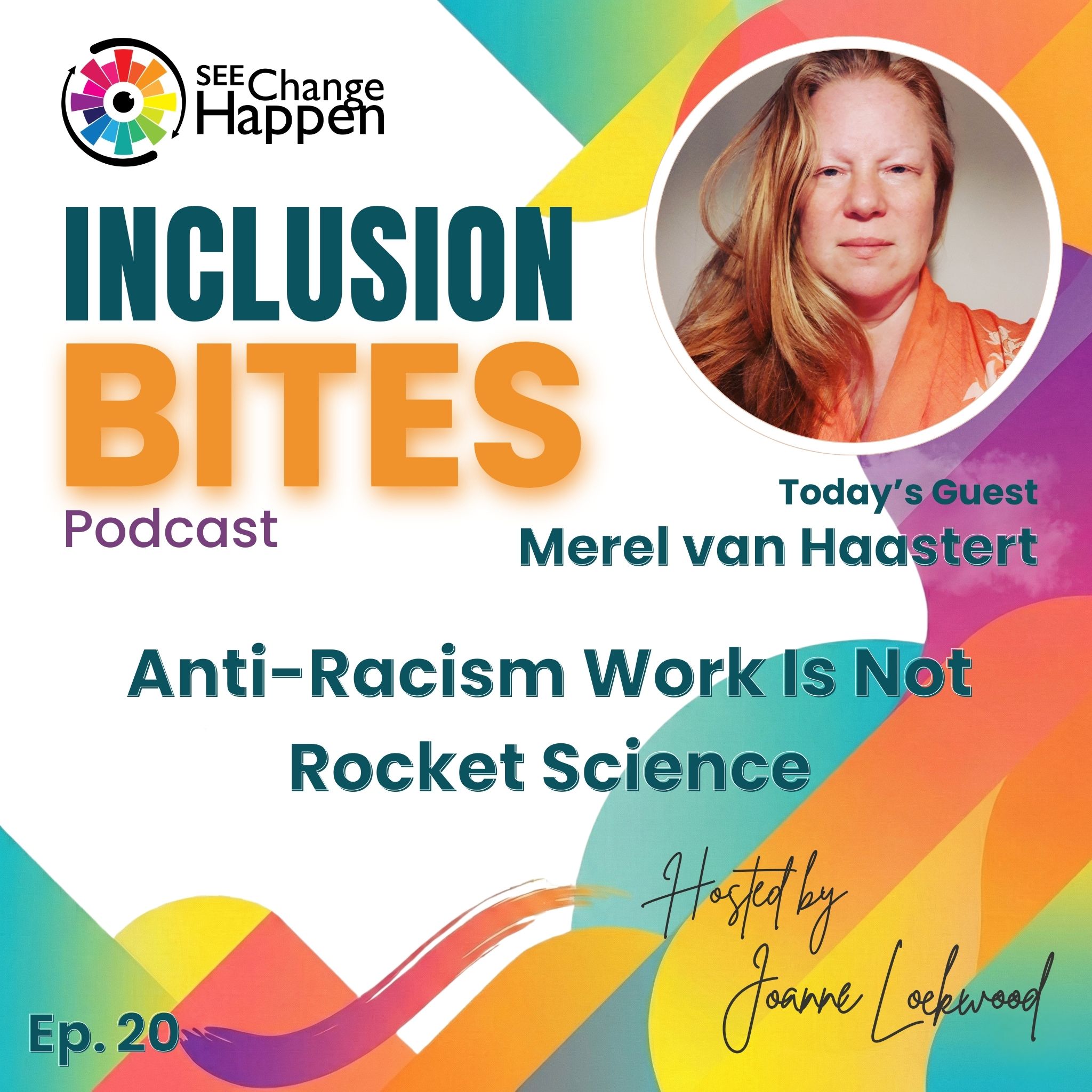
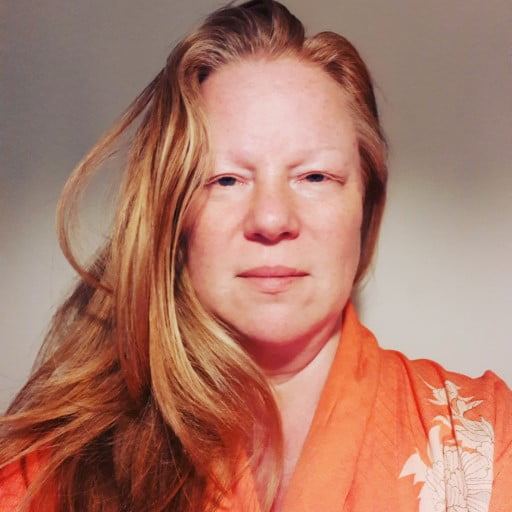
Merel, who describes herself as a "wise woman and a crone", talks about how she believes anti-racism work can be delivered to white people in a way that is non-threatening and ensures that people don't become defensive.
In this episode of Inclusion Bites, Joanne Lockwood speaks with Merel van Haastert about workplace culture systems.
Hello, everyone. My name is Joanne Lockwood and I am your host for theInclusion Bites podcast. In this series, I will be interviewing a numberof amazing people and simply having a conversation around thesubject of inclusion, belonging and generally making the world abetter place for everyone to thrive. If you'd like to join me in thefuture, then please do drop me a line to Joe Lock codeat seechangehappen. Co UK. That'sseechangehappen. Co UK. You'llbe able to catch up with all of the previous shows on itunes, Spotify andthe usual places. So plug in your headphones, grab adecaf and let's get going. Todayis episode 20 with the titleAntiracism isn't Rocket science. And I have theabsolute honour and privilege to be joined by Mural vonHustard. I met Mirror recently at an onlineevent and discovered we both share a passion forinclusion. Mirror describes herself as a vessel through whichknowledge and wisdom manifests. WhenI asked Meryl to describe her superpower, she said shecreates solid ground. Hello,Meryl. Welcome to the show. Hey, Joe.
Merel van Haastertguest
Hi, Jo. Hey. Good to be
Joanne Lockwoodhost
welcome. So, who is Mural? Tell me a bit aboutyourself. Well, like you
Merel van Haastertguest
said, Mirror von Hasttert, I live inRotterdam, in the Netherlands. I'm awise woman, a crone.I turned 51 just a couple of days ago.I'm a proud woman, I'm a single parentand I have a beautiful son. That'sme privately. And I have my owncompany called Solid Ground, which, again, comes back. We'lltalk about that a little bit later. Ido energy work and spiritual work,where I guide people throughwell, any problems they have,something that comes up in their life when they get stuck,that's my business.
Joanne Lockwoodhost
So you said you're a crone? Iknow of that word, but what do you mean by a wisewoman and crone? Well, it's the
Merel van Haastertguest
one thing I've always been passionate about. Asa little girl, I knew I was going to thrive when I was olderand I always wanted to be a wise woman, a crone,somebody with knowledge and sharing that knowledgeor being of service, not even sharingknowledge that I have myself, but that comes through me. Like you said, Ifeel like a vessel where knowledge and wisdomcomes through. I always wanted to be this, but it took me a very longtime. Well, of course, in years, but also tofeel confident enough to stand my groundthere. Now I'm 50, I'm thisyoung, new chrome yay. I'm happy aboutthat. So I'm actually finally in the placewhere I wanted to be. You were born
Joanne Lockwoodhost
to be 50. Basically, you were born to be in your havethis lived experience that you can share and amplify for others.
Merel van Haastertguest
Yeah, I've always wanted to be this and I'mfeeling like I've got a lot more years to go, so I'm finallythere. This has all been preparation before. It so when Iturned 30, I didn't have that, like, oh, God, I'm turning 30, I'm turningold. I'm actually quite going like, Yay. Finally.
Joanne Lockwoodhost
Superb. I know what you mean.Each decade you find something more about yourself, don't you? And I thinkI've certainly learned a lot more about myself since I turned 50. AndI think 50 is the new 40. We used to say this about our 40s,but I think we're much wiser now. In our 50s.
Merel van Haastertguest
I've got this new sense of energy, this newsense of being that isn't so rocky. I don't want tobe in my 20s again. I liked it and I liked being a youth,but it's so uncertain. I'm not that uncertain anymore.I know who I am and what the world. So I can nowexchange between the world and me more than I couldwhen I was younger. And I've got something to say,not just stuff that I've learned, but alsoI listen much better to people because you'renot constantly taking it personal. Because I know who Iam, I've learned. Very good point.
Joanne Lockwoodhost
Yes. I think we stopped trying to be anybody else other than ourselves,haven't we? Yeah, we don't need to be. We've been otherpeople all our lives. A parent, a child, asibling. And now we're us, aren't we? I think that's where it comes in.Fantastic. Very good age. So I actually think
Merel van Haastertguest
it's better than I thought it was. Of course, as a young girl, youdon't know what it's like of a young person. You don't know what that's goingto be like. But I want to tell myyounger self, or even other young people going like, but this isawesome. Hurry, come 50
Joanne Lockwoodhost
quickly.Don't worry about it. It's good. Yeah. Welcome to the club.Fantastic. So we got chatting the other dayat this online event, and antiracismis something that we, as white people,probably don't understand enough. So why isn't it rocketscience? Why isn't it rocket science?
Merel van Haastertguest
If you take off the blindersthat you can do yourself, it is nothing that isout there that you don't know you already know.All the information is there. There's nothing you have to do, youjust have to see it.That is, of course, difficult because there are a lot oflayers put upon us,indoctrination and all sorts of ideas andstuff that are put on top of us.But your soul knows, so there's nothing newabout this. There's nothing thatyou won't understand. It's yourdefence mechanism that kicks in, but that's it. Therest of it, you just have to listen and then go like,oh, but that's actually quite normal, that peopleare the same, everybody's the same. That skin colour doesn'tdo anything. There's nothingthere. When we are youngand we're going to school for the first time, youare taught to help others, to see people as equals.As young kids, we have noPhiltre put in there yetto see people as different. So if you go back tothat and feel like, oh, yeah, but I neversaw my friend different because she or hehad a different skin colour, it was, know, Jackor whoever daisy it was. And if you goback to that, that's that's, then from there, you can understandall, uh,different strategies that are used to putracism and white supremacy in place.Does that make sense to you? Yeah, it does. But
Joanne Lockwoodhost
as a white person myself, it's.
Merel van Haastertguest
Really. Challenging to sort of
Joanne Lockwoodhost
think about racism. And it's not about ourselves. It's aboutthe societal and structural racism moreas much as it is about the casual racism and thevindictive or discriminatory racism that occurs in day to day life.So as a white person, how do I drill through that? How do I tryand really unpack about? Because it's not about theracism I've caused, is it? It's about the racism that exists in society andthe inequity that occurs. Yeah, I think that
Merel van Haastertguest
white people take it very personalbecause you take it as an individual, as an individual CEO. ButI don't have these beliefs. I don't see you any differently.But it's a system. It's a system therethat you were born into.It's not something that you did. You didn'tthink like, okay, let's discriminate againstwhomever or whatever it could begender or sexuality. You don't thinkconsciously think, okay, let's discriminate. It's a systemthat you're brought into. Like, you go to school and you learn about your ABCsand you learn about calculation. And throughall these messages you get how societyworks. And then you start as a child, you start relatingto, okay, my parents ask this of me, or Society asksthat of me. And that's how you learnhow the world works. So what whitepeople forget is that there iswhite culture. Itexists. We don't see it, butit's the set of values and norms and all that stuffthat you get imprinted. And thatimprint is how you act in the world.And that is not your soul. It has nothing to dowith you being a human. That's how I seeit. So is that the same as
Joanne Lockwoodhost
kind of the default is white? So if we're looking fora photograph, the Default photograph is of a white person.We're looking at pictures of in your various faith groups,pictures of our faith leaders, of historical faith leaders. They'realways shown as white people, aren't they, with beards and goldenhair. So we've built this very whitest default sortof way of looking at the world, haven't we? And when we think as awhite person, we always think about white people. We don't think inour narrative about non white people as part of ourpicture, do we? No, we don't.
Merel van Haastertguest
You don't even realise that it happens because you'reso used to all the books being with the samepictures and the movies being about.There are a little bit of in the background or on theedges, there are some people of colour therelike it's like you know that there's a little bit of ablanket of the world with different groups, butthe narrative is white. But we never callit that way. We never mention it, thatyou are a specific group.That's where the how do you saythat decolonizationstarts when dismantling starts when yourealise that you are of white culture. Andthen you can start to see the difference between systemand the individual and how that works.
Joanne Lockwoodhost
You're aware of my gender transition and my background.And ideally, in the same way we see white asdefault, we often see men male as default as well. In a lot ofnarratives in movies and the heroes, and whenwe're looking at roles and expectations, man is kind of thedefault. And havingmoved to the other side for whatever better way of describing it, Inow see that default from a differentangle. Whereas once I was immersed in that and saw no problem,now I'm now feeling the wind inmy face as I travelof seeing all this inequity of representation. I don'twant to get off the topic of racism and I'm not trying to talk hereabout gender, but I think unless you'vecome out of a place where you are in the default and gone to aplace where you're not the default, you cannot understand what it's like to be thedefault, if that makes sense. So for white people likeourselves, we can never stop being white andtherefore our privilege is the same as water andoxygen. It's all around us and we can't tell it's there because wecan't see it. Yeah, you can
Merel van Haastertguest
never get away from it. It is not something that you take offthe privilege is there. You can't put it away. You can't sayto, when you're going through security at an airport, sayto this officer that's standing there, well, treat melike the person you did with a different skin colour.It doesn't work that way. So that's also why you don't seeit. I think that you touched upon something that I was thinkingabout. Just thinking about. There needs to be a bitof a breakdown somewhere.And I'm saying what you just said,you've had that gender change.I've had some breakdown in my life too,like divorce and losinga job. When the crisis went on about tenyears ago, it started an economical crisis.There needs to be a bit of a breakdown that gives youan entry towards seeing the world a littlebit the larger scope ofthe world. So,strangely enough, you have an advantage when you arenot the standard in the world.In white people. Of course there's a standard. We have a hierarchywithin white people too. But nobody fullyfits this standard. But the amount that you don'tfit into that standard gives you the opportunityto see from a different point ofview, see different perspectives. That also meansthat you can pick up on differentperspectives and then you start seeing then you canit's like something that you you turnout of yourself, you, you know, like and that's not the right word.You zoom out of yourself a little bit andthat's this break, this breakdown of normsand values that helps you to see otherplights, other narratives.
Joanne Lockwoodhost
If you look at some of the terminology and phraseologies that's evolvedover the years. So we talk about people ofcolour, POC, we talk about BAME,we talk about BME, we now talk about BIPOC, we talk about allthese sort of various terms for categorising people who are notwhite, whereas there is no kind of categorization assuch for whiteness, is there? We don't talk about a bitwhite or very white or English white or brown orFrench white. We just are again, it'sdefault. Some of these terms, I understand, arequite maybe not offensive to some people, but they certainlyare stereotyping people, they're grouping people thatnot every person who is not white is the same. Andwe kind of marginalise and erase lived experiences by categorisingpeople as black, Asian, minority,ethnics. And that sounderstates people's lived experience as a community, doesn't it?
Merel van Haastertguest
Yeah, and it does, becauseyou have white as the default.It all is related to as not whiteor default. In the centering is stillwhite. That is like you put yourself in the centreof the world and then everything has to relate to you.And that's how we do it. At firstit's really weird, actually. Yeah,I started laughing a little bit white, lesswhite, that kind of thing.Actually, there is a little bit of itbecause I live in the Netherlands and we have somePolish people here. We don't consider them white, weconsider them foreigners. Sothere is a hierarchy within white.
Joanne Lockwoodhost
I had this conversation about a year ago with someone and we're talking aboutinclusion and there are good immigrantsand there are bad immigrants, aren't there? And I was talking to this personwho was Dutch themselves. I said, well, as a Dutch person in the UK, you'rea good immigrant. We like Dutch people, French people wemake our own jokes about, and Germans we make our own jokes about, and Italianswe make other jokes around. But if you camefrom the old Eastern Europepoland, Romania, Bulgaria, Albania,anywhere that is maybe east of Germany,effectively what would be considered maybe part of the Soviet Union or part ofthat kind of70s image of communism we see thesepeople as less intelligent. We see them aschancers, often maybe morecrooked. And we cast these doubts on people whoare not good immigrants. Andit's shocking to hear the language in the media, the way that people aredescribed and the way that their accents are kindof demonised in a way.People would say people from Estonia are good immigrants because they're kind of cleanand very well spoken, whereas someone from Lithuania soundsa bit darker. There's a whole load of newstereotypes are coming now and again. Racism is morethan just white people and black people. There's also racismwithin communities, within faith groups, within religions. Isn't.
Merel van Haastertguest
Have probably in England the same. But I'm goingto ask you about that because in the Netherlands, within the country,there's also we have thesedifferent accents that we consider notso bright, not soand I lived in Thailand for a whileand I worked there and it's a huge country, ofcourse, not one of the biggest, but huge country. And thenI was thinking about the Netherlands. If you do,you're through it, right? It's like one and a half hoursor almost maybe two, and it's done.And then we have this. Then I thinkabout the way we categorise andlabel people just from the area they're from. It is theNetherlands. We're a post stamp.But even there, there are parts from the Netherlands. Whereyou're from means that you're a certain kind of way or you thinkthat you're more intelligent or not. Is this going on in England too?
Joanne Lockwoodhost
Yeah, I think we would call it white supremacy. We havea lot of English nationalism going on about anythingnon British is kind of not as good.And inevitably that leads people to beracist because what they mean when they talk about being British, theymean white British, they don't mean whateverBritish. There's still this kind of if you'renot white and British, you're not British. And there's acertain section of society that still sees that and that's abhorrent tome. But again, part of this white isdefault and England is a unitedkingdom, is a kind of a white default society and it's takinga lot to change people's minds. And there's a lotof rejection of the Black Lives Matter movement. There's a lot of fight backagainst this movement by a sect of British society.And it's shocking to see, but those kindof attitudes still exist. But they do. We saw it with Brexit, we saw itwith this nationalistic protectionism. We want toprotect this country for the white British people. And if you're notwhite British, then you should go.And it's hard fighting back around that. And I don't even necessarily think that'sprivilege speaking. In fact, a lot of these people, I would say, are not speakingfrom a point of privilege, they're speaking from a point of nationalism. Almostlike this, I dare say. I don't want tostress too far to say fascist views, extreme right wingviews, but a lotof it is spelling from that, I think. Yeah,
Merel van Haastertguest
it's the same in the Netherlands.England and the Netherlands have a bit of havesimilarities where they colonised parts of thisworld and they called it the part of their kingdom.You still have the Commonwealth. I think that's one of the wordsthat's used in the Netherlands. We don't use it,but we have of course had Indonesia,Suriname, some islands inCaribbean and strangelyenough, when I grew up I knew these areas werethere. But I now recall that Inever thought of them as being Dutch.While they were includedin our laws and everything, I neverconsidered them Dutch. So whenyou have these problems right now with thedemonstrations in the Netherlandstrying to get the conversationgoing about systemic racism and white supremacy,people still keep yelling at these people with a differentskin colour than white, like go back to your country. Because theydon't consider they never thought thatSuriname was part of the Netherlands. Of course itwasn't, but by law it was.But we hear too, Dutch meanswhite, means white person from theNetherlands. There are largegroups, I live in Rotterdam and that it meansthat we have 70% of ourinhabitants have a different cultural orbackground than Dutch. So how isit still possible that just this minority getsto say just us is whatmatters. That's what we do it for, nothingelse. 70%, that means 70% of thecity has to go. Then the city will shut down. Just thiscity and this goes rest of the worldas well. Yeah,
Joanne Lockwoodhost
you're touching on colonialism now, which is theBrits, the Dutch, the Portuguese, the Spanishand even if you think about the Italians and the RomanEmpire, there's been a lot of colonialism going on bywhite Europeans. If you liketrading religion for wealthand we give you our religion and destroy your culture and we stealyour wealth and yourheritage. I was at aTutankhamun exhibition at the SaatchiGallery in London, I think last year and Ididn't look at it with the right lens. I'vereplayed that visit with a different lens and basicallywhite privileged people went to Egypt, dugholes in their ground, stole all their goods, brought them back to the UK.And it was almost likewe were the colonial masters and we felt entitled to do that.And I look at it now and thinking all the stuff we hold at theBritish Museum, that's from Egypt, from Greece, from ancientcivilizations that we hold andquite rightly, the governments of these countries want theirartefacts back. And I think it's important that weunderstand whose artefacts they are and the culturalism about wherethey came from. And this is again part of the Britishor the Western white culture is that wefeel an incentive entitlement to the world'shistory. The white people wrote history. And actually what we need to dois understand that white people didn't write history. White peoplecreated some bad history and some bad events. Butthere's plenty of cultures out there that were managing quite happilywithout white people coming along and giving them religion,stealing all their goods. Yeah,
Merel van Haastertguest
I'm not so good with names, but there was a woman that recentlysaid or said like, our history does notexist unless white people were there once white peoplecame there, history all of a suddenexisted again from their lensthrough the white lens. And it's in ourgenes somehow, because probably you'vehad this experience as well, that yougrow up and you know that there's a big world and you want to seeit and you travel it. Right. You've got a passport that gives youaccess to it. I have a passport, Dutch passport,that gives me almost access to almost anywhere in the world,and I don't even think about it. Andit means that we are so used to thinkingthat we can just go and beanywhere without asking it'snot even asking. It's just considering the otherperson. This is what we'vegrown up with. And that's this system thing. Again,this is not personal. It's this system thing thatour ancestors have given usthis idea that the world isours and we can take whatever wewant with it. Just to mention because there's going tobe criticism here. It happens every time.And that is like but in all those countriesand years before racism, like slavery came,all these other cultures also did enslave people andstuff. Yeah, that happened, too. Butthe Dutch, the English, the Spanish, the Portuguese, theFrench what we did waswe made it a worldwide economy.We put it on a global scale. That is,to me, what racism is. We made itour default economy. Yeah.
Joanne Lockwoodhost
And we built the wealth of our country off the back of that.So our power and privilege today has actuallybeen built off the wealth that we plundered andappropriated from these other cultures. We spread
Merel van Haastertguest
it worldwide. We spread it globally. And of course, there wasthe Chinese and Mongolians with Genghis Khan andGenghis Khan, or how do you say that? Andthere are Middle Eastern cultures that hadblack people from Africa as slaves, all thatexisted. But around about one,four hundreds, we started to lift it through to alevel that is where we are now.That's a continuum. We also started
Joanne Lockwoodhost
using science to justify it. I wasreading some shocking journals, somesummary journals from the 1819 hundreds, whereeminent professors and scientists at the time were measuringpeople's skulls and determining thatwhite men had to be more intelligent because of their skullshape. Black people, because of the way their skullwas developing and the size and proportions, meant their brain couldnever be as intelligent as a white person's. And even atthe same time, we were looking at women's skulls and saying that women couldn't beas intelligent as a man because the shape and size of their skull.So we were using science to justify whitesupremacy. And that narrative hascontinued in that feeling that white people are more intelligent.Black people or non white people, non men are lessintelligent because there's no way their brain capacity can be as goodas a white person, a white man. And we've seenthat through this kind of white VictorianEdwardian privilege in the UK being propagated thatthis is a high privileged society that has thisentitled belief that they are better. Yeah, we
Merel van Haastertguest
thinkwe're thinking that we've evolved past all this violence, pastall this stupidity, and we are thisratio, very well behaved, gotthe best norms and values in the world. That's what wegrow up with. And people go like, well, slaverywas abolished, I think it was 40 years earlier at yourplace than ours. We were quite late.But it's not in the past with this, COVID-19they're testing vaccines in Africaon black people. They are.That is classic racism. That isclassic white supremacy still goingon. We can't test it in our country because that wouldn't be
Joanne Lockwoodhost
allowed. But we can go somewhere else where their standards are less,they value life less, therefore we can get away with it. It isshocking. And I'm not sure how it's justified whetherwe've identified the fact that disproportionately blackpeople are affected more by COVID and therefore it's justified on that bound, Idon't know. But you're right.We even still call it the Third World. In some areas,we're the first world. I really
Merel van Haastertguest
believe this. I'm not above any of this. I'vebelieved this. I thought indeed that we inwest, this Western and we're talking some specificcountries, right? England, the Netherlands, Germany,Denmark, the Scandinavian,France, Spain and Portugal. Alittle bit of Italy andSwitzerland. That's it. And I thought wehad it going on. I really thought we had democracy.We have ratio, we have science,we're living in a safe country, there'sno war, there was nothing going on. Ireally believed that there were Third worldcountries where the only thing they had to do wasgo up on our level and we needed to help them get up to ourlevel and then the world would be fine.
Joanne Lockwoodhost
So what we're saying is we need black people to act like white people inorder to be as accepted in the world, in the same way we wantwomen to act like men so that they're accepted in the world. So we wantto assimilate everyone to the same ideals as being a whiteman. And isn't that what we're doing with privilege? Weassume that this privileged structure wehave in society when our Western society isall based around this default norm, isn't it? Which is the whiteman. And the further you stray away from that,the less valuable you're seen, the less worthy you'reseen. And that's the challenge, isn't it? And when we put intersexualityinto the mix, where we've got people's age, race,faith, beliefs and gender and sexuality in there,that leads to massive more inequities, doesn't it? Yeah.
Merel van Haastertguest
And then that also explains why white peoplethink that if you're living inJamaica and you're not making it yet in the world,that it's your personal fault that you're not making it,or that you're poor, that it's a personal thing.And all this stuff has never been personal.It's just to make this system work, to make thiseconomy work, to make this power work that wehave and keep it in place. Andonce you stray from it, you willimmediately feel that the system does not want you tochange. Because the
Joanne Lockwoodhost
Western world we've been talking about, the original Eurovision Contestcountries, webuilt our economies on power and wealth and control,haven't we? If we don't have control of the markets, we don't have control ofthe wealth, then we lose our status amongst ourfriends, if you like, our other privileged countries. So we're always competingagainst who we see as our competingeconomies, rather than seeing other countrieslike India and China or Russia or someone who isa bad or lesser part of the world. We want to compete,be more equal with better than the French, better than the Germans, better thanthe Dutch, better than the Americans, and we assume thateverybody else has the same attitude. But in reality, peoplevalue different things out of life and society, don't they?
Merel van Haastertguest
Yeah. Well, it is whatwhite people fear. This is the fear that we willlose something. I don'tthink that if you would ask somebody that they reallyknowwhat losing means, then but it's like positionin this world where you mentionedwe think that we're going to fall backto a lesser standardsomehow. This is what we think. But that's only becausewe see other cultures in other parts of the world asless as us.Of course I don't want to go all lives matter,because of course that's true, but the system saysto us thatit matters. It matters where you come from. Andthat's why we think that the rest of the world isstrange and violentand people have values andnorms that are not ours. So then there must be bad.If you step away from that, you will findthat people have, of course, othervalues and other ideas about life andthat could actually be enriching. It is enriching to havepeople think differently than you and it's nota step back. Everything that comes into our country, theNetherlands, I'm assuming it's the same in England.If more people with theIslam faith come in, we immediately think,oh, well, we will start goingoppressing women again. Ourfeministic ideas willtake a plunge. It is not true. Itis not true. No, but the media
Joanne Lockwoodhost
feeds us. This stuff right backfrom as soon as television was invented, the movies wereinvented, the newspapers,the media have been creating stories thatsell newspapers. They sell films. And the reason theysell is because they create conflict, they create challenge, theycreate some narrative that is different to everyday life.I was speaking to an editor of anational Sunday paper in the UK about something recentlyand they basically said to me thatthe Anti brigade havesomething to talk about, whereas the people just getting on with theirlives, it's no. A person gets up inthe morning, smiles, goes to work, comes home, putskids to bed, goes to sleep, it's not news. So unlessyou're creating news and creating some debate or creating somechallenge, you're not newsworthy. So the media is picking up onthese stories of the Middle East, these stories of China, these stories of Russia,these stories of people who are different to us and almostsaying we are the default. These people are different and creating storyabout it. So no wonder we've been fedthese images of poor people in Africa withflies and pot bellies and need of our supportfor drought and then painting their countries as dictatorsand backwards. And wesomehow talk about them being at risk of nuclear weapons. How can we trustthese people with weapons? All we see is them running in the street withfiring rifles in the air.The media is almost saying, acting like savages, we can't trust these people. Sothis is what the media is putting into our living rooms every day. How canwe stop and walk a step back and go, Actually, they're not.But now we see people from Syria, from other countries, Afghanistan, asrefugees. We see these highly intelligentbusiness people who are now reduced to carrying all their possessions on their back withtheir families and walking for hundreds of miles to try and find a better life.And we just see them as scroungingpeasants. That's what the media is portraying them. We don't see the livedexperience behind these people, the story of tragedy, about howthese people from fantastic communities have lost everything through war,through no fault of their own, being displaced. And we'redevaluing them, aren't we? And that's what the media is telling us. It's like an
Merel van Haastertguest
intravenous every day. That's what youcall it, right? Like you get this or microaggression
Joanne Lockwoodhost
little pin pricks all the time. It drips into
Merel van Haastertguest
us every single day. And that's how we see the world. Andthat's what creates this fear. That's why white people are so scaredright now, because the bad man, the badpeople are coming for us and they want our world.We've created all this. We've created all this.If you take all their wealth and destroy everything, ofcourse they're going to go like, well, hey, yousaid this is the first world and all this wealthis here. We're coming and it's not they're gold diggers.These people would love to go home. They really wouldlove to go home, back to their own countries and livethere, raise their kids within theirfamilies and that stuff. They're not coming forus. There's no storylinethere. Like you said, it's created with theseimages and we bombarded and that we have to savethem. That's just this white saviorism. There's a wholestructure of beliefs andideas and feelings and emotions that areconstantly being triggered in us. They'retapping into it every single day just to keepthis trigger going. It's trauma. It's actually trauma triggering.They're going to keep doing it so that we keep saying, like,no, shut our borders for these refugees. Our countryis too full. And Iwas in the south of Francerecently, and I was flying overthe ocean. There what's calledthe same ocean that people use channelfrom Turkey to Greece.
Joanne Lockwoodhost
The Adriatic is it? The Adriatic is it? I'm not really sure.
Merel van Haastertguest
But the same ocean. I remembergoing there as a child thinking, oh, it's this lovely place. Andnow I'm flying over it and I'm thinking, but we're letting people diethere because of our ideas. That's theonly reason that is happening. Andit's upon us to change our own minds.And we can. We're intelligent human beings. We can.It's very simple to me. If you create one set of rules, you canalso create another set of rules. You can just chuck itand just say, okay, let's do it differently. It's possible.The whole COVID thing actually showed us thatby one day, all of it was shut down, everything was done. Wenow have different rules. Okay, fine. Thenjust say, okay, this is not working for our world.It has nothing to do with money. It has nothing to do with spreading ofwealth. Thatis a thing. It isn't a thing.This whole economy is just in our heads. At least that'swhat I think. It might be very simple to say it like that, but that'show I view it. It's really simple.
Joanne Lockwoodhost
Well, we start off this podcast by calling thetitle Antiracism Work is Not Rocket Science. And the more we're talkingabout it, it is a bit of rocket science. There's a lot in it, isn'tit, that we need to get our heads around. And it's not something we justpick off a menu and say, this is how I do it. There's a lotof unpacking to do. So why is it so hard for whitepeople to talk about racism? What are the big obstacles that you see?
Merel van Haastertguest
First of all, what you mentioned earlier is thatyou are in it. You are white. So thatmakes it difficult to see it.So that's a challenge. It doesn'tmean that you can't come to a point where you startthinking differently or did you change your thinking around certainstuff. But we are not usedto being viewed as a group,white people as a group, as a culture. That's the firstthing. If you would do that, say okay,like we do with other cultures, like with names you mentionedearlier, the labels that we have. If you
Merel van Haastertguest
just say, okay, if I am a group, if I amfrom white culture, what does that mean for the rest of the world?Then you have an entrance to startunpacking and why it is difficult. There area couple of things why it's difficult,I have no full extent, but one of the things ispeople from other cultures say to us like well, you are in theposition of power, you can change things. Butstrangely enough, within white culture this is what I've discoveredis we talk of this freedom ofspeech that we have this abilityand freedom to share our thoughts and all this.Yes, there is, you can share it, but actuallyif you look at it, it's really frownedupon to go againstauthority within white culture. It isnot okay to challengeauthority. We say it is andthen you get these nice groups that have thesethey're contained within an ideology or stuff andthen we tolerate it but actually go againstour leaders. And that starts young,right? That's not just our government,but that starts young within our families, withinschool, there's authority, always authority andit's not okay to challenge it. So this is whatwhite people feel is whenthey say like oh, but maybe this point of view is notreally what the world is like andI'm starting to question it. You immediately feelthis going like okay, if I do that, then I'll be placed outside of thegroup and we aretrained to stay within the herd. That is whatwe are trained to do. And this means if youdo antiracism work or start even thinking about it, likeequality or inclusion, thenimmediately you feel that you are placed outside of thisgroup and you are taught from a very early age that you'renothing without family, you're nothing.I'm sure you can relate to it. I can relate to itin instances in my life that I've placedmyself outside of the group. And then you're alone andthat is a scary thing for a human being to bealone with this massive force ofstructure and system that is going againstyou and beingable to step out of it and say okay, but I'm okayhere. That is difficult. That is thebig challenge. Yeah.
Joanne Lockwoodhost
I think what I'm feeling myself isthat whilst I myselfhave not directly been racist, directly courseracism, obviously as a white person I benefit from being thedefault. But it's extremelychallenging for an individual toinfluence the social construct as an individual of racism, thesocial construct of society. So it'snot just something we can do within an organisation and within abusiness. We ourselves can promote antiracism, we can talkabout how we can do this, but how dowe, as white people who want to do somethingabout this, change society itself? Because that'sfundamentally what we're talking about here. This is not a tweak. Thisis a fundamental realignment.
Merel van Haastertguest
Yeah,it's scary to raise your voice andto say, well, this is not okay. I don't agree with this.And I think that would be in any structure whereyou challenge authority and power.It's not like that. I have privilege as a whitewoman, which means I'm on this, you know, I'm the step down from awhite man, which means I've got a lot of power in this world. It isnot power that I can actually how do you saythat?Into something that, okay, now let's change society.But you need community.And I think that is what I'm trying to dotoo, is speaking up about this so that itresonates with others and others start coming into this community offeeling like, okay, we need some change. But thischange won't happen within the system.Of course there needs to be stuff done there. But thechange happens when you, as an individual, step outside of this groupand say, I want to live in a differentworld. I want to live in a worldwhere I won't be scared of foreigners,of people coming into my country or taking myjobs, just actually saying, okay, not going to dothat. I believe in a kind oftipping point kind of thing. If more people start saying,okay, this is not okay, then the thing willtip. And it's a long process. It'sa very long process. And it's very painful because on the one hand, it isindividual. You change your individualpoints of views. That means, like I said, I do energy workand spiritual work. You change your vibration,your being, and that resonates with others. That's howchange actually happens. So it's individual work.And then enough people have to get there. Then wecan challenge some ideas aroundit. It's not a linear world thing.In the Western world sorry, in the Westernworld,sorry. For people thinking, why am I because. My cat is
Joanne Lockwoodhost
going another Lockdown special. We've got the catvisiting. We've had mothers, we've had the Amazon man and now wehave the cat. People can't see this, but you could
Merel van Haastertguest
see in front of my face, okay, I lost my trainof thought. Let
Joanne Lockwoodhost
me ask you a question. One of the challenges whenwe've talked before, one of the challenges we find is that white people feelshame. They don't know where to start. They're worried aboutgetting it wrong. They don't understand theirwhiteness. And I understand thatyou set up a project, project Colour White. Whichdo you want to talk to me about? Why you created that and how itcan help white people be antiracist? Yeah,
Merel van Haastertguest
I started that because I indeed wantedto reach out to other peoplewas a personal thing, actually. Like, I felt all these thingsthat were wrong and I had noidea how changewas going to come about. And I thought, Well,I want to talk to white people. How do they feel? Do theyfeel this? It's very uncomfortable. It'sreally uncomfortable being challenged on your beliefs around the worldbecause it feels like candy is being taken away from you. That'sactually really how it feels.I couldn't talk tothe women because I mostly work with women of colour. Icouldn't talk to them about this because they, of course, have anidea about it, but they're not white. They don'tfeel the way I feel.Waking up in this system where you are part ofthis oppression is something else than waking upon the outside of it andseeing this system work against you.Waking up with this privilege and you're going like, oh,jeez, I've got this. Privilege is hard. It's reallyhard. And I wanted to talk to others.That's actually how Icreated this project. I wasn'tthinking about creating a project, it just happened.I wanted to have some white women come together becausewe already said it's white men. That's on top ofit. I still am very weary about talking to whitemen about antiracism, because I immediately getinto this patriarchy thing where I'm not taking so seriouslyand that kind of thing I'm wary of that starting to getbetter. But I wanted to talk to white womenand it turned out that is not that easy.So then I thought, well, I'll make it a project andI'll throw it out into the world, like what myviews are and how I think that we can changethis so that we can start having areal constructive conversation aboutwhat this actually means to dismantle antiblackness in yourself and what you come up againstso that you won't feel so alone. And in the meantime,try to come up with some ideasabout the world that you actually want.Because I don't want this world. I never wanted this world to bethis way. This is not something that Iconsciously chose. Sothis is why I started this project colour White. And it's still verydifficult to get white people to talk about it. Itis shame in there. We think that we have totake on this guiltthing of our ancestors and it'snever been about that. It's not what people want.You can't change the past. Really can't. I haveancestors whohad sugar plantations in Indonesiaand I can't feel guilty about it, but that doesn't changeanything anyway. It's what happen. You just have to behonest about it, that this is a part of it and that'show you need to talk. And this is something that we,as Western culture, we still don't do so well.
Joanne Lockwoodhost
I'm nervous about having a conversationabout antiracism. I'm not an expert. Where do Istart? What if I say something? So I thinkmany white people are uncomfortable having this conversation becausethey've got no anchor of theirperspective. I think when we were talking aboutyour project, Colour White, it was trying to create a safe spacefor white people to not know white people, to not besure about how to have conversations withoutthe fear of upsetting somebody else whomaybe is part of that conversation. So it's almost like a safe space toexplore whitenessbecause we have many communities where people who are notwhite, black people, brown people, they come togetherand they have a passion to change the world, whereas white people effectivelyare trying to change themselves, which is a lot harder sometimes than tryingto change the world. The enemy is ourselves, effectively. And that'swhat you're doing, is you're almost battling your owninfrastructure, your own family, your own friends. And peopledon't always have the tools because as humans we like to agree with each other,we like to have easy conversations, we want to be superficial, but toactually start almost being paternal, maternal oreven patronising or patronisingsomebody by talking to them in a way about racismis not comfortable in our nature, is it? No.
Merel van Haastertguest
And you don't like to admit that you're fearful.Currently I do theseI call it let's sit and talk. I go outinto a public space outside.Usually I see down two stoolswith the COVID metre and one and a half metres apartand I invite people to come and sit downand talk to me about it. That'sagain, creating a safe space. And there was thisconversation recently I had with a white manand he said, but I am afraid oflosing what I have because I'm actually comfortable with what I have.I said, yeah, that's okay. To feel and to
Merel van Haastertguest
have this kind of conversation in a mixed group isdifficult because youadmit tothis fear that keeps other people outsideof your network or stuff,so they get triggered on a different level. Well, you needto own this feeling offear, these emotions that you have aroundit. There are a lot of emotions you're going to have.I remember going through differentsteps of what white fragility means, what white tears means,and how that comes up in me. And I remembersitting there for, I think, a week it was,of feeling no ground beneath me anymore. Like everythingI believed in had gone and I didn't know what thisnew thing was going to look like. I still don't know. Soyeah, also in me there's still some fearbecause I was cheering aboutbeing 51. It also means that I've for51 years been living in a certain way and Ineed to give it up. And that's notfun. Like you said, we'renot changing the rest of the world, we're changing ourselves,which is, yeah, that is the fear. So youneed the safe spaces. We need lots more safespaces and we need to figure out how,for white people, there is an urgency to this. Whyto do this, why do we need to change? Because, yeah,you and me, we can withdraw ourselves and say, okay, we don't wantto do this fight, we don't want to talk about inclusion. Wecan withdraw in our lives, we can live happily ever after.In Dutch, we say NA unstasunsflute, which meansafter us, whatever.I'll just live my life and I can do that. I don'thave to do this, I don't have to change the world becauseit's working for me in a certain way and actuallyhaving to realise that this discrimination,this thing that we have learned to do, isactually causing us all these problems that are in this world.So there is an urgency for us to do it.I will say it dramatically. It's our souls that are at
Joanne Lockwoodhost
risk here, for sure.One phrase I use myself is holistic, active anddeliberate. That's about inclusion. We have tobe deliberate about it and active. And what you're saying is, if wewalk on by, if we let it pass, we turnthe other cheek, we turn a blind eye, whatever expression you want to use,we're not being deliberate and active. What we're doing there is we're letting somethingbecome more normal by the onlyreaction can and should be to say no, to standup and be actively and deliberately antiracist,antisexist, anti, whatever. Because the moment we letit pass, we give permission for it to happenagain. And at some point it escalates. So I thinkyou're right, it's incumbent on each of us totake an anti stanceand the oxymoron, orbe intolerant of intolerance,which is a paradox in itself, but whereintolerance lays, we can't be tolerant of anyone'sintolerance. And antiracism is justa good example where we need to be intolerant of any racism andactively and deliberately so. That's fantastic. AndI'd love to find out more about your project. Colour white. I mean, we've talkedextensively. If anyone's listening to this,how can people get in touch with you to find out more about your projects?
Merel van Haastertguest
Project Colour White is on Facebook and Instagram,so you can type in Project Colour White.
Joanne Lockwoodhost
Is that the American spelling and colour color? Or is it theC-O-L-O-R? So the American spelling and colour.
Merel van Haastertguest
Okay, sorry. Yeah, we like to put you
Joanne Lockwoodhost
in our colour. We extra U in our colour.So project colour white, spelt the white. Yeah, yeah. So you can find
Merel van Haastertguest
it on Facebook and on Instagram and that gives you theaccess to the project and my contact.And on the Facebook there's a big note,which I call the ground of Project Colour White, whichtells you about how I create a safe space for whitepeople to talk about these very difficult things.
Joanne Lockwoodhost
Excellent. Well, we're going to carry on talking aboutthis and we're going to keep in touch. And I'm definitelybeing active and deliberate about my antiracism,and I'd welcome anyone who's listening to get in touch with yourselfand myself. Maybe you'd like to come and talk about what work you're doing inantiracism, maybe from a white perspective on thispodcast. Come and have a chat. So, a huge thank youto Mural. Thank you for joining us today. Thank you forthe listeners for tuning in and sticking with it.
Joanne Lockwoodhost
Please do subscribe to keep updated on the future episodes of theInclusion Bites podcast. That's bites. Please tell yourfriends if you have some, and your colleagues if you happen tohave some colleagues as well. I have a number of exciting guests linedup that I'm sure you'd be even more inspired by, if that's possibleover the next few weeks and months. And remember, if you'd like to be aguest on the show, please let me know. And aslong as you're talking about something around inclusion, making the world abetter place for everyone to thrive, then no topic is offlimits. So I'd welcome your comments, your feedback andsuggestions to Joe Lockwood at ctnchapan coUK. Tell me how we can improve future shows. Tell me whattopics you'd like to hear. So, finally, my name is JoanneLockwood, and it has been an absolute pleasure to host this podcast for you today.Catch you next.
Media Narratives and Cultural PerceptionThe Concept of White Privilege and Systemic RacismCreating Safe Spaces for Antiracist Conversations
Joanne Lockwood is joined by Merel van Haastert to explore why anti-racism work can feel daunting for white people, and why the work starts with seeing racism as a system rather than an individual moral failing.
Together they unpack how “white as default” shows up in everyday life and representation, and how media narratives, nationalism, and colonial histories reinforce structural inequity. They discuss how labels and categorisations can obscure lived experience, and how racism is sustained through systems that reward compliance and discourage people from challenging authority.
Merel shares why she created Project Colour White: to create safer spaces for white people to talk honestly about fear, shame, and fragility, and to build community for those wanting to do deliberate, active anti-racism work. The episode closes with a call to speak up, be intolerant of intolerance, and stay engaged in long-term change.
“So when you have these problems right now with the demonstrations in the Netherlands trying to get the conversation going about systemic racism and white supremacy, people still keep yelling at these people with a different skin colour than white, like go back to your country.”
“Our history does not exist unless white people were there once white people came there, history all of a sudden existed again from their lens through the white lens.”
“If you do antiracism work or start even thinking about it, like equality or inclusion, then immediately you feel that you are placed outside of this group.”
“You need community. And I think that is what I'm trying to do too, is speaking up about this so that it resonates with others and others start coming into this community of feeling like, okay, we need some change.”
“I wanted to talk to white women and it turned out that is not that easy. So then I thought, well, I'll make it a project and I'll throw it out into the world, like what my views are and how I think that we can change this so that we can start having a real constructive conversation about what this actually means to dismantle anti blackness in yourself and what you come up against so that you won't feel so alone.”
The societal construct of a privileged "default norm" based on the ideals of white men.
The impact of media narratives on perpetuating stereotypes and influencing public opinion on non-Western cultures and refugees.
The imprinting of white culture and the marginalisation of non-white experiences and voices.
The emotional challenges and fear involved in white people addressing their own privilege and racism.
The importance of creating safe spaces for uncomfortable conversations about anti-racism and privilege.
The historical exploitation of other cultures by colonial European countries and its continued legacy in modern practices.
Strategies for challenging authority and promoting societal change towards genuine inclusion and equity.
One thing to remember
The most essential takeaway from the episode "Anti-racism work is not rocket science," featuring Joanne Lockwood and Merel van Haastert, is that addressing systemic racism and the default norms within Western society requires a conscious and active effort to challenge privilege and dismantle ingrained biases. It's about recognising not just personal beliefs but the broader societal structures that perpetuate racism. By creating safe spaces for uncomfortable conversations and actively pushing against the status quo, we can pave the path towards a more inclusive society.
Explore topics
Ideas from this episode
Media Narratives and Cultural Perception
In a riveting discussion with Merel van Haastert, we delved into the powerful influence of media narratives on shaping perceptions of different countries and cultures. The media plays a pivotal role in perpetuating stereotypes, which significantly impacts societal attitudes towards non-Western cultures and refugees.
The Concept of White Privilege and Systemic Racism
A deep dive into the pervasive nature of white privilege and systemic racism within Western society. We examined how the ideals of white men have become the "default norm" and the consequences of this on both individual and societal levels.
Creating Safe Spaces for Antiracist Conversations
The essential yet uncomfortable task of creating safe spaces for conversations about white privilege and antiracism. Merel spoke about her initiative, "Colour White," designed to provide a secure environment for white people to confront and discuss their privileges and biases.
Learn
Frequently asked questions
What is the "default norm" in Western society as discussed in the episode?
The “default norm” in Western society typically refers to ideals based on white men, which often dominate societal standards and perspectives. This concept implies that other cultures and identities are measured against this norm, leading to marginalisation.
How does the media perpetuate negative stereotypes about non-Western cultures?
Media perpetuates negative stereotypes by frequently portraying non-Western cultures and refugees negatively. This biased representation can manipulate public perception, instilling fear and resistance to diversity.
What is Merel van Haastert's "Colour White" project and its purpose?
Merel van Haastert's "Colour White" project is designed to create a safe space for white people to discuss and understand anti-racism. The project aims to help participants recognise their own privileges and dismantle anti-blackness within themselves.
Why is it challenging for white people to discuss privilege and anti-racism?
Discussing privilege and anti-racism is challenging for white people due to discomfort and fear of confronting their own roles in systemic racism. These conversations often evoke vulnerable feelings, making it difficult to acknowledge and address deeply ingrained biases.
How can white people contribute to anti-racism efforts according to the episode?
White people can contribute by actively engaging in conversations about racism, educating themselves about privilege, and deliberately taking an anti-racist stance. This involves challenging norms and confronting personal and societal biases.
What impact does the fear of losing status and wealth have on anti-racist efforts?
The fear of losing status and wealth can make white individuals resistant to change and perpetuate systemic racism. This fear is often manipulated by media narratives, leading to a reluctance to support anti-racist initiatives.
Share this episode
Heard something worth passing on? Send this conversation to someone who needs to hear it.