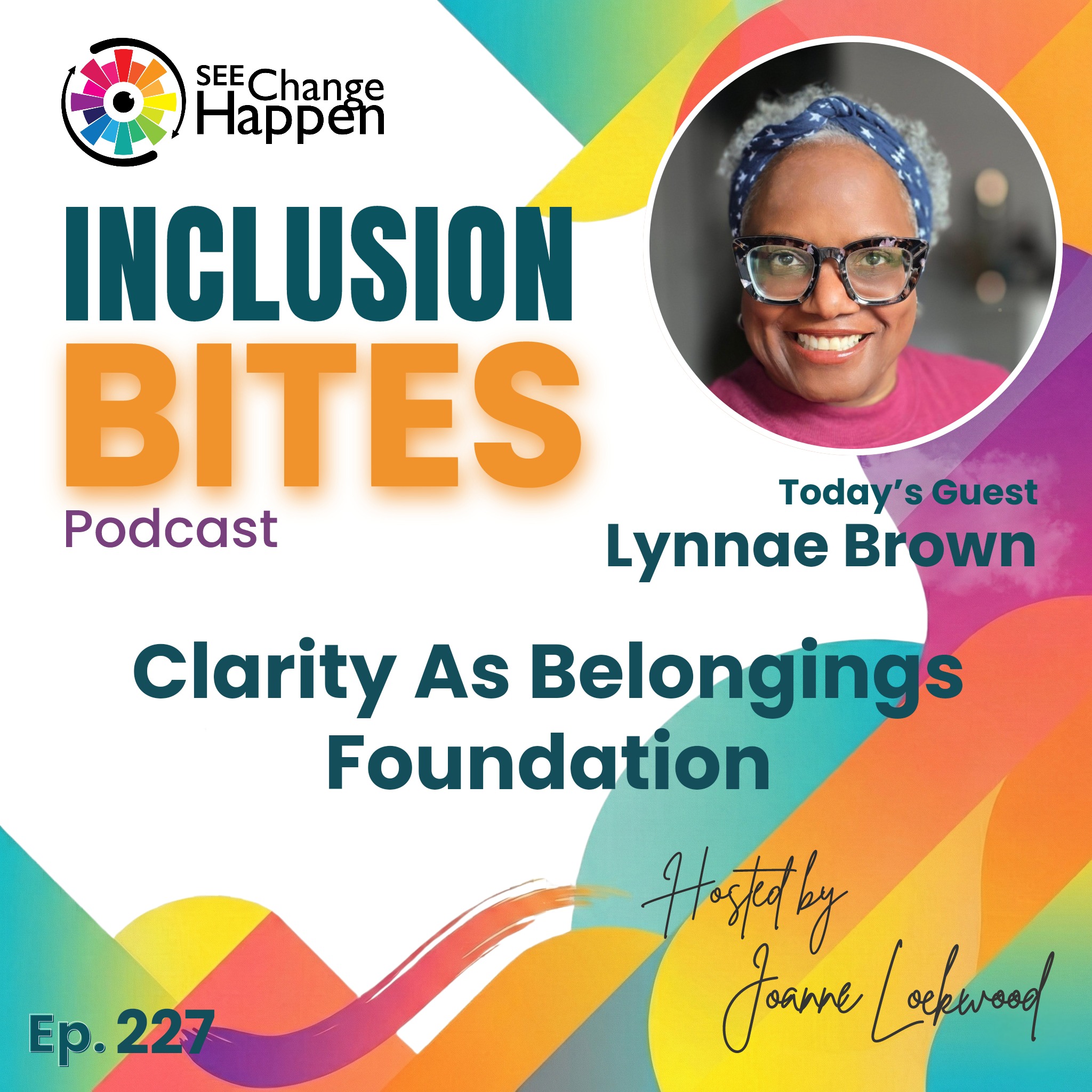
Joanne Lockwood hosts Lynnae Brown to explore how clarity in work roles fosters belonging and inclusion, especially for marginalized individuals facing mental health challenges. They discuss the importance of understanding one's place within an organization to feel secure and supported in the workplace, transforming belonging from a feeling to a foundation.
In this episode of The Inclusion Bites Podcast, Joanne Lockwood is joined by Lynnae Brown for a thought-provoking exploration of the role that clarity plays in fostering belonging within organisations. Joanne and Lynnae move beyond the buzzwords to interrogate the real dynamics of inclusion. They examine why simply stating a commitment to belonging is not enough, highlighting the gap between organisational values and lived experience. Their discussion draws on practical examples and delves into why employees often sense a lack of trust, the frustration caused by ambiguity, and how the vital, often overlooked work of managers profoundly affects workplace culture. The episode unpacks the nuanced difference between true belonging and merely fitting in, questioning whether workplaces should aspire to emotional investment or maintain a more transactional relationship that empowers individuals to thrive elsewhere.
“Belonging is you're able to be yourself and be comfortable and everyone's cool with it.”
Explore
Navigate this episode
Joanne Lockwoodhost
Welcome to Inclusion Bites, your sanctuary for bold conversationsthat spark change. I'm Joanne Lockwood, your guide on this journeyof exploration into the heart of inclusion, belonging and societaltransformation. Ever wondered what it truly takes to create aworld? Remember, everyone not only belongs, butthrives. You're not alone. Join me as we uncover the unseen,challenge the status quo and share stories that resonate deepwithin. Ready to dive in. Whether you're sipping yourmorning coffee or winding down after a long day, let's connect,reflect and inspire action together. Don't forget, you can bepart of the conversation too. Reach out toJo.Lockwood@seechangehappen.co.uk to share your insights orto join me on the show. So adjust your earbuds and settlein. It's time to ignite the spark of inclusion with InclusionBites.And today is episode 227 with the titleClarity as Belongings Foundation. And I have the absolute honour and privilege towelcome Lynnae Brown. Lynnae is a consultant, trainer and speaker whohelps people and teams use Clarity to make work easier to understand,to navigate and sustain. It is grounded in the belief that when peopleunderstand how their work belongs, they can feel more secure that theybelong to. When asked Lynnae to describe her superpower, she said thatit is finding the shape inside the blob, taking something thatpeople feel yet can't yet name and giving it enough edgesthat they can finally understand it, talk about it and work withit. Hello, Lynnae . Welcome to the show.
Lynnae Brownguest
Thank you, Joanne. Thanks for having me. It's lovely to be here.
Joanne Lockwoodhost
Absolute pleasure. I've loved having a chat with you before we push the recordbutton. And whereabouts in the world are youbased?
Lynnae Brownguest
I'm in Western Massachusetts, United States.
Joanne Lockwoodhost
Western Massachusetts. My geography of the state ismediocre. So whereabouts is Massachusetts relative to theworld?
Lynnae Brownguest
So it's in. The first. Was the first of the 13colonies. So in the northeast part of the United States, we're right betweenConnecticut, Delaware, Rhode Island. Between and above us is Maine, NewHampshire, Vermont. Yeah.
Joanne Lockwoodhost
Right. Okay. So you're. Before it gets too cold, you're in that kind of middle zone, areyou?
Lynnae Brownguest
Yes. Yeah. I mean, it does get cold where we are. We have some viciouswinters.
Joanne Lockwoodhost
Right. So you're halfway between. BetweenWashington D.C. and Canada. Are you somesomewhere?
Lynnae Brownguest
Guess so, yes. Okay. You could say that. Yeah.
Joanne Lockwoodhost
I'm just. My. My knowledge of the statesis. I. I've been to New York, I've been toCalifornia.
Lynnae Brownguest
Okay.
Joanne Lockwoodhost
I've been to both San Francisco and LA and around that sort ofarea. San Diego and I've been to Florida, but I've not done a lot elsereally. So my knowledge of the States. Is. It's probably the same as your detailed knowledge ofEurope.
Lynnae Brownguest
Exactly.
Joanne Lockwoodhost
You know, roughly where the bits are.
Lynnae Brownguest
But yeah, yeah, because we're. Then the closest you. You've been to me is New York, because we'renot. We're about two and a half hours away from New York City now.
Joanne Lockwoodhost
Right, okay. So you're not too far from New York State then?
Lynnae Brownguest
No, not at all.
Joanne Lockwoodhost
Cool. Right. Okay, I'm with you now. Okay. Yeah,yeah. I remember having an emergency landing in Ganderonce. Newfoundland. I was flying in. I was going toMiami. No, no, I was actually going to the Bahamas viaMiami. And we were over the Atlantic and then the pilot came ontothe. On the radio and said, strap yourselves in, put your tray tables up, get rid of allyour food. We're gonna have to do emergencylanding. Someone's having a heart attack or something likethat. So we ended up emergency landing in Newfoundland andGander. And if you've ever been there. But it's basically a rock tundra and we're onthis Runway and just. There's nothing around you, justsnow. And we were stuck on this Runway for something like two and a half hours becausethe plane turned all the engines off. It got really hot in there and it was like theydidn't serve any food or drink. It was. It was awful. Anyway, eventually took off andscary and then I ended up in Miami and it was even hotter and stickier inMiami. So, yeah, Newfoundland wasn't so bad afterall. So, yeah, that's a. That's my emergency landing in Newfoundlandstory.
Lynnae Brownguest
My goodness.
Joanne Lockwoodhost
Many, many years ago. So that sounds very scary we're talkingabout. I mean, for those of you listening, you can't seethis. I appreciate, but Nana's got a fantastic, very strikingphoto. What, sorry? Picture of a. Of a. I guess an African elephant on the wallbehind. Behind you. So what's the story on that one?
Lynnae Brownguest
Yes. So I got this painting in an outdoor market in Nairobi,Kenya. I was there back in 2019 during a safari. I was on MasaiMara. And so we went to a market one afternoon and I just saw thiselephant. I love elephants in general. I think they're the symbol of wisdom and alsofreedom to some extent. And so when I saw this picture, it looked like it was a realpainting and I just loved it. So I brought it back and framed it and it reminds me of notOnly my adventures but the, the quiet beauty and wisdom of, of elephants and what theyrepresent. So. And it's colourful, it's a lovely, it has all the colours in the rainbowin it.
Joanne Lockwoodhost
I think it is, it's very stylized and yeah, it's very contemporary looking,isn't it? Yeah, very striking. Yes.
Lynnae Brownguest
Yes. Thank you.
Joanne Lockwoodhost
So Linae, you talk a lot aboutbelongingness in the workplace, mental health and helpingpeople navigate this world of work and they're finding their place withintheir world of work. So what was the original thingthat sparked you to get into.
Lynnae Brownguest
I would say it really began over a decade ago when I begana job at a programme in New York City that helped people in mental health recoveryget back into the workplace and work as what's called peersupporters. A peer supporter is just somebody with lived experience and a certain marginalised experience andthey work in the system to help other people in their own recovery process. The people that I worked with had mental healthconditions. They also had experiences like substance use or some people hadincarceration histories, things like that. And so the programme I was a part of was training people to go intothe workplace and how to use that lived experience to help otherpeople. So I was helping people become, from, go from being a service user to a service providerand at the same time knowing that folks had emotional vulnerabilities likehow, how I like to see it as a mental health condition to something to have to be more aware of, you have to bea little bit more deliberate in taking care of yourself if you have a mental health, if you, if you have mental healthchallenges. I don't know how to say it anymore, how to say it anymore. But, but if you experience that sort of vulnerability, you have to takecare of yourself a little bit more intensely than maybe someone else who doesn't. And so when, when Iwas there in this particular job, one of the job, one of the, my, what do you call it, mandateswhen I first got the job was to figure out, build a philosophyaround the training. There was a 400 hour training and then a 400 hour classroom trainingand then people would go on an internship somewh York City and then we'd help them get a job at theend. So my job was about taking those 400 hours of training and somehow putting it togetherand reformulating it and putting it on paper for the programme to be replicated in anothercountry. And so that was my job at the time to figure out, okay, not only do I have to like figure outhow we're going to do this programme now that had been around for like 15 yearsbeforehand. Like, it wasn't like it was, it was new, it wasn't, but it wasn't onpaper. And also had the extra, what do you call it, like, mandate to be able tosay, okay, these people in Netherlands also wanted to have a version of theprogramme. And so I had kind of a couple pressures at me to try to figure out how thispro. How this training programme can go. And so as I was helping,like, really refine the training, I had to think about some workplacesdifferently than maybe somebody else did. Because here we are, people who, with marginalised experiences, people whohave experiences that other people will have stigma around,right? So these folks are going into workplaces with experiences that other people wouldstigmatise. And, and so, so for instance, if you have a mental health problem, people think, oh, you know, you have, you'reemotional, you're off the, you're off the rails, or, you know, you don't know how to regulate yourself or allthese other stigmas that go with mental health. And so I had to think peoplegoing to workplace, like, how can they show up and do their jobs and feel like theybelonged? And. And workplaces that maybe not, maybe that, but weren't reallyset up for them, you know, because most workplaces aren't really set up for people who have marginalisedexperiences like that. And so as we were developing the training andI was getting more feedback from people and their internships and what was happening at work, at, intheir actual internships, people were saying that, well, I got to the job and they don't even know what I'm supposedto be doing. They hired us as peer support workers, but they haven'tex. You know, they don't seem to know what to do with us. So then people were talking about, well, do I even belonghere? Like, what am I supposed to do? If they don't even know what to do with me here, then how do I belonghere? And so that's what got me thinking more and more about this issue of belonging andinclusion. That from that perspective, that sort of thinking that, you know, yeah, it's like part ofbelonging has to be that your work belong, like, like that's the reason you're there, that you're clearabout what your role is, who you're serving, who you affect, how yourjob fits into the larger organisation and what mission does it fulfil, who do you affect, who affectsyou? These are all, like, ideas around figuring out if your Work belongsto. Belongs at all. Because if your work doesn't belong, then it just makes sense that you wouldwonder if you did. So that's how I started thinking about things like that, thatbelonging. In that perspective, how do you, how
Joanne Lockwoodhost
do you describe what belonging is? It's quite nebulous,isn't it? What is belonging?
Lynnae Brownguest
Well, it's so funny because you asked that. Cause the first thing I thought was what Brene Brown wouldsay. So. But I think it's just the idea that you can be yourselfand your personhood is part of somethinglarger. Right. Just something that's. And you're comfortable in the situation and youcan be yourself and you don't have to worry about being something else. I mean, I think we, we talk about the difference between belongingand fitting in. Fitting in is when you over adapt right to the situation and you're not reallyyourself, you're just trying to do what everyone else is doing. Belonging is you're able to be yourself and be comfortable and everyone's coolwith it. I mean that's the basic like, you know, simplifies orsomething.
Joanne Lockwoodhost
Yeah, fitting in. You're having to change yourself to fit into someone else's square or box orthe box is there for you, ready to go, isn't it? It'sexactly. Slots right in.
Lynnae Brownguest
Yeah, exactly. Exactly right.
Joanne Lockwoodhost
It's. I, I always find the word belonging, it's, it's really hard to put yourfinger on what makes or what creates that, that sense ofbelonging. It's very, very sort of ethereal, sortof. You can't always put your finger on it. But you know when you don't, you knowwhen you don't belong, you know, you know when you don't fit, you know when you'rehaving to mask, cover or crow by yourself into a space, but you couldn't actuallysay, well, what is the magic sauce? But I know when I haven't got itright.
Lynnae Brownguest
Exactly right. If you know it, you know it. When you, when you feel like you're out, out ofsorts, you definitely know you don't belong. And I would say it's interesting when you saw, when you talked aboutthat, I was thinking about some people I was working, they were working at a job that had belonginginclusion on the website. And yet their particular boss, their supervisor, was actuallyquite abusive and micromanaging and very undermining forthe work they were doing. And I just thought, see that to me right there isthat lack, that lack of trust undermines belonging.Right. So you can't Belong. If you don't trust, you can'tbelong. If you can say anything you want in an organisation like we, we have belonging, inclusion, everyone's welcomehere. But if you have people in power who are misusing that power so that peopledon't feel like they belong and they. And they feel afraid and they free, judged,then the whole belonging thing doesn't work. So that's why I think it's interesting that you bring it up, that belonging isreally hard to put your finger on because you definitely know when you don'tbelong. You definitely feel it when you do.
Joanne Lockwoodhost
And you can't prescribe it to somebody. Can you say you will belonghere? You know, we have put everything in place for you tobelong. It's not that kind of contract really, is it? It'sa. The environment exists, the culture exists, the values exist, the peopleexist. And then do you slot into that in abelonging way? Or is that. Or is there friction? There's rough edges, there's thingsthat don't quite work and that's it. It's something I have to warm into, isn'tit?
Lynnae Brownguest
Yeah. And that's the thing about work, it's the workplace ingeneral. It's when you start getting into belonging, you're talking abouta sense of being valued, a personal worth. And I always, for me, I always found it very dangerous forpeople to expect workplaces to be able to dothat. Well, I don't think, again, this is just my opinion about the whole belonging inclusionissue is like, I don't think that a lot of workplaces do belonging verywell because belonging has multifacets to it when it comes to personal value and personalworth, making people feel like they're personally valued at theworkplace. And that's why I think the basis of belonging at work needs to be the work itself, that,you know your job fits, you know that the work you're doingmatters. You know how if you didn't do your job, if you didn't show up, how that would affect thecompany. I think that. That when your job is very clear and when you're very clear about what your jobis and how it's connected to other people in the organisation, when you can say, I do thisand this is the outcome and the outcome is connected to the mission and you can seeyour. What I call coordinates and like, like how you're. Where you are is actually connected toeverything else in the organisation. To me, that's the most powerful belonging there is at work anyway,because then, you know your Work matters. It's connected, itmakes sense. You know, where you begin and where you end. It's like you're a piece of apuzzle.
Joanne Lockwoodhost
There's that famous anecdotal story. Whether it's true or not about the janitorworking at NASA isn't there? And someone says, what do youdo? He says, I help put people on the moon. That's whereyou. You're bigger than your role. You're part of the mission of theorganisation. Not just here to sweep the floor, to restock thetoilets. You're here to help people, to put people on themoon. I think that's where you truly align with the mission values of theorganisation, your team, the people you workwith. I'm not just an accountant, I'm not justthis. I. My part of the company is to help us dothis.
Lynnae Brownguest
That's exactly right. And especially even the example that you gave Ron, thejanitor. I don't just. He doesn't just, you know, clean floors and wash toilets because quitefrankly, if he didn't, if no one did, that'd be a problem for everyone who workedthere. So all of it matters. All of it. All the pieces of a company domatter. And it's important, I think, as if you have abelonging. If you have a belonging mission is that people know that their role matters, that theirrole fits, that there's no sense of, like you can just be getting rid of at anypoint. And I think that's also brings me to a larger issue of what I'm seeingnow. Is that why I find belonging really kind of a gnarly situation in terms of work, is that we'reseeing, at least in the States, we're seeing companies lay people off for profit, not evenperformance reasons anymore. Right. It's not even that people are being laid off because theirjobs don't. Their job itself doesn't matter. They did a poorjob. You know, you have companies who are saying, no, we need more profit, so we're going to get rid ofall these people. And you're like, wait a second. Like, this doesn't makeany. This just doesn't make any sense. And so I think now, especially, more than anything, it reallyhelps people if they know that their job really matters, to help them belongsomeplace.
Joanne Lockwoodhost
Do you think in, in. In the modern world of work, we have to havebelonging? Because. Let me. Let me just throw something out there that workis. Work can be more transactional. You do. You need to have a belongingness with acompany. If you're A. I don't know, an Uber driver, forexample. Do you need to feel belonging with Uber? Do you have to have that, thatrelationship? You know, we, we work remotely. I remember seeing, especiallyduring COVID times or big organisation was saying, well, you have to come back to theoffice. We want to create this culture. We are cultures, we all belong, we all gettogether. I thought, well, do I need yourculture? Do I need that?
Lynnae Brownguest
Yeah.
Joanne Lockwoodhost
Why can't I have my family, my community, my neighbours, my, my, mysports club, the things I do locally? Surely that's mybelonging. That's my culture, my value, my home life. Work istransactional. Work is there to pay me, work is there to enable me to have my homelife. And what I always said to people was, I want my culture tobe like my pension. I can take it with me when I changecompanies. I don't need to have all my belongings invested in youas a company. I want to have my belongingness vested in me and that way I can invest init across career roles. And as long as the organisation I work forallows me to pursue my home life belonging, then it becomes moretransactional. Is there a problem with that?
Lynnae Brownguest
You are singing my song, Joanne. Really? Because I really think this is the future ofworkplace. If we just did that, life would be so much better for everyoneinvolved. Sometimes I think that we even have the belonging conversation is becauseso many workplaces expect so many hours and such devotion frompeople to their company, not just the job, but devotion to the agency, the company and hours and hoursof work that people will automatically say, well, If I'm here 10 hours or 15 hours, you know, 10, 10,15 hours a day, then it makes sense that I would have friends here, that I'll expect a little bit more because I spend somuch time here. And I think that's kind of like the crux of why people feel like they need that, thatoverall emotional belonging. It's because if you spend so much time doing something, you're expected to bedevoted to something. Of course you're gonna want something more than a paycheck andbenefits. You're going to want some sense of value, personal value, because that's where you spend most of yourtime. And it would be really interesting if workplaces decided to say,okay, that's not our role. Our role is not to help you belong as a humanbeing. Our role is, we have this thing we're trying to do, a service, a product we'remaking. We have this job that was part of helping us do that we hire you to do that job,we keep that job at reasonable hours, you know, six, seven hours aday. We have, give you fair pay, fair compensation, you know where your jobbegins, where it ends. That's what's, what's important to us. You have time off to go live yourlife. We, when you leave for the day, we hope you go live your life and have the lifeyou want to have. So when you come back here, you, you come on a full tank and you're able to focus on the work we need you todo. I think that's more honest and I think that's more straightforward and I think it would, would be more beneficial toeveryone if we did things that way. And, and that the only belonging you have to worry about is your actual jobitself. Does your work matter to the company and to what's happening, then you'regood. And as long as you do that job, you're good. I think many people would be very happy working thatway. I know I would be. I think what makes work really challenging is, you know,you. And I've experienced this in my lived experience too, where I'm doing the job itself, the job, the
Lynnae Brownguest
job is fine. But then you have people saying, well, you're not being friendly, you don't seem like a teamplayer. You didn't come out with us when we did this thing and you didn't make me feel welcome and you didn't, you know,making these sort of personal jabs about how I showed up personally when I was beingquite polite and quite, quite competent in my job. But I didn't like playing,I didn't like the politics of the job and, and having to spend time, you know,wondering if, if my boss liked me or not. I just don't think, I think all of those things can makejobs really, really dodgy and really, really hard to workin. I think. And actually, if you look at all of the different reasons why people leave jobs or don't like their jobs,there's always something about that, you know, it's always something like toxic bosses, moving gold posts, thepolitics of workplaces, things like that. It would be really great if we could just have workplaces wherewe, we did them and then we left at 5 o' clock or whatever to go liveour lives. That'd be great.
Joanne Lockwoodhost
And when you've done your job, you get five stars or four stars and you can rate yourboss as well. So your boss gets three stars today, I get fourstars. And we're all trying to aim for the five star sort of thing, moretransactional in our kind of evaluation. But there'sa. I mean, you've probably come across things like the Herzberg's two factortheory and Maslow's hierarchy of needs. And I always think there's thisintersection between Maslow and Herzberg, where you've got the hygiene, if youlike, and the motivation of Herzberg. And I think belonging happens where yourhygiene is met. So there's nothing here detracting from theorganisations. I'm being paid well, I'm being treated with respect, I understandwhat's expected of me. I get credit for where credit'sdue. What I do is achievable. It's within my skillset. I feel challenged, all those kind of things. The people around me look after meand that's. I always think that's kind of the EDI, that's the diversity,inclusion, equity, basically making sure that the environment I come into, I feelsafe in psychological safety for want of a better way of describingit. And provided that's met, that's belonging. I've got the basics, I don't have tolook over my shoulder. The motivation side, the rah rah, the sort of, all the otherstuff we can add on top. But many organisations confuse thisbit. So I'm pointing my hand to the podcast, the motivation side, without actuallygetting the real basics right. And that, that's, that's the struggle, isn'tit?
Lynnae Brownguest
That's it. And that's what we found when I was working with all our folks when they were, you know, having internshipsin the workplace, they weren't clear about what their job was, they weren't clear about what they were, what, whatthey were supposed to do, were not supposed to do. And, and then they had, they had people,their supervisors were getting them to do jobs that had nothing to do with what they weredoing. They just wanted them to fill in where, where, you know, where help was needed, as opposed toactually using their profession as peer support workers. And so when you start doing all that,when you're not even clear what your job is and you have people who aren't even clear about what your job is and making you do things that youweren't hired to do. But, but they're having pizza parties,right? We had a pizza party every week. Those pizza parties don't meananything. They don't have. You belong if the rest of the week you were scurrying, trying to figure out whatyou're supposed to be doing.
Joanne Lockwoodhost
So, yeah, yeah. And I think people lose sight of that sometimes becauseit's easy to throw money at a problem. It's easy to throw these perceived benefits, thesemotivational things, without really get to the ground of what the challenges areand the friction and the challenging conversation you have to have. And I think you said it right at thebeginning, one of the fundamentals is trust. Can I trust me withyou? Will you break me or will you enhanceme? And I think that's fundamentally part of part of belonging, which you put your net finger on veryfirst part of the conversation.
Lynnae Brownguest
Absolutely. And this is why I don't think many workplaces get belonging, really getbelonging really well, because when people are put in power in management positions, they're not alwaysassessed about their ability to help people feel like they belong. They're going to be assessed for other things and othercompetencies, and yet they're expected to somehow be part of the belongingconversation. But they're not held accountable. Many aren't held accountable for people tobelong. So that's why I think that the whole belonging, the larger part of it, the, thehelping people feel like they matter, like they matter in a workplace, I thinkis. Is not achievable, as achievable as making sure their workmatters. And I love this idea of what you're talking about before is like helping work be more transactional and make it more clearthat you're doing this, we're giving you this, and then you, then you, you know, you leave at the end of the
Lynnae Brownguest
day. I think that's a much cleaner break. What would get in the way of us changing all ofthat? Like, that's one of the things I think about a lot is like, what would it take for people to, for us to have aworkplace like that? And a couple of things I think about, because, you know, there's plenty oftrainings about leadership and belonging, but when you do the surveys,you're finding people feel like they don't belong. And so my thing is the people inpower who have the power to help people belong, some of them aren't doing thework. They're not doing the work helping people belong. AndI'm not sure why. I'd love to hear what you think about this too, but when I thinkabout my own, my own workplace, I kind of think about how part of belonging andtrust is about competence in your role. And I think people in powerwho don't have as much competency as maybe they should have are tryingharder to keep their own power as opposed to actually gaining competency. And I think,like, that's part of what gets in the way of having a workplace that's very clear and verystructured is that it would require people to be competent at their jobs and everyone to be clear andcompetent. And sometimes I don't think there are people empowered whoto. That would kind of not be to their benefit. I don'tknow. What do you think?
Joanne Lockwoodhost
Yeah, I have lots of conversations with people around imposter syndrome and manypeople out there. I'm not saying everybody, many people out there are faking it till they makeit. They're struggling. They're hoping they're not going to get caughtout. I've been in rooms where I've put my hand in the air and said,well, I feel like an imposter. I feel like I'm struggling. And almost like that gives permissionto the entire room. Me too. And me. Andme. Yes, I think, Yes, I think, I think we're all, all looking forvalidation. We're all looking for gratification. We're all looking to be told on a goodjob. We're all looking for these things and chasing it. And the managers, you know, we talk about ourmanagers competent, our managers good at what they do. They're probably desperate to be seen asa good manager. So they're trying hard to do this and that. They've got theirmanager imposing rules, whereas they're having to filter down and push stuff backup. And they just want to. I just want to. I just, I just want everyone to likeme. And it's really hard because you go back to that again, the point you made earlier aboutfitting in. Everybody is trying to crowbar themselves into these little boxesto be the person they're supposed to be and to eachother. And every interaction you have is different. So I've got to be 15 people to15 different ways of being to 15 different things. And managers come homeexhausted, go, I can't win. Wish everyone would just bebetter.
Lynnae Brownguest
You know what? And I do. Exactly, I know exactly what you're talking about because I was actually middlemanagement. So I got it from every. All ends. I had to answer to people above me besides me,my, my staff, et cetera. So I understand the multiplepressures. And actually what makes it hard to lead in those situations islike, you have to be able to be willing to make mistakes in public.Right? Like, there are plenty of times when I did took a misstep and my staff was like, what the, you know, what didyou say? You weren't Supposed to say that or something to that effect. And I have to like, kind of backpedal, like, oh, no, you're right, you'reright, you know, I'm wrong here. Let me go, Let me change that. It's. It is very difficult to do that inpublic. It's very difficult to learn to lead in, inpublic. So I understand exactly what you're saying. And it's. And it does feel you, like, you can't win in alot of situations, especially if you're middle management. So I could absolutely, I'm absolutely on board withthat. And, and the one thing I always made sure, when I first became amanager and I was trying to decide how I was going to lead a staff, Iknew I was going to be very intentional about it. Because my number one issue was I knew thatas a manager, I had a direct effect on people's experienceof work. That whatever I did and however I led, I had a direct effect onhow they felt about coming to work and doing the work. And for me, I took that veryseriously. And I thought to myself, I can't make everything perfect, but I can at leastmake things clear, definitive, fair, justmake sure that it made sense, doable, so that they would at least not be coming to workhating what they were doing because everything was chaotic.Right? Or that I was bullying anyone or things likethat. So that structure allowed them to at least be okay at their work, to be like, I know whatmy job is, I know where it ends. My boss makes goal posts that I canreach. They don't move around, they don't change around, things likethat. I think it's very important to consider that because Idon't. Again, I've been, you know, like, from you, I've been working for many years, andI don't think many managers I've had had that thinking of, oh, right, I have a direct effecton the staff's experience of work, so I have to take thatseriously. Like, when you look at surveys again, top five reasons people don't like their jobs as thedirect supervisor. And yes, there is difficulty in being a leader and isdifficulty in supervision and being a supervisor. I'm not downplaying that at all, butI do, I do say that if you take a position of leadership, the firstthing to keep in mind is that when you're leading people or thinking about taking your promotionis that you have direct effect on how people feel aboutwork. And what does that look like for you? And what can you do as a manager to Help people feel okay comingto work. That's what I think.
Joanne Lockwoodhost
Yeah. Have you heard the expression of radical candor? Basically being brutally honest andopen?
Lynnae Brownguest
Yeah. Okay.
Joanne Lockwoodhost
And I think one of the things that the airline industry learned, and we talk aboutSimon Sinek and black box thinking and these sort of things, was being brutally honestaround failure and being very quick to open up, to admit it, totake responsibility and not trying to brush under the carpet. Whereas you think, look at some of the healthcare industry,they tend to mask and cover and hide. And there's a. Almost like an unwritten rule that youcan't tell the truth. If I tell the truth, I'll get into trouble. Whereas the airline industry, their safetyrecord went tenfold increase in being safe,because people were not afraid to speak up and call outissues and problems. If they saw a screw loose, they'd say, there's a screwloose. Whereas before they'd have walked away and then the screw fell out and it sucks into an engine and the engineblows up. And I found that, I suppose more so since I've been running my own
Joanne Lockwoodhost
business, been working alone, because the number of times that you're in a situation where theanxiety, the mental health is kicking in because you're worried about being judged, you're worried about what elseI was gonna say, you worry about, are you good enough? The moment you could just say, I'm me,I'm not perfect, I've got it wrong. Yep, my bad, I messed upthere. Then all that pressure to belong and fit in and all thosethings disappears. I know that I can turn up, do the best job I canbe, be me. And if something goes wrong, I can say, I'm sorry, I messed up,I'm going to try harder next time or I'll get it right, or what can I do differently to make thatbetter? And then most people I talk to respect that, thathonesty because they're so used to having people BS them all the time and tryand lie and cover stuff up, actually. So I go, I messedup. I'm afraid, I'm sorry, I got it wrong, let me fixit. And that's about the best you can be, isn't it?
Lynnae Brownguest
Yeah. And it's so funny you bring that up because I thought of a couple different things aroundthis. So one is absolutely. Would be really much easier just to say, oh, I got that wrong, I made a mistake,let me try to fix it. But we know that in many work environments, if you do admit that you will pay aconsequence of some sort, I Know, like, one of my work jobs I had was if I made a mistake and I fixed it, youknow, I'd say, yes, I did this wrong and I fixed it. Then the people in power would then watch me like a hawkthat I didn't do it again, or they'd, or they bring it up. Oh, remember that time you said this thing, you didthis thing, it becomes, like, used against you later. And so in order to be able to say, oh, I'm wrong, let
Lynnae Brownguest
me. Let me fix it, you have to be in an environment that allows that tohappen. Right? That's part. That's also part of it, but also something I found really, reallyinteresting, working with people from experiences and various types of trauma, whether it's from work ortheir personal lives, is that if you come from a background sometimes of feeling like if you make a mistake,you'll be punished, you kind of take that fear and trauma with you everywhere yougo. So even if your environment is. You're allowed to make a mistake, just let us know you made a mistake andyou just clean it up. If you come with the perspective, if I make a mistake, that means I'm a terrible person,so I can't admit this. Right? If you have that in your bones, then that's something that you have to kind ofwork on for yourself to be like. Even though the environment is saying, you know, you're allowed to makemistakes, let us know, we'll fix it, etc. And I'll give you anexample. Because my favourite thing when I was working with a staff member,I. I absolutely believe I absolutely worked exactly like you weresaying. I was thinking, I would rather know upfront, there's a problem, we'll fixit. Because there's no way in social services that you get everythingright. It's just not possible. When you're working with people in their lives, there's no way tomake. To get. Make the right choice every single time. And in fact, you can do the right thing at the righttime and still not work out, because working with people, that's how thatworks. And so I had a. I had a staff member actually say to me, well, Ididn't. I was afraid to tell you because I. I didn't want to get intotrouble. And I said to him, I go, what do you mean by trouble? Oh, you know, I didn't want you to, you know, yellat me or something. And I said to him, I go, how long have I been yoursupervisor? He said, like, four years. I'm like, have I Ever yelled atyou? Did I ever yell at you? Or have you seen me yell at anyone? Because at firstI'm. I'm thinking to myself, like, wait, maybe I did wondering. He's like, no, you know, you never seenit. It's like, absolutely not. Because I just know we're not going to get itright. It's more important to me that we just fix it. Yeah, Y. I just, you know,I. I just didn't want to. I just, you know, I didn't want to get introuble. And I was watching this, watching him, thinking to myself, see, that'snot. That's not me. And that's not this workplace. That's him. That'ssomething. He's coming with this idea that he's going to be introuble. And that's also something else about, like, another aspect to belonging and an aspect to having acompany think that they can help people belong. That's another aspect to be awareof. Because if people come with a sense of not belonging, your trauma thatper. When you're trying to make people personally belong, you'll be trying to validate people left andright all day long, and it won't be enough. And that's why I think, as I said earlier, I think making sure thatthe work that they do belongs. It's something you can always point to and say and validatepeople. This is the job you're doing, and you're doing it well. Here are the things I can tell you that you'redoing well. You can rest assured in that and make that be the focus of belonging and not be of, you know,having people belong as, as, as people and, you know, as a whole people, becausethat's. It's very dodgy. It gets very, very dodgy with people when people bring their other stuff towork.
Joanne Lockwoodhost
Back in the, the 90s, I. I went. I. I transitioned fromemployed to freelance, acontingent. And I remember the freedom Ifelt. So being an employee, I was worried about my desk, the chair,my status, how people perceived me, whether there was enough light about the Christmasparty. Always sort of little things that didn't reallymatter. And I became freelance. And I remember not caring about mydesk, my chair. I just, have I got a chair? Have I got a desk? Have I got acomputer? Have I got a phone? I don't care if it's in the best situation, if my back's in thecorridor. I'm here to do a transactional piece ofwork. And I remember sitting there once and all the employees got up to goto the team meeting or to the companybriefing. And I just sat at my desk and got on with mywork. And they came back half an hour later and they were chatting away. I thought, I've got no interestin what they've just experienced at all. I'm here purely to do what I want todo. And even though I was week by weekpaid, I had no real job security as such, I felt more securethan I'd ever been because I was purely being judged on myusefulness and capability and competence, not about whether I fitted in or played thepolitics. And it took all that burden of responsibility of having to do all thisother stuff and just. I really appreciate that transactionalnature.
Lynnae Brownguest
Joanne, we can end the podcast now because that's it right there. You just gave a perfect example of what we'retalking about, this idea of the freedom of what it means when youjust. Your work belongs and you don't have to worry about all the rest of it. You don't have to worry about who likes you and who you know, whoyou like and who likes you. You can have, just. If you have an affinity towards people,great. If you're, if you're, if you, if you want to just work and go home, you can dothat. If you're the type of person who likes to have work at friends at work, that'sfine. But the bottom line should just be if you're doing the workin the way that it matters and that the work itself belongs, everything else is justextra. If you want to or don't want to. This idea of, like, again, one of the things that Ifound working for other people to be difficult was the. Was thepolitics. The, you know, you're. You weren't. You weren't. Didn't sit with us at lunchtime, like it was high school orsomething. I'm thinking to myself, but. But I just came out of a meeting and I just needed, like,downtime. I. But you didn't, you know, or, or I noticed how you didn't go to that picnicafter the work picnic afterwards. Because I didn't want to go. Like, I want to gohome. You know what I mean? But those things are kind of held against you, and I find that tobe, you know, just don't think that. I just don't think that should be part of theworkplace. I don't think that should be how you're evaluated now, Iguess. I mean, I'm not sure what that would. I'm just musing out loud and maybe you want to like talkabout this part, but I don't know what it would mean to say if we had work that way, what it wouldmean, how promotions would work.Right. Because promotions are always basically like somebody, if you, if you've played thegame. I mean, again, I've talked to other people about their promotions were never about the job they actuallydid. It was always about who trying to, you know, make sure they're in right with the right people, who had the most power andthe people in power like them, like them the most. I'm not sure how that would all play out, but yeah,I mean, you just, like I said, you illustrated beautifully like exactly the beauty of when your workbelongs. Everything else is fine, can be fine, and there's a freedom init.
Joanne Lockwoodhost
Why do we chase promotion? What is it about promotion that wewant? Let's break that down. What we're really looking forfundamentally is, I think fundamentally we want moremoney. Really. I want more money, therefore Iwant more responsibility. I want more, more, more. So I get paid more, more andmore.
Lynnae Brownguest
Yeah.
Joanne Lockwoodhost
If I got paid more without being promoted, would I want to bepromoted? Then it comes down to that jobsatisfaction, growing in your role, doing somethingbigger. You know, you don't want to be doing the same thing year in, year out, day in, dayout. So there's a whole load of things that you can build into a job thataren't promotion, that reward people. And promotion doesn't have tobe the end game. I remember I had some friends who work for IBM andIBM. You had the managerial route and then you had the masterinventor route so you could become a fantastic techlead person who had oversight of projects, things like that,without any people responsibility. But you had a guru typestatus without having to be a manager. So you are rewarding people basedon their value and worth to a project and their knowledge and skillswithout their ability to be a leader or badleader. Why do we want promotion?
Lynnae Brownguest
Well, it's interesting because I think it goes back tointentionality. Because I think many people, many of us just kind of say that's what you're supposed todo. Like you have this job and you work at it and then you get apromotion. So you get more money, more responsibility, morecachet. Right. It's also a way of demonstrating what you've done with yourtime. Oh, you were the training coordinator, now you're thedirector. Okay. Now you're the vp. Now you're the, you know, it kind of shows progress over time viatitles. So you're able to Demonstrate how you've used your time, you're able to demonstrate your efficacy intitles, you're able to, you know, you have more money, that sort ofthing. And what I think is interesting is like. And we are, we're actually ingrained this from school,right? Because when we go to school, the whole point of school, so you get up and get a job and then you get a job andyou sort of. Of go up the corporate ladder, if you will. That's how it's allexplained. And as you. And when you got. And what you brought up was just like that is it, do I really want themoney? Well, you know, for us who are trust. Who are not trustafarians, yes, it could be veryhelpful. But you have to think about like, well, what are you trading for more money,right? Because you might be getting a type of stress that wouldn't warrant the money that you'regetting. So it is definitely. But about intentionality. And I love the idea of what you just said about thecompany that was able to allow two different tracks so that if you're not the management type, you could findsomething else to do that had more responsibility and more money, etcetera. So that would be. That would be absolutely great. But yeah, I think that's when I think about peoplegetting promotions, I think that's it. And it was so interesting too is like the job I wasat. I became the director of the program and I was that. And I did that job for nineyears. And then the, the. There was a higher position that became aboveme. People said, you know, are you going to go for that job? And I said, no, no, but then you'll have, you'll be thehead of a division. And I said, but that would me away from the work that I really loved, which was working withthe students and helping them become service providers and socialservices. Like, that's what I love to do. That's the whole point of any ofthis. And I don't want to be a division head and looking over the shoulders of everyoneelse. It's like I really love what we were doing. And I remember people looking at me going, you're, you know,that's really strange, but I just thought, but that's my. That was the calling for me was working withpeople. It wasn't to look over numbers and divisions and graphs andso. But that was a very intentional on my part, right? That was very something to say like, yes, more money wouldhave made this, it meant this, but it would have taken me away from what I really wanted todo. Yeah, yeah.
Joanne Lockwoodhost
I've been working for myself now for, well in this phase for about 12 years, butmostly in freelance roles or running my own business for probably the best part of 35,40 years. And promotion means nothing tome. It's my business, it'swhatever. I'm a director, I'm a head of, I'm a achievethis. But the bottom line is what gives me satisfaction isfreedom. And I think that when we talk about belonging,that freedom of choice, freedom of opportunity, I can decidewhat to do with my time on a minute by minutebasis. The lower down the list you are, the more you are doing thingsat somebody else's timescale, you're reporting the demands onyou. So with promotion comes freedom of choice and freedomto explore. So I think when we talk about here, about how you evolve in a technical route or amanagerial route, when you achieve guru status, people expect you to beself regulating, self managing, self developing, selfgrowing. When you're lower down the pecking order, you're being instructed, you'rea padawan, you're being trained. So I think, I think when we're looking at the promotion aspect here,it's an evolution of trust, an evolution of freedom, an evolution ofbeing self reliant, where the empowerment comes and I think that'swhat we miss is giving people that delegated authority andresponsibility. That's where peoplethrive. You trust me to do this, I can use myself, I candeliver, so I can create. The artisan in us comes out, doesn't
Joanne Lockwoodhost
it?
Lynnae Brownguest
You get into like a really important part, I think of what makes work satisfying is that you have the autonomyto how you want to be able to do the work itself. And I think that is a really important part of worksatisfaction. It's, you understand what the end goal is. You have it very clear like we're supposed to get over here, buthow I get there is up to me. And you're able to use your strengths and to be ableto get there and that is very satisfying to be able to figure out how to do that. And it's, and it's, that's why micromanagingcan be so damaging to people. When you, when you're telling people not only where you're going but, but telling them how to do ittoo. And you're not giving anyone the opportunity to be able to figure out like forthemselves. And here's the other part of that too. And that can undermine belonging aswell. That's why, you know, micromanaging Can. Can undermine belonging. Because the thing is, then, now you're basically saying to someone, Idon't trust your thinking. Your thinking does not belong here. So you do it our way to get tothat way, you know, to. To get to that end result. And yeah, I just think that that gets to the heart of jobsatisfaction, as you said. For sure.
Joanne Lockwoodhost
Yeah. I go back to our genesis story. You know, why does it matter that thetoilet paper is replaced in all the stores everyday? Because if someone wants to use the toilet, it makes their day bad,their life goes bad. The sinks are dirty. People think, oh, why do I workhere? Because the sinks are dirty. So what you're doingis. You're describing the why it matters, rather than just saying, do this,do this, do this. I don't mind whether you do that first or that first or thatfirst, as long as by the end of the day you'veachieved. It's the output we're trying to measure, isn'tit? Output, not the amount of work. If you develop some great technique forcleaning in 30 seconds and it means you can have eight and a half hours ofdoing something else, great. So we want people to be innovative and think,be more creative within the parameters of their role, don'twe? Exactly. Become excited.
Lynnae Brownguest
Yeah, exactly. That's what. Because it becomes something you can own,right? You give people the context from what they're doing and why they're doing it and why it matters,and then you allow their own creativity to how to get it done. And, and you don't try to figure outways to keep them busy the whole time. Like, I love what you're saying earlier, like, if you figure howto. How to do it in a half hour and it. And it turns out beautifully, I'm not going to then give you more work todo. Like, you've done your part, that was your role. I wish people would think more like that,too. That whole idea of, like, this is your. This is your responsibility, this is what you'redoing. You do it your way. As long as it ends up this way, we'regood. If it takes you a half hour, four hours, what you know, as long as it's within the time allotted, we'regood. Gosh, that would be so great, wouldn'tit?
Joanne Lockwoodhost
Yeah, it's understanding the value of the output, isn'tit? Is that what's it worth? What you. What you've produced, what valuesare. I remember talking to a solicitor friend of mineand. And when someone goes to them for some legal advice, they chargesomething like £500 for a letter. And my sister keeps going, it'scrazy. I'm charging 500 pound to write somebody aletter. That letter takes me an hour plus mypa. And we type it up and we do this, we check seemscrazy. And then we sort of sit there and talk about, it's not the letteryou're paying for, it's the person behind theletter. It's the fact that that letter has an assurance as a legal stance,as a backup, hasn't it?
Lynnae Brownguest
Yes.
Joanne Lockwoodhost
So when we're doing a role, it's not about the effort we're putting in, it's about thevalue that you're injecting into thatrole. That is the value. Andif I'm paying you based on minimum wage, that's my perception of what you'reworth. So what we want to do is we want to increase our sense ofworth. I think that's another part of belonging, isn't it? We have a heightened sense ofworth.
Lynnae Brownguest
You got me thinking about a couple of things there, because I remember thinking when I became the director of theprogramme that I was a part of, and again, social services doesn't always pay people what they'reworth. They just pay people based on a budget of what's available,unfortunately. And I used to explain to the staff that wholereasoning. I explained how. How the company budgeted and where the money was coming from and whytheir pay was not where. Where it actually belonged, it needed to behigher. And I always made sure they understood that it wasn't them personally, thatthe bud. How it was budgeted in social services. And I remember thinking to myself, well, the one thing I willmake sure of with people who, you know, who aren't being paid what they're worth is to make sure that theirwork is. They can work efficiently. I thought that was really important to me, that they madesure. I made sure that they could streamline their work and so they would be done within eight hours and go home and live their lives,that sort of thing. Because I think that's part of. Ithink. I think when I'm thinking about the larger issue is that when you're at a job and you're at work and you'retrying to figure out the value the job has on you for you and value the job has forthe employer, and sometimes what we value as workers is different than whatthe. What the employer values.
Lynnae Brownguest
Right. And so I think it's really important when we had these conversationsabout belonging or, or inclusiveness Et cetera, is that we kind of tryto get each other on the same page about what we're, what's being valued here,right? What's being valued and how the job itself is being valued in, to order in theorganisation and money is one way to look at it, but also, you know, it's time,you know, it's how much the work, how much what you're offering reallymatters. Because I know one of the things I've seen people get paid a lot of money and they don't feel like the workmatters. And so they're wondering, why am I doing any of this? What kind of world am Ichanging? You know, there are people in the world who are making lots of money and they're like, my, what am Idoing? How am I changing worlds? I mean, we have this society is having such a difficult time and here I am pushing thesepapers for what? Right, that's all kind of like the same conversation of like trying to figure outthat, you know, when it comes to the health belonging question, but also about, you know, the valueand worth of work that we consider how to bridge what the employer values and whatthe worker actually values.
Joanne Lockwoodhost
Yeah, and being a, a self employed small business person myself, you know,I, I do the, I do the 10 pound tasks, I did the 100 pound task, I do the 500 pound taskand sometimes I do the tasks that don't have any value at all. And I thinkmost people's roles, there's a blend. You know, using another analogy, you thinkabout the top heart surgeon, the top heart surgeon does the top heartsurgeon bit, somebody else cleans and preps and does all thestuff. The person gets wheeled in, that heart chosen, turns up,hands in the air, dives in, does their stuff and says, right, I'm out now, close, andthey walk away. Somebody else does all the other stuff. So when you know your, yourworth and people value for that, they're using you for thosethings. Not because you're aloof or not capable of doing the otherthings. It's just you, your speciality is that 15 seconds ofbrilliance and everybody else is there to make that 15 seconds of brilliancehappen. And then you can move on to another 15 seconds of brilliance because if you had to,to do it all yourself, yes, you could do it, but then your mind is bogged downand, you know, to use an AI terminology, your context is being overrun with all the otherstuff in there. You want to be able to separate that out and come in clear and go, I've Got to bebrilliant for 15 seconds right out, I'm done.Right.
Lynnae Brownguest
I love that analogy because it's true. It's like this. So the surgeon can just focus on being asurgeon and they can focus on what their specialty is. In that moment they don't have to worryabout, I have to, you know, washing the instruments and washing down the table, learningthose things, somebody else is doing those things. So that like you said, the person who can,they can come in and actually just do their thing, what, what they're able todo. And I work for myself as well. So I, I, I do understand. It's like I have to do everythingmyself. The scheduling, the, my website updates, my, you know, all the correspondence that Iget, all my, all my, you know, LinkedIn posts every singleday. I do everything myself. And yeah, but again the trade off, I don't know about you, but thetrade off for me is the focus. Like I get to focus on the things that really matter tome. I, I remember thinking, it was funny, I, when I was working 9 to 5 and Covid hit and our job hadto go online for two years and we had to figure out how to take this classroom training online sothat people could continue to train while we're trying to figure out what to do and workingfrom home. There was such relief and I couldn't understand what was so relieving about it atfirst. And when I thought about it, it was because I was just doing thework. I wasn't managing. There was not, there's a lot less emotional labour on a day to daybasis, you know, because when you're, when I was the director of a programme, I would just walkdown the hall to the bathroom, let's say, and I'd be in my head justthinking. And then later on I'd find out that someone said, you know, Linnae was mad at me andthey'd be like, what, what do you mean I'm mad at them? Oh, she, she walked right by me and shedidn't say hi. Wow, okay, so then I have to go and I have to go back and have to say no, that wasn'tthe case. I'm very sorry. I was thinking about somethingelse. I wasn't. And I was going to the bathroom and I was thinking I was came out of thismeeting. But that kind of emotional labour over time, it's a lot, It's a lot and it's the stuffthat's not written in job descriptions at all but it makes, it really makes adifference. And so when I started working from home and I realised that emotion, how much thatemotional labour really was for me, I thought, oh, okay, that this is, this makes a differencefor me not to have to do all of the extra things to manoeuvre onpeople. So, yeah, it really, yeah, that's what made me thinkof. Cause I thought, I remember that relief going, oh, I don't have to do thatanymore.
Joanne Lockwoodhost
And you think about the burden on people who are neurodiverse have different thinking styles, differentinteraction, different first language, different culturalbackgrounds. And we're expecting everybody to be smiling andwe're going back to the word fitting in. In order to fit in by walkingdown the corridor, I have to have a smile on my face. I have to be observant, I have to be looking out foreverybody. What about, hang on a minute, what if I'm in my head, I'm trying tosolve a problem as I'm walking down the corridor, I've got all this baggage in my head, I'm dealing withthat. And when I'm going to the toilet, I'm still thinking about it. When I come back and youinteract with me, scrubs my brain. It's like, where wasI? Well, that context has been blown away. So, yeah, it's that fittingin versus belonging. I just, I'm notgrumpy. I just. When I go, when I walk down the corridor or I've got stuff going on in myhead. Okay. If that's okay.
Lynnae Brownguest
It's like, yes, let's give each other a little grace. Like, maybe it isn't about you, it's not always all aboutyou. Somebody didn't smile at you doesn't mean, oh, they're mad atyou. Maybe they were just thinking about something else. Exactly. But those are things you have to thinkabout. Meaning you're in close quarters working with different people and it's not aneverything. And here's again going to the whole belonging thing. And that's when, when your job isn't clear,when you're not sure of your, your place in the, in the company, you're not sure, not feeling certain about yourvalue, then you're looking for validation and how people react to you to give you some information about how muchor how little you belong. Right. And that's when things can get very, can get verydicey. That's what I noticed about the people that I was workingwith. That's what they were looking for. They were looking for, like, did they look atme? Did somebody say hi to me? That's a. That was just like a little chink to let me know, okay, I'mokay. They said hi, you know, that's very exhausting for everyone to think about thosethings. It's very exhausting for the person who didn't say hi to have to go back and say, oh, I'm sorry, I didn't say
Lynnae Brownguest
hi versus you. Looking around to see, letting other people validate your experience and validate whether youbelong or not, like, that's just a lot of work and that's a lot of energy and it's a very, you know, the goalpostmoves all the time. And that's why I think it's so important that when you know what your job is and you can focus ondoing your job and as long as you do that, you're fine. And no one gives you any, you know, no one, like reallycriticises you for things like, oh, you didn't say hi in thehallway. You could just be yourself, like, and people would say, oh, yeah, Joanne, she doesn't say hi a lotbecause she's in the middle of thinking. If she's looking like this, then no, she's thinking, just leave heralone. And they'd be, oh, yeah, right. That's belonging, right? That's like, everyone knows Joanne does that,you know, everyone. That's how she is, or something like that. That's aboutbelonging. That's not trying to make you say instead of going to Joanne, when you're in the hallway, you reallyneed to hide everyone as you walk out. I understand your thinking, but it's really, you really should, hey, say hito everyone. Because that's the polite thing to do. Like, that's the fitting instuff. That's the overadoption part.
Joanne Lockwoodhost
I'd buy a T shirt with hi everybody on it and just walk down withthat arrow, hands on a stick and just point at the high Tshirt.
Lynnae Brownguest
Exactly.
Joanne Lockwoodhost
Have you ever noticed that? I think something, I realised years agothat people don't think about other people thatmuch. They think about themselves. You know, when you're walking down the street, peopledon't care what you look like because they're too worried about what they looklike. And here's a test for you. You, you, you've been to awedding or a big party, a big, big thing, and there's a photograph and there's, I don't know,30 people in the photograph and you get a copy ofit. What happens when you look at that photograph? Who do you lookat? You look at yourself. Don't you?
Lynnae Brownguest
Absolutely, absolutely smiling.
Joanne Lockwoodhost
Anything in my teeth is yourself. And you, you're worried about how youstood. You say your teeth, where your glasses were shiny, if you had your hair in the right place, whateveryou. And then some, the person, another person in the photographs go,oh yeah, but I'm not smiling. They caught me the wrongeveryone. Nobody looks at anybody else in the photograph apart fromthemselves. And I think we have to remember that we are veryself centred, very selfish, very introspective. And it's not that we don't careabout other people, because we do. We want to be seen as a good person, we want other people to thrive on thosethings. But fundamentally we care. We're not looking to others, we're looking for selfvalidation. And everyone's looking for the same thing. Yes. So when we're looking down the corridor and yousaid there, when in that example you gave, people are wondering, why did I ignorethem? What's going wrong? It wasn't about them atall. It's about me thinking about me and not thinking aboutthem. I think sometimes we need to get over ourselves, don'twe?
Lynnae Brownguest
Yes, that's a whole, that's a whole nother level, like show. Because yeah, we really need to get over ourselves in a lot of differentways. But the other thing too, which I find really interesting, I think this, I don't know if this is connected, but I'm just gonna sayit. Cause I just thought of it was one of the thingsabout that I always wondered about as we grow up is like when you're a kid, when you, whenyou're a kid, you think everything is about you, right? Justeverything. If something goes wrong, it's about you. Cause that's what kidsdo. And at some point we're expected to somehow understandthat. It doesn't always work that way. It's notalways. It doesn't. It doesn't always work that way. And it's so funny to see, to ask ourselves like, or wonderlike, when do we make that distinction? When do we startrealising that, you know, you don't have that kind of power over people orpeople are thinking about other things too.That. And when I look at stuff like, you know, the videos of people who road rage,you know, how dare you cut me off. You know, that sort of thing. And getting all indignant, I think to myself, yeah, youdidn't quite make that, that distinction yet. You didn't quite make that. Realise it wasn't aboutyou. They didn't cut you off. Maybe they were had to go to the bathroom really badly and they just made a very bad turnor something. And yes, it wasn't great, but just like it wasn't about trying to mess you up or mess up yourday. It was just this person was in this situation and it would be great for all of our bloodpressures if we thought about that more often too. To be like, maybe something else is happening, maybe they weren't goingafter me, maybe they weren't trying to make my day bad or they weren't insulting me atall. Yeah, but I always wonder about that. It's like we're born that way, but how do we makethat transition? And growing up, up, the chances are
Joanne Lockwoodhost
that person who was road raging didn't even know youexisted. The only time they realised you existed waswhen you honked your horn or waved your fist or shouted atthem. Until that point, they never even knew you werethere. So it's only the fact you've sort of raised their awareness ofyou, which then gave them a reason to then get angry back or whatever it may bebe. It's a bit like the, the lions in theSerengeti. The lion doesn't actually care what the antelopethinks. The lion is hungry, the lion wants toeat. It's up to the antelope to get out theway. And the lion's not making any apologies. I'm not saying we should be that selfish andself centred as lions and not care about the antelope becausethat's. We've got to bring some humanity into this. But yeah, we've got sometimesthinking that other people are doing it to us when people reallyaren't. They're not even thinking about us.
Lynnae Brownguest
And maybe sometimes for people that's even harder to think that, oh, they weren't thinking about us atall.
Joanne Lockwoodhost
Yeah, yeah, absolutely, absolutely.
Lynnae Brownguest
I mean, I mean I would find that relieving but at the same time I think some people would rather think they'rebeing thought of than not thought of at all.
Joanne Lockwoodhost
Yeah, we've been yakking away nowfor. Well, yeah, for a long time before we press the record button aswell. It'd be fascinating. I could carry on talking to you all day. How can people get a hold ofyou?
Lynnae Brownguest
Please visit me on my website, lynnaebrown.com you'll find out about offers I have there work with peopleone on one to help people make decisions about and how to get clear about theirwork. I work and I'm really focused on people who are employed who are trying to figure out how to do thingslike keep their job, but be able to hold their job a little bit differently and more sustainably in a way thatoffers relief. So that's a great place to find me. lynnaebrown.com, and then I'm also on LinkedIn alot. I post every single day. I'm always there talking to people. So if you ever want to get in a conversationwith me, get on LinkedIn. That's where you'll find me.
Joanne Lockwoodhost
And Lynnae is spelled L, Y, double N, A, E, Brown,B, R, O, W, N. Yes.
Lynnae Brownguest
Thank you.
Joanne Lockwoodhost
So have we achieved clarity in ourconversation?
Lynnae Brownguest
I think we have. I think we've actually made some really great distinctions and the power ofboth. How the power of belonging would really be strengthened if people were clear about their work and howtheir work, if their work belongs, then they belong. I think so.
Joanne Lockwoodhost
Awesome, Joanne. Thank you so much.
Lynnae Brownguest
Thank you, Joanne. It was a pleasure.
Joanne Lockwoodhost
As we bring this conversation to a close, I want to express my deepestgratitude to you, our listener, for lending your ear and heartto the cause of inclusion. Today's discussion discussion struck achord. Consider subscribing to Inclusion Bites and become part ofour ever growing community driving realchange. Share this journey with friends, family andcolleagues. Let's amplify the voices thatmatter. Got thoughts, storeys or a vision toshare? I'm all ears. Reach out to Jo Lockwood changehappen.co.ukand let's make your voice heard. Until next time, this is JoanneLockwood signing off with a promise to return with more enrichingnarratives that challenge, inspire and unite usall. Here's to fostering a more inclusive world one episode at atime. Catch you on the next bite.
Clarity as a Catalyst for BelongingThe Distinction Between Belonging and Fitting InTransactional vs Emotional Belonging at WorkThe Role of Trust and Leadership in InclusionThe Value of Worth and Recognition
In this episode of The Inclusion Bites Podcast, Joanne Lockwood is joined by Lynnae Brown for a thought-provoking exploration of the role that clarity plays in fostering belonging within organisations. Joanne and Lynnae move beyond the buzzwords to interrogate the real dynamics of inclusion. They examine why simply stating a commitment to belonging is not enough, highlighting the gap between organisational values and lived experience. Their discussion draws on practical examples and delves into why employees often sense a lack of trust, the frustration caused by ambiguity, and how the vital, often overlooked work of managers profoundly affects workplace culture. The episode unpacks the nuanced difference between true belonging and merely fitting in, questioning whether workplaces should aspire to emotional investment or maintain a more transactional relationship that empowers individuals to thrive elsewhere.
Lynnae is a consultant, trainer, and speaker whose expertise centres on helping individuals and teams achieve clarity in their work. With a background working on programmes supporting people with lived experience of mental health conditions and marginalisation, she brings a unique perspective to how individuals can transition from service users to invaluable contributors. Lynnae's strength lies in "finding the shape inside the blob": translating nebulous concepts of belonging and value into concrete steps and conversations. Her approach combines compassion with rigour, ensuring that the clarity she instils helps others understand how their work fits into the larger purpose—making it easier to navigate, sustain, and ultimately flourish in demanding environments.
The conversation navigates psychological safety, imposter syndrome, and the hidden emotional labour that workers, especially managers, carry every day. Joanne and Lynnae dissect the importance of role clarity and genuine trust, taking listeners into the practical realities of what must change for true inclusion to take root. They reflect on the need for organisations to value people both for their contributions and their humanity—reminding us that belonging starts by making our work matter and by validating people openly and honestly.
Show notes drafted with AI assistance and reviewed by Joanne.
“But the bottom line should just be if you're doing the work in the way that it matters and that the work itself belongs, everything else is just extra.”
The significance of connecting individual roles to organisational mission and why clarity in job purpose underpins real belonging.
How belonging differs from merely “fitting in” and the risks when workplaces conflate the two concepts.
The importance of psychological safety and trust for fostering inclusion beyond performative actions or superficial perks.
Transactional versus relational models of work, with reflection on whether workplaces should fulfil our needs for belonging or simply enable meaningful personal lives outside work.
The challenges of unclear job roles, shifting expectations, and how workplace ambiguity undermines inclusion and motivation.
The effect of management competence, transparency, and humility on team belonging, and why direct supervisors are so pivotal.
Ways to balance autonomy, creativity, and output within flexible role structures so that all employees can thrive without enforced uniformity or unnecessary politics.
One thing to remember
A profound sense of belonging in the workplace emerges not from superficial team-building or motivational perks, but from genuine clarity around work purpose, role expectations, and trust. When individuals understand how their work fits within the broader mission of an organisation, they are far more likely to feel that they themselves belong—creating a robust foundation for inclusion, satisfaction, and sustainability.
Questions this episode helps answer
What does it mean for your work to truly belong within an organisation?
How does clarity around roles and expectations underpin a sense of belonging at work?
Can belonging in the workplace exist when cultures prioritise transactional relationships over community?
Why do pizza parties and perks fail when the basics of trust, clarity, and respect are missing?
How can managers balance the emotional labour of leadership with fostering real inclusion?
What shifts when organisations move from a “fitting in” mindset to one of genuine belonging grounded in shared mission and values?
Explore topics
Ideas from this episode
Clarity as a Catalyst for Belonging
Establishing clear roles and expectations as the foundation for genuine belonging in organisations.
The Distinction Between Belonging and Fitting In
Exploring the difference between adapting to conform and thriving as one’s authentic self.
Transactional vs Emotional Belonging at Work
Questioning whether workplaces should foster emotional belonging or prioritise clarity, fairness and trust in roles.
The Role of Trust and Leadership in Inclusion
Examining how trust, power dynamics, and leadership competence directly impact employees’ sense of value and safety.
The Value of Worth and Recognition
Understanding that true workplace belonging arises when contributions are valued, outputs are recognised, and environments accommodate diverse strengths.
Learn
Frequently asked questions
What does it mean for work to belong?
When work belongs, it is clearly connected to a larger organisational mission, with defined roles, outcomes, and relationships, so individuals understand how their contribution fits within the whole.
How does clarity underpin belonging in the workplace?
Clarity provides individuals with certainty regarding their purpose, responsibilities, and impact, fostering trust and reducing the ambiguity that can undermine a sense of inclusion.
Is belonging in the workplace always necessary?
Whilst belonging can deepen engagement, for some, particularly in highly transactional or freelance roles, satisfaction may derive more from autonomy, respect, and fair treatment than from social or cultural alignment.
What is the difference between belonging and fitting in?
Belonging allows individuals to be themselves without masking, whereas fitting in often requires people to adapt or suppress aspects of themselves to conform to external expectations.
Why do people seek promotion?
Often, people pursue promotion for increased pay, responsibility, and perceived status, but real job satisfaction may also come from autonomy, purposeful work, and recognition of value, not solely from climbing the hierarchy.
How do toxic management practices erode belonging?
Behaviours such as micromanagement, shifting goalposts, or lack of trust undermine individuals’ security and worth, making it difficult to establish genuine belonging regardless of any publicised commitments to inclusion.
Share this episode
Heard something worth passing on? Send this conversation to someone who needs to hear it.