“Fear of getting it wrong is a huge barrier for many people.”
Explore
Navigate this episode
Joanne Lockwoodhost
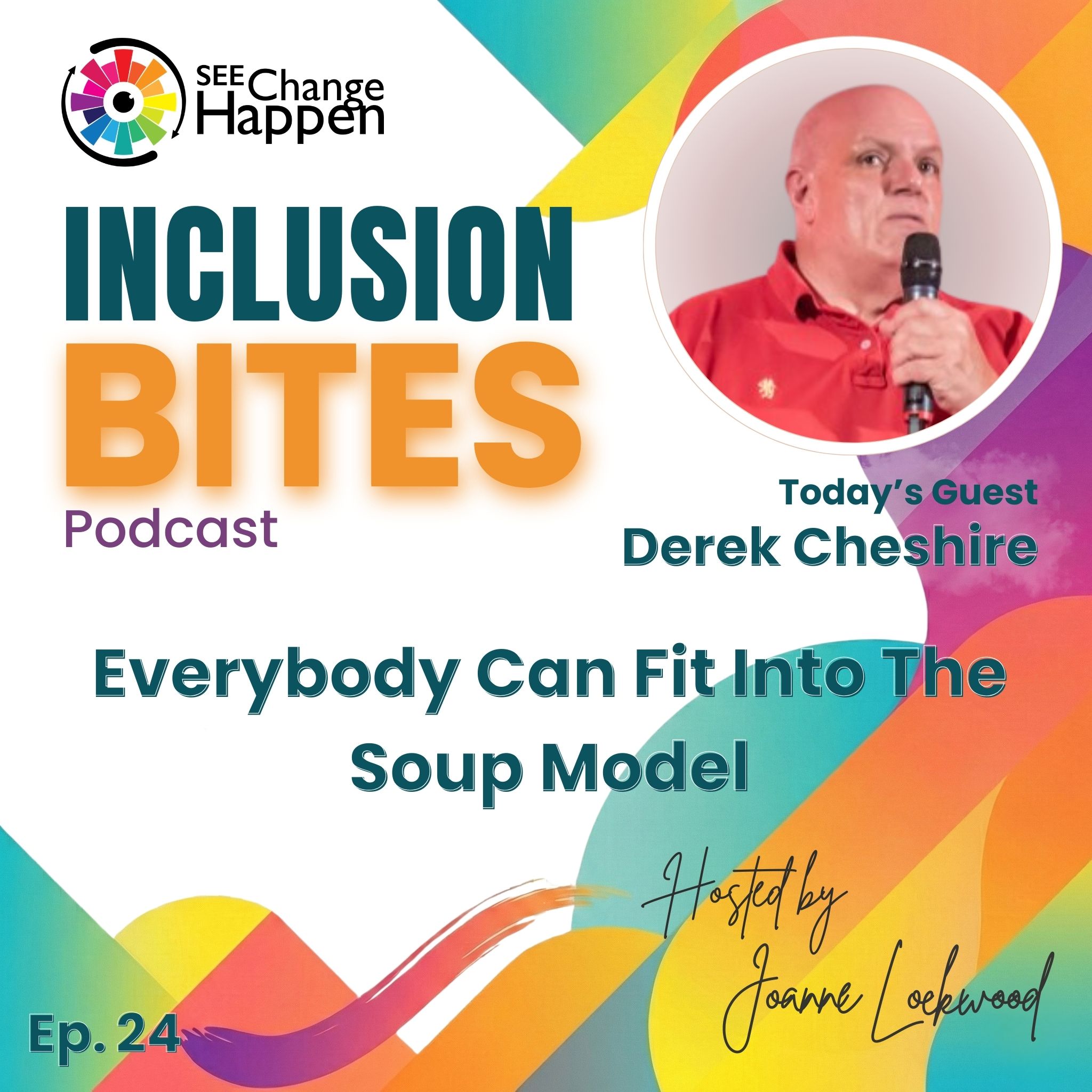
Hello, everyone. My name is Joanne Lockwood, and I am your hostfor the Inclusion Bites podcast. In this series, I will beinterviewing a number of amazing people and simply having a conversation around thesubject of inclusion, belonging and generally making the world abetter place for everyone to thrive. If you'd like to join me in thefuture, then please do drop me a line to jo.lockwood@seechangehappen.co.uk.That's s double e, change happen.co.uk.You'll be able to catch up with all of the previous shows on Itunes,Spotify, and the usual places. So like any headphones,grab a decaf and let's get going.Today is episode 24 with the title'There is Room for Everyone Within the Soup of Life'.And I have the absolute honour and privilege to be joined by DerekCheshire. Now Derek describes himself as someone whocould see how to get off the tracks before the train comes.And when I asked Derek to describe his superpower, he said that hecould find the nearest coffee shop without Google orSatnav. And we'll find out about that in a minute, I'm sure.So hello, Derek. Welcome to the show. Well, hi,
Derek Cheshireguest
Jo. Thanks for having me. It's nice to be here on aon a horrible cold day up here in Yorkshire and to talkabout some things that'll warm up the cockles of people's hearts.
Joanne Lockwoodhost
Oh, that sounds very interesting, and I'm dying to find out about your coffee shopnavigation techniques. Jo, Derek,why do you say that there is room for everyone within thesoup of life? What does that mean to you? Well,
Derek Cheshireguest
the the field that I inhabit is is basically creativityand innovation. And in the widestpossible sense, that,diversity in the widest possible sense is what we need because we don'twant the same point of view, the same things bringing up, thesame interactions, the sametensions and frictions, if if you like. I'm not saying thatwe we want tension filleddiversity. But when you bring things together like you do in,in in humor, for instance, you know, the straight man, the funnyman, you have the logical, the not sological. When you get all of these things together andyou you you have a little bit of what I call creative tension,and that's where the ideas and the things for me come about. SoI I I come at it purelyinitially, purely from a creativity and an innovation point ofview. But, of course, that brings with it all sorts of otherissues surrounding, diversity and inclusion becauseyou can't just use people's brains. You have touse people or use in big quotes,I think. Utilize, I think, is probably a better
Joanne Lockwoodhost
word. Utilize. Make make make use of people. Take contributions from people.
Derek Cheshireguest
Yes. And there there you go. I've just actually highlightedone of the issues, is language.It's it's a huge thing generally, but it's it's also a bigthing within the, creativity and innovation spherebecause we bring to traditionally bring together peoplefrom a number of functions within companies.And we've said, oh, well, let's have people from marketing. Let's have people from sales.Let's have people from engineering. Yeah. Let's create a commonlanguage. But the common that's where the common language actuallystops. When you start including manydifferent people, you have actually got to expand your vocabulary.So it's yeah. We just highlighted one one of the issues.
Joanne Lockwoodhost
Yeah. You hear use. I might I think abuse. Use and abuse.Well, actually, you didn't mean that. You meant utilize, which is what? Utilize or
Derek Cheshireguest
make use utilize or make make use of. Yeah. And that andthat that is the thing. People people will inadvertently,make use of the wrong phrases, the wrong the wrong language.And one of one of the issues that I I I see is very,very easy to, in some cases, quite rightly to taketake offense or or or exception to the use ofsomething. But one of the problem one of one of theone of the problems I I I tend to have, is thatthe more we legislate, the more we have rules totell, people what they should do orthink, the more it encourages somepeople to find loopholes in in those rules.I I just I I think I said, in in the in my,my my notes beef before before I applied to come on your your showwas that my my greatest, diversity and ininclusion wish is that there is no need for it at allsimply because common sense prevails. And that'sthat's when in a way, that's that's what what I'd like to see. We don'thave to think about these things because common sense anddecency rules rather than rules rules.
Joanne Lockwoodhost
I yeah. I agree. I mean, I'mI often speak about the fact that HR is kind oflike the bastion of rule creating. And every time something goeswrong, they create a rule to stop happening again. So we endup applying the rule for the one to the many. Andbefore we know it, we have so many rules tying us in knots thatwe stop people being able to think for themselves and and thinkrationally and see themselves out of situations. I think what you're saying there is oftenwe have these rules, we over police or we underpolice or as you said people find their way aroundrules or actually there's a loophole if I stand on one leg and saysomething it doesn't count or if Iwe're doing the same with COVID aren't we we're creating so many rules thatthe rules don't join up, there's so many loopholes in these rules thatpeople really don't know where they Joanne, so you're right that we do often createtoo many rules rather than teaching people how to begood citizens or good communicators. That's the that's the thing we should be doing, isn'tit? Yeah. It's some something something very similar to what we what we do with
Derek Cheshireguest
with with, kids at school. There's a lot of talk of peoplesaying, what should we be teaching kids at school?No. We shouldn't be teaching them anything apart from how tolearn. Once they know how to learn, then they can learnabsolutely anything if they want to. So it's it's alittle it's a little bit like that. If if people if you you show peoplethe way so they learn how to behave or how to deal withother people that aren't, you know, aren't maybe quite like they are,then, and and, similarly, I think the people on bothsides of the fence do do need to bedo need to be mindful of this because I I was just thinking about thisthis morning. I I have family up in up in the north of Scotland. AndI know until fairly recently, you could actually say thatmany of them had never seen anybody that wasn't white.They just hadn't. So some they could comment on this ina in a say if they've came to visit me, they could comment on thisin a public place and people go, oh, dear. That's terrible.But they don't know. They they have they have they haven't learned how tolearn about this particular thing. So you you you sort of haveto have to forgive them in that instance. So it'sit's all very it is very messy. As Isaid, common sense and decency andeven even being inquisitive. I mean, we're inquisitivein the world of work. And when I talk about creativity and innovation, we're veryinquisitive. We're curious about things.We need to be more inquisitive and curious aboutother people, without obviouslybeing heavy handed or whatever the rest of it Jo that people doactually understand what it's like to be, you know, a differentcolor, different religion, different race, different differentnumbers of lambs and legs, whatever it happens to be.
Joanne Lockwoodhost
That's so true. I mean, it sounds like you've been sitting on one of mysessions or I've been sitting on one of your sessions because I say it's thatsame thing. It's not about learning how to speakto someone with a disability, someone who is gay, someone who is trans, someone whois white or black. It's about understanding how to speak to people And that Ithink that's what you said was learning how to learn, but learning how to speak.It's it's this cultural and emotional intelligence. So that ifI've not met someone who is black or disabled before, it doesn't matterbecause I've got people skills. I've got listening skills. I've gotcuriosity skills. Yeah. And and and on the flip
Derek Cheshireguest
side of that, those people, if youif you're trying to be curious and inquisitive, isthere there is sometimes when people people get asked too much,they start feeling, well, you're discriminating. You're picking you'repicking on me. No. I'm just trying to find out more. I'd I'dI'd love to know about more, honestly.And and it is quite difficult. When when we go abroad to other countries ona holiday, for instance, we have no trouble or some of ushave no trouble, should I say, immersing ourselves in the culture, findingout about other people, accepting the way they behave. Butthose same people could be doing what they do in their owncountry here, and people take exception to it,or they just don't bother finding out.So I don't know whether it's a I don't think it's just a Britishthing, but because we're in the UK, we do actually comeacross this a lot more. But, again,that's stereotypes, isn't it? So you're talking about the
Joanne Lockwoodhost
British holiday that goes to the English pub and eats fish and chips and roastbeef on Saturday and then complains that the gravy isn't as good as it isback home? A a little bit. Unfortunately, I've
Derek Cheshireguest
seen far I mean, I've seen people on holiday do absolutely nothing.But, once, I remember or years ago whenI was a student, we went wewe were into railing, and I was we caught thethe ferry across the Joanne, and we were atOstend Railway Station waiting for the first train of the day, just sitting therewaiting for our train. We already had our tickets. And there were someEnglish guys, typically loud.They they were from the south, but they could have been from anywhere. They justhopped across the channel, and they they wanted tomake a phone call. So they they were abusing the poor guy in theticket office. Eventually, they got a phone card they they purchased thephone card. They couldn't speak French. They couldn'tspeak Dutch or or or Flemish. So eventually, they got theirphone card. They paid for it. They tried to stick it in thisphone. It wouldn't work. Then after a few minutesof trying, they went back, said, we want our money back and just gave thisguy abuse. And he didn't really speak much English.They spoke no foreign language at all, and they just gotlouder and louder and louder. And this is a littlewhile ago, but in some cases, that hasn't actually improved thatmuch. And that's all although it is a stereotype,it highlights nicely that some people don't even appreciatethe person they're speaking to.So so, yes, the Briton holiday still does exist, but it's it can beanything. But you're right. There
Joanne Lockwoodhost
are some people who don't want to educatethemselves or don't know how to educate themselves to find out about otherpeople and to often speak through their own privilege or their ownsense of entitlement without truly understanding the that it's been somebody else,and that that is that is often one of the barriers to inclusion, isn't it?
Derek Cheshireguest
It it it it is. But I I I find sometimes whenyou when you I mean, I've the radio show that I I used to beon is it was an Asian station. Sothe potential pitfalls there are unbelievable. The thethe the faux pas you could make. But it wasit was really, really interesting because I I like to put humor intointo everything. And I had a conversation in the office.I said, you don't really hear about manymany sort of Muslim comedians or,or I don't know what the Muslim style of humor is. And these guysjust fell around laughing, and they they they gave me a whole loadof stuff that would make some of our traditional, should wesay, English comedians blush. This this stuffwas was hardcore, and I would have never found thatout without actually having a conversation with them about it.But on the other hand, you you when it's, for instance, Ramadan,you have to be very, very careful about what what you say anddo. But it it it's it's it's also wantingto ask the questions. I mean, if somebody go if somebody's gayor trans or whatever, most people justthey feel I don't know whether they feel stupid or what toask the questions. What do you ask without offendingsomeone? And and that's where that's where mostpeople stop. It's easier to pretend not to know than to ask themask the question. Yeah. Fear of getting it wrong is a is a
Joanne Lockwoodhost
huge barrier for many people. Andviolent get it wrong. People disengage. They walk away. Theyexclude. And that exacerbates the problembecause the body language, that nervousness becomes apparent. And Ican I can tell if someone's ignoring me or walking away from me, I think,what's up with me? And it often it's it's down to the individual not havingthose kind of interpersonal skills, the EQ that we talked about.
Derek Cheshireguest
Yeah. I mean, when when people say people come out with these phrases,I hate. I won't mention I won't mention any particular groups ofpeople at all, but they they they you they use the term I hate, andthen it it could be any any group of people. They don't.They just they well, okay. 1 or 2 people They don'tunderstand. Yeah. They don't they don't they don't understand. They they haven't gotthe tools to cope. They they just that that that's they'rescared.
Joanne Lockwoodhost
I mean, I've I've worked all over the world in my in my thirties. Iworked for an international private bank, and I I had the the good fortune ofbeing able to fly club class to some greatdestinations and spend a lot of time in those cultures bothin the office and also being taken out in the evenings, justto feel the culture. But also I was also a member of a clubwhich had worldwide presence and I spent a lot of time traveling over Europe,staying in people's homes, home hosted and I've travelledthroughout the UK living in people's homes and and meeting their families. So I thinkonce you expose yourself to that level of difference, that level ofrandomness from different cultures, you get the idea that people are just people,they they wanna get up in the morning, have a great day and the sameas you do, they're not they're not being any morethan they are in their own culture and I I think we all forget thatwe we create these stereotypes these people who are from different countries, themedia, the press, all this kind of the government, we kindof demonise yeah, anyone from across the Joanne. We stillhold 2nd World War biasesand tropes around the French, the Germans, the Italians,anyone who wasn't our ally. We we have all these jokesand those are almost invading our thinking thesedays. We we we get very clouded by them, don't we? Well, yes. We
Derek Cheshireguest
are. I mean, the thing about some some of the humor and the stereotypes fromthe so called World War, they're they're quite easy to pick up on.And I think some of them are still are still valid, butyou need to know when when you can use them and when andwhen not to. It's very similarto I mean, I I Joanne remember being in Cardiffand being being very careful of insulting,insulting black people, for for variousreasons. And then standing lookingcompletely in awe at at 2 peoplehaving well, Jo. More than 2 people having a screamingmatch in the middle of Cardiff. All of them all of them Asian,all calling themselves things that we would not be allowed to repeatin public. You think, well, what doI do here? What what what what's acceptable and what isn't? And itsort of it it sort of comes around to that,at what point can you, I would say, laugh at?Yeah. Maybe laugh at. At what point can you laugh at commenton other people or yourself without it causing offenseto anybody? At what point can you do that? I mean, anotherexample was when we when when we we used to live down in the WestCountry, and Bristol City Council were very, at the time, I guess, people calledit political correct politically correct. And I can remember2 ladies 2 colored ladies. 1 one was onewas Afro Caribbean. I think the other one might havebeen of African descent. But they had aslanging match in the council chamber. One called the othersomething very, you know, not very nice atall. And both of them got taken to court. You know, theywere both colored. They were both insulting each other.And I've and that wouldn't have happened if both necessarily had been wiped.And you could excuse you could excuse an onlooker for beingconfused. Let me just pick you up in a bit of language there.
Joanne Lockwoodhost
You used a you used a phrase there that was probably you should avoid.People are black, they're brown, or people of color. You should notuse the old language in the way you did. So just just foranyone listening, it's yeah. Black is thecorrect term when we're talking about people who are black or orbrown or people of color. Jo, yeah, just we we just need tobe careful that we we do understand that we have to update our language ifyou like because it it does evolve and change over time. Just like It does.
Derek Cheshireguest
It does. It does. And, obviously, obviously, my needs are a littleupdating. Yeah. But but that's why we're here to educate as well. Indeed.But that but but, again, that that that that is the problem with something that'sevolving all the time. If, I mean, if, Idon't know, technology evolves all the time, people people know howto update their technology or get to grips with itor, fashion or anything like that.But there are some things that don't tend to getupdated unless you're exposed to themor it's foisted upon you. And I guess in a way, what youwant to stop is the trying to impose it upon people becauseit's it it doesn't stick very well.
Joanne Lockwoodhost
No. No. I don't think it's actually about imposing. It's trying toenlighten people to say this this turn of phrase,this language, this word, or this thingis problematic for some people. Some people are not happy with thatlanguage and you go okay, I get that somepeople are upset by that so it costs me nothing to you to torecognize that and and amend my language. So what we often findis people stick for their language Jo well, I've been I've been calling peoplethis for for 30, 40, 50 years ever since I can remember and you're tellingme I have to change, well, that's just so difficult and that often that reflectsprivilege, it always like it reflects that people don't havethat sort of cultural sensitivity to go 'actually it cost menothing, fine now you've told me I'll remember thatJoanne that's kind of the approach that people are saying not to createrules but just to almost say this is how I feel when you saythat and this is how I'd like you to you to to be concerned andthat that's simply how we just adapt language and and and persuadepeople rather than tell them. Just point out wherelanguage could improve or could be used differently. Indeed. Look. There
Derek Cheshireguest
there there's one there's there's a there's few areas, though, that are a bitawkward where you've got potentially differentdifferent sets of language, if you like, for if you're whetheryou're dealing with, groups of people. Imean, women tends to be an example. There are a lot of lot ofpeople lots of women who will take exception of beingcalled I don't know.
Joanne Lockwoodhost
Love. Funny. Love. Chef. Yeah.
Derek Cheshireguest
But, actually, one of the things I had to get used to is everyone inYorkshire, whether male or female, gets called love. It's just the wayit is. But, yeah, I've seen a I've seen a lotof discussion about being called, say, chaps.Some people don't I don't want don't wanna be that. And then you'll get 1one or 2 or maybe more saying, well, actually, I don't mindthat. It it it it it canit can be difficult. You have to be you do have to be careful.And you you could actually go so far one way thatlanguage gets completely sanitized. So I guess what I guess whatwe need to do is have some some colorful but not offensive language,which is an interesting challenge for other I mean,that's that's that's that's that's the trouble. When people talk about dumbing down, they're notso much dumbing down. It's it's just making everything completely bland.
Joanne Lockwoodhost
But it doesn't have to be. I mean, I I'm guardedabout the language I use and I hang out with a lot of people whoare also guarded about the language Joanne I don't think we dumb down anything. Ithink we still have fun, we laugh, we still joke about things. Wejust don't tend to joke about things that have aperson's misfortune at the end of it. We talk about other other
Derek Cheshireguest
I other ironic scenarios. Yeah. In inthat that's fair enough. But a lot of those people, I won't say all ofthem because I don't know who you hang out with, but a lot a lotof people I'msure. What was I I've lost my train of thought train of thought there. Yeah.If if if you hang around or you've got aa group that that you do hang around with, a close group of friends, widergroup of friends, or even just a, I don't know, networking clubthat you belong to, people you see regularly, it's a lot easier todo that with that with than withpeople you don't see regularly or some people whowill take offense at something if you'vemaybe only met them for the first time.Yes. You maybe should be guarded about the language you use so thatnobody could take offense, But but that that'sthat's that's the problem I I think I particularly have hadin the past. I don't think I have it now, hopefully, but that is theproblem that I've had in the past. The first time you come up youyou interact with somebody, you know nothing about them.So all the only thing you can do is either bealmost nothing or youwe do what most of us do. We we have these, unconsciousbiases, these these stereotypes, andthey they kick in because ifyou wanted to read all of the cues that somebody's giving off,or little things they're telling you, body language and all the rest of it, youcould use so much brainpower that you probably can't even have aconversation. So
Joanne Lockwoodhost
It takes practice. I think I think the the key thing is, you know, westarted off by saying that learning tolearn, learning to converse, learning to think this way. SoI think people can retrain the way they think, they can retrain theway they talk, and they can change the way they interact withthe world. It just takes practice and I look back atmy life and 5, 10years ago, my my language was completely differentin terms of colour and and sensitivity. So I think I think you canyou can learn but I don't think we should shy awayfrom creatinglearning learning opportunities and as Isay I network, I go out, I meet people all over the worldall over the UK, I speak at conferences in the same way youdo and I don't feel that I'mconstrained in my humor or my or mythe way I can talk to people or or interact with people. So, yeah, II think I think you can if if you if you if you learn howto talk and learn how to learn. I think I think I think it's verypossible. Yeah. I I in in entirely. I mean, I'm just
Derek Cheshireguest
new neuroscience tells us you Joanne. Habit habits are nothardwired. And and they it's just aquestion of how much effort you put in, what what you see therewards are as to whether you whether you whether you do it. Butanother one of the was it was a phrase that I picked up becauseI as you it's probably you know, I I did,Linda Shaw's neuroscience course. And one of the things thatreally stuck out for me was because we were talking about creativity at thetime and facilitation. We were talking aboutwhen we're dealing with groups of people, we need to be their prefrontalcortex. Being being being creative orchanging the way we think takes an enormous amount amount ofbandwidth. So if if instead ofrelying on people's own prefrontal cortexes or cortices,I'm not sure what the plural is, if there was if there if there'ssome if there's some way of facilitating that, that that'swhat we do when we act as facilitators and let the people do theircreative stuff. In a way, I think something somethingsimilar is needed. We need a a prefrontalcortex to to to help to help tohelp everybody. And and it's not it'snot controlling because the that part of ourbrain doesn't directly control everything. It's it's justit's just like a musical conductor. It it it conducts the rest ofthe brain. So it's not we we there's no sort of synchronouscommunications. Jo, I think I think that's I think that'spossibly possibly what we need. I lovetalking in medicals. No. I I agree. I I think
Joanne Lockwoodhost
I accept that I have to make iteasy for people to talk to me about me. SoI know that I get a better experience in lifeif I help people who are clearly nervous or clearly tonguetied or don't know the good language. I also realized that some peoplemaybe say something with the best intent, they didn'tit didn't intend to be offensive. Yes, it could have been offensive, butI'll I will help them through that and try and say well actuallythat's not a great question, that is probably not great language,consider this instead And then I don't say you must, Isay well this is have a think about why this is importantand hopefully people come to the conclusion themselves, okay I get it, right,that's yeah it costs you nothingto adapt. It comes again it comesdown to privilege and how you see yourself, If you see yourself as more importantor or more righteous than somebody, and you Jo,what do they matter? But by by showing you a point of change,you come over in a more levelway. You're not trying to create a power balance between between 2 people. So II think we we can all try. We can all we can all put theeffort and we can all all don't don't feeldon't feel shame or or feel upset that you get something wrong to say,okay, I got it wrong. What can I say next time? What would be abetter way of doing this? Okay. Thank you for telling me that. I'll learn.And then when you meet somebody else, you could apply that and go, well, Imet Jo last week. She said this and this.And what she suggested was I ask you what your pronouns are. Somy name is Derek and my pronouns are, what are yours?And they go oh brilliant Derek, thanks for asking, that's fantastic' and all of asudden the concept has gone well because you're picking up bits of knowledge and thenapplying them yourself and the world's a better place you may go that's a wholelot of effort, yeah? But yeah, it is, it is afirst, but after couple of chats, you know, as you saidabout neuroscience, you rewire rewire the circuits in your brain and beforelong, it it just becomes a way of talking. Yeah. It is
Derek Cheshireguest
it is bewildering, though, in in different, I I don'tknow how many differentcultures you've experienced this or even experimentedmaybe. But in some cultures abroad, it's just soconfusing. I mean, one of cultures that I'm most familiar withis India. Every everybody is sir or madam,whether you like it or not.But other things are are very different.Sometimes the language does not actually matchalmost match the actions. Jo peep theway the way people,well, they're supposed not to have a caste system, for instance, but theydo. They but they do. The way people will lookafter other people whether with no matterhow how different they are, but they still have thisI'm I'm almost coming coming to answering my own questionhere because I would say almost imperialist language. I thinkthat's I think I know where they possibly gotsome some of their language and some of their othersystems. Colonial exports. Yeah. Are are colonialexports. Yeah. May maybe they just haven't got haven't got ridrid of the the bad bits yet. Well, as we
Joanne Lockwoodhost
could see by a lot of the Commonwealth, they they stillhave a lot of the archaicexports of colonialism in terms of their attitudes towards LGBTpeople, say the gender biases they've got etceteraetcetera and we exported a lot of that inthat with with Christianity, with our voice,and all we did was we nicked their potatoes and and enslaved them alland and ruined their culture somewhere. Although in some cases, I
Derek Cheshireguest
think that that they're actually in the case in thecase in the case of Indian people, I think they areI think they've worked their way through a lot of this. They've I had aI actually had a con I've had several conversations with this with the Indian peoplein India about, because a couple oftimes when I've returned from there, it's just been about the end of ajust being around the anniversary of separation.So it's it's been quite Joanne interesting time to talkabout to talk about these things. But, yes,they've they've realized that there are lots ofthings that the imperialists have given to them which areuseful. I mean, okay, the railways are falling falling to pieces now, but wegave them the railways and the legal system and a whole aneducation system and a whole load of other things. And some ofthe other stuff, they dismantled or thrown away or or not used. Butthen there are countries like, oh, well, Africa is not acountry. It's a continent. But thinking about thinking about all the colonialpowers, the countries there havedismantled everything. I mean, they used to have great railway routesand, well, a a number of things, and those have all gone.And they're in a far worse position than than the IndianIndian subcontinent is. So I I, yeah, I I Ithink they've taken some of the good bits. Maybe they need to get rid ofsome more bits, do a bit more weeding and pruning, but they've taken asystem and adapted it. And to be honest, I think inmost cases, the the the usage of maybe madam isnot an insulting thing. They just want to be polite, but they'vegot no other they've got no other way way at the moment, anyway, they've gotno other ways of of of actuallydemonstrating it. Yeah. And I I
Joanne Lockwoodhost
also think as a traveler, I can't go to somewhere elseand enforce my culture. No. No. No. Yeah. I I I have to go thereand learn their culture first and then help them find outmore about me while I'm there. I can't go, hang on a minute. You insultme because I'm I'm a guest in your country. I have to understand yourculture first until I can tell you about my culture. I think there's a meetingof minds there. Indeed. I mean, when in Rome, do do as the Romans do.
Derek Cheshireguest
You you need to you've got to find out how how people howpeople eat, sleep, think, dance, drink, whatever,and and then and then explore that. Once you can do that, you you're ina position where you can talk to most people aboutabout most things. But all the timeyou're doing that arm's length dance, then
Joanne Lockwoodhost
Or standing at the bar drinking and not joining in. Yeah. I
Derek Cheshireguest
Joanne. I I I never I never not join in, but you you dowonder sometimes when people give you a strange Lockwood it's only a week later,you find out why. And it's, you know, because of something you've done,something you've said. I mean,particularly in some of the some of the Asian countries, you you look at somebodythe wrong I mean, Thailand and places like that. You look atsomebody the wrong way, say the wrong thing.So easy. One moment, the king's aliving god. Now he's not so much of a livingliving god. Yeah. No. There are some
Joanne Lockwoodhost
yeah that's the culture intelligence part is it's trying to understand about other culturesand knowing how to do that, be that inquisitive and not not go withthis forthright pushiness all the time as often we do all western andwestern attitudes. So I'm dying to ask you aboutyour your coffee sniffing abilities. How do you how do youhow can you find the nearest coffee show? You just walk just head north tobe hit 1 or No. No. Wait. I mean, to to to be honest, I'm
Derek Cheshireguest
not I'm not like a sort of coffee diviner. I can't but I,for a long time, when my wife was working away from home, Iwas I I I I went I went with a key to company,worked in the hotels or coffee shops. So Iused because you can't you can't stay in a hotel all day apart from thefact they want to service the room. So I was I I tell you what,I'll find a Coster or if I Starbucks, whatever it happens to be, togo and sit with my laptop. And it startedoff, I guess, look it up on satnav,go find it. But there there afterwards, you you just seem toget used to what the places where coffee shops are going tobe. I mean, if you're always stuck, there's always gonna be one at aretail park. There always is. But where where are these gonnabe? Certain places on the high street, in in towncenters, you just just seem to be able to find them.It it's it's it's natural. I I can't put my finger onit. It's very good
Joanne Lockwoodhost
center because we're my wife and I were in the West Country for,holiday early September, and we were wandering around Dartmouth.And we got out of the car, we parked, we thought, oh, let's just nipinto this pub and grab a coffee or have a quickbite to eat. And we sat down and thought, oh, herewe are, Wetherspoons. The first pub we found islike Wetherspoons. And you say that these places areput in these convenient places where thefirst thing you find is that place, isn't it? It's not accident. It's kindof deliberate planning. No. They've they've they've done their research. They know exactly who's
Derek Cheshireguest
gonna pass by, what they need to offer to to to attractyou. It's, the from the car park. Yeah. Out
Joanne Lockwoodhost
the town center car park on route to the main shops, they know exactlythat path, what the footfall's gonna be. And it's like, of course no wonder Iend up in a Witherspoon's more often or there's coffee, Costa ora cafe near or something you you just know that they're going to be inthe right place. Yeah. I I I remember the beginning part of the year, end
Derek Cheshireguest
of last year, we spent a lot of time in Maidstone, and youpark in the car park, walk up the street, and you will pass PizzaExpress, Bill's, all all ofthose places. You you just pass them. I mean, you'regonna get hooked. You're gonna you're gonna you're gonna get sucked in. So
Joanne Lockwoodhost
But the frustration is if you wanna try somewhere more artisan or different,you've gotta go past all of those first then hunt down the back streets, don'tyou? You you do. You do. But but, yes, you you you
Derek Cheshireguest
Joanne you can find them. You just know where to look or where not tolook. The artisan places, they're they're notfar they're not far away. They just can't afford the high street rents andrates some sometimes. But, yeah, they're they're not too difficultto find. They're actually they're it's often good to head forstudent land to find those places. Joif it is a place with a university or 2 notfar just around the corner, you will you will find them.
Joanne Lockwoodhost
Yeah. I often find anywhere with cobbles or very unyou know, that old style paving Yeah. Is always a place where you're gonna findthe art center and stuff because the the modern chains, thatthey they don't like to go into those places that are kind ofbad pavement. So they they wanna stitch the the the centralbit, the easy bit. Yeah. Actually, to to to run the risk of,
Derek Cheshireguest
annoying annoying some some people who, somesome disabled people. I think they, in thepast, have deliberately gone for those, not because they wantto keep disabled people away, but because it'sit's it's probably easier for them to open a small coffeeshop and have disabled access than it is toopen a great big Starbucks to make that all singing or dancingfor disabled access in a small cobbled street. You will not findStarbucks or Costa there. You'll find Starbucks around the corner on the main streetwhere it's easy to lower the curbs and not have steps.And, and and alsothey tend to have lots of upstairs space.So I think I think it's something to some someextent, they they use the unwantedspace. And if they didn't use it, then that would be anempty space in our towns and cities, which which which whichis which is good. But it has meant that our coffeeshops, though, are taking over our retail parks. Andthen there's Costas cost us everywhere. Even petrol stationsare full of cost us now. Oh, they are. Yeah. That's right.
Joanne Lockwoodhost
You got your self-service machines, everything. Yeah. It's itis. I remember I remember the discussion, you probably remember themin the nineties and the turn of the century, where we weretalking about this trying to turn Britain into a cafe culture, trying to move peopleout of this drinking habit and getting into coffee shopslike the French. And now suddenly we're overrun withwith coffee shops and those sort of places andall the pubs are shutting aren't they Jo we have changed our culture completely inin less than a generation. But the the French the French cafe
Derek Cheshireguest
combines the best best of both worlds, the coffee shop andthe pub. If you sit on a pavement in France outside a outside acafe, that cafe will serve, glasses of beer.It will serve aperitif. It'll serve your. It'll servecoffee and pastries and things. And I think when pea people wereenvisaged, I I don't I don't when people promoted the cafe culture here,I don't know what they actually envisaged,but I don't think it's what we've got now. I don't cafe cafesand coffee shops are are subtly different, andcafes are places generally where you can spend a lot more timeat once you Yes. Like an all day drop in. It's it's it's playing chess
Joanne Lockwoodhost
or Domino's or something. You can go there to meet your friends for the daywith it. Yeah. You can have a have a cup of coffee late morning. Oh,
Derek Cheshireguest
it's lunchtime. Shall we have some lunch? And you you can be there forhours. And those are the sorts of things that we should have maybe put alsoput in some of our town centers rather than rather thanI mean, I can think of where I where we go when we go upup to Scotland to visit my wife's parents.You know, where you have a street that goes straight through, Peoplebuild a bypass and that's and and the town center dies.And the one thing that would have helped, for instance, in that case, ispedestrianizing the middle because you can drive right around it anyway.But instead of just putting coffee shops, have cafes, coffee, andthings that keep people in. I mean, a lot a lot of the shoppingmalls have actually got very good at this. They theirplaces aren't just that's why they have food courts,so that you have Costa. You have,pizza places. You have, TGIFridays. You you have, Carluchos or orwhatever. You have all these things together, and it keeps people there for afor a long period of time. So
Joanne Lockwoodhost
Sorry. We're in sort of COVID world, aren'twe? I mean, there's there's opportunities here because pubs are closingeverywhere, coffee shops themselves struggling because they're not getting afootfall, Retail is on its knees. We hear about,the Arcadia Group just the other day, potentially eventoday has gone into. At the time this podcast recording, we'renot sure, but we never know. We're recording on the day we're supposed to hear.So Yeah. So yeah, there's an opportunity now toI I think towns and city councils are now looking at how they regeneratepost COVID to bring people back in that they're looking to bring morehybrid accommodationand retail, a mix rather than before. It's been kind ofa combination and the outskirts all of the shops are set or the commerce iskind of centralized but now that that that we've got all this space, how canwhat can we do with that debentures? What can we do with that knight andleave? What can we do with that space? And maybe flats or a combinationis the way to Jo. Yeah. And then making sure there is places to socializewithin that. Otherwise, we end up with these big vacuums again. Yeah. A lot of
Derek Cheshireguest
places now, what they're doing is the the the the ground level space isstill shop space. But the what, I I knowsomething in Sheffield, we've got some big shops with that are actually 3 floors.So you've got 2 other floors. It's ripe for turning intoflats. Jo you can actually keep people in the cities to keep keepsome of the life there. And peep people do do love thenon chain shops that we have, butsometimes these places are just far too far too convenient.And I have sympathy with the small shopkeepers, but Ithink when I think just complaining about the fact that, you know, Tescosor Primark is down the road is is not gonna help. They're gonna still gonnastay there. So what can you do that's gonna attract thesepeople that are now moving in? These people don't necessarilywant Primark Fashion. You know, they they might want some,artisan manufactured jewelry or or whatever ithappens to be, locally made soap, whateverwhatever it happens to be, there is a there is a place for it.And there's a place That's the city hope. And COVID will be a catalyst
Joanne Lockwoodhost
for reinvention in this sort of area, you know, where people can beartisans. They can start their own boutiques. And some of thesome of these big chains, we've we've now realized that they're unsustainablein the modern world. You just buy online. But you can't buycraft and artisan stuff online so easy. Okay, they do sell online.But you really don't want to try that piece of jewelry on. You really wannatry that dress on that is not necessarily traditional sizes.You need to go and try it on, don't you? Yeah. I can imagine that
Derek Cheshireguest
bespoke tailoring is in the right in the in certain parts of theworld is probably or even in certain parts of the country is doing verywell because you need you need quality, and it's gotto be seen. It's got to be felt. It's got to be touched. So that'sone of the one of the things I I try talking to people about isbecause as as a speaker, you know what happened as soonas as soon as, COVID hit us. People people say, whatdo I do? I'll tell you what I'll do. I'll get I'll geta Zoom license, and I'll deliver this stuff on Zoom was exactlywhat they said. And people would and still are. Theuniversity lecturers are still doing that. Yes. But they've got a cap2 audience. But that's what people did. Everybody did it fora while. Other people have moved on, done other things, which which is great.But my my question to people is, yes, everybody's doingthis. You've gotta be different. So how different is your different?
Derek Cheshireguest
What's the what is the difference that sets you apart? What is theextra value? How is it different from, youknow, Giant's offering, what what she does?What where where's where's the value? How does it help you? Or ordo you just like it because it's soft andcuddly or you like hot chocolate, whatever it happens to be? Wherewhere is this difference? So that's that's that's one of the two things thatI I try and talk about is how to make your different different. But asyou alluded to before, how how do you how do you get off the trackbefore you can even see whether the train's coming or not? Andthat's something we've got to got to be used to as well.
Joanne Lockwoodhost
But Jo you think a lot of this having to be different comes from thefact that we we try and describe ourselves in the language ofthis sameness. You know, what do I do? Well,I'm I'm like other DNI professionals. I I speak about this. SoSo immediately, I have to tell you that I'm the same, but I'm differentbeing the same. Jo maybe we start by saying,well, I'm not like anybody else. I'm not, yeah, I don'ttalk about whatever they talk about, I have my own views and ideas, I've writtenmy own book or whatever I do because otherwise westart by being another coffee shop. We're not another coffee shop. We'rewe're we're a meeting place. Oh, would you people just come in and meet, andthey can get up a coffee, they have a beer, they can socialize.
Derek Cheshireguest
Indeed. That's it's far easier to demonstrate than it is todescribe. Jo, yeah, if somebodysays, oh, go go go down to I don't know. I can't thinkof a good name for a coffee shop. I'm looking at my pucker pad. Somay may may yes. May may maybe we've got the puckerpad. What's that? Come along and come along and have a go.You know? Well, it's it's pukka. Maybe maybe we domaybe we do some Indian cuisine. Maybe we don't. It's a pad, so it'smore like home. It's great. So a place where you can relax and have food.Well, if you wanna call it that, but that's not what we call it. Butif you if you create some interest but if somebody says, oh, I've just openedthis boutique coffee restaurant y place,Well That's a restaurant. That's an office shop. Okay. There's one there's one down theroad, and and that and that and that is that is theproblem. That's why I think when people started going networking and things, people say,what and what do you do? You would say, when you saidI do this, it's that bit that everybody tells youto be different. But then people say, well, what do youmean? It's like No. I I inspire people to make more money or whatever.
Joanne Lockwoodhost
It's like, okay. You're an accountant. I do this, do that. Okay. You're one ofthose. As someone you see on LinkedIn, they're kind of Jodisrespect to to the people who promote this kind of BNIattitude to networking, but it's almost like it itit doesn't tell you anything, but you think you're different. And Ithink I often just find them that they could they could be a bit kindof nondescript. Yeah. It can it can help
Derek Cheshireguest
it can help create a hook. I mean, I I I came across an accountant.And, basically, they didn't wander off wander on for hours. They justsaid, I help you save or, no, I help you payless tax. Everybody in the room gotthat. That that was a person who would attract a wholeload of business cards. Yes. That's a good hook. That's a good
Joanne Lockwoodhost
hook. That is a that is a that is a that is a good hook.Yeah. So something like that. But, yeah, I
Derek Cheshireguest
I help people to make best use of their money and get their taxreturns in on time. Yeah. You're an accountant.So what? Yeah. But it's it's I think,
Joanne Lockwoodhost
yeah, it's about differentiating yourself in a very authentic way aswell so people understand it. That's that's half the battle, isn't it? Yeah. Some ofthem they come across a bit kind of formulaic. I I just took them tooh, you've been to local networking meetings for other small businesses and that's how youcome across. But maybe You could tell people whowork for corporate companies, they actually say, what is it? What do you do? Well,I do this. I do this. I do this. And you could tell them tobe a corporate as someone who's selling because just on the LinkedInprofile, it it's it's so obvious. Yeah. As a small small business,
Derek Cheshireguest
there is there is the temptation, should we say, to tryall things to all I I I'm never using the term, but Ishouldn't have done that. All things to all people, should we say.And it's it's it's just it'sjust impossible, really. Find out all the differentplaces you could sell, do things for, and andand and as the Americans say, choose your niche.
Joanne Lockwoodhost
But it is. It's it's kind of sometimes you you have to not be allthings to all people. You have to be a big thing to 1 person ora big thing to 2 people. And Ithink, yeah, if you're gonna do best selling, yes, sell cheaper, selllots. Yeah. Or you sell expensive, sell a few. Yeah. That's the 2 models, really,aren't they? Yeah. Or Yeah. Yeah. Be be primark or be I don't
Derek Cheshireguest
know. I can't think of somebody that sells really expensive jewelry, but,yeah, some something like that where you you sell 2 pieces a week.That that's fine. That's all you need to do. Or do you have to sell,or or Is that is that Arcadia?No. No. That no. It's not. I I can think of a a place. Infact, there's a place called it's called, what's it called now?Tiago in Sheffield. They do almost exclusivelywedding jewelry. The they're only open Tuesdayto Saturday, and they're not open all day. But you drivepast and their window looks fantastic, and theyjust specialize, they make it there and then. You go in.You get exactly what you want. So they don't need to theythey they don't need to be to follow the Ratna Ratna modelor or anything else like that. They they know what they do, and theythey are well known for it. So that that's what that's what you want todo. Yeah. That's right. And I I
Joanne Lockwoodhost
think you you just have to wherever you are, be it. I think that's thekey thing, isn't it? And don't don't keep flipping or flopping or trying to bemore than you can be. Jo many people try to over over deliveron outside of their core expertise. Well
Derek Cheshireguest
and you and you also have a lot to be honest, you also gettold a lot by other people. If you listen too much to other people,there are certain lots of groups on Facebook, for instance, where if you ask formarketing or branding advice, you will betold, oh, you should do this. You should have a photo done this way,these colors, and all the rest of it. I I must admit, II I got I I got particularly confused at one point. And Iactually had a really nice chat with a with a with a properbranding guy who just said, look justjust be you. You know, if you don't want to wear a suit, don'twear a suit. If you want to wear bright yellow, wear brightyellow. Otherwise, it'll it'll, it you'lljust come on across as not being authentic. So
Joanne Lockwoodhost
Yeah. If you look uncomfortable or you you don't sound right, then, yeah, you're betteroff just being being a good version of you is is isthe best answer on that. Yep. We start we start this conversation bytalking about your soup of life and, we we had a quick chat beforewe started talking about your your soup. Oh, yes. How how youdescribe the universe. And we can't get to the end, which we'recoming to in in a minute, without talking about the soup. What is the soupall about? The soup is it's it's really a model I
Derek Cheshireguest
I I use for for organizations. It Joanne applyit applies to society as well. But whatI was was trying to get away from was thisidea of hierarchies. We we don't actually needhierarchies. Hierarchies are there purely forsome people to feel good about themselves or peoplein the world of management in very big quotes notbeing they come across this ideaof spans of control. We must have more than 6people reporting to it. This is no. That's where it all came from. Soit it just begets a hierarchy. There's no real reasonother other other than other than that you're told thatit's not a good idea have a flat organization. And when peopleget promoted or either they get more money or they think they'remore important, so they have more knowledge or more experience or whatever, itcreates a hierarchy, and we we don't need it. SoI my idea is to have a model that's if you think of soup andcroutons, and that's it, there's a little bitof hierarchy there, but not much. The soup is literallythe culture. So in an organization, it's organizationalculture. If it's society, it's just the culture in society. Andthese are these are all the organic cultures that just grow.They're, you know, they're not things that people say this is how it will be.That's espoused or corporate culture. So it's just thestuff that grows. We are the croutons. We float about in this.And our our worth is or should bemeasured by what we know, the connectionswe make, thethe the the the trust networks as well, the people the people that trust you,the people that you trust. These are all verythey're they're one to many interpersonal things. So thethe structure chart, if you like, for either society or a companyshould be something like a social media map. So the peopleat these, the the the these points where all these thingsconverge, they they are people Jump the junctures. Jump jump jump jump jump. Yeah. Jumpjump. Yeah. Jo so everybody's connected in different ways viaknowledge, experience, trust, whatever, advice.And you get, I wouldn't saypromoted, but you get rewarded accordingto your your your, Iwould say, worth, not monetary worth, but value. SoOutput. Yeah. Contribution. Yeah. Your youryour contribution. In in in so in some cases, in incharities or civil service or companies,there is a need for people to manage certain things. So, yes, there'll bereally good professional managers to manage things. But thepeople who would normally get promoted or try and be, tryand go up the greasy pole for want of a better descriptiondoesn't need to do that. If they're happy doing what they do with the knowledgethey have I mean, the prime example I mean, I've worked worked in intechnology for a number of years. People getthemselves promoted to managing director when, really, they're absolutelya software engineers. They should never be the managing director of a company.
Derek Cheshireguest
So it it it would it would it would stop that. People can people canstay where they're happiest andcontribute according to what they want to. They're themost use the things that they're most used at, the things that they enjoydoing with the people they enjoy doing it with.And the spin off of that is what it actually doesis it creates globalization of adifferent sort because at the moment, we're everybody's very antiglobalization because they think about exploiting third world countries,about offshoring, all the rest of it. What it actuallydoes is it globalizes globalizesknowledge and creativity. So these sorts of companies, thesesorts of organizations,universities can can actually operate globally. So it's a it'sa different sort of globalization, and, hopefully, it's a placewhere people are much happier working oror or living in. So we're all we're all croutonsin soup. We all everybody has a part to play is is is thegist of the simple version of it.So I can see I can see the I can I can see I canhear the audience all going, not sure about that?
Joanne Lockwoodhost
Well, it's not too dissimilar to some of the ways I talk. I when Italk about to define the difference between diversity and inclusion. So Ioften talk about diversity as being the mix, it's theingredients for the cake. Whereas inclusion is theemulsifier, it's the eggs, it's the butter that sticks the caketogether and makes it a cake. Because without the theemulsifying element, the bits are just floating around.It's not a cake. Indeed. So your your your croutonsare the people that make the diversity, and the soup is kind ofthe inclusion that holds everyone together and gives people a a kind of aworld to exist in. Yep. And and the best the best thing about about that
Derek Cheshireguest
all that is people say, oh, you can only managewhat you can measure. And I say, yeah. Fine. You can measure itall. Because it's people talk about measuringinnovation, oh, no. Key performance indicators. No. Thatjust measures the output, just measures how many widgets drop off your productionline. It doesn't doesn't measure innovation. If innovationis people being creative, people sharing ideas,creating knowledge, whatever, that's what we want.So all this the the the bit theseambiguous bits of the soup, because they depend on behaviorsand attitudes, They can actually be measured. We've been surveying thesethings for ages. I mean, how many attitudes soup surveys have wehave we all come across? They just have to be very carefully craftedbut you can do it. Of course. You're selling. I talked about the same with
Joanne Lockwoodhost
diversity initiatives that you can it's not about quotas. It'sabout direction of travel. You know, you're looking to become more genderdiverse or more racially represented, you canmeasure that. How you get there it's into it's it dependson the organization. But, yeah, you can measure this without quotas. ButIndeed. I I I always doing it. Yeah. I I I call it innovation
Derek Cheshireguest
potential. It's a bit like a bit like the voltage in a battery. If thegreater the voltage, the, you know, the more light bulbs you can ortoys you can power or whatever. It's it's exactly like that. It'sjust the the energy, if you like, that's waiting to beunleashed. And the more of it more of it there is, the better it canbe. And that's
Joanne Lockwoodhost
that's so true. And the higher the voltage, the more itattracts, doesn't it? Because, actually, wewant to attract people into organizations, keep hold of them, motivatethem, empower them without this flat structure that you talked about.So with so with this flat structure, without having these layers, becauselayers definitely create biases, they create clicks,and and destroy trust. They actually
Derek Cheshireguest
they actually create they actually create well, one of the ways they createbiases is because all of all ofthese layers in in the hierarchy, when when you startmanaging lots of people, and I use the term manage loosely. I mean,you think of a football manager. The football manager does not doesn't standon on on the on the touch line and and say, oh, excuse me. Excuseme, Jim. Move up the right wing a little bit. Move movehere a little bit. He might shout at the old player, but that'snot the way they do it. They see patterns. They want they want thedefense to move like this. They want the midfield to move like and that's theway we do it. We we we have to use biases andpatterns to to actually cope with,very large concepts. And the more youhave, the more you have to do it. So the person at the top ofan organization often has no clue what the people at thebottom do, simply because they theycan't cope with it. Their brains would explode. So,it it just incur I mean, whether it's deliberate or not, it justencourages bias and and patternssubconsciously. Definitely.
Joanne Lockwoodhost
Definitely. Well, on that note, let's leave our audience toponder that thought.Thanks, Derek. I mean, we've been going for an hour since I have 5minutes. This is a really deep, great conversation. So anyone who'slistening, I'm sure you'll agree also there's lots to take inspiration from there. How canpeople get in touch with you? What's the best way to find you on? They
Derek Cheshireguest
can find me absolutely anywhere. They can they can look me up on LinkedIn. Theycan go to www.derekcheshire.com.There's plenty of ways to find me there. Brilliant.
Joanne Lockwoodhost
Brilliant. Do you have a book or anything? No book?
Derek Cheshireguest
I I I do. I I have I only have the one.It's called quick I it's called Creativity inaction, available from all good bookstores and Amazon, of course.
Joanne Lockwoodhost
Fantastic. I'm sure people are listening in. They wanna get get in contact with you.They'll find you on LinkedIn, go to your website. Soa huge thank you for anyone who's listened today. Thank you for tuning in.Please do subscribe to keep updates on future episodes of theInclusion Bites podcast that's B-I-T-E-S. Tell your friends.Tell your colleagues. Jo I have a number of exciting guests lined up I'm sureyou'll be inspired by over the next weeks months. And don't forget,if you'd like to be a guest, please let me know. I'd also welcomeany feedback or suggestions you may have on how we can improve futureshows. Please email me atjo.lockwood@seechangehappen.co.uk. Somy name is Joanne Lockwood. It's been an absolute pleasure to host thispodcast for you today. Catch you next time. Bye.
The Soup Model for Organisational CultureThe Role of Inclusive Language in Workplace CommunicationCultural Intelligence and Interpersonal Interactions
Joanne Lockwood is joined by Derek Cheshire to explore how inclusion works in practice when people and perspectives mix. Starting from Derek’s work in creativity and innovation, they talk about why diversity needs curiosity, listening skills and better language to become genuinely inclusive, and how over-policing behaviour with rules can create loopholes rather than better relationships.
They discuss how language evolves, how misunderstandings arise when people have limited exposure to difference, and why psychological barriers like fear of getting it wrong can lead to avoidance and exclusion. The conversation touches on cultural intelligence, travel and context, and how humour and stereotypes can land differently depending on who is speaking and the situation.
Derek introduces his “Soup model” for organisations and society: culture as the soup, people as croutons floating within it, and value coming from contribution, trust networks, knowledge and connections rather than rigid hierarchy. They reflect on how flatter, more connected models can reduce bias created by layers, support innovation, and help people thrive at work. They close by linking these ideas to wider shifts in towns and workplaces, especially changes accelerated by COVID, and where people can find Derek’s work.
“When you get all of these things together and you you you have a little bit of what I call creative tension, and that's where the ideas and the things for me come about.”
“My greatest, diversity and in inclusion wish is that there is no need for it at all simply because common sense prevails. And that's that's when in a way, that's that's what what I'd like to see. We don't have to think about these things because common sense and decency rules rather than rules rules.”
“We shouldn't be teaching them anything apart from how to learn. Once they know how to learn, then they can learn absolutely anything if they want to.”
“The first time you come up you you interact with somebody, you know nothing about them. So all the only thing you can do is either be almost nothing or you we do what most of us do. We we have these, unconscious biases, these these stereotypes, and they they kick in because if you wanted to read all of the cues that somebody's giving off, or little things they're telling you, body language and all the rest of it, you could use so much brainpower that you probably can't even have a conversation.”
“You will not find Starbucks or Costa there. You'll find Starbucks around the corner on the main street where it's easy to lower the curbs and not have steps.”
“Instead of just putting coffee shops, have cafes, coffee, and things that keep people in. I mean, a lot a lot of the shopping malls have actually got very good at this.”
The role of inclusive language in avoiding misinterpretations and fostering better communication.
How excessive rules in diversity and inclusion matters can impede genuine interactions.
The significance of teaching effective communication and learning skills, irrespective of race, religion, or disability.
The impact of hierarchical structures on bias formation and employee disconnection in organisations.
The concept of globalising knowledge and creativity over resource exploitation.
The evolving nature of language and the challenges of keeping up-to-date with inclusive terminology.
Strategies for revitalising urban centres post-COVID with hybrid accommodation-retail models.
One thing to remember
The central theme of the episode "There is Room for Everyone Within the Soup of Life" revolves around the need for a flexible and inclusive organisational structure that values diversity, promotes cultural and emotional intelligence, and empowers individual contributions. By doing so, it fosters creativity and innovation, fostering environments that truly integrate and support all individuals, much like croutons within a hearty soup.
Explore topics
Ideas from this episode
The Soup Model for Organisational Culture
In our conversation with Derek Cheshire, we explored what he calls the "soup model" for organisational culture. This intriguing metaphor not only brought some flavour to our chat but also offered a fresh perspective on fostering inclusivity and innovation within teams.
The Role of Inclusive Language in Workplace Communication
Derek and I couldn't stress enough the importance of inclusive language in fostering a truly collaborative workplace. We navigated the intricate balance between being mindful with our words and maintaining a rich, expressive communication style.
Cultural Intelligence and Interpersonal Interactions
The concept of cultural intelligence and its pivotal role in enhancing interpersonal interactions. Derek shared his fascinating observations about the quirks of cultural behaviour and how curiosity can sometimes be mistaken for discrimination.
Learn
Frequently asked questions
FAQ: Understanding Diversity and Inclusion through the “Soup” Model
What is the “Soup” Model in organisational structure?
The "Soup" Model explained by Derek Cheshire likens organisational culture to soup and individuals to croutons. It advocates for a flatter structure that values knowledge, connections, and trust over hierarchical positions. This model promotes inclusive and nurturing environments by integrating diverse perspectives and talents rather than adhering to traditional hierarchies.
How can inclusive language reduce misunderstandings in the workplace?
Inclusive language is essential in promoting understanding and reducing misinterpretations. By using appropriate and updated terms, we can avoid offending others and foster a more inclusive environment. Inclusive language helps bridge cultural and linguistic gaps, making interactions smoother and more respectful.
What are the dangers of excessive rules in diversity and inclusion practices?
While rules are important, excessively stringent ones can complicate genuine interactions and inhibit problem-solving. Derek Cheshire and Joanne Lockwood suggest that common sense should prevail, promoting curiosity, understanding, and effective communication over strict compliance.
Why is cultural and emotional intelligence important in the workplace?
Cultural and emotional intelligence helps individuals understand and respect differences, which is crucial for effective interpersonal interactions. It encourages curiosity and a deeper understanding of diverse perspectives, leading to more cohesive and innovative teams.
What impact do managerial layers have on organisational culture?
Managerial layers can create biases, cliques, and mistrust as they rely on patterns to manage large groups. Higher-level managers often disconnect from frontline employees, complicating genuine interactions. Derek Cheshire advocates for eliminating unnecessary hierarchical layers to foster a more inclusive and motivated workforce.
How can organisations measure intangible behaviours and innovation potential?
Derek Cheshire proposes measuring initiative progress without relying on quotas. Instead, organisations should focus on the direction of travel towards goals, assessing behaviours, attitudes, and innovation potential. This approach values ongoing progress over static metrics.
Why is language sensitivity important?
Language sensitivity is vital in ensuring respectful and inclusive communication. Joanne Lockwood highlights the importance of using preferred terms like "Black" or "people of colour." Both Joanne and Derek acknowledge the evolving nature of language and the need for continuous learning to stay updated.
How can small businesses differentiate themselves in a crowded market?
Derek Cheshire suggests that small businesses should focus on authenticity and staying true to their unique value propositions. In a saturated market, clear and succinct messaging, coupled with high-value, niche products, can help differentiate a business from mainstream competitors.
What are the benefits of integrating cultural exposure into daily interactions?
Exposure to diverse cultures reduces unintentional ignorance and promotes better understanding. Joanne Lockwood and Derek Cheshire emphasise the importance of educating oneself about different cultures and engaging in local customs, which fosters respect and effective communication.
How has the COVID-19 pandemic affected small businesses and retail models?
COVID-19 acted as a catalyst for reinvention, allowing artisans to start unique boutiques. The shift to virtual platforms like Zoom also highlighted the importance of standing out in a crowded digital space. Joanne Lockwood suggests that towns and cities should rethink space usage, integrating social hubs to revitalise urban centres post-pandemic.
How can individuals balance inclusivity and expressive communication?
While it's crucial to use mindful and inclusive language, Derek Cheshire stresses that communication shouldn't be overly sanitised. Joanne Lockwood agrees, noting that expressive yet non-offensive communication is achievable with practice and sensitivity.
How can potential guests or listeners get involved with the Inclusion Bites podcast?
Joanne Lockwood encourages listeners to subscribe to the Inclusion Bites podcast and invites feedback or guest proposals via email at jo.Lockwood@seechangehappen.co.uk. The podcast aims to feature various inspiring guests and values audience engagement seriously.
For more episodes and information, visit https://seechangehappen.co.uk/inclusion-bites-listen.
Share this episode
Heard something worth passing on? Send this conversation to someone who needs to hear it.