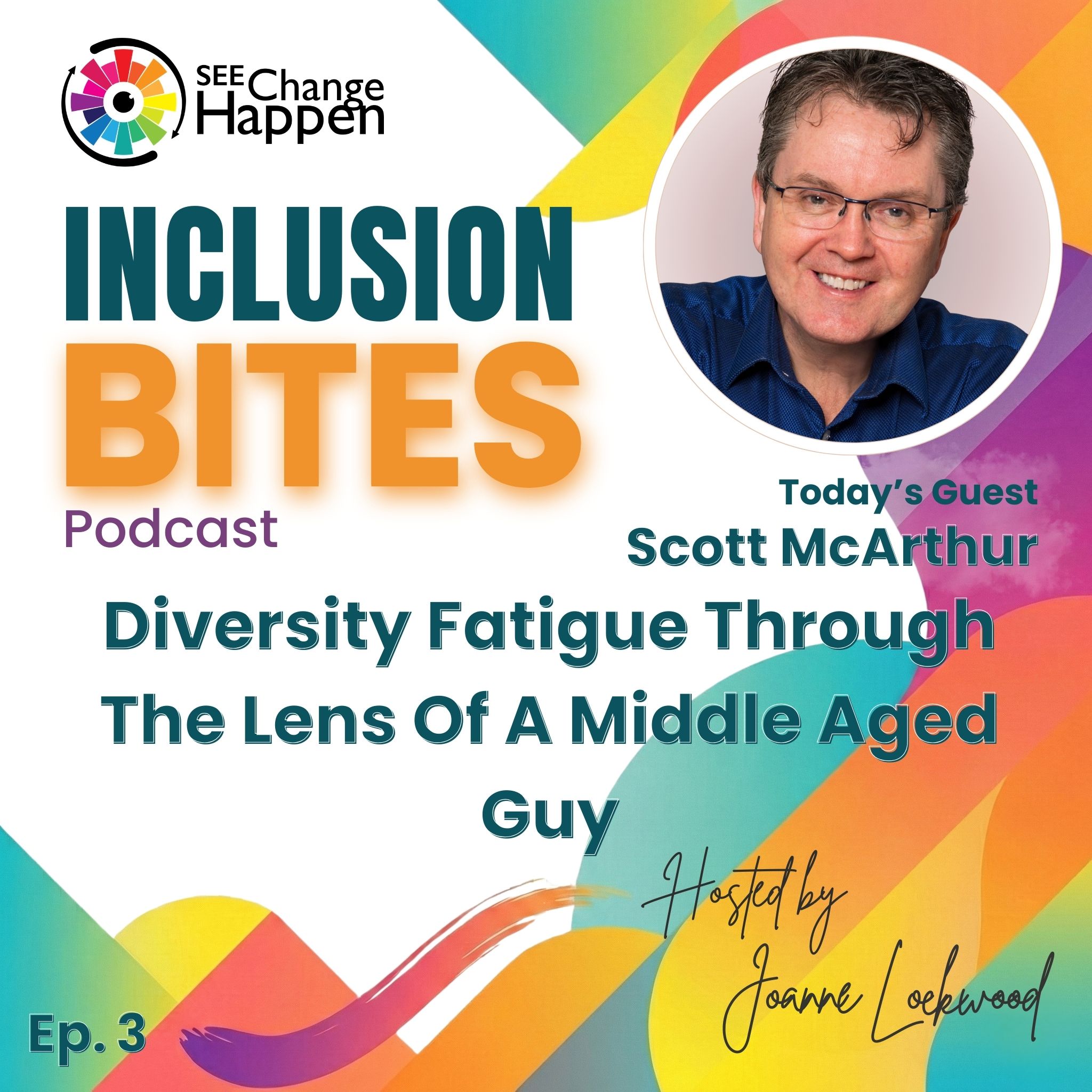
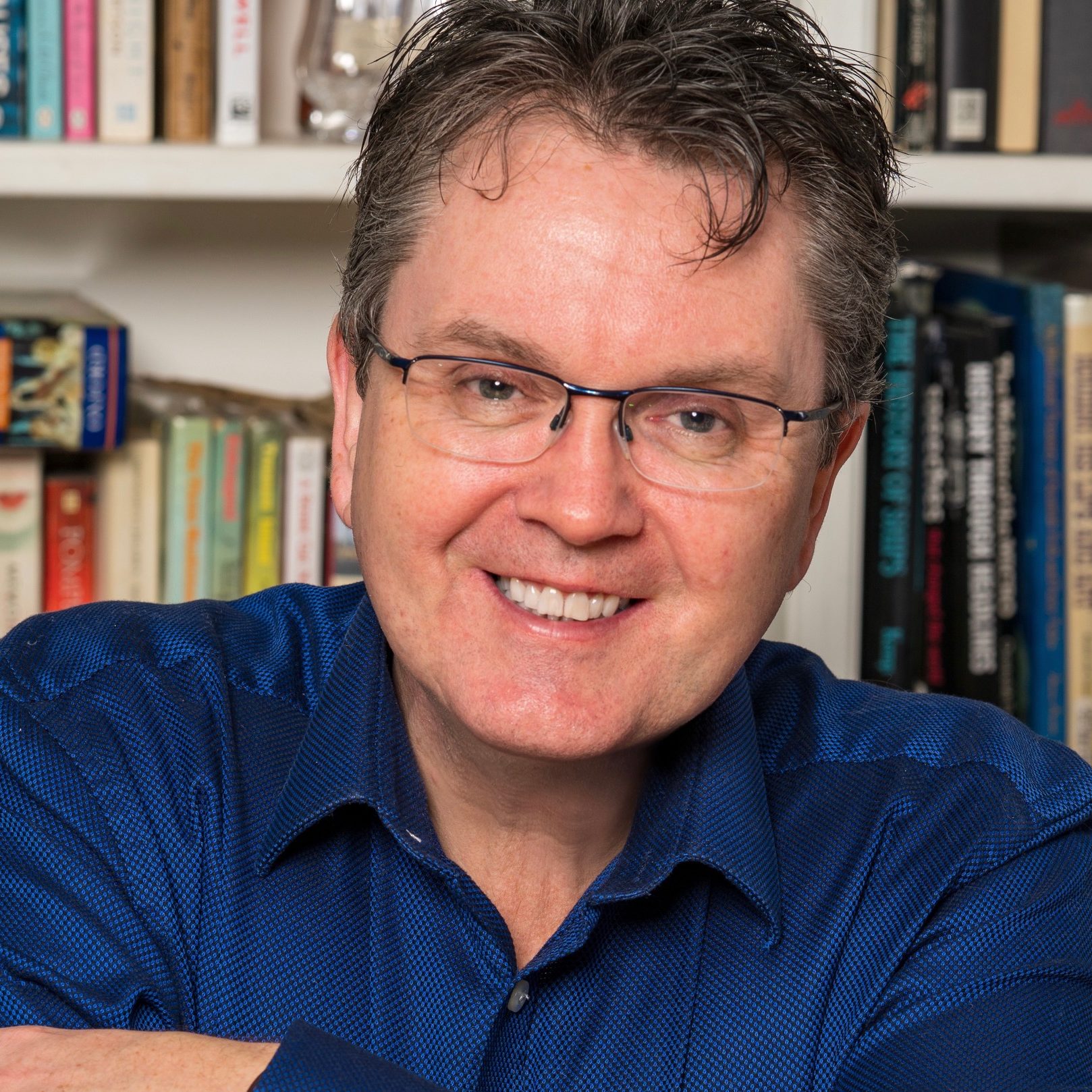
Hello, everyone. My name is Joanne Lockwood and I am the host of theInclusion Bites podcast. In this series, I will be interviewing anumber of amazing people and simply having a conversation around thesubject of inclusion, belonging and generally making the world aplace for everyone to thrive in. If you'd like to join me in the future,then please do drop me a line tojo.Lockwood@seechangehappen.co.uk.You'll be able to catch up with all of the shows on itunes, Spotify andall of the usual places. So plug in your headphones, grab a decafand let's get going. Today is episodethree with the title of Diversityfatigue through the lens of a middle aged white guy.And I have the absolute honour and privilege to be joined by ScottMacArthur, no less. And I first met Scott at a ProfessionalSpeaking Association conference in 2018, and we hit itoff straight away. Scott is a mentor, a speaker, awriter, and, as he says, has worked withmusical producers as a rock musical producer, a TEDx speaker, a businessconsultant, an HR director, a zoo ambassador,research scientist. And today, Scott focuses his writing and keynotespeeches on the employee experience and the workplace ofthe future. This is all through his lens experiences of science andtechnology. He has a particular interest in emergenttechnologies and cognitive diversity. Scott hasworked in over 300 companies worldwide wow.Including PwC atos, Superdry,Willis Deloitte, Specsavers, Capgemini and the ChineseOlympic Authority. I bet they've got problems at the moment. So I askedScott to describe his superpower and he said,I know how to read, so hello, Scott. How areyou? Hi, Jo. Nice to speak to you. How are you? I'm very good,thank you. We meta year and a bit ago at that PSA conference inwhere was it? Coventry way, wasn't it? Coventry, yes. That was
Scott McArthurguest
an interesting experience in itself, wasn't it? Yeah, we kind of
Joanne Lockwoodhost
gravitated, kind of kindred like mindedspirits. Yeah,
Scott McArthurguest
it was good. It was interesting because I think, if I remember rightly, therewas quite a lot of people knew each other, and you andI didn't really know many people there. That's whywe gravitated. But it was a good force of gravity.I'll never forget that. It was a good introduction. It was, yeah.
Joanne Lockwoodhost
It's quite daunting when you go to these events for the first time on yourown. Yes. And everybody seems to know each other, don'tthey? I think we looked after each other well. I
Scott McArthurguest
think we did. And I mean, actually, if I'm absolutely honest,despite the fact I'm a public speaker these days, I feelquite uncomfortable in social environments like that.For example, I dread dinner partiesand I can't stand formal networking events.I think I can empathise with people who struggle with it, kindof to. Collect sort of self professed introvert. Is that how you describe yourself
Joanne Lockwoodhost
or. Is it just I don't think I'm an introvert.
Scott McArthurguest
I've done all the tests and you know that I'm not a greatbeliever in the science is very poor behind most of thesetests, but I guess I'm maybe anintroverted extrovert. I don't know if that makes any sense,but I like my own company. I really like my own company.And I think it's partly why my superpower is reading books, becauseI love being in the company of Tolstoy or,you know, and I can do that by opening a book.And I can be quite difficult to get to know as well, becauseI put up this shield quite often that's not alwaysparticularly welcoming. So, yeah, I'mintroverted extrovert. I'm extroverted introvert. I don't really know
Joanne Lockwoodhost
ambivert, I think is the kind ofyeah, I've read. About that as well, but maybe I don't know.
Scott McArthurguest
But certainly I don't feel comfortable in social environments and this iseasy because I know you and I could talk to you all day,but certainly in these environments I feelquite uncomfortable. But the PSA, the Professional Speakers Association, does get easier,doesn't it, once you get into it and you crack the veneerof you get to know thesethink. Because as
Joanne Lockwoodhost
speakers, we're all opinionated, we all want to sell ourideas, we all have a certain stagecraft and presence aboutus. That's probably why it's daunting, I think. Once you realisethat you are the same ilk, if youlike, and then people start finding us daunting now, don'tthey? And it's kind of oh, they do. I think it's just a caseof breaking that ice and just jumping in. I thinkboth feet first isn't mean. There's a Scottish saying, I don't know
Scott McArthurguest
how well it translates, but it's we're all Jock Thompson'sBayams. And what that basically says is we're all theknow, we're all from the same place, butsometimes you have to rediscover that you're just the same as everybody else.And in that environment, it can be quite difficult. I noticed you've done a couple
Joanne Lockwoodhost
of ten X's over your life. I watched a few on the YouTube the otherday and if anyone's listening in, do look up Scott MacArthur'scouple of TEDx on YouTube. If you tell us the titles and just tell uswhat that experience is like. Well, I've done two.
Scott McArthurguest
One was one of the biggest ones in Europe, which was TEDxWarwick. There was a couple of thousand people there.That was quite a moment for me. I call it a thresholdmoment. You have these experiences in your life that suddenly you go,Whoa. And you see things differently. So at thatTEDx, I spoke about why facts don'tchange people and it's all about how important storytelling isand how important cognitive bias is, et cetera. And I was coming
Scott McArthurguest
at that from my scientific and psychological training andpast. But I'll tell you what the best that was, it wasn't theTEDx. I mean, that was daunting. I'd done lots of speaking at that point,but having 2000 people in front of you and a red dot, itwas quite scary. But it was the meal afterwards that wasactually the threshold moment because they took us out to a reallynice hotel to have dinner and I'm sat therewith I'll just give you a few. There was a guy who's becomea dear friend who's one of the UK's leading AI experts.There was a guy who was a prison guard from California.There was a professor from Bristol who's one of the world's leading authorities onNanotechnology. She's an incredible creature. There was a womanthere who was an opera singer, who was one of the she waslead soprano in the CoventGarden Opera Company. Unbelievably different people. And wewere all sitting there giving each other feedbackand it was just like it wasincredible. You wouldn't, on the face of it, think that an opera singer could tellsomebody from a scientific background about how to improve his talk,but she really could. So that was a thresholdmoment. The second one I did was TEDx Telford, whichis a much smaller 100 people, much, much smallerexperience. But the interview set up was terrific. And at that
Scott McArthurguest
one I did something that I never thought I would do. I spokeabout my relationship with my grandfatherwho was very dear to me and the talk was calledwho is paying for Your attention? And it was all about howthe analogue technologies, which is the future. I mean, analogue is thenext big thing. Digital is coming to the end of its time and analogueis going to be next. And I was basically going back to the future. Iwas explaining to them why a letter I'd hadfrom my grandfather and I've got a box of them that are foot deep andI call it my grandfather's foot, which always cocks people'sattention. But I could smell his aftershave, Icould feel his writing and where he changed his mind and there was all thesepeople crying in the audience. It was wonderful. Sothat one was more I guess it was slightly more aboutmyself. It was about my own story and telling it for thefirst time publicly, which was something I do as a speaker a lot. Butthat was a really intimate one. I was in tears.I came out off the stage and I was crying. You can't see that inthe video. But I was I was crying. And so it was acomplete two different experiences. But I'll tell you whatand I know some people criticise TEDx and say there'stoo many of them now and you don't get paid to do it.That's a load of nonsense. I absolutelylove it and I cannot wait to do the next one. It's aprivilege to have the opportunity to stand up there and meetthese incredible people. I mean, the one atTelford, funny enough, there was a diversity expert,there was a marketing guru, there was a guy whois a design expert, there was a chap who was aglobal warming expert.
Joanne Lockwoodhost
We've lost Scott. Hold on, something just happened.We've got a global warming expert and. An incredible
Scott McArthurguest
array of different types of people. So itwas a privilege, and it is a privilege to be associated with it.So bring on the next one. Yeah, I've not done one yet.
Joanne Lockwoodhost
I have applied once. I didn't get accepted. I don't think I foundmy story. I need to find something unique,something I've got a passion about, and crystallise it as a oneoff. Whereas I think before, the mistake I made was I triedto just tell a general, sort of like, doesn't work.It's not repurposing an existing keynote. This is developing something specific.
Scott McArthurguest
And I think the other thing is the mistake I made well, not a mistake,it was a learning thing. The first one. Well, they both get goodtitles. Why facts don't change. People are you paying attention? Or who is paying foryour attention? They're both easy to remember, they're both easy to say. Andpeople, they are what I call generative. You immediately think,what's he going to be talking about? And I think that helps. So ifyou go in there, and some people do, and I don't think you should, butyou go in there and you're selling a book or you're selling a product,I don't think that works. You just have to be yourselfand come up with something from your experiencethat really captures people.Actually, I'll tell you what you can speak about. I remember you telling me this.You said to me, and this is quite personal, so you might want to editthis out, Jo, but you said to me, one of mystories is about how I turned my wife into a lesbian. Yes.That would get 100,000 bites in a second on a TEDx.It would, because what's thatabout? It's got, obviously, sex, it's got all sorts of funny.And it's that sort of title that works as a TEDx.One of my mentees just now, she'sthe chief executive at Twycross Zoo and I'm zoo ambassadorthere, and she's just done one, and it wascalled How To Be More Bonobo.And it's rocketed it's over 40,000 hits.
Joanne Lockwoodhost
Wow. Because it's just this unusual title and folk go, who's that about?
Scott McArthurguest
There's an art to it, and I'm not saying I'm particularly good at it, butthere's an art to it, and I think it is about having one simple thingthat you talk about for 15 minutes. Yeah, no,
Joanne Lockwoodhost
I don't half forgotten about that as a talk title.
Scott McArthurguest
I've still got it in me. I've still got it in me and maybe that's
Joanne Lockwoodhost
the one I expand and go for.I'm not going to edit this out. I mean, for the benefit of people whoare curious. It's about how I took part. My wife and I took part ina Channel Four documentary which documentedmy gender transition. So we went from what people wouldlabel us as a heterosexual couple intoa same gender couple. So on nationalTV, she kind of became a lesbian. And that's kind of the basisof the talk. But I would go into a lot more abouthow we like to label people, how we feel more comfortable, and we put peoplein boxes, which is probably the basis of that talk,that people want to assume that those are our labels.And actually, we're not sure what our labels are. In fact, we don't bother withlabels in a marriage. That's how we woulddescribe ourselves. Yes. Of two people.That's probably a good point. What I need to do is I probably need todig out some applications and go on a huntfor a TEDx opportunity somewhere. Yeah, good point.
Scott McArthurguest
It's a great experience. I titled this
Joanne Lockwoodhost
when we talked about diversity fatigues with alens of a middle aged white guy. And the reason I suggest this iswe hear this expression, white male panellist tail banded around. For me, it'sa horrible expression. It's discriminatory, it'sinsulting and doesn't have any place in my world.But also, I am aware there is diversity fatigue. We're always quotingMcKinsey, we're always quoting these stats. We're throwingmillions and millions globally on unconscious bias training. But I think weboth know it's not working. We'renot causing a shift change in cultureovernight, or even at all. I think the latest stats on gender paygap, we're looking at 2080 before we get even gender parity,almost. We're making it worse before we get there. SoI'm also conscious that I speak to many men andthey're starting to feel marginalised. They're not being involved in the conversation. So how doyou feel as a man, as a white guy inthat space, talking about diversity and cognitive diversity?
Scott McArthurguest
Well, there's two parts to that. The professionalpart, which I spent 15years working in the HR world.I was an HR director, I worked in British gas, I worked inScottish and Newcastle, quite male environments, but I worked in whatthey used to call equal opportunities for 15 years.And I professionallyfeel excited, actually, about what's happening, becausewhat you've currently got, and it's a bit like politics at the moment, thereare interim moments. Remember I said that phrase thresholdmoments before? I take great pride in beinginvolved in the laying, the foundationthat's come to today. I think it has moved.If you'd gone to a gas engineer in the back of a vanin the 1980s when I was a British gas, they wouldhave laughed at you. And I'm not talking about you, I'm talking about me talkingabout equal opportunities. They would just laugh at you. What are you talking about littlegirls? But they've got no role in this. Blah, blah, blah.And now we're at a point where, yeah, it's everywhere.And for me, it's an interim step because itshouldn't be like this. It shouldn't be everywhere. It should be likeelectricity. It should just be there, but invisible. It shouldn't be something we have totalk about. That's the next phase. Soprofessionally, it's amazing.I'm really excited about it. But personally,there are things that are getting in my Wicklabelling just drives me nuts.I hate that toxic masculinity phrase. Icannot stand it because not just because it'sstupid, but because we allknow you, and I definitely know that if you label somebody something, theytake on that label. So it's completely counterintuitive.It's crazy. But as a bloke who looksfor work in the conference environment,I now have this monster that I'm competing against, and it's calleddiversity, and it hurts my businessright now. So there's a professional side of meis quite comfortable with it, but in terms of opportunities, for me, it'shad a negative impact. So I have to balance that. And, I mean,I'm obviously very happy about it in terms of the humanity side of it, butbeing in the interim phase is quite complex. And I think oneof the reasons you and I hit off is we can have that sort ofconversation. I don't know what tosay. What do I say? Jo, one of your other phrases that could beanother good TEDx title is, don't be a dick.You know that you've said that to me a million times. And I think thatis really telling because the environment is full of peopleon one side being offended. They become professional at being offended. I think that's ahorrible trait. And another side are just becoming more and moretoxic because of the labelling. So, actually, we've got to be really carefulabout how we because we're all Jock Thompson's bands, we're all just peopletry to do our best. And I think you said in your introduction, helping peoplethrive. And that's ultimately where I think we're heading.We're on a journey, and I think we're getting there. I think we're making realamazing progress. Amazing progress. Yeah. There's
Joanne Lockwoodhost
some great points you've pulled up there. And I find sometimes,let's call it in the DNI space, the conversations go on. You end up thesetwo polarised camps, the people who won'tchange and the people who demand change. And then there's often no room for thecentrist view, where people come together, where people are able to have these,I don't know, conversations. Please help me understand this. I wantto make things better. I want to make change, and I'd love you to helpme type conversations, but we keep getting caught up withbad language. We throw in phobias and isms all thetime. Let's be clear, there are some people
Joanne Lockwoodhost
who are toxic. There are people out there, it's not males, it's not whitepeople, there are toxic people, people on both sides of the argumentthat won't come together and have conversations. And I understandwhy people have entrenched views, having been oppressed, having beenbrought up in an environment where they have lived experienceof being discriminated against and bullied andbeaten up and violent. So I understand fully why people haveprotection views. But I think in a corporate world, we need to start comingtogether in this centrist ground, having open, honestconversations without fear ofreprisal. If you get it wrong, if you're comingfrom a position of respect, from openheart, to listen, to learn, then we should embrace people like that. And Ithink that's the challenge we have at the moment.But I think we still do detect someprotectionists from the middle aged white guys sometimes,because often we see initiatives that favourwomen, that favour ethnic minorities, that favour to people of differentfaith. Almost the point where we're saying, well, actually, if you're the white guy onthis slate for his role,you stand less change than a diversity candidate. That's
Scott McArthurguest
right, yeah. And I mean, that's why we formedI'm part of a group called the Whole Man Academy. The whole Man Academy, whichis a group of guys. There's three of us, fourof us mainly, who are looking at initially, it was to create a space formen to talk, because men aren't asgood as others at speaking andgetting airing their feelings, talking about howthey're coping with the label of things like toxic, masculinityand tim has been really interesting. Jo, ouraudience is men only, right? It'sabsolutely and deliberately and unashamedly menonly. We've had our biggest audience is women,which is really interesting. We'll come back to that. And our second biggestaudience is the bisexual and gay community and thetrans community, and our third community is men.So we seem to be getting this upsidedown response and it's reallybecause I'm just watching it what's going on.And on the whole, I'm speaking in stereotypes, but on thewhole, women are coming because they want their men to come.So they're saying, I'm going to buy John a ticket because John needs to talkto somebody about his feelings or about his biases,and we give them that environment and that's great.The bi and gay and trans community see to be, and thisis terrible stereotype, I'd love to know what you think of this, but theimpression we are getting is they are more in touch with our feelings, so they'recoming anyway. Half of our audience, literally, in every event,is from that community. And then finally, we're gettingvery fewheterosexual men coming into that environment that want to actuallytalk about how they feel. They're just not coming. So it's afascinating as an experiment, it'sfascinating. And we've had events where ourlast event had Rob Rinder, Judge Renderfrom the television, that chap, he spoke,charlie King, who's from TOWIE, came along. I was speaking,we had some others and we attracted 25 people,whereas if I do a talk in London, over 100 people turn up if I'mdoing an open thing in a pub. So I get more than the whole manacademy. I think it's the label, it's the man bit.We're not giving up because I think it's a really worthwhile and an importantpiece, particularly given, if you look at the mental health part of it,so many young men killing themselvesthat we need to do something about it, we need to help.But it's a very interesting social experiment, Jo,you think of that and it's partly in reactionto everything's about notme, and I think that's fair, that's a goodnatural human reaction. I'm not sorry for that, not in theslightest, no.
Joanne Lockwoodhost
Speaking from my own lens, my own perspective, and my own lived experience.What you're saying about people who may be LGBTI certainly went through a phase in my life where I had to think aboutme, who I was, my identity, relationships Ihave with other people, some of the things in my life thatI liked disliked, places I want to move fromand to. When I consider my own gendertransition. I had to think about collateral damage, who I was going to hurt.Was it worth it? Who am I? All this kind of stuff is going onmy head. So I probably did a lot of self reflection, self analysisabout my own sense of self and identity.And I think many people who go through whatever transition that is in their life,whether they've had an illness, an incapacity,or they've had a major death in their family or closefriends, we all start to then think about our own mortality and humanity,don't we, at that point? Yeah. And I think it's quite probably a true
Joanne Lockwoodhost
observation that in my previous life,I didn't do that. I was so focused onbeing the head of the family, earning income,delivering my job, hunter killerprotectionist type role, showing no weaknessand being there a 100% 24 x seven to make sure I wasdelivering what I could at work, living what I could for the family. And thenI realised that there was no fulfilment in that, it was just an emptylife. I wasn't living to live, I was living towork, and I was working to live.As a result of my change, I rebalanced my entirelife that actually, I want to live my life, I want to live mylife, I want to enjoy my downtime and I want to enjoy what Ido. And I was thinking about I wasout shopping in the local tesco's at the weekend with my wifeand I remember we filled our trolley up and we got such a cashier andI remember there's been times in my life where I dreaded having to paythe bill, thinking, Will this card work? Have I got enoughmoney? Can we pay the rent? Can we pay the mortgage? Can we do this?And I kept all that in my head without sharing with myfamily. So I had all this pressure. I had cash issues with thebusiness. I couldn't draw my monthly allowancethat month because the business hadn't generated enough profit. I was paying thestaff, I was doing credit control almost aggressivelyto get money in from clients, to pay people, to pay that, to pay that.
Scott McArthurguest
And then there's only a little bit. Left for me, sort of thing. So I
Joanne Lockwoodhost
remember sort of 20 years of my life running a business, literallyworrying about everybody.I never allowed myself to open up and say, well, how about me?I feel I can't cope anymore. I really am struggling. Yes.And I've certainly learned over the last three or four yearsa different way of being, which the gendertransition has been a catalyst and arealisation. And I'm not saying it's cause and effect, but thisis obviously in my head a long time. But it has I thinkit's interesting you note that your target audience is yourminority group. Yeah, exactly.
Scott McArthurguest
Fascinating.You've reminded me that one of the phrases that your audience might not have heardbefore is this phrase, cognitive diversity.And I think what you've just said, it reallyquite didactic there, because it remindedme of how I felt and howI grew up in an ex mining town inthe roughest part of Scotland that you can imagine. Verymale dominant, classic man getting the pay, goingto the pub and the wife having to come down and pull him out thepub to get money to feed the kids. That environment.And I never met a person who wasoutwardly gay until I was inmy never met a person of colour until I wasprobably 19. It was all thatenvironment. And to expect anyone to come out of thatenvironment, male, female, not to be impacted by it is acompletely ridiculous thing to expect.And I have been unfair on, like myfather, for example, who, on the face of it, is a homophobicracist. However, he's on his journey, I'mon my journey, we have different journeys. He's never metanyone. He's never had the experience to questionwhere he was brought up. And it's why I often say topeople, it's a bit trite, forgive me,but seek first to understand before being understood. You've gotto learn to ask questions andnot make judgments, because, Jo, you've got cognitive biases just asmuch as I have, as you know, andit's difficult. And that's why I like you, because you and I havethese debates where we'll probably fall out because we're like,that doesn't make any sense. But that's exactly how it should be.
Scott McArthurguest
You should be able to have this differentperspective. And again, one of the things I really value about our friendship isthat it's cognitively diverse. We are not thesame and we shouldn't be the same. And it meansand this is why, again, in many ways, I quite like the ProfessionalSpeaking Association. Because, again, you can be sitting there, and you can be talkingto someone who's an expert at doing training courseson cruise ships, and then you can be speaking to somebodywho's an expert at speaking about rape, and then you can be speaking tosomebody who's an expert on LinkedIn. And you have thesecognitively diverse perspectives. And whatthat does, if you're willingto see it, what that does is it holds a mirror up to youand goes, do you know what, Jo? Or do you know what,Scott? I don't agree with you. I see it differently.And that's where the magic is. I mean, David White, one of myfavourite poets, he says in one of his most beautiful poems, hesays, Start close in. Right, startclose in. And what he means is, you've got to start with yourself. And theonly way you can well, sorry, there's multiple ways, but one of the main waysyou can do it is by meeting people who are different to you, because theylook at you and they go, you're weird, or I don't agree with you.And that's like, oh, no one's ever said that to me before.And as long as you've got that soft front thing, you canactually learn about yourself from a stranger.And that's terrific. Terrific. But mostfolk don't see it. No, that's one of the things I try and
Joanne Lockwoodhost
talk about when I'm consulting or training or running workshops,is about the expression go and drink in someone else's pub. If youkeep drinking your own pub, you meet the same people. Exactly.Go to a stranger's pub, get involved with conversations, meet newpeople, expand your perspective, be likeable,be approachable, be open, be vulnerable and just get involved withconversations with different people. And I often encourage people to look at their circle offriendships, look at the people they know in their life andwithout make it sound tokenistic. Work out who you're notfriends with, work out what people don't have in your life and thenfind a way of meeting people. Either join community groups,volunteer, get out there and drink in otherpubs, or just meet different people in different groups. And then youexpand your circle of friends. Absolutely. I thinkwe've all got room at our table for more perspectives. Oh, yeah. As soonas we start narrowing our perspectives, we get a single view of the world. Thenwe have these polarised conversations wherenobody can have the middle ground. It's almost like a mediaevalbattle, where people are standing on the hills with their arches firing at each other.All the foot soldiers and the mental horses and their swords, and things aregetting slaughtered on the battlefield, and the generals just look at each other.Hmm. That didn't work. There's twice. The more arrowsand these battles are just last man standing things, aren't they, that no one wins.It's just who doesn't die? Who doesn't die? Yeah.
Scott McArthurguest
Crazy. That's what we are. Sometimes in these DNI
Joanne Lockwoodhost
conversations, it's the loudest voice, the biggestfists. Who's not going to die? Absolutely pummelledpeople into I've given up argument. I just can't take anymore. I'm out. Mymental health won't take this. I'm out. And that's what thepress, Twitter and all these online stuff does now. It just spreadshate from two hills with the arrows flying at eachother. Yes, absolutely.
Scott McArthurguest
There's an app have you heard of Shaper? No, Ihaven't. No. It'skind of tinder without the sex,what it talks about. And I'm not saying it's a great app, it's anokay app, but it's one of these swipey things, butit swipes on interestingness, and I quitelike that. I don't even know if that's a word. Okay. So, forexample, you'll go on there, and it'll have people from abroadcast. So you'll have scientists, poets, engineers,gardeners, whatever, cooks, and you can meet them, you canconnect with them and get to know them. It's not amean I think you're better to get something like the PSA than you are ashafer. But if you're sitting at home now and you're wondering how tomeet people, it could be a way to start. I met
Scott McArthurguest
a very interesting microbiologist that'snot a million miles from me, because I used to be in that game, butnevertheless, it's been 30 years since I've done it. So when I met her, itwas really interesting. And she is an interesting person,and that's a way to meet people. But because of the way society haschanged and I mean, the other thing that I think and you mentioned it, communitygroups, we're not good at that anymore. I'm anatheist, and I don't find the God thinghelpful, but I do find church helpful, oddly, becausechurch, if you take away the God stuff, was a great placefor people to come together, to dance, to sing, to talk.And we haven't replaced that in society because the church is dying. Andthat is a good thing. And from my perspective sorry if you don't agree withthat, but that's, from my perspective, a good thing. But we also, Ithink, have therefore left a gap. And there's achap called Elaine de Boton talks about this. He talks about the school of life,and he's trying to bring in the idea of almost secularchurches where we get together from different backgrounds and help each other. AndI think that's a real opportunity. I mean, someone's going to do really well inthat space, because I think as human beings and certainly from abiological perspective, we need to be with other people.We're not meant to be on our own. We're not thesewild cats that go around polar bears who spend most of their life walk aroundon their own and only come together for sex. Humans are not like that.We need the socialisation. I've been to a few cities like
Joanne Lockwoodhost
that, but yeah.
Scott McArthurguest
So there are opportunities there. But again, we're atthis threshold moment. We'll never get to theend. There's another beautiful piece ofpoetry that talks about we're on the pathless path.All these people talking about goals and all this stuff, andfrankly, I think it's a lot of nonsense because life isn't like that. You canonly really see life in hindsight. It's very difficult to see it that way. ButI think part of the pathless path is we need to be better atworking, being together. We used to be quite good at it, but that was withina construct that's no longer appropriate. So we need to think of a new constructand certainly not going to be going back the way it's going to be goingforward, but in a different way. Do I know the answer? No, I don't.But I do think there is an opportunity there, which is kind of what theHomean Academy is about, but it's not the answer.
Joanne Lockwoodhost
I think the new focus on things likemindfulness being moreintrospective, providing people support to know that goodenough is good enough, they are good enough. And a lot of stuff we're doingaround mental health, first aid is very powerful. And I think that'swhat we've lost. I think what we need to dois help men embrace this,where women will naturally come together and talk about their feelings,talk about the stress of their life, talk about the man in their life, talkabout all the issues with each other in a safe,friendly environment. But men always come to in my pastexperience, men come together looking for sort ofone upmanship, establishing their place in the pecking order,not showing weakness, or they'll be the brunt of the banter.It's making sure you're not the weak person in the pack, isn't it?
Scott McArthurguest
Yes. To burst into tears and say, I'm really
Joanne Lockwoodhost
struggling, is not a male thing. And Iknow two men have committed suicide through financial pressuresat work, business and family. And their problemswere solved immediately after their death by everyonepulling around the surviving partner and saying, we can helpyou and fix this. And their businesses were rescued, everyone was paid.So these solutions are always there.You need to have a fuse in your head that says help.
Scott McArthurguest
Yes. And even what you've just said is interestingbecause in a tangential way,because if you go into the football dressing room is a classicmetaphor. Right? And what's a reality. And I've heardpeople saying, it's awful. Thelanguage, the demeaning language, about women. Thedemeaning language about homosexuality and transpeople is terrible. And actually, I used to agree with that,and I used to during my British gas days, Igot dragged into a job where I was looking after welfare.And that's a word we used to use as much now, butwe used to have welfare officers who'd run events,and I had to look after these guys. And to be quite honest with you,Jo, they were disgusting. I was like, and I'll tell youthe story in the pub sometime, but there was some stuff that was reallyscary, but I've actually reframed that in my headnow. I kind of see it as saying that's reallybad is not right, because they obviously need it. There's somethinghappening there that they need. The problem is, there's not the next step.There's not the place for them to say, I've gone to thefootball environment, and I get a lot of that from my mates, and I likethat, and personally, I don't like it, but a lot of men clearly do.Millions of men clearly do. So just to say that'srubbish and discounted, I don't think it's right. I think we say, okay,men need that environment. Let's understand that. And I don't understand it, but let'sunderstand it. But then there's the next level. And this is what the Homean Academyis trying to do, is to say, okay, come along to one of our events.We'll talk about football, but we'll also talk about your feelings.We'll also talk about and we're trying to be cute with it because we'll talkabout things like fashion. Men never talk about fashionwith guests. Last month from a company called Shakeup, which
Scott McArthurguest
is men's makeup, right? And when we started to talkabout men's makeup, one of the guys said, put your hand up if you everuse your partner's makeup, nearly every hand in the room went up,right? It was like, whoa. So a lot of this stuffis about getting us together, men, women,and get us together and just get us talking abouthow it feels.Please don't misunderstand me. I also have an issue with the victimculture I think we've created. I work with school kids quite often,and you can see a lot of those kids are being programmed to be victims.And I don't think that's helpful either. But it's because it's socomplicated, and it's kind of why I use poetry quite a lot, becausepoetry cuts through a lot of this and things like,as a first step, stand close in. What does that mean?And it gets you thinking rather than telling you, this is how you've got tobehave. Does that make sense? Jo? I see a
Joanne Lockwoodhost
lot of people trying to repurpose the word victim.I'm not a victim. I was the target ofvictim is a very personal experience. Whereasif you can reframe that and say, I was the target of abuse. I wasthe target of someone's inappropriate behaviour. It puts it back to the personthat perpetrates it. So I think I think we shouldstop using victim andsaying, I was the target of andyes, if you identify as a victim, that's fine. I'm not saying you shouldn't, butwhat we need to do is push it back to the people creating those scenariosin the first place.But it is if you are the targetof abuse or the target of discrimination, throughmicroaggressions, through socialisation, through all the things.And it's a very privileged statement to say, well, I don't seethat man up, girl up, whatever thatmay be. It's a very privileged way of looking at life. And it'soften incumbent on those with privilege to walk in theirshoes, to understand their lived experience and to try and think aboutwhat's going on in their life and what support you can give from that perspective.Rather than don't just chuck money at something, actually, some peoplewould rather you embrace them and gave them emotionalsupport, not financial support. Give them attention.
Scott McArthurguest
Give them some attention. Belonging, value, worth,
Joanne Lockwoodhost
encouragement, praise, motivation goes a longway. And understanding what motivates people is somethingwe do in the workplace all the time, isn't it? Absolutely.What's the future, then? What's the future for diversity initiatives?And how do we get men to have these conversations with each otherand have conversations with women and have conversationswith people who are not like them in the workplace? How do we get themto come together? Well, God,
Scott McArthurguest
there's a PhD thesis on that question. Magic bullet.Yeah. It's not going to besimple.That's right. But it's true. I think there has to be somecarrot and stick. So I think legislation hasto change. I think,with the world I used to live in, employment law has become far tooabout, far too much about quotasand not celebrating difference, but actually making moredifference, which I've got, I think is just stupid looks at it the wrong wayaround. I think there are real nitty grittythings like maternity and how that'sdealt with and how careers are dealt with, how companies respond.But I think there is actually, and maybethis is more a hope, one of the thingsthat is belonging more and more obvious to anyone whoworks in any number of companies. And I've worked in over 300 companies.And you start to see trends in all sorts of companies, and you start tosee how they're morphing and changing and all therest of it. Now, I don't buy into the millennialsnonsense and I don't buy into all this stuff. It's just silly. It's
Joanne Lockwoodhost
consulting labels, newpackaging. We don't need it. We don't
Scott McArthurguest
need it at all. But what is happening?I don't know. And I'm proud that I don't know, because I really don'tknow. If you look at the high street now oreven online, however you buy things, what are peoplelooking for now? They're looking for things to be done for them as an individual.So it's personalization individualization. So youget your coat can with your name on it, or you get your dress doneto measure in the shop with a scanner, or you get all this ishappening and you think, okay, that's only beingaround for a long time, but it's only really getting traction now. And I'veseen some of the emergent technologies in this space which is going to make iteasier and easier and easier for companies to do things, bespoke products foreverybody. So it used to be the driving force behind companieswas something like we used to call it scalable efficiency, right? So everybodyhad the same uniform, the same terms andconditions, collectively bargained with trade unions or staffassociations, all of that stuff that's now counter towhat's happening in our lives. We're looking for individualism.We're looking for things that are for me, not for my tribe.I think that and I can't imaginea future where that isn't going to be just something that keeps going like that.It is exponential, and a lot of folks use thatwithout really understanding what that means. Exponentialmeans that if I take 30 steps from where I'm sitting rightnow, I'll be in my loo, which is just down there. Joright. 30 steps will get me to that loo. If I take30 exponential steps, I'm on Mars,right.
Joanne Lockwoodhost
Doubling each penny on a chessboard. That's exactly
Scott McArthurguest
the grain of rice, the famous story. But if that'shappening in society about individualization,there is only one thing that's going to mean, and that means that at workwe're going to turn around and we're going to say, I'm not acceptingcollective bargaining. I'm not accepting quotas. I'm notaccepting the collective model. Now,I know people have, you can say my superpowerreading in one of the great writers in this space, who I don't like, butwas Iron Rand, who was writing this in the shewas talking about individualization from the market beingthe ultimate supreme ground force. And I don't agree with that. But what Ido agree with is where you look at it and you say, okay, what willthat mean in the company? And it will just mean that if you want myskills, you're going to have to give me what I needfor my life. It's why I don't believe in the work life balance thing aswell, because it's a false binary. It's just nonsense.But that's another talk. But for me,it's coming, and companies are not quite thereyet. And I think that will be the beginning of making this a much easierprocess for us all, because again, it's why I amvery cautious about things like psychometric testing who say, oh,you're a yellow or a red or a pink. No,that's labelling and if you get labelling, you know that that can never be agood thing. There are 7 billion different personalities in theworld and we should celebrate that. And then people say to me, well,we can't do that, too expensive. No, technologyis taking us on that almost evolutionary journey where we can I mean, evolutionusually takes millions of years, but not in this context. Wecan now do things efficiently, but at the individual level. AndI think, Jo, that's our salvation because ittakes away all of this. So our conversation would justbe Jo and Scott having a it's. Itell you, you taught me something, right, about speaking,actually, and you said, imagine how you wouldfeel if the MC came on the stageand said there were two types of people in the room. Therewas blue people and red people. And they walked in and went, Good morning, bluepeople and red people and I was yellow, how wouldI feel? Right? And you taught me to say, Good morning, everyone.Do you remember that? I don't remember even doing it right. Tinylittle change. And I thought, Shit.And I didn't mean when I went up and said, hello, ladies and gentlemen, Ididn't mean to not include somebody,but I never realised. Sorry. I did realise, I just never thought aboutit. I'd never thought about it, so I never realised. And Ithink that that sort of story that you tell and Itell to a lesser extent, but will help people understand that we'reall Jo Thompson's Bears, we're all the same, but we're actually allunique and it's that we should be celebrating and not thingslike in the HR world, recruiting to matchcorporate values. What a pile of nonsense.But people sell that and people go, well, it's reallyimportant, it's actually killing your business,particularly in the next ten years.
Joanne Lockwoodhost
Branding, that's what it's all about here's, our visions of values. Wewant to use that as an excuse for cookie cuttering somebody else.
Scott McArthurguest
Yeah, well, let's be honest, it alwayswas about discrimination and it was deliberate, manageddiscrimination. And I get know historically, if you'rerunning an army, you need somebody that fits that mould. Theyneed to be the know. But if you're running Martin Spencer's oryou're running Barclays Bank, you don't need that. Atmean, I won't tell you the company name, but I rememberjoining a company and just look at my CV, you can work it out. Buttheir induction programme, they actually told youwhere to get your haircut, what suit you were allowed towear, what aftershave you had to buythey actually told you what fucking umbrella you were allowed tobuy, Jo, from what shop.It was the same with the girls, butthey've stopped that now, which is good, but that iswhere we're coming from. And anyone who's naive and include you and I inthis, who thinks we can change it overnight? Well, they've just been naive. It'sgoing to take generations. But to answer your question, I've been prattling on now, butyour question is such a good question. I think that change will bethat will be driven by a mixture of sensible legislation,but mainly about the culture we live in, being based onindividualization of products, and that will drive a demand and arequirement for companies to treat us as individuals, not as labelledgroups. Some good thoughts there. Personally, I think
Joanne Lockwoodhost
we're going to see the rise of the artisan. We're going to value theintellectual ability of an individual and that fits into yourindividuality there. And organisations need to learn how tomanage artisans and respect them and motivatethem and not box them into this corporate structure. We need moreneural networks of employees and people, and don't think ofemployees as team players in our neural network. And ourartisans in the future are going to be gig workers. They can have a portfolioof careers, they're going to come together for small, discrete projects,maybe in an agile workforce, resources on demand. So again, weneed to be able to value and motivate these people differently than just put themin this HR box. I also think we also have increased
Joanne Lockwoodhost
pressure on mental health because if a lot more people are going to work remotely,going to work in isolation, what outlet do people have for socialisation,to share ideas, to have discussions, to have disagreements and agreements?I think that's the danger of the future, where we end up just having conversationslike we are now online with one on one, but we don't enrichthat with a broader experience. I think that's maybe the challenge of the future isto stop people feeling isolated, because as soon as we see people likeindividuals, some of the tribe and team spiritdisappears as well. So we all become gifted individualsand not team players. So those are definitely challenges as I see it.
Scott McArthurguest
Yeah. As far as the pathless path, we don't know where it's going to go.But another thing that I quite often have heated debatesabout is people telling me that we have to thinkabout development in a different way. It has to be done online.No, it doesn't. There isnot a platform on the planet that does it well, theydo it okay. And it's only ever going to be okaybecause, you know, you're sitting, you and I can have this conversation here, partly becausewe know each other, that helps. Butactually, to get the real nitty gritty with somebody, you'vegot to be in the same room as them. You can't replace it. Thereused to be a phrase and I don't like it, but it was a blendedlearning. You would look at things from different perspectives and of course we now knowthat learning styles is nonsense and all this labellingstuff is all nonsense. But getting peopletogether is dynamite. Dynamite. And it goes right backto where you started us when you mentioned about community. Community isnot online. You can help with online stuff, but the reality is,and a lot of people get a lot of good things out of the onlinestuff, but actually, real communities like face to face,touching. Hands, et cetera, and a blend,
Joanne Lockwoodhost
blended learning. We're not kinesthetic,audiovisual, et cetera, et cetera. We're more than. But we all appreciatediversity of learning opportunities in two different ways.Absolutely. Storytelling is a very historichuman way of communicating. We draw cave paintings, we tell each other stories.The Icelandics have the sagas of Snorri totalk about their culture, how things have evolved way before we can write and communicateand transmit. The human species developedthrough stories, which is, I guess, where religion, a lot of religion came from throughthe stories. But we love our stories.We go to the cinema to see a story, we come entertainment. It'sabout taking us from a journey from here to here and making us feel greatat the end of it, or sad or happy getting an emotion. So, yeah,humans coming together and telling stories is very powerful.I'm a great believer in that. But they don't teach us how to tell
Scott McArthurguest
stories. No. I was working with a group theother week, two weeks ago, young people who were all doing quite well on theircorporate jobs. And I'd watched them all do presentations. Therewas maybe 20 of them. Not one of them told a story.Not one of them. It was all about bullet points andabout leveraging the value, all that nonsense, languagethat you get indoctrinated with. But of course they don'tteach you at school. It's crazy. The important stuffis not done at school. They don't teach you how to have relationships. Theydon't they don't teach you how to read a book. And I know, Ithink that's my superpower. They don't actually teach you how to read a book atschool, and they certainly don't teach you how to tell stories.What's more important than those three things? I can'tchange? Yeah, you look at the recruitment
Joanne Lockwoodhost
process, we base it on a CV and we were taught how CVS, andit's all about bullet points. Iachieved even short sentences.I did this and I achieved 50,000 pounds worth of saving. Whatever.Let me tell you a story about who I am. Get to know me asa person. Get to know my values, what makes me tick, what makes me happy,what makes me sad. Those are the conversations. And you go, Actually, I think you'rea fantastic person. You'd be great here. We'd love you. Come and have a job.
Scott McArthurguest
Come and have a job. Let's figure out how we can make that work together.
Joanne Lockwoodhost
And we never have those conversations. I appreciate hiring atscale isn't very difficultfor artisans, for specialists, for senior managers, forleaders. We need to have that more story based. Who areyou? Tell me about yourself.
Scott McArthurguest
Sorry? I mean, tell me about yourself again. Creates problems for people
Joanne Lockwoodhost
with diversity, then. We're always wellversed in the storytelling art, sowe got to respect different learning styles, different personality types, to be able to alloweveryone to succeed within a story and wellbeing, environment.There's no easy magic bullet, as we've said already. No, it's
Scott McArthurguest
complex. That makes it beautiful. That makes it beautiful. For me, thatjust makes it beautiful. Complexity is beautiful. Simplicity, it's abit like and I won't go on about this, but one of thecompetencies I really don't like. Really don'tlike, and I know it's anindicator of someone who is going to have a problem with me,if nothing else, is people who are certaincertainty is the sign of a fool or ateenager. Yeah. Certaintyis just such a silly way to be.And that's why Brenny Brown nicked us from the Buddhist. But she talksabout having a soft front. Strong back and a soft front and a wild heartthat she added. But that's what that meant. It meansthat a soft front means you take inyou don't have a hard front. The armour like the certainty thing.
Joanne Lockwoodhost
I agree. And it's beautiful when you think about it,
Scott McArthurguest
but people don't get it. They think, companies think, oh, I needsomebody who's dead sure and they need to know what they're doing.That's how we got the Scottish Parliament building or the two, orwhat they call them, black swans. That's because people were certain about what they weredoing, rather than actually open to feedback and changing what they were doing.But I won't go on, Jo, because. That
Joanne Lockwoodhost
subject, that's another hour we can have a questionI like, which is strong opinions, lightlyheld. That means you can have aviewpoint. You do know what you stand for, but lightly held meansyou're able to embrace other people's and maybe adjustyour own and recontextualize it, or accept other perspectives.Your soft front, strong back type. I love thiscontent as well. Anything that says, Iwant to speak to somebody who has an opinion. But I'd like to thinkthat between us, we can come up a third opinion. Bit of yours, bitof mine, and a shared one. And I think the basis of allstorytelling and human direction is to come up with a third view, which is amalgamation.
Scott McArthurguest
Yeah. Well, I think we yak on
Joanne Lockwoodhost
now for well over an hour, and that's been fantastic. So howcan our listeners and our viewers find you? So you've got hashtags and what'sa good way of finding? Well, my main hashtag that I use everywhere is
Scott McArthurguest
slightly narcissistic, but it says Scott Speaks.And if you use that on LinkedIn oron Instagram or on YouTube, you'll find me. My YouTube iscalled The Employee Experience, which is fullof mini documentaries and little what I call talk trailers for whatScott speaks about. Otherwise, I'm obviously on LinkedIn.But my favourite platform, and the one that I think ismisunderstood, is Twitter. BecauseTwitter is about information. It's not about your familyor your job, it's about information. And if you use it well, Ithink it's still a lovely platform. So atScott, underscore MacArthur is where I can be foundmost of the time. And I'm veryproud of how I curate my Twitter stream.And a lot of the detail there disagrees with what Isay because, again, I think you should be given balance to peopleand don't think that all my stuff is certain because it certainly isn'tfantastic. And if anyone would like to find out more about the whole man academy,
Joanne Lockwoodhost
whether you're a woman listening, a man listening, or someone whoidentifies as non binary or other genders, then again,contact you. Is it hashtag allman academy as well. It is. Yeah.
Scott McArthurguest
hashtag #AllManAcademy. And it'swe have a we have a newsletter which is open to everybody.We're about to make a big announcement about a podcast.It's coming soon. We're starting recording that in the next couple of weeks.That will be a bi weekly podcast. So that's all comingin the next few weeks. Well, thank you, Scott.
Joanne Lockwoodhost
I really appreciate our time together and I really look forward to catching upwith you face to face again and just carrying on this conversation. In fact, what?We should set up a webcam next time we have a pint.
Scott McArthurguest
That's a great idea. Yeah. Okay, let's be in eachother's pubs on the webcam. That's a great idea.
Joanne Lockwoodhost
Thank you very much. And to the audience, thank you for listening.Please do subscribe to keep updated with future episodes of the InBites podcast. That's B-I-T-E-S bites. I havea number of exciting guests lined up that I'm sure you'll be inspired by overthe next few weeks and months. And if you would love to take part,please do let me know. I'm looking for other people to just have a chatwith Jo and inspire the audience.
Challenges and Opportunities in Diversity and InclusionThe Power of Storytelling and Cognitive BiasNavigating Emotional Support and Conversations About Masculinity
Joanne Lockwood is joined by Scott McArthur to explore “diversity fatigue” and what happens when inclusion conversations become polarised, overly labelled, or reduced to training and statistics that don’t shift culture.
Scott shares professional and personal reflections from his background in HR and employee experience work, including why storytelling changes people more than facts, and how cognitive diversity and community can help create better dialogue. Together they discuss men’s experiences of feeling sidelined in DEI conversations, the unintended consequences of labels, and the importance of creating spaces where people can ask questions, admit uncertainty, and speak without fear.
The conversation also touches on mental health and vulnerability, including the stigma men can face when expressing emotions and the links to male suicide. They discuss Scott’s work with the Whole Man Academy, the role of connection and community, and how workplace practices may need to evolve towards more individualised approaches rather than one-size-fits-all policies.
“I think it's the label, it's the man bit. We're not giving up because I think it's a really worthwhile and an important piece, particularly given, if you look at the mental health part of it, so many young men killing themselves that we need to do something about it, we need to help.”
“And it's why I often say to people, it's a bit trite, forgive me, but seek first to understand before being understood. You've got to learn to ask questions and not make judgments, because, Joe, you've got cognitive biases just as much as I have, as you know, and it's difficult.”
“I'm an atheist, and I don't find the God thing helpful, but I do find church helpful, oddly, because church, if you take away the God stuff, was a great place for people to come together, to dance, to sing, to talk.”
“if you want my skills, you're going to have to give me what I need for my life. It's why I don't believe in the work life balance thing as well, because it's a false binary.”
Historical managed discrimination in companies and the imperative need for cultural transformation.
The rising value of individual intellect and the challenges associated with managing gig workers and remote employees.
The critical importance of face-to-face interactions for effective learning and community building.
The power of storytelling and the move towards story-based recruitment and recognising diverse learning styles.
The complexity of diversity-related discussions and the dangers of being overly certain in one’s beliefs.
Emotional support in the workplace, focusing on belonging, value, worth, and motivation.
The significance of men engaging in conversations about emotions and breaking traditional barriers concerning vulnerability and introspection.
One thing to remember
The most important key learning from this episode is the recognition that inclusive conversations must encompass all voices, including those with privilege, who must act as enablers of change. Scott MacArthur offers insights into the challenges and complexities of diversity initiatives, emphasising the need for open, honest dialogue and re-evaluating traditional constructs to foster true inclusivity and understanding.
Questions this episode helps answer
In the context of diversity fatigue, how do you navigate conversations about inclusion as a middle-aged white guy?
Can you share an experience where you felt discomfort with the concept of toxic masculinity within the diversity and equality dialogue?
What are your views on the impact of diversity initiatives on professional opportunities for individuals with privilege, and how do you see yourself as an enabler of change in this regard?
In your experience, what are the challenges in engaging heterosexual men in conversations about their feelings and biases, and what steps can be taken to overcome these challenges?
Can you discuss the formation of the Whole Man Academy and its role in creating a space for men to talk about their feelings and biases?
What role do you see for legislation in driving change in the workplace to support diversity and inclusion?
Explore topics
Ideas from this episode
Challenges and Opportunities in Diversity and Inclusion
An exploration of the complexities surrounding diversity and inclusion in various professional environments. We delved deeply into the challenges experienced by individuals from diverse backgrounds and the need for inclusive practices that go beyond mere representation.
The Power of Storytelling and Cognitive Bias
The conversation then steered towards the potent role of storytelling in reshaping recruitment processes and the significance of respecting different learning styles and personalities. We delved into the profound impact of cognitive biases on decision-making processes and the transformative potential of embracing storytelling as a means to foster a more inclusive and empathetic work culture.
Navigating Emotional Support and Conversations About Masculinity
Our dialogue transitioned to the need for emotional support and Ian's reflections on the Whole Man Academy, which aims to create a safe space for men to explore their emotions and biases. We explored the challenges in encouraging heterosexual men to engage in discussions about their feelings and biases, shedding light on the societal constructs and expectations that impede open conversations about masculinity and emotional vulnerability.
Learn
Frequently asked questions
What are some key takeaways from the podcast episode?
The episode dives into the complexities of diversity and identity, emphasizing the need for open and honest conversations about privilege and inclusion.
Scott MacArthur and Joanne Lockwood discuss the challenges of diversity fatigue, the impact of diversity initiatives on professional opportunities, and the importance of understanding and supporting individuals who are targets of abuse or discrimination.
What topics are covered in the podcast episode?
The episode covers a range of topics, including diversity and equality, toxic masculinity, the formation of the Whole Man Academy, the impact of labels and personal transitions, the significance of individual uniqueness, and the challenges in conducting open conversations about feelings and biases.
What are the key messages around diversity and inclusion in the workplace?
The importance of valuing individual intellect and addressing the challenges of managing gig workers and remote employees is highlighted.
The need for men to engage in discussions with women and people different from them in the workplace is emphasized.
How does the episode advocate for change and inclusion?
The episode stresses the need for open and honest conversations without fear of reprisal and promoting emotional support as more valuable than financial support.
It encourages reframing the use of the word "victim" and shifting the focus to the individuals perpetrating abuse or inappropriate behaviour.
What platforms and resources are recommended by the speakers?
Scott MacArthur can be found on social media platforms using the hashtag "Scott Speaks" and hosts a YouTube channel called "The Employee Experience".
The Allman Academy, with the hashtag "allmanacademy", is open to everyone and is about to launch a podcast.
Joanne Lockwood looks forward to hosting future inspiring guests on the In Bites podcast.
How does the episode tackle the issue of polarisation in society?
The conversation emphasises the need to expand perspectives and social circles to foster understanding and reduce polarisation in society.
It discusses the impact of online platforms in perpetuating hate and forcing people to disengage, highlighting a platform called Shaper.
These FAQs encapsulate the key themes and messages from the podcast episode, providing a synopsis of the insightful and thought-provoking discussion on diversity, identity, and conversations for change.
Share this episode
Heard something worth passing on? Send this conversation to someone who needs to hear it.