We are drawn to people that are like us, it is human conditioning and causes an ‘other group’. As William says, it is about difference not about being better or worse.
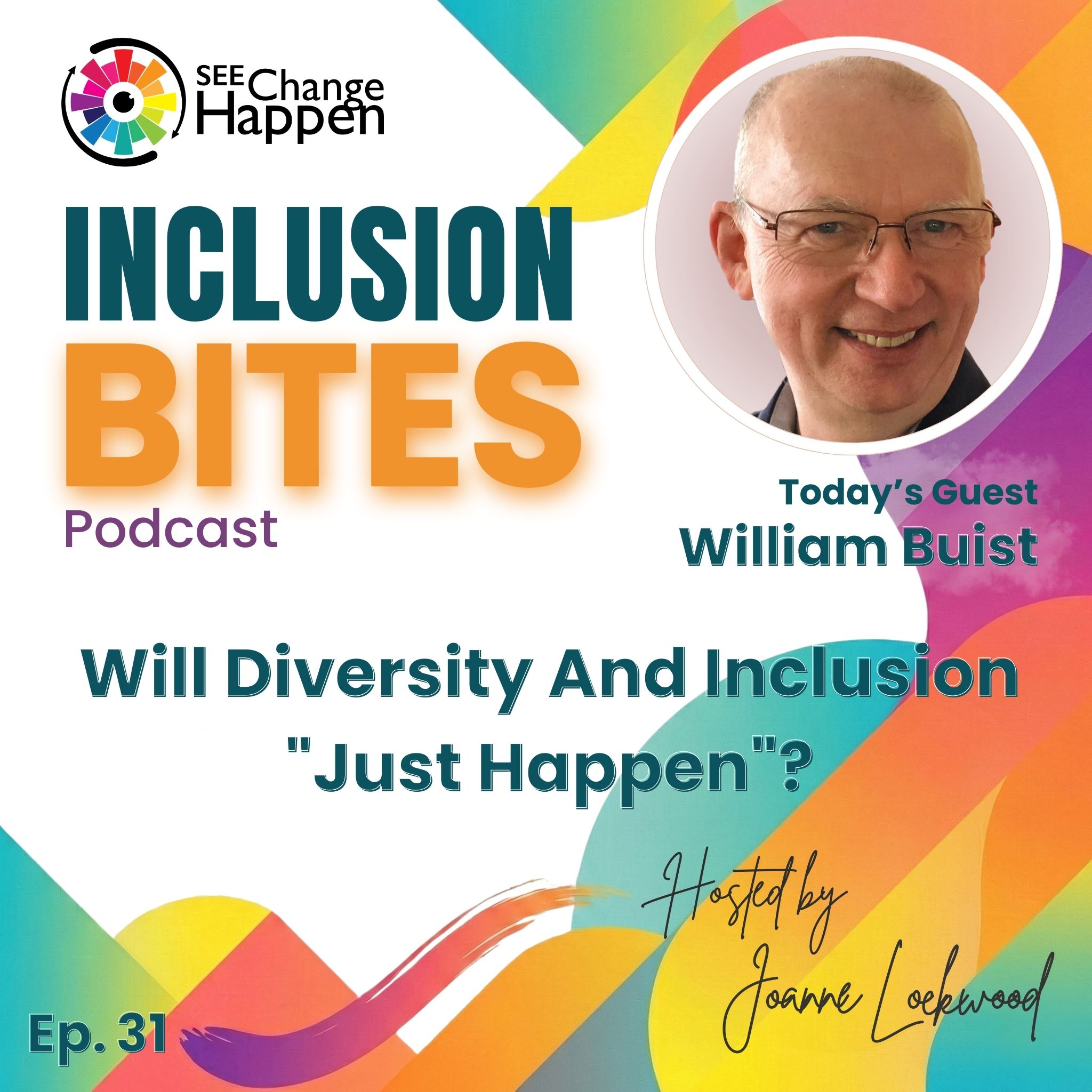
In this episode of Inclusion Bites, Joanne Lockwood speaks with William Buist about workplace culture systems.
“Little a 100000000 little changes is much better than one piece of legislation that most people don't understand.”
Explore
Navigate this episode
Joanne Lockwoodhost
Hello, everyone. My name is Joanne Lockwood, and I'm your host for the InclusionBites podcast. In this series, I have been interviewing a number ofamazing people and simply having a conversation about the subject of inclusion,belonging, and generally making the world a better place for everyone to thrive.If you'd like to join me in the future, then please do drop me aline to jo.lockwood@seechangehappen.co.uk.That's S-E-E, Change Happen dot co dot uk. You can catch upwith all of the previous shows on Itunes, Spotify, of course, the usualplaces. So plug in your headphones, grab a decaf, andlet's get going. Today is episode 31with the title, will all diversity and inclusion just happen?I have the absolute honor and privilege to be joined by William Buist.William describes himself as someone who works with clients to ensure theyhave the clear business strategies and goals to make them stronger. When Iasked William to describe his superpower, he said that it iscuriosity.Hello, William. Welcome to the show.
William Buistguest
Hello, Jo. I'm very good to be here. Thank you very much for inviting meon. Absolute pleasure. I'm pleased we've been talking about this for a couple
Joanne Lockwoodhost
of months, and I'm pleased we finally made it. So, William,do you think that diversity and inclusion will just happen?
William Buistguest
It's such an interesting question. And I think there have been,certainly, you know, there's been a lot of legislation over the yearsto try to help, move this along and make sure that weare treating everybody as we should as equals.And I think the danger is that we kind of think that there arecertainly some people out there who now think that diversityand inclusion either has already happened, orthat they don't need to do anything more. And I I just thinkwhilst that's possible, if we wereto take that view of just letting things run as they are,change would still happen, but it would happen too slowly. I thinktoo slowly for you, too slowly for me, too slowly for the world at large.We need to take action. You know, I'm a I'm a white bloke,So I've had privilege all my life. I've had an unfairadvantage, and too often that unfair advantageactually is is invisible. I I haven't noticed that I've had anadvantage because I'm the one with it. I thinkit's always very easy to see the disadvantageif you are the one that is disadvantaged.And I as a result, I kind of, for a long time,not really realized the impact that that privilege hashad on on other people. You know, I I seetoday if we kind of become aware of it as the years have gone byand seen people that I know and love struggling to overcomethe disadvantage that the world has thrown at themand and realizing that I wouldn't have had those difficulties. Youknow, if I want to, open a doorinto a company, if I if I pick up the phone and and dial thenumber and ask to speak to somebody, I'm more likely to getthrough than some other people because I've got a malevoice, because I'm a white bloke. You know, and that justfeels intrinsically wrong. But if equally well,if you are a white bloke, you may not havereally noticed that happening because you pick the phone up, you get put through. So,you know, what what is there to notice? You you've gone to do something andit's happened. It's very difficult to be in the shoes of thepeople for whom that doesn't happen. And I mean, I know I'm using avery simple example, but but it's true in so many areas.So do I think it would just happen? No. I don't. I thinkpeople like me who've got privilege needto consciously do somethingto step away from that privilege and level the playing field.And I want to level the playing field by bringing the parts of itthat are struggling and finding it harderup rather than, you know, damaging and and doingdown the good things that are on that playing field. And I think that's,you know, that's a a harder thing to do than justto kind of some of the, you know, mutedlegislation over the years has sought to do, you know,actively discriminating against a group that's had advantage doesn'tnecessarily do anything to remove discrimination. What we need to dois think about how do we how do we get into a situation where itdoesn't happen at all, where it's not part of the consideration.That's a very that's a different world, not an amendment of the current one.And and I think that's hard. I think it's, you know, we all need tobe thinking about how do we do that. Jo sorry. That's along answer to a very simple question. Yeah. That's a very good answer.We are. Very good answer, I mean I've
Joanne Lockwoodhost
heard a saying that, a fish doesn't see the water itswims in until it's taken out of the water And that's oftenhow privilege works, you don't see your privilege until you're takenout of your privilege or you're you suddenly have something that changes your lifeand makes you appreciate your privilege. And yeah, that's very true. And the other thingthat resonates with what you're saying is thatwe need to involve everybody in these discussions andto demonize white men, to demonize people whohave privilege, and not involved in conversationsdoesn't drive change, so it's about collaborative corporate conversationswhich is what I believe in. I think the other thing that what you saidstruck me was that and I paraphrase what you said what we need israpid evolution rather than revolution. So it's not aboutthrowing away everything we've currently got. It's about evolving at a pace ofchange that is acceptable to everybodywhilst maintaining what is working. And I think that wouldbe more making people more feel more comfortable because I think there's a dangerthat by being inclusive and beingforward thinking, we leave people behind and often people leaving behind are theincumbents and then they feel more marginalized in the same way that I think whenwe looked at post apartheid, South Africa, thenthe white community were then marginalized in a different way. So and I'm notsaying I I don't understand South African politics Jo I'm not making any judgment callthere. But what we wanna try and do is make sure that there's equity insociety for everybody and suddenly we don't end updisplacing people and say, well, you've had your turn now,it's now our turn and that all that does is create reluctance for changeand people will tend to barricade their castle and say well I'm not going tolet you in and I think my start is alwaysdialogue, corporate collaboration, talking, cooperation, lowerthe drawbridge, sit round and in pirate terms,parley, talk about the problems, but not lettalking be a preventative of progress. We don't want lotsof committees, we don't want lots of tracked out. If we want gender equality, weneed to have some really tight timescales, we need to be looking at 2030 andthat's not far away. Some might argue that 2030 is a long way away ortoo far, but we've gotta start making change because it starts in somethingrealistic. But yeah. No. I completely agree with what you're saying.
William Buistguest
Yeah. Yeah. It'sit's you you're right. 2030 isn't very far away.It it will be here before we know it, inmany ways. And I think if we were to get to 2030and not have a different worldwhere, you know, people were seen for who they are, how theyfeel, what they think, the the thoughts that theyhave, and the value that they bring to the world by what they do andhow they behave. And in and in all of that, I haven't mentioned anythingon which we discriminate or createthis kind of sense of othering that still exists in society. Seeit every day. See people talking about, you know, immigrationin ways that is discriminating againstprimarily color of skin, but other things as well. You know, religion can come intothat as well. And there's this wholepiece around, you know, people like me, and I don't meanpeople like me William Beers. I mean, that sense of people likeme as a stronger draw than people who are notlike me. And that's always gonna be true. It's part of the humancondition. But that's about difference. It's not about better orworse. And too often, it's it's
William Buistguest
interpreted as better and worse ratherthan just different. They're not looking for and celebrating those differences andsaying, what can this teach us? You know, what what is thereabout somebody who's blind in terms of the waythey perceive the world? Because clearly they're not seeing it. They'refeeling it, hearing it, tasting it, and touching it.Now what is it that they get from doing that that I don't get becauseI look at it? And what learning is doingthat? And then and and when you have those conversations, boy, do you learn somestuff that's interesting?And, you know, that takes me into takesme into a little story, actually, about one of the things that I think asa business person that we that we all do is,you know, we're we're we're talking to the people we know, to our clients,to people who have run across us. And and from time to time, they askthings like, you know, a question that starts with, who do you knowwho? Who do you know who does adiversity and inclusion podcast? Or who do you know who speakson, speaks on communicationskills? And those questions, you know, they're trying to getto somebody in my mind who I know, who I understand,who I think is good at that thing that they're asking about, and whoI would refer. And I I rememberwhen I first Joanne, an organization called the PSA,of which we are both members, the Professional Speaking Association,which some of your listeners, I'm sure will be too, but others othersperhaps haven't heard of it. And one of the things thatstruck me very quickly was how collaborativethat community of people is and how much referralgoes on between speakers of other speakers. Youknow, for people who are all in the industry of speaking,there is almost no competition because we all speak on ouron our topic, whatever our topic is. So we're we're notworried about referring others because we're referring them for their topic, notfor ours. But one of the things I noticed was that,there was a tendency for people, and I think rightly, way, only torefer to those people who they had seen speak and who they knewwell. And you look at the history of the speakingindustry, and the history of the speaking industry was white blokes.And so what you've got is people who've seen white blokes who are reallygood at what they do, and so the white blokes refer to white blokes.
William Buistguest
And it's not that they're tryingto exclude anybody, and it's not that they're trying not to be diverse. They'rejust the people that they've seen and that they know.And so I I looked to that and I thought, let me have a lookat my black book and see who would I refer. And Istarted realizing that my black book too was filled with people who werewhite male predominantly. And I thought thisthat something should Joanne, and the only person who can change that is me.So I've been spending the last 5 or 6 years deliberatelyseeking out people from from other backgrounds,other, you know, other diversities, other andseeking to be inclusive in who do I know? Who's in my black book?And I remember somebody we both know that sadly is no longer with us, JoyMarston. Joy,wonderful black lady who who spoke reallyabout motivation and keeping going when times were tough,and and a whole, you know, whole beautiful style that she had. Andshe was speaking down the road from where I live in Cardiff.And I thought, I haven't seen her speak. I'm going to go and see herspeak because then I can put I can put Jo in my black book asone of the people who I would refer, you know, if if ifthat's worthwhile doing. And,there's 2 things that happened. 1 is that Joy was, you know,quite taken aback to find me there in the audience. It wasn'tan audience you would expect to see me in, and I explained why I cometo to see you speak. And and we struck up areally strong and enduring friendship,from from having done that. And she taught me an awful lotthat helped me with my speaking, which wasn't why I went to Seav at all.And and part of my point here is that when we are inclusive,we're gonna get benefits we didn't even consider when we setout to do those things. And I just would invitelisteners to think about where have you got aninadvertent, unintentional bias in thethings that you do and say and think that lead you toan a less inclusive group of people than youcould otherwise have. And what can you do to change that? Becausethat's how we change this. That's how we make the world more inclusive.Little a a 100000000 little changesis much better than one piece of legislation that most people don't understand.
Joanne Lockwoodhost
Yeah. I I think nudges is a good word as well. We can make asmall nudge, inclusive nudge. We can be anally or whatever. Ally. Ally should just have to be huge massivegestures as you say. It can be a small nudge, it can be a smallinvitation, it could be amplifying, it could be creating space for someoneto have access to something they wouldn't have had without your without your input.And it's interesting what you're talking about networking it's I know many people who comefrom marginalized or underrepresented communities or areunderrepresented in certain positions, networking is often abig barrier because it's generally the domain and I'mnot saying historically it was the domain of the white man orthe man in power, you had in order to go to abreakfast networking event, you had to have availability to goto breakfast somewhere else where many working women,there are many working parents who aren't women as well, but there are many manyworking women who had responsibilities for child care, found it verydifficult to, to do both jobs, you know, gonetworking at breakfast and make the children okay and sort out the home etceteraetcetera. And then another networking zone is lunch hour and
Joanne Lockwoodhost
then and then there's after work networking and again there's often discriminationsagain against women who have had home and family responsibilities.And as we both know, it's quite difficult sometimes to break into the networkingclique, You gotta have a level of confidence, maybe you need to be referredin by somebody. So if you haven't got access to that power andprivilege circle, how do you make your first break? How do you getsomeone to give you that leg in? And as you were saying, the important thinghere is just creating that little bit of movement, identifying someone's on theoutside and just opening the door and say come in meet my friendsthis is so and so they're fantastic they they do this and I've used thembefore and they're amazing. And that's what networking is about,which is to make sure we're doing it to people who are not the traditionalpeople. I've seen people who go network and getall you end up evaluated with someone suitable for the club.They all sit around and discuss about this person, say, well, actually they're not reallyvery business y. They're a bit they're a bit kind of,bit working class for us really. We're here we're a bit more business professional andI've seen people actually creating judgments on whether someone's goodenough to join the networking club because of their their social standing.And that was less than 5 that's about 5 or 6 years ago and Ithink are we we must be still doing that, it mustbe still happening I can't believe the society's changed that much. But we we are.We're furthering these these as you call it othering, which is a great term.We're seeing people who are different to us as other, the outsider. Andand they're still doing so. How how I mean, I don't know how much networkingyou do outside the PSA, but it's it still happens on on LinkedIn maybe,we're amplifying different people, maybe people like us.
William Buistguest
Yeah. And I think there's I mean, there's a there's a realchallenge around understanding who thepeople in the group are from the outside as well. You know,that as well as as you've rightlydescribed, that whole ethos in a networking group of,you know, are they good enough? And I mean, who who defines what good isfor goodness sake? I mean, it's just it's a nonsense, isn't it?And it it's one of the things I think that, you know, we're recordingthis at the, at the beginning of March,2021. So, you know, we're we're in a lockdown situationcountry. We're a year almost a year into, the pandemic andhaving to work much more frequently remotely. You and Iwere just chatting before we started recording about how that's affectedour business and our ability to reach out to to peopleand to get our businesses in a wider you know,with wider acceptance. I knowI don't know about you, but I've been certainly been chatting to people all overthe world in a way that I simply would not have done had I beentraveling because, you know, chat to somebody in Australia for half anhour and fly out there to do that. You know? I mean, it was itwas it's just not not feasible. It's become it wasalways feasible before, but it tended not to happen. And now we've got thisopportunity to network in a very different way. And Ithink I I'm delighted because I've seen peopleon those networking calls and and events and thingswho you wouldn't necessarily normally see because they're in awheelchair, or they're blind, or they've gotsome other disability that that means it's difficult for them to travel orto get out or to to go, as you say, atbreakfast time or in the evening when when other pressures come tobear. And that opportunityto have time spent withpeople for whom you wouldn't normally spend time hasjust reinforced again to most of the people I know and toespecially to me that people are just people. Youknow, they're just it doesn't matter whether the body's workingproperly or not. You know, if you've got some physical disability oror what the color of your skin is or what religion you are, we'reall human. We all feel. We all think. And we all have we
William Buistguest
all have the opportunity to listen and process in our own way from ourown experience and play back, you know, as you didearlier in this podcast. You know, you listened to what I said and you paraphrasedit and you played it back. And then I I'm hearing thatparaphrase. What I'm hearing is what you heardtempered with your experience, all the years of experience thatyou've had and how valuable is it to get that feedback.You know, have I been clear in my communication? I can only tellwhen I hear it played back to me. Andwhat I'm what I'm delighted to see is that people arekinda having their eyes opened a bit to the fact that everybody can bringvalue, regardless of their history, regardless of their socialstanding, regardless of anything. If they're in a conversationand they're bringing to bear their viewpoint, It has asmuch value as anybody else. And the more we can show that and demonstrateit, the less the more we break down that fear thatof the other that we've been talking about. And it's ait's a fear. It's not based on anything systematicother than an emotion. And and the way we break downfear is to build familiarity and and comfort and trust.And I think that's something that this medium, you know, thethe the in Lockwood medium of communicatingacross technology has really helped to do. And I just hopethat hangs around when we move back into a moreopen society where we can meet in person as well. And and I kindof a challenge for those who are listening is how are yougoing to be as inclusive as you have been on on Zoomand all those other tools when you'reback into traveling and meeting people. What what are you gonna dodifferently because of what you've learned in the last year tobe more inclusive? And I think if we all thinkabout that question a little bit, well, that might make quite a difference.Yeah. I I love what you're saying about the listening element here. And,
Joanne Lockwoodhost
I mean, we're speakers. We like to share stories. We like to share our ownstory, and we like to listen to other stories. But One of the things Ialways focus on is as a human species we tend to be most of ourconversations about around trying to sell our own ideas we always wantto say we're right, we want to give our perspective andeducate somebody. And we do that all the time, you know, not just inprofessional but when we're trying to to decide which cinema filmwe're going to go and watch, we want to persuade the other person we're goingwith, we want to watch our film or their film, we try to come intoconsensus. What I encourage people to do in a DNIspace when even in a humanity space is to start trying to proveyourself wrong all the time, which may sound like an oxymoron, may sound a bitcrazy, but if we try and prove ourselves wrong, we'll get tothe truth quicker. Because otherwise what we end up doing is trenching in ourpositions trying to both trying to prove ourselves right. Whereas if I
Joanne Lockwoodhost
start asking you questions about your reality about your perception,I'm going to learn about you and why you think something.So we're not actually having a debate about the minutiae of the point we'retrying to make, we're trying to understand the logic or be or the person behindthe point they're trying to make. Because I may not we may not agree onthe point, But I may be able to understand that your lived experience whereyou've where you've been in life, the things that affected you have led youto think this is a good idea. I Jo, well, I don't see it's agood idea because I've had this. And when we start to understand who we are,we start to forget about the point of right or wrong. We just go,actually, I understand about William now and I kind of realize where he's where you'recoming from or where you've said that. And we're still we'renot agreeing to disagree, we're just agreeing to understand eachother's perspectives of why something is different between us. Ithink that's that's the challenge of trying to prove yourself wrongrather than always trying to prove yourself right because otherwise we we just end upin these entrenched, unwinnable arguments when nobody comesout enlightened or with any moreknowledge than they started with. And that's that's because by opening ourmind, I can come up with another opinion without havingto agree with you. Yeah, show me your workings out. We may have adifferent answer, but I get your workings out, I can see where we differ.That's I think the power of listening,and reflecting and understanding somebody to just to learn about someone that'sperspective. I think that's the power of, you know, when we talk about diversity, wetalk about inclusion, it's about the power of other people. It's about those thosepowers of other perspectives. There's powers of difference of opinions,though, someone from a different ethnicity, a different faith, a different background,a different gender, whatever that whatever the gender identity is.That person has a different perspective on life to me. And Iwanna learn about that perspective, so I can incorporate that into my modeland go, okay, I know what it's like to be me, but I don't knowwhat it's like to be you. So let me hear your story. Andnext time I meet someone who's different from me, I'll go, okay, I've heard lotsof stories, I kind of get different perspectives now. And is it and Ican then be involved in their conversation because I've got that sort ofway of thinking in my head and I think that that's the kind of thekey thing. But picking up on the other thing you were talking about is thethe othering, the the disability. I I watched,on iplay the night a documentary called silenced and it wasabout disability, people of disability and it waslooking at the history of that about the eugenics and about how we were tryingto fix people, how people who had deformedlimbs had to be put in casts and and how there's this fearof people who are missing limbs and they had to wear prosthetics. It wasn't fortheir benefit, yet so they didn't scare the other people. So we'vekind of built up this disfigurement is scary,difference is scary, difference is other. We want we want to
Joanne Lockwoodhost
be pure, we want to be a pure tribe for the survival of the species,this Darwinistic type evolution that we're hanging on about.When that turns into eugenics, that turns into sort of trying to fix people,or if we get the technology to understand how someone's going to beborn, and they're not born healthy enough, good enoughwith the right eye color, with the right hair color, with the right number oflimbs. Do we do we have made that humandecision to decide that life isn't worth livingwith blue hair, green hair, with pink hair, with red hair?And we say no unless they've got brown hair, they're not good enough or nohair, they're not good enough for the species. And I think that's where it becomesto say someone who is different, has a different quality of life because you can'tspeak English because you have no wealth, you have no no status means you havegot a lesser life. And I think the other point you made was people allthink the same, you know, we've all got our brains, we all perceive the world,we all see color and smell and sight or whatever, whatever ourabilities are. And we sometimes judge people asbeing different to us, well they can't perceive the world I do because I'm right,they're wrong. I think this is a danger and silence if you haven'twatched it dig it out on Iplayer. It's an hour of documentaryand I was completely drawn into the stories, drawn intothe the horror, if you like, of the work houses,how people spend 80 years of their life because they were seen as mentallyinfirm, whatever that meant. They were difficult to dealwith, you know, today that would be ADHD, today that might be someone who'sneurodiverse, whatever that may be. These people spent 80 years in the in theworkhouse cause they had no exit, no one advocated, no one said, hang on aminute, once you were in, you were kind of in and it's frightening andthat was less than a 100 years ago, less than a 100 years ago.
William Buistguest
Well, I mean, you know, I'm I'm 62 and, you know,in that in those 62 years, I've seen an enormous amount of ofJoanne. And yet, some thingshaven't really changed at all. They've changed kind of there's a veneerof change that's being put over the top.You know, we we have, youknow, equal pay legislation and have had it for a long timebetween men and women. And yet still, if youby by almost every standard, if you look at thethe statistics, whichever way you want to look at them,there is still a gender difference in pay. And,you know, something something isn't quite right. There's always reasons.So, you know, when you start talking to people about why that is, you willalways get the defenders who will say, well, you know, maybethe the people who are in different types of jobs areare skewed by gender. And it's not the pay that's the issue, it'sthe fact that, you know, some some women are doing these sorts ofjobs and some men are doing those sorts of jobs, and yet still thereis, you know, there is clearly something not right in thestate of Denmark as as Shakespeare might have said.And, you know, I think we need to look start looking at theseproblems, and they are problems, from a differentviewpoint. It's not what do we need to do to fix theworld as it is. It's what world do we want to build.You know, let's not let if I have legislation to deal withwith abuses of a system that already exists because youneed to do that, but what world do we want to build for tomorrow?And and I remember I was I was talking to somebody who's who'squite a senior I mean, white bloke, of course, quite a senior guy ina a big infrastructure national project.But one of the things that he was very, very keen to do is tomake sure that he had a really diverse workforce. And he wasemploying, you know, tens of thousands of people,and and he was struggling to get, you know,certain areas of the business filled with what heviewed as, you know, the the right level ofdiversity and inclusion within it. And I, you know, I absolutelyknow that his motives were entirely right. And we
William Buistguest
spent some time talking about the whole recruitmentprocess and and what were the processes he was going through. And in the courseof that conversation, we kind of identified a whole host ofthings that were unconsciouslybiased towards a certain type of employee,and that certain type of employee wouldwas not diverse, wasn't inclusive. And that's why they were strugglingto make it diverse and inclusive workforce. And, you know, by way ofone example, and it is one of of many things that we uncovered in thecourse of some time looking at the whole process end toend, One of the things that they used as aas a measure of should you apply was experience.And, you know, how many job roles do you see that require2 years, 5 years, 10 years experience? And if you're looking for very seniorpeople, it might be 20 years of experience. So, you know, if you'reapplying to go on to the board of a company and they want 20years of experience at board level, you'vegot to have been able to get onto a board 20 years ago. Well, guesswhat? All the boards 20 years ago were white men. Sowho's gonna get those roles that need 20 years of experience today?White men. And and so you you not only doyou have the issue that you're not resolving, but you're perpetuatingit by just not quite thinking through what doesthis requirement for hiring actuallymean we get in terms of people in the pool that's available to behired? And when we talked about this, well, what's what's theexperience of proxy for? What are you trying to uncover by askingfor experience? You know, then you you dig under the skin of that,and it's about good decision making. It's aboutinquisitiveness. It's about leadership. It's about, you know, a whole hostof skills that if you have hadall that experience, you will have honed. But when you startlooking at the skills, some of them need, you know,a kind of innate skills. You either have them or you don't. Othersof them are things that can be taught and taught very quickly, in whichcase, if if you haven't got them, it doesn't actually matter because you can teachthem very quickly and you can overcome that issue. And others of them are notabout length of service, but about examplesof doing it. So, you know, good decision making. Tell me a coupleof really good decisions you've made in the last few years. Right? I don't haveto know that you've had lots of experience in decision making. I need to knowyou'd know what a good decision is and how you'redefining, how you measure a good decision, those kinds of things.So, you know, they this you know, in thisexample, you know, they went away and they took apart thewhole recruitment process and started looking at k. Let's notask for things that are going to favor inadvertentlythe the the typical person that would be in those roles. Let's instead,you know, change them and look at what are we what are we actually seekingto achieve. They didn't solve the problem entirely. I don't think you cansolve it in a single change. But but you certainlystarted to get more people who were, you know, in a morediverse and inclusive way. And, of course, once thatmomentum had started, it built on itself.The fear started going away. The othering started going away becausenow there were disabled people, and it was itwasn't a problem. You know, all the things that people say, well, we haven't gotenough disabled loo's if we have all these disabled people. Where are they gonna getthe loo? You know, I mean, it's all a nonsense because you just deal withit. And what you get is thetalent. You know? And and to me, that's evolving.You anything that isn't about talent that isa problem is solvable. And whosolves it? The people with the talent. So get thepeople with the talent and the problems go away anyway.So I I yeah. That's another one. That's a point of mindset.
Joanne Lockwoodhost
Com quite a mindset leap for a lot of companies, though, isn't it? Oh, massive.
William Buistguest
But companies gotta have a mindset leap there where they they
Joanne Lockwoodhost
still have this mentality that, as you say they're looking for 20 yearsexperience, they're looking for this they've got this round hole and they want around peg and anyone who's not quite, you know, they may be roundbut they're too small that they're not prepared to work them to totrain them to nurture them into that position or that they're too big for thehole, you're too old, you've got too much experience. I often hear that. You're over50. You've got you know, we want someone younger than you who can fit,ageism, sexism, racism, whatever it may be. Wewe we're masking this this desire for hitting the ground running. Wewant someone to hit the ground running, which is which is code for we wantsomeone like us, someone like the person who was there before, someone like the restof the team. And it takes a leap of faith because it shouldn'tdo because people often see a diversityhiring strategy as meaning hiring for 2nd best. Because if wewere hiring for best, we'd be hiring people like we've got already. AndI wanna get people to start to reframe diversity hiringinto hiring people who are marginalized, hiring people who are underrepresented, whoisn't represented in our organization. We want more representation ofpeople of of color, people who have different face, different differentgenders, different abilities, because we want to havethose voices because that's who our customers are. We've got to be representativeof the people we serve, we serve customers, we serve ourstakeholders, whoever that may be. And it's no different tothe disconnect people feel when the government, the parliamentis made up of people who are different to them. We we see the northsouth divide where the people from the north believe that the governmentin Westminster is representative of people with northern voices seeing theirchallenges. We see it where there's underrepresentation of women in government where womenbackgrounds saying parliament is made up of too many white people, theydon't hear our voice. So that's no different to us as an organization. We haveto be representative, so our customers believe that we're meeting theirneeds. Our our stakeholders, our investors believethat we're meeting our needs. And now we're gonna factor in not onlydiversity inclusion, but environmental sustainability goals.Our Earth's footprint, if you like, we're going to try and make sure that wehave these, these ethics that crossfrom people to planet and that's how organizations are being judged in thefuture. I know you work with businesses and you youcoach, you mentor businesses, you know, you Jo from yeah. How about going fromstrength to strength? Do you see this as something that businesses are starting toadopt? Is this a is this an open door or is this still something you'rehaving to persuade them?
William Buistguest
Is that open door? I said, there's a question.I think it's an unlocked door, not necessarilyopen. So Ithink I think businesses, if they choose to walk through it, are not gonna beimpeded. They've just gotta, you know, press the door handle and and carry on through.But if they're looking at it from afar, it kind oflooks like it's a locked door, you know, and it's too difficult.I'm probably stretching that analogy too far now myself,But but but but you you take my point. And I think it'sI keep coming back to the the the way that I I seechange happen is when people are exposed to the advantagesof having done it without having necessarily to takethat step themselves first. So because then they then theywant to take the step because it's in their interest todo so. You know, I I remember talking to
William Buistguest
somebody. It's not that long ago, but it's it's probably pre COVID.So when we were all meeting in a room and and, you know, thedebate had started about, you know, as long as as long asit's on merit. So, you know, if if ifyou're choosing a a person for a job or for aspeaker to speak on the stage, as long as it's on merit, it's okay.I I I don't think that that's enough as we've discussed. Youknow? I think that the trouble with merit is it's measured by thingsthat are intrinsically biased. It'snot until you seepeople, you know, I'm I'm gonna use a speaking example again, but, youknow, people in in wheelchairs on stage talkingabout the reason they were in a wheelchair or who've lost a limb or whateverit is. And you hear these fabulous storiesthat help you to to look at your own life as a, you know, physicallyable-bodied, fit, healthy, white male. I'mI'm and hopefully never do, touching wood now over to theside. You know, never had an injury thathas has caused that for me. But what I what I do know is thatif I did have an injury like that, that I would be on a greatadventure. I would learn enormous amount in a relativelyshort space of time, and there's nothing to fearfrom that. There is opportunity in it. And I know that because I'veseen enough speed people who have had the misfortune to havethose sorts of injuries talk about it. To know that, you know,I don't wish it on anybody, but if something happens to me thataffects my life in a in what others outside would see as anegative way, what I would see is the opportunity to learn.And that's a mindset thing. We come back to mindset. It is youknow, all of this is about seeing culture,you know, our culture, whatever that means. Ourculture is, you know, the way we do things around here.You know, so if the way that a business does things isnot inclusive and not diverse, then that's the way theydo it. And and you've got to change the culture, and that means changingthe hearts and minds of the people within the organization inorder for that change to take effect and to stick.And and there's another key point, isn't it? It's not just about making the change.It's about making the change stick. Andit's too easy to go backwards, and people dothat. Now what's the what's the word the Americans use?Recidivists. I love that word because it just rolls off the tone nicely. You know,the the criminals who repeat, offend, of recidivists.And and it's it's it's that samekind of thing that people will make an effort to be more inclusive,you know, almost when they feel they're being watched. And then as soon as they'renot being watched anymore, they they they slide back intothe old biases. Well, we need to change that for you too. And the waywe do that, I think, is is by really letting people seehow how much more they can achieve with amore diverse, more inclusive audience, if you'rea speaker, with a more diverse, more inclusive workforce, if you're an employer,with a more diverse, more inclusive customer base, if you're ifyou're a business? You know, how do we appeal,across the whole spectrum of humanity?Solve that problem, but the rest is easier now.
Joanne Lockwoodhost
Is it the fear of getting it wrong, Not knowing where to start or theenormity of the task. What do you think is the biggest barrier?
William Buistguest
I think I think there's a bit of there's a bit ofboth of those. They're not knowing where to start and it being a big abig challenge. You know, and I've certainly you know, Iorganize events from time to time in my business. And one of the things that,you know, if you're being diverse and inclusive in organizing events, you have to thinkabout is how do I make sure this event is inclusive? So, you know,is there wheelchair access to the venue? Because we haven't had that issue fora year. That's why I think we've seen a morediverse audience on Zoom calls and the ability ofpeople who would quite often struggle to get to a 3rdfloor meeting room in a building that only has stairs.Yeah. And and so we have to start thinking about allthose things that we need to think about in order to be moreinclusive. And that'shard because suddenly you find some of the things that you'redoing actually do have an unconsciousbias against them. And it's nobody's fault that an office blockbuilt in the 19 fifties didn't put lifts inbecause those weren't the building regulations at the time. Andand, you know, we've we've changed the regulations and now, you know, a modern officeblock will be built with sufficient, you know,facilities to cater for most things. Still don't cater for everything. Don'tthink because you're in a modern building that is inclusive in itsdesign that it caters for every possibility. It doesn't. So you still gotta think aboutit. But, you know, then then yousay, okay. So if we were going to be more inclusive in our employment,now we have the first time or the first few times we do that,you have a real situation of a very much of them and us.There's the 2 or 3 people we've just employed to tick that box,and God help you if that's what you're doing. It's the wrong reason to doit, but some people still do. And you've got that littlegroup and you've got the big group of all the people who still got aculture of this is the way we do it around here, and that doesn't includethose people. And I've seen that happen. I've seen people being, youknow, isolated in an organizationbecause they're different. And they've beenemployed to address the difference, but they're still isolated by their work colleagues.So you've gotta have a real mindset that is abouthow not just how do we do this in recruitment,how do we make the whole office change its attitude, everybody?And that's a big task. It's difficult. It's it's something youhave to put heart and mind and soul and money to because yougotta invest in the training and the development of people and and andpossibly address the infrastructure reviews and so on.And that's that's only gonna happen if you really, reallybelieve in the outcome. So it's, yeah, it's toobig. It's too hard. It's gonna take toolong. All things I've heard.None of which I accept as a valid reason. Yeah. I think
Joanne Lockwoodhost
I think it's important to to point out to people who are listening to thisthat just because we've gone online or you know or our eventsonline it solves every person every person with disabilitiesproblems and we just introduced new problems and accessibilityaround online events is also a major problem. PeopleI know I know many people who are wheelchair users, but they also have verylimited dexterity in their their hands and fingers. So they can't contribute inchat, they can't take part in live polls in a speed quickenough to interact in time. I know people who lip readand sometimes they find online events very, very difficult tolipread. The images are too small, as in there'stoo much blur, and not everybody's subtitles,not everybody transcribes. Again, it's very difficult and Iknow with this podcast, this podcast is is it's not reallyaccessible for people who, who can't hear becauseit's a podcast, it's an audio medium, I don't transcribe it, I don't I don'tmaintain it's a video experience, it's only an audio experience. But,yeah, I I I'm quite conscious, I'm excluding 6 to10% of the of the organization of the population who are born deaf, whateverthat is, plus the 60% of us who will be deaf at some point orlose our hearing over the course of our lifetimes. Jo,
Joanne Lockwoodhost
yeah, we've got we gotta think about being inclusive by designvirtually as well as physically and making assumptions that people with adisability have more access and it's easier for them now ifit's online. It's again, it's not thinking about the individualas being very stereotypical or very, very generalistic aboutour inclusion and saying what those should be better off now and then excluding awhole different set of people. Jo, yeah, it's a challenge, you know, inlarge auditoriums, theaters, there are hearing loops, there wereother methods to help people who had hearing difficulties accessthe topic and the conversation, there were screen readers, people who had a sightimpairment, got copies of slides in Joanne and they hadtranscribed or they had them read out to them using a transcriptionservice. So again, a lot of these online events aren't doingthat. That's another barrier to inclusion that we all we allstart thinking about and as the hybrid world evolves, because thinkabout how who are we excluding still, how can we make it feel more includedand it's and that's the continual process. I mean we said at the beginningthat we Joanne solve inclusion and diversityovernight, we're not gonna it's getting better, but it's not there yet. We areon Joanne infinite journey, we've still got aninfinite way to Jo, it's always gonna evolve, always gonna change, we'vealways got new things happening. Jo, yeah, Ithink I think what you're saying there, it rings rings true and resonates alot. And I love the way you talk aboutfrom your own narrative, your own thinking about howabout the challenge of inclusion. And they resonate so greatly with the way I thinkand the way I talk as well. So I'm trying to prove myself wrong asI said earlier. I'm trying to prove myself wrong. I keep hearing what I'm thinkingwhich is which is in a way it's validating for both of us I guessbut yeah it's it's nice to nice to get into some into into theweed sometimes. Do you feel asa as a as a white bloke that you're under attack inby the DNI community? Do you feel that you're you're seen asnot woke enough anymore?
William Buistguest
Such a good question because, I mean, certainly, I I hear that kindof sentiment, you know, from time to time. No.I don't. Not at all. You know, if anything,quite the reverse. I think II think, you know, underattack is such an it's it's an interesting thought.Not not in the slightest. And I I think,you know, I think I have a responsibility,but I think we all have the same responsibility. It's just that not
William Buistguest
everybody accepts it, I suspect. And this comes backto something I was saying earlier about this, you know, this discussion about,you know, as long as as long as everything is done on merit, we'll allbe fine. And I just think it'syou know, that actually, that comment comes froma mindset that I think does feel under attack.It's a kind of siege mentality that make that takes people tothat that kind of view of, you know, as longas I'm okay because everything's on merit and I'm good, I don'tmind what you do for others. And that's you know, it's an inwardfacing sensation. My viewis unless there's somebodyunless there is literally nobody in the world who's better, youknow, that's the time you should hire me. It's when you when you decided there'snobody in the world who's better. Jo, you know, it's almost the exactopposite. I don't want to be pickedbecause I I certainly don't wanna be picked because I'm white and male. Right?So that that that's a given. But I don't wanna be picked because I'm goodenough either. I wanna be pickedbecause I'm the right person for the job. And that'sI'm I'm carefully choosing my words here. The rightperson doesn't mean the best person necessarily.There are times to take people on because of what they will learn,not because of what they bring you. There are times to take peopleon to you know, and I'm not talking about employment necessarily, but, you know, ontoa project, onto a stage, onto, you know, take peopleon to the next level of their lives. One of the one of thethings I talk about is, when I dospeak from a stage, is about mastery and about the journey we're all takingin our lives to get better and better. And, you know, we kind ofstart out with no knowledge as a child. We we learn through rotelearning. We learn to talk. We learn to name things. We learn towrite. We learn to we learn to understand some basicsof of chemistry and physics and English andmaths and all of those things that we learn at school. We'reexplorers. We're gathering knowledge. And then we kind of whenever we goto university or we or we go on a training course or we get ajob, we're we're novices at it. And the novicesare desperate for experience. They're out trying things tolearn to get experience. They become practitioners. They'regetting good at what they do, and the world lives on practitioners. Youknow, all almost every job is is about having the rightperson who is able to do that job well, be a practitioner.You do it for a while. You learn stuff. You become experts in it. Youlearn nuance and subtlety and that's again it's a different sort oflearning. So we've had, you know, learning like a child, rote learning.We've got experiential learning. Now we're learning subtlety and nuance. It'skinda honing skills. It's both a mentaland a physical learning. But there's a there's astep further, which is that step to mastery. And and masteryis much less about doing and much more about being.It's it's when you stop worrying about taking a good photographand start thinking about being a photographer.And that that difference is about learning to letgo, learning to understand that what you doisn't as important as how you do it as to who you are,how you think. It's all about mindset, and it'sall about being inclusive, and it's all about lifting peopleso they can learn from all the things that you've learned from.And and, you know, we know those. You know those people when you run intothem. They're few and far between, but, boy, do they stand out.And they stand out because they're no longer the one thatmatters. They're there to supporteverybody else. Back when wewere hunter gatherers, you know, they would have been the elder sitting in the tentwho would say, you know, it's time to move the camp because the buffalo willwalk next week. And they just knew.I didn't go catch the buffalo. That was for the younger ones who were stillgetting the experience of how do you hunt. But they knew where tobe. And I thinkthat's the journey that humanity is on with diversity and inclusion.
William Buistguest
And we maybe got to being practitioners right now.And we need we need to we need to develop the expertise. But,ultimately, as society as a whole,we almost need to completely let go of the idea of needing to bediverse and inclusive because we will have becomediverse and included.And I you know, we started this call with a question, you know, is itpossible that diversity inclusion would just happen?Well, not until we are more mature as aas a race, as a species, and not until we've taken the time,effort, and energy to learn the subtleties and nuances andthe value of doing that, then we get there. But it'sa long road. You described it as an infinite road. No. I I I don'tthink it's infinite, but it is long. And wecan enjoy the journey while we journey on it too. AndI think, you know, that's that's why I don't feel under siege orunder threat, to come back to your question. Idon't feel threatened by any of this because I'm enjoying the journey.And I'm, you know, watching and listening and learning andimproving what I do and what I think so that I canbe a better person as a result of that learning.And that that journey is worth taking.
Joanne Lockwoodhost
Some might say to enjoy the journey is a privilege.Some might say that to achieve mastery is a privilege Joanne there are manypeople who would welcome thatthat privilege and that opportunity so I think let's notdeny what you've achieved and what you're achieving or whatever everyone else is achievingBut the privilege we hold is the fact that we Joannedo that and that's aspirational for us. I think what you'resaying really is making sure that we create opportunity for people,we look at we unpick the meritocracy, we unpickwhat that's truly saying and seeking to amplify andgive opportunity for people who wouldn't have had that opportunity. Andthat's our pathway, if you like, to giving people the theability to to develop and grow and enhance so that we're notlooking for 20 years experience, but we're giving people a a pathway to tomastery from whatever your background is and that's that's the mission ifyou like for privilege. It's not only about fair pay,as you say, employing people with a disability, it's allowing those peopleto thrive in a way that they can achieve their potential, whichwe all hope is is the mastery, it's the beingfantastic practitioners, being artisans in their craft,whatever that may be. And, that's what we that's what Ibelieve we can do as as a privileged people in society is makesure that we use that privilege to amplify and give opportunity toothers. I think that's a a fantastic sentiment you're saying there. I thinkthat's that's, it's not idealistic, it'snot utopian, it's a state it's a statement ofdirection, it's a direction of travel, this is where we're heading And we we candebate whether it's a long journey or an infinite journey as society evolves on adaily basis. But you're right. We've got to keep focused on it. We'vegot to keep putting petrol in the tank, putting air in the tires andkeeping on that path because if we stop and pull overour progress will be lost as well. So no very very impactful. I reallyenjoyed listening to you and hearing your thoughts,it's been very powerful. How can people get hold of you? I mean, youyou you you speak, you mentor, you train, have you got a website, have yougot a book? How do people get hold of you?
William Buistguest
So yeah. Well, thank you. Yeah. The website unfortunately, Ihave this unusual name, which is which is one of the, one of the realadvantages of of, my parentage. I I thank themimmensely for that. If if if that was the only thing they gave me, itwould be great. They, of course, gave me other things too. But,yeah, William Buist, B-U-I-S-T.
William Buistguest
Williambuist.com is the website, and william@williambuist.comwill get you on email, to me. I'm veryhappy to speak to anybody about any of the thetopics that we've talked about today. But if you're particularly, ifyou're running a business and and thinking abouthow do we address the sorts of issues that we talked about today?How do we do that from a strategic viewpoint and and make itembed it in the business and make it long lasting, then I'd love to havea chat with you and talk about how to approach that, andmake it make it work for you, from the beginningand ever ever better as as time goes by.
Joanne Lockwoodhost
Fantastic. I've just clicked on the link on your website, gone there, andit's it's a great website, very easy to navigate. Jo, yeah, I I wouldencourage anyone who's, just keen to get a hold of you, yeah, check you out.It's, Jo very powerful. Well, it's beenan amazing journey this last hour. I've really enjoyed our conversationand obviously a huge thank you to you, the listener, for tuning in and listeningin, keeping up to the end. Please dosubscribe, to keep updates on future episodes of the Inclusion Bitespodcast at B-I-T-E-S. Tell your friends, I'm sure you have some,and obviously your colleagues. I have a number of exciting guests linedup that I'm sure you'd be inspired by over the next few weeks months. We'vehad an excellent, guest today with William. And if you'd like tobe a guest yourself, please let me know. I welcome any suggestions and feedback youmay have to jo.lockwood@seechangehappen.co.uk.Tell me about what you'd like to hear on future show shows. Tell me howI can improve. In fact, tell me you're listening. Tell me you're out there. Pleasedo drop it on LinkedIn. Say hi. So my name is Joanne Lockwood.It's been an absolute pleasure to host this podcast for you today. Catch you nexttime. Bye.
The Role of Privilege and Creating PathwaysInclusive Networking and AccessibilityMindset Change and Workforce Diversity
Joanne Lockwood is joined by business strategist William Buist to explore whether diversity and inclusion will naturally improve over time, or whether it requires deliberate action. They discuss how legislation can create the illusion that equality has been achieved, while everyday systems and norms still produce unequal outcomes.
William reflects on the invisibility of privilege for those who have it, and why allyship often looks like many small, intentional “nudges” rather than grand gestures. The conversation moves into how networking and referral habits can unintentionally reinforce sameness, and how widening personal and professional circles can create opportunity and learning for everyone.
They examine inclusion and accessibility in both physical and online settings, noting that remote working can reduce some barriers while introducing others. The episode also explores how recruitment and “merit” measures (like years of experience) can embed bias, and why organisations need to redesign processes and culture to make change stick. Throughout, the focus is on practical culture change, dialogue, and building a workplace and society where people are valued for what they bring rather than excluded by outdated assumptions.
“If I pick up the phone and and dial the number and ask to speak to somebody, I'm more likely to get through than some other people because I've got a male voice, because I'm a white bloke.”
“So I've been spending the last 5 or 6 years deliberately seeking out people from from other backgrounds, other, you know, other diversities, other and seeking to be inclusive in who do I know?”
“People are just people. You know, they're just it doesn't matter whether the body's working properly or not. You know, if you've got some physical disability or or what the colour of your skin is or what religion you are, we're all human. We all feel. We all think.”
“When we talked about this, well, what's what's the experience of proxy for? What are you trying to uncover by asking for experience? You know, then you you dig under the skin of that, and it's about good decision making. It's about inquisitiveness. It's about leadership. It's about, you know, a whole host of skills that if you have had all that experience, you will have honed.”
The significance of recognising privilege and using it to create pathways for those without inherent opportunities.
The continuous journey needed for societal evolution towards inclusivity, rather than expecting instant results.
Practical steps for businesses to incorporate diversity and inclusion in their strategies effectively.
The impact of focusing on skills over experience to overcome biases in hiring practices.
How to design truly inclusive environments, both virtually and physically, and the accessibility challenges each presents.
Embracing and learning from different perspectives to enrich personal and professional lives.
The importance of setting meaningful timescales and avoiding new forms of marginalisation in the pursuit of equity for all.
One thing to remember
Diversity and inclusion require deliberate efforts and continuous progress. Simply hoping for natural progression is insufficient; active engagement, awareness of privilege, and strategic initiatives are essential to creating an equitable and inclusive society. This involves rethinking recruitment practices, ensuring accessibility in both physical and virtual environments, and fostering a culture of inclusivity that permeates all organisational levels.
Questions this episode helps answer
How can organisations create pathways to mastery that genuinely cater to individuals from diverse backgrounds?
What are some practical ways individuals with privilege can use their influence to uplift others in their workplace or community?
Why is it important to view inclusivity and diversity as a "direction of travel" rather than aiming for an idealistic end goal?
What are some of the challenges and solutions in ensuring inclusivity in both virtual and physical environments?
How can the diversity and inclusion community address the feeling some individuals have of being "under attack" due to their privilege?
How can organisations balance the need for merit with the necessity of providing opportunities for growth and development to individuals from underrepresented groups?
Explore topics
Ideas from this episode
The Role of Privilege and Creating Pathways
In our recent conversation, William Buist and I addressed the pervasive issue of privilege and how it impacts opportunities for individuals across various backgrounds. It was enlightening to discuss the nuances of privilege and the responsibility that comes with it.
Inclusive Networking and Accessibility
The topic of making networking and professional environments more inclusive and accessible. This was particularly relevant with the growing trend of remote work and virtual events.
Mindset Change and Workforce Diversity
Another focal point of our discussion was the essential need for mindset changes within organisations to embrace true diversity and inclusion, moving beyond surface-level commitments.
Learn
Frequently asked questions
What is the main theme of this episode?
The main theme is the necessity of proactive efforts in achieving diversity and inclusion, rather than expecting these goals to materialise naturally over time.
What does Joanne Lockwood mean by "privilege" in this context?
Joanne Lockwood discusses privilege as the systemic advantages certain groups have in society, urging the utilisation of privilege to create opportunities for those who may not have had them, fostering a pathway towards mastery for all.
How does William Buist suggest businesses address inclusion?
William Buist suggests embedding strategic inclusivity ideas into business operations, focusing on diverse skills and talents rather than extensive experience, which helps overcome biases and creates a more inclusive workforce.
What is the "direction of travel" that Joanne Lockwood refers to?
The "direction of travel" refers to the continuous and evolving progress required to achieve inclusivity and diversity, acknowledging it as a long-term journey rather than a final destination.
Can diversity and inclusion progress naturally without intervention?
William Buist argues that while legislative frameworks exist to promote equality, relying on natural progression alone may lead to slow change. Proactive efforts are necessary to drive meaningful and timely progress.
How can individuals and businesses ensure fair pay and opportunities for all?
Both speakers stress the importance of fair pay and creating pathways for everyone to reach their full potential. Businesses should re-evaluate their recruitment and pay structures, factoring in diverse backgrounds and skills.
Share this episode
Heard something worth passing on? Send this conversation to someone who needs to hear it.