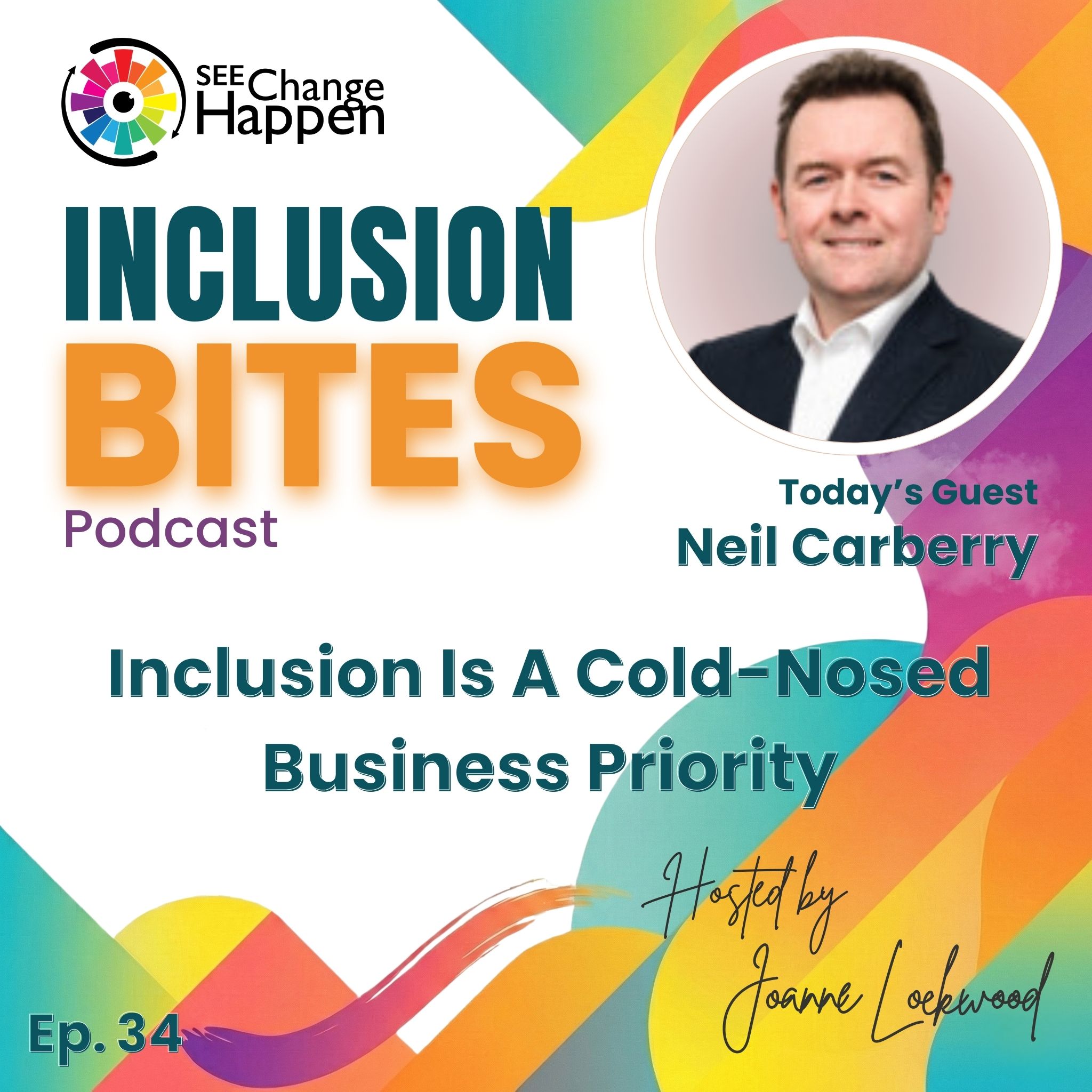
Driving the message that inclusion is a cold-nosed business priority
Neil, the CEO of the REC, talks about his belief that responsible and conscious capitalism can be inclusive and be able to realise the benefits to their business
In this episode of Inclusion Bites, Joanne Lockwood speaks with Neil Carberry about inclusive leadership management.
Hello, everyone. My name is Joanne Lockwood, and I'm your host for the InclusionBites podcast. In this series, I have interviewed a number of amazingpeople and simply had a conversation around the subject of inclusion,belonging, and generally making the world a better place for everyone to thrive.If you'd like to join me in the future, then please do drop me aline to jo.lockwood@seechangehappen.co.uk.That's s S-E-E Change Happen dot co dot uk. You can catchup with all of the previous shows on Itunes, Spotify and the usualplaces. So plug in your headphones, grab a decafand let's get going. Today is episode34 with the title driving the message thatinclusion is a cold nose business priority. AndI have the absolute honor and privilege to be joined by a great friend, NeilCarberry. Neil describes himself as someone who is on acrusade for better workplaces and great work. WhenI asked Neil to describe his superpower, he said he can playthe steel drum. I'm sure we'll find out more about that in a minute. Sohello, Neil. Welcome to the show. Hello, Joanne. It's a real pleasure to
Neil Carberryguest
join you. How are you doing? I'm doing really well. Really
Joanne Lockwoodhost
well. Lockwood. You can almost feel the end of lockdown coming. Thevaccines all fall under way. So I think we're in a positive place in theworld right now. Yeah. I have to admit that, I my main
Neil Carberryguest
emotion last week was envy because my partner teaches in acollege. And so they went back to work, and,my kids are back in school. And I'm still stuck in the room I've beenin since since a year ago from this recording when we, when we moved outof the office. But it's not long to go now. We can see the lightat the end of the tunnel. Yeah. Well, I'm jabbed up. I've had my
Joanne Lockwoodhost
AZ. I I have my, 24 hour of,feeling really, really lousy afterwards, I think which many people have.Popped up by paracetamol and a couple of hot cups of coffee and Netflix. Iwas fine 24 hours later. So yeah, it's I think I feelwell on my way and hopefully the nation will get going soon. Absolutely.
Neil Carberryguest
Absolutely. So Neil, tell me,
Joanne Lockwoodhost
why do you believe that inclusion should or is a cold nosebusiness priority? What do we need to do to keep driving that home?
Neil Carberryguest
So cards on table. Right?I work for a business organization, and it's the second business organizationI've worked for. I'm a capitalist. I'm a cold nosedand proud of it. And, you know, often, when you talk aboutinclusion, priorities of inclusion anddiversity have have sometimes been seen as of thepolitical left in some way associated with,with, different forms of economic organization. I thinkif you look at our society, I think whatall businesses need to understand is that we operate. Your businessand society are not separate, they operate together.And business in many ways has a, a licenseto operate from the society in which it exists.So from a from a a business leader'sperspective, you have to reflectand serve the society in which you operate.So that reason number 1 is that your custom base,your employee bay base is more,is more diverse than ever. Reason number 2is we know that people perform at work when they areable to bring them their whole selves there. So whywould we choose in a cold heartednot cold hearted, cold nosed,business perspective to put people in situations where they are lessproductive than they might otherwise be.All of that speaks to a different form of capitalism.And I I think that we will see overthe course of the recovery from the pandemic, thisconcept of responsible capitalism becomemore and more common currency. I think you're beginning to see it. Andthat's a space in which businesses are able toarticulate their purpose, more able to clearlyset out why their success is beneficial, not only for theirshareholder, but also for the wider society they serve. And that actually,their shareholder interest is in serving that widersociety well because that's where the longevity and the longtermism of, business success comes from. Soif you think about businesses right now, whether it'sinclusion or it's climate impactor it's recovery from, fromthe pandemic, You know, the kind of commitment you've mentioned having,the AZ vaccine, the kind of commitment AZ made in terms of howthat would be supplied at cost around the world. I thinkthese are things which are redolent of a businesscommunity that needs to think more about the long term to remain competitive.And as you think about the long term to remain competitive abit more, you set people and your peoplepolicies in a business in a different light. And I'm, you know,I have a habit of standing up in front of HR directors. I worked withbig company HR directors for 15 years at the CBI. Standingup in front of big company HR directors and say, if people are yourgreatest assets, why do you hire them like you buy paperclips? Why do you manage them? Frankly,sometimes, like you manage your paper clips. I mean, I I I do notlike, the phrase the the term human capital at allbecause you, you know, the Isle original founding declarationsof the International Labour Organization are pretty clear that labor is not a commodity.People need to be managed in a different way. Icome from a school of employee relations rather thanhuman resources. Thinking about people coming to work from very differentbackgrounds with different things to achieve and the art is aligningwhat they want to achieve with what you want to achieve.That is fundamentally an inclusion message. It's amainstream inclusion message. It's not about an individual strand. But I dothink that unless companies are thinking thatway, they will progressively be less relevant.And it applies just as much toany member of the workforce as it does to anyone who's protected by oneof the characteristics set out in the Equality Act. So for me,inclusion is is a critical businesspriority going forward. And the the mainmessage that I share with business leaders that I talk to is don't leave itto your HR director. It's gotta be about how you do business, about how theline behaves. Now Antonio Hootersario at Lloyd's said thathe started seeing a real difference in the hiring that they were doing whenhe stopped saying he wanted diverse and started throwing shortlist withoutdiversity back at the managers who put them up to him. And I thinkthat piece around, this is a business priority. We need to behavelike it's a business priority is a big message. We've setout just recently, at the REC where I work,the impact of doing recruitment well and in inclusive ways onproductivity as well as an opportunity for individual people,through our new recruitment for recovery campaign. And I think we needyou talk we talked in the intro about a crusade. I think this piecearound good work and fulfilling work andproductivity is not just about being nice to the employees, althoughthat is an important byproduct. It's actually about having workplaces that arefundamentally productive because people are comfortable there to workin the ways that, are most effective for them and are bringingthem their whole selves. You know? Yeah. I I've beenprivileged, for instance, to work with a lot of, truly talentedgay colleagues over the years. And they have all been very clear withme that the day they didn't have to spend Monday morning worryingabout, not slipping up on what they said about what they did at theweekend was liberating in more than just personal emotionalsense. Yeah. I I I
Joanne Lockwoodhost
so much of what you're saying there is resonating with me completely. Weknow these facts. I mean, McKinsey have published thesestats. You've only got a Google DNI stats and we all know thatbusinesses are 19% more of this, 30% more of that.So this data has been around for many, many years now, and it's kindof a every DNI person chants these these statistics.But we're we're all well aware that the facts don't change people. You know, weknow if we drive too far fast on the motorway, we shouldn't do that. Butwe all think we can get away with 75, 80, or a100. We know thatred meat, we know that wine, we know that beer, we know that smoking isn'tgood for us yet. We still persist in doing these things even though weknow the facts aren't changing. So what do youthink what businesses and organizations can do to startmoving from these stats and making it so thatthey really get their own ROI return on inclusion?What how do they wake up or become woke if you like?
Neil Carberryguest
Oh, there there's a politically loaded term allof a all of a sudden, isn't it isn't it woke? I look. Ithink that there are a couple of things that are on my mindright now. One is,I think, being more cognizant ofwhere you are now, which I think is veryis very frightening for a lot of businessleaders because it involves admitting that things might not be perfect,or might even not be good and stepping into aterritory where you are fundamentally uncomfortable. I think one of the great things aboutbeing quite short term and looking at the sales figures and driving the short termperformance of a business is that you always know where youstand because the numbers don't lie.The longer term stuff is more difficult because itrests on belief, purpose, direction, strategy,and a a real sensethat you're puttingmore of your self into it. So Ithink the thing that is changing is our understandingof leadership in businesses. I think they're kindaalpha very kind ofnumbers focused, almost impersonalleadership style that has dominated, ourthinking for maybe the last 20 or 30 years. I thinkthere's a it is being gradually placed by a much moreauthentic approach. And that authentic approach is not
Neil Carberryguest
unconcerned by the short term performance of the business. But I thinkit does allow for people to, actwith more humanity. And as they act with more humanity in whatthey are doing, I think the big question that weask ourselves, and you and I have discussed this before the recording,is how do we not just not be part of the problem as aleader, but how do we actively use our influence to make theproblem go away? And that's difficult forcorporates because,culture in any business is is difficult to to manage,but leaders are better equipped to manage it than most. Andif so if you think about the debate after the Black LivesMatter, protest began following thekilling of George Floyd last year. There was a big debate abouthow corporates can be not just not racist, butactively anti racist. And I think a lot ofthose same themes flow through to a lot of what many ofus were feeling, you know, in with the recent news about Sarah Everock,which is it's not just enough you know, I I speak asa as a middle aged man. It'snot just enough to be one of the good guys. It's actuallymore about how do we actively challengethe environments that allow harassment of,women to happen. And I think those things,in lots of companies,even up until quite recently, would have felt quite, andinverted commas, right on, would have felt like,yeah. No. No. We're here to do our Jo, and our job is this. AndI think the real art for people who care about this incorporate is to make the linkto corporate reputation, which we know can be trashed in a second thesedays if something goes wrong, is tomake the link to the what I said earlier aboutmaking sure that people can bring their whole selves to work.And it's to make the link to the fact that no one loses whenwe do this. Because I think that'sthe that's the thing that I I think often doesn't quitecut through. You know, flexible working is a great example ofthis. I'm a working dad. Theflexible working revolution was brought about in its originalin its in its beginnings. It was being done,in inverted commas, for working moms? Well,maybe. But, actually, flexible working benefits everybody in theworkforce if you get the structure right. And companies need to kind of thinkabout how they do it and how they do it well and fairly. Butthat level of inclusion, because Ithink flexible working is a tool for inclusion of people who might not otherwise beworking into the workforce, benefitseverybody. Classic case post pandemic. We've now proved thateverybody can work from home for a year, in lotsof office based jobs. If this isn't transformationaltransformational for, Britain's disabilityemployment rate, that will be shambolic. I mean,our disability if you look at our employment rates, our disability employment rateis actually much the worst. And a lot of it is aboutaccess to the workplace even though there are some pretty good government schemesto support, access to work out there.This should be a moment for us to say, well, here's an a new routeto opening up disability employment. It'sa whole slew of things there, I think, where if weget our people planning into our business planningand don't approach it as though we're thinking about humancapital, we can open up some productivityupside. As I mentioned earlier, our recruitment and recovery reports are reallyclear that doing recruitment well opens up £7,700,000,000of, productivity upside every year as people start moreengaged. Yeah. This isn't new stuff. Imean, Nita Clark and David McLeod were doing all that work about employeeengagement, and its and its benefitswell over a decade ago. And as you said, Joanne, the,it's about how we get cut through. I think cut through only comes at thecenter. And this moment of leadership change that's been drivenby the pandemic is a huge opportunity. Yeah.
Joanne Lockwoodhost
Completely. I've got so many thoughts coming out of what you've just said there.Going back to almost at the beginning of what you're saying there, the the termwoke, you're right, it has been kind of hijacked as a kind of a politicalstatement. And someone drew attention the other day, the theopposite of awake or woke is asleep.So you're quite right when you're saying that what's happening is many businesses, ifthey're not careful, will be asleep on the watch. They won'trealize that they're no longer becoming relevant. They their theirreputation will suffer. So rather than seeing woke as being thispolitical statement, think of it as being awakened orwoken up to the idea that your business needs to havesomeone at the helm, not in their course, the trajectory, thevelocity of how you're gonna get somewhere that includes their peopleand really engage with their people. And I think I see too manyorganizations still thinking about going straight back into the office. Youknow, as soon as whatever date it is, 12th April,where technically I think you can go back to the office straight away, I seemany people just saying, well, I've been told we have to go back now. Andthere's been no consultation. A lot of a lot of business leaders in manycompanies are just saying, we've decided.Yeah. We've not consulted. We've not done our employee engagement survey. We've not donethe pulse test. What do people think about this? I think they're missing a trickbecause there's a lot of anxiety out there because the workplaceisn't gonna be the same. We may still have to commute with masks on. Wemay still have to Joanne space space everywhere. We might have to haveplastic screens between desks, social distance in the office, not making each other cups ofcoffee for a while. All these kind of guidelines are gonna come out. So whenwe go back to the office, it won't be the same. We'll be sitting onbuses or trains or transport feeling kind ofvulnerable. Jo I don't think many employers are really thinking aboutthis this human personal centric anxieties that arestill going on. We've chucked everybody to home, said right now we need to getmore back. I want to go back. We need to go back. Sodo you see that that divide happening? Some greatcompanies really engaging, some not? Funnily enough,
Neil Carberryguest
one of the calls I had earlier today before we jumped on, thepod, Joanne, was with a group oflarge companies in London and a group that KPMG has pulled together that Isit on thinking about the future of the London economy, which of course isfundamentally, bound up with,that question of how do we work. Mytake on that would be this.Different groups of the workforce will have different priorities.By and large, I think senior execs want to go back.By and large, I think younger workers want to go back as well. I mean,we've all done the call with someone who's sitting on their bed orusing the ironing board as a desk. Andthat that's a challenge as is the kinda health and safetyresponsibilities that employers have for people who are working at home in inless than perfect, situations. After all, you know,we all started this a year ago,thinking 4, 8, 12 weeks. The thehealth and safety concerns are a bit different when you've been doing it for ayear, and it's no longer really an emergency, measure.But in the middle, you've got a bunch of people who might not want tocome into the office, as much.And that's a real challenge because it's not just abouthow do we accommodate people's needs or how do we makeeveryone work the same. It's about how do we balance the 2.You know, young workers want to come into the workplace because maybe they're living ina, a house share. They actually need to be in the workworkplace. We've all advanced our career by being in the right place at the righttime and getting the right advice from a colleague, who was who wasaround. Equally, that colleague might want to be at home a bit more. There's a
Neil Carberryguest
whole framing of how people engage and that that weneed to get right. And the paralleland this maybe is where those who are trying to drivean inclusion agenda, andI always have. You know, the reason I can play thesteel drum is I went to a really right on state comprehensive in theeighties. And our music program was a little different to the onethat, that maybe you would have got at one of England'sgreat public schools. But themy driver's always been social and economic inclusion. You know, I'mfrom a working class background. I, you know, I II worry about how we make sure people makepathways through, into career and people'speople's, potential can be fulfilled.And I think when you think about that orany other form of inclusion that might fire up someone who's listeningto, listening today,What have we learned about other people's experiencesthat aren't our own experiences? We listen, don't we? You know, I've spent a lotof time listening to my senior female colleagues at theREC over the last week about how the RECshould Joanne, the the kind of stuff that's tumbledout the Sarah Everard case.We've got 2 ears and one mouth. I think increasingly,leaders are appreciating you should use them in that ratio. Sowhen it comes to opening up the office like you,suggested, Joanne, or indeed any kindof initiative in this space, you youwouldn't you wouldn't goand, play football on just a random field.You'd want it the grass to be cut and you'd want to feel thatthe you'd want the goals in place and all of that. And there's something therein making sure that the actionbias that many leaders have, this is an issue.We need to do something. This is something, so let's do it.Doesn't drive us off down the wrong path and all this stuff.
Joanne Lockwoodhost
Did you think leaders have learned a lot over the last yeararound well-being? You know, wewe use the old phrase here, same storm, different bows, but, you know, well usedover the last year. Each of these leaders haveoften been in their own boat and and and have realizedtheir own mental health, their own family needs. Even if they're in a position ofprivilege, they've been touched in some way. And the impression I get is thateverybody has become awakenedto this need that maybe we didn't have a year ago.But what really worries me still is that we're gonna revert to all habitsand there'll be this momentum to try and thishas been a blip. Let's go back to as we were.And I also think there's there's a divide between some of the larger organizations,the organizations that have the infrastructure, the DNI, the momentumversus maybe the midsize or small organizations that don't have thebudget sort of resources, the workplace workplace planning inplace. And we'll end up seeing 2 tier,employee experience if we're not careful. So,
Neil Carberryguest
I mean, I I'm less concerned actually on thesize piece because I do think as you get smaller, you get more personalinvolvement from leaders. And I think that that adds to the humanityof the of the response. I think in many ways,it's more difficult for big firms to deliverconsistency of experience. And in particular,thinking about how you support your first line managersto do what they know is right, but they might find sometimes the signals arepointing them in the opposite direction. Sothere's no I I think it's fair to say it's challenging in every size ofbusinesses, and the challenges change. Capacity is clearlyalways an issue at the small end.For me, I think there issomething in leadershaving seen inside people's lives over thelast year in a way that they haven't previously. You know?I talked to my team from from my house, and they're all in theirhouses. I think we've been powerfullyaware as leaders in businessesof people's mental health more broadly and the bleed across fromthings that are happening in their home lives to their work life as wellas, as well as, vice versa. So there'sa whole kind ofpotential moment of reset there. You're right,though. The risk is we just flick a switch and try to go back.Now let me be you know, I talked about being cold nosed earlier.We do need to go back to a certain extent. The economy is still quitesignificantly smaller than it was in February 2020. We need to recover thatquickly. Not because, you know, the corporates
Neil Carberryguest
need massive profits, but because those profits need to fundpeople's pensions, and we need people to be employed, and we need to be ableto fund pay rises and all of the the kind of the good things thatbusiness does week to week andmonth to month for for people all over the country.But we've got choices in how we normalize and how we go back.And so thatprocess and it's probably the biggest challenge leaders have, whichis what isnormal once the pandemic is over?And it's clearly not what we've been doing for the last year,but it's probably also not what we were doing before. Andthat's difficult, especially in a position where people are tired. Everyoneis tired after the after this, last period.So the really good leadersthat I observe are carving out spaceto think about what the normalized businessthat they are building would look like. And that'sdifficult because some of the edges are fuzzy. We don't know what the appetite forreturning to commuting to major cities will be. Mybet is that it will actually be quite high.But we do know that, yeah, that thatthere will be a challenge with sectors like retail, which have changedfundamentally forever through this, through this period. So I thinkthe the if you'reinterested in driving a more inclusive economy, and I think that'swhere, you know, where my, kindof agency is on inclusion. The advantageis actually how blank the canvas might be now because we have torebuild back. And I find myself sortof saying to inclusion and diversity,professionals, this is the moment because the canvas is blank.And, on the other hand saying to business leaders, let the canvasbe blank. Don't, you know, don't be theleader that you described, Joanne, who's saying right where I just want everything backto normal as quickly as possible. Because that mayvery well be helpful in the short run, butyou might miss the big change that's going on. You know, I'vealways liked the, the the Henry Ford thing about if I'd asked thecustomer, I'd have given him a faster horse.The, you know, the the issue that should beon leaders' minds right now is, how has thisfundamentally changed the market I serve, and how does my business have tochange to reflect that? And I think more often than not, when you answerthose questions, one aspect ofit is the human connectionthat you have with customers and the value that's demonstratedfor you by the people you engage in your business. And if those two thingsare true, then that forces the inclusion and diversitydebate much more center stage.
Joanne Lockwoodhost
Do you think then that we have the skill setin the leadership of our businesses? And we talkedearlier about the the glorification of thealpha type personality, the go getter, theimpersonal style and that makes a lot of the top level positions in manybusinesses. And, you know, we can I'm sure we can have a conversationabout meritocracy for hours and call out the BS of that sometimes.But do we see an evolution of whatis just seen as meritocratic, if you like?Are we starting to see that this alpha in personal styleis a is a bygoneperson? Are we are we seeing the rise of more empathic,empathetic, compassionate leaders and how much ourbusiness have or how much business is invested in in building thatleadership team over the last year to 18 months toput them in a better place to handle this new world that we're lookingat? So I'm definitely seeing a change. You know, I probably
Neil Carberryguest
first came face to face with the leadership of Britishbusiness in 15 years ago at the CBI.And I think that there is a difference. And, you know, I always when Ithink about new style leadership, I always recall the memory ofDame Helen Alexander, who was, one of the presidents ofCBI during my time there. And, Helen taught me a lot aboutthis, about how you can lead a business and be yourselfand, be, you know, cold nosedand focused on the performance of the business, but alsohuman. She but she once said to me, Neil, never take a meeting before 9or after 5. It sets a precedent you don't want to set. Now fora major British business leader to say things like that to,to more junior members of staff is a sense of kindof positioning and putting signposts up for for for
Neil Carberryguest
people. It'll take a long while to change, I think. But I'mdefinitely seeing that, you know, in particularwe've we've made some big progress on, gender diversity in our boardroomsover the last, few years. There's more to comeon that and on other forms of diversity.But I think thatwider picture is,is starting to feed to to through to how we think about risks and riskmanagement in our businesses. There's some work I'm working,supporting, with a leadership group I'm involved with at the momentlooking at how different governance structuresreacted to what happened last March April. And it's pretty clearthat those who'd already thought about all this stuff,about how are we appreciatingthe kind of risks that we can't see easily, about how arewe, managing our interactions withpeople more broadly about how arewe tackling challenges on inclusion, where by and largebusinesses responded more nimblyto the onset of the pandemic and are probably better positionedfor for recovery. So I think both, you're seeing adifferent kind of tenor from some leaders in the business community,and you're starting to see evidence through this period that doing itslightly differently pays off. My,my kind of corethinking about about this has often been shapedby, experiencewhere you see people demonstratethe ability to not think they have the answerthe minute the problem appears.And that requires the ability to say,what are my prejudices with regards to this problem?What are the questions I'm not asking myself? And who canI get to help me understand what those questions are? And I thinkthat's a that's a a governance function, but it's also a leadershipfunction in businesses. And businesses who are doing that well arethe ones that are starting to reap thebenefits of this. My worryis how we train our managers. So I'm I'm gonna getmy soapbox here. So sorry, Joanne. This will take this will take I'll I'll tryand do it in 90 seconds. Wewe made some changes to corporate governance in the United Kingdomin the 19 nineties. They were very sensible at thetime because what they did was they slimmed down the number of executive directors onboard, replaced them with nonexecutive directors, gave greater independence ofgovernance, gave shareholders greater, security that thecompany was being run well. But what they did wasthey reduced the number of executive directors on boards to 2, thechief executive and the finance director, Which prettymuch means that to be a chief executive, you have to have been the financedirector beforehand. And to be a finance director, you have to be anaccountant. I loveaccountants. I think they do fantastic work.I'm not sure, by and large,they are the most skilledprofession when it comes to,you know, the pathway that they take is not people led.It run alongside that the,MBA curriculum, which has become kind ofthe currency with quali with, withthe qualification with currency for trainee managers.Show me the bits of that that are about employee relations.Get your magnifying glass out. And that's thechallenge for me, which is we we still train our managersto be really good at stuff they need to be good at. You gotta begood at numbers. You gotta be able to drive the numbers. That is essential. Youdon't get a pass to the game if they're not if you're not. But, actually,the people stuff is not hugely kindof it's not hugely there in our business schools in the wayit could be. So there's a whole slew of how we educate our managersand the path that people take to leadership thatif we're going to bust through this, needs to change insome way. That I'll get off my soapbox there.
Joanne Lockwoodhost
Oh, excellent. No. I completely agree. And I'm I'mpassionate that many inclusion, belonging,people, culture initiatives can only bedriven effectively by a different style of leadership and itis around just being connecting, compassion. And I'm notsaying not being cold nose and businesslike, but I'm also saying that hasto have a edge to it all the time. How doesthat make people feel? What's the impact of that decision? So I'm agreat believer in that. We started earlier talking about,you mentioned George Floyd, Black Lives Matter, and at the timethere was a almost like a pushback around all livesmatter, white lives matter, and what about me, what about me as well.And we're kind of seeing that now, you know,after Sarah Everard was murdered, thatwe're now seeing, you know, the rise of of of many womenand and their allies standing up and saying, hey, hon, it may not be allmen, but actually it's most, if not all women have thisstory. But we still see not all men as ahashtag, it's trending and arewhite people, are men comfortablebeing uncomfortable talking about this this stuff? Or and orthere's still this fear of getting it wrong right here?
Neil Carberryguest
That's a really good question.And I'm only one white man. But mysense is thatit's the transition from not having tothink about it to having to think about it That'scritical. I've heard a few people overthe last week or 2 talkingabout, I used to think that, but now I've thoughtthis. And particularly around the the Sarah Everardpiece. Andthere's athat sense of being uncomfortable about the positionother people are in requires time and effort andthought. If you haven't had to think about it,actually, there's a there there's a gift that we, andI say we on behalf of my trade union of white men,slightly presumptuously, can giveto thinking about inclusion, which is to acknowledgethat this requires our thought andparticipation as well. Comes back to what I said earlier about not be not justbeing one of the good guys when it comesto, how, how we treatwomen in our society, not just not being a racist.It's act it's about actively how do we promote a society thatworks for all of us and the the payoff. And this is where I Ithink we have to really hammer this point. And and and, you know, I dolots of lots of things in my careerwith ACAS on the advisory side right down to I've got I've got an,an under 10 boys sports team that I that I coached on Sunday morning. That'sthe highlight of my upcoming time. We've come the 4th April. I'm allowed to getback to that on a Sunday morning, which is good. It'sabout how we challenge things when we see them in the spaces thatonly we share. I think there's definitely somethingin terms of, you know, what do you say to your mate who expresses withyou one way or the other when there aren't any women around? There are noblack people around. That that I think isreally important. And, yes, I think it is a bigchallenge to to get people to realize that we have a role inthis. But I think that's betterthan the alternative, which is to feel that these movements aren'tabout the whole of society. Of course, these movements are about the whole of society,but it's a bit like the kind of it's a bit like the kindahashtag all lives matter thing. Of course, all lives matter. We all know that, butit's black people who are who are having the experiences we need to challenge.And I think, having moreallies who are willing to say thatis critically important. And I think particularly inspaces which are quitetraditionalist in Outlook, and I think businessescan fall into that class. And I'm one
Neil Carberryguest
of my kind of, when I'm feeling cynical, one of thethings I'll say about the progress we've made on boardroomgender diversity in the UK is that it'sfantastic, but I'm not sure thatthe wives, daughters, and sisters of the samefamilies where the fathers, brothers, and sons have been on board for the last250 years now making it onto boards is as muchprogress as we would like. And and what I mean bythat isat the our ability to challengethe idea that there isn't one best way for everything to be isimportant. I remember talking to the HR director of Joanne4 years ago and she said the thing that opened her eyeswas, feeling really chuffed aboutthe diversity break breakdown of, ofof the Joanne 4 staff. And she was talking to,an Afro Caribbean, colleague about this, and he turned to her andsaid, yeah. But we all read The Guardian, don't we? And and, ofcourse, the point cuts through, which is, you know, it'squite easy to think that there'sthe best way of doing things. And, culturally,it's actually quite easy for,for women from those families where where the men have been at the topend of business for years to make the cultural switchinto, to into boardrooms. It's a lot more difficultif you are from a fundamentally differentbackground, if you've,you, you're coming from a position where you're trans,where you're challenging the way the world isa lot more fundamentally from the point of view of people'sstarting points. And I think we're talk we needto talk a lot more about good way several good ways of doing thingsand a more permissive cultural regime in our companies,than just allowing people to be in the spacesthat, these spaces that previously they weren't in and that beingokay. I mean, you you mentioned earlier about
Joanne Lockwoodhost
slimming down the change of the way the board governance works. You know, the the2, the chief exec, the CFO andeverybody else being kind of a Ned or a Sid, however you describe.That really, let's put it out there, iskind of an old boys network. In order to get to CFO, the chances areyou would have come through years of growth as amanagement accountant or financial accountant or whatever in the accounting role. Andand that pathway often excludes women or minoritygroups because they don't have access to that social capital or orthe the opportunities to engage in those roles. Therefore, becoming achief exec narrows the field. And also because they've notheld maybe a senior or a board role in an organizationtheir their NED portfolio is kind of limited as well because I'vesat on advisory committees and recruitment panels for for NEDappointments and looking at their terms of reference is often,well, we want someone who's had this governance role in a similar organization, thisperson who's got a risk background, this person who's got a CFO background.And that really does limit the type of people we're gonna get to who areactually getting more of the same. And it takes abrave decision, it shouldn't be brave, but it is a brave decision sometimes to say,well, actually, we're looking for the capability, the lived experience and wecan train this person, we can actually put them on a board induction programand look at, maybe they've never been a net or never been held ina position where we could teach them about a set of accounts, maybe we cansee teach them about various processes, governance structure. Butwhat we need is your lived experience. We want to see someone who is intheir mid-20s, maybe female, maybe Black, bringingthat perspective of their customer or their theircommunity into the into the boardroom. I I still seethat there's a huge way to go there, isn't there? Yeah. Look.
Neil Carberryguest
Absolutely. And I think, yeah, I'll give you anexample. We've been doing some work with, theprimary suppliers into the CCS, the the,the, government commercial services, recruitment,recruitment frameworks recently. Based on thefact that government felt it wasn't making enough progresson, diversity in its recruitmentprocess. And there was a bit of a bit ofpeople pointing at each other here. You know, it's it's the recruiters. They don't give
Neil Carberryguest
us the diverse lists. Well, yes.But let's should we take a quick look at what you the brief you'vegiven us? You know, government, for an as an example, government, for instance,is really interested in people who have backgrounds in certainconsultancies. And while those consultancies might be performing better nowon diversity, 10 years ago, they weren't. So if you're looking atpeople who who were in those businesses 10 years ago, you're alreadyskewing the the the pitch. Another thing would beeven if you just write in this person must be security cleared.Well, why do they have to be security cleared to get the job? Surely, yousecurity clear them after they get the Jo, and shall we have a look atthe demographics of the group of people who are security cleared?So there's a there's a bay I I I feel verystrongly there's a big role for our members at the REC, forrecruiters, to be having muchmore, in-depth discussions withtheir, with their clients about what do you reallymean? When I was on I was the CBI rep on the Parker reviewcommittee on, I think diversity on boards. And the bigdecision we made was there were enough candidates out thereto make significant progress on,on, appointments to boards from Britishminority ethnic groups. They just weren't whereaverage British companies were looking at the time because they weren't inwithin the network you refer to, Joanne. So some ofthis comes back to, at the risk of talkingmy own book, the nature of how we recruit andappoint and how we dothat as an as aprofessional, service,not as a process. Because we knowthat we know that technology will change recruitment and we should usetechnology. But we also know that we have to use technologywell to make sure it's positive, not negative on inclusion.And actually, the skill for recruiters is going to be advisingclients on workforce planning. Part of which is effectivediversity and inclusion in their processes. Andthat means we are going to have to get better as an industry. And Iwas I've talked to several, chiefexecs of REC members just this week who are telling me the story, which issaying, no. No. That's not how you want to do it. We wantyou should be doing it like that. You know, one of the,one of the taglines I've been using for our recruitment and recoverycampaign is no chief executive would go to the high court without thebest lawyers. Yeah. If they genuinely believethat, in inverted commas, people are our greatest asset, andall the survey data says that beside product product quality, thatis the thing that business leaders think, thengo and get them with genuine professional advice and fishing in thewidest pool possible. You know, you said yourself atthe at the top of the pod, Joanne, that the datais pretty clear on this. It's actually the translation of that data into action thatmatters. And I think there's a huge role for recruiters in in startingto change that perception and being willing to look ata job description and go back to clients and say, do you really mean that?Do you really need that? Why whythis and not that? I think that process is increasingly whererecruiters will deliver the value that they deliver to clients.
Joanne Lockwoodhost
Yeah. I mean, certainly the top end if you if you really are trying tocreate genuine diversity of of mixof people on boards. Well, I I've read some someNed role profiles, personality profiles that people arelooking for, and I look at them and think, wow, that'stoo aspirational. That's that's that doesn't sound like anything I could do. You know, youmust have risk analysis skills. Not all these come from, you know, the basicgovernance structure you would have. And so I saysometimes we're over expecting somebody who is embarking on their1st net role or their 1st board position to have a lot of these skills.I think we end up putting a lot of people off and you mentioned sortof widening the net. I think in some cases, what we actually need to dowithout getting caught up in too many metaphors is is change the pond, gosomewhere different and and fish or spearfish or targetpeople. A phrase I love is if a hard to reachpeople reach harder. And I think often what we do is we give up tooquickly or we're board is undersuch pressure to fill that vacancy. The chairs on arotation design, they've done their 9 years or their 6 years. They have to resignthis year. And then, wait. In order to meet that AGM, we must haveappointed by here. We must have yeah. And then, oh, actually, we should have started2 months ago. So we don't always have the timeto look and hunt and and target people whoare nontraditional, because of thethe priorities. But, you know, you go out to the same search firms, you engagethe same people and the the candidate profile, the recruitmentmarketing you're doing tend to be very bland and similar andnot unique. So I think we we keep doing the same things, you know, andgetting the same results. And sometimes you gotta say, well, actually, maybe we don't goto the same search firms. We go to maybeBAME specialists or or or diverse board specialists,maybe they're not specialists in board positions, but maybe theythey have hired in senior roles and have a track record.I think that's the problem. We we we keep not planning ahead, you know,workforce planning, board succession planning, these kind of things, and actuallyseeing what what is the profile of theperson that is gonna add something, not just their thepure governance side, but it's that lived experience. I think that's the challenge I seeis people not having enough time to makethose those long game decisions. They're they're too rushed intoit. So what do you think of that? My observation would be that we always
Neil Carberryguest
have more time than we think we have. So one of the one of thequestions that, we should ask ourselves areare, you know, what assumptions are we making that actually we couldchallenge? I was recently involved in the appointmentof, some nonexecs to a board where,the chair rightly took the decision to stop the process becausethey didn't like the diversity of the of the long list,we went round again and made much betterappointments, which, yes, absolutely,met the, inclusion goals that the chairhad, but actually appointed better directors as well.And, you know, this fallacy that these two things,are in any way in opportune, oppositionto each other, really does need to be challenged. I think you come you comeright back to what I said earlier about Antonio Horta or Sario at lawat Lloyd's. It's when you change the rules of the gamethat people change behavior. So,it is about kind of are you really under as much timepressure as as you think you are? And if you are,then the answer is to start earlier and to plan better.Jo there's a wholeyeah. We are at risk of kind of massivelymixed sets of metaphors, but, you know, I I I'm followingwe started, so I'm gonna finish. You know, it's it's it's about what, you know,what's in our toolbox because we probably have a bit more thanwe appreciate. It's I suppose it's the it's theHR professionals version of the candidate who's sitting theregoing, I can't do any of that. Why would I apply?A a thought on which as we as we run past it. One of thethings I used to do when I was a recruiter, when people saw jobdescriptions that they, thought were,beyond them, is I used to say to them, you know, go and have alook at the job description that Boots puts inits window for Christmas stuff. This was the late nineties, so I'm not havinga pop up, at Boots today. But they used to have thisChristmas stuff thing that went up in August, Septembertime. And I used to read it occasionally when I was gonna get a toothpasteor whatever. And you'd think they were looking for someone to work on theManhattan Project rather than be aChristmas, a temporary member memberstaff staff at Boots. And, of course, what thatdoes is it rewards a certain type of confidence.And you ask, well, where does that confidence come from? It comes from those whoare culturally comfortable in the, in the environment that you have now.You know, Canter's prosocial reproduction is alive and welland, and with us. Sochallenging our processes on,what we ask people for andappreciating that candidates will have different confidence levelsin in the environment they work in. Thosetwo things, are absolutely criticaland can only be driven by leaders whoare willing to change the rules from what went before.
Joanne Lockwoodhost
I think it's quite profound. I think that I I agree thatthat that's the, again, one of the other things I hear frompeople is not knowing where to start, you know, DNI, whatever it may be,culture change, where do we start, how do we how do we embark on this.And that that Joanne be a real challenge if you haven't got a playbook,you haven't got a DNI team, you've done none of this, You you got thisfear of getting it wrong, you don't know how to communicate with your staff, maybeyou haven't got the inclusive leadership sorted out in your organization. So not knowing whereto start. And I think everything you're talking about that you just saidis is is not I was gonna say idealistic. It shouldn't be idealistic. It shouldbe realistic. It should be realistic. It should be something that people aspire to.But, really, how do people know where to start with this?When people say that to you, what what do you push back with?
Neil Carberryguest
I think there are a couple of things. The role of leaders is not tomake every decision in the business. It's to put up signposts. Soalways think about what you're rewarding and what you're challenging.Just make sure that what you're rewarding is pushing you in the rightdirection. I I think the biggest misnomeron this is people thinkingwe have to, you know, we have to make this front and center, and wehave to have it all fixed in 6 months. It's fundamentaland cultural. You are not going to, to fix itin 6 months. It's gonna take years years years.I, you know, I like the kind of the Joel Grimond quoteabout, you know, always going towards the sound of gunfire. AndI I think that's the way leaders should approach this, which isjust because it's big and difficult and you're not gonna fix itin 6 months or a year, doesn't mean you can't do your biton getting getting on the path towards where the gunfire is.So it's about the same post you put up. It's about what you reward. It'sabout having a plan and and making sure that youfollow through on it. And youmentioned fear of getting it wrong. I think thebiggest single thing that stays,leaders' hands we talked about confidence in the corporate environment andhow how that pays, theevents. We talked about kind of,yeah, the role of white men in,as allies earlier. I think the challenge isthat doing things the same, lotsof leaders have confidence over. I peopleare terribly, terribly concernedabout putting a foot wrong, the wrong phraseology,the wrong initiative. Ithink you almost have to accept that occasionally you will get things wrong,but that if you're acting with good intentionsand you've done your listening upfront, so you've doneenough of the path finding that you need to do to understand where people withlived experience are coming from, then when you do getsomething a little bit wrong, you usually get forgiven for it because whichof us hasn't made a mistake?
Joanne Lockwoodhost
So your role at the moment is you're you're you're the chief exec of theREC, which is a, a membership organizationrepresenting recruitment organizations, agency RPO.So, what are you as a body pushingforward with your members? What's your advice you're givingright now to your members? So the REC is trade
Neil Carberryguest
association professional body, 10,000, individual membersand 3,000 company members, veryfocused on three things. 1,representing the industry to the world outside the industry,which we talked a little bit about earlier about the difference we can make forclients and then, obviously, there's government relations there as well.2, helping members understand how their businesses can grow. So there's an anglethere around productivity, and andactually diversity within the industry itself on our own staff.And then thirdly, on standards of doing well, you know, we want peopleto actually choose an REC member and increasingly,you know, supply chain transparency is not gonna go away as a as an issueof concern to clients. And increasingly,we will see how are you helping usmake a difference on our social commitments and oureconomic commitments to inclusion in what we docome through the ask from the client side. And, actually, we should beactively encouraging clients to go down that path as manyREC members are and we do through our good recruitment collective. Sothe REC's job is basically to help,recruiters find their way through that. And some of that'sabout, a helpingthem to win business on, professionalservices basis through through thestandards of their compliance and their initiatives on diversityinclusion. Some of it's about giving recognition to the work that they're doing,And some of it's just about really top notch advice on what they might beable to do. And all of that is,is right at the heart of, I think, the good that wesee recruiters doing for for the UK and the recovery. So youexpect to see quite a lot actually through the second andthird quarter of 2021 from the RECtalking about inclusion as part ofthe recovery plan that recruiters can deliver. Butalso kinda looking into the mirror a little bit and saying, well, how can weas an industry up our game? So, quite a bit to comeover the next few months and and certainly right at the heart of my agendaas chief exec.
Joanne Lockwoodhost
So one final leading question. So if you've got a crystal ball, I mean, Iappreciate if you had a crystal ball this time last year, you wouldn't have seenwhat happened. But what what do you think is going to be the big thebig key element of the business in the next 12 months? Obviouslywe've got the lockdown coming out of Lockwood, coexisting, So what's yourwhat's your kind of your gotcha? What should we be looking out for?
Neil Carberryguest
Follow the money with business is usually the the 2. I'm amassive optimism, well of optimism about theBritish economy. So I'm I'm more in the Andy Haldane camp if you're following theBank of England than anything else. Savings rates in theUK, peaked last year at a rate not seen since thesecond World War. Many companies are sitting on,cash as well. As uncertainty goes away, we can expect apretty big economic bounce through the,through the rest of this year. A bit more worried further out once that cashwhat washes through the system about inflation and so forth, but I think I Iexpect the recovery to be quite quick. The exam questionis, what are we gonna do with that recovery? Are we just gonna try andservice the demand in the same old ways,or we're gonna do some things that are fundamentally different, whether that's howwe, deliver digitally,whether it's how we,deliver in person, you know, with the question of where we workthat we discussed. Critically,
Neil Carberryguest
how do we manage that economic transition so that it's inclusive?Whether that's our young people who are facing the toughest labor marketfor young people that we've seen in a generation orwhether it's many people who arestruggling to transition out of, ofindustries that are shrinking and are in secular rather than cyclical declineor whether it's stepping up our game on inclusion. I think there's a hugechallenge there to business onare we just going to enjoy a cyclicalfast recovery or are we gonna ride thatwave? And as we ride that wave, do some big long term strategic change.I think this it's really interesting to see the amount of debate that'sout there about better business. Now you look at the work Julian Rich has beendoing for Richard Sounds, as part ofthat. I do think that there's a bit of a moment here that wecan grab hold of and I think the exam question for British businessis, yeah, how are we really going to make thisa moment where, business showshow it can drive a better outcome for people across Britain in the decade tocome. Thank you, Neil. There's so
Joanne Lockwoodhost
much we've covered over the last hour, to take inspirationfrom. How can our listeners get in touch with you if they wanna be presumeif you're happy to connect or can they find out more about the REC?
Neil Carberryguest
Absolutely. If you want to find out more about the REC and the work we'redoing, it's https://rec.uk.com, on, theInternet, or you can always hit me up on Twitter. I'm @recneil. Fantastic.
Joanne Lockwoodhost
Well, a huge thank you andI appreciate your time today. That's been extremely interesting and I've certainly gota lot out of this. A huge thank you to you the listener fortuning in, listening in this far. If you'renew to the show then please do subscribe to keep updates on future episodesof the Inclusion Bites podcast, that's B-I-T-E-S. Tellyour friends, tell your colleagues, please do share. I'vegot a number of other exciting guests lined up over the next fewweeks months that you'll I'm sure you'll be equally inspired by. So also, ifyou'd like to be a guest, then please do let me know. I welcome anyfeedback and suggestions you might have for future shows how I can improve tojo.lockwood@seechangehappen.co.uk. And finally,it just remains for me to say thank you. My name is Joanne Lockwood, andit's been an absolute pleasure to host this podcast for you today. Catch you nexttime. Bye.
The Future of the British Economy and InclusionDiversity in Recruitment and Organisational NormsLeadership, Inclusivity, and the Pandemic Reset
Joanne Lockwood is joined by Neil Carberry to explore why inclusion should be treated as a hard-edged business priority rather than a “nice to have” HR initiative.
They discuss how business performance, productivity, and reputation link to employees being able to bring their whole selves to work, and why leadership accountability matters more than statements or statistics. Neil shares practical reflections on what shifts behaviour: rewarding the right actions, challenging non-diverse shortlists, and building inclusion into line management and recruitment decisions.
The conversation also looks at post-pandemic working, including flexible and hybrid work as an inclusion tool, and what leaders need to do to listen to different workforce experiences rather than defaulting back to old norms. They touch on allyship and responsibility in the wake of events such as Black Lives Matter and Sarah Everard, as well as structural barriers in senior leadership pipelines and board appointments.
Finally, Neil outlines how the REC is encouraging higher standards in recruitment and advising clients to widen talent pools, challenge unnecessary requirements, and translate inclusion data into sustained action during the economic recovery.
“If people are your greatest assets, why do you hire them like you buy paper clips? Why do you manage them? Frankly, sometimes, like you manage your paper clips.”
“It's not just enough to be one of the good guys. It's actually more about how do we actively challenge the environments that allow harassment of, women to happen.”
“But I'm definitely seeing that, you know, in particular we've we've made some big progress on, gender diversity in our boardrooms over the last, few years. There's more to come on that and on other forms of diversity.”
“And I'm one of my kind of, when I'm feeling cynical, one of the things I'll say about the progress we've made on boardroom gender diversity in the UK is that it's fantastic, but I'm not sure that the wives, daughters, and sisters of the same families where the fathers, brothers, and sons have been on board for the last 250 years now making it onto boards is as much progress as we would like.”
“The chair rightly took the decision to stop the process because they didn't like the diversity of the of the long list, we went round again and made much better appointments, which, yes, absolutely, met the, inclusion goals that the chair had, but actually appointed better directors as well.”
“I think the exam question for British business is, yeah, how are we really going to make this a moment where, business shows how it can drive a better outcome for people across Britain in the decade to come.”
The optimism around the British economy, high savings rates, and predictions for a substantial economic bounce.
The importance of an inclusive economic transition, particularly for young people and those in declining industries.
How companies can seize the recovery moment to drive long-term strategic changes rather than relying on traditional methods.
The significance of re-evaluating recruitment processes to challenge assumptions and foster diversity.
The call for leaders to reward and challenge the right behaviours within their organisations and to listen more actively to their teams.
The role of flexible working as a tool for inclusion and its potential impact on productivity and disability employment rates.
The ongoing efforts to achieve broader diversity in boardrooms and the necessity of inclusive approaches in corporate governance and succession planning.
One thing to remember
The episode underscores that inclusion should be integrated as a fundamental business priority rather than being treated as a political statement. Emphasising diversity and inclusive practices not only reflects the societies that businesses serve but also drives higher productivity, innovation, and employee engagement.
Questions this episode helps answer
How do you perceive Neil Carberry's optimism about the British economy post-pandemic?
Neil Carberry mentioned concerns about future inflation as cash reserves start circulating. How should businesses prepare to mitigate potential inflationary pressures while maintaining an inclusive approach?
What challenges might young people and those in declining industries face during an economic transition, and how can inclusivity address these challenges?
Neil emphasises the need for strategic long-term changes versus enjoying a quick recovery. What fundamental changes do you believe are necessary for a sustainable and inclusive economic future?
How can re-evaluating traditional recruitment processes and organisational norms lead to better, more inclusive outcomes in the workplace?
What role should leaders play in fostering an inclusive culture, and how can they challenge existing norms to promote diversity within their organisations?
Explore topics
Ideas from this episode
The Future of the British Economy and Inclusion
I had the opportunity to chat with Neil Carberry, and our discussion naturally gravitated towards the future of the British economy. With an optimistic outlook, Neil aligned his thoughts with Andy Haldane, predicting a considerable economic bounce as uncertainties diminish.
Diversity in Recruitment and Organisational Norms
Another significant strand of our conversation was the concept of diversity in recruitment and the need to challenge established organisational norms. Neil provided a compelling example of a board halting a process due to insufficient diversity, ultimately leading to more inclusive and better appointments.
Leadership, Inclusivity, and the Pandemic Reset
Our discussion inevitably touched on leadership evolution, particularly in the post-pandemic landscape. Neil shared enlightening insights on the shift from 'alpha' personalities to more empathic and compassionate leaders.
Learn
Frequently asked questions
What is the overall economic outlook for the UK, according to Neil Carberry?
Neil Carberry is optimistic about the British economy, predicting a significant economic bounce later in the year as uncertainty fades, despite concerns about future inflation as cash reserves begin to circulate through the system.
Why are savings rates and cash reserves significant in the current economic discussion?
UK savings rates last year peaked to levels not seen since WWII, and many companies hold significant cash reserves. This situation suggests a potential for robust economic recovery and increased financial activities as the pandemic uncertainty diminishes.
How does Neil Carberry suggest businesses utilise the economic recovery period?
Carberry calls for strategic, long-term changes rather than merely enjoying a quick recovery. He stresses the importance of an inclusive economic transition, addressing the challenges faced by young people and those in declining industries.
What does Neil Carberry say about time management and business assumptions?
He suggests that we often have more time than we think and should challenge our assumptions about time constraints. By planning and starting tasks earlier, we can alleviate perceived time pressures and foster better outcomes.
How does diversity influence recruitment processes, according to Neil Carberry?
Carberry highlights the importance of diversity in recruitment, illustrating with an example where a board halted a process due to lack of diversity, ultimately leading to more inclusive and effective appointments.
What are Neil Carberry's views on leadership and company culture?
Carberry emphasises that leaders should set company directions by what they reward and challenge. Cultural changes take time, and leaders should be patient, prepared to make mistakes, and willing to learn from them through inclusive feedback.
Share this episode
Heard something worth passing on? Send this conversation to someone who needs to hear it.