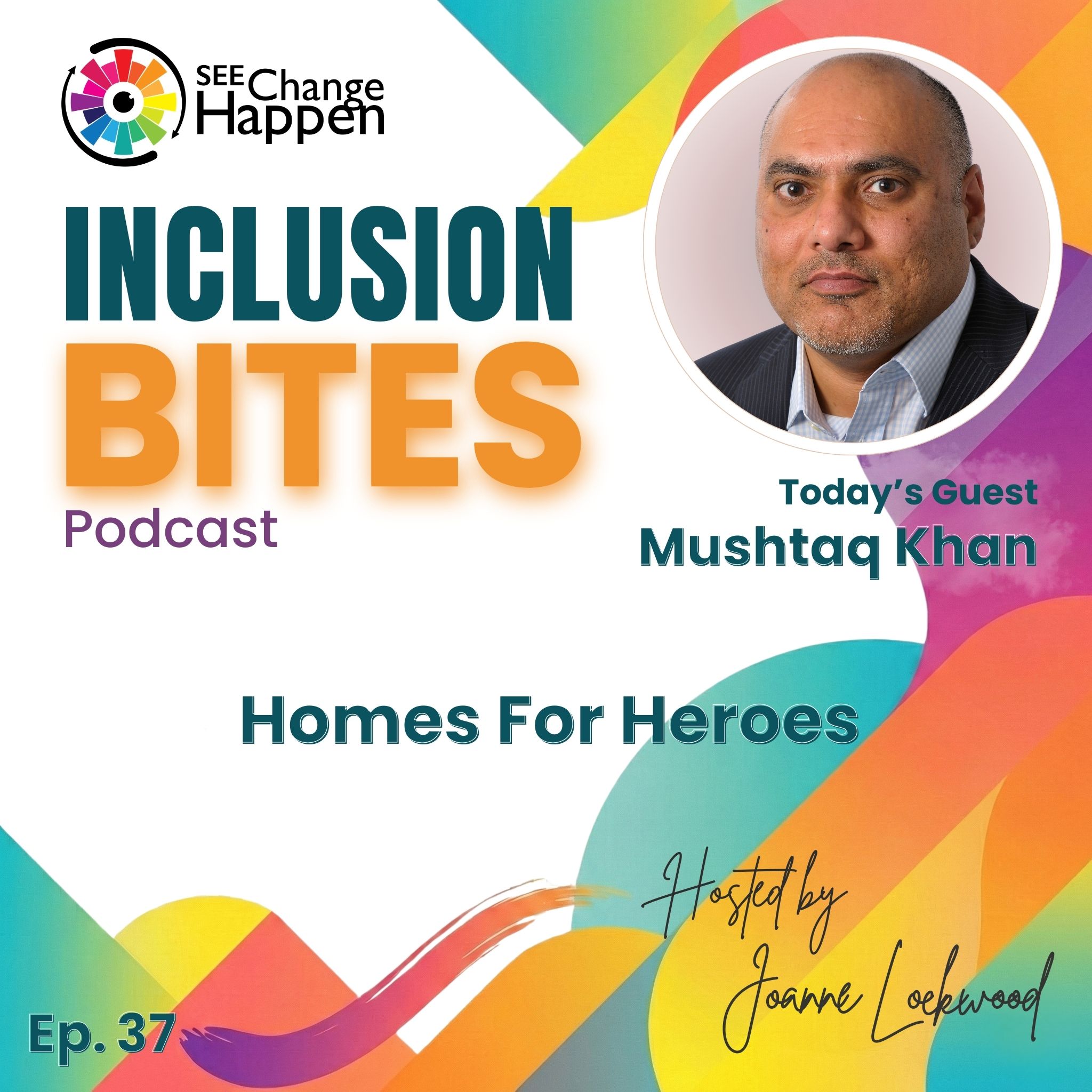
Mushtaq Khan is passionate about tackling inequality, giving people the best chance in life through helping the social housing sector become more inclusive through leadership and governance, community services and workforce development.
In this episode of Inclusion Bites, Joanne Lockwood speaks with Mushtaq Khan about workplace culture systems.
Hello, everyone. My name is Joanne Lockwood, and I'm your host for theInclusion By Its podcast. In this series, I've interviewed a number ofamazing people and simply had a conversation around the subject of inclusion,belonging, and generally making the world a better place for everyone tothrive. If you'd like to join me in the future, then please do drop mea line to jo.lockwood@seechangehappen.co.uk.That's S-E-E Change Happen dot co dot uk. Youcan catch up with all of the previous shows on iTunes, Spotify, and theusual places. So plug in the headphones, grab a decaf,and let's get going. Today is episode37 with the title Homes For Heroes.And I have the absolute honor and privilege to be joined by a great friendand colleague, Mushtaq Khan. Mushtaq describes himself as someonewho helps the health social housing sector become moreinclusive. When I asked Mushtaq to describe his superpower,he said that he's still going strong and active in his fifties,playing football and tennis. Hello, Mushtaq. Welcome to theshow. Thanks, Joanne. It's really good to be on the
Mushtaq Khanguest
show. We've got to know each other really well over the last12 months, although we've never met in person.I'd like to say we've got a really good working relationship, and Ivalue your input into the housing sector.
Joanne Lockwoodhost
Thanks, Mushtaq. So when we checked earlier, you're talking abouthomes for heroes. What do you mean by that?
Mushtaq Khanguest
So when I did my housing studies course, wedid a little bit about World War 1 and peoplereturning from the trenches and British politicians saying thatwe wanted homes fit for heroes. And Ithink it's just as important now,2021, we've got a housing crisis. In fact, we'vegot multiple housing crises across thecountry. And it's really importantthat we, as a society, canbuild homes and houses thatare suitable for today's needs and that can helppeople, live and thrive and be thebest that they can be. So you say
Joanne Lockwoodhost
housing crisis, where's that come from? Is itsnuck up on us, or is it a a a steady rot? I
Mushtaq Khanguest
think we've had a major housing crisis probably for the last 30 or40 years. Governments of all persuasionshave pushed homeownership, as thetenure of choice, and homeownership has its place.We've had a denigration of social rentedhousing. We've had a load of houses that have been soldoff through the right to buy. Wehave got childrenwho Jo parents and children who've got issues becausetheir children can't afford to get on the housing market.We've got large swathes of the country which are unaffordable. London,for example, is unaffordable and many of the ourcities aren't affordable. And people arespending far more of their income on housingthan I than I feel that they should be. So we've not gotenough houses. Those that we've got are probably in the wrongplace, and those that we've got haven't beenrefurbished and bought up to today's standards either.
Joanne Lockwoodhost
I suppose that was highlighted by what tragedy such asGrenfell where building regs,contractors, housing stock ownership is maybe not sociallyresponsible as it should be. No. So Grenfell is
Mushtaq Khanguest
a it sums up all that's wrong with the housingfield at the moment and that you have got some of the poorest people insociety living in the heart of one of therichest boroughs in the country. Andthose, people wereshut off from the rest of society and that the local authoritywhich ran those houses decided to cladtheir tower block in materialthat was flammable to make it, the because it was one of thecheapest options. And it was to shut off those people from the restof of societies like, seen but notheard. And almost all the people who died from thetragedy were from a black and minority ethnic background.4 years on, we still have the ramifications, theinquiries still going on, whetheranybody will ever get prosecuted or whether any sanctions willapply. You know, it's open to question.
Joanne Lockwoodhost
Is it a British problem, a UK problem?How does social housing work in other countries in Europe?
Mushtaq Khanguest
So I think homeownership and the emphasis on homeownershipis a particularly British problem. I know that many Europeancountries have got a far more thrivingprivate rented sector and a social housingsector in places like Holland, for example.And they also have much more regulation and control over the privaterented sector. You have rent controls, for example, which wehad for many years up until the sixties andbeyond, and they've been steadily whittledaway to having no rent controls in the private rentedsector. I mean, I'm a big proponentof having a private rented sector that is well regulatedwhere landlords are monitored and where thestandard of properties is is is of a high standardJoanne rents are are controlled, and we just simplyhaven't got that source of issue. I mean, you know, the private rentedsector in large parts of the country is poorly managed. It'sof low quality, and it's adumping ground for people who can't go anywhere else.
Joanne Lockwoodhost
I've had one of the other troubles we have at the moment is isis tenure. Jo the leasestend to be in private rented sector for 12 months timewhich makes it very difficult for people to put down roots, plan for thefuture. You're almost always thinking about your next renewal,you don't get that chance to just relax in your home.Is that the challenge that maybe the the private rented sector faces?
Mushtaq Khanguest
Yeah. Again, we think that the leases or I think the leases in theprivate rented sector should be a lot longer.There's all these section 8 evictions where people canbe evicted without notice. It's about having a betterregulated private rented sector where landlords arealso registered. Somecouncils have compulsorywhat's the word? Compulsory registration compulsory registration forlandlords. I think if you want to be a private landlord, you should have togo through a registration process and not just be a flyby night, a rackman type landlord. Youknow, I did a lot of work in in northern towns. So for example, inOldham, we did a survey of how manylettings agency well, there's 84 lettings agencies in Oldham.So this is a small town where anybody could set up their ownagency, let out properties,not manage them properly. They'd be really poor condition. There'dbe a focus for antisocial behavior, all on the basis that, you know,for somebody to invest in these properties and they're just bothered about getting a rateof return. I mean, my experience is
Joanne Lockwoodhost
the the private rented sector and the letting agents is everythingseems to be outsourced. So they outsource the key collection.They outsource the inspections. They outsource the inventory. They outsourcethe maintenance. So what you're really dealing with isnice people, but they don't really have any end to end view of thetenant life. They're just pushing a button to say, well, we'll get somebodyin. I think from a tenant's perspective, that leaves a lot of lackof joined up thinking in the experience. Yeah. It's not just that,
Mushtaq Khanguest
Joe. I think it's all them incur a feeand private lettingor lettings, they see many of their fees are a rip off. You know, renewalfees, sending signing tenancy agreement fees,inspection fees, all those sort of things. It isan absolute rip off. And I know some housing associationshave set up their own social lettings agencies where they manage propertiesin the private rented sector. They've just done away with all them fees because youdon't hear about them in the social event. So what was changed? Was it
Joanne Lockwoodhost
12 to 18 months ago, wasn't it? Where there's no document feesanymore. There's no you still pay deposit. You still do a pair ofreferencing fee, but a lot of those renewal fees have been taken away now, haven'tthey? Yeah. So in the housing association, when I used to work, we had a
Mushtaq Khanguest
social lettings agency. Jo upfront fees for thetenant. You know, none of that stuff. We we asked them for 2weeks rent upfront so you didn't have to pay a month's deposit either.And the you know, there's a major hindrance or there'sobstacles for people to get into the private rented sector. If you had a ifyou're a private landlord, if you gave your property to us to manage, we wouldmanage it. And that's what housing organizations do. They manageproperties. They manage tenants. And I think, you know, that isthat's a social lettings agencies that are really attractiveway forward. My
Joanne Lockwoodhost
naive, I suppose, view of the private housing market is or housingletting sector is that people often enter it as aprofit, a pension fund rather thanthe social responsibility of providing someone a home is a business to them,isn't it? I think sometimes they forget about the customer whichis their their less their less or less e.
Mushtaq Khanguest
Yeah. It's a financialization of housing where people arein it for a profit. People see it as their pension fundrather than it for it's a it's a place to live for many people.I'm not saying that all landlords are bad. I think some people have a reallypositive experience in the private rented sector. But we knowin some of the big cities and the smaller towns, the quality is poor, themanagement is poor. They're not looked after.And they they don't add anything to the built environment.
Joanne Lockwoodhost
I mean, I I used to work with, in my previousbackground working on IT, I used to work with a couple of nationalchains of letting agents, and I spoke to some of the franchise holders.And they were very clear that their client is the landlord.At no point does the tenant figure in anyone's mindas the client. So as far as the landlord's concerned, theless the letting agent is dealing with the client or the tenant.The the letting agent believes the landlord is their client. So who's worrying aboutthe interests of the tenant there? And often it's not.It's the the letting agent is trying to maximize thereturn for themselves via fees to the landlord.Pushing up rents, index linking at 5% a year, whatever it maybe, because that returns more money to the letting agent. Sonobody's nobody's got the tenant's interest at heart, have they?
Mushtaq Khanguest
No. I think that's the difference between private rentedsector and the best social landlords where,having the tenant's interest at heart, making sure that tenants have asay both into the running of their home and the running of their neighborhoodsis important. Yeah. But I think you're right. You
Joanne Lockwoodhost
said it earlier on that there's this UKperception that owning is best, whether thatwas developed in the glorydays of Mackey Thatcher pushing everybody for ownership.But but not only around home, it seems as a stigma or something. Yeah. And
Mushtaq Khanguest
I think you I would go back to the 19 eighties and the Thatchergovernment. One of their flagship policies was givingcouncil tenants the right to buy their homes. I've got nothing againstthat, but those homes were never replaced. There was awindfall for the windfall for those people who bought those properties straightaway, and we know that probably athird or more than a third of those x right to buy properties endup back in the private rented sector at extortionaterent. So and if those people on housing benefit were actuallypaying, you know, the state is paying for those thosethose benefits now. You know, they're paid they're paying for that rent. Soon the long term, it's never worked out for the state, and you've had anenormous loss of affordable housing,which, you know, plays itself out in society at the moment. So it was agood thing at the time. And, you know, I know, forexample, is it Scotland or Wales one of to have a stop theright to buy it, you know, because they just feel that it's a it's aan asset to the community which has been privatized, and it does nogood whatsoever for their local communities.
Joanne Lockwoodhost
So you talk about the the ethical side of social housing.What's that look like? What's what what what are the whatare the good good parts of that? So I think well, I've
Mushtaq Khanguest
worked most of my life in the housing sector,And I've worked with social landlords, both local authority andhousing association. AndI think that the housing organizations have 2functions. 1 of all is what first of all is to bethe best possible landlord. So it's getting the basics right interms of property condition, repairs,collection of rents, turnaround of properties,making sure that the neighborhoods are up tostandards. But the secondly the secondpart of being a good landlord is being a a communityanchor, which is ensuring that your residents andyour neighborhoods canimprove their life in termsof potential, in terms of access to work,access to educational opportunities,and access to having a better socialenvironment around them. So I think there's 2 there's2 functions for for housing organizations. And Ithink, sadly, some of them just do the core landlord functionsand build new houses, some of which aren't affordable.I think housing organizations should help regenerate thecommunities that they're working. And I completely
Joanne Lockwoodhost
agree.When I when I you're the CEO of the HousingDiversity Network and I believe you also sit in the board of of 1or some housing associations yourself, have spent, as youjust said, a long time in the housing sector or thesocial housing sector. Are socialhousing companies alsoleaning towards profit before before tenant in some cases?
Mushtaq Khanguest
Well, they won't say profit. They'll say that they want they're all not for profitorganizations. They do have some for profit off yousubsidies. I thinkthe focus over the last 10 or so years has beenon new build because the government ispushing them to build new housesbecause we the you know, everybody recognizes a housing shortage. I think in thepush for new houses, they have moved away fromtheir core purpose, which is regeneratingcommunities. I think the best housing association was set up in thesixties as small locally based venturesto help local communities improve housing conditions.And they've just grown to be massive organizationsnow, and they like doing the core landlord bitbecause, you know, that's what they feel is of ofport important to them. They have callcenters. They have text for rent arrears. You know, they've gone awayfrom the face to face contact andin the drive for new homes, and they save everything just so they canbuild new houses. I'd like organizationsto to do both. And I think, you know, losing that local communityimpact, local community connection issomething that, you know, is important to us. And at thediversity network, we've got an accreditation scheme, which doesn't justlook at the,how many houses you build. It looks at your wider community purpose. Itlooks at your business impact. It looks at how much social investmentyou've done. And I think that's just as important for me.Mhmm. Because there there's two sides to
Joanne Lockwoodhost
a housing association with tenant. There's the affordable housingfor key workers, nurses, doctors, firefighters, police,whoever that may be. There's also the lifeline housingfor people who are on benefits or don't have accessto credit ratings or whatever that may be. Do you thinksome housing associations are prioritizing the key worker affordablehomes rather than the baseline social impacthousing? I think I think Jo. Certainly in London.
Mushtaq Khanguest
I think, you know, London's got a particular housing crisis.Key workers can't afford to live there, but they have affordablehousing and then there's a even the affordable housing, there's a push for sharedownership rather than truly affordable rented housing.To me, yeah, housing house is affordable if you're spendingprobably a third of your income onrent. So you you just look at the average wage in a particular areaand say, look, if a third of your wages on rent, then that isaffordable. The government defines affordable housing as 80%of what the market charges, which is far in excessof what I would class as truly affordable.And just going back to your earlier point, I would likehousing social housing was set up for anybody, andyou didn't have to be on benefitsor, you know, in the twilight of youryears needing sheltered accommodation. It was set up for anybody.And you were meant to have doctors miss mixing withlaborers and having truly mixed communities.And you're right in that we moved away. And there's a stigmaattached to social housing, and there was a concept inthe nineties and early 2000 having sink estates where peoplewere dumped because nobody else would have them. They'd been through thehomelessness route, and they were just dumped on particular areas.And that led to a real downward spiral in thoseareas. And, you know, I'm a great advocate ofhaving mixed sustainable communities with people from allwalks of life living together.
Joanne Lockwoodhost
Yeah. Because this shared ownership is is not the panaceait reports to be because it's it's not any more affordablethan the renting. Is it becausea shared ownership resident is seen to bemore likely to care about the property and the environment because they have a stakein it. Is this the bias against people who aretenants as being more like to commit antisocial behaviors, more like tobe the wrong sort? Is that the bias that's created? I'm
Mushtaq Khanguest
sure it's the bias. I'm sure it'sthe emphasis that we've had on your home. Isit your home, your castle? What's the phrase? Is it like youran Englishman's home is his castle? And that's youknow, if they if there's an emphasis on homeownership, and it's just beingpushed over years years. But we know that over recent years,homeownership has declined because the generation that'scoming up now to the stage where they are moving into their ownaccommodation simply cannot afford to buy.You know, law in large swathes of the country on the wages thatthey're on, they simply cannot afford to buy properties in those areas. So Ithink there's a real imperative to have a majorhouse building program, but we're never gonna get there, you know, notwithout a major sea change.I remember probably was it 2000 early 2000s, KateBarker, an economist, did a report on the state of thehousing market. And she said one of the reasons why,housing was housing market was inthe state which is in is the developersontoonto the table that there wasn't, itwasn't to do with planning, which is is always trotted out. Youknow, planning is behind it, planning regulation. Andpeople did people want new houses, but they don't want themnext door to them, they don't want them in their own backyard.
Joanne Lockwoodhost
And there's a massive, you know, housing estatenot far from where I live, it's called Burwood in Walkleyville.And I don't know how many houses are on the entire state. And there's obviouslya balance between affordable, social,and private. But they've beencrammed in and I dare say that the the social housingand the affordable housing, you can just tellthe difference in stock is crammed in. I would be botheredto get an ambulance of a fire engine through those streets at night where thethe cars are packed tight. There's no garages, no driveways,often 1 and a half car widths wide, which means everyone's on the curbs.It means that you've got 0 access for people with wheelchairs orpushchairs. And it's actually a nightmare to get out ofthere. I mean, I remember getting lost trying to find my way out. This islike 15, 20 minutes. So they're quite dark, what's that?Because there's not a lot of light coming in because it's built up,creating this sort of like shadow on the streets and it just worries me thatwe're building these estates now and packing people inin in the guys that's not being high rise but still suffering that high risementality where everything's crammed together. There's no room to breathe. Yes,there are parks, greenery every so often. But itjust seems like a fault with kind of future social problems that are gonnadevelop. Yeah. Ted Wright. Again, in
Mushtaq Khanguest
a tower block with they're called pore doors in that you've got 2different entrances. You've got a really nice tower block, and the plushentrance is for people who bought their houses around the backoverlooking the, you know,the the bad views, overlooking the poor parts of town are isthe affordable housing, which is, you know, let through ahousing association. And the people wholive in those properties don't have access to the to the gymor the car park, and they Jo in through the poor door around the corner.And that's what they were called. I mean, you know, there's some majorissues around how these developmentsare constructed and local authorities, I think, need tobe a lot stronger, and should have a lot more,weight in that the emphasis that they placed. And, you know, these places shouldbe indistinguishable from each other.
Joanne Lockwoodhost
Again, is that the bias against the people who arein the poor end of society, people whodon't come from the same privileged background. There's a perception they're going to becausing trouble, noise, drugs,violence, etcetera, etcetera. So this is the bias that's playing outagain, pushing some people down lower and raisingsome people higher. Yeah. Would would you say that's unconscious
Mushtaq Khanguest
bias or some conscious bias or a mixture of both?
Joanne Lockwoodhost
It's definitely bias. I I think it's probably commercial biasmixed with unconscious bias. I think there's a is the isthis conscious about the their perception or theperception may be unconscious, but they're conscious about enacting on it.So I think there is some business marketing was going on there.
Mushtaq Khanguest
And there's always been discrimination in the housing market going back tothe 19 fifties and the no black blacks dogsor Irish. They used to go up, you know, inmany proxies. And, you know, the Commission For Racial Equality in theeighties, serving notices on local authoritiesnondiscrimination notice on local authorities saying, look, you're rehousingpeople in particular areas. You shouldn't be doing that. So I think there's along history of discrimination in housing, and it stillplays itself out to this day. But
Joanne Lockwoodhost
that fuels societal problems in the future again as as we know. Itcreates hotbeds of tension, hotbeds of frustration, whicherupts. And it becomes a self fulfilling prophecy, doesn'tit? The These people are going to cause trouble therefore they do because ofthe frustrations that amount and it's oneperson, it's always history is written by the victors. So oneperson's right is another person's social justiceor shouting out for what's right. And too often, wedon't listen to the people who are asking for basic humanrights, basic being listened to, basicservices, and we just brand them as troublemakers and that'sthat seems to be happening time and time again. Yeah. I'm a great
Mushtaq Khanguest
proponent of having a housing market that's fair for everybody.We know that certain groups are disadvantaged in the housingmarket. For example, a third of peoplewho are homeless are from a black and minority ethnic background,which is far in excess of the population as a whole. Andhomelessness in England is a legal termin that you've got to you can only be declared homeless by alocal authority, so you've got to go and present yourself to the local authority tocarry out an assessment. So there's a whole load of people whoare hidden homeless, who are sofa surfers, who don't know the system,who can never, you know, Joanne access things. So, you know, thehousing market itself is a is an unfair market,and it has been for many years. And things are coming to coming to ahead. People think, for example, rough sleeping is
Mushtaq Khanguest
what homelessness is. It isn't homelessness households orpeople, you know, somewhat wider definition, people who haven'tgot access to an affordable place where they canlive. You know? And we solvedit at the beginning of the pandemic by putting everybody who was outon the streets in in a hotel becausewe thought that they were gonna they were gonna transmit the virus. But we're backnow to having homelessness be homeless people on the streets. Butit's just the it's like the iceberg. You only just see thethe visible bit. There's a whole, you know, 9 tenths of the problemis between the water below the waterline.
Joanne Lockwoodhost
And you said right about we managed to solve the the rough sleeping problem fairlyquickly before realizing actually living outsidein the fresh air was probably least risk sticking withthat. Stick him in a or Lockwood him. In fact, what we did was welocked him into hotel rooms and wouldn't even let them leave their room.And these people have been used to living in their own communitywith their friends. Many, I believe, many would describe themselves ashomeless. They had a home. It just didn't have a roof on it. Theyhad a community. They had friends. They had a network. Because then when we typicallystuck in hotel rooms and expected them to be grateful. Andwhat what we did was we stripped to the the dignity and freedomsunder the guise of looking after them without really asking them what theywanted. I think that's a typical government, isn't it? Weuse this big mallet to hammer this small nailwithout actually talking to the people. I think we've we haven't wehaven't actually fixed the problem, have we? No. I mean, people said that homelessness is
Mushtaq Khanguest
unsolvable. They were that they were you'll always have homeless people. We did solveit. We we solved it in 10 days. We don't have, you know,we don't have 3 year, 5 year rough sleeping strategies.It was solved straight away by finding people who are out on the streets'accommodation. But like you say,that accommodation needs to be providedwith some real intensive support because people who are out on thestreets have, you know, multiple issues, you know,massive mental health issues, for example, that need to bereally explored and worked through with those peopleso they don't go back out onto the streets. But sadly, we're back into thatsituation now.
Joanne Lockwoodhost
So things like yeah. Food banks will be seeing the rise of these of thosethroughout the pandemic. More people fall into poverty. If it wasn'tfor the amnesty on evictions,there'd be thousands of people, hundreds of thousands of people evicted bynow. And that's bubbling up, isn't it? It's gonna it's gonna thatbowel pressure is gonna happen. We've got normalization of things like food
Mushtaq Khanguest
banks. I don't remember food banks before 2010, and Iworked in some of the poorest parts of the country. We thinkit's normal now. We have MPs going to food banks. And opening foodbanks is just I just think it's horrific, the state that we've gotinto where we normalize things which were unimaginable10 or 12 years ago. Yeah.
Joanne Lockwoodhost
When we do our weekly shopping, we always have onebag for somebody else. And we'll we'll shopand put put things in there that we would appreciate.Maybe not the usual Joanne beans and other we put toiletries,sanitary products into that and know that to make not everyone thinks about. And wemake a very conscious effort to to deposit that. We wouldn't have done that, asyou say, 10 years ago. No. The state has withdrawn from its
Mushtaq Khanguest
responsibilities for providing for everybody.You know? And it's now gone into loans loans and benefitssanctions and things like that, which are unimaginable 10 or 12years ago. And you know, like I said, I never remember food banks, never whenI was growing up, never when, you know, I was working inin some really disadvantaged areas, and now it's a normal part ofsociety. Yeah. I'm I'm I'm not an
Joanne Lockwoodhost
expert on the types of benefit people can claim, but I'm I'm aware thatthere's so much means testing, so much believability testing. Areyou are you really incapacitated enough? Are you really disabled enough? Areyou really unable to work enough? Of course, human natureis you're trying to create the best impression of yourself all the time and you'vealmost gotta create the worst impression of yourself inthese situations because if you can walk from a to b, you'redeemed to be able to walk. Yes. It'sfrightening what happened. By the way, that wasn't my fault. I don't know whether you
Mushtaq Khanguest
heard it. No. No. I didn't hear it. It's alright.
Joanne Lockwoodhost
No worries. I've had I've hadpeople's numbers phone them up on on the podcast, so don't worry. It'sused to used to working in a in a COVID COVID friendlysituation here.So I was saying that what was I saying? I was talking aboutI've lost my thread there. Well, I completely forgot what was going on. He wastalking about normalization of feedbacks, benefits, options.Yeah. The term benefits is, you know, the means testing. Wasit incapacity benefit, independence payments, they're allso linked. So many people have been denied access.This not only impacts their ability to stay in a in a home theyhave, but also feed the family, heat.So many conflicting priorities going on in people's lives these days, isn't it? Just justto survive. Yeah. I think the benefit system always reminds me of the insurance
Mushtaq Khanguest
system. It's designed to make sure that you get as little asyou possibly can with the most amount of effort.You know, probably I'm an advocate of a universalbenefit for everybody, whether they're working or not, just to do awaywith some of the stigma and to make sure that everybody can have areasonable standard of living. I think in the futureas work more and more work gets automated, it mightbe something that we as a society we move we move towards.
Joanne Lockwoodhost
Well, there's a quick book I read. Rook and Brickmanis Utopia for Realists. I don't know if you've ever read it, buthe discusses all about UBI, universal policing income Joanne heposes thought that rich people have squanderedfar more money than someone who is consideredpoor will ever do. Jo, yet we associate people whoare poor as being untrustworthy, incapable of managing money.So they're incapable of managing money, they don't have money to manage with. Moneyis always trying to work out the next priority,survival. Whereas when you have lots of money, you'll squanderon luxuries, non essential items, etcetera, etcetera. So youcare less about money the more you have. So by empowering people with
Joanne Lockwoodhost
UBI, we're actually creating an environment where people can start to thinkabout tomorrow, next week, the week after, ratherthan thinking about this afternoon, how am I gonna feed my kids when they gohome to school? That's the challenge of getting people out of povertyor onto onto a universal basic income levelwhere we they know that they they can actually start planningwhat's gonna happen. And 0 contracts don't help because people can't plan aroundthose. Gig workers, yes, I know it suits some, but it doesn'tsuit everybody and it was causing situations where people just can't plan theirlives. They can't save their rent. They can'tpay their children. They can't put shoes on on their feetbecause they can't plan where their money is gonna come from. And that's that reallyis kind of, you know, if you think about theelements of mental health, it's being able to have agency andplan. If you can't do that, that it really impacts your abilityto function as a human being. Absolutely right. I
Mushtaq Khanguest
think it's it's an important debate and one that we we're suddenlynot having at the moment even as we're coming outof a pandemic. You know, how are things gonna be differentfor us in the future? I mean, a universal UBI,universal basic income is really important, I think, as part of that.
Joanne Lockwoodhost
But we don't see any political party, whatever whatever side of thespectrum you're on, really talking about this problem, whetherit's UBI or whether it's really tacklingsocial housing, housing, affordability. No one's really lookingat this, are they? It's all around national health. It's the bigpolitical at thestart guys we always get is NHS. Aren't they wonderful? We've got toprotect the NHS. What about Yeah. The people? I think
Mushtaq Khanguest
housing has been described asalways the dog that doesn't bark during election campaigns. Peopletalk about it, but it never comesup as some major policy other thanan emphasis on homeownership. I thinkincreasingly, though, people have recognized the seriousness of thehousing crisis, the lack ofsuitable affordable housing for far too manypeople. And I think as time goes on,it'll become more and more of an issue because the NHS andhousing are in strict what's the word, inpricibly? How do you say it? Precisely linked. Precisely linked. Yeah. That'sYeah. In that, if you havea decent, secure affordable home, it affects your mentalhealth, it affects your physical health and your overallwell-being. And I think it's really important to have,you know, housing that is suitable and affordableand have a really good standard so that you canlessen the expenditure on all the services.
Joanne Lockwoodhost
Yeah. Well, we've also seen in the last12, 14 months, the magic money tree thatsuddenly sprung up to plow into COVIDhad a fraction of that being plowed into UBI,a lot of the problems we have in society wouldn't just wouldn't be there, wouldthey? We wouldn't have this we wouldn't have had to have the jobsupport scheme. We wouldn't have had to have some of the other schemes we hadbecause the basic UBI would have been there, meaning nobody was gonnafall through those cracks rather than having to invent something on the fly.And then as soon as it's working, pull it away again and justpull that rug out. Or you could have invested swimmer in
Mushtaq Khanguest
housing because COVID is a disease of the poor.You know, if you live in poor quality accommodation, you've got nooutdoor space. You may be overcrowdedin your own accommodation. Youknow, your health is poor so that you can't actually go outand exercise and those sort of things, and you've been locked down for the past12 months. And, you know, I've come across people who've never left theirhouse since last March. I think,you know, investment in housing that should, you know, should have been acritical part of any post COVID recovery?
Joanne Lockwoodhost
I I found that myself. I I work from home duringthe the lockdown periods. The only reason I was going out was shopping, and mostof the time we were shopping online. When it was wet and windy,I wasn't going out getting exercise. I found myself gettingkind of more institutionalized, more like a caged polar bear.I was wandering around my 10 square meters of propertythat I had. I found my own mental healthsuffering and as a result of that, theNHS are very focused on this term, PJ paralysis. The longer you spendin your pajamas when you're in the hospital, over the age of, Ithink it's 60 or 70, every day canknock a week off of your life sort of thing. So if you're spending weeksweeks in there, your outcome when you leave hospital having spent allthat time laying in bed, your muscles atrophy, youryour your whole well-being suffers. So we've got to keep people active, you know. Imean, you said at the beginning that you're still playing football and tennis andrecently given up cricket. But I've learned the importanceof the last 14 months to be more active becauseI feel myself as a 56 year old starting torealize that if I don't, in 5 yearstime, my health will suffer badly if I suppose.
Mushtaq Khanguest
Yeah. I don't disagree. It's it's really important that peopleare active and that we have communities and spaces wherepeople can be active. And, you know, it'sagain if you're middle class, you've got sharp elbows, you get thebest deal in everything. And I just think, you know, many of the poorcommunities have been poorer communities have been left behind in thispandemic, and it has exasperated majorinequalities in society.
Joanne Lockwoodhost
We're now focusing on sustainability, environmental.Again, is this about the the richer, more privileged you are, thesharper hours you have? I get it. I gotta be living in cleanerenvironments. Can some ofthe less buy off people in society afford to electrify theircars? Can they afford charging points? Can they afford whatever it maybe? Well, again, we'll see this massive dividebetween houses that are for thefuture and houses that are just legacy and not being investedin? Yeah. I
Mushtaq Khanguest
think houses and neighborhoods need to be sustainable.Sustainable in terms of the property itself, but thesurrounding area, open space, healthfacilities, education facilities, transportis a major issue as well. I always remember goingback to 2010 when the last labor governmentintroduced the equalities act, and they had 9 protective characteristics.And I've always thought that there should be a 10th protective characteristic, which isclass, and that public organizations should take intoaccount their decisions, thethe effect that it has on different neighborhoods anddifferent social classes because I think we would have a very different worldif a local authority would, for example, would have to thinkabout transport and health in termsof class rather than in terms of ethnicity and disability.In many respects, I think class is the biggest determinant of whether yousucceed in life rather than any of the othercharacteristics. Yeah. For sure.
Joanne Lockwoodhost
And and class is made up a whole load of different dimensions, isn't it? It'snot just the class you're born into, but it's alot of it today the more modern definition of class is youreducational achievement, your your first Jo, if youlike, or what size family you came from, what sizefamily you're in. There's all the dynamics about your earning potential that comesinto class these days. I think there's Jo manynouveau riche and internet millionaires that have come fromnowhere and footballers, etcetera. So there's the old the olddefinition of class is kind of well, we need to redefine what do wemean by class, I suppose. Yeah. I mean,
Mushtaq Khanguest
when I was studying it, it was a,b, c one, c two, d and e. You know, your socialclasses were defined by a social scientist as one of the thejob you know, it's about your job the job market. I think the job markethas changed so much. You probably got a lot of people at thetop and a load of people at the bottom and less soin the middle. And maybe the biggest divider in societyis age, education,leave and remain. You know? You know, thethe the way that you look at divisions in society are very different now. Andyou can predict people's behavior based on whether theygraduate or not, whether they voted leave or whether they voted remain.You know? There's there's just different ways of looking at society. Imean, David Goodhart talks about,the these somewheres, anywheres, and in between us. You know?People, you know, it classifies people differently.It's a fascinating subject. I'm not sure what the best way of looking at itis, but you've got to look at things in a different way now whenwhen it comes to class and, you know, definitions of classesis is an important area that we need to think about.
Joanne Lockwoodhost
I think you're right about the in betweeners because often those are theones that fit nowhere. If you'reproud working class in a community, you've often got a supportnetwork around your local community. As you say, if you're upper classworking class, you have somewhere to reside. But if you're kind ofin this lost class, where is yourtribe? Where are the people who will support you? There arepeople who understand you. Those are the people sometimes getting they have holes inthe cracks where it's people who have traditionally been safe,secured you know, in work, but theirwages aren't keeping pace with their cost of living, they're falling further andfurther behind, they're getting into debt, credit cards aremounting, payday loans, etcetera, etcetera. Those people are really struggling.And they're one bad decision around being hopeless on thereand that's some of the trouble we face.
Mushtaq Khanguest
Yeah. It's a really fascinating area, andI think, society as a whole needs topay more attention to, you you know, theimpact of major public decisions on,you know, people from different backgrounds and not have aone size fits all approach.
Joanne Lockwoodhost
You mentioned Brexit remained just then. Do you think there's gonnabe yet moredivision in society around those people whoperceive themselves to be British and thosewho are perceived to be not British, whatever that maymean? Are we gonna see xenophobic type riseor do you think society will survive this? So I
Mushtaq Khanguest
in 2000, I spent a lot of time working in Oldham,like I mentioned previously, which is a segregatedtown, different communities living in differentparts of town. And there wereriots there in 2,001 which,you know, I'm not sure the town has has recovered from, but, you know, it'smaking great strides. And a lot of the work that wedid in the housing sector was aboutdispelling myths and trying to bring communities together.And I think, sadly, over the last year or 2, we've not doneas much work as a society aboutlooking at what we have in common and what brings us together.It's mostly been around divisionand divide and Joanne us and them.And I think as a society or as a political class,that has played well. And it's, you know,I think at the heart of much of the work that housingorganization should be doing was around cohesion and about bringing peopletogether and recognizing and talkingabout our differences. There's a really goodproject in Sheffield called who is my neighbor who we had on one ofour housing diversity network webinars who's who Joand talk to people in neighborhoodsabout the change that is occurring and how they feel aboutit. And they often feel that's the first time anybody's ever talked tothem. You know? And the first time that they've managed to, youknow, listen to what their fears are about the pace ofchange, about the things that are happening in theirlocal area and how it affects them. And I thinkwe've not done that as a society. You know, it playswell to certain elements of the political class to keep that going, tokeep that divide and rule going because,you know, for example, olderhome owning people are more likely to work tovote in a particular direction?
Joanne Lockwoodhost
Yeah. I mean, that's some of the work I'm I'm doing with the HousingDiverse Network and, yeah, the work we're doing together is thatvery much around the community focus. I think what you picked outthere, people often just want to be listened to, But in order to belistened to, you've got to find them. You've got to reach out andlocate the people and then make time for them because too oftenwe we create a stereotype. We just look people andsay, oh, we'll assume they all think this, but we often don'treally go and talk to individual communities. People in the communitiesunderstand their needs and struggles. Obviously in theconversations I've had with the housing associations who are very progressive, very wellmeaning and trying to do the right thing is they oftendon't hear everybody. And I think the example you talked about at the beginningwas the digitalizationof service, the online payment methods that reallyrecognize that some of the people who are most struggling in society don't haveaccess to what we treat now as the norm.I had to get one of my relatives to sign a document the otherday and they don't have Internet at home, they don'thave a laptop, they've got a phone and that just aboutcatch the Internet. So when someone glibly said, oh, just get getto sign the PDF just and then send it back. He'slike, I must have been talking Irish or Spanishor Portuguese or something to my relative and they wanted itprinted out. Of course, I don't have a printer, they don't have a printerand the organization that was sending it didn't really understand what thetrouble was. Jo again, it's a disconnect between people whoare not digital or not thinking like youdo and creating these services that are accessible.And that's that's some of the challenge that we we often forget about. Yeah.
Mushtaq Khanguest
And it's another one of the divides, the digital divide as well betweenpeople who are familiar with the new ways of workingand those who who aren't and, you know, aren't familiarand have never embraced some of the newways that we work.
Joanne Lockwoodhost
Well, it's been amazing. We've been chatting for almost an hour.So do you wanna tell us a little bit more about the work you doat Housing Diversity Network and if you're anybodyout there who's in the housing sector, what services do you offerand how can you help? So very briefly, Housing Diversity
Mushtaq Khanguest
Network is a not for profit. We work in probably4 main areas, leadership and governance. We doa lot of work with exec teams and boards to makethe organization more inclusive. There's been an enormousfocus about making boards more diverse.And we've been really concentrating onthat over the past 12 months. We do a lot ofworkforce development too,everything from training to having mentoring program. We'vegot a flagship staff mentoring program for people who wantto move on in their careers, who are just stuck.And most of the people on our mentoring programs are women or people fromminority backgrounds. And we also do some work on servicesto the community, you know, making sure that you work,you listen to the communities, and are responsive totheir needs. And we have an accreditation program as well, whichis a bit like what used to be called the audit commission used tocome in and inspect organizations,come to a judgment based on the evidence that you've got.And the accreditation program that we have has really picked up for housingorganizations because they just see us laying down a markersaying, look, this is where we are in terms of equality anddiversity and inclusion, and this is what we want to do next.Jo Housing Diversity Network is a membership organizationtoo. Our membership has grown a lot over the last 12months. We want to continue wewe want to continue growing and provide servicesacross the sector. Excellent.
Joanne Lockwoodhost
And you mentioned about the housing, the board diversityprogram. I mean, I've had some experience. There's a real pushnow to become more representative of the communities, whichI'm sure you'd agree is really, really important for this listeningand being relevant again, isn't it? Yes. So we
Mushtaq Khanguest
know that housing association boards tend tobe on the older side, people who aretired and have got skills in the areasof risk or financial management. Andthey don't reflect the communities that theyserve. Sometimes there's groupthink.They're not as close to the community. They're not aware ofnew developments. And our board diversity programs thatwe have are help with recruitmentand help with succession planning because you can't magic up a diverseboard overnight. Sometimes you've got to go out and recruit somepeople as trainees Jo that inthe the next 12 to 18 months, they're in a positionto apply for vacancies as and when they occur. So boarddiversity is critically important if you want to be a growing andthriving organization in today's world.
Joanne Lockwoodhost
Yeah. And that's not just housing associations. It'sNHS Trust, CCGs. We know the Nedmarket and thespecialists who do a lot of these these work areportfolio holders, and they tend to be, as you say,a typical type of person, often older,often retired, often had a certain background.And I think it's really important for the growth of services inall sectors to think about bringing in peoplewho are have different lived experience and invest in the trainingbecause a lot of the requirement to be a a net or a non executivedirector is you tend to have to have had a portfolio oropportunity in the past. Again, that's excludingpeople who don't necessarily have a depreciation of the Companies Act, whodon't have unsettled governance risk and how do you become yourfirst how do you bring your first portfolio inuntil you've had one start. So I I think it's critically important if we don'ttap into people from minority underrepresented communities toprovide them that pathway. Yeah. I'll be interested in your views on
Mushtaq Khanguest
this, Jo, because you've been work handholding a housing organization right from the beginning of theprocess so that they Joanne, get amore diverse intake into that board. How howhave you found that? What have you had to do to help them along theway? Well, it's been a couple of times where
Joanne Lockwoodhost
it's almost like this nervousness ofwe must have this, this is avatar of the person they wantand it's really hard to break that mold and say imagine thatthis person was completely different to what you're thinking.And you can almost see them like there's a quiver of fear,letting someone different onto the board. And I even and I evenchallenged them. I said, Jo what would it look like if this person didn't speakEnglish as a first language Joanne you had to provide aninterpreter at the board meeting? And there was this, again, this kind oflike, well, that wouldn't work, we need to better, so if you couldn't think abouttrue diversity, true representation of your community,There's somebody who may not speak English as the first language, in which case, youshouldn't discriminate or pull them out because of that. And howdo we work, make that reasonable adjustment the way around it? Or if you alwayshold your board meetings at 10 o'clock on a Tuesday, you maybe limiting the access to younger parents orsingle parents who can't tell at times. So how do you how do you bringthose people into it? But this is real resistance of but thenonce you once you talk and you spend timeexplaining how this could work, it starts tosoften and starts to melt. But there's there's still thisthis comfort blanket of the CV, this comfort blanket of a trackrecord, this comfort blanking of hitting the ground running. If you've gota board of often 13 or 14 people,most of the key compliance and governance box are beingticked already. Your main committees are already being resourced. Soyou've got the opportunity to bring people in really justfor their perspective and thenbring them onto the committee, then bring them into other roles. As you said, thetrainee, the apprentice, Ned, whatever you wanna describe the role.That's what we need to do is we need to bring people and let thembelieve that it is for them as well. And it's not justfor the traditional, often white, oftenmiddle class, often retired face in the room.
Mushtaq Khanguest
Yeah. We're doing some work with a cooperative, which is the purestway of running a housing estate. And they havegot we're doing some board development work with them. They'vegot 8 people who are coming on the program. And2 of those, their English is very poor, but they're a vitalcomponent of the management of that estate. So we've gotto think through how can we do some board development, which is personaldevelopment as well as attending some workshops.And we can make it as inclusive so that those people can attend and getthe best out of it. But, you know, those 2 people whose English isn'tas good actually add a lot to the management of thatcooperative. Oh, one of the challenges I've
Joanne Lockwoodhost
I've heard when I speak to some of housing associations and theirteams is that it's really hard to get resident engagement.Not everybody wants to be an activist, not everybody wants to give their timeup. They just want a house, they just want a home, they just want tolive. And so sometimes we're asking toomuch of people, where peoplereally just don't expect to be asked that question. You don't gointo your bank and they say, do you want to come on the committee? Doyou want to come and talk about the service you've had today? Do you wantto be a part of a feedback group? So the housing associationsneed to develop a way of involving themselves in the communities andreaching out in a way that works, not expecting the residents tocome to them all the time. And that could be door to door knocking,sitting down, having a chat, more 1 to 1 sessions,and just putting more time and effort to find out what people are really thinking.
Mushtaq Khanguest
Yeah. We've all been there. We've all been 7:30 on a wet Tuesdaynight in a committee room where most people want to be watching CoronationStreet, but we've dragged them along to a committee meeting.Again, you've got, you know, average age of the people in there is probably about72. They're not representative of the tenantbase. Our our views are that you should be usingtechniques like yourself, like you said yourself. Doorknocking, you should be incentivizing people to attend. You should be using Facebookand social media to get feedback. You know, there are different ways ofdoing it rather than the standard committee room model.
Joanne Lockwoodhost
Yeah. Yeah. Which appeals to the parish counciltype mentality or the the people who like that traditional oldschool meeting. But many people got anxiety about speaking inpublic. They've got, they've got commitments. They can't give outthe time. So, yeah, it's completely as I theexpression I love is when people are hard to reach, you have to reachharder. I think that applies to so many cases, And that'scustomer engagement is is exactly that, reach harder if you're nothearing from people. Well, that'sour that's our hour and a bit. Well done. Brilliant. Thank you. I really reallylove the conversation. I hope I didn't come across as muddled
Mushtaq Khanguest
in some ways. Sometimes I'm just thinking ahead of what I'm saying, yousee. No. I thought you were fantastic.
Joanne Lockwoodhost
Hopefully, our listeners, thank you for tuning in. Thank you for listening.Please do subscribe to keep updated on future episodes of theInclusion Bites podcast at B-I-T-E-S. Tell your friends andcolleagues, I've got a number of other exciting guests lined up that I'm sure you'llbe equally inspired by over the next few weeks months. And, ofcourse, if you'd love to be a guest, then please do let me know. AndI'm always open for feedback and suggestions tojo.lockwoodchangehappen.co.uk. Tell mehow can I improve, tell me what you'd like to hear from? Oh, absolutepleasure. My name is Joanne Lockwood and it's beenawesome and a pleasure to host this podcast for you today. Catch you nexttime. Bye.
Homelessness and Rapid Housing SolutionsFood Banks and Rising PovertyHousing Affordability and Social Inequality
Joanne Lockwood is joined by Mushtaq Khan to explore what “homes for heroes” should mean in the UK today, in the context of long-running housing shortages and affordability pressures.
They discuss how policy choices over decades—such as prioritising home ownership, the impact of Right to Buy, and inconsistent regulation of the private rented sector—have contributed to insecurity, poor property standards, short tenancies, and rising costs. The conversation also touches on tragedies such as Grenfell and what it revealed about standards, accountability, and inequality.
Mushtaq and Joanne examine how housing conditions shape people’s health and wellbeing, including the links between secure housing, mental health, and outcomes during the pandemic. They also consider how stigma, discrimination, and segregation affect communities, and why tenant voice and community cohesion matter.
Towards the end, Mushtaq shares the focus of Housing Diversity Network’s work, including inclusive leadership and governance, workforce development and mentoring, community-responsive services, and accreditation to help housing organisations improve their equality, diversity and inclusion impact.
“Grenfell sums up all that's wrong with the housing field at the moment and that you have got some of the poorest people in society living in the heart of one of the richest boroughs in the country.”
“I mean, I'm a big proponent of having a private rented sector that is well regulated where landlords are monitored and where the standard of properties is of a high standard Joanne rents are controlled, and we just simply haven't got that source of issue.”
“There was a windfall for the windfall for those people who bought those properties straight away, and we know that probably a third or more than a third of those x right to buy properties end up back in the private rented sector at extortionate rent.”
“But the secondly the second part of being a good landlord is being a a community anchor, which is ensuring that your residents and your neighborhoods can improve their life in terms of potential, in terms of access to work, access to educational opportunities, and access to having a better social environment around them.”
“Homeownership has declined because the generation that's coming up now to the stage where they are moving into their own accommodation simply cannot afford to buy.”
“Yeah.... And the plush entrance is for people who bought their houses around the back overlooking the, you know, the the bad views, overlooking the poor parts of town are is the affordable housing, which is, you know, let through a housing association. And the people who live in those properties don't have access to the to the gym or the car park, and they Jo in through the poor door around the corner.”
“We've not done as much work as a society about looking at what we have in common and what brings us together. It's mostly been around division and divide.”
The importance of proactive community engagement by housing associations to understand and address residents' concerns effectively.
Alternative methods for engaging tenants, such as door knocking, social media feedback, and incentivisation.
The rapid resolution of homelessness through providing accommodation, coupled with the need for intensive support for those affected by complex issues like mental health.
The rise and normalisation of food banks in response to increasing poverty and the role of the benefits system in exacerbating financial instability.
The case for Universal Basic Income (UBI) in mitigating poverty and offering financial security, especially in the wake of automation's impact on jobs.
The systemic and historical issues within the housing market that perpetuate inequalities, including discrimination against marginalised groups.
Encouraging diverse board representation within housing associations to better reflect and serve their diverse communities.
One thing to remember
The "Homes for Heroes" episode of The Inclusion Bites Podcast underscores the critical need for housing associations to proactively engage with residents through innovative and non-traditional methods. It highlights the broader systemic issues of homelessness, poverty, and inadequate social support, advocating for inclusive policies like Universal Basic Income (UBI) and community-focused housing strategies to foster societal cohesion and sustainability.
Questions this episode helps answer
Joanne Lockwood and Mushtaq Khan discuss various engagement methods for housing associations to connect with residents. Which method do you think is most effective and why?
The episode mentions the rapid resolution of homelessness by providing accommodation within 10 days but stresses the need for ongoing support. What kind of support systems do you think are crucial for sustaining these efforts?
Food banks have become normalised since the early 2010s. Do you believe society has become too reliant on them, and what alternative solutions could better address food insecurity?
Both speakers advocate for Universal Basic Income (UBI) to alleviate financial instability. How do you think UBI could transform the current benefits system?
Joanne and Mushtaq touch on the lack of political action regarding housing and UBI. Why do you think these issues are often overshadowed in political discourse, especially during election campaigns?
The impact of the COVID-19 pandemic on poorer communities is highlighted in the discussion. What lessons should be learned from this to improve social policies and housing conditions post-pandemic?
Explore topics
Ideas from this episode
Homelessness and Rapid Housing Solutions
During our recent conversation with Mushtaq Khan, we tackled the urgent issue of homelessness, focusing on how rapid housing solutions can be a game changer. Mushtaq shared an inspiring yet challenging instance where homelessness was eradicated within 10 days by providing immediate accommodation.
Food Banks and Rising Poverty
Another compelling part of our dialogue centred around the rise and normalisation of food banks in the UK. Mushtaq Khan and I discussed the disturbing trend of food banks becoming ingrained in society since the 2010s, driven further by the COVID-19 pandemic.
Housing Affordability and Social Inequality
Our discussion also touched upon the towering issue of housing affordability and its intrinsic link to social inequality. We examined the long-standing British housing crisis, delving into how an overemphasis on homeownership and insufficient social rented housing has led to overwhelming financial burdens for many.
Learn
Frequently asked questions
What are the major challenges faced by housing associations in engaging with residents?
Housing associations struggle because many residents are reluctant to participate or feel overwhelmed by participation requests. Proactive engagement through door-to-door visits, one-on-one sessions, and a better effort to understand resident concerns are suggested solutions.
How can housing associations improve resident engagement outside traditional meetings?
Alternative methods like door knocking, incentivisation, and using social media for feedback can be effective. These approaches consider the anxiety many residents have about public speaking and other commitments that make traditional meeting attendance challenging.
What does the phrase "when people are hard to reach, you have to reach harder" signify?
This expression summarises the need for housing associations to exert extra effort in engaging residents who are difficult to reach, striving for more inclusive and proactive communication.
How was homelessness quickly resolved as discussed in the episode?
Homelessness was rapidly addressed by providing people with accommodation within 10 days. However, Mushtaq Khan stresses the need for intensive support due to the complex issues faced by those previously homeless, such as mental health challenges.
Why have food banks become normalised since the early 2010s?
The rise and normalisation of food banks are attributed to increasing poverty and the exacerbating effects of the pandemic, making them a critical response to meet basic needs.
What are the critiques of the state’s withdrawal from support systems highlighted in the podcast?
The state has shifted from providing direct support to imposing loans and benefit sanctions, necessitating the reliance on food banks. The benefits system is also criticised for means testing and the stigma attached, which pressures claimants excessively.
Share this episode
Heard something worth passing on? Send this conversation to someone who needs to hear it.