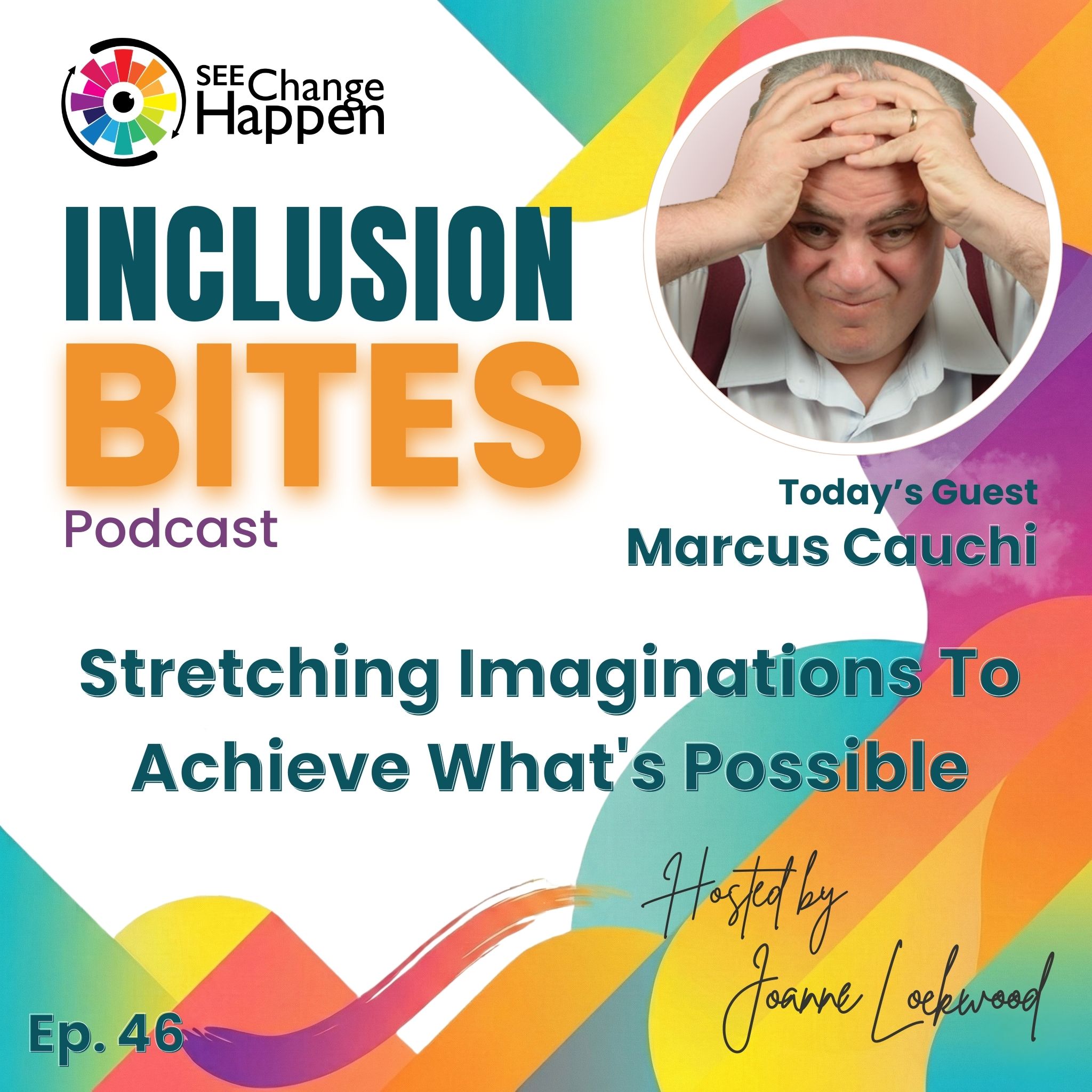
Stretching imaginations to achieve what's possible
Marcus works with businesses that want to scale fast and is not afraid to ask shitty and uncomfortable questions. He challenges thinking, especially when it is learnt behaviour to help organisations remove the constraints that hold them back
In this episode of Inclusion Bites, Joanne Lockwood speaks with Marcus Cauchi about inclusive leadership management.
Hello, everyone. My name is Joanne Lockwood and I'm your host for theInclusion Bites podcast. In this series, I have interviewed a numberof amazing people and simply had a conversation around the subject ofinclusion, belonging, and generally making the world a betterplace for everyone to thrive. If you'd like to join me in thefuture, then please do drop me a line to jo.lockwood@changehappen.co.uk.That's S-E-E Change Happen dot codot uk. You'll be able to catch up with all of the previous shows onITunes, Spotify, at the usual places. Soplug in your headphones, grab a decaf and let'sget going. Today is episode 46,with the title Stretching Imaginations toAchieve What's Possible. And I have the absolute honor andprivilege to be joined by Marcus Cauchi. Marcusdescribes himself as someone who challenges idiocyand attachment to traditional ways of doing things.When I asked Marcus to describe his superpower, he said it'sbeing able to ask shitty and uncomfortable questions.Hello, Marcus. Welcome to the show. Hi, Jo.
Marcus Cauchiguest
Thanks for having me. My pleasure. Been looking
Joanne Lockwoodhost
forward to this for some time. So, Marcus, we were talkingjust now before we started about stretching imaginations to achievewhat's possible. What do you mean by that?
Marcus Cauchiguest
There's a lovely quote from Mark Twain that your eyes won't see whenyour imagination is out of focus. AndI see an awful lot of attachment to this is the waywe've always done it. Peopleholding on to received wisdom, which is anythingbut wise. There's a lovely story.Whether it's true or not doesn't really matter. Never let the truth get in. Wehave a good story. In the 19 seventies, there was a captainwho was commissioned to observe and,do a time and motion study on artillery firing.And he was watching these gunners load these guns,and, after they, carried the shell and, put it in the backof the breach, and closed it, 1 of them would turnaround, stand to attention facing Lockwood, andthe other 1 would march 8 paces, turn around, stand to attention with hisright hand behind his back and hold up his left arm.And he couldn't understand why they were doing this.And the the 1, who walked backwards would nod and then the other1 would fire the gun. Anyway, long story short,he asked them why and said, well, no idea. That's the way we were trainedto train, trained to fire the guns. And that's why, we fire theguns in this man's army set Who trained you? The gunnery sergeant.So off they went off, you went to the gunnery sergeant Gunny. Why do youteach them to do it this way? That's the way I was trained to trainthem, sir. That's the way we train them in this man's army, sir. That's theway we fire the guns in this man's army, sir. So after,you know, a couple of weeks of observing this behavior, he couldn'tfathom for the any any reason why they would do this. And hewas in the pub outside the barracks in Lark Hill.And, this old codger came in who had been in worldwar 1 as a gunner and said, have you got any ideawhy they do this? And so, Oh yeah, they're holding the horses. Now they haven'thad horse drawn artillery for 50 years. And,my question is always, why are you holding the horses?If you want better answers, you have to ask better questions.And self reflection is something that almost neverhappens because people are so busy and fixatedon doing things the way they've always done them. They don't question. Ireckon any important process needs to be reviewed every 3months. Why why did we start doing it this way?Why are we still doing it? Does it serve us? Does it serve ourcustomers? Does it serve our people? And if it doesn't, is therea better way? And if so, what is it?And, you know, I'd if we bring this into the context of,diversity, equity and inclusion,why is it we recruit people of a certain type.Most of my work is around sales. And if you listen to the tonalityof, a salesperson, are theysomebody who is heavily motivated byscale, self interest and scarcity or dog eatdog, because that means that they're probably a taker.If they are heavily focused on self interestand abundance, they're really more interestedin keeping what they've got.If they are somebody who is focused ondelivering universal value, but also scarcity, They'reprobably someone who's very much about control.And if they're abundance, thinkers andthey have universal value, as key drivers,then they're very much focused on service. So Iwant people who want to serve. I don't wantto people who are, people who are interested in the statusquo, who are selfishly self orientated,or who are trying to, operate in a command andcontrol structure. That's not how reality works. We operatein complex systems against wicked problems,and wicked problems require you tounderstand that the first solution will probably fail, andyou've got to gather data. Stakeholdersdiffer. The rules change as you play, and there is noperfect answer, only imperfect options. And sothat's the world that I play in.
Joanne Lockwoodhost
Brilliant. I mean, there's a there's a couple of lovely quotes in there, and Ithink let go of the horses. I think that's that's brilliant. Wegotta we gotta analyze the realhistory behind some of the ways we do things, and you're you'reso right. I I see so many examples of the commander control mentality.If I can't see you, I can't trust you. That the wholestruggle that people have working flexibly, agilely,remotely really breaks down that command and controlbecause many of our leaders have been trained or they'veevolved in this controlled way, haven't they? Andthey wanna see the people. They wanna manage the people.They haven't learned to evolve their style so thatthey can empower the people that are working for them.
Marcus Cauchiguest
And that's key. In order to earn trust, you have to givetrust. And in order to havecontrol, you have to relinquish control. You hire greatpeople. I mean, Steve jobs is, famously quoted, for what's youknow, saying something along the lines of what's the point of hiring brilliant people ifyou're gonna try and stop them from being brilliant, by controlling them?You need to create an environment where they can thrive. AndI see this, I mean, diversity is a topic thatmost organizations pay lip service to,because they say we're an equal opportunities employer, and theyput a tick in the box. And they hire for difference, and they fire fornot fitting in. They make it impossible for peopleof difference, to fit in. We're all freaks. We'reall different. We're all broken. And what we need to do isfind people whose imperfections fit neatly with ourimperfections so that we can become better. And therethere's a wonderful experiment of a picture of a tiger in the grass.And most people will say that they see thetiger, or if they're more from the Oriental,environment, they'll talk about the jungle, with atiger. But unless you get bothand you get to see the whole perspective, thenyou miss out. And so you end up being very blinkered.
Marcus Cauchiguest
And, that means that you, diminish your creativityin tackling difficult problems. At the moment, I'm on amission. I have 5 big, great big, hairyassed audacious goals. 1 is to take 8 companies to a$1, 000, 000, 000 profitable revenue without the wheels andwings coming off with customers for life and to becomedestination employers. So people are queuing up because theylove to come to work here. The second isto, rip the legs out from the entire marketingand advertising industry, which is a monstrous con.There are 4.3 quadrillion, digital adverts servedup every year that get 1 or 0 clicks, and Google andFacebook make $265, 000, 000, 000 on the gullibilityand idiocy of their, their customers. The venturecapital and private equity market is utterly broken and corrupt, and it'screating a bubble, within technology where people arefixated on revenue growth, new logo acquisition, anda fictional pipeline because that allows them to fiddle, theirnotional value instead of creating strong fundamentally,well built businesses with people who love coming to work,give massive discretionary effort that are led by fantasticleaders who get twice as much out of,their employees through discretionary effort and giving themtrust than people who try and command and control who get half asmuch as they possibly could. So there's a 400%,differential. The 4th is making sales a force forgood. There were 2 studies that came out at the end of 2020. 1 fromGartner that said 33% of business to businessbuyers want a 100% seller free buying experience,and that's a damning indictment of our industry or ourprofession. And another studyfrom LinkedIn that said 67% of buyersconsider sales and salespeople to be morally bankrupt. And I can'tdisagree. I'm amazed it's only it's only 67%,because the values, and the behavior,that, permeate from investors through leadership,through management, through to salespeople that then put thecustomer at the end of a long chain of, abuse and make them aforgotten afterthought, make that inevitable.And then the 5th is to look at the sales training environment,and work out why that isn't working and fix itbecause people should really want to learn. Theyshould want to get better. Instead youhave 3 groups of people. You've got a tiny fraction who want tolearn. You've got a bunch who are entitled and they expect,their company to serve them up training. And then you havemost others who just wanna be left alone and to geton with it and survive on their basic salary, and they may take homecommissions 4 or 8 months in the year. And all ofthat is broken. Now when you tie them all together and you look at theproblems with, culture, investors,compensation, measurement, recruitment, and hiringonboarding training, their perception of thecustomer, the customer cannot possibly feelsafe. And so the central theme aroundall of this is creating buyer safety. I
Marcus Cauchiguest
fundamentally believe every buyer deserves to be safe whenever theyare dealing with a salesperson or a vendor organization.And 99 times out of a 100, I believe that they cannotfeel safe, which is why you create this adversarialrelationship between vendor empire. And that doesn't serveanyone. And so I'm looking at all of these thingsas a complex system. And in the same way that if youtake a digital, an SLR camera, you gotfilm speed, the ISO number, You got the aperture, and you got theshutter speed. If you change any 1 of those without adjustingat least 1 of the other 2, then the picture gets distorted.Now companies are way more sophisticated thanthat. You've got all these different moving parts,working often against 1 anotherbecause you've got a culture that is command and control,encourages internal competition, and that drivesblame, excuses, avoidance behavior, andeveryone playing cover your ass. And none of that isgood for anybody. All it does, it serves a tiny handful,I lie, a tiny handful of people, who benefit fromthe status quo. And my view is that thestatus quo needs to be rocked.
Joanne Lockwoodhost
I agree completely. And I think when you look at Imean, picking up on something you just said there, the the concept, this blackbox thinking that the Matthew Syed, book and quotethat where you empower your people. You you youput the decision making closer to the point ofcontact rather than having to refer back. You get better outcomes as theairlines found. And as we still see thechallenge in organizations such as the NHS, where they have this verymuch command and control structure, Everyone is ass covering. Everyone'sworried about litigation. Everyone's worried about making mistakes. Nobody's prepared tobe open. Okay. I'm generalizing their apology to anyone from the NHS.Let's feel us that way. But from an outsider's perspective, we we do end upcouching a lot of thisbased in in the protection of ofstopping people failing, if you like. Whereas and I think you you I pickedup what you said earlier. It's about failing quickly, learning. Okay.If you've got your if you've got your fingers deep into someone's brain, you don'twant to fail quickly there. But if you're doing other tasks, you've got tolearn and and I've had this discussion with people in the past where Isaid we've got to fail quickly. And and all theseNLP practitioners start giving me all this rubbish about. It's not about failing. It's aboutlearning. I said, no. You learn through failure. You learn through makingmistakes. You learn through Absolutely. Trying. Andwe could you can change the language, you can put all this soft stuff inthere. No one's no one's a loser. Everyone's a winner in their ownright. But really, what you got to do is you got to learn that youdon't always succeed, and learn how to deal with that. And learn fromthat. I think what's happened
Marcus Cauchiguest
is we've become afraid, to haveconflict. Andwe're, we're afraid of all conflict. Whereas constructiveconflict is fantastically useful. Wetread on eggshells. I've done a series of conversations,around, d and I. And what'sreally interested me is when you have a grown up conversation with people whoare wildly different, I I've spoken to you. I'vespoken to Ricky Arundel. I've, had,Dave McQueen on. I've had Rod Jefferson on,and, you know, a variety of people whohave a very different perspective to me. What I'm lookingfor is the common ground. And this is where Ithink people misunderstand the concept of winwin. Win win is difficultbecause it's about finding a win for everybodywithout compromise. And the problem is that win win isoften about capitulation. We give stuff away in the hopethat they may give us the business or whatever. It'sbloody hard work. Leadership management arebloody hard work. They require you, to putyourself in harm's way, to be vulnerable. And theroot cause the the root origin of the word vulnerable comes fromthe Latin will never able to. And it means to put yourself ina position where you may get wounded or hurt and do it anyway.It's an act of courage. It's alsorequires you to come with an open mind. And this is wherethere is a massive difference between the majority whooperate playing a finite game, where the objectiveis to get to the end of the game, having wonor not lost. And that's taking a bigger piece of ashrinking pie. And I see this all the time and it drivesscarcity, mindset. It'svery self, selfish. It means thatyou become very protective. You're a detractor. You're cynical.You snipe. You're focused on keeping what you'vegot. It creates mistrust.Whereas an infinite game player, their objective is to keep thegame going and make the pie bigger. So everyone can
Marcus Cauchiguest
have a bigger slice. It means that you need to learn howto accept others for who they are without judgment.It means that you have to, embrace the difference.I did, a really interesting interview with a lady calledCora John, Warren, who, heads upthe sales team for, a company called Rare Recruitment,and they place black candidates in lawfirms, hedge funds, accountancy firms, andmanagement consultancies. And the frustrationof placing these brilliant minds in places where they cannotfit in, and they, they end up leaving. So you'vespent a fortune ticking a box being woke.Diversity is not about, ticking abox. Diversity is about pooling incredible talentand having different perspectives, different races,genders, sexual orientations, different religions,politics, socioeconomic backgrounds so that you cancome up with a much better solution. And, myexperience has been fueled over the last 2 years,by running my own podcast. I think we're up to a episode 330.I've had access to 4 and a half 1000 yearsof collective experience on that podcast. NowI cannot even begin to tell you how thathas shifted my ability to conceive of new solutions.That 2 years ago, when I first started it, there wasn't a hope inhell. I I knock out 2 to 3 episodes a week because it'sbecome an addiction. You know, the the learning that Iget and the fact that my thinking has been challenged so consistently,and we fight and we disagree, who cares? I don't mind fighting.I don't mind being wrong. You've got to leave your ego at the doorand you've got to stop your attachment. 1 of my mentors,Mark Galston, who wrote what the, a book that if you're part ofthe species, you have to read it. It's called just listenby Mark Galston. And he's become a mentor of mine, a goodfriend. And he's come up with a wonderful phrase that he taught me, whichwas let go or be dragged. TheBuddha said that attachment is the root to allmisery. You need to let go of your attachment.If you don't, then it will end up grinding youdown. You will start judging others. Thereis a fabulous model that describes every broken, dysfunctional,screwed up relationship you can or will ever have on 3 points of atriangle. It's called the drama triangle. And if you imagine anequilateral triangle on its sharp point, and at thebottom, you have the victim voice, top left, thepersecutor, and top right, the, the rescuer.The victim's voice sounds like it's so unfair.Why me? It's always happens. And their favorite bylineis save me, help me.Okay. The persecutor comes with a jabby indexphone, pronoun, sorry. Jabby index finger and the pronounyou in capital letters, shone up in lights withJoanne exclamation mark at the end. You piece of shit.You always. You never. You're such a. And it diminishes youat an identity level who you are. And the mostdivisive, interestingly enough, is the rescuer.Rescuing is helping without boundaries or permission.Rescuers tend to end up as micromanagers. They suffer from upwarddelegation and create learned helplessness. Persecutorsdrive out any form of entrepreneurialism, free thinking.They, they eliminate risk taking because people don't put their head above theparapet and victims love a pity party.There's nothing they enjoy more than, sharing their wounds,and comparing how bad their wounds are. Rescuersalso tend to be molly coddling and permissive and egothrives on drama. So anytime you hear anyone takeany 1 of those 3 positions, you've now got attachmentthrough the ego. Now my favorite philosopher, BruceLee, was asked what's the best way to avoid a punch. And he said, besomewhere else. It's bloody awesome advice. Youonly have to move your head to the side that's somewhere else,but be somewhere else. And that is the winner's triangle.So instead of being a victim, you're vulnerable. Insteadof being a persecutor, you're assertive. And instead ofbeing a, a rescuer,you're nurturing an empathic. Now this triangleis on its flat base, so it's very stable.The drama triangle is on its point, so it's very unstable.And in fact what tends to happen in the drama triangle ispeople just swap positions. It's so unfair.You always do this. You're always picking on me. Youdon't understand. I'm doing my best. Yeah. Andpeople, go around it. In fact, I'm not very proud ofthis. I have to be honest, but it was a good object lesson. I rememberhaving a fight with my wife without involving her. So,1 Friday, she said to me, I'm gonna decorate the living roomtomorrow. And so I in my family, DIY standsfor don't involve yourself. So, I'vevery smartly gave her a kiss, went to sleep. Now 11:36the following day, having watched, the cookeryprograms, I thought, Jo. I wonder if she wants help. So I wentdownstairs and I said, sweetheart, do you want help?And she said, only if you want to. Now in myworld, only if you want to meant get yourbucket and brushes and pull your weight. So I went to the garage, Igot my bucket and brushes and this cloud formed over my head,Lightning, thunder, hail, and,I can't believe she's roped me into bloody thing. Ihate I think DIY had a longweek. Anyway, went into the living room and startedtearing off little bits of wallpaper.And after about 8 to 9 minutes, she just looked across and said, sweetheart, areyou okay? You don't really seem fully engaged in this activity.And I said, well, you know, straight into victim, you know, I'vehad a hard week. And I said, well, you know, I, I know you hada hard week. I haven't seen you at all. And Ithought it'd be nice to do something together. Now I managed to havean entire fight with my wife without hereven being involved. That's how stupid we are as a species.So I look for that stuff. It'severywhere. You look at the things that we, we consider tobe entertainment, dramas, soap operas,reality TV, the news. The news is all aboutwatching other people's misery. So we can say, thank God that's not me ormine. That is very
Joanne Lockwoodhost
true. And I've had conversation with journalists and publishers and editors,And there has to be a human tragedy inthere somewhere for it to be newsworthy. Person gets up in themorning, has a great day, comes home, has dinner, goes to bedis not newsworthy, which is the majority of what we do. People want to betaken out of that mundane realityand shocked and all into something else on there. And that's what sells.
Marcus Cauchiguest
There there's a, theory intransactional analysis called okay. Not okay. Andthe basic premise around the human condition is this, forme to feel okay, I need to find someone more notokay than me. And just think abouthow divisive that is if we're both,okay, we can get stuff done. So again, a lot of thework that I do is about creating, finding the commonground, finding what we both want and thenworking on collaborating. And sometimes we haveto make compromises here or there, but by and large, ifwe bother to listen and listening is the transfer of meaning,if we show up with the right intent, wecan do some amazing things. As a species, wehave accomplished enormous things, but the reality isthat's probably 0.0003 percent ofour population throughout the entire history of humanity has made thosefabulous strides. But I love itwhen you get teams of what appear to be quite averagepeople and you give them trust. Youempower them, you, ensure that they have avoice, and you set them on a problem.And the leader only interveneswhen they are truly stuck. And then they give thepen back the moment they have enough information to carry on on theirown. And there is a wonderful book called multipliersby Liz Wiseman. Again, a must must read.If you haven't read that yet and you're in management orit is a must along with just listen. Imean, the the fact that so few people,have learned to love learning isa damning indictment of our school system. Istill remember I I'm going back to when I was 15, there was doctor.McLaughlin, and it was our general studies Jolevel, which is dating me badly.And we had to do a summit. It was assault. There was assaultnegotiations of a nuclear disarmament. And weplayed the Russians and the Americans and all of this kind of stuff. I stillremember that class with incredible vivid joy,because we were given free reign to think for ourselves, tofeed off 1 another's ideas, and to come upwith solutions. And, actually, we came up with some pretty decent ones,you know, for 15 year olds, with our limited scope,because what we were looking for there was the common ground.We weren't turning up, defending our empire or,defending our dogma. And, you know,I, I think far, far too little attentionis focused on, diversity, equity and inclusion,Not a fan of equality. I am a fan of equity. It needs tobe fair. The equality piece, I think, is a distraction.What I think is really important is that we,draw the best out of peoplediscretionary effort.
Joanne Lockwoodhost
You think it's a distraction. Because I hear this all the time wherepeople say, oh, it's equity. It's not equality. Is this is thisa distraction that we we end up people just trying to be clever?You could you could say equality is around giving peopleequity as well. Or are we just or people just trying to be clever bygoing, actually, no, it's not equality, it's equity we need, or do you think thereis a real distinction? I think there is a real distinction.
Marcus Cauchiguest
I don't think the world is equal. I don't think the world is fair, butwe can make it fairer. There there is a massivedisparity in wealth, power, education,and so on. And maybe I'm miss misunderstandingthe interpretation of the meaning. But I Ireally, believe that what we should be doing is creating afair environment where, we have a chance to play toour greatest strengths, and we work with people whose strengthsmake our weaknesses irrelevant. Thatis a fabulous kind of environment. I I've set up,a global community, called Salesforce for good,with a view to collecting the most difficult problems,asking the gnarliest shittiest questions that everyone is avoiding,and coming up with solutions and making those solutions freelyavailable for any member of the community forever.And they have equal access to that. And how they choose toimplement it is up to them, but there won't beequality. There'll be differences in their ability to implement,in their thought process, in theirwillingness to submit, to,giving up control. And some peoplewill turn up and just steal it because they can. And I'm cool withthat because God knows they need to improve theirchance. And to succeed. Yeah,
Joanne Lockwoodhost
I agree. And I just sometimes get caught upor frustrated with the deck chair on the Titanic Brigade,where we start off by saying, is it DNI? Is it EDNI?Is it Debbie? Is it Equity or is it Equality?We spend a lot of time to decidethat diversity, equity or equality, belonging and inclusion.So people are all trying to cram these acronyms in. Andsometimes I think, well, we're just rearranging the deck chairs here. We're notreally tackling the issues. We're trying to work out what mytitle is, what my job is, and it's very inward andand we're not actually going out and solving the problem. We're trying todefine our own place in the world by being a a culture officer orDNI officer or whatever we wanna call ourselves?
Marcus Cauchiguest
I I I've not had a lot of exposure to, thosesorts of role functions. But what what I amconscious of is as over the last 30 years,the political narrative has been very cleverly and verysubtly hijacked by the far right. Andyou've got these large super packs run by the Koch brothersand the DeVos' and, the European,research group and whatever. And they've shiftedthe narrative and the lefthas taken the bait. And so they've created,they've, they've pulled away from the middle ground.I'm a diehard wishy washyliberal. I I believe that everybodyhas the right, to thrive. I havethe, a belief that, we have a responsibilityto contribute, not just take out.I believe that we should help our fellow man. Now Istarted out, interestingly enough, I've gone the other way. So I'm obviously following,the the the wrong process based on the oldadage that, you know, if you're, you youstart out being a socialist and you, as you grow wiser, youbecome more conservative. I don't believe that. Ithink we should find ways to include as manypeople as possible, and give people,a forum and the conditions so that they canthrive. They can do their best work, andrevel in the difference, but the right has shifted thatnarrative. So, people like you,people of color, people of,different political views are seen as themAnd there's other.Yeah. Now, I have friendswho hold those views, but I welcome having themin my network. And I don't exclude thembecause I fundamentally believe that if I do, then I live in an echochamber equally. I've got friends who are rapidly the other end of thespectrum. And unless I listenedto both sides, I'm never ever goingto actually get the full picture. And this is where,I've seen our politics shift, our terrible,phenomenally bad leadership, in politics,has gone awry. And we now have,a handful and it's not like this is new.We have a handful of super rich, super powerful peoplewho really do control the narrative. They control,the flow of cash and capital. Andthat worries me seriously worries me,because it's unforgiving, it's lacks compassionand it's selfish. And the thing that madeus thrive as a species is our ability tocollaborate it's to pass on that wisdom,through the generations. But I look at what's happened toeducation. Yeah. My my children have just gone through,secondary educational. They're just in the latter stages.And what worries me is the lack ofscope, the lack of breadth. You know,since the 19 eighties, education has movedtowards, back to, creating fodderfor the, the, the workforce.And, so things like music,art had been marginalized and diminished.You know, the school that my daughters, were at,they stopped running German. I mean, why would we stoplearning a language of our close neighbors? That'shorrific. Yeah. And it just baffles me that,we, we hire in our own image often onlyweaker. We,you know, we might hire people of different color or genderorientation, but if they all read PPE Oxford,that's not a diverse team. If they all ended upbecoming LLBs and getting a law degree, that's notdiversity. And, II despair when I look at companies because I, I go intocompanies and I, it's almost impossible for me not to find400% growth inside of 2 hours.It's and it's really not that difficult when you stop them askingstupid questions and you asked really basicuncomfortable questions, then it opensup a wealth of potential. Now these are companies that are strugglingto make 4% growth or 12% growth. And 2hours in I've found 400% that you can find probably within 7 months,But then they don't believe it because they're still holding thehorses. It's that attachment. And that's So how can we
Joanne Lockwoodhost
create a culture where thecenter ground conversations are not dismissedas woke, or politically correct.We're allowing people to have their own identity. Because at the moment, we'repushing people to the edges, aren't we? As you say, the far left, the farright, whatever that may mean, the extremist views. TheBrexit remain was a classic debate. There was no way anyone could have adiscussion around the middle ground, the facts thatwas erased. You're either for or you're against.And we were virgin on that with vaccinationsand mask wearing, where you could see that polarization occurring.But fortunately, there's enough center Joanne discussions here whereinformation came out, facts came out, and peoplewere were allowed to have those conversations so that mostpeople move to the center rather than being really, really polarized on it. So howdo we create that business? You say most, but it's
Marcus Cauchiguest
only a small majority. You know, we, we still have 40%of the population here and in the US around vaccinated and probably won'tbe. And I was 25,
Joanne Lockwoodhost
isn't it? Is it? Of adults. Okay. Well 80%roughly of of of 1 and 70 have had 2,haven't they? Right. Okay. But that's still a very
Marcus Cauchiguest
large, minority. I, I was speaking to,1 of my collaborators this morning and,a really good friend of his was a very successfulentrepreneur. And he recently died from COVIDwouldn't have a vaccine. Wouldn't wear a mask, thought it was just amassive hoax. And you know what, whata waste, because we didn'tlearn how to find the common ground. And I thinkthis is where we need to teachat a management level and that's a leadership level, whatit really means to lead and what it really means to manage.Most managers are glorified supervisors,and they beat you with a stick. They beat you with a carrot,and they're command and control freaks.And with, Jonathan Farrington,who's a very well respected player, in thesales, arena, and he's the, editor for top salesworld magazine. He did a study for theSRC, which is a research center.And he found that 94% of managers were not fitfor purpose. Now, honestly, I'mamazed the number is that low. However, let's give them thebenefit of the doubt. What most managers spend theirtime is on the supervisory piece. What mostwhat managers should be doing. I have 5 things on the job descriptionfor a great manager, hire the best peopleThat doesn't mean hire the best people within our own ethnic group orwithin our, our own orientation. It meanshire the best people from the entire marketplace.Get the best out of them. That means we need to understandwhat their drivers, what their motivations are. We need toon pre onboard them, onboard them, coach them, trainthem. But coaching almost never happens. In the same study,they identified that 76% of managers think theygive coaching, but only 17% of their people believe they receiveit. Now that's a huge disparity.
Joanne Lockwoodhost
Is that because often managers think coaching is telling?
Marcus Cauchiguest
Yeah. It's not telling. Because coaching is asking questions, isn't it? And people aren't
Joanne Lockwoodhost
good at asking questions. They wanna share their view or theirknowledge. There there is definitely an element of that,
Marcus Cauchiguest
but very often they turn up and they become the hero closer.Joe, let me show you how a real sell salesperson does it.And they puff up their chest and they diminish the, the salesperson. They underminethem. So hire the best people, get the best outof them, make sure they have the tools and resources they need to dotheir best work every day. That doesn't mean being seducedby the technology spaghetti and shiny object syndrome,buying lots of tech. What's the minimum level of technology you need to doyour best work? What are the systems and processes you needto underpin what you do so that you're free todo your best work and focus on the stuff that matters the most?The 4th 1 is to act as, the pointguard. Your job is to protect them from actsof idiocy from your senior leadership and yourself, andhelp them clear roadblocks that they can't clear on their own.And the 5th 5th is to give them a voice. It's tomanage inclusively. Now if everymanager's job description was started with those 5 pointsand they were measured, compensated, and rewarded forit, then the emphasis would be away from trainingto learning. The emphasis would be away fromtelling to coaching. You would allow people tofail fast, fail early, fail often,and you don't punish failure, which again, yourpersecutor managers do. What you do is youpunish hiding it. You keep a failurelog. Everybody writes their failures in the failure log. Andon a regular basis, you work out, well, right, how do we fix that andstop it from happening again? But that just doesn't happenin most organizations. Why? Because of ego and attachmentholding on to what they thought made them successful. And youonly have to look at the demise of Blockbuster and Nokia,and the rise of Or Asia Group. You name
Joanne Lockwoodhost
it. Where wherever you look, it's the more often than not yeah.
Marcus Cauchiguest
We were driving, off to the Joust, atLockwood yesterday, and we drove past, a defunctDebenham store. And my wife was bemoaning the fact that Debenhamshad, closed down. And I saidstupid leadership. Inevitably, it comes down tocrap leadership doing really stupid things and holdingthe horses. That it's not like Debenhams couldn't havesurvived. It didn't because their leaders weremyopic. Well, they made decisions 10,
Joanne Lockwoodhost
15, 20 years ago that put them in a vulnerable position in termsof their overexposure. Some of the big organizations, they sold off alltheir property assets and became tenants. So they had no capital. They hadno way of leveraging any assets of the business when they needed money.And I think a short term shareholdergain was not. Yeah. I but I'd even challenge that
Marcus Cauchiguest
because there are plenty of organizations that have no assets and noproperty, but they still Joanne to thrive.So again, yes, that was a contributory factor.But how about actually listening to your customers? Marks and Spenceris another great 1. If you go into Marks and Spencer's, their rangeis always boring as hell. The only thing that's really propping thatbusiness up is their food, because there are few people who are diehardloyalists, but, as a shop,III won't shop there because of a terrible experience. I hadpicking up a Christmas Turkey, well, 18 yearsago. That stuck with me, because I just thought,yeah, if you treat me like that, you can stuff it. There's noway you're getting another penny out of me.
Joanne Lockwoodhost
We're coming out of cope. So this is what we're we're middle of August. Peopleare starting to feel more relaxed about themselves.And you see these conflicting messages, I watch on telly that we've gotgovernment ministers, you've got property developers, allspelling the the virtues of going back to the office and how it's essential.We all go back to the office to create this great workforce,which is going against, well, most of the people I speakto in terms of the feeling that they they want thisagile workforce. They want to they want to have the choice of whether theywork in an office, at home, work flexibly.But the command and control is dragging themback. But the excuse I keep hearing is howdo we create environments where people can learn on the job? Howcan we have these water cooler conversationsthat people so valuably need in order to togrow and come up with ideas? And I say, well,yes, but there has to be more than 1 solution. Thesolution cannot be go to the office. There has to beanother solution says, don't go to the office and do it differently.So do you have any thoughts on that?
Marcus Cauchiguest
Do you have another hour? So, absolutely.And again, the, thesolution that you come up with, the first 1 willfail and there is no perfect answer. We are dealing with wickedproblems here. We're not dealing with linear problems. We're dealing with 33, 4 dimensional problems, that are complex.And the backlash on this is that, I think it was a Gartnerstudy said 46% of employeesin the United States are considering a job change this year.Now my mother keepsphoning during the most inoperative.The, the problem that we have is that,so many, organizations are looking to goback to what they want, what they had before, ata leadership level, but their employees don't want it. In fact, there was aand a study in 2020 that said somethinglike 97% of employees wantsome form of balance between working from home and working in theoffice. And, as a result,there was another survey that came out that said something like 76%of CFOs were, rebalancing theirbudgets, in order to facilitate that. And wedon't need to go back. The, the organizationsthat insist on people going back, I think will suffer froma massive talent drain. And when people leave anorganization, knowledge goes out and that's going to bea massive problem for them at which they have not factored in.Jo, yes, I think there is a solution, which is to find ablended solution that allows people to work collaboratively.And the technology is now out there. There's a wonderful man,professor Eddie Obeng,excuse me, who runs a company called,or, Pentacle, business school. And
Marcus Cauchiguest
he's got a platform called cube, QUBE,which allows people to work collaborativelyat the same time remotely. And he'sgot a 96% success rate ofdriving transformation and change programs to succeed in theintended outcome. Now this kind of technology hasbeen out there actually for quite a while, but because we've been command andcontrol, office based, it's a struggle.Done a lot work in the NHS, which again is notoriouslydifficult, to work in, but they're makingenormous strides. And, again,I think we need to really rethinkthe questions that we ask. What is the desired outcome?What are we trying to achieve in the end?And what is our common purpose? What are the thingsthat we share and how can we facilitate that?And that's not really being thought about by a lot of leadership becausethey are fixated on how do we get back to the nice stable,environment that we knew, know and love that we grew up in.But the status quo is your biggest competitor.In sales, on average, 60% of buying cyclesend up with do nothing. That's really your biggestcompetitor. Internally, the status quo I see asa toxic, dangerous, thing. Now theproblem is people believe that human beings don't like change.Actually, what they hate is uncertainty.So what can we do to find ways to give them certainty,to give them clarity, focus, direction, help themunderstand their place, within the, the,system and what contribution they can make.But how many when was the last time you heard of anyone sat downwith their manager talking about their career path?So I look at, what, 1 of the books I'm writingthis year is what the sales management apprenticeship, becauseyour average sales manager gets tapped on the shoulder and toldJo, we've just 5 year idiot boss. You're now the idiot boss.Congratulations. And that's your runway. So you don'tlearn how to do the job. They're very differentjobs. You know, being an individual contributor, I Iquestion that as well. Because I think you need to be a collaborativecontributor to be really powerful and, toexcel. But to be an individualcontributor, you gotta focus on, you know, just doing your stuff.But to be a manager, you'll you have to have your heart sing byhelping other people meet their fullest potential. You haveto love watching other people make more money than you be more successful thanyou, get the accolades, take the credit,but almost none of that happens in a traditional operation,whether it's commercial or otherwise. I remember years
Marcus Cauchiguest
back, my brother worked for the Red Cross, and that wasessentially fueled by a bunch of egos of trustees.It it had bugger all to do with the, the recipients. It was allabout whether someone could get a knighthood, or whether they could getinvited to a particular garden party. It's crazyangers me that, ego, again, itkeeps coming back to these simple things. So I think what we need to beis really much more, aware of,who turns up the language patternsthey use, the history that they come from. We've got toinvest more in the recruitment process so that we,instill in people, about who we are and whywe do what we do. There, there is a phenomenallyinteresting company, called,AKC global. And,these guys, work on,truly wicked, difficult problems.And, what what's really interestingis, how they do thingsin their manifesto, we guard the gates preferring to hirefrom those we've gotten to know or get to know before hiring. We'reconstantly teaching each other and learning because knowledgebuilds insights and options. We're not fans of hierarchyor titles because age or status doesn't guarantee wisdom orcreativity. We do incredible work by giving smart,talented, and kind people kind people incrediblefreedom and responsibilities. We put our values into practiceby using them to decide who leads, is rewarded, and is letgo. And, what's really interesting is theseguys have been solving global problems with the likes of theUN, in the Balkans, in, Rwanda,in, Afghanistan, and trying tohelp other people solve problems.Nothing is worth doing. That's worth doing is accomplished alone.Solutions have to be a vote, not imposed. Our work must buildsocial value. For us, there is only the bottom up.Name and treat the causes, not the symptoms. Someone elsecan handle the tame stuff. We do good work and then move on.And with that kind of philosophy, I absolutely getwhy it's an exciting place to work. I, you know, if I wasn'tdoing what I was doing, I'd be applying in an instant.
Joanne Lockwoodhost
Well, absolutely fascinating conversation withyou. I don't think I've spoken so little in any of thepodcasts because you've been absolutely enthralling to listen to.I mean, I came up with the title at the beginning, stretching imaginationsto achieve what's possible. And I think youhave certainly stretched my imagination over the last hour.And I'm gonna take away a few things here. So let letting go of thehorses, you know, we have we're prisoners to our own beliefsometimes and we gotta let go and not believe that theway we've always done it is gonna be the way we should always do itAnd re reframe, we adjust our thinking to come up with new solutions.And the drama triangle. I love the drama triangle. Well, I don't love it.III love the concept, so I'm going to do someresearch on that and because, yeah, I'm very conscious about my ownuse of the word hue and the pointy finger. Andwhenever I feel myself doing it, I I immediately turn the finger around and talkabout I. And I think sometimes when you're a minority, it'svery easy to fall into that. The
Marcus Cauchiguest
important takeaway from that though, Joe, is the winner's triangle. Yeah. Thewinner's triangle means you never get sucked into the fight. Peoplecannot play those psychological games with you when you operate from thewinner's triangle. Yeah. And it's so
Joanne Lockwoodhost
we're so ingrained into the drama triangle, I think, as asociety, Because there are so many people who are whowant to be saved. There's the people who want to save thevictim, then the drama, and then the the pointy fingerbrigade. So I see it all the time, and you're right. It's stepping out ofthat. Do you want a really good action control?
Marcus Cauchiguest
Yeah. A really, a really fabulous exercise toraise awareness of your use of the drama triangle.There is a Buddhist mantra for happiness, which is never complainabout anything even to myself. And that means even in thought. Soyou take an index card and you write down the Buddhist mantra for happiness onthe back, and then you divide the other side into 7 columns.And whatever day you started on, that's the first column. And everytime you whine, moan, bitch, complain, judge,grumble. Yeah. Or,
Marcus Cauchiguest
you find yourself being sucked into, thepointy finger, or the victim or anything, youjust mark a tally. Now the first day I did this wasa Wednesday and I got 29 points. The secondday I've got 9 because my awareness level startedgetting heightened and I caught myself before I went down that badroute. The 3rd day, Friday, I got3 and I went home and mywife and kids both said all said to me, are you okay?You know, something seems wrong. So then I grumbled and I had a 4th,the next day, 17, the next day, 22, the next5 days, 3, 3, 3, 3, 3. Yeah. The nextday, 31, the next day, 28.Yeah. And I was at home on Saturday and Sunday with the people I meantto love. But my level of attachment there is significantlyhigher At work, I could let go. And you do this for about6 or 8 weeks, and you just raise your awarenesslevel of when you get sucked into that drama triangle. It'sincredibly potent. It is literally life changing.
Joanne Lockwoodhost
Because I noticed when I looked at your the bio you filled infor the show, you describe yourself as a a curmudgeonly oldman who holds up the ugly mirror. And the definitionof curmudgeonly is a bad tempered negative person.So you're you're you're using that in a differentway now. You're using that to empower and ownthat. Yeah.
Marcus Cauchiguest
III hold the ugly mirror up to myself.I'm very tough on myself. AndI, I stick, I have this huge attachment to allthe terrible things I've done as a parent, as a husband.And it's you know, III have to hold myselfup, to a higher standard because 1 of the things that I've builtis this, biosafety model. And 1 of the corepillars is rigorous authenticity. Youif you speak to me, I will always tell you the truth. There'llbe a little voice inside of me saying I'll go on gild the lily.You know, but a pal ofmine told me, you can't polish a turd, but you can roll it inglitter. It's still a turd. And there's anawful lot of that around. And I don't believe that you can be partly rigorouslyauthentic. You either are or you're not, and there is no middleground on that. And so I have to hold up that ugly Mary, and I'llalways tell you the truth even when it terrifies me or it could do meharm. That's fine.
Joanne Lockwoodhost
Thank you so much. So, Marcus, tell ushow people can get hold of you. Where's the best placeto do that? Easiest ways are LinkedIn.
Marcus Cauchiguest
I'm 1 of 2 Marcus Cauchi. There's another, youngMarcus Cauchi over in Essex who's a recruiter. I'm thegrumpy looking old man, with my hands, head in myhands, on my profile. You can emailme. My company email address is marcus@lasthyphenlast.com.I'm the_inquista on Twitter, andI have a couple of podcasts which you're welcome to, subscribe and listento. 1 is the InQuista podcast, and the other 1 is Skane Ups andHypergrowth, and the Salesforce for Goodcommunity. Check that out on LinkedIn as well.
Joanne Lockwoodhost
Brilliant. I'll put all of those details in the show notes. And for thosepeople who are not, Maltese, how do youspell Cauchi?
Marcus Cauchiguest
CAUCHI. Thank youfor asking. C-A-U-C-H-I, pronounced Cauchi, as in 'cow' and 'key'.
Joanne Lockwoodhost
Brilliant. I learned that today. Thank you. Well, it'sbeen absolutely awesome, and I'm sure all of our listenerswill take much inspiration from this. Jo mylast thing today is to thank you, the listener, for tuningin, listening in. Please do subscribe to keep updated onfuture episodes of the Inclusion Bites podcast. That's B-I-T-E-S.
Joanne Lockwoodhost
Tell your friends, tell your colleagues, share the link. I've got a numberof other exciting guests lined up that I'm sure you'll be inspired byover the next few weeks months. And, of course, if you'd like to be aguest, please let me know. And as usual, I'd welcome your thoughts, feedback,suggestions on how I can improve future shows tojo.lockwood@seechangehappen.co.uk. So finally,my name is Joanne Lockwood, and it's been an absolute pleasure to host thispodcast for you today. Catch you next time.
Marcus Cauchiguest
Bye.
Tackling the Drama Triangle in ManagementEmpowering Organisations Through Inclusive ManagementReimagining Growth and Learning in Organisations
Marcus Cauchi joins Joanne Lockwood to explore what it takes to “stretch imaginations” and move beyond default ways of working that no longer serve people, customers, or organisations. Through stories and practical examples, Marcus argues that received wisdom often survives long after its original purpose has disappeared, and that progress depends on regularly revisiting processes and asking better, more uncomfortable questions.
The conversation focuses on leadership and management: the limits of command-and-control, the link between trust and empowerment, and why many organisations pay lip service to diversity while still punishing difference through “fit” and conformity. Marcus and Joanne discuss psychological safety, constructive conflict, and how better decision-making happens when leaders create conditions for people to have a voice, learn through failure, and collaborate around a shared purpose.
They also dig into patterns that keep workplaces stuck, including ego, attachment, and drama-driven behaviours, introducing the drama triangle and the “winner’s triangle” as tools for healthier interactions. Marcus shares a simple awareness exercise to notice complaining, blame, and rescue dynamics, and outlines what great managers should be hired and rewarded to do: bring in diverse talent, coach rather than tell, remove obstacles, provide resources, and lead inclusively.
“Why did we start doing it this way? Why are we still doing it? Does it serve us? Does it serve our customers? Does it serve our people? And if it doesn't, is there a better way?”
“The second is to, rip the legs out from the entire marketing and advertising industry, which is a monstrous con. There are 4.3 quadrillion, digital adverts served up every year that get 1 or 0 clicks, and Google and Facebook make $265, 000, 000, 000 on the gullibility and idiocy of their, their customers.”
“Diversity is about pooling incredible talent and having different perspectives, different races, genders, sexual orientations, different religions, politics, socioeconomic backgrounds so that you can come up with a much better solution.”
“If we're both okay, we can get stuff done. So again, a lot of the work that I do is about creating, finding the common ground, finding what we both want and then working on collaborating.”
The metaphor of "holding the horses" to illustrate the persistence of outdated practices and the need for regular review and self-reflection.
The distinction between superficial commitments to diversity and genuine embrace of diversity in organisations.
The "Drama Triangle" and "Winner's Triangle" models, exploring the roles and impacts within each framework.
A personal story demonstrating drama in relationships and comparing it to organisational dynamics.
The critique of the education system's failure to instil a love for learning and the advantages of fostering critical thinking.
The debate on equity vs. equality, emphasizing fairness over literal equality and advocating for leveraging individual strengths.
Observations on management and leadership failures, highlighting the need for inclusive management that empowers teams and shifts from control to facilitation.
One thing to remember
Effective inclusion and diversity within organisations require moving beyond superficial commitments, embracing genuine diversity, and creating environments where all individuals can thrive. This involves dismantling outdated practices, fostering mutual trust, and embedding fairness in organisational processes. Key Takeaway:
Organisations must cultivate a culture of empowerment, collaboration, and continuous learning by adopting inclusive leadership practices, critically reviewing processes, and leveraging diverse perspectives.
Questions this episode helps answer
Marcus Cauchi uses the metaphor of "holding the horses" to discuss outdated practices. What are some examples of outdated practices in your organisation, and how might you address them?
Marcus stresses the need for regular review and self-reflection to serve stakeholders effectively. How often does your organisation review its processes, and is there room for improvement?
Discuss the difference between equity and equality as presented by Marcus. How can organisations ensure they are fostering an environment of fairness and inclusivity?
What are the roles of persecutor, rescuer, and victim in the drama triangle, and how can shifting to the winner's triangle model improve workplace dynamics?
Reflect on Marcus’s critique of traditional management styles. How can leaders shift from a command and control approach to one of empowerment and trust?
Marcus discusses the decline in educational diversity. How can organisations compensate for this decline to foster a more inclusive and creative workforce?
Explore topics
Ideas from this episode
Tackling the Drama Triangle in Management
Our conversation took a fascinating turn as Marcus Cauchi introduced the concept of the Drama Triangle, illustrating its roles of persecutor, rescuer, and victim. These roles often create a toxic environment in organisations, stifling creativity and fostering blame cultures.
Empowering Organisations Through Inclusive Management
The dialogue broadened as we discussed the significance of empowering individuals across organisations. Marcus emphasised that many management styles, particularly those rooted in command and control, fail to foster trust or harness the potential of diverse teams.
Reimagining Growth and Learning in Organisations
The hindrances of conventional thinking in organisations, often a barrier to significant growth and learning. Marcus stressed the need for continuous peer-to-peer education and critical analysis of entrenched processes.
Learn
Frequently asked questions
What is the focus of Episode 46 of The Inclusion Bites Podcast?
Episode 46, titled "Stretching Imaginations to Achieve What's Possible," features guest Marcus Cauchi discussing transformative approaches to inclusion, diversity, and organisational change. The episode explores challenging traditional methods, empowering employees, and fostering environments where people can thrive.
Who is the guest for this episode, and what are his main perspectives?
The guest is Marcus Cauchi. He challenges traditional management and inclusivity methods, emphasising the importance of critical self-reflection, authentic commitment to diversity, and creating trust-filled environments. He also critiques traditional command-and-control management styles and advocates for empowerment and collaborative problem-solving.
What does Marcus Cauchi mean by "old practices are holding the horses"?
Marcus uses this metaphor to suggest that outdated practices and resistance to change are hindering progress and innovation within organisations. He advocates for regularly reviewing processes and self-reflection to serve stakeholders more effectively.
Can you explain the Drama Triangle and Winner's Triangle described by Marcus?
The Drama Triangle consists of three roles—persecutor, rescuer, and victim—each with negative impacts. Persecutors suppress initiative, rescuers micromanage, and victims indulge in self-pity. The Winner's Triangle, in contrast, promotes being vulnerable instead of a victim, assertive instead of a persecutor, and nurturing instead of a rescuer.
How does Marcus Cauchi view the current state of educational diversity?
Marcus criticises the education system for being too focused on workforce preparation at the expense of fostering a love for diverse subjects like music and languages. He believes this narrow focus is detrimental to creating well-rounded, critical thinkers.
What is the significance of equity vs. equality in the context of this podcast?
Marcus and Joanne discuss how debates over equity versus equality can be distracting. Marcus emphasises fairness and creating environments that leverage individual strengths rather than strictly striving for uniformity, acknowledging societal disparities.
Share this episode
Heard something worth passing on? Send this conversation to someone who needs to hear it.