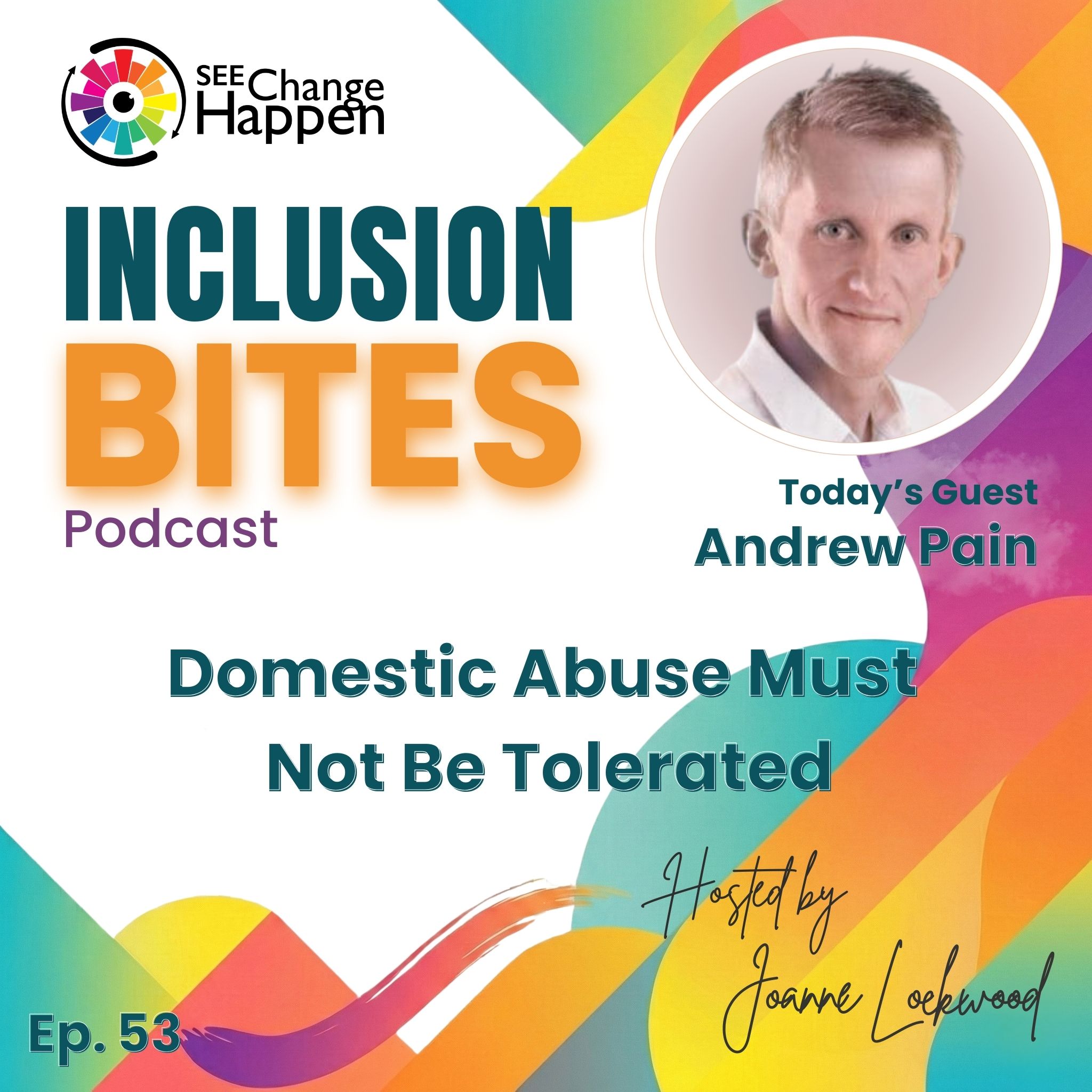
Andrew talks about domestic abuse following his own previous experiences in a former marriage. His passion is to generate awareness of all the faces of domestic abuse, including parents abused by children, LGBTQ+, male victims, and women abused by men.
In this episode of Inclusion Bites, Joanne Lockwood speaks with Andrew Pain about lived experience identity.
“In a former marriage I was the long-term victim of domestic abuse.”
Explore
Navigate this episode
Joanne Lockwoodhost
Hello everyone my name is Joanne lockwood and I am your host for the inclusion bytes podcast in this series I have interviewed a number of amazing people and simply had a conversation about the subject of inclusion belonging and generally making the world a better place for everyone to Thrive. You'd like to join me in the future then please do drop me line to Jo dot lockwood SEE Change Happen dot co dot uk that's S E E Change Happen dot co dot uk you can catch up with all of the previous shows on itunes spotify and the usual places so plug in your headphones, grab a decaf and let's get going. Today is episode 53 with the title "Domestic Abuse must not be tolerated" and I have the absolute honor and privilege to be joined by Andrew Pain. Andrew describes itself as someone who talks about domestic abuse and gender equality. When I asked Andrew to describe his superpower. He said I am an open book and happy to talk about anything hello andrew welcome to the show.
Andrew Painguest
Hi Jo It's a pleasure to be been looking forward to this you keeping? well.
Joanne Lockwoodhost
I am keeping well Andrew Thank you so much for giving up your time. So Andrew tell me why are you so passionate about domestic abuse or why shouldn't it be tolerated.
Andrew Painguest
Not, you're welcome.Well, um, in a former marriage I was the long-term victim of domestic abuse I was married to my now. Ex-wife for 1018 years um and I have daughters and sons and so I'm a. Ah, passionate campaigner around domestic abuse and around taking a a non-gendered approach towards domestic abuse I'm not sure if you're aware of some of the statistics but a lot of the language around domestic abuse at the moment is that the overwhelming majority of victims of domestic abuse are women. And the overwhelming majority of perpetrators domestic abuse are men but statistically it just doesn't stack up roughly speaking with the statistics that we currently have a third of victims of domestic abuse are in fact, men which is not the overwhelming minority. It's the the lesser proportion for sure but of those third. The vast majority of male victims domestic abuse. It's been perpetrated by females. It doesn't come from the Lgbt communities roughly ten percent of male victims of domestic abuse with with research carried out by mankind initiative and so I'm passionate because having been through it having seen how. Difficult it is how how difficult as a guy I felt to so be honest about it and about what was going on. Um I want to talk about the messages I want to create more awareness and of course often we think of domestic abuse as ah, well it's either going to be man on woman woman on man. Man on man or woman on woman. But I mean I work with a charity where we support families in crisis where the perpetrators of the children and can be as young as 5 or 6 and very violent towards their parents and that it's something that's not talked about. But if I refer back to the statistics sorry of a third of victims are men. 2 wo-th thirdds of women some of those statistics would be made up by a woman and a man in a loving relationship together but they're being abused by their child and it may be that that has has been reported to the police and the police if you look at some of their their own sort of reporting and awareness. It is a rapidly. Growing phenomenon this phenomenon of parents abused by children. So I want to talk about domestic abuse I want to create more awareness and I'm passionate about shining spotlight on all faces of domestic abuse. So that all victims of domestic abuse have support. And can talk openly and freely about their experiences.
Joanne Lockwoodhost
And that's really interesting because I was watching a tv program last night around 2 parents who had autistic children paddy mcginnis and it came up in there where children autistic children. Can often vent frustration and anger against their parents. It was the first time it really occurred to me that a young child could lose control to the point where they could inflict. Yeah and they were talking about having claw marks down their arms and things that.
Andrew Painguest
Yeah, yeah, it's not uncommon. Yeah well 1 of the cases that the charity that I work with that they supported was a child as young as I think it was 7 or 8 that tried to push mum onto the railway tracks and kill it. You know and that's.
Joanne Lockwoodhost
Advise me.
Andrew Painguest
What you up against I mean even in my close circle of friends I know of a single mum who was knocked around quite a bit by her teenage daughters who really did rule the roost. There was no man on the scene. There's no boys There's no partner but you know as a parent you feel like a. Failed parent unless your child has some kind of additional needs you you feel like a failed parent and and talking about it feels quite shameful and so I think we need to open up more space for more of these faces of domestic abuse. Of course we need to protect. Female victims of domestic abuse. So some of my dear female friends have been through it themselves I have sisters I have daughters and I'm blissfully remarried so we shouldn't take the spotlight away from women but we do need to support men as well. And for example, the new domestic abuse bill that got Royal ascents this year um the organizations that came to give testimony to to try and shape that domestic abuse bill all of them without exception were women's organizations even though a third of victims are men and some of the leading male organizations like mankind initiative applied and applied to be able to come along and and asked and asked. And we're completely ignored from the process and so that's where we need to change we. Of course we need a strategy that tackles violence against girls and women. But we also need an official strategy that tackles violence against men and boys as well. If we're serious about equality.
Joanne Lockwoodhost
I I'm I'm completely taken back by the the stat of a third of victims are a men as you say that some of those could include child or or couple abu of children etc. But that's a massively high number that.
Andrew Painguest
It's a massively high number and that number doesn't take into account the under-reporting among men because of all the whole thing around. Yeah manning up man flew Man Eyes who wears the trousers have you got your kitchen pass If you're going out.
Joanne Lockwoodhost
Ah, was completely un aware of.
Andrew Painguest
You know I play football and you know that's the kind of banter in the locker room all the time and um, there is a stigma for men of reporting will I be Believed. Um I feel so weak and stupid um to to share this. This has been happening and so. Some men's organizations, not mankind initiative necessarily but some men's probably more men's rights organizations would actually argue that there is a higher prevalence of women committing domestic abuse against men than there is the other way around now I wouldn't go that far in my own beliefs because I don't think the data yet supports that it may or may not be true. But what we do know is that a third amen and we do know that there is ah a lot of under reporting and the thing that struck me I did um um this isn't a plug for my tedx talk but I did a tedx talk on domestic abuse on my experiences and on some so some of these wider issues and what I wasn't prepared for after that talk went live. Was the sheer number of women who messaged me sort of through linkedin facebook email and and the rest of it saying? Yeah, it happened to my brother. It happened to my son. It happened to my uncle. He didn't talk about it was left in a really bad way. Thanks for doing the talk and so you start to realize actually there's a lot of women who've had enough. A lot of women with loved ones who are men who have been abused but they they don't have a voice I don't feel that they can speak up and my hope you know in terms of feeling optimistic is that with all the focus now on wellbeing on mental health. My hope is that more and more men do speak out. Don't feel ashamed and I do think there's slow progress. There is slow change but I also think that some of the larger organizations that rely on funding. It is in their interests to maintain a very gendered narrative on the debate domestic abuse the the. Vast majority of victims are absolutely women and the vast majority of perpetrators are men. There are some powerful organizations where they have vested interests to maintain that narrative and so I think change will be slow, but but it is definitely happening.
Joanne Lockwoodhost
The is also the so the human bias men are strong women are weak even with fourthway Feminism they're still and that's that's why men are probably underreporting because they don't want to be seen.
Andrew Painguest
Um, yeah, yeah.
Joanne Lockwoodhost
As weak or emasculated or as you say have this stigma and there was a there was a story line on the bbc tv casualty recently I but think it was casualty where 1 of the nurses was who was male was being the victim of abuse. Ah by 1 of them.
Andrew Painguest
And yeah.
Joanne Lockwoodhost
Supportant who also happen to be there. Their their partner girlfriend. So yeah and I I saw a different side to that as well about how that can occur. So it's not always just pure abuse physical is also coercive control and and this goes 1 um in all relationships I'm not saying this is basically men or particularly women. This is people.
Andrew Painguest
Um, yeah.
Joanne Lockwoodhost
Suffer physical and mental and ah abuse no matter if it's physical or mentally still as intolerable and still as dangerous A mental coercive control was.
Andrew Painguest
Um, yeah.Yeah, no, um it up. Yeah, you're absolutely right to and then in fact, the I mentioned the new domestic abuse bill. So there's a new definition of domestic abuse, a new statutory official definition that does include coercive control economic abuse. That recognizes that domestic abuse isn't just physical violence and you know, um, after my tx talk came out actually 1 of the people that contacted me was a guy and and I'd known him years before quite well we saw lost contact. And he messaged me out the blue cell. Oh you know I've seen your tedx talk you know he's 1 of these Facebook friends who like he's a friend but like I don't don't really have a lot contact but he um he revealed he shared with me that he'd been brought to the brink of suicide by the sheer campaign of emotional abuse his former female partner had waged on him. To put things into perspective. This guy is 6 foot 5 He's built like a tank. He's a lawyer with his own legal practice. He's not he's not a fool he speaks several languages fluently and his partner at the time who I'd met several times she was quite quiet I didn't particularly get to know her but she had a walking stick. She was partially sighted. You know if you put them together in the Street. You would not think oh well, there's a victim and a perpetrator here. He's the victim. She's the perpetrator you just wouldn't think that but the the point with that as well as the whole kind of gender bias thing the whole point with that is really backing what you've said is that. The emotional side of domestic abuse is extremely serious for men and for women and I think that's why it's now recognized within the official definition and it's a good thing because it the ah you know the the gaslighting did you know what gaslighting is by the way just before I yeah.
Joanne Lockwoodhost
And I I think I've got good idea but no, please do explain it for anybody who who's listening.
Andrew Painguest
I'll try you know what? I'll explain it and then I'll give you a working real life example from my former relationship so you can kind of see how this plays itself out so gaslighting is where the the abuser will will cause the victim to. Doubt their own judgment their own sanity. You think you're going crazy. The abuser is running rings around you emotionally um so an example of how this works a really silly example. So my ex-wife was very sort of flamboyant and and love to entertain. We were living in the south of France at the time as we were living there for for some years and she had a load of our friends round she was entertaining holding forth as she always did at the dinner. There's probably about 10 or a dozen of us around the table I can't remember exactly how many but she was telling some great stories. She was a good storyteller and she told this story of where she was doing a teacher training course. Working in a school in a deprived part of the uk where ninety five percent of people that live in that area are drug drug addicts and when she said this absurd statistic because there's nowhere in the world where ninety five percent of its residents are drug addicts. She kind of lost the interest of people around the table. You could see people thinking what a load of rubbish and it was a bit 1 of those kind of excruciating moments whereas her husband I like oh she's come and done it again. You know she always does anyway. So later when they've gone I plucked up the courage I didn't usually pluck up the courage I have to say but on this particular occasion I don't know why I had. Maybe I just was feeling particularly I have no idea how I put the coded but I had the word I so see. Love you know you tell great stories. It was great. You had everyone following you but that statistic is he's just so improbable and and I felt like you lost people around the table. She went mad at that point I wasn't physically attacked on that incident but the thing that she did and this is why this is gaslighting. Absolutely she came back at me and say you know you always do this andrew you know I see this with the kids you always spoil their fun. Take everything so seriously, you won't let just let them play. You're so pedantic and so do you know? what? I thought coming away from that conversation I didn't think do you know what? you know I've I'm really gonna need to repeat this conversation because she's embarrassing herself when she comes out with it when she makes these statistics up I came away from that conversation thinking. I need to go back to counseling and 1 of the things I'm going to bring up with my counsel is I am I've become so pedantic you know I've lost the little kid in me that is gaslighting that that is how gaslighting works and you know it's very it's ah ah, a very common feature of abusive relationships with.The abusive relationship is a home-based abusive relationship or whether it's a work That's how gaslighters work.
Joanne Lockwoodhost
Is it does it stem from a personality disorder narcissism ah Psycho psychopathy or something or is it or is it just not relate appropriately.
Andrew Painguest
You asking some? Yeah I mean so with my ex-wife um it's hard to know what the real issue was or is because the the lying is just inep. It's just. You know if she said she went to sainsbury's now I'd be thinking, you didn't you went to? Tesco's you know about everything and so there there were in the family courts when we were battled for years in the family courts after the relationship breakdown and she's definitely had some diagnosis around personality disorder. But it's not clear and and it's hard. Yeah, it's never going to be that clear. But so from some of the campaigning work I do sort of talking with male victims and female victims I think some of the words you mention personality disorder narcissism these are the typical sort of traits and words that crop up when we look at Abusive. People? Um, but so you know my ex- wifefe would admit that she had some anger issues but to take that to the point where she would admit she had a person had disorder as a compulsive liar. You know, no 1 ne's going to admit to that? Really? um, but yeah, it.
Joanne Lockwoodhost
It's but's ah it's a lack of and compassion isn't it. It's ah it's a disconnect between intent and impact is there's no compassion there. There's no understanding. It's is that kind of self-centered not wanting yourself to.
Andrew Painguest
Um, yeah.
Joanne Lockwoodhost
To look bad feel bad. It's never your problem. It's all with somebody else's I Guess that's what I was hearing what you were saying that.
Andrew Painguest
Yeah I think the other thing to really to remember to sort of remember as well. I certainly pull out when I talk about domestic abuse is often we can imagine in our heads. Um, you know an abusive home. So the perpetrator is obviously violent and aggressive and. You know this gaslighting. Yeah, we can all imagine that but we also have to remember that a lot of abusers. Um, they will change tactics from day to day to keep people on their toes. So my ex-wife there is a condition did she have it or not it good I don't really know there's a condition called munchausen where. She was absolutely obsessed with all these illnesses and conditions she had so on the 1 day. She'd be bullying and shouting and screaming and the kids would be scared and I'd be scared the next day. Everyone's worried about her because she's in bed. She's not getting up. She's seriously unwell. She used to talk about heart attacks that she'd had a brain tumor the size of an orange bronchitis hepatitis c you name it? Yeah, she had every allery known to man or beast and so abusers are also very good at switching the Tactics. So. So then everyone's racing around bringing the meals worried about them and then suddenly they're out of bed and they're raging and ranting and chat so that's it's like a rollercoster of emotion. You never quite know what you're gonna get and and when you're on the receiving end of domestic abuse you become quite obsessive yourself. So I became. Ah, chronic worrier, an obsessive planner so thinking at the start every day. What are the possible triggers that might set her off and how do I stop those triggers being pulled so I was a compulsive li must I used to lie all the time I Remember. Ah. She was at work she was out the house or wherever she was we were in France at the time and I remember washing up and breaking like her favorite wine glass. It had some sentimental value I think a friend had given it to her. You know you know when you wash it up and the stem just comes off in your hand and you're like oh that wasn't meant to happen. Um, and I remember like just this fear so just going I'm like. Feeling sick to my guts and so what I did was she was out at the time I was like well what am I gonna do how how am I going to conceal the evidence. So I screwed it away into the neighbor's recycling bin breathed a sigh of relief the next day when the recycling truck came and took it away and then when she was like have you seen that wine glut I was like no. And I haven't so in order to protect the peace in order to keep things as stable as you you're constantly overthinking over planning and you'll do whatever you have to to protect the piece. You're even down to losing your own integrity within that which which I definitely had um.
Andrew Painguest
And towards the end I Really I probably lied as much as she did in order to try and keep things peaceful.
Joanne Lockwoodhost
And as you're talking and I'm I'm just thinking back to a recent time in my history where 4 or 5 years ago I I gender transitioned which is obviously not an easy thing to do in ah in a family relationship.
Andrew Painguest
Not.
Joanne Lockwoodhost
Not every family succeeds and I knew at the time that I was causing the pain So I was the pain instigator or the the change indicated for my daughter. My son my wife my family and friend and so kind of I accepted the fact that I I was the. Perpetrator of blame if you like the perpetrator who who caused this pain on everybody else and I almost felt like I had to well I did feel I had to absorb whatever was coming back because that was that was because it was my fault and that wasn't through gaslighting.
Andrew Painguest
Um, yeah.
Joanne Lockwoodhost
I just owned it if you like and I really respected that I caused that pain. But I soon realized that I used to describe it as this this red line that used to appear behind me so I crossed the red line without even realizing 1 that the red line existed and 2 suddenly I crossed it without even knowing it was there and what was fine. 1 day was not fine the next day. So there's a lot of emotional um disruption in the family unit and as I say I wouldn't go as far to say there was domestic abuse but there was definitely It was definitely really difficult for me to absorb. Pain and the technique I learned eventually was to recognize what was going on I recognized that these outbursts these and these initiations these these anxiety outbursts. Whatever it was but was. Red line was gonna appear behind me again and again and again and what was good. 1 day was bad next I learned just to not not not walk away but just disengage and go. Okay, oh I I can't fix that it is what it is and I I realized that that helped me. Didn't diffuse the situation because all it did was pour pour more anger on the fire because there was always this this this prod to find out where the next week spot is and if you keep pushing hard enough. You'll find the next spot. So I learned to close down all those spots over the course of a couple of years and it's made me a.
Andrew Painguest
Um, yeah, yeah, yeah.
Joanne Lockwoodhost
Be able to react to those kind of situations differently now because I I recognize them coming and I know I know you can't argue out of it. I know you can't negotiate I Know there's no fix.. The only fix is is is diffusing or walking away letting it burn out and then coming back later and going. Are we fit are we done yet. Go No okay, all right back later and eventually the anxiety or the trigger in the other people just just dissolves and and then everything's back to normal Again. It's like nothing ever Happened. So I've learned that by. My my active involvement in trying to solve the problem at the time just poured more petra on the fire. It was just making it worse worse Worse. So I've definitely just discovered my mechanism for withdrawing from those situations and I feel much more comfortable in my own self now knowing I can handle.
Andrew Painguest
Yeah.
Joanne Lockwoodhost
Situations when they occur not just in my family unit in other units as well. You know other situations where I know that there's there's back and you can win battles. You can't win conversations. You have to have and conversations that are pointless to have and it's it's definitely can help me create that that that protective barrier.
Andrew Painguest
Um, yeah, yeah.
Joanne Lockwoodhost
I Now understand whereas before I didn't understand what was happening to me and I think that's what you're trying to describe here is that you become the victim because you don't understand it. You think I must be able to fix this.
Andrew Painguest
Yeah I think that's true I think I think it's very hard trying to raise children with with an abusive partner because you you just want to protect the kids and you you do blame yourself. You think. Because you're you're the victim of gaslighting as well. So you see that everything's your fault. You're just constantly trying to improve yourself make yourself a better person and I think you know people sometimes say well how does someone fall into that you know were you con did you fall in love and then it was too late. And and I think you you know there are people that calm their victims. They they make them fall in love with them and then they they turn into someone else, but my ex-wife was as she always was from the start but and and the thing that I'm getting to with this is that I was just a nice guy out I wanted to help her. Um. And I sort of got sucked into this. You know she she talked and talked about this abusive childhood that she'd had how should overcome it and I was like wow this um, she's amazing. But she's obviously still has issues with that and I wanted to help her for long I was just embroiled in this relationship. But. The issue for me was I didn't have sort of a clear sense of boundaries when when I first met her if you just said to me. Well, what's a boundary I'd have been like I don't know like I don't know I wouldn't ever have thought about life that deeply and now I mean I do do work as part of my leadership work on boundaries with people. And um I see it that you've there's 3 types of boundaries and this really helped me just referring to your technique of the red line which light I like that although I often think with the red lion I just imagine pub. But maybe that's a good thing. Maybe that's a good thing and as a yeah, ah, okay, okay, red iron I thought you were saying red lion.
Joanne Lockwoodhost
It's red line rather than D Red Line L I and E Yes, it's a red line.Light a line at l I N e so is ah like a host is is this invisible wiggly red line that used to appear behind me I lost realizing it? yeah.
Andrew Painguest
And I was thinking okay, okay, red line. Okay I was imagining an angry sort of red lion. But then it kind of remind me of red line. Yeah, so the um and the 3 boundaries. Me. So but people often think of boundaries. As 1 thing you know you ask someone personal boundaries even you have to so quantify that does it oh well, it's like isn't it like a brick wall that you put around yourself to stop yourself being taken advantage of but I think of boundaries I encourage others now I just kind of made it up for myself coming out this abusive relationship. And as a kind of way of thinking about boundaries other people seem to find it quite helpful too and I was like well there's 3 types of boundaries actually that we need to start thinking about and at the beginning of the day when you're planning your day. You know what are the conversations you're gonna have who you're gonna interact with what are the moral dilemmas you might face. And therefore you 3 types of boundaries 1 is you've got a line in the sand if you imagine that a line in the sand you could just walk up to that line step over it like and the tide will wash it way the next day so you line in the sandbounders are where you've got a desired outcome on something but. If you don't get your own way on it. You wouldn't lose too much sleep about it's fine. You roll it. You'd happily roll over even though you do have a preference on that thing, you've then got your flexible fencing boundaries where this time there's a bit more a flexible fence is dug in. It's harder to climb over a flexible fence. Although it is possible. You can move flexible fences and these are where you've got a desired outcome or a preference on something and now the outcome matters more to you than the line in the sand boundaries. There's some room for flex but not complete room for flex and then the third type of bound is your castle walls. No budging. You know they they have deep foundations and there's no negotiation or compromise and I've felt coming out my relationship I want a suite of boundaries like you know it's important that I roll over on some things that I maintain I want to preserve my easygoing nature but I need to toughen up on some things and I need to know where I'm going to toughen up on. Need to know with the flexible fencing. Well I need to know how far I compromise otherwise I'll just get pushed into compromising too far. Um, and so I started to think about boundaries as these 3 things and start really trying to think of my day ahead and then wherever I stood whichever boundary I might choose on a dilemmo or. Or an issue. Well the next question is well. There are consequences to that Boundary. So am I okay with them because obviously if you go for a line in the sand boundary. You might create expectations that that you may later regret if you go for a flexible fencing boundary and you haven't thought through where your compromise you may compromise too far.
Andrew Painguest
And if you go for Castle Wall boundary then you have to be prepared for war and and can you cope with that and do you have the resources at the moment to to handle that. Um, and so that helped me coming out of my relationship to say I Still I don't want to be a bitter man I Want to meet another woman I want to settle down. Um, but I know that I need to toughen up and and that's just the boundary model I used but I like thinking about your red line your red line now behind you.
Joanne Lockwoodhost
Yeah, where it appears behind you. You don't know even though it exists and then it appears behind you so you crossed it without having any control over it and but I used to use a I used to have my own metaphor around when I was transitioning and.
Andrew Painguest
Yeah.
Joanne Lockwoodhost
I wrote a blog article called finding my Safari park. So why for me there were these the 3 metaphors or the 3 boundaries if you want 1 was living in a cage in a zoo basically being told what to do no controller of my life just just being fed.
Andrew Painguest
Um, okay.Yeah, so.
Joanne Lockwoodhost
And ah March walking around around circles and let out window house. So the safari park was big as massive I felt kind of wild I could roam it had fences that I probably never found you know, but I knew I knew there wereenses and I buy and I could keep within the fence then the third. Element was the Serengeti. So I was roaming free I was living my own life I was just doing whatever I wanted to do without any any constraint and no rules. So I didn't want the serengeti I wanted to be married I wanted to have a family I wanted to have children I understood there had to be boundaries for everybody. Not just me but other people in the ratio.
Andrew Painguest
Yeah.
Joanne Lockwoodhost
So I didn't want to roam wild but I didn't want to be kept in a cage and let out when it suited other people living living my life by somebody else's rules that was my cage so I wanted to do is was have a Safari park where I felt that I could live my life as I needed to respecting the rules of the game with respecting. Yeah this. Ah. certain certain parameters you have to live by in a family unit but hopefully never get into the fence where the fence became the problem so I had plenty of room to roam so that's how I used it with my my Nivana was trying to find my Safari park where I could live my life as me.
Andrew Painguest
Um, yeah.Um, yeah.
Joanne Lockwoodhost
Understand the rules and the parameters and not be told how to live and put in a cage so that that was that was my metaphors if you like.
Andrew Painguest
I love that? Yeah I love those metaphors really really like those metaphors I've got 3 boys under nine now and they just they just love anything that's animals or prehistoric safari. Yeah, but no I love that.
Joanne Lockwoodhost
M.
Andrew Painguest
Really really helpful metaphors. Actually this.
Joanne Lockwoodhost
Yeah, and I sit during that process I said what I don't want you to do is is kind of catch me 1 day and and stick me back in the cage because I you think I've transgressed you know the Safari park is the Safari park. There's note, there's no kind of locks me in a c front night because you don't like it so yeah it was it was a ah metaphor that worked for me.
Andrew Painguest
Because I think you you raised something else as as a you know we hear some of the whole thing. Um, we're going off topic I suppose but um, some of the thing around the vaccine did not you know and the the covid deniers and I hear a lot of stuff. It's my. Personal choice I think there's an expectation that we should be able to live in the serengeti and just live this this life. But actually we're a society there. There has to be some rules and and I think a lot people use this. It's my choice as an excuse and what they mean to say is I want to live selfishly. And I don't care about the impact of of my life on other people and there has to be a middle ground like you say a safari part where we have room to be ourselves but where there are rules and boundaries and we're actually in in finding ourselves. We are respectful of of others in Society. Um, but.
Joanne Lockwoodhost
Yeah, yeah thing about. So yeah, the other thing about Serengeti is you can roam free. But if you're a zebbra you can also get eaten and and die with the idea inpi part you're you're not actually worried about the basic survival. You know that you kind of got your bottom 2 layers of.
Andrew Painguest
Yeah I mean that's just 1 of my ah little book bears.Um, yeah, yeah, ah.Yeah, um.
Joanne Lockwoodhost
Baslo pyramid sort of fairly wellored so that was the other metaphor with the serengeti is yeah you could die so you you can talk about the anti-vaxs and and living your life. Yeah, go and live in Serengeti but the risk is you're kind of on your own. You're kind of outside the the social norms and if you want to live in the social norms. Then somehow you've got to kind of.
Andrew Painguest
Yeah, yeah.
Joanne Lockwoodhost
Live within the bows of Safari park and the Bay of ruless. Otherwise it doesn't work for everybody if you put somebody put a lion in in the zebbra cage the lionss got covid and the zeppbras haven't been vaccinated then you got you got a struggle there. That's but that's where it all breaks down.
Andrew Painguest
Yeah.Yeah, very interesting, very interesting. Yeah.
Joanne Lockwoodhost
You? Um, yeah, not., But yeah you I Love your your line in the sand 1 and I talk about strong opinions weekly held which is for you. You can have your view. You can have your. Know what you stand for but you don't carve it in stone you you etc your views your opinions in Sand and as you say you can wipe them Out. You can move them Tomorrow. It's and it's another tide. It's another line and I think that's really really important to be able to have that flexibility of opinions isn't it. So.
Andrew Painguest
Yeah, and I think I mean with my kids. Um I mean I'm I'm very passionate about boundaries and I think because I really didn't know what my boundaries were I didn't really give it any thought as a kid. Um, you know I want my boys ideally to have have a better sense of that as they're growing up. Um, and so you you know I use the the visuals of a line in the sound flexible fencing castle walls. But for for younger children. So my middle 1 is 5 when when they're playfighting which they do all the time and when they're not playfighting. They're just squabbling being a pain which they are quite a bit they um. Ah, getting them to understand the words stop and enough and it's okay to say stop and enough and actually when somebody says stop and enough then that should be respected you respect other people's stop and enough and just at a very basic point. If you can start to get your head round. Well what is my stop What is my enough. It's okay to say it and it's okay to stand by that and and make difficult decisions and you're definitely halfway there and using children's example, my teenage daughter now she's seventeen but when she was 14 she started dating this guy who everybody she goes to a girls school. Everyone was wanting to date him. He was the super cool kid skateboarder good looking all that kind of stuff. Um, ah she was so chuffed in terms of Street kudos to have this boyfriend but he started like belittling her skills and being quite controlling about who she was seeing what she was wearing. She dumped him just dumped him got rid um as she was really sad. She was talking to me afterwards I thought she was gonna think about it but she just got read and um, she was saying well you know I didn't want to dump in but I can't put up with that I'm not going to put up with that and I think the point of that and the reason I share that is. You know boundaries. It's not a fluffy concept. You know you can have your flexible fences your castle walls your line in the sand you can have a sense of stop and enough and that all sounds quite nice in theory but practically you're going to have to make some tough decisions therefore those boundaries if you're going to live by them. Cause you to make decisions where your heart is saying no please no but they are your boundaries your your boundaries are your lighthouse your red flags. No, you know it is correct I let go of this thing or this person and so boundaries are not It's not an easy concept to. No stop and enough and then to act on your stop and enough. Um, but I you know admire my daughter 14 being able to do that and and that's where we as we start thinking about boundaries as as adults and in the workplace and at home you know that's where we have to start thinking about boundaries and and saying well.
Andrew Painguest
There are tough consequences whichever boundary I choose and if I don't choose any boundaries then the consequences get bigger and bigger Actually so it's better to have some tough consequences on defined boundaries than no boundaries at all and then everything just gets all is is allowed to just meander.
Joanne Lockwoodhost
And that's 1 of the big challenges with things like grooming and escalation isn't it where if you don't if stopping enough it isn't respected then it's hard to pull it back because you. What what you're trying to say stop for if it's been ignored at the basic level.. There's no,, There's no barrier to you growing and growing and growing and all of a sudden your boundary sort of being a manageable boundary so it becomes an unmanageable and you're you're hooked into the whole event then you no longer know where stopping enough is.
Andrew Painguest
Um, yeah.Yeah, yeah, yeah, and and that's yes I mean fully fully agree. But I think if if we can raise a generation of young people that are used to thinking about what their stopping enough might look like. And that actually it's important to respect other people stopping enough then I think we stand a better chance of kids spotting the signs earlier and maybe communicating that not all is well. Um I don't think it fully protects because I think you're right these things can they can gradually escalate and then your boundaries sort of change. And you don't even see them changing and they've changed and certainly you're accepting things you'd never ah thought you would accept 5 years ago that happens. But I think you know, but your boundaries will always change and for me 1 of the lessons I've learned from sort of going through domestic abuse is that. I Need to be on top of my boundaries I need to think about them and not lose touch with them as as I move forward in life and to be constantly questioning. Those boundaries are they appropriate? Do I Step back? Do you know? what? what are they saying to me.
Joanne Lockwoodhost
And yeah, as you're talking now. I'm just thinking that it's such a powerful and simple thing to educate children on is stopping enough educating boys around what that means when they hear it educating girls and other people that. When they they feel they want to say it they say it in in a very authoritative unequivocal way. So there's no misunderstandings and and learning that stopping enough can evolve. What was okay, 1 minute. Can suddenly hit a red line and not be okay, the next minute and and that's okay as well. I think that's that's a really powerful educational lesson when we talk about trying to sort out violence against well let's say fightsgainst all people and rape against people and coercive control editing. It's.
Andrew Painguest
Yeah.Yeah.
Joanne Lockwoodhost
A really important lesson and and maybe signs of how to spot this. How to how to spot the signs of this process or this escalation or this this gaslighting occurring because we don't learn it often until we become the victim. It's not until with hindsight you see it is.
Andrew Painguest
Yeah.
Joanne Lockwoodhost
And we teach the foresight. Yeah how how can we stop? intelligent people falling into this abuse.
Andrew Painguest
Yeah I mean I when I was at school and it's going back I'm forty seven now. So it's going back an awful long time I seem to recall there was some class lessons on on relationships but they were very wishy-washed there was nothing you know and I think today we we are knowing what we know. We we owe it to our ah young people to to do more to do better to to ensure that when when you know there is stuff on relationships that they know what gaslighting is what it looks like that they speak to survivors of domestic abuse women and and men. So they can see. It's both genders and it's okay, it's just not It's not just something that happens to girls as a guy if you're going through it. You can talk about it. You know and and I do think you know when I when I look at some of the stuff that my kids come back with I do think schools are doing all they can within covid restrictions and all their.
Joanne Lockwoodhost
And.
Andrew Painguest
Budgetary restrictions that they have um, but yeah, we we have to do more I think to to create this sense of boundaries mental health um self all those things you know we we can always do more but I've got a lot of faith. We're in a better place today than we were 30 years ago and hopefully we we can keep keep moving forward as well.
Joanne Lockwoodhost
And so how how do we get men or male identifying individuals to be in the room to understand the conversations that women are having around violence against women and girls and then how to be kept. Women ah with female identifying people to want to get into the room to listening to men at their own abuse because at the moment there's I think you said that right? the beginning is polarized camps often Narrative is controlled by the victim and the people who.
Andrew Painguest
Um, it's very yeah.
Joanne Lockwoodhost
Who want to say something but how do we have the centrist ground where we sit down and talk about it because it's very difficult to get men into the room in dni conversations in well-being conversations. It's very easy to find women and minorities. Not so easy to find men How how do we? How do we get people into the room to have these conversations.
Andrew Painguest
It you know it's it's difficult. It's and it's it is ah the work. What I've realized since I sort of do so I mean it's not my I don't I don't get paid to campaign. It's just something that I I'm passionate about so I do campaigning. But. I've realized in domestic abuse it it is quite a divisive field. Um, some of the other issues that are debated like parental alienation when when a loving parent is squeezed out of a child's life by an abusive parent. Very very common in abusive relationships once the relationship breaks down if there are kids the abuser will use the kids in a new game of psychological warfare but all the conversation around parental alienation is very gendered very divisive. Um, and it's the the only thing we can do to try and create. Center is ground is to challenge Bias is to challenge inequality gently and and respectfully and to keep speaking up so you know on some of the linkedin posts where I I feel they're heavily gendered and quite divisive I will sometimes make a polite comment. I won't go in all guns blazing like an angry you know I don't want to be an angry man. But um, the the kickback from that is usually quite strong because of course the the other thing is where um, where you know a lot of women and men working in the domestic abuse field. They have suffered they they have lived experience so they carry pain and and it's a painful subject the same with parental alienation a lot of the people campaigning that it's you know it need we need to tackle it. There's then a view from so groups like women's aid where. Parental alienation is a male patriarchal construct used to punish women so you know you've got this abusive man. He shouldn't have access to the kids he waives his parental alienation card in court and now mum is under huge pressure and children are being forced into contact with abusive dads now of course. Will be examples where that does happen. Um, just as there are examples that parental alienation where the loving parent is squeezed out the child's life. But somehow we have to find a way to bring those camps together and say look men and women both abuse men and women both suffer. This isn't a competition here. But how do we have. True equality. How do we support each other How do we come together as genders and it ah you know it pains me it really does the the division in those fields we we should be working together. We should be sharing resource knowledge and we're not.
Joanne Lockwoodhost
And it reminds me about the the rhetoric around black lives matter and being able to talk about other people who have challenges but it's about retaining the focus on the original post if you like or the original point is that in this particular moment we are talking about black lives.
Andrew Painguest
Um, yeah, yeah.
Joanne Lockwoodhost
And by by trying to recentry it on something else. It's just is' kind of taking the spotlight away from the original point. So it's it's not about trying to take over usurp that the the problem with violence against women and girls, etc, etc. What it's doing is it's recognizing that that has a validity. And then having another conversation around ah advance against men and boys and then somehow we've got to try and create a middle ground where we say actually yes, we've got focus on francekin women. Girls. Yes, we've got focus around men and Boys. We've also got a center ground where we can. We can have both conversations and address it together. But.
Andrew Painguest
Um, yeah.
Joanne Lockwoodhost
The challenges I think you're facing there is where an attempt to take the spotlight off of the point is being met with a kind of ah an all lives matter type response where it's recentering the problem on something else other than what they were talking about which is always going to be a challenge for.
Andrew Painguest
Yeah, ah yeah I think I think that's true I think my concern about not challenging some of the very gendered narrative in within the field of domestic abuse. So for example, this happened in Australia. So.
Joanne Lockwoodhost
And people.
Andrew Painguest
Um, not saying that every school is doing this but it's just an example 1 ne-off example, there's a school in australia came to the into the news. Um, where the boys aged sort of 7 to 10 had to stand up in assembly as a gesture to apologize to the girls for all the oppression that they've faced over the years and my concern in in this kind of vilification of of men of boys a bit like you and the boys will be boys postard commented on the the beginning of this podcast and then boys will be held accountable. You know we wonder why 3 quarters of suicide victims are in fact, men. Um, of the 6000 or so a year some like 4 and a half thousand I think a immense so the rough figures but there is a vilification of men and boys if if a mother kills her children. Um, what that the press will do with that as a story is they'll highlight her mental health issues. Um, if a father kills his children. He will be branded as a monster throughout. So we we need some consistency we we we need to be encouraging girls and boys to support each other where boys aren't being sort of. Vilified and and called you know where where there is equal focus on boys and girls treating each other well and and with respect and celebrating each other's differences and and there's equal responsibility on boys to call out boys and girls to call out girls as well and so that's kind of what. I'm passionate about in campaigning and in talking about some of my experiences that that's the point that that's why I did a tedx tour that that's why you know that my is not my business it will never be my business is that I have daughters and sons and and and i. I feel that they're growing up into quite a divisive world in terms of gender and and we need to work better together. But it doesn't start if we vilify our boys. We'll just create an angry and disaffected generation of young men.
Joanne Lockwoodhost
Yeah, and we can already see the rise of that I think the biggest growth in disaffected people at the moment is young white men in um, less affluent circumstances and they're being disenfranchised because there's no support for them. There's support for.
Andrew Painguest
Yeah.
Joanne Lockwoodhost
Minority communities but not the the disenfranchised young white man and we've got to be careful I Always we've gotta be careful Society. We don't create inclusion by leaving people behind what we end up doing is we we end up amplifying certain people and not not keeping making sure that everybody is with us at this point and we end up. Fraction people and we see it in the in the inclusion and bloging space. The dni space where we are leaving behind white men and there's a lot of disenfranchization there where they think they shut off the conversations Square and say this isn't for me what what value can I contribute because if I do try and contribute I'll get shut down.
Andrew Painguest
Yeah.
Joanne Lockwoodhost
But it's ah it's important to let everybody sit around the table and have conversations if not to speak but to listen and to be involved and that's the big challenge. You can't change the world by sitting in an echo Chamber At some point you have to let the people with the power and the privilege into the room to to vote change.
Andrew Painguest
Yeah, yeah.Um, yeah.
Joanne Lockwoodhost
But you have to invite them in the but in the way they want to be there and listen and contribute because if you just kind of invite them into shout at them. They won't come in. They said they'll just lock at that lock door and barricade themselves in and say when you've sorted it out. Let me know but in the meantime you're too angry for me and that's that's the reality and I think we' got to find a way of engaging. And a non-threatening which I appreciate for some people that means that change will happen too slowly and that's the other thing is it's trying to get the pace to change to a point where we can all recognize that something's occurring and we wish see progress and that's that's the other challenge I say so you said you said just now that this is not.
Andrew Painguest
Yeah, yeah, yeah.
Joanne Lockwoodhost
Is not your your main business. You know you don't spend all your time talking about. But what's your what's the other side of what you do.
Andrew Painguest
Yeah, so I do um I talk around when I say leadership I mean so particularly if I look at this year I do so standalone keynote talks and training sessions particularly on burnout critical decision making resilience. Another um on how to delegate so the job gets done on time and to the standard that you want because we all know we should delegate. The leaders are often nervous of delegating because they fear that the handover will take them forever and then the people they handed the task to will nag them incessantly and won't do the job properly anyway and so. Looking around techniques so because there's not actually a lot of training on delegation yeah should be an absolute if you look at specific coaching. So um, it it leads I suppose if you were going to put it in a box. You might say it's productivity related. Um. Ah, do talk around procrastination and and and time and efficiency. But the the talks that are most popular at the moment and my talks around burnout resilience and critical decision making as you can probably imagine in the current climate those seem to encourage as much attention more attention than the others. And I mean certainly with the critical decision makingking. Um, it's about looking at the science of decision making it's then about I have sort 3 real mind-bending working dilemmas that we pick apart and through picking those dilemmas apart we we can draw out. Really useful insights and strategies to help us make better decisions more quickly and with less stress. That's the focus. Um, so that that keeps me busy and and then I also do talk about domestic abuse and gender unity as well. Um, so yeah, both both things I have so 2 very separate niches. As ah as a speaker and a trainer.
Joanne Lockwoodhost
And that's really interesting about critical decision thinking is I saw ah something about climate change I don't know must mean 1015 years ago. It was It was just a simple quadrant and it was likelihood versus do something So the bottom left quadrant was. Unlikely do nothing so we just care on as we are then it was very likely do nothing and then it was unlikely. Do nothing do something and or something like that. So and basically by just following this this decision process the risk of doing nothing and. Likelihood of it happening was that if climate change happened then we'll end up with a situation where is yeah is it's going to kill us all if we do something and climate change is not real then we just spend a load of money. But but if we do something and it is real. Will Avert a planetary disaster. So Basically you've you've got to do something no matter how unlikely it is otherwise you end up on a destination to planetary disaster and I I saw saw this quadrant and I and I love the way you just you just produce this truth table.
Andrew Painguest
Um, yeah.
Joanne Lockwoodhost
And just look at Probability versus the impact of of of a probability and I just used to talk about disaster recovery for I systems in my previous life and I did I I applied this critical decision making with and this sounds very sit Face city. But whether to have my beard lasered off. So. And I had this I boiled it down to a binary decision would I regret having let it lasered versus would I regret not having it lasered and I decided that if I if I didn't have it done now and my hair turned gray.
Andrew Painguest
Um, yeah.
Joanne Lockwoodhost
It would be a lot more painful and a lot more drawn out of it lays off later when I was great. So I thought if I if I decide that I I wish I hadn't and I could actually I could live with that easier than wishing I had so ah I was able to point it down to that that truth table of of entity there and and come up the decision. But.
Andrew Painguest
Ah, that's great.
Joanne Lockwoodhost
I Guess that's what you're trying to talk about is you're trying to boil down the essence of the of the challenge into the core elements and they're making very binary decisions on yes, no so situations.
Andrew Painguest
Yeah, yeah, so like the first dilemma is the dilemma we all face between hanging in there or waking up and smelling the coffee and looking through techniques to help us when we're stuck in that dilemma of. Do we keep going with something could be a business could be a relationship. Or do we pull the plug on it and what are the things that keep us stuck in that dilemma and and how do we outsmart that dilemma so we can move forward and make decisions and the thing. Yeah I mean and the other thing I was just gonna add really to what you're saying I think sometimes people are afraid of making a bold decision. Because they think it's risky. But actually when you when you really kind of pull apart some bold decisions. They're actually the safest decision but bold doesn't necessarily need to be dangerous. Sometimes the safe decisions are the most dangerous ones. So. We we have to bear that in mind if particular for risk averse people that actually these safe decisions that you prefer in theory they are safer but actually if you really forecast them. They're actually the most dangerous decisions you could make.
Joanne Lockwoodhost
I yeah I mean as you're talking I'm thinking sunk cost Bias you know you've you've got so much investment in this. Yeah I've spent 10 years of my life doing this I can't stop now and we do that in business. Don't we we get to the point in business I think.
Andrew Painguest
Yeah, yeah.
Joanne Lockwoodhost
Um'll just roll the dice 1 more time it will come good next month I'll put another thousand pounds into this so that's the sunk cost bias the hs 2 the channel tunnel all of this kind of we keep planned money into it. Yeah.
Andrew Painguest
Yeah.Yeah scottish parliament building original budget was I got to get my facts straight here I think the original budget was something like forty million. They then got into the building. It went up to ninety five legislators several years later then came and capped here 2 hundred million. But they're getting more more and in the end it was finished for 400 million. So you you see how some cost bias. It keeps us stuck in these things so we look at some cost bias among among other biases and and and really the the workshop is about trying to give people some some a bit like I mean I don't use the the table that you mentioned although quite like the sound of it. But giving people some little tools and strategies that they can use so when they're caught in these difficult decisions. They've got some stuff that they can use some stuff to help keep them grounded and and be quite methodical about what they're going to do rather than sort of panicking and having sleepless nights.
Joanne Lockwoodhost
I Are people worried about what people will think of them is that is that part of it as well. Where if if I if I bottle it. Yeah, they may seem I'm bottling it or I'm indecisive I'm wishy wasy or is that part of it I mean you look at the most recent decision. The government with it. They cut the.
Andrew Painguest
Um, yeah I think.
Joanne Lockwoodhost
Hs 2 eastern section. Everyone's been saying for years that the whole project should have been scrapped years ago and then they scrap a bit of it and then they're going wait hey gonna be you're being wishywashy again is that is that is that the challenge people being seen to be weak in a failure but but but.
Andrew Painguest
I think that is 1 of it's definitely 1 of the challenges. Definitely 1 of the challenges saving face. Yeah.
Joanne Lockwoodhost
Well, that's been an absolute pleasure to have a chat with you for the last hour I know we could carry on for another couple of hours at least how do people get hold of you. What's the best way for people to contact you.
Andrew Painguest
But the best way. Um, and you see my surname is payne p I n my initial is a you just thought my parents would have thought about that. Um, and so I'm quite easy to find. There aren't many andrew paynes with the surname that I have. Because pain. Usually there's an e on the end or it's pa y and e so if you just andrew payne my website ww wwww dot andrew payne dot co dot u k um, you can book us a chat with me there if you if you want to halfway down page that's fine I'm on linkedin if you punch in Andrew payne I think there's a guy that. Writes about motorbike adventures that he's had that's not me but there aren't many other andrew payne so I'm really quite easy to find because I guess it's an unusual name but I'd love to connect anyone listening to this that kind of wants a conversation or wants to comment or some you do connect with me on linkedin. It's probably the social media platform I'm most active on. Um, yeah, so my website or all that and if you want to look at my TedX talk please give it a thumbs up only if you like it of course. Um, but if again if you head to youtube punching andrew paying ted x. It'll be the only 1 that comes up. So yeah.
Joanne Lockwoodhost
I Fantastic I'll make sure that all of those are in the show notes and tanked you on the bottom of that. So yeah, if people are looking just to go down to the bottom and click. So yeah, brilliant. Well thank you Andrew and a huge thank you to the listeners for tuning in for listening in this far. I Hope you've really enjoyed this, I have.
Andrew Painguest
Brilliant cool.
Joanne Lockwoodhost
Please do subscribe to keep updated on future episodes of the inclusion by its podcast. That's B I T E S. Tell your friends tell your colleagues I've got a number of other exciting guests lined up over the next few weeks a month so I'm sure they'll be inspiring you as well and of course if you'd like to be a guest. Please let me know and if you've got any feedbacks. And suggestions. Please send them to Joe dot lockwood as t change chap dot go uk finally my name is Joanne awkwardwood and it's been an absolute pleasure to host this podcast for you today. Catch you next time. Bye.
Engaging with Personal Boundaries in RelationshipsNavigating Identity and FreedomThe Complex Truths of Domestic Abuse
Joanne Lockwood is joined by Andrew Pain to discuss why domestic abuse must not be tolerated, drawing on Andrew’s experience as a long-term victim in a former marriage and his subsequent campaigning work.
They explore how domestic abuse can affect people of all genders and can include more than physical violence, including coercive control, economic abuse and gaslighting. Andrew explains gaslighting and shares an example of how it can make someone doubt their own judgement, and they discuss how fear, stigma and under-reporting can prevent men from speaking out.
The conversation also covers recognising escalation, the importance of boundaries, and practical language like “stop” and “enough” as early boundary-setting tools for children and adults. They reflect on the challenges of polarised public narratives and the need for respectful, centrist dialogue so that all victims can access support and society can move toward greater equality.
“And you that it's something that's not talked about. But if I refer back to the statistics, sorry, of a a third of victims are men, 2 thirds of women, some of those statistics will be made up by a woman and a man actually in a loving relationship together, but they're being abused by their child.”
“It's better to have some tough consequences on defined boundaries than no boundaries at all, and then everything just gets all is is allowed to just meander.”
“I think today, we we we are knowing what we know, we we owe it to our our young people to to do more, to do better, to to ensure that when we when, you know, there there is stuff on relationships, that they know what gaslighting is, what it looks like, that they speak to survivors of domestic abuse, women and and men, so they can see it's both genders and it's okay.”
“The only thing we can do to try and create centrist ground is to challenge bias, is to challenge inequality gently and and respectfully, and to keep speaking up.”
“There's a school in Australia, came to the into the news, where the boys, age sort of 7 to 10, had had to stand up in assembly as a gesture to apologise to the girls for all the oppression that they've faced over the years.”
“The talks that are most popular at the moment are my talks around burnout, resilience, and critical decision making. As you can probably imagine, current climate, those seem to encourage as much attention more attention than the others.”
“I think sometimes people are afraid of making a bold decision because they think it's risky. But actually, when you when you really kind of pull apart some bold decisions, they're actually the safest decision. But bold doesn't necessarily need to be dangerous.”
A three-tier boundary model: "Line in the Sand," "Flexible Fencing," and "Castle Walls," and how these concepts apply to personal relationships and societal interactions.
Personal strategies for maintaining an easy-going nature while reinforcing essential boundaries after abusive experiences.
The journey of transitioning and balancing freedom with necessary constraints, explored through the metaphor of a "Zoo Cage," "Safari Park," and "Serengeti."
The significance of strongly but weakly held opinions to foster adaptability and growth.
The educational importance of teaching young people to recognise signs of abuse, coercive control, and the necessity of respecting boundaries.
Addressing societal stereotypes and the challenges of discussing domestic abuse from a non-gendered perspective.
Practical advice on handling critical decision-making, resilience, and the pervasive issue of burnout, utilising real-world scenarios and established decision-making models.
One thing to remember
The most crucial takeaway from this episode is the indispensable need for setting and maintaining personal boundaries to safeguard against domestic abuse. Personal boundaries can be conceptualised into three tiers: Line in the Sand, Flexible Fencing, and Castle Walls, each serving as a fundamental mechanism in preventing and addressing abusive relationships. The discussion underscores the importance of educating both adults and children about these boundaries to foster resilience and prevent the escalation of abusive situations.
Questions this episode helps answer
How does Andrew Pain's three-tier boundary model (Line in the Sand, Flexible Fencing, Castle Walls) help individuals in abusive relationships redefine and strengthen their personal boundaries?
Joanne Lockwood uses a safari park analogy to describe her transitioning journey. How can this analogy be applied to understanding the balance between personal freedom and societal constraints?
Andrew shared his personal experiences with an abusive relationship and its impact on his children. What strategies does he recommend for parents to protect their children in such environments?
Both Joanne and Andrew discuss the importance of teaching children about personal boundaries. What are the key lessons they believe should be part of a child's education to understand and maintain boundaries?
The episode addresses the challenge of involving men in conversations about gender-based violence and abuse. What methods do Andrew and Joanne suggest for engaging men in these critical discussions?
Andrew Pain mentions his passion for campaigning against domestic abuse with a non-gendered approach. How does he propose society should address domestic abuse to support all victims equally?
Explore topics
Ideas from this episode
Engaging with Personal Boundaries in Relationships
Andrew Pain and I had a compelling conversation about personal boundaries and their significance in our daily interactions, particularly in intimate relationships. Andrew introduced his three-tier model of boundaries, which he developed from his own experiences after an abusive relationship.
Navigating Identity and Freedom
Our discussion took a deeply personal turn as I shared my journey of transitioning, using the zoo-to-safari metaphor to describe my quest for balance between freedom and necessary boundaries. This analogy resonated profoundly with Andrew’s principles of personal boundaries.
The Complex Truths of Domestic Abuse
A significant part of our dialogue revolved around domestic abuse and its multifaceted nature. Andrew shared his personal experiences of living with an abusive partner, highlighting the emotional and psychological turmoil involved.
Learn
Frequently asked questions
What is the concept of personal boundaries discussed by Andrew Pain?
Andrew Pain introduces a three-tier model for personal boundaries:
Line in the Sand: These are preferences that can be easily crossed with minimal consequences.
Flexible Fencing: These boundaries represent more significant preferences that allow for limited compromise.
Castle Walls: These are non-negotiable boundaries with deep foundations that do not permit any compromise.
How did Andrew Pain apply his boundary model to his own experiences?
Andrew used this model to manage his easy-going nature while becoming more stringent on certain aspects after an abusive relationship. This helped him navigate and maintain healthier interactions.
How does Joanne Lockwood’s safari park analogy explain personal autonomy?
Joanne uses a safari park analogy to describe her journey of personal freedom:
Zoo Cage: Represents living under strict control with no personal autonomy.
Safari Park: Symbolises a balance of freedom within known boundaries.
Serengeti: Stands for total freedom without constraints, which she finds undesirable.
What societal implications are discussed using the Serengeti and Safari Park metaphors?
Joanne and Andrew reflect on the balance of personal freedom and societal rules, especially relevant during events like the COVID pandemic. They discuss the importance of balancing personal beliefs with societal responsibilities.
What does Joanne Lockwood mean by opinions that are "strongly but weakly held"?
Joanne advocates for having firm opinions but remaining open to change. This adaptability can foster better understanding and compromise in social interactions.
Why is it important to teach children about personal boundaries, according to Andrew Pain?
Andrew stresses that teaching children about personal boundaries helps them recognise and act upon their limits, which can prevent larger issues and ensure healthier relationships in the future.
Share this episode
Heard something worth passing on? Send this conversation to someone who needs to hear it.