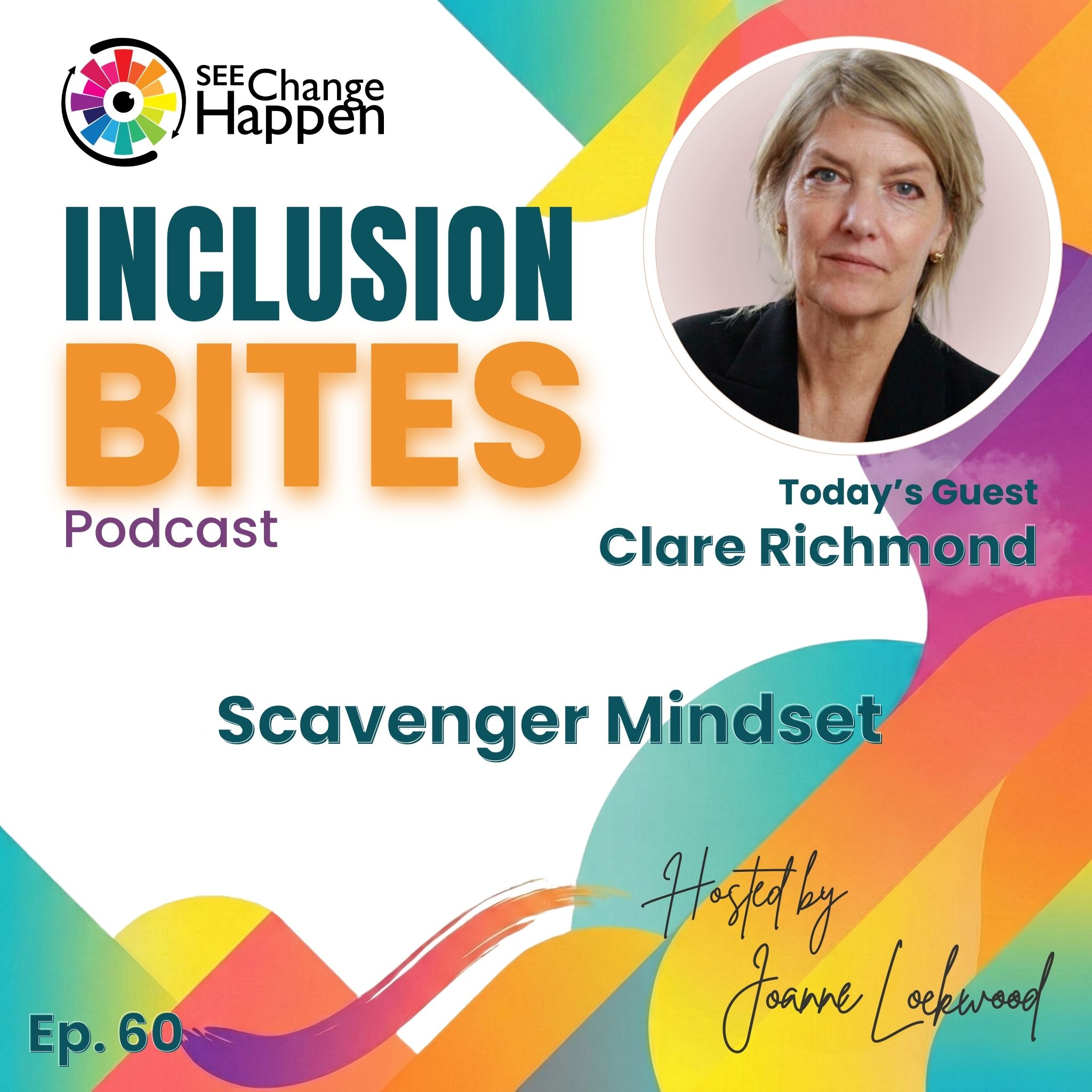
Hello everyone my name is Joanne Lockwood and I am your host for the inclusion bites podcast in this series I have interviewed a number of amazing people and simply had a conversation about the subject of inclusion belonging and generally making the world a better place for everyone to thrive. Like to join me in the future then please do drop me line to Jo Dot Lockwood as c changee happen dot coder uk has swlychangeapppandotcoderuk you can catch up with all of the previous shows on Itunes Spotify and the usual places so plug in your headphones grab caf. And let's get going today is episode 60 with the title scavenger mindset and I have the absolute honor and privilege to welcome Claire Richmond Claire describes herself as a socially innovator and engagement specialist award-winning speaker and coach. But asked Clare to describe her superpower. She said it is a passionate belief in people. Hello Clare welcome to the show.
Clare Richmondguest
Well hello Jo how lovely to be here and thank you so much for inviting me. We have a.
Joanne Lockwoodhost
I know we've been trying to plan this for many many weeks and we've had to dart around your building renovations and the noise in the background but we've finally made it finally made it.
Clare Richmondguest
And we have and I'm hoping there'll be no interruptions today I'm that perched at the top of my house in the quietest possible spot despite the fact building is still going on so fingers crossed.
Joanne Lockwoodhost
Brilliant but so Clare Scavenger Mindset tell me about that.
Clare Richmondguest
Yeah, well the scavenger mindset is what I have identified as a way to help leaders to find untapped talent within the resources and the teams and even in themselves that they already have. It's a mindset that I have identified from years of working with communities and organizations really inspired by my first experience of setting something up from scratch with nothing no money, no resources, no experience. And discovering that actually having nothing created enormous freedom. Not just for me as a leader but in the way that other people worked with me. The scavenger mindset is very much about encouraging people to think more resourcefully more pragmatically and more innovatively about what they already have and how they can use it better.
Joanne Lockwoodhost
And I love that I love that? Um, when I work with the Ta recruiters I Always try to encourage them to see into the heart of the person and it's often we get boxed into thinking This is what I need for this role.
Clare Richmondguest
Here.
Joanne Lockwoodhost
This is the job Spec This is this is the the gap that's being left by somebody else I need someone to fill that gap and I want to I want people to see into the heart of of an individual and say hang on a minute. What else can you bring? Maybe maybe you're you're good for me. But you're also better for the company or better for a different role. So I think I think that's a really great place to start where but we're trying to not box people off. We Want to find out what else they can do to enhance their contribution. Um their expertise their opinions. All those things and I think I think that's a great place to start when we think about hiring but also as you as you said. Within the talent you already have what are we missing out on.
Clare Richmondguest
yeah yeah I mean one of the things I discovered so I mean my background had been working in media marketing which to all intents and purposes is a fairly sort of bureaucratic process despite the sort of you know the sense that media is very creative. It. Circling the days that I was working in it. It was very hierarchical in the way it was approached and that requires such a level of or expectation of control and order and because of that we tend to sort of. Put people into sort of orderly places. So this person's an accountant so that's what they do. This person is creative so they go in the art department and actually what I've discovered from my work in the last ten years is that people are capable of so much more when you take away the boxes. And it is quite uncomfortable for people for for a lot of leaders. It's actually they like to fill the ordern. We know where people sit but I've been on so I've been in so many situations where the most unlikely people have come up with some of the most important insights. Have come up with some really brilliant creative ideas which don't normally get voiced. Don't even get involved in some of the conversations. So I'm I'm a great believer that if you give people the right conditions you will you will achieve so much more with them. They will achieve so much more themselves. And I often think as well. That leaders equally need to think differently about what they themselves offer and how they can let go perhaps some of their sense that things need to be in control and we need to have order. It's but it's ah it's a difficult. Um, it's a it's difficult you to get the head round. But if you put people in boxes. That's where they stay and we live in a world which is changing so fast that we need people to come out of their boxes. We need. We need everybody to contribute. Higher level and and we need really people to become inspired by what is possible.
Joanne Lockwoodhost
So when we think about yeah we we talk about inclusive leadership. How could I mean I'm a great believer that leaders aren't born. Leaders could be nurtured. They can be trained like any other skill We can teach empathy compassion.
Clare Richmondguest
Yeah.Yes.
Joanne Lockwoodhost
Yes, you've got to have an inherent desire to learn and that drive as well. But we we can evolve our leaders. No one has the the god-given right to be a leader. We can all have it within us. So How do we encourage our leaders to develop the people and. And to have this cavature Mindset. What's what's the techniques we can start learning.
Clare Richmondguest
I mean I know it sounds like a very strange thing to say because it seems so obvious but the first thing I say to leaders is do your groundwork start at the beginning get down to the foundations and get to know the people that you work with get to really know them. Ask you know involve people in different conversations. Ask them questions get to know them on the level beyond the role and responsibilities that they have because there's almost like a shortcut to the way we we interact with each other There's a sort of this is your title. This is your. Level of responsibility therefore this is the point in which I engage you and in my experience that hems everybody in. Um, you know there are situations in the world where you need people who have huge expertise and experience. And I'm not sure if you're familiar with the terms wicked and tame problems but there are the problems which for which somebody who's been doing this for 20 years is very important because they're going to need that sort of experience. You know, being a surgeon for instance or making you know rocket ships and things they all have requirements. Expertise however, we increasingly live in a world of wicked problems and wicked problems are not actually easily understood. They're not something which has a specific answer so you need far more different perspectives involved because there isn't going to be There's your answer. That's how we fix it. It is an ongoing problem and it needs everybody involved and in those scenarios as a lovely example of that with scientists who who got together for the first time different disciplines of science in order to look at a problem that have been ah, an issue for a long time and because. All had different disciplines. They all had different perspectives and they were able to discover things and to suggest things into challengings that they hadn't been able to before so I say to leaders. The first thing is go back and talk to people get to know get to know your teams get to know yourself beyond. The initial labels. The initial accountability do your groundwork and then importantly is to build a community around what what you're looking at doing what your challenges are build that community of diversity bring in people from your top to the bottom. Whether they're new or whether they're experienced so bring community to any challenge or opportunity that you're facing do your groundwork develop your community and then your position to start asking the really exciting innovative questions which lead to progress and growth.
Joanne Lockwoodhost
I Yeah I completely agree I Think what I see a lot of and there's I think the big big challenge when we when talk about what we talk about here is that staff Colleagues employees help We want to describe have often been bought. Up in a world of work where they are stifled as you say boxed off stay in your lane and we find this maybe happens more when we think about people who are marginalized black people women people with Disability. They're just not used to giving their opinion or being heard or even being listened to um. Traditional leadership model doesn't it invite that kind of comment and and and and in the workplace people are expected as you said earlier to be to stay in their lane and and stay in their box. So If you're a leader that. Is kind of transformational that they they're collaborative. They want to listen to this. What can they do to help employees feel that they can speak up because I think there's a lot of if I So if I say something will I be will I be penalized for that or maybe maybe there's a culture where. Anxiety of speaking up or fear of speaking up for fear of that. Um putting it head above the parapet and getting it short off or something that how can leaders us note to the and the culture of of the organization as well.
Clare Richmondguest
So I think it's as really, That's the massive challenge that we have is that mindset that you know nobody really wants to go out of their comfort zone because it feels obviously a frightening place and actually getting um, getting comfortable with being uncomfortable is really important but it it. My experience. It's all about starting with small steps and building a level of trust because I've I've worked with organizations and communities where there have been all sorts of initiatives with all the best willing the world. You know the intentions are great but they've always sort of. Brought in ah, an initiative to get people to you know collaborate better or become more innovative and it's such a on such a grand scale that it actually scares more people off and people are ah frightened to sort of change their behavior because this so such a grand big thing hanging over them. So My my. My approach has become more and more about really starting small beginning with the conversations that that allow people to relax into the fact this is for real This isn't just some grand gesture that we're doing This isn't you know to sort of tick a box here. This is actually somebody wanting to establish a relationship where I can really feel trusted. And then the building Community is very important. That's all about building a safe space safe So psychological space for people to contribute and recognize that people contribute at different levels in different ways. So You know when I Run community to try to get people together into communities. It's all about looking at what. How people meeting them where they are at the moment. How do people really feel and very often. That's not easily talked to amongst your peers and amongst the leaders so actually having a neutral voice a facilitator to start those conversations where people can feel comfortable enough to to open up and be honest is really important. And then taking those results into a community group where you see people able to sort of you know, talk at the at a point where it doesn't matter what your role is it doesn't matter what you've done up until now we're all equal that's quite a difficult theme to establish. It is exactly what you'll need, but you're right? It's difficult I mean some of the techniques I've used in in the past encouraging people to contribute know getting them to think about a question or get it to ask them something prior to the meeting and then being anonymous in their response. So. I Can then facilitate meeting or somebody facilitator can then introduce people's voices and opinions in a safe Way. So they're not being.. It's you a cus a tree people can't be. You know that. But if if they're worried about what response is going to be their response will not be associated with them. It will be a neutral.
Clare Richmondguest
It would be anonymous voice so little techniques which are all designed to keep the space and build a relationship of trust is absolutely vital but they're small things sometimes and then gradually you see people's confidence going. When they realize that actually it is okay to speak and it is all right? And in fact, you know I've I've got some of my heroes or scientists who I think are amongst the most creative innovative souls around and there's a lovely quote from Francis Cripp who was one of the. Founding fathers of Dna his nobel prize winner and what I but what I find most astonishing about him and his partnership particularly with Sydney Brenner was not so much about how brilliant they were as scientists but how brilliant they work creativity and the way they created a space which allowed them to really. Be vulnerable and honest and they had this thing on a Friday I think it's on a Friday but there was 1 rule sydney brener used to say they had in their office and that was that you could say anything you could say whatever came into your head however foolish or random or you know ridiculous sounding. Um, because they employed that level of safety within the office that you could say anything and not be laughed at or be made to feel foolish and these are scientists these are some of the most brilliant minds in the world but they absolutely contrived and ah a completely safe. Space for their creativity to really flourish where they literally could say anything and interestingly he said so often. We'd say things which meant nothing really to ask that somebody else might pick up on something and and see something but they he reckoned that it was only because they had that safety. That they could say whatever they wanted to say sounds ridiculous. They wanted to sound that they made those sorts of incredible leaps in science now. That's the sort of safety that we need to try and employ with people. It's that safety where you can say whatever you like and not feel be afraid of foolishness. I mean I have a phrase which is being right's not the answer and that's the sort of principle which creates that space being right? doesn't matter. There isn't a being right? and that's that's quite a weird thing for people to get their heads around but that's the level of safety you need. So it's it's looking for small ways that you can build. That level of relationship of trust and whatever it wherever you are with the people that you're working with those initial conversations will indicate to you? what what stage you have to what what things you have to employ to help that and it takes time. It doesn't happen overnight.So it's ah it's a process of learning which you go on together and is richly rewarding because of it.
Joanne Lockwoodhost
Yeah I As as you're talking I was thinking I've I've worked for myself or been in ah a leadership position in my own business or senior position in in other Organizations. So I've I. I've almost forgotten what it's like not to speak up and have an opinion because my role has been to speak up and have an opinion if I'm ah at a chairing a charity Md of a company senior director. Whatever it may be I know how to speak up and I but I also recognize that.
Clare Richmondguest
Plain as.
Joanne Lockwoodhost
That's a skill I've learned and many people I think one of the things you you talked about there was psychological safety and and the other thing I pulled out what you're saying there was not hijacking people so giving people the opportunity to know what's coming. Yeah at this meeting.
Clare Richmondguest
Yeah, yeah.No.
Joanne Lockwoodhost
At this conversation I'd love to talk about this and I'd love your opinions because we know people maybe who are Neuro divergent not neurotypical. Maybe but they've been put on the spot that that can create high levels of anxiety people aren't used to express no opinions. So they everything you said there about creating this this cycle because I did created this trust.
Clare Richmondguest
Yeah. Yeah.
Joanne Lockwoodhost
Creating this contract of communication between you so that everybody knows what's expected then people will learn how to speak up how to have vote voice their opinions because they know it's welcome. Ah, and I I Yeah you've probably done a lot of training and breakout rooms and stuff over the last couple of years in pandemic.
Clare Richmondguest
Yes.
Joanne Lockwoodhost
And it's sometimes really really hard to get people to turn their camera on and their microphone and start joining in the conversation. Youre saying any thoughts like oh no, no, don't ask me, don't ask me. Ah you can see people retreating voiding eye contact and they's still a thought that human nature and I think that's I think for me, that's the challenge.
Clare Richmondguest
No.Yes, yeah, yeah.
Joanne Lockwoodhost
Leaders have to overcome is creating that cycle because actually creating that trust environment and um, creating a culture where people go Yes, my voice can be heard.
Clare Richmondguest
Yes, and depending which setup absolutely Jo and and depending on different setup I'm now worked for huge housing association a while ago and they were very proud of the fact that their Ceo once a month took part in sort of question and answer. Anybody in the company could ask him a question and that to me was a lovely example of how people having absolute the right intention. We want this to be inclusive. We want everybody to feel they can ask a Ceo a question but I put it to them that what that did was retained this sort of parent child scenario where. The Ceo had was expected to have all the answers and he kind of was the the being at the top of the the tree who was you know, magnanimous in responding much more interesting I felt would being to turn that round instead of asking him. Asking everybody else and then allowing people to answer and allowing people to contribute in the way that they wanted to because that's where you find the magic throughout that's where you find the wisdoms and the insights throughout an organization or community. It's very rarely ring fenced. Around the experts or the people at the top the experts the people who are living it and breathing it and involved in different perspectives.
Joanne Lockwoodhost
Yeah, going back to another point said it's not about being right being right is not the objective I say you can't be happy and right all the time. So sometimes certainly certainly in a marriage and I've learned over the years that
Clare Richmondguest
1Yeah, this no.
Joanne Lockwoodhost
Being right is not actually important anymore. Um, being happy is actually more important I think you can translate into that into the working environment being productive working as a team. It's not about someone being right? So being wrong by definition. It's about coming. It's about having a shared objective and a shared truth and a shared opinion. Ah I think that's that's that's really really important and it's I think some of this start stems and as you're talking the example there about the Ceo on stage I think some of its tend for being vulnerable and I'd like to think that I'm again one of my privileges I've been I'm comfortable being vulnerable I'm comfortable oversharing sometimes.
Clare Richmondguest
Is.
Joanne Lockwoodhost
Being being the raw me and maybe if that Ceo had started with a vulnerability story about his own newer nearer diversityity or his own challenge. He said or is Kant's battle of cancer or is battle with weight loss with alcohol is or whatever it may been and said this is the raw me now ask me anything. Asked me about that that would have maybe set the scene more to give permission I think that's a really great starting point.
Clare Richmondguest
Ah I have um I won't swear but I have a technique which um I've taught a number of people which I call eff it Friday mendit Monday and and the idea behind that is it gives people permission on the platform. To do a number of different things. They can admit to a mistake that they've made you know this time when I did this what you know I've accidentally found this and but or it could be that you know you're you're gearing yourself up for something that you you're a bit scared of. But yeah, do you know what on Friday I'm just gonna do it but they. Eff it Friday end. It Monday is an opportunity for people to have that vulnerability that we've made a mistake or I've got a problem which you send out to the rest of your team and then the mend it Mondays you have time over the weekend to really think about it and. Different people can actually I've thought about that and I've just been thinking I often think one of the problems about the way that we work is that we expect immediate answers and we expect them to be right? and so often it's only I've always found anyway that the way my brain works is that I can be sitting in the you know, really interesting workshop or presentation. And you know what? so you can ask questions and things are going on in the room but it's only when I'm walking the dark a day later or two days later that my brain has sort of clok c clok c clomp and things have suddenly made sense. So again, you know, looking at how you build community how you. How you take the scavenger mindset and bring out this talent is to also consider how as humans we really operate we tend to operate better when we have a better space to go back and think things through and when we're not afraid because if we know that being right isn't the answer. It gives you permission. Have a go and to contribute because you're not I mean the interesting thing I don't know about you Joe. But the thing that I find most extraordinary about my experience of work and living is we all share far more than we than we don't share. You know at the root of humanity doesn't even matter whether we go back 200 years or go forward 200 years what really motivates us to stop doing something or to start doing something is whether we feel valued whether we feel there's a. A level of connectivity and whether we have ownership and if you get those things in place people are are resilient. People are far more creative and certainly with with the scavenger leaders that I've met over the last few years
Clare Richmondguest
You know none of these leaders had any access to money or resources any more than I did when I set up my grassroots high street initiative I had nothing but yet they managed to motivate people and they managed to get people to work the most random groups of people to work together as teams and to achieve a phenomenal amount. I mean far more than I did and the way they do that is not by giving people great status or a sense of you know, um, you know huge bonuses but they don't have any money they're nothing all they do is they get people very quickly to feel that they matter to give them a voice. Create ownership and give them a sense of their connectivity to what it is. They're trying to achieve and so I I really feel you know this whole sort of approach to leadership creating a mindset that that focuses in on the things that really matter to humans. It's actually quite simple because it's what. We're all afraid of looking foolish none of us want to say the wrong thing. So if you take away that anxiety and fear you create a space where people can really step forward and are brave and and and say things that they really mean and are vulnerable as you were saying earlier on if you can be vulnerable. First person's put out hand say I don't know you know is the first person who will open up that community for people start joining in and I don't know is a superpower as far as I'm concerned. It's the thing that really in in so much in the world. We live in now. It's the only honestancer.
Joanne Lockwoodhost
And.So yeah I I don't know and I can't do it ah, 2 sentences. You can always put a comma and the word yet after so I don't know yet. But I can find out leave it with me. Let me look at that I can't do that.
Clare Richmondguest
Yes, yes, absolutely.
Joanne Lockwoodhost
Now but I could do that given the chance given the time given the training yet. So I think yeah, not knowing everything I think is is extremely powerful and and admitting. You don't know everything rather than floundering and guessing and and making ill-informed decisions or informed opinions.
Clare Richmondguest
It is yes.
Joanne Lockwoodhost
You're just because you under pressure to do something. It's bit like an interview situation. We feel you got to answer the question now. Um and that.
Clare Richmondguest
Exactly exactly Well, you've got to. You know you've got to deliver what you think someone's expecting even though you know it's not going to work I mean the most ridiculous scenarios if we look over I mean.
Joanne Lockwoodhost
Written.
Clare Richmondguest
There are so many examples is the book I've written has many in there um of of of people making decisions which deep down they know aren't right, but they're so afraid of of being honest and they're so afraid of telling their line managers or their bosses that what's really going on here is. Is actually nothing like they are being presented in the boardroom and to me that's just that's just such a waste you know talking about Untapped talent. It's like you know we are wasting so much talent From. All corners of the world because we have created this ridiculous climate where expect people to be able to predict the future. We Expect people to be controlled in situations where control isn't even possible. It's not within your power So We're all sort of chasing our tails to look like we've we've achieved something which. Probably isn't possible. Anyway, we're all focusing on the wrong things If you're not I mean.
Joanne Lockwoodhost
Yeah I think many leaders and managers become very parochial and very protective of their resources their staff because they're so focused on their objectives and I would love to see every leader's objective to develop their people. The point where those people can move on in the organization or move on somewhere else because that has been their growth because if we we bring people into to box them into 1 role at some point they're either because become frustrated that they've never moved on.
Clare Richmondguest
And.
Joanne Lockwoodhost
Or so conditioned to this is the way we do things you never get any creation or innovation in there. So I'd love to see leaders hiring into organizations knowing for well. Their mission is to is for that person to grow and leave not to try and hang on to them and actually celebrate people leaving because they're they're advancing.
Clare Richmondguest
Yes, yes.
Joanne Lockwoodhost
Um, and I see I see the frustrations I've seen it with people worked around me where they had they've had no training. They've had no development. They've had nothing. They're just expect to do their job if they're fed the next task but not the fitte not the 15 task ahead. So they can think about things in advance. Just.
Clare Richmondguest
Yeah.
Joanne Lockwoodhost
Literally what's on the plate today and I I think I think that's one of the one of the challenges is this the the mice have a leader creating growth for their team and I think that's that's a mindset we need to start nurturing and enhancing in our leaders.
Clare Richmondguest
And I think absolutely Jo and I think there's something really profound about the starting point. You know when I meet leaders there are you know the leaders I've met right? who who were my sort scavenger pioneers. The leaders who have inspired me by setting up something from nothing and achieving incredible things sort of global organizations from start from nothing and doing it very quickly within a matter of years and then meeting leaders in more conventional setups this is sort of. I can very quickly identify if a leader believes that their team. Their people are really, they really believe in their abilities and there's a sort of sense that I find too often that they're quite scathing of. Well, they're not good enough. They don't have enough skill. You know this? this is sort of sense of we haven't quite got the right people yet. They don't have enough. We don't have the right skills. We don't have enough people. We don't have enough resources and I sort of point out more these what's enough and how do you know? That's true. How do you know that. You don't have enough people how how are you working? What are you doing? That's perhaps not allowing you to see that you actually do have igs and in my experience we all have exactly what we need already. We just need to learn to identify it.
Joanne Lockwoodhost
And.
Clare Richmondguest
And properly release it. We need to tap into the talents that's already there and we don't we skim over the surface and we're focusing on things which perhaps are never going to engage that talent in a way which we'll show you, you've got what you need I mean if if a bunch of people that I've met over the years and there's as I said loads of them but people who start with nothing can create. Random groups of people many of whom don't even speak english or they don't have any qualifications none of them would get the jobs. They're currently doing if they went through the normal process and yet they're capable of setting up organizations which go global within 5 years it suggests to me that it's the problem is leadership. Which as you say is is is not letting out and I don't blame leaders. You know it's it's they have been ah you know as you said, right? at the beginning we we sort of being brought up to believe that we fit into boxes and that this is and leaders' jobs are. The job of a leader is to be right and to be into control and to be able to say things with real authority and the problem is time and time again. Although that's been proved to be fatally bad as as an approach. Um, that's what they're heming to do so. I do one of what the leaders to help them rethink what their leadership can be to select them. Let go if you like of a little bit enough for them to begin to see that the people they work with are capable of more. They don't need to control anything.
Joanne Lockwoodhost
And.
Clare Richmondguest
And it's that sort of psychological safety for the leaders as well that you know your value is as you said so beautifully the value of a leader is not that it can you know set targets and meet them the real value of a leader is it can see talent and let it grow.
Joanne Lockwoodhost
So.
Clare Richmondguest
The whole you all worked against so I mean by Community this is about you know, not not seeing not seeing the departments not seeing the the functions and the differences but seeing what you're all trying to achieve together and how actually it might be a bit messy but actually it's far far better to bring people along with you. And to try and segregate and keep them controlled.
Joanne Lockwoodhost
But don't dont we see this in kind of the the traditional hiring or hr model. It's it's all about yesterday when we I mean the cv process. The interview process is what have you done? What have you done before past performance should be an indicator of future performance.
Clare Richmondguest
Yes. Yes.
Joanne Lockwoodhost
Um, it doesn't wear for stockcks and shares it doesn't always work with people because the scenarios different. The company is different. The team is different. So someone's past success isn't always an indicator and I and I think what we should be looking for which is coming back to your scavenger mindset is someone's capability.
Clare Richmondguest
Yeah, yeah.
Joanne Lockwoodhost
Haven't done that before but hey I'd love to give it a go their learning ability their learning quotient they that their flexibility their pat their their values to me if you've got that the learning ability the passion, the capability and the drive to succeed and I can give you anything with a bit of training.
Clare Richmondguest
Yeah, Yang.Yes, yes.
Joanne Lockwoodhost
And you you'll tell me whether it's working for you or not you go? Yeah I've never done that before fantastic. So when when I'm applying for roles which I do infrequently these days. It always frustrates me that this they're asking me. But why I have done Well I haven't done that for years but sure as egg is X if you say we're going to do that I'll go yes, sounds like a great plan. This.
Clare Richmondguest
Yeah.
Joanne Lockwoodhost
I'm up for that. Let's go is's go for it and that's what we miss isn't that we miss the potential the capability to drive the desire because I think again picking up on something you said earlier around. What is my part as a cog in the bigger machine I'm not an accountant I'm here.
Clare Richmondguest
Absolutely yes.Yes.
Joanne Lockwoodhost
To deliver housing or vulnerable people or people. Yeah, whatever and my role within that is to make sure the book's balanced but my my real objective is part of the oval mission and I think too often we we box people into their little little zone and say this is what I do actually no I don't.
Clare Richmondguest
Yeah.
Joanne Lockwoodhost
I think it's a famous story I don't if it's true or not yeah so you are someone asked the janitor at Nasa what they did they said I put people on the moon. Ah, and it's it's a bit cliche and it's a bit bit of an old story. But that's what people should believe what's my mission. What's my part of this mission.
Clare Richmondguest
Next? Absolutely I'll think you the same story. Um, it's like what it needs. Absolutely absolutely because I yeah I was doing a workshop with pharmaceutical company. Few years ago when they were doing a big thing about their purpose and they spent a lot of money on developing a new purpose and it was very good and everybody's very proud of it. There were t-shirts and balloons ahoy. Um and yet when I ran my workshops and in each the workshops. There was a real diversity of people there. Different levels within the organization and I I every time I asked this question I ran 3 workshops at that day and I got the same response and I said so how is this new purpose impacting on the way that you are working. How is it? How is it improving it or what's exciting you about. Employing this new purpose within the way that you work and there was a real sense of well. Why are you asking us that for its purpose is is. It's almost like a strap line. Why should that have an impact on us. But we then began a conversation around because it was a great purpose and and how it could have an impact on them and the woman. In 1 of the workshops came up with an insight and she you know she to begin with she was a bit sort of I could see she was a bit not entirely sure what I was where I was heading with this but when she began thinking about it when she was given some time and space and just you know let's think that that what. Could this mean for you and you what are your contributions suit made to this. She came up with this insight which was absolutely brilliant and by the end of the eve and afternoon she had got a literature a community of people around her from all across the organization saying that. That would make such a difference to me because I hadn't realized you did that but the did to they hadn't talked to each other before and the extraordinary thing was she was an accountant she's you know she said I sit in the depths of the of the organization I never get invited to these things I never asked I didn't you know I'm glad to come here. It's nice to get away for the weekend but I hadn't didn't you know what.
Clare Richmondguest
That's untapped talent that there person has a perspective on something here which is really valuable and yes you should be. It should be that you know everybody's a janitor. Everybody's helping people to get to there and everybody has an insight or something important that can have an impact.
Joanne Lockwoodhost
And.
Clare Richmondguest
That's on me by the alat talent. It's all around. We don't even we don't work with a quarter of what's already available to us. We just skim that skim that surface and and that you know when I think about my children who are twenty s early 20 s now and they look at their futures and. Both at university but they're sort of you know one of the the conversations we have most frequently is their fear around. Well there's so much uncertainty in their young lives and they're they're trying to work out how they can be how they can build certainty into their lives. So that when they leave university they can be sure they're going to be okay and I've said then we've never there's never been that level of certainty life. It's never existed. We've just pretended it has and that's where the stress has been because you keep expecting to be certain and in control when there's none. Scavenger mindset says look. We don't know about that but all I can tell you is this that when you get there, you're going to be okay because you're resourceful because you're pragmatic and because you're actively engaged in the world so you will be able to work inevitably with whatever you've got available to you. You're going to be fine. Root of this, you're fine. you've got everything you need and when you get there you know how to employ the resources that you've got in order to help you over any challenges. Don't worry about that. You can't do anything about it. Enjoy where you are enjoy the journey. That's the learning bit. This is a bit don't focus on the end bit mate.
Joanne Lockwoodhost
Living in the present rather than having the anxiety about what if is is yeah and um I would never say cut yourself off from what's going on in the future but don't let it worry you yeah control the controlables make sure you're aware of what's coming I think I think that's really really powerful I think.
Clare Richmondguest
He knows.Yeah, yeah.Then.
Joanne Lockwoodhost
I like to think a lot of us learnt this over over the last two or three years you know the lockdown. Um, we went from having a life of fair fairly certain rules to suddenly thrust into a life where everything we believed suddenly changed overnight. You know we.
Clare Richmondguest
Yes.And then.Yes, yes, yes, yes.
Joanne Lockwoodhost
No way that we're going to be locked in our house for three months no how could how could that ever happen and there's something we are um and we kind of accepted it and went. Okay, if that's what I have to do that's what I have to do I'll go for my half hour walk and I'll come back home if someone has said to that a year before you gone na that's that's ah
Clare Richmondguest
Absolutely well. That's the thing and that's that's the lesson going back to your thing about the HR and cvs and things you know for me. What's really fascinating and I've met you know, worked in communities which many people would label as deprived.
Joanne Lockwoodhost
Ah, press and slate. Yeah, so we we we adapted very quickly isn't we.
Clare Richmondguest
You know, have problems. It's like you know what? I've met some of the most innovative enterprising resourceful and frankly productive people in some of the places which every you know which I said would be pretty much just oh yeah, that's that they problem Eric no, they're not there. Problem there. There are problems everywhere you know don't start with that premise start with the premise that there are people here. What? what can what good can what? what could he say go and find out because ive I've met with people who you were have dismissed and overlooked and really have richness beyond anything I've seen in the more sort of qualify error. And I sort of feel a particular I mean I have now done the degree but I didn't do I was the first one in my family not to go to university by some considerable margin I mean going back over you know, generous. So I had to learn to work with life without a plan I mean I knew I wanted to. You know, live in a nice place and you know not be stard I knew there were certain things my life I I wanted. Oh I didn't know how I was going to get there and in some ways that meant that uncertainty has and and and having to navigate this sort of the hit in a work with the here and now and not worry too much about what goes on and of course i've. Always had plans but work with what you've got see what you've got stay where you are and you know and make the most of things see where you've friendly. Got don't just skim over things enjoy that journey learn so that sort of whole scavenger where am I what? what can I use. How can I use this to the best of my advantage.
Joanne Lockwoodhost
And.
Clare Richmondguest
What are the opportunities. What are the changes facing things dealing with things and 1 of the things that pandemic has shown us all is it actually if you embrace it working with the here and now and dealing with uncertainty can be joyous. We've all survived this, you know from from childhood upwards we've survived dealing with uncertainty we've we've navigated change as a natural part of growing up and yet it's something we still have to learn almost that it's okay. Change it so change is not something to be frightened of it's something to actually really learn through and work with but in my the scavenger cv which I'm I hoping to develop over the next few months is is is trying to encouragehr departments yes, of course ask about people's qualifications. They're important but also maybe ask somebody about time when they were very innovative or ask somebody about a time when they had to be resourceful or when they had to use their leadership skills and they may not look like the the way that we think but there are. Countless examples in all our lives and we have demonstrated extraordinary powers of scavenger but we don't they don't see shop on a cv but anybody you could put anybody in front of me and I'll find their scavenger powers. They'll be there and they will be hugely important and incredibly valuable.
Joanne Lockwoodhost
Yes.
Clare Richmondguest
Any organizational community if they were recognized and they were given that sense of yeah, you've got this power. That's that's impressive.
Joanne Lockwoodhost
So Do you think as? yeah would would lock downs a thing of the past businesses are now trying to coerce if I if I dare to use that word people back into the office Even our government ministers are making these. Big bold statements that it's time to come back and do some proper work. You know sign of phrases which is desperately ah insulting to everybody who has always worked from home small business owners and everybody's had had a really productive Covid environment.
Clare Richmondguest
You can.
Joanne Lockwoodhost
So our employee is doing enough to listen and understand what is making a productive team rather than we seem to be falling to this dictate that you can only work effectively around a water cooler. So.
Clare Richmondguest
Yeah, and I mean I'm probably going to is probably slightly unfair of me but I'm going to exaggerate this a little bit but I think half the problem is the country is run by people who want to have reflected back at them the world that they feel most comfortable with the things that that they feel. Been brought up to value the most. This is what this is what education looks like this is what hard work looks like this is what value looks like and it has a place but they themselves aren't equipped to do with the world. We're dealing with and they seem to get the know the more. Out of control or the more sort of discombobulated thing filled by the world. The more they're trying to control it and get it back to something that they used to know it's no longer fit for bloody purpose sorry no longer fit for purpose. It's no if it has ever been. It's certainly not now and that's they're missing out. I mean that as you said the insult the insult to people that they have to have some sort of you know, parents standing over them to make sure they do their homework come on. You know we are all we have all survived things and most of us have survived true trauma. In the last few months what we need is to learn from each other not not to sort of set our stall by whether or not somebody's in an office or not It's like what's the best way. Let's treat. Everybody. Let's let's share this ownership. Learning. Let's work out what it is that we've all learnt from this that can go forward to make us all far more productive and far happier because if you are happy you become more productive and if if if we can find a way I mean that it as you you know it's sorry it's a real. You've hit a nerve with me because it really gets to me and it goes back that point that I said earlier on you know I come across leaders who fundamentally start the premise they don't believe in the people that they work with that they are capable that they can be trusted I don't know if you've you've heard of the the research done in the 1960 s by a guy called Mcgregor.
Joanne Lockwoodhost
Yes, it directs people and why people? Yeah yeah, I've heard this.
Clare Richmondguest
Theory x and theory y right? So exactly and theory x leaders start from the premise that their their teams are lazy and need to be properly motivated that they need lots of controlling and you know they need to be looked at. You know, carefully ah monitored. Otherwise you know who knows what they'll end up doing and then theory why leaders tend to be start the premise that the people they work with are absolutely trustworthy. Self-motivated capable intelligent people who can contribute something significant and. The big difference of course is that theory x leaders end up having a self-fulfilling prophecy because they cheat people so badly that they end up getting more stuff you and theory wine leaders and and they will do the bare minimum. You know they'll do the job they need to be paid but they will do the bare minimum whereas and they may well Nick the old pen actually um. And then theory why leaders have have teamens of people who are utterly motivated who are far more creative and far more truck because they're treated I mean it is this goes back to water babies. You know, be good as you would be treated by whatever that woman's name was I mean it's common sense but it. Has a marked difference and if you treat people with such a level of distrust and disrespect you're going to get that back in spades.
Joanne Lockwoodhost
Well my my would talk to anyone that has the that that X personality is if you don't trust people. Why are you hiring them surely you part of part the fundamental contract when you hire somebody you have a level of trust I mean.
Clare Richmondguest
Yes, yes, yes. Yeah.
Joanne Lockwoodhost
People generally will will pay back that trust with responsibility with other things. Um, but yeah I think I think so many people as you say are a bought app in that mindset if I can't see you I can't trust you I need to I need to I Want to be.
Clare Richmondguest
Well.
Joanne Lockwoodhost
It's not micromanaging you at least understanding what you're doing now what you're doing next I want to be in control that I think some of that comes down to maybe their own insecurity or or or what's their. What's their leadership purpose if it's if it's not cracking in the whip or beating the drum. That's how yeah the.
Clare Richmondguest
Exactly.
Joanne Lockwoodhost
Command and control leadership model. We see that as as my purpose is to drive my people and make sure they're performing not creating any environments where people can succeed and the leader's role is to unblock to inspire to strategize to.
Clare Richmondguest
That's yes.
Joanne Lockwoodhost
To create conversations and to and to listen to people. Um I always said that I'd rather run a business that I had no expertise in because it wouldn't allow me to interfere with the the production if you like I could just talk about I I joked about running a pizza company because I love pizza.
Clare Richmondguest
So yeah, you want.
Joanne Lockwoodhost
I Don't know how to make it I don't know I don't want to make it but I could talk to you about fulfillment I could talk about product I can talk about cost per pizza and all these kind of things so I can think about that strategically but I don't want to make one but I want to find people who make the bets pizzas and make sure they stay and make sure they're motivated. Um.
Clare Richmondguest
Yeah, yeah.
Joanne Lockwoodhost
I've had the least satisfaction where I become a technician and I I'm in in the middle of it. That's where I get most frustrated where I'm the expert and I'm I'm the buck stop as well and that aspect becomes extremely frustrating as a leader where you have the all the expertise and so I'd say any advice for Lee. Leadership I have is don't be the expert. Ah yeah I think we said that earlier don't have all the answers so solves of the problems.
Clare Richmondguest
Don't know all yeah and and and you know the reality is you know if you look at most problems at the moment when we don't know what's going to happen I mean we we need start thinking more like farmers I mean you have a plan for the year of course you do you know that you've got to you know. But you there's no point worrying about the fact that you don't know whether of what the weather's gonna do so you have to set yourself up to be absolutely actively engaged in what's going on so you can have your antennae up to change. You can bring people in you can you can work more agilely and leanly you you know work with the I think this.
Joanne Lockwoodhost
And.
Clare Richmondguest
Phrase I use I've got so many blooming phrases but 1 of the phrases I use is you know you got to work with reality stop trying to control it because you can't yeah you can't control this is stop trying to that. That's what I mean a focus on things that you can do and and it it is it. It. It. It is something which I think leaders like all of us they're human, you know we want to feel valued. We want to feel comfortable. Nobody wants to feel uncomfortable. But actually if we could just learn that uncomfortable is actually quite an exciting space and if you know that. Being right isn't this the the great nirvana but to discovery is exploration is being you know involved of the people working with others that is where it's but I mean in some strange way I think you know we. We think that learning is about measurement. It's not It's about understanding and just because you can measure something you know you could be missing so much so much else we need to think and it's a lovely um story about Ford. Who years ago was sort of you know, measuring their success by the number of chucks that came off the conveyor belt I'm slightly going to paraphrase this because um, my memory isn't brilliant on detail but it was only when they and this somehow didn't compute with what was really going on and when they widened their their lens to look instead of just measuring sort of output. Started looking at start turnover starting to look at absenteeism starting to look at you know productivity at a different level within they began to see they were all over the blooming place and that actually you know they had been measuring one very small thing but missing out the most important part of the story. And I I do think that we need to we need to see leaders in in a facilitator role in a supporter role in a role which is sort of standing from the back like my scavenger leaders. You know they they all of them had very clear views of what they wanted to achieve but you know. Phrase I use is you know they're very clear about their direction but open to the route I don't know how we're going to get there haven't got a clue so. Let's do things to find out. Let's like scientists. Let's test and trial and work things out then let's come back and see what worked what didn't work you know and let's broaden our reference points so we can. Down some boundaries about what we think is important what we think success and what we think we're about who's to say let's challenge some of our assumptions. Let's say well who who says we can't do that who says that's the most important. How do we know? what? our customer is how do we know what you know do as a mean it's sort of it's if it's about sort of.
Joanne Lockwoodhost
And.
Clare Richmondguest
To me this is the ear of the Scavenger. This is a really exciting time. This is a time of hope when actually we need all hands to the deck when we need to look again and look a bit deeper at people and stop making our assumptions and stop being fearful of being not being right because being right is no longer the answer. We've we've got to learn and and we've got to learn quickly and we need as many people helping us as possible.
Joanne Lockwoodhost
I as I listened to you there and and and as a story is popping into my mind. Um I like I kind of had this mantra. Um over the last ten or so years that I want to navigate the world without without Gps without satnev. Um.
Clare Richmondguest
Wow.
Joanne Lockwoodhost
When I was kind of negotiating or dezing with my my own far my business I'd often meet business consultants. You know you know this typical sort of business plan need need devil all this sort of stuff and I and I said I don't want I I know I know I kind of got this idea what's on the horizon I've kind of got this idea of what I went ahead. I want to wiggle around I want to go into the forest no sat na and just see where the path takes me go oh left or right? Oh lets try a bit left. Oh that's a bit muddy. Let's try a bit right? a bit left and then one day you pop out the forest and go oh wow, it's sunny out here or if it's raining you go back in and and and go another direction so I wanted to navigate. My business life my to some extent my personal life without necessarily having the specific in mind it was the destination I was looking for not how I got there, enjoy the journeys or stuff and when I was in the in this on the west coast the us one I was on a project there Twenty Twenty or years ago
Clare Richmondguest
Yeah, yeah.
Joanne Lockwoodhost
And we had some free time at the weekend I think it was Thanksgiving weekend and the team we all went out just wandering around l a and we did what I call green man navigation. So we got to the first injunction and whichever junction was green. We went across that road.
Clare Richmondguest
Who.
Joanne Lockwoodhost
And we walked and then we got to the next juncture if it was green. We went if it was red good green So we navigated around L a looking for somewhere to have lunch via green man navigation and then we just went wherever the green man went and it was a fantastic way of just allowing yourself to explore something where you haven't got necessarily as.
Clare Richmondguest
I.I Love me garsly.
Joanne Lockwoodhost
Ah, an exact destination in mind but allows you to explore something with a bit of strategy or a bit of a bit of fun. So yeah I do love the idea of just check in the Gps array sometimes and just navigate by green men. Where's that opportunity. What's the opportunity next what's the next opportunity and see where it takes you.
Clare Richmondguest
Were rap. Yeah. You know? yeah because that's where I think you know, um, if you look at most natural disasters in the world. You will see scavenger at work. You will see you know that actually when when you take away the. Um, it's and it's it's a horrible example in many ways, but it's it does illustrate the fact that people are with the right conditions people are incredibly enterprising innovative and able to self-organize and be self-motivated in a way that it's in you just don't get in the normal. Working environment I mean when you look at Katrina for instance, there's a wonderful example of that where it was the grassroots communities that were saving lives and looking after each other and self-organizing and keeping things going where two hundred miles away was hotel room full of first responders who were going through the health and safety issues implied in a scenario of a natural disaster and the storys coming out from the farm infant are saying we know we couldn't believe it's we sat there being told we had to you know fill in forms. No, we need. We need to get there and do things. And it's such a brilliant example of you know, just I guess you know that that superpower thing you asked at the beginning when um, talked about the beginning of the podcast this sort of what do I but I really know I know that people are capable of far more. I've witnessed the most unlikely people being the most extraordinary leaders I've seen people change lives for the better where they have very very little in the way of resource or experience. But my god they're able to make a profound transformation. The lives of people that they live or work near and they don't have any of the the conventional sort of expectation. They don't have the they haven't done an nba they haven't some of them even got you know to school got through school some of them. But you know the bit. We can't overlook people anymore. We can't afford to waste the talent that exists within our world within ourselves if we keep sort of focusing on making sure we've got that map and we're sticking to it no matter what we fail to capture the opportunities that exist that just emerge from.
Clare Richmondguest
Our involvement and we fail to address the challenges Properly. We fail to properly face the ugly truths of the realities and so we avoid things and mistakes get made and things don't happen and people can die because we're too scared to say all of that is is what happens when we try to. Follow a map too closely instead of being realistic about the fact that you know what follow the green man. Let's see you know we've got a very clear sense of what we want to achieve here. Let's just see where and and trust ourselves and actually we have an innate wisdom in Us. We have an innate intelligence. And we all have value which is very rarely represented in the world but I hope increasingly will become more so but I love that green Man's story I might do that myself.
Joanne Lockwoodhost
Thank you Claire I I think that's a ah, very poignant moment to to end this episode. Thank you so much. It's lots of inspiration that you've given us here today and I'm really really inspired.
Clare Richmondguest
Gosh It's a nibbe.Oh well I'm about to um publish a book called scavenger mindset and that before now for that there is a speak to site that you can reach me at or I'm on Linkedin.
Joanne Lockwoodhost
How can our listeners get in touch with you if they want to make contact.
Clare Richmondguest
Richmond Claire speak to um so yes, I'm afraid I haven't yet set up my scavenger platform because you are the very first person to hear that concept. So. Be much more of it coming across the year but thank you very much for the opportunity to talk about it for the first time it's been really fascinating talking to you Jo I've loved it.
Joanne Lockwoodhost
Thank you so Claire Richmond so CLARERichmond on Linkedin and your website is speak to SPE a KTODot code dot u k is that right? That's brilliant. Well I'm sure people.
Clare Richmondguest
Yes, it is yes it is.
Joanne Lockwoodhost
Contact you and your you're welcome. There. Ah their feedback. Thank you so much and also a huge thank you to you? the listeners for tuning in and getting to the end of the the show please do subscribe and please keep yourself updated with future episodes of the inclusion Bites podcast that b I t yes. Please share it tell your friends tell your colleagues. We love to have subscribers. So thank you so much I have a number of other exciting guests lined up and I'm sure you'd be equally inspired by them over the next few weeks and months of course if you'd like to be a guest if you're listening in there and you'd like to be a guest I'd welcome you to apply. Um, I'll also welcome any feedback and suggestions you have on how I can improve so just drop me an email to Http://joe.lockwood As T Changeeapp Dot code at uk and finally my name is Joanne Lockwood it has been an absolute pleasure tosis podcast for you today I'll catch you next time. Bye.
Embracing the Scavenger Mindset in LeadershipPsychological Safety and Creative SpacesNavigating Uncertainty and the Power of Adaptability
Claire Richmond introduces the “scavenger mindset” as a way for leaders to uncover untapped talent and capability already present in their teams and organisations. Drawing on her experience building a grassroots regeneration initiative with no budget or formal resources, she argues that starting with “nothing” can create freedom, innovation and new forms of collaboration.
The conversation explores how traditional, hierarchical workplaces can box people into roles and limit contribution, and why inclusive leadership begins with doing the groundwork: getting to know people beyond titles, inviting diverse perspectives, and building community around shared challenges. Claire and Joanne discuss practical ways to increase psychological safety, including starting small, creating trust over time, enabling anonymous input, and giving people space to think rather than demanding immediate “right” answers.
They also challenge conventional approaches to hiring, performance and productivity, emphasising potential, learning ability and resourcefulness over rigid experience checklists. The episode closes with reflections on uncertainty, adaptability and why leaders who focus on connection, belonging and ownership can help people do extraordinary work.
“And I often think as well that leaders are equally need to think differently about what they themselves offer, and how they can let go perhaps of some of their sense that things need to be in control, and we need to have order. It's a it's a it's a difficult, it's a it's difficult for you to get their head around. But if you put people in boxes, that's where they stay.”
“The first thing I say to leaders is Do your groundwork. Start at the beginning, get down to foundations, and get to know the people that you work with.”
“So I think it it's as a really that's the massive challenge that we have, is that mindset that, you know, nobody really wants to go out of their comfort zone because it feels obviously a frightening place. And actually getting getting comfortable Wellbeing uncomfortable is really important.”
“I won't swear, but I have a technique which, I've talked a number of people, which I call FIT Friday, Mended Monday. And and the idea behind that is it gives people permission on the platform to do a number of different things. They can admit to a mistake that they've made. You know, this time when I did this, you know, I've accidentally found this and but or it could be that, you know, you're you're gearing yourself up for something that you you're a bit scared of, but yeah, do you know what? On Friday, I'm just gonna do it.”
“We all have exactly what we need. We just need to learn to identify it and properly release it. We need to tap into the talent that's already there, and we don't we skim over the surface and we're focusing on things which perhaps are never going to engage that talent in a way which will show you. You've got what you need.”
“I said, so how is this new purpose in on the way that you were working? How is it how is it improving it, or what's exciting you about in employing this new purpose within the way you work? And there was a real sense of, well, what are you asking us that for? It's purpose. It's it's it's almost like a strap line. Why did that have an impact on us?”
“But anybody, you could put anybody in front of me, and I'll find their scavenger powers. They'll be there, and they will be hugely important and incredibly valuable to any organizational community if they were recognized, and they were given that sense of yeah, you've got this power. That's impressive.”
“And it goes back to the point that I said earlier on, there's, you know, I come across leaders who fundamentally start the premise. They don't believe in the people that they work with, that they are capable, that they can be trusted.”
“And and, you know, the reality is you know, if you look at most problems at the moment when we don't know what's gonna happen, I mean, we we need to start thinking more like farmers, mean, you have a plan for the year. Of course, you do. You know that you've got to, you know, but you there's no point worrying about the fact you don't know whether what the weather's gonna do. So you have to set yourself up to be absolutely actively engaged in what's going on. So you can have your antenna up to change. You can bring people in. You can you can work more agilely and leanly. You, you know, work with the I think this the phase I use, I've got so many phrases, but one of the phrases I use is, you know, you gotta work with reality, stop trying to control it. Because you can't, you you can't control it. Just stop trying to.”
“I know that people are capable of far more. I've witnessed the most unlikely people being the most extraordinary leaders. I've seen people change lives for the better when they have very, very little in the way of resource or experience, but my god, they're able to make a profound transformation to the lives of people that they live or work near.”
The challenge of aligning a new organisational purpose with employees' day-to-day work and its solutions.
The importance of starting small, building trust, and creating a safe space for collaboration.
Techniques to encourage open participation, such as anonymous responses and embracing vulnerability.
The inefficacy of traditional hiring practices and the advantages of focusing on capabilities and potential.
Examples of grassroots initiatives during crises, showcasing extraordinary leadership without formal resources.
The necessity of embracing discomfort as a space for learning and the benefits of the scavenger mindset.
Strategies for leaders to develop deeper connections within their teams and drive collective success.
One thing to remember
Key Learning: Embracing a "scavenger mindset" is crucial for unlocking hidden talents and fostering innovation within an organisation. By creating safe spaces for diverse perspectives and encouraging adaptability, leaders can harness the untapped potential of their teams. This approach involves recognising and nurturing individuals' innate capabilities, fostering an environment of trust, and valuing shared ownership of learning and problem-solving.
Questions this episode helps answer
How can leaders effectively tap into the diverse perspectives and untapped talent within their organizations?
What are some practical ways leaders can create a safe space for their team members to contribute and share their ideas without fear of judgment?
How can leaders shift their hiring practices to prioritize qualities like capability, learning ability, passion, flexibility, and values over past performance?
In what ways can leaders foster a sense of community, connectivity, and ownership within their teams to enhance motivation and creativity?
How can leaders embrace discomfort and uncertainty as opportunities for learning and growth?
How can leaders reframe their approach to leadership and let go of the need for control and authority to unlock their team's full potential?
Explore topics
Ideas from this episode
Embracing the Scavenger Mindset in Leadership
In our engaging conversation, Clare Richmond and I delved into the concept of the "scavenger mindset" in leadership. This approach is all about adaptability, resourcefulness, and valuing diverse perspectives within an organisation.
Psychological Safety and Creative Spaces
Our discussion took an insightful turn when we delved into the importance of psychological safety for fostering creativity and innovation. Clare shared compelling examples of how creating safe spaces where people feel comfortable expressing their ideas led to breakthroughs in various fields.
Navigating Uncertainty and the Power of Adaptability
How embracing uncertainty and adaptability can lead to personal and organisational growth. Clare’s reflections on her children’s fear of uncertainty resonated deeply, emphasising the necessity of developing a scavenger mindset to navigate the unpredictable nature of life and work.
Learn
Frequently asked questions
What is the scavenger mindset?
The scavenger mindset is a way of approaching challenges and opportunities with resourcefulness, adaptability, and an openness to new ideas. It involves embracing uncertainty, being willing to learn from diverse perspectives, and valuing untapped talent.
How can leaders foster a scavenger mindset within their teams?
Leaders can foster a scavenger mindset by building relationships with their team members beyond their roles and responsibilities, involving people from all levels of experience in problem-solving, and creating a safe space for open and honest communication.
What role does diversity play in the scavenger mindset?
Diversity is crucial in the scavenger mindset as it brings together different perspectives, experiences, and ideas. It allows for a more holistic approach to problem-solving and increases the likelihood of innovative solutions.
How can individuals tap into their scavenger powers?
Individuals can tap into their scavenger powers by embracing discomfort, being open to new opportunities and challenges, trusting their innate wisdom and intelligence, and valuing their own capabilities and potential.
How can organizations recognize and appreciate scavenger powers?
Organizations can recognize and appreciate scavenger powers by shifting their hiring and HR practices to focus on an individual's capabilities, learning ability, passion, flexibility, and values rather than solely relying on past performance or qualifications.
How can leaders create a safe space for vulnerability and openness?
Leaders can create a safe space for vulnerability and openness by encouraging open and anonymous communication, embracing mistakes and failures as learning opportunities, and fostering a sense of community and shared ownership within the team.
Share this episode
Heard something worth passing on? Send this conversation to someone who needs to hear it.