Insights From The Science Of Happiness And Positive Emotions
Nic talks about how the use of statistics and people science allows us to look for trends and opportunities to see how people are likely to react to certain situations.
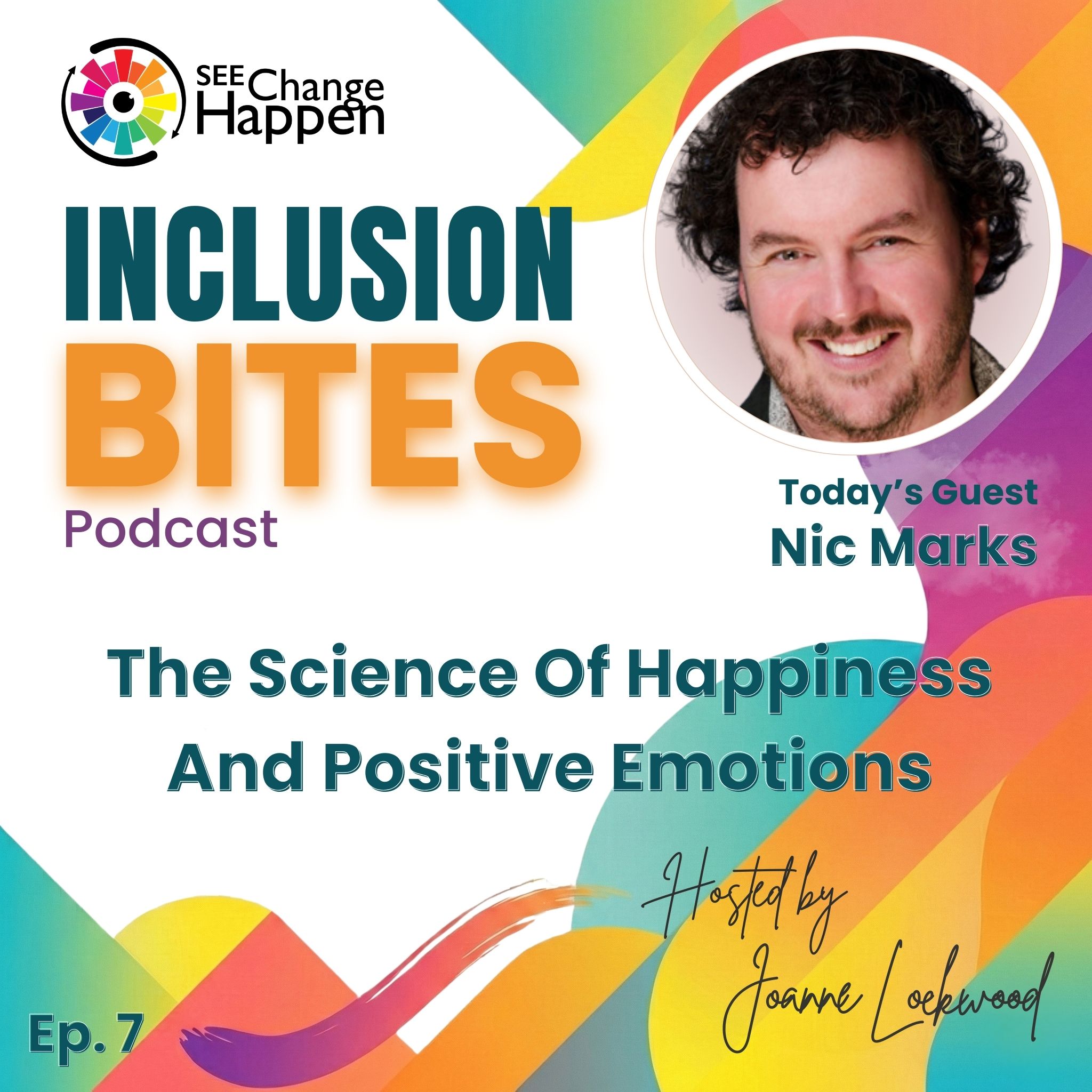
In this episode of Inclusion Bites, Joanne Lockwood speaks with Nic Marks about mental health wellbeing trauma.
“The averages are very disappointing because you miss that variance.”
Explore
Navigate this episode
Joanne Lockwoodhost
Hello, everyone. My name is Joanne Lockwood and I am your host for theInclusion Bites podcast. In this series, I will be interviewing anumber of amazing people and simply having a conversation aroundthe subject of inclusion, belonging and generally making theworld a better place for everyone to thrive in. If you would liketo join me in the future, then please do drop me a line tojo.Lockwood@seechangehappen.co.uk.You'll be able to catch up with all of the episodes and shows on itunesand Spotify and of course, the usual places. So plug in your headphones,grab a decaf and let's get going.Today is episode seven with the title ofInsights from the Science of Happiness and PositiveEmotions. And I have the absolute honour andprivilege to welcome my guest today, NicMarks. And I met Nic randomly onLinkedIn, like you do. I think he was stalking me one day and we cameacross and we chatted. And now Nic is now on the podcast.Brilliant. So Nic is a statistician, a trainedtherapist and a ted speaker. A ted speaker.Gather. No, X. We're in the presence of royalty.Brene Brown's best friend, I'm sure, so well.And he's also the founder of the Friday Pulse andspecialise in improving team morale andmeasuring it. So I asked Nic to describe his superpowerand he said seeing the patterns between thingsand communicating simply without being simplistic.So, hello, Nic, welcome to the show. So, tell me more, what areinsights from the Science of Happiness and positive emotions?
Nic Marksguest
Hi, Jo. So, yeah, I'm astatistician and I have, over the years, started to specialisein happiness and well being. I started off doing quality of lifeand I am a trained therapist. My mother was afamily therapist, so I got quite interested in therapy when I was young. Andalthough I was a statistician, I kind of end up with this mixbetween hard statistical skills and soft analytical ones, whichprobably makes it more interesting. And what are the insightsfrom? I mean, there's so many insights from happiness and positive emotions, butmost people tend to start by asking, what is happiness andis it different for different people? And in oneway it's the same for us, and in other ways it's different inthat happiness can be both thought of as an emotion. So I feelhappy now, and also a thought I am happy with. And sothere's a tension between how people use the word, so some peopleuse it to mean contentment and quietness, and some people meanenthusiasm and joy. So the brilliant thing about the word happiness isthat people can sort of project onto it lots of different things,and I kind of like that from an interpersonalperspective. But then when you get into how you measure it, you start getting moretechnical. So there's a lot of insights for them. But basically mywork is about how the people live better lives. So when you talk aboutinclusion, belonging and creating better lives, that's kind of what I do.And I try and bring my statistical skills to that.
Joanne Lockwoodhost
Okay, I've always come from this inclusionconcept about avoiding stereotypes, avoidinggrouping people and creating in groups and out groups. But I guessstatisticians, you're trying to use data to create groups ofpeople. So how do you see the individual within that statisticsrather than seeing people as a lump?
Nic Marksguest
It's very interesting. So you can use statistics in different ways, but mainlystatistics, even the word comes from states, so it came from populationsurveys. That's the root of the word. And so, yes, wasgenerally looking at populations, but not always. You're often looking toidentify subpopulations and groups within that. Andthere's one, you see patterns sometimes you seepatterns where all humans move in the same direction, and some patterns you see wheredifferent groups of people act differently. So you do start to see that, and there'sa different analysis that you can do for that that starts identifyingthose. And there's some ways that when you're doing populationstatistics, the averages are very disappointing because youmiss that variance. And actually all of us know in our own livesthat people are different, and yet we're the same.There's two things going on. There's something generically about being human and then there'sthe variability within it. And actually stats is really quite good at identifyingboth of those things. So we can seeif you're tracking people through time, you see some people becoming happier, some peoplebecoming less happier, some people bouncing back, some people staying going know, youcan see all of those patterns in it. And there is a lot of individualstories in there. I mean, a very classic one is thatwhen population researchers look at happiness comparedto age, you find that the least happy age is42, which I'm sure Douglas Adams wouldbe delighted with that that was the answer to it. But that's roughly where itcomes, early 40s. But of course there's many very happy 42 year oldsand there's very many unhappy 60 year olds, and there's unhappy 20 year olds.So the means always hide a lot of stories. AndI think that's one of the things you have to be careful about with statisticsis that you don't hide that individual variability. Yeah, because we look at this bowel
Joanne Lockwoodhost
curve of normality, aren't we? This midpoint, and Isuppose you got your upper percentiles and lower percentiles. Whatis normal? It's such a waffle thin partbecause everyone's normality is different, isn't it? It must bereally hard to try and find typical human A or typical humanB from a statistical point of view. You could probably plot it thatI'm average height, maybe, but not averagebreadth. So many different factors aroundhuman makeup and opinions.
Nic Marksguest
We often talk in statistics about bell curve and we've talked about standarddeviations. And one of my favourite stories about that is thatthey took these Buddhist monks and they were looking at brain scans of them,and they got them to meditate, and they were looking at these brain scans,and they were four standard deviations away from the mean ofwhat other people's brain scans, which means it's entirely impossible they existed.But all ten of the Buddhist monks were similar. And what that basically meant, theystarted to realise, was that you can change the shape of your brain by yourbehaviour and your meditation. So the fact they'd done 20 years of meditationhad actually created different patterns in their brain than we'd seen ina normal American, particularly population, before.And that wasn't that they were forced standard deviation, it's just that they had notmet people like them before.Sometimes, statistically, you box things in too much and you have towatch out for that. So when we talk about things like
Joanne Lockwoodhost
bias and stereotyping and all these sort of things we do as humans forour own safety and protection, what you're saying basically, is the brain is learning alot of this stuff and the plasticity of the brain. Society evolvesbased on your environment. Is that what you're trying to say here?
Nic Marksguest
Yes, we're definitely able to shape the plasticity of our brain.I mean, it happens with brain injuries, which you can sue people, and ithappens with diseases such as Alzheimer's and dementia, but youcan see it also with mindfulness and meditation that actually people startimproving and how calm you are. I mean, I'm not aneuroscientist, so I just read some neuroscience. It's not my speciality.But if you ask about biases,then that's actually something different, really, because we have these two bigsystems. I don't know if you know Daniel Kahneman's work. Have you ever read hisbook? It's called thinking fast and thinking. Oh, yes, yeah. Fast
Joanne Lockwoodhost
brain slow, yeah, yes. And the fast brain is very
Nic Marksguest
emotional. It's looking for immediate signals, it'sintuitive, it's biassed. And atypical way of thinking about it is that we have a verystrong signal when we meet someone for new,we make a judgement about them straight away. And basically, from anevolutionary perspective, it's friend or foe. Should I approach this person?Should I avoid them? That's the most basic thing. And ofcourse, if somebody looks like you, if somebodyfeels like they come from your tribe, they're a friend. And if they're different, theylook different. Different colour, skin, different type of person, differentaccent, then they feel more like afoe. If you look at friendship groups,for example, you find that people have very strongfriendship networks with the people that they grew up with because they've learned thatfriendship thing. Very strong friends with someone, the same accent.If you meet someone from your hometown later in life with an accentthat's the same, you have an immediate trust. Even though it could just be a.Bad person, as a good person for someone, but you instinctively feel it and sothere's all those biases going on all the time. And sothat's just part of our speedy response, because if wehad to assess everybody from route one every time,it would take too long and we wouldn't get anywhere completely.
Joanne Lockwoodhost
It's a very good way of putting it and explaining it, isn't it?Some of the challenges we face when we try and explain biases to people, wherethey root. And I often find that when we talk about bias, it alwaysseems a negative thing. We actually have positive biases. We can actually favourpeople as well as discriminate or outgroup people. So it canwork both ways, can't it? Yeah, well, I mean, I think it is that
Nic Marksguest
sorting it's a sort of Harry Potter sorting algorithm, isn'tpeople, some people into gryffindor, some whatever.You're putting people in boxes because we can't deal with the whole person, so wecategorise and we stick them there. And that is useful,but it's not a holistic approach. And ofcourse you can't pay attention to everybody that you meet. You justbe overloaded too much information. Yeah, you have to. Philtre
Joanne Lockwoodhost
we're recording this right in the middle of the new norm, thisunprecedented times, whatever adjective we want to describe our currentsituation in. But the reality is that the world's changed for a lot of peoplein various ways. I mean, myself and many people we probablyknow. So as a statistician, you must be looking at thenews, looking at the figures that come out of government, the graphs they'reproducing. Is that kind of like a busmat holiday for you? Isthat kind of things that you really love? Or is it shouting at the telly,going, come on, these stats are telling a lie. How do you see the statsthat are coming out? Well, it's interesting. I mean,
Nic Marksguest
talking about bias, there's something called a negativity bias inpsychology, which is we pay attention to negative news and negativesignals. And the reason why, again, evolutionary reason, is thatthreats can kill us and you only die once. So we pay a lot moreattention to anything that could possibly kill us, because life is long anddeath comes once, whereas positive things happening are not so interestingto us because they keep coming along. So we don't report very much onweddings and things like that. We report on deaths, we report on badstuff. And so what is going on is that there issuch an overload of bad news at the moment that it's actuallyvery difficult for us to process. So if you want to look after your ownmental health, then one of the first things you should be doing is listening toless news, because it's outside of your locus of control,most of this. And so you're taking negative signalsthat you can't really act on. So, of course there are things we can acton. And actually, I think Britain is doing anextraordinary is actually people are really taken onboard the message that we need to stay at home and protect the NHS andsave lives. It's like duck and cover of the old, isn't it? We all
Joanne Lockwoodhost
know we've got to climb under the dining room table to save ourselves from thenuclear bomb. We're now, as you say, stay at home, protect theengine. No one's ever going to forget that. It's kind of
Nic Marksguest
but it's like also what's really happeningis that death rates have doubled, andthat's really bad for those people that have died andfor their families. Some of those people, maybe two thirds, were probablylikely to die in the next six months. Twelve months, anyway. They had multipleconditions. Some are absolutely new deaths and that's absolutelytragic. But what that means is thatpretty much the shape of the curve of people's deaths is roughly thesame as our normal risk of dying. It means that basically most of us havegot twice the chance of dying this year than we did. If we get COVIDif we don't get COVID, I'm not quite sure if it's coronavirus, we get orCOVID, but if we don't get the virus, then we're our normalprobability. But if we get it, we've got twice the chance of dying than wewould have done. Well, I'm 55 year old male and mychances of death this year about 0.8%, so they probably increasedabout 1.6% this year. That still means98.4% chance of survival this year, so I don't feeltoo bad about it. But it's putting it in perspective, I think, is quite hardfor a lot of people. And of course, the government wants toget us to comply, quite rightly. And so there's a lot ofemphasis on the deaths to help us sort of do it. So it's an interestingtrade. There's a statistician looking at it, I understand thestatistics. I said it very early on topeople in my team that actually this looks like a pandemic. I said that rightback in February, and it could spread verywide, but that's actually always been humanity'slots. I think we've got a little bit complacent that, you know, we're sort ofsuperheroes and we're never going to get it. To quote
Joanne Lockwoodhost
in the early stages, I was expecting this kindof new world to be more visible and obvious. You look out thewindow and we haven't got alien creaturesrunning down the street, fighting and attacking people, demolishing stuff like you see in themovies. We haven't got this dark sun appears or this bighovering spacecraft, so people are looking around going, theworld looks the same to me. Nothing's really changed, so it's really confusing.In the apocalypse, we're supposed to see all this stuff. We've got this Hollywoodbias going on, haven't we? We know what a pandemic is supposed to feellike, riots and burning and lootingand Will Smith running around shooting zombies orkind of we haven't got any of that thing to bescared of. We've almost got an unknown enemy, haven't we? Is thatpart of the problem people are feeling? It is. I think, actually, in some ways,
Nic Marksguest
we've been primed for the apocalypse, haven't actually. This is something that goesway back, earlier than recent movies. It goes right back tothe New Testament and Revelations. Fourhorses of the apocalypse. And the idea that the world will come to the endof the world is not coming to an end. We've got a nasty disease andit's killing people that shouldn't be dying, butit's not going to wipe out humanity. The plague took out athird of the UK population. At the worst, this is going to take
Nic Marksguest
out 1% of the population. But of course, that's still tragic and I'm not againstthe lockdown or anything like that, but it isunlikely to affect me personally and so therefore I shouldn't gettoo anxious in the senses. I'm trying to say something which is about our mentalhealth and about our attitude towards this, and Ithink for most of us, the likely thing is that we get away withit and there'd be a vaccine, but of course, for some it isn't.And my mum's 85 and of course I worry about her,but she is safely locked down with my sister, so she's probablyfine. She definitely should avoid getting it becauseshe's actually relatively healthy. 85 year old. I was trying to work out thestats on it because that's what I do and she has a 15%chance of dying anyway this year. That's up to 30,but that's age appropriate and that's what itis. As you're talking about this double the
Joanne Lockwoodhost
chance of dying this year, statistically, through this,COVID my brain is now going off on a tangent, thinking,well, my risk factors from other things have gonedown. So I'm not travelling, I'm not crossing the road,I'm not doing other dangerous things that humans do where I couldget randomly killed by another event. So I'm doing less of those dangerous thingsor risky things and more at risk from COVID So there's got tobe an amalgamation of those figures to say, well, actually, my risk profile will godown because of this, but go up because of this. Or are you saying it'sdouble overall? I mean, there must be a
Nic Marksguest
sophisticated calculus you could do. So, yes,accidents on the road have gone down, but possibly accidents at home have goneup, possibly domestic violence has goneup. We don't know about suicide rates.
Joanne Lockwoodhost
We. Do know about suicide, that a lack of hope is
Nic Marksguest
very difficult in suicide, and I think there must besome people that feel very hemmed in and helpless at the moment, stuck in adifficult relationship, stuck alone, stuck at home, madeunemployed or feeling like there's nothing to work. And ifthey were already on the borderline, suicide. I don't know what thestats are there, but I would imagine that we'll have a spike insevere mental health problems and suicide. I imagine we'll havesome post traumatic stress that comes out of this for people that havegot difficult situations and we'll see what's called post traumaticgrowth for some people. This isn't going to be evenlydistributed about how people respond to it, but many, manypeople, if you're sort of middle class and you've got financial security and emotionalsecurity, are going, wow, maybe I should travelless, maybe I should quieten down. They're going to get quite mindful experiences ofthat. But of course, again, that's likely to be what we call the social gradient,where the people that are already secure are going tohave better experiences and the ones that are already insecure financially,emotionally, physically, are likely to have worse.So there's likely to be some increases inequalities of experience, I wouldthink. Yeah, I've heard people saying, well, we're not all in the
Joanne Lockwoodhost
same boat, but we're on the same river in different boats,so we're on a similar journey but having different experiences. Some of us have gotlovely boats with outboards and sun decks and some of us areon a raft with a paddle experience. So yeah, completely,it's a variability of lived experience. I also think there's a lot of peoplewho have acquiredproblems through it. So I'm thinking about people who werepreviously well off, had greatjobs, or owned their own business, or had a security ofincome commission. Now they're finding that they'renow in a position where they're financially struggling that they've never been in before. Sothere's a great levelling for some people. As you said, there's a whole group ofpeople who are secure, happy, they're just getting bored at home.There's a whole load of people that have lost significant partof what they believed was their life and they must be reallystruggling right now, I guess. Yeah, I think there are
Nic Marksguest
whole sectors that have shut down. And there'd been peoplethat I read something on some news website of the guy said, I haven'teven opened my coffee shop and I've gone bust. And he must have worked towardsthat passion to do something in his own control and worked outwhere he was renting and then he's gone bust before he's even opened his doors.And so I think there's going to be all sorts of personal,real challenges. And I've got a lot of friends that havebeen furloughed. I've got one of my kids has been furloughed, actually, to be honest,he's dead happy with being furloughed because he's tryingto pick up a new skill and do web design or whatever like that. Andhe's getting paid. I've got 80% of my payand he's quite happy. But other people,that's not a happy experience at all and it's a very insecure experience.I think this is great and I see it in my team. I have ateam of twelve and the ones with young childrenare preschool are starting to struggle aftersix, seven weeks into lockdown when we're recording this, and it's acumulative effect going on for them. The first three, four weeks weall had a shock, but we sort of bounced back and thenI think that that's where quite a lot of peopleare at this very moment.
Joanne Lockwoodhost
There's this initial kind of panic, worry, anxiety,and then there's something to focus on. Now we're into this tailing offinto sort of this set in reality. Is that what you're saying?There's no end date. There's nothing to look forward to. There's no light at thetunnel. Whatever analogy we want to use.
Nic Marksguest
Someone said the light of the tunnel is a train coming towards you.I think that's some expression from the Vietnam War or something. But I'm astatistician, so I do look at data. And actually, Friday pulse my business.What we do is we ask employeeshow their week has been. How have you felt at work this week? Are youvery unhappy? Through to very happy and the idea is to pick up that goodbad signal a bit like the friendFO signal it's like is it goingwell? My work is it not? So we've got clients across the world, but theUS, the UK mainly, some other places. I've neverever had a pattern in my data across all of ourclients before, because clients do different things, they've got different challengessetbacks going on at different times. We get a very small seasonal effectwhere the summer is slightly happier than the other times because we'remainly northern hemisphere. We have got some hemisphere clients, butmainly but you've got a massive drop middle of Marchacross every one of our clients. So we have an index from zeroto 100. Most of our clients run along on average about 70.We obviously have some clients of 50, some 80, but that's where they're going along.And the whole average just dropped down to 45 in themiddle of the week. And now we're back to 60, 65, but we're not backto 70, 72 where they were. There'sbeen some bounce back, but there's absolutely a gap from where they were. And ourclients are clients that are very already very interested in their employee well being,otherwise they wouldn't be using us. Sothey've no doubt got better experiences going on than many outthere, and they've got this huge gap. And that, as astatistical story is very interesting because basically that'sresilience in action, which is that you're seeing people's weeklyexperience. They have a setback, how do they come back? And what we're seeing, we'reseeing a partial comeback but not a full comeback at the moment.
Joanne Lockwoodhost
This is kind of that buzzword of probably 510, 15 years ago, that bounceback ability, or what we called it, isn't it? This resilience, tenacitystiff up, a little British sort of stoicism, whatever you want to call it,this ability to take challenges and bounce backthrough them, if you like, isn't it? Well, when a psychologist, my
Nic Marksguest
understanding resilience. I'm not an expert in resilience, but well, I think of it thatstatistically, but there's different ways you can think about so you can think about beinga bouncy ball and a hard wall, and the ball comes and hits thewall, the wall stays absolutely solid, so itis resilience and the ball comes back. The way the ball deals with it isit absorbs the shock and then moves away. Sothere's two types of resilience. There's the firm sort of resistant resilience,and then there's the absorption one. And I thinkthat what we're seeing is the absorption one working with people, they'veabsorbed the shock, they're coming back, they're putting a brave face on it and thenthey're finding, well, remote working isn't as easy as being with otherpeople. There's some loss with that, there's some gains, there's some losses.It depends on how they can set up their home office. Mine isin the corner of my bedroom because we've got two teens in the house.And when I used to work at home, I did often work at home ona Friday, they were a university or school, and I'd sit on the kitchen tableand be quite happy now. Well, I'm quite happy, actually, but I'm in mycorner of my bedroom. I've got pushed to the corner, butthere's different experiences. One of my team, sheworks from downstairs, but when she wants to take a call, she has to goup to her bedroom. She hasn't got a proper desk, her back's aching after fiveweeks, and her young child doesn't understand she's got a three year old, doesn'tunderstand what's going on. So there's so many different strains, and someof them are cumulative, some of them are starting to build up now and toreally get under people's skin. So it's hard. It's hard for some people,
Joanne Lockwoodhost
yeah. I try and talk about this. Almost.Imagine when you first left home all those many years ago. Andyou move into your first home. Or you live on your own. You move intoyour bed sit wherever you did. And the first couple of weeks you live onbaked beans, on toast or the odd jacket potato. You think. And then oneday you wake up and go, actually, this is life, this is how it's goingto be. Now that reality kicks in, that I can't keep just in thatbasic survival mode. I've got to move into my new business asusual, my new life as usual mode. And that's where Ithink we've had this holiday. We can all go on holiday fortwo or three weeks. We can all live in that sort of like, hiatus ofnormality, and then the brain suddenly goes, Hang on a minute.I've now got to do this for a long time. This is not going toget fixed quickly. We're now talking about June, we're now talking about July, some peopletalk about September, now we talk about maybe it going until next year. People think,well, actually, I've now got to adjust in a more permanent way. And maybethis is maybe what I'm picking up on what you're saying is now we're gettingto this. We've gone through our denial or our stages of griefor whatever it may be. We're now having to move into acceptance and accept ourlot. And maybe we're not quite so happy with that as we thought we mightbe. Or anxiety levels are kicking back in because we'renow missing something. Yeah, it's been some nice writing,
Nic Marksguest
hasn't it, on the stages of grief and how that's going on and I thinkthat there is some of that. I think in the worksituation, I don't think we're anything near like a new normal.I think there's been absolutely larger institutions have hadto move remote instantly. I mean, Iremember beginning of March hearing that one of the accountancyfirms was going to have everyone work from home on Tuesday to see how theirsystems were and I thought, well, that's a bit dramatic and then two weeks laterwe're all working from home. So they had it absolutely right that they were testingtheir systems andthe next week we were starting thinking about it. But anywaybut it's been very hard for them and people didn't get into HR and intopeople departments to furlough people, to make them redundant,to be their mental health advisor, becauseeffectively so many people are really stressed and who are they going to turn to?They're going to turn to HR. So I think organisations are still very stressedand heard someone make a nice analogy. He saidit's like there's a road accident. And the first thing that happensis that the passers by and whatever, just try and stick somethingto stop the bleeding. And then the second one is the paramedicsarrive and they start just keeping then you have to get to hospital. Andthen when you're in hospital, you have to transfer to hospital. Then youhave to be in hospitaland get the experts and whatever. And then eventually you go home and there'sstill some recovering. Where are we? I thinksome people are still on the way to hospital, some are at hospital.
Joanne Lockwoodhost
Triage at best, coping with nowkind of thing, isn't it? Yeah, so I think we've got quite a long way
Nic Marksguest
and I also don't think the world will ever be the same.The world of work won't be the same. The world won't be the same.
Joanne Lockwoodhost
Is that a good. Thing, do you think I've got a. Helicopter going over me?
Nic Marksguest
Can you hear it? Your helicopter taking to the
Joanne Lockwoodhost
next Ted Talk? No, it's not me
Nic Marksguest
that's working from. Home pickup, isn't it? No,they're still at work, isn't it? What was the questionagain? You said the world will never be the same again so I'm saying
Joanne Lockwoodhost
and in your opinion, is that a good thing? What do we want to keepfrom this? What's our learning experience we're going to get out of thisthat we want to hang on to? I think the
Nic Marksguest
world of work is never going to be quite the same again, isn't it? BecauseI think that all sorts of people have tasted homeworking and they're like someof that, and they're not like and there's the bit we're missing, which isthe human contact. So, for example, for me, I run asmall team of twelve people. I don'tsuppose that we'll have an officeagain. I think maybe we're into room one or two days a week and we'llmeet together and then work the home the rest of the time. I think thatmight happen. I think a lot of organisations will look at I mean, the costof a know, running a desk in London is very expensive, so they look atit and go, well, can we reduce the cost of that? So I think that'sgoing to be a big difference other people will haveslightly rediscovered how to be quieter because we dorush around a lot but as I say again, it's uneven,isn't it? Because some people are going to myyoungest is 21, he's the mostdepressed sounding I've heard him. I've not seen him for eight weeks because he's athis mum's. I'm divorced, well, I'm remarried,but he was at Lockdown, his mum's, because his university shut. Andthis is not about a comment on his mum at all, it's a comment thathe's missing his friends. His life was around sport, it wasaround university studies, it was around his friends and that wholestructure of life's gone and asking a 21 year old tomotivate themselves is difficult.
Joanne Lockwoodhost
I completely accept that I'm similar age to you,55. I've run my own business or been a directorof a business for 30 odd years, so I've always been a veryself starting, self motivating sort of person and I've workedprobably on my own from home for the last three or four years anyway, sofor me, my complication is my lack of business. All the clientsI was dealing with has kind of tailed off, so I havepassive income coming in and my wife has been furloughed, soI've never worked from home with other people before. Apartfrom having no income and working with somebody else, my life hasn'treally changed a phenomenal amount. I'm sat in the same chair, doing the samething, I just spend a lot more of it in front of a camera thandriving to London every day. And I'm getting far more done, I'm havingfar more conversations and getting far more engagement nowremotely, because everyone's now receptive to this way of communicating.So I don't think I want to be going to London every day again.Maybe I've got to think about conferences and speaking gigs and how those virtualconferences work, whether the audience still wants to sit in achair all day for 8 hours and have all a conference, orwhether we do little bite size snippets, 20 minutes here, hourhere, more curated content, more tailored content, I don't know. Or maybethe audience is going to be more YouTube savvy and consumeasynchronously in future, who knows? Butyeah, I've kind of decided that I can't take my old business, myold momentum, and convert it. I've got to almost say to myself,step back. If I was starting from scratch today, how would I dothings differently? That's kind of the approach I'm taking. Andthat, I think, is going to be a more sustainable approach for me and notfor everybody, but I think for me. But yeah, it's interestingthat there are still some people who are just waiting andbiding their time for things to go back again, aren't they? But they're not going
Nic Marksguest
to go back quickly anyway. Some sort of social distancing fora you know, I had a split life where I livedpartly here, I'm in Dorset and partly in Londonbecause I got remarried relatively recently andZoe already lived here, so we sort of moved here. But I still have mybusiness in London, so I used to be between the two. I'm not missingLondon at all, apart from seeing friends in restaurants.And actually I've lost a bit of weight because I'm not eating out twice orthree times a week and buying sandwiches at lunch. I've not lost weight becauseI'm trying it's just a little bit's come off, not very much and not nearlyenough, but I'm notsure I want to do that again. In fact, we were having a conversation justlast night. How much could we live off?We could live off a lot less money than we I don't know, but I'mnot saying I want to earn less, but I'm just saying that I think alot of people must be having those conversations. But of course I'm speaking from privilegein that I have earned money in life and I don't have a large mortgageand I don't have dependence at home. And so it'svery different for me than other people. And other people, quiteunderstandably, really want to get back to their lives, want to get back to theirthings. And I think the young people, that falls quite heavily on I thinkthat, as I say, preschool are really difficultfor the parents, but I think the student age, it's veryhard for them. Missing their friends, coming back to
Joanne Lockwoodhost
your science of happiness and you touched briefly onwhat your organisation does in terms of employee engagement. I suppose we call thatas a high level sort of thing, staff well being, feeling the pulseof the organisation, hence the name of your organisation. Doyou have any drill down heat maps bycategories of people, or is it a very high level? I mean, could you saywhen you talked about this happiness quotient, you've definedwe're now way down. Is that all sorts of people? Is it byage group, by background, or can we tell anything moreabout it? So not particularly from this very recent data. I
Nic Marksguest
haven't done any analysis like that on it, but from populationstudies I've done about happiness in populations and happiness atwork, yeah, there were differences definitely between different groups ofpeople. So if we look in the workplace, then we canfind that people that do professions where there's more humancontact are happier. So if you'rein creative industries or caring or something likethat, you're happier than you'd expect for your income. Whereas people that are in verydetailed jobs, such as lawyers and finance and whatever like that, they'reless happy than you expect for their income. And I'm saying that you expect fortheir income because obviously income has an impact.It's ridiculous to say money doesn't buy you happiness, moneycertainly protects you from misery, doesn'tnecessarily bring total joy, but that's actually part of the game of it.So we do see differences between we see differences between agegroups, we see differences between different size companies. People arehappier in smaller companies as a general rule, and that's mainly driven byautonomy, that they have more autonomy and more able to shape their work. They cansee the impact of their work. So we candefinitely see these patterns in the datain Britain. If we look at the happiness of the population,which would you think is the most and least happy region inBritain? What would be your guess? Well, I
Joanne Lockwoodhost
suppose typically a year ago I would havesaid the north would have been the least happy in someof those working class mining type communitiesof old would probably be the least happy traditionally, butthey probably have a greater sense of community, they probably have a greater sense ofteam spirit in those environments. So I would say probably the big citiesof the south are probably the least happy. They're not used to havingtalking to each other and talking to the neighbours. I'd say some of the oldercommunities are probably stronger. I don't know. Have I missed the mark there? No, you've
Nic Marksguest
got it pretty good, actually, and it's very rare that people get it right. ButLondon is the least happy and weknow actually, density of population actually makes people morestressed. And we also know thatinequalities do and in London you really experience the inequalities,so you're fine if you've got money in London, if you haven't got money inLondon, you really see people living their life with money and it's inyour face a lot of the time. Whereas I'm not saying rural poverty is easy,but you actually don't feel as bad in rural communities. Soas a general, rural people are happier than urbanpeople. But the most happy region inBritain is actually Northern Ireland, really. And yeah,and it's rural. It's quite rural.They're actually very positive, the Irish, almostunrealistically sometimes, and alsorecent experience of the Troubles. So actually feeling like life is better thanit. So NorthernIreland actually turns out to be the happiest, which is a big surprise, actually, wasto me when I. First saw a lot that I would say I'm
Joanne Lockwoodhost
guessing. Educated guessing, I suppose, or uneducated guessing is aroundthe community, around the tribe, around this, pulling togethershared experiences, the feeling that you've got something to dependon. Whereas in the cities, you're all distant from each other, you'reseparated from your communities, from your family, you're not with peopleanymore in these smaller communities, you've got that. You're
Nic Marksguest
totally on the money. I think it's about 2002 wasmy first study of well being, and it was actually in Nottingham of all places,and it was a study with young people inNottingham, and I was working for the city counciland they had this hypothesis that peoplewho've moved into Nottingham were moreentrepreneurial, more ambitious.So we put a question in about whether you were born in Nottingham or not.And to their surprise, the people born in Nottingham that lived inNottingham were happier, but it's community, they've got their family, theirextended family around it to you, the sense of belonging.They have a strong sense of belonging in the city and that was part oftheir happiness and it was exactly the opposite of what they thought. They thought everyonein Nottingham is in a rut, whatever, and all these new people are comingin and it was the opposite. So you said
Joanne Lockwoodhost
earlier that you have staff and you've goneto this remote working or disparate working, decentralised working, whatever analogy you wantto use. So what have you learned as a leader, assuch, that maybe you didn't realise you had to learn and thatyou could maybe advise other leaders who are listening to think, well, how doI lead my staff through this?
Nic Marksguest
So, as the founder and leaderof the organisation, part of me is about setting vision,so we had to rethink some of the vision stuff. Butpartly, I don't mean this in a political way, partly I'ma cheerleader, I'm actually encouraging people. And I think that more of my job hasbecome about that, is checking in on people. I'm sure like lotsof people, we have a zoom call every morning at 09:00 A.m.
Joanne Lockwoodhost
To begin with. He said, everyone come on it, and actually people can choose to
Nic Marksguest
come on it or not but I'm on it every day, I'm available atnine and we chitchat mainlywhat's happened? What's the weather? What do you watch on TV? How are your kids?What's this? And we literally do just a bit of human chitchat.And so that's gone from just happening in the officein between things into like half an hour of our day every day.And for the ones that are in their flats on their in London, which isa couple of three of my know, I think it's an important part of theirday. And for others who've got young children, it might not be. So actually we'restarting making it voluntary because they've got so much going on. They just see thatas losing a precious half hour of their work. So that's the variability of experiencethere. But it is checking in with everybody more and itis going how are you? And then when they say fine, you go, no. Howare you really just going that second one and asking what'sunderneath? You know, if you don't see anyone, we useslack. If you don't see anyone for bit I do just tend to go in,ask how they are. So I think I'm doing much more of thatand I think that's probably very particularto the circumstances, but I think it's very necessary. That's a good point, what you
Joanne Lockwoodhost
made there about the how are you? And asking it twice because I've spoken toa lot of people and people often remarkhow are you? Used to be this polite thing. We used to say how areyou? I'm fine. How are you? I'm fine. Then you get on with stuff howare you now? Lasts half an hour and that's an important half anhour. And I think people I mentionedBrene Brown earlier, but using this vulnerability, being ableto share what is really going on in your life is a really powerful thing.And I think a lot more people are finding they need to be able toshare and they need some empathy. They want someone to actuallyunderstand how bad or struggle they've got. They want to be offload.Sometimes I think that how are you? Conversation is really important for someoneto feel valued and again, that belonging in theirwork tribe, if you like. Yeah, because it's very
Nic Marksguest
disruptive to us all. I mean, we live in a close in avillage, and most of the people are retired and are close, as it happens.And I walk out. I go for a walk every day. Andthere's people there that I've never really seen before. And ifthey're in front garden, I'll just say, how are you? And20 minutes. 30 minutes. They'll tell you what they did in the war? Almost.It's like I did, honestly had a conversation with a guy down the road, andwe started talking because he was 80 something. We started talking about thewar. And I just thinktrapped inside, it's very hard for people, particularly the over 70sor the vulnerable ones. I thinkit's nice to ask people, butyou got time. I've often actually said that thecurrency of happiness and well being is timeand how much time. And I thinkin this time,offering our time to people. My wife goes andvisits a friend of hers who's much older and isolated,and Elizabeth bites in her porch and Zoe sits at leastthree or four metres away, brings a thermos of coffee, and they just talk andthey were friends before, but Elizabeth is absolutely stuck at home andI think Zoe goes around every other day. I think it's a lifeline for Elizabeth.
Joanne Lockwoodhost
That they certainlydetected. And I hate to divide the population totwo, but there are people who are generous,they're giving, they're empathic, they showempathy, they care for how somebody else is. And there are peoplewho are more reserved, they're more worried about themselves, and they're lessinterested in the lives of others. And so I think we're seeing thatin businesses as well, some big corporates, the way they react to people, theway people have created polarised opinions. And now is the time to pulltogether and be collaborative and form our newtribe than it is to be individual, self servingand profit focus. I'm seeing a lot of these conversations nowwith people who want to come together for big hug and supporteach other. I think when you talk about the new norm, I think we're goingto see a lot more people wanting to collaborate and work together on thingsthan being protectionist and sort of defensiveabout themselves. Yeah,
Nic Marksguest
I think you can always split populations into two. I'm quite happyyou need to worry about that with me. Just drive a bus straight through in
Joanne Lockwoodhost
the middle of the population and stereotype everybody. Yeah. Nothing I like better than a
Nic Marksguest
10 variable. You're this or you this. Of course, life is much more messy thanthat, but there's spectrums of things andthere's continuums,but the ones that are more selfish are probablythere's personality, circumstance, reasonswhy they might not have grown up in generous, loving families. Youjust don't know why these people are like that, of course. And sothere's things about that, but the business world can be quitebrutal and quite difficult sometimes.And I think that we've seen it actually the best place we seeit is with world leaders, isn't it? People revert to knowthe difference between Trump andI can't remember how you say her name, the New Zealand jacinda. Imean, she's justmean. Boris has had an interesting journey and actuallyhe comes across as quite genuine with hisknow. I don't mind saying I've never voted Tory in my life,but in some ways I had some respectfor him about how he was dealing with he's very straightforward. I mean, Trumpis a different thing altogether. I mean, I don't understand how anyone can even makeup that character, let alone President.But he's gone instinctivelyto divide. That's what he does. He divides people,he gets authoritarian, he thinks he knows everything. I mean, it's extraordinarywatching it out. And so I think that in all our businesses, we've got ourTrumps, we've got our what's her name, the New. Zealand woman again, I think jacinda,
Joanne Lockwoodhost
isn't it? Anyway, and hopefully you work
Nic Marksguest
for someone like Jacinda rather than someone like Trump. But if you work for Trump,they're going to be even more difficult because they're stressed. I mean, actually, he isacting out of stress. I mean, you can look at him as adistressed little boy acting out with his toys. It's just a bitof a shame. He's supposed to be President of one of the largest countries inthe world, but psychologically, he's an interesting character.
Joanne Lockwoodhost
Yes, it's interesting, as you say, I suppose he grewhis business not having anyone recording all his conversations andcaring about every tweet, and now everyone's amplifying,he thinks out loud without a philtre and just comes straight out of his mouth.I think he's never been used to someone actually recording it. He's alwaysbeen able to bully someone into that's not what I said. And they used togo, okay, it's not what you said, these aren't the droids you're looking for. Andnow people are going, no, actually, that is what you said, and actually, that iswhat you said. And, no, that wasn't sarcasm, no, that wasn't wit, thatwasn't you being funny. That is actually what you said. And he'snot used to having that kind of real detailed scrutiny. And Ithink Iagree, however you vote,Boris is doing a job and he's doing it with his heart and his soul.And I think there's a lot of emotion and passion there, not self servinginterests. I think he genuinely cares about himself, the world,the country, the economy. He's desperately upset about thedeaths and the struggles people are going through. And that comes across in thebriefings. I think most of the people who stand on the podium on anafternoon around four or 05:00, all will have that same responsibility.The burden of the world is on their shoulders. And that must be a realthey didn't sign up for this a year ago, this wasn't on theroadmap. And now everybody's kind ofrealising that their business plan for the future, the countryplan for the future, is not what they thought it was going to be. Andit's a real shock, I guess, for everyone. It is. It's an interesting
Nic Marksguest
expression of leadership. And I actually quite like seeing himgrapple with his libertarian self that he didn't want to shut everythingdown. And so you really knew that he took it with a heavy heart tolock know and actually, I think possibly we lost two,three weeks. And there's other things that almost certainly wasn't great decisionmaking early on, but you sortof felt here was a man struggling with something which was a very difficult decision,and he sort of wanted to sort of find a way a bit more likeSweden have done. And it was,yeah, it's interesting, and I'm sure in our businesses that's goingon, I think some people will have been really compassionate in the way that they'vehad to furlong and make some people redundantor cut wages, and some will have been just brutal and they'd just beendisplaying their yeah, interestingtimes. Yeah. Well, many thanks, Nic.
Joanne Lockwoodhost
We had a really great conversation there. I'm sure everyone listening will agreethere's much to ponder on and take some inspiration. So how can people get intouch with you if they want to find out more? Yeah, so my company is
Nic Marksguest
called Friday Pulse and you can just Google Fridaypulse.Fridaypulse.com we measure and improve teammorale. We're actually free to use during the crisis for any organisation,up to 1000 people. So if you're interested in finding outmore, you can look on the website. I myselfam on LinkedIn, very actively. That's how I found you. I didn't stalk you.I sent you one message saying,I'm on LinkedIn. Nic Marks. Nic is without a K.NicMarks.org, again, without a K is my website. I putup an article most weeks. I do miss some weeks, but most weeks I putup an article on there. So that's really whereyou can find me. I am vaguely on Twitter on I am Nic Marks. I'mnot good with Twitter, so that's. Nic without a K, but Marks with.A K. It is exactly that, yeah. Brilliant. Okay, that's fantastic.
Joanne Lockwoodhost
Well, I'm sure people will get in contact and find out more. I mean,the offer of the server or the Pulse for up to a thousandpeople during this time, it's a very generous offer. I'm sure that people want totake that up. So thank you to all the listeners. Big thanks forlistening and tuning in. So please do subscribe to keep updated onfuture episodes of the Inclusion Bytes podcast. That's
Joanne Lockwoodhost
B-I-T-E-S bites. And please tell your friends andcolleagues, I've got a number of exciting guests lined up that I'm sure you'll beinspired by over the next weeks and months. And also, remember, if you'dlike to be a guest on the show, then please do let me know. Iwould welcome any comments, feedback you may have tojo.Lockwood@seechangehappen.co.uk.Tell me about how we can improve future shows or tell me topics you'd likeme to cover. So, my name is Joanne Lockwood and it's been a pleasure tobe your host for this podcast.
The Evolving World of Work Post-PandemicMental Health and Well-being in the Time of Covid-19The Power of Human Connection and Genuine Empathy
Joanne Lockwood speaks with statistician and trained therapist Nic Marks about what the science of happiness can tell us, and how positive emotions and wellbeing can be understood and measured.
They discuss how happiness can mean different things (contentment versus joy), how population statistics can hide individual stories, and how biases and fast/slow thinking shape our judgments of other people. The conversation also reflects on the mental strain created by sustained negative news, COVID-era uncertainty, and how resilience shows up as people absorb setbacks and partially recover over time.
Nic shares insights from Friday Pulse data on shifts in employee morale during lockdown, why experiences differ across groups, and what leaders can do in practice when teams are remote—especially checking in with people, creating space for human connection, and recognising that different life circumstances affect wellbeing at work.
“So the fact they'd done 20 years of meditation had actually created different patterns in their brain than we'd seen in a normal American, particularly population, before.”
“So if you want to look after your own mental health, then one of the first things you should be doing is listening to less news, because it's outside of your locus of control, most of this.”
“Many, many people, if you're sort of middle class and you've got financial security and emotional security, are going, wow, maybe I should travel less, maybe I should quieten down. They're going to get quite mindful experiences of that. But of course, again, that's likely to be what we call the social gradient, where the people that are already secure are going to have better experiences and the ones that are already insecure financially, emotionally, physically, are likely to have worse. So there's likely to be some increases inequalities of experience, I would think.”
“So there's two types of resilience. There's the firm sort of resistant resilience, and then there's the absorption one. And I think that what we're seeing is the absorption one working with people, they've absorbed the shock, they're coming back, they're putting a brave face on it and then they're finding, well, remote working isn't as easy as being with other people.”
“I remember beginning of March hearing that one of the accountancy firms was going to have everyone work from home on Tuesday to see how their systems were and I thought, well, that's a bit dramatic and then two weeks later we're all working from home. So they had it absolutely right that they were testing their systems and the next week we were starting thinking about it.”
“I think the world of work is never going to be quite the same again, isn't it? Because I think that all sorts of people have tasted homeworking and they're like some of that, and they're not like and there's the bit we're missing, which is the human contact.”
“In fact, we were having a conversation just last night. How much could we live off? We could live off a lot less money than we I don't know, but I'm not saying I want to earn less, but I'm just saying that I think a lot of people must be having those conversations.”
“So if we look in the workplace, then we can find that people that do professions where there's more human contact are happier. So if you're in creative industries or caring or something like that, you're happier than you'd expect for your income. Whereas people that are in very detailed jobs, such as lawyers and finance and whatever like that, they're less happy than you expect for their income.”
“He said, everyone come on it, and actually people can choose to come on it or not but I'm on it every day, I'm available at nine and we chitchat mainly what's happened? What's the weather? What do you watch on TV? How are your kids? What's this? And we literally do just a bit of human chitchat.”
The free services offered by Friday Pulse to improve team morale for organisations with up to 1000 employees.
The psychological impact of the pandemic on different demographics, from young people to parents.
Strategies for fostering genuine human connection and well-being in the workplace.
The importance of embracing new ways of working and the potential long-term shift towards remote work.
Insights into the varying happiness levels across different regions and age groups in Britain.
The role of leadership styles and their emotional impact during a crisis.
The expected rise in mental health issues and the uneven distribution of the pandemic's financial and emotional effects.
One thing to remember
The central takeaway from this episode of The Inclusion Bites Podcast is the paramount importance of team morale and genuine human connection during crises like the Covid-19 pandemic. Nick Marks, through his work with Friday Pulse, underscores the value of consistently checking in with employees, fostering a sense of belonging, and adapting to new ways of working as essential strategies for maintaining well-being in the workplace. Both Marks and Joanne Lockwood illuminate the need for empathy, resilience, and the recognition that the pandemic's ramifications are diverse and unevenly spread across different demographics.
Explore topics
Ideas from this episode
The Evolving World of Work Post-Pandemic
In my conversation with Nick Marks, we delved into the seismic shifts in the world of work spurred by the pandemic. The crisis has necessitated a re-evaluation of traditional workplace norms and ushered in a new era of remote working.
Mental Health and Well-being in the Time of Covid-19
Our conversation took a poignant turn as we explored the mental health implications of the Covid-19 pandemic. The strain on individuals and the anticipated increase in severe mental health issues was a major focus.
The Power of Human Connection and Genuine Empathy
Finally, Nick and I explored the profound importance of fostering genuine human connections during challenging times. He stressed the simple yet powerful act of asking "how are you?" and truly listening to the response.
Learn
Frequently asked questions
Who is Nick Marks and what is his expertise?
Nick Marks is the founder of Friday Pulse, a company dedicated to measuring and improving team morale. He is also a statistician, trained therapist, and renowned TED speaker, specialising in happiness, well-being, and the dynamics of team morale through statistical analysis.
What is the main focus of Friday Pulse, and how are they assisting during the current crisis?
Friday Pulse aims to improve team morale by measuring happiness within organisations. During the current crisis, they are offering their services for free to organisations with up to 1000 people, helping them navigate the challenges posed by the pandemic.
How has the COVID-19 pandemic impacted the world of work?
The pandemic has drastically affected the world of work by accelerating the acceptance of remote working and prompting organisations to re-evaluate the necessity of physical office spaces. There's a significant stress on HR departments and an overall shift towards collaboration and empathy in the workplace.
What long-term changes in work dynamics are expected due to the pandemic?
Permanent changes such as increased remote working, reduced reliance on office spaces, and a stronger focus on the mental well-being of employees are expected to last beyond the pandemic.
How important is genuine human connection during challenging times, according to Nick Marks?
Nick Marks emphasises the importance of genuine human connection, starting with simply asking "how are you?". Offering time to others for meaningful conversations can significantly improve well-being and foster a sense of connection and empathy.
What are some unique challenges faced by organisations during the pandemic?
Organisations face challenges like maintaining employee morale remotely, the stress on HR departments to manage transitions, and the emotional burden of making tough, compassionate decisions during unprecedented times.
Share this episode
Heard something worth passing on? Send this conversation to someone who needs to hear it.