Exploring the power dynamics and covert prejudices that hinder progress towards inclusivity, this episode challenges listeners to go beyond being passive allies and actively dismantle systemic injustice.
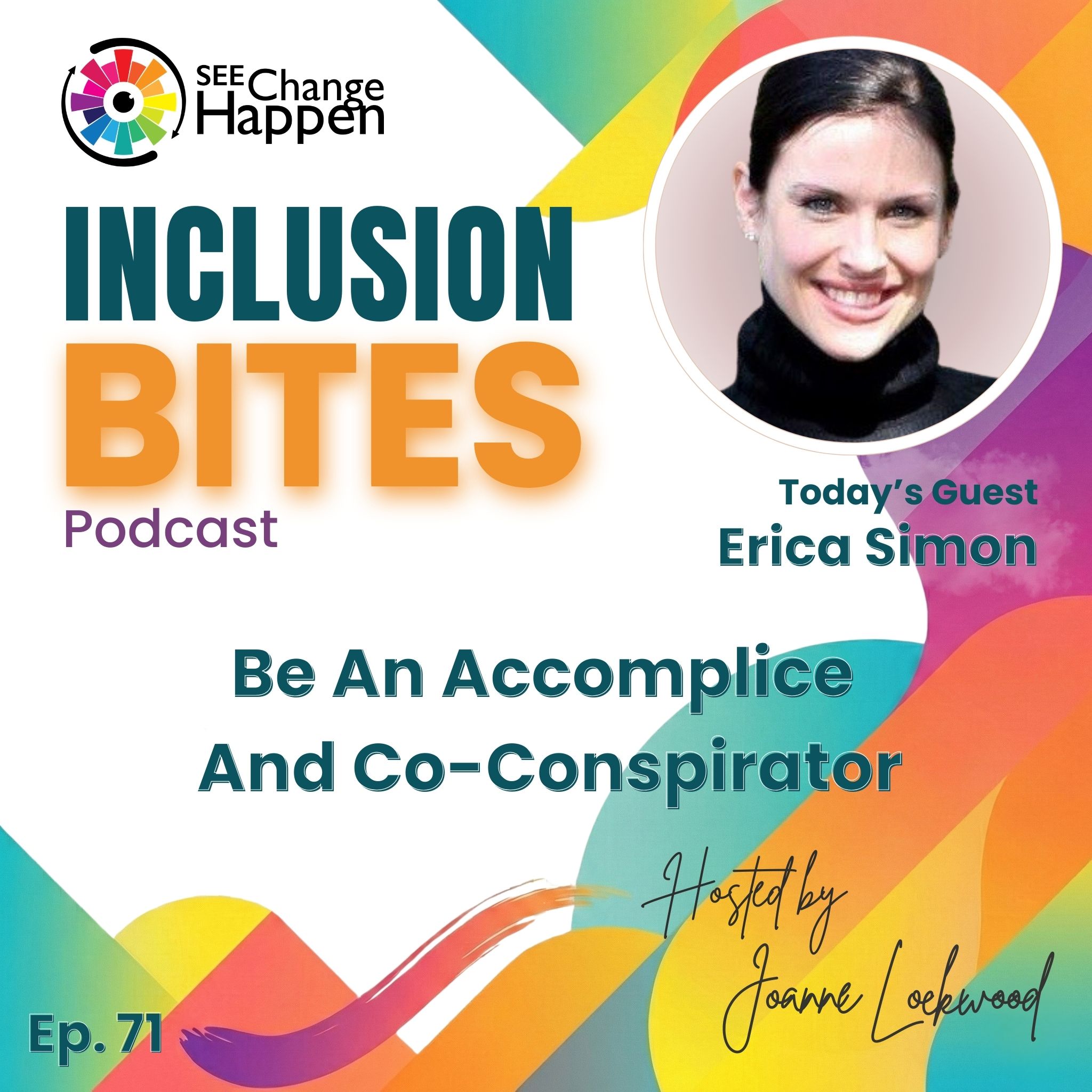
In this episode of Inclusion Bites, Joanne Lockwood speaks with Erica Simon about workplace culture systems.
Hello everyone my name is Joanne Lockwood and I'm your host for the inclusion bites podcast in this series I have interviewed a number of amazing people has simply had a conversation around the subject of inclusion belonging. And generally making the world a better place for everyone to thrive like to join me in the future then please do drop me a line to Jo Dot Lockwood at see change happen dot cod uk has swly change happen dot cod uk you can catch up with all of the previous shows. And Itunes Spotify and the usual places so plug any headphones grab adff and let's get going today is episode 71 with the title. Not an ally be an accomplice and co conspirator. And I have the absolute honor and privilege to welcome Erica Simon Erica describes herself as a clinical psychologist and consultant whoses work is strongly rooted in social justice when I asked erriica to describe her superba. She said she is very comfortable with uncertainty ambiguity. And discomfort and she truly cares and wants to get it right? Not just feel like I am right? Hello erica welcome to the show.
Erica Simonguest
Um, oh hello Joanne thank you so much for having me I'm so delighted to be here.
Joanne Lockwoodhost
Awesome! Fabulous! So Erica I know't know chetting just now. So what do? what do you mean by? not just being an ally but you want to be an accomplice and co consspirator.
Erica Simonguest
It's a really interesting conversation that's being had these days around allyship and what's really particularly important about this conversation around allyship is that. Allyship is what you do in your actions we can't just call ourselves an ally It's what are we actually doing so allyship is also kind of rooted in this. Um it has this this. Tone to it as if I'm here to help you I'm here to support you and 1 of the things that has really been an important part of my journey around social justice is understanding how much we have to have skin in the game. If we're going to truly seek out true justice for all equality for all if we're going to see a world where all of our identities are celebrated and welcomed then we all have to have some skin in the game. And so we don't get to just say hey I'm here and I support you we have to do that in every action that we take as best as we can and so I strongly subscribe to the quote Martin Luther King Jr of yeah.None of us are free until we are all free and it's not about me saying you need help. It's about me saying that I'm not free either. This world is not okay until we all have achieved. Recognition that we deserve for being a whole person and showing up for who we are and that that's really Important. So My actions have to align with that My actions have to demonstrate that we're in this together.
Joanne Lockwoodhost
So that's fantastic and I think we we probably all heard this mantra that being an ally is a verb is about doing isn't it and too often. We can forget that too often. We can just take a day off or not or not step up. And as you quite rightly say it's people who come from these marginalized underrepresented communities characteristics live and breathe the challenges day in day out and they do not have the privilege to be able to take that off. Ah, put it down for a day and then pick it up when it's suits so. It's so important as you say to be a co-conspirator because I think the other thing part of what you're saying there is. It's not just about supporting you or understanding your pain. It's about understanding what's causing your pain how you and I and we. Can step up and remove the root cause not just the sticky plaster or the savlon or the little and cream we put on its and it's it's tackling proactively. Our governments are lawmakers. The people in authority that create these. Social constructs his injustices in the first place.
Erica Simonguest
Absolutely there are systems and structures that are in place that maintain oppression that maintain inequality that maintain the the biases and the discrimination. This isn't the systems are working exactly how they were designed to work and it's that's just simply not okay and we have to go in and really as you're saying root out the causes and we have to examined our unearned privileges. That we have the the ways that we get to show up and sort of in a lot of ways kind of be invisible when we want to be um, depending on which you know privileges. You know we wear and. Exactly as you're saying we can take a day off if you want to be an ally and this is why the term is just such a Problem. We can just decide to take a day off or maybe we decide that in this moment we're not going to speak up and that is a that is a tremendous privilege that people do not understand that they have that. We can pick and choose when we say something or not say something it said my mother always said growing up character is who you are in the dark was a big mantra of our of our family characters who you are in the dark.And it's kind of in a way the opposite of what I'm saying now which is that you know sometimes character is well no character is doing the hard thing. It's saying the thing it's it's being living your values and the things that matter. Even when it's really really hard to do that and I think that is a big part of the conversation as well to be a co-conspirator and accomplice.
Joanne Lockwoodhost
I love that that phrase it's it's shouting at me saying you got to do the heavy lift if when no one's thanking you or looking at you or seeing you you do it because you do it not for recognition I think I think it's important and i. I always say when I talk about allyship and um and we're trying to move past allyship is that there is there is no medal in it and I also but I don't believe you call yourself an ally I think Ally is bestowed on you like ah I don't think you can call yourself an entrepreneur I think someone else calls you an entrepreneur they call you an ally. And if you feel worthy enough then you can step up to it. So I think yeah characters who you are in the dark when no one's watching and when you're not looking for recognition. It's your default base instinct and I think that is really really powerful and I mean what's the what's the political climate or the social climate. Where you are your're in California is that right? So yeah, so um, I mean I in the Uk in England we've we've moved past the ah the previous presidential administration but is that is that rhetoric still there isn now and we hope we've.
Erica Simonguest
I am.
Joanne Lockwoodhost
The impact for the Supreme Supreme court the roe versus Wade ah Trans rights this each state is now what many states are very right wing very kind of anti woke for whatever better way of putting it. Um. So What was it feel like if you were in a minority in the states of the moment.
Erica Simonguest
You know it's um, it's an interesting time to live and I'm using that word very specifically. It's an interesting time to be living in the Us because we sort of simultaneously have seen this explosion of a new civil rights movement.We've seen this tremendous change in how we even acknowledge individuals who are transgender we have completely changed how much. Racism has been exposed. It used to be I wrote a paper in um, actually in undergrad about how you know racism had become so insidious to where we could talk about being post-racial for example and it in a way that ends up being a bigger problem. Because then people can just not acknowledge the oppression. The different groups experience. What's interesting is we have this civil rights movement that's happening and at the same time we have this terrible rhetoric. That's so extreme. That has been emboldened to not only have hateful bigoted you know beliefs but to say them to speak them and to have them be emboldened from the most powerful position in the country. And some would say the world. That's a whole different conversation but to have those at the same time.. It's that and both of those things. There are True. It's interesting. The um I'm a clinical psychologist and ah, there's a treatment and.Intervention called dialectical behavioral therapy. It's very powerful and one of the concepts out of this particular. Um, this particular form of of therapy is how to help people live in an and. To see an and in the situation and one of the concepts is truth stands side by side. It can be 100% true that the us is in this brilliant civil rights. You know movement is happening at this exact moment and. We also have the most hateful rhetoric emboldened in every way and it's everywhere. it's amazing how it's everywhere um and I think both of those are true and and it's palpable. It's really palpable and and you you see it. So many hate crimes that occur while at the same time we're also starting in this beautiful way to acknowledge I mean I just see how far we've come around transgender rights and acknowledgement across my 17 years as ah as a clinician. And to see where we're at at this moment where people are sharing their pronouns that we actually don't even call them preferred pronouns anymore that they're just pronouns. Um I think that there's something at some point we kind of expose.In this very raw way. A lot of the pain that people have experienced in silence and we're trying to do something about it.
Joanne Lockwoodhost
For my own lived experience I see a ah ah polarity between what's going on in my life which for me I appreciate I'm privileged I don't. I Don't have any issues being me I married to children or adult children who've left home I've got ah a good sort of income I've got a a great network of friends, a global business I don't have any trouble being me and I know many people who are also transgender.Professionals in in business also have a very positive life and you look at what's going on in the world of business big corporates organizations the the trans support is positive. You know everyone wants to. Learn more find out have great policies respect their people. The staff networks the prides everybody everybody has a momentum around trans rights. But then you turn on the television. We see our politicians. You know we had a alleg competition in the summer and the 6 or seven contentors for that. Trying to prove who could be the most anti-trans as part of the debates. It was like we've got major global issues. We've got Ukraine and and Putin we've got ah fuel issues going on. We've got poverty. We've got um civil rights issues and you want to talk about. Denying trans people their rights and have competition so you could be the most transphobic I think suddenly I'm being debated about as a political football and this is quite crazy and it's it's kind of like if you heard the expression the dead cat when you have story when you have a store a news story. You talk about the dead cat not about the story. Everyone was trying to avoid the big issues and just talk about this dead cat of trans people and not saying were dead cats. But it's kind of like the distraction technique and now we have a bo our new prime ministerrishi sunak is unknown I suppose in some of these areas. But yeah, he's quite measured I believe.Still have some far right people in his party in government who are still openly talking about trying to wind back transgender protection and you think we're hang on a minute this is going against what the majority of the world at was so the Uk world maybe some of the other western world are talking about already. The countries are passing laws to make it easier to to obtain legal recognition for their gender and our government is trying to make it harder and harder and harder and they even talk about removing some vice you think hang on a minute this isn't what the mood of the country is this is is to be the extreme is with the loud voices. Which yeah and I think your your previous administration is placed to the fears and unites these different sorts of hate into 1 big hate I think that's what we end up doing.
Erica Simonguest
I do agree completely. It's there's so many disconnects between in a lot of ways between governments and people. Um, who are you know who are a. Within a country and their beliefs and their opinions and their thoughts and I think there's it's interesting because in the Us it's like there's this push pull that's constantly happening like what you're saying we're like overhear the government you know. People are saying hey we can. We just let's just all be and then you have this pull this direction with the government saying. Okay, yeah let's give some right? Yeah, but let's let's we're going to give rights. We're going to acknowledge. We're going to protect and then that gets pulled back and there's sort of this push me you know.
Joanne Lockwoodhost
And.
Erica Simonguest
Push and pull between you know, do we or don't we and I just trying to hold in my mind the experience of being a political point of discussion. Just for being who I am just how exquisitely painful just that fact must be.
Joanne Lockwoodhost
I yeah mean I I think when you you're trying to bring forward big changes in terms of the way society is constructed when we think about I look at some of the pushback on anti-racism and we've got. White people going hang on a minute we're being oppressed now because black people are getting all the help and it's like hang on a minute. No. No, you're not being oppressed and as ah, ah as a great sense of ah phrase I've heard is when you're used to privilege equality feels like oppression and I think that's what's going on. It's where. People are starting to fill this the equality or the the equity in society and they now having to look either side have to compete whereas before they could they were way ahead and there was no one around us. So. It's not like they're not being pulled back. But other people have been pushed forward to the start line and it's it's becoming a more level and I think but so we see that with. People are white when we talk about anti-racism I think we see that in certain terms where we're talking about trans or gay rights or ogb to q rights where straight people are going hang on a minute we need pride as well and or Cis people are saying hang on a minute these trans people are are taking over. We're talking about trans people who say why can't we talk about me and my troubles it's like. Again, bit like black lives matter all live matter. It's it's me too tight campaigns and I think what we're seeing here is is we must be making a difference because these conversations are happening. People must be starting to acknowledge their privilege or.
Joanne Lockwoodhost
Feeling their privileged being challenged because we are striving to make change and I think to me that says we're doing something but we've also got to have that pain of the pushback and that is the push me pull you where we end up taking a bit and then when we're stamped on hang on a bit. You've taken too much. Go back.
Erica Simonguest
Yes, it's so true and that is one of my I regularly use that quote that you that when you're used to having a whole lot of unarned privilege then equality feels like oppression is spot on because. We don't realize it's one. Ah I don't know his name is ah is it James Fisher Wallace I'm pretty close on his name. He had a commencement speech in I don't know it was like 2005 and he tells a story about there are these 2 fish young fish and they're swimming in the water and this older fish swims by and says hey yeah hey how how's the water and the 2 fish swim on and they look at each other and what's what's water and I think this is my. This is foundationally how I view privilege because we don't realize the water we're swimming in. We cannot see it until we see it and that's the thing. It's what you know whether it's. Gender or sexual identity or its you know race or its religious identity or cultural identity or a whole host of things right? age size. There's all sorts of disability or ability. There are so many different ways that our identities impact us.And when you don't hold a certain identity. It is impossible to see how that identity is impacted by the world by the environment until something helps you to see it. And I Really think that's where people are until you have I think everybody should have to spend a few days trying to navigate the world in a wheelchair I would hope part of me.
Joanne Lockwoodhost
Yeah I've got a so I've got I've got a great friend who has cerebral palsy and I've traveled around London with her. She has a power wheelchair getting on off a basking on the underground. Um. Navigating rooms that are too tight for a chair to fit through I spent a day with her and I came home thinking I have a privilege I can walk I don't think about my legs my legs my body my ability to move may to be is a privilege she doesn't have that she is problem solving. From the moment she wakes up to the moment she she falls asleep again because everything she does in her life is is complex compared with my life.
Erica Simonguest
exactly exactly and this is where it's not about allyship. It's about being an accomplisher or a co-conspirator I love ah, there's a ted talk names are escaping me today I don't know why. Ah, but there's a ted talk and it's really amazing. How the title is something like I'm not your ah it's basically like I'm not your um I'm not your point of like pity I can't remember exactly what the the title is but it's something like that. It's this amazing. Amazing ted talk and this woman was saying how people when it comes to disability. We sort of will pity people or we will sort of glorify right? and we'll see it as like oh I'm not your inspiration. Thank you very much That's what it was something like that. Because we do one of 2 things with disability. We either pity the person or we glory. We. We see them as their inspiration right? Oh if they can do it then we can do it right? and I think what you are speaking to so much is how. When we step inside the experience of someone and go oh my good and we don't see it it like the way you were describing your friend's experience was so beautiful because you're talking about it from this place of wow like my friend has complexities to navigate.From the time that she wakes up in the morning and this is where we can. We can see this as just seeing the facts of the situation. She struggles constantly she has to figure out how to navigate all these things. I Remember when um, there was another Ted talk and they were the person who was speaking said that the Ada accessible ramp was the loading dock.And when you stop to think about this someone in a a motorized wheelchair who has to navigate around the back of the building around a whole bunch of Semis and things being loaded and unloaded to try and get into a building we should. Be enraged by this. We shouldn't see this as okay. Well you know people with disabilities. They need some extra. They need some extra accommodation. Why in the world. Would we build stairs instead of a ramp. When you think about it you you build a ramp and everybody can can can access the building you build stairs and only some people can we see disability like we have to give that Okay, we're going to give you some some accessible something. Or we get really angry that the yeah the doors to the bathroom have to be a certain Width or we get really annoyed because you know a whole host of reasons we can get annoyed about it. Why in the world. Do We think the it is okay. For only some people to have access to a building that doesn't require a herculean effort I Do yourself again sometimes.
Joanne Lockwoodhost
Ah, yeah, and I I think what we also forget sometimes is that workplace adjustments or societal adjustments that benefit people who have a disability also benefit people who don't have a disability. Um, if I've got my luggage I Want to go. Massive suitcase I don't have to lug it up the stairs I can use that as well or if I'm if I ah am not feeling great one day or maybe I've twisted an ankle or something I can now access something as well. So We're not making solutions here for a minority. We're making solutions that everybody can use and benefit From. I Think that's the important thing to remember is that we we're not we often think about O for the people who are Disabled. It's not it's for it's to create accessibility in our society accessibility in our workplace that means that my friend. Doesn't have to ask for help to use the toilet and that that I was I was when I'm thinking about a an accessible workplace or accessible conference or anything I do I Always think could my friend go to the toilet without asking someone for help in this venue and I think about the route I Think. No, she's going to have to ask someone to help her open that door or she's going have to ask someone which is not too bad I mean just opening a door's not too bad, but there are certain certain places she goes where she really needs more help on that and I was with her once and a well-meaning able-boy designer designed an accessible.
Joanne Lockwoodhost
Ah, elevating platform to take you up above up the stairs and she pointed out to me the fact that the person who designed this must have made an assumption that the person who had a disability would have had a p a or someone with them to help them because. The button she needed to push to call the lift was higher than she could reach as a wheelcha but also because she has limited movement in her in her arms. She can't lift her arms really above her shoulders so she couldn't use the button to cool the lift and she yes the door would open when she got in there again. The buttons to move floors. Weren't accessible and they they required her to have someone with her because they were behind her so she goes in forwards in the but the behind so assuming someone's going to be with her So yes, were we're designing these systems to help people. But we're We're also making people feel as though they have a disability because they can't. Use the systems on their own without asking for help. So That's disabling somebody through lack of planning and and I and I always say I always use her as a ah yardstick for me just thinking about would this work for my friend and it's. I Think when we when we're designing systems in our workplacece when we're just even in projects wherever we do in our Work. We don't often have a voice in the room speaking up for people who aren't represented so I'm left handed.Bought products that clearly won't designed for left-handed people and they work' fine if you're right handed They don't weren't fine if you're left-handed so you think even something as simple as being left handed is often forgotten about.
Erica Simonguest
You are just so spot on I'm also left handed and my partner. It's hilarious because he really so many times I'll be like really frustrated with something and he really cannot understand why this particular Canopener. Just won't work for Me. He's like it's just a can opener. Well it's just a can opener to you but it was made for someone who's right handed and so when I flip it over the mechanism doesn't work the same way and it's something so silly like a can opener but everything is made for right? handed people. Except for a few little special things and then even those left handed things. Sometimes they're hard to use because we're so used to trying to navigate a right handed world and then all of a sudden. The the scissors are are flipped over and I'm like I don't actually know how to use these scissors and I think this is so exactly it and I Love what you're saying Because. You're talking about being an accomplice when you go to a conference or the workplace you're thinking about how do I make sure that this would be accessible to my friend where she wouldn't have to ask for help and that's the thing that's seeing her humanity. It's not about sort of I think in a lot of ways we we kind of infantilize individuals who have disabilities as if they need our you know how are we? they just need some help right? So Why can't they just ask for someone to open the door for them.And in the end you know, being able to be autonomous and move through the workplace without having to constantly navigate difficult or awkward situations. We need to put the person like you said whose voice is not at the table. Whose voice. It's not just about having diversity like the whole d I thing that is exploding right now in a lot of beautiful ways. But it's also gets very tokenized. You have now I have the one person who's black I have the one person who's transgender I have the 1 person with disability. But if we don't have those voices at the table if we don't amplify those voices and center them and say what are we? What are we missing here? What are we not seeing where is the water that I am existing in please and we can't ask for that emotional. Labor either It's sort of this interesting thing that's happening right now too where it's you can't just ask you can't just tokenize someone you have to understand how do you actually how do I do my own work to understand the water that I'm swimming in that I don't see. And then how do I really listen and then in the workplace. Especially how do I make sure that everybody is represented. Everybody's voice is heard and amplified and then.What's actually happening in the workplace is representative of everybody's needs and preferences. It's It's super important. We can't just we can't just take a couple of those steps.
Joanne Lockwoodhost
And. Yeah I I talk a lot about cq cultural intelligence and for me I know at the high level you think about culture being thing about ethnicity and faith and all these big big culture type things I always boil culture down to. All micro communities of disability of deafness or blindness of of transiness or wherever it is not just the big experiences and often we we start focus on these big big labels without looking down at the nuances in different communities. So someone who is is born deaf. Has a different challenge than someone who's acquired their hearing impairment or their deafness throughout their life. Someone who is born blind and never seen has a different experience as someone who has become blind later in life. So if you're not careful. We make these big big assumptions or they're blind. They can't see that oh sorry I talked about color. You. You don't know what color is do you But yes I do I could see for 30 years of my life I know the grass is green I remember what green looks like so again by by but not drilling down into the communities of culture where you can sometimes make these assumptions false assumptions. So.
Joanne Lockwoodhost
I always find that when I when I learned something about someone or a characteristic or about whatever that may be a lived experience. The first element for me of of Cq is is about drive that I want to find out more so if I learn answer says to me. Space doesn't work for me I'm neurodiverse space is too loud too. Noisy. It's is too random for me I can't I can't can't process all this going on in it I go okay I need to find out more about this I need to understand why I need to and yeah so when I'm in a space in future I can go this isn't going to work for neurodiverse people or neurodiverse people that I've spoken to in the past. But struggle with this environment because so I'm not going to and I'm trying to become an expert in someone's lived experience. But I I know more than that I didn't know before so it's allowing me to have the next conversation to say I think we should do some thinking about this. And get an expert in to talk about this that that's how I would have frozen.
Erica Simonguest
I Love that too because we can't be an expert in everybody's lived experiences and there are a lot of textured nuances to different global. You know, different lived experiences within more global kind of catch. You know, catch sort of um. How we describe identities. Ah, even so I were I think well I'll I'll mention that in a minute. Um, it's so interesting because with the neurodiversity conversation that you're bringing up and I I don't want to have that part pass by because Neurodiversity is.
Joanne Lockwoodhost
Yeah.
Erica Simonguest
Ah, real thing that we're starting to really unpack and understand and celebrate There's ah this idea of why why? Why are we trying to extinguish differences. There are so many beautiful ways that our brains work and instead of seeing this is how we're trying to flatten. That experience and try and find something normal or or typical and with neurodiversity It's so true somebody actually called me out on this. Um and I was very grateful for the for the the lesson. Ah I do a lot of um. Do a lot of presentations I do a lot of support sessions I do a lot of talks and in one of them I was doing for a for a group we were talking about. Um, how to have difficult conversations and 1 of the things that when one of the point being made was around active listening. Having open body language having direct eye contact. You know, reflecting back all these different things you know being really so kind of sitting and being present and afterwards somebody said that's a very neurotypical way of talking about conversation and I was just so grateful. Because I hadn't thought of that really before I work with a lot of individuals who are on the spectrum and it hadn't even really fully occurred to me that for someone and I know this to be the case for someone who might be on the spectrum direct eye contact.Can be uncomfortable or actually you know traumatizing and if you're trying to force something that doesn't work for someone and I was forever grateful for this because I learned something very powerful in that moment of the water that I was swimming in you know and. I Think that's what we need to try and learn and figure out. How do we find these ways where we can have these opportunities to learn about these more subtle aspects of other people's lived experiences that might not be our own.
Joanne Lockwoodhost
And my my my wife gets quite frustrated with me sometimes because she will say something about a person. Maybe they were not very attentive to her no doing me I could maybe a bit dismissive or something about them. She goes oh that person I said well okay, ah that. I take take on Paul what you're saying there. But that's a bit of a judgment you't anything about their lift spirits. You know what wass going on their heads. You know they may not be a great communicator for various reasons. So the fact they haven't communic communicated with you in a way that you're comfortable with doesn't mean say they're a bad person or being ignorant or being nasty to you it just means that that is their style. So what we have the opportunity here is to is to meet people in the middle adapt your style halfway to their styles if you can encourage them to to speak it ah in a kind of centrist centrist way and I'm also guilty when I talk about eq emotional intelligence I to recognize that. Neurotypical people tend to use emotions but maybe neuroerdiverse people don't use emotions in the same way. So expect someone to pick up the emotional cues the body language cues is is is something that is is is a kind of Neuro ah was ah was the equivalent of heteronormative here neuronormative. Um. Ah, behavior that we're trying to judge people by what we expect I think it's really really important as you're saying just to just to remember that when you're when you're making these judgments or making these big decisions about people. We got us try and think about their lived experience first.
Erica Simonguest
Absolutely absolutely and you know again going back to the the workplace having a ah workplace. That's really welcoming of our identities. The workplace is is fraught with and uncountable. Numbers of number of of ways that it says you don't belong if you're you know Adhd or you're on the spectrum or there's maybe you just have an incredible amount of of social anxiety. And you're still asked to stand up and and give some sort of talk even something is is that kind of anxiety that we can feel around who we're speaking with and what we're talking about it's we just. What would happen if we just stopped for a moment in our interactions in our daily lives and went what don't I understand or know about this situation or this conversation or this person and we truly approached. Everything from a place of curiosity genuine curiosity and compassion. How different would this world. Be.
Joanne Lockwoodhost
Yeah, yeah, it's I mean we're obviously kindred spirits and like minded in this and it's for for us to have this conversation. Maybe that's a privilege as well for for us being able to have this conversation where it means we're far enough back from that coal face of injustice. We can start to to saana analyzeze or become self-aware but often the the case is where where people are living it in that moment in that toxic environment and whether you're a fan of Maslow's hierarchy or not, you're living right at that. That that those bottom 2 layers for your safety and psychological safety is really really important to you then you don't often have the chance to to step back and think you're you're just living in the moment you have no, you have no, you have no next week. It's all to die isn't it.
Erica Simonguest
It's very true I Think what you're speaking to is is how much trauma exists in the workplace and we don't often think about it or talk about it as Trauma. There's trauma with the big T and trauma with a little t. And trauma with a big T is is something where you've experienced some sort of you know something that where you're in physical integrity or your life has felt at stake your safety etc. And then little T is you know things where they're more than just a typical stressor. You know something like a you know and kind of a nasty divorce for example in the workplace we have both a lot of people's identities are are. Constantly being threatened in the workplace and again it's that water we we don't realize we're swimming in if we don't have those lived experiences. There are so many ways the workplace says this you do not belong here. And if you're just trying to navigate that and understand what's safe or unsafe and it's really just unsafe that is that is trauma with a big T. We're physical your your integrity your your life your your who you are.Is being threatened in the workplace and you know the whole approach around Dei is not just about saying. Let's have some representation. It's about how do we have a workplace where people truly feel safe to show up as who they are as a whole person and not carve away. Different parts of their identity in order to to fit in.
Joanne Lockwoodhost
So I was surprised recently I I I had a ah couple of people to come on into my business to help do some social media and some marketing and some videos and Graphics. So Really clever intelligent people and. I Truly believe or believed that I set up set the tones and open culture. This is most ah most wholeheartedly not a top-down company. This is a we're all sitting on the floor. We're all Cross-legged. We're all talking about what we need to talk About. We're There's no right or wrong answers. There's no psychological safety is high. Want to say think to me, you've got as much right to tell me that my ideas sucks as I tell you your ideas sucks and I had a chat was having a chat and I so said cool tap tell me and I can't I can't tell you I can't tell I I'm too and I'm too nervous to to tell you what I'm thinking. So So there I was with my arms open saying. Come on surely surely. You can say anything Now, you've told me you can't tell me now I Want to know more and and they'll just say that sometimes with my exuberance I'm I'm kind of creating a little bit too much pressure or too excitement about something and I feel they're always having to try and keep me happy and feed but feed by Ah. Ah, my my ideas I said Wow No that Seriously thank you now. I I had no idea that's how you you you perceived me as someone who was created load of pressure. You didn't want to let me Down. There's a fear of failureing all this kind of stuff and I said Wow. Thanks And thank you is. It's kind of that's really well. I.
Joanne Lockwoodhost
Upset me a bit because I thought I was creating this culture where you could say anything but be it was the self-awareness going way actually as as hard as I thought I was trying I still missed not not in a bad way but in a not a not a perfect way and I think. 1 1 thing you talk about with with the fish is swimming in their water and they don't see the water is that maybe people who hold the privilege and and I'm not 1 to demonize straight white men because we need straight white men to change the world because they are they have the biggest swords and shields in the world so that we need them to do the change. Um, but many many people believe they're a great person and they think they're doing fantastic work that they don't realize that power dynamic and that culture they've created no matter how much they didn't want it does exist so that recent lesson that I learned was you have to not only. Believe you're creating a culture but you have to be active and proactive about it and reach out and make sure the culture you hope you're breeding is in fact, reality not just in your head people around you believe it as well.
Erica Simonguest
I Really love that because I think it also speaks to um, this whole idea of wanting to get it right? not to just feel like we're right I when I that is so foundational to this work.We have to because it is we we need to seek out. We we sort of you know I'm I'm trained as a scientist and I appreciate my mentors in graduate school because they really taught me true science. Yeah, how to be a true scientist whereas you you try and. Figure out how you can prove yourself wrong if you're actually wrong. How do you figure out that that's what true science is you create a study where you're saying. Okay, there here's my hypothesis I'm going to do everything in my power to prove it wrong and then if it's if I have you know some sort of. You know a significant finding I'm going to be able to lean into that more but I'm still going to try to figure out how I got it wrong because that is what we do. We have to constantly refine and think about everything in a different way. How can we. I don't remember who this quote was by but they said um in order to improve at least 1 of our basic core assumptions has to change. We have to be constantly thinking about where am I stuck what am I not seeing. How can I get this information so that I can see more clearly.
Joanne Lockwoodhost
And the the other thing about science community or communities or scientists is that they are willing you to disprove it as well and when you do find a new solution or a new a new formula or or a new mantra. You're celebrated by the people whose previous mantra has been superseded because it's in striving to find a betterment is by examining and not not believing that everything you have is fact and I think I guess we we could learn that society. And yeah, we we know about confirmation bias. We love being right? Don't we we we we're scared of being wrong because it makes us feel weak and there's ah, there's a great saying. Ah I do you've come across it. It's ah, there's a forecaster called Paul Sappho and he coined strong opinions weekly held. So it's all about knowing what you but you got your beliefs Youve got everything but you're not a prisoner to them. You're challenging yourself, you're looking to prove yourself wrong all the time and and I always say it's not about going down conspiracy theories. You know I'm I'm proudly vaccinated as much if you there's a vaccine give it to me both arms both legs if you have to I'm going to go straight in there. Some people are. And I but I want to find out why they believe that and not because I want to agree with it. But I want to understand why their perspective is so Novak joovicch when he was deported from Australia for not being vaccinated I completely disagree with the outcome. He's come up with yeah his decision.
Joanne Lockwoodhost
But actually when I listened to his interview and he said I want his agency over my own body I I can't disagree with that I can't disagree with his logic because it's his body you should I I want the right to do what I want to do with my body. Okay, the impact is maybe on other people. But for that for that Moment. He has the right to decide what he does with his body and I thought yeah okay I go with that.
Erica Simonguest
I Think what you're speaking to here as well is that a lot of these conversations are really tricky and what we tend to do as humans is we make things oversimplified and very either or and yeah, it's all this or all that.
Joanne Lockwoodhost
And.
Erica Simonguest
And most people are not comfortable waiting into the discomfort of ambiguity and uncertainty and that's why I call this my superpower because I am supremely comfortable waiting into conversations where it's like ooh I have no idea what the answer is how do I get more information. This conversation is really tough because bodily autonomy again that true stand side by side bodily autonomy is really important. We're having conversations in the us about you know with Roe V Wade being overturned and women. We don't forced. Pregnancies are a real thing here. So. Bodily autonomy is absolutely important and public health and community and caring about each other and that my choices for my body in this instance with vaccines impact other people and their safety. Right? You can't yell fire in a in a crowded theater. You have to wear. You know you? there's all sorts of things you have to stop at stop signs if there's a pedestrian crossing there are things we have to do you know when it comes to masks well are you? You are you a person wearing a shirt. You know? Well then you don't have full bodily autonomy you know to make your choices on what you wear or don't wear and I think these are those conversations where everybody's either this or that and we don't have a lot of people who are willing to say this is really hard to figure out. Let's put our heads together.
Joanne Lockwoodhost
Um.
Erica Simonguest
And see if we can come up with something that solves for this dilemma.
Joanne Lockwoodhost
That's exactly what I found about Jokovic I said you got the right not to be vaccinated but the consequence is you can't play in the tennis match. You can't stay in Australia and the chances are you won't be allowed to play in many other matches around the world. And people may cancel this friendship because that's your decision. So the consequence of you having bodily autonomy which you're entitled to are that you cannot. You cannot. You can no longer participate freely in society in the way you once did yeah having autonomy doesn't mean say you can kill somebody or be nasty somebody or hurt somebody. Society says no. But even you can have autonomy but there are consequences. So it's it's making sure that those consequences are explicit and well known so you can't be caught out by them. But you have responsibility as a human as a citizen as ah as a participant in our culture I know what's expected of me. It's it's in the same debate I have around trans rights and I understand my responsibility as a woman in female spaces I I and I know I shouldn't have to but I blend I I make myself as minimalistic as possible in those spaces I don't want to be a threat or be seen to be a threat to anybody. I take my responsibility to be allowed unfettered access to places by the way I behave if I went in there and behaved in a in a way that made me stand out and a threat then I I would expect not to be welcomed and I would expect people to look at me and and with a different look.Today people look at me and smile. So I I accept my responsibility and my choices in order to access society in the way I want to access it.
Erica Simonguest
What would happen if we all just took this this this conscientious lens for how we show up for each other because that's what you're describing. You're describing having this intentional conscientious way of showing up in spaces where you're you're thinking about. Your impact on other people and it's important for this if we we could all find this this way to navigate the world I do have a caveat in that I understand how. When you hold an identity that is so marginalized and oppressed and mistreated in in so many different ways there I understand the anger that comes with. All of that and I always try and keep that in mind as well because in a way like to as you were describing how you show up in in in spaces with other women I would not expect you to have to hold yourself to that. Level of of selfreflection in the moment I would hope that we could get to a world where you can just show up with you. You don't have to think about those things and if you're angry.
Joanne Lockwoodhost
I agree I agree I Completely agree. Yeah, the cognitive the cognitive load to maintain that concentration and that as you say this this intentionality of our but. My behavior is I'm not relaxed. Yeah I'm not bringing my whole self to all spaces. But I do bring most to myself to most places. It's just there are certain places where there's a pinch point where I I know that hang on this is ah is a good place to to do this everywhere else I'll do that. I Mean a classic example is I've chosen not to to change my voice have voice coaching or or even or even actively manage my voice so when I in those spaces I will not have a conversation. So if I'm with my wife in the toilets or the changing rooms and and she starts talking to me I'll just look at go I'm not talking. Ah, just give that look I'm not going to say a word in here. Um, if I cough I'm very conscious about my cough because it's quite a deep sort of cavity cough or sneeze or all those kind of involuntary sounds you make in your body are very conscious because what if if the doors are shut. People can't see you they hear you and they make assumptions So by being Minimalistic is not I I don't I feel unsafe but I'm more worried about other people feeling unsafe more than me. So I don't want to be a threat to anybody. So if I create.
Joanne Lockwoodhost
Ah, Persona around me the way people perceive I'm different then they may feel less safe and so but my empathy is out there and compassions out there that I don't want to cause that to anybody else. So not I'm not pure to think about my safety I'm just thinking about the the respect for the space.
Erica Simonguest
And I think that's beautiful I I make brings my heart incredible amount of joy to know that you do have that sense of safety because that is what we need to have and if we can get to a place. Where you don't have to be thinking about how you just showing up as you are feeling unsafe to someone else if we can get to this place I mean even when it comes to transgender rights and even across my work with the Transgender Community. I've been amazed at my own journey at Understanding. It's not even just yeah I used to have a little bit more simplistic view. It's like oh I just I'm in the wrong body or you know my gender doesn't match my body parts and what I've learned over time is that there's so many incredible ways that. You can be transgender and be totally comfortable with who you are whether whether it's you change your voice or you don't change your voice you change facial Hair. You don't change facial hair there any kind of gender confirming surgery.. There's so many different ways that you can show up as. A woman who's transgender or a man who's transgender or a non-binary person who's transgender.. There are so many ways you can show up as just who you are and my hope is that we get to a place where you don't have to think about will somebody else feel unsafe.Because they might hear a deeper tone of voice in the stall because that's just something that's normalized and celebrate. That's just yeah, there are women who have deeper voices and that's okay.
Joanne Lockwoodhost
I.So yeah, but it's it's not.. It's not just the the queer ltbt key class the Trans Community. It's people who are black experiences all the time if they're on their own in ah in a white area or a white space they that they're worried that they may be seen be seen as a threat. As a black person in a white space and so it's any marginalized community that's been demonized and misrepresented it has this covering and masking that they need to do in order to ah to navigate their spaces.
Erica Simonguest
It's so sad to me as a white woman I am so keenly aware of how I am perceived and it's interesting because um I remember at the beginning when the whole do you remember the safety pin. Ah back. I don't know if this was and a thing that happened in the U K but in the us um, at be when the the election five years ago happened and there were a lot of unsafe spaces ah being actively cultivated. We had this thing. It was a safety pin movement and if you were a safety pin. You were safe for you know I'll go to the bathroom with you if you're wearing his job. You know I'll sit next to you on the bus etc and it was really interesting because all of a sudden I realized I don't get to have that I don't get to say I'm safe I don't get to tell you I'm safe and in fact it is my responsibility to hold the the systemic injustices that exist racism and you know transphobia and islamophobia and all of that I don't get. I have to hold that as part of my responsibility for again for that being an accomplice or a co-conspirator which I again won't call myself that but that is what I aim to be I have to hold that as a white woman in any space. The perceptions of me.I Might not personally deserve those because I do think that I show up for social justice but I have to hold that because the system and structures are in place that maintain that lack of safety for people who are black or Muslim. Or Trans I Benefit unfairly from this system. This system is built in a lot of ways and especially there's a whole conversation around specifically being a white woman. The system works for me in a way that I don't get to put down. I Don't get to say Okay I'm just going to take a day off from that so it is my responsibility to hold this until I am a part of demolishing these systems and structures that are in place that maintain the suppression that is my responsibility and I don't get to be deemed as safe. Until that is true.
Joanne Lockwoodhost
I Erica thank you? Thank you so much. We've been chatting away for an hour and I think that's a really good place to leave it with those thoughts. You've just given us there. So how can people get hold of you. It's been an amazing conversation I'm sure there'll be other people who want to ah have a chat. So.
Erica Simonguest
Well I'm on Linkedin you can Erica Simon and I think it's even Linkedin my the the handle is eka simon ph d.
Joanne Lockwoodhost
What's the best way to get hold of you. Okay.
Erica Simonguest
And then ah you can also reach me through Erica E I C a at Series B Dot co that's SERIESBEDot co that's my that's my work is around. How do we really address toxic work environments. And so you can reach me there and I welcome any future conversations This has been amazing and I really appreciate and thank you and it's been such an honor to be in this space with you.
Joanne Lockwoodhost
Likewise thank you? Um I'll put all of those links in the show notes. So if you ah, you're listening just check the show notes they'll be there so find its up but a huge thanks to you? The listeners for tuning in for getting to the end I really appreciate this? Um, please. Some comments tell us what you think of this episode and others do subscribe to keep updated on future episodes of the inclusion Bites podcast that beat it t yes, tell your friends tell your colleagues please share the link share the love I have a number of other exciting guests lined up I'm sure you'd be equally if not. I don't know. Could you be more inspired I'm sure equally inspired maybe but over the next few weeks and months and also if you'd like to be a guest yourself. Maybe you've got a story got a message that you'd like to share um or you've got some feedback or suggestions. Please do let me know to Jo Dot Lockwood as's teach chap dotcouk and the last thing i' say is my name is Joanne Lockwood
Erica Simonguest
Right.
Joanne Lockwoodhost
It's been an absolute pleasure. Dose is podcast for you today. Catch you next time bye.
Joanne Lockwood is joined by clinical psychologist and social justice consultant Erica Simon to explore why “ally” is not an identity you can claim, but a set of actions you consistently take. Together they unpack what it means to be an accomplice or co-conspirator: having “skin in the game,” speaking up when it’s uncomfortable, and aligning values with behaviour rather than seeking recognition.
The conversation examines why equality efforts often trigger backlash, including the idea that when people are used to unearned privilege, equality can feel like oppression. Joanne and Erica connect this to wider social and political dynamics, and to the need to address root causes in systems and structures rather than offering superficial fixes.
They also discuss accessibility and inclusive design in workplaces and public spaces, using lived examples of navigating environments with mobility needs and the ways poor design can create dependency. The episode broadens inclusion beyond headline categories, highlighting micro-communities and the importance of cultural intelligence, curiosity, and listening. Neurodiversity is explored through communication norms and how “typical” expectations (like eye contact) can unintentionally exclude.
Across themes of identity, power, and belonging, the episode invites listeners to take responsibility for the environments they shape, seek feedback on whether psychological safety is real, and contribute to building workplaces where people can show up as whole selves.
Read
What this episode covers
One thing to remember
Instead of trying to extinguish differences, we should appreciate the beautiful ways that our brains work.
Questions this episode helps answer
How do you think the pushback on anti-racism efforts and LGBTQ rights shows progress towards equality?
Do you agree with the speaker's statement that workplace adjustments for people with disabilities benefit everyone?
Have you ever encountered a poorly designed system that made you feel disabled or excluded?
Do you think there is a voice missing in conversations about inclusivity and representation?
How do you think individuals like the speaker, who benefit unfairly from existing systems, can take responsibility for dismantling them?
What are some micro-communities within culture that you are aware of?
Explore topics
Ideas from this episode
Workplace Culture Systems
Allyship
Change & Transformation
Belonging
Psychological Safety
Authenticity
Learn
Frequently asked questions
What is the difference between being an ally and being an accomplice or coconspirator?
Being an ally means supporting marginalized groups, but being an accomplice or coconspirator goes further by actively participating in dismantling systemic oppression and challenging privilege.
Why do some white people feel oppressed by anti-racism efforts?
This mindset often stems from a lack of understanding of privilege. When individuals are used to being privileged, equality can feel like oppression to them.
Why is inclusivity important for people with disabilities?
Inclusivity benefits not only those with disabilities but everyone. A well-designed accessible environment enables everyone, regardless of ability, to navigate and use it independently without needing assistance.
What is cultural intelligence (CQ)?
Cultural Intelligence refers to having a drive to learn and understand more about others' lives and characteristics, allowing for better understanding and consideration of their needs in different environments.
How can I create an inclusive work culture?
Creating an inclusive work culture requires actively listening to and amplifying diverse voices. It involves considering and accommodating the needs and preferences of all individuals within the workplace.
What challenges do left-handed individuals face?
Left-handed individuals often encounter difficulties in using everyday objects designed primarily for right-handed people. These challenges range from using scissors and can openers to navigating a predominantly right-handed world.
Share this episode
Heard something worth passing on? Send this conversation to someone who needs to hear it.