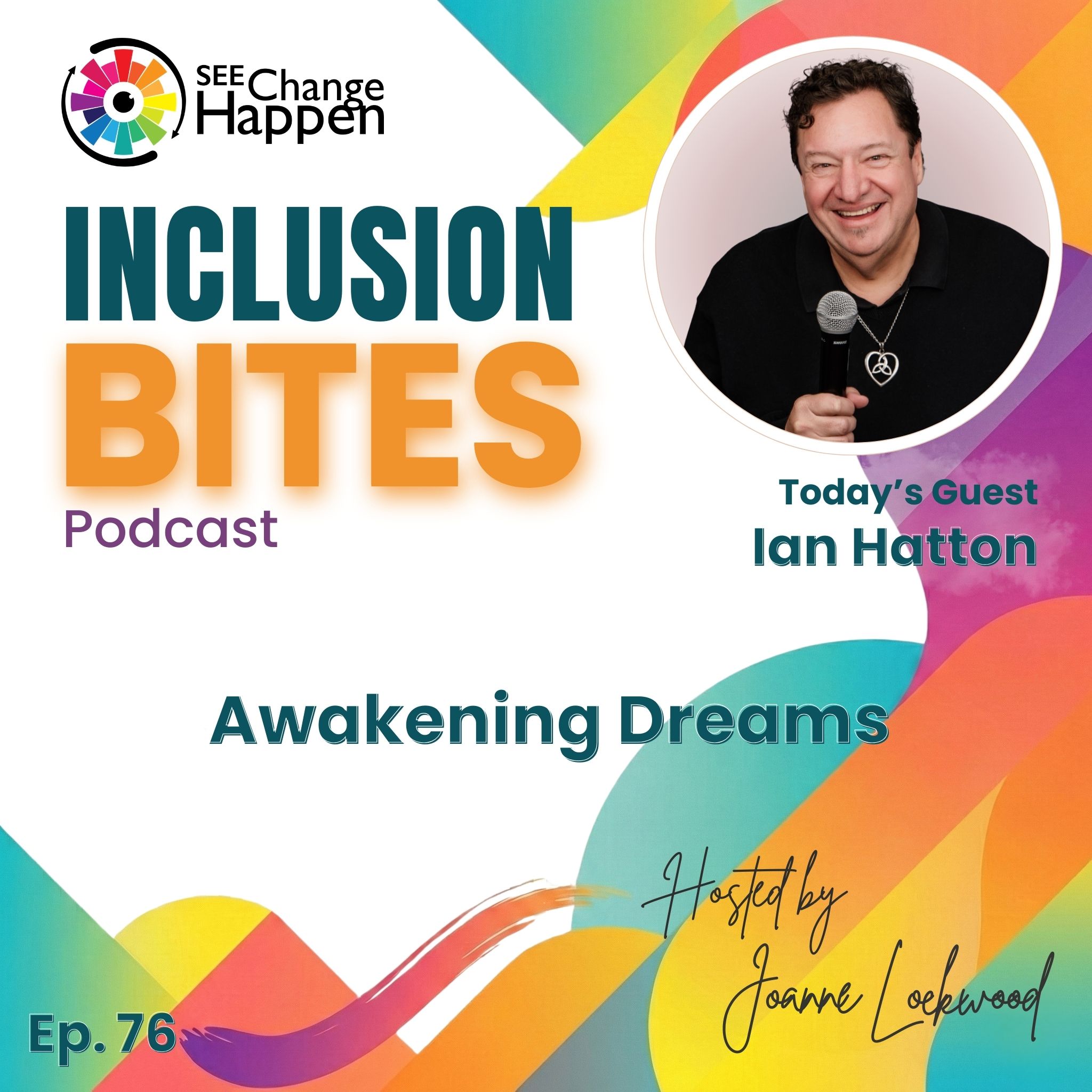
Awakening Dreams explores the power of conscious leadership, bridging cultural gaps, and embracing diversity to create inclusive environments that enable individuals to awaken their true potential.
In this episode of Inclusion Bites, Joanne Lockwood speaks with Ian Hatton about inclusive leadership management.
You. Hello,everyone. My name is Joanne Lockwood and I'm your host for theInclusion Bites podcast. In this series, I have interviewed a numberof amazing people as simply had a conversation around the subject ofinclusion, belonging and generally making the world a. Betterplace for everyone to thrive. So, to join me in the future. Then, pleasedo drop me a line. ToJo.Lockwood@seechangehappen.co.ukthat's SEE Change Happen do codot uk. You can catch up with all of. The previous shows onitunes, Spotify and the usual places. Soplug in your headphones, grab a decaf and let's getgoing. Today is Episode76 with the title AwakeningDreams. And I have the absolute honour and. Privilege towelcome my guest today, Ian Hatton.Ian describes himself as someone who builds consciousleaders. And when I asked Ian to describe. His superpower, hesaid radical self acceptance of his flawsthat enables him to. Radically accept others,no matter what. Hello, Ian, welcome to theshow. Hi, Joe. It's so good to be here. I've been
Ian Hattonguest
looking forward to this since. We met in October. Yes, we did. In
Joanne Lockwoodhost
Dublin, wasn't it? At a global Dublin? Indeed, yes, itwas. Brilliant day. Ian, tell me,Awakening Dreams, what's that about?
Ian Hattonguest
So, Jo, it's a bit of a long story, but it goes back morethan 20 years, where some friends and I got together andwe said, who are we? Sort of mythically and mystically, justas a way of discovering more of our own uniqueness. Andvarious of my friends came up with all sorts of ideas and Icame back and said, I'm blank, I'm stumped, I'm coming up withnothing. And one of my friends looked up and she said, but yetit's obvious you're morpheus. And I said, what do youmean, I'm morpheus? I wish I was morpheus. And everybody elseturned and said, you are. You aremorpheus. And the one who awakensdreams. The Greek god of dreams, the one whobelieves. And everybody else has stopped believing. Not the hero, but the onewho raises up the hero. And I came toidentify with myself as Morpheus. AndI am one who awakens dreams in others,leadership dreams, dreams to influence and leave the world a better place.
Joanne Lockwoodhost
I love that. I love that. Just picked up you said that. Thecreator of heroes, the unsung,the teddy's coach of the greats, if you like, the the leadershipcoat, the coach of the greats. It's toooften we find that the. If you like,the guru wants the limelight. But what you're saying thereis you are the supporter, you are the promoter, you are the person thatgets the person to their dreams. It's not about and yourdream is. To get them to their dream, if you like. Exactly. That is
Ian Hattonguest
exactly what it's about. And nothing gives me a greater thrill. And I don't mindthe limelight, I don't mind being on stage, giving keynote speeches and allthe rest of it, but my real success is 20 yearslater, what are they saying? And I've gottwo examples of young people in South Africa well, they were young20 years ago, who I met and spent a lot of time withand who now how running either in seniorleadership positions or their own businesses verysuccessfully. And that, to me, is thereal glory I want is whatthey do. Not what I do.
Joanne Lockwoodhost
I'd love to see that replicated in otherleadership development because yes, Iappreciate you want the line, right? You want the glory, you want more business coming.Obviously we all do, but I think as speakers, we often recogniseit's not about us, is it? It's about the audience. It's about the people whoare inspiring and it really helps to ground us in that.
Ian Hattonguest
Joanne, one of the most humbling lessons I've ever learnedwas somebody once said to me a quite a good orator said to me,Eloquence is in the audience. And I was like, no, no, I'mthe eloquent, it's in me. And eventually I became torealise that the audience drew it outfrom me and that the audience was what was themissing ingredient between me being eloquent or not.It's all about the audience. It's not about me at all.
Joanne Lockwoodhost
When we were talking before we went live, you were talking about consciousleadership. So what's that?Consciousness? I presume there must be an unconscious leadershipor a lack of consciousness leadership. So what do you mean byconscious leadership? Well, it's a very all
Ian Hattonguest
encompassing term and when I left the computer industry just over20 years ago to follow this new career, my second career,I was very excited about a concept I'd learnt aboutcalled authentic leadership, where people bring their truest selves andthey lead from that. But that's evolved and the termconscious leadership has only emerged since about 2016. So it's afairly new idea, but it builds on this idea of authenticleadership. So conscious leaders are conscious of themselvesand that means everything personality,strengths, weaknesses, intuitions. It'snot just head, it's heart as well. Body, even. We'renot just brains on sticks. There's a whole lot of stuff about being awareof the fullness of who we are, butsimultaneously the same for their people. Theirconsciousness of self becomes a consciousness of other. And lookingat the diversity there and the different strengths andweaknesses and preferences andwirings and all of these things, and again, it's mental, it'sphysical, it's heart, it's intuition, it's all these things.And then perhaps even beyond being aware of our planet andconsciousness of the ecologicalthings that are happening and that sort of thing. So itincludes this full variety and a consciousleader is somebody who leads with conscious in all of thoseareas. Yeah. Picking up
Joanne Lockwoodhost
what you say. I was talking about this the other night with somebody. Andit's down to some of it, it's down to your personal brand. We talk aboutmarketing term and it's who youare, what you stand for and what people can expectfrom you. And that's our brand, isn't it? Wherever you want to boil that down.And I was talking to him the other day about we have to now factorin to our brand, our planetaryconsiderations, our environmental, our sustainability,our impact on the planet has to be part of our personal brand as wellbecause we know that our brand either turns people on or turns peopleoff. So if we're gasguzzling, polluting brand, we know that's going to havean impact on our clients, our audience, whoever that may be. That
Ian Hattonguest
is totally true. And again, one example is that I'vegot twelve leaders on a one year journey with me.And one of them I met with Lost earlier thisweek and I was asking him, so what do you wantto shift at the next year? What lies ahead for you?What is the next step in you and your leadership? Andit took a little while and eventually said, you know what, this is the yearthat he wants to establish his personal brand. And it'sexactly this. It's all encompassing. It's drawing on hisstrengths, being aware and releasing his,his weaknesses, you know, teeming for weakness and beingconscious of that. And the same with his people and hisimpact on the planet. He's very, very interested in theAfrican context, in agriculture andhow agriculture impacts things. And it's all of that he wantsto include in his personal brand story.
Joanne Lockwoodhost
Yeah, Gen Z,the emerging generations that are our future leaders. You'reprobably even seeing some early Gen Zed leaders already.That is really, really important. And certainly when we look at GenZed's follower, the Gen Beetle, Gen Alpha, we willsee more of this consciousness. Around, well,consciousness about identity, conscious about. Who they are, consciousness about theirenvironment and how they want to be treated and respect is completely differentto I'm a Gen Xer millennials or Boomers.We have a different view of the world, don't we? And it's going to bereally important. And you know what else
Ian Hattonguest
linked with that? You said, well, if they're conscious leaders, are there alsounconscious leaders? And the people who are going to strugglethe most with these new generations coming through is the oneswho are leading unconsciously because they really willstruggle. And what we're finding is conscious leadership is very appealingto the new leaders coming through and the new workforce comingthrough. And so this idea of conscious leadershipis critical. And we are already seeing the first Gen Z or GenZ leaders coming through andthey absolutely have an awareness that we haven'tseen previously. And I'm often workingwith some older generation, even baby boomer leaders, andthey're going, they don't know how to handle these people. And they start complaining aboutall the gen zeds and then I say, have you thought of flipping it aroundand thinking of the advantages that they bring? And we start listingthem and their jaws drop open when they realise how unconscious they'vebeen to the incredible strengths and identity anddiversity and awareness that. The new
Joanne Lockwoodhost
generations bring. Yeah, the way they communicate, the way theycollaborate. They're more collaborative, I believe, just in.Terms of more collaborative, yes. More microinteractions, more asynchronous communication.There's a lot more trust, maybe, as well. I think we go back tomy. Generation and older, it's very much command and control. It's very much,if I can't see you, I can't trust you, I need status reports,I need updates all the time, I need to know what you're doing.We're not seeing that in the newer leaders, are we? No,
Ian Hattonguest
much more awareness, trust. Andin fact, what we're seeing is that so muchwhere the old style leadership tries toclamp down, it breaks trust and it slows everything down. Sothere's advantages in this high trust environment that is thismore inclusive environment where things can speed up. So whatyou'll find is, in low trust environments, leaders arecreating this sort of clamp down space, as you said, command andcontrol. And the command and control space means peoplespend time off task. They are now doing the
Joanne Lockwoodhost
covering my. Rear end activities as opposed to the actual
Ian Hattonguest
task. It's all the report.
Joanne Lockwoodhost
There's layers and layers and layers and I don't know about you,but I'm a big fan of Trello and some. Of these new toolswhere I'm not. Saying I'm an AgileScrum Master or Agile Project Manager myself, but I like the idea ofhaving micro, these sprints, these little activities. We're notbig monolithic projects where we. Get to the end, look over our shoulder and go,oh, we've missed something. It's collaborative all the way through, isn't it, now? Andthat's a nightmare for some, but. I thinkmodern ways of working are much more about touch points, keepingin touch toolbox talks or start a day Scrum typethings. How are we doing this week? What are our problems? What are our challenges?Let's get on with it, then. Exactly.
Ian Hattonguest
And the new tools are coming through. I was working with some leadersrecently in a big global company and I was saying,so how competent are you with the new tools?And they will well, they still rely on email and I'm saying,well, email is not a collaboration tool and they were in a state of shock.And I'm going, well, there's so many collaboration toolsout there. Email is basedon the Memo in, Memo out, which was more than100 years old. These days we're looking tocollaborate, but we want to do it virtually. So canyou master these tools? And they realise that some of their biggest gapsin their leadership is they were blind to the tools that wereavailable and the mastery required to be. Able to
Joanne Lockwoodhost
collaborate in that way. Solet me ask you, I think I know you answers thisare leaders. Born or are they bred? My answeris yes. And what
Ian Hattonguest
I mean by that is that not everybody's going to be a Mahatma gunda ora Nelson Mandela or a Martin Luther King Jr. Or MotherTeresa or whoever you want to use as an example. Because Ithink there is an element of wiring for certaintypes of leadership. But if you then
Joanne Lockwoodhost
go back and. Let me just use those exact names I've just used
Ian Hattonguest
gandhi, Martin Luther King Jr. Nelson Mandela andMother Teresa. You'll find between themthere isn't one style of leadership. They're incrediblydiverse in the way that they led, what they brought. And so forme, real leadership is discovering who you really areand bringing that to the influencethat you want to bring on the world. And sothere is this idea that I've never met a leader who wasn'tborn,but then again, I've never met a good one who wasn't alsomade. Look at Nelson Mandela's27 years in prison. That made him in so manyways. When we look at theidea of yes, we need to be teachable, in fact, one of the mostfatal flaws of leadership is to not be teachable. And so we do want togrow, but actually we all have the opportunity to lead,whether it is as a parent, you're a leader. If you're a teacher, you're aleader. If you're a friend or a consultant or you'reinfluencing the moment, you're influencing others, you are a leader. You might neverbecome the President of the United States, but those arenot the only leaders in the world. Anybody who influences others is aleader. I always say that we are all
Joanne Lockwoodhost
inherently leaders. We have to lead ourselves, we have to see example, this socialinfluence, all those kind of things. So, yeah, I'm a great believer in that andI completely agree that some people do have a kind of aninnate personality trait that makes whether it's theirconfidence or something that is not learnt, it's just part of who they are.The danger is we're not careful. We believe that certain people arebetter at leading, which again leads to biasesand denial of opportunity. For people who are not tickingthose boxes, maybe their voice isn't as powerful or as strong,therefore they have less authority when they speak and those kind of styles.But as you just mentioned, Mother Teresa, she didn't havea loud, authoritative stance or voice, yet she stillinfluenced many millions. Exactly.
Ian Hattonguest
And this idea of bringing your unique self to meis so central to it. So one of the things I've hadbefore is I've had people come up to me during training when I'mshowing them a particular leadership technique. In other words, the partof being made as a leader. And I've had them come to me andsay, no, but surely we should just reject all of this and I should justtry and be more like Steve Jobs. And then I go and I say, okay,fine. Have you heard Steve Jobs's commencementspeech? Because his commencement speech says, if you wantto have your biggest impact on the world, you need to be your unique self.In other words, Steve Jobs himself said, don't be like me.Yes, we can learn techniques from others, but there issomething about our unique impact on the world is going to bebased on the full diversity of. Uniqueness
Joanne Lockwoodhost
that is within us. Yeah. And you can't suddenlystart shouting and screaming at people, foras Steve Jobs often did, and without without buildingup your credentials as a leader to have that level of respect,you can't just suddenly think or be Steve Jobs and act likehim and get away with it.
Ian Hattonguest
Very successful leaders who never shouted and screamed at anybody. Yeah,
Joanne Lockwoodhost
exactly. And different styles and yeah,we're seeing it now with I won't mention theperson's name, but Twitter and Tesla and SpaceX.So that leadership, again, is different. But there's aneurodiversity in there as well. So we got to remember that not everybodyis neurotypical, whatever that means to people. Andpeople have different approaches where empathy and compassion oreven logical clear thinking. Isn'T a factor in everybody's leadershipstyle. Exactly.How do you build the marriage betweenauthenticity and consciousness? Becausefor me, when we think about, say, EQ, emotional intelligence,part of that is about self awareness and then self regulation. If you're selfregulating, do you lose. Some of your authenticity? Ifwe're learning to be leaders and learning adapting our style, whatis the true self? Are we putting a mask on?
Ian Hattonguest
I love this question. It's actually one of my favourite questions andit's brilliantly worded. Thank you. So, Jo, in thiscase, emotional intelligence doesinclude a level of self management and that, tome, actually does align with consciousness. So if you take, for example,the person who has a really bad day at work and they arrivehome and the dog does something and the first thing they do is they kickthe dog, that, to me is not consciousleadership because it wasn't the dog's fault that they had a bad dayat work. Or conversely, I had a row with mypartner this morning and I arrive at work and I now take it out onmy staff. It may be authentic, but it isnot conscious and conscious leadership. But the ideafor me of authentic is that Iam self examining, I'm self aware.I am going to bring my unique personality, mygenius. I'm very simultaneously awarethat I have areas where I havedebilitating weaknesses or areas whereI actually feel quite stupid.I want to be aware and authentic about all of that and say,I know where I need help and let me get that help, let me bevulnerable enough to get that help, let me be transparentenough. And that is really what I mean by authentic. Authentic isnot I'm just going to vent and take outsomething that's there and bring it and project it over here. That to meis not conscious. And that's perhaps why I like the graduationfrom my thinking around authentic leadership towards conscious leadership.Because it's abetter managed type of. Leadership but it's still
Joanne Lockwoodhost
authentic. Yeah, I completely agree and unlessyou use the word in their vulnerability, I'm a great believer. Vulnerability,humility are core skillsfor great leaders in today's world. How doyou get leaders to accept their vulnerability and humility?
Ian Hattonguest
It's a very tricky area that I work andI don't think I've got one answer for that question,but we can talk about it from so many different facets and paintthe picture. So for example, if we're talking about trust,so many people say, oh, well, I don't know how importantthis trust is and I just need to be myself and this sort of thing.And what we've seen as the research is emerging from trust is that trustis in some ways the precursor and more important tothan engagement without trust. And the consequencesof low trust are actually more extreme than theconsequences of not having people fully engaged. Andso you start talking about, so how do you build trust? And everybody kind ofgoes, oh well, I've got integrity. And then you say, okay,do you have integrity with yourself? And now
Joanne Lockwoodhost
suddenly they're taken aback. What do you mean? I say, well,
Ian Hattonguest
when you commit to something in your own life, do you always doit? Are you authentic with yourself? Are you ableto build that authenticity with self? And then
Joanne Lockwoodhost
they kind of start to. Realise this is quite tricky
Ian Hattonguest
now and say, well, if you're saying, well, I always practiseintegrity with my people but. I don't have integrity with myself,
Joanne Lockwoodhost
where. Does that leave you? Are they not picking up on that lack of
Ian Hattonguest
integrity with self? What do they think? If you say,well, yes, I'm true to my word, and then they hearyou lying to your partner or even lyingto yourself, there's this whole thing of a realisationthat there's a piece ofvulnerability that if that's not in. Place, you cannot be
Joanne Lockwoodhost
trusted and if. You cannot be trusted, what's the impact on your
Ian Hattonguest
leadership? And so it's sort of building the case. Andtrust is just one area that I work with that I think there'sso many others. I mean, another one, probably onethat's very intuitive and obvious to you, is thatif you want people to open up, you start by opening up.There is nothing that will trigger others to open up quicker than youopening up. And so without vulnerability? Are you going to really knowwhat's going on with your people? Are you going to know what the real issuesare? If there's a potential safety issue or qualityissue, is anybody going to speak up if you're not prepared to be vulnerable,will they be vulnerable?My biggest principle of conscious leadership is it starts with self. Infact, my favourite saying for conscious leaders is, Iam my number one job every day. I'm not my only job.But it starts with self leadership and then goes external. You've gotto be a little bit. Vulnerable to be able to do that.
Joanne Lockwoodhost
So trust sort of feeds into one of the new buzzwords.We're talking about psychological safety, doesn't it? It's making sure that I cantrust. Me with you, you won't break me.Yes. And I think vulnerability is key
Ian Hattonguest
to that, because if we are not vulnerable, howdo people trust us? How do they know that it's actuallysafe? Yeah,
Joanne Lockwoodhost
people want to be listened to, they want to be heard, they want to knowthey can speak up. Yes. And if they don't feel they've got a comfortable environmentwhere they can do that, and then that's all parts of the life cycle, therecruitment phase, the employment phase, the growing phase, whatever it maybe, you need to be able to have that confidence that youmatter and you'll be heard. Andoften we find that people start with, this iswhat I think. Do you agree with me? Type sentences,not, hey, team, we got a challengehere. Who's got some ideas? Right? Andit's about flipping the leaders there to coach andfacilitate and to steer. Not to directalmost well. One of the big skills there is
Ian Hattonguest
this almost balance between candour andcuriosity. To come in and say,
Joanne Lockwoodhost
I think. We have a problem with our clients. This is the picture as
Ian Hattonguest
I see it, and I'm basing that on this.
Joanne Lockwoodhost
Evidence, but I don't know if I'm. Seeing the whole
Ian Hattonguest
picture. So I'd love to hear your opinion and soyou're bringing in something quite direct, quite candid, but you'reopen to the possibility that you might be misinterpreting thedata or not have all the data and then you canget the discussion going and others can sort of say, Well, I'm not sure aboutthis interpretation of that. I interpreted that this way. And so youget a much better quality conversation goingaround the issue. Yeah, I think you're right
Joanne Lockwoodhost
there. Starting off withthat, what have I missed? Here's myperspective. What have I missed? Is kind of the thing I often talkabout. We spend a lot of our timedisagreeing with outcomes and I use the.Equation E plus R equals O, event reaction,outcome. And we spend all of our life in O talking aboutO's and outcomes, and that could be someone's belief system. Whatever itmay be, but we very. Rarely talk about the plus, which is. Theperspective of that event or that. Perspective of that situation.And I always try and encourage people, if we can start talking about perspectives,that's very interesting. Why do you think that, oh, wow, I never thought of that.Tell me more about that. So we may not actually alignoutcomes because we don't all vote for the same party. We have different perspectiveson who the best party is, but we can agree that I see why youlean right and I lean left or you're centrist.So we can actually be very happy in each other's perspectives without having to agreewith each other. This is totally
Ian Hattonguest
correct. One of the things we talk about is functionalconflict. Dysfunctionalconflict is when there's no conflict. That's dysfunctional,and dysfunctional conflict is when there's rage or war.But somewhere in the middle there is this functional conflict whereI have my perspective and then I really canhear your perspective and we go, oh, we've beenarguing my outcome, or my solution versus yoursolution. But now that we're aware of bothperspectives, maybe there's a better solution that. Meets
Joanne Lockwoodhost
both of them and that's only possible. And that's
Ian Hattonguest
functional conflict, that is where the result of the conflict is betterthan either of the two proposed ideas.
Joanne Lockwoodhost
Yeah, I always say this. My idea is your idea. And there's theshared idea, the other, the bigger idea, the joinedidea. But very often we can't get to that shared idea
Ian Hattonguest
when we are just talking about the idea, when we talk about what'sdriving our ideas, what's my perspective? What's my evidence? What am Ibasing it on? Then we can sort of go, oh, but ifwe did this, it actually addresses both. And that's the key.
Joanne Lockwoodhost
I'm going to wind up both our memories back to Dublin, the conference we wereboth at. And one thing that I still take away from that wasthe speaker, Jo Berry, who was her father, waskilled by the IRA, the British IRA, back in1970 or early 80s, whenever it was,and how she sat down with the terrorists of the organisations whomurdered her father. Shocking. Yes.
Joanne Lockwoodhost
And the thing I loved about it was the way she resolved thatin her mind, was, we have to find a shared goal.What do we both want to achieve? And in her particular case,you got to move past the argument or the fact that someone's killed your father,and move to the we want to end conflict as being the shared goal. Andif you can paint a shared goal, then you can both have that vision andwork towards it, and then you acknowledge what happened in the past, butyou move on from it, because what's important is the future and the sharedgoal. Exactly. And it's just
Ian Hattonguest
such a shocking story, but at the same timegave such hope inrestoring and rebuilding andcreating a better future. Yeah. It
Joanne Lockwoodhost
does take people to get to the mindset, whereas I don't have to beright, I don't have to win. It's not about mewinning, it's about. We win, we all succeed, isn'tit, Joe? I would venture that one of
Ian Hattonguest
the number one problems I work with leadersis on the need to be right.I've seen this across South Africa, I've seen this across Africa, I've seen itin the Middle East and I've seen it even with a lot of leaders thatI've worked with in Europe, more than 80 countries now, leaders I've worked with.And the fascinating thing is there's this obsession,and I think it's based on insecurity, which is why, for me, consciousness isso vital, this obsession with needing to be right, needingto win arguments. And you couldwin those battles, but you will lose the war. You'll lose the war of trust,you'll lose the war of engagement, you'll lose the war of leveraging people'sgenius. You will shut down so much in theprocess that you'll win these little battles. Andto me, one of my biggest arguments as leaders is leadership is not about beingright. It's in fact got nothing to do with being right. It's aboutfacilitating people's thinking, it's about facilitating people'sgrowth. And the moment youattach it to your need to be right. But I had a personalencounter with this where when I first started out asa leadership training facilitator, this is somelong time ago, and I got on oneof my review forms, somebody wrote, Ian'sneed to be right is. Getting in the way of being a great facilitator.And it was one of the most painful things I'd ever heard in my life.Devastating. But I tell you what, it changed the whole trajectory ofmy life. That my job is not to be theexpert, my job is to facilitate the learning and growthof others. And when we can get away from ourattachment to being right, we can createspace for our people to think and to bring allof their greatness to the task that we havein front of us. That's interesting. Yeah.
Joanne Lockwoodhost
When I start my workshops and facilitation sessions, I often say at the beginning,I'm not here to tell you what to think, I'm not here to tell youwhat to say. All I'm doing is inviting you tothink. And I'm not here to give you any answers, I'm here togive you loads of questions. Exactly. That's the purpose.And it really shocks people because sometimes mydelegate feedback forms, they go, Jo. Was really amazing,but she didn't give. Me any tangible answers. And it's like,I gave you loads of questions, I gave you loads of thinking opportunities.So it's about teach the man to fish and he'll feed himself for therest of his life rather than give him a fish. Exactly.It's people with thought, isn't it? Yeah.
Ian Hattonguest
I sometimes get pushback from leaders to say. Well, if all I'm doing is askingquestions and I'm not telling people what to do, am I still leading? Andthen I show them what it means to ask great questions, I show themwhat it means to listen well. And they suddenly realise this isharder work than just telling people what to do. But it's much moresustainable. It gives me the opportunity that one day I'll be able to takeleave, take some vacation, becausewhen I'm doing all the telling, it's all on me. Butif I can get my people thinking, if I can be asking them the rightquestions, and even when it comes to sort ofsemi sort of disciplinary type issues, where somebody maybe hasmissed the mark or whatever, asking great questions puts morepressure on them than jumping in and saying, you must, youmust. Which kind of puts the focus on the leaderinstead of having them do the introspection.
Joanne Lockwoodhost
Yeah, I've certainly learned mymarriage is stronger by adoptingthat approach, not having to be right. I ask questions,I seek clarification. So if I have a different perspective,I try and phrase it as a. Question andinvite a conversation. And it frustrates the bejesusat my. Wife because she gets really frustrated that I won'tagree with her sometimes and I just come up with loads of questions.Can't you just agree with me for once? I said, well, if I don't agreewith you, what do you want me to do? Do you just go, yes,dear, or sometimes I'd like that. Yes, please. I go,okay. Now I say, is this a yes, dear question or is thisa let's have a discussion question? We'requite playful with it, but yeah,if you have this stance where you. Change people withquestions, and I don't. Mean aggressively challenged, I'm just saying, wow, that'sinteresting. I never thought of it that way. Tell me more.It allows you to get that person to even examine their own beliefsystem. Exactly. That they've probably thought about superficially.And certainly where we got polarised debates.As I say, vaccinations, not vaccinations. That's a kind of a global thing, wasn'tit? Asking someone why they think it'simportant not to be vaccinated or what that means, orjust tell me more. Tell me. Oh, wow, it's fascinating. Tell me more. And youfind out that some of the debates are waffer thin andthere's no depth to them. They're just very superficialstraw man type arguments or contradictory arguments.And it could be very good way of engaging with somebody because theyend up walking off going, oh, I can't tell you. I can't talk to youanyway. Okay. And I keep doing thatwith people trying to find the answer. If you explain this to me,I'd love you to turn me, I'd love you to persuade me that I'mwrong or have my views is different,I actually ask people to challenge me on these things because I want to find.Out the answer that I've missed. And that's the challenge,isn't it? I totally agree with you. And in this very
Ian Hattonguest
polarised world, which seems to currently becoming almost morepolarised, we need the conversations and bothsides see to be unwilling.And the whole for me of consciousness is being consciousthat I might be. Wrong and that it's okay
Joanne Lockwoodhost
and that. I can be influenceable. If
Ian Hattonguest
we are not as leaders listening. In a
Joanne Lockwoodhost
way where we could be. Influenced then are we really
Ian Hattonguest
listening or is it an insincere thing? Sothat comes back to an authenticity and a consciousness.And it's not to say that I'm suddenly wishywashy about what Ibelieve, it's simply saying thatI understand that there's a spectrum and it would be really useful forme to understand the bits that are different from my own and.
Joanne Lockwoodhost
That'S going to make me a better leader. And it's really hard
Joanne Lockwoodhost
to occupy the centre ground or centre risk ground because there's thispolarisation between one opinion at the edge andthen the other opinion on the other edge and both those two opinions are tryingto drag you to their corner. So being in the centrealmost people say well, don't be wishy washy, make a decision, come beinfluenced by me because they want to draw people into their crowd. AndI find that trying to have centrist type arguments with peoplethat they're nervous because they don't necessarily have a viewor they're being shouted at by other people and it's kindof uncomfortable to say actually I don't have an opinion. I don't know, I'm tryingto find. Out more in a balanced way but. Then as soon as you tryand find out more there's a momentum to. Suck you away from the centreagain. Yes. What I'm finding more and more
Ian Hattonguest
with many of these things is that we can get so focused onthe two poles that maybe where we really don't. Want it, we
Joanne Lockwoodhost
really want to be. Is not in the middle but in a third position. A
Ian Hattonguest
position that is something new, a new way of thinking, a newway of looking at some of these things.And I don't know that it's in the centre because the centre just feels likea compromise sometimes and it feels to melike can we transcend, can we get to anotherlevel in this argument? Is there another position we could takethat is different from both of these. Positions or
Joanne Lockwoodhost
recognising that both positions have. A perspective that is validand trying to work out it's trying to rationalise those two valid perspectives.And I mean the example I use often is going back to the vaxantivax thing is Novak Djokovic,the Fiasco, when he was in Australia and he was quarantined and they kicked himout, et cetera, it could barred him in the open. And I was determined notto like him because I'm vax. I'm pro vaxand he was kind of anti. And I saw an interview with himand the bit that gave me that. As you say, that thirdposition, was. When he said, I want agencyover my own body. I want to decide what I put into mybody. And I went, yes, human. Right. Human right.Agency. Okay, I get it. I don't agree with youroutcome, but I agree with your right for agency. And you can argue,yes, but you're doing stuff to other people. I don't care what else he's doing.But he has the right to agency. I can take that, as you say, thatthird position, that aerial view and go, okay, so how canwe get agency to marry withsociety, et cetera, et cetera? Then we're having a differentdiscussion, aren't we? We're not angry with him. We're trying to work out howthat can work. Exactly. And
Ian Hattonguest
that's getting to that other solution thatdoesn't require somebody to compromise their rightsor their strong beliefs, but it allows them tostill engage with the. Question and the issue and the implications of
Joanne Lockwoodhost
it. Yeah. And they explained the rulesand he said, okay, I have agency, my decision is to leave.Goodbye, thank you. He had a choice, so we weren't forcinghim out. We said, well, this is the option, I think, by giving peoplethose options and the rules, if you like asociety or humanity that we have at this time, and thenyou have a choice to opt in or opt out. And there are consequences ofboth, but you have that choice. Exactly. Joeyeah. You don't show anymalice towards the person. You just go,that's your choice. That's your choice. And that, to me,
Ian Hattonguest
again, is conscious leadership. It's the idea offinding that key, that thing that you go, Actually, I canalign with that. I can align with that.And imagine in the workplace, we've got so muchdiversity. How do you build a team where you may evenfind on the team, you've got these two very polarising,different perspectives. Our job asleaders is to transcend that and go, yes, I may have anopinion, but what is the truth of youthat we can accept and we can understand? Oh, yeah,
Joanne Lockwoodhost
you have that right and we welcome it.Do you get any or a lot of pushbackon the kind of the rejection of inclusion,the Wokism brand, this is all too woke, thisis all too politically correct, or you can't use humour anymore.Here comes Joe. Here comes Ian. I've got to be careful what I say aroundthem. Do you get a lot of that still with leadership?
Ian Hattonguest
Totally. And I'll give you an example. I was working with a group of seniorleaders in a financial institution in I think it wasDecember, november. December, and one ofthem actually just came in the next day, and he was going, it sounds likewhat you're trying to promote is niceness, that we should be nicerpeople, but we've got some work to do, and we seem to be sofocused on getting these things, all these other things in place thatwe've lost sight of.We've got a pressure, we've got to deliver.And for me it sparked perhaps thebest conversation that we had in the two days we worked together. Becausewhat resulted was this is not either or, it's both.And we are not creating places of inclusion so that everybodycan be happy and smiley and do nothing. We are creatingplaces of inclusion to actually bring out the best in eachperson. And we talked about how we could do that andspecifically talking about the telling style ofleadership versus the asking style and saying, okay,how do we make sure that if we're doing an asking style of leadershipthat it actually increases people's engagement towardsthe task? This is not I'm asking because I'm going to benice. I don't believe niceness has aplace in leadership. Warmth, yes. Curiosity,yes. Inclusivity humanity, yes. Butniceness. My ultimateanalogy for leadership, and people really don't like this, but myultimate analogy for leadership is that leadership is love. What peopleimmediately then assume is that I'm talking about being nice.No, it's loving to confront people.It's loving to talk about where they'vemissed a target because to not talk about that to me, is not an act,is the opposite of love. To just sort ofsmooth things over and to not ever confront issues, that to me is notlove. And so this whole idea of yes,we are talking about people being able to bring their whole selves towork in order to work, not in order tonow not actually work. And that, to me,once people get that whole argument, they suddenly realise thatthat is true. Leadership is where people can bring themtheir full selves and we can achieve. The task,
Joanne Lockwoodhost
we can achieve the goals. And you can apply that to being aparent, can't you? Exactly that. You have lovefor your children, ultimate. Love for your children, but you're not alwaysnice. You're a coach or you're a mentor, you're a taskmaster ormistress. You're there to achieve the objective, which isa fantastic human being who can have a fantastic lifeand contribute to the world. And sometimes that needsfocus and direction and coachingand correction and all those various things. One of my
Ian Hattonguest
favourite sayings about parenting and, and my, my children aregrown up and I have a couple of grandchildren now, but one of myfavourite sayings about parenting is it's our it's not our job to raisechildren, it's our job to raise adults, people who canbehave in the adult world. And thatmeans, for example, as you said earlier, getting peopleto think that our job is raising people who knowhow to think. And that's an adult response, people who know howto think, people who can ask the difficult questions.And that you do not get by being nice. You get thatby getting people thinking, which is asking the verydifficult questions. Yeah,
Joanne Lockwoodhost
I don't know about you, but I love someone to come up and challenge mewith the question. You go, wow, I don't havean answer. No, I don't have an answer. Leave that one with me. Iwant to do some ticket on that. That's okay. I totallyagree. If we think we're supposed to have all the answers all the time,
Ian Hattonguest
I think it actually communicates a lack ofteachability. And I think that people really respect.
Joanne Lockwoodhost
That kind of a response.If you don't mind, let me ask you a bit about South Africa, because that'swhere you're based, that's where your home is. South Africa as a country hasbeen on a huge journey over the last 20, 30, 40 years. Youmentioned Nelson Mandela and you swapped from white minority rule toblack majority rule. And we've talked about a lot of things aroundforgiveness, acceptance and moving on. It's been atough well, generation, I guess.What lessons are being learned as a society from this?
Ian Hattonguest
Well, I think that one of the lessons is that thereal healing is is at a much deeper level than, youknow, the sort of smoothing over the niceness thing, you know. Sowe we had our first fully democratic electionsin 94, and in 95 we won theRugby World Cup. And it was such aeuphoric sort of moment of people of all coloursdancing in the streets together and this sense of unity.And we called it the rainbow nation. And there was thisincredible but many of the underlying issues havenot yet been addressed and where we've beengoing ever since has been getting to the realthings. And I love it now whenI see a lot of integration and I walk intoa restaurant and half the tables are mixed race andthis sort of thing. There's a lot of inclusion and there's a lot of acceptance,but there's still extremism, of course, on both sides,but. The sort of papering over
Joanne Lockwoodhost
and assuming. That because we won the World Cup and we can dance and
Ian Hattonguest
celebrate together, that all the problems are now gone. It'sjust so untrue. And we still seeexamples where there is exclusion. We still see exampleswhere.
Joanne Lockwoodhost
There'S this. Automatic thinking that people are stuck
Ian Hattonguest
in. And I'll give you a very simple example. I, a few years ago,was invited to give a talk in one of the traditionallyvery black areas, township areas, andliterally the children were running up and touching my skinbecause they'd never actually seen a white person in personbefore. And it's just horrifying to realisethat many years later, we still have so muchseparation in so manyexamples as well. Let me give you a very simple example.In most of our more European traditions,looking someone in the eye is a sign of respect.If somebody senior walks in and you stand up, that's a sign ofrespect. In in many of the African traditions,it's the exact opposite. Looking someone in the eye isarrogant. You make yourself small inthe presence of an important person. You don't stand in theirpresence. And so these sort of things,you can't expect everybody to move from one part toanother part. And these people never do any moving. There's gotto be a movement in both directions and a beginning ofan understanding. And that journey for us is notover. I remember having a conversation with somebody in the90s when we had had our first democratic movementsand elections and saying, there are facets ofwhere we are going as a country that's going to be multigenerational before it'sgoing to be resolved. The sort of thinkingbecause a lot of people think, oh, well, we had the apartheid government from1948 until94, but the reality is that even underthe previous government, there was not fairnessand inclusion and obviously,under colonial rule there wasn't. Itwas the dominant forces. And that's not aBritish South Africa thing. There was the Dutch before and if you look overAfrica, the French, the Belgians, the Germans, therewas a lot of that sort of thing. And the
Joanne Lockwoodhost
idea of being open to. Learn from each other, the
Ian Hattonguest
idea to be asking the difficult questionsis so important. Theidea of looking and seeing what arethe incrediblestrengths that a multiculturalsociety can bring and inclusivity that we canhave. Because there are facets, for example, in leadership,where some of the African traditionalelements of leadership are sorelevant, not just to betterleadership in the world, but better leadership todaybecause they are more aligned withthe Gen Z that we were talking about earlier on. There are someelements there where we suddenly realise, wow, butthese traditional forms. Of leadership are
Joanne Lockwoodhost
suddenly relevant. We think of them as old but they'reactually new. Yeah, I meanleadership and humanity has been what, around for 5000 thousand years orwhatever it is. Our current version of it wasinvented by white people in the Western world, wasn't it?
Ian Hattonguest
Exactly. Who says we're right? I would
Joanne Lockwoodhost
say there's a lot more depth and breadth of leadership scut styles fromaround the world than there is just in, as you say, the colonial pastwe need to move away from.
Ian Hattonguest
Exactly. It's fascinating. We need
Joanne Lockwoodhost
to listen to each other. Yeah I had theprivilege to meet Lek Voensa inPoland when I was there back in the late ninety s. Andfor those who don't know, Lek Voenza was the founder of Solidarity, whowas the movement that some credit withbringing down the Berlin Wall and the fall of communism. Exactly. And the shipworkers and I remember him doing the talk hegave saying that many people in Poland seehim as an enemy, they see him as. Adestroyer, because you have to go. Almost gobackwards to go forwards. You have to unlearn, you have toremove the infrastructure, you have to remove all these constructsthat exist in order to move forward. And I'm guessing that'sthe painful part that maybe your own nation is going through.You have to unlearn. And maybe that's the other barrier that leaders have.They have to unlearn their biases, they. Have tounlearn their methodology in order. To embrace newideas. Yeah, it's so similar to the generational
Ian Hattonguest
argument we were talking about earlier on, where we need to unlearn the waysof leading because they're not going to work with this new generation. And what canwe learn from them? What can we learn from the diversity that is global?I have a client who's just finished a comprehensive programmewith us and she's based in Malaysia andshe was astounded to realise some of the problems that we have inAfrica, how similar they are in Malaysia, wherethey also went through things like, we haveour Black Economic Empowerment and people kind of go, oh, well, this isreverse racism, and things like this. And and she's talking about thedignity and the similar challenges that they faced inMalaysia, being independent and trying to kind ofreverse a lot of the traditional thinking. And it's mindsets onboth sides that need to shift.And we're just realising how much we have in common and some of the conversationsthat have been having, because I have in my team, obviously,people of colour and the conversations betweenher and my people of colour and going, we havethe same experience and what can we learn from eachother and how can we then move things forward?
Joanne Lockwoodhost
That's fascinating. It just shows thatsharing of experiences. With people from different perspectivesactually brings together and either reinforce some ofour thoughts and changes. Yeah, I think it is important andI think one of the things I've learned over the last four or five yearsis more talking, more listening. Well, more listening mainly, butnot being afraid. I mean, one of the reasons I found this podcast, it gaveme a good excuse to talk to people from all around the world and heardifferent perspectives. And as a host, Itry and ask most of the questions and not give many of my opinions. Sofor me, it's an excellent way of seeking dean perspectives on the world.So I do appreciate that. Indeed. We've been chattingfor over an hour now before we press the record button in the greenroom. And it's been absolutely amazing talking to you and getting to know youbetter. I can't wait for us to meet face to face somewhere else in theworld. Maybe Bali in a couple of years time. Or who knows, maybeI'll get a trip to South Africa one day and I'll come and knock onyour door. So, you told me you've got a book coming outsometime in 2023. Do you want to tell us a. Bit about that and howto get hold of you? Yes. So it's actually my first
Ian Hattonguest
book of but there are three coming over the next two years, but the firstone is called Lead Like Morpheus The Genius of ConsciousLeadership. And that one will be out sort of in theMarch April time frame here in 2023.And I'm very excited about that and. It'S
Joanne Lockwoodhost
really bringing a lot I seem. To havelost Ian.Hi, Ian. Welcome back. I thought we'd lost you for good there. You got suckedinto the Matrix or something. So welcome back. I think when when youdisappeared, we. Were talking, I just asked you about your book and how people gethold of you. Do you want to just remind us?
Ian Hattonguest
Yes, indeed. So my book coming out in a few months time is LeadLike Morpheus the Genius of Conscious Leadership. Andthat's just bringing out all the theory of this inner journey of aleader, resulting in external results and legacy thatthey can leave behind. So that's what the book is all about. And the bestway to people to get hold of me is on LinkedIn. So in LinkedIn,it's simply annhattan one word, very easy to get holdof me that particular way. And then whatyou might find up there is there's a little QR codefor doing a free assessment, a free conscious leadership assessment thatwe have, which is called the Leadership Egg, theessence growth gap assessment. And that's a free little assessment that people cando. But, yeah, LinkedIn is the best way. To get hold of me.
Joanne Lockwoodhost
Fantastic. Many. Thanks, Ian. I'm sure everyone
Joanne Lockwoodhost
listening will agree there's much inspiration and stuff to ponder thereand also some challenging perspective, which is fantastic.So, a huge thank you to you, the listener, for tuning in, for listening thisfar. Please do subscribe, if you're not already, to keep updates onfuture episodes of the Inclusion Bytes podcast. That's bit,yes. Tell your friends, tell your colleagues, share thelove. I have a number of other exciting guests. Can they be more exciting? Ihave no idea. You have to find out number of other exciting guests lined upthat I'm sure you'd be equally inspired by over the next few weeks and months.Of course, if you'd like to be a guest, I'd love to hear from you,as I would also welcome any comments, feedback or suggestions. Just drop mean email to Jo dot Lockwood at seechangehappen dotco dot uk let me how we can improve, if that's possible.So, finally, my name is Joanne Lockwood. And it's been anabsolute pleasure to host this podcast for you today. Catch you nexttime.Bye.
Joanne Lockwood is joined by leadership coach Ian Hatton to explore what it means to “awaken dreams” in others and how that connects to conscious leadership. Ian shares his “Morpheus” framing as someone who helps others step into leadership and influence, focusing less on personal spotlight and more on the legacy created through other people’s growth.
They unpack conscious leadership as an evolution of authentic leadership: deeper self-awareness paired with awareness of others, and the ability to lead with head, heart, and context in mind. Much of the conversation centres on trust, vulnerability, and psychological safety—how leaders can create environments where people speak up, share perspectives, and engage in functional conflict without fear.
Ian and Joanne contrast command-and-control leadership with collaborative, question-led leadership that helps teams think for themselves. They discuss the cost of a leader’s “need to be right,” how curiosity and candour can coexist, and why inclusion is not about “niceness” but about enabling people to bring their best to the work.
The episode also touches on bridging cultural differences and learning across generations, with reflections on South Africa’s ongoing, multigenerational journey towards inclusion and mutual understanding. The key takeaway is that conscious leadership starts with self-leadership—and that letting go of certainty can open the space for better conversations, stronger trust, and more sustainable results.
The goal of leadership is to create a place where people can bring their full selves and achieve their best.
Questions this episode helps answer
How can our automatic thinking prevent us from embracing new beliefs and traditions?
Ian Hatton shared a personal experience of being the first white person some children in a traditionally black area saw in person. How did this experience impact his perspective on cultural separation?
What are some examples of signs of respect in different cultures and traditions?
Ian Hatton mentions that resolving issues of inclusion and fairness in South Africa will be a multigenerational journey. Why is this the case, and how can we work towards progress in the meantime?
How can we unlearn old ways of leadership that may not be effective with new generations?
Ian Hatton highlights the importance of learning from global diversity. Can you think of an example from your own life where you learned from someone from a different culture or background?
Explore topics
Ideas from this episode
Inclusive Leadership Management
Psychological Safety
Belonging
Authenticity
Change & Transformation
Community & Connection
Learn
Frequently asked questions
What is conscious leadership?
Conscious leadership is the practice of leading with self-awareness and intentionality. It involves being aware of one's own strengths, weaknesses, and emotions, as well as being mindful of the diversity and needs of others. Conscious leaders prioritize fostering trust, engagement, and creativity in their teams, rather than focusing solely on being right or winning arguments.
How can conscious leadership benefit organizations?
Conscious leadership can bring numerous benefits to organizations. By fostering trust and open communication, it creates a positive and inclusive work environment where individuals can thrive. Conscious leaders also prioritize the growth and development of their team members, leading to increased employee engagement and satisfaction. Moreover, conscious leadership helps organizations adapt to the changing needs of new generations, like Gen Z, who value purpose, authenticity, and diversity.
Can anyone become a conscious leader?
Yes, anyone can become a conscious leader, regardless of their current position or level of authority. The key is to cultivate self-awareness and a willingness to learn and grow. Conscious leaders are open to feedback, acknowledge their weaknesses, and are committed to developing their leadership skills. It's a journey that requires a continuous commitment to self-leadership and a conscious mindset.
How does conscious leadership relate to authenticity?
Authenticity is a key aspect of conscious leadership. Conscious leaders embrace their true selves, acknowledging their strengths, weaknesses, and emotions. They are genuine and transparent in their interactions, creating an environment where others feel safe to do the same. Authenticity allows leaders to build stronger connections with their teams and fosters trust and loyalty.
What is the role of trust in leadership?
Trust is essential in effective leadership. Conscious leaders prioritize building trust with their team members by creating a safe and inclusive environment where individuals feel valued and supported. Trust enables open communication, collaboration, and innovation, and it fosters strong relationships and teamwork.
How can leaders awaken dreams in others?
Leaders can awaken dreams in others by inspiring and empowering them. Conscious leaders understand the importance of helping others tap into their potential and purpose. They encourage and support their team members to set goals, take risks, and pursue their passions. By creating a culture of growth and possibility, conscious leaders can inspire individuals to reach their full potential and make a positive impact.
Share this episode
Heard something worth passing on? Send this conversation to someone who needs to hear it.