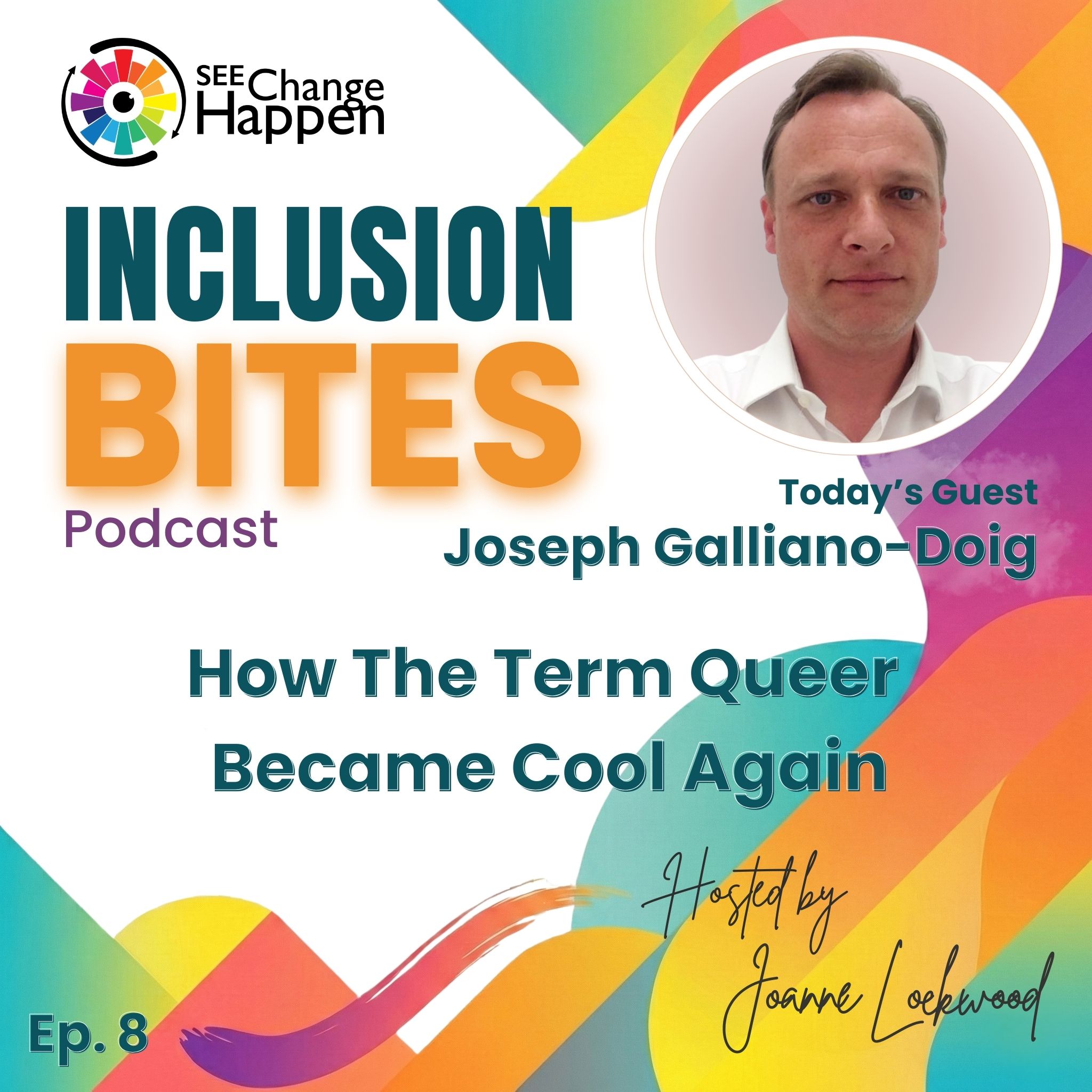
Joe talks about how he feels that Queer is an inclusive term now it has been reclaimed by the community together with his thoughts on where the world is going with LGBTQ+ acceptance.
In this episode of Inclusion Bites, Joanne Lockwood speaks with Joseph Galliano-Doig about lived experience identity.
“It feels like an idea whose time really has come.”
Explore
Navigate this episode
Joanne Lockwoodhost
Hello, everyone. My name is Joanne Lockwood and I'm your host forthe Inclusion Bites podcast. In this series, I will beinterviewing a number of amazing people and simply having a conversation aroundthe subject of inclusion, belonging and generally making the world abetter place for everyone to thrive in. If you'd like to join me in thefuture, then please do drop me a line tojo.Lockwood@seechangehappen.co.uk.You'll be able to catch up with all of the shows on itunes, Spotify andall of the usual places. So plug in your headphones, grab a. Decafand let's get going. Today is episodeeight with the title how the Term Queer Became CoolAgain. And I have the absolute honour and privilege to be joined byJoseph Galliano. I met Joe following an introduction from amutual friend, Kate Bosnsworth, who was the CMO atM&C Saachi. She thought we'd have loads to talk. About and we
Joseph Galliano-Doigguest
did, and I don't. Think we've stopped talking since. Joe is the co
Joanne Lockwoodhost
founder and CEO of Queer Britain, a charity working toestablish the first national LGBTQ Plus museum.But he's been a journalist, editor of the Gay Times,a book editor, a third sector major donorfundraiser, an ambassador manager and a senior corporatenetwork leader. Surprised? I guess I can't do anything else. And I askedJoe to describe his. Superpower and he said,
Joseph Galliano-Doigguest
other people. So. Hello, Joe.
Joanne Lockwoodhost
Welcome to the show. Hello. I'm
Joseph Galliano-Doigguest
exhausted hearing that. I think I need to have a lie down.
Joanne Lockwoodhost
Well, we'll have plenty of time for that later, I'm sure.So tell me, how did the term Queer become coolagain? It's funny, because we had quite a long
Joseph Galliano-Doigguest
discussion as an organisation about what we were going to call ourselves, whichwas that was always the hardest thing todo, really, in the early stages. Andwe really thought about what is it that young people in particular, howdo they refer to themselves now, andwhat is also the most inclusive term under that big longacronym that rolls on and on?And Queer was the only moniker underthat acronym that actually everybody can standunderneath. So for us, it was about being as inclusive aspossible. But also, Ithink it's that last little bit ofreclaiming, because it's stillproblematic for a lot of peopleyeah. Of a certain generation. I know many people that when they hear that
Joanne Lockwoodhost
word, it sends shivers down their spine.They've heard it so many times as a word of abusedirected towards them. I guess it'sabout time. It's definitely been a stick
Joseph Galliano-Doigguest
to beat people and it hasbeen used for a long time, I think. Right back toLord Queensbury, oscar WildeBosey's father, oscar Wilde's lover'sfather, whoused queer in that pejorative sense.One of the things I thought was quite I certainly make absolutely no claim tohaving been key indisarming that word. Butif you go back to the early ninety s and you look at an organisationlike group like Queer Nation, which was a split offfrom the HIV AIDSactivist group Act Up. Andthey obviously embraced the word queeras an act of radical defiance.Yeah, I think the the fact that. Most people
Joanne Lockwoodhost
now use LGBTQ Plus, the queue obviously beingqueer, it's gained acceptance andit's belonging normal conversation. It's part of the acronym, if youlike, for anyone who doesn't identify eithersexually or genderhetero, CIS, normative, if you like. It's a term for anyone who wantsto be who is just themselves. It's
Joseph Galliano-Doigguest
that kind of sexual and gender nonconformingand I think there's a beautiful plasticity toit that it canbe embraced to mean what you want it to meanand outside of kindof academic circles, I think that's what people do with it andthat's what I find most exciting about it. Yeah. Personally
Joanne Lockwoodhost
I'm quite comfortable describing myself as queer ina queer community around queer people. I think if someone,as you said, used it pejoratively or weaponized it against me, I'd find itoffensive but as an I am monikerit works quite. Well for me and that's about control and self
Joseph Galliano-Doigguest
identification, isn't that? Yeah, completely.Where does the power reside in the use of aword? If you can take it and use it for yourselfand you can use it affectionately, then you're holdingthat power and I think that itcomes back to exactly like you say, though the intent,where is the violent? If there's violent intent, then actually you hear the violencerather than the word. Yeah, I suppose you could use any word with
Joanne Lockwoodhost
violent intent and it would sound violent.Flowers. Don't
Joseph Galliano-Doigguest
you dare hit me with those flowers.
Joanne Lockwoodhost
With the right intent or the wrong intent, you can weaponize anything, I guess,as you say, by reclaiming the queer and identity that I'm proudof, I own that and I take the power back. So Icompletely understand that. And this is why also,
Joseph Galliano-Doigguest
particularly for some older people in particularwho have had it used against them as a slur,it can be hard for people to kind of step outside, step away from thatpain,which is tough. So
Joanne Lockwoodhost
you had this crazy idea ofco founding the first LGBTmuseum in the UK, orfixed space LGBTQ Plus Museum.There's been many roaming ones, hasn't there? But this is kind of the first one.You're aiming to have a fixed permanent home? Yeah, I mean, there have been
Joseph Galliano-Doigguest
plenty of really good exhibitions andgreat community projects and soforth. This is the first, actually notthe first attempt to get project like this up andrunning, but the first attempt for a whileto establish a national bricks and mortarmuseum. We'll also always dopop ups around the country and so forth, butit feels like bricks and mortar is a really important thing in terms of thesort of symbolism of what does it mean? In terms ofhow do we show, as a country whose stories and artefacts wevalue and how can we own them for ourselves aswell? So that was the why? That was the reason
Joanne Lockwoodhost
that you felt it was important to create this sort ofsnapshot, this storytelling,capturing the lives and the moments of peoplefor future generations, queer and non queer people. Yeah. And
Joseph Galliano-Doigguest
actually, that's absolutely, reallyvital, is that we think of it as theLGBTQ plus museum for all, regardless of sexuality orgender identity. I keep coming back to it's. The image and I know we'vetalked about this before, but it's the image of young woman who's just come outto a mother and trying to create somewherethat they can both go to together so they can both come away feelingexcited to be a part of this set of communitiesand understanding their own family a lotbetter and coming away just excited with thepossibilities of the world and all it can offer.
Joanne Lockwoodhost
So have you found it's been received by,A, I suppose, the queer community, and B, by the non queer community? Have youfound there's a real kind of yeah, we need this,or has it been a struggle? No, I've been
Joseph Galliano-Doigguest
pushing against it feels like I've been pushing against one open door afteranother. It feels like an idea whose timereally has come.It's so funny, Joe, because I started off, in someways, just sort of thinking, like, what's the most exciting thing I could do rightnow? AndI knew emotionally what it meant to me. Iknow emotionally what it would have meant for me to see myself betterreflected in the culture.I hadn't somehow made that leap as to how that would feel for other people.Quite often I've been talking to people about what we're doing,actually, strangely, in business meetings orwith community activists,and you suddenly realise that they're talking to you, but there'sa tear in it, they've kind of welled up. AndI think the first few times that happened,that was a real signal for me, that it was like, okay,this is really important, this is something to becarried with a great sense of responsibility. AndI feel very privileged to be ableto do everything in my power to holdthat and make that happen.
Joanne Lockwoodhost
So I suppose in the same way that a church is notthe building, it's the people. The Cream museum, effectively, is the community,the people coming together, the memories it holds that you treasurebeyond just the bricks and mortar. Yes. Although I see the bricks
Joseph Galliano-Doigguest
and mortar being a very strong signal,and that's kind ofcreating the what would theright word be? The crucible for the beacon to be sittingin, so that that can be then seen around the worldand so that people can see the value in these stories.And understand why this is important, that this is important.
Joanne Lockwoodhost
Some sort of North Star shining light that everyone could focus on.One of the things that I became, I suppose, aware of when I firstmet you, we started talking about this. It was just a conversationover a coffee in a cafe, effectively, Ithink. Then I came to some of the launch events and I met some ofthe other people who are involved with the project. And I think you hear somuch from the community, or wherever the community is. Thepopulation of people who are queer about negativity,around business, aroundPinkwashing, around the government,MPs, parliament, civil service, not representing or notconsidering queer people. But what I was struck by wasthe depth and breadth of people involved with the project, who aresponsoring it, who are promoting it, who are happy to stand shoulder toshoulder with the museum from thatlaunch at Dover House. Number of people there and the Demershire Club, theone there. There was such a number of diverse peoplefrom all over. Okay, maybe the privileged side ofLondon, maybe. To be fair, we started off with
Joseph Galliano-Doigguest
very much a focus on developing a donor community.In those early days,there was definitely privilege in those rooms.You need that to get things going. But I felt it's being wielded for the
Joanne Lockwoodhost
benefit of the community. It wasn't privileged for privilege sake. It's privileged using itsprivilege for amplification and toestablish this and be a part of it and be proud. Andto be proud. I mean, there's many people who are notproud to be openly queer. But in those rooms there were people whowere prepared to be openly queer. And back the project.
Joseph Galliano-Doigguest
And what is wonderful is the amount of times those people, theysay, how can I help? And thatsome of the most powerful four words you can hear, aren't they?Really? Yeah. Because that was a real powerful amount, I think. Last year there was
Joanne Lockwoodhost
that event that Coots organised in 440 Strand, wasn't there?Where they had the massive rainbow stripes on theoutside of their main office, their flagship, globalflagship office in London. I can't
Joseph Galliano-Doigguest
tell you how much that made me both sort ofproud and give a wrysmile. The fact that Cootshad taken such a bold move toknow it's a private bank, that's kind of prettyconservative type of organisation, one would think theQueen's Bank. And we've slapped the word queer on the frontof it in one of the most high profile locations in thecountry. And you can talk about Pinkwashing. And I don't thinkin that particular instance that was a demonstration of Pinkwashing in the slightest.I think that was donewell within that sector. A bit of bravery, actually.
Joanne Lockwoodhost
Yeah, it was. I worked for Coops in the inthe whole place at 440Strand was so controlled about who could be seenon the on the banking floor, which entrance you could come into,which escalator what you were allowed to wear as anemployee. They still have the frock coats. Have frockcoats and they used to have that massive revolving treein the foyer right on the ground floor, which used to rotate once every24 hours really slowly. I didn't know that.Yeah, you wouldn't notice because it rotated so slowly becauseobviously they wanted the tree to grow upwards, not twist and things into thesunlight, so they had to rotate it. Fantastic.And a massive koi carp pond in the middle. It was likestill there. I found it clearthat night there were what, 100, 200 people in thefoyer there in a receptioncelebrating pride. Celebrating coots'scelebration of pride with queer Britain dead centre. I thought thatwas. You know we've done other things with them
Joseph Galliano-Doigguest
as well. They've been sort of happy to introduce us tosome of their clients. They've been happy tohosted us for a donor dinner andactually just some of the staff thereare there at the end of the phone when you need to talk thingsthrough. Yeah.
Joanne Lockwoodhost
So we're now in June, aren't we? So this 2 June2020 is it June? I've lost track.
Joseph Galliano-Doigguest
I actually googled the day the other day.What day is it today? It's funny, my wife and
Joanne Lockwoodhost
I had this routine when she was being furloughed. Welost track of days so we got in the habit of wake up in themorning shouting out the day of the week it was so we both remember whatday of the week. And religiously we always do pinch punchthe first of the month when we wake up in the morning. It's kind oflike a commando assault on each other. The first one to get in wins. It'skind of like we've had for years andsometimes it can get quite over the top. I wouldn't say violent, butcertainly it gets a bit risky with people looping each other andI've got this app on my phone and I just realised that my lockdown effectivelystarts on the 13 March and that's eleven weeks ago and it'slike, where's that time going?
Joseph Galliano-Doigguest
It's funny. How are you coping with it all? How are you? I've
Joanne Lockwoodhost
worked from home on and off for quite a while and in the lastcouple of years quite a bit. But I'd always intersperse working fromhome or working remotely with trips to London, clientsdelivering, travelling the world. So this is the firsttime I've been consciously at home somuch and occasionally I go a bit stir crazy. I need to getout. I realise that I haven't really been out much for four orfive days and even then it's just to put the bins out or have aquick look outside. So we're starting to make the most of theweekends now. It's socially acceptable tobe out more, to social distance more and to sort ofput some deck chairs in a local park. So, yeah, I'm capping. Okay.I've got plenty to keep me busy. This podcast, for one, andhaving conversations with people on Zoom. Yeah, I'm doing all right. Howabout yourself? Yeah,
Joseph Galliano-Doigguest
I'm lucky enough tobe living in a sort of fairly rural partof North Essex.We have shops just down the road. Local shops just down the road.My husband's a gardener, so the garden's lovely.I think it would be churlishto say that I haven't been enjoying some aspects of that. I'm certainly not missingcommuting. I was travelling about 4 hours a day,so I'm not missing that at all. But it does make methink, what would this be like for the single parent living on the 17thfloorwho doesn't have those luxuries? Must be tough.
Joanne Lockwoodhost
Yeah, it's not easy in those situations. We're in a firstfloor, two bed flat with one living room, so, yeah, we canget on top of each other and we don't see a lot of the outside.There's not a lot out there apart from a road. So, yeah, we do needto get out of it. But, yeah, you're right. There's a lot of people outthere who are either living alone, who've been very isolated, or, as yousay, a single parent, or even worse, in some respects,a different problem, where there's multiple generations living in the same household,all trying to compete for space, internet, computers,tabletops, which can be equally stressful.
Joseph Galliano-Doigguest
Yeah, I think it can throw people togetherintoemotional soups that they might nothave either wanted to find themselves in or they mayhave had other way, other releases for and actually, aswell for some queer people. Particularlytough timesif you're stuck in a hostile environment, if you're stuck in an environmentwhere you can't be yourself and there's noway of actually going out to the places where you can be yourself.If you're in the closet.Yeah, it must be must be very tough for I think thereare particular challenges, I think,for many LGBTQ plus people.
Joanne Lockwoodhost
I think we're starting by saying that the Pride Month is cancelled. So thiswas obviously a global celebration month forpeople that all the marches, all the Prideevents have now been virtualized. It's hard toimagine some of them taking place over Zoomuntil Eurovision. Ireally had an amazing night watching theEurovision Revisited, the online version,the way that the production company still put an event onin a different way. And I thought it was fantastic. I thoughtthey missed a trip, though. They could have still done the voting. They could haveplayed all the songs and still had the voting. We could have all joinedin still. I didn't see it. And I sometimes wonder if
Joseph Galliano-Doigguest
I'm not gay enough.
Joanne Lockwoodhost
I didn't realise there was a sighting scale. I didn't realise you could be abit gay. Yeah, very definitely.You're right. It's impacting on people and just the fact that they can't getout, they can't meet people, they can't be themselves.I'm hyper aware of the impact on people who maybe havea gender identity, the trans or nonbinary, where they live in a family environment or with people whothey're not open with, they're not out. And that could be areal challenge. There's no way they cansort of get any respite in that situation. Maybe, unless they'rezooming, even though that's difficult. Iknow some trans people who are out at workbut not out or not fully out at home, or thatthey're not out with their kids, or they're living in amarriage where it's not acceptable to be themselves.So work is their respite, and now they have to do zoomcalls in. An environment where
Joseph Galliano-Doigguest
they don't want to. Go back to their birth gender for a
Joanne Lockwoodhost
zoom call for work, but then. They can't fully express themselves when they're. Ina household with other people. So it's a real dilemma for certain
Joanne Lockwoodhost
people. Yeah, it must be. I think this also goes to
Joseph Galliano-Doigguest
show why theworkplace for many people is such animportant place.And I shy away fromthis kind of use of the word authentic, which kind of it does,I think gets I think gets perhaps overused in acorporate setting. But that said,where cultures within companies can bemade to beinclusion. And I'm not talking about diversity in the senseof headcounts and making sure that we'vetick got one of them. Tick got one of them. I'm talkingabout how do you make the workplace somewhere that actuallyyou can feel celebrated in and accepted inand that you can bring your best professional self to work inwithout worrying about too much of that other baggage.And there's not enough companies that are like that.Are we getting better? Obviously still a long way to go,
Joanne Lockwoodhost
but is it better than it was? Certainly, I
Joseph Galliano-Doigguest
would say obviously I don't want to speak for trans. I certainly can't speak fortrans people. Certainly as a certainlyas a gay man seems better to me.But if we're talking about wherea white, middle class gay man sits onthat privilege ladderwithin the sets of communities, then it's possible thatI'm not getting the best view for otherpeople. I suppose my
Joanne Lockwoodhost
experience is variable, it'ssituational. There are pockets ofissues, but there are large swathes of places thatare fully accepting. I spend most of my time in the worldbeing embraced for who I am. It could well be that I'vegot my blinkers on and my hearing aid turned down,so I don't hear the negativity, butI don't experience much of an issue these days. But then again, I'mwhite, I'm relatively privileged, andI live in a world that is quite comfortable. So, yeah, maybe I'm not thebest judge. Yeah. And it comes back to it's funny, I always sort of
Joseph Galliano-Doigguest
think about the William Gibson quote,which is the future's here. It's just not very evenlydistributed,and I think that's true.Obviously, the experience of somebody who isblack and trans or sort ofgenderqueer in some other wayis going to be very different than for somebody wholooks like me. And it's also going to be different ifin the sort of company that you're working, are you working in a big corporatethat's got policies kind ofwithin an inch of their lives? Or are you talking about people who are workingin SMEs that are maybeled by one entrepreneur whomay have opinions that haven't been filtered through anHR department?
Joanne Lockwoodhost
That's a very good way of putting it. Yeah.Shooting from the hip. Exactly.
Joseph Galliano-Doigguest
Yes, quite. Yeah.
Joanne Lockwoodhost
The unfiltered politicians speak, isn't it?From over the water. Yeah, really.But that's true. I think you're right. I thinkcompanies who are multinationals,big corporates, tend to have great policies, great HRteams, great inclusion strategies, employeenetworks, staff groups that cover all differentintersections of diversity. But, yeah,I think in the small business community, they either get it or they don't. There'sa real challenge there. It's often hand to mouth watchingthe bottom line. They're probablyquite sexist still, let alonehomophobic or transphobic or biphobic.
Joseph Galliano-Doigguest
Yeah. They're still struggling with the basics around gender. Well,let's face it, most of us have had a crap boss at some pointthat createstoxic environments. And that's avery tough, very tough place to be if you're just tryingyou're going to work to keep the wolf from the door, food on the tableand a roof over your head andnot necessarily going to work. Going to work to change the world.
Joanne Lockwoodhost
Yeah, you're right. I think the
Joseph Galliano-Doigguest
world is moving slowly, though. The world is moving slowly, but it's moving.
Joanne Lockwoodhost
I think that each generation passes, each year passes. We're making progress.Maybe not enough progress for a lot of people, but we are making I don'tthink we're going backwards yet, so let's see where wecome. It's funny, though, because
Joseph Galliano-Doigguest
the way I kind of often think about this is thatwhen I think about when I was a teenager andin theory, could have been arrested for holding somebody's handsin public, another man's hands in public ifsomebody had complained and had reported that as it could have been reported asa breach of the peace. Let alone the fact that whenI was 17 and I was living with my first boyfriend who was19 no. Who was 20. Sorry,wasn't 19. I was 19, he was23. And at that time, he could have spent sevenyears in prison for the relationship that wehad forwardfast to however many years itis. And, you know, the the idea that Ican I can be married and livevery comfortably in a rural village withoutanybody seemingly batting an eyelid isgreat. The trouble is thatwhen things move quickly, they can also unravelquickly as well.And one of the political reasons, witha little p that I felt it was so important todrive this museum project forward is to helplock down those gains. It's like, what could be my part in helpinglock down those gains and make sure that we are kindof properly positioned asourselves, embraced in the heart of themainstream, without having to make those compromises aboutwho we are. And that's what I'dreally like to see. I
Joanne Lockwoodhost
agree. I think that's where we got to. Try and move societyforward. We've got to try, as you say, capitalise onthe progress we've made, make sure that we can't go backwards because it onlytakes a different government, a different politicalbent, different priorities. I think we've seen that with thefrustration around the trans, the gender reform,the GRA Gender Recognition Act consultation to put out. It was apriority for Theresa May's government. We had number ofequalities ministers championing it, speaking for it, theLabour leader spoke for it and now it's being kicked into thelong grass. And whether I'llever come back again, whoknows whether it's going to be something that will never happen, mighthappen, it's reallydifficult to say. And of course, for many non binary peopleand trans people who are notgoing through what was traditionally a medicalized process, they feelvery vulnerable that they're not going to get acceptance there's.There's gatekeeping, there's talk about rollingback access for child services in termsof young people's, trans access to the genderidentity services. So that's all quite worryingand it's giving oxygento radical groups whoare very small in number but very loud,and they have the ear of quite a feweditors in big tabloids and broad sheets.
Joseph Galliano-Doigguest
Sorry. No, sorry, go after you. You
Joanne Lockwoodhost
see a lot of Sunday papers fromprinting kind of the negative trans stories about peopledetransitioning, about medical issues, about people whoabout one child who sued their school for allowing gender neutraltoilets. And these things hit the nationalpapers, they get promoted. And I spoke withthe deputy social affairs editor for one of those papers recently and hewas telling me that they get hit with dozens or so stories everyweek from these vocal groups, all these negativestories. And I said, well, why can't you print something that I want to talkabout? And he said, well, tell me a story that's interesting butgetting on me in life, being happy,being a functional member society isn't interesting. It's only interestingif something creates a reaction. SoI have to do something that was against my nature to be interesting.Whereas all the all other people seem to be doing is finding people who havehad a bad experience and amplifying that. Whereasthe thousands and thousands of people who don't have a bad experience suddenly have novoice and the only voices you're hearing are the people with problems. And
Joseph Galliano-Doigguest
isn't that true as well, where I'm totally true. When you talkabout actually people don't want to bethe subject of debate. They just sort of want to get on with theirlives. And I think a lot of therhetoric around trans people nowin the media actuallyvery strongly echo how gay men were being talked about sortof 30 years ago.It's quite interesting andsalutary to see how historyyou can read history to make sense of what's happeningnow. And actually, if you look at how,say, gay men and lesbianswere spoken about all that time ago,what are the similarities and the correlations between that andthe way that trans people are talked about now in thosesettings, similar. Messages
Joanne Lockwoodhost
disbelieving is real. We can fixyou. You don't have to do this. You're just aphase. You don't know your own mind. Or that's notnormal. The biologythe world wasn't designed for people to be anything other than menbeing men and women being women. And a marriage is a relationshipbetween two people of different sex or genders. Andwe're hearing the same stuff again. And it's to say thatpeople don't know their own mind, they don't have this lived experience,and then demonising people as being predatory whenthere's such a minority of cases where apredatory person uses thefact to say they're trans, to bepredatory. It's such a rare occurrence.Why add the stigma?
Joseph Galliano-Doigguest
Is it even a rare occurrence? I mean, this is the thing, isn't it?Isn't it, that when those stories tend to be looked at,they're unsupported anecdotalstories that have been really used to just sort of whisk upsome fear. They've been quite oftenput out by somebody from the Christianright. And I do mean that in a very you know, when I talk aboutthe Christian right there I mean that in a very specific way.I talk about those people who would use the Bibleto deny basic humanrights. And it's also that kind ofisn't it just a bit boring? And like, how long can you describe peopleusing terms around the shock of the new?How often can you have headlines about thisoutrageous new transtrend? Just it'ssuch nonsense. And you can't say that samething again and again and again, and it be true.
Joanne Lockwoodhost
But we see well meaning schools,well meaning government, local government all trying to do what they think is theright thing. Suddenly facing lawsuits,facing people who are antitrans for whatever reason, trying to unpick theEquality Act and reword it to suit their own objectivesand basically just make stuff up around it.And then, because everyone's so risk adverse, they thinkthat the status quo is thedefault option, rather than saying, well, actually the status. Quo is no longer adefault option. Trans people have had change. They've had accessto services, they've had access to live, and now they're findingthose protections roll back because everyone's too. Scared, it's going too quickly.
Joseph Galliano-Doigguest
And aren't trans people just about?Excuse me,that's my mother.
Joanne Lockwoodhost
She can join in. That's my mother on the phone.
Joseph Galliano-Doigguest
I've just lost her.
Joanne Lockwoodhost
Hi, mom. Hello, Mum.
Joseph Galliano-Doigguest
You're on a podcast at the moment.I'm being interviewed for a pod. We're having a conversation for a podcast at themoment. That's my
Joanne Lockwoodhost
mum. Say hello to Joe.
Joseph Galliano-Doigguest
Hello. Hi, Mum.Call you later. Bye bye. Well, that's
Joanne Lockwoodhost
the new norm, isn't it? We have to bring our whole family to work atthe moment. Right. That has stopped my
Joseph Galliano-Doigguest
voice memo, so I'm going to start that again. Right. Okay, where werewe? I think we're just talking about the rights
Joanne Lockwoodhost
of certainly trans people being kind ofquestioned and erased in some respect by people whoare risk adverse and the loud vocal kind of,as you describe them, the Christian. Right. Well, I wonder
Joseph Galliano-Doigguest
as well, becausepart of the culture wars, where a few years ago, where you had the defenceof the Marriage Act in the States, thatwas defining marriages betweenone man. And one woman.In a way that became a proxy for a different sortof culture war, for the culture wars. Andit feels like as theargument for same sex marriage has been largely wonfor now, it's movinginto where is the next frontier that they can useto probe and try and kind of breakdown coalitions that can exist between transpeople, lesbians, gay people? How canfeminism be used as a way of clawingpeople apart from each other, as opposed to doing the thing that it reallyshould be doing, which is about bringing everybody together as.
Joanne Lockwoodhost
Mean? I thought I thought it was interesting that Ruth Hunt was speaking in theHouse of Lords the other day around her support fortrans equality. And whilstnot everybody loved her in her role at Stonewall, shedid certainly advance the focus of Stonewall to lookat trans rights and bring it to focus at Stonewall way overto can. We can debate whether she was effective at that,whether it was authentic. But at the end of the day, Stonewall now havea trans positive element and they do a lot of trans awareness training toorganisations which love them or hate them. They're doing afantastic job doing something.
Joseph Galliano-Doigguest
I'm so glad that they are. I'm so glad that they are.Yes, it needs to happen. And actually, I thinkanything that can keep theL, the G, the B, the T, the Q closertogether means that we'll be stronger orjust come. Together as Q is. Kind of.The wonderful thing about that is that what I really loveis people couldjust be whoever you are, be whoever you want tobe. Yes. Because it doesn't really matter, does it? As long as
Joanne Lockwoodhost
you come from a position of kindness, thenyou just want to get on with your life. People don't generally want tobe bad people, actually.
Joseph Galliano-Doigguest
This is one of the interesting things through history, is that by andlarge, people have kind of got on with their livesand they've worked their way around thesystems as much as they can.And this is no different.
Joanne Lockwoodhost
Yeah, I'm watching the news. I'm sure you are followingwhat's going on in America at the momentabout some of the rhetoric coming out of the White House, some ofthe statements, butthere's the upswell of support around the globeto call out racism to being vocal, being an ally.But it does still show that no matter how far we think we've come,racism is still prevalent in most societies in theWestern world. It's just below the surface.Homophobia, biphobia, transphobia are just below thesurface. And I think if youamplify thosesupremacy type voices, then it doesn't take much for theseviews to surface in clusters here and there.
Joseph Galliano-Doigguest
Isn't it about theruthlessness of the urge topower, which, when you get aparticular kind of, say, character likeTrump, for example, and I'm not saying I think Trump is asymptom, he'snot the sole problem. Butwhen that kind of when when that sort ofpower is trying to establish and preserve itself, or is trying to preserveitself, it doesn't really care who it throws under the bus in order to protectits own positionand actually divide and conquer. It's a classictactic, isn't? And I imagine as well,that for a lot of blackpeople in the States and in the UK,probably what they're going to be. I would imagine that they're going to be notsurprised to seethe films have disturbed other people, have disturbed,actually, lots of white people. Because Ithink probably what they're going to be saying is, yeah,this is what we experience as black people all the time.This is why black kidsare so often taught by their parentshow to not attract the attention of police as they're walking out in the street.This is why people are worried when they go out jogging innice neighbourhoods. Nice meaning white andwealthy.
Joanne Lockwoodhost
Yes, that perception. A black person out fora run with a hoodie on is likely to be there for nefariouspurposes, rather than be there just to go for a run. Yeah,
Joseph Galliano-Doigguest
true. Completely true. It's
Joanne Lockwoodhost
something I don't experience even as a trans person. I don'tperceive that people perceive me as athreat and a criminal in that way. They may perceive me in other ways. But
Joseph Galliano-Doigguest
they clearly don't know you.Shh. But, no,
Joanne Lockwoodhost
I've never experienced that kind of guiltby perception type. Yeah, okay.Like yourself, I've experienced discrimination in employment,in opportunity, but never beingjudged as a criminal withoutcause. Or some of theimpact that racism has on people, so I've never experienced thatand I can only have a littlebit of empathy because I can't understand the full impact of it.I know what I feel about having to cover,having to pass, having to maybemy voice is quite deep, I'm cautious about how I speak incertain company. If I'm on the train, I'm conscious about if I shout out fora cup of coffee, it could cause somesort of kind of confusion amongst the people around me, so I'm verycautious about it but that's nothing compared witha black youth just being themselves, if you like.
Joseph Galliano-Doigguest
How does that make you feel? I mean, what does that do toyou on an emotional level or an intellectuallevel? I assume on an emotional level?
Joanne Lockwoodhost
Well, I suppose what I'm doing is. I'm trying to protect
Joseph Galliano-Doigguest
myself from having. A further situation, so it's better
Joanne Lockwoodhost
to control myself, to maybewhisper or not to ask for a cup of coffee orif I'm out with my wife, sometimes I say, can you go and have thatconversation, please? Because I really can't be doing withhaving to out myself effectively to the waiter or to the personserving or to someone who I want to try. To get
Joseph Galliano-Doigguest
some help from. I think it's just easier for you. Guys feetbecause I don't really want. To bring me into the equation,
Joanne Lockwoodhost
I've kind of got used to that, but you're right, it's holdingback.I'm not bringing my whole self to the world, I'm bringing my whole selfsociety. So, yeah, it does impact and my wife and I are consciousabout holding hands, kissing in public, like many, many queerpeople do, which I find really confusing becauseshe doesn't look any different. To me.Maybe a bit older and a bit more gorgeous, but, yeah, she's matured.
Joseph Galliano-Doigguest
Well, isn't it funny, though, howa kiss between partners can be politicised?Yeah.
Joanne Lockwoodhost
We used to go to a lot of National Trust walks, do a lot ofNational Trust houses, and we would find cubbyholes behind doors or behind a curtain somewhere and we'dhave a quick snog. I feel like we were really devilishbecause we were being kind of naughty behind the cupboard sort of thingas grown adults, but we just didn't feel brave enough oropen enough to be. Able to sort of just show public. Signs ofaffection, hold hands walking around. A National Trust building. Well, I had
Joseph Galliano-Doigguest
a funny moment. My experienceis, again, it's very gentle, I think, compared with what manypeople have to experience. But I found myselfabout five or six years ago,and I was in a local shop near where we justmoved into the house that we just moved into andwent to buy a bottle of wine. And the womanserving nicest pie, oh, your wife will be pleasedwith that, obviously. I'm wearing a wedding ring,and I had almost like a weirdout of body experience wherethe thought process went for first of all, Iblushed because I thought,well, I can't just let thatpass. Because somehow that feels like that's lettingmy lovely husband down and not kind of respecting thatrelationship that I have with him. And thenthere's the conflict of not wanting tobe antsy or awkward orrude and then the nextthought thinking oh my God I'm asout as it's possible to be. You google my nameit is gay, gay, gay out there. You can'tget away. There's no going back into the closet for methankfully. Not that I'd want toexactly, but I also just thoughtif that is how I felt formereditor of Gay Times. Somebody who'sbeen very well supported by his mother, who you just met.Somebody who at the timein his early forty s and hasbeen there, done that. What is it going to be likefor somebody who is not so sure ofthemselves? What is it going to be like for that person whois like a young person who hasn'tyet come out the closet or is struggling to come out thecloset or is struggling with our identity issues.And I just felt inthat moment it was like well I have to say somethingbecause for that person I can't leave thatunsaid. And so just actually very kind of politelyit was just like oh husband actuallyand of course nothing more was said. It was just like oh well, enjoy yourwine. And obviously because these situations we're kind ofalmost trained to think that these things are going to be muchbigger than they will be in the moment.
Joanne Lockwoodhost
But, God, it's complicated. That whole series of thoughts that you.Can I was at my wife's Christmas partywith her office colleagues, and she startedintroducing me as her other half.And I sort of laughed at her becauseI just used to introduce her as my other half in the distantpast. And she kind of didn't get upset withme, but she kind of went, oh, other half bit on the side. It soundsa bit yeah I'm your. Wife sort of thing. And then to hear
Joanne Lockwoodhost
her introduce me as our other half I sort of said well and she saidwell I thought about it. She said because you're not my wifebecause technically and legally I'm still ahusband. I haven't change that role really.I don't identify as wife in that way and tocall me husband when I was in a cocktail dress sound righteither andpartner didn't quite work either. So we kind of fell backto other half as being kind of anondescript of we're together and everyone knew shewas married to me but described me asa very neutral way of describing me. The people who knew we weremarried you got to double thinkthese things, haven't you? It's no longer can you just go through lifejust using everyday language that other people, otherstraight, normal, typical people use. We have to sort ofnormal wherever normalis, but thesocietal norms. Whatever.People use who have never questioned any part of our identity,they just do. They don't think about what they do. Having to doublethink everything, having to work out the risk, thereward, the impact. Am I going to come acrossas pedantic? Am I going to come across as reallyanother gay person trying to make trouble or trying toyou almost have to think about the impact of what you say back.
Joseph Galliano-Doigguest
Do you? And every time I'm misgendered, do I make a big deal of
Joanne Lockwoodhost
it or don't I? When I talk about my wife, do I saypartner? If I'm talking on the phone to somebody,my partner will be down quick, down soon. Do I saywife? Sometimes I just use language that just makes iteasier for me not to have to explain it. And Ithink that's probably what you're saying there as well. Yeah.
Joseph Galliano-Doigguest
Do you ever feel like you kind of also trip up on those thingsfor other people? Is there any anxiety around getting the languageright. Doing it deliberately for other
Joanne Lockwoodhost
people? Not deliberately, but the kind of accidental,
Joseph Galliano-Doigguest
say, around misgendering, for example.
Joanne Lockwoodhost
I misgender people occasionally.I misgender myself sometimes.I've described myself as the eldest of three brothers beforeI ended up correcting myself and saying, well, actually, I'm the eldest of three children,or the eldest three siblings. So, yeah,I've corrected the language of myself. I sometimesrefer to myself in the third party sometimes, and I sometimesmisgender. Myself historically, but
Joseph Galliano-Doigguest
no. I am I slipped
Joanne Lockwoodhost
up with people before someone was telling me aboutthey were going to be a grandparent. I said, oh, it must be really greatto be a granddad. And I thought, actually, that just misgenderedyou. I haven't actually asked you how you want to identify inrelation to that child. I suppose it's that building
Joseph Galliano-Doigguest
I've built assumptions in without letting you tell me what it is thatyou want. How do I describe myself in relation
Joanne Lockwoodhost
to my brother's children?Am I an uncle? Am I an auntie? What's the sortof the non gendered term? I know a niece and anephew. The non gendered terms are nibbling. I'm not sure what the reverse? Nibbling. I've
Joseph Galliano-Doigguest
never heard a nibbling. Apparently it's a nibbling is a non
Joanne Lockwoodhost
gendered brother orsister of a parent, but I'm not sure what the reverse isof an aunt or an uncle. The non gender version of that is nibbling. I
Joseph Galliano-Doigguest
like that. I like nibbling. Nibbling. Yeah.
Joanne Lockwoodhost
So, yeah, it's language,the constructs, I guess we're all working around them, aren't we?
Joseph Galliano-Doigguest
Yeah, yes, very much.And actually, it's funny,it's interesting how, I mean, obviously where we're at now withthis pandemic, witheverything that's going on. We're about to launch a pieceof in the process of launching a piece of research that we're doing withGoldsmiths and Kent State University in Ohio,which is going to be a research project that's going to look at notonly experiences in queerpeople's, experiences across the UK, inpandemic, but it's also going to be looking at that question asto sort of how do these kind oftimes affectsenses of identity?This is a little bit of a sideways kind of thought from what we weretalking about, but I wonder how identities aregoing to change as we come out the other side of this. Yeah,
Joanne Lockwoodhost
I often have this similar thought when I think about theRobinson Crusoe kind of scenario. If I was aloneon a desert island, who would I be or how would I beor what would I be? I guess I would re identify asa survivor, primarily, and as ahuman being trying to survive. So I thinkidentity is relative to your scenario surroundings, and whenwe're in lockdown, we're kind of almost likein a smaller bubble, so our identity is more limited.We're not expressing it to anybody, we're not being it to anybody,we're not who we are with anybody else. We're just within our own heads.So how do we maintain that identity when no one can see us, noone can hear us, no one can feel us? Well, it's interesting,
Joseph Galliano-Doigguest
isn't it? Because we have all gotmultiple, multiple identities,different times and with different people. Different parts of those come to the front.So are you ahusband, son, bad guitar player,shoddy singer? Someone who's trying to set up a museum?Nephewbloke who likes a bit of banter in the shops on a Saturday morning?Any neighbour? All of these things are different kinds ofidentities which all in aroundmake us who we are. But,I mean, even the funny thing is, when you think about a mean, these areall social constructs as well, becauseI'm not Joe. You're not Joe? That's just a label that's beenstuck on your not. That's not nothing intrinsic about to who youare. We're just this collection of atoms here, assembled in thisparticular way at this particular moment in time, if that's not too esoteric.
Joanne Lockwoodhost
Yeah, we could just be seven of nine, couldn't we?
Joseph Galliano-Doigguest
Yes. Just defined by
Joanne Lockwoodhost
where we live or where we sit.Third person from the right.It's just a way ofcontrolling policing, organising, helping us fitidentify each other. Yeah.It's probably less devaluing than describing afeature of you. If you have a name, it doesn'tbecome, is that Joe with the which which Joe withthe oh, Joe with the glasses and the long hair?It's Joe Lockwood sort of thing. So we can createa name and label that isn't relative to how we look or where we're from,I suppose. Yeah. And I
Joseph Galliano-Doigguest
guess at the end of the day, how do we just allow ourselves tobe ourselves?
Joanne Lockwoodhost
And that sounds like a great moment to ask you kind of where'sthe world going from now then,what's your predictions for the Lockdown and the communities?
Joseph Galliano-Doigguest
Well, I wouldn't dream of making predictions. I mean, I certainly wouldhave hopes. I hopethat this is one of those moments and including actuallyit's all interconnected what's happening in the States at themoment, the pandemic.And I would hope that out of this we'll emerge with agreater sense of community, better sense of valuesabout. What'S important and what's just g jaws.I wouldn't dream of predicting. What do you think, where do you think we're going?
Joanne Lockwoodhost
I oscillate betweenhope that we won't gobackwards and that we'll learn a lot from this.But then I see what's going on at the beaches, I see what peopleare doing the moment they're allowed to go out, allowedto unlock. Old behaviours are coming back very quickly.The anti government rhetoric is starting up again, the politicalnessis starting up again, the division is starting up again.I'm not sure we'll learn all the lessons.Will we see this as a sad time, a happytime, or a time for learning? I don't know. I'd like tosee where we are now as a time for learning the great socialexperiment and hopefully we'lltake stuff from this and learn from it. And
Joseph Galliano-Doigguest
it's all those things, isn't it? Yeah, it's all of those things.
Joanne Lockwoodhost
Too many people have lost things for everyone to be happy. So I think wehave to find a way of helping thepeople who've lost a lot, but also allowing thosepeople to recognise what they have gained. I think we've gained a
Joseph Galliano-Doigguest
lot. People are speaking to people they've never spoken to before or haven't spoken to
Joanne Lockwoodhost
another a long time. They're spending more time with the families that the children arespending more time with their parents. We're commuting lesspollution is down. There's a whole lot of stuff we can takeand let's hope we keep the good stuff and chuckthe bad stuff out with the bathwater, not the baby. As I
Joseph Galliano-Doigguest
guess, an anxious optimist,I'd say that I think it's reallyimportant that in however tough times are,we've got to kind of make sure that positives canbe taken out of them.And I really hope that that's the casenow. Obviously, I'm anxious about straightened times,I'm anxious about the things that people have lost, I'm anxious about all of thosethings, but I'm also hopeful that greater community cancome out of this well, many thanks,Joe. I'm sure all agree there's much there to ponder and take
Joanne Lockwoodhost
inspiration from. So how can I listen to get. In touch with you?
Joseph Galliano-Doigguest
If you go towww.queerbritain.org.uk,that's a website for the charity or for themuseum, or you can drop me a line tohello@queerbritain.org.ukand yeah. Comments, thoughts,ideas? How can we helps all welcome.Fantastic. Well, a huge thanks to everyone today for
Joanne Lockwoodhost
tuning in and listening. Please do subscribe to keep updated on futureepisodes of the Inclusion Bites podcast. That'sB-I-T-E-S. Please, please tell your friends and colleaguesI have a number of exciting guests lined up and I'm sure you'll be inspiredby over the next few weeks and months. If you'd like to be a guest,please let me know. I would welcome any feedback and suggestions tojo.Lockwood@seechangehappen.co.uk for thefuture shows and how we can improve. My name is Joanne.
The Evolution of the Word "Queer"Public Affection and Identity PoliticsThe Impact of the Pandemic on LGBTQ+ Communities
Joanne Lockwood is joined by Joseph Galliano-Doig, co-founder and CEO of Queer Britain, to explore how the word “queer” shifted from a weaponised slur to a reclaimed, inclusive umbrella term. They discuss generational differences in how the term lands, the importance of self-identification, and how language, intent, and context shape who holds power in a conversation.
Joe shares his career across LGBTQ+ media and advocacy, and the motivation behind establishing the UK’s first national, bricks-and-mortar LGBTQ+ museum. Together they reflect on why a permanent space matters for visibility, cultural memory, and creating somewhere both queer and non-queer people can learn, connect, and feel proud of these histories.
The conversation also touches on life during lockdown, including the ways isolation can be especially difficult for people who are not out or who are living in hostile environments. They discuss workplace inclusion as a potential refuge, the pressures of constantly managing language and disclosure, and the wider social climate—including trans rights debates in the media and renewed global attention on racism and allyship.
“But that said, where cultures within companies can be made to be inclusion. And I'm not talking about diversity in the sense of headcounts and making sure that we've tick got one of them. Tick got one of them. I'm talking about how do you make the workplace somewhere that actually you can feel celebrated in and accepted in and that you can bring your best professional self to work in without worrying about too much of that other baggage. And there's not enough companies that are like that.”
“How often can you have headlines about this outrageous new trans trend? Just it's such nonsense. And you can't say that same thing again and again and again, and it be true.”
“But when that kind of when when that sort of power is trying to establish and preserve itself, or is trying to preserve itself, it doesn't really care who it throws under the bus in order to protect its own position and actually divide and conquer.”
“I found myself about five or six years ago, and I was in a local shop near where we just moved into the house that we just moved into and went to buy a bottle of wine. And the woman serving nicest pie, oh, your wife will be pleased with that, obviously. I'm wearing a wedding ring, and I had almost like a weird out of body experience where the thought process went for first of all, I blushed because I thought, well, I can't just let that pass. Because somehow that feels like that's letting my lovely husband down and not kind of respecting that relationship that I have with him.”
The politicisation of public displays of affection and its impact on LGBTQ+ individuals.
The importance of gender-neutral language and the effects of misgendering within the community.
The impact of the pandemic on identity, community, and the collective consciousness of LGBTQ+ people.
Insights from a new research project on queer experiences during the pandemic, spearheaded by Goldsmiths and Kent State University.
The multiple identities individuals navigate and how social constructs shape these identities.
The historical reclamation of the term "queer" and its newfound inclusivity and acceptance within the LGBTQ+ community.
The vision for Queer Britain, the first national LGBTQ+ museum in the UK, and its goal to foster inclusivity for all, regardless of their sexual orientation or gender identity.
One thing to remember
The revival and reclamation of the term "queer" illustrate the importance of self-identification and the dynamic nature of language and identity. The episode highlights how language evolves to reflect societal changes and empowers communities to redefine themselves.
Explore topics
Ideas from this episode
The Evolution of the Word "Queer"
Joseph began with an exploration of the cultural journey behind the term "queer." From its origins as a pejorative to a cherished identity, the word has traversed a significant path, reflecting broader societal changes.
Public Affection and Identity Politics
Our dialogue took a poignant turn as we delved into the politicisation of public displays of affection. Joseph shared personal anecdotes about the hesitancy and fear that many LGBTQ+ individuals face when showing affection in public.
The Impact of the Pandemic on LGBTQ+ Communities
Our discussion seamlessly transitioned into the unprecedented challenges the pandemic has imposed on LGBTQ+ communities. Joseph and I examined both the hardships and the unique opportunities for fostering stronger community bonds.
Learn
Frequently asked questions
What is the primary topic of this episode of The Inclusion Bites Podcast?
This episode explores the cultural journey of the term "queer"—how it evolved from being a pejorative term to becoming a widely accepted and inclusive identifier within the LGBTQ+ community.
Why do Joseph Galliano and Joanne Lockwood discuss public signs of affection?
They discuss this to highlight how acts like a kiss between partners can be politicised and the societal pressures that make LGBTQ+ individuals wary of showing affection in public, mirroring their personal experiences.
What does Joseph Galliano say about being misidentified?
Joseph shares his experiences of being misidentified and the constant need to correct people's assumptions about his identity, which ties into the broader conversation on language and self-identification.
What is "nibbling," and why is it discussed in the episode?
"Nibbling" is a gender-neutral term for the non-gendered sibling of a parent. Joanne Lockwood discusses this term to emphasize the importance of gender-neutral language and addressing misgendering.
How has the pandemic affected LGBTQ+ identities and communities, according to the discussion?
Joseph and Joanne examine a research project with Goldsmiths and Kent State University that looks into queer people's experiences during the pandemic. They discuss how isolation and virtual interactions have impacted identity and community bonds.
What are the hopes expressed by the speakers for the post-pandemic future?
They hope for a stronger sense of community and more inclusive values to emerge, urging society to take lessons from both the positive and negative experiences during the pandemic.
Share this episode
Heard something worth passing on? Send this conversation to someone who needs to hear it.