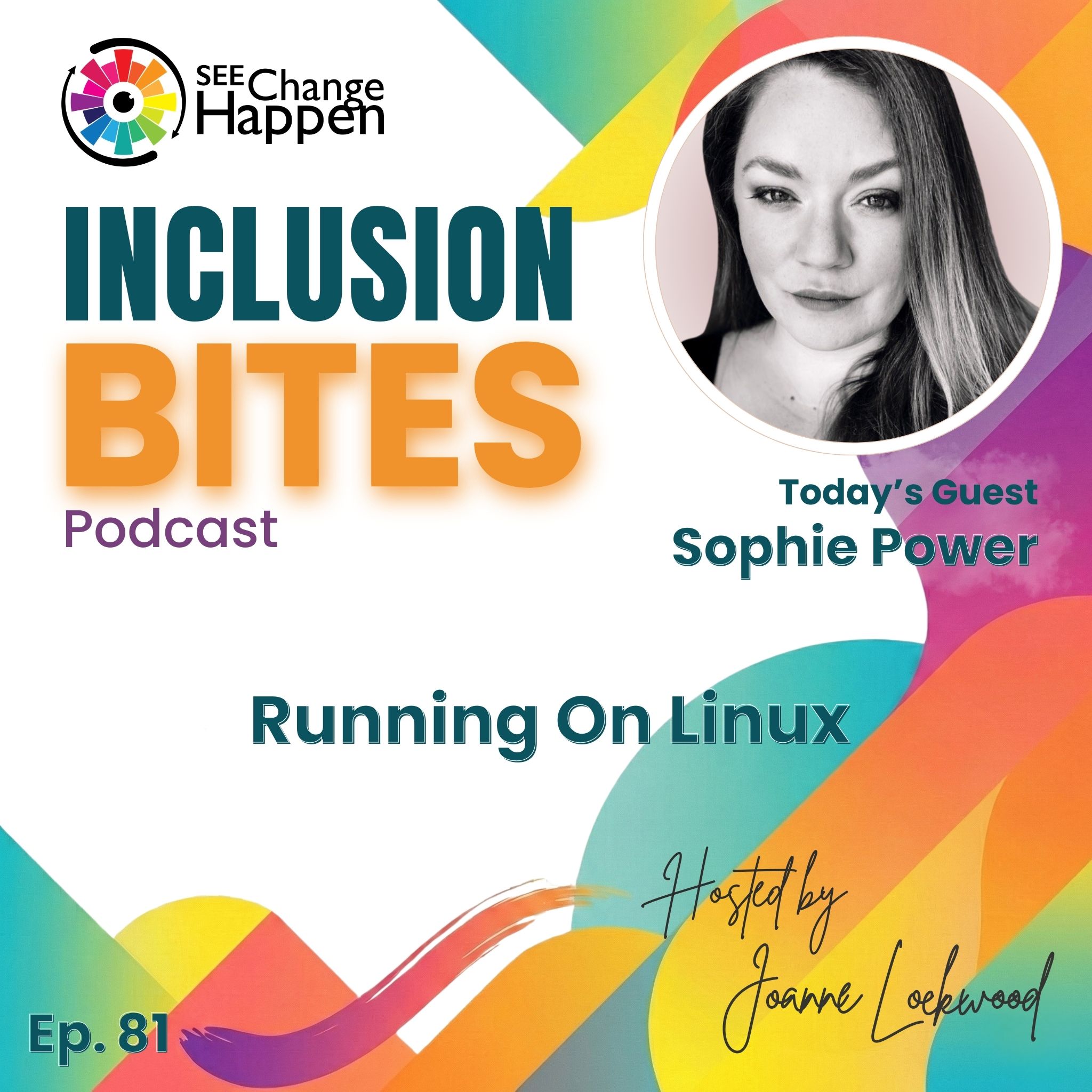
Exploring the power of embracing neurodiversity, Sophie Power and Joanne Lockwood challenge stereotypes, advocate for inclusivity, and share personal experiences that remind us to celebrate our unique operating systems in a world that values authenticity and understanding.
In this episode of Inclusion Bites, Joanne Lockwood speaks with Sophie Power about lived experience identity.
“I was obsessed. I knew every name of every dinosaur.”
Explore
Navigate this episode
Joanne Lockwoodhost
Hello everyone, my name is Joanne Lockwood and I am your host forthe Inclusion Bites podcast. In this series, I haveinterviewed a number of amazing people and simply had a conversation about thesubject of inclusion, belonging and generally making the worlda better place for everyone to thrive. If you'd like to join me in thefuture then please do drop me a line to jo.lockwood.co.uk@seechangehappen.co.ukThat's S-E-E Change Happendot co dot uk You can catch up with all of the previous showson iTunes, Spotify and the usual places. So plugin your headphones, grab a decaf and let'sget going. Today is episode 81 withthe title Running on Linux. I have the absolute honorand privilege to welcome Sophie Power. Sophie describes herselfas a talent lead and podcast host for Zinc, which isthe automated background checking software for Teams. When I askedSophie to describe her superpower, she said that she is apeople person and great at connecting with near enough anyone.Hello, Sophie. Welcome to the show. Thank you. Thank you so much for having
Sophie Powerguest
me. And hello. Hello,
Joanne Lockwoodhost
indeed. Sophie, we were chatting just now andwe decided to call this episode Running on Linux. Tell meabout that. Yes, we did indeed.
Sophie Powerguest
So, Running on Linux, sorry, when I can get my wordsout, is alighthearted way of describing my experienceover the past year of having been diagnosed at the ageof 32 with autism. It'sstill, it was at the time and still isa new experience for me. It's spent the past year kindof reframing the way that I've approached things. It'sobviously very interesting to be reasonably late in life, diagnosed,and looking back on thepast 33 years now at the time of recording, youknow, the past 33 years of living, I've always hadthe sense growing up, and I've often made the joke, oh I'm notwired right. It's been a running joke with some of my long termfriends, if any of them happen to be listening. They'll know that 1well. It was interesting to actually getthat confirmation, which while it wasn't a shock,it certainly was, it kind of was and wasn'ta shock, I think is probably the best way of putting it.It's very strange tohave the sense that there's got to be a disconnecthere somewhere. I've always had that feeling like, there are thingsabout life I'm not getting. It's not that I'munintelligent. It's not that I'm bad with people. It's not that I'm unempathetic.Quite the opposite. But there's something sort of not quite right there. So it wasreally interesting to realize actually, I'm tryingto, yeah, trying to, you know,sort of interact with a world that runs on Windows, if we're goingto use that analogy. And actually, I'm on a completely differentoperating system and I've been reading the wrong instruction booklet,whichwas where the analogy came from. I came up with it in the office,sort of as a little bit of a joke, butrealized actually it kind of hit the nail on the head of my experienceanyway, very, very well. So that's alittle bit of what running on Linux is aboutwhen I say that. So what was it
Joanne Lockwoodhost
that you realised was different about you thatled you to realise that the operating system was different?
Sophie Powerguest
Yeah, when I was veryyoung, like a lot oftoddlers, but probably more, perhaps more boysthan girls, but I think that's more a socialization point. That's probablyanother talk for another time. I was obsessed withdinosaurs.Anyone who's ever met a toddler probably won't be that surprised to hearthat actually, as my friends have now got toddlersof their own. But it wentbeyond just liking playing with the toys. Jurassic Park cameout when I was a kid, So myfirst cinema trip was to see the Jurassic Park film.I was obsessed. I knew every name ofevery dinosaur. You could put up flashcards ofthe most obscure dinosaur and I could tell you what their name was,what period they came from. I could tell you a fun fact aboutthem, what other kinds of dinosaurs existed around at the time. Itwas precocious. It was uncanny.My parents loved it. They thought it was brilliant.
Joanne Lockwoodhost
I I realize now, reflecting back
Sophie Powerguest
with the knowledge I do now, that was probably my first special interest andcertainly the first example. I amterrible at maths. I have actually known for sinceuniversity that I've dyscalculia. And itis what it is. I've worked with that for a long time. ButI was always extremely good at reading. I couldread and write long before I started school. Often,I remember as a kid, I wasactually told off for reading the wrong stickerbooks. I don't know if they still do this because I don'thave kids, so I'm not sure what happens in schools now. Butcertainly back in the 90s, you'd have coloured stickers onall of the books in the school library and a reading level would be assigned.And I'd, right from the get-go, be reading the higheststicker, which was purple and blue, if you're wondering, whenI should have been on red. Iused to get told off for reading too far above mylevel, which I remember thinking very strange and then being like, well, no, I'm notgonna read the Red Book. I read that 2 years ago, I'm not interested. Andsort of that, again, that kind of precociousness, butit didn't translate to later school life as school got more complicated,social structures got more complicated, things got more nuanced.I started to really struggle. I got bullied a lot at schooland I wouldn't really understand why. Ihad some really deep, passionate special interests thatI'd get laughed at for. I was very passionate about dramaand theatre and drama group.Passionate about politics, like a lot ofteenagers to be fair. That's not unusual, but I joined the student council,the local town council, and I'd very earnestly runcampaigns to get people in sixth form child bus fares. Iwas successful, I'd just like to say, because I was very persistent, verypolite pest. Itwould often be viewed as, I'd realizepeople weren't laughing with me, but I wouldn't quite knowwhy they were laughing at me, which is extremely disorientatingand confusing when you're already goingthrough the joys of being a young person. I wouldn't be a teenageragain for all the size 6genes in the world. Thenas I became an adult, I started to, inmy mid to late twenties, reflect back on a pattern ofrelationships, friendships, romantic relationships, and realizing Ioften got taken advantage ofand not quite realized the steps that were happening as they were happening, andsort of not see these patterns of behavior. So I'd gotake myself to the therapist's office. And then eventuallyI had a therapist say, Idon't know how to help you. And I was like, oh, it would have beennice if you told me that before we'd spent 6 months, mepaying 6 months of invoices, but okay. And sothat led me to kind of question what and why. And I think that sortof coincided with a growing movementof more adult women realizing that theirneurodivergence exhibited itselfvery differently to the stereotypes of ADHD and autism as being somethingthat happens to middle class white boys.It's veryreal and very valid forthem as well. And they still don't get the support they need, Ithink. When I reflect back on the boys at school I went to school withwho had ADHD and the stigmatismthat they faced. And I remember that. Youknow, it's something that flew under the radar for me. And rather than,you know, Sophie, Sophie is autistic. It was just, Sophie's weird.She wears weird clothes becauseshe doesn't see the point of wearing the fashionable clothes just because everyoneelse is. You know, a little bit of sort of that oppositionalkind of tendency. So yeah, it was a lot of things. And thenyeah, it sort of culminated in end of twenties, spending my... I turned 30 beforethe pandemic, but my early thirties spent 2 years sat alone in myflat because I lived alone and was single and self-employed. Sotriple whammy of solitary confinement for lockdownand realizing that 1, I'mactually okay on my own. Yeah,I haven't noticed it's been 2 years. Oh, right, okay.And realizing I've dived into another special interest andNow I'm surrounded with loads ofart and things I've created and that's really cool. I'm realizingactually I do really well in online communities andliving online. I'm realizing it's because there arerules and there's rules for internet forums, there'stheir structures, there's ways that you converse and things you do and don't sayand it's all very kind of fixed and literal. Andthen I think the absolute catalyst for goingforward and getting a diagnosis was going out fora catch-up dinner with an old uni friend who herself hadbeen diagnosed with ADHD. And she saidvery sensitively and very empathetically,Have you thought about it for yourself?Because a lot of the things that weshared as a struggle, she was a course mate, we sat togetherevery day for 3 years. Just sort of, you know, Some of the things westruggled with together, and it was just a joke and a, ha, ha,ha, love deadline mode, lol. Actually,it turns out it was just classic ADHD symptoms. Thatled me to, through Psychiatry UK with the NHS,looking at ADHD. And then actually, themore I spoke to my psychiatrist, she said that it's, I think,the underlying issue that's really driving a lot ofsort of the things that you're talking about struggling with is actually autism. Andthen from there ended up getting a diagnosis and itwas like, you know, sort of mind, quitemind-blowing in a slightly long
Joanne Lockwoodhost
nutshell. So getting the diagnosis,what difference did that make to your life? Just that diagnosis.So what changed as a result of that?
Sophie Powerguest
Um, in some ways, absolutely nothing.Um, so in some ways, like, you know, I kind of told some people andthey were like, yeah, I'm not surprised. Like, oh, did you not know?Was how some of my friends responded, which was quite, I mean,I'm a big fan of just not taking life too seriously andhaving a bit of a giggle, as you probably tell by the suggested titleof this podcast. So, you know, I found, you know, sort of some of themwere like, yeah, yeah, we know, babe. It's okay, welove you anyway, which is wonderful. And then,you know, sort of other folks, it's sort of the classic,you don't look autistic comments, whichI'm not really sure how to unpack. I don't know how I feel about themactually. It's only been a year. I don't really know. I don't have enoughof data to do a retro on that.And then in other ways, therewas a period of reframing mywhole life's experiences, and thathas been very tiring. Soas I've talked a lot about school so far already, but alsomy professional life. There's been so many timesand references that are in my report as well,talking about, you know, incidences at work where I've justbeen blindsided by things and been really shockedby, you know, that or I've said something thatI think is completely innocent, and then somebody's reacted like I'vethreatened their firstborn, and it's really blown my mind. I'm like, whyare you so angry? I've just asked the question.I'm not understood why People have hadquite extreme reactions to what I think are quite innocent things.I'm a nice person. I do nice things. Ilike to help people. I'm always looking forthe best way of doing things, doing the right thing,and invoking community is really important to me.Having that reaction sometimes has always been quite shocking.It's been a period of reframing all of those experiences and going, well,actually, me and thisother person are just reading, seeing off completely different hymnsheets to pick a colloquialism.We're approaching things with a completely different way ofseeing and experiencing the world. And that's,sometimes yeah, there's been a lot of feelings with that.
Joanne Lockwoodhost
And now I understand that I feel things quite strongly and why.Is anybody neurotypical? You know, we talk about beingnormal. Normal is such a very fine line on the bellcurve of extremes. Who is neurotypical? Becauseeverything you're describing, I think, yeah, I get obsessed about that. Yeah, I can dothat. I was very polarized in my school years.Maths and physics, I was completely in tune with. So Iwas A grade maths and physics and chemistryand biology. But Z grade if there was a Z grade inother things like French and German and some of themaybe economics, those sort of things. So I'm either in orI'm out. If you look at my report card, there was nothing in the middle.It was either loved it or hated it, which isa classic symptom of assessing and pulling things apart and getting to thebottom of it. If it's in your frame, if it's not, it's justnot relevant to you. So is anyone actually neurotypicalor is everybody on this, I hate the word spectrum,But we are all different. And who said that 100, 000years ago, when our species started evolving into communities,that we had to be typical? I always think about dyslexia.Dyslexia is... Who decided that we were designed to write and read?Who decided that? We haven't evolved to read and write. So who says dyslexiais abnormal? Dyslexia could be our default position andwe've just decided the social construct we've created says that dyslexia iswrong or not as good. I think, so who says that neurodiversity, youknow, your traits that you special, your superpower,would have given you significant advantage in certain, and theyprobably still do in certain situations, where you can hyperfocus, you can get really stuckinto something and block everything else out to get a task done or toachieve something. And I think we often see people asdifferent, when really we're just, we'reall different. I wonder if you've experienced that kind of feeling aswell. Yeah, definitely.
Sophie Powerguest
Yeah, there's really a sense of we allbring different things to the table and we're all good at different things and weall, you know, there are some things I'm absolutelyatrocious at. The 7 times table, sorrymum. Long division, awful.To be honest, budgeting, again, my dad's an accountant, sorry dad.But then there are other things I'm really good at, which is,I am 1 of those rare people that is quite comfortable walkinginto a room full of strangers on her own and going andmaking friends. And again, Ireflect back and I've traveled all over the world on my own. And to me,it's like, yeah, sure, why not? Her firstsolo trip was when a friend pulled out and was like, I'm really sorry. Iknow you really wanted to go. And I was like, oh, I'm still going. Shewas like, what? I was like, yeah, I'll just go on my own, it's fine.And I didn't really appreciate at the time, 20 yearsold as I was, that was quite an unusualthing to do. But it just never occurredto me to be any other way. And then you realize,yeah, we've all got different strengths.Some of my friends are very analytical, some ofmy friends are very social, and some of my colleagues are very creative.Some are very data and numbers driven.Some are very pragmatic. Some are very energizedand their thoughts jump all over the place. I see it happen in meetings.You've got people who come out with20 different ideas in the space of about 10 minutes, and then you've got otherpeople who are more methodical and analytical whosit there and we go, right, okay, well, let's put these in order andlet's have a think about how we're gonna, you know, make some of these ideashappen. Do they relate back to this? You know, and then you've got somebody whogoes, right, okay, cool. Well, if we get 0.1 done byFriday, I'll get it done.You know, And so if you have people, if you have ameeting room to relate it back to work,if you have a meeting room full of purely analytical people who just sitthere and drill through numbers and no creative people and no kind of peoplewho can just get stuff done,nobody's going to tell you what to do with the data. So you're going tohave loads of really interesting data, but where's the insight?Where's the action that comes from the insight? Where's theprogress? So you need people with lotsof different ways of approaching things, whether that be the way we evolvedthousands of years ago, or the way that we work now. So yeah, Iagree. Normal is, you'reright, Jan, such a narrow definition and I don't think itserves anyone, let alone somebody workingon a different operating system. Yeah, and you could
Joanne Lockwoodhost
probably appreciate I was operating on a, Ithink MS-DOS when I was growingup, I'm that old. In fact, pre-MS-DOS punch card, I think I wasoperating on. And it took me to my teens and 20s and intomy 40s to realize that I was running on the wrong hardware.And I had to do a shift. And I often think that thefact I'm left-handed, the fact that I'm transgender, it's justmy brain has a different set of wiring and it's no different to being neurodiverseor whatever it may be. And some might argue that some of my traits havea touch of autistic or ADHD or ADD about them because ofwho I am. But I kind of think like you, they're just who I am,they're my superpower. And I remember seeing apsychologist or psychiatrist, whichever the definition was, at the genderclinic. And I remember coming out with a bit of paper and it said, youare trans, DSM 64.2. Yeah.Transsexual. And I went, yay, I'm official, I'm real,I exist. I'm not making this stuff up. And sometimesjust that bit of paper or that diagnosisgives you permission to be you and then put everything in place.And it unlocks a lot of the history of you. Irelate to that completely. Yeah, definitely that. It was
Sophie Powerguest
a really surreal feeling because the whole assessment wasover a video call. And I was actually, I wasn'tworking at the time, so I was waiting to start atMyNow Companies Inc, having had a prettymajor operation actually. So it was very surrealto just be like, okay, I've had a really major operation onmy body and my whole body's going to be different now.And Also so is my brain. I'm going to move house and starta new job. Whyam I so tired all the time? I don't get it.In a way it was really energising though, because it gives youthis, yeah, like that sense of, yeah, youput it really nicely, permission to, or sort of a,like a, what is the word, permission,mandate, a mandate to be yourself. Yeah, mandate,
Joanne Lockwoodhost
I like that, yeah, it's good as well. It's, yeah,you've got the authority to be you, haven't you? And it's, and you're authentic, You'renot playing at this. Yeah. I mean,I want to take you back to the dinosaur comic. Because Iremember when I was in my childhood and I remember there being acomic, you know the comics used to come with that really, really low quality newsprint.And I remember having 1 and it was a case of over the over like6 to 8 weeks, you had to read this comic strip andidentify all the dinosaurs that were in the story.And you then had to work out from the images of them. SoI spent hours in the local library with my mum. This is waybefore the internet. This is in the mid seventies. So we're in the local librarywith my mum getting books on dinosaurs out and trying to work out which dinosaurwas which. And so I entered the competition with like a list of 20dinosaurs. You know, this picture, this picture, this is what? And I won.I got every dinosaur right. It was like, so we're justtalking about being obsessed with dinosaurs. Um, waybefore Jurassic Park. But 1 thing I was looking at the other day, there's aTikTok reel or something on Facebook or something that came up, someone hadmade an 8 foot high, I guess it was a velociraptor,just from the Jurassic Park type thing, made out of chocolate, made out ofchocolate. And this thing was absolutely, I mean, youcould have made it out of any mouldable material, but he was a chefand he made it out of chocolate, it's absolutely incredible.In fact the comments in the chat underneath was the dinosaur's teethare too perfect, they didn't have dentists,the teeth wouldn't have been that shiny. So I thought it's a fantastic thing butwhen you said you know interesting fact about all these dinosaurswhat's your interesting or funny fact about a pterodactyl then? I really want to knowwhat what's interesting and funny about a pterodactyl. Oh gosh
Sophie Powerguest
um do you know what the the really the even funnier thingis that I, to my great shame, don't remember a lot ofit. So I remember the obsession, I remember the fun,I remember the excitement. I have actually quite a lot ofdinosaur themed clothes in my wardrobe. If my colleagues arereally lucky I might wear my dinosaur dress to work 1 day.Last time it had an outing was my friend'sson's second birthday party, which was dinosaurthemed. But yeah,
Joanne Lockwoodhost
pterodactyl. There's something in the way the names
Sophie Powerguest
made. So ptero isa number and dactyl refers to fingers.So, the wings, they've got a certain amount of fingersand that's where the name comes from because they obviously they're winged.
Joanne Lockwoodhost
They are lizards with skin between their body and their arms, aren'tthey? Yeah. Yeah, okay. Yeah. Yeah, which is quite cool.
Sophie Powerguest
And, yeah, and then my parents, of course, having a kidthat was obsessed with dinosaurs, took me to the Natural History Museum in London. Andthey were really excited for me to see the big animatronicI was terrified, absolutely terrified.It looked, when you're tiny, it looked very real. It is prettyscary. And I wasapparently cried and cried and criedand didn't actually want to see it because it looked too real.Because yeah, they felt very real. I had noconcept of what 70 million years ago might feel like. Noneof us do.Then I went back as an adult when I had a random day off work,as you often do when you spend some periods beingself-employed. And I was like, oh,0, it was a really nice trip down memory lane. It was justbefore Dippy went on holiday. Butyeah, so that was really cool to see.To see sort of all of the... Yeah. Yeah, all of the... I've gotan Instagram boomerang of the T-Rex at the Natural
Joanne Lockwoodhost
History doing its growl and sort of thing. I've got a little boomerang on myInstagram. Oh, amazing. Yeah, I found it quite interesting. I thinkwhen we went to Florida, I think it was Disney, there was a ride whereyou're either on a boat or something and you're going along and you got tothis cliff edge and this T-Rex or some big dinosaur popsits head over the edge and like, oh my god, I wasn't expecting this. Iguess it's called the dinosaur Jurassic, it must be called the Jurassic Park, right?We were in a jeep or something, that's probably what it was, yeah.And this big T-Rex thing pops over and it's like, oh, I remembermy children were really, really frightened of that. Oh yeah,
Sophie Powerguest
it's very scary when you're little andeverything looks so much bigger for a start, and everything's somuch louder and what have you.There's 1 place I haven't been yet, actually, is Crystal PalacePark. I don't know if you know. It'sin South London, for anyoneunfamiliar with the geography of outer London.There are lots of statues of Victoriandinosaurs, so Victorian impressions of dinosaursfrom the Great Exhibition of 1888.I want to say 88, but I'm not a historian.I'm making that up. Around that time.I really want to see them, but I live in North London so it's abit of a trek and life is busy. 1 of thethings that's really interesting about them is that they're actually very historically inaccuratebecause they were based on what few fossils they hadand obviously modern science and modern paleontology is caught up and said actuallythese aren't accurate. So it's sort of like Victorian impressionsof dinosaurs based on all these bones they started finding
Joanne Lockwoodhost
on the Jurassic coast and things like that. Even now, they're trying torewrite some of the thinking about dinosaurs, about the color,even some of the shapes and the skin texture, some of maybe having morefeathers than they probably imagined because wecan't establish colour or some of those things have obviously deteriorated overthe years but they're now trying to reimagine dinosaurs witha new more modern light rather than say based on that Victorianjust a skeleton. Yeah, which is really interesting.
Sophie Powerguest
Speaking of Facebook and Instagram, I did see quitea funny meme about dinosaurs a couple of months ago.I think I sent it to 1 of my mates being like, lol, how'd youdo? Itwas a comment that basically said,we have no idea if dinosaurs had hair or not because fossils don't preservehair. So imagine a dinosaur looking like this. It was a pictureof a diplodocus with a long head of brown hair,just randomly, which was quite like a little drawing thatsomebody had stuck some, you know, drawing of some hair over, which was quite funny.And yeah, maybe, you know, in another sort of20, 30 years, there'll be a completely different framingfor what we know about dinosaurs then.
Joanne Lockwoodhost
Going back to the topic we were talking about,if anyone's listening, you can probably gather we could probably talk about dinosaurs or anything.We could obsess over anything for hours. This is great. Ilove this conversation. Going off, just talk about random stuff.I see a lot of, you know, you're in recruitment,I'm in EDI, HR space, we obviously hang out onLinkedIn a lot. And you see a lot of memes,stories around autistic superpower,how autistic people have got this sort of extra spideysense or this fixation with data. What worries mesometimes is we're trying to categorise orstereotype autistic people as rain man, youknow, data experts. Is that setting up people tofail sometimes because I'm autistic, but I'mnot a mathematical genius. Are we creating a stereotype?
Sophie Powerguest
Yeah, I think so. I think there's a lot of, it'swell-intended, like a lot of these things are.You know, It's born out of a desire to celebrate andchampion with the best of intentions.But I think when we create this view of the autisticsavant, and if you look to media, There's a lot of that aswell. I've not seenthe show, but there's a Korean detective show, The ExtraordinaryDr. Woo, we want to say. There's also SherlockHolmes, another famous, more readily recognizable 1.They're often autistic coded characters. It's like these genius,analytical savants. And1 of the things that I think I realize now I'mvery good at is that's often seen as Spidey sense,quote Marx, but it's pattern recognition.I'm very good at spotting tiny littlechanges in people's behavior. I am theabsolute worst person to watch a film with, becauseI very quickly have worked out how it's going to end. I also have adegree in comparative literature, so I've read pretty much every bookthere is to read and made anextensive study of all the different types of storiesthat could possibly exist. There's a little bit of that as well. ButI'm really good at watching it and going, yeah, no, it wasn't thehusband. It was the cousin.And people watching this detective film, peoplego, wait, what? And then it turns out to be right. Andthen I realized, I think it's brilliant. So I'm like, oh, great. And I've satthere and I've worked out. My friend sat with me watching isfrustrated because I've just bought it for them. And for them, the surprise is thejourney. I hate surprises. So like thatpattern recognition, that perception,that analysis, I think can be reallyharmful because ultimately, the way I see it, is it frames autisticand neurodivergent people as, you know, it framesthem in as much as their use tothe wider population. Ifeel like the 1 thing people have always said is, what'syour superpower? Oh, well you just have to find your superpower,is 1 thing somebody said when I told them I was autistic and theymeant well. I'm notoffended or anything, but it obviously puts pressureon the neurodivergent person to almost prove theirworth. What use have they got? If you're going tobe disabled, what value can you provide?Is it the more sinisterkind of message? I don'tlove that view. It's wellintended and I don't think anybody's ever meantit in a harmful way, but I think it puts a lot of pressureon people. Because sometimes actually, youknow, The burnout is real and the exhaustionis real. It's very tiring. I wasalways confused by where people got their energy from.Just going a whole day of being at work, socializing,talking. I love socializing. I love talking.And then also the executive functioning around going home and managing ahousehold if you've got children, managing a household with children,which is a whole other board game. And, And,you know, and then kind of doing all of that and then also having thetime to go to the gym, have hobbies, like have long-term goals,you know, work on a long-term project, you know, saving for ahouse, you know, planning a big trip, you know,organizing a wedding, like take your pick, you know, where do people get allthe energy from? And to then alsohave to think about your superpowers and how to present themand how to find them and how to unpack them andshow them. That's also really tiringwhen you're also swimming against the tide.
Joanne Lockwoodhost
As an
Sophie Powerguest
autistic person, I suddenly realized, I talked about it with Theo Smith, sorry,but just before Christmas and, youknow, sort of things like sensory sensitivitiesand lighting and all of these things, you know, Stimmingand fidget toys and things, yeah. Yeah, and a lifetime of being told tostop fidgeting and being put in detention or told I look like I'mnot enjoying things because I'm fidgeting in a meeting. It's just like,yeah, I've got a couple of- Sorry, I'm just holding up
Joanne Lockwoodhost
my squidgy, I've got some squidgy teddy bears here, which Ioften play with. I've
Sophie Powerguest
got a couple of poker chips that I fiddlearound with. Don't even play poker.Not remotely good at it. But I've got a couple of poker chips that Ifiddle around with like off camera when I'm in meetings and it reallyhelps. It actually helps me focus, so I look likeI'm fidgeting and not paying attention, but I'm actually more focused for doingthat. Yeah, 1 thing I
Joanne Lockwoodhost
noticed, I was at a workshop thatI was facilitating for a charity I'm a trustee of actually,and 1 of the things they did to prepare theenvironment was to be neurodiverse aware. So what they didwas they made sure there was no strong lighting. So they turned them forsensory person review that they didn't use the main room lighting. They put table lampson every table and they put fidget toys out andpeople who want to stim or fidget or play or occupy their hands.And I'm holding 1 now, it's like a bit of a plastic mesh with amarble inside. I picked up this, I've also got another 1, which is a kindof a key ring type thing, which you just flip over. And1 thing that I've suddenly realized after a couple of hours ofplaying with these that I hadn't touched my phone.And what I realized that I'm picking up my phone, I'm playing with it, I'mstimulating myself, I've got this obsession with checking it, Ican't handle any red notificationicon on my app, so I've got to close them all. And I realised thatyou can actually turn the notifications off, so I started going around to turn thenotifications off so I don't have to close them. But I found that after acouple of hours of just playing with these fidget toys, I wasn't picking my nails.I often pick my nails. I'm very guilty of that. And Iwasn't picking my phone up. So I realized that actuallymy brain needs something to fiddle with. And,and I, it was a real awakening for me. And I shared that when peopletalk about fidget toys from a neurodiversity point of view. And I don'tknow if I'm neurodiverse, I haven't had a test or haven't even considered it.But what I have identified is that I do benefit froma fidget toy in a way of helpingme put my phone down and maybe start havingconversations and being more attentive becauseI'm not fidgeting in the background, if you like. Yeah, yeah,
Sophie Powerguest
it's definitely, I think it's something a lot of people can benefitfrom. I mean, you'll probably know better than megiven your line of work, but I think we call themaccommodations for disability, but actually they're things thatbenefit everyone, regardless of neurotype.There are a lot of people who could probably focus muchbetter on meetings when they doodle on their notepad or theytwiddle a couple of poker chips to dosomething with their hands rather than bite their nails. I am a nail biter. Iwas for my entire childhood. I was constantly nagged about it. Realistically,I was probably stimmingbecause you weren't allowed to fidget. You had tosit stock still, stare at the front of the class, not say a word, notmove. And if you did, you were told off, sent to the corner or putin detention. And soyeah, so we, you know, 1 of the things I've done recently at Zincis write a sort of, not apolicy policy, it's a bit heavy handed in a 30person seed stage startup.But just write what equality means at Zincand what it means in practice. Because I thinka lot of it was done in an unspoken way. And actually,for those of us who need things outlined, it's very useful. SoI outlined it. And 1 of the things we talked about waslike, do you need to use fidget toys? Do you need to, Is ithelpful to wear sunglasses in the office sometimes?Does your hyper focus look like dancing at your desk with someheadphones in while you've got 3 browser tabs open?Because that's what it looks like for me.My colleagues are very patient when I needto work that way. And then it makes it easierfor me knowing that They're comfortable with lettingme work my way and supporting that, which givesme the energy back to help them when theirway of focusing and knuckling down is silence and not talking.You spend 20 minutes being like, right, okay, let's putsome music on and have a bit of a chat. It seems like,great, I've got loads of work done now. Okay, right, I'm going togo make a cup of tea andgo and sit and do things. Thenwe'll have some quiet time. Iswitch my diary around because some days I sit and get my headdown. Those are work from home days. Then I try and do themore people-focused things. But yeah, there'salso been times when I've worn sunglasses in the office. And myteam have been really good at just notmaking a comment, actually. I turned up on a video call at aprevious company once wearing sunglasses because I was just overjust too the sun was like beaming into my flat and I waslike oh I can't even anymore. And instead of sort of likemaking a big comment about it everybody just put the zoom sunglasses filters onSo we ended up like an entire call of people wearing sunglasses, which Ithought was quite funny.Um, but yeah, um, I can certainly relate to
Joanne Lockwoodhost
what you're saying around the, the noise, what you have noise in thebackground, sometimes you do sometimes you don't. I mean I'm 1 of these people thatI walk around my house telling Alexa to stopbecause Alexa's often got radio too on in the backgroundand when my wife sets it up she tends to have it at a kindof a background hum level And when it's because my hearing is fadedas I got older or not, I find this like, noise where Ican't quite hear the vocal, I can hear the music, but I can't hear thespoken. It just really, really, I gotta go, just turn it off, eitherturn it up or turn it off. I can't handle the hum level.But I can find myself sitting in silence for hours without even, and go,oh yeah, I've been sat in silence. Or sometimes I get in thecar and I haven't turned the radio on, I haven't put any music on oranything, and I've driven to Manchester and I get to Manchester and I realizeI've just done that in silence. I haven't had any other stimulation.My brain has been focusing on obviously the drive but also it's beeninto thinking mode or exploring ideas modeand yeah I can be perfectly happy. I think you said earlier you can spendall day on your own and have a great time and you don't need anybodyelse to sort of join in sometimes. Oh, there's enough going on up there
Sophie Powerguest
to be honest. Yeah. It's been busy for hours. Like, yeah, it's interesting.Like I definitely have days where, yeah, I need the stimulation.But then I also have days where, God, I would love to just hitpause. And those are definitely the days where,yeah, I'd prefer a quieter day, lower lighting, lessmusic. And it's actually not because I'm lower in energy, it's because I've got toomuch. And as well as being, you know,sometimes under stimulated, like there have definitely been times when I've beenoverstimulated. And I've, I've been likeway too up. And then, you know, sort of, I'vegot other people in the office where we sort of hype eachother up and then it's, you know, I'm up in the ceiling and I'm justlike, oh God, I've got to go home and try and go to bed andcalm down now. And yeah,so that's always a fun 1. So it's sort of, yeah, it's, andit's interesting because I just didn't have any clue about any ofthis until a year ago. So these things werehappening and I just assumed that these were experiences that everybody had and that wasnormal and well, you know, normal, quote, mark,widely experienced, you know,and it turns out that actuallyless widely experienced than I realized it. But 1 thing aswell is that understanding about yourself helps you to find your tribeand your people. And I've always felt a sense when I was youngerof not fitting in and not feeling likeI've met my people, that kind of senseof belonging. And I feel I'm much closer to that now I have abetter understanding of where I belongand what belonging means which is really important.
Joanne Lockwoodhost
So in your job you are a talent acquisitionspecialist. Yeah, for the person on thestreet, that's a recruiter. I know it's a... Yep.Whatever. You place people into roles for a company.So as someone who is neurodivergent, hasASD, autistic, ADHD, whatever terminology you use,what do you think is important for people in the TAprocess, talent acquisition process, to think about when engaging withcandidates who are specifically around neurodiversity?What are the good things? Because there's still lots of myths and you should dothis and should do that. What really makes a difference? Yeah
Sophie Powerguest
so Things aroundlike the typical sort of socialmarkers of confidence, credibility andsuccess are very much rooted inwhat that looks like for a neurotypical person.Eye contact, a firm handshake, less umsand ahs, minimal pausing,sounding certain, sounding assertive, projecting your voice clearly.Now, Ihad a lot, I used to go to theater school in my spare time, soI've had a lot of training in these things from a young age.It's a passion of mine. I was at the theater on Monday.So these are things I realize now are a big part of my masking.But actually when I'm very tired, they're things I really struggle with. And I realizeI catch myself stammering and I find eye contactpainful. And, you know, oh, don'ttouch me. Don't shake my hand. Don't gently pat me on thearm. Like, ooh, leave me alone. Yeah,and, but then, you know, sort ofwhen I've got more energy, these things I don't struggle with, but that isn'tthe experience of everybody. You know, and so for a lot of candidates,like 1 of the things we put on our website about accessibility at Zinc is,you know, if you need to make us aware that you'reuncomfortable with eye contact or you don't want to do handshakes oryou need softer lighting in your interview room, then let us know.The lighting is probably the 1 I'd need the most notice about because I needto work something out with our office manager. Butit's not insurpassable. We can overcomeand sort of work with all of this. So, you know, noneof these things are difficult. And Ithink as a company, as an employer, as arecruiter, it's just a matter of letting people know that they're availableto be asked for as well. The burden doesn't always have to beon the disabled person toguess what you're able to provide. Letthem know what you can do straight off the bat, what youunderstand, you know, because it also shows that you're an employerand a business that thinks about these things proactively, whichmeans that they are, you know, when I'm looking at things, I know that I'mmore likely to be more comfortable because these are peoplethat think about this stuff before I've asked them to because it's stuffthey care about and it means something to them.Also, none of these things are expensive. None of these things are time consuming.None of these things actually impacts an ability to do a job.You know, unless your job's a professional eye contact andhandshake tester, that job doesn't exist. Youknow, it's absolutely fine, you know, tosometimes just not say a word if somebody's wearing sunglassesand headphones in the office, like they're getting the job done. It's
Joanne Lockwoodhost
cool. I've said that before when people are transfixedabout grammar and spelling on CVs. And I say, Look,you're hiring and recruiting a forklift truck driver.Does it really matter? What you're looking for is, are they competent andsafe for driving a forklift truck? So oftenwe create this normative expectation andbiases about who this person must be in orderto be good enough. And we're just notthinking about what the requirement for the role is and the greatattributes we're looking for. We're creating all this other stuff.And I've seen the debates again on LinkedIn aroundthe do or don't around sending the interview questions inadvance to the candidate. And people will say, well, if you send theinterview questions, that's cheating. They'll be able to rehearse them and practiceand do some research. You think, well, hang on a minute, in myjob, when I'm doing things, I rehearse, Iinvestigate, so what we're trying to do here is we're saying you've got tohave a fantastic memory and be able to recall facts and figures, or you'reactually saying that in the real world, we don't expect you to shoot from thehip. We want you to think about things in advance. I think it's agreat way. And... Yeah, I mean, when you actually get
Sophie Powerguest
the job, you're expected to prepare for meetings. Youknow, if I turn up to a meeting with my managementteam and I've done absolutely no prep and I've got no idea what I'm doingand I'm just rocking up and winging it, that wouldnot go down well. I've got a lovely team, but they wouldn't be happywith me. So what's wrong with helping peoplefeel prepared? Some people don't. And I thinkanother thing as well is like, what I will say, because I've experiencedthis as well, I have been offered to be sent questions ahead of time andI have accepted and gone, thank you. I have sat there, gone through the questions.I've not written a script, but I feel prepared and organized. And then I've goneinto an interview and been asked completely different questions.Deviating from a fixed plan is probably 1 of the easiestways to intensely stress outa lot of autistic people I have interacted with and certainlymyself. That was probably 1 of the most stressfulinterviews I've ever had because I don'tlike surprises and I hadprepared to be interviewed for this job this way because I'd been told that washow it was going to be. So that's probably another thing I'd say to bemindful of. If you are going to do it, commit to it. Stick with it.But yeah, It's another way of showing if they really want the job,they'll take the questions and prepare. So if they've prepared, they're showing you that theycare about the job. They're showing you how they'll turnup to meetings prepared and organized. You can send themthe questions, but they might not necessarily read them, prepare them,use them, make the most of the opportunity. If they don't, that initself is data that you may or may not wantto use. It's not cheating.If you've got to that point in the interview, they've obviously at least shown, atleast on paper, that they've got potential. So you'reexpecting them to have experience or the rightattributes or whatever. Yeah. Is that
Joanne Lockwoodhost
modernizing the recruiting profession, isn't it?And opening people's eyes and ears and mindsto. What would be, I hate the phrasediverse talent. I hate that with impassion but I keep using it. WhatI mean is people of all experiences making sure that we're valuingpeople, making accessible, making it available to all andrecognizing the equity we need, the extra support people need and whatever itmay be so that people can succeed. Yeah.
Sophie Powerguest
Yeah, and neurodiverse folksare notably underemployed,either because they've been working,again, in a system that isn't set up for their success.They are literally underemployed. They're not hitting the potential they couldwith even minimal support. But then also,there are lots of people that have a desireand a want to do work but are struggling to get through the door andactually would be able to do lots of differentjobs and provide lots of sort of value totheir own lives and their self-esteem and also the workforcebut you know are being held back bysilly outdated practices.
Joanne Lockwoodhost
And on that note, I think it's been fantastic chatting toyou over the last, well, we've actually been talking away for about an hour anda half before we started. And nodoubt we could keep talking about, well maybe even dinosaurs. I gotobsessed with planets when I was younger, sort of the solarsystem and I used to write whole projects for myself onthe planets, do all the researches and yeah, the temperature on thesurface when it was in front of the sun or behind the sun, it waskind of all this kind of stuff. Oh wow. Yeah, we could go on forhours. Sophie, how can people get hold of you? Yeah,
Sophie Powerguest
So if folks wish to get a hold of me, the easiestway because I go on there more than any other form of social media isprobably LinkedIn. I am on LinkedIn as Sophie Power andthen in bracket she, her, mus, which are my pronouns because Iupdated it before they put the pronoun feature in. AndI, yep, I'm at Sophie Power, working at ZinkWork as a talent lead. And I'm also can be foundvia Talent Hacks for Scale-Ups, which is the name of my own podcast.
Joanne Lockwoodhost
Fantastic. That's absolutely amazing. And thank youto you, the listener, for tuning in, for getting this far. Ireally appreciate your time, and hopefully you've enjoyed this. I have.Please do subscribe, if you're not already, to keep updated on futureepisodes of the Inclusion Bites podcast. That's B-I-T-E-S.Please tell your friends and your colleagues, please share the love. I'm sure they'llenjoy it as well. As you can imagine, I've got a number of otherexciting guests lined up that I'm sure you'll be equally inspired by over the nextfew weeks and months. And of course, that may well be you. If you'd liketo be a guest, then please let me know. Or if you've got other comments,feedback, or suggestions on how I can improve, then just drop me a lineto jo.lockwood at seachangehappen.co.uk.And finally, my name is Joanne Lockwood, and it's been anabsolute pleasure to host this show for you today. Catch you nexttime. Bye!
Joanne Lockwood is joined by talent lead and podcast host Sophie Power to explore what it feels like to discover, in adulthood, that you have been “running on a different operating system” all along. Sophie shares her experience of being diagnosed as autistic in her early thirties, what it changed, and what it didn’t, as she reframed years of school, relationships, and work through a new lens.
The conversation unpacks how popular culture and workplace narratives can over-simplify autism into the “autistic savant” trope. Sophie discusses why the language of “superpowers” can be well-intended yet still put pressure on autistic people to prove their worth, and how traits like pattern recognition are often misunderstood or over-romanticised.
They also move from story to practical inclusion. Sophie and Joanne discuss simple, low-cost adjustments that help neurodivergent people thrive, from fidget tools and sensory-friendly lighting to clarity in processes and reducing unhelpful expectations around eye contact, handshakes, and interview performance. In recruitment specifically, Sophie argues for transparency, offering adjustments up front, and being consistent if interview questions are shared in advance.
Throughout, the episode returns to belonging, authenticity, and the idea that supportive environments benefit everyone, not just those who disclose a diagnosis.
“I think that sort of coincided with a growing movement of more adult women realizing that their neurodivergence exhibited itself very differently to the stereotypes of ADHD and autism as being something that happens to middle class white boys. It's very real and very valid for them as well.”
“You need people with lots of different ways of approaching things, whether that be the way we evolved thousands of years ago, or the way that we work now.”
“There are lots of statues of Victorian dinosaurs, so Victorian impressions of dinosaurs from the Great Exhibition of 1888. I want to say 88, but I'm not a historian. I'm making that up. Around that time. I really want to see them...”
“That perception, that analysis, I think can be really harmful because ultimately, the way I see it, is it frames autistic and neurodivergent people as, you know, it frames them in as much as their use to the wider population... I don't love that view. It's well intended and I don't think anybody's ever meant it in a harmful way, but I think it puts a lot of pressure on people.”
“The burden doesn't always have to be on the disabled person to guess what you're able to provide. Let them know what you can do straight off the bat, what you understand, you know, because it also shows that you're an employer and a business that thinks about these things proactively.”
“Deviating from a fixed plan is probably 1 of the easiest ways to intensely stress out a lot of autistic people I have interacted with and certainly myself.”
I think it's important that we see autistic people as valuable in all respects of life, that our value is not limited to our unique abilities.
Questions this episode helps answer
How can harmful stereotypes of neurodivergent individuals be challenged and addressed in media?
Have you ever felt pressure to prove your worth or value in a professional or personal setting?
Do you think there is a narrow definition of "normal" in society?
How can employers better accommodate and support neurodivergent individuals in the workplace?
Have you ever experienced a positive impact on your work or productivity when provided with accommodations for your disability or neurodivergence?
How can we normalize and celebrate differences in thinking and operating systems, instead of seeing them as deficits or abnormalities?
Explore topics
Ideas from this episode
Lived Experience Identity
Authenticity
Belonging
Change & Transformation
Confidence Self Worth
Community & Connection
Learn
Frequently asked questions
What is neurodiversity, and why is it important?
Neurodiversity is the concept that neurological differences like autism, ADHD, dyslexia, and others are natural variations of the human brain rather than disorders to be cured or fixed. It is important because it promotes a more inclusive and accepting attitude towards people who think, learn, and communicate differently.
What are some harmful stereotypes about neurodivergent people, and why are they harmful?
One harmful stereotype is the autistic savant, perpetuated by media portrayals like Sherlock Holmes and other fictional characters. This stereotype suggests that all autistic people are only valuable for their unique abilities, like pattern recognition or analytical skills, and completely ignores their struggles with executive functioning and social interaction. It is harmful because it creates unrealistic expectations and pressure to prove oneself as an autistic person.
How can employers promote accessibility and inclusivity for neurodivergent individuals in the workplace?
Employers can promote accessibility and inclusivity by being aware of the social markers of confidence, credibility, and success that are often rooted in neurotypical behaviors, such as making eye contact, having a firm handshake, or speaking confidently. They can provide accommodations like fidget toys, reduced lighting, or specific work hours that suit individual needs. Employers can also ask about the needs of their employees and provide resources that don't put the burden solely on the disabled individual.
How can individuals with neurodivergent conditions prepare for interviews and meetings?
Individuals with neurodivergent conditions can prepare for interviews and meetings by being aware of their needs and planning accordingly. If interview questions are sent ahead of time, commit to them and prepare responses. Make sure to have a set routine to follow before and after meetings to help keep focus and manage stress. Use any accommodations that are available or that have worked in the past.
How can people respond to comments like "you don't look autistic/dyslexic/ADHD" made to neurodivergent individuals?
People should respond by educating others about the diversity of neurodivergent experiences and the harmful stereotypes that perpetuate these comments. Reframe the conversation to celebrate neurodiversity rather than reinforce societal ideas of "normal." Explain how comments like these are invalidating and make it harder to seek accommodation and support when needed.
How can embracing neurodiversity benefit everyone?
Embracing neurodiversity benefits everyone by providing different perspectives and approaches to problem-solving and thinking. It creates a more tolerant and accepting workplace and community that values individual differences and strengths. Encouraging neurodiversity also fosters innovation and creativity, leading to better social and economic outcomes.
Share this episode
Heard something worth passing on? Send this conversation to someone who needs to hear it.