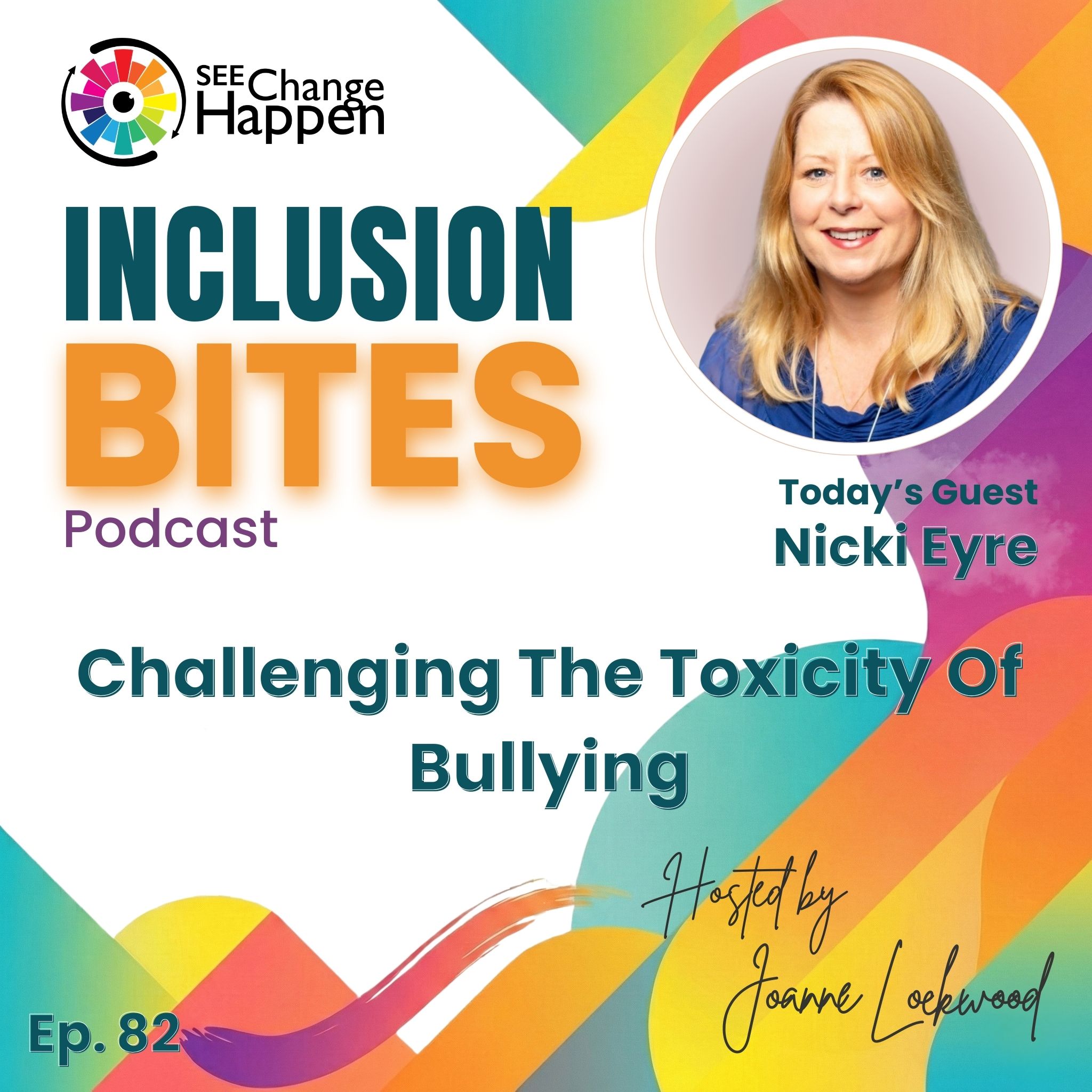
Exploring the damaging effects of workplace bullying, Nicki Eyre and Joanne Lockwood delve into the necessity of recognition, accountability, and collective action for a more inclusive and supportive work environment.
In this episode of Inclusion Bites, Joanne Lockwood speaks with Nicki Eyre about workplace culture systems.
Hello everyone, my name is Joanne Lockwood and I'm your host for theInclusion Bites podcast. In this series I'veinterviewed a number of amazing people and simply had a conversation about thesubject of inclusion, belonging and generally making the worlda better place for everyone to thrive. If you'd like to join me inthe future then please do drop me a line tojo.lockwood@seechangehappen.co.ukthat's S-E-E Change Happendot co dot uk You can catch up with all of the previous showson iTunes, Spotify and the usual places.So plug in your headphones, grab a decaf and let'sget going. Today is episode 82with the title Challenging the Toxicityof Bullying. I have the absolute honour and privilege to welcomeNicki Eyre. Nicki describes herself as a workplacebullying expert. When I asked Nicki to describe her superpower,She said that she turns a bad situation intoa positive, never gives up even when it'sreally tough. Hello Nicki, welcome to the show. Hi
Nicki Eyreguest
Jo, absolutely lovely to be here with you today.
Joanne Lockwoodhost
Yes, likewise. I took part in your conference last year and it was anexcellent and you can tell us all about that later if you wish. So, Nicky,toxicity of bullying, how do we challenge it? Tell us about that.
Nicki Eyreguest
Well, the first thing that everybody can do, Jo, is exactly what we're doing here,and that's talking about it. Let's shout it from therooftops. This is a subject that needs to be discussed. It needsto be brought out into the open, and we need tobe helping people to understand exactly what it is,what it looks like, and most importantly the damage that itcan do. So that's definitely the starting point,let's have these conversations. So you said
Joanne Lockwoodhost
there, describe it, whatis bullying? Is it What it looks like, what it feels like, what it soundslike. So what is it? What does it sound and feel like?
Nicki Eyreguest
So the thing about bullying is that there's a whole spectrum of bullyingbehaviours and they can start from those reallysmall moments of rudeness and incivilityand go right up to violence in theworkplace. So it can be physical oremotional injury that is suffered as a result.And there's all sorts of different behaviours in between and some ofthose are verbal behaviours,so talking about other people, gossipingabout them, spreading rumours, shouting atthem or even not talking to them at all,blanking them, ignoring them, excluding them.And that can be done physically as well. So you get intopeople's faces, you encroach their personal space or youblock them from joining a conversation with just a small turn ofthe shoulder. Right up tophysical violence, which is assault basically. AndThen all the psychological impact as well.When we start thinking about the psychological side, this is really the mostcommon workplace form of bullying now. It'svery much about getting people to doubt themselves, doubt theirown sanity, questioning them all the time,humiliating them, stealing theircredit for their ideas so that people think, well,they're just making things up when they say that that was my idea.So absolutely people end up withdrawnand really scared to speak up in those situations because every time theytry and speak up, they get punished for it. That'sa very broad brush stroke approach toall the different kind of behaviours that can be involved.It becomes bullying behaviour when you start to get a patternof behaviours, particularly when it's targeted towards 1person. And alsowhen we're thinking about there's a power dynamic involved,which doesn't necessarily mean that it's got to be a boss.A power dynamic can come from just holding informationabout somebody, having a photo of somebody that they don'twant you to share. It can be peer-to-peer, it can beupwards, it can be downwards. Bullying can happen in everydifferent direction and the area of bullying thatI focus on is non-discriminatory. SoI think of harassment as bullying attached toa protected characteristic. But there's a hugeamount of non-discriminatory bullying, which is, itcomes about just because it may just be that you don't like thatperson or you're threatened by them. There are lots and lots of different reasons whythese situations arise. And I've been chatting for agesthere, Joe, so I'll pause for a breath and let you come in with anyquestions there. That's interesting yeah because
Joanne Lockwoodhost
as I'm sure you and many of our listeners are aware discriminationis defined in the Equality Act and harassment isalso defined in the Equality Act, the UK EqualityAct 2010, whereas bullying isn't. So thedistinction you're making is it's not just about having a protectedcharacteristic, this is bullying that occurs outside of the protectedcharacteristics, where you're using the word bullyingrather than harassment, which is a legal definition as part of the EqualityAct. Yes, absolutely spot on. And
Nicki Eyreguest
a lot of people don't realise that there is a difference in lawand they'll use harassment and bullying interchangeably.And actually in law, as you rightly say, anything todo with harassment and discrimination and victimization is covered in theEquality Act but bullying that isn't linked toa protected characteristic it's a very very differentsituation. So anybody who's in a workplace has to haveworked there for at least 2 years beforethey have any protection rights and youcan't actually bring a bullying claim to anemployment tribunal. What you have to do is leave yourjob and bring a claim such as a constructive dismissalor something like that. The other option available toyou is to get injured to thepoint of having a psychiatric injury, a recognised psychiatricinjury, and then you can take it through the civil courtsin terms of personal injury, which is very, verydifferent to harassment, where you're protected from recruitmentstages and you can stay in your job and bring aclaim and you canget, you can claim for injuryto feelings as well which you can't do in thecase of a bullying situation. Soin law, they're treated very, very differently. And currently workplacebullying is not recognised in theUK legislation system.
Joanne Lockwoodhost
I have some experience of this situation. My wife,almost a year ago this month,exited her role of 7 or 8 years witha constructive dismissal resignation letter. And you'reRight, the onus was then on her to leave before she coulddo anything about it. And of course the company's response was, youshould have followed our grievance process before it got to this.However, in her particular case, the grievance processwent through the people that were causing the problem.And she felt she had lack of support or no supportfrom her immediate team lead, her manager. And in fact, it got to thepoint where she went, she was told she wasn't allowed to resignwith that letter because they wanted her to remove thewords constructive dismissal and bullying from her resignation letterbefore they would accept it. So we had to get a solicitor and an HRadvisor involved to basically tellus that it stands and here's our replyto your reply. So you're further bullying me. You're not allowing meto resign. You're making my mental health impacted evenmore through your unwillingness to engage in victimblame or my wife's blame. Andyeah, it was an incredible situation whereshe ended up, instead of working her notice, she ended up signing herselfoff sick because she couldn't get out of bed. She was crying her eyes out.She felt she really was bullied by this.
Nicki Eyreguest
Yeah and you know what you've picked up there is actually the damage that itdoes to individuals and the grievanceprocedures in themselves. I can completely understandwhy you know if it's got to go through those people you have no faithin the system. The grievance and disciplinary proceduresthat we use are really not fit for purpose inthese kind of cases at all. You have to thinkabout, are you prepared to do that to yourselfalmost, whether or not you go through that route, but theonus is still on individuals who have been bullied to speakup all the time and that's where we've got to turn thingsaround hugely because it's time forit to be recognised as an organisational issue and notan individual issue because there are working practices thatallow bullying complaints to be more likely tooccur, if you like. But even when you do go through thoseprocesses, you know, if I go, oh, we've got an anti-bullyingpolicy and we've got a grievance procedure and we've got this, that, and theother, the stress of going through those isenormous. And there's no really strongstatistics, but kind of colloquialevidence, if you like, is that somewhere around 80to 90% of bullying complaintsare not upheld. So you've got asystem with 80, 90% failurerate and yet we're still being told to useit. So we have to look at different ways of doingthis and it's got to start with first of all,people understanding what bullying is, but secondly,starting to try and prevent it rather than allowit to go to that stage where people's health is gettingdamaged. I completelyempathize with your wife about that feeling sobad that you just don't want to get out of bed, you're crying all thetime. Absolutely, I went through that with my own experience ofbullying and it is massive the impact that it has.
Joanne Lockwoodhost
She still has an element of PTSD from it because everytime we drive on the dual carriageway that overlooks thatbuilding where she used to work, you can tell her she's kind of,it's flashback in her mind. So it's not a thing thatjust fades quickly. There is PTSD in this environment.
Nicki Eyreguest
There is and there's a couple of psychologists who have writtena paper about workplace bullying trauma. EvelynField who's in Australia and Pat Ferris who's in Canadaand they have 20, 25 years ofworking with people who have been on the receiving end of workplacebullying. Basically what they saidis there are a number of different waysin which this affects people. So it obviously affects yourpsychological health and you mentioned you know your wife's mental health therehas a hugely damaging impact. Depression,anxiety, panic attacks, loss ofconcentration, confusion, flashbacks, all of those thingscome in there. That spreads to your physical health aswell. Fatigue,muscle ache, headaches, migraines, yourbehavior changes, the tears, the angry outburstsand everything like that. There's all differentways in which it changes you. It destroys your self-esteem,your confidence, all of those different areas.I know when I went through it, I always say that I felt like Ilost myself and I felt like I just becamea different person. It was a person that I didn't likebecause I started shouting at other people. They were coming to me andsaying, it's obviously making you ill, maybe you should give up, butthat need to fight and get justicefor what has happened is almost overwhelming. And1 of the things that you get with workplace bullying is thisrumination, so this constantly going over and over andover things in your mind, but also it differs fromother kind of trauma in that you want to talk to everybodyelse around you and they actually,you know, you draw them in until they'reexhausted and then you draw the next setof people in until they're exhausted and eventuallyyou exhaust yourself and you just become broken.So that trauma element is incredibly realand some of the work that Pat and Evelyn did they looked at kindof 3 different levels and if workplace bullying iscaught quite early on then if it'swhat they call mild, a mild case. So they might just have had ashort period off work, may even still be in work, then thereis potential to turn things aroundand keep them working in a healthy way.A more moderate might be you know you're off work for severalmonths and that's when you start to experience a lotof the symptoms I just talked about. But for the most severecases, some of those people never work again.They can end up on the benefit system.They're never able to really let go of what has happened.But that moment you talked about there,with seeing the building where you worked, or it mightbe seeing someone you used to work with and having thatmoment of panic or that going back intothat vital flight mode, that stress response that you livedin for so long, that's incredibly common Andso it's very easy for people to go, well, it's just anotherHR case. It's another grievance. We've got an outcome. That's it, endof case. Oh, it does not stop there. It keeps goingand going and it actually affects, you know, it's not justyour working relationship, it affects relationships all around you,friendships, you know, personal relationships, all ofthose things get, that ripple effect is huge.And most people probably, if they walk away from a job, they quiteoften walk away from a lot of friends at that point as welltoo. I use the word victim when I
Joanne Lockwoodhost
describe my wife just now and I know that when we spoke before we startedrecording that you don't use the word victim although victimizationcomes out of the Equality Act. So what's the best terminologyto use when we're talking about this? So for me, I always use the
Nicki Eyreguest
word target, because whenyou are bullied, you are targeted. So Whattends to happen is that the relationship between you and that bully is reallyquite unique, which again is why we do an awful lotof, well, what are they like with you and have youever seen that side of them? The chances are that people haven'tbecause they will have targeted you or they willvery much be a lot of covert, behind closed doors,one-to-one meetings type behavior thatother people don't understand.It's quite individual in terms of what people perceive as bullying.So what might be bullying to 1 person might not be for another. Sofrom that point of view, then actually this iswhere we need to think about how is whatever you're saying beingreceived? What is the delivery of thatmessage like? What is theimpact you're having on the other person? We've got to become much more self-awareand aware of the impact that we're having on other people.And so from that point of view,when you think about that person's relationship, it istargeted. And inthat sense, so if I think about my experience, a lot ofwhat went on was in one-to-one meetings.But I felt that I was treated differently to otherpeople and they tried to say that I wasn't.
Joanne Lockwoodhost
But this was somebody who
Nicki Eyreguest
had a favourite in the group as well and it was very obvious.So, you know, he obviously did treat people differentlyin the team, but it's really hardto articulate things like that.And this is 1 of the biggest problems. So when we cometo trying to explain what has happened,you start to pick up things like, well, they rolled their eyes at me, orthey didn't ask me if I wanted a coffee, or they didn't sendme some information I wanted, or they didn't reply to myemail, or they copied me in, and they copied all these other people in onan email that was sent out and individually on their own,they don't sound like anything at all. Sowhen you're kind of exploring, particularly in an investigation, that relationshipbetween the 2 people and the target is sitting there going, wellthey did this and they did that. It's really easy to dismissthat and go, well so what, well so what.But actually It's the fact that it is nonstopand it's that drip, drip, drip effect that keeps youin that stress response because you're never quite surewhen the next threat is coming around the corner.From that point of view, you are targeted becausesomething will have started you feeling that way.For me, it was a really clear moment in time, butwhen that relationship starts to break down, if that person hasn'tgot the self-awareness to recognize what they've done,then it's really hard to pull back and if they keep pushingand if they keep pushing especially after you've tried totalk to them about it, that'sintentional and we don't talk about intent in bullying anymore, wetalk about impact more. But people say to me, when do you knowit's intentional? I went, well, when you've told them they're doing something wrong and theydo absolutely nothing to change it. That's good you picked
Joanne Lockwoodhost
up on that because I, before we could record this, I did a bit ofgoogling. Now, what is bullying and what I got back wasrepeated behaviour which is intended to hurt someone either emotionally orphysically. I was going to ask you, who decidesthe intent? Is it the person who communicates it or the person who receivesit? So for you to say that actually impact,as perceived by the target, overridesintent, because there's so many people who are maybe blind to theirprivilege, blind to their manner. Their intentis often positive or ignorant, but the impact,and as you say, is the repeated element of that impact.
Nicki Eyreguest
Yeah, and if you think about the definition of harassment inthe Equality Act, talking about unwantedconduct, but it actually uses a phrase in there,the purpose or effect. This is thesame as what we're talking about now. The original definition ofbullying came from a casewhere a judge did their absolute best to identifyand define what bullying was. He used theword intent in that original definition. And that's whereACAS got their original definition from. And that wasback in 2014. So relativelyrecently, even though there's been work going on in this area for25 years or so. Andbasically, if you look at the way the ACAS definition haschanged, it included the word intent, then they justtook intent out. So it was behaviourthat could cause, that could be defined asmalicious etc. Now they've changedit to actually say behaviour that couldcause physical or emotional harm.That last bit is actually quite a new part of the definitionand I'm really pleased to see how it's changed overthe last few years. Because I always use the
Joanne Lockwoodhost
example when people tell me what's the difference between intent and an impact, I saywell I use the example of manslaughter and murder. With murder,the intent is to kill. With manslaughter, the intent is notto kill. It's a byproduct of what happened. But theimpact of both of those is someone dies. SoIt's recognizing the difference between intent and impact.By using that as an example, you go, yeah, okay, I've lost a loved 1and my family's died, that person's life's been cut short, whether you meant to ornot. I didn't mean to get into my car after having 5 pints anddrive home and hurt somebody. I just wanted to go home. But theintent doesn't matter. The impact statements, the judge,our courts now bring in victims or the familiesof the people who've been impacted to give impact statements, whichinfluences sentencing. So impact is really, really beingtaken into consideration when it comes into crime and other things, doesn't it?
Nicki Eyreguest
Yeah, and that's really interesting because I've kind of thought about that analogymyself before, because itis, like you say, the outcome is the same.Yet in bullying cases, it's all aboutthe target being made to provethat this has been the impact instead of just being able to say,yes, this is the impact. Here'smy 6 months off work that the doctor signed me offsaying that it's work-related stress, that I've got depression, that I've got anxiety.I've got medical evidence here, doesn't matter.It still didn't mean you were bullied. And so I think there'sa huge amount of learning for the medical profession,a huge amount of learning for businesses and organizations,but there's a huge amount of learning for us as individuals as well.Because 1 of the things that I found really hard waswhen you go to put in a bullying complaint, Ididn't really know what I was doing because I hadn't really thought aboutbullying until that point in time. I don't think I'dever had any training on it. So all I had was an anti-bullying policyand do a bit of work around it. And so I was like, I've gotto write a grievance and Ishould be putting it into words thatreally show, put my case forward, but I don't actually know what thosewords are. I don't actually know what it is I'm trying to prove here.And so that in itself, when I look back, I've looked backat my investigation document and gone,well, actually, that is just incoherent nonsense,which I can now look back at and say, well, actually, the reason it wasincoherent nonsense was because you were in a state of trauma. But as aninvestigator, I would probably have come to the same conclusion andnot upheld it. But that's when, as an investigator,that's where you need to be trauma-informed. So I thinkthat's a huge area for development in termsof this work as well. So if we take, I appreciate
Joanne Lockwoodhost
you're talking specifically about the workplace here, but I've had a lot of guests onthis show, talk about domestic violence, abuse at home. Andwe're quite, I think we're becoming quite familiar with the words, coercivecontrol, gaslighting, and what you were telling me earlierabout how it manifests itself sounds exactly likegaslighting, not good enough, being undermined all the time, and coercivecontrol being pushed in. So we're seeingbullying from different dimensions here. We're seeing it from the Quality Act against aprotected characteristic. We're seeing it in a domestic situation, DVcases and abuse in the home. And we've got workplace bullying.Is there any overarching view of this where wecould look at it holistically rather than fragmenting or are they so differentin the way they impact? I don't think they are that different in the
Nicki Eyreguest
way they impact and a lot of people do refer to it as workplaceabuse and you're absolutely right. You know the similaritiesparticularly in terms of the gaslighting andcoercive control. Well, actually, that is another. When you think about thefinancial control as well, peoplestay in jobs because they can't move onor they've lost their confidence and they're not able to moveon. They've got to put, you know, people don't support otherpeople who are going through these things because they don't want tobe seen to be a troublemaker, she says in quotes,because they've got to pay their mortgage, they've got to put food on the tablefor their family, you know, they've got to pay their bills. Soabsolutely, there is an element of coercive control therecompletely. And that can also go down intothe way that people work in terms of, well, I'm not going tolet you have the budget for that, but I'll let that person dowhatever they like with their budget. You can't have any training, butthat person can. So there are all sorts of ways inwhich it infiltrates across. But theimpact, yeah, I mean it might start from a differentreason but actually the impact is pretty much thesame for all of these things. And I think 1 ofthe things with the workplace,when you're in a relationship, it's domestic violence, then there isabsolutely, you expect to be treated well within thatrelationship. You're supposed to be there because you love each other, you carefor each other, you're going to respect each other.When you're in a workplace, it's not just that you should respecteach other, but the employer has a duty of care.And so 1 of the things that is sometimestalked about is the workplace becomesthe traumatiser. So, where are somepeople, perhaps if they're in a domestic violence situation, theygo into work, that's their safe place.Then, essentially what you've got is people leaving their homeand being forced to go to their traumatiser.Go and spend the day with your traumatiser.So that's not going to ever going to make them better. And particularly ifyou've gone through a case, even if there's an outcome, even if yourbullying complaint was upheld, it doesn't endthere. So the workplace, the employershould have done something to keep you safe and stop that happening andthat's where we need to really flip it around and start sayingwe've got to put prevention in place, we've got to pickthis up earlier, we've got to intervene earlier andwe've got to stop it going to formal processes because they areso damaging. The process
Joanne Lockwoodhost
can go wrong though can't it? I mean I'm aware of a friend ofmine who has been the target, this is the wordtarget, of a whistleblowing campaign against them,where people lodged complaints using the whistleblowingprocess to underminetheir credibility in the workplace due to some nebulousevents. And because the whistleblower policy created was anonymous,there was no right of reply. You had to just sit there in a chairand take it and try and defend yourself for that, knowing what really happened.So we've got to be careful also that we put checks and balances to stopthese processes being weaponized by bullies. Yeah.
Nicki Eyreguest
And we talk about this a lot, don't we? We don't really talk aboutthe person who's on the receiving end of these accusations.And If it is legitimate, then alot of people are actually shocked to discover that people think that they're a bully.But if it's vexatious,then there's got to be a way of looking atthat as well. You have to start. 1 of thethings that happens is that any of us we're in this situationwhere there's some sort of accusation against us, we're goingto react with a defensive approachinitially. It's just natural. It's a humanreaction. It's the animal reaction. You know, if you get trapped in a corner, you'regoing to come out fighting. And actually what youhave to do is allow people to have that initialreaction and then actually let's come back to this andlet's put some support in and find out what's really happened, what'sreally gone on. Let's have those individual conversations,coaching conversations if needed. Bring someone external inif you need to, but actually start to have a look atwhat the real reasons behind these things are.And I mean, it's interesting because there's a lot of things in the paper atthe moment where people are coming forward and talking about thingsand it took the first person to come forward.So if you're looking at that, then how onearth do you deal with it? AndIf it's a series of anonymous complaints, which is what you're talkingabout with whistleblowing, then actually thereis nowhere to go back. And so, 1 of the things we talk about withbullying cases is that actually you should put yourname to them because there has to be a right of reply.So the thing about whistleblowing is, again,whistleblowing was set up to have a look at wheresomebody was doing something that was potentially fraudulentor against the public purse orstandards or something like that. It wasn't really set up forindividual behaviors. If people are startingto use it for that, then I think wealmost have to have a little bit of a pushback that says,let's deal with the right thing in the right way. If this isa behavioral problem, then we have to come back and we haveto say, let's have alook at what's going on. If there is evidenceof some sort of fraud or somethingthat really sits under the whistleblowing arena, thenby all means investigate that. But don'texpect somebody to defend themselvesif you're not able to tell them what it is they've done wrong.So it is complex, it's really complex, in fact it's getting more complexas we talk about it.
Joanne Lockwoodhost
I've always felt you have to safeguard both parties.The target andthe perpetrator or alleged because they're an alleged perpetrator.So you've got to make sure that you're safeguarding both individuals,giving them dignity and respect and believability, because part of thisis believing, believing what people say. If you start disbelievingpeople, then people won't come forward. So it's creating all that environmentin a very non-judgmental way, partitioning the 2 partiesin a way that neither of them feels like they're being prejudged. And it's
Nicki Eyreguest
a really complex minefield, isn't it? It is, yeah. And I would agreewith you totally. Put support in for both parties.It may even have been a ripple effect of this around the team.It may be that you actually need to put some support in for a teamthat's, you know, where there's something that has blown up in the team.But absolutely, for those 2 individuals, they've got tohave support. Support to understand the situationfrom their own perspectives and from each other's perspectives,support to potentially change behaviours, and I wouldsay on both sides as well.If somebody feels they've been bullied for a long time, which is what usuallyhappens before they speak up, then they're going to haveto have support to recover from that process torebalance their stress response before they can even startto talk about the situation. And you haveto be able to do that, but at the same time,if you put those support systems in place andchanges don't happen and people refuseto take any of that on board, then you haveto be prepared to make the tough decisions and hold them accountable.So absolutely always start withsupport though, that would always be my approach as well.
Joanne Lockwoodhost
Yeah, presumably many, many of thecases that start get dropped quickly.People run out of steam, they run out of motivation, theirtrauma's there, they just want, I can't take anymore, I just got to moveon, the PTSD kicks in, they're constantly having to be pushingthat zone where they remember what happened and it's like,life's too short, I just need to get this out. So a lot of thetime we haven't got the stamina to go forward, havewe? No, absolutely. And for some
Nicki Eyreguest
people, they'll vote with their feet very earlyon and just leave. But for the people who do start to gothrough these processes, then... I know from my own point ofview, I went through a grievance and that involved,well, I had to go and find the evidencebecause the bullying had been going on for the best part of 2 years atthis point. I had to go back because they were like,oh, document it. As soon as it happens, document it. Youdon't know when it's happening. You don't realize until you've been init for a long time that, well, you're notprepared to admit it to yourself probably to start off with. I wasn't. I wasa strong independent woman in a senior position. I couldn't be bullied. Thatwas ridiculous. So I didn't collect any evidenceas I went along. So I had to go back and find it all. Sofirst of all, you have to remember it. So you're reliving the trauma there. Thenyou have to collect the evidence so you're reliving the trauma again.Then you have to put it all into order and put it into a documentready to submit your grievance so you're reliving the trauma again. Thenyou go through an investigation, you relive it again.Then you have the outcome, you relive it again. All of thesetimes and every conversation in between, you'rereinforcing the trauma because your brain does not know thedifference between whether it's happening right there, right then,or whether it's just a memory. And so you'rereinforcing that trauma all the time. And ifsomebody comes in and then goes, we don't believe you and we dismissyou, that creates a secondary level of trauma.And so the way in which those formal processes aredealt with has a huge impact on howthat person responds. So people going throughthat are soon going to run out of stamina. They're soon going to runout of, become less resilient.It is so damaging that so few get totribunal because people just know that they haven't got theenergy to go through there. Tribunals are being bookedsome like 2 years ahead at the moment. So they're nota quick and easy fix. Formost people, the tribunal is not about, it's definitely not aboutthe money in terms of bullying because all they do is put youback to the position you would have been in if you still had your job.So if you've left and gone into another job 2 months later, you'llget 2 months salary at the most. ButIt's about being heard because through all ofthat process they don't feel heard. They don'tfeel validated, they don't feel heard and they don't feelsafe. So that's all they want. They want thatmoment to have their voice and that's so much moreimportant and to put people through that just tobe heard, not good enough. So wedefinitely need to make some changes. Yeah, when my
Joanne Lockwoodhost
wife left, we deliberatelywaited for the 3 months and a day and didn't sayanything. So we kind of left it hanging deliberatelyto the organization had to reverse bullying, ifyou like, making them wait to see what we were going to do. But fromthe first day she left, she said, I've got no intention of taking this forward.But our HR advisor said, well, just hang on. You've got 3 months and aday to sit on it and make a decision. And we kind of decided thatwe didn't need to do anything to do nothing. So we didn't doanything to do nothing sort of things. We just sat on it and let itexpire.And Marie, my wife, didn't actually want anything out of itother than acknowledgement that she had been bullied.She wanted just someone to say, I believe you and notget all HR and defensive and kindof all this shackles went up. Rather than sitting down and saying, you'reright. Yeah, you're right. Yeah, it was, yeah, we could havedone better. We're kind of ashamed of ourselves and we've learned ourlesson, thank you. But you never get that, do you? You never get that.It's always legal speak and I'll payyou off without accepting responsibility, without prejudice,
Nicki Eyreguest
whatever the phrase is. And you think, I just want someoneto say sorry. I really want someone to saysorry, please. That's so true. And there's a sayingthat I've come across and it's something like, The hardest thing Iever had to do was to accept an apology I never received.That was part of being able to let go of all of this and moveon from it. But yeah, that isit. So many cases, they wouldn'tgo through any of these processes if they just said, do you knowwhat? You're right. We shouldn'thave treated you like that or that wasn't the best managementand we can do better than that and we're really sorry. Can we tryagain? God, it would save so much time,money, effort, but yeah, they're so concerned aboutlitigation and we can't possiblysay that that was the case. And Yet,if it goes to tribunal, then it's in the publicdomain. You've got social media nowand Glassdoor and places like that. It's going to be in the publicdomain no matter how quiet you want to try and keep it.And there are also interms of investment, if they've actually looked at companiesnow and where there's been, for example, with theMeToo campaigns or the Black Lives Matter, where there's been examplesin the press of actually, you've got problems inyour company. They actually did a piece of research in theheight of the Me Too and it said that if you'd invested in acertain group of companies that hadscandalous reports or whatever, however you want to put it, you'd have lost20% of your investment as opposed togaining, I think it was about 47% in the other direction.And so, the way in which employeesare treated by their employer is now becoming a keyfactor for investors as well. So even if you don't want todo it for the moral reason, there are lots and lots of reasons forbusinesses, competitive reasons toactually treat people really well and making sure that they treat eachother well within that environment as well.
Joanne Lockwoodhost
The other problem I found is that,it took a movement for people to speak.And I've been involved with a societyclub in the past where we organized events andthings and people came along to these events. So it's kind of workplace kindof in out what to, Everybody visited this club rather thanit being an organization's event. So it's an eventorganized for others organized. And we had an example wheresomebody was the subjectof some inappropriate sexualintent. There was physical touchinginvolved and thislady was spoken to and she didn'trealize that she had been the target of something, she just thought itwas something, it happened, I'm a grown woman,I get used to this kind of inappropriate behavior, so men do that, yeah, right.And I think it was only when someone said to her, hang on, you shouldn'tfeel that you've got to turn up to an event such as this and thenbe worried about what's going to happen to you. You should be able to turnup like everybody else or every other man, if you like, and just think, well,I have a safe space. And what happened was that wealso found out that other people had a very similarexperience with the same alleged perpetrator,but nobody was prepared to be the 1.And I suppose the question I'm trying to get to you about is, where we'vegot this sequence of unsubstantiated or unfulfilledcomplaints. What worried me at the time wasthat what if the next person came along and I said, oh yeah, you're notthe first. And then they go, I'm not the first. You knew about this.You've done nothing, but I can't do anything because, so how can Iact on unsubstantiated claims where there's no processfollowed and yet still look someone in the eye and say, I knew, but Ididn't do anything? I think that's
Nicki Eyreguest
where we've got to differentiatebetween I know something, but I can only dosomething if there is a formal process.Actually, as soon as you know something, particularly as anemployer, if something has been brought to your attention,then you have a duty to act on it.Now, you don't have to go in and be accusatory,but you can sit someone down and say, I've heard something that's quite worryingand I feel the best thing to do is to bring it to your attention.So, yeah, it's going to be difficult, it's going to betough, but and they're probably going to deny it. Yeah, who
Joanne Lockwoodhost
said? Tell me, give me examples. Yes, yeah, And you
Nicki Eyreguest
can protect that person, but actuallythat 1 conversation might be enough for them to change their behaviour.Even if they don't acknowledge it toyou, they might acknowledge it to themselves and they might startto be more careful. I think what isreally interesting is what we're talking aboutis this acceptance of behavior wherepeople kind of brush things off and go, well, it's just what it'slike around here or, well, I'm a grown woman, I shouldexpect it. I can deal with it. But like yousay, why should you have to? But actually,what we do is we've got so used toturning a blind eye to certain behavioursthat it's really hard for us to challenge them now.That's why it took a movement because It was thatsafety in numbers, those collective voices. Andyeah, it's really important thatif you're feeling uncomfortable, the chances are someone else is as well.And so Find an ally,find someone that you trust to speak to, findsomeone who can help you. Stand up for others if you seeit happening. Check in with that person, was thatokay with you? Did you feel uncomfortable? Do you wantme to report this for you? Do you want any support?Whatever it is they might want, or divert,distract, or basically call it out. If it's a safeplace to do it and you can call it out, youcan say it in such a way of, be careful there, that'snot acceptable anymore. Itmight just be enough, but unless we startto be brave enough to do that,and it does feel, it's scary. The first time you call it outit's scary and the second time you call it out it's scary butthe more you do it the more people will join you doing it as welland definitely safety in numbersbut yeah the collective voice is what makes a difference.
Joanne Lockwoodhost
Yeah, I had a situation 6 or 7 years agowhere I was with a group of male friendswho I'd known for some time in a clubsituation, sort of a society club sort of situation.And 1 of them wasn't aware that I wastrans or transitioning at the time. AndI guess looking back on it, and I'm not allowing thisperson permission to have done what he did, but he did that sort of scenefrom Crocodile Dundee where he grabbed me between the legsand said, yeah, it's what's down there sort of thing in a very kindof bantery blokey sort of thing.And there was contact, it was uncomfortable.And I was left aghast at someone who sexually assaultedme, really. I mean, even if I wasn't trans, it was still beingsexually assaulted by me. And I remember notlaughing it off at the time, but by being bit like you pick up acat or rabbit by the back of the neck, you become a bit kind offight, fight or freeze, I froze. And I was really in that kind of likeshock. And it took me 3 days, I think, to kindof start to replaying it in my mind allthe time, replaying it, replaying it. What did I do wrong? What did I dowrong? And I suddenly thought, wow, I'm doing that.I'm blaming myself here. I'm trying to make excuses forthis person. And what I end up doing was sending them a text saying,I need to talk about the impact of inappropriate sexualconduct the other day. And I need to have a phone call with you.And they've picked up the phone. I said, I don't need to speak or saya word. I just want to tell you how I felt and how thatmade me feel. If you want to say something after I've spoken, that's fine,but I don't need you to do anything. I just want to tell you howI felt. I did it, and at the end, they just said, I'm sorry, andwe both hung up. And that gave me my power back. Cause Ididn't need to ruin that person'slife over this incident. I could put it in context asbanter, as a bit of a laugh. But what Iwanted to do is make sure they realized that the laugh wenttoo far, and I didn't need to take it any further.But that takes a certain kind of strength and resilience in yourcharacter, and I know that not every targetof inappropriate verbalbehavior or whatever it may be is able to say no andre-own it or that person wouldn't maybe even responded in another wayand dismissed or not listened. Yeah and of course
Nicki Eyreguest
the other thing you've got there is you've got bystanders whostood there and let it happen. Actually, as a bystander,you can intervene. You can say something or you candistract or you can, did any of them say to you, are youokay? That was a bit off or anything. Did anybodycome to you? It doesn't take much, does it? I think they laughed
Joanne Lockwoodhost
because it was that kind of environment. So, yeah, I didn't get a lot ofsupport, but I did talk to 1 of the other people who was in thegroup at that time and told them how I was feeling andthen told them what I planned on doing in terms of this owning,taking control back. And we didn't speak about it after that,but they knew that I'd had that conversation as well. So it mademe feel better that, in my case, I had witnesses,3 or 4 witnesses, although they didn't defend me at the time,they laughed at the time.Having had my own examples, my wife's been through examples, I really, reallyunderstand the complexity of this and the challenge ofactually standing up and saying something. It is.
Nicki Eyreguest
It's incredibly hard. And Ithink for me, I tried to stand up, I tried tofight to make sure this didn't happen toanyone else again. I felt responsible for all of the people thatI was responsible for in an organization, which I'm talking about500. I'm not just talking about my team.I just sort of went, I can't possibly let this happento any of them. And so I fought and fought and fought. And Iwas so sure that obviously they're going to see thisis bullying. And, you know, you come awayfrom things like that with so much anger andhatred and injustice and all ofthose really negative emotions. And I've had to workreally, really hard to turn that around. But 1 of the things I'vereally learned is that you can't change things from aplace of anger, you can never do that.So I ended up in a position where I've absolutely surroundedmyself by amazing people.They're helping me now with the Stop Hurt at Work campaign,where we're trying to get workplace bullying recognised in law,so that you have the same level of protection in the workplace.There's still huge numbers of people who aren't protected,freelancers. If you look at something like the film and TVindustry where they go on different jobs all the time.So there's lots and lots and lots ofwork to be done, but You know what, there are someamazing people out there doing this work. There are someamazing people out there making a difference in their own organizations,and they're starting to have more and more of these conversations,which is all just absolutely fantastic.And, you know, you mentioned earlier, Joanne, that you were in the conference lastyear. So we run the United Against Workplace BullyingConference in November, an anti-bullying week each year.And that is really helping to get thesubject out there and just bringingeverybody together to say it's okay to talk about this,it's okay and you are not alone, you're not the only 1 this hashappened to and there is help and weare trying to make a difference. I'm trying to build those collectivevoices to really push that through in legislation aswell. What you said there about not speaking
Joanne Lockwoodhost
from anger, speaking to educate and there's a saying that,as a professional speaker, there's a saying that we often use, speak from the scarnot from the wound. So if you're speaking from the wound, it's all about me,it's my own trauma, it's my own thing. But once you have the scar,you can step back and you can then think about it's abouteverybody else, the bigger problem, the challenge, without always bringing it backto you and reliving that trauma because of the mental health PTSD. So Icompletely understand, yeah, you've got to heal yourself firstand not sorry, forget the anger, but don't let you notbecome driven by anger, become driven by outcomes, by the changeyou want to see, isn't it? Yeah, definitely. And the way
Nicki Eyreguest
that I put that is that most of the people are angry because theirvalues have been compromised in some way. And soI say to them, just remember, you're driven by your values, not by youranger. And that's so important toremember. I like that. That's a great note
Joanne Lockwoodhost
to start running out. Driven by your values, not your anger. Ithink that's a fantastic punchline to end on. Thank you. We'vebeen chatting over an hour now, and before we goton to record, it's been fascinating talking to you again. I know we talked alot during your Conduct Against Workplace Bullying conference lastyear. How do people get hold of you? How do people get involved in theconference? Do they listen to this? How can they get hold of you? So the
Nicki Eyreguest
best place to go is the website, which is conductchange.co.uk.And On the website, if you check on themenus there, you'll see the UAWB conference,United Against Workplace Bullying. There's alsothe Stop Hurt at Work campaign. So again, it's on themain menu. Have a look in there, have a look at the work we're doingon legislation as well. And we'realso, if you want to share your story and help add to thedata collection, then Speak Out Revolution areour data partners for the campaign and you canadd your voice to theirdata as well and you can do that anonymously. So there's lots andlots of different ways that people can get involved and help influencechange. Fantastic and if you go
Joanne Lockwoodhost
there you may even see my video from the conference last year when it getspublished soon. So yeah. We will indeed, yes. Go and check thatout. Excellent. Thank you. Nicki, that's amazingas ever. Thank you so much. Also a huge thankyou to you, the listener, for tuning in, for getting to the end. Ireally, really appreciate and value that. If you're not already subscribed, thenplease do tick the box and subscribe in your favoriteplatform for future episodes of the Inclusion Bitespodcast. That's B-I-T-E-S. Do share it with your friends,tell your colleagues about it as well. I've got more and more exciting guestslined up that I'm sure you'll be equally inspired by over the next few weeksand months. And of course, if you'd love to be a guest, I'd love tohave you on. Send welcome, welcome, suggestion and feedback tojo.lockwood@seechangehappen.co.uk. Andfinally, my name is Joanne Lockwood. It's been an absolute pleasure tohost this podcast foryou
Joanne Lockwood is joined by workplace bullying expert Nicki Eyre to unpack what workplace bullying is, how it shows up day-to-day, and why it can be so difficult to evidence and challenge through formal routes.
They explore the spectrum of bullying behaviours—from incivility and exclusion through to intimidation and psychological manipulation—and the way repeated patterns and power dynamics can keep someone in a prolonged stress response. The conversation covers the legal and procedural gap in the UK around non-discriminatory bullying, the limitations of grievance processes, and how investigations can retraumatise those raising concerns when organisations focus on defensiveness rather than learning.
Nicki and Joanne also discuss the real impacts on wellbeing, including anxiety, depression, reduced confidence and self-esteem, and trauma responses that can persist long after someone leaves a role. They highlight the importance of trauma-informed approaches, early intervention and prevention, accountability alongside support for all parties, and the role of allies and collective voice in challenging harmful behaviour and pushing for change.
“I felt like I lost myself and I felt like I just became a different person. It was a person that I didn't like because I started shouting at other people.”
“There's a huge amount of learning for us as individuals as well. Because 1 of the things that I found really hard was when you go to put in a bullying complaint, I didn't really know what I was doing because I hadn't really thought about bullying until that point in time. I don't think I'd ever had any training on it... But as an investigator, that's where you need to be trauma-informed.”
“The workplace becomes the traumatiser. So, where are some people, perhaps if they're in a domestic violence situation, they go into work, that's their safe place. Then, essentially what you've got is people leaving their home and being forced to go to their traumatiser.”
“For most people, the tribunal is not about, it's definitely not about the money in terms of bullying because all they do is put you back to the position you would have been in if you still had your job. It's about being heard because through all of that process they don't feel heard. They don't feel validated, they don't feel heard and they don't feel safe. So that's all they want. They want that moment to have their voice and that's so much more important and to put people through that just to be heard, not good enough. So we definitely need to make some changes.”
“The hardest thing I ever had to do was to accept an apology I never received. That was part of being able to let go of all of this and move on from it. So many cases, they wouldn't go through any of these processes if they just said, do you know what? You're right. We shouldn't have treated you like that or that wasn't the best management and we can do better than that and we're really sorry. God, it would save so much time, money, effort...”
Prevention of bullying is essential to avoid damaging individuals' health.
Questions this episode helps answer
What does Nicki Eyre mean when she says that investing in fair treatment of employees is a practical consideration for businesses?
Why is it important for organizations to differentiate between behavioral problems and whistleblowing when dealing with bullying accusations?
What do Evelyn Field and Pat Ferris say about the impact of workplace bullying on victims' psychological and physical health?
Why is stopping workplace bullying important for freelancers and how is the United Against Workplace Bullying Conference helping to address this issue?
How can formal grievance procedures traumatize those who have experienced workplace bullying?
How can psychological and physical bullying in the workplace be avoided?
Explore topics
Ideas from this episode
Workplace Culture Systems
Psychological Safety
Belonging
Allyship
Change & Transformation
Resilience
Learn
Frequently asked questions
What is workplace bullying and how is it defined?
Workplace bullying can take many forms, from small acts of incivility to physical or emotional abuse. It is defined as targeted behavior towards one person, often with a power dynamic involved.
What are the effects of workplace bullying on a person’s health?
Workplace bullying can cause both physical and psychological health problems like depression, anxiety, panic attacks, and fatigue. Victims may experience changes in behavior, destroyed self-esteem and confidence, and a sense of losing oneself.
What is the best way to handle workplace bullying?
Prevention and early intervention are essential, and employers have a duty of care to prioritize them. That said, when workplace bullying does occur, it should be recognized as an organizational issue rather than an individual issue.
How can organizations avoid allegations of bullying in the workplace?
By investing in the fair treatment of employees and implementing a robust whistleblowing process, organizations can avoid allegations of bullying by creating an inclusive culture of transparency and accountability.
Are grievance procedures effective in cases of workplace bullying?
No, the current system has a high failure rate, and the burden of proof often falls on the person alleging bullying rather than the employer. For a formal grievance process to work, it must be trauma-informed, and investigators should be trained in assessing trauma’s impact on a person’s ability to provide evidence.
How can managers and employers recognize bullying behavior and prevent it from happening?
By promoting an inclusive culture and increasing awareness of bullying, managers can learn to recognize bullying behavior and intervene when it occurs. It's important to act rather than ignore the behavior, and early intervention can help prevent long-term damage.
Share this episode
Heard something worth passing on? Send this conversation to someone who needs to hear it.