Exploring the resilience and creative brilliance of the queer community amidst global challenges of marginalization and discrimination, this episode uplifts the power and genius of queer individuals.
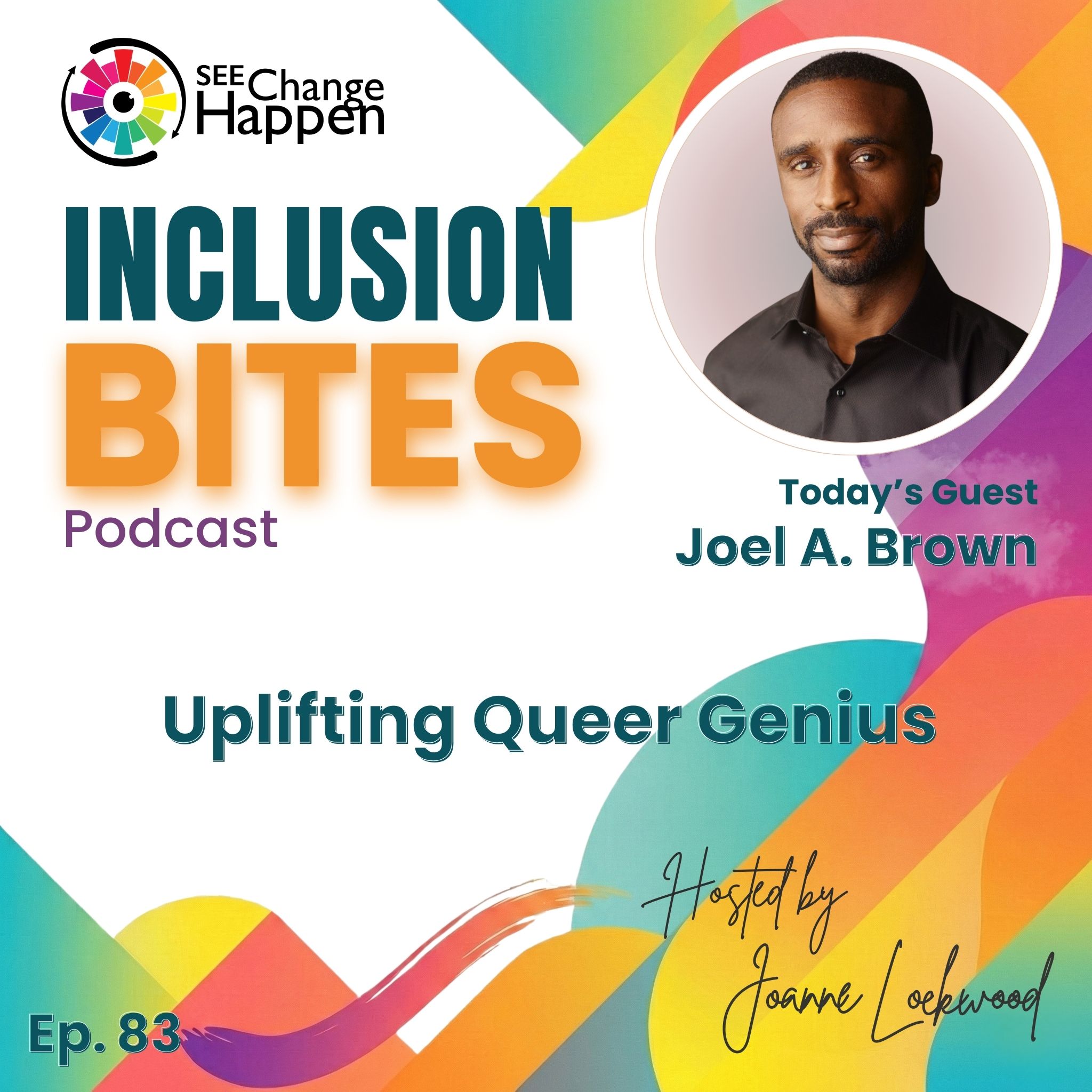
In this episode of Inclusion Bites, Joanne Lockwood speaks with Dr Joel A Davis-Brown about lived experience identity.
Hello, everyone. My name is Joanne Lockwood and I am your host for the InclusionBites podcast. In this series, I have interviewed a number ofamazing people and simply had a conversation around the subject ofinclusion, belonging and generally making the world abetter place for everyone to thrive. If you'd like to join me in thefuture, then please do drop me a line tojo.lockwood@seechangehappen.co.uk,that's S-E-E Change Happen dotco dot uk. You can catch up with all of the previousshows on itunes, Spotify and the usual placesto plug in your headphones, grab a decafand let's get going. Today isepisode 83 with the titleuplifting queer Genius. And I have theabsolute honour and privilege to welcome Dr Joel DavisBrown. Joel describes himself as a change agentthat has too much stuff going on. When I asked Joelto describe his superpower, he said queer minded creativeproblem solving. Hi, Joel, welcome to theshow. Good morning. Or I should say, good afternoon.
Dr Joel A Davis-Brownguest
It's a pleasure to be here. Nice to meet you.
Joanne Lockwoodhost
Absolutely. Joel, we've just had an amazing warm up in the greenroom, so I'm looking forward to this conversation no end. And we cameup the title uplifting. Queer Genius. So what's all thatabout, from your perspective? I
Dr Joel A Davis-Brownguest
think, well, we're at a time inglobal history wherequeer people are being denouncedand how should I sayit? Discriminated against,criticised, misunderstood, on, in newand not so new ways. Andwhat is ironic is that a number of the skills that the world needs inorder to create a world that works more perfectly for allof us, a lot of the thingsthat the queer community embodies are those veryskills. And so this is an opportunity for us, as a communityand as a world, to start to fully recognise,appreciate and understand what queer people bring to the world froma leadership standpoint, from a transformational standpoint, from a spiritual standpointand from a global standpoint, in orderto take advantage of our talents, tohonour our gifts. And hopefully, I would hope, as a byproduct, to make morespace for us in the world, giventhe beauty that we possess and the things that wenaturally use and utilise just by virtue ofbeing queer. So there's a lot therethat we naturally, I think,bring to this space, bring to the world, bring to a lot of differentdimensions and regions and parts ofthe planet. And I think it's about time for usto spend some time really examining what thoseare and really giving breadth to how queer people actuallybenefit the world, as opposed to this persistent narrative, whichis one where people see us as a threat. So that's what the wholeidea of Uplifting Queer Genius is about, is givingchange the narrative and starting to viewqueer people in a more full bodied way than we have previously.
Joanne Lockwoodhost
That's quite interesting. The way you say that, becauseI would call myself describe myself as queer. I'm a transwoman. And what you're saying there aboutthis queerness as a superpower within us that the worldneeds more of to balance out some of thethings that are going on, I'd never really thought it in that terms. Itransitioned seven or eight years ago effectively, and Ifelt an immense sense of freedom, an immense sense of enlightenment andempowerment within myself as a result of that. I put a lotof that down to my gender identity. But maybe there's awhole different dimension in there that you're talking about here, aroundthe extra dimension of queerness. Not just around gender, it's around sexualityand the multifaceted nature of queerness thatbrings out that real richness of difference ofexperience that maybe straight people, CIS peoplehave that, as you say,they see us as a threat. Because we're prepared to challenge the statusquo, break out societal norms, not be living tothe constructs of social society that they've definedover the years. Is that what you're saying there? Is that theinfluence of what you're saying? Is this empowerment we have thatmaybewe bring to the world, or is it more than that? I think it's more
Dr Joel A Davis-Brownguest
than that. I think it starts with empowerment. What you described is a beautifulprocess of self discovery and self realisation, ofgoing within to learn more about yourself so that you can be yourfull and best self. Even that in and ofitself requires courage andcommitment and a certain level of energy that a lot of peoplechoose not to possess. I'm not going to say people don't have the capacity, butpeople choose not to possess. And what you haveexperienced is what a lot of queer people, a lot of transpeople, a lot ofLGBTQ plus people have experienced, because we have toin order for us to be fully who we are, we have to excavate ourtruths. We have to understand our realities and ourworldview. We have to give voice toour full identities and our aspirations. And indoing so, we help to create freedom for ourselves.Just modelling that process, I think, is something that could be a benefit to anumber of people and to a number of global citizens.Because how many of us actually take the time and actually create thespace to be fully free? And I'm not speaking just in terms ofhistorical systems of oppression. I mean to give ourselves permission to befree. Regardless of whether someone says, I deem you worthy offreedom, I deem you worthy of love, I deem you worthy ofbeing happy or being fully expressed as a humanbeing, we give ourselves permission. And I think that by itselfis a needed revolution in the world where people stoplooking to others and followers on socialmedia and other people to give them permission to be themselves. And to be theirbrightest light. We do that for ourselves. That is a very importantand understated aspect of leadership to say, Iembrace who I am, I appreciate my talents, I know that I caninfluence my environment just by being who I am. Butbefore I can influence my environment, I have to first be clear and to leadmyself. That's the first step of leadership. And queerpeople do that every single day that we decide and we come outconsciously assert, this is who I am.And I think the world could use that. And beyond that, there are,I wouldn't call them unique traits, but there are aspects ofour culture that I think really needgreater visibility in the world. There are aspectsof who we are that need greater practise orelevation. And a lot of that,I think, has never been fully explored because for a number of people,when they think about queer people, they reduced us to a stereotype, toa caricature, or they have just come to the conclusion that thiscommunity is not worthy of study. So therefore, the idea that there's something ofvalue that we bring would seem absurd to them, even to some members of ourown community. And I think now is the time, throughmy own journey and my own research, that I realise we actuallybring a lot. And what we bring is essentially what alumber of people are asking for. And that is our cultural genius.That is the acumen that we havenaturally, by virtue of being queer people. That serves us inan ever changing, ever evolvingsociety. And I think more peoplecould benefit from it if they simply took the chance to see usin our full light. Do you think this
Joanne Lockwoodhost
is rooted in introspection?Before I came out to myself,we all have to come out to ourselves first. We're the first people we comeout to. And that whole exercise is around selfanalysis, self questioning, introspection, who amI? What's important to me? Until I went through thatprocess, I probably never considered those questions tomyself in the rest of my life. So it's some of our power,the fact that we are self analysing, we are questioning who we are, weare working out our position in society and that's where ourcamaraderie within the queer community comes from. Maybe because we'veall been through that place of discovery, I think, as youput it, we have to come out all the time, so we're constantly makingchoices about who we come out to, how we comeout, our safety, the benefit to us,all that impact. So those decisions are going on in our head every time westep out the front door. As a straightperson, a non queer person, you probably don't evenrealise that you have to have those thoughts.
Dr Joel A Davis-Brownguest
No, you probably don't. Or you take them for granted, or you don't use themas often as you could. And like anything, any talent, any muscle,the less you use it, the weaker it becomes, to the point of where italmost seems like it's nonexistent. What wegive our attention to, what we prize in a society or in a particularcultural group, is a value. So if we say, for example,that we prize or we value creativity, then that is a value. Ifwe say that we value inclusion, that isa value. If we say that we value money, that also is a value. Anddepending on the particular group we all have, everygroup within the world has asense or a core set of values. And we typically think about values from a
Dr Joel A Davis-Brownguest
very nationalistic standpoint. So you'll hear people, for example, say, in theUK or in places like or any country, it could be Kenya, it could beSingapore, it could be Japan, it could be Chile, it could bethe US. Well, what do you all stand for? And there arecertain principles that countries, nations, peopleorganise around to say people of like, mind are here. Or if you are partof this group, this is what you subscribe to, this is what you believe in.That doesn't mean that people don't have individual differences and that doesn't mean that peopledon't have serving values that perhaps they leaninto more than others. But what I would say is thatwith the queer community, there are values that we support.That, for example, the idea ofinterconnectedness that are really importantand who doesn't need more interconnectednessnow, particularly after the COVID-19 pandemic? And given the fact that we'vesee loneliness become a bigger issue in the socialsphere. Even before COVID-19 even came onthe global scene, there were a number of countries, denmark,Japan, New Zealand, the UK,the US, that were focusing on lonelinessbecause they said, and they realised that there were pockets of the population that werefeeling more estranged, moredisconnected. And here we are as a community, has spent a lot oftime out of necessity, to build community, to build connection, that doesn'tmean we're perfect. So if our community has been ableto do these things at the riskof being harassed, discriminated against,even killed or hurt, and we've never been able to do them,well, I would think most people in the world if I werestudying a group I heard about this group that, despite the odds and despitevery few resources, was able to do these miraculousand powerful things in the world. I'd want to learn what they were doing,I don't want to learn how they were doing it. I didn't want to studywhat their model is. And that's where I think we have an ability andopportunity to teach. Because we as a society, we as agroup have been able to do things in our society that othersprobably wouldn't be able to do. Given the level of deprivation that we'vesuffered from a legal, political and social standpoint that's,again, part of our cultural genius. How do we do that? How do wemaintain that? How do we keep that flame lit? Those arethe things that we don't talk about enough. So there is the aspect ofbeing out and proud and engagingin self realisation and being self determinative. There's also that aspectof, wow, look at this community that here.There are 71 countries that havepassed anti or have opendiscrimination or discriminatory laws against LGBTQ people.There are, I think, at this point, 37 countries that explicitlyhave laws that are hostile to gender nonconformingpopulations. And yet we still are able todo some pretty remarkable things, not the least of whichis exist. Sothat is part of our superpower and we're so used todoing it that we don't think it has greatconsequence, when in fact it does. The fact that you and I are having thisconversation, the fact that you created this platform and thispodcast, there's something powerful in thatand I think a lot of people could learn from that because a lot ofpeople are looking for inspiration, they're looking for hope, and I thinkwe can offer that.
Joanne Lockwoodhost
So, as a community, yeah, I get what you're saying.Our long standingfight against marginalisation oppression. So you are a blackman. How does the intersection of racism and queernessdiffer?As a marginalised black person, you must have experienced discriminationfrom a different vector. Is beingblack a similar empowerment to queernessor it's a different experience that you can'tcompare the two? I'm just really curious as to where thatintersection kicks in. And is there a commonalitybetween the oppressed community and the spirit and the problemsolving within it, or is it something unique to queerness?
Dr Joel A Davis-Brownguest
I would say there are some similarities. However, the way that queer people havebeen able to create it or fashion it orto design it is different. The same way that for a black person or forblack people, it's different. And I think, like anysuperhuman beings, our tools and our superpowers are justslightly different. So you may see one superhero that they're ableto shoot a beam through concrete or throughsome precious mineral, whereas another superheromight be able to or super person excuse me, might be able to fly andanother one might be able to speak with animals or whatnot.I think we possess unique, indifferent talentsand that doesn't mean that our talents are exclusive and it doesn't mean that othergroups and communities don't have them. One of the things I like to remind peopleis that people of colour, or I know in the UK, I thinkit's black, Asian, minority, ethnicities also arepart of the community, so it's one and the same, right? So there's not alwaysthis distinct difference between the groups. You havepeople of colour who are queer in the community and those superpowers have beenembellished, expanded upon or enhancedby their experiences in different areas. So I thinkthere are different experiences. They're notas different as we make them out to be. It's like havinga cousin. So you have a cousin, knowyou're connected, you have something in common thatwould be the human experience, but their life is completelydifferent than yours. Let's say they're living in Manchester as opposed to living inPortsmouth, and that's how I think it is. When we look at diversityoverall, is that, yes, a number of us, all of us have differentidentities and, yes, they can be distinct, but we all come from the same mosaic.And the emotions and the realitiesare not all that different. They just show up a little bit differently and thatallows us to maintain our individuality or our unique experiences, but also torecognise that in the whole, there are a lot of things that weencounter that are not all that rare and that are not all thatdifferent. You can't talk about white supremacy without talking about
Dr Joel A Davis-Brownguest
heterosexism and you can't talk about patriarchy without talking aboutcisgenderism. They're all connected, right?And just the way that these things play out is just a little bit different.So that's how I think of it. I would say to you there are definitelytimes where I have to use my blacksuperhuman powers and there are times when I use my queersuperhuman powers. I think at least with blackpeople, there has been at least some recognition,albeit slight, that the way that we think andthe way that we are relational and the way that we are community minded isan asset. And I still think that we're at the very beginningof looking at queer people from an asset basedperspective, even for those of us who areallies. I've heard things like where you like toparty, you're lively and I say, well,perhaps there are some of us who like to party, but what is the deepervalue that speaks to that? So that requires us to go deeper. And what thatrequires is for even our allies and even ourselvesto go beyond the idea and the beliefthat they know who we are to actually say, well, do you actually know whatit's like to be us and what we actually stand for? Because what you seewhen you say that we like to party or we like to be lively iswhat's sticking above the waterline. It's the iceberg that sticks out.
Dr Joel A Davis-Brownguest
But have you taken time to really be clear as to what more webring to table, where that comes from? So if I'm I remember a guy ona plane said to me I was going to somequeer event conference and he said, oh, there's going to be a lot of parties.And he thought he was being endearing to me when he said that and Isaid, Well, I don't know about going there to party. I said, I doappreciate that people do want to celebrate and that comesfrom an idea of wanting to be closer and to connect with people, but alsowanting to honour who one is. And if you frameit that way, then I think a lot of people can understand it from adeeper level and have more appreciation for how important it is forall a billion of us human beings to honour and celebrate who we are,as opposed to just thinking that we want to go party. Sothat's where I think for the queer community, I would love to seemore exploration and more research and morehumility to say maybe we don't understand well, we know that we don'tunderstand this group and maybe we can do more. And I think the blackcommunity has that as well. And I would say that there are alot of parallel synergies and energies between the two groups and there are obviouslysome distinct ones. And I just think that right now, the queercommunity, I think a lot ofminoritized communities, but I think the queer community needswe need to take the reins of our narrative and stopallowing other people to define us in ways thatare completely disrespectful to ourcultural legacy and to who we are.
Joanne Lockwoodhost
How much do you think the media plays in this? Because.Going back a few years, ten years, 20 years, themedia used to trope and stereotype queer peoplein a certain way, as you say, the camperness, theflamboyance, the party, theelements of queerness we can all see represented in the media. Butlately I've noticed a real shift where peoplearen't centering someone's queerness in the storyline, they're by theway, they're queer. There'll be a kiss later on, there'll be a handhold, there'll bea look, and you can go, oh, they're going to kiss in a minute. Andit's quite an emotional thing from a queerperspective to see that queer representation without it being the wholepoint of the movie or the whole point of the episode, andit becomes a voyage of discovery in the same way thatheterosexuality is just a by the way thing. And I thinkthat I see a shift in the media, but before that it was allstereotypicalleading to the you don't seem gay, you don't sound gay to me. Those kindof microaggressions and tropes that come out. Are we seeing a shift in the medianow? Yes and no.
Dr Joel A Davis-Brownguest
I think the media at the and I think we all know this, the mediaat the end of the day is entertainment business and so it's trying toput out whatever is most expedient and what's going to get most people's attention.I do think what's changed is that there are more queer people in themedia and there are more allies in the media andpeople recognise our humanity. So that the difference. Theperceived weirdness of us is not as muchof a storyline because we're human but at the same timeI also think, as opposed todownplaying our queerness, I would love to see morerecognition of what our queerness really stands for. So there's one of twochoices that you can make. If you have had a history, as the mediahas, of distorting, mischaracterizing and stereotypingqueer people, you could downplay it and not talk about any difference at all, justsay, oh, they just happen to be two people who are queer. Or you couldsay, maybe we need to think about how we present queer people in a morepositive, affirming and culturallyrespectful light. And I would love to see more of that too, because there's parts
Dr Joel A Davis-Brownguest
of me as a queer person that, yeah, this is a queer thing that youmight be experiencing and seeing. But let's talk about where it comes from and whyit's important and how being in the crucible knownas human existence as a minoritized person has contributed tothis as opposed to just downplaying it to something that's not culturallyinformed or rich, layered, nuanced and complex. So I thinkit's a both. And has the media improved?Definitely. Are there still more opportunitiesfor us? Yes, and I think one of the ways in which the media canimprove its representation of us is not focusingjust on the cisgender, straight maleaspect of our community. I've been in many situations wherepeople have said to me why don't we see more trans people? Why don't wesee more bi people? Why don't we see more people of colour? Why don't wesee more women? I'm like, well, we don't have enough time to talk aboutthat. But at the same time it's not that complex because we havethe same forces of racism and sexism and cisgenderism and ableismand all those sorts of things are still very much at play within our communityand in terms of how people portray our community. Sothat would be something nice. And I think alsoseeing us in a more of an intersectional lens andrecognising that. For example,what someone represents as queerness is and may be informedby their ethnicity and bytheir idea of gender, and that may work for them,but that is not how the rest of the community seeitself. So I think the next chapter for usis and for how we're viewing the society as a wholeis to see more of our multidimensionality.You see we are being recognised more for our humanity.I think there's more work that can be done, but I think alsorecognising more of our identity and recognising, too,that, yes, many of us have achieved some level of privilege,but there are still many of us in many countries around the world who don'thave freedom. And I think that's the thing that concernsme is this trope of, oh, you all like to party. You all just arevery lively. Can give the impression that we're still not beingpersecuted, which of course we are. So those are thingsthat I worry about because I want us to have a broadlens where we look at the community to not create thetragic queer person stereotype, but also notto create the party. Everything's okay and nothing's wrong andeverything is just and perfect, because that's not true either.And also making sure that we represent all the communities. One of the things Ilove to say is we are one community, but many people and I would loveto see us represent and show more of the people aspect, too.
Joanne Lockwoodhost
Yeah, I prefer the term communities rather than communitybecause we have multiple communities coming together and there's no onerepresentation, no one view. Really interestingwhat you're saying there.As a trans woman, one of my ultimateaims is to be perceived as a CISwoman, ideally. So in some areas I want to downplaymy queerness and my difference and blend in asmuch as I can. So my objective in some respects isn't toparty, isn't to go out and be visible and flamboyantor express myself openly. Just I almost downplayit. Dress for the supermarket.I don't want to be obvious.I'm just thinking as you're talking, I'm looking to hide myqueerness. Not because I'm ashamed of it, because as a trans woman, my ultimate aimis to blend in. That's what I'm looking for. So everyone experiencestheir queerness differently. But, yeah, obviously I'm proud of who I am. I'mproud of being part of the community. I'm proud that,as you say, there's this superpower, there's this camaraderie, for want ofa better word, this shared belief in we are morehaving a level of empowerment and change agents.So I completely get that. But I feel sometimes that myobjective really goes against it's about blending and hiding.So how does that rationalise? Well, when you
Dr Joel A Davis-Brownguest
say hiding, I guess the question I would ask for you, is ithiding because it's just your personal sensibility or becauseyou are wanting to maintain your level ofsafety? It's not about safety. It's
Joanne Lockwoodhost
aboutmy objective of transitioning is to realise myfemale potential and by expressingmyself with the trans adjective, if you like,it's creating a I'm not as good, I don't pass the test.I failed in my persona to convince youthat I'm female. So it's all about trying to blendin as a female persona. I didn't transition to beperceived and read as a man. I transitioned to be perceived and red as awoman. So for me, an element of myidentity is not to stand out as a trans woman. Althoughprofessionally I'm professionally trans. I talk about it all the time. Just when I goshopping in a supermarket, I want to take my trans hat off andjust be a woman.It's a different expression, no doubt. You goto the supermarket, you don't want to go to the supermarket as a gay blackman, you just want to go there and buy some eggs.
Dr Joel A Davis-Brownguest
That is true. Joelness is the thing that I goby first is I want people to just see me as Joel. And, yes, Idon't want to bring undue attention to myself, but I think this is where myblackness also has helped me in many ways, because I realisedthat no matter what I do, people are going to see me however they seeme. And people sometimes are going to see me as different, even just bywalking down the street, even by going and buying tomatoesor pumping gas into my car orgoing to the movie theatre. And so I think withthat there comes thecomfort of I have to just be who I am. Because no matterwhat I do, people are going to have their expectations andtheir beliefs as to how I shouldbehave, how I should show up, or they're going to have their reactions to howI am or who I show up. And there's nothing I can do about that.And because my skin tone is going to be one that people are going tonotice readily, I don't get away from that. So with my
Dr Joel A Davis-Brownguest
queerness too, I think thegoal for any person, at least for me, I'll speak for myself, is to bea fully integrated person, which means I amall of me, all of the time. And whenyou sample me or when you experience me, you're going to necessarily get a littlebit of blackness, a little bit of queerness, but you're going to get a littlebit of Americanness, but you're also going to get someMidwesternness. You're going to get some Agnostic aspectof me. You're going to get the sports lover in me, you're going toget the artist in me. You're going to get the person who is very muchthe anti American. You're going to get all sorts of things and have all thosethings sampled and not feel like I have to pull back the one,which is the queer aspect of it. So that's where it really comes from.It's not so much that I'm trying toblend, I just want to be able to have everything showup as it would naturally in any environment, and not feel like I have tobe diminished in that in some places, it's going to come out more so thanothers. And I think from the black standpoint andof course, our journeys are different, it's just a matter of people are going tothink whatever they want to think. So I'm just going to be me andwhatever they need to think. As I'm in the grocery store, they'll think whereverthey need to think. When I'm in the gym, they'll think. And whatever. They needto think when I'm on stage speaking to an audience, they'll think that aswell. And at all times, I'm still just going to be me. And sothat's part of our uniquejourneys, right, is that, yeah, we want toblend and that sometimes we just can't blend. Weare the part of the stew that no matter how muchyou heat it, no matter how much you stir it, no matter howvigorously you try to blend in those ingredients, some are just notgoing to blend. And I think I've gotten okay with thatand just realised that's just part of my experience as aqueer black man in this world is that there are parts of me that willnever blend. And sometimes that's frustrating, but mosttimes that's okay. Yeah, I agree
Joanne Lockwoodhost
completely. When I speak on stage, I know you do aswell in front of audiences. And I'm not looking to hidewho I am. In fact, the only thing I hide until the last secondis my voice. Because I know my voice gives me ashock, a power, something to surprisepeople, get them to look up and pay attention, because they see me on stagein a dress, wearing heels or whatever I'm wearing, and my voiceis incongruent. And that creates a kind of a snap moment.So I use it as my superpower. I recognise it. I'm not going to changemy voice. It's mine. I've had it all my life. I'm not changing foryou. And I also have people who are style consultants,do my colours or get my outfits and I say,Look, I'm trans.People look at me wearing a dress and they have opinions. I don't need youto tell me what I should be wearing either. I'm going to stand up hereand express myself, not what your version of what looks good on me.I want my version of what's good on me. So I'm very much more selfassured about my own sense of identity and it's abouthow I feel and the impression I create that I want to stagemanage. I don't want someone to stage manage me for me. And Ithink the empowerment I have by transitioning is recognising thatI have the power over myself to express myself as Iwish, and not to be governed by constructs orsocietal expectations. So, yeah, I like to look good, but I like to lookgood my way. And that in and of itself
Dr Joel A Davis-Brownguest
is not common. The levelof consciousness and the way that you'reliving signals to me or is a wayof being that many of us haven't and don'tachieve the ability to say, I'm going to not onlyseparate myself or distinguish myself frominterpersonal expectations. Familial expectations, but also systemicconstructs is apretty powerful thing to do, and it's notcommonplace. That is one of the things that we, I think,are able to inspire and motivate other people to do is to say,are you questioning that's part of being queer minded? Are you questioningwhat's been handed to you? Or do you just accept that there's either this wayof thinking or this way of thinking? Do you look at the truths that areset before you as being infallible? Do you take thephilosophies and the ideas around theworld and heaven and hell and do you accept thoseas unbreakable? Or do you look back and say, there's a different waythat I can think about this and I don't have to be beholden towhat's shared with me or the two polemics that have been laid out for me.I can actually look at something different. That's the very essence of queermindedness. And to do so in a way to exploreour own journeys and our own identities, but alsoto help the world to be different.So that is what you just shared, which I'msure I don't want to say I'm sure maybe for you, you might think, no,that's just who I am and that's just my way of being.And I'm very comfortable with thatfact. That's not so common. Andthat, in and of itself, is just one of the verypowerful but delicate ways in which I think we help to bringin a different perspective, where people say, I don't have to live a certain way.I don't have to think a certain way. I can be open to love, expression,identity, actualization in so many differentways. Which then means if a person can bepowerful then the communities, the institutions,the groups that they inhabit become muchmore affirming and heart centred and human centred aswell, as opposed to the opposite, where they become and remain these archaic,formulaic state institutions that many of usare trying to break from in many ways. But many of ushave resolved that we'll just deal with them as best we can andmaybe we get away from them by going on vacation or buying a bunch ofstuff on the internet or by havingaddictions or whatnot. There's something to be said of sayinginstead of going into the matrix and accepting that I'm going to swallow the redpill and choose to see life as this and be different.
Joanne Lockwoodhost
Yeah, I'm sure like you, I often walk into aroom and I'm likely to bethe only one. The chances are Iam one of a very small minority of gender diverse people in the room.And I think you have to kind of get used tothat level of uniqueness and theattention that brings, even if it's not overt discrimination or anythinglike that. It's just the kind of having to explain yourself sequentially orhaving to be representative of yourself all thetime, even getting a coffee or even hanging out in the lobby orwhatever it may be, or going to the toilet and having to have thatcognitive load about being different. AndI think I took the choice that rather than you tryingto work out or guess who I am, I'm just going to put it outthere, just own it and say, look, you don't have to quit. But the differenceis, I think professionally that's okay, but in thesupermarket, I want to take that load off andjust hide. Not hide, you know what I mean? Just chill.Because it's a huge pressure, a cognitive load, to go into these spacesand have to be something not fake orinauthentic, just be kind of a stage managedmodel of who you are. It's hard torelax. Yeah, I call it the difference between having to be
Dr Joel A Davis-Brownguest
focused all the time and just being able to casually flow and allowyourself just to be it's like the ability to be carefree, which for,again, for a number of people in society,that's their privilege. You don't have to think about these things. What yousay, do, how you operate, is seen as a norm. You're not questioned, you'renot challenged. You don't have to think concretely about, oh, if I'mwalking down the street, I hope this person doesn't think I'm trying to robthem, or if I'm in thestore, how much do I haveto navigate or negotiate someone's expectation or belief that I shouldn't even bein the store? I have that all the time. I remember, forexample, I was getting into a Lyft or an Uber. I don't know if theyhave that in the UK, if it's called Uber or Lyft or there's some otherUK equivalent. And I hada bottle of water, and so I get into the car and this guysays to know you can't drink in my car. I said,you mean I can't ingest water? He said, oh, Ithought that was like what we would call here in the United States,a 40 ounce, which is kind of a derogatory.It's a very charged word because what it suggests is you'redrinking beer, but it's almost like you're someone who's drinkingbeer from a tavern, but you're justkind of out there during the day doing nothing and having a goodtime and probably up to no good. You're a miscreant of some sort. Andwhen he said that, and then he realised his mistake and I'm thinking,here, I can't even get into the ride. You're assuming that I'm somehowguzzling some beer when all I'm trying to do is stayhydrated. Because let me put this in Celsius. It's 30degrees Celsius out here. It's hot. So the last time, I'mjust drinking some water. So, yeah, it does get exhausting to dothat. And so that's where we have to give ourselves grace andcompassion and say, Just be. And you don't have to fight all battles all thetime, and at the same time realising that when thoseincidents happen, that's not your issue,that's not your problem perse. Yes, you may have to deal with that situation, but you're not thecause of it. Again, to see yourself as who I am is beautiful,essential to the world. I am perfect as I am,as opposed to the deficit model, which is or operating from thedeficit model of I've done something wrong or who I am is wrong and that'swhy this happened. As opposed to I'm. Good. And this issomebody else's stuff that they need to work through that's. The balancingact with any of this is tobe yourself and understand that being yourself meansthat you take care of yourself. Youprioritise yourself. And that you are many thingsand one thing that you can also be proud of to use your queerness. It'snot something that you need to hide from or that you need to subjugateor suboptimize because that is part of what makes you just as beautifulas anybody else. Love that
Joanne Lockwoodhost
we're chatting before I push the record button in the green room,we talk about the economicor political climate in the US. You also touched onthe fact that 37 odd countries around the worldcriminalised same sexbehaviours, if that's the word I want to use. Same see acts.Some of those include women, some of those include trans people,some include death penalties, some include imprisonment, incarceration, meetings,whippings, whatever it may be. We're seeing a rise ofthis kind of division in the US as well. And theUS is a massive country, coastto coast, top to bottom, and you're almosta microcosm of the world where it's becoming illegalto be trans, illegal to be gay, legal to talk about it, legalto express it. And you have to almostdouble think where you can travel, where you can live, who you can hang outwith. I've looked at people on LinkedIn when I'mconnecting, checking which state they're in as to how likely they areto want to have a conversation with a trans woman because they're coming froma southern state or a state that you know is potentiallyhostile. The climate is hostile, the political climate inthat state is hostile. So how do you navigateliving in that toxic,developing political climate in your own country?
Dr Joel A Davis-Brownguest
I'm so over the US. On some level,I am so over the US. And when Ifantasise about moving places like Spainor the Netherlands or going toKenya or to Singapore, the reality is there's no place to go.It's happening in different levels. And part of what's happening in the US is partof what's happening across the world in places like the UK and France andHungary and Poland and Russia and Italy and Spain and thePhilippines and Chile and Argentina and Braziland Ghana andUganda and the list goes on. Singapore as well, China, the list goes on andon australia. So I think that's the first thingwe have to realise is that this is part of a larger global trend andthe US has its own role in it. And I think the US. Has avery important role because we'reexporting a lot of our ism a lot of our prejudice anda lot of our methods, right? So the whole idea offake news and a lot of the autocratic behaviours thatwe've seen in the US have beenmutually reinforced and have taken other countries as well.It is very difficult untilyou remember the history. And that's where I think it's really important.So 2016 to 2020 was probablythe most dystopian time I've ever had as anAmerican. When Donald Trump was president.I thought to myself, if he is reelected, Ihave to leave this country. Because it was just madding every dayto wake up and to think, okay, how else are you making the world amiserable place? And as you and I were discussingbefore, there's almost like this patchwork quiltof jurisdictions, of states where here it'sokay to be queer and here it's not. And it can bevery easy to fall into a sense of helplessnessuntil you start reading and learning and remembering ourhistory. And when you go back and you track our history, you learn
Dr Joel A Davis-Brownguest
about all the people who were able to do miraculous things, powerful things.Let me just take it out of the realm of being miraculous. They were ableto be authentic and live their lives and they did so in themidst of very repressive laws.Then that tells me that we can handle what's being thrown at us nowand we'll be okay. This stuff tends to be cyclical and right nowwe're at the bottom of the cycle or we're at a low point in thecycle. AndI think the reality is that the fantasy wouldbe to think we could escape it by moving someplace else. WhatI would love for us to do as a community, but alsoas a globe, is to start talking moreacross national lines about what we can do to support each other. Whichmeans that people in the Global North and the Global West haveto show greater humility and be open tolearning from those, our friends in the Global South and the Global East,what we can do differently and what we can do together tocounter some of this stuff.
Dr Joel A Davis-Brownguest
Right now things still seem kindof bizarre because, yes, there are 71 countries thathave criminalised same sex relations. There are 37 countries that have madeit de facto illegal to be trans or gendernonconforming and at the same time think aboutwhere we have come. And so our legacy is one ofpersistence, one ofcommitment and one of fighting for ourselves andadvocating for ourselves. And we have to remember that. And wealso have to make sure that we find times to rest and to enjoy ourlives and not to be in a constant state of vigilance because it leads toburnout and it can zap our energy and it can take away our life pulseand our life force. So there are times, and quitefrankly, I just said to someone the other day, they asked me where my partnerand I are looking to move to a particular state. And they said, well, whydon't you move here? You can come here and join the fight. And I said,I want to come someplace and live. I don't want to come someplace and fightanymore. I've dedicated 40 plus years of my life tothis. I deserve to have at least maybe ten years of justwatching Netflix,toiling in the garden and walking around the neighbourhood with mydog and I have to worry about some of that stuff. And the realityis, too, that sometimes that's just not possible. So I pick and choose mybattles. I always look for inspiration from my friendsabroad, like yourself, who are fighting along the samefront. And I also take times to rest. And I also realisetoo that in some way, because I don't want the next generation to have toexperience the things that we're experiencing, Icannot completely abdicate my responsibility.And so I'mselective, I'm intentional, I'm always strategic and savvyand when it's time to speak up, you speak up.And that's the best that any of us can do. And that's, again, beenour historical legacy since time immemorial ofwhat queer people have always done, is say, we're going to be here and we'renot going to back down and allow someone to tell us who we can beand what we can do. So it's difficult, there's no easy answer.And I think having conversations like this can onlyone build connection so that we can lean on each other when we dofeel tired and zapped. But we can also feel inspired by each otherand continue to support each other in different ways and know that each of us,collectively, but individually, is marching towards the centre and marching towards a placewhere we can all be free.
Joanne Lockwoodhost
It's easy to sort of demonise a certain group ofpeople that are instigators of these views and thesebeliefs. I would always use theexpression the Christian far right asa kind of a body, well funded,monetized agendas, around perceivedagendas, around family values. But a lot of it is just around thepatriarchy trying to exert, control and create division.And a lot of this is leakingacross the Atlantic and in the UK, you can'tnecessarily polarise it in the same way.There's a lot of middle class,often white women from good backgroundswho are not far right. They're probably centre or evenslightly left leaning, who are also having the same thing.So you can't simply blame right extremismanymore. It's becoming a pervasive noisearound societal values, which is what worries me. It's the undercurrent.And I don't think we have the same problem in the UK, in the US,from conversations of average people, is that a lot of thechallenge that started at the government level becomes reallyactivated in communities and in law enforcement. So you don't feelsafe in the community, you don't feel safe with law enforcement. In theUK, the political climate is such that it's creating this negative rhetoric,it's creating these tropes, it's propagating the stereotypes, making people feelunsafe, but it's not being activated in communities in the same waywhere I feel unsafe walking down the street, I don'tfeel under threat in the supermarket. I know some people who arequeer, have suffered violence, et cetera, et cetera, but my livedexperience is it's a fairly safeenvironment, day to day. Whereas I get the impression the US,in certain areas of the country, you are more likely toexperience violence and hurtand overt discrimination than maybe we do in the UK.Is that relatable or have I misunderstood that? Well, I would
Dr Joel A Davis-Brownguest
say your perspective is interesting because when I talk to my friends in theUK, I get a different perspective. I get a perspective that depending on where youare, it can feel feelyou can't feel marginalised. Of course, that level of safety is going to be different.It doesn't necessarily mean people are going to attack you, but you could feel frozenout. You can feel that people challengeyour right to be in the mean. We certainly are seeingthat on a number of different levels. Around immigration, aroundanti Muslim rhetoric. So here in theUS, I think all of our countriesare made up of other littlecountries and everybody's realitycan be different from one place to the next. I mean, I can travel across
Dr Joel A Davis-Brownguest
San Francisco and have a completely different reality, 3 miles orthree kilometres, I should say, from where I am, than I do where I'm sittingright now. Same in New York, same in the States. And soI think what's important to realise isour sense of peace and safety has to constantly benegotiated. And I would say alsoreminding ourselves that what we have soeasily fought for, what we so easily take for granted, canbe taken away very quickly. I think that's the thing that I would ask usto be thinking about. And in the US,I think a lot of what's happening is,compared to the UK and compared to what's happening in other places,the US is fighting for its soul. The US is fightingvery much for who are we going to be? Are we going to be whatwe've been in the past? We're going to be something different. And I think fora number of people so this goes back to what you were saying before. Peopleare afraid of anything that's different, especially if they've been invested in a systemthat, albeit imperfect, has given them certain rewards and benefits.And that unknown factor makes people scared. So if you have a country,as we have, where we had a black president for two terms,we have an increasing Latino population, we havegay people, queer people getting married,and our national identity and our nationalnarrative is being challenged andquestioned, that scares people and that is not a religiousargument. And you're seeing the same thing happen in places like France,where, for example, there's the secularism. It's not a religious argumentthat families should operate, knowa man and a woman at the head of them. It's this whole traditional ideaof this is how French culture is supposed to be. It's not necessarily a religiousargument as much as it is a traditional republic typeof argument, that we have existedthis way and how dare anybody tell us that we should be different? Yeah. SoI think in the US there is a strong element of that that's the same.And I think there is the religious argument thatfuels a lot of that, or the religious and I wouldn't callthem all religion, but some of these right wing Christian beliefs. But I would alsosay there is a sense of Americanismthat's also behind this. That for us to be good and greatand mighty, we have to maintain this. And givingLGBTQ people privilege, rights and opportunityis going to further erode the America that we know.And therefore we're going to become a socialist republic, even though many Americansdon't even know what it means to be socialist, and though many Americans don't realisethat a lot of the programmes that we benefit from are indeed very muchsocialism, but there's this fear that we're becomingsomething different. And if you've beenentrenched or you've had privilege and power, that is scary. Andso queer rights is just part of that larger trend ofthe country being different and that being intolerable moreinsufferable to people who are scared of any type ofchange. As you challenge the
Joanne Lockwoodhost
paradox of tolerance, you've got to be intolerant ofintolerance. It's a really nuanced thing. Andpeople often when we talk about inclusion,belonging, what we both talk about the need to beinclusive. Naturally, people believe you've gotto hear all views, you got to balance arguments. At some point, you've got tosay that your views go beyond the bounds ofwhat's right and proper in a decent society. So howdo you balance this intolerance of intolerancewhilst creating cohesive, inclusive conversations? I focus
Dr Joel A Davis-Brownguest
on equity because you're right, there is apoint where people will say, why aren't you supposed to be tolerant of all views?And I said, Well, I can tolerate them to an extent,but any actions and voices that are thereto rob someone of their humanity, then no. I don't necessarily want tosupport and elevate and give credence to equity, Ithink helps to refocus the conversation. Howcan we make sure that everybody's taken care of while recognising the different systems ofhistoric, systems of oppression that have kept some people at the margins?That's what I focus on. And soI will be the first one to tell you I'm not very tolerant ofanything or anyone who will debasesomeone's humanity because they're LGBTQ. I'm nottolerant of someone's beliefthat they debase someone because they're a person of colour or they're a woman orthey're disabled or they're an immigrant or theyare working class. However you want to say it. DoI give you honour your right to say that? Yes. Do I honour your rightto think that? Yes.
Dr Joel A Davis-Brownguest
However, as a societyI think that's where we have to focus on equity and realisethat while people can say and think anything that we want, this goes back towhat we talked about at the beginning values. Our value as a societyis that we have said that we want to make sure that people, regardless ofwho they are and in celebration of who they are, they can be their bestselves as long as they're law abiding citizens. And I know that whole law abidingcould be charged as well. But as long as they are wanting tocontribute to society in a meaningful, positive way,that we're here to support them and we're here to make sure that people cando so to the best of their ability in their own authentic way. That's whereI come from with it. So I think tolerance hasdifferent levels and degrees and I think we have to be careful in oursociety of creating these false equivalencies of because I'm sure you've seen it,there'll be something where, let's say there's a protest and someone will say, okay,let's hear from, let's say, the queer person. And then they'll say, well let's getthe anti LGBTQ person's perspective as though that'sbalanced. And I'm like, well, that's not really balanced. And why are
Dr Joel A Davis-Brownguest
we basically giving platforms to people to behave if they thinkthat you can't stop someone from thinking and saying those sorts ofthings? But what I think we have to do, just like we wouldn't necessarily givecredence to someone who injures someone orphysically attacks someone, we have to also recognise that we're creating the same typeof dynamic. When we say to someone, it's okay for you towe're going to treat your opinion as though it has validityand reason and logic when the fact it doesn't. So I think if we're goingto talk about those things, I think the way we frame them is different andso we don't want to tell somebody that they can't voice it, but just saythis is just not a reasoned position or opinion. And basedon the values that we share as a modern day a society, these are thethings that we hold dear and this runs counter to that.And these are just not values that we want to uphold and these are notvalues that we want to celebrate or honour, and I think that'sthe way that we do that. So there aresome people who I think disagree and there are a lot of interculturalists outthere who will just say it's just a difference of opinion when peoplehave these different views. But I think from ahuman standpoint and from a power and privilege standpoint, whenyou do that and you treat these opinions as being neutral, you ignore the historiesof our world notice I said histories. And youignore the ways in which people have been oppressed and peoplehave been harmed. And I think in our society today, in 2023, thatis just not acceptable.
Joanne Lockwoodhost
Fantastic. I think on that note, we'll leave our listeners toponder on those thoughts and I think we've achieved theobjective of uplifting queer genius in this episode. So thankyou. Joel, do you want to just tell our listenershow to get in contact with you about any programmes or booksyou have or anything else out there? Sure.
Dr Joel A Davis-Brownguest
I appreciate that. So. My book, The Souls of QueerFolk how Understanding LGBTQ Cultural Values Can Transform YourLeadership. Practise is a bestseller on Amazon andis doing very well. Just won an award. So, please, if you would like tolearn more about my book, please search it out. You can also findme@joeldavisbrown.com you can find me onInstagram at joelabround and you can also find me onLinkedIn. And I encourage my friends from all around the world to reachout. We do best as a peopleand as a society when we support and honour each other. And I'malways looking just to meet people from around the world who are on the samejourney and have the same mindset. So that's how you can find me and reachme. And it's been a pleasure. So thank you for the time and theopportunity to be with you today. Thank you, John. I'm going
Joanne Lockwoodhost
to dive onto Amazon in a minute and see if I can pick up acopy of Souls of the Queer Folk. How understanding LGBTQplus culture values can transform your leadership franchise. I'm going tolook that up and I strongly recommend listeners out there do the same.So, thank you so much. Really appreciate your time today. It's been an amazingconversation. Thank you. Thank you to you, thelistener, for tuning in, listening to the end. I really appreciatethat. Please do subscribe to keep updated on future episodes of theInclusion Bites podcast. That's B-I-T-E-S. Please tell your friends,tell your colleagues, please share this episode far and wide. Thank you.I have a number of other exciting guests lined up over the nextfew weeks and months that I'm sure you'll be equally inspired by, so please continueto tune in. And, of course, if you'd like to be a guest, please let.Me know. I'd welcome feedback, suggestions, offer future shows howwe can improve. Just email me atjo.lockwood@seechangehappen.co.uk. Andfinally, my name is Joanne Lockwood. It has been anabsolute pleasure to host this podcast for you today. Catch you nexttime. Bye.
Joanne Lockwood speaks with Dr Joel A Davis-Brown about what they call “queer genius”: the skills, values, and ways of navigating the world that many queer people develop through self-discovery, coming out, and living outside social norms.
They discuss how negative stereotypes and hostile narratives continue to shape how queer people are perceived, and why it matters to move from merely “including” queer characters or colleagues to recognising queer experience as culturally rich and socially valuable. The conversation explores community-building, interconnectedness, and how queer people often create connection and resilience despite legal, political, and social oppression.
Joanne and Joel also explore intersectionality, including Joel’s experiences as a Black queer man and Joanne’s perspective as a trans woman, touching on the different kinds of visibility, safety, and cognitive load that can come with being read as “different” in everyday life. They reflect on media representation, global political trends impacting LGBTQ+ rights, and the importance of equity when confronting intolerant views.
Overall, the episode invites listeners to challenge inherited assumptions, embrace authenticity, and rethink queer identity through an asset-based lens—highlighting what queer communities contribute to leadership, culture, and social change.
“And so this is an opportunity for us, as a community and as a world, to start to fully recognise, appreciate and understand what queer people bring to the world from a leadership standpoint, from a transformational standpoint, from a spiritual standpoint and from a global standpoint, in order to take advantage of our talents, to honour our gifts.”
“But what I would say is that with the queer community, there are values that we support. That, for example, the idea of interconnectedness that are really important and who doesn't need more interconnectedness now, particularly after the COVID-19 pandemic?”
“I think we possess unique, indifferent talents and that doesn't mean that our talents are exclusive and it doesn't mean that other groups and communities don't have them.”
“You can't talk about white supremacy without talking about heterosexism and you can't talk about patriarchy without talking about cisgenderism. They're all connected, right?”
“I do appreciate that people do want to celebrate and that comes from an idea of wanting to be closer and to connect with people, but also wanting to honour who one is. And if you frame it that way, then I think a lot of people can understand it from a deeper level and have more appreciation for how important it is for all a billion of us human beings to honour and celebrate who we are, as opposed to just thinking that we want to go party.”
“I think one of the ways in which the media can improve its representation of us is not focusing just on the cisgender, straight male aspect of our community.”
“Are you questioning what's been handed to you? Do you look at the truths that are set before you as being infallible? Or do you look back and say, there's a different way that I can think about this and I don't have to be beholden to what's shared with me or the two polemics that have been laid out for me. I can actually look at something different.”
“However, as a society I think that's where we have to focus on equity and realise that while people can say and think anything that we want, this goes back to what we talked about at the beginning values.”
“And based on the values that we share as a modern day a society, these are the things that we hold dear and this runs counter to that. And these are just not values that we want to uphold and these are not values that we want to celebrate or honour, and I think that's the way that we do that.”
The skills and qualities embodied by the queer community are essential for creating a better world.
Questions this episode helps answer
How has the media representation of the queer community improved over time?
What are some of the issues and discrimination faced by the queer community, both within and outside of the community itself?
How has the queer community been able to build connections and achieve powerful things despite these challenges?
What unique abilities and opportunities do queer people have to teach others?
How do the experiences of queer people of color differ from those of white queer people?
How can the media portray queer people in a positive, affirming, and culturally respectful manner?
Explore topics
Ideas from this episode
Lived Experience Identity
Belonging
Authenticity
Change & Transformation
Resilience
Community & Connection
Learn
Frequently asked questions
What is the significance of discussing the origins and experiences of queer individuals?
Exploring the origins and experiences of queer individuals helps us understand their unique perspective and the challenges they face in society. It promotes empathy and inclusivity.
How has media representation of the queer community improved, and where is there still a lack of representation?
Media representation of the queer community has improved in some areas, but there is still a lack of representation for trans people, bi people, people of colour, and women within the community.
How do issues of racism, sexism, cisgenderism, and ableism influence the portrayal of the queer community in the media?
These issues further marginalize and limit the representation of queer individuals, perpetuating stereotypes and excluding diverse voices within the community.
What challenges do the queer community face, such as harassment and discrimination?
The queer community faces various challenges, including harassment, discrimination, and even violence, which can greatly impact their mental and physical well-being.
What miraculous and powerful achievements have the queer community accomplished?
Despite the challenges they face, the queer community has built connections and achieved miraculous and powerful things, showcasing their resilience and strength.
What is the focus of understanding the queer community's actions rather than how they accomplish them?
Understanding the actions and contributions of the queer community is crucial in appreciating their unique abilities, talents, and opportunities to teach and inspire others.
Share this episode
Heard something worth passing on? Send this conversation to someone who needs to hear it.