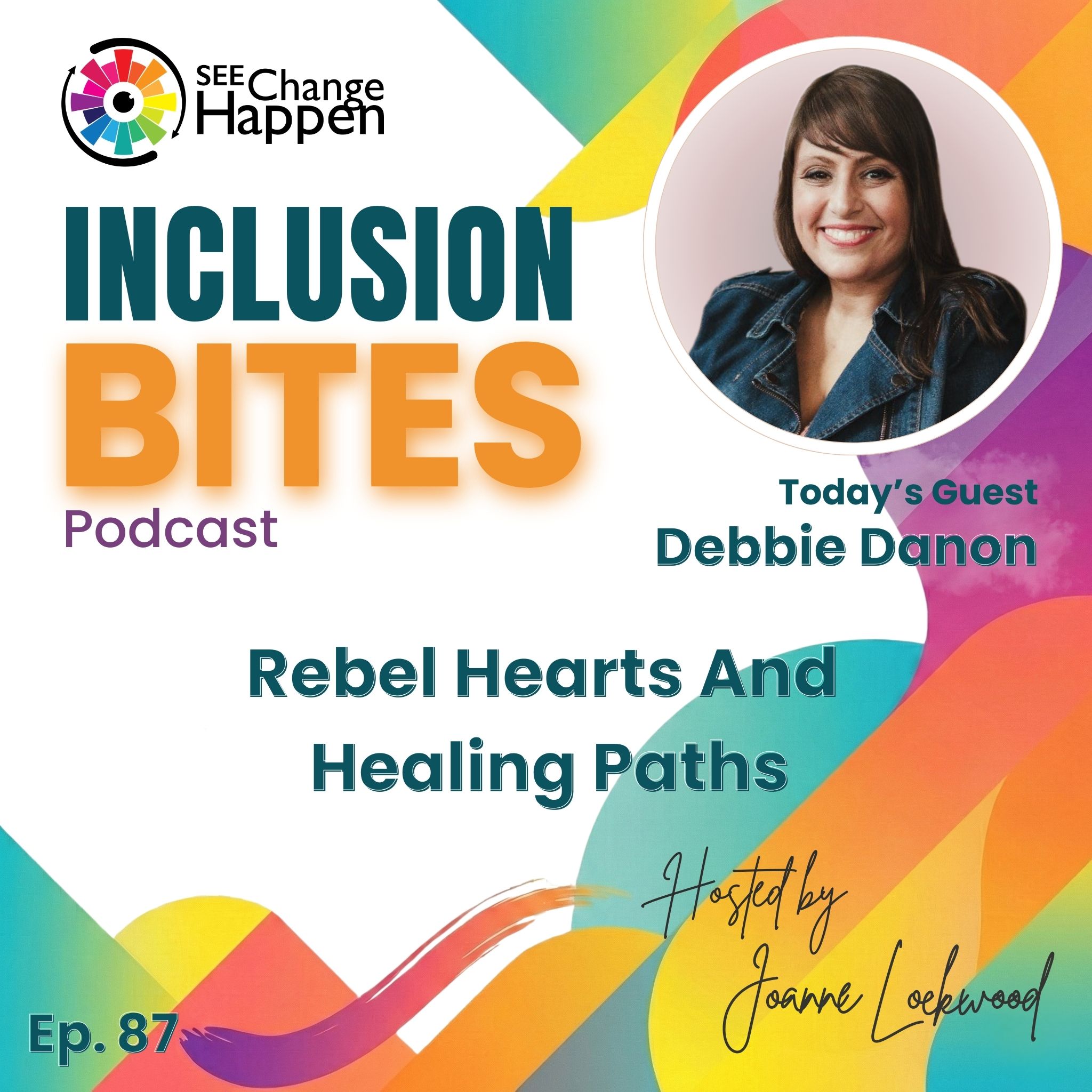
Join Joanne Lockwood and guest Debbie Danon as they delve into rebel leadership, authentic activism, and the power of healing and inclusivity in a world not set up for flourishing.
In this episode of Inclusion Bites, Joanne Lockwood speaks with Debbie Danon about mental health wellbeing trauma.
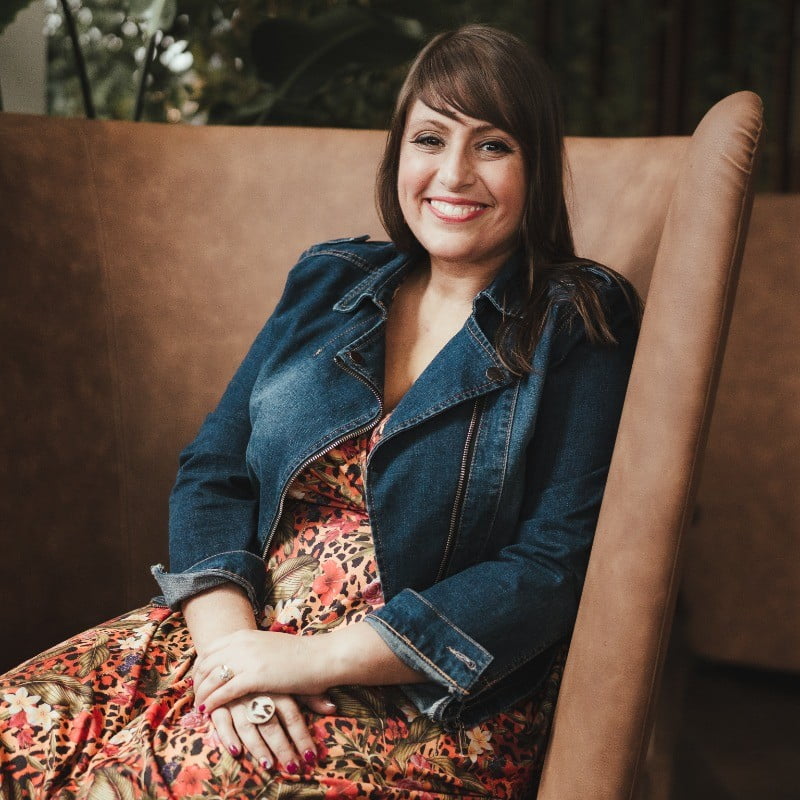
Hello, everyone. My name is Joanne Lockwood and Ibe your host for theInclusion Bites podcast. In this series, Ihave interviewed a number of amazing people and simply had aconversation around the subject of inclusion,belonging and generally making the world a betterplace for everyone to thrive. If you'd like to join me in the future,then please do drop me a line tojo.lockwood@seechangehapen.couk.That's S-E-E Change Happen dot co dot uk. Youcan catch up with all of the previous shows on itunes, Spotify andthe usual places. So plug in your headphones,grab a decaf and let's get going. Todayis Episode 87 withthe title Rebel Hearts and Healing Paths.And I have the absolute honour and privilege to welcome DebbieDannon. Debbie describes herself as a leadershipcoach, facilitator andrebel. When I asked Debbie to describe her superpower, shesaid, taking pain and transforming itthrough healing and liberation into loveboth her own and others. Hello,Debbie. Welcome to the show. Hello, Joanne. It's so good to
Debbie Danonguest
be here with you. It's brilliant. I mean, we've known each other
Joanne Lockwoodhost
now four or five years, ever since we did adesign for inclusion with Fearless Futures. Oh, that was a longtime ago. Way before COVID Way before COVID You. Are definitely one of the
Debbie Danonguest
trainees that I remember. I remember we connected quite deeply there and Iwas so delighted to reconnect with you through LinkedIn in more recent times, as we'reboth striving for similar things in the world. So I'm really, reallyglad that we not only met but also reconnected.
Joanne Lockwoodhost
Yeah. And I've been kind of secretly a bit of a fangirl of yours eversince. So, yeah, I was really inspired by that session. Mutual fangirling
Debbie Danonguest
is about to occur. I can handle it. I can handle it.
Joanne Lockwoodhost
Can the audience? I don't know. So, Debbiedebbie, tell me. Rebel hearts andhealing paths. Tell me about yourself.
Debbie Danonguest
Wow, I love this introduction. It's really speaking towho I think I'm becoming in the world and who I'm inviting my clients andmy co conspirators to become as well. So, my name isDebbie. My pronouns are she, her. I was bornin South London, but I live in North London. I do believe you can beboth. People are very binary about these things. But I'm first generation inthis country. My parents came from Istanbul in Turkeyas Turkish Jews. So kind of minority within a minorityliving in a kind of predominantly white Christian or white atheist communityin South London. So ever since I was really little, I found myself having toexplain things about why we didn't have a Christmas tree. And people asking, doyou speak Jewish at home or Turkish with your family? And you're like, I'm like,Well, Jewish is our religion and Turkish is thelanguage, these sorts of things, where even from a very young age, I found myselfin a kind of explanatory role. So maybe it's not surprising, the kind of careerpath that I've taken from there. I have always beenfascinated in religion and identityand I guess what has people act as they do? I guesswhat has people act in ways that are compassionate and lovingand affirming and kind of almost selfless,or, I guess, generous in those ways and thenalso ways in which human hearts can kind of close and we can become,by the same token, closed off. We can become judgmental, we canbecome disconnected, we can do harm to each other.And I've always been interested in that, but through different lenses. So I studiedtheology and religious studies at university and philosophy.I was at the same time super active in a Jewishyouth group where I learned a lot of the leadership skills. Andthe facilitation that I do has its roots really in a lot of that theoryand that practise of youth work. Very trying to be verydemocratic, trying to kind of remove a lot of the power dynamics that existin formal education settings, making it possible for different people toparticipate, removing barriers. And then my career has kind ofhad different chapters to it. So I worked initially in theinterfaith space. So I was one of the co founders of an interfaithorganisation. It was at the time called Three Faith Forum. It's now. The Faith andBelief Forum. And we were developing a youth programme, a Muslim anda Christian colleague, and me as a Jewish colleague. We werehighlighting and basically kind of imagining what it would be like to go into schools,particularly single faith schools, where they won't really meet people from different faiths andbackgrounds. And we were experimenting with what kind of programming could we dowith these young people and actually their teachers, too, in order to break downstereotypes. To help young people become more fluent and moreconfident. Having conversations about faith, without needing to abandon their own faithor without needing to change who they are in any way but making space forothers in their world. And that led to developing a whole range of programmingfor businesses, too, around faith awareness, around how do weaccommodate our Muslim friends at Ramadan? How do we not plan thosemeetings on the Jewish High Holy Days in September when everyone's back from holidays,but then Jews are taking off time? How do we ensure that thereis vegetarian food if our Hindu colleagues who arevegetarian? How do we make sure that we're really makingit possible for people to participate? And also addressing, at the really thin end ofthe wedge, anti Semitism Islamophobia, the kind of racismthat kind of gets and prejudice that gets wrapped up withreligion and the particular ways that plays out. So I did that for about eight
Debbie Danonguest
years and then I moved to the city and I was working, as you andI now do, joanne with organisations. So I was designingleadership pathways for the kind of, I would sayearly talent, so it would be apprentices graduates and maybekind of the first step up into kind of a bit more seniority in thosefirst two years of working for corporates. So I was doingstuff with Deloitte and Clifford Chance and the bank of England and Vodafoneand these kinds of folks really looking at how do we not onlyequip those young people to become part of the organisation, but how do wefoster a sense of belonging? So they want to know. Retention is a really, reallybig question. You spent all this time and money and effort onboarding theseyoung people and really giving them the best possible start in their careers,but why would they stay? They might stay for the pay.But more likely, and particularly we see that with Gen Y andGen Z is they're going to stay because the values align, because they feel theybelong, becausethey are being appreciated and they aren't sort of experiencingsort of being undermined or being patronised or being donedown, which in all workplaces there are pockets of that. Right,so how do we address that? So that was fascinating work. I did that fora couple of years and I've been working for myself since 2017 and it'slooked a number of different ways. I had an amazing partnership business for a couple
Debbie Danonguest
of years, for about four years, with with my old business partner, Yasmin Akhtar.It was called Trust Lab. And we were experimenting with, how do we doreally long term inclusion solutions with organisations who aren'tjust, wham, bam, let's do this on a Tuesday, and that can be that, butreally looking at the long term path, of diagnosisof what's going on in an organisation, really listening to peopleand then designing bespoke interventions, whatever those looklike, whether they look like training conversations, processesof defining leadership competencies and then ways ofembedding them and then being able to communicate that internally.Lots of organisations want to rush to the bit where you shout about it tothe outside world, but we were very clear that the first step is tostart to do that internally, so that we're not kind ofshouting about something before we've really achieved it inside. Including the learnings, right.Including the ways we mess up along the way. I think some of the bestlearning comes from that, if we can have the humility and accountability to getthere. So it's worth saying that at this point in my journey, whenYassin and I were still working together, I went through a reallydifficult period in my own life. I experienced a miscarriage and then subsequenttermination for medical reasons. So I was having fertility troubles forabout two, three years and I was really down and out. Joanne Iwas not able to get out of bed. I was really suffering I didn't wantto see friends who were pregnant. I was really having a tough time.And I guess what I learnedduring that time through seeking support, first of all, that seeking support is superimportant and shouldn't be something that weput off, shouldn't be something that we think, well, I'm okay. I'm just aboutsurviving. I think sometimes, all of us, particularly British people,I think maybe, Joanne, you can concur we can be very stiff upper lip aboutthese things. We can be like, oh, no, it's all fine. It's all all right.But actually, it's not really all right. So I got amazing supportfrom a baby loss charity. But what I've really understood is there areparts of us that need to be heard. In each of us, there's sort ofself inclusion that needs to happen. There were parts of me that I really didn'tparticularly want to acknowledge, that I was angry, that I was frustrated, that I wasjealous, that I was grieving, that I feltalone. That's really difficult stuff to turn towards. It's much easier to turnaway from it. But what I found was, and this speaks to the superpower thatyou mentioned when I turn towards those things, first ofall, no emotion ever lost forever. I know itfeels like it will, the pain, but to this day, there's never beena difficult emotion that I've turned towards that has lasted forever. And the otherthing is that by turning towards that pain, I've been able to move towards beingan activist in that field as well. Around baby loss, not justaround securing good provision for mental health support andperinatal mental health support, but also particularly aroundqueer couples getting the support that they need when they go through babyloss. Because even the Miscarriage association in certain areas werevery kind of, I think, insensitive in the way thatthere were certain chapters where there was some insensitivity around twolesbian mums, for example. Only one of them the one who hadmiscarried getting support, but then the othermum couldn't go to the men's group because it would be weird. It was juststrange. So trying to sort of support in that way as well.So I now I'm a trained integral coach, which isa very holistic school of coaching, which takes into account a lot of business coaching.If anyone listening to this has had business coaching before, a lot of coaching iskind of head and heart. It's what I'm thinking about and what I'm feeling. Andthere's a goal, and we remove the obstacles and we go get the goal, andthen we kind of, like, have a few fall downs. Like, we trip over thehurdles, and then we get back up again and we keep going towards the goal.My school of coaching, integral Coaching, which I now teachas well. So I'm now one of the faculty of the Integral Coaching School. Thirdspace in the UK. This is a school of coaching, which takesinto account much more of the human experience that kind of holistic. Joanne sowe're talking about the spiritual I. E. What we believe ourpurpose to be, not necessarily religious, but our sense of purpose and communityand connection with values, with the web of life.However you want to see that it's also about somatics it's about the body. It'sabout the fact that our brain is a physical thing living inside a physicalbody. And our legs are not just kind of like wheels that move thingsfrom place to place. Our whole bodies are experiencingeverything we're experiencing. When we experience emotions and all of that, that's really big aswell. Yeah. Go on, Joanne. You're going to jump in. I'm dying to ask you
Joanne Lockwoodhost
some things. First of all, you sharedyour experience through your pregnancy ormiscarriages or termination, and one thing that jumped out at me there is thatit's really hard for people to know what to say to you, isn't it? Youmust have found you're brave. You're this all these words, thingscoming out which are in danger of being patronising or nothelpful or here we go again, almost verging onmicroaggression, experiencing the same things all over again.Reliving that trauma and having to explain to someone how you're feeling and howthat sort of plays into I think a lot of things we talk about inthe inclusion, the diversity space, is this fear of getting it wrong.I won't see Debbie this week because I don't know how to support her. Idon't how to ask her that question. Andfear of getting it wrong is a real paralyzer in the dei space.So how can people overcome that? I've just asked you that question now on theback of what you've said, and my brain's been running around overtimetrying to figure out the right language to use. So how can peopleovercome this? Oh, that's such a great question, Joanne.
Debbie Danonguest
And I think it shows such sensitivity to go, I know there's something to besaid and I don't know quite what that is. AndI think there's something to be said for affirming justgoing, that sounds really hard, right? Not trying to be trying tokind of make a hero of someone go, well, you're so brave. I could neverdo what you're doing. Or you hear when people die and people say, oh,I can't imagine what you're going through. Well, it is imaginable because it's happened. You'reimagining it right now by empathising with me. So actuallygo to that space, imagine what it must be like, and just reflect back whatyou're hearing or what you imagine. Just saying, that sounds really hard. That
Debbie Danonguest
sounds really difficult. There can be a tendency, can't there, to try tominimise or rationalise so saying, well, it's good that you can get pregnant, isn't it?Or, oh, but don't worry because I have a sister who hadfive miscarriages and now she's got three healthy kids and it's like, that's got reallynothing to do with me. But that sounds a lot like you trying tomake me feel better, but also make yourself feel better, because wouldn't it be niceif there was something simple that we could say that could make it better? SoI think rather than try to make it better. Because quite often withgrief, with loss, even with some of the stuff that's going on right now, Imean, my family in the Middle East and my friendswho I used to facilitate with in the west bank and in know people arereally grieving and they're in a really tough spot right now. I think tryingto go into well, let me make it better by trying to rationalise it isa really it's such a well meaning move, but it's not the one that's goingto bring relief. I think the more we can almost hold the mirror up andsay, I see you, I really do see that you're trying andI really admire you, for these are thecharacteristics I see that you're showing, but I just want to acknowledge that that mustbe really hard. See, I cheated by
Joanne Lockwoodhost
asking you a meta question, didn't I, about how to answer the question, how toask the question. So I was able to talk about it with youwithout actually diving into your pain,because I didn't know where you were on that journey or whetherthat has healed within you or it's still there with you. Soit can be tricky. I think what I would say to anybody is have asimilar question. Just don't lean away from it. Lean intoit with an open heart without being invasiveand just be there for people. It's quite simple sometimes, but people doget scared. The other thing you mentioned right at the beginning, andthere's so much in your opening to dive into, wasthe fact you're a minority and a minority. And when we think aboutwhat's going on in the world right now, certainly in the Middle East area,you've grown up in a world as a person of Jewishfaith, in a Jewish family, in a very Muslimcountry with probably different core languages, Hebrewversus Turkish, differentcharacter sets. And now you're in England or theUK, speaking English in a very kind of Isuppose, again, our society is quite polarised. It's not all integrated,having to listen to what's going on in the world and people'sopinions. And we obviously see marches in London at themoment, one againstpro Palestinian, some anti Semitism, antiSemitic marches going on. We got far rightpeople trying to dive in there and cause trouble for their own ends,and the government not able to make a cohesive statement of support.You must be really conflicted, not in your own community, becauseknowing as much as I know about you. Youhave compassion for all sides as. Well, don't yeah, no, thank
Debbie Danonguest
you for asking that, Jo. It's been really difficult, andI should say maybe this is the prelude to this, is that my rebel leadershippractise now I run a practical rebel leadership is really about tryingto show up in a world that is not setup for us to flourish, right? And I mean, violence is the absolute kindof sharp end of that. But for all of us,flourishing is something that we really have to work hard at. AndI think you talked about thriving right at the beginning. And my wholephilosophy is, what's the rebel move? What's the rebel move we can bemaking in a world that's not set up for flourishing, to create space forflourishing. And I do that through rebel authenticity, rebel balance andrebel courage. And I think I've been challenged in all of those areaswith what's happened, what's been unfolding in Israel and the MiddleEast the last few weeks, because my instinct with thatis like, rebel authenticity, I should speak out on what I believe in and mycompassion for all sides and be a leader. Rebel balance, Ishould really ground myself and not get swept this wayand that way. Rebel courage, I should really have aclear sense of what it is that I want to say. And the fact is,Joanne, when the trauma is fresh andI was traumatised on the 7 October, I wason Facebook looking through, literally because the news was not fast enoughto catch up with what was happening. I was just going through, looking at allmy friends in Israel saying, where's this person? Where's this person?I can't get hold of this person. And essentially some of theattacks were broadcast live by the people committing them,by the terrorists. And I saw some of what was happeninglive and I didn't realise until about two days later that it hadcompletely taken up resonance in my body and completely dysregulatedme. And I mean, if you think about the prolificness of these videos andwhat we're seeing, the footage from Gaza, fromKnow, I think a lot of us are in a state of dysregulation. Ourbodies are not able to hold this much pain.And I guess to answer your question, yes, it's been deeplyconflicting. It's been also deeply worrying to
Debbie Danonguest
me that there's elements of the inclusion space whereby taking sides in this, by saying, hey,if you support the Palestinians, then you support terrorism, or if you supportthe Israelis, then you're racist and you'resupporting state terrorism, whatever. By taking thosesides, there's a way in which also Islamophobia and antiSemitism are allowed to play in those spaces that has made it really unsafe forme and actually unsafe for my Muslim friends and colleagues as well. Andwe've actually shared a lot of experiences of being like because I have relationships withMuslim colleagues and friends and actually Arabfriends who are Christian or who are not religious. It'slike, yeah, this is really, really unsafe for us right now. My husband isIraqi Indian, Jewish, so he's a brown man. I'm kind of whitepassing, brown passing, depending, whichever way you want to look at it. I'm kind ofneither nor, but he's very much brown. And as wellas seeing anti Semitic graffiti and havingour Jewish bakery gotsmashed, the glass got smashed in. As well as that, he got profiled on publictransport by the London Transport Police for being brown and beardedand carrying a so, like, that's the kind of complexity that we're livingin right now. So what I am realising, therebel move, Joanne, is for me, has been arebel. Authenticity is like surrounding myself with people who see meas a human and who understand me and who don't paint me well. Becauseyou're Jewish or because you have family in Israel, because you spent time in Israel,you can't possibly be part of our inclusion party. Like, I'veliterally had to leave spaces because I've called out some anti Semitismthat's played itself out and wanted to have a conversation about it. And you knowwhat? I didn't have the energy. And I was like, I'm not going to sithere and educate you when I myself am traumatised and going through ongoing trauma.On the other side of it, I have friends and I have people who listento me and who recognise who I am. And I've had some of the mostfruitful conversations about what's going on with my co conspirators, withwhom I've facilitated dialogue in the region, because they know the complexity of it,because they're really committed to a differentreality than the one we're seeing. In terms of rebel balance,I've just had to come off all social media, Joanne, like I have come offLinkedIn. I've decided I'm not going to retraumatize myself. I went on it forfive minutes this morning and then cried for half an hour because I was like,this is just not it for me. And that's really hard for me because that'sa big platform for me. I'm very, very connected to all my clients and coconspirators out there. But in terms of the way that the dialogue isunfolding, I'm not okay with it and it's discard. Bobby ledinto my system and I'm getting also somatic trauma support. So I'm having weeklytrauma support again, reaching out for help. Do it early. I did itwithin two weeks. This time, I didn't wait months and months. And then in termsof rebel courage, I think the rebel move here is actually trying toimagine, I think, violence numbs imagination, Joanne, like,when things explode to the extent that they have, andwhen people are making statements about other humanbeings that are so dehumanising and who are actually when I thinkabout. I've really experienced talk about turning towardsdifficult feelings. Like, I've experienced deep, deep sorrow andcompassion for the Palestinian people and also deep, deep, I'm going tosay it like anger and fury at the people who committedthis against it could have been me and my like, had we been inthe south of Israel visiting friends and family, that could have been us. So it'scomplex. I feel all these things very, very deeply. But in terms of
Debbie Danonguest
the rebel courage element, it's like,where can I create space or where can I find space? Andit's not going to be online, I don't think, in the kind of social mediaage of dumpster fire, just say something and thenleave and get into the comments kind of broadcast only commentssituation. I think it's going to be some kind of maybe online, butprivate spaces with people who are really committed to listening andbeing with each other and not turning away just because someone says something theydisagree with. I'm really ruminating on what might bethe right place to place my rebel courage andactually serving my clients right now, like being there for my clients, many of whomhave connections to the region, because I work with a lot of NGOs andthink tanks and folks who are in the space. I think that's the best useof my rebel courage right now. So I guess it's a big learning. And Ithink for those of us in organisations as well, that sometimes when we're going throughsomething big, our capacity just gets a bit smaller and we have to workwithin that capacity. Trying to overstretch myself and trying to be on LinkedIn and tryingto be here and trying to be there doesn't serve right now. I've got verylimited capacity. Sometimes I get triggered by something in the news and I cry foran hour and that's okay, I have to bemindful about my capacity. And it's actuallykind of a weird capitalist extractive narrative that says that I have to be everywhereall at once and I have to be showing up in that way all thetime. So, yeah, I don't know if that answers your question, but certainlyvery complex time. One thing
Joanne Lockwoodhost
I go back to, the Design for Inclusion sessions that you facilitated allthose years ago. One thing that I've learnedis that where do I get my information from? I getmy information from the media. Do I trust themedia? I'm not sure I can trust all of the media.I can't always unpack it. There's so many tropes, so many stereotypes, somany historical political angles onthings that I've learned that what I need to do is find my ownsource of truth that I can trust. And even that is tricky towade through. But one thing I have realised,listening to comments that you've made, other people I've made, that I knowonline and in person is that I don'tknow. I've learned that I don't know. I've learned thatI have no ability to make a judgement, thereforeI'm stepping out of judgement and listening. Ido know that I want peace. I do know that I don't wantpeople to die, whoever they may be. I don't want familiesdestroyed. I don't want infrastructure and the future hopes anddreams of people, whoever they may be, destroyed and torn apart. I doknow that. So I do know that. I wantDeescalation. I do know I want Simplification. I do know that I want peopleto live. That's where I start from. And how wegot to here is something I'm learning about, and I'm taking it as learningopportunity without putting you into any trauma. I saw something onthe probably on LinkedIn or Twitter orsomething around a recently broadcast episode ofUniversity Challenge, and there's a ferraroaround this blue octopus that uses amascot. And there was informationabout the person whose mascot it was waswearing Palestinian colours on her dress,her T shirt, wherever, and superficially, I had noidea what the blue octopus signified and I.
Debbie Danonguest
Don'T have any I don't think I. Even
Joanne Lockwoodhost
well, I say there was a lot for all around it. I did the researchand it transpires that the blueoctopus was a symbol used by the Third Reich, bythe Nazis, and there was lots of cartoonsaround this blue octopus engulfing the world with its claws intoeverything. So it became a trope ofantisemitism back in the 1930s.So I don't know whether this wasthe signal that someone's trying to put out or wasn't, but I then step backand say it's a problematic symbol for some.I don't have to debate whether it is or isn't problematic to me.If it's problematic to somebody else, I just go, thank you. Iunderstand. Now, I recognise what you're saying. I have the choicenot to propagate that pain or thatemblem, but I've learned about it. SoI think we could all take a bit of that education to sort oftake everything that we react to as an opportunity tolearn and to dig deep rather than fallstraight into judgement and taking aside, based onoften, a lack of historic detailed.
Debbie Danonguest
Totally. Totally. And what Sus is really bringing up for me,Joanne, when you say, you know, I can take that on board and Ican learn something new, rather than needing to dispute it because we're taking aside and we're like, well, but that side always lies, or those people aren'ttrustworthy. And I think there's a number of ways inwhich the way the current discourse is going kind of displays a number of thethings that rebel leadership is really set up to stand against orstand to imagine something new. So, for example, performativity theidea that we have to perform or do something a certain way toget likes. Or strokes or to be appreciatedversus who we are as human beings, how we show up, what we're about inthe world being of intrinsic value. And that comes from industrialrevolution kind of humans as machines kind of ideologyof humans being productive and performing right.Your value comes from the output that you create or your performance. And I thinkthat activism has we talk about performative activism. I think that's something toreally, really question and think about how do we do this in a waythat's relational, in a way that's grounded. Another thing that I think rebel leadershipstands to kind of innovate, let's say, is thisidea of scarcity. So you talked about kind of like, oh, you can just stepback and say thank you. There's lots of thingsI don't know and that's okay, and I can say I don't know. And that'snot a sign of weakness, that's just a sign of the world being really complex.And there's been lots of things I didn't know. I didn't actually make the linkwith the Blue Optimus until you mentioned it. And I'm like, oh, thanks, Joanne.
Debbie Danonguest
Okay, that makes sense. But what I seeeven in the spaces that I facilitate in organisations is sometimes there's a sortof scarcity, is scarcity of budget,scarcity of space. There's only so much space that we can givepeople. There's only so much support. There's this way in whichcapitalism, again, and I guess kind of the mindset that we haveof there's only so much to go around and we see this in therefugee narratives, stuff that gets turned out about, oh, well, refugees are coming, they're goingto take our jobs or they're going to take this from us. And it's like,actually, what if we could look at this from a place of abundance? What ifthere is an abundance of compassion? What if there is an abundance ofunderstanding to be had? What if there is an abundance ofnuance? What if there is an abundance of resource? How can wecome from that place? And that doesn't suddenly add three zeros to a budget.I'm not saying that this is kind of magical thinking, but it does change ourorientation towards what's possible. Andit actually takes a lot of self work and it's what I work withmy clients in kind of leadership spaces, is how to ground yourselfin that space of abundance rather than scarcity. I don't know ifthat's something you come across in your work too, Joanne.
Joanne Lockwoodhost
Yeah, I hear what you're saying there and itis. It's trying to focus on those things that aremore than just self promotion orself declaration of allyship and self declaration of yay,I'm going on a march, yay. Because I'm a good person. And yes, dotake part, do be visible, do stand up, but do, domore than just be there. It's about tomorrowand the day after and the week after and the year after about how youcan really do the lifelong learning. AndI'm sure you do talk about allyship. I always talk about as holding the rope.If you're in a tug of war competition, if you just let the rope drop,then it's going to get pulled over. So you just got to help that tensionwith everybody else and recognise that your hand on that rope is avaluable resource and a valuable support, no matter how muchyou're pulling, as long as you're not letting it go. I think that'sreally important. And I think the thing I'mconcerned I don't know if concern is the right word, but where we are now,this is what, November 2023, we saw a couple ofyears ago, just before, around the COVID time, we had BlackLives Matter with George Floyd, we had that murder. We had sometoo. We had violence against women and girls, we had the Metpolice, we had all these things going on, we had vigilsorganisations were very focused on well being, mental health,lunch and learns and making sure that everybody was kept in touchand nobody knew what was going on. We're all in the same storm, but differentboats, all these kind of analogies coming out. We're now,what, a couple of years later, is the world forgetting? Is the worldforgetting? I don't know about you, but I'm seeingDNI people budgets beingmore limited, budgets being cut,reprioritized. I'm seeingwe see it in the UK, this kind of war on Wokism, this antiwokeness of right wing tropes. We seerise of right wing power across the world pushingback on. What I quite rightly think is progress thatwe've made over the last few years being etched away,and suddenly we've got people who hold power and privilege feelingthreatened. What's your take on that? That's what I wantto know. Oh, goodness, yes, of course. And I
Debbie Danonguest
guess that's sort of how therope moves, isn't it? It's like, oh, gosh, they're pulling on it, we'd better pullharder in the other direction. Right? And I think itcan be a real struggle sometimes, workingin the inclusion space or campaigning. A lot of my clients are campaigners oractivists, for example, whether they're in dei roles inorganisations or whether they work for NGOs or think tanks orstartups with a social mission. And really, I hear themtalking about this same thing of, like, doesit really make a difference? I feel like the people whoaren't listening are still not listening and so forth. And the way I think aboutit, Joanne, is I'm not a campaigner. So when Isee how things play out someone I've worked with an LGBTQcharity that has had a lot of struggles with the mediaand with all the sort of antitrans rhetoric and stuff and theirstaff being traumatised and all sorts of things. And when I see that,I get so angry and upset about that that actually in a waythat by saying things that arehurtful and that are known to be hurtful by the people of power andprivilege against people who aremarginalised and who've been historically marginalised and still marginalised. They are knocking
Debbie Danonguest
them off balance so they can't do their work properly. And it's kind of thisweird, I don't know, jujitsu move or something whereit's like, oh, and now you're so traumatised or you're soincapacitated or so angry that you can't really do your workwell. So a lot of my work is around, first of all, kind of keepingthe faith, like keeping the home fires burning, that this work is worthdoing, and bringing people together in community as well, to say like,look, we can all see the value in it and look at the impact andthe wins that we've had. So not losing sight of that, but also giving peoplethe tools to co regulate and self regulate when we get knocked down. BecauseI think what you're talking about when we hear about, oh, well, maybe it's allbeen for naught and there is this quite pervasive narrative of Dei is dead, whichI actually think we need to wholesale reject because we know that that'snot the case. It's out of the bottle now. No one's putting it back inside.And what I see is the need for us to regulateourselves. I absolutely love this book called The Politics of Trauma. Maybe we can putit in the show. Notes by Stacey Haynes. And it's all about thesomatics the body stuff of doing this work,where actually our bodies take a know when we'reputting ourselves in spaces where we're speaking about our lived experience or where we're standingup and being allies for people and we may be attacked or made an exampleof. Right, so how can weget really wise about that? And then when I look at my campaigner friendsor colleagues or clients, it's really about recognisingthat this just hasn't happened by accident. The right is extremelywell organised, they know what they're doing, it's very deliberate andit's very political. And I think there's ways in which and I'm notthat person and I think this is something that I really believe in, Joanne, isthe vision is big. There's a massive, massive vision that we've got to bring aboutand we can't all be everywhere. I can't be in reproductive health and transrights and this and that. I can stand for all those things and I cansupport my colleagues in all of those things. But as one human, you just can'tbe everywhere. So you've got to pick where your contribution is. AndI know that my contribution is being the unblocker for thosepeople who are making that change, like you, like peoplelike the dei leads and the CEOs who really want to make a difference. Andthe project folks who are really leading this work. It'show can I unblock them, give them the rebel authenticity, the rebel balance,the rebel courage they need that they already have, that just needs awakeningand unblocking, so that they can show up and dothe difficult but absolutely necessary and absolutelyalive and kicking work of inclusion and buildingflourishing for all. I see myself in a
Joanne Lockwoodhost
very similar light. People accuse me, andI use that word, accuse me of being an activist, because I don'tsee myself as an activist. I don't see myself as a placard,waving, shouting, angry personwho is speaking from a wound. I don't feelwounded orchallenged personally in that way. I mean, some of that is my old privilege. Someof the fact is, as a trans woman, I've experienced very littlepersonal discrimination in my life, soI am very privileged in that respect. So I've never felt that I've neededto get angry about anything. And I think that's actually a privilege in itsown right, not feeling the need to get angry about something. So I recognise andhold that. But I always see myselfas an educator, if you like, an advocate, a supporter, achampion, a voice ofthe centre rather than a voice of the edge. Ireally want to bring people to the middle of the table, not on the edgesall the time, which isn't easy. And we talk about this frustrationand I always take it. There's a phrase inone of these videos, the essential one. Inclusion starts withI and towards the end they sayit does start with I, it starts with me. And I can bethe one as the message out of it. I can't change the world, I can'tchange everybody, but I can change me, I can change how I showup. And then I can be in a position of social influence, leadershiparound me. And if I can influence one other person for thebetter, who then spreads that on, then that's theinfection level of inclusion, if you like. And I'm also great.Another 01:00 a.m. I saying is a snowflake on its own will fall to theground and melt on the pavement. A billionsnowflakes are an avalanche. An avalanche changeslandscapes. So it is about coming together forsocial change and not being frustrated that we can't doit all on our own because we won't. But we can find other snowflakes. AndI'm proud to be a snowflake. Call me a snowflake all you like.
Debbie Danonguest
I'll take it unique and resilientin community. And I totally agree with you that solidarity is the way. And that'show I see the vision. When I think about Rebel Courage and what the visionis and I do this with organisations, it's like the vision is so huge.But just because I'm not over there and over there and over there and overthere and I found my little patch doesn't mean I can't supportknow her mission over here and I can't support Fahana over here and Ican't support Mariam over there and Gary over there. Ican absolutely be in community and in solidarity. And I would say,actually, I don't see activists as I think maybe there wasa time when I thought activist was a dirty word or activist was just likeso far outside my world. In a way, I am an activist and I
Debbie Danonguest
embrace it. And I also think thatcertain powers that be have kind of framed activists in that kind of slightly negativelight or demanding light. I would saygoing on marches and being kind of public in that way, it doesn't feel likethe best use of my energy. What I do kind of like you, is bringpeople around. So I'm a facilitator. I'm a conversation starter. I'm justbrewing an idea right now about what it could look like to create a spacefor Jews, Muslims, Arabs, folks who are affected by what's goingon right now, who are willing to be in spaces with people they disagreewith. Not to come and discuss the conflict itself, but to share andlisten and be present with what's happening for each otherfrom a perspective of building the muscle of empathy and building the muscle ofcompassion and building a sense of imagination, of actually,the world is telling us we shouldn't be able to stand each other. And yethere we are, listening to each other and validating each other and affirming each otherand seeing similarities in our experience. That's the kind of activism that I want tobe up to and that I know is going to make a lot more impactin my mind. And this is entirely me, and people can disagree with me andthey can have their own ways of making impact that's going to make more impactfor me. When I think about the kind of effort for effort exchange,effort for impact exchange, than going on marches forme, which could be traumatising for me anyway. So, yeah, I'm really hearing that.Yeah, I think we need to reclaim the term activism. I think yeah,
Joanne Lockwoodhost
I think it's because it's been weaponized as a trope and aterm. It's used to denigrate or put you down oryou hear about trans activists and that conjuresup this rebel, degenerate, sortof non constructive group of people,whereas the people on the other side of the fence are the decent,upstanding, middle class people who are perfectly reasonable.So, yeah, it's how you frame it. And I think sometimes the word activist isthrown in there as a slur and a pejorativeand I think not celebrated. I think that's probably whereI don't identify with it because I don't want to identify with it as aslur. It's not my identity. It may be something that peopleperceive me as, but are they perceiving me? AsI say, in a negative way or using it against me negatively. So, yeah,maybe that's why I reject it. But I guess I activateand activize myself in ways everyday. You
Debbie Danonguest
activate each other about other people, too. Don't diminish that, too. Andactually, funny enough, until about three years ago, I didn't reallyidentify with the idea of a rebel. And now I'm, like, wholeheartedly110%, down to my toes, up to my head rebel. Becausewhen I was younger, I was like the girl who was voted in the yearbook,most likely to keep in touch with her teachers. And lo and behold, I did,because they were really cool people. That's not very rebel,right? And I was never, like, the one pushing boundaries. And I still sometimes havea bit too healthy respect for authority, and I have to catch myself, and it'ssomething I'm learning to unlearn my respect for authority. But what I will
Debbie Danonguest
say is, when I was certifying from the Integral Coaching Programme, my dearfriend, now friend, and my coach Justin said to, youknow, reading your cases. My cases were I submitted casesfrom folks with really diverse identities and I spoke about thesystemic factors that were affecting their ability to flourish aswell as, obviously, their own choices and trying to expand the range of choicesavailable to them. And he said to me, Debbie, I just see you as thisgiant rebel, like, tall as a mountain that is like, I'm not standing for thisanymore. This is not how things should be. And that was the seed ofrebel leadership, which has been revealing itself to me ever since, which knowhow in a world that doesn't allow for flourishing, how can we bendthe rules? How can we create spaces that say, up yours to some of thethings that the world is saying we should be doing or isprofessional or is right, is moral. It's like,actually, who said that was moral? That might not be actually moral.That might just be power, holding on to power. So I'm learning,too, and I say this for folks listening who might be like, oh, I'm nota rebel. I'm just cracking on. I don't identify with this idea of rebelactivists. I guess the thing that I ask people in my workshops orin my coaching too, is, what are you a rebel for the sake of?What do you stand for? What is a norm in the world that youthink I'm not about that. That's not okay. So I always say thatI'm a rebel for the sake of breakfast, because I think breakfast is very culturallyconditioned and people get very like, you're eating what for breakfast? And it's like, well,hello, colonialism. Like, cereal has been around, what, like 200 years or something?Not even. And people have been eating rice and soup and noodles andfish and all kinds of things for breakfast for years. So I'm very mucha rebel for the sake of the breakfast revolution, of eat what you want forbreakfast and don't let anyone tell you otherwise. But I'm also a rebel for the
Debbie Danonguest
sake of healing, liberation and love. And that's something that really has come clear tome this year, and you mentioned it in my superpower, is I'mhere for healing, which is taking our pain, turning towards it,witnessing it, validating it and moving through it and helping others to do thesame. Liberation, which is about gettingthrough all of these systemic factors, these past life experiences, factorsthat the ways in which we're participating in a broken world that have kept ustrapped and stepping into liberation. And thenlove, which is really about realising that we're not disconnected.Human beings are not disconnected. Our nervous systems, it's been proven, are not disconnectedfrom each other. And this idea thatwe are no longer divided and that we can find, wedon't sort of squirrel away or kind of fall into the scarcity narrativearound love. How can I really train myself tolove others? And I think where you might think, oh, that's a weird thing totalk about in a corporate context. I talk about love with my clients a lot.And actually, when we break it down into what it actually looks like, it's reallyshowing care, showing empathy, like you said, with the miscarriage question of, like, how canI support you? What's the best way that I can be supportive to you? That'slove in the workplace, reaching out to a colleaguesix months after they've had a bereavement, just checking in, becausewe know that grief has no timeline. And it's not just like the three daysafter their compassionate leave that affects them, it'srecognising and listening and believing to people when they say thatthey've had a hard time, rather than trying to minimise or rationalise. Yeah, so thoseare things I'm a rebel for. So I really encourage folks at home to think,what are you a rebel for the sake of? And what does it take tostand up for that? I'm with you on breakfast, although
Joanne Lockwoodhost
I'm not a constant rebel. I was in Thailandmany years ago at a hotel, and the selection ofbreakfast food, or early morning food there wascurries. It was basically what I would consider anevening meal, but for breakfast, and it was like, wow. Itallowed me to just try different things at a different time ofday. I'm with you on that. If I go to ahotel and they have something different, let's give it a go. Idon't have this at home every day. Let's go and try a bit of blackpudding, which, when's black pudding been breakfast, it's kindof only in England, maybe, I don't know. But, yeah, it's all
Debbie Danonguest
arbitrary, isn't it? Someone made the rules and we now have to breakthem. See if you can help me out on
Joanne Lockwoodhost
this. You've probably experienced it as well.But I experience it often where peoplefeel like I owe them an argument or I owe them a debate.What's your view on this? What's your view on that? Or I think thistell me. I'm and then they want to argue it, whether it's transpeople in sport or trans this or trans that.Lately I've just reacted to people said, I'm sorry, I don't owe youan argument on this. This is not something that I really want to engagewith. So how do you rationalise that? Because that couldbe seen as deplatforming or shutting someone down, whereas whatyou're trying to do is bring people to that centrist area of the table tohave these conversations. Myreaction, as I say, is walk away and stop. I'm not having that conversation. Howwould you handle that? What techniques have you? Yeah. Oh,
Debbie Danonguest
such a good question, Jared. And yeah, I am sorry to hear that and notsurprised that people act that way. I love your response. I think that's really anact of rebel balance, respecting your boundaries, respecting your limitedresource by saying, I don't owe you an argument. And I think that is acompletely legitimate thing, particularly when they're talking about it in a hypothetical wayor an academic way, and you're talking about it as in, like, your right tolive a normal life way. So I think that's completelylegit and as a completely understandable wayforward. So I'm not big intomy take on social media is that it is broadcast only. So even when you'rein comments with people and you're having a conversation back and forth,it's still broadcast only because you broadcast a response and then someone else broadcasts aresponse. You're not in a state of listening. There's not a lot of listening onsocial media. I reserve myself for spaces where there islistening, where I can facilitate that listening, or where that listening is presentalready. And I think that's what you're tapping into when you say, nah, notdoing this. And I guess some people would say that'schickening out and running off, or some people would say that'smaybe leaving an educational opportunity untapped. Butif someone has already said to you that they want to fight you on thisor they want to get into it with you, we've gotto assess how safe that is for us and whether there's listening present. I alwayssay there's a beautiful model in integral coaching, and I use this with my clientsall the time. And it's this idea of like, there's
Debbie Danonguest
children's toys that there's like a stick and then there's three rings of decreasingsize that sit on top of each other. So there's like a big bottom ring.And that's relationship if you're going to create change in the world, first you needrelationship with people, which is why I'm big time investing in myrelationships with my Jewish, my Muslim, my Arab Christian,friends right now because that is what's dependent. Having that inplace means that we can move to the next ring, which is possibility. It's like,okay, let's go somewhere, let's learn something, let's figure out if there'ssomething we could do together and then only then can we move to action andcollective action or wanting to do something together. But actually peopleskip out the relationship bit and I think it's such a shame. I thinksometimes people do it because they don't want to be vulnerable. Sometimes people do itbecause they don't think there's time. But we know this intrinsically, right? You've got tohave relationship with people.I'm really grateful to folks who have the patience for it, who will actually havethose conversations. But personally, for me, it'sabout is there listening? There? Is their relationship there? Does this person matterto me? I've had some conversations with people who matter to me in the lastfew weeks. I would not have given the time of day to someone who justwanted to have it off the bat. But because I care about them, I didenter the conversation. So yeah, that's where I stand. I don't knowwhat that brings up for you, Joe. Yeah, no,
Joanne Lockwoodhost
I resonate with that. To me,a lot of it is context, motivation, trajectory.What's the outcome for this? If the outcome is justbeing told that I'm wrong and as you say, there's no listening,there's no education to be had. They're not really interested in my perspective. They justwant to tie me in knots with their views. I think thosebecome unproductive arguments that's edgeconversations, not censors conversations where the trajectoryis one of curiosity, one oflooking for education misunderstanding? Not sure.Worried, nervous, or just want to find out morethen you can tell. The trajectory of that conversation is positive.
Joanne Lockwoodhost
But if it's going off a tangent or like to bounce off the Earth,it's not worth having. So I tend to walk awaybecause you know, they're not never going to be productive.That's kind of my take on it, you know, when it's going to be productiveand for mutual benefit rather than just somebody elsewanting to tell you. I think I often describe it's a bit like roadrage. Someone wants to get out theircar and tell you you've been driving badly.They want to police you back into their box of their ruleset. And I think that's what people do. They want to put you back intotheir rule set. You don't conform with my ideals of society or my senseof right and wrong, my whatever it is. If I'm going to tell you likeroad rage, you've done wrong and I'm going to get angry with you until yougive in and say, I'm sorry, that's kind of how I see it. Oftenthese people just it's just road rage or graffiti. Someone's sprayingsomething on the wall. Not at me. They're just angry. Igo, that's fine. So I can step away fromthose using that context. I can just wind my window upand wave, smile, driveoff, see you never. Well,yeah, I'm just going to continue being me, you're going to continue being you, andthat's fine. I can live with that. I didn't need to fix you. And
Debbie Danonguest
yet those people who we are in relationship with, that's such a beautifulcontrast, isn't it? What if you're in the same car and you actually have arelationship with someone who's in the same car who's like, oh, you nearly run overthat cyclist or whatever, you're actually in conversation with them because you're in the samecar and you have some kind of shared destiny, so it's worthhaving a conversation about it. But the person in the other car, forgetit. Yeah. It takes
Joanne Lockwoodhost
an educated and grown up mind in my mind thatyou don't have to be right. Nobody has to be right. Wehave perspectives, we have opinions, we have our protective beliefs, whatever they are,but they are based out of our head and our sense of selfand our lived experience. So once you accept thatI'm right in my own head, not necessarily writing anybody else's head,and everybody else has a view, a perspective, an opinion and livedexperience, and it's about trying to find that shared understanding about why someonethinks something rather than just arguing about this outcome, that weget so hung up on this. You've got to agree with me. Iwant to understand why we disagree, actually, first. If I can understandwhy we disagree first, the fundamentals, then we can getcloser by going, okay, I get it. So that's how you were broughtup. That's the community you lived in. That's what happened to you in a youngerage. That's the lived experience your parents or your community told you that I didn'texperience. Now I can get close to you andunderstand the passion or the motivation behindwhere you stand on that. Got you. Yeah. Now I can have aconversation. And that's what we don't do, as you say. It's about thoselayers, that relationship layer of understandingand willingness to engage, not just wanting to be right.
Debbie Danonguest
So true. So true. I think there's oh, gosh, I'm going to forget who saidit. It's a poet who wrote, there's a fieldbeyond right and wrong. There's a field and I'll meet you there.Right. Which is like it's sort of surrendering the need to be right or makesomeone else wrong. Yeah.
Joanne Lockwoodhost
It does take some enlightenment to get to that point.And I'm sure you do. I certainly do. I get to the point sometimes whereI go, hang on a minute, I'm entrenched inthis. I'm kind of nailing myself to this stake here. I need to getoff this quickly and step out and go, I don't know,I need to think more. I. Need to understand you more, because Ithink it's a human thing. Protectionism, judgement and allthese kind of things that we threat analysis,we want to be right. And I think if we could fix everybodynot wanting to be right, then we'd be mean scientists.They're only right until another scientist proves them wrong. It's likePluto. Poor Pluto. It went for not existing to be a planet,and then for a few years it was a planet, and now suddenly it's nota planet anymore, for sure. And this wasright. You're so right,Debbie. It's been absolutely fascinating having a chat with you and it's beengreat to connect with you after many years. And I know we keep bumpinginto each other on social media and other platforms. We did. But we have tokeep in touch a different way now. So you mentioned earlieryou had a programme and a website, sotell our plethora of listenershow to get hold of you. Yeah. So if you would like to get in
Debbie Danonguest
touch with me, well, you can absolutely connect with me on LinkedIn. I'm still there,I'm just quiet and I am in my DMs. So if you want to bein touch with me, DM me on LinkedIn, say hello, say you've listened to thepodcast. We'd love to hear what you thought and answer your questions.So Debbie Dan on debiedanon.And you can also find me on my website of thesame. So WW dot. Debbiedanon.com and
Debbie Danonguest
I offer leadership coaching with an intersectionalliberatory lens and also a programme called Rebel LeadershipMastermind for leaders within one organisation to go through aprocess of developing rebel leadership together. So if you'd be interested inthat, feel free to get in touch. And I have a little invitation for you,a little free something something. So, I've just developed a30 minutes video coaching session called Well Being Reclaimed.And it's not your average well being session. It's really looking at the systemicways that our well being gets compromised and also looking at a reallyholistic set of ways that we can start to develop the practises and therelationships and the supportive mechanisms to make sure that we're taking care of our wellbeing in the world that we live in that is broken, that doesn't support ourflourishing. So if that's of interest to you, we'll make sure that the link toWell Being Reclaimed is in the show notes. You can download it. It's yours tokeep with a workbook as well, and I would love to hear what you thinkof it. And it's just an absolute pleasure to be here with Joanne today. Iso admire your work. We are definitely co conspirators in the same field with lotsof solidarity and, yeah, it's been a great pleasure.
Joanne Lockwoodhost
Yeah, it's been an absolute honour to spend this time with you. Justrecharging my belief in society, rechargingmy belief in humanity, and I often describe thisas like a scale electrics track. If you go too fast, sometimes you get flyingoff at the corner and I think you just help put you back on thetrack again for another lap. And it's been really powerful. And sohope also that you, the listeners who've tuned in, you'vegot to the end have been inspired as well, because there's been alot here today. Thank you. Thank you. Thank you. Please do subscribeto keep updated on future episodes of the Inclusion Bitespodcast. That's B-I-T-E-S. Tell your friends and tellyour colleagues. Please subscribe. Love to hear from you. And of course, if you'dlike to be a guest on the show yourself, then please do drop me aline together with any comments, feedback or suggestions on how we can improveto jo.lockwood@seachangehappenco.uk.And finally, my name is Joanne Lockwood. It hasbeen an absolute pleasure to this podcast for you today.Catch you next time. Bye.
Mental Health Wellbeing TraumaAuthenticityBelongingAllyshipChange & TransformationResilience
Joanne Lockwood is joined by leadership coach and facilitator Debbie Danon for a wide-ranging conversation about what it means to lead with care in a world that often feels unsafe and polarised. Debbie reflects on growing up as a Turkish Jewish Londoner and how early experiences of being “a minority within a minority” shaped her relationship with identity, belonging, and the constant pressure to explain herself.
Debbie shares deeply personal experiences of miscarriage, termination for medical reasons, and the impact of grief on the body and mind. Together, they explore why people often freeze with fear of “getting it wrong,” and what genuinely supportive responses can look like in moments of loss—less fixing and rationalising, more presence, listening, and simple acknowledgement.
The episode also turns to the strain that global conflict can place on individuals and communities, including the rise of antisemitism and Islamophobia, and the ways trauma can dysregulate us and shrink our capacity. Debbie describes stepping back from social media, seeking trauma-informed support, and focusing her energy on relational spaces where listening is possible.
Across the discussion, Debbie’s “rebel leadership” framework—rebel authenticity, rebel balance, and rebel courage—becomes a practical lens for sustaining inclusion work over the long term. Joanne and Debbie discuss allyship beyond performance, how to build trust and relationship before action, and why community and solidarity are essential for lasting change.
“But more likely, and particularly we see that with Gen Y and Gen Z is they're going to stay because the values align, because they feel they belong, because they are being appreciated and they aren't sort of experiencing sort of being undermined or being patronised or being done down, which in all workplaces there are pockets of that.”
“Including the learnings, right. Including the ways we mess up along the way. I think some of the best learning comes from that, if we can have the humility and accountability to get there.”
“I think trying to go into well, let me make it better by trying to rationalise it is a really it's such a well meaning move, but it's not the one that's going to bring relief. I think the more we can almost hold the mirror up and say, I see you, I really do see that you're trying and I really admire you, for these are the characteristics I see that you're showing, but I just want to acknowledge that that must be really hard.”
“It's been also deeply worrying to me that there's elements of the inclusion space where by taking sides in this, by saying, hey, if you support the Palestinians, then you support terrorism, or if you support the Israelis, then you're racist and you're supporting state terrorism, whatever.”
“Where can I create space or where can I find space? And it's not going to be online, I don't think, in the kind of social media age of dumpster fire, just say something and then leave and get into the comments kind of broadcast only comments situation.”
“And when I see that, I get so angry and upset about that that actually in a way that by saying things that are hurtful and that are known to be hurtful by the people of power and privilege against people who are marginalised and who've been historically marginalised and still marginalised.”
Rebel authenticity, rebel balance, and rebel courage in a world not set up for flourishing.
Questions this episode helps answer
How did Debbie Danon's personal experiences with miscarriage and fertility struggles shape her approach to leadership and activism in the field of baby loss and supporting queer couples experiencing similar challenges?
In what ways does Debbie Danon express her rebel leadership philosophy of authenticity, balance, and courage in the face of trauma, particularly in the context of recent events in Israel and the Middle East, and her experiences with anti-Semitism and racial profiling?
What insights can we gain from Joanne Lockwood and Debbie Danon's discussion about reclaiming the term "activism" and reframing its connotations towards community building, empathy, and compassion?
How do Joanne Lockwood and Debbie Danon explore the challenges and importance of building relationships with individuals from different backgrounds, as well as engaging in productive conversations that involve active listening and understanding of diverse perspectives?
How does Debbie Danon advocate for embracing abundance and nuance while standing against performative activism and scarcity mindsets in leadership, and how does this relate to creating genuine allyship and fostering holistic well-being practices within the corporate world?
What are the practical implications of Debbie Danon's Rebel Leadership Mastermind and Well Being Reclaimed coaching programmes in developing authentic leadership, nurturing well-being, and challenging cultural norms within organizations and individual lives?
Explore topics
Ideas from this episode
Mental Health Wellbeing Trauma
Authenticity
Belonging
Allyship
Change & Transformation
Resilience
Learn
Frequently asked questions
What is rebel leadership, and how does it relate to inclusion and diversity?
Rebel leadership challenges norms and promotes individual flourishing, contributing to inclusive environments where diverse perspectives are valued and respected.
How does the concept of rebel authenticity apply to leadership and well-being?
Rebel authenticity encourages leaders to be genuine, brave, and balanced, creating spaces for dialogue and support to foster well-being and resilience.
What advice does Debbie Danon offer on navigating trauma and seeking support?
Debbie Danon emphasises the importance of seeking trauma support, setting boundaries to protect mental well-being, and creating safe spaces for dialogue.
How does the podcast address the challenges of engaging in productive conversations across different backgrounds?
The podcast highlights the significance of building relationships, actively listening, understanding diverse perspectives, and surrendering the need to be right for meaningful dialogue.
What resources are available for further learning and support on topics of diversity, inclusion, and well-being?
Debbie provides a 30-minute video coaching session on holistic well-being practices, with a complimentary workbook. Additionally, the Inclusion Bites podcast offers valuable insights and discussions on these topics.
How does the discussion address the impact of social and political dynamics on diversity and inclusion work?
The conversation delves into the potential repercussions of current discourse on diversity and inclusion work, including concerns about regressive movements and the need for genuine allyship.
Share this episode
Heard something worth passing on? Send this conversation to someone who needs to hear it.