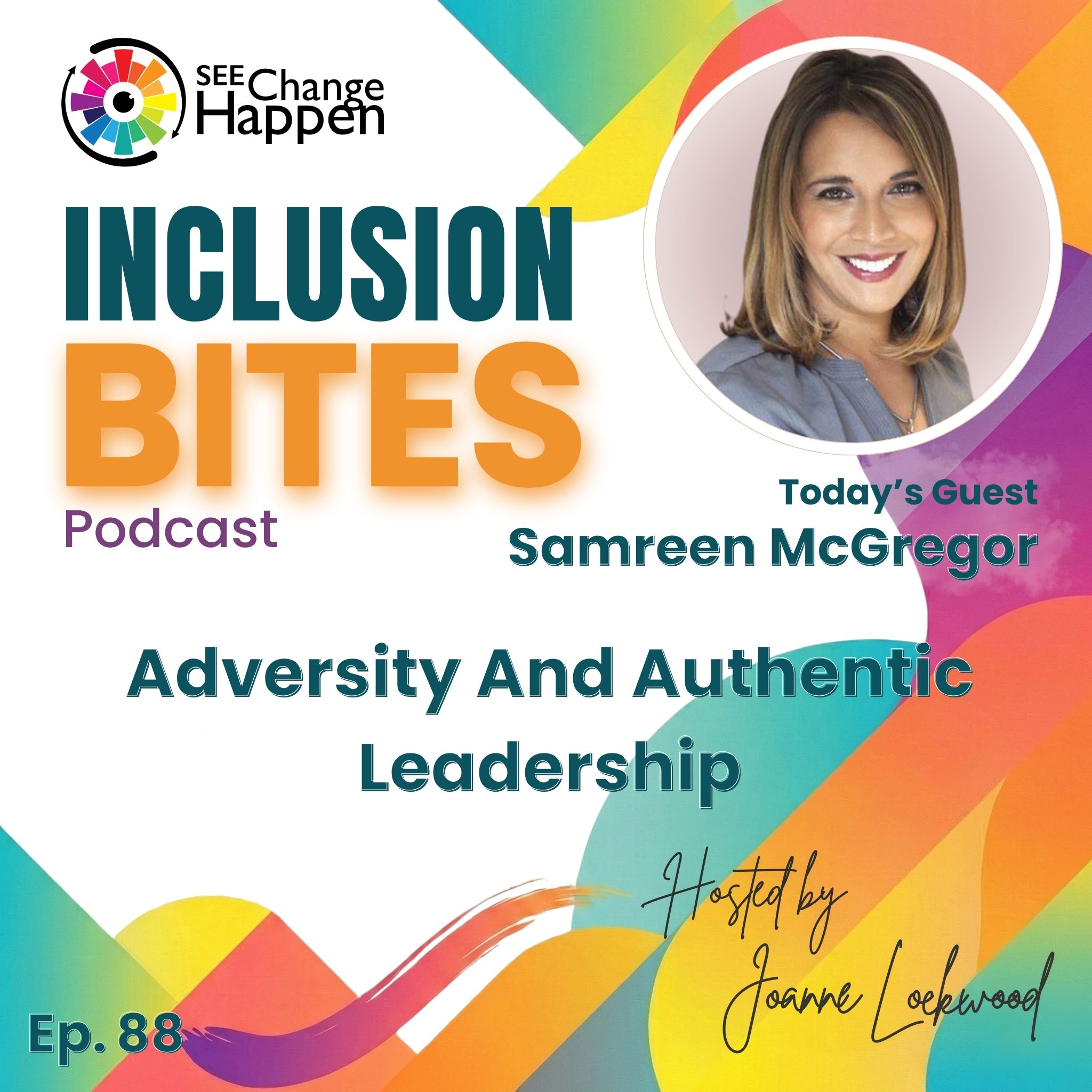
Join Joanne Lockwood and guest Samreen McGregor as they delve into the transformative impact of adversity and trauma on authentic leadership, offering poignant reflections and strategies for fostering inclusivity and belonging in the workplace.
In this episode of Inclusion Bites, Joanne Lockwood speaks with Samreen McGregor about mental health wellbeing trauma.
“The adversities that I face are a part of what make me.”
Explore
Navigate this episode
Joanne Lockwoodhost
Hello, everyone. My name is Joanne Lockwood and I'm yourhost for the Inclusion Bites podcast. Inthis series, I have interviewed a number of amazing people andsimply had a conversation around the subject ofinclusion, belonging and generally making the worlda better place for everyone to thrive.To join me in the future, then please do drop me a line tojo.lockwood@seechangehappen.co.ukl,that's S-E-E Change Happen dot Co dot Uk,you can catch up with all of the previous showson itunes, Spotify and the usual places. Soplug in your headphones, grab a decaf andlet's get going. Today isEpisode 88 with the titleAdversity and Authentic Leadership, andI have the absolute honour and privilege to welcomeSamreen McGregor. Sam reen describesherself as an executive coach anda strategic advisor to leaders and organisations.And she encourages others to see diversity andtrauma as a catalyst for empowerment.When I asked Samarine to describe a superpower, she said it is herunique blend of multicultural insight andtransformative executive coaching expertise that shebrings to the world. Hello, Samreen. Welcome tothe show. Thank you, Jo. It's great to be here today.Pleasure. It's really great. I've had a great time chatting toyou in the green room before we've gone live here. I can't wait to findout more. Really excited about this. So Samreenadversity and authentic leadership. What does
Samreen McGregorguest
that great. Great start. Well, look,there's two different words there I guess I wantto speak about. One is one that's very core tome and certainly been core to me in my consciouslife over the last six or seven years. And that'sdiversity and in the currentbackdrop that we all share,whether it's the last four or five yearsbefore and during and after the pandemic, or whether
Samreen McGregorguest
it's the very current, what I would callpolycrisis of a sociopolitical economic,environmental, health,all of those factors in the current realityare volatile. They're changing, they're significantlyaltered. And although that may have been true 100 years ago, for thosewho lived, our access and our experience of thosefactors are particularly magnified at the moment.And so adversity is really something that I wouldsuggest not many of us escape. Andthose adversities can span from being very personal, veryinternal, very intrinsic to us all the waythrough to quite externally drivenand manifest inhow we live, in our behaviours and how we work.And I feel that the skillsneeded to learn how tonavigate adversities and live with them and work with themare truly critical at thistime. And then authenticity.Well, I work with many peopleacross many industries and many organisations andbusinesses, and I have done for well over 2023,24 years. Andthroughout that time, whatever the context, Ihave experienced anumber of factors that get in the way of howwe connect with one another. And touse some psychological terms like masks andeven metaphors like shields, webring them with us to the places thatwe socialise. We work even in our own homes, in ourown families. And there are verylegitimate reasons why these masks orshields or barriers support usat times and that can get in the wayof us being our true selves. And so I thinkif I combine the two words and not necessarily force themtogether, I think they both play an importantrole in how I learn about how I studyand research and how I work with the people that I work with asan executive coach, as aconsultant over the years and as an advisor and even asa friend and as a mother or wife. Inall those contexts, theadversities that I face are a partof what make me me. And I wouldsuggest that the same thing would apply for most of us. That's a beautiful
Joanne Lockwoodhost
start. I love what you're saying there and we don't thinkabout some of the things that go on our lives as adversities necessarily.We hear a lot of people talk about resilience and if you're oldenough back I think it was the 80s or 90s, we talked about bounce backability, didn't we? That kind of the ability to be knockeddown and get back up again. So what you're sayingis we're all going through something and whether it's on a macroor micro level, we're all havingto exhibit that resilienceand deal with the diversity we're facing. Because I'm just thinking about what'sgoing on in the world at the moment. We look at what's going on inthe Middle East, what's going on in Ukraine, what's going on in other parts ofthe world. Politically, there's a lot of challenges that many peopleare facing that iscausing psychological.
Samreen McGregorguest
It is. If I were toreflect on what I've learned just through my own lifejourney and how I see myexperience with people day to day today inthe current context, I wouldsay that the word trauma hastwo just to simplify it, really. But it's not as binaryas this, but two different reactions. One is to embrace itand to be curious about it and to work with it and to get helpif it's causing effects that are getting in theway of our livelihood. But there's also anavoidance for it, towards it and a fear ofwhat it is or evena negative connotation associatedwith it. There's a stigma in many cultures. It'svery much associated with weakness, whichisn't easy to be with.And I do see more and more andI think that the wake up call for me was right in the midst ofthe pandemic. I was working within a big corporate organisation
Samreen McGregorguest
going through a fairly significant set oftransformations. One was a merger and the otherwas a digital transformation. Not just for the businessitself, but it was attempting a transformation for theindustry as a whole and the impact that thattraumatic organisational experience was havingon its people. In addition to the Pandemic and us being inlockdown. I remember sitting,as I was, working with quite a few teams at the time, and individuals andsome of the leaders across the organisation, and justnoticing that we were all livingamongst some fairlyunprecedented conditions. And thatwas a trauma that we were all experiencingin that moment. And so I started toexplore and try to understand what is trauma?And I was very inspired byand supported by the definition that Dr Gabor Mategives, which is that trauma inthe Greek language is definedas a wound. Andit's not necessarily a catastrophic event or,know, unexpected. It's what happen withinour bodies, not just our psyche, but withinour bodies. And unlike physical woundsthat form scar tissue and that hardens,they stay with us. But they're very deep. They're very, very deepwounds andthey're a form of trauma,psychological trauma, even physiological trauma,they interact with how our neurologyworks and how our physiology works. So,yes, in this current context, I would say many of us areholding and carrying these effects.
Joanne Lockwoodhost
I've heard people liken thispsychological load wecarry. As if you think about a sheet of a fourpaper, brand new out of the packet and you scrunchit up, even though you can flatten it back out again,it's never without the lines, never as perfectas it was. So even if we fixourselves as much as we can, we still carry, as you say, those scars,those creases, those scrunch marks of thattrauma that we've been through. I guess it's how we process that,because some of those are battle scars ofresilience and some of them are maybeunhealed wounds that we have to processand deal with over time. So it's how we can move on fromthat scarring. Yes, I think that's
Samreen McGregorguest
really palpable metaphorand it's very helpful becauseyou just see thepermanence and the impermanence of that, if that makes sense. It's both,isn't it? And I would say that in myexperience, there are aspects of traumathat are incredibly supportive and theychallenge us. In fact, they stretch from aneuroscientific perspective. They help us formthose elastic possibilitiesin our synaptic activity and enableus to do more. So that's sort of thebiochemistry of the resilience that you were mentioningearlier. But equally, there arelayers of us that are affectedeither more shallow or more deeplyby some of these traumas. And the quality ofhow we resolve or work with orunderstand the effects becomesincreasingly important. The more I workwith people and teams, the moreI see that I oftenam coming up against. And they share and we're talkingabout symptoms and we're talking about undesirable effects thatthey're living with, that the coaching creates a safe containerand a challenging space to work through.And I think the thing that I've realised is thatthe hidden effects, the unseen but felteffects of those unresolved aspects that livewithin us can be quite obscure,really subtle. But whenwe start to notice some of the connections between how theylive within us and then how they influence ourreactions, our responses, ourbehaviours, the actions we take, even how wefeel, generally, the more Irealise how important it is for us to truly understand some of these connectionsand the possibilities that come from learninghow to not necessarily resolve them. Because sometimes they're notfully resolvable, but it's actually acknowledge them and notice they'rethere so that we can regulate how we are responding and acting andbehaving. Yeah, I can imagine where
Joanne Lockwoodhost
if you're constantly having reinforcedmessaging through trauma, it can affect your sense ofself. You internalise anegative state of who you are, your emotions,and they become self fulfilling. This internalisation could become self fulfilling,hard to move on plays into impostor syndrome or limitingbeliefs or triggers anxietywhen certain scenarios are relived. And thatmust be really I guess everyone's going to be different on this and the waypeople deal with that, but it's going to exhibit itself in stressdifferent ways of communicating, less responsive, the emotional intelligencetakes a hit and they may not be as self aware of theirbehaviours. All these kind of things kick in whenyou're trying to maybe work through thosetraumas of the past even though they're maybe subliminal. You don't know you're going throughthat trauma or reliving that, but there's something. That'S triggering it is I mean,
Samreen McGregorguest
I recently did a talk and I'll share the story that I sharedduring that talk because it was one that came to meas I was preparing andclassifying different versions of trauma. And I think it's important to noticethat some of us might respond and goI've never been traumatised because I've never really had anythingreally significant happen to me. But I startedto explore that spectrum. You've gotthese moment to moment events that happen.Some of the typical contexts for that arechildhood and duringchildhood we experience adversitiestraumas challenges. They could be anythingand they form an imprint, they form some sort of imprint andthe extent to which those imprints are negative or awound that can sort of followon later on in life will determine whetherit's a trauma or not. And then we've got theseincidences throughout our lives when we're perhaps moremature or have far more conscious ability towork with them. But even then they leave imprints. And theseimprints again, have characteristicsaround how we respond to those imprints. And sometimes they'reconnected to our childhood, sometimes they're just connected. And soI'll share two stories that maybe brings this to life. But the first story,the one that I mentioned in the talk. My dadis a very bright man. He's Indian. He's fromIndia. Because I'm half Venezuelan, half Indian. My mother'sfrom Venezuela and I was born and raised there. But my father,he came from a family ofnine siblings. He was the eldest boyand he was born through the turmoil of theSecond World War. And when histwo youngest brothers were born, his father had alreadyretired andhe was burdened with this mantle of responsibilitythat he would have to and in thosefamilies, it was a Muslim family, it was veryimportant that the eldest brother,the eldest boy, looked after. Therewas second kin andhis grit bore fruit because heincredible. Got a fullresearch fellowship to Stanford University in the US, took aboat, a big ship, and went to Stanford andended up with a PhD, a master's and then a PhD,rather. And then he did another PhD, by the way, later on. This is whatmy dad's like. And by then, his family had been forced
Samreen McGregorguest
out of India through the partition. And so, thankfully,he was able to provide quite a lot for his family.Now, the relevance of that story isthe weight of a word he used towards me throughout my life,and the word was stupid. I know it sounds a bit embarrassing to even sayit, it's, like, so trivial. It seems reallyridiculous, actually, when I even say it out loud. But throughout my childhood, hedid call me stupid a lot, and he still does, by the way, and I'mnearly 50, so it's that kind of it's gone on and onand on. And I remember in my teenageyears, and maybe early 20s, when I'd get really angry and say, why do youkeep calling me that? It doesn't matter what it is. Whether I've stacked the dishwrong and my dad's quite OCD in the kitchen, or whether I'veanswered an algebraic equation wrongly, or whether I've made adecision with a boyfriend that wasn't one that he'd like.All of these different examples wereall classified for him as stupid.And what I realised later on in life,and again, this has taken quite a lot of personal work, isthat my relationships with bosses,often male, I would go above andbeyond my call of duty to make surethat I didn't come across as inadequate orstupid. So I'd work myself,solidly my ambition, sometimes gets thebest of me, and I would do anythingto get the acknowledgment, the feedbackthat not only was my work complete, but it was outstanding. And the moreI got this positive feedback, the moreI'd see out these challenges and relationships.And it was extraordinary. And to thedetriment of my relationships, as infriendships, even my relationships at home, I'm amother, I've got two children, and at times my ability tobe a good parent. But at work,it was my ability to set boundaries and managethem. So it's a verytrivial word, usedfrequently and often. And look at theimpact it had on my behaviours,professionally. Listened
Joanne Lockwoodhost
to you speak. And I, too,am a survivor of the wordstupid. Throughout my life, my fatherused to use that kind of word, or if notthat word, but trivialised mycontribution to something, my effort, my attempt.I went through a cycle where he would never let me write anythingin ink until I'd written it in pencil first.He checked it was okay, and then I could ink over the top of it.So if I was writing an application form for a job or something when Iwas in my teens, or if I was writing some homework for school, Ihad to write it out in pencil first, make sure that it's done correctly, andthen I was allowed to ink it over because there was no trust. I wasn'tallowed to make mistakes. And I think we think talk about things like psychologicalsafety. You need to allow people to makemistakes because you don't learn by getting things right first time, everytime you don't know where you're going wrong. So I have a similarhistory in trying to prove everybody else wrong aboutme. It's driven me, but it also manifests itselfas in procrastination,I won't start things unless I can finish them perfectly.And I've had to recalibrate perfect tobeing good enough. And I've started to understand that good enoughis good enough. And, yeah, unless you're a brainsurgeon, perfect is the only outcome, but good enough formost things. It's the 80 20 I've had to learn about 80 20. I've hadto learn that perfection is the enemy of progress, et cetera, etcetera. But it's taken me a lot of my life, and I still have thoseflashbacks of not being able to do thingsunless I can do them better than anybodyelse. And I also seek a bit of validation and personalvalidation. And I don't hungerfor well done, but I want people to know that I'm thebest I can be, even if it's just them giving me a nodor talking to me or treating me in the way that go, yeah, Joanne's reallygood at this, or Joanne's top of the class. And I end upgravitating to senior roles purely becauseI want to keep testing myself and testing myself. Testingyou've got what you're saying there resonates. I can see that. And all of
Samreen McGregorguest
those examples areI really connect with. And it'sinterestingthat in an organisation orin any sort of corporate context or organisational context,we've got individuals who are coming with these sorts ofversions of these sorts of experiences andwhether they're a deep wound that affected them, some people are less affected,and there might be other factors. Know whothey know. Carl Jung would say that theirdisposition would be different. Yeah,but actually what's interesting is that in many know there'san intent to set psychological safety andcreate those sorts of messages, narratives,conditions, expectations but this part of thepuzzle plays a significant role. It doesn't matterhow many times you expect leaders orcultures to shift in line with some of these factorsand conditions that are needed to invite for example,inclusivity or a sense of belonging. And I'm sure we'll talk a little bitabout belonging, because I've certainly had real challengesbelonging in many contexts throughout my own lifestory. And all of these expectations are onlyone part of the equation. Andthe part of the equation that involves the individualsthemselves truly understanding how toreceive that message, how to engage with it, howtheir own personal story, like you and I have just shared, mightinterfere with their ability toadapt in line with some of these expectations. It's quite
Joanne Lockwoodhost
challenging, it's quite hard.Yeah, you mentioned belonging andI often talk about belonging and to tryand give context that belonging isn't the same asinclusion and in the same that being alone is not the sameas being lonely. There's nuances and you can beincluded yet still not feel belonging.How does that manifest itself with you? I've got my own anecdote but I'd loveto hear your manifestation of belongingness if you like.How do you know? So, look,
Samreen McGregorguest
as I explained my sort of national background,my father, in the end, married a Venezuelan woman, who hemet at Stanford, actually, andthen he followed her to Venezuela. And hewas lucky because he was a petroleum engineer. And Venezuela is a very richoil well, has been a rich oil country for many, many well for manyyears. And I wasborn there, along with my brother. He was seven years older than I wasand we went to an international school because both myparents had studied in the States. So they wanted us to learn English firsthandand be bilingual and have that international. Sothe teachers that taught at the school werehighly likely to be American because of the geographical location ofVenezuela. And I foundknow it was great in many respects because there's lots of differentcultures but those who were Venezuelan and who were in the internationalschool tended to have some international flair tothem many of which also continued to have aVenezuelan more of a Venezuelan background. But
Samreen McGregorguest
then you had Americans who came from the States would comeand live there or any other nationality. Somewould travel and be either diplomaticchildren and would travel and liveelsewhere. But the effect of all that wasI ended up having quite a mishmash of anunderstanding of what my core identity was nationally.And to make things even more confusing, and this was veryconfusing, my father had beenpersuaded by a medicthat it wasn't advisable to teach a child more thanone language at a time. So although I waslearning Spanish and English at school and I was living inVenezuela, so we all spoke Spanish at home, we were onlyto speak inknow see, my mother mother tongue is Spanish andwe weren't allowed to speak Spanish.And to this day, it's really interesting, Jo, because my brother andI never speak in Spanish together, even though both of us arefluent. My mother and I was in the car with a friend the other day,in fact, on Sunday, and I called my mum and we weretalking in English and she goes, do you know? And she was Dutch and shesaid, do you ever speak to your mum in? I'm like, well, actually,sometimes not really and it's that kind of thing that happensoften so this language thing has reallyimpacted me and not in a bad way necessarily, but I'mvery conscious of it, so that's one bit. The other thing is that havinggrown up in Venezuela and then moved to London when I was 14,went to a similar kind of school. So, again, quite sort of
Samreen McGregorguest
disparate, I never genuinely feltI had, as I said, a core identity of who Iwas and from where. So I used to speak to my dad a lot andsay, So what are we? What am I? Andhe'd say, oh, you're a citizen of the world. Andalthough that sounded really and nowadays we see all theseThird Culture kids or certainly it's more talked about,I'm sure that they existed back then, like me, how clearly I did. Butit was quite destabilising and disorientating. And I neverfelt I belonged anywhere because I was always the weird one.In fact, I remember joining an organisation for the first time in my early22nd time in my early twenty s and Iintroduced myself as a mutt. And people would look at me and say, whydo you call yourself a mutt? So thatwas my experience of it and my sort ofexistential crisis growing up. Andit sounds a bit dramatic, but genuinely, it was quite confusing.And then, I think, as I've gone through life, I'll tell you one other thing,is I'm married to a British man and we havetwo kids, a boy and a girl, and 16 and 13 now. Andthey have very British accents, all three of them. And I do get correctedoften. And, yeah, the references aredifferent. Sometimes it just feels a bit youknow, I can't go back to Venezuela. The situation there has been, unfortunately,not great. We have travelled toyeah, I'm never quite like everyone else, I don't know. If
Joanne Lockwoodhost
that makes sense ask a questionso what's your internal in your head language?What do you count to ten in or add up ordo you dream in? Do you dream in English or Spanish? Yeah, but I have
Samreen McGregorguest
dreamt in both if I'm in Spain orin Venezuela or in a Spanish speaking country, I will dream. It's funny, it'sa conversation I've had recently because we were in Spain last summer,two summers ago, and I was dreaming in Spanish by the third daybecause I'm very. Yeah, so
Joanne Lockwoodhost
you can drop into native mode withouthaving to translate. People
Samreen McGregorguest
who only know me as speaking English see me speak Spanish, because my wholemannerisms change. And I'm totally Latin, soI do have both. Yeah. I don't use it as much,though, sadly. I think it's fascinating that
Joanne Lockwoodhost
you communicate with your mum, who is native Spanishspeaking In English I find that when I findwith a group of multinational people at a conference oraround the world, everyone tends to gravitate to English.And I've noticed this. I was having a conversation with a couple of Dutchpeople and I stepped out the conversation and the two Dutch people kept talkingin English and they looked at each other and said, can we just swap toDutch? Is that okay? Everybody? We need to havea proper conversation, though, in Dutch. And I thinkas a native English speaker, and that's my only real language, I'mvery privileged that a lot of the world will default to Englishin the absence of any other common language. And you don'trealise how lucky I am ofbeing in. Even if it's not the most popular language in the world. It's quitea dominant language. It is the majority, isn't it? It's
Samreen McGregorguest
definitely in working life.
Joanne Lockwoodhost
I promised you my story. I suppose, so I didn't realiseabout belonging for a long time in my life.I suppose I marched through lifehunting for something that I could neverfind. It was like this. You're turning every stone, turning ofeach rock, looking for something more, getting yourself intothings, hoping that the destination or the end of this journey would bethe thing I was looking for all my life. And I kept huntingand hunting and hunting and never found it. I think when I got into mymid 40s, that's when my gender identity kind ofstarted to become quite dominant in my thinking. Andalso it started me thinking about my I had an It career.I ran It companies for 20 odd years. It started me realisingthat that wasn't my destiny either.I fallen into this in my early 20s as a hobbythat turned into a career. It was never something that really, reallyexcited me. And I think if you've heard the Japaneseword icky guy and that sweet spot in the middleand I started to realise, even though I'd never heard of that wordbefore, that I was always missing the thingthat you love. I could earn money. The world needed it,I was good at it. But I never had the thing that I loved. Iwas dominated by making money and I was good at it. And people said Iwas good at it, I think in my mid forty s. And that's whatstruck me, is thatyou have this midlife crisis, you wake up and go, Hang on a minute,I'm now old enough to say no.And I think I did. I just stopped and said, hang on a minute. SoI explored my gender identity at that time and tookthe decision to gender transition at the ageof 52, much to the dismay of my family,I'm still married and I've still got great kids, so it's a happy storythere. And I sold my It business and I became aprofessional speaker around inclusion, belonging and also trans rights,trans awareness as well. And suddenly I discovered thatI was in alignment. All four of those boxes were now ticked. I was now
Joanne Lockwoodhost
doing something that I love and I was the personthat I'd always been missing the bit never fittedbefore, I was always in the wrong queue, I was alwaysnever quite figuring out why it was goingwrong. And now I always describe thisas I went from a period of my life where my head had noise init, there was two conversations, there was arguments, there wasdebating with this kind of this masculine feminine energyin my head, always trying to have another thought, another conversation, another secret orsomething. And I can only describe it assilence. When it's silent, it is truly silentand it was never silent in all my life. And I could sitin a chair with no music, no noise, no nothing to stare intospace and my head is empty and I can either wander off, I canideate, or I can just let time go by without thinkingand I could never do that before. Somehow I foundthat sweet spot in my life where everything kind of fits.But what I've also realised isthat I haven't rediscovered where Ibelong. I realise that whilst
Joanne Lockwoodhost
I'm included in events that my malefriends put on, they go for a drink, they go fromreal, they go to the horse racing, they do all these sortof things and I'm invited, I turn up and I have a great timebut I leave without a sense of fulfilment. I leavefeeling that wasn't me.I tolerated them, if you like, it's not them, it's definitelyme, it's not their fault or anything they're doing, it's justme. I realised that I don't belong in that maleculture and that's what I found before I gender transition,that I was in that male culture and it was rubbing me, whichis why I never felt and I didn't realise till I left itwhat was going on. But I also have a struggle isI've been out with female friends, we've beenbricklane in London, we've gone out drinking and stuffand I haven't quite found my belonging in a group of femalefriends. I don't have the same shared. Lived experience. I don'thave the same growing up at school, all the kindof things that young girls, young women, teenage womengo through, I haven't had that experience. I'm trying tofind my new sense of belonging in that environment and that's really, reallytricky as well. So I'm kind of caught on this middle groundbetween not feeling I belong here and not feeling I belonghere, yet I'm included in both. Andit's not a worry, it's not something I play about, but it's somethingas I'm talking about it now to you. It's something I do conjugateand play with in my head occasionally, trying to findthe secret source of trying to solve this riddle ofpuzzle, of how I rediscover my belonging. So,yeah, that's how I would say. What an amazing
Samreen McGregorguest
story of belonging. Gosh, it's really got me in here.I'm holding my heart for those who can't see me.It really has. And I guess some of the questions that are comingup for me around what does belongingfeel like? What has belonging feel like?Felt like, rather not feel felt like. And Iguess, what are some of your expectations aboutwhat belonging feels? And I think expectations areinteresting things, aren't they? Because, yeah, they are.
Joanne Lockwoodhost
I can't write down the piece of paper what belonging means. It'svery ethereal, very kind of undescribed. I cangive some metaphors. The metaphor I often use topeople is I know when I walk into a coffee shop, ifthis coffee shop is for me, whether it's the way I'm treated, the wayI'm served, the blend, the brand, the colour, or justthat nice sofa. And I sit in this corner with a nice sofa, and Ijust feel kind of cosy and comfy and safe andrelaxed. But I know if I walk into a different coffeeshop, I don't feel that. And it'snot a familiar coffee shop, it's knowing that the coffee shop I'm in, wherever inthe world that may be, it just feels like my kind of coffee shop.So that's all I can describe. I know instantaneouslywhen I put this coat on, when I put that pair of shoes on, whenI sit in this chair, it's for me, that's howI describe it. And I often use the if you remember thesitcom Cheers, there's a bar where everyone knows yourname and I always listen to the theme tune and itjust brings that sense of belonging. You walk in there and it'smy place. And that's how I describe belonging, that I don't have to thinkabout anything other than just being me andbeing who I am. And it kind of works.
Samreen McGregorguest
But it's the essence of what we feel. I mean, gosh, thatsong and the theme tune and that yeah, I canimagine that's. Well, I can feel it. I can definitely feelit. I can see. I think many
Joanne Lockwoodhost
of us felt that if you ever watch Friends and Rest inPeace, Matthew Perry that Central Perk, the coffeeshop they were in, that was their happy place,their sense of belonging. It was kind of them, wasn't it? And I thinkthat's, I think, the root of that, I think that's why so manypeople resonated with that sitcom, because it wasthat created the belonging that's in you. You wanted tobe in that flat. You wanted to be in that and no matter
Samreen McGregorguest
what happened, it was containing the mole, wasn't it? It wasjust a really safe.
Joanne Lockwoodhost
They drop in if it's one of them or two of them, or someone willcome in and join them.
Samreen McGregorguest
Very much. So thank you for sharing that.
Joanne Lockwoodhost
Yeah. How do you hunt downbelongingness, then? Do you have a similarfeeling? There are a few things that came up as you were talking, actually, because
Samreen McGregorguest
I'm going through not a midlife crisis, I don't know whether it'sthat or I'm actually going through this real sortof very differentexperience, a bit like you,actually. My job has been myhobby and mainly because I've loved thework I do, and I continue to, by the way, I do really enjoy thework I do and I would count myself in maybe15% to 10% of people who really,truly enjoy what they do.And I do feel that my family isjust really sacred to me and for lots of reasons,actually, we had a very bigupheaval six years ago when my son wasn't well,and this is part of what I'm about to say, butwe had an unexpected paediatric cancer journey to go through withmy son. And so when you said you wouldn'twant the brain surgeon to not beprecise and make mistakes, it was a brain surgeon who saved myson's life. As aresult of the last six years and us shifting and changingthe constellations of our life, I'vebecome really aware of myphysiology, coming back to the whole concept of trauma andadversity of the impact that those psychological imprintshave on our physical life, forobvious reasons, because my son was nine when he was diagnosed. SoI'm eternally curious about why. What isit that contributed to that? Because it wasn't genetic.So I've been on a journeypersonally in going down that whole psychological, embodiedconsciousness route and also become quite spiritual, notin a religious sense, butthere's something greater than me that I'm sort of trying to understandand I'm doing quite a lot of work in mental health. I'm dipping myfingers in lots of different approaches where we alterconsciousness to truly go deeper into ourselves.Breath work is one of them more recently. And I'm toying with anotherother things. And themore I experiment with some of theseforms of understanding myself, going a bit deeper. Healing, actually,from my childhood as well as my recent trauma as amother of a nine year old and a seven year old daughter whofelt very abandoned for two years while all ofour attention was on our son. And then coming back andrepeating myself back up again and trying to get back into professionallife. All of that healing that I'm doing now,every time I go deep into that kind of work,I feel a form of alienation from the statusquo and I go back into a corporate environment or Igo back into work. My normal work.
Samreen McGregorguest
Normal? And I don't know how to whether I can even use the word normal,but what I've been doing familiarly for many, many years.And then there's this whole area over here that I'm learning about, that I'mbecoming more and more curious about and actually being blown awayby that depth, that spirituality, that deepmental health kind of work, not just for myself, but withothers. And yeah, belongingstarts to get I really connect with how you describe thatbecause I'm not sure I fully belongin this familiar place, but I'mdefinitely not fully here because I'm integrating with people who've beenthere on this path from it whether it's indigenous tribe members or whetherit's people who are working withbody work and yoga and breathwork and mindfulness, which I haven't. I mean, I've done this, butI've not practised it or used it aspart of my profession. So, yeah, I don't know whetherthat sort of resonates.And then, of course, I bring it home to my husband and my kids andthey go, what's happening to you, Mummy? Whatare you doing? And there is some sort of transformation happeningand it's extremely deep.
Joanne Lockwoodhost
Do you find yourself in an eternal battle,trying to find the why and the reason for something? Or are youable to have a self affirmation? You can stepout of the why, not needing to know why. It just is,I would say, when. I'm in my little
Samreen McGregorguest
why is this? Everything was fine. Whyam I having to sort of ruffle my own feathers,put it that way, or the feathers of my life? And then there are timeswhen I just feel it's absolutely right. Itfeels like this is my calling, I'm seeingthings. My vision for the next 20 yearsis clarifying at a fairly rapidpace and I don't even need to know why. It just feelslike it's. Yeah, I was going through my
Joanne Lockwoodhost
reinvention reboot, however you want to describe it.A lot of my trauma and pain andconfusion, all those kind of words, were driven out of tryingto rationalise because I was a logical person, I had to solvethis problem. Why? Was I trans? Or was I transenough? Or was I just kidding myself? Can Ijust shut the lid and get on with life? Just don't be silly. Get onwith it. I wentthrough some dark times over a few months, never depression. Butyeah, certainly crying, can out of bed understand who I was,couldn't sleep. And it was just the affirmation. I am.That was the answer to every question, every selfdoubt, every confusion I had. It didn't have to have awhy, it just was. It just is. Andeven now when someone says to me what's being trans all about? AndI say, I don't know, I can't explain it, I justam. It just is. There's no reason, there's no logic.You can debate with me all you like around thisbiological fact or that biological fact or this opinion that I justshock my children to go that's fine, I don't need to have thatanswer. I just am. I can't explain it. And for me that's put mein a happy place. Not in denial, I haven't brushed it under the carpet. I'vejust realised I don't need to solve that question. Iam is enough and it's more than enough.And maybe that's part of the affirmation that I neededto get on with life and tackle things in a different wayand enables me to feel thatsense of self empowerment, I think. But not everyone'sable to find that, are they? I think that's kind of the when we'retalking earlier about the trauma, the diversity, we getlocked into that place where we can't find thelight at the end of the tunnel, can't find the combination to the lot. I'm
Samreen McGregorguest
just curious. That's what people are struggling with, perspective. I'm just asking,so how did you find your I am?Where did it come from? How did you meet it?
Joanne Lockwoodhost
I'm a very visual person.When I'm asleep and I'm ideating when I'm thinking, whatever it may be, Iimagine myself walking down a path.If I'm going to do something tomorrow, I will play through what theroad looks like, what the car looks like, what the journey looks like, what thecar park looks like, how I open the front door, how I get into there.So I visualised the entire journey in my headand I think what happened was I was doing all of thesescenarios and all these permutations trying tofind the door that would open. I thinkI just got to the point where my brain sort of said,you're okay here. You don't need to find a door. You don't need to getout of here. You just got to find your happy place. You just got tofind yourself now. And then I think just that onerealisation. Then everything just disappeared. There was no doors, there wasno barriers, there was no fence. There's nothing holding me inanymore. I was now free of those mindbarriers that I had because I didn't have to justify myself toanybody. And I use another metaphor example.In the first Matrix film, right at theend, right at the end, after all of the film, keanu Reeves andNeo is flying through the air because he sussedout that he isn't governed by socialconstructs and rules. He can just be him. And once hefreed his mind and freed himself, he was able to takethat control and manipulate the world around him. I'm not saying I want to manipulatethe world around me, but what I mean is I'm now nolonger manipulated by the world. If you like, I can stepout of that and I think that combination ofthinking is soempowering, it's gorgeous. Thank you for sharing that. Yeah,
Samreen McGregorguest
that's my life. Similarly,I do often use those two words and Ioften encourage my daughter to yeah.
Joanne Lockwoodhost
And you don't need to find I mean, I know everyone wants five. Whys?To find the solution. And yeah, sometimes it's useful to drill down onto thingsin the business world. But actually, sometimes there is
Samreen McGregorguest
no things to ground. Some ofthis transformation that I'm going through and transition I'm going throughfrom the cognitive to the lesscognitive, and that less cognitive does include things likeemotions and psychological andspiritual. I do encourage us,my clients, to notice a lot more howmuch we rely, even in the workplace, on ourcognition rather than onso many other things that we, as humans, haveavailable to us. But since I would say since theIndustrial Revolution, where farmore of the scientific method evolved and the farmore mechanistic approaches to howwe make things and sell themand transaction on them, that focuson our mind has really, reallyserved us strongly. And there is a spacefor us to amplify that and expand it much more now beyondour cognition. I
Joanne Lockwoodhost
fully recognise the world needs to be made up of a diverse waysof thinking and just in the fact that I'm happy with notknowing everything about me and why. We do need peopleto challenge, we do need scientists, we need people who want to do the detail,we want people to evolve and change things. I think what Idid was I stepped out of a world where that was mewanting, being in It computing. It was verybinary, very black and white. It worked, it didn't work. If it did work, itshould work again, type stuff. And I realised thatI thought I had attention to detail, but actually I don't. I likethere to be detail and I like there to be a process, but I don'tnecessarily want to be the one who has to find it or follow it. AndI stepped out of that, forcing myself to do detail that I wasn'treally cut out for. So we do need we need itall different personalities, different ways of thinking. And now I found my way ofthinking, I'm quite comfortable going, that's not meanymore. No, I don't need to play that game.So you wrote this book year or so ago, publishedfor about a year. Tell me a bit more about the book. So the book
Samreen McGregorguest
called Leader awakened. Why? Acceptingadversity drives power and freedom.And I remember at the very beginning when Iconsidered writing the book, I really thoughtabout my target reader who wasthat person picking up the book and getting somethingout of it and what experience I wanted them to have.Look, I think that it servedthree purposes for myself andmy aspiration, is thatit catalyses something for the targetreaders. I think that the first purpose it served for me was itwas a really important catharsis.And the catharsis for me was because I believethat in order for us tobe alive and well and maintaina healthy well being, but also do the things that reallymotivate us and be aspirationaland sort of have some sort of proportion betweenthose different forces in our lives.I felt it was important that people recognise what arethe things that happen in our life? Stories that thenhave an imprint thatguide us through life, consciously orunconsciously. So that was the second purpose and it'sarticulating it by telling a story. And there's several
Samreen McGregorguest
stories about me, there are several stories about the clientsI've worked with and that's individual clients, as well as organisationswithin which I've worked, as well as specific teams. So there's some reallylovely cases in there that bring to life a lot of the concepts andthen there are trends and research topics in therethat have formed my professional suiteof interventions. Not all of them, but a lotof them. And so really, the third thing for mewas the purpose was to showcase how Iwork and the impact it has and the difference itmakes with those individuals and those teams and groups that I work with andorganisations with whom I've worked.What I really want it to bring the reader that picks itup and immerses himself in the storiesand in some of the topics is to look in themirror, but not just to allow that imageor that light to bounce back, to go a bit deeper. I introducea concept called refraction, which is a physics concept, a bitlike reflection, but ifthe speed at which the light hits the surfaceis slower, it can actually shiftthe angle of the outcome of thatrefraction. So I'm encouragingleaders. People, and I believe most of us are leaders insome context, whether it's a parent, whether it'sa professional in a functional context, whether it's,I don't know, someone in a currentgovernment position in one of the currentwell, I don't know, nations that arecertainly going through quite a lot of challenge. We're all leaders inour own right. And so I'd really encourage leaders to slowdown, to take the space, to really refractand understand themselves at a deeper level, to alsostep back and look at the context around them andthe bigger picture. So I offer things like systemicthinking to help really understand and amplify howyou might understand the contextaround you. And most of all, it'sreally a compassionate companion for peoplewanting to understand themselves and their relationshipsand their own health and well being.Wow. Wow. I'll have to go and buy the book now.
Joanne Lockwoodhost
I presume it's on Amazon, is it? Well, look, there's
Samreen McGregorguest
several ways to get it. It's now also on Audible, so if you liketo hear them, you can get iton Audio version as well. But, yes, it's available onAmazon and in most retailers. I've got awebsite, Leaderawakened Co UK, thatif you visit that website, there's lots of different options that you can buy it,but also gives you some information about it. And it's gotthe first chapter for free, if you'd like to read that beforeyou buy the book. And, yeah, we do have aleader awakened on LinkedIn, as well as onInstagram, if you want to see little snippets ofcontent that either are found in the book orthings that I'm doing and my teamis doing, and our work with people.
Joanne Lockwoodhost
If anyone wants to get in contact with you, what's the best way to.
Samreen McGregorguest
Definitely look me up on LinkedIn? It's Samreen McGregor.And you can also, as I said, visit that samewebsite and there's links there you could get in contact with methrough that. Fabulous. Well, I know I've
Joanne Lockwoodhost
got six audible credits left. I'm going to invest one of those in aminute and cheque out your book. And next car journey.I'll put that on. I'm off to Up North next week, I think,so I'll have that. I've got a couple of hours in. The I would love
Samreen McGregorguest
that and I would love to hear, especially given the stories we've exchangedtoday. I found them really heartwarming. So thank you.
Joanne Lockwoodhost
Yeah, likewise. Thank you. Well, brilliant. I mean,if you're listening, you could probably tell we could carry on this conversation all dayand all night. So this has been an amazing conversation. Thank you. And we gotquite deep at times, which was really, I don't know, quitecathartic. I don't know if you felt the same, but yeah, definitely cathartic. So,thanks, Amreen, and I'm sure you, the listeners, must betaking lots away from today's episode. It's been fantastic.Thank you for tuning in. Thank you for getting to the end and staying withus. Thank you. If you're not already subscribed, please do subscribe tokeep updated on future episodes of the Inclusion Bites podcast.That's B-I-T-E-S. Share the love. Tell your friends, tell yourcolleagues. Find us on itunes. Apple podcasts, Googlepodcasts, we're everywhere. Leave us a review, please leave us a review. Give us fivestars. Tell us how much you love us. I've got a number of otherexciting guests lined up that I'm sure you'll be equally inspired by. Over the nextfew weeks and months. And, of course, if you're listening and you'd love to be
Joanne Lockwoodhost
a guest, I'd love to have you on the show. So please drop me aline tojo.lockwood@seechangehappen.co.uk. Andif you've got any suggestions on how we can improve, I'd love to hear thoseas well. And finally finally, my name isJoanne Lockwood, and it's been an absolute pleasureto host this podcast for you today. Catch you next time.Bye.
Mental Health Wellbeing TraumaAuthenticityBelongingPsychological SafetyResilienceConfidence Self Worth
Joanne Lockwood is joined by executive coach and strategic advisor Samreen McGregor for a wide-ranging conversation about adversity and authentic leadership, set against a backdrop of global uncertainty and everyday personal pressures.
Samreen unpacks how adversity can show up both externally and internally, and why the language and stigma around trauma can prevent people from recognising its impact. Drawing on her coaching work and research, she describes trauma as a deep “wound” that can influence behaviour, relationships, and performance over time, and explains the value of creating safe spaces where people can notice and work with these patterns.
Both Joanne and Samreen share formative experiences that shaped their sense of self-worth and belonging. They explore how childhood messages can drive perfectionism, validation-seeking, and boundary issues at work, and how these dynamics connect to psychological safety and inclusion.
The discussion also moves into identity and belonging across different contexts. Samreen reflects on growing up across cultures and languages, and Joanne shares her journey of gender transition and the ongoing challenge of feeling included without necessarily feeling a deep sense of belonging.
The episode closes with Samreen introducing her book, Leader Awakened, and her invitation for leaders to slow down, reflect more deeply, and broaden leadership beyond purely cognitive approaches to include emotional and embodied awareness.
“And I think it's important to notice that some of us might respond and go I've never been traumatised because I've never really had anything really significant happen to me.”
“It doesn't matter how many times you expect leaders or cultures to shift in line with some of these factors and conditions that are needed to invite for example, inclusivity or a sense of belonging.”
“So, look, as I explained my sort of national background, my father, in the end, married a Venezuelan woman, who he met at Stanford, actually, and then he followed her to Venezuela.”
“What I really want it to bring the reader that picks it up and immerses himself in the stories and in some of the topics is to look in the mirror, but not just to allow that image or that light to bounce back, to go a bit deeper.”
We carry invisible burdens that weigh heavily on our identity, affecting how we show up in the world.
Questions this episode helps answer
Joanne Lockwood discussed her journey of self-realisation and transition as a trans woman. How did her experiences influence her perspectives on inclusion and belonging in the workplace?
Samreen McGregor talked about the impact of trauma and adversity on leadership. How can leaders effectively navigate adversity and trauma within themselves and their teams to foster inclusive environments?
Both guests shared personal experiences that shaped their sense of self and belonging. How can leaders use their own experiences to create empathetic and inclusive work environments?
Samreen McGregor discussed the significance of authentic leadership. How can leaders balance authenticity with professional expectations in corporate settings?
Joanne Lockwood and Samreen McGregor emphasised the importance of diverse thinking and introspection. How can organisations encourage diverse ways of thinking to enhance inclusivity and innovation?
Samreen McGregor shared her experiences with navigating different cultural influences and language use. How can language and cultural awareness contribute to fostering a sense of belonging and psychological safety in the workplace?
Explore topics
Ideas from this episode
Mental Health Wellbeing Trauma
Authenticity
Belonging
Psychological Safety
Resilience
Confidence Self Worth
Learn
Frequently asked questions
Who are the hosts and guests featured in this podcast episode?
The episode is hosted by Joanne Lockwood and features Samreen McGregor as the guest.
What is the main focus of this podcast episode?
The main focus is on adversity, authentic leadership, diversity, trauma, and empowerment.
What personal experiences do the hosts and guests share in this episode?
They share experiences related to identity, belonging, trauma, corporate transitions, gender identity, childhood experiences, and professional journeys.
How does language impact a sense of belonging and identity?
Language plays a significant role in shaping a sense of self, with examples of multilingual upbringing, struggles with language use, and the manifestation of belonging.
How does trauma affect personal and professional experiences?
The guests and hosts discuss the impact of childhood experiences, reinforced messaging, self-critical beliefs, and the role of trauma in shaping behaviour and emotional responses.
What are the main themes related to authentic leadership in this episode?
The themes include embracing adversity, navigating trauma, authenticity, removing masks and barriers, and understanding the impact of trauma on individuals and organisations.
Share this episode
Heard something worth passing on? Send this conversation to someone who needs to hear it.