Sara Dalsfelt and Joanne Lockwood dive deep into the complexities of modern talent attraction, challenging traditional hiring methods and advocating for inclusive, behaviour-based recruitment approaches, ultimately encompassing a breadth of essential
In this episode of Inclusion Bites, Joanne Lockwood speaks with Sara Dalsfelt about workplace culture systems.
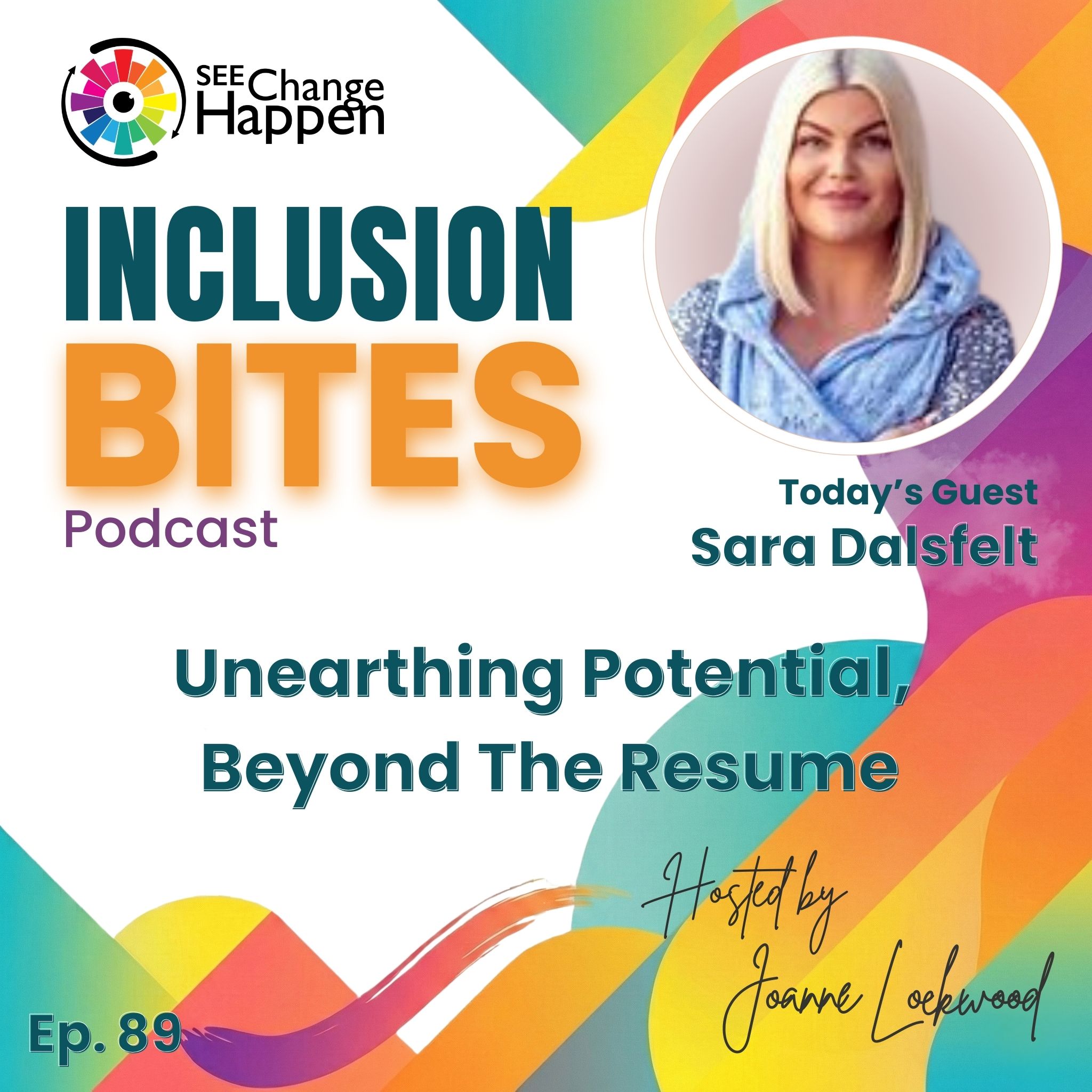
Hello, everyone. My name is Joanne Lockwood and I am your hostfor the Inclusion Bites Podcast. In thisseries, I have interviewed a number of amazing people and simply hada conversation around the subject of inclusion, belongingand generally making the world a better place for everyone to thrive.If you'd like to join me in the future, then please do drop me aline to jo.lockwood@seechangehappen.co.uk,that's S-E-E Change Happen dot co dot uk.You can catch up with all of the previous shows on itunes,Spotify and the usual places. Soplug in your headphones, grab a decaf andlet's get going. Today isEpisode 89 with the title UnearthingPotential beyond the Resume.And I have the absolute honour and privilege to welcomeSara Dalsfeld. Sara is the Chief MarketingOfficer at Adway. Adway are a talent attractionsuite, a consciously inclusive platform thatis built to find hard to reach talent on social media.And when I asked Sara to describe her superpower, shesaid she unapologetically daresto be herself and walks the talk. Hello,Sara, welcome to the show. Hello, Jo. Thank you for
Sara Dalsfeltguest
having me on the show. We met
Joanne Lockwoodhost
several years ago. I think I did an adwaypodcast or live stream with you and we just went in the green room, weren'twe? That was four or five years ago, early COVID. Yeah,
Sara Dalsfeltguest
I just looked back. You were on my LinkedIn live show, 2019, Ibelieve, and we did a fabulous episode. You canstill rewatch it, everyone, for listening. In English it was called ishiring for diversity hiring for second best? And weunpacked what conscious inclusion means in Practise for hiring teams.It's still a really good topic, a really good show.And that's how we met, I believe, through the TAcommunity. It was last
Joanne Lockwoodhost
year. Yeah, we did on the adwaystand, yeah. Brilliant. Yeah. I've been a fan of yours ever since,
Sara Dalsfeltguest
Joanne. Like what you do for the space, who you are, the knowledgeyou bring, the perspectives. I recommend you toeveryone I stumble across for Conscious Inclusivehiring tactics. For those of you can't see,
Joanne Lockwoodhost
because this is a podcast, I've gone bright red, I'm blushing, I'm all over theplace. This fangirl stuff is hard to take.Fangirls. You have to take it in. You're an important voice. Thankyou. So, UnearthingPotential and so what is beyond the resume? Can we binthe resume? Yeah. For me, I
Sara Dalsfeltguest
believe we're heading into a time where candidatesalmost will start questioning employers in whythey're assessing their potential based on a piece of paper. Ibelieve we're almost there. Where? Well, the CV is, for most employersnow, even ancient, but it's still used, right. It's a traditionalhiring tactic, but in a very nearfuture, candidates will start questioning, how is this evenrelevant to assessing my readiness, my potential andmy transferable skills? So everythingis beyond the resume? Everything is beyond the CV. Theperson, the potential the people is beyond the CV. Soit's just an easy way for employers to weed outwhat's not relevant to them and it holds a lot ofbias into the process. Don't you find
Joanne Lockwoodhost
that many traditional hiringmanagers, employers, they've got this kindof scared they're scared, aren't they? They start twitching if you saywe can't have a CV. And they go how can I find out about peopleif I don't have their CV? Minds are blown. Minds are blown.
Sara Dalsfeltguest
I'm here to tell you there's never been a time where there's moretools, more tech, more solutions, more everythingto assess potential as early as possible in thehiring funnel. And for me, Joanne, it allcomes down to if you're not consciously including,you are most likely unconsciously excluding.
Joanne Lockwoodhost
That's definitely one of my sayings. I've used that. So yeah, it's so true.
Sara Dalsfeltguest
There's so very few people building that in to theirtalent attraction or talent acquisition strategy or hiringstrategy. It's still just a saying, it's a good quote on the fridge.But we're here to say you have to consciously build itin to your tech stack or your strategy or anythingin order when you go to find talents, it has to be built in,otherwise you are most likely excludingare organisations. This is a sporting analogy. Are they match fit
Joanne Lockwoodhost
for hiring? Because I see people talking about diversehiring, inclusive hiring, whatever buzzword they want touse to make them sound kind of contemporary and on themark. But I always wonderif the candidate experience and the employee experiencethey're selling is reality or a dream orvapour. Right? Absolutely. It's most likely
Sara Dalsfeltguest
buzzwords. Right. We have to start somewhere. I believe everything starts withbuzwords but I mean, we have theknowledge anything at ourfingertips, we can't just rely onbuzwords or quotes anymore. We have to start acting. Andas beautiful as our ta community is, we're good at talking.That's where I sort know introduced myself with I walk thetalk. So why we built that way five years ago was
Sara Dalsfeltguest
to make sure that there are toolsharnessing all the potential in diversity on social media. Becausethere's over 5 billion people, every person under the sunis on social media potentially. And there's ways whereyou have to work in order to keep upwith the policies on some, to actively includeand not target anyone on gender or age or ethnicityor all these factors that might come from an idea, from an hiringmanager. Right? So we built that way to have anautomated suite powered by AI to really go out and findpotential on social media and make sure the candid experience is walkingthe talk. In terms ofthe best shopping experience you've ever had online,designing your dream car or just ordering yourfoods for the grocery store or whatever piece of clothing you mightorder that, but better, more sophisticated and more personalised shouldbe your hiring experience as well. So that'sthe reason why we did it. And so far the most innovative and mostthought provoking and forward TA teams are using these kindof tools because they know if they're not consciouslyinclude, they are excluding in somewhere in thejourney. And I believe well, somesay, I say 90% of your hiring success isdetermined at the first 10% of thejourney. So what you do in the first process, when you gobroad, when you go to find your audience and you start nudgingand attracting and building this storytelling experience for them,that's where you can improve for potential anddiversity in the very first steps. And then, yes, there should beautomated assessments, right? There should be automated testing, there should be all thesefeatures that helps both the hiring teams and thecandidate experience, right? Sowhy I'm on the podcast, Joe,it's everything that we do, it's everything that I believe in and for myself.I know we touched upon where I shared. Ihave a one year long gap in my CV orresume from a trauma, a really troubling traumawhere I had to be off work, right? Andthese traditional hiring methods would never hire me. And here Iam, the CMO of my dream company that we started five years ago.I would never been hired if I were to be judgedby a recruiter from my cover letter becauseit's not saying anything about my readiness or my potential or whatI bring to the table in terms of transferable skills, etcetera. So to answer your question, what's behind theresume? Everything potential.
Joanne Lockwoodhost
So we know that the talent attraction part of thestory starts way before we go tomarket with a campaign. If you'renot in Ta, you're not in recruitment, talent acquisition,EVP, employer branding, all this value propositionstuff all around the recruitment marketing element. It's got to start waybefore and be that authentic thread through the organisation.So I often find that organisations are trying to jump to the hiringphase without doing the heavylift on the. But on the contrary, a lot of
Sara Dalsfeltguest
teams, they stay stuck and paralysed in thework of the EVP or the career page or the value propositionor the communication versus not a lot of people have thedistribution, the actual strategy. How doyou take your fabulous EVP to thephones, the hands of the most desiredcandidates that you want to approach? Not a lot of teamsput the investment or the energy into thedistribution of that. They just hope that people will find their EVPor find their employer branding. So even if you have the mostinclusive promise as an employer, how do youhave the most inclusive and thought through strategyto go and approach them? And approachingmeans approaching mostly like passive candidates, hardto reach talents. Talents that most likely are alreadyfully employed, working doing what theylove. So you now have to have a strategy that'sreally built into providing your lovely EVPinto the hands of their phones, where they spend over three 4hours a day scrolling through social media. And it has to be an experiencethat's built for that specific social media channels that they're in,all while being as inclusive as they want it with theirEVP. So you see, there's a lot of likeas to your point, a lot of teams spend their time figuring outthe EVP, but the other part they just jumpstraight into the hiring and not a lot of companies spend the time on thedistribution. How do we go to market? How do we makesure that we've opened the funnel for as manytalents as possible? Because here's the facts. Youneed to go broad in order to attract diverse talentand the best talent from there,volumes of candidates will still be relevant talentsif you automate the assessment and the testing andeverything screening based that you might have. But youcan't say that you have an inclusive hiring if you just go to a selectednetwork or a close group or your bestfriend, or your male friend.That usually happens. So that's why Ireally challenge ta teams to look into how do you go tomarket and stay consciously inclusive.
Joanne Lockwoodhost
I'm just trying to piece together what you're saying here. So help me out.So are we talking about a broadspectrum of trying to build our candidatepool our talent pipeline from a broader spectrum as possiblearound a broad demographic and skill set and everything else,and then being able to bring those into your funnel, your pipelineand use automation to siftpreselect on competency and capability andadaptability and change all these sort of things. Yes, the hiring teamthemselves are just getting a presifted diversepool. Exactly that. Exactly that. You won't get to a
Sara Dalsfeltguest
presifted diverse, relevant pool if you don't open thefunnel from the beginning. And opening the funnel is utilisingtech because there's the heavy lifting right there's whereautomation really comes in. So what I'm saying isthere's no other platform in the world where over5 billion people spend more time than they do oneating every day. The general user onsocial media spends social media almost like they spend almost2.5 hours a day. And that is increasing. Like, you know,just cheque your settings, right? That is increasing. So what I say is
Sara Dalsfeltguest
you have to go where the candidates spend their time, where they livetheir lives, right? You have to then make sure youare distributing a strategy that builds a storytelling experiencebased on your EVP, on your employer brand, on all these valuepropositions that are as inclusive as you say. Meaningyou will then only attract and assess the most relevant talents becausethey've been appealed and targeted based on potential and readiness.And your arguments that areselling to them. Because there's alwayslike, I love this discussion, but people always come back to it, say, I justwant one great candidate. Right.How with one great candidate would you know, you've opened the pool forpotential, for inclusion, for diversity. Fordiversity. You wouldn't. What you're saying tome is I want an easy life. Sure. Easy life means doingthe right thing, consciously working intoworking inclusive strategies into your method,but utilising the tech then to do the heavy lifting. So you sitthen with that relevant social talent poolsbased on relevance, potential, readiness,and with the most diverse teams you could ever imagine. And from thereyou could start assessing. Right.
Joanne Lockwoodhost
This is kind of like headhunting ona mega enormous scale. So you'vegot a pool of potentially thousands of people or morebeing spear fishing them. So you're targeting them directlyon mass. Yes.You're not suggesting cast a broad net everywhere. What you'resaying is you're casting your net specifically forcompetency and skills. So it is spear phishing, but on amega scale. Yeah. And we work with behavioural targeting, so
Sara Dalsfeltguest
it's still targeted. But thenhow algorithms work is that they have to learnfrom a lot of data initially. Right. Andwith that you can then teach algorithm to work towardsthen specific data points that are building for aninclusive hiring strategy or not segmenting anyoneon gender or ethnicity or all these bias factors.So it's simply makingsure you walk the talk in your ta setup aswell. Like, everything into your tech stack should walk thetalk and you have to make sure it does. Can't just be thequote you're throwing at your next RL 100 talk.Right. You have to walk the talk andlook into your own process.
Joanne Lockwoodhost
How long does the candidate stay passive in theprocess? Until they're kind of triggered into akind of yes, this person meets our primary criteria, then we'll do someoutreach so they can be passive in this process foryears. Drop into it. This is such an interesting
Sara Dalsfeltguest
question. Right. So there's a consensus in the market, like in thehiring industry, that we'vealways talked about a passive and an active market. Right. People activelooking for a job when they're in between jobs. Right. And people who happen tobe employed. But I like to look atit as to your point, as how I incorporate yourquestion. There's a window of opportunity wheresomeone is about to act if we go back to e commerceand shopping tactics online. Right. I'm a passivecustomer always. I have money, I'm on social media, Ilike clothes. Let's make it easy. Right? I'm not in the look foranything. Yeah, you too. Exactly. Who isn't? Jack Joe? Whoisn't? I'm not in the look for anything. Let's just make it supereasy. It's been black month. Black Friday. I'vedone all my shopping. I'm satisfied. But I'm still apassive customer online, living my life onsocial media, right? If I stumble acrossreally targeted ads with very personalised messages,discount codes, anything, and these ads,iterate they go after me on Instagram, then when I'mon TikTok, I get a new one. When I'm on LinkedIn, I get three other
Sara Dalsfeltguest
ones. When know, jumping into could be Twitchor whatever platform that might be. I have a designedexperience to sort of approach me with a product, right?In this case, might be a bag. I like bags, for instance.Let's make it super easy. So there's a window of opportunitywhere I've been nudged enough times.There's not a golden number, but a lot of people say there should be seventouch points in order to make an action, right? Soin the window of time where I turn active,that's where I believe you have to make sure you have a process that'sso sophisticated, that actually capitalises onmy window of opportunity when I'm active. So it meansI need to be buying this bag with one click. I haveto feel super secure. I have to trust the tech. I haveto make sure it's not a scam site, it's not a scamcompany taking my card details. I have to feel supertrusted. And it should be the smoothest, easiestconfirming experience ever. Like, yes, sir, you're doing the right thing.The bag is coming in a day. One click, we have all theinformation that we need. And the same goes forapplying for a job. There's a window of opportunity.
Sara Dalsfeltguest
And this window of opportunity can increase by buildingthese personalised storytelling experiences over social mediaplatforms, making me turning me into an activecandidate once I've been presentedwith these offers over time. So to your point, yes, it cantake over six months. We have a process that makessure our customers, they hire everything fromCEOs down to customer service personnel or whatever, likeall different types of roles. And it takesforever for some because they're so passive. Could be eyedoctors or pharmacists, right? They'reso passive in terms of looking for job, but they're very active in terms ofworking, so they're not a lot of time approaching them, right? They might be onsocial media just when they're taking a coffee. Then thetiming needs to be there. The sophisticated strategy needs to be there. SoI like to look at it as a window of timewhen someone turn active. You have to make sure yoursoftware works for you to capitalise on thisvery rare moment. I
Joanne Lockwoodhost
love that idea. I'm with you on bags, but I'mprobably almost active on buying an airfryer everywhere I go. I
Sara Dalsfeltguest
bet you every social media channel knows this.You're 80% there. And I'm being honed
Joanne Lockwoodhost
into a certain brand, a certain price range,certain feature set, because I can feel that I've inquired and I've done someresearch and I'm looking at certain things. So thisis what you're saying, really is it's building up a behavioural patternof what has interested me, what hasn't interested me,where I go, it indicates my abilities and mypeople I hang out with. So you're building up a picture of me to knowthat this particular air fryer on Black Friday, and youprobably know that 50 pounds off is my kind of dealthreshold. Yes. And then I'm going to click on it and then, as yousay, it has to happen immediately. Immediately,
Sara Dalsfeltguest
yes. It has to be a trusted process. Super easy, oneclick and it should be. Imaginethe business of an e commerce, not converting thoseJoes like yourself actually going to market for that airfryer. Imagine that business loss. And the same goesfor ta teams. For instance, look at the spill happeningon every career page today. Every ta team out thereinvests a lot of money in driving traffic to their career page.Nothing new. Right. What do you think is the average conversion rate on a careerpage today? I guess it was pretty low because people are
Joanne Lockwoodhost
just window shopping, passively checking the market out.
Sara Dalsfeltguest
Yes. But some teams are like, I wouldn't,so I argue there's not a lot of passivecandidates just surfing around, a lot of clicks, alot of steps down to your specific career page.It's a big ask. It's a big ask for a pharmaceuticalworking full time, super stressed, havingeverything to do by themselves. Right. So not a lotof passive candidates stumble across a career page becausethat's not like your SEO isn't that good? I would just shout. You got to
Joanne Lockwoodhost
kind of have a motivation. You're disgruntled, you're atrisk, something's happened. Exactly.
Sara Dalsfeltguest
There's people naturally looking for there's somepercentage going into career pages, but that's not the majority. The majoritywould mainly spend their time on social media or anythingelse on their phones. Right. But so the ones thatactually do come to the career page haveoften committed to something. There's often some interest there.Once you actually come into a career page, that meanslosing out. On an average, 98%of the traffic is like throwing fishnets in thewater and not picking up the fish. And this happens for almost all
Sara Dalsfeltguest
ta teams and hiring teams out there. And again, how is thisbuilding upon to your inclusive, diverse talentpools? How is this building for the canned experience? It's not. It'sjust repelling thousands andthousands and thousands of people every day. Hundreds, if you're anaverage company. But this loop is justwhere I getfascinated of how this can still be going on when there'sso much knowledge and there's so much you don't evenhave to be using social media yourself to know that there's acertain expectation from a persona, a usertoday. And, Joe, you're the same persona buying the airfire asyou would be applying for a job that Adway would promote. Right.You're still the same. Your behaviour is still the same. You have the sameexpectations. You go into social media, you go online, you have anexpectation of your user experience that has to bemet. Otherwise you would never buy the air fryer.You expect Amazon checkout or you expect easybuy or you expect klarna easy checkout or whatever.And the same persona is expecting a super easyapplication journey. So as
Joanne Lockwoodhost
a passive candidate, I'm browsing minded my own businessand I would start seeing targetedcontent around a brand, around astory the brand's telling to lure me in, tocreate a brand association. This brand is good. I love thisbrand in my head. And then they're going to kindof hit me with a why don't you find out more about us? Is thatthe kind of approach to try and drive me into their inquiryfunnel? Yes. So what we do is we build social talent
Sara Dalsfeltguest
pools built of relevance as well. So, yes, we would definitelygo to market with a lot of arguments built on ourcustomers. ICP, EVP, employee branding, all the arguments that'srelevant for all the categories that they arepromoting. But then as to your point, there needs to be a sortof Hansel and Greta storytelling experiencehappening to even care. Because you're not in a war fortalent, you're in a war for attention.And that comes back to the distribution and the strategy ofgetting the right message at the right time on the right platform with theright window of opportunity. So what we do isthat we build these talent pools that we can then retarget with allthese relevant messages. One good example that we alwaysdo is, for instance, how the travel industryhave really nailed onlinepurchases of travels, right? The majorityof travels being sold or bought today is happening online.And that's been an industry sort of pioneering howyou would go about an online order,because like ten years back, we still shopped a lot ofwell, we did a lot of travel bookings online. It was one of the firstindustries starting it, and still today it's one of the most lucrativeindustries in terms of online shopping. Right? So what they do is,first of all, an online ecommerce company, likebooking.com, let's make it easy. They are very muchaware that it's not one ad that sellstheir travel destination. It's an experience.And it's an experience that has to have built in social proofand trust in order for anyone to even care andput that much money behind it. Because it's for instance, let's say we're going tothe Maldives, quite an investment. Often
Sara Dalsfeltguest
like honeymoon investment, even like you wouldn't just randomly ona spring holiday go to Maldives, right? This is big investment andthese companies know this. So they have to build a storytellingexperience where they blendmessages and social proof and trust into all thesedifferent ads, approaching the customerswith a sophisticated, timely,precisely timing of everything. So there's like afine line being spammed, as you might have been experienced,Joe, like, spammed with the targeting ads. Like, I already bought those shoes.Why are they still following me? That is not a sophisticated journey,that's sort of spray and pray approach to targeted advertising. Butthe sophistication means messagesright on time, where they still feel nudging and not like,big brother is watching me, right? And this is where e commerce for travelagencies have done amazingly well. So the first ad that my showis going to, it's going to be like a coupleexperience going to the Maldives, right? They show the turquoise water,they show the villa, they show the champagne on the beach, and it's just likesetting the scene. The first ad is like, we have a package deal for yougoing to the Maldives. They know this is not where you buy, but this iswhere someone in your reptile brain,something might be registered. Right?Three days later, they show, oh, so this isa kids free hotel. It's for couples looking to get away,having their old bungalow. It's really, like, targeted towards you and perhapsyour wife, because they know, right? Fourth day, fifthday, it's a family testimonial, or in this case, a coupletestimonial. Yes, it was kids free. I got all the freemassages that I wanted. It was so much rest for me. I hadthe best time ever. Five ratings, right? Dayten, there comes the booking.com review.Like, ten stars. Best reviews ever. A lot ofcouples love this destination. It was worth all the money ever.We would never regret this. Yada, yada, yada. And on day14, you get the last ad in the sequenceof storytelling with a 20% discount.Last chance to buy. Would you believethey would sell the same amount of travel packages on the firstad versus the last ad? I can believe that. Because the people
Joanne Lockwoodhost
have different buyer journeys, different buyer experiences, different impulses.
Sara Dalsfeltguest
Exactly. So every one is going to
Joanne Lockwoodhost
peel people off, depart, and thenno doubt, the last one, that's not give up. That's just pause andcome back later, isn't it? You don't give up completely. Exactly. It can always
Sara Dalsfeltguest
be retargeted. And they know that. The couple testimonialad you've sent to your wife, like, hey,aren't we worth this? We're worth this. And then the questioningstart happening and you guys could start picturing yourself goingthere. So once you get the last message, thelast ad, the last storytelling experience, it's a no go.And that's how we like to approach talent attraction as well. We need to builda storytelling experience to sell them their new lifestyle,their new life work, life balance. All thesearguments that are selling the position and selling their newpotential job. And it should be as timed asthe Monday, you go in and you actually havea bad meeting with your manager and like, damn it, I'd never getmy will through. Whatever. And bam, there's the ad. Find adate to apply, let's go. Yeah,
Joanne Lockwoodhost
it's being there, being ready. And you say spear fishing, right at the pointon that cusp of being passive active, isn't it? It's no point, right? And
Sara Dalsfeltguest
I like to see it as window of opportunity. So when someone actually is turningactive, you better work. The solution better workfor you. So, as you can tell, I love this topic and coming back toinclusive hiring strategies, there's so much we can do, there's so muchtools in our hands, there's so much knowledge, and there's never been a bettercase for conscious inclusion and making sureyou're hiring people who can bring their authentic selves to work. That is wherewe are. And adway, we've been inspired by so manyof you guys, every advocate and profile,educating the market, and we just believe we have the tech andsolution to actually activate it and making it real andnot just keeping it as a good quote. Wewant to change how we work. We want to change and make sure we havethe tools operating currently. So
Joanne Lockwoodhost
you're in the majority working with forward thinking companieswho kind of plugged into this, who get it. There'sstill the rest of the world that is operatingon a different modus operandi. And you know as well as I dothat the challenge is the cost per hire, the speedof hire, the experience, all those kind of things. Andwhenever I'm talking to organisations, the frustration isaround getting people into the funnel ofa broadest demographic. Possible. Exactly. Ina cost effective way. So let's just talk about the people who haven'tfound the light just yet. And that's a challenge, because what we end updoing is we end up using traditional recruitment processes witha non diverse and non broad demographic talentpool, wondering why we're not getting the output fromthat pipeline. True. Or enough candidates to give youchoice across a broad demographic. That's the challenge, isn't it?And it's around getting the people in the funnel. And you're saying this passive activewindow of opportunity is a way of getting people into the top of funneland then doing something with it. So let's talk about I'veclicked. Yeah, I want the air fry, I want the holiday, I want the couple'sretreat, I want that new handbag, that pair of shoes. I definitely got tohave that pair. So I've clicked. Whatshould my candidate experience be like from that pointforward? So I want to advocate that the
Sara Dalsfeltguest
expectation here, even if it's a handbag, even ifit's the travel, even if it's the air fryer, isthat you do not want to leave the form.And by form, I want to say, when you click on an ad, what.Should happen is you called straight in to theapplication form. In this case, it should be as easy assubmitting a lead. For instance, Joe, you pressed ajob ad from adway. What should happen and what does happen with our talentattraction suite is you get a question like, would you like toregister interest or would you like to apply? You onlyneed to submit your email to actuallybe in the loop. And this is where a lot of ta teams andhiring teams get stuff wrong, because the old way of lookingin hiring is we don't want a lot of work togo through. Like that's the old way of looking. I would
Sara Dalsfeltguest
even argue that most hiring processes is built to weedout, not include versus todayyou have to broaden your perspective. You have to have a processthat includes. That means if Joe has awindow of opportunity, you have to meet that and you have to makeit super, like, stupidly super easyto capture this interest. Which means one clickis what needs in the initial phase, thenit should be a gamified experience. So, for instance, what we builtis you stay in the ad, you submit your email, then youcan leave. We don't need anything more from you. We can retargetyou and we can say, hey, Joe, remember you applied for head ofthe universe at Tesla, head of universal Tesla,right? Great role for you, Joe. Then you get a ping notification or anemail or an ad, whatever you like, an SMS, a text, could be anythingsaying, well, you've only submitted 20% of the informationto become a great hire for Tesla. Would you like to just include threescreening questions and then you're 100% done. So it's agamified experience. Either you stay in the ad and you just fillknow if it's screening questions or know the employer ofchoice tesla have chosen to fill in to make your hiring process,or you leave the form and come back when you have the time. Because youmight be on the subway, you might be in the supermarket, you might be inthe bathroom. So there's always alternatives to when yousubmit and come back. But capturing the first interest isvital, the first window of opportunity you have to capture.Then you can always push the candidate to update theirprofile. In this case, it's not a profile, but it's still anapplication for head of universus Tesla. You don't have to create an account, but you
Sara Dalsfeltguest
can still be submitting your profile to the talentpool of this role, right? Or you stay in the form, you add youremail and you answer a few questions, making surethe most relevant information come through, right? We don't needposter code, we don't need that. We just need to make sure that youperhaps live in France if this is the case for know, thesefactors are really built into the specific employer and thespecific role, but I'm trying to say it in an example. Right, so the experienceshould be one click. You should be in the ad, there should be nofluffy 1 billion clicks through aform which is not mobileassessed or it's not built for mobile friendly, should be noaccount created, should be ideally not a single coverletter or CV uploaded either. It should be a supersmooth journey based on finding potential withassessments and tests and screening based on science in order to reallymake sure what's getting through is relevant for this roleand that you are opening up for potential and transferableskills and everything that you need in order for have a thriving workforce.Right, so, same as with Airfire. One, two clicks,super secure, easy checkout, making sure my bank details is allsecured. I don't feel stressed about this decision. I have to have an immediateconfirmation. You did a great job, Joe. The airfire is coming.Or thank you so much. We have everything we need in order to process youfurther for Head of Universal Tesla, and that should be the cannedexperience and you should then continue with your life, keep scrolling instagramand go have dinner with your family. But
Joanne Lockwoodhost
we know that isn't the typical candidate experience in the world, isit? We know that's a very curated, verycontemporary, forward thinking way of dealing with things. But candidatesgenerally have a very poor experience. I'm sure manypeople listening here have been experienced. The Blunder Bus approach onLinkedIn, recruiters sending us, are you interestedin this, are you interested in that? Or you look great for this role,picking something that you did 20 years ago as a keyword,that's still the candidate experience. We've gone out there and itbuilds a lack of trust into the recruiting process. And I believe it's like
Sara Dalsfeltguest
it's no blame on the recruiters, no blame on peoplejust trying because they're so pressured. Like, there's an insane amountof pressure on recruiters right now. They're supposed to be AI engineers,marketing experts, sales experts, like, all these. There's so muchpressure on them. But what I do want to challenge and what I like todiscuss is how come we're not valuing our candidatesand building processes and experience just as we would withsuper valuable customers? Because it's thesame. Imagine, again, an ecommerce, a travelagency, treating their desired customerslike most companies does with their candidatesin revenue loss. Just imagine the figures in revenueloss and it's not like in terms of buyingstuff or being a customer, I could still goback some years later and like, I want air fryer. Like, I don't care,it's a good deal, I'm going to buy it. I'm not that sceptical about thebrand selling the air fryer, but when it comes to hiring, ifI've had a bad experience with a brand, they're doomed.They're out the majority of candidates will never applyagain. So it's not just that you're turning them off,you're ending forever a relationship. And it'snot just a lot of people come to market saying there's nocandidates. How come you're thinking you'resprinking each dayyou're working against yourself? So I think the bigger question shouldbe, yes, of course, everyone should have the ideal can experience and everyoneshould work with the best tech out there. But still, you have tosee and approach your candidates as valuedcustomers and you have to make sure that is the experience, else whyare you in recruitment?
Joanne Lockwoodhost
Most? I think I think 65, 70% ofthe UK workforce work for businesses that areten people or less, or certainly small businesses, microbusinesses. What we're talking abouthere is an enterprise. It's acorporate, large organisation budget,I guess. How do smaller organisationsget into something like this? Because first of all, it's amindset change, isn't it? Recruitment, marketing and what you're talking about is a real mindsetchange versus the old. I'll put it on typicaljob site and get thousands of applications from around the worldthat very few are actually relevant. We latch onthe biases, kick in that person's name, that person's education.We're suddenly biassing and going, oh, look, there's a couple of white peoplehere with English handing names who live in the local town. They'll beperfect. That's what goes on at the moment in the majority of the world, doesn'tit? I want to
Sara Dalsfeltguest
challenge when it comes to investing ininclusive strategies or tech or platforms, it's like, what wouldit cost you to not get this diverse workforce intothe company? Right? So that's always the calculation. But,yes, we work with companies that are hiring for very complexroles and volumes of roles that's like mainly our target audience,but it still could be companies doing 30 hires a year if it's likepharmacists or It specialists or salespeople orservice personnel or whatever. Soeither way, because what I'm coming fromis I had this brilliant live stream yesterday on my LinkedIn Live channel together withWolfgang Brickwetter. He's an HRspecialist and recruitment experience personfrom the Doc region, and he's been doing recruitment trends reports forover 1015 years. And we went through a lot of benchmarkdata because there's nothing we love more than benchmark data. And when it comes to,like, what are the hiring budget or the marketing budget for this TA team,or how much are they spending on these channels, or what's their average? Andwe went through a lot of this data, and what was reallyinteresting was even if you have a super tightbudget for Bahuma marketing or employee branding, which you might have in thetimes we're in, what you don't get isthe change here is in terms of whatI said before. You're not in a war for talent. You're a war for attention.If you don't join the party now, it'llbe exponentially more expensive next yearand the year after that and the year after that. Because again,everyone is going into social recruiting. Everyoneis understanding the need for the most epic candidate experience.Everyone is investing in this and if you're not joining the party, you're out ofthe game. So even with the tiniest recruitment marketing budget, and we looked intothis cool benchmark data, I can send you some then later joe,even with the tiniest budget, you have to make sure these budgets are working themost efficiently for you. Building the talent pools, optimising thecareer page, not losing out on this valuable, relevant,diverse traffic that you are driving in some way, even if it'sthrough search or outreach or automatedprocess. With recruitment marketing, you have to make sure these tiny budgetswork for you and you have to go where the candidates are. So I wouldnaturally argue never to put all your eggs in onebasket. My approach to hiring with tinybudgets either way, is multichannel. You haveto understand that the persona the average socialmedia user has, I think it's on average7.5 somi apps that theyuse, so they live in a universe of social media,meaning LinkedIn is not your golden or silver bullet,meta is not your silver bullet. TikTok might not be asilver bullet, but there is several platforms where people are living. Andif you build in a super smart tactic, you don't have tospend billions of dollars in building these candidateexperiences. You just have to make sure that your EVPis not be left for everyone to experience. Because who willtype in VVV?Mycareepage mycareepage, my career? Noone. No one knows. And how would I even know that H Mis one of the biggest It employers in the world? I think ofH M as clothing, I don't think of HM as AI engineers. Right? So Iwouldn't type in a career page because I would think H M is forclothing. There's all these differences in terms of mindset and howyou have to approach shopping experience and online behaviourinto incorporating that, into talent attraction. So I wouldstill make sure my tiny budgets work for me,making sure I can collect the audiences, I can retarget the audiences, and Igo broad on social media to make sureI can attract diverse potential.
Joanne Lockwoodhost
So it starts this conversation with unearthing potential beyond the resume.The CV. Yes. So I'm a candidate, I've got a CV,I'm an employer, I want a CV. So how do I, asa candidate settle myself? Because theCV is a sales prospectus document. I actuallywant you to be biassed for me, so I actually want the right bias.
Sara Dalsfeltguest
Isn't this so interesting? It's all made up from the beginning.I can chat, GBT, everything, right? So it's noteven that's a problem. I want you to be biassed, but thenagain, are you assessing me on my readiness and myskills and everything that is me? So the whole thing, like thewhole show, the whole charade of a CV is made up onnon beneficial information for anyone, notanyone. So good point, though, in terms ofhow can I word you in this case, joe, you're going to challenge Tesla forHead of Universe, right? You want Tesla to hire you without a CV.What I encourage candidates to do is to actuallyquestion one, are you giving everyonethe same chance for this job? Two,include assessments and testing as early aspossible in the process. That means you're not weeding outanything, you're building to include peopleand give everyone the chance. And as long as you explain,it's super easy to have a little box of information in youronline application journey saying, hey, we're putting our tests super earlyin the funnel because we want everyone given the same chance. You as well, makesure this will take you five minutes, sit somewhere comfortable, take a coffeeand let's get started with a test. Make sure it's
Sara Dalsfeltguest
built to include, not to exclude.And from there,if you want to use your gut feeling or if you want to have alook at a CV, do that later. Again,I always advocate and everyone does this, I believe the community is great.We always talk about challenging hiring managers and I don't thinkno recruiter ever on this earth have missed the fact that you have to bea strategic business partner. I believe everyone knows this, and I believe everyone doeswhat they can about this, but it's still if you've done everythingright from the beginning opened up thefunnel, making sure you have automated an assessment and testing tools, making sure it's notheavy lifting, but you're still processing relevant talent pools. So whenyou get involved, it's still relevant to the role. And fordiversity? Meaning if you've done everything right,your funnel is built on the best possible, inclusive way, you will end upwith five equal good candidates.So if a hiring manager must, in this world,use their gut feeling, they can I mean, I'm not recommending it,but as a last step on paper, they can,right? Because you've built the process, securing thatpotential and diverse applicants hadthe chance to come through all the way to the last submission.Right? So that ismy whole thinking. I believeyou have to challenge the facthow employers are assessing you. And I know this ishappening today just as review sites or glassdoor orwhatever, transparency into the hiring process is happening and it's goingto blow up more than ever. But candidates are challengingemployers how they're assessed and how they're measured, on howthey're a match for this opportunity.And I believe we should be prepared and we should definitelyproactively approach the candidate market with this. And we wantto make sure that we don't build orgo back to this charade where someone has a charadeapplication paper in their hands and I have a charadeassessment strategy where I spend 6 secondssifting through a CV and like, hey, it's a good match. Yeah, I can readhis name. Perfect. No picture, not going to use it. Right?So there needs to be challenge, the whole thing needs to bechallenged from both ends. And I believeemployers have to have the answer. Why are you assessing me on mycover letter? Have to have the answer.
Joanne Lockwoodhost
Yes, the ability to write a word document shouldn't be the basis on your. Ability
Sara Dalsfeltguest
to rule the universe with generative AI. We're like, there's nosubstance. Mean, imaginethe risk Tesla would take with you, Joanne. Not withyou, of course, but I meant with your cover letter built on chat GPT forHead of Universe. Imagine the risk if they were to assess youon this piece of paper that you've been creating. Five minuteswith Generative AI. It's no substance, it's no relevance, it'snothing. So I think the whole thing should be challengedfrom both ends. So this process is
Joanne Lockwoodhost
completely fair. It's bias, it's mitigated as much as wecan based on behaviours, it's based on competency, it's based onpotential, not based on yesterday, it's based on tomorrow. All the kindof great things we know. But if my organisation hasa gender equity problem, a pay gap problem, disabilitygap problem, or an ethnicity problem,if I can't bias the process towards femalehires, or towards people of colour, or towards people with disability,I'll keep hiring, probably in the same ratio, or Iwon't change the ratio enough to fix my gap. Fix my ratio. The leaking
Sara Dalsfeltguest
bucket. How do I
Joanne Lockwoodhost
influence the funnel? Naturally? I mean, this is the big
Sara Dalsfeltguest
question, right? And I believe there's so many great people outthere discussing this and having the best answers ever.But of course you can't fill a leaking bucket withrelevant applications if there's no foundation orenvironmental support for them to stay and thrive, right?So you have to look internally.Everyone is like you have to start with this first. I want to challenge andsay that you can have two thoughts in your brain at once. Wecan have parallel activities happening, right? So there shouldalways be an ongoing strategy and work for makingsure everyone feel that they can turn up to work as theirauthentic self, they're supported as their authentic self,or as I said, unapologetically myself, right?
Joanne Lockwoodhost
We're talking about here is the employee experience, the retentionelement. Get my retention, get my employee experience, right?Primarily. Then go to market that's with air fryer Joe.
Sara Dalsfeltguest
What if I send you the shittiest old McDonald'sfrying super stinky thing to you and like, eh, it's an airfryer, whatever. It doesn't matter if you had the best online experience,right, if the product, if the reality then ismet with a fraud. Right. So obviously,obviously you have to clean your house first, obviously. And you have towhere you I believe what you're doing, Joanne, is makingsure this is incorporated into the business,OKRs? It's not just a value proposition, it's not just ata KPI, it's incorporated into our businessKPIs. And this is everhave in terms of seasons. You could have a season ofgreat hiring and great thriving and people staying forlong, but then all of a sudden a whole department would quit becauseof XYZ and you have no diverserepresentation at all because of XYZ. So this is everongoing and no, naturally, you cannot build the bestonline experience for candidates if it's met with the worstoffline experience. I mean, that's just a waste of everyone'stime, money and happiness.
Joanne Lockwoodhost
I think what I'm hearing saying is you got to get yourself right. You gotto be a look in the mirror. You're selling who you are. You'renot selling something fake and inauthentic. You got to be walking thetalk anthropologically yourselves as anorganisation, but that still says you've got a 7030 gender ratio.In my mind, you got to hire two women for every men, every man, otherwiseyou're not either not fixing the problem or the problem is gettingworse. That's a real challenge. When we're looking atunbiased or debiased or anonymizedrecruitment processes, the ratio is likely tonot change much. Exactly. And the question of
Sara Dalsfeltguest
representation,because the outcome is not status quo, right. Ourstarting point is not equal. Our starting point wasnever 50 50 male female genderequality. Right? So we have to workfrom a starting point where I don't know the figure, but if it's70% men in organisation and 30% women, that's our startingpoint. So then we have to have representation, and Ibelieve boxing women and menin or grouping or all thisstuff could be hurtful in the long run. But asa starting point, we have to have an activestrategy in terms of making the foundation where we areequal. So naturally we have to approach the fact that,yes, there's going to be a lack of diversity or gender diversityor all parts here, and that needs to be takeninto acknowledgment when you build the process and how you assess and how youagain, make sure you have the most diverse teams in yourcompany. But there's also a dangerin labelling right.In hiring as well, in the long run. But it's a very interestingquestion and it's an important question. And I think as topoint, the starting point was never equal tobegin with and that needs to be taken into consideration when you buildyour strategy. I think you said it earlier, you don't just
Joanne Lockwoodhost
do one thing, you got to fix youryou got to sweep the floor, clean the room, get your company thetoxicity, the culture right. First, then you can do what you're talkingabout here is the behavioural outreach via social media. Then if you gota specific need around changing the ratioof the demographic in your organisation, that's adifferent targeted approach. Yes. You can use different recruitment, marketing,different outreach solutions exactly. Totry and resolve gender or an ethnicity problem. Yeah. Messaging as well. Messaging as
Sara Dalsfeltguest
well. So, again, what I'm usually getting questions becausewe do volumes of job campaigns onmillions of campaigns on social media platforms. And we're not saying you haveto dance and be a TikTok company where you have to have asuper polished EVP employer branding. We're saying what people wantis your authentic own personnel, explaining tothem why they get supported to be their authentic self atwork. This is what the candidate market want. They onTikTok, do not want you can dance saying it if you want to, butit's not expected. We want authentichuman connections. And just as with the shopping experience,you want real reviews. Right, Joanne? You're looking at the reviews forthe air fryer. You want to make sure it's a verified buyer. You want tomake sure it's a verified person. It's not getting paid to do the review. Samegoes for canned experience. You want to make sure yep. Okay. Hassan hasworked in this company for four years. He's the head of engineer. He's been thrivingin the company. This is why he stays. That's what you want to know.So, again, it comes down to authentic messaging, but thestrategy needs to open up to attractdiverse potential. And that comes down to a lotof these factors. It's in the messaging, it's in distribution, it's inthe AI powered solution, it's in targeting, but it definitelymust be supported by authentic content. No onecares about donuts or whatever peoplegoes for benefits of work. I actuallydo well. I thrive with I'm having a puppy and Iget a lot of budgets approved and we get a lot of new hiresbecause puppy at the office is really popular. Butthat's just me. And I did not buy the puppy to get more hires. Butit was a big plus. We've got to use different
Joanne Lockwoodhost
sorts of marketing and puppies turn people on, cats turn peopleon, children turn people on. Skiing. There's different ways of justattracting people and say, oh, this company just get abelongingness. Creating the belongingness, isn't it? Exactly.Sara, we could talk all day. We will againnotice in future, I'm sure we'll do another podcast. We'll do a live stream sometimesoon. But in the meantime, how can people get hold of you?You said you had a white paper or some research you can put in the
Joanne Lockwoodhost
show notes. I'll put this in the show notes, absolutely. First of all, I will
Sara Dalsfeltguest
definitely link to Wolfgang Brickwedde's latest recruiting trends report because Ibelieve everyone needs benchmark data. We also have our latestsocial recruiting trends analysis, which is really jam packed withhow social media can help with inclusive hiring. And if theywant to know more about adway, how we work and myself, it's just type inAdway AI and cheque out our talent attraction suite. AndI am well addicted to LinkedIn, so I have my communitythere, I have a lot of engaged followers and I do a lot of livestreams and discussions on there. So just type in Sara Dalsfeld onLinkedIn if you want to connect. And I'm happy to keep thesediscussions going. And that's what we do all the time, Joanne. That's whereyou thrive in the community and keepeducating and challenging old ways of hiring, which I love. You'reone of my favourites in the newsfeed. Thank you. I've got
Joanne Lockwoodhost
all blushing again. Thank you. Thank you so much. Andthank you to you, the listener, for getting to the end staying this far. SoI really appreciate your engagement. And if you've not alreadysubscribed, please do subscribe and cheque out the back issues and theback episodes as well. This is the inclusion bites podcast. That's B-I-T-E-S.Share the love. Share it with your colleagues, your friendsand other people on LinkedIn. Of course, I've got other guests lined upand I'm sure you'll be inspired by them over the next few weeks and months.And, of course, if you'd like to be a guest as well, drop me aline together with any feedback, suggestions on how we can improve.That'd be fantastic. So, my email addressjo.lockwood@seechangehappen.co.uk Andfinally, my name is Joanne Lockwood. It has been anabsolute pleasure to host this podcast for you today. Catch you nexttime. Bye.
Workplace Culture SystemsBelongingAuthenticityChange & TransformationMental Health & Wellbeing
Joanne Lockwood is joined by Sara Dalsfelt, Chief Marketing Officer at Adway, to unpack why traditional CV-led recruitment can be a poor proxy for readiness, transferable skills, and future potential. Sara argues that over-reliance on resumes and cover letters bakes bias into hiring and encourages employers to exclude early, rather than designing processes that actively include.
The conversation explores how talent attraction can be rethought as a distribution and candidate-experience challenge, using social media to reach passive candidates with sequenced, authentic storytelling. Sara shares practical ideas for opening the funnel to broader and more diverse talent pools, then using early, automated assessments and screening questions to identify relevance without defaulting to credential filters.
They also discuss what a modern, mobile-first application journey can look like: capturing interest quickly, reducing friction, avoiding unnecessary steps like account creation and CV uploads, and following up in a way that respects candidates’ time. Alongside the tech and marketing strategy, Joanne and Sara stress the importance of organisational authenticity and retention—a great recruitment experience only works if the employee experience matches what is being promised.
“So we built that way to have an automated suite powered by AI to really go out and find potential on social media and make sure the candid experience is walking the talk.”
“So even if you have the most inclusive promise as an employer, how do you have the most inclusive and thought through strategy to go and approach them?”
“The majority of travels being sold or bought today is happening online. And that's been an industry sort of pioneering how you would go about an online order.”
“So there's like a fine line being spammed, as you might have been experienced, Joe, like, spammed with the targeting ads. Like, I already bought those shoes. Why are they still following me? That is not a sophisticated journey, that's sort of spray and pray approach to targeted advertising.”
“The experience should be one click. You should be in the ad, there should be no fluffy 1 billion clicks through a form which is not mobile assessed or it's not built for mobile friendly, should be no account created, should be ideally not a single cover letter or CV uploaded either. It should be a super smooth journey based on finding potential with assessments and tests and screening based on science in order to really make sure what's getting through is relevant for this role and that you are opening up for potential and transferable skills and everything that you need in order for have a thriving workforce.”
“If you don't join the party now, it'll be exponentially more expensive next year and the year after that and the year after that. Because again, everyone is going into social recruiting. Everyone is understanding the need for the most epic candidate experience.”
“So if a hiring manager must, in this world, use their gut feeling, they can I mean, I'm not recommending it, but as a last step on paper, they can, right? Because you've built the process, securing that potential and diverse applicants had the chance to come through all the way to the last submission.”
Addressing toxic cultures and using different targeted approaches to create a sense of belongingness in the company.
Questions this episode helps answer
How can organisations ensure that their employer branding and recruitment marketing efforts are authentic and inclusive, particularly in reaching diverse talent pools?
What are some effective strategies for debiasing the hiring process and assessing candidates based on behaviours, competency, and potential rather than traditional CVs/resumes?
In what ways can businesses align their key performance indicators (KPIs) with their values to drive real change towards inclusivity in their hiring and retention practices?
How can targeted advertising and social media outreach be used to create an inclusive and non-invasive experience for potential candidates, aligning with their expectations and preferences?
What are the challenges faced by small businesses in adapting to more inclusive hiring strategies, and what are some practical steps they can take to overcome these challenges?
How important is the candidate experience in the recruitment process, and what impact does a poor candidate experience have on future employer-candidate relationships?
Explore topics
Ideas from this episode
Workplace Culture Systems
Belonging
Authenticity
Change & Transformation
Mental Health & Wellbeing
Learn
Frequently asked questions
What is the significance of employer branding in today's recruitment landscape?
Employer branding is crucial in attracting diverse talent and creating a sense of belonging within an organization. It involves shaping the company's reputation as an employer of choice through authentic messaging and creating a compelling value proposition for potential candidates.
How can companies use recruitment marketing to attract a diverse pool of candidates?
Companies can utilise recruitment marketing to reach potential candidates through multichannel approaches beyond traditional platforms. This involves utilising technology and automation to reach a broad pool of candidates by tailoring storytelling experiences to specific social media channels.
How can organisations ensure a fair and inclusive hiring process while addressing biases?
Organisations can promote a fair and inclusive hiring process by adopting early assessments and testing to give all candidates an equal opportunity. By focusing on behaviours, competencies, and potential, employers can mitigate bias and open doors to a more diverse talent pool.
What is the role of outreach and behaviour-based social media marketing in talent attraction?
Outreach and behaviour-based social media marketing play a crucial role in reaching passive candidates and engaging them with personalised storytelling experiences. This approach involves utilising sophisticated and timely messaging to attract potential candidates and create a more inclusive hiring process.
How can companies align business KPIs with values to drive inclusivity and diversity efforts?
Companies can align their business Key Performance Indicators (KPIs) with values by integrating diversity and inclusivity goals into their strategic objectives. This ensures that the pursuit of diversity and inclusivity becomes an integral part of the company's mission and vision.
Why is it important to debunk traditional biases associated with CVs and resumes in the hiring process?
It is essential to debunk traditional biases associated with CVs and resumes to unlock the potential of a more diverse talent pool. Over-reliance on CVs can limit the assessment of candidates based on their true potential and perpetuate biases in hiring decisions.
Share this episode
Heard something worth passing on? Send this conversation to someone who needs to hear it.