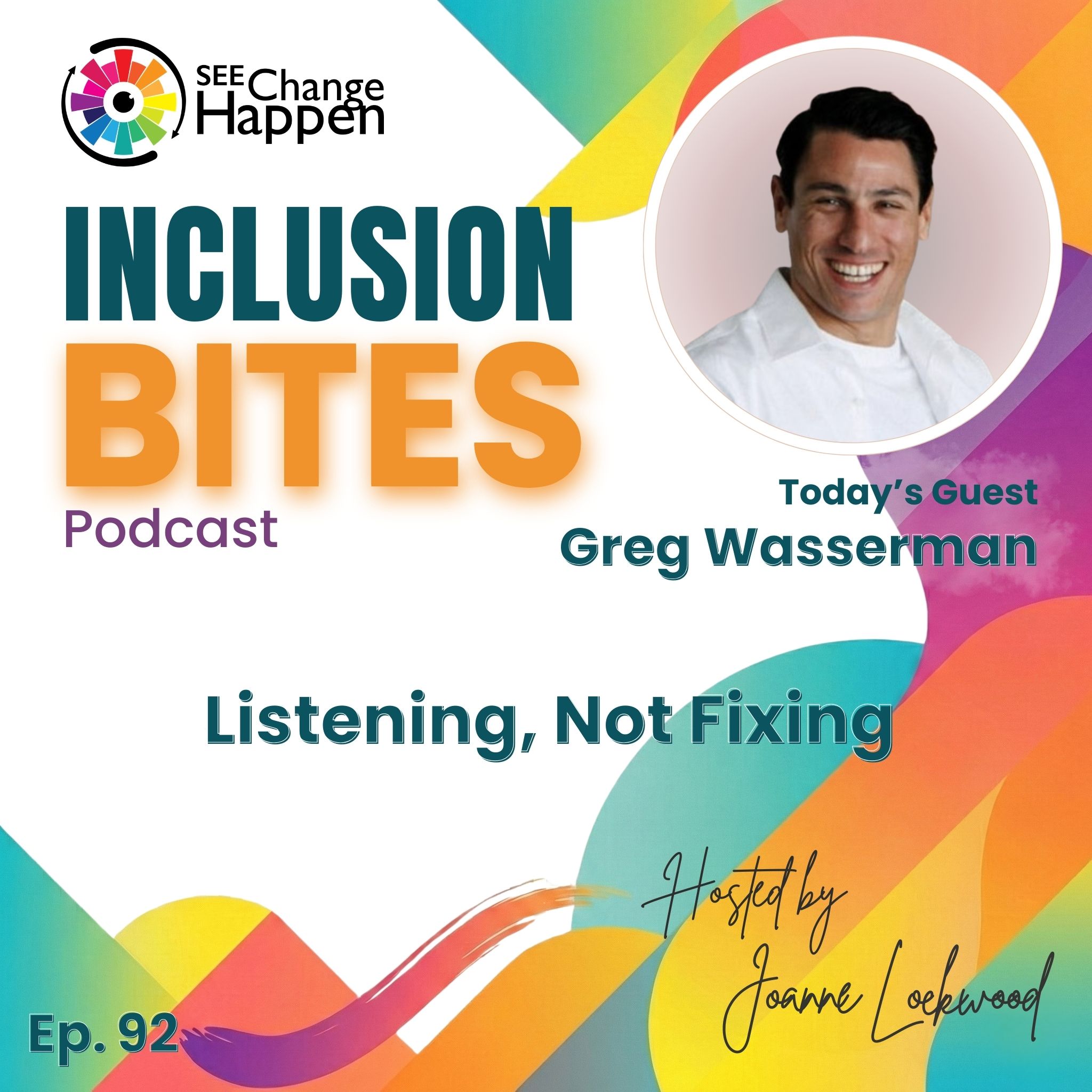
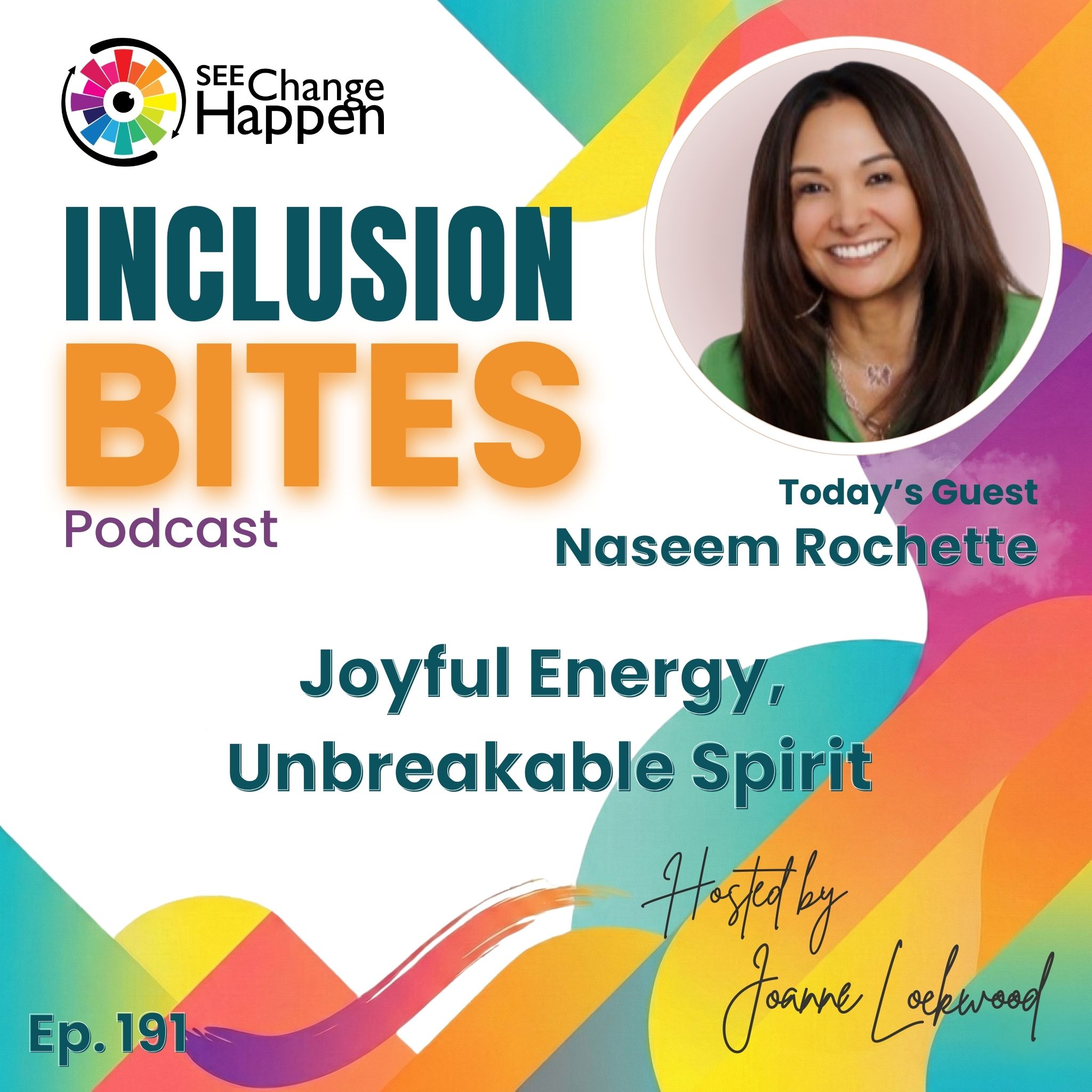
Exploring the power of vulnerability, Greg and Joanne delve into the impact of a fix-it culture on mental health and the importance of genuine listening and emotional openness.
In this episode of Inclusion Bites, Joanne Lockwood speaks with Greg Wasserman about mental health wellbeing trauma.
“I don't need you to respond. I just want you to listen.”
Explore
Navigate this episode
Joanne Lockwoodhost
Hello, everyone. My name is Joanne Lockwood and I am your host forthe Inclusion Bytes podcast. In this series, I haveinterviewed a number of amazing people and simply had a conversation aroundthe subject of inclusion, belonging and generallymaking the world a better place for everyone to thrive.If you'd like to join me in the future, then please do drop me aline tojo.lockwood@seechangehappen.co.uk.That's S-E-E Change Happen dotco dot uk. You can catch up with all of the previousshows on iTunes, Spotify and the usualplaces. So plug in your headphones,grab a decaf and let's get going.Today is episode 92with the title Listening, not fixing,and I have the absolute honour and privilege to welcome GregWasserman. Greg describes himself as the head of community,partnerships and growth for an AI startup calledCastmagic. When I asked Greg to describe hissuperpower, he said he is a gladwellingsuperconnector, someone who spreadsideas. Hello, Greg. Welcome to the show.
Greg Wassermanguest
Pleasure to be here. Great to join in with youraudience. Thanks, Greg. We've chatted a bit
Joanne Lockwoodhost
on slack via the cast magic community, so Ikind of feel like I've known you before we connected today. So absolute pleasure tofinally meet you logically, physically, virtually, in person,whatever. So, Greg, reading through the shownotes, you pulled together ahead of this, and I put out the title listening, notfixing. So what does that mean to you? Why is that important to you? I
Greg Wassermanguest
mean, there's so many ways to think about this, andI think we have a fix it culture and if we now takea step back, how did I actually get to this point of afix it culture?I guess if we get raw, and this is what I love aboutthe show is a year ago I entered a programmefor rehab. Truly was not wanting to behere. This is the first time I'm joyfullysharing this message with your community because I
Greg Wassermanguest
say joyfully because it is a message that I think othersneed to hear. Because I was in a darkplace and I got there because we havea fix it culture. I grew up in an amazing hoUsehold.Love my family, unbelievable parents, showednothing but love. And the problem we haveis the lens that we look through is not necessarilythe lens that other people are intending us to look through.And no one actually understands that. So if you're like, everythingwas done with love, doesn't mean that it can't hurt. Andso if we have a fix it culture, the fix it cultureis we ourselves are indiscomfort when someone shares a problemwe want to fix that, we want to solve that.So instead of understanding that a personis just sharing that, they arein a position to feel comfortable with you, and they're like, I'm justsharing this now. We also don't, as asociety, say, hey, I want to share something with you.I don't need you to respond. I just want you to listen.Maybe as a society, we need to start doing that as well. So there's aduality to this. If we can start training people to go,I want you to listen, and the other side to go, whatdo you need me to do with this information? I feelwe will start improving as asociety. Then people will actually feel that they're beinglistened to, they're heard their validation.There's more validity there. So if we take my story,like, I grew up, and a lot of what I went throughwas this feeling of not being good enough thatanytime I said something, it was met with, well, have you thought withthis? Whether it was a parent, a teacher, a friend, it wasalways, how do I give you a solution?Or the other side of that is, it's a me too. Like, oh,I've been through this. And so now the other side doesn't feelvalidated. They're like, well, now, all of a sudden, the story I'm tellingyou is one that you are trying to create connectionwith. But instead of actually creating connection, I'm nowcatering towards you because you are feeling like you havethis connection with me. And so if we can stop and actually startlistening and understanding froma human standpoint, that people just wantto feel validated, they want to feel understood, that wedon't need to be quick to give them a, here'show to do it, or here's how I would do it. Here's what I thinkyou would be doing. And so through all of that,the lens I put my life through was I was never good enough andthat I couldn't do anything right. And then you've also have, like, a perfectionistmindset. So if we are always thinkingabout, well, have you thought about this? Then it's like, oh, what Imust be doing was wrong. So how do I do somethingbetter? Or you have a better idea, or my idea is not there. Sofrom society standpoint, we start creating this culture, fix it.Perfection of not good enough.
Greg Wassermanguest
And that is a core of ultimately, afteryears of not knowing why I was so unhappyand why I was not living afulfilled life for myself. Yeah, a yearago, I didn't want to be here and someone was able to help me andcheque me into a programme and I'm nowso grateful and have so much love, but also anunderstanding. And every time I tell my story to people, I'm like, I want youto start and pause and learn that.Ask the question, are you sharing this with me becauseyou want me to respond, are you sharing this to mebecause you want a solution? Why areyou sharing this? And if we actually take that moment backand do that, the other party is going to go like, wow,I feel seen, I feel understood. This is going to help me.And if you look at that from the workspace standpoint andwho your audience is, it's like that changes the gamecompletely. You now have an audience inside your companythat feels even more validated. So I'll kind ofpause there because that's a lot. But, yeah, that's kind ofwhy listening, not fixing, is a key piece forme. Thank you for trusting me to tell
Joanne Lockwoodhost
me that story. That's really powerful. Andif you don't mind, can I ask you, can you trace backthe root of this? Was it to your childhood,your parents, your educational system, yourpeers? What led you to believe you were never good?
Greg Wassermanguest
I mean, I guess I would go with my parents in this one. SoI'm a big Brene Brown fanand I always remember this story from one of her booksis when she was sick, her parents wereloving and amazing parents and they took care of her, right?And they did all the things you would expect a good, nurturingfamily to do, to take care of their child whenthey got sick. They didn't do that for themselves. So thelens that Brene saw was sickness is a weakness.And that's why I go back to the story of, like, when your parents aredoing something out of love, or someone's doing something out of love,their thoughts are, I'm doing an amazing thing. I'm trying to help you. I'm doingsuch a great job. But the lens that another person puts onthings may not be that perception is changingtheir reality. And we have to remember, perception is eachindividual's reality. So for me, itwas. I mean, my father tomorrowwould have been his 75th birthday, passed away a couple of monthsago. He grew up in a broken home, didn't havea father himself, and he did an amazing job in raising us.But if we look at generational, he was your standard malewho knew three emotions. I got happy, angry, sad. SoI didn't grow up understanding that.I didn't know until this year, what dysregulation washolding space, feeling regulated. Like words thatare now becoming common. Most of us don't knowthat. Why am I anxious? Why am I feeling what I'm feeling?I couldn't tell you that I'm dysregulated now.I can tell you that. So back then, it wasunderstanding that my parents were just doing their bestto protect me, being the protective parents that they were,or they were in such discomfort. I have aproblem. Great. How do I solve this? Because they're problem solvers. Like, weare in a fixed society and we want to solve things. It wasnever of. So, yeah, the answer to your questionwas probably going back to that of, I didn't feel good enoughbecause anything I did was. It was too scary. So there wasthe worry. Have you thought aboutthis idea? There was no validation of like, you're good, I trustyou. It's more of how do I protect you from the world? Orhow do I ensure you don't have pain?When reality pain is a good thing. Like, you need the bitter and thesweet. You need some of those things. So if we're not allowingpeople to feel discomfort, to learnfrom mistakes, we're actually doing a disservice to them.So, yeah, that's, I think, the answer to your question.
Joanne Lockwoodhost
Yeah. A buz phrase we hear at the moment ispsychological safety. And one of the elements there is learnersafety. So being able to learn in a safe space, and a key part ofthat is being able to make mistakes. So if you're not in an environment wheremistakes are learning exercises, mistakes are valid, the mistakesare okay if you believe you can never make a mistake. I guess thatis the root of perfectionism,to a point where perfectionism is a problem, not just highachievement, it holds you back. It stops you being goodenough. You have to be better than good enough, and everything has to beperfect, which we know is unachievable andunattainable, and also you're chasing something that is unhealthy,sometimes 100%. And that's what
Greg Wassermanguest
I ultimately was trying to do. I had a perfectionist,fixed mindset that if you have that asa double dose, it doesn't lead tohappiness. And then back to your intro.I'm ahead of growth. I'm in a revenue role. Mycareer has been revenue. I love talking to people. So backto my superpower is life is about time and relationships.I love opening up a conversation with someone. I don't know where it's going togo. But let's open that up now. That goes into a salesmindset of going like, look, eventually I could sell to you, butalso I can help you. If I don't have a solution, maybe I can helpyou and connect you to someone else. And so if you look at it fromthe sales mindset, salespeopleare rejected a lot. You have to build thick skin. Soif you have a perfectionist mindset, a fixed mindset, you're alreadytorn down and you're going into a profession where you're gettingtorn down even more.Yeah, it was a recipe for disaster untilI was able to get help and realise it. Yeah,
Joanne Lockwoodhost
I feel that pain. And my wife works with me, she doesmy business development. She call it sales, call itengagement, outreach, Linkedin emails,and often I'm having toreinforce and amplify and boost her when she has abad day. She's had too many no's, too many rejections,or someone won't pay the asking price or something like this,and she gets all kind of, like, flustered and angryand lock herself for the toilet for ten minutes and shout at the wall. AndI just step in and give her a hug and say, it's okay. Every nois closer to a yes. Keep going, you're doing great, you can do this.So I get it that you want validation, you wantgratification, you want those brain chemicals to hit you andgo, yeah, I'm winning. And when they don't come,you go to that downward spiral, don't you? Yeah.
Greg Wassermanguest
And I think it's also an understanding. So if we look at it froma sales culture and a fix it culture, and just aculture of not understanding people's values and what'simportant to them. So if we can do a betterjob of understanding those things, especially inthe sales culture, but I think it is a corporate worldas a whole. Most people move up in their career because they weregood at what they did. But as you know, as a leadershipcoach, just because you were good at that job doesn't mean you're good atmanaging people, doesn't mean you are good at coaching people. Thoseare very different skill sets. So if you look at the salescommunity, I crushed my numbers, so, great, you're going to move up intoa sales manager role, because if you did well, maybe you can teach all theseother people how to do it. That doesn't work that way. And you're notgiving that person actually the understanding of going like, holdon. Is what I'm doing a good thing?You're probably perpetuating a perfectionist mindset, orwork hard, just overcome it. Just make more dials and go do these things.We have to take a step back and actually be able to have those vulnerableconversations, which most of us aren't doing. Yeah,
Joanne Lockwoodhost
I think it's got a name, isn't it? It's called the Peter Principle. So you'repromoted to the point of incompetence and then you getstuck there. So what happens is you're really good at what you do. You standhead and shoulders above the people around you, so therefore you're candidatefor promotion. So you get promoted to the next level. If you stand out atthat level, you get promoted to the next level. You get promoted until at onepoint, you no longer stand out. And you're now incompetent at doing thatrole without the investment, because everyone thinks you're a high achiever.Everyone thinks you can do all this. And you're so right in whatyou say there is that we need to invest in our leadership.And leaders aren't just great technicians. There areskills and competencies that leaders should haveand can be trained. Leaders aren't born, they're not created likethat. Leadership is a learned skill. Yes,you can have some natural talent, natural flair for it, but you can learn this.You can learn emotional intelligence. You can learn to listen. As you said,learn to listen without having to respond. Sometimes it'sso difficult, though, isn't it? Someone tells your story. You were tellingme your intro, and I so wanted to respond toyou. I so wanted to dive in there with empathy. Iso wanted to go. And me as well. And, oh, yes, I've had that experienceto try and validate what you're saying. But as you say, the powerthere is not to listen to respond, listen toacknowledge, listen to ask youhow you feel about that, how you can drill down in that. Not for meto go, well, that's happened to me as well. It's a me too thing, isn'tit? Yeah. I
Greg Wassermanguest
hate that we have the Me too movement, but I'm like, this is a differentme too movement that I think is actually, if notmore, or an equal playing field of, like,hold on. We are damaging usas a people by me doing this, bytrying to build connection when you're not really building connection, you're just.I don't know.
Joanne Lockwoodhost
It's hard, though, isn't it? You've taught me something really deep.And my natural reaction, and most people's natural reaction isto either use sympathy or empathy as a kind of a feedbackmechanism to show I've listened and to acknowledge you and validate you insome way by saying, I get that because I've done this. And what you'resaying is when you're in a certain status where you were,you don't need someone to fix you, you just need someone to go,wow, that's so powerful, Greg. Tell memore, or let's dive into something like that. What more do you want to share?How else can I listen to you and hear you withouttrying to come up with any answers? Because we want to fix each other, don'twe? That's the trouble. We do want to fix each other. I think
Greg Wassermanguest
the biggest phrase I learned during my programme wasthank you for sharing those littlewords. Literally, just then allows the person to golike, you heard me, you understood I wassharing something that is either difficult or I'm goingthrough a pain or I'm in pain. It could be a simplefrustration with work. Going back to yourscenario, it's like I'm beatingdown, I'm getting all these no'sand your response is you've got this. It's like, okay,the next call is just going to get you to a yes type deal. It'slike the motivation they need, but it's understanding then is that what theyneed? Is the person actually coming to you and saying, I'msharing this with you so that you can boost me up? Or am I sharingthis with you so that I just can share this? AndI trust you and I love you and I just want to share this withsomeone because I'm beating down and I know this is a feeling thatwill go and it will pass, but this is where I'm at right now andI'm kind of asking you to sit here with me as opposed to boostingme up, but until we actually go, thank you for sharing that. Areyou looking for me to respond? Are you looking forme to do what? We don't do that.And once we start doing that, my God, what power ofthat is going to be amazing. Yeah. Have you heard
Joanne Lockwoodhost
of an expression called Rubber ducking?
Greg Wassermanguest
No. I can't remember which company it was, but one company, they
Joanne Lockwoodhost
had this kind of guiding principle that you could not askfor help from your manager, from your colleagues unlessyou discussed your problem with a rubber duck on ashelf. So you'd have people, or in the office, they'd standin front of this shelf with a rubber duck on it and they'd explain theirproblem. And they'd have a conversation with a rubber duck. And obviously, ninetimes out of ten, just saying it out loud, just bringing it out of yourhead into the open, is enough for you to go, right, I've got it now.I've got the ideas. As you said, I've let the frustration out. I'veexpressed it somehow. And as you say,sometimes it's just the need to saysomething with somebody else in the room so that you're heard, you're listened to, andthat frustration hasn't gone nowhere.So I completely get that, and I do it as well. Ihave a bad day, and I want to scream, but if noone hears me, it's not a scream, is it? If a tree falls in thewoods, does it actually make a noise? Yeah. I want someone to acknowledge andgo, okay, I heard you. Great. Andthen we can feel acknowledged. I think that's the acknowledgment ofmy frustration, my pain, my challenge. Whatever it is, youcan't fix it. There's nothing you could say. It's just.
Greg Wassermanguest
And that goes to if we allow people to sit in discomfort.I'm learning this. Sitting in discomfort means there's change. And soif you can just accept discomfort, then that's a greatthing to move and change.
Joanne Lockwoodhost
Do you have a lot of people say to you where you're sobrave or you're a realinspiration and sort of giving you hero status?
Greg Wassermanguest
In the last year, friends and family continue to justuse the proud of me. Proud tohave chosen a different path than I was originally thinkingof taking, and proud of where Iam a year later, since I was there,I don't know if it's hero status. It's more of, like,just being able to engage withthem on these deeper levels that I couldn't. That was thebiggest thing. Even my mom, no one knew where Iwas. No one knew the depth of mydepression, because you hide it really well. That's what we do.As society goes back to your water coolerconversations of, like, how are you doing? I'm fine. How are you doing? I'mfine. And you walk away, and it's like, no one actually has the conversation ofgoing like, no, I'm having a shit day. It's like, now I got to sithere and listen to you tell me about your shit day. Fine.No, we'd rather. And that's the irony of this, right?I want to fix it, but when you tell me Igot something else to do, I'm like, well, I don't want to listen to this.So we have this weird societal issue, and I think when wecan start having those vulnerable conversations, we'll do it. And so I thinkthat's where my friends are coming from, of understanding. Like, you'reactually trying to do things. You're trying to make a change, not onlyyourself, but help others. And that's whyI'm so honoured to come on here and talk to you about this topic, becauseI feel we're missing this.
Joanne Lockwoodhost
Yeah, I hear what you're saying there. When we'rewith our friends, our family, whatever it is, and theconversation about, how are you doing? The expected answer is, yeah,I'm okay. Having a tough week. Things will be okay. Don't worry about it. Andthen you say, how about you? And they go, yeah, metre. Yeah. Similar sort ofthing. Yeah, life goes on. Yeah, we're getting there. And that'sthe kind of superficial level we're kind of comfortable with. And as you say, onceit goes down a notch into, actually, no, I'm not okay.I've got some real things going on. Can you listen to me for five minutes?It's like, okay, we're getting deep here. Arewe? This is a bit of bro love. Is it? What are we doing here?How can we take this to another level? It's like, uncomfortable. What doI say? And it takes a very special friend, colleague,family member who give you that time and move into that space foryou to truly listen 100%. Like I said, it
Greg Wassermanguest
wasn't until a year or so ago I learned the phrase like hold space.We don't know how to hold space. No one's taught holdingspace for someone because we continue to have that bro lovesuperficial. Like, you're good, I'm good. Cool. Let'sgo drink a beer. And everything's good, right? I don't know.Which is also probably why most of my friends are females, because I'm like, oh,I can have these deep conversations as opposed to men. We're notreally talked about. We're not told these things.One of my favourite books that's helped in my journey was Lewis Howe'smask masculinity. And it's like the ninemasks that we as men wear. Most ofus don't even know it. So I try and tell every friend,especially if you're in the education space, if you're a teacher, go read this book,because you'll start understanding what's going on at a psychological levelwith those kids in your classroom, because that's whereit's all starting. And then if we can go into the adult leveland if adults start reading that and the HR world start reading that andsales managers and leadership start, then we can start identifyingcertain things. So once you start seeingpatterns, you can't unsee them. But we're not trained on it.
Joanne Lockwoodhost
What it's like in corporate America, but certainly in the UK,we're doing a lot more around mental health, first aid, trainingpeople to have those listening conversations, to cheque in on peopleto understand. I mean, I've lost probably three orfour people, all men actually, over my life,who have taken their lives for various reasonsand nobody can understand why. There was nosign. They were just getting on with life. And thenone day they weren't and there was a friend who lived in Australiaand his wife came home and found him. He'd hangedhimself on the pergola in the back garden and nobody had any clue.He just went home from work early and took that routeand it's that unknown. And Iguess had all of these people had the opportunity forsomeone to just hear them, to listen to them or cheque in on themjust at that one moment, thenpotentially that conversation could havehad a different outcome rather than just everyone's okay,everyonE's fine. First,
Greg Wassermanguest
thank you for sharing that. That's notlight, so thank you for sharing that piece.What comes to mind when I hear that, having beenthere, the cheque ins are nice, but chequeins I don't think help so much.So if a person doesn't know where theyare, if they're already in a placementally, then it comes down to shame and fear.Like, if I've never been trained on talking about these things,how do I come to you and you're going like, are you okay? And you'relike, yeah, I'm fine. That's what we are. We are a finesociety. And I always forget what the acronym of fine is,but it's not a good one. Soif I always told people, it's like, look, RobinWilliams, Anthony Bardain, they seem like they had suchgreat, like, they're not with us anymorefor whatever reason. So we can go down that path. Butpeople could cheque in, I don't think it'sa cheque in, I think it's actually understanding anddiving in. Like, I did not know where I was. If you checked in,I was great at hiding it. I didn't know how to share. No oneactually taught me those skills. No one held space. So I thinkit goes from how do we do that betterin order to stop anyonegetting to that sad ending?
Joanne Lockwoodhost
You talked about the multiple masks, multiple hats that men wear.Was it? You said nine. Was it hats, different masks?Having tried it in my past, being a man, I tried it for a while.It didn't work out for me. But there's a lot of pressurebeing a man, to live up to societal expectations,family responsibilities, as you say, thatperfectionism, to be the person that everybody looks up to forstrength, not showing weakness or deepemotion, and to keep that invincible,stoic front going, which is why wesee suicidal amongst men being the biggest killerof a certain age range. I think it's, what, 20 to 50 or something? It'sone of the biggest killers of men, certainly in the UK. I guess it playsthe same in the US as well. Andit is a tough gig being a man. I knowwe say that women have tough gigs having to put up with men sometimes, butmen Have a tough gig just existing asa man for the pressure they have without sometimes the supportstructure, or as you say, the conversations you have with yourfemale friends allow you to go deeper and to havethose more empathic, more emotional type conversations that youcould never have with male friends. And men tend to socialisewith other men, and it often stays at that superficial levelwithout the opportunity to go deep, doesn't it? Yeah.
Greg Wassermanguest
Look, I think being a human isdifficult, regardless of anyfactors, and each one's got their own. Like, we can all joke going like,oh, I couldn't be a woman. Oh, I couldn't be a man. Right? Couldn't bea dog, it's like, oh, a dog's probably the greatest life. I don't know.But, yeah, I mean, as a male, a 40,almost 41 year old male who grew up in ageneration where your parents inthe early 60s were taught certainthings, I think we're changing and the next generationswill become better and you're seeing that. But the currentgeneration, where I'm at, I'm still living from thosepast and it's tough, but that's why I'mlike, all right, we got to start listening better. We've got to startasking questions and responding.Otherwise, not only is it suicide, butit's also why men die of heart attacks.I didn't cry. I could tell you I cried four times,probably in 20 years, and those fourtimes were over sporting related events, whether I was playing orwatching. So that just goes to show you where myhead was and then crying over them, especially when I wasplaying you're like, I can't believe I'm crying, and I'm showingall this emotion in my field. Like, this is terrible. No,you've got to allow that. And so I've now learned, like, crying issuch a great release. It is a beautiful thing.We're not taught those things. Those aren't allowedculturally across all differentfacets. That's so true and so
Joanne Lockwoodhost
insightful. One of the things that I've learned over thelast seven years, since I gender transitioned, isto not hold my emotions in. Maybe it's the oestrogen that Ihave Flowing through my body now. Maybe it's those hormones, the chemicals,the female brain kicking in with those hormones, but Ifind crying extremely cathartic. It'sextremely powerful release of all thoseemotions. I'm happy to burst into tears in front of the television.If I'm having a deep conversation with someone professionally, we'll all end up having acry and a hug. I find it's just such a release now thatI don't have to hold that in. It's almost like I've gotpermission to be female, to be emotional, and therefore I'm goingto bathe in it and use it to my advantage or to my selfcare. And I think you're right there, allowing yourselfto share and show those emotionswithout any bound, without anybody judging you.And as a woman, I don't get judged for crying. It's almost like, oh,she's crying again. It's expected. Or my wife will say, oh, there's hormones.Here we go. I go. It's great. I'm lovingit. It's fantastic. So, yeah,I think that's a really insightful thing, what you said. There is. You can cryfour times in memory, and those were over winning orlosing a sporting competition or your team losing or something, or winning.So, yeah, we got to give permission, not justto men, to people, to let this out. It's a natural humanrelease, isn't it? Maybe we're training people to hold it in rather than expressit. You've got to stay
Greg Wassermanguest
strong, or I can't show weakness, orthere's a problem with that. If you're always stayingstrong, then where is thejoy and the beauty of actually, quote unquote, being humanand weak and allowing that?I empathise for parents who are like, I've got toshow strength. Even though my life is in atail spin at the moment, as whatever's going on at work and I gotmy kids, there's a lot more that you're taking onas I watch my brother and my sister in law with my niece.But sometimes there's strength and there'sbeauty in going, like, it's okay to not be okay.And if you teach kids that, if we teacheach other that, wow, once again, how amazing thatwould be. Because then we'rE all not trying to be stoic, we're all not tryingto be strong. We're allowing ourselves to behuman, to be vulnerable. If you
Joanne Lockwoodhost
think about maybe back to high school, college,don't the big, brave, strong men have the best life?And then the kids that are maybe emotionallyweaker and expressing themselves have kind of likethe not so great life. They don't get the girls, they don't get the herostory. We're setting ourselves up for men having to bebrave and strong to get the girl, to get the hero, to be thesuccess that's still propagated in movies andDisney and other cultures, isn't it? Yeah. I mean, if we go
Greg Wassermanguest
back to Disney and the movies we all grew up,I mean, they perpetuated a lot of that, hopefully. I thinkthings now, if you look at, you've got more female character led movies.So we're changing that. The thought of the princerescuing the princess is what we grew up on. Right. Sothat narrative is changing, which is amazing. And I thinkas we continue to evolve, and that's why I'mhere, to try and let people know.People just want to be heard. They just want to beunderstood. They want vulnerability. We just don't know how itto do it because we weren't taught. So how do we start teaching this? Howdo we start changing that perspective?It will stop a lot. It will.
Joanne Lockwoodhost
It's almost like we got to help educate parents,maybe even pre parents, when you're planning afamily, as to how to bring your children up,to nurture them in a more,less stereotyped, less gendered way, to use moreempathy, to use more compassion. And it's not about winnertakes all. It's not about having to be the best. I think if we caneducate our next generation of parents withthese tools and skills, otherwise all they're going to do is, like yourself,propagate the behaviour andthe parenting model that you were given by your parents.
Greg Wassermanguest
I would go with not just educating them asparents, because I don't know if I'll have kids.So it's more of a matter of just educating us as humans andthat's going to make us better regardless. Asif I'm a breeder, or if I'm not right, if I'm adopting, if I'mnot right, if I have kids, whatever the case may be, it's going to makeus as better, it's going to make you a better partner, it's going to makeyou a better coworker, it's going to make you a better humanbeing, able to have honest conversations with your boss and going, look,my father passed away two months ago, and I had to tell,as you know, I'm at a startup and I'm like, I got three co founders.I'm like, I don't want to let them down because there's somuch to be doing. But I was not in a mental placeto do much of anything. And they're incredibly supportive, and that goesto bereavement. We, as a society, usually have three to five daysfor bereavement. So we're allowing, as a society, going like,hold on, you just lost someone. There's grief. We have a problem withgrief. I learned that one as well. So if we have a problem with. Wehave a lot of discomfort because we don't talk about these things. So if wecan start forgetting parents and just doing it for ourselves andhaving these conversations and understanding, this is natural,and there's ways to go about this and that. We can removethat shame of A, not knowing, orB, feeling this way, we can become a betterhuman race. Yeah,
Joanne Lockwoodhost
I'm going to give you a high five to that one. That's definitely a goodmantra and a good way to evolve our society.I look back seven, eight years ago, when Igender transitioned. I was at that pointwhere everything was dark, everything was dismal,everything was kind of a stress point. There's lots ofholding secrets in trying to prop everything up,and then this feeling of being the pain giver andtrying to be the pain fixer at the same time. All that pressure of playingall those roles. And I think I learned, Icame up with an affirmation, which is just two words, Iam. And that, for me, solved a lot of my baggageand my demons, because I was trying to wrestle with, as yousay, not being good enough, trying to fix things, trying to work out,rationalise my ideNtity, rationalise all the things in my head. Andthen I realised I didn't need to rationalise them. They didn't need fixing, they didn'tneed understanding, they just needed accepting that I am who Iam. And I think once I found that affirmation, everythingclicked into place. I didn't need theanswer. There was no answer. There was noproblem in reality. There was just an acceptance ofself. And once I was able to accept self, itallowed. Enabled other people to accept me based on that affirmation,if you like. So I think, as you say, wehold it in, we build this pressure cooker and it's finding thatrelease so that it doesn't explode throughstress, through depression, through hopelessness, whateverit may be, and just stepping back, going,I need out for a minute. I need out. Let me just take some time.Let me be me for a bit. Let me talk to you. Listen to me.Rather than feeling this need to say, hold it in and be theone that is invincible. Can
Greg Wassermanguest
I ask you a question on that? Go for it.I'm finding at 41, almost,that I am able to go, like, I don't care about anyone else, right? Like,I have reached that point of, like, I am who I am. I'm acceptingthat. So you reach that point at whateverage. But before that,right, the question is, could you have acceptedI am who I am earlier? Andhow do we get people to accept who they are earlier? It'sa hard thing, right? Because you had all this pressure, youhad all this fear, you had all these things going on. So how do weget that I am moment accepted earlier?
Joanne Lockwoodhost
Yeah. Could I have found it earlier? I don't know. I don't know,actually, because a lot of it's caught up with shame, fearof failure, rejection, all these kind of things, thesehuman instincts, fear of failure, fear of rejection. Shame is a powerfulemotion. Brene Brown talks about it a lot, about shameand guilt. There's useless emotions that we can't do anything with,but you're caught up in it. The fear of the unknown, the fear of takingthat step forward, that irrevocable step that once you've said it, youcan't unsay it. And then the fear of being judged for doingit. And I don't think I could have,looking back on my life,found an earlier time zone. I needed to revolve into it. I needed to takethose small steps, nudge up to the edge of the cliff, lookdown it a few times, look down it a few times, and then realise itwas only a centimetre drop. It wasn't thousand feet, it was acentimetre an inch, half an inch. Ithink I had to discover that myself. AndI had people in my sort of socialnetwork who were going through similar kind ofdemons in their head around being trans at the time. So ithelped to have other people to bounce this stuff off, to realise that I wasn'tcrazy on my own, so I didn't do it alone. I didn'tactually have active help, but I knew there were other people. It wasn'tjust me, which gave me the belief that it wassolvable. If you seen. I've seen people come out the other sideintact, so I knew it was possible. And I think it was just acase of after I gender transitioned, after I sold my previousIT company business. Sat on the end of my bed in tears, not being ableto sleep each night, going round around circles, trying to fix this problem.Laying awake. Laying awake, really kind oftearful, angry, depressed,retreating into myself. And I said, theart became to me one day that I am. And I woke up andthe sun came out, the curtains opened, and I suddenlyfound my purpose in life. And I often talk aboutthe Japanese saying, Ikigai. It's where those fourelements intersect. What you love, what you're good at, what you get paid for,and what the world needs. And I realised that I hadn't actuallylocked into place what I love. I was good atstuff, I was getting paid for stuff, and the world needed it, but I didn'thave my heart and passion in it. I think a combinationbetween I am and realising what fulfilledme allowed me to bring that together.And I think once you've made a huge. Theconversations you share today, once you've made those bigfundamental life announcements or sharing what youshared, it becomes very easy, or a lot easierto share other things in your life because you're no longer held back by fear.You're almost empowered to talk aboutthings and to share things. I don't want to put words in your mouth, butdo you feel stronger and more empowered to share things now than you've everdone? Oh, my God, completely.
Greg Wassermanguest
If there's fear in me, I go, okay, let's gotalk about this. Because as soon as I keep letting that fearstay inside, whether it's through a rubberduck or whatever, it's like, all right, howdo I share this? Whether it's therapist or someone else going like, allright, am I crazy? Is this anormal emotion? That's where you're looking, the validation? So it's like, allright, before, I was keeping everything in my head. And so when you're keeping everythingin your head, yeah, you're going to go down aruminating rabbit hole. That's probably not good for you, but when you start talkingabout it, I'm like, I love your concept. I am Popeye,right? Why was Popeye so famous? Because he is who he is,and that's his thing. And so once we start understanding that,the problem is once again, as, like, we say thesebuzwords, like, oh, everyone, you should be Popeye. Like, what's great about Popeye?He is who he is, and that's great, but we don't accept that. We don'treally accept that. We want you to have that, but, like, do we really acceptthat? Those in your network that do. Back toyour story. And you had a community. Like, you weren't alone.I felt alone. I felt if I shared any ofthese things, that it would not actuallygo. So it was the fear of if I sharewhat I couldn't control, and that becomes a perfectionist mindset. You're, like, perfect,right? You want to control things, butI love that I'm going to have to look into the Japanese. One phraseI love from the Japanese. What is it? I always screwit up. Kinsuji, where it's putting brokenpieces together, but with gold, so it allowsthe beauty of you. You're not broken, right. You can be put backtogether, but allowing those broken pieces instead of just glueingit so it's back to the original piece, it's like, no, show that with thegold and your cracks are beautiful. You arebeautiful. Who you are and all elements ofyou. Once we accept that,back to you. I am. When we accept who we are,that becomes a beautiful thing. That's truly
Joanne Lockwoodhost
beautiful, because I want you to see all of me. I want you to seethe broken bits, the healed bits, the scars, because that's part of myessence, is how the adversity I've overcome, thechallenges I've picked myself up from. That's sobeautiful, those golden threads, those golden joins. Because I oftenuse the analogy of taking a piece of paper, screwing it up, and thentrying to flatten it out. It will never be the same perfect bit of paper,but I've never thought of it in the way you framed it as, seethose scars, see those healing, andsee what I've been through. Don't see that crumpled bit of paper asbroken. See it as whole with lifeand lived experience. I love thatI'm going to look up that and. And bring that into my mindset aswell. Thank you. That's really powerful.
Greg Wassermanguest
Yeah. When I heard that one, I cried, of course, because I'm like,wow, that is a powerful wayto look at you, going like, I am all thesethings and you can be all those things. Thequestion is, are you willing to allow others to see those? Andgoes back to the start of this conversation, like, if we can actually startlistening to people and giving them thespace so that they feel like they can be who theyare, then we'll all be walkingaround covered in gold, and that's kind of cool.
Joanne Lockwoodhost
It also plays into the kind of, when people say,I don't see gender, I don't see ethnicity, I don't see race, I don't seethis, I don't see that. I just treat everybody the same and I want togo, no, I want you to see me for who I am. And that'sexactly what you're saying. I want you to see those cracks. I want you tosee where I've healed and all of those things that I've come through,because that makes me me. That's thepower I have. We talked about superpowers at the beginning. My superpower isI'm etched in gold, where I've healed myself and pulled myselfup. I think that's a great analogy.I'll put that in the show notes so we can share that.Fabulous. So going back tothe period of, excuse the euphemism, call ityour dark time, where you are not surewhether tomorrow would come or not or whether you'd make different choices.We often talk about the difference between being alone and lonely.And you can be lonely in a room full of people,and you can be alone and yet fulfilled and happy.You are probably experiencing being lonely inlife, regardless of who you were surrounded by. 100%,
Greg Wassermanguest
like I said, no one knew.When I tell the story, there's no way you're a glass half full person.There's no way. It's a shock. And it's like,no, you get really goodat putting up a front to allowsociety to see what you want society to seeand not letting people truly in. Becauseif you did, there's the fearof what they would see, what you would feel.So you kept that all inside. So, yeah, it goes back tothe early part of this conversation. Like,you feel so lonely because you don't know how to sharethose things. You are afraid you're not told andtaught that you can share those things.Or if you're told, like, oh, I want you to share these things with me,then there's a judgement or there's a fix. It's easier to notshare these things. So I'm going to continue to not sharethings about myself because I amfearful of the response that's going to be given and the response that's going tobe given is you shouldn't feel those things. Or how could you?It's a standard. If you think about, we were talking offline aboutfood, it's likeif they comment about their weight, they're like, oh, but you're not fat. Or whateverthe case may be. It's like you're not helping the situation becausethat's how they feel. You literally just told this person, don't feel theway you feel. You didn't validate how they're feeling. Youare just trying to go like, well, compared to other people. Like, oh, you're soskinny, or whatever. It's like, we have that as a societal, andI'm just using weight and food because that came to mind when we're talkingabout it. But, yeah, we are soquick to, in that instance, noteven me, too. It's just like, well, you're not. And it's like, I'm going toboost you up because you're tearing yourself down. But they'renot tearing themselves down. That is how they feel. So how do weactually allow them to feel that? And what is it that they need tohear or feel?I'm in great shape. So when I tell people I'm out of shape, they'relike, but you look great. I'm like, okay, looks is one thing,how I feel, what I'm used to.I worked out last night. I'm like, oh, this is kicking my butt.I'm so out of shape right now. And then other people are like, well, comparedto me, you look great. Those are the things that play withonce we stop realising how a person's feeling, what they'rethinking, and we validate that instead of trying to go like, oh, you'renot. Or like, me, too. Yeah,that lonely feeling was there because you're like, noone's going to validate anything I'm saying right now.Who do I talk to? Yeah, I hear you.
Joanne Lockwoodhost
You talk about having a workout last night. I am notanyone's athlete. You look at me, I'm 58 years old.I'm significantly, probably twice the weight I shouldbe for my height, certainly my age. And Ihave a gym session each week. I have a personal trainer. We do an hourtogether. And I don't pretend that I'm fit, but I do comeout of those sessions. She kicks mybutt, basically. She works me and works me and works me. So I comeout of that hour and I can't walk I can't breathe, I've got to sitdown, I got to recover. She goes, are you okay? I said, yeah, I'm happy.Knackered. I've delivered, I've done what I wanted to do todayand I don't ever expect to be fit,but I take pleasure in doing the best I can, going backto the perfectionist thing or putting my whole self into something toachieve. I don't want to walk away thinking, I left a bit. I want togo walk away thinking, yes, you had everything today. And that was all I couldgive. I think that's the sign of a good workout, that personal drive todo all you can, regardless of compare with somebody. I don't need to compare myselfwith somebody else. I don't care if I'm doing eight pounds and somebody else isdoing 16 pounds. It doesn't matter to me. I'm doing what I can doto limit my ability. So, yeah, the comparisonis such a negative kind of emotion andtrait. We should judge ourselves by ourselves.
Joanne Lockwoodhost
And when I set this new business up,I mean, you talked about impostor syndrome or that feeling of not being good enough.I started a new career, a new gender in a newsector, and I had immense imposter syndrome. And whatI realised was I was evaluating myself against the standardsof others, not looking for my incremental improvement.And as soon as I stopped comparing myself withyesterday and started comparing myself with a month ago and two monthsago and a year ago, I realised that there was a differential,but I was comparing myself at a micro level and not seeing muchimprovement. So I think that's the important thing. Whenpeople say, wow, you're doing great, you're moving on, you've come a long way.You don't go and argue with them, you go, thankyou, really, thank you, and accept what they'resaying as validation and notjust fake platitudes andsayings. Most people mean it. And that's what I hadto do. I had to learn to say thank you andreally absorb that to enable meto sort of, kind of manage my impostor syndrome. Ithink that's what I ended up doing. You gave
Greg Wassermanguest
me a thought that I'm going to have to ponder on, becauseif I say it, it's not fleshed out. I know in myhead it doesn't make sense, but it's like when you'retalking about comparison, it is truly a negative thing. Andso I compared. I compared myself allthe time. Self deprecation was my thingand taking a compliment was not something you could do,because if you have a perfectionist mindset, how could you take a complimeNt?Right? I'm not perfect. There's more I could do.I fed off of. Tell me what was wrong so I canfix it. Because if I knew what was wrong, that means I could go andtry and become perfect, as opposed to accepting like, you were goodenough or you did the best you could. It's like,no, tell me I could have done better. So how do I fix that?Especially in a corporate world,especially in the sales? Like, I want a hunter who's going to go out thereand close all these business deals and so forth. It's like, when you'relooking for that, you create a culture that's probably not healthy, butit's going to do great for your business. But your mental health ofyour employees is probably not great. So there'sa balance there. But, yeah, comparison is such a negativetrait, and we do it all the time, ineverything we do. And social media doesn't help in that regard.
Joanne Lockwoodhost
Yeah, the instaculture, the philtres, theSnapchat, the pressure onyounger people today, being always on, alwayscompared. Chasing the likes, chasing the validation.
Greg Wassermanguest
Aren't you glad both of us didn't grow up with social media in that regard?Like, imagine where mental health would have been then. Yeah.
Joanne Lockwoodhost
No phones, capturing photographs of everything we did. We got upto stuff and it disappeared. It never existed. And I'mglad I can't remember some of it because I did some crazy stuff. I'msure you did as well. And it's gone. And we can laugh about it aroundthe campfire, but we got no evidence. We can't post it all over socialmedia. But yes, it's a tough gig. And the mental healthof younger people is really impactful.We see bullying because in my day. In your day, we went home,we could escape it. We shut the front door. And unless we had people beingvicious and phoning us up and saying things, we largely had safezones where we weren't being. But now your phonevibrates and it's a bully. It's a negativity. Oreven if we didn't talk to someone for a couple of days, that was theworst it got. Or we maybe pinched them occasionally or poked themor somethIng. That was our bullying of our day. But now it'sintense. And it's not just the circle around you. It's theinfinite amount of connections, the thousands and thousands andthousands of people who can pile on to a stranger andreinforce negativity so destructive these days.
Greg Wassermanguest
And to that point, the fact that it is an infinite amountof people that are influencing you, which makes it even morecrucial that we are creating habits andmental structures within side all ofus. So that, all right, a troll is a troll. It'snot going to bother me because I accept people are going to be likethat. And negative feedback is just as good aspositive feedback. And those are someone's opinions, and that's perception. AndI am who I am and I'm going to be there, and I like that.But we're not training the people appropriately.To philtre, that, and that's a hard thing.Yeah. And feedback. If I don't value your opinion as a
Joanne Lockwoodhost
person, then I don't have to accept your feedback. I canleave that present unopened, I can return it to sender. Idon't need to absorb your feedback into my life, or Ican frame it in such a way that, okay, that's one person's opinion. Okay,if everybody gives me similar feedback, then maybe I should learn andadapt and listen. But if it's a one off, out of contextwith everything else, then it's just. I call it graffiti.Like you're driving down through a ghetto and you see all thesehate words sprayed on the wall and it's just someone beingangry at the world. You don't know who I am. Your wordsaren't directed at me, you're just being angry at someone. Astereotype like me. That's fine. I can drive byAnglesco and I can ignore it. It's just graffiti. I don'ttake it personally, but it does take a very strong mindset tobe able to philtre out that noiseand contextualise it as just junk, because manypeople will bring that in, into their psyche and they'll want to argue, theywant to fight, they want to debate it, they want to bring it in. Andthose emotions aren't productive either.Being able to let things go and not get absorbedby the negativity again, it's a trait I'velearned over the last few years, to be able to,and I wouldn't say it's about putting a suit of armour on and protecting myselfall the time. It's around just being able tophiltre out the noise and move forward. And Ithink a lot of people don't necessarily have thatability, but it's helped my mental health no end to be able tocompartmentalise noise and just close itdown. You bring up an interesting point. We also struggle.
Greg Wassermanguest
We're defensive as a society. Soif I give feedback, I'm going to go, like, hold on, nowyou're attacking me. So it's all a matter of I'm defensive. And sothat's where the argument starts, as opposed to, like, hold on.What is this person trying to show me? What are they trying to tell me?Can we sit here and actually have a conversation? It's like, no, I'm going toget defensive and that is the ego getting attacked. Right.If I think about things in that regard. So ifwe can just realise it's a US together as opposedto me against you, we'll also be better inthat regard. Yeah. And I often say
Joanne Lockwoodhost
when people are coming at me wanting an argument and I justsay, I don't owe you an argument. I don't owe you a debate.If you want to have this conversation, I'm not the person that's going tosit here and want to engage in it. You can tell meabout my identity, you can tell me about what your belief is and you cantell me about biology, you can tell me all these things. I go, I don'towe you a discussion. I am. I'm me. I can't explain it.I'm not going to debate it with you. Sorry, but this conversation is not goingto give you productive for either of us. You just want to tell me you'reright and attack me. I don't need to get involved in that conversation.So I think being able to step out of it sometimes and notowe someone a debate, not get engaged in something where it'snonproductive and it's not bottling it, it's notavoiding the conversation. It's just saying this is not productive foreither of us. You just want to be right. Whatever I say,we're not going to change each other's opinions. So I don't need to have aconversation where you want to be right without listening to me. SoI can do that in the pub, in the bar, somewhere with somebodyelse, I might enjoy it. Right.
Joanne Lockwoodhost
Greg, we've been chatting now for an hour and ahalf bit in the green room and an hour on here.Amazing. And thank you for sharingyour story. When you said to me that you wanted to take part and youhad something you wanted to share, that was deep, Ihad no real idea as to what you were going to say or how you'regoing to say it, and I let it unfold and, yeah,thank you for trusting me. Thank you for coming here and saying what you said.But also thank you for being,I suppose, a friend. We've known eachother superficially through Slack and through aproduct that you're a part of. I'm quite a fangirl of castmagic and I'll be using it for the show notes for this episode.So tell us more about cast magic, tell us more about how to get holdof you and how to find out about the mean. Once
Greg Wassermanguest
again, thank you so much for making this a reality andhaving this conversation, giving me. I don'tdrink coffee, but a coffee chat over something that's veryserious to me and why I want others.And that's what I love about what I do. So cast magic, it'splatform that allows you to take any audio and videoand repurpose it. So you can take this podcast, youcan take your speaking engagements. What I love aboutwhat I do goes back to my thesis, life is about time,relationships. And so I get to connect with people likeyou through our slack community, through a product that ishelping your business. And then I get to serve you and go like, how doI help you? How's this doing that? So I'm onLinkedIn. That is where most of my content lives. EveryMonday I post three podcasts I think people should listen to.I am trying to constantly tell people on how tohelp their podcasting journey, how to help with theirbrand identity and a partnership person. So partnershipsas well. It's kind of where I live. And this is thetransition of 2024 into the ethos of howdo I continue to tell a story to help people from a mental health standpoint?While it's now the trendy thing, it's somethingthat is great. I can jump on because I knowwhere I was a year ago and if I can just help one personfeel less lonelyand help one manager understand how to have a betterconversation, that's all I need. That's so
Joanne Lockwoodhost
powerful. Help one person have abetter outcome as a result of a conversation with you. I think that'san easy thing so often not achieved bymany. But yeah, it's a good starting point. We're not trying to change the world.If I can just change one person, we can all do that. We can allinfluence the one, if you like, change ourselves, influence those aroundus. So very powerful. Thank you. Amazing.Thank you to you, the listener, for getting this far. I mean,we've had been online now for about an hour and hour and five minutes. Thankyou for getting to the end. I really appreciate you and I hope you foundthis conversation as insightful and powerful as I have,please do subscribe. If you're not already subscribed to keep updated onfuture episodes of the Inclusion Bites podcast. That'sB-I-T-E-S. Please share the love, tell your friends, tell yourcolleagues. I've got other exciting guests lined up over thenext few weeks and months, and it won't be long till we're at episode100. Yay. Fireworks. So I'm lookingforward to that episode, that milestone. Of course, if you want to be aguest like our guest today, Greg and others I've had in the past, if you'dlike to come on the show and you just want to tell a story, youwant to have a conversation with me, please do drop me a line tojo.lockwood@seechangehappen.co.uk.If you got any other suggestions. Also please let me know.Finally, my name is Joanne Lockwood. Ithas been an absolute pleasure to host this podcast for you today.Catch you next time. Bye.
Mental Health Wellbeing TraumaPsychological SafetyAuthenticityChange & TransformationResilienceConfidence Self Worth
Joanne Lockwood talks with Greg Wasserman about the difference between listening to someone and trying to solve them. Greg shares how a lifelong “fix it” culture and a perfectionist, fixed mindset fed a deep sense of not being good enough, leading him to a crisis point and a period in rehab. Together they unpack how validation, presence, and simple language like “thank you for sharing” can help people feel heard without being redirected into advice, comparisons, or “me too” stories.
The conversation explores why many men struggle to express emotion, how stoicism and social conditioning can keep pain hidden, and why surface-level check-ins often miss what’s really going on. They discuss psychological safety, learning through mistakes, and the importance of holding space—at home, among friends, and at work—so that people can sit with discomfort and move through it rather than suppress it.
They also connect these themes to workplace dynamics, including sales and leadership cultures that reward outcomes while neglecting emotional skills. Joanne reflects on her own experience of self-acceptance and gender transition, and both highlight how accepting “I am” can reduce shame and enable more honest, resilient relationships. The episode closes with Greg’s hopes for helping others feel less lonely and for managers and teams to build healthier, more human ways of communicating.
“If we can start training people to go, I want you to listen, and the other side to go, what do you need me to do with this information? I feel we will start improving as a society. Then people will actually feel that they're being listened to, they're heard their validation. There's more validity there.”
“And so if we can stop and actually start listening and understanding from a human standpoint, that people just want to feel validated, they want to feel understood.”
“And every time I tell my story to people, I'm like, I want you to start and pause and learn that. Ask the question, are you sharing this with me because you want me to respond, are you sharing this to me because you want a solution? Why are you sharing this?”
“So if you look at the sales community, I crushed my numbers, so, great, you're going to move up into a sales manager role, because if you did well, maybe you can teach all these other people how to do it.”
“It's okay to not be okay. And if you teach kids that, if we teach each other that, wow, once again, how amazing that would be. Because then we're all not trying to be stoic, we're all not trying to be strong. We're allowing ourselves to be human, to be vulnerable.”
“I would go with not just educating them as parents, because I don't know if I'll have kids. So it's more of a matter of just educating us as humans and that's going to make us better regardless.”
Listening is about being present, not about fixing.
Questions this episode helps answer
How does Greg Wasserman's personal experience highlight the impact of a "fix it culture" on mental health and emotional well-being in society and the workplace?
What does Joanne Lockwood's approach to listening without always trying to fix the other person teach us about creating more inclusive and empathetic conversations?
In what ways does Greg Wasserman's experiences with male stoicism and opening up reflect broader societal challenges around vulnerability and emotional expression for men?
How does the emphasis on validation and sitting with discomfort, as discussed by Greg Wasserman and Joanne Lockwood, contribute to fostering healthier workplace dynamics and personal growth?
What role does societal expectation play in perpetuating loneliness and fear of sharing emotions, as discussed by Greg and Joanne in the context of mental health and well-being?
In what ways do personal narratives and shared experiences, such as those discussed by Greg and Joanne, contribute to creating a more inclusive and understanding environment for discussing mental health?
Explore topics
Ideas from this episode
Mental Health Wellbeing Trauma
Psychological Safety
Authenticity
Change & Transformation
Resilience
Confidence Self Worth
Learn
Frequently asked questions
What was the main focus of the conversation between Greg Wasserman and Joanne Lockwood on the Inclusion Bites Podcast Episode 92?
The conversation centred around topics such as the impact of a fixed mindset, the unhealthy culture of seeking perfection, the need for vulnerability and understanding in the corporate world, societal expectations of masculinity, mental health, and the importance of listening without always trying to "fix" the other person.
How did Greg Wasserman and Joanne Lockwood discuss male stoicism and the pressure on men to always stay strong in the episode?
Greg and Joanne explored the societal expectation for men to show strength and resilience, the challenges of displaying vulnerability as a man, and the detrimental effects of male stoicism on relationships and individual well-being.
What was the significance of the phrase "thank you for sharing" in the conversation between Greg and Joanne?
They highlighted the phrase "thank you for sharing" as powerful, as it acknowledges the speaker's feelings and experiences, without trying to fix or relate the story to oneself. This approach emphasises the importance of listening and validation in conversations.
How did the conversation address the impact of social media on mental health and the need for strong mental structures to filter out negativity?
Greg and Joanne discussed the negative impact of social media on mental health, the pressure of social media, and the importance of developing strong mental structures to filter out negativity while interpreting feedback appropriately and not internalising baseless negativity.
What were the key takeaways from the conversation about emotional expression and realizing the need to redefine societal expectations of masculinity?
The conversation highlighted the need for redefining societal expectations of masculinity, allowing for vulnerability and emotional expression in men and in society as a whole. They discussed the pressure on men to live up to societal expectations, family responsibilities, and the challenges of showing vulnerability as a man.
How did Joanne Lockwood and Greg Wasserman discuss the concept of opening up and embracing vulnerability in the episode?
Greg and Joanne emphasised the need for understanding and vulnerability in the corporate world, the importance of accepting oneself, and the need to allow people, including men, to express their emotions without judgment. They shared personal experiences and highlighted the significance of acknowledging and sitting with discomfort for personal growth and change.
Share this episode
Heard something worth passing on? Send this conversation to someone who needs to hear it.