Joanne Lockwood and Elsa Caleb explore the resilience and entrepreneurial spirit of women, discussing the impact of setbacks on personal and business growth.
In this episode of Inclusion Bites, Joanne Lockwood speaks with Elsa Caleb about careers growth confidence.
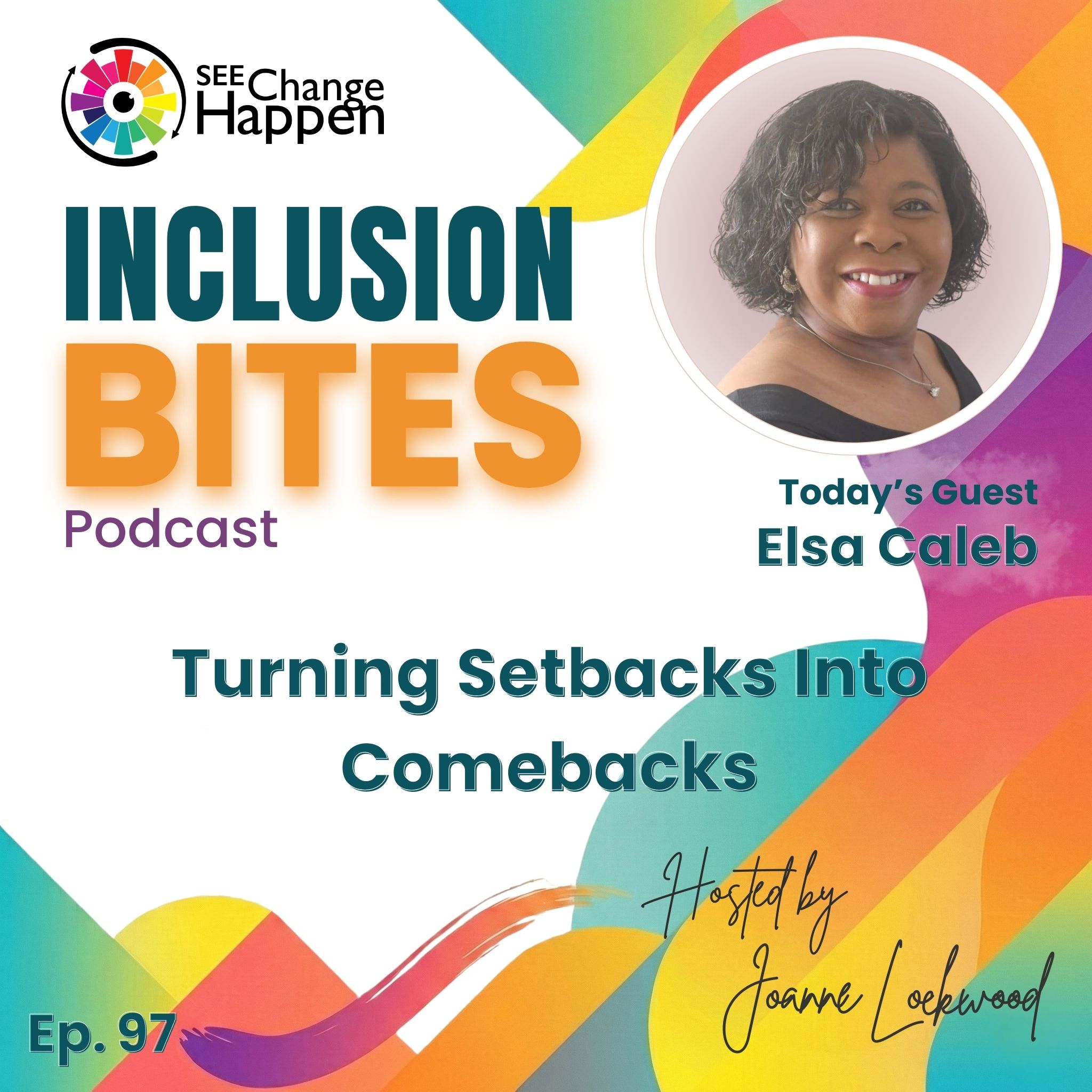
Hello, everyone. My name is Joanne Lockwood, and I'm your host forthe Inclusion Bytes podcast. In this series, Ihave interviewed a number of amazing people and simply had a conversationabout the subject of inclusion, belonging, andgenerally making the world a better place for everyone to thrive.If you'd like to join me in the future, then please do drop me aline tojo.lockwood@sechangehappan.co.uk,that's S-E-EChange Hapen dot Co dot Uk. You cancatch up with all the previous shows on iTunes, Spotify and theusual places. So plug in your headphones,grab a decaf, and let's get going.Today is episode 97 withthe title turning setbacks intocomebacks. And I have the absolute honour and privilege towelcome Elsa Caleb. Elsa is a businessstrategist who assists women to develop a robust business planfor the future. And when I asked Elsa to describe hersuperpower, she said she can get individuals to thinkdifferently about their circumstances, especiallyin the world of business. And she was recentlylabelled everyone needs an Elsa.Hello, Elsa. Welcome to the show. Hello, Joanne. And
Elsa Calebguest
thanks very much for the invitation. Really pleased to behere. I'm really pleased. We've been talking about this for several
Joanne Lockwoodhost
months, and I'm finally pleased. We got here at the tailend of 2023, just before the new year. So absolutely fantastic.Elsa, turning setbacks intocomebacks. Tell me about that. Yeah, it's interesting. And
Elsa Calebguest
also the timing of today's show, because we all rememberBrexit. Yeah, we also remember Covid, and now we'recurrently going through the cost of living crisis. And thechange of the year was roughly when Brexit kicked in because wecame out of Europe, Covid kicked in in the march. So thetiming now is, I think it's just right for people to beginto start thinking about what they want to do going forward.Okay, let's take some of the setbacks. For example, most of the clientsthat I meet at the moment, as soon as they meet with me, they alwayssay before COVID And I'm thinking, if I hear that
Elsa Calebguest
again, not that I'll scream, I'lldo something, I don't know, differently, butonce they start with that sentence, I now think,okay, there's been some setbacks. There's something that's held them back.They're not as progressive as they were prior to, say,Covid or even Brexit. It's the changes that have happenedworldwide that have really made an impact on a lot ofindividuals'lives, as we all know. And some people just cannotseem to shake it off. Yeah. So let's take Covid, forexample. A lot of women, for example, had to,in some cases, give up their livelihood, even ifit means being at home to school children, to do theschooling for the children. And in some cases, some of them were not equipped.And also with children, you know, you need space, you need to beout and about, you need to have the energy to be able to deal withthem. Whereas overnight, people's liveschanged. The way that they had to do things changed. Andit wasn't that they had a choice.They actually just had to make the changes there and then. And in some cases,they adapted because they had to. But a bit of them, I felt,in some cases, have been left behind. So now that the doors have beenopened up and we're actually moving forward, and some people are now saying, oh,I can't go back to the job that I used to do. I now wantto do something more creative. I'm speaking to
Elsa Calebguest
individuals who are saying, look, all I know is to cook,or all I know is to clean. And I'm saying, well, you know something, let'swork with that. And when you look at all the skills andexperiences that people acquire over the years, and it's things likebeing organised, it's things like making cups of tea,having routines, planning, et cetera, these are someof the important areas that we need in business.So once we've had a long conversation, I can start telling themwhat they can do with what they have. They begin toturn their ideas around, they begin to change their mindset, and theybegin to have that tinyshining light in front of them. In other words, they begin to hopethat there's definitely going to be a positive future. So that's where I alwaysstart. But, yes, of late, it's eitherbefore Brexit, before COVID and now, as I say,we're going through the crisis. So, yeah, I always feel that if I get themat that stage and we work together,put some kind of plan together, they're able to move forward in a positiveway. That's really interesting. Yeah, I never
Joanne Lockwoodhost
thought about it, because Covid is aglobal bookmark, isn't it?It's an event that everybody has been aware of, from thetip of Africa to the top tip of Alaska, if youlike. It's affected the entire world. So I suppose it's notsurprising that we use it as an before and afterevent. You're right. It created lifechanging moments or situations for many people.As you say, women largelysuffered greater inequity because of their responsibilityfor home management. For one of them, home admin,children, education, or fittinginto the. This is a derogatory term, thewife mode, if you like, looking after everybody. Oftenseen as the lower paid outof the couple, maybe. So they ended uptaking the kitchen table as opposed to the office tableor something. The lesser facilities. Yeah. Puttingtheir career on hold, definitely. They had to be more creative,
Elsa Calebguest
but like you said, just changing the kitchen table into anoffice table, some of them in some of the works and the jobsthat they did, didn't bring work home.Suddenly, to have to manage all of that in one space,it's bound to affect you in some way. And especially when you reach out topeople and sometimes just to go out of a home to have acoffee with a friend really changes a lot of things.But to not have that opportunity and then to allof a sudden become very technical because you had to get online,a lot of people had to actually develop a lot of skills very quickly.
Joanne Lockwoodhost
Do you think women also, I hate togeneralise the stereotype here, but statistically,women were often in lower paid roles in thehospitality or entertainment business, in hourly paid roles, whichwere some of the most affected at that time. Andtherefore they lost income, lost purpose, if you like, as well theydid. And if you really think about it, Joanne,
Elsa Calebguest
you've built your career all your life. In other words, you've sat down and you'vemapped it out, you've got it planned. You want to thengo for that next promotion, then all of a sudden, bam, it'sshut. What do you do then? Where do you go?How do you then take yourself out of that situation to say, you knowsomething, I've still got to continue, I've still got to provide, I've stillgot to think of myself, but at the same time, I've still got to bethere for my children and my family. So I cansee how some of them has really affect them, even down to theirconfidence. I spent more time now helping women tobuild their confidence and believing in themselves. Andpeople think, oh, it's about the skills and everything. Yes, it is. That's important.But if the person isn't focused and thinkingin an entrepreneurial way, which way are you going to go?It's just going to end up being a hobby as opposed to a business. Sothere's a lot of changing of the mindset and actualattitude to a lot of things that actually have to come into play and ina short space of time, so movingoff from. COVID because you said about the beginning, you don't want to anchor
Joanne Lockwoodhost
everything as before COVID after Covid. So let's think about thisbroadly. More broadly, you talk abouttransferable skills, you talk about returningmidpoint in your life, career pivots post family,if you like, or post care and responsibilities, orjust waking up one day and going, why did I pick this subject when Ileft school? I really don't enjoy this. Be able topress the stop button and say, actually, I don't want to be a lawyeranymore, I want to be a personal trainer. And I use that example because mypersonal trainer qualified. She's LLB, she worked at apractise as a solicitor and she went, I don't want to be doingthis every day, I want to be a personal trainer. And she gave all thatup. But that takes a huge amount of bravery or confidence orresilience to just chuck it all in. It does. But it's
Elsa Calebguest
also knowing. And I know in the back of the mind, although she's goneforward to become a personal trainer, she's also got that safety net tofall back on, determining should it not have work. And not only that,with those skills of being a lawyer, oh, my goodness, you can work in businessesjust doing the legal side of things. You don't have to go back intoa practise the way that you do. But the fact that she woke up onemorning and had that dream and that burning desire, that is where Iusually start with individuals, because I'll say to them, what's yourdream? What is your passion? What is it that you really want to do?Because if you've just checked, if you've suddenly had the door shut in onearea, why not take this opportunity to say, you know something, I'llstart again. And you can start again, but you're neverstarting at zero because of all those years. And as I said, theexperience and skills that you've acquired, you can use them, but peoplefeel they have to start at zero. And I'm thinking, no,we can use x from what you did before. We can use y fromanother area that you've worked in and put it all together along withyour personality and your passion. It can open up doors.
Joanne Lockwoodhost
You mentioned the cost of living, cris as well. Andwhere we are now with mortgage rates, with cost of living,we're in a situation where most households needtwo incomes in order tosurvive. Not saying thrive, survive.Budgets are really tight. It must be a tough actto risk one person's income. If you like tostart again, it. Is, but then it's going back.
Elsa Calebguest
As I said, if you come to a point in your life where you haven'tgot a job to go to, then, as I said, it's looking at some ofthe soft skills, like, for example, painting and decorating, makingcakes, doing things that people want and need.So you've got to find that gap, you've got to find wherethe demand is. Once you've identified that,things can be very, I won't say very easy, but a lot easier.For example, take a painting and decorating. I'm not a painter or a decorator, inno way, shape or form, but if somebody knocked on my door because I knowthat I need walls painting and stuff, I'll say to them, yeah, let's have aconversation. Or if somebody's referred to me, most probablythat's a better way for me to go. And they sat down with me andthey said, well, actually, you want your walls painting, tell me the colour,I'll show you, get you some examples, et cetera, et cetera. They go away, doall the research, bring the colours in, sit down with me, I start matching itup at the wall and I say, okay, that's what I want. They can askme for a deposit there and then that deposit can buy all thematerials. They go buy the materials, they come paint my wall, Ipay them the balance. To me, that's a winwin. You don't have to keep running to the bank to get money.You start with what you have, but then you also enter in acontractual agreement that's realistic, because people do expect to paya deposit for what they do and then pay the balance at the end. Sowhy not start small and then build it up gradually?
Joanne Lockwoodhost
It's interesting, you use that example of a painter decorator, a good friend ofmine who I met maybe eight or nineyears ago, she was a special speaker. She used to work in moneymanagement and we're really good friends. And thenone day I noticed on LinkedIn, she changed her profile, changed everythingelse. She left her husband, got divorced, set up in her ownhouse. She'd retrained as a painter and decorator, and nowshe specialises in being a female painter anddecorator in her 50s whotargets specifically women who wantanother woman to come and do their painted decorator. Because that trust elementabout coming into someone's house and we think about the number of women who liveon their own who've, at the age of 40 or 50, they've left theirhusband. They've had enough of that. Maybe they're widowed earlyor maybe they've never got married and they wantsomebody who they can trust in their home. Correct.And she's ideally placed for that? Yeah, definitely. I've got a client that I'm working
Elsa Calebguest
on. Well, she does painting, decorating. She's a carpenter as well, andelectrician. So I think it's exciting that thereare women coming up with those skills because, as you said, from the safety elementand also the confidence, having somebody in your home and you know they're going totell you the truth, they're not going to just say,oh, you have this knowing that it's more expensive than somethingelse. You know what I mean?
Joanne Lockwoodhost
I've never used her services as a patient decorator. Ifelt no problem at all recommending her to my mumand my mum had her in to redecorate her bedroom and there was noqualms at all. It was a kind of me. Anne. Anne is fabulous. I'veknown her for years. She will do a superb job and she did. And mymum is so happy with it and she's like, my mum paid her a deposit.There's no risk about someone doing a runner with the moneyor asking for more money later that you sometimes get.
Elsa Calebguest
I like those kind of business ideas because, how canI say? Women understand women. But that's just how weare. We understand that sometimes things can be tight, we understandthat things can be difficult and we will make allowances for that.Do you know what I mean? Not only that, even when the person's working, youknow, we're going to sit down and have a conversation. It's not justabout the job and off you go. It's about building that relationship aswell. So that's what I like doing what I do, because at the end ofthe day, I have all these friends I never had before.
Joanne Lockwoodhost
You're so right. My mum, she knows more about Anne than I do nowfor two weeks. I mean, I know Anne really well. She's had conversations andshe can't wait to get Anne back to paint her other bedroom and the hallwayin the lounge at some point. So it becomes afriend. It's more than just atrusted. But one of the areas, though,
Elsa Calebguest
people can actually forget, is that they're running a business.So you may get somebody who's going to try and push you to say, well,actually, can you do it a bit cheaper? Yeah, you can. But it's whether ornot you've done the math. And you've got to understand finance, be able toknow how much leeway, you've got to be able to make a discount inwhat you're doing, because you could quite easily forget andlose that focus that it's a business and not that you're helpingsomebody out or you're doing them a favour. Do you know what I mean? You're
Joanne Lockwoodhost
so right. Yeah. Maintain them. There's a big difference when you've worked for somebodyelse for many, many years, or you've never had to beresponsible for your own sales, marketing, profit and loss, advertising,everything else. People feed you, work, you getpaid, you come in. It's a completely different mindsetbeing a solopreneur or a small businessgenerating revenue which needs to beprofit, which means to pay your bills, doesn't it? Yeah, and I think,
Elsa Calebguest
again, that's where I come in, if you know what I mean. Because at theend of the day, my job is to ensure that I equip them with thebusiness side, that they understand it. So I put together aneight week business startup course and also an eight weekbusiness course to enable women to understand the basicsof business. And even if you're running a business for a few yearsand you've got to make that change sometimes it's knowing how to make that change,but staying within the law, making sure that you don'tdrop anything that's important, but that you're still building at thesame time. So me either working alongside you on a oneto one basis or one to many in a course, I always feel that it'simportant that you at least go through it so you understand even some ofthe changes that have happened in legislation, because at the end of the day,once I've left you, and even if you start up like a limited company,don't forget, you've got to make sure that you're up to date with your confirmationstatement, that you pay your taxes, that HMRC is your friend,you're paying your corporation tax as well. So we can't neglectany of that just because you enjoy doing what you.
Joanne Lockwoodhost
Yeah, you've got your public liability, you've got your professionalindemnity, you've got your health and safety requirements. Ifyou're climbing ladders, working at height safety, ifyou're in someone else's property, you've got to be careful there of trip hazards andall those various things. Yeah, exactly. It's your businesscompliance and also your financial compliance, your tax, everything else, isn't it?Yeah. And it's also known the difference that once that money comes in,
Elsa Calebguest
it's business money. It's for the business. You can take out thatproportion to live on, but you've got to make sure that you do arobust cash flow, because when you think money is not going to come in, andit does come in, that's great. But when money doesn't come in, when you thinkit's going to come in, you've got to have a contingency plan inplace. Yeah. I've met a
Joanne Lockwoodhost
number of people who are probably not confident on theprocess of taking credit cards, and it sounds complicated, but witha bit of basic knowledge of setting up a stripe account, or even mostbanks offer merchant accounts these days, knowing that you're going to have acredit card transaction fee, that you've got to build into your profit margins aswell. And those considerations, and you don't always get paidout the same day. Sometimes there's a two week lead time and things likethis. So it's all those little things you don't know about until you getinto it and start running the business, is it? Yeah. And also it can be
Elsa Calebguest
a bit overwhelming to suddenly say, oh, my goodness, I've got to pay extra onthis. Why? But if you're in a groupof, a group of women, we're going to discuss it. Somebodywould have hopefully have gone through that experience. If not, I would be able totell them. And it actually makes people a lot more relaxed to know, youknow something, it's doable, I can do this, but it's all about theplanning. You've got to be able to plan. Noteverybody's an administrator, and I get that, but if you can take thetime out, say, every quarter, to just assess and reassess everythingyou've done previously and then set yourself up for the coming threemonths, you'll find that you won't go so badly wrong. Do youknow what I mean? You will stay on track. And not only that, being apart of a group for at least eight weeks, it's like being accountable tosomeone. Yeah.
Joanne Lockwoodhost
One thing I found since setting up this business inthis part of my life is that I foundmy female network is far more supportive than I ever hadin the past. And I find my femalenetwork are more collaborative, they're less competitive,they're more willing to share, they're more willing to be open. And there's a generalsense that you want each other to succeed. Yeah, maybein my previous life it was a bit more competitive and dogeat dog. Now, I'm a member of many female entrepreneursnetworks, and it's caring and sharing. That's it,
Elsa Calebguest
definitely. And I think also, like I said,we like to share. We can always go for coffee, always gofor lunch. That's what we've always done. But you'll actually have atight network to be able to share. And also, if you're not in the same,actually, it could actually work even if you're in the same areasector. Do you know what I mean? Working together, you've got a problem.Somebody's always there to help you. Because we like solving problemsas a woman, that's what we do. Because I rememberraising my son, we always solve problems. And also,one thing that a lot of people don't do, and I have always tried toencourage this, is get their children involved. Get theirchildren involved in what they do, especially from a creative side, because they still havethat creativity approach to life. They get excited.They love to do things in a different way. So why not listen to yourchildren? When my son was ten, I actually taughthim how to do my bookkeeping. A lot of people know that. I always talkabout this story. Now he's 28 and he's quitemature. Finance is not a problem for him. He deals withfinance like we most probably go and buy shoes, do you know what I mean?But he's done the calculations. He feels confident with figures.But if you can imagine having children around there trying to design yourlogo and saying, oh, mom, that doesn't look white, why didn'tyou do this? Why didn't you do that? Et cetera.Not only that, children have got their own network. And, you know, when childrengot their network, the mothers become part of that network as well. Agreat, ideal way to actually market your business.
Joanne Lockwoodhost
I find I've got to be careful. My daughter sometimes, I mean, my daughter's what,31 now? And she works in early yearsnursery, sort of preschool. She's a deputy manager ata preschool nursery in West Sussex. And I've got tobe careful because I keep trying to persuade her to become entrepreneurialand get out of the corporate life and start her ownearly years training business. Or I can help you.And I've got to be really careful sometimes that I'm not overlyentrepreneurial and pushing someone out their comfort zone.I want to be kind of a magnet if they're interested, butnot a push or a pull. I think it's
Elsa Calebguest
to allow her to have to, say, run her race,do her career at her pace. And what she wants todo, but at the same time keep planting the seeds every now and againto say there's also an alternative, because one dayshe may just get fed up and she says, I need to do something different.But knowing that you're behind and you're watching that you can thenmake the possession to maybe ready then. Her husband's an
Joanne Lockwoodhost
accountant in practise. He works for a firmadjusted accountant practise. So she's got kindof a good solid financial footing as well as a kind ofan entrepreneurial footing. Yeah, she's got the.
Joanne Lockwoodhost
My wife worked for a company for a long time andit was one of those companies where it was an engineering, even thoughit was a small. They were part of Itachi, butthey were a small subsidiary that was kind of independent. Justthe ownership was there and it was engineering. It was verymale orientated. So the people that had value weremen. The women tend to be the admin or the less important, and they gota box of chocolates at Christmas. The men went to the racing or went tosee cricket or something. In a typical kind of male female divide thevalue and the worst. And she found herself
Joanne Lockwoodhost
not. I don't want to be too cruel, but she found herself beingtreated badly. Lack of respect, lack of value,just pushed down and I kept saying to her, look, come and work with me,come and work with me, we can figure this out, we figure this out. Butshe wanted her independence, that was her money, that washer role. And again, whilst she had a fearof getting it going wrong, but she also wanted that independent life whereit was her job, her role, and that was nothing. I was verycautious. Creating the gravitational pull without pushingand being overly. Kind of fineline, isn't it? Between. It is very fine, but occasionally you
Elsa Calebguest
could pass something her way for her to do that. Shecould actually see, well, actually I could do this independently andperhaps I could be the administrator for a lot of small businesses, do you knowwhat I mean? So it's kind of pulling her out of that environment, but atthe same time showing her that she has got the skills and the independenceand the knowledge to do something for herself, but at the sametime still help you in your business.
Joanne Lockwoodhost
As it happened again post Covid,her elderly parents, her mum needed morecaring. She tried to go part time, reduce her hoursby one day a week. The organisation said, write us abusiness case. It's like she says, I don't want to write a business case, Ijust want you to listen to me. Sit down, have a conversation with me aboutwhat's going on in my life and help me. And thensomething happened. And then she effectively did a constructivedismissal, walked out and said, I can't take this anymore. Anda week later, she started working with me. So in the end,she had that power to say, I don't need you anymore.I'm out. You can't treat me like this. I can go somewhere wheresomeone will value me.I created an environment where she knew she had safety without pushingher into it, if you like. Yeah, no, it's good. And it's just nice to
Elsa Calebguest
know that people have got that, how can I say that, connection.They're not just got the one option and that they can think differently andthey can do things. Do, you know, creative things going forward.
Joanne Lockwoodhost
I've got to ask you something. I noticed when you sent some shownotes ahead, you said you were a jazz dancer andyou learned to express yourself through movement. I'd love toexplore that, if you don't mind. Well, I started dancing from the age of
Elsa Calebguest
four. Mum told me this and my cousin, whowas like my best friend, she's a year older than me, she went toschool, so I thought I was going to school by going to dancingschool. So I actually spent a lot of timedancing in the midlands. I did ballet, jazz andtap. I won a lot of trophiesand medals over the years. At the age of 17, Ibecame a teacher. So I used to do little keep fitclasses every now and again. And then,by doing cabarets and shows, I found thatI could express myself so much more through movement. It wasat that time that I used to stammer quite a lot.So it was very difficult for me to stand up and read orstand up and express myself openly. But you put me on a stage, even atschool, they'd play a record and that was, you know, Elsa'sdancing. And they used to know me as a dancer, do you know what Imean? Because I used to work, as I said, did cabaret shows, didannual pantomimes with the stage school that I wasgoing to, as well, managed to travel through Europe as well, doing that.But then I realised that is not going to take mevery far, especially in those days, so I had tothink again. So decided to use thecreativity or the creative side of that to then become anarts officer. And that was what brought me to London.Yeah. And from there,
Joanne Lockwoodhost
you worked in this role andthen how did you become an entrepreneur? What got you outof working for somebody else? Yeah, I was working as an arts officer
Elsa Calebguest
for a local council. And I had a very good manager who suggested that Iwent back to college, but they wanted me to do leisure because they wantedto keep me in the leisure industry. But I decided, I satdown, I thought, well, actually, what's a couple of things that I could do orone thing that I could do, should I get married and want to settle downand then have life after a child or children? AndI thought, well, business runs throughout, no matter what.So I was fortunate that I went back to college, studied,got my qualification and the same year, I mean, I finished myqualification in July, September, I was headhunted to work forthe prince's youth business trust. It's now called the Prince's Trust, but it was aprince's youth business trust. The fact that I was headhunted, that was evenbetter. That opened up my life in so manyways. And from there it was like sleevesup and I just dived in. And I can say that thatwas what really got me into this world of business andentrepreneurial style of living. Yeah.
Joanne Lockwoodhost
Have you experienced a tougher journey as awoman and doubly as a black woman? Or has thatbeen the superpower? You know something jar
Elsa Calebguest
in life when you suddenly wake up, when I say wake up,you're doing things, but you're doing it. Because I havea mother that is very ambitious and very supportive,who never saw colour, but always ensuredthat she ingrained in us to do better than we could everdo but keep striving.I suppose it's for perfection. Sowhenever I used to dance, it was like, don't forget, you're a dancer,you're a good dancer. You go out there and you do your best andyou hear those words and you think, well, okay, I'll do them. And that's allI did for a number of years before I realised, actually, you knowsomething, there are a lot of things against me,do you know what I mean? But I seem to be pushing hard. But Iwas pushing thinking that, well, my mom's behind me, she's telling me, I've got todo this and I'll do it. Until one day somebody tells you straight in yourface that actually you're not wantedhere, we don't need you. And you think, well, hang on, I'mgood at this, I'm good at that, what's the issue? And then yourealise, you know something, wow. I didn't think colour wouldbe a major setback or could be a setback in life,but as I said, and when we spoke earlier, my mom is 92. She's93 next year and next week. No, not actually next year,next week. And every time I feelthat I need to speak to somebody and I need to actually bepushed forward, I go to my mother now. She's a ladythat came here in the trained asa psychiatric nurse. She only ever had one jobwith seven children. She raised us all. Do you see what Imean? And I'll say to you that we're all ambitious, we've allgot our lane that we work in and we've all got children andgrandchildren, et cetera. But she's our rock.And I'll say that she never saw colour, even thoughit was there. She
Joanne Lockwoodhost
raised seven children, she held down a job, she kept a family together.She was the matriarch of yoursiblings and your family. I'm not surprised.She's one heck of a woman, isn't she? Yes, she is.
Elsa Calebguest
Yeah. That's why we'll make sure we go and spend Christmas with her everyyear, because not that we don't see her during the year, but it's just soimportant that we all have. Think back to where we were when we were youngerand we have a laugh and a joke. We're a very tight family,very supportive to one another. Not everybody has that,unfortunately. But unfortunately, that's what's kept me straight, that'swhat's driven me. Even when I look at things likeopportunities that I've had working with the small business council, with government,advising secretaries of state and trade and industry aboutbusiness. Don't ask me how I got there.
Elsa Calebguest
I cannot pinpoint and say to you, well, actually, I knew this person.No, it didn't work like that. It was a whole application process, doyou know what I mean? It was tough to get in there, but when Igot in there, it was like. It opened my eyes to a lot of thingsof which I use now to help people to move forward,because people, it was either government or for thegovernment, whichever, but I just saw how it worked. I went in there tounderstand how it worked, to give my advice where I felt that Ineeded to, along with 22 other people. And if it meantthat we made a difference, then that was great. And I could see how makinga difference actually trickled down to the everyday person.So I thought, well, if I've done it on that level, I can do iton this level. And that's why I love it. And I've got that passionfor helping people all the time because I know that change is whatsome people just need. And in some cases, it's only a small change.It doesn't have to be nothing major, but it will definitely havean impact on your life. Yeah, change could be
Joanne Lockwoodhost
scary. It also be very empowering, aren't it? Andif you let change hold you back, you can always belooking over the fence wishing, can't you? Yeah, definitely. And I always
Elsa Calebguest
said that I was born in the era of change. Nothingstands still for long. Everything's changing when youexperience what's happened in a few know. And I think when theBerlin wolf came down, I was like, oh, my goodness, that was just the beginningof Nelson Mandela beingreleased, you know what I mean? Seeing the coronation from queen toking, it's like we're living in an era where things have just constantlychanged.
Joanne Lockwoodhost
Sorry, yeah. I won'task you your age, but I was born in the mid 60s.My father was in the navy. He did 22 years in the navy. And thenwhen he left the navy, went to teacher training college and becamea woodwork technical drawing teacherin secondary school. And my mum was ahouse mum. She stayed at home with myself and mytwo brothers until we had left home inour 20s. So she was in her late 40s before shewent to teacher training college and became a primary school teacher.And they lived in the same house. So for me, myparents were sort of the rock of stability, the rock of no change,probably like you, I've been like a pinball, bouncing offthe cushions, doing lots of different things in my life. Yeah.Making mistakes, failing, picking myself up, trying something else,crashing and burning again. I've got quite used tonot knowing what I'm doing tomorrow or not worrying about it. But myparents are very much. They want to see things mapped out. And I think mybrother's a bit more mapped out. He's neverhad that sort of randomness, so it's tough if youcome from that stable environment. It is, yeah.
Elsa Calebguest
But as I said, it is about change.So we adapt, we change, we listen, we move forward.But I'll notice that this generation coming up now, oh, mygoodness, they've taken us to another level.Microwave. I keep saying it's so quick and so fast that,yeah, you can keep up. And I speak to my son quite a lot andhe says, mom, you are really techie. And I'm thinking, I'm notcompared to some people. But I do make sure that Ikeep abreast of what's happening on the technical side, because if we losethat, you're kind of going backwards.
Joanne Lockwoodhost
Yeah. Because you got new kids on the block coming on all the time.And I feel the need to be prettysavvy technically. I mean, my background is it. Soit's in me anyway to keep abreast, but AIand learning about software tools and web design andgraphic design. I kind ofdo everything in my business, or at least have an opinion on everything. I dooutsource some stuff, but I like to dabble.
Elsa Calebguest
I understand. Yeah. And I think it's good andexciting that we do. Also. It keeps our minds in tiptop condition as well. Do you know what I mean? And we see life sodifferently. The fact that we can actually do business, actuallycommunicate with people from all over the world at the same time,I think it's fantastic. Yeah. As opposed to just stayingin your lane, so to speak. Isn't that also the
Joanne Lockwoodhost
challenge, going back to the advice you give toyour coaches, if that's the word.It's not just about being a great technician or a greatprofessional. It's also the other stuff people have tolearn. It's just sales and marketing thatsometimes that can be the hardest thing to learn, isn't it? It is, yeah. Because
Elsa Calebguest
you're going to be doing things that you perhaps had colleagues doing for you. Asyou said, the sales is one thing, the marketing is another. It's being afinancier, it's being a planner. But you know something? If yousit down with people, they have touched on certain elements of it.They may not have a lot of knowledge about it, but if you can sayto them just talking to people or going for a coffee with somebodyand just telling them what you do or finding out what they needand you meet that need, that's really all you need to do.You just need to be yourself. You don't have to be that hardsalesperson. I've never sold anything in my life and Idon't like marketing. Okay. I'm on LinkedIn and I've got my littleblogs going there and then, but that's not me. I mean, I dothat because I have to, but I find that my engagementwith people is more important and that's where I helpsolve the problem. So it's finding a niche.Yeah. Because people often use this term jack
Joanne Lockwoodhost
of all, trace, master of none. But that's only half the quote. I'm not sureif you're aware of it, but the second half of the quote is better thana master of one. So what it's really saying is being a backjackof all trades is better than being a master of none.It's better than being a master of one. So being a one trick ponyisn't the solution. It's having a broad in business. Torun a business, you got to have broad skills across a whole range of acumens,
Joanne Lockwoodhost
haven't you? Yeah, definitely. And I think it's not until you actually
Elsa Calebguest
embark on running the business or go into that area of business that yourealise you know something. You've got more than what you think you have. It'sjust that perhaps you've done it years ago and you've put it to bedand you think, I'll work on something new. But then as soon as you runthat business, what you did in the past all of a sudden becomesrelevant. I'm alwaysspending time digging into people's skills and knowledge andexperiences and say, well, surely you've done something similar.Can we build on something that you've done in the past? And then when theyget it, they go, oh, yeah, of course. I buy my shopping on a weeklybasis. I'm quite happy to sit down and make a shopping list. And I'mquite happy to say, well, I've got x amount of money for my shopping. AndI'm thinking, well, that's basically what we're talking about with business aswell. It's just that you just take your time, you stop and youactually spend the time doing the numbers.
Joanne Lockwoodhost
Yeah. Without going back to the unprecedented times of COVIDand things like that, we're both professional speakers and we're both member of the professionalspeaking association, and we go back to the COVID timeswhen March 24, whatever it was, March 23at Monday morning, when Boris came on the telly and said, thou shalt stay athome. Everyone except for me. Of course, he could do what he likes, but everybodyhas to stay at home. Many of ourprofessional speaking colleagues, their living wasearned by standing up in front of people either as a trainer,a coach, consultant, or a keynote speaker on stage somewhere.And our market disappeared overnight. Yes, it did.
Elsa Calebguest
In some cases, I was fortunate because I've never been a full timespeaker. I used to use Skype before. I used Zoom.So I used to work from home occasionally with clients. But Ithink there's some people within our network thatwas quite willing to grasp the change and take ontechnology and do things different. But unfortunately, there were some thatwanted to keep things the way that they were and were waiting untileverything was opened again and then they'll restart. But Iwas pleased that the first conference that we had during COVIDhow many people did embrace the change andhow many people came forward and that would actually sharing their skillsand knowledge. I thought that was fantastic because I actually joined thePSA. I think it was the August just before COVID so it'd havebeen 2019. So I literally just got in. Sowhen it all happened changed, I was like, oh, my goodness, look at these people.They're giving everybody so much. I felt alot of people gave a lot of themselves and they shared so much. Andthat's when I saw the PSA come together and that's what I likedabout the PSA. It's like you were helping each other without realising you werehelping each other. You're making sure that everybody waslooked know. Ireally commend the PSA for. Yeah, we did
Joanne Lockwoodhost
come together as a community and there was a lot of people sort of leadingthe way on remote speaking techniques and technicalsolutions. I was part of some of those technical conversationsand I think one of the reasons I got involved with it was I wanteda purpose and be able to share back to thecommunity. Gave me a purpose. It gave me a reason to get up. Itgave me a reason to have conversations with people, whereas I could have sat theredoom and gloom, but, yeah, it gave me a purpose. It was verysymbiotic, whilst it wasaltruistic. Also, I got a lot out of the help I gave.
Elsa Calebguest
Yeah. And not only that, we got to know each other.And what was nice is that everybody from different parts of the country,yet we met up and we talked and we continued,as I say, that I don't even know, not how I would have survived,because I was fortunate. I actually got a contract in the march, justliterally days before the lockdown. And I was working with clients,as I say, through Skype, before I got to understand zoom. So I wasfortunate. I had that income coming in all the time. But I think for me,my highlight was the PSA. Do you know what mean?
Joanne Lockwoodhost
Yeah. Doing those virtual meetings. Yeah,it was. Yeah, certainly for me. You say you met people around the country.I met people over the world, okay. I was helping people inHawaii, Australia, far East, Middleeast, helping them set their zooms up and settheir cameras up and doing this sort of stuff. And I was having some amazingconversations with people who were.And I don't mean to be cruel to anybody, they were technically out of theirdepth. They were desperate for someone to help. And I feltimmense because my it background, I fell into it as akind of. I guess when the cris hits, everyonefalls back to their core skills, don't they? There you go.And that's kind of what it was. And I felt that wasmy contribution to the world, was using my core skills andexperience to help others. In the absence of any other income, we might as wellhelp each other. I mean, the income is either
Elsa Calebguest
there or it starts coming in, but then you can build on it. But it'snice to know, as you said, you went back to your core skills.
Joanne Lockwoodhost
I got a lot out of it as well, in those sort of terms whereif you're not used to presenting and delivering online, it's askill you have to learn as well. But I suppose because I was talking topeople online all the time, helping them, I was building up my ownonline skills. There you go. How to speak, how to get thelighting right, how to get your camera right. So, yeah, I thinkhelping others helped me. It was kind of a yes.
Elsa Calebguest
As you said, once you've got that area that you're good at, youdo use it to help others and you're always happy. You're not alwaysthe person that's always thinking negative in any way. So, yeah,I always think of the. I know Covid was a setback for a lot ofpeople, but for me it was definitely a positive time.
Joanne Lockwoodhost
Definitely was, yeah, I was definitely one of the winners. I came out of itwith a far stronger business than I went into it with because Iembraced the change that was occurring in the world. It was right place, right time.Yeah, that's good. And it's also helped me to develop, as I
Elsa Calebguest
say, two programmes that I do at the moment,but now I have one online and one that we do face to face, whichis, I've always done things face to face. So, yeah, I got somethingthat's quite positive out of it as well.
Joanne Lockwoodhost
Are you seeing a change in the people you'recoaching in terms of the challenges they're facing, or is it reallyjust the same challenges, different person,different year sort of thing, or are there new challenges developing?
Elsa Calebguest
I'm seeing a lot of the same because I've managed toget a really good, lucrative contract at the moment, of which I'mworking with groups of 20 women. I've just finishedone group of which was all aboutentrepreneurs, just taking their ideas from where they are and takingit to the next level, and that's worked really well. And now I'm on thesecond cohort of 20 women, but these are focusing onnonprofit organisations, so they want to set up the community interestcompany. They want to set up a little communityinterest organisation, which is like a mini charity. So these are thenonprofit individuals. And what's interesting isthey've got this great ambition to actually createsomething, but I always feel as ifthey don't think they're worthy or they can actually do something.But now that they're beginning to see what they cancreate, it's just interesting how they're now thinking ofgrowth and thinking of others, which in somebusinesses is all about yourself andsurviving. But these ones that are doing nonprofit stroke charitablebusinesses, it's about embracing those that are less fortunate thanthemselves. How can they bring them on board to help them inwhat they're doing? So it's just interesting how Isuppose people are becoming more caring. I think maybe it's justbecause I'm working with these nonprofit organisations, whereas I don'tnormally see that in those that are looking and actually trying to builda small business for shares andprofit, et cetera. But I'dsay that everybody seems to still have the same issues andsame problems. Do you find that some of your clients
Joanne Lockwoodhost
are embarrassed to want to make a profit? Is there a kind of aCIC route allows people to do it ethically, therefore there's no guilt about makingmoney? Is that barrier? Yeah, I'd say so. And
Elsa Calebguest
also when you start talking about profit, it's like, oh my goodness, you'regreedy. No, I'm not greedy. That's what businesses isabout, do you know what I mean? It's like we're not supposed to talk aboutprofit, and that's on both sides of the fence. But the realityis, why are you in business in the first place if it's not to makea profit? Okay, if you want to go the nonprofit organisation, Ialways try and encourage them to do both, because one can help theother, depending on what the ideas are. But don'tnot build a business and run it like a hobby, becausethat does not make any sense whatsoever. You end up having more problemsbecause then you end up owing the tax man, you end up owing people,and that's not what business is about. To do businessethically, you've got to think about making a profit to make sure that all yourbills are paid, everything's done on time, legally andopenly. And from a sound governance perspective,
Joanne Lockwoodhost
if you're not generating a surplus and reserves, then you'renot prepared for downturns,events, sickness, unable to work,whatever it may be. So you have to have a surplus ofrevenue, which is for you to reinvest in yourself at alater date when you need it. Definitely. And also if you're running a
Elsa Calebguest
business because you want to retire in a nice way, not that youever retired from your business if you don't want to. Yeah, you've got to thinkahead, you've got to plan ahead. And it's all about making that extramoney. As I said, it's not that you want to. Some people go around theworld, some people buy fancy cars and everything else, but inreality, episodes is all about growth. It's all aboutthinking ahead of times.You've got your short term, your medium and your long term. And if you're notthinking long term, then what are you doing?
Joanne Lockwoodhost
Yeah, if you're employed, you're happy to knock on yourmanager's door and ask for a pay rise. That's kind of increasing profit, isn't it?
Elsa Calebguest
Yeah, there is that. But then how long is the company going to be aroundfor? Yeah, or you work all the hours
Joanne Lockwoodhost
for the organisation that employs you, generating themprofit without taking the revenue share yourself. And that's theother thing. You become slaves, the corporate machine, don't you?
Elsa Calebguest
Yeah, it's interesting, but, yeah, I just like the factwhen people say that, you know something, there's more to life than what I'm currentlydoing and I actually want to stop and do something differently,that's when I jump in, I go, right, okay, let's have a conversation. I getexcited and then when they start seeing what the possibilitiesare, their whole mindset begins to change, which is great.
Joanne Lockwoodhost
Yeah. And just breaking it down into how much you need tolive on. Yeah. So what do you need to achieve? That's
Elsa Calebguest
it, the person work out your. Pricing strategy, you work out your units of measure
Joanne Lockwoodhost
and say, okay, if I do three of those a month, I canbe quite happy on that pricing structure,actually. That's quite easy, isn't it? The right steps,isn't it? Yeah. And also as you're getting older, you don't have as
Elsa Calebguest
many as energy running around, so you got to think ofliving life in a different way. So to me, I always think this is theanswer. Yeah, I completely agree. And
Joanne Lockwoodhost
one thing I would say as a solopreneur is being selfemployed, you work when you want to, but the flip side ofthat is you also have to work when you don't want to.You have both things. You still aredependent on a client, someone paying the billssomewhere. Whilst you do have a very positivework life balance, clients when you think I really could dowithout this, but the buck stops with me, I've got to go and do it.
Elsa Calebguest
Yeah, there is that. But then again it's a planning. For example, okay,Christmas, we know we can take days off and we just add thoseextra days and that's what we do. Take those extra days off knowing that weneed to refocus and plan and everything for the coming year.But we don't have to ask permission. No.
Joanne Lockwoodhost
In fact, many of the people I know, self employed,disabled, well, I'm not going to work after the 15 December until the 7January. It's like I don't work, sorry, bye. I think later. Goaway. I work on a ten month year, I don't reallywork. August, I don't really work for half of December and I don't really workfor half of January. There you go. Not because I necessarily don'twant to, but most of my clients don'twork. It's a pointless exercise for me. SoI take the opportunity to take those one month andtwo half months off knowing full well there's, there could be no revenue.
Elsa Calebguest
Well.
Joanne Lockwoodhost
There'S no income this month. Okay. I wasn't planning on any income this month.It's fine. Okay. That's interesting because what I tend to do is double up on
Elsa Calebguest
the clients beforehand, knowing that I'm going to have a break sothat the income is still the same. It's just thatI worked a bit harder just before the break. Do yousee? So I know that at the end of the month, yeah, the invoices aregoing to come in, but I still have a nice little restin between. I'm just making sure I'm generating surplus
Joanne Lockwoodhost
every month throughout the year and knowing that I'vegot a pipeline that'sactive and going to drop early in the new year.So I know that I can take my foot off the pedal knowing that Ican pick it up a bit later on, things are going to drop. But
Elsa Calebguest
then there's an experienced business person, whichis nice and it's great to hear, but it's when people don't do things likethat, does that mean they spend as they go along thinkingthat tomorrow is definitely going to be at the same level,which is not always the case. I'm not
Joanne Lockwoodhost
saying it's an easy journey. I'm not saying that I've gotmy act together completely. A lot of it came from experience. So I suddenly,look, yeah, okay, I've panicked, I've worried,I've pulled things together. That was tight and then gone.Okay, next year I'm going to plan for this being the situation, because now Iknow the reality. And then it's learning the lessons quickly, isn't it? Failingfast, quickly. But as you said, it's all in the planning.Yeah. And pricing yourself right in the first place so thatyou are making surplus and you are the reserves at a healthy level sothat you know you can ride those months out.
Elsa Calebguest
Yeah. So cash flow is key. I always encourage people to docash flows. Yeah. But I tend to do them on a personaland a business level because I like to see on what angleeverything's coming in and going out. So maybe I go over the top,but it works.
Joanne Lockwoodhost
Yeah, I agree with you completely around the personal side as well, because ifyou've got personal cash flow issues, that willinevitably impact your business cash flow as well, because you end up having to drawtoo much or you haven't got stability in the personal level. Soyou can't go into starting a new business if you've got personal cash flow issues.
Elsa Calebguest
No, exactly. Yeah. And it's to make people realise thatwhen's the best time to actually start the business. Do you know what I mean?In relation to how many clients you've got? Does that mean. Because if you can'tstart it properly, why are you starting it at all?
Joanne Lockwoodhost
Yeah. And today you look at a lot of you mentionedyounger people earlier, gig working. You've gotmany young people have got multiple gigs going on YouTubechannels, monetizing this cottage industry fromhome. So there's opportunities to do parallel tasks these days,isn't? Yeah, the opportunities are out there. I think people have just got
Elsa Calebguest
to just grasp them and keep focusing. Yeah.
Joanne Lockwoodhost
It's been fascinating talking to you, Elsa. Absolutely fantastic. It's greatlistening to your experience as an entrepreneur yourself and alsoworking with other entrepreneurs and getting them out the starting gate andsetting them on the right path. Really fascinating. How do people get holdof you? Well, Joanna, I've got my LinkedIn,
Elsa Calebguest
which is my name, Elsa. Caleb. So you can always find me on LinkedIn. Youcan also my email is my nameelsa@elsacaleb.com. Andyeah, I'm out there. Know Instagram, not very highly, butput my name in my website, Elsacaleb Co. Uk.Yeah. Usually the best channels to get me on. And just
Joanne Lockwoodhost
for anyone listening, Elsa is E-L-S-A as infrozen, I presume. And CalebC-A-L-E-B. Yeah, I
Elsa Calebguest
had it first. You had it firstname first. You are. It's beena pleasure just to be able to talk about what I do, because I don'talways find the opportunity to do that. But it's just knowing thatpeople, at the end of the day, can actually put food on the table. Sothat's what I'm about. I like to ensure that they have food on the tableand they can actually be happy in what they do. Yeah.
Joanne Lockwoodhost
And believe, because a lot of it is lack of belief, isn'tit? I think people start to believe they can.Thank you. Brilliant. And thank you to you, the
Joanne Lockwoodhost
listeners, for you, the listener, for getting this far. I reallyappreciate it. Thank you for tuning in. If you wantto keep updated on future episodes, please do subscribe. If you're not already,just search for inclusion Bites podcast B-I-T-E-Seither on Google, Spotify, iTunes or the usualplatforms. Please tell your friends, please tell your colleagues. I'vegot a number of other exciting guests lined up and this is episode 97.It's not long to episode 100, which will be out in the next couple ofweeks. If you'd like to be a guest, let me know. And anysuggestions, please email me tojo.lockwood@seeechangehapen.co.uk.And finally, my name is Joanne Lockwood. This has beenan absolute pleasure to host this podcast for you today. Catch you nexttime. Bye.
Joanne Lockwood talks with business strategist Elsa Caleb about what it takes to turn setbacks into comebacks, especially for women whose careers and income were disrupted by Brexit, Covid, and the cost of living crisis.
Elsa explains how she helps clients move from feeling stuck to taking practical steps: reframing circumstances, identifying transferable skills, and building the mindset needed to treat a venture as a real business rather than a hobby. Together they explore common barriers such as loss of confidence, fear of financial risk, and uncertainty about sales, pricing, and planning.
The conversation also highlights the value of supportive networks and accountability, with examples from women’s entrepreneur communities and the Professional Speaking Association during the pandemic. Elsa shares parts of her own journey from dance and the arts into business support work, as well as reflections on family influence and the reality of facing race as a factor in her experience.
Across the episode, the focus stays on sustainable entrepreneurship: cash flow, compliance, pricing, and building resilience so people can create stability for themselves and their families while pursuing work that fits their strengths and ambitions.
“Yeah, it's interesting. And also the timing of today's show, because we all remember Brexit. Yeah, we also remember Covid, and now we're currently going through the cost of living crisis.”
“And when you look at all the skills and experiences that people acquire over the years, and it's things like being organised, it's things like making cups of tea, having routines, planning, et cetera, these are some of the important areas that we need in business.”
“I've still got to continue, I've still got to provide, I've still got to think of myself, but at the same time, I've still got to be there for my children and my family. So I can see how some of them has really affect them, even down to their confidence.”
“I was fortunate that I went back to college, studied, got my qualification and the same year, I mean, I finished my qualification in July, September, I was headhunted to work for the prince's youth business trust.”
“I have a mother that is very ambitious and very supportive, who never saw colour, but always ensured that she ingrained in us to do better than we could ever do but keep striving.”
“But now that they're beginning to see what they can create, it's just interesting how they're now thinking of growth and thinking of others, which in some businesses is all about yourself and surviving.”
Embracing transferable skills and identifying passion to pursue new career paths.
Overcoming the financial pressure of needing two incomes to survive and the challenge of risking one person's income to start a new endeavour.
Finding demand for soft skills and starting small to build a business.
The value of women understanding and supporting each other in business, along with maintaining focus on the business aspect.
The impact of COVID-19 on professional speakers and the Professional Speaking Association, along with positive outcomes of embracing change.
The shift in mindset towards caring for others in the non-profit sector and understanding the responsibilities of transitioning from employment to entrepreneurship.
The importance of financial compliance, planning, and understanding business basics for long-term success.
One thing to remember
The importance of understanding business basics, compliance with legislation, and financial management is crucial for the success of female entrepreneurs in transitioning from being employed to being solopreneurs or small business owners. Short
Questions this episode helps answer
How does Elsa Caleb approach the development of business plans with female entrepreneurs?
In what ways does Elsa Caleb encourage women to think differently about their circumstances in the world of business?
What impact has the COVID-19 pandemic had on women in lower-paid roles, and how does Elsa address these challenges in her work?
How does Elsa Caleb emphasize the importance of identifying passions and skills when pursuing new career paths for women?
What are the financial pressures and challenges faced by women needing to balance two incomes to survive and potentially risk one income to start a new business?
In what ways does Elsa suggest finding demand for soft skills, such as painting and decorating, and starting small to build a business?
Explore topics
Ideas from this episode
Careers Growth Confidence
Change & Transformation
Resilience
Confidence Self Worth
Community & Connection
Race & Ethnicity
Learn
Frequently asked questions
How can ethical business practices alleviate guilt about making money?
Elsa Caleb explains that ethical business practices can help alleviate guilt about making money by ensuring that the business serves a purpose and positively impacts people's lives.
Why is profit necessary for running a successful business and preparing for future uncertainties?
Profit is essential for running a successful business as it provides the financial stability needed to navigate uncertain times and plan for the future.
What are the key factors in maintaining healthy reserves and long-term success in business?
Planning ahead, having surplus revenue, implementing pricing strategies, and financial planning are crucial for maintaining healthy reserves and achieving long-term success in business.
How can women entrepreneurs build their confidence and entrepreneurial mindset?
Elsa emphasises the need to help women build their confidence and mindset to think entrepreneurially in order to move forward positively in the business world.
What are the challenges and opportunities faced by women transitioning from employment to being solopreneurs or small business owners?
Elsa Caleb discusses the challenges and opportunities faced by individuals transitioning from employment to being solopreneurs or small business owners, highlighting the need for a different mindset and understanding of business responsibilities.
How can female entrepreneurs navigate financial and business compliance in their ventures?
Understanding business basics, compliance with legislation, financial management, and building a robust cash flow are essential aspects that female entrepreneurs need to navigate to ensure business success.
Share this episode
Heard something worth passing on? Send this conversation to someone who needs to hear it.