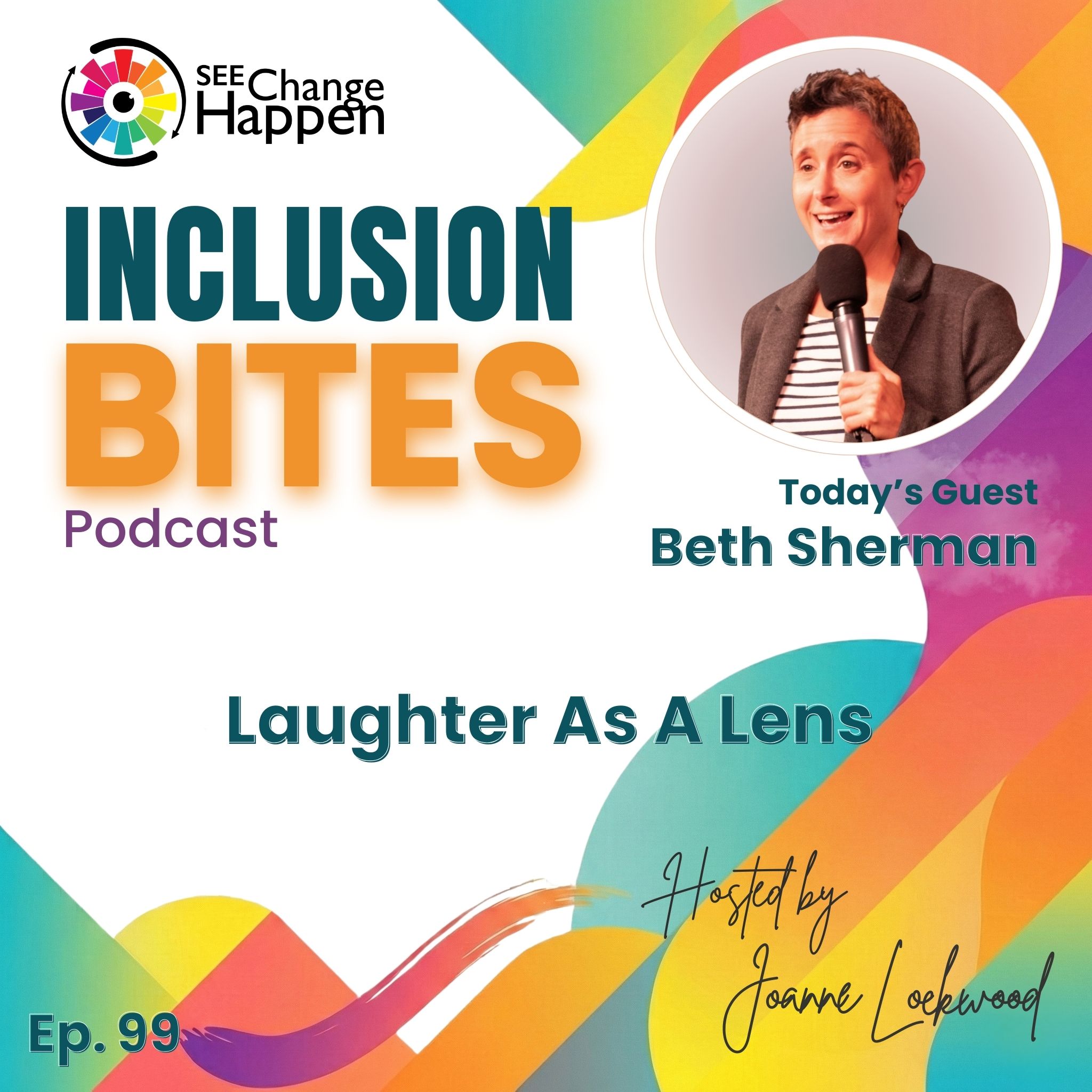
Exploring the power of humour as a vital tool for inclusive communication, Joanne Lockwood and guest Beth Sherman deliver an engaging conversation on incorporating authenticity, preparation, and context into public speaking and comedy.
In this episode of Inclusion Bites, Joanne Lockwood speaks with Beth Sherman about careers growth confidence.
“I mean, humour is a tool, and like any tool, you can use it to build something.”
Explore
Navigate this episode
Joanne Lockwoodhost
Hello, everyone. My name is Joanne Lockwood and I'm your host for the InclusionBites podcast. In this series, I have interviewed a number of amazingpeople and simply had a conversation around the subject of inclusion,belonging and generally making the world a better place for everyone to thrive.If you'd like to join me in the future, then please do drop me aline tojo.Lockwood@seechangehappen.co.uk.That's S-E-E Change Happen dot Co dot Uk. You cancatch up with all of the previous shows on iTunes, Spotify and the usualplaces. So plug in your headphones, grab a decaf and let'sget going. Today is episode 99with the title laughter as a lens, and I have theabsolute honour and privilege to welcome Beth Sherman. Now, Beth is amulti Emmy award winning comedy writer and speakeron the power of humour for human connection. When I asked Bethto describe her superpower, she said, she can make you funny evenif you don't think you are. Hello, Beth. Welcome to the show. Hi,
Beth Shermanguest
Jo. Thanks for having me. I should actually say, welcome back to the show.
Joanne Lockwoodhost
You have the honour of being my first repeat guestbecause we had such terrible Internet troubles last time thatwe had to basically write the entire soundtrack off. It just wasn'tusable, was it? No. And it was all the fault of my Internet.
Beth Shermanguest
We disconnected from Zoom. My spotty Internetdisconnected from Zoom seven times. I had just moved and theInternet was not properly set up. So BT had given me sortof an interim device that did not workas so. But you know what, in show business, they say,bad dress rehearsal, great show, great show. It wasa terrible dress rehearsal. But in the
Joanne Lockwoodhost
spirit of this conversation, laugh was a lens.We did have quite a laugh, despite the problems. And it was likea real outtakes blooper reel, wasn't it? At times, it really is,
Beth Shermanguest
but that's what humour does. It is quickconnection and being able to laugh at yourself, being able to laugh at thesituation. Yeah, I guess we both could have just gotten angrier andangrier. I mean, there was part of it,but at a certain point you just have to look at eachother and roll your eyes and laugh. I mean, it wasabsurd. The first time it was uncomfortable. The second time, it was awkward.The third time it's just silly.But that is connection. I mean, are you going to forget that taping?I know I'm not. I'll try.
Joanne Lockwoodhost
Maybe we will publish a bloopers reel at some point, but it was across between going through a tunnel on a mobile phoneand an episode of Doctor who with the Daleks trying to exterminatesomebody. It was a really broken up conversation. Everyso often you'd freeze. And I was thinking, are you going to come back oraren't you going to come back? And it's comedy genius. Well,
Beth Shermanguest
and it became a talking point for us. It becamea way to. Well, it's become areference for us. I mean, I'm sure when we run into eachother again, it will come up. It becomes a sharedexperience, so why not turn a negativeinto a positive? Yeah. So you're an Emmy
Joanne Lockwoodhost
award winning writer. Tell us a bit about your backgroundand how you got here today to. The
Beth Shermanguest
second bedroom where we're recording this. Where I'm recording this. We're not in a bedroomtogether. Well,I am a comedy writer by trade. I fellin love with the idea of writing comedy fortelevision from the time I realised it was a job.And I can actually remember that because I was about 15, I watched abehind the scenes news programme on asitcom that I loved, and they weren't focusing on thecast behind the scenes. They showed us a magical place called the writersroom. And it was just ten guys sitting around aconference table being funny. And they got paid for it and itwas a job and it was guys, mostly guys atthe time. But as soon as I realised that was a job,it's the only thing I ever wanted to do. And I'd been obsessed with standup, so I just always had an ear for comedy. I went touniversity, I moved to Los Angeles.I'm born and raised in Philadelphia, nowhere near show business, nowhere anything like that.I moved to Los Angeles after college to go followmy dreams. I didn't know anyone except a woman that I'dgone to college with. And I started at the bottom, gettingcoffee, making copies. I started as a production assistant, worked my wayup to writer's assistant, and then eventually started gettingpaid writing jobs on tv shows.And I found my tribe. It was my place and I absolutely lovedit. I did that for. Well, I'm still doing that. That's27 years. And along the way, I didn't have thecourage to do stand up myself, even though I was in love with it. Ididn't really find the courage to do that until I'd had a fewprofessional comedy writing jobs under my belt. And I also found myself writing
Beth Shermanguest
for a lot of comedians who pushed me to try stand up myself. So withinthat career, I also did 15 years of stand up and aboutsix or seven years ago, because the nature of tvwork is it's freelance. So sometimes the jobslast three years or five years and sometimes they're ten weeks and quite a bitof them were ten weeks. And to fill some of thatperiod in between, I started writing for doing speech writingfor non entertainment professionals. So helping peoplewho were doing TED talks or delivering sea levelexecutives, delivering speeches, helping them make their speeches funnier and moreengaging. A lot of very smart people delivering Ted talks,helping them not sound like a robot, butfinding a way to be authentically funny, because there's nothingworse than listening to someone shoehorn in a joke thatclearly has nothing to do with them or their personality.So I also fell in love with thatside of it. I just love bringing humour into the worldand working one to one with a lot of these speechwriting clients made me realise that a lot of the thingsI do instinctively and my friends and colleagues do instinctively doesnot come instinctively to other people.I've been working as a professional comedy writer since I'm in that world sinceI was 20 years old. So I just assume everyone thinks thatway, but they don't. And as I was explaining over and overagain to one to one clients, or pointing out these comedic opportunities in thematerial they'd written, and again, not trying to make them into stand upcomedians, just trying to make that quarterly report or the TED talk,just give it a little bit of humour, a little bit of balance to someserious subjects. I realised that I had something to teach and to share.And so I've now started speaking on the subjectand talking about humour as a tool for quick connection.
Joanne Lockwoodhost
There's a massive fear of public speaking, letalone professional speaking. It's even got its own term,glossophobia, fear of public speaking. And it's one of thebiggest kind of anxieties that most human beings can face intheir life, actually having to stand up on stage or stand up in public, oreven stand in front of a room of your team and speak.It must be doubly difficult, if you have that anxiety about speakinganyway, to add some of yourself, some of yourhumour in there, because you're so focusing on the contentor what you've got to try and say, or being professional or creating agreat impression that you can't relaxinto it. So how do you help people overcome that fear of publicspeaking and therefore embrace their comedicself or humorous self? Well, there's that great Seinfeld joke about the fear of
Beth Shermanguest
public speaking, where that it's one of the biggestfears, which means that at a funeral, most people wouldrather be the person in the coffin rather than the one delivering the eulogy.But to me, whattakes away some of that fear of public speaking, one,like the fear of doing anything, is preparation. Soknowing that you have good material to deliver helps.And when I work one to one with people who.Well, and also, again, adding humour tosomething isn't just about trying to make someone a stand upcomedian. So if someone is getting up to give a best man speech or afather of the bride speech, I work with a lot of clients doing those. Agreat way to add humour is just to beyourself and add authenticity. So if I've got someonewho's terrified and they're giving a speech where it's goingto be so distracting to them and to the audience, where their nerveswill be a massive distraction, not just to them, but to the audience, people willreally see them and see how nervous they are, you have toacknowledge it. So give them a joke. I mean,give them something that sounds like. I haveto be honest, I'm not comfortable speaking in public. It's not myfavourite thing to do. So if I pass out from nerves,just drag me back to my seat when I come to tell me I wasgreat. And it's the kind of thing, it's justacknowledge. It's a dialogue.When you're up on a stage in front of people, whatever it is that you'redoing, it's a dialogue. So let the otherhalf of. Let the other party in the conversationknow how you're feeling. And if you're nervous, you don'talways have to acknowledge it. Sometimes it's just kind of that littleadrenaline rush. But if it's the elephant in the room and it's something that's goingto be a distraction to yourself so that you can't get thewords out or to your audience, you don'twant them sitting there thinking, oh, that poor guy.Oh, this is awkward. Oh, this is uncomfortable. If theyknow the stakes, if they know how you feel and they know the stakes,or if your opportunityto speak, if youacknowledge, I couldn't turn down this opportunity and they know you're nervous,they're going to root for you, they want you to succeed.If they know what you're up against, if they know you have a paralysing fearof public speaking and you're up there and you're doing it anyway, let them knowthat, because now, well, one, you've madeyourself a little bit vulnerable, but you've connected with them,and if you can do that, with a little bit of a sense of humour,more the better. But now you've got people that are on yourside. I remember delivering the speech
Joanne Lockwoodhost
at our daughter's wedding a couple of years ago and it was likeI was given 15 minutes and it was the toughest audience I thinkI've ever had because I wasn't speaking around what a professional speakermyself. So I wasn't speaking about my day job, I wasn't thinking about my comfortzone, the things that I speak about all the time. I was trying to beentertaining for a guest list. I onlyknew probably a third of them. I was under strict instructions. Mydaughter's husband actually took me to one side and said, you must notmake it. These embarrassing statements. You must not show myhusband. I was giving this kind of like, up talk to me andsaying, give me a brief on how I had to behave. And I thought. Andit was trying to put some humour in there because you can't make that stuff.It's got to be light hearted. So I told some anecdotes around. My daughter's lifejust sailed close to the wind where I knew the red line was I didn'tcross it. I just took people there and I led them down the pathwithout telling them the punchline. And you can guess what happened next. And
Joanne Lockwoodhost
so she then had to explain it to all her friends what happenednext. So I let her do the telling. But I remember tellingthis gag at the end and I won't tell it now, but I tell thisgag at the end that even now, people who are at the weddingstill remember that gag because it was so relevant.It was a play on their name and their surname and, yeah,they still remember it now. And everyone's going, wow, that's fantastic. Andeven the mother of thebridegroom, my daughter's mother in law, evenfinds it funny, even though it's her name. I was taking the mickey out ofsort of thing. So you can build it in, providedyou understand the boundaries of where humourstops and embarrassment starts or discriminationor bullying or whatever that may be. That's the fine line in comedy, isn't it?It's knowing when to punch up, not punch down. Well, of course.
Beth Shermanguest
I mean, humour is a tool, and like any tool, you can use it tobuild something. You can use a hammer to build something, or you could use itfor much worse purposes. Good for you for giving a speech, by the way, justas a public service announcement, if you're getting married, don't give anyone15 minutes. It's a lot of time. I mean, you are a professionalspeaker, so they were in good hands. But 15 minutes isa long time. If you've got just the best man,that's an invitation you might live to regret. 5 minutes. 5minutes is a general, good rule. Yeah, but the differencebetween knowing where the line is, I mean, in a personalspeech, what I find works very well is if you have anythingthat you know because you love this personisn't crossing a line, but the person, you think the person mightsee it as a little bit embarrassing, but you feel in goodconscience that it's not awful. You know, yourdaughter, sometimes you can get away with something like that by sort of sandwiching itwithin a bunch of. Within compliments. She's thisand she's that. She's this wonderful. Has this wonderful quality. That wonderfulquality. But sometimes she blank. She doesthis. So you put it out there in a way where it'sclearly affectionate, clearly balanced, and theadmiration and the respect that you have for her is abundantly clear.Sometimes that's a way to navigate it. I have a lot of clients where itjust sounds like a roast and it becomes un. Would you like to saysomething nice about this person who is your best friend? Even though weall know that they feel that way in professionalspeeches, I always recommend playing it safe. If you'renot sure, don't say it. There's a leeway that you have with a personal
Beth Shermanguest
speech that you don't have in a professional situation. ButI think when people go wrong, often now, they're trying to beprovocative. They are intentionally trying to get areaction. So I think sometimes that's something tomeasure it against, personally. I mean, if you're asking aboutcomedians who sometimes cross the line, asa comedian myself, I support theright to do it. To me personally, unless everyone in the room is laughing,it's not funny. To me personally, that raises thebar. And if you have a joke that's on a controversialsubject or could possibly be interpreted in a way ormisinterpreted, rather in a way that seems as if it's punching down,I think then you need to really show your skill asa writer and a performer to make it clear what your intention isbehind the joke. Because there's a world of difference. A friend of mine putit in a way that it was just beautiful. I mean, because there's a worldof difference between the subject of the joke and the target of thejoke. So the subject of the joke in itselfmight be controversial, but the target of the joke isn'tnecessarily it would be possible to have a joke abouttrans or abortion or something like that, where the target of the jokeis. It's a joke that everyone, including the communitythat is mentioned, could laugh, I would hope.
Joanne Lockwoodhost
Yeah, I've got my own five to ten minute comedyroutine and it's around transcomedy, and I tell jokes and people tell meit's funny from all perspectives. So, yeah, it'skind of visual comedy. So I'm painting pitch to people's minds with actions andtaking to that journey. You're right, youcan use tricky subjects if you havesome authenticity in that area, so you're not trying to use it against something youhave no experience of, I think. So you can use yourself as an example ofthe joke. What are you trying to say with the joke? I think it comes
Beth Shermanguest
down. We've certainly seen a lot of people. What they'retrying to say with the joke is, these people are bad, this person is stupid.It's not always a great message, but I think it's definitely possible,because it's definitely possible to write a joke whereeveryone's laughing. And to me, that's the only reason to do ajoke. If everyone's laughing, not just fora moral. As. As a moral reason,but if I'm speaking to a room of 200 people,200 people laughing sounds better than 100 people laughing, or75 people laughing, or four people laughing. If yourobjective is to make a point or inspire action,or simply just make the room laugh, more people laughing sounds better,feels better to everyone. I suppose we've also got to be
Joanne Lockwoodhost
mindful that humour doesn't always travel bordersor cultures. So what is funnyto a UK based english speaking person who'sbeen maybe lived here in this country all of theirlives is different to someone who's come to this countryin their mid 20s, speaks English,you originate from America, so there's some british humourthat you probably don't understand. You have to be sort of socialised frombirth, almost, with the humour and the culture. And if you're not careful,you can crack a funny or think you're cracking a funny, and the whole roomjust stares back at you. And there's also generational. If I talk about MontyPython or some of the things that resonated with me when I was growingup in the modernperson, probably wasn't even alive when friends hit thetv screen in the late 90s. Yeah, it's a matter
Beth Shermanguest
of. And in those cases, if using something like that isan example, sometimes all you have to do is just add a little bit ofexplanation. If you feel like Monty Python is thebest example of whatever it is you're trying to illustrate,just make sure that you say Monty Python. It's a group. They did a bunchof ridiculous stuff. They had movies like this and this. You may know, even ifyou don't know who they are, you may have heard of this. Just give itan extra little bit of explanation so that everyone in the room can followyou. Make sure everyone has context. I see that happen a lot.Especially for me. Yeah, I didn't grow up here. So there arereferences, there are words, there are phrases. Even though my partner isEnglish, I've known for 20 years and kind of had 1ft in this culture, veryoften I have no idea what's beingreferenced. But again, if you aredelivering humour on stage or you're just trying to make a connectionwith someone, just take an extra 3 seconds and add a little bit of anexplanation. And you don't have to start from the very beginning, justenough so that the people who may or may, I know I'mspeaking to an international crowd here, I mean, even something like that, give the reasonwhy you're going to give the little bit of explanation and then just give thattiny bit of explanation. And you can use that as an opportunity for humour.You can sort of have an awareness of your age. Oh, Monty Python. Iknow I'm a thousand years old. So maybe everyone hereisn't old enough to remember Monty Python. I mean,you can give it context and you can use. Well, again, turn thatpotential negative that people might not understand. Use it as a positive, useit as a way to, well, inform andeducate. And alsoadd the humour of self awareness. Not self deprecatingnecessarily, but just the awareness. People will appreciatethe awareness that you're not just because thatyou're not just continuing on and not caring if they understand it or not.Because also, if you're speaking and someone doesn't get somethingor it's not funny, it's not just that they stare back at you and youdon't get the laugh in the moment their minds wander,you start to lose them. And then you're sort of digging yourself intothis hole where they're not goingto be paying as close attention because it's not really forthem or they feel as if you haven't taken them intoconsideration or just their phone pings, so they take a look atit. And now you've dug yourself into a hole. Now you have to reallywork even harder to get that attention back, and it's easilyavoidable. So the obvious time where humour can work really
Joanne Lockwoodhost
well is when someone's trying to heckle you or joinin the conversation from the floor. As a speaker on stage, you canuse comedy or humour as a put down as well, can't you? If you'recareful, you can. That's always a
Beth Shermanguest
line that you have to be careful if you're going to cross it, because youcan't uncross it. There are times the best advice Igot on that a guy who was a legendarycomedian saw something happen to me and then said,here's what you do. First you have to vet the heckle, andthat means you have to. Again, well,in a comedy club, you don't always have to acknowledge every single heckle.You don't have to acknowledge everything because sometimes it might distract you, butmaybe it hasn't distracted the whole room. If someone says something,you have to repeat it back because you've heard it. But maybe thepeople in the back of the room haven't heard it. And I'm now gesturing towardsthe back of the room, which is perfect for a podcast,but maybe the people in the back of the room didn't hear it. So all
Beth Shermanguest
of a sudden you just go off on someone and their friends stop what you'redoing and go off on someone, and they're very puzzled, the people whodidn't hear it. So you have to repeat it back, because alsowhat has happened? And he told me a great story, I can't remember the phrase,but he told me a great story where he thought someone had heckled him, someoneshouted out something, and he repeated back what he'dheard again, for that purpose of making sure everyone in the room heard it beforehe took that next step. Because if the heckleserves as a set up, then whatever he says to it would serve as thepunchline. And you want everyone to have the context. But it turned out that's notwhat the person had said. The person was talking to the waitress about the chickenfingers, or whatever the order was. It wasn't give him thefinger. Are those our fingers? Something that was justtotally had nothing to do with him. It was distracting. Buthad he just jumped down her throat, it would have beeninappropriate and unearned, which is a reallytough thing. To get away from as you're
Joanne Lockwoodhost
talking. I think about humour as a sort of spectrum.There's the big gag that you're setting up and reallysort of signposting and then trying to get this major laugh. Then there'shumour, which is kind of an anecdote you're weaving intoa story and the result is trying to make peoplefeel and experience a different emotion inside them.So should you use jokes or should you useanecdotes that are humorous situation I appreciate, butin a professional talk, in a public speakingat work, you probably want to aim down the humour route rather than thegag route, wouldn't you? Is that what I'm thinking? Well,
Beth Shermanguest
it depends. I'm not quite sure what you mean bygag. I mean, to me, whatever it is just has to be authentic to you.And if you're not a gag person, everyone has a different sense ofhumour. I'm quite dry.I might comment on something or allude to something, butI don't always try to hit it over the head because that's just not mystyle. But when I talk about humour in a professionalsituation, for speakers, Idescribe it as a seasoning. Sometimes. You
Beth Shermanguest
don't always need a lot. If you think of it like salt, if you've gota very heavy talk, then just a little bitis going to be plenty. It's just enough to sort ofrelieve the tension, relieve a little bit of the pressure, give it somebalance so that it's not just unrelentinglysad, but if it's a best man speech, there's anexpectation that you're going to use a lot of salt. You want movie theatrepopcorn, but sometimes it's really just.But if you put a few grainsof sea salt on chocolate, it's just literally justa few grains, it makes it an entirely different experience.But if you just kind of dumped the shaker on it, which isgreat for popcorn or chips or something likethat, it would be inappropriate, it would feel out of balance.So I think it's a matter of who you are and what the situationis. When
Joanne Lockwoodhost
I speak, I'm very conscious around the needto speak methodically, rhythmicallyand with a certain cadence that allows people toruminate and absorb. You speak too quickly, it'slike a machine gun hitting them, isn't it? You can't take anything in. Youspeak too slowly and people are going, what I've got no interest in. So you'retrying to find that ideal cadence and pace to keep peopleengaged, allow them to digest at the same. For comedy or humour, isn't it? Ifyou're not careful, what we do is we try and rush a gag because we'renervous or we have to sort of blurt out and then we just move onquickly. It's all about the timing in comedy, isn't it? Yeah, it's about the
Beth Shermanguest
timing and it's really about making it sound natural again. It allgoes back to feeling authentic to you. The bestlaughs that you'll get in a speechare the things that, well, either sound likethey've come off the top of your head or really did come offthe top of your head. The observations, the asides, things likethat. But I generally wouldn't suggest thatpeople put big gags in or big. It'sjust tough to land things like that, and it puts a lot of pressureon one particular moment rather thandistributing a little bit ofwonderfulness throughout your speech. Because whenit sounds rehearsed, obviously you have to rehearsethings, but audiences are smart, they're very perceptive, andwhen something sounds rehearsed, it soundsinauthentic. And that's not necessarily a badthing. People want you to sound prepared, and if you'redelivering material, if you're delivering serious material ordelivering, in comedy terms, straight, as opposedto funny, intentionally funny, if you'redelivering information, then there's nothing wrongwith it sounding prepared. But if you're delivering comedy and it sounds overprepared, it's diminishing returns. So I thinkthat's another reason to sort of just have small moments and let the smallmoments add up. Yeah,
Joanne Lockwoodhost
you've heard me speak a few times andI'm really conscious about people finding me tooserious. I've had people say, you're really serious, and I thought,you don't know me very well. Because in my day to dayconversations, my day to day life, I don't take myself seriously. I don't expect otherpeople to take me seriously, but I expect people to respect that I amserious, but don't take myself seriously, if that makes sense. I'mprofessional with a light heart, and when I do myprofessional speaking, I sometimes find that a gagor a witticism or an ironic statement or something will pop into my headwhich is completely unrehearsed yet lands sowell. I then use it again, because next time I use it, it isrehearsed or it is tried and tested. So I don't necessarilyset out to write gags, but I remember the ones that get thelaughs and then recycle and bring them in authentically. It's very
Beth Shermanguest
green. Yes, it's very good for the environment, the recycling of jokes.But I think what that speaks to is thatthat comedic opportunity that you took advantage of, wasauthentic to you and to the material.And it wasn't something where you said, I'm going to writesomething funny here, because that's very hard to do. I have people thatcome to me and say, I want you to add some jokes to this. Idon't have a wand. And Icould, hey, I could write it the way I would say it. Icould write it the way someone else would say it, but it's not going tosound right coming out of that person's mouth. It's a matter of drawing out,well, what happened next in that story? Or wait, you got fired.What was the ride home like? What was the conversation with your partner?What was the first thing you did the next morning?So trying to find the real moments andbring it a little bit closer to storytelling. And truth isfunny, when youhave an aside or something spontaneous and you use it againbecause it was spontaneous the first time, even though you've rehearsed itand you've put it into your set and now you're planning to do it, youprobably also have the muscle memory of how spontaneous it felt the firsttime. So your delivery probably feelsspontaneous as well because that's just kind of howit popped out of your mouth originally.It probably doesn't sound as rehearsed as something that justsounded good when you were sitting at home typing on your computer.
Joanne Lockwoodhost
Yeah. I actually find it maybe easier to belight hearted or throw a humour in there at thebeginning because I'm kind of just trying to warm myself up tostart talking. So it's almost like an icebreaker for me, an icebreaker to the audience,to something quick. When I'm in flow in the middle of a talk, I'm probablytoo much in flow unless I've got something. I've got a lot ofphrases I use unless one of those phrases happens to trigger a thought about somethinglighthearted. But I find the easiest time for me is during the Q asection where people are asking questions. Because I'm nowrelaxing my shoulders, I'm now in a different mode. I'm now engaging with theaudience and trying to entertain them with an answer. So I findthat I'm more in creative mode during A-Q-A whereas inthe delivery, I'm more in flow and it's harder to, in my brain to tryand pause, gag, carry on unless it's kind ofingrained into that banter or the pattern I use.
Beth Shermanguest
Yeah. When I work with people,I always say that there's three placesin the speech when humour is reallybest used and it's very, very technical, it's the beginning, the middle and theend. It's not as hard as itsounds, but at the beginning, when you use it, just as you're saying, when youuse it at the beginning, it not only relaxes you, it relaxes the audienceand it creates a connection andit creates an expectation, it sets a tone. Andwith a lot of us, that tone is, you're in safehands, you're going to enjoy this. I mean, look, we'veall sat through talks thatwe didn't volunteer to attend, andso you can also set a tone of, this isn't going to be painful, thiswon't suck. Which is really, people really appreciatein the middle, you don't need much in the middle,because that flow that you're in, it's not a matterof you not wanting to distract yourself, it's a matter of you're presenting information.It's not stand up comedy, you're presenting information. So there's not always anopportunity, but in the middle, if there is something that you canadd, just a little something, and it sounds like you do, ifthere's one of the phrases that you say, itsort of perks people up, it reengages your audience. Just in case there's
Beth Shermanguest
anyone whose mind began to wander. Becausewhen there's a laugh, especially when the speaker is inflow, when suddenly there's a laugh, anyonewhose attention has wandered is going to think, wait, whatdid I miss? What did I miss? I need to lock back in onthis. And then at the end, what Ilike using it at the end is something, and I always recommend people do it.It's something called a callback. And a callback is literally,it's just a reference to whatever the biggest laugh in your piece was.And it's a way to sort of. And if you watch any stand up special,I guarantee you the last joke of the set, the biggest joke of the setis going to be something that references something that happened earlier. So a callback,if you can get a laugh at the end or you can reference whatever itis you said at the very beginning, even you're leaving on alaugh and people's memories are very short,so they will remember. It's much more likely they're going to remember that laugh atthe end and think that was really interesting and kind of funny, too.Even if you've got 25 minutes of just information, usefulinformation in the beginning with not a lot of laughs. Soyou're using it, I think, in just the right way. And when you get tothe Q and A, you're there more as Jo the person thanJo the speaker. So you kind of have licenceto relax and have a little bit ofbanter. I saw John Bishop, the comedian,
Joanne Lockwoodhost
live show he did at the guild hall in Portsmouth, and he talked about hiscallbacks. He told about, I don't know, let's just say ninedifferent stories throughout his set. And Iremember one was about a llama or something, or alpaca or llama in there. Anyway,that's the one I really remember from it. And you went through it and youdidn't really know if these were true stories or they were based on anything there.But right at the end, as he was finishing off, he put a slideshow upof each slide was something that related to thestory he told. So I always remember the llama being there. So he was withthe llama doing this and he went through it and thought. So heimmediately took all this stuff he told you and then gaveit a fact. It happened. And that made the gags andthe enjoyment even more powerful because you then sharedthat another laugh by going, yes, I remember thatstory. Yes, it did happen. And I thought that was so expertlydone. And that's effectively a callback as well. It's refreshing thatmind or putting you back into that moment where you laughed the first time, tolaugh a second time without him having to do anything. He just stood there andwent. I thought, that's really powerful. I mean, that sounds beautifully
Beth Shermanguest
constructed. Yeah, it's really effective because it createsa sense of community with the audience. Also, think of. We have this incommon now. We're all laughing about this. We've had this shared experience, and this sharedexperience is something that we're laughing about.It's amazing because he's created a community withthe same reference points. It's brilliant. Yeah.
Joanne Lockwoodhost
As a professional speaker, I find that as well. You come out, you deliveryour set, your gig, your talk, whatever you want to call it, and you comeout and you're networking with the audience afterwards, you can feel that sharedcommunity picking up on the things you said and they're repeating it backto you. And it's kind of really powerful to know you'veengendered that into somebody, that feeling and that memoryand that passion you've given them. I guess comedy is the same.You're giving people that brain chemicals and that endorphins and thathappy feeling, aren't you? Yeah. And it means you've made impact.
Beth Shermanguest
If people are quoting you back to you, you've done something right becausethey're remembering what you said. Anyone can just speak andhave it sort of flow into people, and then what theyretain is how much they retain is sort of.Who knows? But if they're repeating you back to you, if they're quoting you,then you've succeeded, because whyelse are you up there? And I'm
Joanne Lockwoodhost
going to quote you back to you now, because I want to hear this storyagain about the Dallas Cowboys. For the Dallas Cowboys.I want to hear this story again. I'm sure our listeners would love to hearthis. A bit of background. You were inIraq, as the Americans call it. We call it Iraq, but Americans call it Iraq.And I have an iPhone, not an Iraq. But,yeah, you could tell us a story about how you went out there and whatwere you doing. Well, it sounds. Especially saying it, to
Beth Shermanguest
me, it sounds so much more exciting when you say youhave a story about the Dallas Cowboy cheerleaders. Boy, I wish.Says the middle aged lesbian. Well,yeah, in one of my talks, I talk abouthumour. Well, it's about humour as a tool for connection and how touse humour to connect with people who might, on thesurface, be very different from you. And in stand upcomedy, you have to make that connection very,very. I went. When I was doing a lot ofstand up, I did a military tour of Iraq. I went toIraq. Yes. Atroubled place. America had its hands all over,but I went there to do a military tour. And I alsotalk about when you're looking for opportunities, for comedic opportunities,you don't always have to think of gags and puns.Truth is funny. Real life is funny. So
Beth Shermanguest
when I did this military tour, and it was amazing, we went tocombat outposts and forward operating basesand we went on Blackhawk helicopters. It was four or five showsa day. But the people atthese forward operating bases, they're 19 year old kids who had notseen anyone other than the 20 or so people thatguys that they were with for weeks at a time. So a lot ofour job was just to be a different person. So I went up andmy opening joke in front of thesekids was truth. It wasn't even a joke. Itwas the big bases. Get the Dallas Cowboy cheerleaders,you get me. And then in my talk,I show a slide of the Dallas cowboy cheerleaders. Because in the States,people have an immediate picture in their head, but less so inthe UK. But the picture is, it's 22 year old blondewomen kicking their legs up in the air. I mean, they're thecheerleaders for an american football team andit's sort of a Barbie image. So there's always a laughhere. But when I say that thebig bases get the Dallas Cowboy cheerleaders, you get me. And herein the States, there's an immediate big laugh. In theUK, there's a titter. And then you show the DallasCowboy cheerleaders and I say, yeah, there's a difference.And that difference did not go unnoticed by those 19 year old marines.But that's not even a joke. It was justtruth. There's no pun, there's no funnyturn of phrase, there's no setup. Well, I guessthere's a set up and a punchline. The setup is the big bases get theDaleks, jailbreak cheerleaders, you get me. But on paperit's hardly even a joke. But. So when you're looking to add humourto something, it doesn't always have to soundlike a joke. Sometimes just truth, seen in a differentway, presented in a way that is just open and vulnerable andhonest, can do the job. Not just as well, I think,better than anything that's prepared, because you said. Earlier,
Joanne Lockwoodhost
at that moment, you and the audience have ashared experience of you being there, them listening. So you're talkingabout the situation, the context they're in, with an ironyor a reference of this could have been you, if you were a different base,but actually, I'm here instead. So I think, yeah, you're bringingthat common, shared understanding of the situation into that. And so thehumour comes from that, doesn't it? So I think it works really well.When I'm on stage, I'm basing the humour I want to use onthe audience I'm with because they need to understand it. Ithink, as I said to you earlier, you got to be careful around bringing humourin, into an audience that may not understand that humour. So, again,by having the context of who's in front of you, you can thentarget your witty remarks or your anecdotes to theaudience and not to another audience where it did work well.
Beth Shermanguest
Exactly. And that's why I realised I had to add the slidehad, because I realised that here I'm delivering in front ofpeople who may have a sense of who the Dallas Cowboy cheerleaders were,but they don't have an immediate image in their head. Sothat was because I was aware of who these audiences are and thedifferences, but the connection that itmakes between the speaker and the audience. Yeah,it's a great way to add humour. At the beginning of your talk, everyone wantsto be funny up front. Everyone wants to start with a laugh, but simplyacknowledging the elephant in the room can do that. And the elephant in theroom was a bunch of 19 year old marines looking atme, middle aged, short haired lesbian, thinking,it's nice that see came, butthese are sort of the quintessential. They were 19 year oldmarines, the quintessential red blooded american male. I was not their first choice. Iwas probably older than most of their mothers, even at38 at the time. So I'm justacknowledging what they're thinking. But me doing thatmeans that they can then appreciate,oh, she's thinking about us. She understands whatwe're thinking. It just creates that. Well, it createsthat dialogue. Oh, yeah,it worked every time, which is prettymuch everything you can hope for. But I'vewatched you do that too. I've watched you open one of my favouritething I've seen you done, and I love watching you speak, butI saw you speaking at a day that was dedicated toimpostor syndrome, and you walked up on stage. Andagain, this all goes to things don't have to sound like ajoke. Truth is funny, and things don't have to sound like a joke, and itdoesn't have to be a pun, and it doesn't have to have water shooting outof the bow tie and the big floppy shoes and a hat.You walked up on stage and you said, almostas a throwaway, what do I know about impostor syndrome?And it was a slow burn and you let it sit there. Youlet the fuse burn all the way down tothe full firecracker. And I could see people. I knew what you weredoing and you could really see the audience almost do the math. You could seethem go, wait, hold, carry the seven.And it was a huge laugh that blew the doors off the place. Itwas absolutely wonderful. But again, it wasn'ta big cartoony. Here, I'm doing a joke,just a little bit of truth, but I think it got you 100times. Anything any gag would have. And you knew that it
Joanne Lockwoodhost
was the truth. It was the truth, yeah, it was truth. What do I know?My impostor syndrome was kicking in and going, what do I know about impostorsyndrome? It was kind of prepared.I don't know about you, but when I professionally speak, it's always about the firstline or the first 10 seconds. Five to 10 seconds thatgrab that hook where you get the audience, and I have a standard set ofopenings I tend to use, and I oscillate between them, depending on how I feel.But that day, it wasn't a preparedspeech. I had about half an hour's notice to go and do something and askit in the audience, thinking, right, if I can get my first line out, therest will happen. I trust my brain enough to be able to keep going. Once
Joanne Lockwoodhost
I've got the first bit out, I'll just sit there thinking, what do I knowabout, what am I going to talk about? So I was sitting there in theaudience, my impostor syndrome was kicking in, big tone, not knowing what to talkabout. And it just came to me that that was, what do I know aboutimposter syndrome? It became the obvious first line, as yousay, it landed well, and you say it's a slow burn.But then when people started laughing, the laughing spread quickly, didn'tit? And I let it carry on. And that gave me five to10 seconds of thinking time as well.So I think that's really important sometimes, is when I really want to work outwhat I want to say next. If it's not rehearsed, I need a little bitof thinking. And that bought me time to become comfortable with the stage, comfortablewith the audience, set some credibility and then go for it. Andthen it all went into flow from there. And it did the same thing for
Beth Shermanguest
the audience. I mean, it has the exact same effect on the audience. Butcan I ask you something? As I took, and I thought that was whythe joke worked. But we all see things from a differentperspective. I took your imposter syndrome joke to be areference not to just you speaking on the day, but I tookthat to be a reference to your identity.
Joanne Lockwoodhost
Yeah, completely. I have immenseimposter syndrome about my gender identity around some thingsI speak about. What do I know?It's less so now, because I've been speakingaround EDi for about seven or eight yearsnow, but I still have that echo of the firstyear or the first month or the first year where you're still trying tofind your feet. And I still remember that. So it's notas dominant as it once was, because I've now got socialproof, if you like, that I know what I'm talking about, or people say,I know what I'm talking about. I've got more confidence in my own gender identityin myself because I've been walking in these shoesnow for seven or eight years. But the memory of those early daysstill stays with me, so I haven't shaken it off. It's just maybeburied a little bit. I'm not sure I'll ever lose itin the same way. I heardsomeone describe it once as when you're trans, if youthink about, you've got people who are native born in the country,you've got people who come on holiday, and you've got people whomigrate. So there are people who are tourists, basically.They do a bit of gender cross dressing. They can't, maybeat the weekends, whatever. So they're kind of tourists. They pop in and pop out.And I migrated, so I moved into the country, but I'll neverbe a native in the same way that whilst you've been here 20 yearsin this country, you've still got american roots and your historyfrom there. So it's that little bit of an imposter syndrome maybe you face asa Brit, because you're not truly a Brit. I'm not truly anative woman in those sort of terms. I always have that kind of impostorsyndrome around that. I'm just an immigrantinto the gender, if you like. Yeah, well, it's almost speaking
Beth Shermanguest
something fluently as a second language. And I've only been here not quite threeyears. I've been with my english partner for that long, soI'm even worse, I'm even newer. But yeah,I think that's a great analogy. I mean, I always feltI was speaking about gender. Most of my career, I was the only womanin the room. In. In comedy, or at least in american television shows,there's a writer's room, it's a group of writers,and one person will get assigned. It's a
Beth Shermanguest
team, and one person will get assigned to write the first draught of something,and then that comes into the room to get punched up as a group, addhumour and polish and things like that. And for a lot of mycareer, I was the only woman in the room. And for a lot of mycareer, the hosts. I worked a lot in comedy variety in late night, whichis sort of a Graham Norton, but five nights a week, sort of astructure. I was the only woman in the room, andso I was writing jokes forthe host. So putting myself in that situation, but Imean, I was essentially writing. I was speakingguy. It's not my first language, it'snot my experience, especially at the time, I have never been,but especially at the time when I was in my early twenty s and thirtys, I've never been a middle aged white guy. Butmaybe I will be someday. But, yeah, I've never been so Iwas always writing as someone else, which, look, everyone in the room was writing forthe host, so they were all writing for someone else. But theperspective on the world and how they saw women and how they. I mean, itwas just very male, and thatwasn't who I was. And so I did feelvery much that I was speaking a second language.I was fluent in it and I was there willingly. I'demigrated, or I was an immigrant who was happy to bethere. But there were times when I thinkmy accent made me stand out, if I can torturethe metaphor even more. As you were talking there,
Joanne Lockwoodhost
I was thinking, there is definitely a different humourbase for masculine and feminine identities, if you like.I've noticed that having gender transitioned, the humour Ionce was bathing in, in terms of my friends andthe social circles I had was very masculine. And the humour Inow bathed in with my circle of friends is very feminine. And thereis a huge difference between the subjects of thejoke, how women will often uselanguage to describe their partner or husband in a derogatory way.And all the women go here. Mine too. There's this kind of commonunderstanding. But men denigrate their partner, theirwives, in a different way, because they tend to build them up and say, mywife's amazing all the time, and they want to make it sound like they gotthe perfect relationship, whereas wives want to say how shit their relationshipis and their husband's such a low life, and that getsthe laughs from a different perspective on the same relationship. AndI can pick up that gender coded language and that gender coded humour. AndI sometimes find it really tricky to listen to male humour these daysbecause it really triggers me. Yeah, I can definitely see
Beth Shermanguest
that. Especially a lot of my experience in these writers rooms, it was withyounger guys, just because we all sort of aged and younger guys definitelyhave a different experience. Level of experience withwomen and a different level of maturity. Yeah. The difference between male andfemale. Yeah, I think that's a really interestingobservation. I'm trying to not speak ingeneralities, though. I think they apply.
Joanne Lockwoodhost
Yeah, we obviously appreciate we are generalising andstereotyping an entire gender, if you're not careful, andmaking the dispersion against 50% of the population. But, yeah,I'd use the word tends to be rather than absolute. Kindof tends to be in this direction. Sure. And I
Beth Shermanguest
think one of the things that you're noticing is that because womentend to be more. Maybe by necessity, I don't know if it's nature ornurture, but tend to be more emotionally intelligentby which also the humour would, I think, tend tohave a little bit more emotional intelligence, often usingthe qualifying words and what you'retalking about. Also that, yeah, women, as a lot of the malehumour, or at least sort of more traditional male humour, hasbeen guys talking about women sort of asextension of themselves. So they are competitive with oneanother and their partner, or whoever itis that they're talking about, the measure of that person reflects onthem. It's really not about the. Whereaswith a woman, she's talking about her experienceand trying to get to the truth of the experiencein that example. And with guys,well, it's more about just how he comes across.
Joanne Lockwoodhost
Let me give you an example which hopefully you'll findlight hearted, humorous. I was out with a group of my male friends inBricklane, I think curry and few beers, whatever,about four or five years ago. And there was a certain part ofthis group of. We were in. Were talking about their broken noses, how they'd beenin a fight and they had stitches and how they had this, and there's cottonone up their nose and all this kind of thing, and everyone's kind of going,oh, yeah, everyone's comparing their stitches and their broken noses in theirfights. And I'm out literally a week later in BrickLane with a group of women after a networking event. And we sat aroundthe table and they were comparing stitches that they'd had afterchildbirth.It was both talking about stitches, both talking about that pain, theopposite ends of their bodies. I just found thatcontrast, that irony in being in the same location, havingtwo polar different conversations. Well, and having to have both
Beth Shermanguest
conversations while eating a curry, which I think is really.That seems the biggest challenge of all. Could you all stop talking aboutblood and stitches while I'm trying to eatmy chicken? But even ordering a curry in an all male
Joanne Lockwoodhost
group, it's, how hot can I get my curry and still eatit in an all female group? It's theflavours and the aromatics and theblends and it's a much more sort of delicacy in the food that'seaten. So it's a complete difference in dining out aswell. Yeah. In that example, anyway, it's almost an issue
Beth Shermanguest
of confidence because the guys are sort of.It's sort of one up in. Or how do I measure up? And also,if they're broken noses from fights, then it impliesthat there's a story behind it or at some point, they are insome way seeking out danger or pain. Butwith women, nature provides usenough pain as it is. So it's pain that we have todeal with, but we're not going out trying to. It'sbad enough that there's enough pain involved in childbirth. I don't needto go out and get stitches that aren'tnecessary, that I could avoid.It is an interesting way of seeing the world. Well, Beth,
Joanne Lockwoodhost
it's been a laugh again. I've really enjoyed this and I'velaughed with you today, at you today. And you'velaughed at me as well, which is fantastic. No, I've laughed with you. No one's
Beth Shermanguest
laughing at anyone. And the fact that we've done this
Joanne Lockwoodhost
twice now, I feel privileged to have had actually a differentconversation. This is largely a different conversation than the one we had before. So it'sabsolutely brilliant. So hopefully the listeners have got somethingout of this as well. So how can people get hold of you and doa bit of a pitch, your website, your LinkedIn address, whatever, onLinkedIn. Well, I'm Beth Sherman. It's https://bethsherman.com. I'm on LinkedIn. I'd
Beth Shermanguest
love to connect with anyone who would like to. You know, Ispeak about humour as a tool for quick connection, and humouris a tool for workplace balance, for life balance,tool for leadership. Just really the ways that people can usehumour to be closer to one another andto put themselves in a position where their messages, whatevermessage it is, whatever action they need people to take, it'smore effective. So if that's speakers,if that's leaders, whatever form it takes. But
Joanne Lockwoodhost
bethsherman.com, bethsherman.com,it's been an absolute honour. Thank you. And a huge thank youfor listening, for tuning in, for getting to the end. Itake my hat off to you for getting to the end. Thank you. If you'renot already, then please do subscribe 'Inclusion Bites Podcast'. If you're listening on Applepodcasts or Spotify, then please give us a, like, giveus a five star rating, drop some comments in there, share thelink with your friends, something to listen to on a long trainjourney or when you're working out at the gym. So please do share this. Ihave more guests, number of other guests lined up over the nextfew weeks and months. This is episode 104. As I said earlier, I wantto get to episode 200 at least, so there's plenty more material coming outthere. And of course, if you'd like to be a guest, I'd love to haveyou on the show. So please do drop me a line tojo.Lockwood@seechangehappen.co.uk. Andfinally, my name is Joanne Lockwood. It has been an absolutepleasure to host this podcast for you today. Catch you next time. Bye.
The Power of Humour in Public SpeakingGaining Inclusive Perspectives Through HumourAuthenticity and Connection through Humour
Joanne Lockwood is joined by multi-Emmy award-winning comedy writer and speaker Beth Sherman to explore how humour can create faster human connection in professional communication. Beth shares how she built her career in TV comedy and stand-up, and how that experience shaped her work coaching leaders and speakers to add levity without forcing jokes or sounding rehearsed.
Together they unpack why preparation and authenticity matter when using humour in public speaking, including how acknowledging nerves can bring an audience onto your side. Beth explains how to think about humour as “seasoning” that fits the context, and offers guidance on timing, cultural references, and using small truthful moments rather than big set-piece gags.
The conversation also touches on navigating sensitive or controversial topics, the difference between the subject and the target of a joke, and how shared laughter can build community and make messages more memorable. Joanne reflects on using humour in talks and Q&A, and discusses how identity and impostor feelings can shape confidence on stage, including explicit references to being trans and to gender transition.
Listeners will leave with practical ideas for using humour to relax audiences, re-engage attention, and end with stronger recall, while staying aligned to personal style and inclusive intent.
“A lot of very smart people delivering Ted talks, helping them not sound like a robot, but finding a way to be authentically funny, because there's nothing worse than listening to someone shoehorn in a joke that clearly has nothing to do with them or their personality.”
“Well, there's that great Seinfeld joke about the fear of public speaking, where that it's one of the biggest fears, which means that at a funeral, most people would rather be the person in the coffin rather than the one delivering the eulogy.”
“And also add the humour of self awareness. Not self deprecating necessarily, but just the awareness. People will appreciate the awareness that you're not just because that you're not just continuing on and not caring if they understand it or not.”
“The truth is funny, when you have an aside or something spontaneous and you use it again because it was spontaneous the first time, even though you've rehearsed it and you've put it into your set and now you're planning to do it, you probably also have the muscle memory of how spontaneous it felt the first time.”
“When I work with people, I always say that there's three places in the speech when humour is really best used and it's very, very technical, it's the beginning, the middle and the end.”
“So a callback, if you can get a laugh at the end or you can reference whatever it is you said at the very beginning, even you're leaving on a laugh and people's memories are very short, so they will remember.”
“At the beginning of your talk, everyone wants to be funny up front. Everyone wants to start with a laugh, but simply acknowledging the elephant in the room can do that.”
“Because women tend to be more emotionally intelligent...women, as a lot of the male humour, or at least sort of more traditional male humour, has been guys talking about women sort of as an extension of themselves.”
The transformative power of humour in overcoming the fear of public speaking and engaging audiences.
Techniques for bringing natural humour into speeches and the strategic placement of comedic elements.
The delicate balance of pacing and cadence in delivering a speech to maximize audience retention and laughter.
Embracing authenticity and vulnerability in comedy to resonate with diverse audiences.
The effectiveness of callbacks and storytelling in creating a shared experience and sense of community in public speaking.
How personal experiences, such as imposter syndrome, can be turned into relatable humour.
Tailoring humour to different cultural and generational contexts, ensuring inclusivity and connection.
One thing to remember
The essence of the "Laughter as a Lens" episode lies in the power of humour to foster human connection, overcome the fear of public speaking, and enhance inclusivity. Humour isn't just a performance tool; it's a bridge to authenticity, engagement, and shared experiences that can be strategically used to create a relaxed and inclusive atmosphere.
Questions this episode helps answer
How can humour be used as a tool for inclusion and connection in professional speaking and everyday interactions?
What are the challenges and benefits of incorporating humour into public speaking, particularly in relation to promoting inclusivity and belonging?
How can individuals effectively overcome the fear of public speaking and embrace their comedic self, as discussed in this episode?
How do cultural and gender differences influence the perception and delivery of humour, and how can speakers navigate these complexities to foster inclusion?
What were the key takeaways from the experiences shared by Joanne Lockwood and Beth Sherman in using humour to navigate potentially controversial subjects?
How can speakers create a sense of community and shared experience with their audience through strategic use of humour, as highlighted by the hosts and guest in this episode?
Explore topics
Ideas from this episode
The Power of Humour in Public Speaking
During my conversation with Beth Sherman, we delved into the transformative power of humour in public speaking. Beth shared insights from her experience as a multi-Emmy award-winning comedy writer and speaker, highlighting how humour can be effectively incorporated into speeches to connect with audiences.
Gaining Inclusive Perspectives Through Humour
The role of humour in gaining inclusive perspectives and fostering genuine connections in social settings. We delved into the differences in humour styles between men and women, as well as the importance of understanding and appreciating diverse cultural and generational humour references for inclusive communication.
Authenticity and Connection through Humour
As Beth Sherman and I explored the impact of humour, we delved into the vital significance of authenticity and connection through humour. Our dialogue highlighted the importance of delivering speeches with authenticity and natural humour, aiming to create genuine laughter and lasting connections with the audience.
Learn
Frequently asked questions
How can humour be used to enhance public speaking?
Humour can be used to engage and relax the audience, making the speaker more relatable. It can also create memorable moments and help convey messages effectively.
What are the keys to effectively incorporating humour into speeches?
Authenticity, preparation, and understanding the audience are crucial. Being genuine and acknowledging nervousness while using humour to connect is essential.
How should speakers navigate potentially controversial subjects when using humour?
Intention and skill are important. It's vital to approach sensitive topics with respect and empathy, considering the impact on the audience.
Is there a difference in the use of humour between men and women in professional settings?
While there are differences in humour styles and experiences between men and women, it's important to avoid generalising or stereotyping genders in humour and social settings.
How can speakers use humour to create a sense of community with the audience?
Sharing genuine experiences and using authentic, relatable humour can help form a connection with the audience, creating a shared sense of community.
What is the impact of cultural and generational differences on humour in professional settings?
Understanding different cultural and generational references is important. Providing context and explanations can ensure that humour is inclusive and relatable to diverse audiences.
Share this episode
Heard something worth passing on? Send this conversation to someone who needs to hear it.