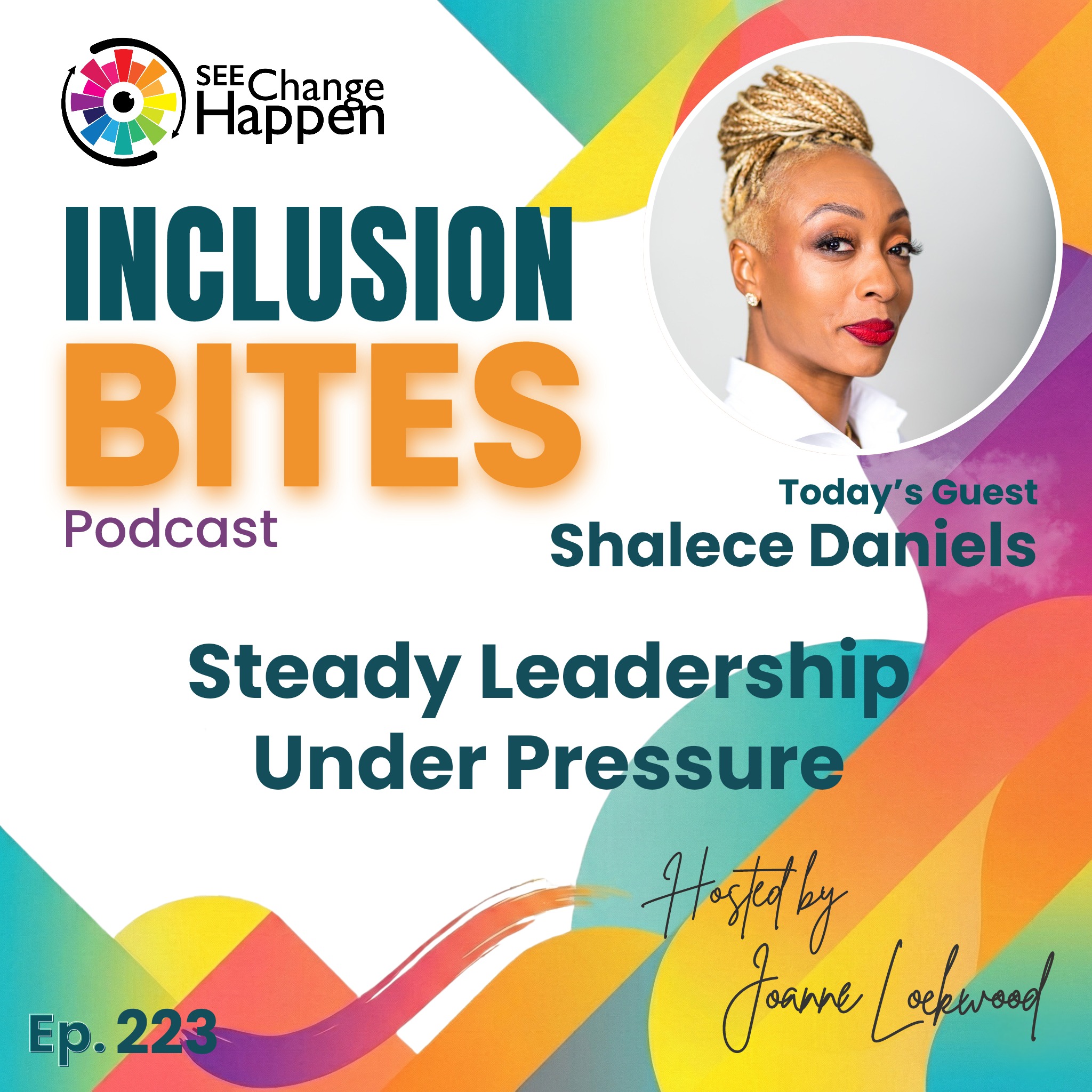
Shalece Daniels. explores the profound impact of steady leadership, guiding listeners through emotional regulation, psychological safety, and the essential practice of downshifting under pressure to lead with integrity and authenticity.
In this edition of The Inclusion Bites Podcast, Joanne Lockwood is joined by Shalece Daniels for a profound exploration into the art of steady leadership under pressure. Together, they unpack the often-unseen impact of upbringing, identity, and psychological safety on professional and personal resilience. The conversation flows from honest reflection on past adversity through to practical strategies for emotional regulation, such as the transformative power of the 90-second pause, downshifting the nervous system, and redefining everyday leadership. Listeners are drawn into discussions of vulnerability, emotional honesty, and the intersection of personal healing with inclusive leadership.
“I went into a lot of toxic positivity, which was probably just as damaging as the chaos.”
Explore
Navigate this episode
Joanne Lockwoodhost
Welcome to Inclusion Bites, your sanctuary for boldconversations that spark change. I'm Joanne Lockwood, yourguide on this journey of exploration into the heart of inclusion,belonging and societaltransformation. Ever wondered what it truly takes to create aworld? Remember, everyone not only belongs, butthrives. You're not alone. Join me as we uncover the unseen,challenge the status quo and share stories that resonate deepwithin. Ready to dive in? Whether you're sipping your morningcoffee or winding down after a long day, let's connect, reflectand inspire action together. Don't forget, you can be part of theconversation too. Reach out tojo.lockwood@seechangehappen.co.uk to share your insights orto join me on the show. So adjust your earbuds and settlein. It's time to ignite the spark of inclusion with InclusionBites. And todayis episode 223 with the title Steady Leadership UnderPressure. And I have the absolute honour and privilege to welcome ShaleceDaniels. Shalis is an executive rest strategist and the founderof Live as if company who teaches leaders how to downshift their nervous systemsin 90 seconds or less to communicate and staysteady. Decisions that land clearly and with psychological safety is protectedeven under pressure. When I asked Shalise to describe her superpower, she said it is herability to translate what is happening in the body into clear, practical actionsin plain language so people can get their brains back online fast and leadwith integrity. Hello, Charlise. Welcome to the show.
Shalece Danielsguest
Hey there, Joanne. Thank you for having me.
Joanne Lockwoodhost
Absolute pleasure. Absolute pleasure. Whereabouts in the world are you?
Shalece Danielsguest
I am in the Motor City Motown. Motor City, Detroit,Michigan and the Midwest. And we're trying to break into spring rightnow. As I look out my my window and I see my flowers against these barrentree branches. But at least my orchids are comingback.
Joanne Lockwoodhost
Oh, orchids. Beautiful. I love a goodorchid. So you grow them in bowls of water ordo you grow them outside
Shalece Danielsguest
or pots in my house? Can't do it outside because of thefour seasons and they would go dormant and probably die because we get such a deepfreeze. But I grow them right on this little bay window that I can look atoutside of my office here inPotts. And I have two one I bought myself and one my daughter gifted me for mybirthday.
Joanne Lockwoodhost
Ah, fabulous. If you're listening to this podcast, you think we've just started, but actually we'vebeen yakking away now for about 35, 40 minutes getting to know each other beforeI press the record button and we Spent most of that time talking about puppies and dogs,didn't we? You're getting a new puppysoon. Yeah.
Shalece Danielsguest
Yes. A family member. She's a year and a half. She doesn't feel like apuppy. She's about 45 pounds, 42 to 45pounds. She's a rescue, a pit bull mix. She was abused and we just found outthat she has an ACL injury. And so that'll be operatedon. We won't know anything about what the care looks likeuntil after the specialist lets us knowthis. This week. Everything seems so real now,Joanne. It's like, okay, the dog, but we're gonna get thedog. But then now she has to have surgery. And that puts another layer on top ofcaring because I'm like, oh, yeah, that's right. They get sicksometimes. They need medication, they needsurgery. We need dog insurance.It's. It's real. But I'm already in love with Shiitake,so.
Joanne Lockwoodhost
And it's a fantastic name, isn't it? Fantastic Name of Shiitake,yes.
Shalece Danielsguest
Little Mushroom.
Joanne Lockwoodhost
Little Mushroom, yeah, it's brilliant. I mean, for regular listeners will know thatI've. My wife and I, we. We got our little puppy, a cavapoo, Amber,six, six or so months ago now. And she's been a bundle of joy in ourlives. And they have 220 of theseepisodes. I didn't have her. Now I do. And she's now featuring onquite a few of them. You might hear a little woof in the background occasionally,but. Yeah, and it's amazing how dogs come into your life and takeover. They become part of your everyday conversation. And the people you meetwho have puppies and dogs, it just creates another connection,doesn't it?
Shalece Danielsguest
Does. I loved meeting Amber. I met her fur before I mether. And she came into the screen and just this big oldfur ball of beautiful amberhair. Yeah, rightfully so. Named Amber,but.
Joanne Lockwoodhost
And she's a facemaker as well, so she always joins in. She doesn't know where the camera isyet. She hasn't suss out her own image on the screen yet, but she just turns aroundand gives my face a good old clean. I think she detects it dirty for somereason.
Shalece Danielsguest
No, she shows. She loves to kiss.
Joanne Lockwoodhost
She loves to kiss. She does love kiss. So,I mean, I was thinking as we were talking just then about. About the puppies and you talked about psychologicalsafety landing your brain, and we spent a lotof our time, a lot of our lives rushing around all over the place. What got you intotalking about this originally.
Shalece Danielsguest
Well, I'm so glad that we had an opportunity to chat before we had to pack theactual recording because it allowed meto. I'm not normally, like a nervous person,but. But it made me feel really comfortable to just go therewith you and tell you whatever. I was in an abusive relationship, notphysically, but my very first marriage when I was 19 yearsold. It was extremely manipulative, mentally, verbally,financially abusive, and it was just full ofchaos. But the chaos around that marriage was just arepeated pattern because I was born intochaos. But it all felt normal because I did not understand it aschaos. And so as I. I got a divorce at 29years old and realised that that wasn'tokay. And I went into. Deep intoyoga. And I would say at about 29 is when Ibegan this journey of beingcalm. I didn't get it right, as we do, we oftenovercorrect. I went into a lot of toxic positivity, which was probablyjust as damaging as the chaos,right? That toxic positivity didn't allow me to say how Ifelt. It didn't allow me to feel my feelings. The very thing that I teachnow, which is like, feel that feeling and allow it to metabolise through and that 90 seconds that ittakes, and that's it. I was on the
Shalece Danielsguest
journey. I was on the road to being this person, to practising what I practise, to doing what Ido for myself without knowing that it would turn into something so valuable for me and the peoplethat I take care of. But I believe that's how I got intoit. That's like the origin, I would say, chaotic upbringing into therepeated pattern of chaos in my first marriage, and thentrying to find something to just make me feel normal, whatever that means,right? Trying to find something that made me feel not out of control oron edge, anxious all the time. And I fumbled into this,literally fumbled into it. And I read Dr. Jill Bolte Taylor'sphilosophy on metabolising an emotion in 90 seconds orless. I had already tapped into meditation and transcendental meditation andbreathing and yoga, taking a deep breath, calmingdown. But I didn't understand the way that the body worked, really operated,based on research. And as I learned more and more and more about myself,I began to see this in other people and I was able tohelp. Did that answer your question, John?
Joanne Lockwoodhost
Yeah. Yeah, it did. Hopefully you won't mind us going back a bit to your pastand your origin, story, if you like, for people who areListening. Who may also have experienced toxic relationships or coercivecontrol. or in events, where they weren't able to be themselves doing thesums. You were probably in that relationship for best part of 10years. Is that how.
Shalece Danielsguest
Yeah, seven. Seven. It was something like. I was in it hardcore forseven. And then we were going through a separation for two. So divorce was in at29, but the marriage was at 19.
Joanne Lockwoodhost
What took so long? Is it because it's still a comfort even in thechaos? Or there's codependency or gaslighting that keeps youthere? You believe it's all your fault? Is it those sort of things going through yourmind? Are you okay? You okay talking about this?
Shalece Danielsguest
Yeah, yeah, I'm okay.
Joanne Lockwoodhost
Yeah.
Shalece Danielsguest
I'm trying to think of how to explainit. I've been writing about it recently, which is why it's easier for me for it tocome up. What took so long? I thought there wasa. One second. Just one. One quick. Allright. And I'm back. Okay, sohere's. Here's the. I try to peel back layers so that I can get to myrawest truth. Because I know every time I get to my rawest self, the one thatcan be a little painful coming out, I'm healing every singletime that happens. So if you bear with me, I'm going to getthere. Just be patient with me. I didn'tknow. I thought that what this looked likewas a hundred times better in my marriage than how I grewup. So that meant I was doing
Shalece Danielsguest
well. The baseline was so low andso chaotic that where I was with someone who manipulatedme but didn't. Didn't yell or yelled, very few and farbetween. Didn't hit because abuse to me, chaos to memeant hitting, yelling, threatening. So I was in a goodrelationship for years, so I thought,and that's why I stayed so long. But there wassomething. Something maybe ruminating back here, saying, but if it's good,why do I feel so bad? Why does it feel so badinside? And so I had to ask myself thosequestions. And I talked to my mom, talked to my mom, who's still with us, andshe. She tried to justify. She stilldidn't understand what abuse was. She still didn't understand aftermy father had passed away, after she was out of it, she didn't understand what abusewas. So she was not the person to give me the right advice. But she referred me to atherapist. And in going to see this therapist, my ex husband was like,oh, my God. That means that you're crazy. You can't see atherapist. Oh, my God. Like, he forbade me to do it without saying, I forbidyou. And so at that point, I knew something was really, reallywrong. And I had to be around 24 or25, right? So this is six years into themarriage. I knew something was wrong. So knowing that something was wrong, I wastaught never to talk about your marriage outside of your marriage because nobody understands or they won't know yourrelationship is yours. So. So I didn't. My mother was the only person that I opened upto. I knew that I needed to see a therapist at that point because he forbadeit. So I was like, there's something like, that's healthy,right? So I'm raising two kids at thispoint. I had both of the kids, my daughter's from a previousmarriage. So when I got married to this guy, that was anotherthing. So you asked a very layered question, Joanne. You said, why did you stay solong? And part of it is because I had alreadyfailed. I had already broken up with my high school sweetheart, who I had my daughterwith. And so getting married to my ex husband wassuccessful. Then we made this whole neat little nice unit on theoutside. We looked perfect. And then we had achild. And so I couldn't leave again. I couldn't failagain. On top of. He wasn't abusing me, on topof my mother not being able to give. Being able to give the best advice that
Shalece Danielsguest
she could, I'm. And so I started seeing a therapist, and I was sneaking tosee a therapist, and when he found out by going through my purse and findinga cash receipt for paying the therapist, he waslivid. Livid. And I'm like, at this point, I don't think we were talkingabout him. And so I'm like, why are you so upset? This is good forme. You know, I had a lot of shit in my childhood, youknow? You know, because those are the things that he would bring up. Like, your parents were, and you'renot. And so that means. Well, I'm not saying anything bad about you, but your parentsare and you are, and that means this aboutyou. Yeah. So that's why I stayed solong. I just. I didn't have a reference point, a goodreference point. Does that make sense?
Joanne Lockwoodhost
Yeah. What you're saying is there were so many goodthings. There was no violence, no shouting, no screaming, which youwere. You'd been brought up with. And then you didn't see the psychological traumabecause you weren't aware of it. And that Was things were okay, goodenough, and then until you realise they weren't and then you look at other people around you and they're nothaving that at all. So. Yeah, I guess you want to believe it as well as yousay. You had a young child, you wanted a traditional family,you wanted things to be. You had a belief that this is how things are and shouldbe until you realise they're not. Andit's. It can take a while. And I, I fully understandthat. I fully understand that kind of feeling.
Shalece Danielsguest
When I say there was no shouting. Let me. The shouting was not like it was when I was achild. There was shouting oravoidance. So from on my part so that there wouldn't beshouting. Does that.
Joanne Lockwoodhost
Right. Okay. So you're.
Shalece Danielsguest
There was.
Joanne Lockwoodhost
You're conforming to the rules.
Shalece Danielsguest
Yeah. Oh, yeah.
Joanne Lockwoodhost
Yeah.
Shalece Danielsguest
He was such a little man and I know that thatdoesn't. Like. I look back now andI. I think about how 1. I have to say he was living his best lifeand he. We. He was doing the best that he could with what hehad. It doesn't excuse it at all. He was doing the best that he could with what hehad. He knew how to manipulate situations to get to where he needed to get to or to getthe answer that he needed to get what he needed. And so he did that. That'sex. What he did. That was the best of his ability. It was not good and it wasn't forme. And so I'm going to tell you a little bit, I think, about soulcontracts. I've learned about it in the past couple years or so and Ihonestly believe that in order for me to evolve to where I am and where I'm going, Idon't know. Right. We made that agreement and only until about acouple years ago. We've been divorced for 18years. I didn't forgive him untiltwo years ago when I found out we had agreedbefore I was ever born for him to be this person to mefor whatever my soul needed. Andthat. That allowed further healing and forgiveness for me totake place. That belief system. And it works for me and it hasworked for me and I feel better. And I'm a much more whole person because ofthat belief system. So I choose to embrace it.
Joanne Lockwoodhost
I think that's really important that you contextualisewhat happens. You. You create an understanding in your ownhead. The things that are just hanging, things you can't explain are really hard to moveon from. If you can find an explanation that works for you, that's part of the healing process as well, isn'tis it has been.
Shalece Danielsguest
And we have a kid in the middle of this. Right. So without getting toodeep into what happened to our child. Ourchildren. Right. We raised two kids in this partially, one and the other completelytogether. Still working through, allowing mychild to have to experience the things that I didon a regular basis because of joint custody and that I know I'm stilldealing with some lack of self forgiveness, I'm sure even if I, youknow, it was beyond the control that I had at thetime. I haven't processed it. I haven't. I haven't come up with anything yet to makethat be 100% okay and me to be free and clear fromthat.
Joanne Lockwoodhost
Mm, yeah, no, I got, I got a. So you talked aboutpsychological safety and some of the notes you sent through. And what does psychological safety mean to you in arelationship or in the workplace or in wherever.
Shalece Danielsguest
When I learned about psychological safety, it was in a workplace, believe it ornot. And I used to work for, for a big telecommunications company herein the States and they have some international holdings aswell. But in that corporate space, I trained leaders to do many, manythings. And I was one of two women of colour that held thisposition. And in the leadership ranks,I sawnone. I'm looking and I'm looking at the leadership. And although I live in Detroit, I did, Idid this leadership training. I worked in Philadelphia. So I travelled once a month for a week to do this
Shalece Danielsguest
intense leadership training. And know how Icosplayed psychological safety in that type ofenvironment. Because when I look back nowand I see the things that I did to my hair and my dress and my languageto fit in to this very, very conservative white male,blue suits, grey suit culture, I understand why I didn't see verymany women and definitely black women inleadership. And it was this. It was after the GeorgeFloyd murders during COVID where everybody had an opportunity to sitdown, shut up and unfortunately do nothing butlisten. Where these terminology and thesetactical teams began to be developed all over thecorporation. And it pissed meoff. It pissed me off, Joanne, because I waslike, this is new to you. This is allnew. Like, I've been walking around here tap dancing and doing cartwheelsand standing on my head to fit in. And you guys are just seeing mydaily. This is what we go through. My gosh, that angered memore. And I didn't know how to express that angerbecause I didn't feel psychologically safe. I didn't Feel likemy concerns would bewelcomed. Right? And maybe even retributionor retaliation. Because here we are trying to help youpeople. And I heard this. They did, they. They stopped short of youpeople. But here we are trying to help you, showing that we care andyou're upset.
Joanne Lockwoodhost
Why?
Shalece Danielsguest
I couldn't. It was like a visceral reaction, mebeing angry. It was a visceralreaction. I couldn't explainit. I didn't know how to articulate. I didn't know where it had comefrom. And so if I could contribute to the corporate world,any one person or them taking it home, even to their family, to teach their childrenhow to pause and allow that emotion to metabolisein the time, the amount of time that it takes and thenreact, I think it would save probably many jobs, many flipped,Flipped desks, and it would help people understand each other a littlebetter.
Joanne Lockwoodhost
That's definitely the. One of my mantras is stop andpause. When I'm running training, I often slap the front of my forehead and say, look,we need to get your thinking out from the back of your head, you know, your chimp brain into the front bit whereyou do all your thinking. So you need to slow down and tap, as I say, every time you finish up gettingexcited, tap the front of your head. That's where you need to start thinkingfrom. Put all your thinking right at the front. Slow itdown. Yeah, slow it down.
Shalece Danielsguest
Imagine me having made those, like to get married and to have children before I could even slapmy prefrontal cortex, like, the synapses weren't even closedyet. I couldn't. Even if I slapped, it wouldn'tmatter. There was nothing there for me to even make these decisions.Right. But anyhow, you were going to ask me aquestion. Yeah, I love that.
Joanne Lockwoodhost
No, it. I think there comes a time in your life when you understandhow your brain's wired, you know, how you react, howyou. You're in your flight. Flight, fight or freeze reactions kickingin. Often when we. When we interact with our colleagues orour. In the workplace or even in our personal lives, we're often driven fromemotional reaction rather than being able to calmly think about things and slow thingsdown. We look at a lot of argumentsor disagreements or challenging conversations. It all starts with peoplereally working in their anger or their emotionaldepth. And it's really hard sometimes to pull yourself out of that, isn'tit? This is where your 90 second pause kicks in, isn'tit?
Shalece Danielsguest
Yeah. So I. Before I learned about Jill Bolte Taylor, I was doing theseExercises, I called them, cue protocols, where I would say, okay, I wantyou to take a deep breath, I want you to get into your parasympatheticnervous system. Longer exhale than the inhale and it's going to drop youout of that fight flight and freeze, fawn, right into theparasympathetic, out of the sympathetic. What we thishard. As we began talking, you were like, we're always going, going,going, going. So we're always activated, we're alwaysupregulated. And I would tell people to downshift and downregulate andthat's when their heart rate slows down and we're able to take in more airand think. When I learned, when I was introduced by my friendDr. Zippy to Dr. Jill Bolte Taylor's work, she's a joycoach. And we were having lunch, brunch, something, and she was like, oh,my gosh, you know Dr. Jill Bolte Taylor's work, the92nd. I was like, no, tell me more. She's like, it takes 90 seconds tometabolize this emotion, blah, blah, blah. And we talked about that and Iwas like, I didn't know it, but I know it now. And I went down a rabbit hole ofconnecting the two. Sometimes you know something and you just feelit. You have a little bit of information andyou. And you test it, test it, test it, and you know that itworks. But I didn't even know that it had already been studied assuch. Teaching people understanding first, becoming aware that youcan. That it's possible that when you're irate, when you're upset, thatyou can access this part of your nervous system that controlseverything. Your nervous system senses things before it sends themessage to your brain, from your feet to your heart, toyour. We talk about the gut, right? We sense things before weknow. What we have to do is slow down and understand how to feelthem. And as that muscle memory kicks in, as you begin to develop that as amuscle, our brain, our conscious brain will then come online a lot fasterso that we can know what we're feeling. Boom, it makes that connection andwe're able to pause, do whatever the protocol is that works for you, andthen make that clear decision. Now, I went all over the place withthat. I need to know if I answered your question or I just talked somuch.
Joanne Lockwoodhost
What was going through my head is that whether people realise it or not,you can learn these techniques and you can learn about emotionalintelligence, you can learn about emotional regulation, you can Learnabout how to, as you say, pause. Take that. Play whatever's going on inyour brain. If you stop and pause in long enough and you get positivereinforcement from that behaviour, you start torealise. But too often people are in that constant state of alert and it'sso hard to downshift or to take yourself out of that if you've not had anysupport or help doing that.
Shalece Danielsguest
Yeah, it is. I mean, I have this pie in the sky dream thatthis will become a part of life. And you know how when we were young orsomething, people would say, take a deep breath perhaps, right,this. This can. This is so easy. These things are soeasy. Where our exhale is longer. We know a lot about box
Shalece Danielsguest
breathing. I hear about it all the time. My son's an athlete. He does it now as a regular thing, like theyteach it, the coaches. I hope that these downshifts, understanding that youmetabolise good, bad, whatever emotions in 90 seconds chemicallyin your body, as long as you don't play them on aloop. And if you do decide to play them in a loop, at least consciously playing them on theloop. Because a lot of times when we're upset and we're going downthat spiral, we're not conscious of it. And so we allow ourselves to go down thatspiral. The more we can become conscious that this thing we can name,this feeling, we can feel this feeling we can go through, this icky, nasty,terrible feeling that we all want to avoid in 90 seconds, thebetter. Our whole this is my pie in the sky society will be maybeless war, maybe. Maybe someone, maybemore understanding, maybe more understanding ofourselves. If the will is there to controlso. Or to let me take the C word out and say, toregulate. To regulateourselves. Yeah. I'm so passionate aboutthis. I'm so passionate because I know what it has done forme and I know what it has done for the people that I'vetouched and the text messages that I receive and the nonprofitsand my own family, which is what mattersmost.
Joanne Lockwoodhost
Tell me about box breathing, for those who haven't heard of that term before.
Shalece Danielsguest
Sure thing. I heard of it from a Navy seal, and the Navy SEAL said, I don'tremember his name, but he was on something, maybe a TED Talkor. I can't remember. But box breathing is when you exhale for a number ofcounts. Same number. You hold it for that same number of counts and then youinhale for that number of counts and you hold it at the inhale and then youexhale and you do that over and over as if you're breathing right around asymmetrical box. And that is supposed to slow down your threatbrain. You talked about a lot about that amygdala back there that has youall up in arms. It's supposed to slow that down and give you the ability tothink. I take that. I take. I tweak that. I tweak that a little bit so that youcan tap into that parasympathetic nervous system even faster byincreasing the time of that exhale. So instead of thinking of it,of. We're going to say an asymmetrical box. I used to call it arectangle. And I thought about it. I'm like, we're not doing a rectanglebecause we're not inhaling the same amount of time that we wereexhaling. So until I can get a better word for it, I'm gonna sayasymmetrical box triangle, if you will,something. Right. And that you'reinhaling. Let's say you inhale for. On a count offour. You hold that for a count of four, and then you exhale for six oreight. And maybe you don't even count. You just exhale until you get it allout and you can't get any more out. And then you hold it for a few counts, andthen you inhale your air all the way in, and you hold that until your comfortlevel don't exasperate your breath. And then youexhale. And that's where you want to really getit. All the way out and hold it and theninhale. And that's what I mean. It's not box breathing, but it'sparasympathetic breathing or chalice-ishbreathing. I'll find out someone else has already coined a phrase, andthen I'll start using that.
Joanne Lockwoodhost
I've got the shape in my head. It's a long base. It'sthat. And it sort of pops in the middle. A little. Little loop init. Yeah, I get it completely. So it's not symmetric.It's. You are breathing out slower.
Shalece Danielsguest
You are. Yeah, slower.
Joanne Lockwoodhost
That's a good thing. When we sigh sometimes we just. We'rejust letting it out. We just let it out. Let itout.
Shalece Danielsguest
Yeah.
Joanne Lockwoodhost
And quickly in. And then you can let it really out as slow as youcan. So. Yeah, no, I get it. Yeah.
Shalece Danielsguest
Yeah. Slows it down. It does something withyour. Well, I say tap into your parasympathetic nervoussystem. Right. Sounds like a big word. It'snot. I call it pns. It's the para. So sympathetic nervoussystem. The fight flight, freeze or fawn. We all are very aware of that,but it's the one that you go into when you. Whenyou. When you want to rest, when you want to bringthat. You know how you tap this when you want to bring that prefrontalcortex back online, The CEO of all of our operations, that's when youwant to exhale really long and allow it an opportunity tobreathe. And it comes from back here in your insula and your amygdalaand bring your blood back up here. And that's why we do the longerexhale. And you know what? I do something with my corporateexecutives, with my kids, with everyone, we blow bubbles because itmakes it really simple to exhale more than youinhale. And you bring that joy and that. That play and that fun intoit. And so on top of you going into that resting, you're also bringing insome joy and play. And it's changing your mood, interrupting yourpattern of that anger or anxiousness.
Joanne Lockwoodhost
Anyone who's listened to this podcast with me on it before, I often talk aboutthat. The Disney Pixar cartoon film called Inside out, whereyou've got the little figures in your brain and they've got all these different memories andcore memories and all this. And I always say to people, for years and years and years, I had the little angryred person running my head. And then suddenly I discovered what joy was andlet joy drive. And then it's a different way of thinking and it's all about trying to justmanage those little things in your head, those little figures. I don't need that little red angry persondriving me at the moment. I just need to. Let's bring some joy. Let's sitdown. I don't need anxiety kicking in. I don't need fear kicking in or whateverelse. Try and let joy take the steering wheel as much as you can.
Shalece Danielsguest
So, interestingly enough, I grew up, or what I can remember isthis. I used to be afraid to getangry. And one thing that I remember about Inside out isanger is important. It has a place to. And it came and took a seat right next to someemotion, joy or fun, because that person too was afraid to allowanger to come in. That's what I remember vividly about thatmovie. I was afraid for anger to comein. I was afraid to show people that I was upset withthem. I was afraid to not to beupset. But being upset was like a privateemotion. You didn't show it. You didn't tell people that they upset youor that you were ticked off? I don'tknow. I can guess, you know, many reasons as to why that was the case forme. But when I started allowing that anger to come out,it felt so good. A lot of people were called a lot ofnames and there were a lot of tenseinteractions. And I remember it being right afterthe toxic positivitystage. I had seen a meme that said, well, I'm gonna tell people offwhile I'm alive because once I'm dead they'll neverknow. And I, I was like, how ridiculous is that? And somehow internalisedit. And I, and I said, well, you know what Ido? I need to stop faking as if everything isokay. It's probably killing me. And so I swung all the way to theother side and boy, I lost some friends, I'm sure, and some,some colleagues and some. But it was, it was, itwas.
Joanne Lockwoodhost
But is that also part of psychologicalsafety? Because if you're not careful, you spend all your time masking, coveringcode, switching, being the person that other people want you tobe. And sometimes actually in order to be yourself, in order to have that psychologicalsafety, you need to be able to be who you need to be in that moment without having to think twice aboutit. So it's important obviously to self regulate, but it's also important to be honestwith who you are at that time as well, isn't it?
Shalece Danielsguest
100%. And I quit my job. I had already had my realestate holdings, I quit myjob. I went face first into my real estate business and I'm a real estateinvestor in addition to the executive rest coach. But I quit the operations of that as well and now Ijust own it as a business and I do what I love on a dailybasis. Now. I was unable in that environmentto reconcile the two. I was so afraidof being seen as the angry black woman that Icouldn't do it. I like shattered relationships in my own personal life before I
Shalece Danielsguest
would do it in the corporate world. To these people that meantnothing. Nothing. And when I say that, I say that theydidn't. They didn't even. I was very privileged in this sense that Ibuilt my real estate holdings to a point that my corporate job didn't pay formy life at all. I understand why a lot of people performand they go along to get along and they can't express themselves and accept not beingpsychologically safe in that environment because they need it tosurvive. I Didn't. And I still didit. I still did it. And Ihave not yet reconciled. I don't know if I everwill. Why the hell did it have such astronghold on me? Kind of like the relationship, right? Familiarity,the comfort. Right? Yeah.Interesting. Interesting. Interesting things.
Joanne Lockwoodhost
Interesting. What you're saying. There's about being a privilege where many peopledon't have the luxury or the privilege to be able to walkaway. They're dependent on that income, dependent on that livelihood, thatjob. And you say you were in a situation where you wereindependently. I'd say wealthy of independentmeans.
Shalece Danielsguest
I wouldn't say that, but I.
Joanne Lockwoodhost
No independent means. Yeah. You pay the rent, pay the mortgage withoutposition that it's really hard to get to for many people, isn't it? And so you aredependent on this role as job, so you can't speak yourmind. You have to toe the line and code switch all thetime.
Shalece Danielsguest
And for those people, this is why these protocols are extremelyimportant. Not just for them, but I've been there and I know and I didn't havethe tools so that I could bring my CEO of my mind, theprefrontal cortex, online and feel safe enough to speak mymind. But I know this helps. I know because of the things thatI've been told, the case studies and. Wow.Yeah. Yeah, that's. I mean that. That's it. That's all that I have tosay.
Joanne Lockwoodhost
Yeah. Do you think there's a. It's easier for womento. To reflect or it. Doesn't it matter?Men. Men have the ability as well. Is it a gender thing?
Shalece Danielsguest
This gender thing is, is. I think womenare. I think women are given the space. More graceto. If. If there were a sex or a gender thatwas going to break down and cryor get what they call emotional in theworkplace, in a corporate place, or in what we've been taught isn'tinappropriate. Like then a woman absolutelyhas more grace. We've been trained as a
Shalece Danielsguest
society. Men on the other end have more grace to get angry ina. In a. Yelling and knocking things oversince. Because women don't have necessarily thatprivilege. But even me, had I seen one of my malecolleagues and I've seen women. One of my male colleagues break downand cry and say how they felt, I wouldhave. Would have been uncomfortable and questioned even back thentheir ability, their capacity to lead, toperform. Yeah. Because they experienced aregular human emotion inpublic. Isn't that something.
Joanne Lockwoodhost
Stoicism is the key for credibility as aleader. That's what we've been bred to believe. Isn't it in. And that's what so many people hang onto. I've gotta be brave, I've gotta be strong, I've gotta be authoritarianto be a good leader. And we're learning today that doesn't make the bestleader. The best leaders are adaptable and multifaceted and emotionis part of their toolbox.
Shalece Danielsguest
It is. You better believe those of us who are holding these emotions innot unable to express them on a regular basis. You had better believe we are doing itin some way and sometimes in many unhealthyways. So I get to peek behind the curtain on a lot ofleaders and see behaviours from eating toabusing substances, to self abuse, selfdegradation, family, you name it. I get to see alot. For those who let me in, for those who are vulnerable with us in a communityenvironment, we need to express our feelings, we need to metabolise those, we need toname them more often. It needs to be regular. Right now my pie in the skyvision needs to happen now.
Joanne Lockwoodhost
So going back to your, your 90 second downshift, I think you calledit downshift. Talk me through how you get people into thatdownshift mindset. How do you approach it? To start with, I'm feelingwhat do I do?
Shalece Danielsguest
So many times when I have to say don't, I have to get them completely off guard and do somesilly icebreaker to make everyone feel comfortable being comfortable being awkwardand vulnerable. Because expressing your feelings, especially in front of a group of people that youknow, is extremely difficult. So I'll start there and then I askthem to think about a time that they heal something inbecause if they hadn't or that they, that they ended up in the HR office or in sometrouble because they didn't hold something in what was happening in their bodyand to tap into what was happening in their body at that precise moment right beforeif they can. And a lot of us are so unpracticed with feeling our feelings thatwe don't, we don't even know. So I'll ask them to think ofa time or a moment right before they got angry or what happens in their body when they doget angry. Okay, so that's the first thing, tap into that and then I'llask them to go through an exercise with me. And many times it's my bubbles becausethat's my go to and people love it. So. And we will rateourselves and what that anger is usually on an index card when we tap into thatEmotion. We'll then go through the bubble exercise and we're doing that asymmetricbreathing where we're taking the wand out, we're blowing,finding the bubble, then breathing in, putting the wand in, and then blowingagain. And after about three sets we put it down and then we go around the room andwe say, well, how do you feel now? What has changed for you and yourbody? And I have them rate themselves again and usually their shoulderscome down. The tenseness in their. I find a lot of men clench, clench,clench, and the tenses, tenseness in theirjaws. Relax. And some people, especially women that wear highheels, they hold it in their feet. And so I have an exercise for them that massages themetatarsals between the second and third metatarsals. By the way, got to get thisin. Did you know that there are 7,000 nerve endings in yourfeet? Yeah. Yeah. So we talk a lot about the nervous system and we talk about thecentral. Right in the parasympathetic. But the feetare.
Joanne Lockwoodhost
Every time you step on a Lego brick, you know there's all 7,000 there, don'tyou?
Shalece Danielsguest
Many times those are only the ones that get you angry. But yeah, that's, that's in anutshell, that's me walking you through the exercise and watching themdownshift. And then they bought in. And so now I can do the other thingslike the grounding here, rubbing their legs or clenching their,their shoulder blades together without anyone knowing. And alsothe reflexology ball that we use that allows me to really get inand get their buy in and everyone being silly and opening up their minds, hopefully bringing thison online to receive and begin to build that musclememory.
Joanne Lockwoodhost
So it's really key then for people to start being aware of everyday life, ofthese small little, as you say, reactions in your nervous system,reactions in your stomach, in your persona, your mood, your thinking,just your sweat or your, yeah, tingling, your spidey sense and start toassociate what happens next when that feeling starts, isn'tit? And then you can, then you can preempt it. Is that what you'resaying? Preemptive. I say this spidey sense is kicking innow. I now need to think, ah, this is, this is going to go badly wrong in asecond. Start slapping your front, every forehead
Shalece Danielsguest
the fore. I'm going to use that, the forehead slap. Joanne told me about theforehead. So yeah, that. The sweaty, sweaty underarms or even knowing thatyou're getting ready to go into a meeting, which is really good for my Executives, I'm going into thismeeting. This person is always mansplaining or this person's always taking my idea orI know, I hate these Monday morning meetings. Do itthen. You preempt it. You may not even need to feel what's goingon. Go and blow your bubbles. Go and take your breaths. Go and do yoursquat. For those who are kinesthetic, go and do itthen. Funny, I have my nosesweats. The only two people that I know that that happens to is me andmy. My late brother. I haven't found another personwhose. No. Beads up with sweat. I mean, noticeably beads up withsweat. I ask, in all the rooms that I go in, do any of you havethat?
Joanne Lockwoodhost
No, I don't. Definitely not. Okay.
Shalece Danielsguest
Yeah.
Joanne Lockwoodhost
Do you find that people need a positivereinforcement? So things that you do that have a positive outcomeare more likely to stick than things that. If you don't followup that action with a, oh, wow, that didwork. Or ah, I felt myself karma. And then consciously lock that in as a positivereinforcement. That's completing the feedback loop really, isn'tit?
Shalece Danielsguest
It is. That's what that second number is for. And so when they're going back intheir day, like, rate how you felt and then how did you do after that meeting orthat conversations that none of us like to have, you know, there are many ofthem. Or that phone call or before you responded to that text, how did you dowhen you breathe and before you respond, how didthat. How did that. How did you do? And to take a moment and acknowledge thatthat's the reward for the most part. Or not being called into HR office again
Joanne Lockwoodhost
for being an angry black woman.
Shalece Danielsguest
That works too. Yeah, that works.
Joanne Lockwoodhost
Yeah, that works. Yeah.
Shalece Danielsguest
Yeah.
Joanne Lockwoodhost
Unless you're happy being an angry black woman and it just needed to besaid. I'm sick of dealing with thisbullshit.
Shalece Danielsguest
I mean, it happened for me. It happened for about the large share, thelion's share of a year. I was happy being that person to finallyget everything out. Now I can do both. I can get itout. I don't always do it right. But having these tools havehelped tremendously. Before I have a conversation, I ask forpermission. Like, this is going to be something that might be a little awkward for me and you, and this is tough forme. Do you mind? Do I have your permission? And I don't always get their permission toproceed and I have to be okay with that. And then I'm blowing bubbles fordays. Damn it. Yeah. But yeah.
Joanne Lockwoodhost
So your organisation You've called yourself live life asif. As if what? What's the dot dot dot? What'snext? And if I. As if what?
Shalece Danielsguest
As if. As if everything is the way that you could only dreamif. As if. My daughter, my daughter named mycompany. I told her all about what I was doing and that I was going to go intothis. Tapping into rest. Rest and thrive is what I called it atfirst. And that I wanted to. This is what I wanted to do. Let's think of somenames. When I came out of the corporate world and I knew this was what I was going to do and we went through severaliterations and she's like, all the possibilities. I think there's a Bibleverse, Live. Gosh, I can't think of it. I just remember hearingit. It's not live as if. Yeah, live asif. Live as if all is well or something like that. And when she said the name I was like, wait, there's even aBible verse on that. Let me look it up. And it was like, act as if that'sit. It's act as. Act as if everything is going to gowell. And I'm like, you can live that way. You can live into the future that you
Shalece Danielsguest
want. And all of this, what we're talking about has been distilled down to maybea fifth of what I actually do in mybusiness. But it's, it's. But it's very popular and it's what people need and it's what Isee that people need. The corporations. And this is where we begin. But I talk so much about destressing and anti ageing and reverse ageing and stopping and how youregrow cellular regeneration based on being able tometabolise emotions and a certain type of food and workingout. But this is the new kid on theblock. Everybody wants to hear about the nervous system and how itworks. So this is what I do a lot of. But I get a lot deeper thanthis. And that's why it's Live as if company.
Joanne Lockwoodhost
So it's trying to find that positive mental attitude that PMA without it straying intotoxic positivity. So you've got to try and keep yourself grounded and be positiveand lives life as if it will work, live life as if it willsucceed. Because if you live life like it won't succeed, you prove yourselfright. And that's the problem, isn't it?
Shalece Danielsguest
Yeah, yeah. Henry Ford said if you think you can or if you think you can't, youalright.
Joanne Lockwoodhost
I think the one line up was Richard Branson. He said, just say yes and figure itout.
Shalece Danielsguest
Yeah, that guy. I mean there's so much, I studiedhim. There's so much I can learn from him. So much that we all. My daughter isdyslexic. He's dyslexic as well. And so I like went so deepon learning so much about Richard Branson and he is just, Idon't know, he's like a walking miracle. Everything that he touches, you know, Iknow it's not perfect.
Joanne Lockwoodhost
Well, if you say yes, enough things happen. You know, I will say thatno fantastic adventure ever starts with no, doesit? You know, you have to start with yes.Yeah. Do you want to have fun today? Yes. But there we are. Youhave. Let's keep saying yes and see what happens.
Shalece Danielsguest
Yeah, yeah.
Joanne Lockwoodhost
I remember I was, I was in the U.S. oh, 20 odd years ago, I mean 30 odd yearsago. A place called Oxnard, if you've ever heard ofOxnard. It's in, yeah. Probably halfway between LA and SanFrancisco. On the I. On the I one a friend and I, we were trying to drive up the101 to see if we get to San Francisco. And we gave up Oxnard and we walkedaround. It's just, just a town. Just a town. And we parked the car up, wethought, well, where are we going to go? And I said, how about every, everycrosswalk we follow the green man. So yeah, if it's green we'll goacross. If it's red we'll go, we'll just, we'll go for thegreen. And we ended up finding this burgerjoint. And I remember it now, it's called LottaBurger. Lottaburger. By following the green man, the joint was absolutelyawful. It was awful. But we've got this storey about how wejust. The life that day was follow the green man and wherever it takes us iswhere we're going to end up and we'll just havefun. And it was. And we just follow the greenman. It is. And that's by saying yes. You know, following the red man's ano. You know, follow the green man says yes.
Shalece Danielsguest
Have you done that since?
Joanne Lockwoodhost
I've done it a few times in London, but I generally know where I want togo. That was the first time in a very long time that I was in the middle of nowhere and I hadabsolutely no idea where we're going to go. It worked thatday. But I always think it's a good strategy. It's a good strategy if you're not sure where yougo. Just follow the green man and sayyes. Say yes a lot.
Shalece Danielsguest
Yeah. Shonda Rhimes wrote a book, the Year of Yes, Her Year ofyes. And that encouraged me. I need to be reminded of that moreoften.
Joanne Lockwoodhost
Yeah. I've got another thing I use often as well, which is if someone gives you achoice of two things, do both, but do thefirst one. If you've got a choice of two things and one is first and one is second, alwaysdo the first one. Because if you do the second one and they realise you should have done the first one, it's now too late, you've lostit. Always do. Always do the first. Yeah. Say yes to both and do the first onefirst and get on with it.
Shalece Danielsguest
Okay.
Joanne Lockwoodhost
You can always change your mind on the second one later. But if you. You wish you took it, the first one, it'sgone. So. Yeah, takeit. I think that's a. Well, for me, it's. It's been a greatmantra. I mean, it's got me in trouble a few times, but it's.
Shalece Danielsguest
So how did you decide to get Amber? What was thedeciding.
Joanne Lockwoodhost
The dog? Yeah, our puppy. I don't know, I just. I think it wasa. My wife and I have been talking about it on and off for a couple of years in avery unserious way. Just. We should do. Yeah, whynot? And I. I think what happened was I've got one of these brainsthat. A bit neurodiverse. Once again, once it gets locked on toa. I want to do something, it becomes completely obsessed with itand. And I, I have to. I do it. I think that's whathappened. It. It flipped into that sort of zoneof. My brain just went, right, we're doingthis. And I started researching it. I found an app, a puppy rehoming app on myiPhone. I found a load of these cavapoos around the country and I startedmessaging people and some people were obviously shady and, yeah, couldn'tquite trust them. And then one person just wasgenuine. We did a video call, I saw the puppy. They were reallyhelpful. Everything about them was like,
Joanne Lockwoodhost
welcoming. They gave me the breeder licences and insurance certificates andthe vet vaccination records over the phone. I just trustedhim. And I drove three hours on a Sunday morning to pick Amber up and then threehours back a week after my wife had had a full knee replacement, total kneereplacement on one of her knees. So she was laid up on the sofa and I come homewith a brand new puppy. Well, big old Puppy, technically probably wasn't thebest timing, but we look back on it now and thought we just didit. You just sometimes got to get it over theline. It's got to. Is there a right time to buy ahouse? No. Is there a right time to start afamily? No. Is there a right time to get a puppy?No. Just do it.
Shalece Danielsguest
Just do it and figure it out.
Joanne Lockwoodhost
Make it happen.
Shalece Danielsguest
Yeah. And figure it out later. Wow, that's a greatstorey. I'm glad I asked because how did you know you wanted acavapoo?
Joanne Lockwoodhost
A good friend of ours came to see us, so we're doing some work together and shecame to us about two months beforehand and I knew she had acavapoo. I didn't really know much about them, so I was looking at a mongrel, Iwas looking at a rescue dog. I was looking at all these otheroptions. She turns up with her gorgeous, gorgeous puppy or 18 month old dogcalled Poppy. And I fell in love with her and I thought, we want one ofthose. It's gotta be a cavapoo. The face licking, the cuteness, the littlewaggle, the cuddles. Just everything about Poppy was amazing and that'sexactly what we want. So we spent a lot of money onher. She's. She's not. Yeah, she's a designer dog, as they callthem.
Shalece Danielsguest
Okay.
Joanne Lockwoodhost
Yeah, she was a. From a breeder, so she wasn't. Wasn't. Yeah, she wasn't Kennel club pedigree,but she's certainly cheap.
Shalece Danielsguest
She's beautiful.
Joanne Lockwoodhost
Yeah, we knew straight away and I brought home and from that moment we've both been in love withher. Yeah, absolutely.
Shalece Danielsguest
Good for you. So I don't know if we, if we havethe. If you just have another moment. What's yourthing? You learned so much about me. I mean, hell, I cried and I'm like, what thehell is going on here? We had a whole conversation before the conversation and none of thishappened. What's your thing? Yeah, tell me more aboutyou.
Joanne Lockwoodhost
Well, that may. Well, I have to come on your podcast and you can ask me thatquestion. I'm not chickening out. I mean, yeah, let's have anotherconversation. Let's have a. You host a podcast and you ask me that question and I'll answerit. But yeah, I'm married. Been married for nearly 40years. Two kids.
Shalece Danielsguest
40
Joanne Lockwoodhost
years, wow. So, yeah, congratulations. Our great days and our not sogreat days and we've come through it and we're with soulmates andyeah. And I set this business up 10 years ago, having spent most of mylife in it. So, yeah, I've got a story, but yeah, wecan. You can ask me that and.
Shalece Danielsguest
Okay.
Joanne Lockwoodhost
And I'd love to come on your podcast and share my story withyou.
Shalece Danielsguest
I may have to. I may be so inclined to dothat. I'm so nosy and curious about everyone that I meet and Imay well do that.
Joanne Lockwoodhost
Let's do it. I'd love to. In the meantime, how do people get
Shalece Danielsguest
ahold of you at Shalece L Danielseverywhere? First name is S H A L E C E L and thenDaniels, like Jack Daniels or bad memories fromcollege. So, yeah, that's how you get hold of me. My website isliveasif co. There's something there that you candownload. It's a free starter kit to your 2 minute or less, 90 second or lessability to downshift. There's an audio there, there's some playplacard cards and there are some exercises that you can do for those who arekinesthetic. It's liveas if co/starterkit K I T. So, yeah, that's how you get in touch withme.
Joanne Lockwoodhost
So I see you've got a. A TikTok. Quickly flicked onthat. You've got loads of TikToks there. So yougot. Wow. I've got loads on there, loads ofvideos. So, yeah, I'll play with that later and watch you inaction. So, yeah, love to. But yeah, I see you onLinkedIn. I see on Instagram, Facebook, YouTube andTikTok. So, yeah, I'll put those in the show notes so people can connect withyou. Well, it's been absolutely fascinating to get to know you and I've reallyenjoyed our conversation and. Yeah, and thank you for beingvulnerable. I know at the beginning you are. You stepped away because Icould. I could tell the emotion was there and it's always as a host, I was worriedthat I've pushed my guest into a place. But yeah, no, thank you for beingvulnerable and sharing your story. It's really powerful and it's been anabsolute pleasure to get to know you.
Shalece Danielsguest
You too, Joanne. And thank you so much and I appreciate you pushing me there becauseI wasn't expecting that. But it helps meevery chance I get, especially when it hurts a bit,when it's something I don't really. I'm not used torevealing.
Joanne Lockwoodhost
Yeah, thank you.
Shalece Danielsguest
Thank you.
Joanne Lockwoodhost
As we bring this conversation to a close, I want to express my deepestgratitude to you, our listener, for letting lending your ear and heartto the cause of inclusion. Today's discussion struck achord. Consider subscribing to Inclusion Bites and become part of ourever growing community driving realchange. Share this journey with friends, family andcolleagues. Let's amplify the voices thatmatter. Got thoughts, storys or a vision toshare? I'm all ears. Reach out to
Joanne Lockwoodhost
Jo.Lockwood@seechangehappen.co.uk and let's make your voiceheard. Until next time, this is Joanne Lockwood signing off with apromise to return with more enriching narratives that challenge,inspire and unite us all. Here's to fostering a more inclusive worldone episode at a time. Catch you on the nextbite.
Rewiring Leadership: The 90-Second DownshiftPsychological Safety: Beyond BuzzwordsMasking, Code-Switching, and AuthenticityEmotional Regulation as Everyday InclusionThe Power of Forgiveness and Self-Contextualisation
In this edition of The Inclusion Bites Podcast, Joanne Lockwood is joined by Shalece Daniels for a profound exploration into the art of steady leadership under pressure. Together, they unpack the often-unseen impact of upbringing, identity, and psychological safety on professional and personal resilience. The conversation flows from honest reflection on past adversity through to practical strategies for emotional regulation, such as the transformative power of the 90-second pause, downshifting the nervous system, and redefining everyday leadership. Listeners are drawn into discussions of vulnerability, emotional honesty, and the intersection of personal healing with inclusive leadership.
Shalece is an executive rest strategist and the founder of the Live as If company. Drawing upon her lived experience and professional insights, she guides leaders to downshift their nervous systems and communicate with clarity even when stakes are high. Her superpower lies in transforming internal chaos into clear, practical action, enabling others to bring their best selves forward with psychological safety. Beyond her work in executive coaching, Shalece is also a real estate investor who has cultivated both financial independence and a deep understanding of nervous system regulation. Her approach blends scientific research with accessible, everyday techniques—from box breathing to joyful play—enabling sustainable wellbeing in high-pressure environments.
Joanne and Shalece dig deep into what it means to truly feel and process emotion, rather than masking or conforming, and explore the critical role of authentic self-expression in fostering spaces where everyone feels they belong. They debate the balance between regulation and honesty, gendered expectations in leadership, and the barriers many face in speaking out due to workplace power dynamics.
Show notes drafted with AI assistance and reviewed by Joanne.
“I do something with my corporate executives, with my kids, with everyone, we blow bubbles because it makes it really simple to exhale more than you inhale.”
“I get to peek behind the curtain on a lot of leaders and see behaviours from eating to abusing substances, to self abuse, self degradation, family, you name it.”
How early life experiences and repeated patterns can influence leaders’ responses to chaos and stress.
The significance of psychological safety in the workplace, particularly for underrepresented identities, and its impact on authentic self-expression.
Differentiating between toxic positivity and genuine emotional processing, and why allowing emotions to metabolise matters.
The science and application of the 90-second rule for emotional regulation and how it improves decision-making under pressure.
Actionable breathing techniques, including box breathing adjustments, to downshift the nervous system and achieve calm quickly.
Steps to develop emotional awareness through subtle bodily cues, and how preemptive self-regulation can transform challenging interactions.
The importance of positive reinforcement in embedding new self-soothing habits, and how these tools support both personal wellbeing and inclusive leadership.
One thing to remember
Steady leadership under pressure is rooted in the ability to downshift one's nervous system swiftly, fostering psychological safety not only for oneself but also for those around. By understanding and regulating emotional responses—especially during stress—leaders create environments where authenticity, connection, and innovation can thrive.
Questions this episode helps answer
How can leaders remain steady and compassionate under intense pressure?
What tools allow us to downshift the nervous system and regain psychological safety in moments of stress?
In what ways does emotional regulation unlock integrity and clear decision-making?
How does lived experience of trauma inform a transformative approach to leadership and inclusion?
Why is it vital to recognise bodily signals as warning signs before conflict escalates?
Can choosing joy—and saying “yes”—overcome patterns of chaos and foster resilience?
Explore topics
Ideas from this episode
Rewiring Leadership: The 90-Second Downshift
Harnessing rapid nervous system regulation to foster clear-headed, values-led decision-making under pressure.
Psychological Safety: Beyond Buzzwords
Parsing the lived reality of safety in organisations and relationships—why it’s foundational, yet so often fragile for marginalised voices.
Masking, Code-Switching, and Authenticity
Exploring the hidden costs of performance and self-censorship, and why real inclusion means more than ‘fitting in’.
Emotional Regulation as Everyday Inclusion
Normalising the pause; making breathwork, bubbles, and self-awareness practical tools for accessible, inclusive leadership.
The Power of Forgiveness and Self-Contextualisation
Using deep self-inquiry and reframing personal narratives to move past trauma, own one’s story, and enable holistic healing for self and others.
Learn
Frequently asked questions
What does “downshifting the nervous system” mean?
Downshifting the nervous system refers to the process of intentionally moving from a state of high alert or stress (sympathetic activation) into a calm state (parasympathetic dominance), using practical techniques like deep breathing or physical grounding to regain composure and presence.
Why is psychological safety critical in leadership?
Psychological safety enables individuals to express concerns, emotions, or novel ideas without fear of ridicule or retribution, fostering true inclusion and reducing the risk of emotional suppression or unhealthy coping strategies in high-pressure environments.
How can leaders learn to regulate emotional responses under pressure?
Leaders can practise short, structured interventions—such as focusing on their physical sensations, engaging in deliberate slow exhalation, or even playful tools like bubble blowing—to interrupt automatic, emotion-driven reactions and choose more considered responses.
What is the significance of the “90-second rule” for emotions?
The “90-second rule,” based on Dr Jill Bolte Taylor’s work, suggests that an emotion’s chemical life in the body lasts about 90 seconds; if uninterrupted, most emotions naturally dissipate, allowing individuals to return to clarity and self-control.
Is emotional regulation a gendered skill?
While societal norms may create differing expectations for emotional expression in men and women, the capacity to notice, regulate, and process emotions is universal, though some individuals and groups may require conscious permission or practice to engage openly with their emotional landscape.
Share this episode
Heard something worth passing on? Send this conversation to someone who needs to hear it.